HOA Tore Down My Flood Wall as “Unauthorized”—Three Days Later, Their Headquarters Was Under Eight Feet of Water
🔥HERE’S THE NEXT PART OF THE STORY, ENJOY !! The explosive twist and the final ending of this story ! ⬇️💬 Thank you ❤
Five sentences.
Twenty years.
One pattern.
That was my moral line in the sand.
I had never wanted Dad’s property because I was greedy.
I wanted his house protected because he had protected everybody else.
The west berm mattered because in 1993 a flash flood had ripped through the old valley and killed two people three miles downstream.
Dad had been part of the volunteer survey crew afterward.
He spent years working with county engineers, farmers, and landowners to redirect runoff away from the lowest homes.
When Briar Glen was developed, Dad warned the original developer not to disturb the natural overflow channel west of our farmhouse.
The developer listened.
The HOA inherited the arrangement.
Then a new board took over.
And somewhere along the line, somebody decided the old man with the stone wall was standing in the way of progress.
That night, after Daniel left, I walked behind the house.
The berm ran almost four hundred feet from the old cottonwood grove toward Fox Run Creek.
It wasn’t pretty.
Dad had never cared.
Large concrete footings sat beneath limestone facing.
A shallow spillway redirected excess water toward an undeveloped detention field south of the neighborhood.
On the opposite side of that field stood Briar Glen’s clubhouse.
Two-story brick building.
Association offices upstairs.
Meeting hall downstairs.
A polished sign by the entrance.
BRIAR GLEN COMMUNITY CENTER.
What most residents did not know was that the building sat at the lowest developed elevation in the basin.
And anyone who bothered reading the original drainage maps should have known.
I photographed the berm.
Every section.
Every drain.
Every marker.
Then I installed two battery cameras facing the structure.
Not because I planned to stop Caroline.
Because I suspected she wouldn’t wait for permission.
I was right.
At the next morning, I woke to diesel engines.
An excavator was parked behind my house.
A dump truck blocked the service road.
Three workers in orange vests stood beside the berm.
Daniel stood with Caroline near a black SUV.
I walked outside wearing jeans, boots, and Dad’s old canvas jacket.
Caroline held up a sheet of paper.
“Emergency remediation order.”
“From whom?”
“The association.”
“So from you.”
“From the board.”
I looked toward the excavator operator.
“This is private property. I am formally telling you that you do not have permission to remove this structure.”
The operator hesitated.
Caroline stepped forward.
“Our counsel has confirmed our authority.”
“May I have counsel’s opinion?”
“You’ll receive documentation through the proper channel.”
“Then you don’t have it with you.”
Daniel sighed dramatically.
“Allie, don’t make these guys stand around because you’re emotional.”
There it was.
Not theatrical.
Almost casual.
He had used my father’s death to seize control of the property, brought strangers onto our land, and now he needed me to be emotional so his version of me would make sense.
I looked at him.
“I’m recording this.”
His expression changed.
“Go ahead.”
Caroline gave the order.
The excavator bucket came down.
The first impact split the limestone face.
I felt the vibration through my boots.
Twenty-seven years of Dad’s maintenance broke open in less than ten seconds.
Daniel watched me.
He expected me to stop them physically.
He wanted a scene.
He probably wanted a video.
Grieving woman attacks contractor.
Unstable heir interferes with lawful remediation.
Instead, I stepped backward.
I photographed the excavator.
I photographed its company logo.
I photographed the operator.
I photographed Caroline standing twelve feet away.
Then I said clearly into my phone, “For the record, I have warned the Briar Glen Estates HOA that this is part of a recorded flood-control system. Removal may alter downstream flow.”
Caroline laughed.
Actually laughed.
“Recorded where?”
I looked at her.
“That’s a good question.”
She stopped smiling.
Daniel stepped closer.
“What exactly does that mean?”
I put my phone in my pocket.
“It means you should probably read Dad’s complete trust.”
His face hardened.
I walked inside.
By noon, half the west berm was rubble.
By three, it was gone.
The detention channel stood open.
Caroline sent a neighborhood email before sunset.
She called the demolition “a major victory for uniform standards and responsible community stewardship.”
Daniel forwarded it to me with three words.
Problem solved. Finally.
I saved the message.
Then I checked the weather.
A storm system coming up from Arkansas had intensified.
The National Weather Service predicted four to six inches of rain over forty-eight hours.
Some models showed more.
I opened my laptop and pulled the county’s digital elevation data.
I ran the drainage model twice.
Then a third time.
Removing the berm didn’t guarantee the clubhouse would flood.
Rainfall never behaved perfectly.
Soil saturation mattered.
Creek level mattered.
Debris mattered.
But the probability was ugly.
I considered warning the HOA again.
Then I remembered I already had.
In writing.
And verbally.
I called the county stormwater office instead.
I gave them the parcel number.
I gave them photographs.
I gave them the demolition footage.
I gave them Dad’s name.
The technician on duty became quiet.
“Thomas Mercer?”
“You’re his daughter?”
“Ma’am, give me ten minutes.”
He called back in six.
“Do not alter anything else on the site.”
“I wasn’t planning to.”
“We’re sending an inspector tomorrow.”
The next morning Caroline arrived with another notice before the inspector did.
The HOA had now assessed $8,400 in fines.
Daniel had signed a trustee directive claiming I needed to vacate the farmhouse by Friday at p.m.
Friday was three days away.
I read the papers on my porch.
“Do you have somewhere to go?” Daniel asked.
He tried to sound concerned.
That was the part that hurt most.
Cruelty is easier when it has the courage to sound cruel.
Daniel’s never did.
It came wrapped in concern.
I folded the notice.
“I’ll manage.”
He blinked.
“You’re actually leaving?”
“You told me to.”
“Well… temporarily.”
“Then temporarily is what you’ll get.”
He studied me.
I could see suspicion forming.
“You’re not going to challenge the trust?”
“Not today.”
That answer bothered him.
I packed one suitcase.
Dad’s document case.
Two framed photographs.
The brass key.
I drove to a small motel near Highway 17 and paid for a week.
By dinner, Daniel had changed the locks.
I knew because one of the security cameras sent me an alert.
My brother walked through Dad’s kitchen carrying a cardboard box.
Caroline followed him.
Then Martin Pike.
They spent nearly two hours inside.
They opened drawers.
They went through Dad’s office.
They checked the filing cabinet.
At one point, Martin held up an empty red folder.
Daniel said something I couldn’t hear.
Caroline looked furious.
They were searching.
That answered one question.
They knew something existed.
They just didn’t know where Dad had put it.
At that night, I drove to the old Mercer Survey Company office downtown.
Dad had sold the business twelve years earlier, but the building still carried his faded name beneath the newer sign.
Behind it stood a row of storage garages.
Units 1 through 24.
My key was stamped 17.
I sat in the car for several seconds.
Then I laughed.
Dad had never trusted banks with original surveys.
Unit 17 smelled like dust, cedar, and old paper.
Metal shelves lined the walls.
Survey poles.
Field books.
A broken coffee maker.
Three decades of a man who believed nothing should ever be thrown away until property law ceased to exist.
At the back sat a green military-style document chest.
My brass key opened it.
Inside were six rolled plats.
A sealed envelope with my name on it.
And a small digital recorder.
My hands finally trembled.
Not when they destroyed the wall.
Not when Daniel evicted me.
Not when he changed Dad’s locks.
I sat on the concrete floor and opened the envelope.
If you are reading this, somebody removed the west berm.
I am sorry.
Not because the wall is gone. Walls can be rebuilt.
I am sorry because I know who probably convinced them to do it.
Below that, Dad had written three names.
Caroline Voss.
Martin Pike.
Daniel Mercer.
I read the names twice.
My brother’s hurt more the second time.
Dad continued.
The west berm is not an architectural feature.
It is designated private flood-mitigation infrastructure under County Recording 94-11872.
The detention field is not HOA common property.
It belongs to the Mercer Land Preservation Trust.
You are the controlling beneficiary.
The Briar Glen clubhouse occupies 1.7 acres under a renewable ground lease signed in 2009.
Interference with the flood-control system terminates the lease protections and transfers all resulting structural liability to the interfering party.
Do not tell them before they act.
Document it.
Then let them choose.
My father had built a legal tripwire twenty years before anybody knew they needed one.
I unrolled the first plat.
There it was.
The original drainage route.
The second plat showed the subdivision.
The third showed the clubhouse parcel.
Dad owned the ground beneath HOA headquarters through a conservation trust designed to protect the floodplain.
The HOA owned the building.
Not the land.
Not the drainage easement.
Not the detention field.
And certainly not the berm.
The ledger contained maintenance records going back to 1995.
Inspection dates.
Concrete repairs.
Flow calculations.
Correspondence with county engineers.
Then I found the red folder Daniel had been searching for.
Inside was the complete Mercer Family Property Trust.
Daniel had not become sole successor trustee.
He had become administrative trustee for Dad’s liquid estate.
I had been named land trustee.
Separate powers.
Separate assets.
Daniel could manage bank accounts until probate closed.
He had absolutely no authority over the farmhouse.
His eviction notice was fiction with a letterhead.
There was more.
A handwritten amendment dated six months earlier.
Dad had anticipated a development proposal involving the detention field.
If any beneficiary attempted to sell, encumber, or commercially develop the protected acreage in violation of the trust, that beneficiary forfeited all interest in the land assets.
I stared at Daniel’s name on the letter again.
Then I turned on the digital recorder.
Dad’s voice filled the storage unit.
Still unmistakably him.
“Allie, if Daniel’s involved, understand something before you hate him.”
“He owes people money.”
“More than he told you.”
Another pause.
“Caroline’s group wants the south field for a private clubhouse expansion and twelve luxury villas. They cannot build while the flood-control designation exists. I refused to release it. Daniel asked me twice.”
My throat tightened.
That was the motive.
Not neighborhood beauty.
Not safety.
Not architectural consistency.
Always land.
Dad continued.
“I told him no. I also told him the berm is the only thing keeping the clubhouse from taking the full western runoff during a major storm. He said the engineers could redesign it later.”
Dad coughed.
Then his voice hardened.
“Later is a dangerous word around water.”
The recording ended with one final sentence.
“If they remove that wall, Allison, don’t save them from the consequences of a decision you warned them not to make.”
I sat there for a long time.
Rain began tapping on the metal garage roof.
Softly at first.
Then harder.
I checked the radar.
The storm had arrived six hours early.
By midnight, Fox Run Creek had risen three feet.
By a.m., the county issued a flash-flood watch.
At , my phone rang.
I let it ring twice before answering.
His voice sounded different.
No polished concern.
No superiority.
“What happened to the drainage ditch?”
“What drainage ditch?”
“Behind the clubhouse. The south field is filling.”
I looked at my laptop.
A remote rain gauge upstream showed 4.9 inches since sunset.
“That’s the detention field.”
“Well, it’s overflowing.”
“I’m aware.”
“Can you come out here?”
“For what?”
“You know this system.”
I stood at the motel window watching rain smear the parking-lot lights.
“So did Dad.”
Then he lowered his voice.
“This isn’t the time.”
“It became the time when you removed the berm.”
“We removed an unauthorized structure.”
“No, Daniel. You removed a hydraulic control structure Dad personally warned you about.”
He breathed into the phone.
“Caroline said the maps showed—”
“Which maps?”
Silence again.
That was answer enough.
At a.m., the Briar Glen clubhouse basement flooded.
At , water reached the first-floor meeting hall.
At , the HOA sent an emergency text asking residents not to enter the south common area.
At , one of my cameras captured Daniel and Martin Pike standing in knee-deep water beside the demolished berm, trying to stack landscaping blocks where reinforced concrete had stood the day before.
At , Caroline called me.
I answered.
“You need to get here immediately.”
“Because the drainage system has failed.”
“No. The drainage system is doing exactly what the topography tells it to do.”
“You are the engineer.”
“I am not the HOA’s engineer.”
“This affects your property too.”
“I warned you before demolition.”
“We can discuss blame later.”
“What does that mean?”
“It means I’m discussing it with the county first.”
She hung up.
At , local fire crews closed the access road.
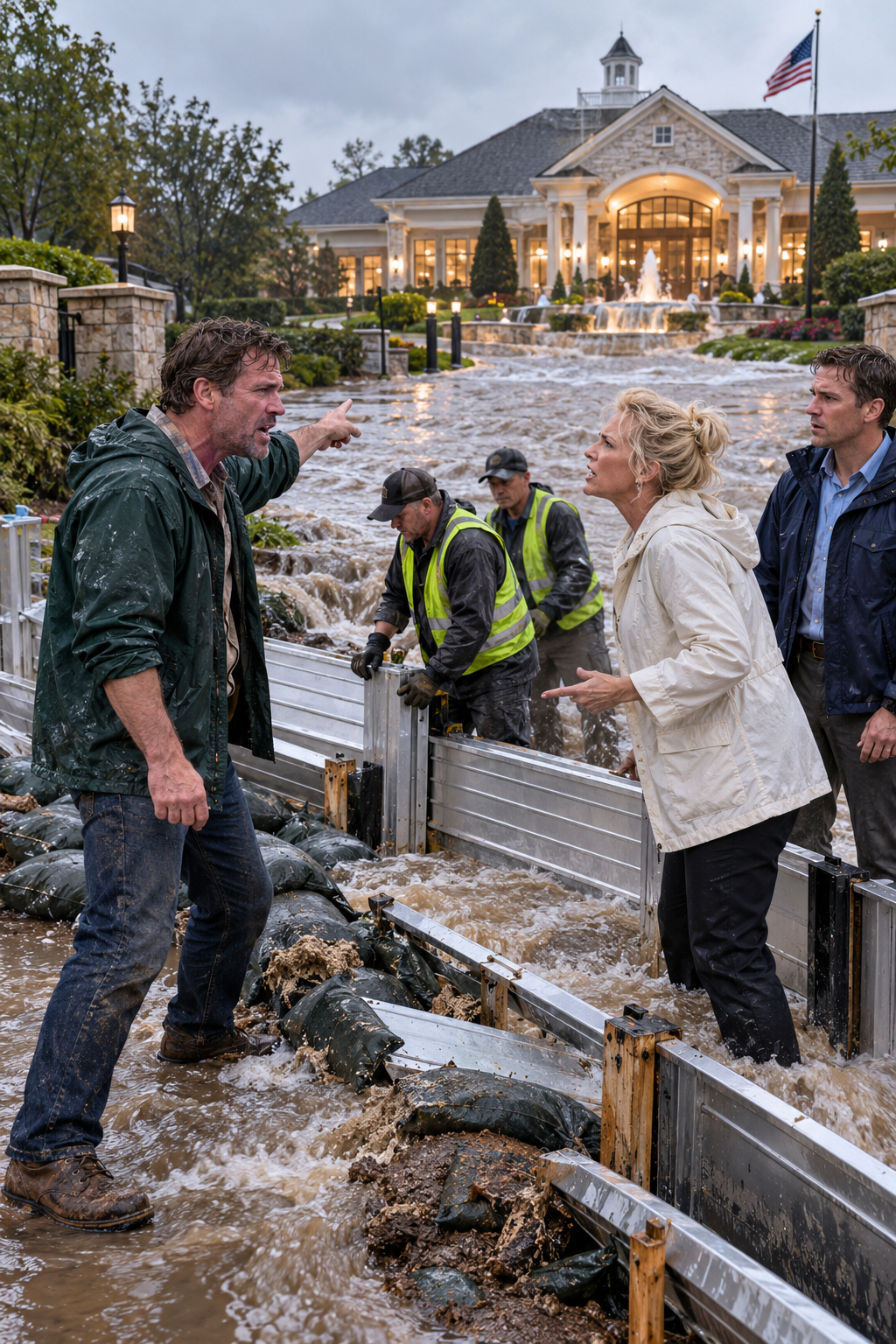
By eight, water inside HOA headquarters had reached the bottom of the front windows.
The polished lobby furniture floated.
Boxes of community records collapsed into brown water.
A framed photograph of Caroline accepting a neighborhood leadership award drifted through the meeting hall upside down.
Nobody was injured.
That mattered to me.
Buildings could be replaced.
People could not.
I drove back after daylight when county officials cleared the road.
Residents stood along the sidewalk under umbrellas.
Some looked frightened.
Some looked furious.
Some had started asking the right question.
Why had the HOA removed the barrier forty-eight hours before a forecasted storm?
Caroline stood beside a television reporter.
Her perfect blond hair was wet.
Mud streaked the bottom of her cream raincoat.
The moment she saw me, she pointed.
“There she is.”
Cameras turned.
Daniel looked down.
Caroline marched toward me.
“This woman designed the original system.”
“No,” I said.
“My father helped design it.”
“She knew the property was at risk.”
“You admit that?”
“I warned you on video.”
Caroline’s mouth stopped moving.
I pulled out my phone.
“You want me to play it?”
Residents gathered closer.
Someone said, “Play it.”
My own voice came from the speaker.
“For the record, I have warned the Briar Glen Estates HOA that this is part of a recorded flood-control system. Removal may alter downstream flow.”
Then Caroline’s recorded laugh.
“Recorded where?”
The real Caroline stared at the phone.
I stopped the video.
“County Recording 94-11872.”
A man behind her swore quietly.
Martin Pike pushed through the crowd.
“That’s not in our current plat package.”
“That doesn’t make it disappear.”
Caroline tried to recover.
“You deliberately withheld information.”
“No. You had the information. My father sent the HOA copies in 2009, 2014, 2018, and 2023.”
“How would you know?”
I lifted Dad’s ledger.
“Because he kept the certified-mail receipts.”
That was the first mini-payoff.
It felt almost quiet.
No screaming.
No applause.
Just thirty people realizing the person they had been told was an unreasonable grieving daughter had receipts.
Daniel stepped toward me.
“Allison, can we talk privately?”
His face tightened.
That word might have moved me a week earlier.
A white county truck pulled up.
Two inspectors got out.
Behind them was a woman from the county attorney’s office.
Her name was Rebecca Shaw.
She shook my hand.
“Ms. Mercer, we reviewed the recording.”
Caroline interrupted.
“What recording?”
Rebecca opened her folder.
“The drainage easement and private flood-mitigation designation.”
Caroline looked at Martin.
Martin looked at Daniel.
That triangle told the entire story.
Rebecca continued.
“Our preliminary conclusion is that the structure removed Tuesday was protected infrastructure. The county did not authorize removal.”
Caroline’s face drained.
“The HOA has architectural authority.”
“Not over county-recorded drainage infrastructure.”
“We relied on professional advice.”
“From whom?”
Caroline hesitated.
I looked at Daniel.
He finally looked away.
By noon, the rain weakened.
The real storm was just beginning.
The HOA’s insurer sent investigators.
The excavation company sent its attorney.
The county issued preservation orders for every HOA email, board minute, contract, engineering memo, and development proposal relating to my property.
Daniel stopped answering calls.
I returned to the farmhouse Friday afternoon.
The new lock lasted twenty seconds under the locksmith’s drill.
Daniel arrived before I finished carrying in my suitcase.
“You can’t just break in.”
I looked at him.
“My name is on the deed.”
“I’m trustee.”
“Administrative trustee.”
His face changed.
There it was.
The moment he understood I had found Unit 17.
“How much did Dad leave you?”
The question was so Daniel that I almost pitied him.
He still thought the secret had to be money.
“It isn’t about how much.”
“What did he leave you?”
“The land trust.”
He went still.
Behind him, Caroline’s black SUV turned into the driveway.
She got out quickly.
Daniel muttered something under his breath.
Caroline walked straight toward us.
“What did you tell the county?”
“The truth.”
“You don’t understand the consequences of what you’re doing.”
I glanced toward the distant clubhouse, where pumps still discharged muddy water into temporary tanks.
“I understand consequences pretty well.”
She lowered her voice.
“Hundreds of homeowners could face special assessments.”
“That’s unfortunate.”
“You could prevent that.”
“Work with us.”
Daniel said, “Allie, listen to her.”
Caroline held out a thin folder.
Inside was an offer.
Seven hundred fifty thousand dollars.
In exchange, I would transfer the south detention field, waive claims relating to the demolition, authorize revised drainage construction, and confirm that the association had acted under a reasonable interpretation of its powers.
I finished reading.
Caroline watched me carefully.
“That’s significantly above market value.”
“For land you told everyone belonged to the HOA?”
Her jaw tightened.
“It’s a settlement.”
“One million.”
Daniel stepped closer.
“Think about what you could do with that.”
I looked at him.
“One point two.”
Caroline lost patience.
“What exactly do you want?”
That question mattered.
Because for the first time, she understood I wasn’t negotiating for money.
I closed the folder.
“I want the minutes from the March 14 executive session.”
Nobody moved.
I knew from the way Daniel’s mouth opened and stopped.
I knew from Caroline’s eyes.
I knew from Martin Pike, visible through the SUV windshield, suddenly checking his phone as if he might disappear into it.
Dad had written one sentence in the margin of the development proposal.
March 14. Ask who approved excavation before authorization.
Caroline recovered first.
“Those minutes are privileged.”
“They have nothing to do with this.”
“Then you won’t mind producing them to the county.”
She took the settlement folder from my hand.
“You’re making a mistake.”
I looked at my brother.
“I made my mistake years ago.”
Daniel flinched.
Caroline walked away.
That evening, I made coffee in Dad’s kitchen and opened the final sealed document from Unit 17.
It wasn’t a deed.
It wasn’t money.
It was a letter Dad had written to both his children.
Land makes people reveal themselves.
Not because land is special.
Because land cannot be flattered.
You cannot guilt dirt into moving.
You cannot bully a creek uphill.
You cannot convince a survey marker that your feelings are more important than coordinates.
I have watched both of you become adults.
Daniel, you have always believed problems can be negotiated after you create them.
Allison, you have always believed carrying other people’s problems is the price of loving them.
Both beliefs are dangerous.
My eyes blurred.
That was the first time I cried.
Not because of the house.
Not because of the flood.
Not because my brother had betrayed me.
Because Dad had seen me.
All those years when I thought my sacrifices had become invisible, he had seen them.
He knew I had postponed graduate school when Mom got sick.
He knew I had spent my emergency savings fixing his roof.
He knew I had taken unpaid leave during his surgery.
He knew I had loaned Daniel money I never got back.
Dad’s final gift wasn’t the land.
It was evidence that my life had not disappeared simply because my family had grown accustomed to receiving it.
The next morning, March 14 arrived in my inbox.
Not from the HOA.
From Martin Pike.
One attachment.
No message.
The executive-session minutes changed everything.
Caroline had presented the board with a proposal from Halcyon Residential Partners.
Twelve luxury villas.
Private fitness center.
Expanded clubhouse.
Estimated land package value: $6.4 million.
The detention-field designation prevented construction.
A consulting engineer had explicitly warned the board that eliminating the west berm without a replacement drainage system could cause “rapid inundation of the clubhouse parcel during a high-intensity rainfall event.”
The board discussed postponing action.
Daniel spoke next.
According to the minutes, Daniel told them the Mercer trust would soon control the farmhouse after Dad died and that he expected to obtain authority over the relevant property.
Caroline then proposed something called “administrative pressure.”
Code complaints.
Architectural enforcement.
They would make ownership “financially impractical.”
Make me sell.
There it was.
The system.
Not one villain.
A property manager.
A developer.
My brother.
Paperwork used like a weapon.
Rules used selectively.
And underneath all of it, the assumption that I would eventually become tired enough to surrender.
I forwarded everything to Rebecca Shaw.
Then I called Daniel.
He answered immediately.
“Are you at home?”
“I’m coming over.”
“We need to talk.”
“We’re talking.”
He breathed heavily.
“Martin sent you something.”
“Listen to me. Those minutes make it look worse than it was.”
“Which sentence is inaccurate?”
“It wasn’t like that.”
“Which sentence?”
Finally he said, “I was trying to fix things.”
“For everybody.”
“That phrase has done a lot of work in this family.”
“You don’t understand how much debt I’m carrying.”
“There it is.”
“You think I wanted this?”
“I think you wanted six million dollars of development to happen on land Dad refused to sell.”
“It wasn’t your land.”
“It wasn’t yours either.”
“Dad always trusted you more.”
I closed my eyes.
Not because the accusation hurt.
Because after everything, Daniel still needed the story to make him the injured person.
“Dad trusted records,” I said. “You should have tried becoming one he could trust.”
Then I hung up.
Over the next two weeks, Briar Glen came apart in slow motion.
The insurer reserved its rights because the board may have knowingly removed protected infrastructure after receiving engineering warnings.
The excavation company sued the HOA for misrepresentation.
The county issued civil violations.
Residents demanded recall elections.
Caroline resigned before the vote.
Martin Pike was terminated by the management company.
The Halcyon development agreement collapsed.
Daniel’s role was referred to the probate court because he had falsely used his trustee title to issue notices outside his authority.
Then came the special meeting.
The HOA rented the gymnasium at Briar Glen Middle School because headquarters remained unusable.
More than three hundred residents showed up.
I sat in the second row.
Daniel sat near the back.
He looked ten years older.
Caroline had hired an attorney and did not attend.
The interim board chair read a statement.
Insurance coverage was uncertain.
Repair costs were estimated above $2.1 million.
Residents groaned.
Then the chair said the HOA intended to pursue recovery against all responsible parties.
Someone shouted, “Including the old board?”
Applause erupted.
The chair raised both hands.
Then he looked toward me.
“Ms. Mercer has requested time.”
I walked to the microphone carrying Dad’s leather case.
The gym became quiet.
“I know some of you are angry at me,” I said.
A man called, “Not anymore.”
Several people laughed.
“This isn’t about revenge.”
The room settled.
“My father helped build the flood system that protected this neighborhood before many of these houses existed. He didn’t do it because he loved HOAs. He definitely did not.”
More laughter.
“He did it because water does not care about property values. It does not care who wins an election. It does not care whether your landscaping is approved.”
I looked toward residents from the lowest streets.
“Some of you have asked whether I plan to terminate the clubhouse ground lease.”
That got their attention.
“I legally can.”
Nobody moved.
“The demolition triggered the termination clause.”
Daniel stared at me from the back row.
“I could take possession of the land beneath the damaged clubhouse. I could pursue damages. I could sell the parcel later. I could probably make more money doing that than I have made in twenty years as an engineer.”
I opened Dad’s case.
“But my father did not create the Mercer Land Preservation Trust to make me rich.”
I placed the original 1994 plat on the table.
“He created it because two people died in a flood.”
The room went silent.
“So this is what I’m offering.”
The land trust would renew the clubhouse ground lease for thirty years.
One dollar per year.
A murmur moved through the gym.
The HOA would not pay me millions.
It would instead use the savings to rebuild the flood barrier to county standards, restore the detention system, establish an independent stormwater committee, and create an emergency fund protecting residents from special assessments tied to the board’s misconduct.
One more condition.
No current or former officer involved in the demolition decision could serve on the HOA board for ten years.
The applause began in the back.
Then spread.
People stood.
Daniel did not clap.
That was okay.
I had spent too many years measuring my decisions by whether my family approved.
The vote passed 287 to 11.
Three months later, construction crews rebuilt the west berm.
Not exactly like Dad’s.
New reinforced core.
Improved overflow channel.
Real-time water sensors.
County inspection access.
At my request, they embedded one original limestone block near the center.
Dad would have hated a plaque.
Caroline Voss eventually settled the civil claims against her.
Martin Pike testified in the insurance case.
The HOA’s insurer covered most structural losses after pursuing reimbursement from several former officers and contractors.
Residents paid a modest assessment instead of the catastrophic one they had feared.
The clubhouse reopened eleven months later.
This time the ground floor had flood-resistant walls, raised electrical systems, and emergency drainage gates.
People joked that I should run for HOA president.
I told them I would rather stand in traffic.
Daniel’s ending was quieter.
Probate court removed him as administrative trustee.
He lost his interest in the protected land because Dad’s amendment applied exactly as written.
When the court order came down, Daniel arrived at the farmhouse.
No expensive watch.
No performance.
Just my little brother standing on Dad’s porch in jeans.
I almost didn’t recognize him.
“I lost the construction company,” he said.
“The bank is taking my condo.”
I said nothing.
He looked across the yard toward the rebuilt berm.
“Dad knew.”
“How long?”
“I don’t know.”
Daniel rubbed both hands over his face.
“I kept thinking I could fix it before anybody found out.”
“That was always your problem.”
He looked at me.
“You enjoying this?”
He seemed surprised.
“I wanted you stopped,” I said. “I never wanted you destroyed.”
“That’s generous.”
“It isn’t generosity. It’s the difference between us.”
That landed.
He looked toward Dad’s old rocking chair.
“Did he hate me?”
I could have punished him.
The answer would have been easy.
A single yes.
He might have carried it forever.
Instead, I told the truth.
Daniel swallowed.
“How do you know?”
“Because he left you a letter.”
His head snapped toward me.
I had found it beneath mine in Unit 17.
I handed him the envelope.
He didn’t open it there.
Maybe some things deserve privacy even after betrayal.
He stepped off the porch.
Then stopped.
“I’m sorry.”
I had imagined that sentence for months.
In my imagination, it felt enormous.
In reality, it was small.
Almost inadequate.
“I know,” I said.
I did not invite him back.
Forgiveness and access are not the same thing.
That was another lesson I should have learned earlier.
Life became quieter.
I stayed in Dad’s farmhouse.
I turned his old office into a small consulting practice specializing in community flood planning.
The county hired me for three projects.
By the following spring, I had more work than I wanted.
Sometimes people asked whether seeing the HOA headquarters flood had felt satisfying.
Watching a building fill with muddy water was not justice.
The justice came later.
Justice was a board discovering rules applied to them too.
Justice was residents seeing the documents they had been denied.
Justice was a developer losing the right to turn a floodplain into luxury villas.
Justice was my brother learning that a signature could carry consequences.
Justice was Dad’s land remaining what he intended it to be: protection for people who might never know his name.
And justice was me walking back into the house my own family had ordered me to leave five days after burying my father.
Not as the forgotten daughter.
Not as Daniel’s difficult sister.
Not as the woman expected to fix everything quietly and disappear before the photographs.
As the legal steward.
As the engineer.
As Thomas Mercer’s daughter.
One year after the flood, I drove to Unit 17 to clear the remaining boxes.
Most were worthless.
Old tax records.
Equipment manuals.
Coffee-stained field notes.
I was almost finished when I noticed scratches on the bottom of the green document chest.
Four small screws held a false panel in place.
I removed them with a screwdriver.
Underneath was another envelope.
This one wasn’t addressed to me.
It was addressed to:
UNITED STATES ATTORNEY — OPEN ONLY IF THE FOX RUN DEVELOPMENT FILE IS COMPROMISED.
My stomach tightened.
Inside was a flash drive.
Not a map of Briar Glen.
A county map.
Nine developments had been circled in red.
Each one had been built near protected drainage land.
Beside six circles, Dad had written the same company name.
Halcyon Residential Partners.
Beside three others was another name.
Martin Pike.
And beside all nine was a tiny notation:
Federal mitigation funds received.
I sat on the concrete floor staring at those words.
The HOA flood had never been the biggest secret.
It was only the first place the secret surfaced.
I inserted the flash drive into my laptop.
Folders appeared.
Grant applications.
Survey alterations.
Wire-transfer records.
One file was labeled BRIAR GLEN — ORIGINAL.
Another was labeled MERCER, DANIEL — COOPERATING?
That question mark stopped me cold.
I opened it.
There was a scanned letter written by my father nine months before his death.
If you have finally decided to tell the truth, come alone.
Do not call Caroline.
Do not call Pike.
Bring the original ledger.
That was all.
My brother had betrayed me.
But maybe Dad had discovered something about Daniel that I still didn’t know.
Maybe Daniel had been deeper in the scheme than I understood.
Or maybe, near the end, he had tried to get out.
I drove home.
Daniel was waiting on my porch.
He looked pale.
He was holding Dad’s letter.
The one I had given him months earlier.
“I need to tell you something,” he said.
I kept my hand in my coat pocket around the second key from Unit 17.
His eyes moved toward the road.
A black SUV had stopped near the end of the property.
Not Caroline’s.
Government plates.
Two people stepped out.
Daniel whispered, “Dad didn’t build that flood wall just to protect Briar Glen.”
The agents started walking toward us.
I looked at my brother.
Then at the map inside my bag.
Then back at him.
And I asked the quietest question I had asked since the morning the excavator arrived.
“Daniel… before they reach this porch, are you absolutely sure you want me to open Dad’s last file?”
✓ Lynn R. Adams
🔥HERE’S THE NEXT PART OF THE STORY, ENJOY !! The explosive twist and the final ending of this story ! ⬇️💬 Thank you ❤ Five sentences. Twenty years. One pattern. That was my moral line in the san…