HOA Threatened to Seize My Old Train Depot—Then Learned Their Entire Winter Supply Route Crossed My Land
HOA Threatened to Seize My Old Train Depot—Then Learned Their Entire Winter Supply Route Crossed My Land
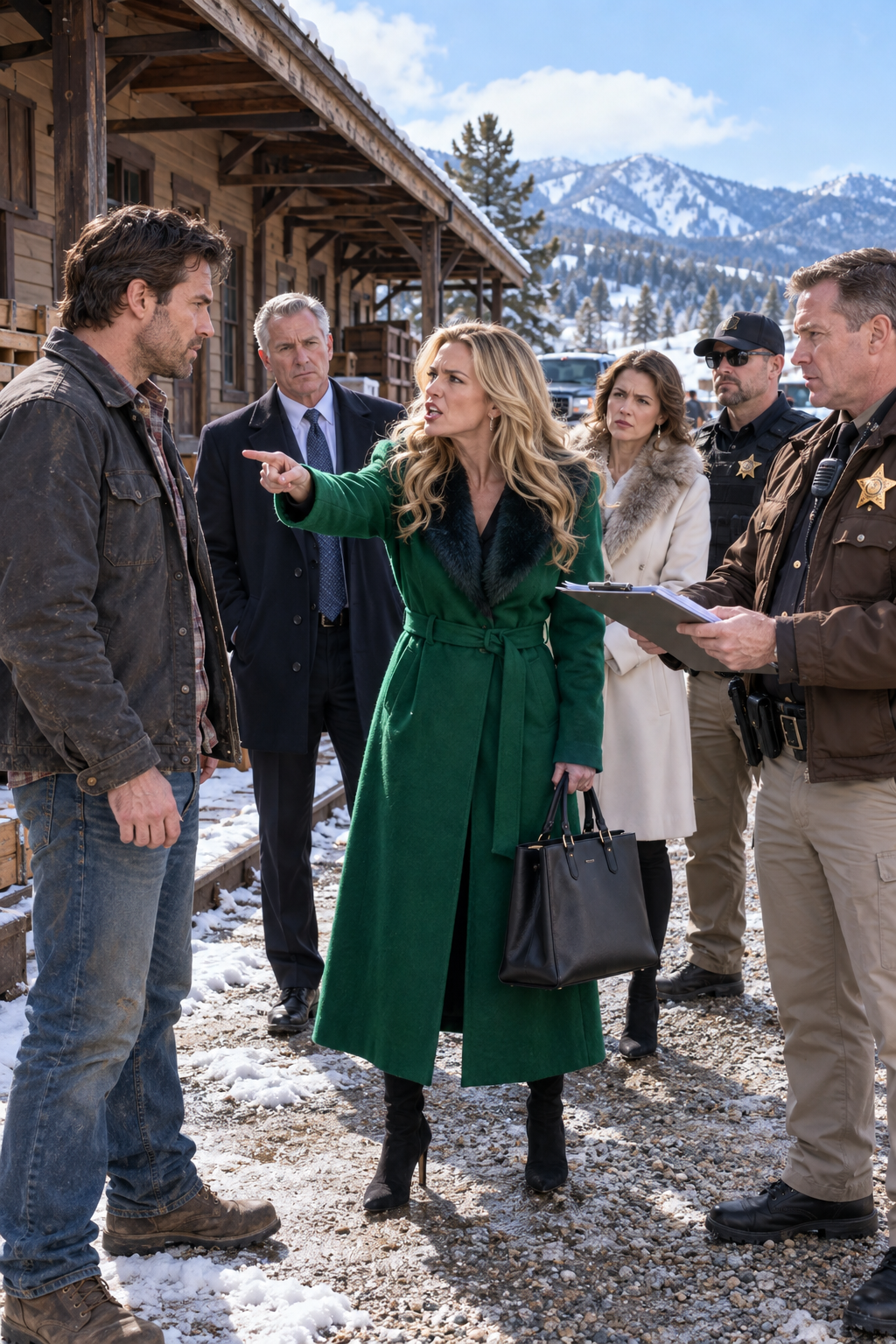
The first thing HOA president Vanessa Crowley did was slap a red demolition notice against my grandfather’s train depot.
The second thing she did was tell forty-seven watching homeowners that I had seventy-two hours to surrender the property or watch it get torn down.
The third thing she did was laugh when I told her the road her snowplows, heating-fuel trucks, ambulances, and grocery deliveries used every winter belonged to me.
That laugh cost her more than she understood.
At on a Thursday morning in late October, I was standing beside the rusted rails behind Miller’s Depot with a mug of coffee warming my hands when three black SUVs rolled through the gravel entrance.
I knew they weren’t lost.
People who got lost out there usually slowed down.
These vehicles came in fast enough to throw dust over the old freight platform.
The first SUV stopped fifteen feet from me.
Vanessa Crowley stepped out wearing knee-high leather boots, a cream wool coat, and sunglasses far too expensive for an abandoned railroad yard in western Colorado.
Behind her came two members of the Silver Pines HOA board, a property manager named Derek Foster, and a contractor carrying rolled blueprints.
Vanessa didn’t greet me.
She pointed toward the depot.
“You’re Daniel Mercer?”
“That depends who’s asking.”
She gave me the smile of someone who had never needed to repeat herself.
“Vanessa Crowley. President of Silver Pines Residential Association.”
That bothered her.
People like Vanessa preferred introductions that caused nervous recognition.
Instead, I took another sip of coffee.
The old depot stood behind me, long and narrow beneath a sagging red metal roof. My grandfather had bought it from Western Continental Railroad in 1978 after the passenger line shut down. He converted the waiting room into a workshop, kept the freight room mostly intact, and used the surrounding acreage for storage, timber access, and cattle.
When he died, my father inherited it.
When my father died, it came to me.
By then Silver Pines had grown from twenty vacation homes into nearly four hundred houses climbing the mountain behind us.
Luxury homes.
Heated driveways.
Glass walls.
Five-car garages.
Private gyms.
And people who had paid enough for mountain views that they believed the mountains themselves came with the mortgage.
Vanessa held out a folder.
“Your structure violates multiple Silver Pines architectural standards.”
I didn’t take it.
“My property isn’t in Silver Pines.”
“That’s your interpretation.”
“No. That’s the county map.”
Derek Foster cleared his throat.
Vanessa ignored him.
“Your deteriorating building is visible from our eastern ridge. We’ve received complaints about rust, broken fencing, industrial debris, and what several residents describe as an unsafe abandoned structure.”
“It isn’t abandoned.”
Her eyes traveled over my work jacket and muddy boots.
One of the board members smirked.
I looked at him.
He stopped.
Vanessa continued.
“Silver Pines recently acquired the parcel immediately south of this one. Our attorneys determined that your depot sits within an architectural control zone created when this entire tract was subdivided.”
“My grandfather owned this land before Silver Pines existed.”
“Old ownership doesn’t automatically defeat modern covenants.”
“No,” I said. “But a deed usually helps.”
Her mouth tightened.
She held the folder closer to my chest.
“This is formal notice. You have seventy-two hours to provide proof of exemption, bring the property into compliance, or sign a voluntary transfer agreement.”
“Transfer to whom?”
“Silver Pines.”
There it was.
Not safety.
Not appearances.
I finally took the folder.
Inside was a proposed transfer price.
I almost smiled.
The depot parcel alone was worth more than eight times that.
The surrounding twenty-three acres were worth far more.
But Vanessa wasn’t looking at the building.
She kept glancing past it.
Toward the narrow gravel lane running north between the depot and the creek.
Mercer Pass Road.
That mattered.
So I closed the folder.
“You’re not here because of the roof.”
She tilted her head.
“You think very highly of yourself.”
“No. I think highly of maps.”
For the first time, Derek looked uncomfortable.
Vanessa stepped closer.
“I’ll make this simple. Silver Pines intends to improve this corridor. Your property is an obstruction. Cooperate, and you get paid. Resist, and our attorneys will bury you in enforcement actions until you wish you had taken the offer.”
A pickup truck had stopped on the county road.
Then another.
Neighbors watched from inside.
Word traveled fast around mountain communities.
Vanessa noticed.
She raised her voice.
“This isn’t personal, Mr. Mercer. Communities evolve. Some people adapt.”
I looked at the depot.
The paint was peeling.
One gutter hung lower than it should.
A freight scale from 1949 sat beneath the loading canopy.
It wasn’t pretty.
But my grandfather had rebuilt that scale by hand.
My father had taught me to weld inside that freight room.
I had spent half my childhood sleeping upstairs on a canvas cot while snow buried the tracks.
Vanessa saw neglect.
I saw three generations.
I saw my father’s gloves hanging on a nail exactly where he had left them.
I saw my grandfather’s pencil marks beside the doorframe where he measured my height every birthday.
I saw the brass key that had been passed from one Mercer to another.
And I saw the one thing Vanessa had apparently failed to see.
The legal description attached to that key.
I looked back at her.
“Seventy-two hours?”
She smiled.
“Plenty of time.”
That smile flickered.
Then she turned around, gathered her entourage, and headed toward the SUVs.
Before she climbed inside, I called after her.
She stopped.
“Make sure your snow contractor reads Schedule C before Monday.”
She lowered her sunglasses.
“What is Schedule C?”
“You’ll find out.”
The SUVs left.
By noon, the demolition notice was gone.
Not because Vanessa removed it.
I put it on the workbench beside my grandfather’s old railroad lantern.
Then I drove thirty-eight miles to the county recorder’s office.
I didn’t need to research whether I owned the depot.
I knew I did.
What I needed to know was how much Vanessa knew.
That was a different question.
County records clerk Martha Bell had known my family since before I was born.
She pushed her glasses up when I walked in.
“You look like trouble found you.”
“Silver Pines.”
She winced.
“That kind of trouble.”
I handed her Vanessa’s packet.
Martha read the first page.
Then the second.
By the third, her mouth had gone flat.
“They’re claiming the depot falls under subdivision covenants?”
“Apparently.”
“It doesn’t.”
“Daniel, the subdivision line ends almost nine hundred feet east of your boundary.”
“I know that too.”
She looked at me.
“So what are you looking for?”
“Their recent purchases.”
That took longer.
Silver Pines Residential Association had spent the previous fourteen months quietly buying narrow parcels near the base of the mountain.
A drainage easement.
An abandoned equipment yard.
A strip behind the old lumber mill.
A vacant parcel beside Mercer Pass Road.
Individually, none looked important.
Together, they formed a corridor.
Straight toward my depot.
Martha leaned over the map.
“They’re assembling something.”
“For what?”
I already had a guess.
Silver Pines had only one year-round route capable of carrying large fuel trucks during heavy snowfall.
Their main boulevard looked impressive, but it climbed too steeply through switchbacks.
In severe storms, tankers couldn’t make it.
The practical winter route came through the valley, crossed the old railroad alignment beside my depot, followed Mercer Pass Road for almost three miles, then joined the subdivision near its maintenance yard.
Residents barely noticed.
They thought it was a county road.
Most of it crossed private land under a patchwork of old easements granted decades earlier to ranches, utility companies, and emergency services.
My grandfather had been part of that patchwork.
I pointed to a document number.
“Pull this.”
Martha did.
The original easement was dated June 11, 1982.
It granted limited winter passage over the Mercer property.
Not to the public.
Not to Silver Pines.
To “licensed emergency, utility, agricultural, and essential-service vehicles serving properties north of the Mercer tract.”
There were conditions.
Lots of them.
Weight restrictions.
Maintenance responsibilities.
Snow-removal requirements.
A prohibition against commercial expansion.
And Schedule C.
Martha read it twice.
Schedule C said the easement remained valid only while the original private roadway retained its “historic service character.” Any widening, paving, permanent rerouting, commercial development, or transfer of access rights required written approval from the Mercer property owner.
Silver Pines had widened part of the road the previous summer.
They had paved several hundred yards.
And according to the county map, the HOA was planning to build a new commercial village at the mountain base.
Coffee shops.
A grocery market.
Rental offices.
A wellness center.
Restaurants.
All dependent on the same access corridor.
Their corridor.
Martha looked at Vanessa’s transfer offer again.
“Sixty-two thousand five hundred dollars.”
“They’re generous people.”
She almost laughed.
Then she stopped.
“Daniel, if they knew this, they weren’t trying to enforce covenants.”
“They were trying to acquire the control point before I understood what I had.”
“You understand what you have?”
I folded the map.
“I do now.”
That afternoon, I called my attorney.
Rachel Donovan didn’t get excited easily.
She had spent fifteen years handling ranch boundaries, water rights, conservation disputes, and title litigation.
When I sent her Schedule C, she called me within eleven minutes.
“Do not sign anything.”
“I wasn’t planning to.”
“Do not threaten anyone either.”
“I haven’t.”
“Do not block that road.”
“I haven’t.”
“Do not put up a gate.”
“I haven’t.”
She paused.
“Why do I feel like you’re enjoying this?”
“Because Vanessa gave me seventy-two hours.”
Rachel laughed.
“Give me twenty-four.”
While Rachel worked, Vanessa escalated.
Friday morning, I received an email imposing $1,500 in accumulated architectural penalties.
At noon, another arrived.
$500 per day until compliance.
At p.m., a certified letter warned that continued refusal could result in “removal of the offending structure.”
At , Derek Foster called.
His voice was quieter than Vanessa’s.
“Daniel, off the record, you should probably send whatever deed documentation you have.”
“Because this is moving quickly.”
“On whose instructions?”
“Board counsel.”
“Who requested the property transfer?”
Another pause.
“The board.”
“Unanimously?”
He exhaled.
“I shouldn’t be discussing internal votes.”
“Then don’t.”
At sunset, I walked the property.
The first snow of the season had begun dusting the higher peaks.
Nothing serious.
Just white along the ridgeline.
But everybody in that valley knew what came next.
November storms.
December ice.
January winds hard enough to bury fences overnight.
Silver Pines advertised itself as “four-season mountain luxury.”
Nature didn’t care about brochures.
Nature cared whether diesel trucks could climb frozen roads.
I stopped where Mercer Pass Road crossed behind the depot.
A propane tanker rolled slowly past.
The driver waved.
I waved back.
A grocery supplier came fifteen minutes later.
Then a maintenance truck.
Then an ambulance returning downhill.
One narrow strip of gravel.
One clause written forty-four years earlier.
And suddenly I understood why Vanessa wanted the depot before winter.
Saturday morning, Silver Pines held an emergency HOA meeting at their clubhouse.
I was invited.
Rachel told me to go.
“Say as little as possible,” she warned.
“That’s your favorite advice.”
“You rarely follow it.”
“I follow the useful parts.”
The Silver Pines clubhouse looked like someone had dropped a ski resort lobby into the forest.
Stone fireplaces.
Thirty-foot windows.
Leather chairs.
Huge timber beams.
Residents filled almost every seat.
Vanessa stood beneath a wall-mounted television with the confidence of a politician about to announce a bridge.
I sat in the back beside Rachel.
Vanessa began with slides showing rusted fencing, weeds, and carefully chosen close-up photographs of the depot.
She called it a “blighted industrial remnant.”
She called it “a potential safety hazard.”
She called it “an obstacle to responsible community planning.”
Then she displayed a rendering.
There it was.
Their real project.
A landscaped entrance plaza.
Retail buildings.
A shuttle station.
Visitor parking.
And Mercer Pass Road widened into a polished two-lane commercial access route.
The depot was gone.
In its place stood a stone monument reading SILVER PINES EAST GATE.
Vanessa smiled at the room.
“This improvement would increase property values, strengthen winter accessibility, and finally remove an eyesore at our southern approach.”
Someone applauded.
Then several people did.
Rachel leaned toward me.
“Keep breathing.”
“I’m breathing.”
“You have that look.”
“What look?”
“The one your father had before somebody regretted something.”
Vanessa clicked again.
A map appeared.
Not the county map.
On it, the Silver Pines boundary extended across my property.
Convenient.
She addressed the room.
“We have attempted to work cooperatively with the current occupant of the depot parcel.”
A man in the second row raised his hand.
“Does he own it?”
Vanessa smiled calmly.
“Title records are complicated.”
Every head turned.
Vanessa’s face tightened.
“You’ll have an opportunity during public comment.”
“This is a private association meeting,” I said. “There is no public comment requirement.”
A few people laughed.
Vanessa didn’t.
I continued.
“The title isn’t complicated. I own the depot. I own twenty-three acres around it. Your subdivision boundary ends east of my parcel.”
She folded her hands.
“Our attorneys disagree.”
“Then show the recorded covenant.”
Rachel whispered, “Daniel.”
I sat down.
Vanessa recovered quickly.
“As I said, our attorneys are addressing it.”
A woman near the aisle asked, “What happens to winter deliveries while all this construction is happening?”
Vanessa answered immediately.
“The access road remains protected.”
I looked at Rachel.
She looked at me.
That was the sentence.
Not because it was arrogant.
Because it proved the board believed access belonged to them.
After the meeting, Vanessa intercepted us near the entrance.
“Ms. Donovan,” she said. “I didn’t realize Mr. Mercer had retained counsel.”
Rachel smiled pleasantly.
“You probably should have.”
Vanessa’s eyes returned to me.
“Your deadline expires Monday morning.”
“Your commercial plan violates Schedule C.”
Her expression didn’t change.
But Derek Foster, standing ten feet away, did.
His head snapped toward us.
Vanessa said, “I don’t know what you’re referring to.”
“You will.”
We walked outside.
Rachel waited until we reached my truck.
“She knew.”
“Maybe not the details. But she knew there was an access issue.”
“And she wanted ownership before anyone examined it.”
Rachel nodded.
“Now we need proof.”
We got it Sunday night.
Derek called from a number I didn’t recognize.
“Can we meet?”
He arrived at wearing jeans, a jacket, and the exhausted expression of a man whose career had taken a wrong turn months earlier.
I let him into the waiting room.
The original ticket counter was still there.
So was the potbelly stove.
Derek looked around.
“I’ve driven past this place for six years. Never been inside.”
“It tends to remain private when people don’t threaten to demolish it.”
He placed a thumb drive on the counter.
Rachel was present by speakerphone.
Derek swallowed.
“I’m not giving you confidential legal advice. I’m not authorized to speak for the association.”
Rachel said, “Understood.”
“But you should know the East Gate project didn’t start with Vanessa.”
That surprised me.
“Who did it start with?”
“Westbridge Development.”
The name meant something.
Westbridge had built luxury resort communities across Colorado, Utah, and Montana.
“They approached Silver Pines eighteen months ago,” Derek continued. “They offered to fund the entire commercial expansion. The HOA would receive a percentage of leasing revenue.”
“How much?”
“Projected? Around $1.8 million a year.”
Now Vanessa’s motive made sense.
An HOA with nearly two million dollars in annual commercial income wasn’t just an HOA anymore.
It was an empire.
“What’s on the drive?” I asked.
“Board packets. Traffic projections. Some emails.”
“I downloaded what I had access to.”
Rachel asked, “Why are you giving this to Daniel?”
Derek looked toward the freight room.
“Because three months ago I told Vanessa the depot parcel wasn’t inside Silver Pines.”
There it was.
“She told me the attorneys were developing an adverse-control theory.”
Rachel spoke first.
“That doesn’t make sense.”
“No,” Derek said. “It didn’t. Then I found an email from Westbridge.”
He tapped the drive.
“They didn’t care about the depot. They cared about the road.”
Westbridge’s traffic engineers had determined the commercial village couldn’t receive county approval without reliable all-season access for deliveries and emergency vehicles.
The steep northern route failed grade requirements for heavy winter transport.
Mercer Pass Road was essential.
And Westbridge knew Schedule C existed.
An email from their acquisition director said:
Secure Mercer parcel before formal access review.
Another said:
Owner awareness of easement restrictions presents unacceptable leverage exposure.
Vanessa’s reply contained only six words.
I will get him under control.
I stared at the screen.
Derek rubbed both hands over his face.
“There’s more.”
“Of course there is.”
“Westbridge promised Vanessa a consulting position after project approval.”
Rachel went silent.
I looked at Derek.
“You have proof?”
“Not direct proof of payment. But there’s a draft agreement.”
That was twist number one.
Not greed for the HOA.
Personal greed.
Vanessa wasn’t just fighting for property values.
She had been promised a private future.
Derek stood.
“I need to go.”
“You think she’ll find out?”
“She already suspects someone is talking.”
He reached the door.
Then stopped.
“One more thing.”
“Do not shut down the road Monday.”
“I never said I would.”
He looked toward the dark windows.
“Because Vanessa wants you to.”
Rachel’s voice came sharply through the speaker.
“She wants an emergency.”
“What kind?”
“If you block supply access, Silver Pines can argue public necessity. Westbridge’s attorneys think they can seek emergency condemnation or court-ordered access. Vanessa’s been telling residents you’re unstable.”
I almost admired it.
She wasn’t merely pushing me.
She was trying to make me react.
Angry rural property owner blocks road.
Hundreds of families threatened before winter.
HOA requests emergency intervention.
Developer arrives as savior.
Clean story.
Except I wasn’t angry.
I was patient.
Monday morning came cold and bright.
My seventy-two-hour deadline expired at .
At , two Silver Pines security vehicles parked outside the depot.
At , Vanessa arrived.
This time she brought a lawyer.
He introduced himself as Charles Reddick.
Vanessa held out another document.
“Your compliance period has expired.”
I glanced down.
Notice of Enforcement Entry.
They were claiming authority to enter my property, secure the depot, and begin “hazard mitigation.”
Rachel stepped from inside the building.
Charles Reddick stopped walking.
He knew her.
That helped.
Rachel took the notice.
“Which court issued this?”
Charles looked annoyed.
“It’s association authority.”
“Then it applies to association property.”
Vanessa said, “We’ve been over this.”
Rachel opened her briefcase.
“No. You’ve been pretending you’ve been over this.”
She handed Charles three documents.
The Mercer deed.
The recorded subdivision map.
Schedule C.
He read them.
Vanessa watched him.
His face didn’t collapse dramatically.
Good lawyers rarely do.
But his eyes changed.
He turned to her.
“Can we speak privately?”
She lowered her voice.
“Not here.”
Charles looked again at Schedule C.
Then at the road.
Then at me.
“How long have you been aware of this easement?”
“My whole life.”
“And the modification clause?”
“My whole life.”
Vanessa cut in.
“That clause is obsolete.”
Rachel answered.
“It was reaffirmed in 1997, 2004, and 2018.”
Charles looked at Vanessa again.
She didn’t blink.
I realized something then.
She already knew.
Maybe not every reaffirmation.
But enough.
The threat was never intended to survive legal review.
It only had to scare me before legal review happened.
A snowplow contractor arrived behind them.
Two men stepped out.
Vanessa waved them forward.
“You can begin clearing access.”
I looked at the driver.
“Morning, Steve.”
“Morning, Dan.”
Vanessa frowned.
“You know each other?”
Steve scratched his beard.
“Been plowing this road nineteen years.”
“Then proceed.”
He didn’t move.
Steve pointed toward me.
“My winter access contract is with Mercer Land Company.”
Vanessa looked at me.
I smiled slightly.
“My father hired him in 2007.”
Steve shrugged.
“Silver Pines reimburses part of it, but Dan controls the corridor.”
Vanessa’s face flushed.
“Your company has a service agreement with us.”
“For subdivision roads. Not this section.”
Another mini-payoff.
But satisfying.
Vanessa dismissed the contractors.
Then she looked at me.
“You’re deliberately disrupting essential services.”
“No service has been disrupted.”
“You threatened our snow contractor.”
Steve laughed.
“No, ma’am. He sent me a Christmas ham last year.”
I almost lost my composure at that.
Vanessa turned on him.
Still smiling.
By Monday afternoon, residents knew something was wrong.
Not because I told them.
Because Vanessa did.
She sent an HOA-wide email describing a “hostile neighboring landowner attempting to exploit historical paperwork to endanger winter access.”
That was her first major mistake after Derek gave me the files.
Her second came twenty minutes later.
She announced an emergency $2,400-per-home assessment to fund “legal defense of critical infrastructure.”
Four hundred homeowners started asking questions.
One of them, a retired judge named Harold Benton, called me.
“I assume you’re the hostile neighboring landowner.”
“Apparently.”
“Are you closing the road?”
“Are you preventing emergency vehicles?”
“Fuel deliveries?”
“Snowplows?”
“Then what exactly are we defending?”
“Ask Vanessa.”
“She muted me.”
By Tuesday evening, sixty-three residents had requested access to the HOA’s legal documents.
By Wednesday, someone leaked Westbridge’s project rendering.
By Thursday, homeowners discovered the board had been negotiating a commercial complex without putting the final access agreement to a community vote.
Vanessa responded by scheduling another emergency meeting.
This one was chaos.
I didn’t attend.
I didn’t need to.
Harold called me afterward.
“Half the neighborhood wants Vanessa removed.”
“Only half?”
“The other half wants to know whether their propane trucks can still get through.”
“They can.”
“Can I quote you?”
That single sentence spread faster than every accusation Vanessa had written.
The road remained open.
The heating trucks ran.
The grocery deliveries ran.
The school buses ran.
The ambulances ran.
I changed nothing.
That made Vanessa’s claims harder to sell.
Because she needed a villain.
And I refused to perform the role.
A week later, Westbridge’s attorneys requested a meeting.
We met at Rachel’s office in Grand Junction.
They brought four lawyers.
I brought one.
That usually tells you which side is nervous.
Their lead counsel, Jonathan Pike, opened with compliments.
He admired the historic depot.
He respected generational ownership.
He appreciated my commitment to community safety.
Then he offered $900,000 for the depot parcel and a permanent unrestricted roadway easement.
He increased it to $1.4 million.
“Mr. Mercer, we’re talking about a substantial premium.”
“You’re not buying land.”
“What do you believe we’re buying?”
“Certainty.”
I continued.
“If you owned twenty-three acres with an old shed on it, you wouldn’t offer $1.4 million.”
Nobody corrected me.
“So the land isn’t the valuable part,” I said. “The route is.”
Jonathan folded his hands.
“What outcome are you seeking?”
That was the right question.
Not how much.
What outcome.
“I want the commercial road removed from the plan.”
One lawyer whispered to another.
Jonathan said, “That may make the project infeasible.”
“Then the project is infeasible.”
“You understand development is coming to this valley.”
“I’m not against development.”
“It sounds like you are.”
“I’m against pretending a forty-four-year-old emergency access agreement is a blank check for a shopping district.”
He stared at me for several seconds.
“What would you permit?”
“Existing essential services. Emergency vehicles. Residents. Maintenance. Winter deliveries. Exactly what my grandfather agreed to.”
“And commercial traffic?”
“Tourist shuttles?”
“Construction convoys?”
“Permanent widening?”
Rachel slid a document across the table.
“And before you argue necessity, please review your client’s internal email dated March third.”
That changed the room.
Jonathan read the email.
His jaw tightened.
Westbridge’s own engineers had identified an alternate access route nine months earlier.
More expensive.
But viable.
The company had rejected it because Mercer Pass Road was cheaper.
So much for necessity.
The meeting ended fourteen minutes later.
That should have been the end.
Because Vanessa didn’t need the project to succeed anymore.
She needed herself not to fail.
And pride makes people dangerous after money stops working.
The first real snowstorm arrived on November 18.
Forecasts predicted fourteen inches.
We got twenty-six.
By p.m., the mountain disappeared behind white.
Wind pushed snow sideways across Mercer Pass Road.
Steve had two plows working continuously.
I was at the depot keeping the old generator fueled when my phone rang.
Silver Pines maintenance director.
“Dan, we’ve got a problem.”
“Our north propane storage is low.”
“Twenty percent.”
“That’s not low enough for an emergency.”
“Not normally.”
“What happened?”
“Automatic backup didn’t trigger.”
I looked through the window.
Snow hammered the glass.
“When’s the tanker coming?”
“Driver’s at Highway 14. Says he won’t enter without road confirmation.”
“I’ll call Steve.”
Ten minutes later, I had the route checked.
I called the tanker driver.
“Chain up before the bridge. Stay behind Steve’s lead plow. Don’t stop on the grade.”
He understood.
At , the tanker reached my property.
At , a black SUV blocked Mercer Pass Road.
Vanessa Crowley stepped out.
I couldn’t believe it.
She had two Silver Pines security guards with her and a local news cameraman she had apparently invited.
She walked directly toward the tanker.
I drove my pickup across the yard and stopped beside her.
“What are you doing?”
She pointed toward the truck.
“That vehicle cannot enter Silver Pines until we establish liability.”
The driver leaned out.
“Lady, you called for propane.”
“The board did not authorize access under Mr. Mercer’s conditions.”
I stared at her.
“You have homes running low on heating fuel.”
“We have reserves.”
“Your maintenance director says otherwise.”
Her eyes sharpened.
“He wasn’t authorized to discuss internal infrastructure.”
Snow gathered on her coat.
The cameraman moved closer.
There it was.
She wanted the confrontation.
She wanted footage of me ordering my truck through.
She wanted a scene.
So I stepped backward.
Vanessa seemed surprised.
I took out my phone.
Called Harold Benton.
Put him on speaker.
“Harold, is your house heated with propane?”
“Vanessa is currently blocking the tanker.”
She spun toward me.
“I am verifying liability.”
Harold’s voice came through the phone.
“Put her on.”
I held it out.
She didn’t take it.
“Vanessa,” Harold said, “get out of the road.”
Her security guards looked at each other.
She pointed at me.
“This is exactly the coercion I warned everyone about.”
I didn’t answer.
Instead, I called the county sheriff’s office.
Not because Vanessa was trespassing.
Not because she irritated me.
Because blocking a fuel truck during a declared winter weather emergency was now a public-safety issue.
Deputy Allison Grant arrived twenty-eight minutes later in a county SUV with chains on all four tires.
She stepped out.
“Who owns this road section?”
“Do you authorize the tanker to pass?”
She looked at Vanessa.
“Then move your vehicle.”
Vanessa started arguing.
Allison didn’t.
She simply said, “Move it now or I’ll have it moved.”
That was mini-payoff number three.
The black SUV moved.
The propane truck followed Steve’s plow up the mountain.
The cameraman recorded every second.
But Vanessa didn’t get the footage she wanted.
She got herself standing in a blizzard while a deputy ordered her to stop interfering with the winter fuel supply.
By morning, the clip was everywhere inside the community.
By noon, seventy-eight percent of Silver Pines owners had signed a petition demanding an emergency recall vote.
Vanessa still didn’t resign.
That was when Rachel called.
“We found the second problem.”
“What second problem?”
“Your grandfather’s 1982 agreement has an appendix.”
“No. Not Schedule C. Another appendix. It wasn’t indexed correctly.”
I drove to her office.
The document was yellowed, typed, and stamped with an old county seal.
My grandfather had granted winter access in exchange for specific obligations.
Silver Pines’ predecessor association was required to contribute to maintenance.
That part everyone knew.
But there was another clause.
If the road was ever used to increase subdivision capacity beyond 250 residential units without renegotiation, the association owed the Mercer property owner an annual impact payment.
Silver Pines had passed 250 homes twelve years earlier.
Nobody had paid.
Rachel had already hired an accountant.
“How much?”
She turned the page toward me.
“Depending on interest and the interpretation of the indexing formula, somewhere between $612,000 and $890,000.”
I sat back.
For once, I had nothing clever to say.
Rachel smiled.
“Vanessa wanted to buy your depot for sixty-two thousand dollars.”
I looked at the number again.
“She owed me ten times that before she arrived.”
“Potentially.”
“Why didn’t my father collect?”
“He may never have known. The appendix was misfiled under the railroad company’s original tract number.”
I thought about my father.
He had never been wealthy.
He had fixed his own truck because paying a mechanic hurt.
He patched the depot roof every spring.
He worked until arthritis curled two fingers on his right hand.
Nearly a million dollars would have changed his retirement.
That part hurt more than I expected.
Rachel saw it.
“I’m fine.”
“You don’t look fine.”
“I’m thinking.”
About how many winters Dad had plowed that road himself.
About how often Silver Pines residents had waved while driving across his land.
About how the association had collected millions in dues while an obligation sat forgotten in a county drawer.
I didn’t want revenge.
Revenge was noisy.
I wanted the math corrected.
Rachel filed the claim Friday morning.
By Monday, Silver Pines’ insurance carrier had intervened.
By Tuesday, Westbridge suspended its agreement.
By Wednesday, Vanessa’s consulting arrangement leaked.
That finally broke her.
The recall meeting took place December 2.
The clubhouse was packed beyond capacity.
This time I attended.
Vanessa sat at the front table.
No cream coat.
No sunglasses.
No entourage.
Just folders.
Harold Benton chaired the meeting because three remaining board members had voted to remove Vanessa from presiding over her own recall.
Residents asked about Westbridge.
They asked about the consulting agreement.
They asked about legal expenses.
They asked why the HOA had threatened a property owner outside its jurisdiction.
Vanessa answered carefully.
She claimed she had acted on counsel.
Charles Reddick was not there to support that version.
She claimed the commercial project would benefit everyone.
Some residents agreed.
Most no longer trusted the process.
Then Harold recognized me.
“Mr. Mercer, would you like to address the association?”
Vanessa stared at me.
The room became quiet.
I could have embarrassed her.
I could have read the emails.
I could have repeated every threat.
I could have announced the back-payment claim and watched the room explode.
I said, “My grandfather granted winter access because people on that mountain needed a safe way home.”
A few heads turned.
“He didn’t do it because he expected people to thank him. He did it because Colorado winters don’t care whose name is on a subdivision sign.”
Vanessa looked down.
“I have never closed Mercer Pass Road to Silver Pines residents, emergency crews, school buses, fuel trucks, grocery deliveries, or snow equipment. I have no intention of doing so.”
A murmur moved through the room.
“What I won’t do is surrender my family’s property because someone wants to convert an emergency service route into commercial infrastructure.”
Silence again.
“The depot stays.”
Someone applauded.
Then another.
Soon most of the room joined in.
When it stopped, I finished.
“The road stays open for what it was designed to do.”
Then I sat down.
I didn’t mention money.
Rachel handled money.
At p.m., the recall vote closed.
Vanessa Crowley was removed, 301 votes to 54.
Two board members resigned before midnight.
Westbridge withdrew from the East Gate project the following morning.
Six weeks later, Silver Pines and I settled the historical impact-payment dispute.
I won’t give the exact number.
It was enough to repair the depot roof.
Enough to restore the freight platform.
Enough to establish a maintenance fund for Mercer Pass Road that would outlive me.
And enough to make sure no future board president could claim confusion over who controlled the corridor.
The settlement included a new access agreement.
Emergency services guaranteed.
Residential winter deliveries guaranteed.
Snow removal guaranteed.
No commercial expansion without written approval.
No architectural authority over the Mercer tract.
No transfer pressure disguised as enforcement.
Vanessa sold her Silver Pines house in February.
I heard she moved to Arizona.
I never verified it.
I didn’t care.
Spring came late that year.
By May, the depot roof had been replaced with historically accurate metal panels.
We repaired the windows instead of replacing them.
I converted the old ticket office into a small local-history room.
No admission.
No gift shop.
Just photographs, railroad tools, maps, and the old brass station clock my grandfather kept even after it stopped working.
Steve donated one of the original snowplow route signs.
Harold brought his grandchildren.
Derek Foster stayed on as property manager after the new board hired an independent auditor.
He came by one Saturday while I was repairing the freight doors.
“You realize something?” he asked.
“You could have shut the entire mountain down.”
I kept tightening a hinge bolt.
“You legally had enormous leverage.”
“That’s different.”
“Different how?”
“Having the power to hurt people and having the right to protect yourself aren’t the same thing.”
Derek nodded.
Then he smiled.
“That sounds like something your grandfather would’ve said.”
“He would’ve used more profanity.”
We laughed.
For the first time in months, things felt finished.
Vanessa was gone.
Westbridge was gone.
The depot was safe.
The road agreement was clear.
Winter had passed without anyone losing heat, missing an ambulance, or getting trapped behind a legal fight.
That should have been the whole story.
It almost was.
Until October.
Almost exactly one year after Vanessa first arrived, I was cleaning the depot attic.
The place had collected a century of junk.
Lantern parts.
Railroad spikes.
Old newspapers.
Mouse-chewed ledgers.
A conductor’s uniform jacket that might once have been blue.
Behind a cedar storage chest, I found a narrow steel box bolted to the floor.
I had never seen it.
The lock was old.
But my grandfather believed in keeping keys.
I spent an hour searching the workshop.
Then I remembered the brass key ring hanging beside my father’s gloves.
One tiny key had never fit anything I knew.
It fit the box.
Inside were six folders wrapped in oilcloth.
A railroad map.
Three notarized agreements.
A stack of photographs.
And a letter addressed in my grandfather’s handwriting.
TO THE NEXT MERCER WHO NEEDS TO KNOW.
I sat on the attic floor.
Outside, autumn rain tapped against the new roof.
I opened the letter.
If you’re reading this, somebody finally came asking about the depot or the road.
Don’t sell either until you read the mountain agreement.
My hands stopped.
Mountain agreement?
I pulled out the first notarized document.
The date was August 3, 1961.
Seventeen years before my grandfather bought the depot.
The parties included Western Continental Railroad, the United States Forest Service, three ranch families, and a mining company that no longer existed.
Attached was a map.
Not Mercer Pass Road.
Something much larger.
A corridor running beneath Silver Pines.
I stared at the faded engineering lines.
Then at the modern county map pinned to the attic wall.
They matched.
A buried freight tunnel.
Sealed in 1973.
Running directly beneath the subdivision.
The tunnel entrance was marked less than eighty yards behind my depot.
I opened the second document.
It assigned long-term surface access and inspection rights to whoever legally controlled the depot parcel.
The third document was newer.
Signed by my father.
That made no sense.
He had never mentioned any tunnel.
Attached to it was a structural engineer’s report.
I read the first paragraph.
Then the second.
By the third, I was standing.
The tunnel hadn’t been abandoned because the railroad stopped using it.
It had been abandoned because sections of the mountain above it were unstable.
The report identified seven locations requiring periodic inspection.
I looked at the coordinates.
One lay beneath the Silver Pines clubhouse.
One beneath the propane storage facility.
One beneath the main residential ridge.
And one directly beneath the newest twelve-million-dollar section of homes.
My phone rang.
Unknown number.
I almost ignored it.
Then I answered.
“Daniel Mercer?”
The man on the other end sounded older.
Professional.
“My name is Dr. Alan Reeves. I’m a geotechnical engineer retained by the Colorado Division of Reclamation.”
I stared at the map.
“How did you get my number?”
“We’re investigating historic subsurface infrastructure near Silver Pines.”
My grip tightened on the phone.
Then he said five words that turned the victory of the previous winter into something very different.
“Because the mountain is moving.”
I looked down at my grandfather’s letter.
There was one final sentence at the bottom.
A sentence I hadn’t noticed.
If the cracks ever reach the eastern ridge, the road won’t be the thing everyone needs from us.
I walked to the attic window.
Across the valley, Silver Pines glittered beneath a cold gray sky.
Four hundred homes.
Propane tanks.
The clubhouse.
Everything Vanessa had once tried to control.
Then I saw it.
A fresh line in the earth beyond the depot.
Running across the hillside where no crack had been the day before.
I lowered the phone.
“Dr. Reeves?”
“How soon can you get here?”
His answer came immediately.
“I’m already outside.”
Headlights appeared through the trees.
Not one vehicle.
State trucks.
Survey crews.
Emergency management.
And behind them, a county sheriff’s SUV.
I went downstairs and opened the depot doors.
Dr. Reeves stepped from the first truck carrying a steel case and a rolled set of maps.
He looked past me toward the mountain.
Then back at the old depot.
“You have the 1961 agreement?”
I held up the folder.
His expression changed.
“Because if the original engineering survey is accurate, Mr. Mercer…”
Behind him, another low cracking sound rolled through the mountain.
Not thunder.
“…you may control the only safe evacuation corridor Silver Pines has left.”
✓ Lynn R. Adams
HOA Threatened to Seize My Old Train Depot—Then Learned Their Entire Winter Supply Route Crossed My Land The first thing HOA president Vanessa Crowley did was slap a red demolition notice against my …