HOA President Handcuffed Me With a Fake Deed—Then I Followed the Money Behind Her $780,000 Marina
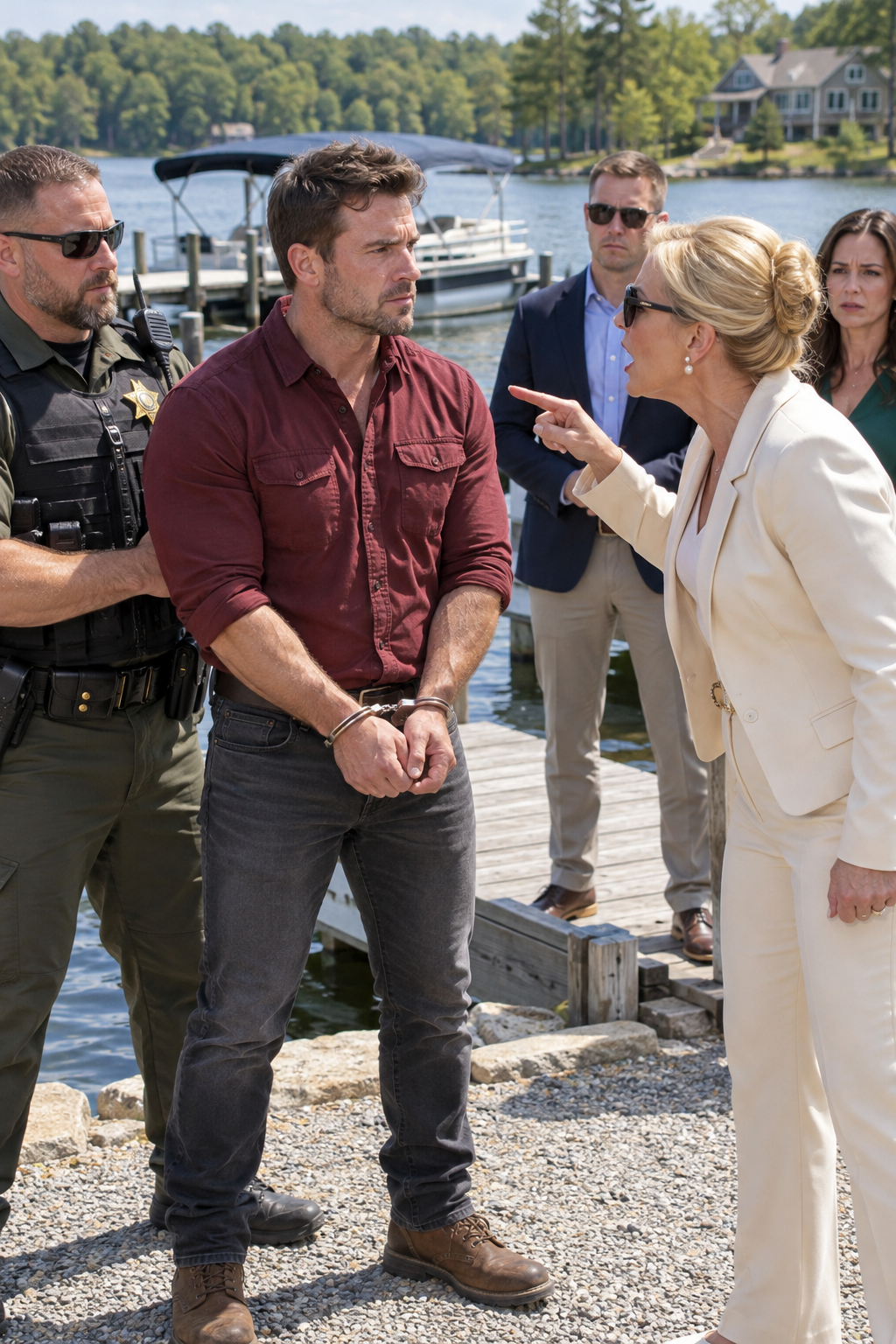
HOA President Handcuffed Me With a Fake Deed—Then I Followed the Money Behind Her $780,000 Marina
The first click of the handcuffs came before I even saw the deed.
The second came while HOA president Vivian Cross leaned close enough for me to smell peppermint on her breath and whispered, “You should have sold when I gave you the chance.”
Then she held up a notarized document claiming the lakefront property my family had owned for forty-three years belonged to her association.
I looked at the cuffs around my wrists.
I looked at the excavator idling twenty yards from my boathouse.
Then I looked at Vivian.
And I smiled.
That was the moment she finally appeared nervous.
My name is Claire Mercer. I was thirty-nine years old when the Cedar Point Homeowners Association decided that my property was standing in the way of progress.
“Progress,” in this case, meant a private marina with sixty-four slips, a glass clubhouse, fuel pumps, rental storage, and a projected construction cost of $780,000.
It was supposed to sit on eleven hundred feet of shoreline.
Nine hundred and twenty of those feet belonged to me.
Vivian had spent almost a year pretending that detail was negotiable.
I had spent almost a year proving that it wasn’t.
The Mercer property sat on the northern bend of Lake Bellweather in western Tennessee, where the water narrowed between limestone ridges before opening into a wide blue basin. My grandfather bought the land in 1983, back when Cedar Point was still timber, weeds, and an abandoned bait shop.
By the time developers built the subdivision on the ridge above us, our eighteen acres were already privately owned and specifically excluded from every HOA covenant they recorded.
That exclusion appeared in the original subdivision plat.
It appeared in the county tax maps.
It appeared in three title policies.
It appeared in the deed my parents recorded when they transferred the property to me.
And, because my father trusted paperwork more than people, it also appeared inside a fireproof box in my office containing forty years of surveys, easements, permits, receipts, photographs, and correspondence.
Dad used to tell me that land disputes were rarely about land.
“They’re about what somebody thinks they can make you surrender,” he said.
He died six years before Vivian Cross walked onto my dock wearing cream slacks, oversized sunglasses, and the kind of smile people use when they’ve already decided the answer to a question they haven’t asked yet.
That first morning, she didn’t mention ownership.
She mentioned opportunity.
“Cedar Point is evolving,” she told me.
“So I’ve heard.”
“We’re finally making the lakefront match the quality of the homes.”
I glanced toward the ridge.
The houses were expensive. Stone facades, three-car garages, manicured lawns, decorative gates.
Nothing wrong with them.
Nothing to do with me.
Vivian unfolded a glossy rendering across my outdoor table.
The proposed marina looked like something designed for a resort brochure.
Covered slips.
A restaurant deck.
A small events pavilion.
A fuel station.
Landscaped walkways.
And right in the middle of the drawing was my boathouse.
Except someone had erased it.
“My house is missing,” I said.
“It’s conceptual.”
“My dock is missing too.”
She tapped one manicured finger against the page.
“The board is prepared to offer you $310,000 for the shoreline parcel.”
I laughed because I thought she was joking.
The parcel alone had been appraised at $1.2 million the year before.
My entire property was worth considerably more.
Vivian did not laugh.
“The marina will increase surrounding values,” she said.
“Then your members should be thrilled.”
“You would retain your house.”
“On land without lake access?”
Her expression tightened.
“We’re trying to be reasonable.”
“No. You’re trying to buy nine hundred feet of waterfront for about one quarter of its market value.”
She rolled the rendering.
“Think about it.”
“I already did.”
Three days later, the HOA’s attorney sent me a letter describing my shoreline as a “disputed common waterfront area.”
I sent back copies of the recorded plat and my title policy.
Two weeks later, they claimed the original developer had intended to transfer the shoreline to the association.
I sent them the developer’s recorded declaration stating the exact opposite.
A month later, they claimed my boathouse violated Cedar Point architectural standards.
I replied that my property was not part of Cedar Point.
Then the fines started.
Unauthorized dock.
Unapproved landscaping.
Improper exterior storage.
Commercial watercraft.
Failure to submit architectural review documents.
The “commercial watercraft” was a fourteen-foot aluminum fishing boat my father bought in 1997.
By August, the HOA claimed I owed $18,600.
By September, it was $27,400.
By October, Vivian sent a notice threatening foreclosure.
That one made me stop smiling.
Not because I believed they could foreclose.
They couldn’t.
But because people who start sending impossible foreclosure notices are usually no longer trying to win an argument.
They are trying to create confusion.
And confusion is valuable when money is moving.
I had worked twelve years as a commercial title researcher before leaving the industry to start a records consulting business. I knew what bad paperwork looked like.
More importantly, I knew what people did when they wanted bad paperwork to become real.
They repeated it.
They filed it.
They referenced it in later documents.
They made banks rely on it.
They made contractors rely on it.
Eventually, the lie became tangled inside enough legitimate transactions that removing it became expensive.
That was why I began checking county records every Monday morning.
For six weeks, nothing changed.
Then, on a rainy Monday in November, I found the document.
A quitclaim deed.
Grantor: Harold Mercer.
Grantee: Cedar Point Property Owners Association.
Property description: approximately 9.4 waterfront acres along the northern shoreline of Lake Bellweather.
Consideration: ten dollars and other valuable consideration.
Execution date: May 14, 2004.
Recording date: November 3 of the current year.
Twenty-two years after it had supposedly been signed.
There was only one problem.
Harold Mercer was my grandfather.
And he died in 1998.
I stared at the screen until my coffee went cold.
Then I printed everything.
The recording cover sheet.
The notary acknowledgment.
The property description.
The digital image history.
I didn’t call Vivian.
I didn’t call the HOA attorney.
I didn’t post accusations online.
I didn’t confront the county recorder.
I didn’t give anyone a chance to understand what I had found before I understood it myself.
I drove straight to the county archives.
That restraint probably saved my property.
It may have saved me from something worse.
At the archives, I asked for the historical notary commission records attached to the name stamped on the deed.
The clerk was a gray-haired woman named Denise who had known my father.
She adjusted her glasses when she saw the document.
“This was supposedly notarized by Ellen Harwood?”
Denise stared at me.
“Ellen Harwood stopped notarizing documents in 2001.”
My pulse ticked once.
“Can you verify that?”
She disappeared into the back office and returned with a scanned commission record.
Ellen’s last commission expired in December 2001.
The deed was dated May 2004.
I pointed at the notary seal.
“Could she have renewed under another commission?”
Denise shook her head.
“She moved to Arkansas after her husband died.”
Then her face changed.
She lowered her voice.
“Ellen died last year.”
That mattered.
Because someone had filed a twenty-two-year-old deed signed by a man who had been dead six years at the supposed execution date and notarized by a woman whose commission had already expired.
That was not a mistake.
That was construction.
I photographed the records, requested certified copies, and drove home.
On the way, I called my attorney, Daniel Reeves.
Daniel was sixty-two, calm under pressure, and allergic to theatrical threats.
He listened without interrupting.
When I finished, he said, “Do absolutely nothing.”
“I’m good at that.”
“No confrontation. No email. No social media.”
“I’m serious, Claire.”
He exhaled.
“I’ll file an emergency action to quiet title tomorrow morning.”
“Can we challenge the recording immediately?”
“Why would anyone file something this obvious?”
That question stayed with me.
Because Daniel was right.
A sophisticated fraud usually tries to look sophisticated.
This deed didn’t.
The dates were sloppy.
The notary history was traceable.
My grandfather’s death certificate was public.
Either Vivian was reckless beyond belief…
Or she expected no one to inspect the deed closely until the marina construction had already begun.
That possibility bothered me more.
The next morning, Daniel filed for an emergency temporary restraining order preventing the HOA from entering, altering, financing against, or transferring any interest in my shoreline.
The hearing was scheduled for Friday.
We never made it that far.
Thursday morning, at , I was pouring coffee when I heard diesel engines outside.
I stepped onto my porch.
Two trucks.
One excavator.
Four construction workers.
A white SUV with the Cedar Point logo.
And Vivian.
She climbed out wearing a navy blazer, white blouse, and gold earrings.
Beside her stood Trent Mallory, Cedar Point’s head of security.
Trent was not a police officer.
He had once been a county reserve deputy, but his commission had ended years earlier.
That distinction would become important about nine minutes later.
I walked down the porch steps.
Vivian lifted a folder.
“We’re taking possession of the common shoreline.”
“No, you aren’t.”
“We have a recorded deed.”
“And I have a court filing challenging it.”
“Filing something doesn’t make it true.”
“Neither does recording something.”
Her eyes hardened.
Behind her, the excavator operator looked uncomfortable.
I raised my phone and started recording.
“Everyone here should understand that ownership is formally disputed, an emergency hearing is pending, and you do not have my permission to enter.”
Vivian turned to Trent.
“Remove her.”
Trent approached.
I stayed where I was.
“You have no authority on my property,” I said.
“We’re acting on behalf of the lawful owner.”
“You’re private security.”
“Ma’am, turn around.”
Vivian sighed loudly.
“This is exactly why we brought restraints.”
That sentence became one of the most expensive sentences she ever spoke.
Trent pulled metal handcuffs from his belt.
I looked at them.
Then at him.
“Are you arresting me?”
“You’re being temporarily detained.”
“Under what statute?”
His jaw shifted.
“Turn around.”
“Am I under arrest?”
He didn’t answer.
“Are you a sworn law-enforcement officer?”
Vivian stepped closer.
“Stop playing games.”
I kept my voice level.
“Trent, if you place those cuffs on me without lawful authority, you should assume this video will be played for the sheriff, the district attorney, your insurer, and a civil jury.”
For half a second, he hesitated.
Vivian saw it.
Metal closed around my right wrist.
Then my left.
And that was when Vivian leaned toward me and whispered, “You should have sold when I gave you the chance.”
She held up the fake deed.
I looked toward the excavator.
Then I smiled.
Because Vivian had made two mistakes.
The first was handcuffing me.
The second was believing I was alone.
A black county sheriff’s cruiser turned through my gate.
Then another.
Daniel had told me the night before to call dispatch immediately if anyone attempted entry.
I had called before leaving my kitchen.
Vivian’s face went pale.
Sheriff Luke Patterson stepped out of the first cruiser.
He was fifty-four, broad-shouldered, and had known my family since I was a teenager.
His deputy moved toward the construction workers.
Luke looked at me.
Then at the cuffs.
Then at Trent.
“Who restrained her?”
Trent swallowed.
“She was interfering with lawful possession.”
Luke’s eyes narrowed.
“That wasn’t my question.”
Vivian stepped forward.
“Sheriff, we have recorded title.”
She offered the deed.
Luke did not take it.
Instead, he looked at Trent.
“Are you currently commissioned by any law-enforcement agency in Tennessee?”
“Then unlock her.”
Trent reached for the key.
Luke stopped him.
The cuffs opened.
I rubbed my wrists.
Luke turned toward Vivian.
“You entered this property after being informed there’s active litigation concerning ownership?”
“Our attorney says the deed controls.”
“Your attorney tell you to handcuff people too?”
Vivian’s chin lifted.
“She became aggressive.”
Luke looked at me.
I held up my phone.
“The entire interaction is recorded.”
Then the excavator operator killed his engine.
That tiny sound felt like the first crack in a dam.
Luke took the deed now.
He read the first page.
His expression changed.
“Harold Mercer?”
“My grandfather.”
“He signed this in 2004?”
“According to that paper.”
Luke looked at me.
“When did Harold die?”
No one moved.
A construction worker whispered something under his breath.
Vivian stepped forward.
“That’s a legal question. The association received this document from its records consultant.”
Luke folded the paper.
“I think the district attorney may have some legal questions too.”
That morning ended without an arrest.
It ended with something more useful.
The sheriff ordered everyone off my property.
The contractor suspended the project.
The excavator left.
And Vivian, for the first time since I had met her, walked away without giving me a final warning.
By lunchtime, Daniel had delivered certified copies of my grandfather’s death certificate, the expired notary commission, and the questionable deed to the county prosecutor’s office.
By p.m., the recorder had placed an administrative fraud alert on the filing.
By Friday morning, a judge issued the temporary restraining order.
That should have been enough.
Because while Daniel focused on the deed, I kept thinking about the marina.
Where had that number come from?
Why was Vivian willing to risk criminal exposure over a project that could have been relocated to another section of shoreline?
Why push construction before the title dispute was resolved?
And why had the HOA recently increased every homeowner’s assessment by $4,800?
Cedar Point had 163 homes.
I did the math.
I sat at my kitchen table staring at the number.
Then I pulled up the HOA’s public filings.
Most homeowner associations aren’t exactly models of transparency, but Cedar Point had circulated a budget package to members before approving the special assessment.
A neighbor named Susan Bell sent it to me after seeing the sheriff’s cars.
Susan had disliked Vivian long before disliking Vivian became fashionable.
I opened the PDF.
Marina Development Assessment: $4,800 per property.
Total projected collection: $782,400.
Construction contract: $641,000.
Permitting, environmental review, engineering, contingency: $139,000.
On paper, it almost balanced.
The contractor was Lakeshore Civic Development LLC.
I had never heard of it.
I searched Tennessee corporate records.
The company had been formed eleven months earlier.
Registered agent: an attorney in Nashville.
Principal office: a mailbox center.
No public website.
No project portfolio.
No obvious employees.
Then I found a county permit application submitted for preliminary grading.
The contact person for Lakeshore Civic Development was a man named Evan Cross.
Vivian’s last name.
I leaned back.
There are coincidences.
Then there are surnames sitting on $641,000 construction contracts.
I searched Evan.
Forty-one years old.
Former operations manager at a regional dock builder.
No obvious connection to Vivian online.
Then an archived local newspaper article appeared.
A charity golf tournament from five years earlier.
The caption under one photograph read:
“Cedar Point resident Vivian Cross with son Evan Cross.”
I called Daniel.
“You’re going to dislike this.”
“I already dislike most things you call me about.”
“The marina contractor belongs to Vivian’s son.”
Then: “Send me everything.”
There was still nothing automatically illegal about the HOA president’s son receiving a contract.
It was ugly.
It was potentially an undisclosed conflict.
But conflict wasn’t fraud by itself.
I wanted the money trail.
Susan helped.
She began quietly talking to homeowners.
Not accusing.
Had anyone seen competing bids?
Had the board disclosed Vivian’s relationship to the contractor?
Had anyone received a detailed construction estimate?
Had the HOA attorney reviewed the contract?
Most people assumed so.
Had excavation actually begun anywhere?
Only at my property.
Then Susan called me late Sunday afternoon.
“You need to hear this.”
“What happened?”
“Tom Alvarez resigned from the marina committee.”
“He won’t tell me.”
“Will he tell me?”
“He said he’ll meet if you don’t record him.”
We met at a diner off Highway 79.
Tom was a retired accountant with wire-framed glasses and the exhausted expression of a man who had recently discovered that volunteering was much more dangerous than advertised.
He ordered coffee.
Didn’t drink it.
“I never approved the final contract,” he said.
“Were you supposed to?”
“I chaired the finance subcommittee.”
“What did you approve?”
“An initial budget of $780,000.”
“With Lakeshore Civic Development?”
That was interesting.
“Who was the original contractor?”
“Bellwater Marine Construction. They bid $517,000.”
I wrote the number on a napkin.
“What happened?”
“Vivian said their insurance documentation was inadequate.”
“I don’t know. I asked to see the problem. She said counsel was handling it.”
“And Lakeshore?”
“They appeared two weeks later at $641,000.”
“Did the board vote?”
Tom looked toward the window.
“We voted to authorize negotiations within the approved marina budget.”
“That’s not the same as approving a $641,000 contract.”
“Who signed it?”
Something shifted inside me.
“Did the board know Evan Cross owned Lakeshore?”
Tom finally looked at me.
“I didn’t.”
He slid an envelope across the table.
Inside were photocopies of three invoices.
Site planning: $86,000.
Mobilization: $112,000.
Materials deposit: $174,000.
Total already paid: $372,000.
But there had been no marina.
No pilings.
No dock sections.
No fuel system.
No shoreline stabilization.
Only an excavator arriving at my house.
“When were these paid?”
“Over the past four months.”
“Why did you resign?”
Tom rubbed his forehead.
“Because I asked for proof of the materials deposit.”
“Vivian told me the materials were stored off-site.”
“She wouldn’t say.”
That was the second crack.
The third came the next morning.
Bellwater Marine Construction returned my call.
Their estimator, Jared Cole, remembered Cedar Point.
“We didn’t lose that job over insurance,” he told me.
“Why did you lose it?”
“President said they’d chosen another proposal.”
“Did anyone ask you to rebid?”
“Did your $517,000 estimate include sixty-four slips?”
“Fuel station?”
“Clubhouse platform?”
“Permitting?”
“Not all professional fees, but most construction.”
“Did you ever discuss working as a subcontractor for Lakeshore Civic Development?”
Jared laughed.
“Never heard of them.”
I thanked him.
Then I asked one more question.
“If someone paid a legitimate marina contractor $174,000 as a materials deposit, what should exist?”
“Purchase orders. Supplier invoices. Delivery schedules. Something.”
“What if they say materials are stored off-site?”
“Then there should be storage documentation.”
There wasn’t.
At least, none that anyone could produce.
The emergency title hearing happened Tuesday morning.
Vivian appeared with two attorneys.
I appeared with Daniel and a banker’s box.
The courtroom smelled faintly of old wood and floor polish.
Vivian did not look at me.
Her attorneys argued that the disputed deed had been found among historical association records and filed in good faith.
Daniel stood.
“Your Honor, the alleged grantor died six years before he supposedly signed it.”
The judge looked over his glasses.
“I’m aware.”
“The notary’s commission had expired approximately two and a half years before the alleged execution.”
“I’m aware of that too.”
“And the association attempted physical possession after receiving notice that the deed was disputed.”
One of Vivian’s lawyers rose.
“My client relied upon recorded title.”
Daniel turned.
“Your client recorded it.”
That was the mini-payoff I needed.
The judge extended the restraining order, prohibited the HOA from entering my land, ordered the disputed deed flagged pending litigation, and required the association to preserve every document connected to its origin.
Vivian walked past me afterward.
I said nothing.
She stopped anyway.
“You think this makes you safe?”
Daniel looked over.
Vivian smiled.
Then she walked away.
That sentence bothered him.
It fascinated me.
People say strange things under pressure.
Sometimes those things are meaningless.
Sometimes they tell you what the person values.
Vivian had not said, “You think you won.”
She said, “You think this makes you safe?”
That night, I reviewed every document again.
The fake deed.
Marina budget.
HOA correspondence.
Old surveys.
Then I noticed something I had overlooked.
The property description attached to the fake deed was not written in 2004 style.
My grandfather’s legitimate deeds used metes-and-bounds descriptions copied from 1970s surveys.
The fake deed used parcel references.
Parcel identifiers the county did not adopt until 2011.
Then checked again.
The document could not possibly have been created in 2004.
Someone had manufactured it recently using modern tax data.
That eliminated the excuse that Vivian had merely discovered an old forged document.
Daniel sent the finding to investigators.
Two days later, the sheriff’s department executed a search warrant at the HOA office.
No dramatic raid.
No doors kicked down.
Just detectives carrying boxes.
That was when Cedar Point started turning on Vivian.
Homeowners demanded financial records.
Board members hired separate attorneys.
The treasurer claimed Vivian had handled most marina payments personally.
The vice president said he thought the contract had been independently reviewed.
A petition began circulating for Vivian’s removal.
Then the HOA’s bank froze further marina disbursements.
$410,400 remained from the assessment account.
Which meant $372,000 had already left.
The question became simple.
Where was it?
Evan Cross stopped answering calls.
Lakeshore Civic Development’s mailbox was emptied.
Its registered-agent attorney withdrew.
Vivian resigned as HOA president on a Friday afternoon through a four-sentence email.
Saturday morning, someone broke into my boathouse.
Nothing expensive was taken.
That was what frightened me.
My fishing equipment remained.
The outboard motor remained.
Tools remained.
But a steel file cabinet containing copies of old shoreline surveys had been forced open.
Whoever entered was looking for paper.
My security camera captured a hooded figure arriving by boat at a.m.
No readable registration.
The sheriff took the footage.
I replaced the locks and moved every original property document to Daniel’s office.
Then I started thinking about the fake deed differently.
Why fabricate ownership?
Obviously, they needed my shoreline for the marina.
But if they merely needed construction access, there were easier ways to pressure me.
Fake easement claims.
Condemnation lobbying.
Boundary manipulation.
Why create a full transfer deed?
And why record it only days before trying to take possession?
I pulled the marina financing documents Susan had obtained.
That was when I found the lender.
Bellweather Community Bank.
The HOA had opened a $350,000 revolving construction line secured partly by future marina revenues and something described as “association-controlled waterfront property.”
My property.
The fake deed was not only for the excavator.
It was collateral support.
I called Daniel.
He answered with, “What now?”
“They borrowed against the shoreline.”
He stopped breathing for a second.
The bank had relied on a title certification prepared by a company called Heritage Land Verification.
I searched the name.
Another mailbox.
Another recently formed LLC.
Registered manager: Patricia Dole.
That name meant nothing.
Then Daniel called.
“Do you remember the notary on the fake deed?”
“Ellen Harwood.”
“Her daughter’s married name is Patricia Dole.”
I closed my eyes.
There it was.
The first real bridge.
Investigators later reconstructed what had happened, but at the time we only had pieces.
Ellen Harwood had notarized legitimate Mercer family documents in the 1990s.
After her death, someone gained access to an old embossing seal, signature samples, and records showing her prior work.
Her daughter, Patricia, had financial problems.
Evan Cross knew Patricia through a dock-supply business where they had both worked years earlier.
Heritage Land Verification was formed four months before the fake deed was recorded.
And Heritage provided the bank with a title package that treated my shoreline as HOA property.
The fraud was not amateur.
The deed itself was intentionally simple because it only needed to survive long enough to unlock money.
A temporary lie.
That phrase stayed with me.
Temporary lies can do permanent damage.
By December, investigators subpoenaed bank records.
That was when the $372,000 started talking.
The first $86,000 payment to Lakeshore had moved through its operating account.
Within forty-eight hours, $28,000 went to a credit-card balance belonging to Evan.
$15,000 went toward a boat loan.
$9,700 went to Patricia Dole.
Another $21,000 went to an account controlled by Vivian.
The $112,000 “mobilization” payment produced similar transfers.
The $174,000 materials deposit was worse.
Only $31,400 appeared to have reached any legitimate supplier.
The rest scattered.
Cashier’s checks.
Personal debts.
Credit cards.
A payment to a vacation rental company in Florida.
And one $52,000 transfer to a company called North Star Consulting.
Investigators initially assumed North Star was another shell.
At least, not obviously.
It had existed for eleven years.
It provided lobbying and development consulting for real-estate projects across three states.
And that was when the case stopped looking like a greedy HOA president helping her son.
North Star had no obvious reason to receive $52,000 from a neighborhood marina project.
Vivian’s lawyer called the payment a legitimate development-consulting expense.
No supporting contract appeared in the HOA records.
The board members said they had never heard of it.
Evan remained missing.
Not missing in the dramatic sense.
Missing in the legal sense.
His apartment was empty.
His truck was gone.
His phone was off.
Then, three days before Christmas, he walked into the sheriff’s department with an attorney.
That changed everything.
Evan did not confess to every accusation.
He was not stupid.
He admitted Lakeshore was his company.
He admitted Vivian knew.
He admitted the board had not been fully informed.
He admitted using some project funds for expenses unrelated to the marina.
But when detectives asked about the fake deed, he denied creating it.
When asked about Patricia, he stopped answering.
When asked about North Star, his attorney ended the interview.
Still, his cooperation was enough for prosecutors to move.
Patricia Dole was charged first.
Fraud-related counts.
Filing a false instrument.
Investigators alleged that she had helped manufacture the deed using her mother’s old records.
Evan was charged with theft and financial offenses connected to the marina money.
Vivian lasted another eight days.
I was at Daniel’s office when the sheriff called.
“They picked her up.”
I did not cheer.
Daniel didn’t either.
There was something almost depressing about watching consequences arrive after months of someone acting invincible.
“What charges?” I asked.
“Conspiracy, financial crimes, false filing. More could come.”
“And the handcuffs?”
Luke laughed once.
“That incident is included.”
By January, Cedar Point elected an entirely new board.
Their first act was rescinding every fine they had issued against me.
Their second was sending a letter acknowledging that my property had never been subject to the HOA.
Their third was filing a civil action against Vivian, Evan, Lakeshore Civic Development, and Patricia to recover association funds.
The marina project was canceled.
The bank terminated the construction line.
The fraudulent deed was formally voided by court order.
My title was confirmed.
The HOA’s insurer began negotiating over the unlawful detention and trespass.
For the first time in almost a year, I walked down to my dock without expecting another certified letter taped to my door.
Winter had emptied the lake.
No jet skis.
No music from pontoon boats.
Just cold water tapping against wooden pilings.
I stood where Vivian had handcuffed me.
The grass had recovered from the excavator tracks.
Everything looked ordinary again.
But ordinary can be deceptive.
A month later, Cedar Point held a community meeting in the clubhouse.
Susan convinced me to attend.
I almost refused.
Then I decided hiding from a building full of people who had once watched an HOA bully me would give Vivian too much power after she was gone.
The room was packed.
Homeowners apologized.
Some sincerely.
Some awkwardly.
A few avoided me.
Tom Alvarez shook my hand.
The new president, a pediatric dentist named Mark Ellison, stood at the microphone and announced that forensic accountants had recovered or frozen approximately $246,000.
Civil litigation might recover more.
The HOA would take a loss.
But it would survive.
Then he said something I did not expect.
“We also owe Claire Mercer an apology.”
The room went silent.
Mark turned toward me.
“This association allowed one person’s ambition to replace basic judgment. Some residents questioned what was happening. Too many didn’t. Claire protected her own property, but by doing so she also exposed misuse of money belonging to every homeowner in this room.”
People clapped.
I hated being looked at.
But I stood.
Not because I wanted applause.
Because I wanted to say one thing.
“I appreciate the apology,” I told them. “But don’t replace Vivian with someone you trust more. Replace the system that allowed anyone to do what she did.”
The room quieted.
“Require multiple signatures. Publish bids. Disclose family relationships. Let homeowners inspect contracts before hundreds of thousands of dollars move. Good governance isn’t finding the right person to trust. It’s making sure trust alone is never enough.”
Tom smiled.
Susan clapped first.
Then others joined.
That should have been the ending.
The fake deed was dead.
My shoreline was mine.
The marina was canceled.
Vivian was facing prosecution.
The HOA had begun recovering money.
Even the handcuffs had become evidence instead of humiliation.
I thought my father would have approved.
Keep your records.
Keep your temper.
Let the other person underestimate both.
By March, Daniel finalized a civil settlement related to the unlawful detention and trespass.
I refused to discuss the amount publicly.
A portion went toward attorney fees.
A portion went into repairing the boathouse.
And with the rest, I established a small shoreline conservation trust in my parents’ names.
No restaurant deck.
No sixty-four slips.
The northern bend would remain trees, water, herons, and the old dock where my father taught me to tie a bowline knot.
One Saturday morning, I replaced a rotten board near the end of the dock.
Susan arrived carrying coffee.
“You know what everyone calls this place now?”
“I’m afraid to ask.”
“The million-dollar dock.”
“It’s not worth a million dollars.”
“That’s not what the story says.”
“What story?”
She grinned.
“The one people tell.”
I shook my head.
“Stories are dangerous.”
“You’re living proof.”
“No. Vivian is.”
Susan’s smile faded.
“She gets sentenced yet?”
“Not even close.”
The criminal case was moving slowly.
Vivian pleaded not guilty.
Evan entered negotiations with prosecutors.
Patricia’s attorney challenged parts of the search.
None of that surprised me.
Courts move slower than outrage.
I learned to live with it.
Then, on April 18, Daniel called.
His voice was different.
Not urgent.
“Are you home?”
“Don’t leave.”
I put down my coffee.
“I’m coming over.”
Twenty-seven minutes later, his car pulled into my driveway.
He carried a brown evidence envelope.
No briefcase.
Just the envelope.
We sat at my kitchen table.
“What happened?” I asked.
Daniel looked toward the windows.
“North Star Consulting.”
“The $52,000 payment?”
“What about it?”
“Federal investigators subpoenaed their records.”
That word made my stomach tighten.
“They were already looking at North Star in another matter.”
“What matter?”
“Land acquisitions. Waterfront projects. Municipal development deals.”
I stared at him.
“What does that have to do with Cedar Point?”
“Maybe more than we thought.”
He opened the envelope.
Inside was a copy of a spreadsheet.
Rows of parcel numbers.
Owner names.
A column labeled acquisition status.
Another listed projected values.
I recognized Lake Bellweather immediately.
Not only my property.
Dozens of properties.
Cedar Point.
The western public launch.
Two family farms.
A campground.
Three undeveloped coves.
“What am I looking at?”
“A proposed resort acquisition corridor.”
I felt cold.
“For what?”
“North Star was consulting on a large private redevelopment concept around the lake.”
“How large?”
“Preliminary projected value after development was over $48 million.”
I looked at the parcel list again.
My land was marked in red.
Priority acquisition.
“Vivian wanted the marina because of this?”
“Possibly.”
“Then the $780,000 scheme wasn’t the whole thing.”
“Did she know about the larger plan?”
“We don’t know yet.”
I traced the rows with one finger.
Then stopped.
A familiar name appeared beside an older parcel reference.
Harold Mercer.
My grandfather.
But that wasn’t possible.
The spreadsheet had been created only fourteen months earlier.
“Why is Grandpa listed?”
Daniel did not answer.
I looked up.
He removed one more document from the envelope.
It was a scanned letter.
Not a deed.
Not an HOA document.
A private memorandum.
The date was fifteen years old.
The first page discussed potential control of the northern shoreline.
The second discussed “legacy ownership obstacles.”
Then I reached the signature page.
Three names appeared at the bottom.
One belonged to a North Star executive.
One belonged to a developer I had never heard of.
And the third signature made the room disappear around me.
Robert Mercer.
For several seconds, I could hear nothing except the refrigerator humming behind me.
“My father never worked with developers.”
“That’s what I thought.”
“He hated Cedar Point.”
“He spent years protecting this land.”
I looked closer.
The signature resembled his.
Not perfectly.
But enough to make my chest tighten.
“Is it forged?”
“We don’t know.”
“Where did they get this?”
“North Star’s archived files.”
I pushed back from the table.
“If Dad signed this, what was he agreeing to?”
“That’s the problem.”
Daniel turned the page.
Most of the body text had been redacted in the copy provided to him.
But one sentence remained visible near the bottom.
A single sentence.
I read it twice.
Then a third time.
The agreement referenced “Phase Two acquisition following transfer of Mercer shoreline control through an intermediary entity.”
Intermediary entity.
I thought about Cedar Point.
The fake deed.
The bank loan.
The marina.
The break-in at my boathouse.
The person who had searched my old surveys but stolen nothing else.
I looked at Daniel.
“You think someone was trying to use the HOA to complete an old plan?”
“I think the $780,000 marina may have been the smallest part of what was happening.”
My phone rang.
Unknown number.
Daniel’s eyes moved toward it.
“Don’t answer.”
It stopped.
Then a text arrived.
One photograph.
I opened it.
The image showed my father standing outside a courthouse.
The photograph was old.
Maybe fifteen years.
Beside him stood Vivian Cross.
She looked younger.
But it was unmistakably her.
Standing on Vivian’s other side was a man I did not recognize.
He held a leather document folder.
The text beneath the photograph contained only seven words.
YOUR FATHER WAS NEVER FIGHTING THE DEAL.
Another message appeared before I could move.
HE WAS TRYING TO CHANGE WHO OWNED IT.
My throat went dry.
Daniel reached for his phone.
I stared at the picture.
Then a third message arrived.
This one contained an address.
An abandoned storage facility forty miles east of Lake Bellweather.
And beneath it:
ASK WHAT ROBERT MERCER LEFT INSIDE BEFORE THEY FIND IT.
Outside, somewhere beyond the trees, a boat engine started on the lake.
I stood so quickly my chair hit the floor.
Daniel moved toward the window.
The engine grew louder.
Then stopped.
Right below my property.
At the dock.
✓ Lynn R. Adams
HOA President Handcuffed Me With a Fake Deed—Then I Followed the Money Behind Her $780,000 Marina The first click of the handcuffs came before I even saw the deed. The second came while HOA presiden…