HOA President Handcuffed Me on My Own Ranch—Then My Wife Arrived With Six State Troopers and a Sealed Warrant
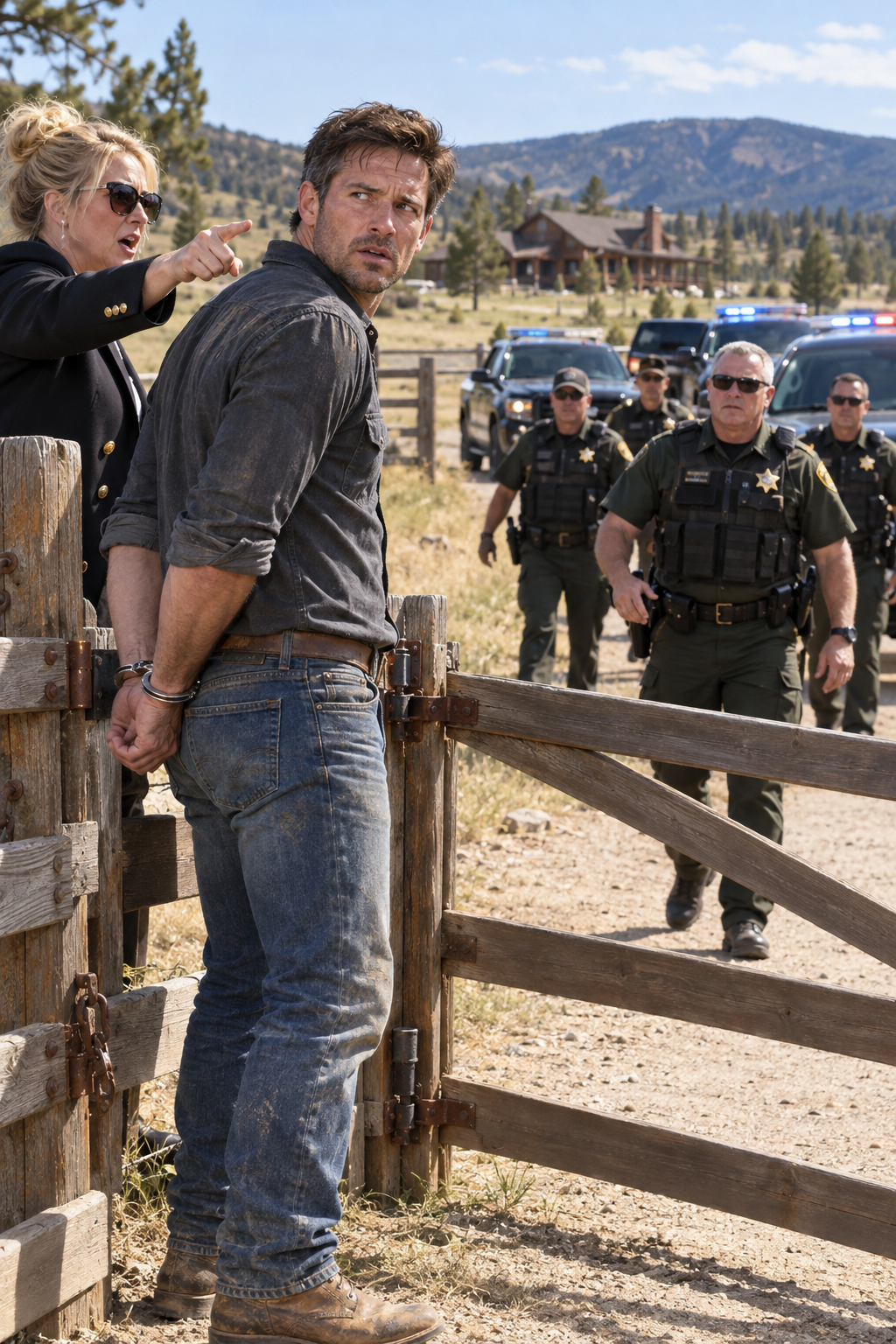
HOA President Handcuffed Me on My Own Ranch—Then My Wife Arrived With Six State Troopers and a Sealed Warrant
The steel ratcheted around my wrist before I finished saying, “That fence is mine.”
Vanessa Pike, president of the Cedar Ridge Homeowners Association, shoved my other hand behind my back and smiled while thirty of her neighbors watched from the road.
“You’re trespassing on HOA property, Mr. Mercer,” she said. “Maybe spending a night in county lockup will teach you who owns this land now.”
I looked down at the survey monument beside my boot.
Then at the old cottonwood tree twenty yards behind her.
Then at the white SUV parked beside the temporary gate she had installed across my ranch road before sunrise.
I didn’t yell.
I didn’t struggle.
I didn’t tell Vanessa she had just made the worst mistake of her life.
I didn’t tell her my wife already knew exactly where I was.
And I definitely didn’t tell her why six state troopers were less than twenty minutes away.
Instead, I smiled.
That bothered her more than anger would have.
My name is Ethan Mercer.
I’m forty-three years old, and my family has owned Mercer Ranch outside Red Creek, Colorado, since my great-grandfather bought the first 180 acres in 1919.
By the time my father died, the ranch covered 712 acres of rolling pasture, cottonwood creek bottom, pine-covered ridge, and one narrow strip of riverfront that had suddenly become very interesting to people with more money than patience.
For most of my life, nobody cared about that strip.
It was forty-one acres of uneven grass, scrub oak, two rocky hillsides, and a gravel access road that followed the eastern property line.
Then Cedar Ridge Estates appeared.
Five years earlier, a development company had bought 400 acres of former hayfield next to us and turned it into a gated luxury subdivision.
Stone entrances.
Artificial ponds.
A private fitness center.
A clubhouse that looked like a ski resort.
Homes starting at $1.3 million.
The s promised “uninterrupted mountain living.”
That phrase became complicated when buyers discovered their uninterrupted mountain view included my cattle, my tractors, and occasionally my seventy-eight-year-old neighbor Walter driving past in a pickup with one door a different color.
At first, Cedar Ridge and I got along fine.
The residents waved.
Their kids liked watching the calves in spring.
One family even asked whether I’d let them take Christmas photos near the old red barn.
I said yes.
Then Vanessa Pike became HOA president.
Vanessa was fifty-two, always perfectly dressed, always perfectly composed, and always speaking as though every conversation were already recorded in meeting minutes she controlled.
She lived in the largest house in Cedar Ridge.
She drove a pearl-white Range Rover.
Her husband, Martin, rarely appeared at HOA meetings and apparently spent most of his time traveling for some consulting company.
Vanessa, meanwhile, treated Cedar Ridge like a small sovereign nation.
Within six months, she had fined residents for basketball hoops, flowerpot colors, visible trash cans, holiday lights left up three days too long, and one eight-year-old girl’s lemonade stand because the handmade sign violated the HOA’s temporary signage policy.
None of that involved me.
Then Cedar Ridge announced plans for something called the Summit Pavilion.
According to the glossy presentation sent to residents, it would include a wedding terrace, event lawn, restaurant patio, and private overlook above the river.
There was only one problem.
The best route to the proposed pavilion crossed my land.
Specifically, it crossed 1.8 miles of my private ranch road.
The first time Vanessa came to my house, she didn’t ask permission.
She brought a folder.
“This benefits everybody,” she said, standing on my porch in cream slacks and a navy blouse.
“Everybody?”
“The community.”
“I’m not in the community.”
She smiled as if I’d made an adorable mistake.
“You’re adjacent to it.”
“That isn’t the same thing.”
She opened the folder and showed me a colored map.
A blue line crossed my property.
Cedar Ridge Service Easement.
I studied it for about ten seconds.
“That easement doesn’t exist.”
“Our attorney disagrees.”
“Your attorney can disagree from your side of the fence.”
Her smile tightened.
“The original county plat includes access rights.”
“No, it doesn’t.”
“You seem very certain.”
“I helped my father replace every fence post on that boundary when I was seventeen. I’ve read every deed, survey, mineral reservation, utility agreement, ditch right and easement attached to this ranch since 1919.”
She closed the folder.
“You should still speak with counsel.”
“I already have counsel.”
That was true.
Just not in the way Vanessa assumed.
My wife, Claire, was a lawyer.
But she didn’t practice property law.
Claire Mercer worked for the Colorado Attorney General’s Office in a unit that handled public corruption, document fraud, and crimes involving state-regulated land records.
At home, however, she was mostly the woman who stole the blanket every night and claimed she didn’t.
I didn’t mention Claire’s job to Vanessa.
There was no reason.
Two weeks later, contractors from Cedar Ridge placed orange survey stakes fifteen feet inside my property.
I removed them carefully, photographed each location, and put the stakes in my equipment shed.
Three days after that, they came back.
This time there were twelve.
I photographed those too.
Then Vanessa sent me a certified letter demanding that I “cease interference with authorized HOA development activity.”
I replied with one sentence.
Please provide the recorded instrument creating the easement.
She sent fourteen pages.
Not one contained an easement.
There were meeting minutes, architectural plans, an engineering memo, an unsigned land-use diagram, and a letter from Cedar Ridge’s attorney referring repeatedly to “established access rights.”
But no deed.
No recorded easement.
No condemnation order.
So I sent another letter.
Please provide the book and page number or reception number of the recorded instrument.
For nine days, I heard nothing.
Then things got interesting.
At on a Tuesday morning, a bulldozer appeared on my road.
The operator was halfway through unloading it when I walked down.
He looked at me.
I looked at him.
“You with Cedar Ridge?” I asked.
“Westline Excavation.”
“You have a work order?”
He handed it over.
The work order instructed Westline to widen “HOA access corridor B” from sixteen feet to thirty-two feet.
My private road was apparently Corridor B now.
I photographed the work order.
“This road belongs to me,” I said.
The operator frowned.
“Guy told me it was HOA.”
“Which guy?”
He pointed at a name.
Derek Moss.
Development consultant.
That name mattered later.
I didn’t know it then.
I told the operator I wasn’t angry with him, but he couldn’t unload on private land.
To his credit, he called his supervisor, waited ten minutes, then drove away.
By lunchtime, Vanessa called me.
“You stopped our contractor.”
“You interfered with approved work.”
“On my property.”
“You keep using that phrase.”
“Because deeds keep using it too.”
Her voice went quiet.
“Ethan, Cedar Ridge has spent significant money based on this access. You cannot hold an entire community hostage.”
“I’m not holding anybody hostage.”
“You know what I mean.”
“I know you’re trying to build something you can’t reach without crossing my ranch.”
Then she said something I remembered later.
“You should think about what your land is really worth to you.”
Not what it was worth.
What it was worth to me.
That was the first moment I understood this wasn’t a misunderstanding.
Someone had already made a financial decision.
And I was standing in the way.
Over the next month, the pressure became almost professional.
First came the letters.
Then the calls.
Then complaints to the county about livestock odor, dust, nighttime agricultural equipment and runoff.
One complaint claimed my cattle were creating “excessive visual disruption.”
I framed that one.
Another claimed my hay barn violated Cedar Ridge architectural guidelines.
The barn had been built in 1968.
Cedar Ridge had existed since 2021.
The county inspector who came out read the complaint twice, looked at the barn, looked at me, then laughed so hard he had to lean against his truck.
Mini-payoff number one.
The complaint was dismissed.
Then Vanessa tried something smarter.
She told Cedar Ridge residents I was blocking an emergency evacuation route.
That scared people.
I understood why.
Wildfire is real where we live.
People who had waved at me for years started looking at me differently.
One man confronted me outside the hardware store.
“You’re really refusing emergency access?”
“That’s what Vanessa said.”
“Ask her to show you the emergency easement.”
He hesitated.
“She said it’s on the county map.”
“Ask her for the recording number.”
Three days later, he called and apologized.
Then two more residents contacted me privately.
That was when I learned Vanessa had already collected a special assessment from Cedar Ridge homeowners.
$11,600 per household.
The money was supposedly for preliminary Summit Pavilion infrastructure.
There were 186 homes.
Do the math.
More than $2.1 million.
And a significant portion had already been spent.
That changed things.
Vanessa wasn’t simply fighting over access.
She had promised access.
At the next HOA meeting, several residents demanded documentation.
Vanessa produced it.
A newly discovered property exhibit, she called it.
One resident, an accountant named Mark Ellis, emailed me a photograph afterward.
I stared at it for a long time.
The document looked old.
County seal.
Legal description.
Typed references to Mercer Ranch.
And one paragraph granting perpetual ingress and egress across the eastern road.
Except something was wrong.
My grandfather’s name was typed as Theodore James Mercer.
His legal name had been Theodore Joseph Mercer.
Also, the document referenced Parcel 7B.
That parcel number wasn’t created until a county mapping update in 1987.
The supposed easement was dated 1964.
I called Claire into my office.
She had just gotten home and still wore her charcoal suit.
“Look at this.”
She leaned over my shoulder.
I watched her expression change.
Not dramatically.
Claire rarely did anything dramatically.
Her eyes simply stopped moving.
“Where did this come from?”
“Cedar Ridge.”
“Original?”
“Photo from an HOA meeting.”
“Who presented it?”
Claire enlarged the image.
Then enlarged it again.
“Do you still have Grandpa Ted’s old deeds?”
“Fire safe.”
“Get them.”
We compared signatures.
The supposed easement carried my grandfather’s signature.
At first glance, it looked convincing.
At second glance, it looked too convincing.
The signature matched one from a 1978 grazing lease almost perfectly.
Same angle.
Same long tail on the T.
Same pressure break between Mercer’s r and c.
Claire pulled out her phone and took several photographs.
“What are you thinking?” I asked.
“I’m thinking you shouldn’t touch this.”
“Meaning from this point forward, you document everything.”
“I already do.”
“Document more.”
“What does that mean?”
“It means no arguments. No threats. No removing equipment unless necessary for safety. No direct accusations.”
She looked at me.
“If that document was presented as genuine, this may be bigger than an HOA dispute.”
That night, she made three phone calls from the back porch.
She didn’t tell me the details.
She couldn’t.
Her office had rules.
Conflict rules too, because it involved our property.
By the next morning, she had formally recused herself from any decision-making related to the investigation.
But recusing herself didn’t mean she stopped understanding what was happening.
It meant someone else would handle it.
For the next three weeks, I did exactly what she told me.
I became boring.
Vanessa sent a letter.
I filed it.
Workers photographed my fence.
I photographed them photographing my fence.
A drone flew over my road three mornings in a row.
I saved my security footage.
Someone moved one survey monument.
I called the county surveyor.
That was mini-payoff number two.
The county surveyor, Luis Ortega, arrived with two technicians and spent four hours checking the boundary.
At the end, he drove a fresh capped monument into the ground and said, loudly enough for Vanessa’s property manager to hear from twenty yards away:
“Mr. Mercer, this boundary is exactly where your recorded survey says it is.”
I asked him to put it in writing.
Vanessa responded by claiming the issue wasn’t ownership.
It was easement access.
That shift told me she knew she had lost the boundary argument.
Then came the gate.
Friday morning.
I was drinking coffee in the kitchen when one of my driveway cameras sent an alert.
Vehicle detected: East Ranch Road.
I opened the feed.
Three SUVs.
A flatbed truck.
Eight people.
And Vanessa Pike.
By the time I reached the road, workers were setting steel posts into portable concrete bases across the entrance.
A white sign had been attached to the center.
AUTHORIZED CEDAR RIDGE ACCESS ONLY.
“Morning,” I said.
Vanessa turned.
She wore a fitted emerald jacket, dark jeans and boots that had probably never touched mud before that morning.
“You were notified.”
“About what?”
“The access transition.”
“What access transition?”
“The board voted last night to secure the corridor.”
I looked at the gate.
“You put a gate across my road.”
“The association is protecting shared access.”
“From interference.”
One of the men standing with her wore a black polo marked CEDAR RIDGE COMMUNITY SECURITY.
He wasn’t law enforcement.
I knew that immediately.
No department insignia.
No body camera.
Just a security company logo and a heavy belt.
Vanessa held up a folder.
“We have documentation.”
“County-recorded?”
“Our attorneys have validated it.”
“That wasn’t my question.”
“I’m not discussing this again.”
She turned to the workers.
“Continue.”
I took out my phone.
“Before they continue, I’m telling all of you clearly that you are on private property without permission.”
The workers stopped.
Vanessa didn’t.
“You’re obstructing lawful access.”
“I’m creating a record.”
“You’ve created enough records.”
That line got my attention.
I kept filming.
“Who authorized this gate?”
“The board.”
“Who authorized entry onto Mercer Ranch?”
“Our recorded easement.”
“Reception number?”
Her jaw tightened.
“You have been provided the documentation.”
“No reception number, then.”
The security man stepped forward.
“Sir, you need to move away from the work area.”
“What’s your name?”
“Cal Henson.”
“Cal, are you a sworn peace officer?”
“Do you have legal authority to remove me from my land?”
He glanced at Vanessa.
She answered for him.
“He has authority from Cedar Ridge.”
“That wasn’t what I asked.”
A few homeowners had gathered behind the temporary barricades.
Phones were out.
Vanessa noticed.
She changed tone.
“Ethan, nobody wants this to become ugly.”
“Then move the gate.”
“We’re beyond that.”
“No, Vanessa. You’re standing on my road at six in the morning with private security and a gate you don’t own. We’re not beyond anything. We’re exactly at the point where you can still choose to leave.”
That irritated her.
She stepped closer.
“You believe being calm makes you right.”
“No. The deed does that.”
A few people laughed.
Vanessa flushed.
Then she did something I never expected.
She reached toward Cal Henson’s belt.
He reacted too slowly.
She pulled a pair of handcuffs from the back pouch.
“Vanessa,” he said.
She ignored him.
I didn’t move.
“Leave the work zone,” she said.
“This is my property.”
“Final warning.”
“Call the sheriff.”
“I don’t need the sheriff.”
That was the sentence.
That was the moment everything crossed from ridiculous into criminal.
I kept my arms at my sides.
“Vanessa, don’t touch me.”
She grabbed my left wrist.
I could have pulled away.
I’m six feet two.
She was maybe five foot six.
I spent most days moving feed sacks and fencing materials.
But Claire’s voice was in my head.
Document everything.
So I let Vanessa turn my wrist.
Let her snap one cuff closed.
Let her force my arm behind me.
Cal finally stepped in.
“Ma’am, stop.”
“Stay out of it.”
“Those restraints are company equipment.”
“He’s trespassing.”
“Vanessa,” one homeowner called from the road, “what are you doing?”
She snapped the second cuff shut.
Metal bit my skin.
Thirty phones seemed to rise at once.
Vanessa leaned close enough that I smelled her perfume.
“You wanted documentation,” she whispered.
“Now you’ll have plenty.”
I looked at her.
Then I smiled.
She hated that smile.
“You think this is funny?”
“Then why are you smiling?”
“Because my wife told me you’d eventually get impatient.”
For the first time that morning, Vanessa’s confidence flickered.
“What does your wife have to do with this?”
A distant engine answered for me.
Then another.
Then several at once.
Heads turned toward County Road 18.
The first dark-blue state police SUV came around the bend fast but controlled.
Blue lights flashing.
A second vehicle followed.
Then a third.
Then four marked Colorado State Patrol units.
Six state troopers in total.
The road went silent.
Even the workers stopped moving.
The vehicles rolled to a stop thirty yards away.
Doors opened.
Uniformed troopers stepped out.
Then Claire emerged from the passenger side of the second SUV.
Hair tied back.
Leather document case in one hand.
She looked at me.
Looked at the handcuffs.
Then looked at Vanessa.
I had been married to Claire for fourteen years.
I knew every version of her face.
The expression she wore then was the one I had seen exactly twice.
Once when a drunk driver nearly hit our niece.
Once when someone tried to break into our house while I was out of town.
She wasn’t frightened.
She was furious.
And when Claire was furious, she became extremely polite.
A tall trooper walked beside her.
Sergeant Daniel Reeves.
Behind them came an investigator I didn’t recognize carrying a sealed evidence bag.
Claire stopped ten feet from Vanessa.
“Good morning.”
Vanessa stared at the vehicles.
“What is this?”
Claire glanced at my wrists.
“Ethan, are you injured?”
“I’m fine.”
“Who restrained you?”
I nodded toward Vanessa.
“I did,” Vanessa said quickly. “He was interfering with HOA operations on HOA-controlled land.”
Claire looked at Cal.
“Are you law enforcement?”
“No, ma’am.”
“Did you restrain my husband?”
“Did you authorize Mrs. Pike to use your restraints?”
Vanessa’s head snapped toward him.
He raised both hands.
“You took them off my belt.”
The homeowners behind the gate murmured.
Mini-payoff number three.
Sergeant Reeves stepped toward me.
“Mr. Mercer, do you consent to us removing the restraints?”
Vanessa opened her mouth.
The sergeant looked at her.
She closed it.
A trooper unlocked the cuffs.
I rubbed my wrist once.
Claire saw the red mark.
Her jaw tightened.
Then she did something I admired.
No emotional confrontation.
She opened her document case.
“Mrs. Pike, my role here is limited because my husband owns the property involved. I have been recused from the underlying investigative decisions. Investigator Hannah Cole from the Attorney General’s Office is the lead.”
A woman in a navy blazer stepped forward.
Vanessa blinked.
“Attorney General?”
“Yes,” Cole said.
“What investigation?”
Cole removed several papers.
“An investigation involving suspected falsification of recorded property instruments, fraudulent representations in land development financing, conspiracy to obtain property rights by deception, and related offenses.”
Nobody moved.
Vanessa’s face lost color.
She recovered quickly.
“This is absurd.”
Cole continued.
“We also have judicial authorization to search specified Cedar Ridge Association offices, electronic records, and devices identified in the warrant.”
She held up the papers.
Sealed warrant.
There it was.
Vanessa looked at Claire.
“You did this.”
Claire’s voice stayed level.
“No. Evidence did this.”
“You’re using your office against me because of a property disagreement.”
“I told you. I’m recused.”
“This is corruption.”
Investigator Cole stepped between them.
“Mrs. Pike, direct questions to me.”
Vanessa pointed at the road.
“This is HOA property. We have an easement.”
Cole nodded.
“Then the recorded original will be useful.”
Vanessa said nothing.
Cole continued.
“We also have a warrant for records relating to the Summit Pavilion assessment, consultant payments, Westline Excavation, High Valley Planning Group, and payments to Derek Moss.”
That name again.
Derek Moss.
The consultant from the bulldozer work order.
Vanessa’s eyes changed.
Just slightly.
But Claire saw it.
Investigator Cole definitely saw it.
A trooper approached the temporary gate.
“Who installed this?”
One contractor raised his hand slowly.
“Company order.”
“Do you have a copy?”
“Yes, sir.”
“Please provide it.”
Vanessa spun toward him.
“Do not give them anything without association counsel.”
Cole looked at her.
“Mrs. Pike, you’re free to call counsel. The contractors are also free to cooperate.”
He cooperated.
Immediately.
Mini-payoff number four.
Within twelve minutes, the troopers had photographed the gate, documented the positions of the vehicles, collected copies of the work order and identified every person present.
Cal Henson voluntarily handed over his security company’s incident log.
Then Sergeant Reeves asked Vanessa to step aside.
“Because Mr. Mercer has stated that you restrained him without consent while he was on property he claims to own.”
“He was trespassing.”
“The ownership issue is documented. We are investigating the restraint separately.”
“You’re arresting me?”
“I didn’t say that.”
“Then I’m leaving.”
“You may not leave with devices covered by the search warrant.”
Vanessa froze.
“What devices?”
Cole read from the warrant.
“Your association-issued phone, tablet and laptop, if present.”
Vanessa’s right hand moved toward her handbag.
Every trooper noticed.
So did she.
Her hand stopped.
The bag was collected.
Then something unexpected happened.
Mark Ellis, the accountant who had sent me the photo of the fake easement, stepped through the crowd.
“I have something.”
Vanessa turned.
“Mark, don’t.”
He looked terrified.
But he kept walking.
He held a flash drive between two fingers.
“I copied the HOA financial reports before she locked board access last night.”
A sound moved through the crowd.
Not quite a gasp.
More like fifty people realizing the same thing simultaneously.
Vanessa stared at him.
“You stole confidential records.”
“I’m the treasurer.”
“You were the treasurer.”
“You removed me three hours after I asked what Horizon Planning LLC was.”
Investigator Cole turned.
“What is Horizon Planning?”
Mark looked at Vanessa.
Then back at Cole.
“Over seven hundred thousand dollars went there in eleven months.”
The road became absolutely silent.
Vanessa’s face hardened.
“Those were legitimate consulting fees.”
Mark swallowed.
That one word hurt her more than any accusation.
Because nobody believed her anymore.
Cole accepted the flash drive into an evidence bag.
Vanessa called her attorney.
The contractors packed up.
The temporary gate came down before noon.
I never touched it.
That mattered to me.
For months, Vanessa had tried to create a story where I was the angry rancher standing in the way of progress.
So I let the state remove the gate.
I let county records answer her claims.
I let her own signatures answer the rest.
By evening, photographs of me in handcuffs were everywhere in Cedar Ridge’s private Facebook group.
So was video of the troopers arriving.
Someone posted the moment Claire stepped from the SUV.
Another resident uploaded Vanessa saying, “I don’t need the sheriff.”
That clip became the sentence everyone remembered.
The next morning, Cedar Ridge’s board held an emergency meeting.
Vanessa didn’t attend.
Four board members resigned.
Two claimed they had approved expenditures based entirely on information Vanessa and Derek Moss provided.
One admitted he had never personally seen a recorded easement.
Another said Vanessa told the board the county had already verified it.
The county had done no such thing.
By Monday, the Summit Pavilion project was suspended.
By Tuesday, Cedar Ridge’s lender froze further construction draws.
By Wednesday, Vanessa’s attorney issued a statement claiming she had acted in good faith based on professional advice.
Then the first real twist landed.
Derek Moss didn’t exist.
Not legally.
Investigator Cole called me because she needed clarification about old access records.
During the conversation, she mentioned that every address associated with Derek Moss led somewhere else.
One mailbox belonged to a vacant warehouse.
One office suite had been empty for two years.
His professional license number belonged to a retired surveyor in Pueblo who had never heard of Cedar Ridge.
His consulting company had been created eighteen months earlier.
Its registered agent?
A corporate filing service.
They had records.
Those records turned the entire case.
Horizon Planning LLC—the company Mark had questioned—was receiving money from Cedar Ridge.
Horizon then transferred money to a second company.
That company transferred funds to a development entity.
And that development entity had quietly obtained an option to purchase twelve acres of riverfront land immediately north of my ranch.
Twelve acres that were nearly useless without road access.
Guess who held an ownership interest in the development entity.
Martin Pike.
Vanessa’s husband.
There was the motive.
Not a speech.
Not a confession.
A wire transfer.
Claire showed me the public corporate filing after it became available.
Martin’s name appeared in boring black letters near the bottom.
Sometimes the most dramatic truths arrive in the least dramatic fonts.
The plan began to make sense.
Cedar Ridge homeowners were paying millions for the Summit Pavilion.
Vanessa and Martin’s development company controlled land near the proposed pavilion.
But the project needed access through Mercer Ranch.
If a permanent easement could somehow be established—or simply repeated often enough that lenders, contractors and residents believed it existed—the twelve acres would become enormously more valuable.
A private appraiser later estimated the difference.
Without road access: roughly $640,000.
With improved access and pavilion adjacency: potentially $6.8 million.
That was why Vanessa couldn’t walk away.
She hadn’t just promised residents a clubhouse amenity.
Her family’s money was tied to the outcome.
The fake easement was no longer a petty HOA trick.
It was the bridge holding up the entire structure.
And bridges get dangerous when people keep adding weight after the supports crack.
Vanessa was not arrested that first morning.
That surprised Cedar Ridge residents.
Some were angry.
Claire explained it to me privately.
“Investigations aren’t television. They’re building a chain. They don’t rush because people want a dramatic ending.”
So we waited.
And Vanessa fought.
Her attorney argued the easement document had been supplied by outside consultants.
The HOA blamed Derek Moss.
Martin Pike said he had no involvement in daily association decisions.
The security company fired Cal Henson for allowing unauthorized use of restraints, though Cal later testified voluntarily and provided messages showing Vanessa had instructed security officers to “treat Mercer as a hostile trespasser.”
I felt bad for Cal.
He had been stupid.
But he hadn’t put the cuffs on me.
Vanessa had.
Two weeks later, she sued me.
Actually sued me.
Her civil complaint claimed I had interfered with contractual relations, damaged the value of the Summit Pavilion project, intimidated contractors and caused financial harm to Cedar Ridge.
My attorney, Rachel Sloan, read it at my kitchen table.
Then she looked at me.
“I’ve been practicing twenty-two years.”
“I have never received a complaint this generous.”
“Generous?”
“She attached exhibits.”
That was Vanessa’s next mistake.
Her attorneys had attached the disputed easement.
Rachel compared it with county records.
The recording stamp number on Vanessa’s copy belonged to another document.
A 1964 agricultural drainage agreement recorded seventeen miles away.
Someone had copied a legitimate county recording number onto the false instrument.
Rachel filed a motion to dismiss.
She also requested sanctions.
The judge granted limited expedited discovery because Vanessa was seeking an injunction to use my road.
That gave us legal access to communications Cedar Ridge might otherwise have fought for months to withhold.
Mini-payoff number five.
One email changed everything.
It was from Vanessa to a graphic design contractor.
Subject line: CLEAN VERSION.
The attachment wasn’t the fake deed itself.
It was a scan of an old Mercer grazing lease.
Vanessa’s message said:
Need signature isolated at highest possible resolution. Background must be transparent.
Eight words would eventually destroy nearly every defense she had.
She hadn’t merely received a questionable document.
She had ordered someone to extract my grandfather’s signature.
The graphic designer, apparently realizing the situation had become serious, hired a lawyer and cooperated.
She supplied the original request.
Payment receipts.
Draft files.
And a second email where Vanessa asked her to “age the finished page slightly.”
The designer claimed she thought it was for a historical presentation.
Maybe it was.
Maybe it wasn’t.
But Vanessa’s fingerprints were now all over the creation process.
Three days later, the Attorney General’s Office announced charges.
Attempted theft by deception.
Conspiracy.
Fraud-related counts involving association funds.
And unlawful restraint related to the handcuff incident was referred separately to the district attorney.
Martin Pike was charged later on financial counts.
Two additional people connected to the shell companies were named.
Cedar Ridge went into chaos.
Residents demanded an independent audit.
The new board hired one.
The first estimate showed more than $1.9 million in expenditures tied to companies with undisclosed connections to the Pavilion project.
Not all of that money was necessarily stolen.
Some work had actually been done.
Engineering.
Environmental review.
Contractor mobilization.
But the conflicts had been hidden.
And the access rights supporting the entire development plan were fictional.
My road had become the most expensive road nobody had permission to use.
For nearly three months, media vans occasionally parked outside Cedar Ridge.
I hated that part.
I didn’t want to become famous.
I wanted to fix fences.
Move cattle.
Drink coffee before sunrise.
Argue with Claire about whether the thermostat should be sixty-eight or seventy.
But the story spread anyway.
People liked the image.
HOA president handcuffs rancher.
Wife arrives with six troopers.
Fake easement uncovered.
Million-dollar scheme collapses.
Simple stories travel fast.
Real stories are messier.
Some Cedar Ridge residents lost money.
A lot of it.
The special assessment wasn’t automatically recoverable.
The association had contractual liabilities.
Legal bills exploded.
Families who had nothing to do with Vanessa’s decisions were suddenly dealing with consequences.
That bothered me more than I expected.
Mark Ellis came to the ranch one afternoon.
We sat on the tailgate of my truck near the creek.
“I hated you for about two weeks,” he said.
“I figured.”
“No, seriously. Vanessa kept saying you were trying to force Cedar Ridge to buy your land.”
“I never offered it.”
“I know that now.”
He skipped a stone.
It bounced twice.
“My wife and I put almost twelve grand into that assessment.”
“I’m sorry.”
“You didn’t take it.”
“No. But I’m still sorry.”
He looked toward my road.
“Would you ever allow emergency access?”
He stared at me.
“Seriously?”
“I told you from the beginning. I never opposed emergency access.”
“But Vanessa said—”
“I know what Vanessa said.”
“What would it take?”
“A properly drafted emergency-only easement. Fire, medical, evacuation. No construction traffic. No pavilion guests. No commercial use. County emergency services gets gate control.”
Mark stared at me for a long moment.
“You’d do that?”
“I have neighbors on the other side of that fence. I don’t care what paperwork says when there’s a wildfire.”
That conversation changed something.
Not legally.
Culturally.
The new Cedar Ridge board stopped treating me like an enemy.
We negotiated for six weeks.
The county reviewed everything.
So did my lawyer.
So did their lawyer.
We granted a narrow emergency-access easement.
I refused payment.
The HOA installed a breakaway emergency gate under county standards.
Residents couldn’t use the road for convenience.
But if a fire ever came over that ridge, nobody would be trapped because of what Vanessa had done.
That mattered.
By spring, the Summit Pavilion site was abandoned.
Grass grew around survey stakes.
The twelve-acre parcel owned by Martin’s company entered foreclosure proceedings.
Cedar Ridge canceled the entire project.
The board converted part of its remaining land into a modest community trail instead.
No restaurant.
No wedding terrace.
No luxury overlook.
Just a gravel path with benches.
Honestly, it looked better.
My civil case with Vanessa ended shortly before her criminal trial.
She withdrew her lawsuit.
I pursued claims for trespass, damage to the road, unauthorized construction activity and unlawful restraint.
Her insurer covered part.
She personally covered part.
The settlement required the association to acknowledge in writing that Mercer Ranch was not subject to Cedar Ridge covenants and that no general access easement crossed the property.
The monetary amount stayed confidential.
The acknowledgment did not.
I framed that too.
Then came sentencing.
Vanessa eventually accepted a plea agreement on several counts after prosecutors produced the designer emails and financial records.
Martin took a separate deal.
Neither walked away untouched.
Neither received the dramatic movie ending people online wanted.
There was no judge pounding a desk.
No crowd cheering.
No Vanessa screaming my name as deputies dragged her away.
Real consequences are quieter.
Court supervision.
Restitution orders.
Financial loss.
A ruined reputation.
Restrictions.
Attorneys who charge by the hour.
A house listed for sale.
A marriage that, according to public filings, entered divorce proceedings less than six months later.
The day Vanessa moved out of Cedar Ridge, I happened to be repairing fence along the county road.
A moving truck sat outside her house.
She drove past me in the white Range Rover.
Slower than necessary.
For a second, I thought she might stop.
She didn’t.
But our eyes met.
I gave her a small nod.
Not forgiveness.
Not victory.
Just acknowledgment.
She looked away first.
That should have been the end.
For almost a year, I believed it was.
Cedar Ridge got a new board.
The lawsuits settled.
The special assessment audit finished.
The emergency easement was recorded correctly.
Claire moved to a different division inside the Attorney General’s Office.
I replaced the old gate Vanessa had tried to seize with a heavy cedar entrance my brother helped me build.
Life became boring again.
Boring was wonderful.
Then, eleven months after the morning Vanessa handcuffed me, a package arrived.
No return address.
Brown paper.
About the size of a hardcover book.
It was sitting inside our mailbox when I came back from checking cattle.
I almost opened it in the truck.
Something stopped me.
Maybe nothing.
Maybe a year of being suspicious had changed my instincts.
I carried it inside and set it on the kitchen counter.
Claire came home forty minutes later.
She saw the package.
“Who’s that from?”
“You touch anything inside?”
“Haven’t opened it.”
She looked at me.
That wasn’t the reaction I wanted.
We put on gloves.
Claire photographed the outside.
Then I cut the tape.
Inside was a small black flash drive.
And an envelope.
Inside the envelope was a single sheet of paper.
One sentence.
You stopped Cedar Ridge because you found the wrong deed. Find the others.
Claire read it twice.
“What others?” I asked.
She didn’t answer.
We didn’t plug the drive into a personal computer.
Claire called someone from her office.
Two investigators arrived that evening and took possession of it.
Three days passed.
On the fifth night, Claire got a phone call during dinner.
She walked onto the porch.
I watched through the kitchen window as she listened.
She said almost nothing.
When she came back inside, her face looked different.
Not frightened.
Something worse.
She sat across from me.
“The drive contains property documents.”
“How many?”
“Hundreds.”
My stomach tightened.
“Cedar Ridge?”
She shook her head.
“Eleven HOAs. Four counties. Multiple development companies.”
I stared at her.
“Same scheme?”
“Fake easements?”
“Some. Others are boundary adjustments. Access agreements. quitclaim deeds. Utility rights.”
“Who sent it?”
“They don’t know.”
“Is Vanessa connected?”
“They’re checking.”
Claire reached across the table.
“Ethan, there’s something else.”
I knew from her voice I wasn’t going to like it.
“One folder is labeled Mercer.”
The room seemed to get quieter.
“Our ranch?”
“There shouldn’t be anything else.”
“What’s in it?”
“A scanned deed.”
My pulse slowed instead of speeding up.
That happens to me when something is seriously wrong.
I become very still.
“What deed?”
Claire looked directly at me.
“It’s dated three years before your father died.”
“My father didn’t transfer anything.”
“That’s what I thought.”
She hesitated.
That scared me more than the answer.
“The deed appears to transfer forty-one acres along the river.”
The exact strip Vanessa had wanted.
I stood up.
“What trust?”
“Red Summit Land Trust.”
“Never heard of it.”
“Neither have I.”
“Then it’s fake.”
“Probably.”
“Probably?”
She swallowed.
“There’s a signature on it.”
“My father’s?”
Claire didn’t answer.
“The preliminary examiner says it doesn’t match the digital signatures used in Vanessa’s documents.”
“So it may be genuine.”
I laughed once.
Not because anything was funny.
“My father would have told me.”
“He left the ranch to me.”
“He never sold forty-one acres.”
“Then what are you saying?”
Claire reached for her phone.
She opened a photograph an investigator had sent her.
It showed the bottom half of an old deed.
My father’s signature appeared above the notary block.
William Mercer.
I had seen him sign his name thousands of times.
Birthday cards.
Feed orders.
My first truck title.
My marriage license as a witness.
It looked real.
Then I saw the notary name.
My mouth went dry.
Claire said nothing.
I enlarged the screen.
The notary signature was clear.
Margaret Mercer.
She had notarized the deed.
My mother had been dead for six years.
My father for four.
Neither had ever mentioned a land trust.
Neither had mentioned transferring the river parcel.
Neither had mentioned anything that explained why a fake HOA easement appeared years later pointing toward the exact same forty-one acres.
I sat back down.
“Who controls Red Summit?”
“They’re tracing it.”
“Who created the trust?”
“We don’t know yet.”
“Three years before the deed.”
“Beneficiaries?”
I looked at the photograph again.
Then I noticed something near the bottom of the page.
A handwritten notation.
Not part of the deed.
Three words in blue ink.
Claire had overlooked them because they were faint.
I recognized the handwriting immediately.
My father’s.
It was the handwriting I had seen on feed schedules taped to the barn wall every winter of my childhood.
The handwriting on the note he left me the morning I took over the ranch.
The handwriting on the final birthday card he ever gave me.
Three words.
DO NOT RECORD.
Claire did.
Her face changed.
“That wasn’t visible in the earlier scan.”
“What does it mean?”
“I don’t know.”
The next morning, investigators searched archived county records.
The deed had never been officially recorded.
Which meant Vanessa’s entire scheme had depended on rights she did not legally possess.
But someone knew the deed existed.
Someone knew about the forty-one acres.
Someone knew enough to forge a different document when the original could not be used.
Someone had built shell companies.
Someone had funded development.
Someone had created an identity called Derek Moss.
And someone had waited almost a year after Vanessa’s case ended before sending us the evidence.
At that afternoon, my phone rang.
Unknown number.
I nearly ignored it.
Then answered.
“Ethan Mercer?”
A man’s voice.
“You received the drive.”
I stood up from my desk.
“Who is this?”
“That isn’t important yet.”
“Then we don’t have anything to discuss.”
“You’re exactly like Bill.”
Nobody outside family called my father Bill.
My grip tightened around the phone.
“How did you know my father?”
The man breathed quietly on the other end.
“Your father didn’t sell those forty-one acres.”
“He hid them.”
“From who?”
Then the man said something that made every fight with Vanessa suddenly feel small.
“From the people who already owned the rest of your ranch.”
The call ended.
I stared at the phone.
Claire walked into the room.
“What happened?”
Before I could answer, the security camera monitor flashed.
Vehicle detected.
East Ranch Road.
I turned toward the screen.
A black SUV had stopped outside our new cedar gate.
Then another appeared behind it.
Then a third.
No plates visible from the camera angle.
Three men stepped out.
One carried a metal case.
Another walked directly toward the gate.
The third remained beside the lead SUV, staring straight into the security camera as though he knew exactly where it was.
Claire reached for her phone.
I zoomed in.
The man at the camera slowly removed his sunglasses.
He was in his late sixties.
A face I had never seen before.
Then he lifted one hand.
In his fingers was a photograph.
An old photograph.
My father stood in the center.
My mother beside him.
And beside my mother stood the same gray-haired man now waiting outside my gate.
On the back of the photograph, held close enough for the camera to read, someone had written a date from thirty-two years earlier.
And one sentence.
MERCER RANCH WAS NEVER YOURS.
For the first time since Vanessa Pike locked steel around my wrists, I stopped smiling.
Because the HOA had never been the real threat.
It had only been the first person foolish enough to knock on a door someone else had spent thirty-two years keeping closed.
✓ Lynn R. Adams
HOA President Handcuffed Me on My Own Ranch—Then My Wife Arrived With Six State Troopers and a Sealed Warrant The steel ratcheted around my wrist before I finished saying, “That fence is mine.” Vane…