HOA President Cut My Farm Water Line—Then Her Entire Street Went Dry and the Deed She Buried Came Back
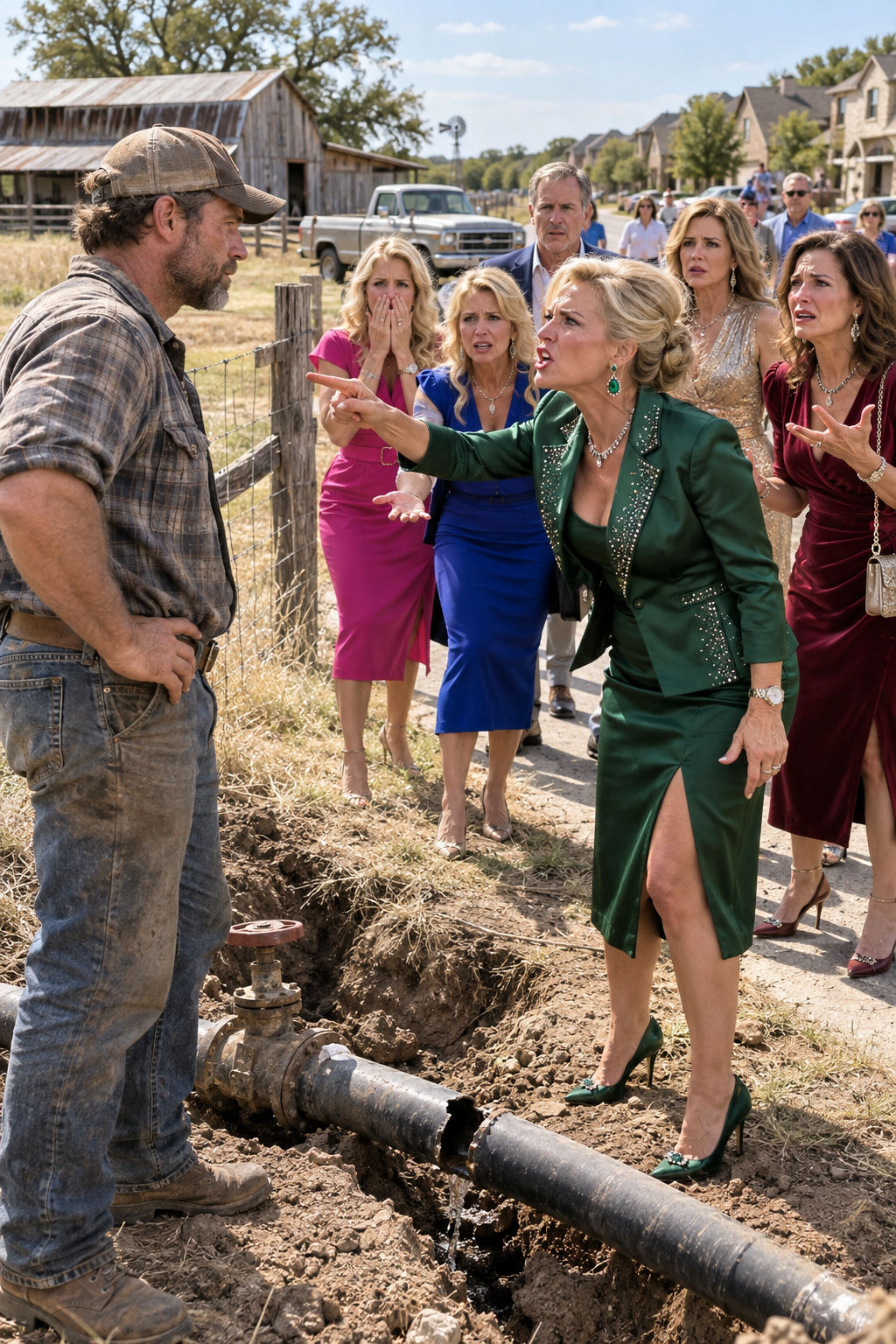
HOA President Cut My Farm Water Line—Then Her Entire Street Went Dry and the Deed She Buried Came Back
The HOA president watched a backhoe rip through my farm’s water line at on a Tuesday morning, then smiled at me through her sunglasses and said, “Maybe now you’ll understand that this neighborhood doesn’t revolve around some old woman’s tomatoes.”
Three hours later, every faucet on her street went dry.
By sunset, she was standing at my gate with two HOA board members, my own son, and a county deputy, demanding that I “turn their water back on.”
I was sixty-four years old.
I had spent thirty-eight of those years learning that the most dangerous person in a room was rarely the one shouting.
So I didn’t shout.
I didn’t cry.
I didn’t even ask them to leave.
I just slid one hand into the pocket of my faded denim jacket, touched the little brass key my late husband had told me never to lose, and asked a question so softly that everybody leaned closer.
“Are you sure that pipe belonged to you?”
For the first time all day, HOA president Pamela Whitfield stopped smiling.
My name is Evelyn Mercer, and Mercer Farm sits on eighty-six acres outside Briar Glen, Virginia, where suburban money has been crawling steadily into old farmland for twenty years.
The farm isn’t glamorous.
The farmhouse porch leans slightly to the east.
The barn roof has three different shades of red because my husband, Samuel, believed paint should be used until the can was empty, regardless of whether the next can matched.
There’s a white oak near the creek that was already old when Samuel’s grandfather was a boy.
There are chicken scratches on the mudroom door where our son Daniel measured his height every birthday until he turned seventeen and decided caring about home was embarrassing.
And behind the north pasture, beneath a line of sycamores, runs a buried water main almost nobody knew existed.
Almost nobody.
Samuel knew.
And according to what I would discover that week, Pamela Whitfield had spent the better part of three years making sure nobody else did.
Briar Glen Estates had not existed when Samuel and I married.
Back then, the land beyond our eastern fence belonged to a dairy farmer named Earl Thompson, who could spit tobacco farther than most men could throw a baseball.
Earl sold eventually.
Developers came.
Roads were cut.
Houses rose like polished teeth.
Then came stone entrance pillars, ornamental ponds, mailboxes that all had to be the exact same shade of black, and an HOA that sent people warning letters because their garbage cans were visible for eleven minutes after collection.
Samuel hated it.
I mostly ignored it.
Our deed predated the subdivision by nearly seventy years.
We were not HOA members.
We never signed covenants.
We never paid dues.
Every few years, some newly elected board member would send us a violation notice anyway.
Samuel would mail it back with the same four words written in blue ink.
Not subject to HOA.
That usually ended things.
Then Samuel died.
Pancreatic cancer.
Four months from diagnosis to funeral.
If you’ve never watched the person who built your whole adult life become smaller inside a hospital bed, there is no useful way to explain it.
Samuel had hands that could rebuild a carburetor in the dark.
By the end, those hands could barely lift a coffee cup.
But his mind stayed sharp.
Three nights before he died, he asked Daniel to leave the hospital room.
Daniel looked hurt.
Samuel insisted.
When the door closed, Samuel pointed toward the old brown leather satchel sitting beneath my chair.
“Take that home.”
“No,” he whispered. “Listen to me, Evie.”
Samuel had called me Evie since our first date.
I leaned closer.
“In the bottom of my desk there’s a false panel. Brass key. Don’t open it unless somebody comes after the north line.”
“What north line?”
His eyes stayed on mine.
“You’ll know.”
I thought morphine was making him confused.
“Promise me.”
I promised.
Then he said something I didn’t understand for nearly eighteen months.
“They’ll make it look like you’re the trespasser.”
I asked who “they” were.
Samuel only shook his head.
“Paper can steal more land than a bulldozer, Evie. Remember that.”
He died three days later.
For a long time, I forgot about the brass key.
Grief does that.
People imagine grief as a storm.
A storm announces itself.
Grief is more like discovering that gravity has changed while everyone else expects you to keep walking normally.
After the funeral, Daniel began coming around more.
At first, I was grateful.
He repaired a porch step.
Helped file insurance forms.
Changed the oil in Samuel’s old Ford.
His wife, Lauren, started bringing casseroles and talking about how “lonely” the farmhouse must feel.
Then their concern shifted.
Almost invisibly.
“Mom, eighty-six acres is too much for one person.”
“Mom, you shouldn’t be climbing on tractors.”
“Mom, property taxes aren’t getting cheaper.”
“Mom, what happens if you fall?”
I told them the farm was paid for.
I had savings.
I had neighbors.
I had no intention of leaving.
They backed off.
Then Pamela Whitfield arrived.
She was fifty-seven, tall, auburn-haired, always dressed as if a photographer might suddenly appear.
Pamela owned a large gray house on Hawthorne Circle, the most expensive street in Briar Glen.
Her husband, Charles, ran a regional construction company.
Her oldest daughter sold luxury real estate.
Pamela herself had no official job anyone could identify, but she treated HOA president like an elected federal office.
The first time she visited after Samuel died, she brought white lilies.
Samuel hated lilies.
He called them funeral flowers.
Pamela placed them on my kitchen table and said, “I want you to know Briar Glen considers you part of our community.”
“That’s kind of you.”
“We’ve always had a complicated relationship with the farm.”
“We’ve never had one.”
Her smile tightened.
She looked through my kitchen window toward the north field.
“There are opportunities now.”
“For what?”
“Connectivity.”
It was one of those words people use when they want something but don’t want to tell you exactly what.
I poured coffee.
Pamela refused because she was doing a cleanse.
Then she unfolded a glossy site plan across my table.
Walking trails.
A playground.
A widened drainage corridor.
A landscaped buffer.
And a green strip cutting across four acres of my north pasture.
I stared at it.
“What’s this?”
“An easement.”
“I haven’t explained.”
“You don’t need to.”
Pamela gave a short laugh.
“Evelyn, this could raise property values across the entire community.”
“Good for the community.”
“It could benefit your farm too.”
“My cows don’t check Zillow.”
The smile disappeared.
She rolled the plan up.
Before leaving, Pamela stood on my porch and looked toward the old pump house near the sycamores.
Not casually.
Not accidentally.
She studied it.
That was the first time I remembered Samuel’s warning.
They’ll make it look like you’re the trespasser.
A month later, the notices began.
First, the HOA claimed runoff from my pasture was reaching their ornamental pond.
A county inspector tested the water and found no violation.
Then they complained my tractor noise violated quiet hours.
The sheriff’s office reminded them farms are allowed to operate farm equipment.
Then they claimed my cattle fencing was “visually inconsistent with neighborhood standards.”
My attorney sent a one-page letter explaining, again, that Mercer Farm was outside HOA jurisdiction.
Each complaint died.
Another replaced it.
I never raised my voice.
I never attended their meetings.
I never argued online.
That seemed to make Pamela more angry than fighting would have.
People like Pamela needed an audience.
I kept refusing to become one.
Then Daniel changed.
He began using phrases that didn’t sound like him.
“Highest and best use.”
“Asset optimization.”
“Unrealized equity.”
One Sunday afternoon, he sat at my kitchen table with Lauren and a real-estate folder.
“Mom, just listen.”
“You don’t even know what I’m saying.”
“You brought a folder.”
Lauren exhaled.
“Evelyn, we’re trying to help.”
I looked at Daniel.
“What’s the number?”
He blinked.
“The offer.”
Then he pulled out a sheet.
Three-point-two million dollars.
The creek where Samuel taught Daniel to fish.
The kitchen where I fed my father during the last year of his life.
The field where Samuel and I buried our Labrador, Scout, beneath a pear tree.
Three-point-two million.
The buyer was a development company called Vantage Land Partners.
I recognized the name.
Charles Whitfield’s construction company had worked with them.
I pushed the paper back.
Daniel rubbed his forehead.
“Mom, be realistic.”
“You’re sitting on land worth millions while driving a fourteen-year-old truck.”
“The truck runs.”
“That’s not the point.”
“It seems like a very important point if you need to get somewhere.”
Lauren rolled her eyes.
Daniel leaned forward.
“You could buy a beautiful condo. Travel. Relax.”
“I relax here.”
“Doing what? Fixing fences?”
He stared at me like I’d admitted to sleeping under a bridge.
Then came the sentence that changed something permanent between us.
“Dad’s dead, Mom. You don’t have to keep pretending this place is still a family farm.”
The refrigerator hummed behind him.
Outside, wind moved through the maple leaves.
I remember those details because pain becomes strangely observant.
I looked at the boy whose fever I had sat through for three nights when he was six.
The boy Samuel had taught to drive a tractor.
The man who had stood at his father’s grave eighteen months earlier with his arm around my shoulders.
I said, “Go home, Daniel.”
Lauren started talking.
I repeated myself.
I did not cry until I heard their car cross the cattle guard.
And even then, I cried for exactly six minutes.
After that, I washed two coffee cups.
Put the chairs back beneath the table.
Walked into Samuel’s old office.
And found the brass key.
The false panel was where he’d said.
Behind it sat a metal document box.
I unlocked it.
Inside were property surveys, handwritten ledgers, utility agreements, photographs, two notarized affidavits, and a sealed envelope with my name on it.
EVELYN — ONLY IF THEY TOUCH THE NORTH LINE.
I sat down.
For ten full minutes, I didn’t open it.
I knew Samuel.
He wasn’t dramatic.
He didn’t write mysterious letters for entertainment.
Finally, I slid my finger beneath the flap.
If you’re reading this, someone has either challenged the spring line, the north main, or access to the pump house.
Do not argue with them.
Do not explain what you know.
Do not sign anything.
Call Martha Kline.
Her number is in the red ledger.
Ask one question only:
“Was Exhibit C ever extinguished?”
If the answer is no, then the land is still protecting itself.
Trust the original deed, not the subdivision maps.
And if Daniel is involved, forgive him if you can, but do not save him from the consequences.
Love always,
I read it three times.
Then I opened the red ledger.
Martha Kline was an attorney in Richmond.
Retired, according to the first internet search I did.
Seventy-four years old.
I called anyway.
She answered on the fourth ring.
“Martha Kline.”
“My name is Evelyn Mercer.”
Then, “Samuel’s Evelyn?”
My throat tightened.
“Is Samuel—”
“He died eighteen months ago.”
Another silence.
“I’m sorry.”
“Thank you.”
I looked at his letter.
“Was Exhibit C ever extinguished?”
Martha inhaled sharply.
That was all she said.
Then she asked, “Who touched the line?”
“No one yet.”
“I think somebody intends to.”
Martha’s voice changed.
The softness disappeared.
“Evelyn, listen carefully. Do not give copies of anything in that box to the HOA. Do not give copies to your son. Do not let anyone remove original documents from your house. Photograph everything. Put the originals somewhere secure.”
“Because Exhibit C isn’t just an easement.”
“What is it?”
“It’s the reason Briar Glen has water.”
That was my secret.
Not buried gold.
Not some surprise bank account Samuel had hidden.
In 1964, Samuel’s grandfather, Henry Mercer, had allowed the county’s predecessor water district to install a main across Mercer land because the surrounding area had wells that failed during dry summers.
The agreement granted a narrow utility easement beneath the north field.
In exchange, Mercer Farm retained permanent priority service through the original spring-fed line and control rights over a junction chamber built beside the pump house.
Years later, when Briar Glen was developed, the subdivision connected to that same main.
But there was more.
Exhibit C required any new development drawing from that branch to maintain the Mercer line, preserve access, and obtain written consent before relocating, severing, or modifying infrastructure within the protected corridor.
Without that consent, the agreement allowed the Mercer property owner to demand immediate isolation of any unauthorized downstream connections until the line was inspected.
Martha explained it twice.
I still thought I’d misunderstood.
“You’re saying Samuel could have shut their water off?”
“No. Not casually. Not as retaliation. But if the protected main was physically compromised by unauthorized work, the downstream branch could be isolated for safety.”
“Who controls the valve?”
I looked out the window toward the little pump house.
For thirty years, I had thought that building contained old irrigation equipment and a filtration bypass.
“Samuel never told me.”
“He hoped he’d never need to.”
“Why didn’t the HOA know?”
“Oh, somebody knows.”
Martha’s voice sharpened.
“The original developer knew. The county utility authority knows. And unless records disappeared, every title company involved in the first phase of Briar Glen knew.”
She paused.
“The question is whether the current board knows.”
I thought of Pamela staring toward the pump house.
“I think one of them does.”
Three weeks later, my own son served me eviction papers.
Not from the farm.
From my farmhouse.
The document was absurd at first glance.
Daniel claimed that Samuel had transferred the farmhouse and twelve surrounding acres into a family trust six years before his death, naming Daniel successor trustee.
According to Daniel’s attorney, I had only a revocable right of occupancy.
According to the paperwork, Daniel had terminated that right.
I had fourteen days to leave.
My hands did not shake.
That frightened me more than shaking would have.
I called Daniel.
He answered immediately.
“What did Pamela offer you?”
Then anger.
“This has nothing to do with Pamela.”
“So she offered you something.”
“You’re twisting this.”
“How much?”
“We’re trying to protect the property.”
“Lauren and I.”
“No. You and whoever explained ‘highest and best use’ to you.”
My son had never sworn at me before.
Then he said, “You don’t understand what you’re sitting on.”
I looked at Samuel’s gray box on the table.
“I think I understand more than you do.”
Daniel lowered his voice.
“You have fourteen days. Don’t make this ugly.”
Then I called Martha.
She drove down the next morning.
She was small, silver-haired, and carried two briefcases despite walking with a cane.
She read Daniel’s documents at my kitchen table.
Halfway through, she took off her glasses.
“Where did he get this?”
“I assumed Samuel created it.”
“He did create a trust.”
My stomach tightened.
“But not this one.”
Martha tapped the signature page.
“This signature is Samuel’s. Or a good copy of it. But this schedule of assets was altered.”
“How can you tell?”
“Because I drafted the original.”
She opened her briefcase.
Pulled out a certified copy.
Samuel had placed some equipment and investment property into the Mercer Family Trust.
Not the farmhouse.
Not the eighty-six acres.
The farm transferred directly to me upon his death through a survivorship deed recorded in 1998.
Daniel’s lawyer had attached a different Schedule A.
One that included twelve acres and the residence.
Martha leaned back.
“This isn’t a misunderstanding.”
“What is it?”
“Potentially fraud.”
I stared at my son’s signature.
Martha looked at me.
“You can call the sheriff.”
“If Daniel forged it, I want to know why.”
“You know why.”
“No. I know what he wants. I want to know who taught him how to steal it.”
Martha studied me for several seconds.
Then she smiled without humor.
“Samuel always said you were more dangerous when you got quiet.”
For the next five days, I behaved like a woman preparing to lose.
That was deliberate.
I packed boxes.
I let Lauren see them when she arrived unexpectedly.
I moved clothing into my sister Ruth’s guest room.
I allowed Daniel to think his paperwork had frightened me.
I even carried Samuel’s framed photograph to my truck while Pamela happened to be driving past.
She slowed.
I saw her watching.
I lowered my eyes.
She drove on.
That night, I returned through the back lane and installed two trail cameras overlooking the north field.
Not because I was psychic.
Because the altered trust documents included twelve acres.
The exact twelve acres containing the pump house.
Pamela didn’t want my kitchen.
She wanted the water corridor.
She wanted control of the thing beneath it.
On Friday morning, Daniel appeared with Pamela and a man named Grant Ellis, who introduced himself as a land-use consultant.
He wore loafers too clean for a farm.
Pamela looked around the kitchen as though mentally removing my furniture.
“We thought it might be productive to discuss an orderly transition.”
I poured myself coffee.
Nobody else got any.
Grant opened a map.
Pamela stood behind him.
Daniel wouldn’t meet my eyes.
Grant said, “Once Daniel assumes control, the HOA would like to formalize access across the north parcel.”
“For what?”
“Drainage modernization.”
Pamela added, “And possibly recreational improvements.”
I looked at her.
“The walking trail again?”
“We’ve expanded the concept.”
“Of course you have.”
Daniel exhaled impatiently.
“Mom, just sign the access acknowledgment.”
He slid a document toward me.
I didn’t touch it.
“What happens if I don’t?”
“You’re leaving anyway.”
There it was.
Not a son speaking to his mother.
A future owner speaking to an obstacle.
I felt something cold settle inside me.
Not hatred.
Not exactly.
I looked at Daniel and saw the cost of every excuse I had ever made for him.
I remembered paying his first apartment deposit.
I remembered Samuel refinancing equipment so Daniel could finish college without loans.
I remembered giving him twenty-two thousand dollars after his restaurant investment collapsed.
I remembered keeping all of that secret from Lauren because Daniel had been ashamed.
I remembered making Christmas happen the year Samuel’s harvest failed.
I remembered selling my grandmother’s diamond earrings to replace a tractor transmission because Daniel’s tuition payment was due the next week.
I remembered being told I was “too sentimental” about land purchased partly with sacrifices he had never even known existed.
I had fed him here.
I had forgiven him here.
I had buried my husband here.
I had stayed when leaving would have been easier.
I had stayed when selling would have been richer.
I had stayed when grief made every room hurt.
And now my son was handing me a pen so strangers could carve through the ground his father had protected.
I said, “Daniel, do you remember the summer you were thirteen and the well went dry?”
He frowned.
“Do you remember?”
“Your father hauled water for seven families on Old Mill Road.”
Pamela shifted.
Daniel stared at me.
“What does that have to do with anything?”
I pushed the document back.
“Just remembering.”
Pamela’s smile returned.
“You have three days remaining under the occupancy notice.”
Martha, seated silently near the window, finally spoke.
“Actually, Mrs. Whitfield, she has forever.”
Everybody turned.
Pamela blinked.
“Excuse me?”
Martha placed a certified deed on the table.
“The property transfer you are relying upon is defective.”
Daniel went pale.
Grant Ellis immediately stopped touching the map.
Pamela recovered first.
“This is a family matter.”
“No,” Martha said. “It became a criminal matter when someone submitted an altered trust schedule as evidence of ownership.”
Daniel stood.
“Criminal?”
Pamela snapped, “Sit down.”
It was instinctive.
Too authoritative.
Daniel obeyed.
And in that tiny moment, I understood the structure.
Pamela wasn’t helping Daniel.
Daniel was helping Pamela.
Martha noticed too.
Pamela picked up her handbag.
“This conversation is becoming hostile.”
I almost laughed.
Nobody had raised their voice.
“Then leave,” I said.
Grant followed.
Daniel stayed behind.
For perhaps ten seconds, we were alone except for Martha.
“Mom,” he whispered.
“How much?”
His face crumpled.
Not with remorse.
“Pamela said the land transfer was legal.”
“How much?”
“She said Vantage would pay four-point-eight if we cleared the title.”
“She said I’d get a development share.”
“How much, Daniel?”
“Six hundred thousand.”
There are betrayals so large they stop feeling emotional and become mathematical.
Thirty-eight years raising a son.
Six hundred thousand dollars.
Daniel stepped toward me.
“Mom, I didn’t know the trust page was changed.”
“But you served it.”
“My attorney handled—”
“You served it.”
“I thought Dad intended—”
“You served your mother an eviction notice.”
He looked at the floor.
Martha gathered her papers.
Daniel said, “I can fix this.”
I looked at him.
“No. You can cooperate.”
“With what?”
“The truth.”
He left without answering.
The following Tuesday morning, the backhoe arrived.
My trail camera notified my phone at .
I was feeding chickens.
I opened the video.
A yellow excavator was crossing the north field through a temporary gap someone had cut in my fence.
Behind it came Pamela’s silver SUV.
A Briar Glen maintenance truck.
Two men in fluorescent vests.
And a white pickup marked Whitfield Regional Construction.
I called Martha.
Then the county utility authority.
Then the sheriff.
Then I walked toward the north field.
By the time I reached the sycamores, the backhoe bucket had already exposed the water line.
Pamela stood beside it holding a rolled site plan.
She wore white slacks and an emerald blouse.
I remember thinking Samuel would have laughed at anyone wearing white slacks in a cattle pasture.
“Stop,” I called.
The operator looked toward me.
Pamela raised one finger.
He stopped.
“This is private property.”
Pamela’s expression was almost bored.
“Daniel authorized access.”
“Daniel doesn’t own this property.”
“That’s disputed.”
“No, it isn’t.”
She stepped closer.
“We’re addressing an emergency drainage conflict.”
“With my water line?”
“The line is improperly located inside an HOA service corridor.”
I stared at her.
There it was.
They’ll make it look like you’re the trespasser.
I said, “That line was installed before your subdivision existed.”
Pamela shrugged.
“Records differ.”
Behind her, one worker avoided eye contact.
I noticed fresh blue utility markings on the grass.
Not official markings.
Spray-painted.
I pulled out my phone.
Pamela smiled.
“Go ahead. Film.”
“I already am.”
That changed her expression slightly.
“What exactly are you doing?”
“We’re removing an unauthorized agricultural connection.”
“My connection?”
“To whose line?”
“The Briar Glen main.”
I looked at the excavator operator.
“Did the utility authority approve this?”
He glanced at Pamela.
Pamela said, “All necessary permissions are being addressed.”
Being addressed.
Not approved.
Not issued.
Not obtained.
Being addressed.
I called the county utility supervisor, Ray Holloway, on speaker.
“Ray, I’m standing at the north junction. There’s an excavator exposing the main.”
Ray went silent.
Then he said, “Nobody touches that main.”
Pamela’s jaw tightened.
She stepped toward my phone.
“Who is this?”
“Ray Holloway. County Water Utility.”
Pamela changed tone instantly.
“Mr. Holloway, Pamela Whitfield, Briar Glen HOA president. We’re correcting an unauthorized spur—”
“No, ma’am. You are not.”
The workers stopped moving.
Ray continued.
“That is a protected legacy main. I have no excavation permit issued at Mercer Farm.”
Pamela’s face hardened.
“Well, your office should check its records.”
“I’m looking at them.”
She glanced at the operator.
That was the moment.
One tiny look.
The bucket moved.
I heard the pipe crack before I understood what I was seeing.
A sharp metallic pop.
Then soil jumped.
Water exploded from the trench.
Not a garden-hose spray.
A white, roaring column slammed against the excavator bucket and blasted mud across the field.
The operator shouted.
Workers ran backward.
Pamela stumbled and fell to one knee in the mud.
I stepped away.
Ray Holloway’s voice erupted from my phone.
“SHUT THAT MACHINE DOWN!”
The water kept coming.
Hundreds of gallons.
Maybe thousands.
The trench filled.
Mud spread toward the lower pasture.
Pamela climbed to her feet, soaked from the knees down.
She looked furious.
Not afraid.
“You see?” she shouted over the water. “Your illegal connection ruptured!”
I wiped mud from my cheek.
“That wasn’t my connection.”
Her face changed.
Ray Holloway was shouting instructions through my phone.
“Evelyn, can you access the north valve house?”
“Do it now. We have to isolate that branch.”
Pamela stared at me.
“What branch?”
I didn’t answer.
I walked toward the pump house.
She followed.
“Evelyn, what branch?”
I took the brass key from my jacket.
Samuel’s key.
The lock opened.
Inside was a steel wheel valve, old but maintained, beside a newer county isolation mechanism.
Ray talked me through the sequence.
“Turn the legacy gate clockwise until resistance. Then pull the red isolation lever.”
I put both hands on the wheel.
Pamela appeared in the doorway.
“You are not authorized to touch municipal equipment.”
Ray heard her.
“Yes, she is.”
Pamela froze.
I turned the wheel.
Three times.
The roar outside weakened.
Then I pulled the red lever.
Somewhere beneath eighty-six acres of dirt, water stopped moving east.
The geyser died.
Silence rolled over the field.
Pamela’s phone rang.
She ignored it.
It rang again.
Then Grant Ellis called her.
Then another board member.
Then someone else.
She finally answered.
Her expression went blank.
“What do you mean, no water?”
I closed the pump-house door.
Within ninety minutes, forty-one homes along Hawthorne Circle and Brookstone Lane had dry taps.
The clubhouse had no water.
Two irrigation systems shut down.
The decorative fountain at Briar Glen’s entrance stopped.
Pamela’s own home lost service.
And because the broken main required contamination testing, the county utility authority issued a temporary boil-water advisory for the entire connected branch once service returned.
Pamela blamed me immediately.
By noon, the Briar Glen community Facebook page said I had “vindictively shut off water to innocent families.”
At 12:22, someone posted that I was “holding the neighborhood hostage.”
At 12:47, Pamela herself posted a statement claiming the HOA had attempted to correct “an unsafe, unauthorized farm tap.”
At , Ray Holloway arrived with three utility trucks.
At , he informed Pamela in front of two sheriff’s deputies that the excavated line was a county-recognized legacy main.
At , he asked who had authorized the digging.
Pamela pointed at Daniel.
My son had just arrived.
Daniel stared at her.
“You provided landowner consent.”
“For access.”
“You signed authorization.”
“For surveying.”
Pamela turned toward Ray.
“You’ll need to speak with our counsel.”
Ray said, “I will. Right after I speak with the state utility commission.”
That was the first mini-collapse.
The second came thirty minutes later.
One of the workers—the one who had avoided my eyes—walked over to Deputy Harris and handed him his phone.
“I want it on record,” he said.
Pamela spun around.
“What are you doing, Eric?”
The worker swallowed.
“She told us the county had approved it.”
Pamela stepped toward him.
“Be careful.”
Deputy Harris moved between them.
Eric continued.
“She told us Mrs. Mercer refused to remove an illegal pipe, and Daniel Mercer was the current property owner.”
Daniel whispered, “Jesus.”
Eric showed the deputy a text message.
I couldn’t read it from where I stood.
But I watched Pamela’s face lose color.
The third collapse came at .
Martha arrived carrying the original Exhibit C agreement.
Ray read it beside his truck.
Then read it again.
He called someone at the county records office.
Ten minutes later, he looked at me.
“Mrs. Mercer, you need a lawyer.”
“I have one.”
“I mean another one.”
Martha smiled.
“That’s usually a compliment.”
Ray shook his head.
“No. I mean the county may need its own counsel before I explain what this document means.”
Pamela crossed her arms.
“Enough theatrics.”
Ray looked at her.
“Mrs. Whitfield, according to this agreement, Briar Glen’s downstream connection exists under a conditional infrastructure covenant.”
“So unauthorized disturbance of the protected corridor triggers mandatory inspection.”
“And until that inspection is complete, I can’t legally reopen the branch.”
The homeowners standing along the road began muttering.
Pamela stared at him.
“How long?”
“Could be tomorrow.”
Relief flashed across her face.
Ray continued.
“Could be several days.”
People started talking louder.
Then Martha said, “Assuming the downstream connections themselves are compliant.”
Ray looked at her.
“What do you mean?”
Martha handed him another page.
Exhibit C, subsection seven.
His eyebrows rose.
Pamela saw it.
Nobody answered.
Ray folded the document.
“Every additional connection added after the original development requires written acknowledgment from the Mercer property owner.”
Pamela said, “That’s ridiculous.”
Ray looked toward Briar Glen.
“How many homes were in Phase One?”
Grant Ellis had returned by then.
He answered reluctantly.
“Twenty-three.”
Ray nodded.
“How many homes now?”
No one answered.
“One hundred ninety-six.”
Ray looked at me.
“Did you or your husband sign additional acknowledgments?”
“Not that I know of.”
Pamela laughed.
Actually laughed.
“This is obviously obsolete.”
Martha said, “Obsolete agreements don’t become invalid because they’re inconvenient.”
Pamela turned on Daniel.
“You said your father’s papers had been cleared.”
Daniel stared at her.
“I said I couldn’t find anything.”
“You told me—”
“I told you Mom didn’t know anything about the utility documents.”
Everything went still.
Pamela realized too late what he had said.
I looked at my son.
“You searched Samuel’s office.”
He said nothing.
His mouth opened.
Pamela walked away.
That answer was enough.
My son had been looking for the box.
He hadn’t found it because Samuel hid it behind the false panel.
That night, Briar Glen brought bottled water to residents.
Pamela posted another statement.
This time she blamed “antiquated county documentation.”
She said the HOA was “working aggressively toward resolution.”
Then she called me.
I answered from my porch.
“You need to sign the acknowledgment.”
No greeting.
No apology.
Just the demand.
“For one hundred seventy-three homes?”
“You know this is absurd.”
“People have children.”
“So did I.”
“This is not the time for games.”
“You’re using an old legal technicality to punish an entire neighborhood.”
I looked toward the dark field where utility crews worked beneath portable lights.
“No, Pamela. Your excavator broke their water line.”
“It was on your land.”
“You could fix this tonight.”
“I can’t certify connections I haven’t inspected.”
She went quiet.
Then she lowered her voice.
“Name a number.”
There it was.
The language she understood.
“For the corridor.”
“It isn’t for sale.”
“Everything is for sale.”
“Samuel wasn’t.”
“What does that mean?”
“It means you never understood this farm.”
She exhaled.
“You think this is about a walking trail?”
“Then what do you think it’s about?”
“I think you should tell me.”
She laughed once.
“Goodnight, Evelyn.”
She remained on the line.
I asked the question I had been saving.
“If the north line was supposedly worthless, why did you need my son to steal twelve acres instead of buying four?”
Then the call ended.
The next morning, Daniel showed up alone.
He looked terrible.
Same blue shirt as the day before.
I sat on the porch.
He stayed below the steps.
“Pamela lied to me.”
I said nothing.
“She said Dad had already planned to sell.”
“She showed me emails.”
“What emails?”
“Between Dad and Vantage.”
My stomach tightened.
“What did they say?”
“That he was negotiating the north parcel before he got sick.”
“He wasn’t.”
“I know that now.”
“Because Grant admitted the emails were drafts from their side. Dad never answered.”
I stared at him.
Daniel took one step closer.
“Mom, I screwed up.”
“You tried to evict me.”
“You searched your dead father’s office for documents so Pamela Whitfield could buy land from under me.”
He flinched.
“You signed paperwork.”
“I didn’t forge the trust schedule.”
“You used it.”
He started crying.
I hated that part.
It would have been easier if he had stayed arrogant.
“I thought I could get you to sell,” he said. “Then once the money came through, I was going to make sure you were taken care of.”
“Taken care of.”
“I know how that sounds.”
“No. I don’t think you do.”
He wiped his face.
“Lauren and I are in debt.”
“Our house. Credit cards. Her business failed. I borrowed against everything.”
“How much?”
“Four hundred and eighty thousand.”
I closed my eyes.
There it was.
Greed wearing panic like a coat.
“Pamela knew?”
“Lauren told her daughter. They’re friends.”
“And Pamela offered you six hundred thousand.”
Daniel nodded.
Enough to erase his problems.
Enough to make stealing from his mother feel temporary.
I thought of Samuel’s letter.
Forgive him if you can, but do not save him from the consequences.
Daniel looked at me.
“Can you forgive me?”
I studied the porch boards.
“That isn’t today’s question.”
“Will you tell the truth when it costs you?”
He stared at me.
Then nodded.
“Come inside.”
For the next two hours, Daniel told Martha everything.
Pamela’s meetings.
Grant’s maps.
The proposed sale.
The altered trust papers.
The plan to secure the twelve-acre parcel, then grant Vantage permanent access through it.
And one detail none of us expected.
A month before Samuel died, Pamela had visited him in the hospital.
I stopped Daniel.
“She told me they met.”
“Three or four weeks before he died.”
“He never said anything.”
“She said Dad offered her the north parcel.”
Martha frowned.
“Did she have proof?”
“A letter.”
Daniel opened his phone.
He still had a photograph.
I zoomed in.
The letter looked official.
Samuel’s name.
His signature.
An offer to transfer “all rights, title, and utility interests associated with the northern service corridor.”
Martha stared at it for a long time.
Then she said, “That signature may be real.”
I felt cold.
“Samuel could have signed something while sick.”
“Evelyn, I’m not saying he knowingly agreed.”
Daniel whispered, “Pamela said he did.”
I stood and walked into Samuel’s office.
The room still smelled faintly of cedar and machine oil.
I opened the gray box.
Every paper inside had suddenly become more complicated.
At the bottom lay one photograph I had barely noticed before.
Samuel beside the pump house.
Taken years earlier.
On the back, in his handwriting:
IF THEY SHOW YOU MY SIGNATURE, CHECK THE DATE AGAINST ST. ANNE’S.
I brought it to Martha.
She stared at the words.
“St. Anne’s?”
“The hospital.”
Daniel pulled up the photographed letter.
Date: September 14.
Samuel had been admitted to St. Anne’s on September 9.
Martha asked, “Was he competent on the fourteenth?”
I knew exactly what happened that day.
Because September 14 was the day Samuel nearly died from sepsis.
He spent fourteen hours sedated in intensive care.
He could not have sat up.
Could not have held a pen.
Could barely breathe without assistance.
Yet someone had a document carrying his signature dated that day.
Daniel whispered, “Oh God.”
Martha looked at me.
“This was planned before Samuel died.”
That was the first real twist.
Pamela hadn’t exploited my grief after my husband’s death.
She had been waiting before his death.
Which meant Samuel had known.
Which meant his mysterious instructions weren’t paranoia.
They were defense.
By the third day without normal water service, Briar Glen residents were furious.
Not with me anymore.
Videos from the excavation circulated.
Eric, the construction worker, had recorded Pamela ordering the digging after Ray Holloway told us over speakerphone to stop.
Someone posted county records proving Mercer Farm predated Briar Glen by decades.
Then one resident discovered something worse.
For six years, the HOA had charged every homeowner an annual “private water infrastructure assessment.”
Four hundred eighty dollars per house.
Pamela’s board claimed the money maintained HOA-owned water infrastructure.
Except the main they supposedly maintained belonged to the county under the Mercer agreement.
Residents started asking where the money went.
One hundred ninety-six homes.
Four hundred eighty dollars.
More than half a million dollars.
Pamela called an emergency HOA meeting.
I didn’t attend.
I didn’t need to.
Thirty-two residents came to my farm afterward.
Not to complain.
To apologize.
One was a woman named Kelly Adams with two young boys.
She stood on my porch holding a case of bottled water.
“This feels stupid,” she said, glancing at the water. “Considering.”
“I’ll use it.”
She looked toward the north field.
“Pamela told us you’d been stealing water from Briar Glen for years.”
“She said your farm was illegally attached to us.”
Kelly’s face reddened.
“I believed her.”
“That happens.”
“She wants us to sue you.”
“That might also happen.”
Kelly swallowed.
“My husband found this.”
She handed me a photocopy.
It was an HOA budget.
Private Water Reserve Fund.
Annual collections.
One line repeated every year:
Mercer Corridor Maintenance — $38,500.
I looked at Kelly.
“Who got paid?”
“That’s the thing.”
She pointed to a vendor code.
WRC Infrastructure.
Whitfield Regional Construction.
Pamela’s husband’s company.
The HOA had been paying her husband tens of thousands of dollars each year to “maintain” a corridor on my property that they legally had no right to access.
I called Martha.
She said one word.
“Interesting.”
By Friday, the county restored temporary water after installing an emergency bypass.
But permanent service required resolution of the damaged protected main and confirmation of downstream rights.
That gave Pamela what she needed most.
She used it badly.
Saturday morning, she came to my farm again.
This time without makeup.
Without sunglasses.
Without board members.
She parked outside the gate and walked in.
I was repairing a section of chicken wire.
“You’ve made your point,” she said.
I kept working.
I twisted the wire tighter.
“People are suffering.”
“They have water.”
“Temporary water.”
“Talk to the county.”
“I’m talking to you.”
I straightened.
She looked older.
For the first time, I could see fear underneath the polish.
“What do you want?” she asked.
“That’s impossible.”
“It really isn’t.”
“A public apology?”
“My resignation?”
“That’s between you and your neighbors.”
Her composure cracked.
“Then what?”
“The truth.”
She laughed bitterly.
“There is no single truth.”
“There is when someone forges my husband’s signature.”
Her face went still.
She knew about the letter.
“You should be careful making accusations.”
“You should be careful dating documents on days the signer was unconscious.”
Pamela’s lips parted.
A tiny movement.
The first clean hit.
I stepped closer.
“September fourteenth.”
She recovered.
“I have no idea what you’re talking about.”
“St. Anne’s does.”
Pamela turned toward her SUV.
She stopped.
“Why twelve acres?”
“The water easement is only forty feet wide.”
She turned.
“You’ve already asked me that.”
“You still haven’t answered.”
She looked past me toward the north pasture.
Then she said something strange.
“Samuel should have sold when he had the chance.”
My skin prickled.
“What chance?”
Pamela realized she had gone too far.
She opened her car door.
I asked, “What’s under those twelve acres?”
She drove away.
Martha and I spent the afternoon going through Samuel’s box again.
Every page.
Every survey.
Every handwritten note.
Near dusk, I found an envelope stuck inside the back cover of an old soil conservation binder.
Inside was a geological map.
Samuel had circled part of the north parcel in red.
Beside it he wrote:
1967 county test.
Martha searched the file index.
We drove to the county archive Monday morning.
The clerk brought out microfilm from an old public-works project.
In 1967, when the water main was installed, engineers had drilled test cores through the north field.
They weren’t looking for minerals.
They were checking bedrock stability.
But the report noted something.
A large underground limestone cavity.
Not unusual in Virginia.
What mattered was its later use.
A handwritten addendum from 1971 referenced a “sealed civil-defense storage chamber adjacent to utility junction.”
Martha looked at me.
“Do you have a bunker?”
“I have cows.”
The archive clerk laughed.
Then stopped when neither of us did.
We kept digging.
The chamber had been constructed during Cold War civil-defense planning.
County emergency supplies had once been stored there.
It was officially decommissioned in 1989.
Ownership reverted to the surface landowner.
Samuel’s father apparently sealed the access.
Still not worth stealing twelve acres.
Then Martha found the final document.
A fiber communications easement.
An early regional telecom company had installed a hardened underground conduit through the old chamber because it already offered secure protected access beneath the utility corridor.
That company had merged.
Then merged again.
The conduit was now part of a regional backbone carrying data between two major network hubs.
The annual easement payments had been routed into an account Samuel managed.
I knew about a small “utility lease.”
I thought it paid a few thousand dollars.
The most recent renewal option, due the following year, was projected at nearly nine hundred thousand dollars for ten years.
But even that wasn’t the biggest issue.
The easement gave the Mercer owner veto authority over surface development that could interfere with the buried conduit.
Vantage couldn’t build its planned road.
Couldn’t expand Briar Glen.
Couldn’t install the luxury clubhouse Pamela wanted.
Couldn’t do anything without whoever controlled those twelve acres.
Pamela didn’t want my farm because it was pretty.
She wanted the choke point.
Three separate infrastructure rights crossed beneath the same forgotten piece of pasture.
And Samuel had known every one of them.
I finally understood why he had kept the documents quiet.
People value land differently when they know what runs underneath it.
That afternoon, Martha called an old contact at the telecom company.
By five o’clock, three corporate attorneys wanted to speak with us.
By six, so did county counsel.
By Tuesday, Pamela Whitfield resigned as HOA president.
She claimed “personal health reasons.”
Nobody believed her.
The board voted to open its financial records.
Grant Ellis disappeared from every meeting.
Whitfield Regional Construction removed its equipment from Briar Glen.
Daniel signed a sworn statement describing Pamela’s role in the attempted land transfer.
His own lawyer told him to prepare for questions from investigators.
I did not protect him.
That was one of the hardest things I have ever done.
A mother’s instinct does not disappear when her child becomes guilty.
It simply becomes painful to resist.
Daniel came to see me before giving his statement to the Commonwealth’s Attorney.
He stood in Samuel’s office.
“I keep thinking about Dad’s last week.”
“Do you think he knew I could do something like this?”
I looked at Samuel’s empty chair.
Daniel looked relieved.
Then I finished.
“I think he knew anybody could do something like this if they got scared enough and greedy enough.”
Daniel’s relief vanished.
“That’s worse.”
After a while he said, “Lauren left.”
I already knew.
Ruth had heard from someone in town.
“I’m sorry.”
“You shouldn’t be.”
“You’re still my son.”
He wiped his eyes.
“Do you still love me?”
That hurt him more than anger would have.
“But loving you doesn’t mean lying for you.”
“And it doesn’t mean giving you this farm.”
“And it does not mean paying your debts.”
He closed his eyes.
Samuel had been right.
Do not save him from the consequences.
Daniel left twenty minutes later.
I watched him drive away in the same old pickup Samuel helped him buy after college.
For the first time since this began, I cried.
Not because I had lost.
Because winning did not restore what betrayal had taken.
People love revenge stories because they usually end before that part.
They end when the liar is exposed.
When the sheriff arrives.
When the contract collapses.
When the arrogant person stops smiling.
Real life keeps going.
You still wake up the next morning.
The coffee still needs making.
The chickens still need feeding.
And the son who once slept against your shoulder during thunderstorms is still the man who signed a paper trying to remove you from your own home.
Justice does not erase grief.
It simply gives grief a boundary.
Two weeks after the water line was cut, permanent repairs were completed.
The HOA signed a new infrastructure acknowledgment recognizing Mercer Farm’s original rights.
The county agreed to install separate monitoring equipment.
The telecom company renewed its easement early.
I placed most of the money into a land-conservation trust.
That surprised everyone.
Daniel assumed I would sell.
Pamela assumed I wanted millions.
Vantage assumed every obstacle had a price.
They were all wrong.
Samuel and I had spent our lives watching farms disappear beneath subdivisions.
I did not need a yacht.
I did not need a penthouse.
I did not need strangers congratulating me for becoming rich at sixty-four.
I needed the white oak to still be standing when I was gone.
I needed the creek protected.
I needed the pasture Samuel’s grandfather bought after coming home from war to remain something more meaningful than luxury townhomes named after whatever they destroyed.
So I created the Samuel Mercer Agricultural Stewardship Trust.
The farm could be worked.
Passed to responsible heirs.
But the core land could never be turned into a subdivision.
The infrastructure income would fund preservation and scholarships for local agricultural students.
For the first time in months, I slept through the night.
Pamela’s house went up for sale.
Charles Whitfield’s company came under audit after HOA financial records showed nearly $640,000 in payments tied to questionable infrastructure work.
Grant Ellis hired a lawyer.
The Commonwealth’s Attorney began reviewing the altered trust document and Samuel’s forged letter.
Daniel accepted responsibility for using paperwork he had reason to doubt.
He wasn’t charged with forgery, at least not then, but his sworn statement made him a witness in a much larger investigation.
Briar Glen elected a new board.
Kelly Adams became treasurer.
Their first vote abolished the private water assessment.
Their second ordered a forensic audit.
Their third was to send me a formal apology.
I framed it.
Not because I needed the apology.
Because Samuel would have found the whole thing hilarious.
For almost a month, I thought that was the end.
Then on a rainy Thursday afternoon, Martha called.
Her voice sounded different.
“Evelyn, are you home?”
“Is anyone with you?”
“Lock the door.”
My hand tightened around the phone.
“What happened?”
“I received something.”
“Samuel left a second set of instructions.”
I sat down.
“That’s impossible.”
“With another attorney.”
“He apparently instructed her not to release them unless someone attempted to transfer the north parcel.”
Rain tapped against the kitchen window.
“When did she contact you?”
“This morning.”
“What do the instructions say?”
Martha went quiet.
“There’s a second deed.”
I stopped breathing for a second.
“That’s the problem.”
“What do you mean?”
“It isn’t a deed to Mercer Farm.”
Thunder rolled somewhere beyond the ridge.
Martha continued.
“It’s a deed Samuel acquired in 2004.”
“For what property?”
“A narrow strip running east from your boundary.”
“How narrow?”
“Thirty feet.”
I pictured the maps.
Nothing made sense.
“How long?”
“Almost two miles.”
My stomach tightened.
“Through Briar Glen?”
“Under it.”
“The original access corridor beneath Hawthorne Circle.”
“Martha, speak plainly.”
“According to the recorded deed, Samuel quietly purchased the underlying corridor after the original developer went bankrupt.”
“I don’t know yet.”
“What does that mean?”
“It means the HOA may own the road surface.”
Rain hammered harder against the glass.
Martha inhaled.
“But you may own the land beneath the main entrance road, the water branch, the fiber conduit, and thirty feet under forty-one homes.”
I gripped the kitchen counter.
“That can’t be right.”
“I thought so too.”
“Then check again.”
A vehicle turned into my driveway.
Headlights moved through the rain.
I looked out.
No county markings.
No HOA logo.
It stopped beside Samuel’s old truck.
Two men stepped out.
Dark jackets.
One carried a hard-sided document case.
“Someone’s here.”
“I don’t know.”
A knock struck the front door.
Three times.
Deliberate.
I walked into Samuel’s office and reached for the gray metal box.
Another knock.
Then a man called through the door.
“Mrs. Mercer? We represent Atlantic Commonwealth Infrastructure. We need to speak with you about your husband.”
Martha whispered, “Do not open that door.”
The man outside continued.
“Specifically, we need to discuss what Samuel Mercer discovered beneath Hawthorne Circle in 2003.”
My eyes moved to Samuel’s photograph on the desk.
Then to the brass key.
Then to one sentence written on the back of the picture that I had always assumed referred only to the water line.
IF THEY FIND THE CORRIDOR, THEY WILL COME FOR THE FARM.
The man knocked again.
And standing there in the house my son had tried to take, on land an HOA had tried to steal, with a second deed I had not known existed and forty-one families apparently living over something my dead husband had hidden for twenty-three years, I finally understood that Pamela Whitfield had never been the most dangerous person in this story.
She had only been the first one desperate enough to dig.
I stepped toward the locked door, kept my hand on the brass key, and asked the weakest-sounding question I could think of.
“What exactly did my husband find?”
✓ Lynn R. Adams
HOA President Cut My Farm Water Line—Then Her Entire Street Went Dry and the Deed She Buried Came Back The HOA president watched a backhoe rip through my farm’s water line at on a Tuesday morning, th…