HOA Karen Used My Private Garage to Hide Three Trucks—Then My Lock Triggered 72 Hours That Exposed Her Biggest Secret
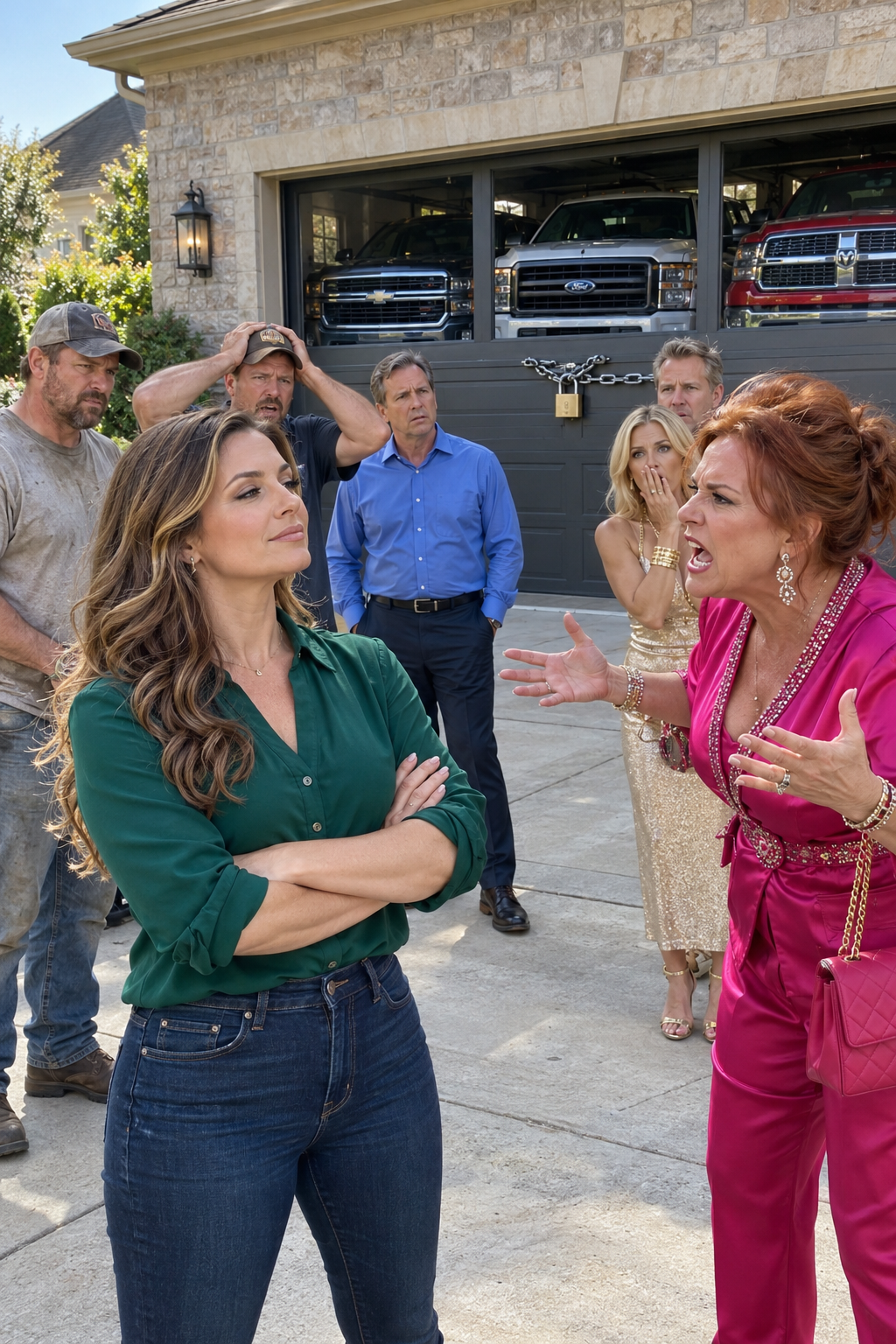
HOA Karen Used My Private Garage to Hide Three Trucks—Then My Lock Triggered 72 Hours That Exposed Her Biggest Secret
“Your father’s garage is community property now, sweetheart. If you don’t like it, you can move.”
That was what Karen Whitfield told me at on a Thursday morning, while three massive commercial trucks sat inside the garage my late father had built with his own hands.
Then she smiled, handed me a $2,500 HOA violation notice, and warned me that touching her vehicles would get me arrested.
There was just one problem.
I didn’t belong to her HOA.
And the garage she had turned into her personal parking lot stood on land my family had owned for seventy-three years.
I looked at the three trucks.
Then I looked at Karen.
“Are you finished?” I asked.
Her smile disappeared.
“Excuse me?”
“I asked whether you were finished talking.”
She adjusted the pearl necklace resting above her bright pink blazer. Behind her, a tall man wearing sunglasses and a construction-company jacket leaned against a white pickup.
Karen had brought an audience.
She always did when she expected someone to surrender.
“You need to understand something, Nora,” she said. “This neighborhood is changing. We have development projects, contractors, deadlines, and obligations. That ugly old garage has been sitting empty for months. It makes perfect sense for the association to use it.”
“My garage isn’t empty anymore,” I said. “You filled it with trucks.”
“Exactly. We’re putting unused space to work.”
I glanced at the notice in my hand.
It carried the embossed logo of the Cedar Ridge Estates Homeowners Association, a list of supposed violations, and a payment deadline.
At the bottom, someone had stamped FINAL WARNING in red.
The document might have frightened a homeowner who didn’t understand her rights.
Unfortunately for Karen, I understood mine very well.
I was thirty-eight years old. I managed commercial construction contracts for a living. I had spent fourteen years reading easements, negotiating property access agreements, reviewing insurance certificates, and watching people make expensive mistakes because they assumed a confident voice was the same thing as legal authority.
And my father, Walter Reed, had taught me something long before I learned any of that.
Never argue with a person who needs you to lose your temper.
Make them explain themselves.
Then make them put it in writing.
I had buried my father four years earlier.
I had kept his garage exactly the way he left it.
I had paid every property tax bill, every insurance premium, and every maintenance expense.
I had watched Karen’s development creep closer to the fence line, one expensive house at a time.
I had tolerated her complaints, her threats, and her ridiculous demands because I believed she would eventually understand the word no.
That Thursday morning, I realized I had been far too generous.
“What are the trucks carrying?” I asked.
Karen folded her arms.
“Association equipment.”
“Which equipment?”
“That’s confidential.”
“Who owns the trucks?”
“The association has authorized their use.”
“That wasn’t my question.”
The man beside the pickup straightened.
Karen lifted her chin.
“Nora, I’m giving you one opportunity to handle this like an adult.”
I folded the violation notice neatly into quarters.
“Good,” I said. “Because I’m giving you seventy-two hours to get every vehicle off my property.”
She laughed.
A sharp, theatrical laugh intended for the man behind her.
“You can’t do that.”
“Then you’ll have no difficulty finding someone willing to explain why.”
I walked past her.
Inside the garage, the trucks stood in three neat rows beneath the steel rafters my father had installed in 1994.
One was a white dump truck with an orange hydraulic bed.
The second was a dark blue flatbed carrying pallets wrapped in black plastic.
The third was a long commercial box truck with tinted cab windows and a heavy rear liftgate.
All three were parked nose-first.
The drivers had left them so close together that there was barely enough room to walk between their mirrors.
My father’s old red workbench had been shoved against the wall.
A rolling cabinet of his tools sat crooked beside the side entrance.
And somebody had knocked a framed photograph of him off the shelf.
The glass was shattered.
That photograph showed my father at fifty-two, standing proudly in front of the garage the week he finished building it.
He had been wearing a faded Cardinals baseball cap.
He was smiling.
I picked up the photograph.
A thin shard of glass pressed against my thumb.
Behind me, Karen’s heels clicked across the concrete.
“Careful,” she said. “Those trucks are expensive.”
“So was my father.”
For the first time, she didn’t have an immediate answer.
I placed the photograph safely on the workbench, took out my phone, and started recording.
Every truck.
Every license plate.
Every tire.
Every pallet.
Every damaged item.
The exterior doors, the cut chain hanging from the old latch, and the fresh scratches around the locking mechanism.
Karen’s expression changed when she realized what I was doing.
“Stop filming my property!”
I kept walking.
“I’m documenting vehicles you placed inside my building without permission.”
“You don’t have consent to photograph confidential association assets.”
“Then you’re welcome to leave them somewhere you actually own.”
She stepped toward me.
“I’m serious.”
At a.m., I finished taking photographs.
At , I called my attorney.
At , I called the non-emergency number for the Hawthorne County Sheriff’s Office.
And at , after confirming that nobody remained inside the building, I secured the damaged main-door hardware with my own hardened steel lock.
I didn’t touch a truck.
I didn’t threaten to damage one.
I didn’t demand money in exchange for releasing anything.
I simply told Karen that she could arrange supervised access to remove all three vehicles, and that she had seventy-two hours to complete the job before my attorney pursued formal removal.
Karen stood beside her pickup, staring at the new lock.
“You think a piece of metal gives you power over me?”
“No,” I answered.
I slipped the key into my jacket pocket.
“The deed does.”
What I didn’t know then was that Karen had a much bigger reason to panic than losing a free parking space.
And seventy-two hours was exactly the amount of time she couldn’t afford to waste.
My father’s property was seventeen acres of flat Missouri countryside, just outside a little town called Bellweather.
Before Cedar Ridge Estates existed, our land had been surrounded by pasture, soybean fields, and a strip of timber bordering Miller Creek.
Then a development company bought the farm to our east.
Within six years, open fields became curved streets lined with brick homes, ornamental trees, decorative stone walls, and houses selling for half a million dollars.
The neighborhood wasn’t ugly.
Some of the houses were beautiful.
The problem was the woman who decided she owned everything she could see from her front porch.
Karen Whitfield had been HOA president for eight years.
She had a talent for smiling during public meetings while making people miserable in private.
A family got fined because their daughter’s basketball hoop stood six inches too close to the sidewalk.
An elderly man received a violation because his American flag was attached to a pole Karen considered the wrong shade of bronze.
A young couple spent $4,800 replacing a perfectly good fence after Karen declared the original stain color unacceptable.
Every confrontation followed the same pattern.
A threatening letter.
Then Karen announced that she had solved the problem.
But there was one person she couldn’t fine into submission.
My land wasn’t part of Cedar Ridge Estates.
The subdivision’s declaration didn’t include my parcel.
I had no HOA membership, no dues, and no obligation to follow Karen’s architectural rules.
My father had refused to sell the property during the original development.
When representatives offered him $290,000 for the eastern portion, he told them he preferred his workshop, his peach trees, and being able to see the sunset without looking through somebody else’s kitchen window.
When they offered $400,000, he said no again.
Karen never forgave him.
After he died, she started treating me like an obstacle she could eventually push out of the way.
First came letters about the grass along my fence.
Then complaints about my father’s old tractor sitting beside the barn.
Then a ridiculous demand that I paint my garage to match the neighborhood’s approved exterior colors.
I answered every letter with the same three words.
Not your jurisdiction.
Eventually, the letters stopped.
I mistook the silence for surrender.
That was my first mistake.
My second was assuming that Karen wanted only the garage.
At that Thursday morning, Deputy Miles Carter pulled into my driveway.
He was a broad-shouldered man in his early forties with a quiet voice and the tired eyes of somebody who had spent too many years explaining property disputes to people who were already shouting.
Karen intercepted him before he reached me.
“Officer, thank goodness,” she announced. “This woman has illegally detained three commercial vehicles belonging to our association.”
Miles looked past her toward the garage.
“Are the drivers inside?”
“Anyone injured?”
“Of course not.”
“Has she threatened to damage the equipment?”
Karen hesitated.
“She locked the doors.”
Miles turned toward me.
“Ms. Reed?”
I handed him a folder.
Inside were copies of my deed, a county parcel map, photographs of the garage, and screenshots from my security cameras.
I had organized everything while waiting for him.
“The trucks were brought onto my private property without permission,” I explained. “The existing gate chain was cut. I have the entire arrival recorded. I’ve offered coordinated access for removal, and I’ve already contacted counsel.”
Miles examined the pictures.
“Who cut the chain?”
“Someone who arrived with the first truck.”
“What time?”
“Two eleven this morning.”
Karen interrupted.
“That access was authorized!”
“By whom?” Miles asked.
“The association.”
“Who owns the parcel?”
Karen’s mouth tightened.
“That’s complicated.”
Miles glanced down at the deed.
“Doesn’t look complicated to me.”
The man in the construction jacket suddenly became interested in his phone.
Karen’s cheeks flushed.
“Deputy, this is a development matter. You can’t possibly understand all the agreements involved.”
“Ma’am,” Miles said calmly, “I’ve been dealing with land disputes in this county for sixteen years. If you have written authorization, I’d be happy to review it.”
“I don’t carry confidential board documents around in my purse.”
“Then have your attorney send them.”
She stepped closer.
“I want her arrested for interfering with association property.”
Miles looked at the lock.
Then at Karen.
Then at the cut chain resting on my workbench.
“Right now, I have evidence of unauthorized entry and property damage,” he said. “And I have a property owner offering access for retrieval. I’m not arresting her because you don’t like her lock.”
Karen stared at him.
“Do you know who my husband is?”
“No, ma’am.”
“He’s one of the largest real estate investors in this county.”
Miles nodded slowly.
“Then he probably knows a good lawyer.”
I nearly smiled.
Karen didn’t.
Before leaving, Miles photographed the cut chain and gave me an incident number. He also told both of us that the dispute over the vehicles needed to be handled through the proper civil process, and that nobody should attempt to force entry or move equipment recklessly.
I agreed immediately.
Karen said nothing.
When Miles drove away, she pointed at me.
“This isn’t over.”
“You have no idea what you’re interfering with.”
“Then explain it.”
Her eyes flickered toward the dark blue flatbed.
Just for a second.
But I noticed.
That was the first time I wondered whether the trucks were worth more to Karen than she wanted anyone to know.
At 10:47 that morning, my attorney, Leah Bennett, walked into my kitchen carrying a leather briefcase and a paper cup of coffee.
She had represented my father before his death and handled the estate afterward.
Leah was fifty-one, with silver-streaked brown hair, rectangular glasses, and the kind of patience that made nervous people confess things they hadn’t meant to say.
She studied the photographs without speaking.
Then she looked at the security footage.
The first truck had arrived at a.m.
The second followed at .
The third entered at .
Four men were visible.
One cut the gate chain.
Another opened the garage’s side entrance.
The trucks drove inside, one after another, while the men moved my father’s equipment out of their way.
At , Karen’s white SUV appeared at the entrance.
She stayed for eleven minutes.
Then she left.
Leah watched the recording twice.
“Did Karen ever ask permission to store these vehicles here?”
“Did you sign anything?”
“Did Walter grant an ongoing right to use this building?”
“Absolutely not.”
Leah leaned back.
“Then she’s going to have a difficult morning.”
She opened her laptop.
Within fifteen minutes, she had prepared written notices to Karen, the HOA’s registered agent, and the attorney listed on the association’s most recent filing.
The notice documented the unauthorized entry and damage, demanded identification of the vehicle owners, and offered supervised access for removal.
It also established the seventy-two-hour deadline I had given Karen.
Leah made something clear.
The deadline wasn’t a magical legal rule that automatically transferred ownership of the trucks or allowed me to sell them.
It was written notice.
If the vehicles remained afterward, we would pursue the lawful procedures available to remove them and recover damages.
Until then, nobody would be permitted to use my garage as a storage facility.
And nobody was going to intimidate me into surrendering control of my property.
At 11:36, Leah sent the notices.
At 11:52, Karen called.
I put the phone on speaker.
“Nora, you’ve made a serious mistake.”
“Good morning, Karen.”
“I’ve received your attorney’s ridiculous letter.”
“Excellent. Then you have the retrieval instructions.”
“You will remove that lock immediately.”
“Have your drivers contact Leah.”
“This equipment is required for an association project.”
“What project?”
“That’s none of your business.”
“It became my business when you cut through my gate.”
Karen lowered her voice.
“Walter understood how things worked around here. He might have been stubborn, but he knew when to cooperate.”
My fingers tightened around the phone.
Leah raised one finger.
A silent warning.
Don’t take the bait.
“My father understood property lines,” I said. “He spent thirty years maintaining them.”
“Your father is gone, Nora.”
The kitchen went very still.
Karen continued.
“You’re alone out there. You don’t have his influence anymore. Maybe it’s time you stopped pretending you can stand in the way of progress.”
Leah slowly took the phone from my hand.
“Mrs. Whitfield,” she said, “this is Leah Bennett, counsel for Nora Reed.”
“I’ve heard enough to recommend that all further communication go through my office.”
Karen hung up.
Leah set the phone down.
For several seconds, neither of us spoke.
Then she said, “She’s scared.”
I glanced toward the garage.
“Of losing a parking spot?”
Leah closed her laptop.
“People who are merely inconvenienced ask for a solution. People who are scared demand obedience.”
That sentence stayed with me for the rest of the day.
Because Karen’s behavior became stranger by the hour.
At p.m., I received an email from the HOA’s property management company.
The subject line read: URGENT ACCESS DEMAND.
The message claimed the three trucks contained emergency equipment for the protection of Cedar Ridge residents.
It warned that my refusal to allow unrestricted access could expose me to personal liability if an emergency occurred.
I forwarded it to Leah.
Six minutes later, she replied to everyone.
She again offered immediate supervised access for qualified drivers to remove the vehicles.
She asked for the vehicle registrations, insurance information, and contact details for whoever owned them.
No answer came.
At , a tow-truck operator arrived at my gate.
His name was Travis Monroe.
He climbed out carrying a clipboard.
“Afternoon, ma’am. I’m supposed to pick up three commercial units.”
“Who sent you?”
“Whitfield Property Services.”
“Do you have authorization from the registered owners?”
He glanced at his paperwork.
“I’m supposed to move them to another staging site.”
He hesitated.
“That’s the strange part.”
He turned the clipboard around.
The destination was my own address.
For a moment, I thought I had misunderstood.
“They hired you to move three trucks from my garage to my garage?”
Travis scratched his jaw.
“Looks that way.”
“Who gave you those instructions?”
“Woman named Karen.”
I asked him to call his dispatcher.
After a short conversation, Travis looked uncomfortable.
“Ma’am, I’m not touching these trucks until somebody straightens this out.”
He tore off a copy of the work order and handed it to me.
“I’ve been doing this eighteen years. This smells wrong.”
He climbed back into his truck.
Before leaving, he added, “For what it’s worth, the customer told us you were the association’s property manager and had approved the job.”
I stood in my driveway holding the paper.
My name wasn’t anywhere on it.
But my address appeared three times.
And beside the garage description were two words that made my stomach tighten.
AUTHORIZED FACILITY.
I immediately photographed the document and sent it to Leah.
She called less than a minute later.
“Nora, go inside and check something for me.”
“Your father’s old property documents. Specifically, the recorded access agreement from the original Cedar Ridge development.”
I knew exactly which folder she meant.
My father kept important documents in a green metal filing cabinet beneath his bedroom window.
After he died, I had moved the cabinet into my home office.
Inside were his tax records, old surveys, insurance policies, warranty papers, and the handwritten notes he made whenever somebody tried to cross his land.
The access agreement was in a yellow folder labeled CEDAR RIDGE — DO NOT MISPLACE.
It was dated March 18, 1997.
When Cedar Ridge’s first contractor needed temporary access to repair a drainage ditch, my father had permitted workers to use a narrow strip along the eastern edge of his property.
The agreement was temporary.
It permitted drainage maintenance only.
It specifically prohibited parking, storage, commercial staging, and construction unrelated to the drainage work.
And it contained no authorization to use the garage.
The temporary access permission had expired after the original work was completed.
My father had underlined that provision in blue ink.
Beside it, he had written:
They always ask for an inch because they want the whole field.
I stared at his handwriting.
Then I sat down.
My father had been right.
And I had a growing suspicion that Karen wasn’t trying to take an inch.
She was trying to take something much larger.
That afternoon, I walked the eastern fence line.
The temperature had climbed into the low eighties. Grasshoppers clicked through the dry grass, and the smell of fresh-cut hay drifted across the road.
Beyond my fence, Cedar Ridge’s newest houses stood on a gentle rise.
Most had three-car garages, wide driveways, and backyard patios looking toward the creek.
At the far end of the subdivision, a recently cleared field stretched behind a row of unsold lots.
I had noticed earthmoving equipment there several weeks earlier.
I assumed the developer was preparing another section of the neighborhood.
Now I looked more carefully.
There were orange survey flags scattered through the grass.
A row of white stakes ran parallel to my fence.
And near the northern corner of my property, several stakes continued onto my side.
I stopped walking.
One had been driven into the ground beside my father’s old walnut tree.
Another stood twenty feet farther inside the pasture.
A third marked the beginning of a shallow gravel path that hadn’t existed two months earlier.
I pulled out my phone.
Photographed everything.
Then I called Leah.
“Those trucks aren’t the only things Karen moved onto my property.”
Leah was quiet for a moment.
“What did you find?”
“Survey stakes.”
“How many?”
“Seven on my side of the fence.”
“Don’t remove them yet.”
“I wasn’t going to.”
“Take photographs with landmarks. I’ll contact the county surveyor.”
I walked slowly along the fence, documenting every stake.
The farther I went, the more obvious the pattern became.
They weren’t random markers.
They described a line.
A very deliberate line.
One that ran from the edge of Cedar Ridge’s newest development toward the gravel driveway leading to my garage.
I stood there for a long time.
Then I looked back at the building.
Three trucks.
An unauthorized access agreement.
A tow order describing my property as an authorized facility.
And now survey markers.
The pieces didn’t form a complete picture yet.
But they were beginning to fit together.
At p.m., my phone rang.
The caller was June Mercer.
June lived in Cedar Ridge, three houses down from Karen. She was seventy-two, a retired elementary school principal, and the only neighborhood resident who had ever apologized to my father for the way the HOA treated him.
We had become friends after I helped her repair a storm-damaged fence two years earlier.
“Nora, honey,” she said, “did Karen really put three trucks in your garage?”
June made a sound halfway between a sigh and a laugh.
“I told that woman she’d eventually pick a fight with somebody who could read.”
“Did she mention the trucks at a board meeting?”
“Not exactly.”
“What does that mean?”
June lowered her voice.
“She announced a special assessment in August. Eight hundred and ninety dollars per household.”
“For what?”
“Community infrastructure improvements.”
“Roadway access. Emergency preparedness. Equipment storage. The usual fancy words that mean somebody wants our money.”
“How many homeowners paid?”
“Nearly everyone.”
Cedar Ridge had 104 homes.
I did the calculation in my head.
More than ninety thousand dollars.
“What infrastructure improvements?”
“That,” June said, “is what I’ve been trying to find out.”
She explained that the board had approved something called the North Spur Expansion Project.
Karen described it as a project that would improve access to future neighborhood amenities and protect property values.
But the meeting minutes were vague.
Several residents had asked where the money was going.
Karen told them the details involved confidential negotiations.
Then she threatened to remove anyone who continued asking questions.
“Yesterday,” June continued, “I saw three unfamiliar trucks driving past my house after midnight. Karen was following them.”
I looked toward the garage.
“You recognized them?”
“The white one had a broken right taillight. The blue one was carrying black-wrapped pallets.”
My pulse quickened.
“June, do you have pictures?”
She laughed softly.
“Honey, I’m seventy-two, not ninety-two.”
Five minutes later, my phone received four photographs.
One showed Karen’s SUV.
One showed the trucks.
And two showed something even more interesting.
A black pickup parked behind them.
Its rear window carried the logo of a company I recognized.
Whitfield Development Partners.
Karen’s husband’s company.
I stared at that photograph.
Her husband, Garrett Whitfield, owned a development consulting firm that had worked on several projects around Bellweather.
He wasn’t merely a wealthy real estate investor.
He specialized in helping developers assemble parcels of land for large residential projects.
He had approached my father years earlier about purchasing our property.
My father refused.
Now his company’s truck was escorting commercial equipment into our garage at two in the morning.
I thanked June and sent the pictures to Leah.
Her answer came almost immediately.
“I just checked the ownership records for the three vehicles.”
My grip tightened.
“They aren’t registered to Cedar Ridge Estates.”
“The white truck is leased by a contractor called North Valley Siteworks. The flatbed belongs to a transportation company in Springfield. The box truck is registered to a subsidiary of Whitfield Development Partners.”
I looked at the garage again.
“Karen said the HOA owned them.”
“She was lying.”
Leah paused.
“That’s what we’re going to find out.”
At p.m., exactly twelve hours after Karen had stood in my driveway and threatened to have me arrested, Leah sent a second formal notice.
This one went directly to Whitfield Development Partners.
We offered supervised access the following morning for removal of all three vehicles.
We demanded preservation of all communications relating to their placement on my property.
And we put the company on notice that any claimed right of access had to be supported by an actual recorded agreement.
There was no anger in the letter.
No insults.
No threats we couldn’t support.
Just a clear statement of what had happened and what was required to correct it.
At p.m., Garrett Whitfield called me himself.
His voice was smooth, controlled, and practiced.
“Nora, I think this situation has gotten a little out of hand.”
“Your wife cut through my gate and parked three trucks in my garage.”
He chuckled.
“Well, that’s certainly one way to describe it.”
“It’s the way my cameras describe it.”
“I’m sure we can find a reasonable solution.”
“I already offered one.”
“Yes, but Karen has certain obligations to the association. Perhaps we could discuss something more mutually beneficial.”
“An arrangement.”
“What kind?”
“Temporary use of your garage. Compensation for any inconvenience. Maybe a broader conversation about the future of your property.”
I leaned against the kitchen counter.
“How broad?”
“Let’s not negotiate over the phone.”
“Then send a written proposal to my attorney.”
His friendliness cooled.
“Nora, your father and I had our differences. I’d hate to see you repeat his mistakes.”
“My father died owning his land.”
“He never considered that a mistake.”
Garrett took a breath.
“There’s a lot of money at stake here.”
“Yours or mine?”
He didn’t answer.
Instead, he said something that made me forget the coffee cooling beside my hand.
“Those trucks have to remain where they are until Monday.”
I glanced at the calendar.
It was Thursday.
My deadline expired Sunday morning.
“Why Monday?”
“Because they’re part of a scheduled operation.”
“What operation?”
“Something that doesn’t concern you.”
“Then it shouldn’t require my garage.”
Garrett’s voice became flat.
“Be very careful, Nora.”
I ended the call.
Then I stood in my kitchen for several seconds, replaying his words.
The trucks had to remain until Monday.
Not because they couldn’t be moved.
Not because Karen needed somewhere to park.
Because somebody had scheduled something.
And whatever it was, Karen and Garrett were willing to risk a serious property dispute to keep it on track.
At that night, my security system sent an alert.
Motion detected.
East driveway.
I opened the camera feed.
Two men wearing reflective vests stood beside my garage.
One carried a flashlight.
The other held what looked like a cordless cutting tool.
They approached the main doors.
The first man examined my new lock.
The second pointed toward the security camera.
Then both turned their faces away.
I called the sheriff’s office.
While I was speaking with dispatch, the taller man reached toward the lock.
He stopped when the security floodlights came on.
A recorded voice announced that the area was under video surveillance.
Both men stepped backward.
One raised a hand toward the camera.
Not a wave.
One finger.
Then they hurried to a gray SUV and drove away.
I saved the video.
Deputy Carter arrived twenty-three minutes later.
He examined the lock.
There were fresh scratches around the shackle.
But the steel held.
“Somebody really wants these trucks,” he said.
“I think somebody wants what’s inside them.”
He looked toward the closed doors.
“Have you looked inside the vehicles?”
“No. I’ve documented what I can see from outside. I’m not opening somebody else’s truck.”
I handed him the new footage.
He watched silently.
Then he asked if I recognized either man.
But one detail bothered me.
The taller man had worn a dark jacket with a pale emblem over the chest.
I enlarged the footage on my phone.
It wasn’t clear enough to identify.
Still, I had seen that shape before.
The same emblem appeared on the construction jacket worn by the man standing behind Karen that morning.
Miles took a copy of the video.
Before leaving, he looked toward the garage.
“Ms. Reed, these people are taking a lot of chances over three parked vehicles.”
He studied my face.
“Do you have somewhere else you can stay tonight?”
I considered the question.
My house stood three hundred yards from the garage.
The driveway was long, the nearest neighbor was across the road, and most of the surrounding land was dark after sunset.
My father’s shotgun was locked in a safe upstairs.
But I didn’t want a confrontation.
And I certainly didn’t want to give Karen a reason to turn this into a story about an unstable property owner threatening people.
“My friend lives ten minutes away,” I said.
Miles nodded.
“Take your important papers.”
Twenty minutes later, I drove to June Mercer’s house with my laptop, the deed folder, and a small overnight bag.
June opened the door wearing slippers and carrying a baseball bat.
“You know,” she said, “I retired from teaching fifth grade, but I still know how to handle bullies.”
For the first time all day, I laughed.
She made tea.
We sat at her kitchen table beneath a hanging light, surrounded by framed photographs of her grandchildren.
Then she slid a folded piece of paper toward me.
“I didn’t want to send this through email.”
I opened it.
It was a photocopy of an HOA board agenda.
Near the bottom, between landscaping expenditures and a proposed increase in clubhouse rental fees, was a line reading:
Executive Session — North Spur Access and Site Control.
I read it twice.
“Site control?”
June nodded.
“Karen used that phrase at three meetings. Every time someone asked what it meant, she said it involved sensitive negotiations.”
“Did anyone challenge her?”
“Our treasurer did.”
“Owen Keller. Nice man. Accountant. Lives on Willow Court.”
“What happened?”
June’s mouth tightened.
“Karen tried to remove him from the board.”
“He wanted to see the project invoices.”
She leaned closer.
“And Nora, there’s something else.”
“Last month, Karen told us the association was applying for a major infrastructure loan.”
“How major?”
“She wouldn’t say. But she claimed it would let us build an additional entrance and increase everybody’s property values.”
An additional entrance.
I looked down at the agenda.
Then I remembered the orange survey stakes crossing my pasture.
My father’s garage stood near the only existing gravel access to the northwest portion of my property.
Beyond it was the cleared field where Cedar Ridge’s developer wanted to expand.
If somebody wanted to connect that field to the county road without routing traffic through the existing neighborhood, my driveway would be extremely convenient.
So would my garage.
Especially if they could claim it as an approved construction staging facility.
I looked at June.
“Does Cedar Ridge have a second entrance planned?”
She nodded.
“Karen said it was practically approved.”
“She never showed us a map.”
I pushed the agenda across the table.
“June, I think I know why.”
The next morning, Friday, I met Leah at the Hawthorne County Planning Office.
We arrived fifteen minutes before it opened.
By , we were sitting across from a county planner named Mark Ellis.
Mark was a tall, careful man who spoke softly and kept his desk so organized that every pencil pointed in the same direction.
He had worked with my father on a drainage permit years earlier.
When he recognized my name, he smiled.
“Walter Reed’s daughter?”
“Your father made sure we measured twice before we dug anything near his fence.”
“He made me measure three times.”
Mark laughed.
Then Leah handed him a copy of the board agenda.
“We’d like to review any filings associated with the North Spur Expansion Project.”
Mark’s smile faded.
He turned to his computer.
For several minutes, he clicked through records.
Then he stopped.
“That’s odd.”
I leaned forward.
He looked at me.
“Are you here because of the roadway?”
“What roadway?”
Mark slowly rotated his monitor.
A digital site plan filled the screen.
At the center was a proposed two-lane access road extending from the northern section of Cedar Ridge toward County Road 18.
The route crossed a portion of my property.
Not alongside it.
Not near it.
The planned road cut through my eastern pasture, passed within thirty feet of my garage, and continued along my existing driveway toward the county road.
There was even a proposed construction staging area.
The outlined rectangle matched the footprint of my father’s garage.
I stared at the screen.
For a moment, I couldn’t speak.
Leah leaned closer.
“Mark, who submitted this plan?”
He checked the filing.
“Whitfield Development Partners, acting as development consultant for Cedar Ridge Estates.”
“Three months ago.”
“And what was the status?”
“Preliminary review. Several approvals were still required.”
“Did your department receive documentation showing access rights over Ms. Reed’s property?”
Mark clicked another tab.
“Yes. There should be a private land-use authorization.”
My stomach dropped.
Leah’s expression didn’t change.
“Can we see it?”
Mark hesitated.
Then he opened the supporting document.
The page carried the name of my property.
My address.
A legal description of my seventeen acres.
And a paragraph stating that the owner granted Cedar Ridge Estates and its development partners permission to use the existing garage and surrounding land for temporary construction staging, vehicle storage, and future roadway access.
Underneath was a signature.
Nora M. Reed.
My signature.
Except I had never signed it.
I stared at the screen until the letters seemed to blur.
The signature looked similar to mine.
The N had the same long downward stroke.
The R curved in almost the same way.
But the final d was wrong.
Whoever copied my handwriting had recreated the shape without understanding how I actually formed the letters.
I leaned toward the monitor.
“Mark,” I said, “I have never seen that document before.”
His face changed.
“You’re saying you didn’t execute this authorization?”
“I’m saying somebody forged my signature.”
The office seemed suddenly too quiet.
Leah asked Mark to preserve the filing and provide the submission details.
He agreed and contacted the county’s legal department.
I took a photograph of the document number.
Then I noticed something else.
The authorization listed an email address supposedly belonging to me.
It wasn’t mine.
It was a variation of my name attached to a private domain I had never used.
Leah wrote it down.
Mark opened the submission record.
The document had been uploaded from an account associated with Whitfield Development Partners.
There was no verified electronic signature trail in the county’s copy.
Only a scanned page.
I looked at Leah.
“Karen didn’t just borrow my garage.”
“No,” she said quietly.
“She tried to make it look as if I gave it to them.”
Leah closed her notebook.
“And now we know why those trucks matter.”
We spent another hour reviewing the proposed road.
The expansion was larger than I expected.
Forty-two additional luxury homes were planned beyond Cedar Ridge’s northern boundary.
A private clubhouse.
A landscaped entrance.
A decorative pond.
A small retail development near the county road.
The proposed project would be called North Spur Village.
The preliminary financial documents described it as a multimillion-dollar expansion expected to increase the value of the surrounding development.
But the project had a problem.
The proposed neighborhood needed a reliable roadway to the county road.
Without that roadway, the existing Cedar Ridge street network would require substantial redesign and new approvals.
My property offered the cheapest route.
And my garage provided a ready-made staging facility.
Mark pointed to a note on the site plan.
“Here. They proposed using the existing building for temporary covered storage.”
“Whose building?” I asked.
He looked uncomfortable.
“Without asking me.”
Leah placed a hand on the table.
“We’re going to need certified copies of these records.”
Mark nodded.
“We’ll preserve everything.”
When we stepped outside, the morning sunlight felt harsh.
I stood beside my truck, trying to absorb what we had discovered.
For months, Karen had threatened me over grass height, fence paint, and parked equipment.
All the while, her husband’s company had been preparing a road across my land.
The garage wasn’t simply convenient.
It was evidence.
By putting the trucks inside, Karen could make it appear that the staging arrangement was already operational.
If inspectors or lenders visited the project, they’d see a functioning construction site.
Three commercial trucks.
Everything lined up with the authorization carrying my forged signature.
Except the actual owner hadn’t agreed to any of it.
And that actual owner had put a lock on the door.
Leah’s phone rang.
She listened for several seconds.
Then she looked at me.
“That was the attorney for Whitfield Development.”
“What did he want?”
“He offered you twenty-five thousand dollars.”
“For what?”
“Permission to let the trucks remain until Monday morning.”
I stared at her.
“Twenty-five thousand dollars for three nights?”
Leah nodded.
“Apparently.”
I thought about the warning notice Karen had handed me.
A $2,500 fine.
Now, less than thirty hours later, her husband’s company was offering ten times that amount just to keep the trucks where they were.
I asked Leah to reject the offer.
And twenty minutes later, they offered fifty thousand.
That was when I knew the problem was much bigger than a forged parking agreement.
At 11:08 a.m., I received a text from an unknown number.
You are ruining something you don’t understand.
I didn’t respond.
At 11:14, another arrived.
Take the money. Let the trucks stay until Monday. Everyone wins.
I forwarded both to Leah.
She told me not to communicate with the sender.
By noon, Whitfield Development had increased its offer to seventy-five thousand dollars.
I still said no.
Not because I didn’t understand money.
I understood it very well.
Seventy-five thousand dollars could replace the garage roof, repair my driveway, and cover years of maintenance.
But money wasn’t the issue anymore.
Somebody had signed my name to a document I had never authorized.
Somebody had submitted that document to a government office.
And somebody was now offering me enough cash to buy a nice new pickup if I would simply pretend not to notice.
That wasn’t a negotiation.
That was a warning wrapped in a check.
At Friday afternoon, Owen Keller arrived at Leah’s office.
June had called him after our conversation.
Owen was forty-six, thin, nervous, and dressed in a blue button-down shirt with the sleeves rolled above his elbows.
He carried a black binder.
The binder was enormous.
“I don’t know whether this is useful,” he said, setting it on the conference table. “But Karen has been blocking my requests for project records since July.”
Leah opened it.
Inside were meeting minutes, vendor invoices, budget summaries, bank statements, and correspondence.
Owen had highlighted dozens of transactions.
“I kept copies because I’m the treasurer,” he explained. “Or at least I was until Karen decided I was being difficult.”
“Did the board authorize the North Spur project?” Leah asked.
“Not the whole thing. We approved money for preliminary engineering and a feasibility study. Karen later presented the project as though everything had been approved.”
“How much money?”
Owen swallowed.
“The original authorization was forty thousand dollars.”
“And the actual spending?”
He turned several pages.
“Almost two hundred and thirty thousand.”
I stared at the numbers.
“Where did the rest come from?”
“Special assessments. Operating reserves. And apparently a line of credit Karen negotiated.”
“Without the board?”
“She says an earlier vote gave her authority.”
Leah examined the minutes.
Owen shook his head.
“Not the way I read it.”
He looked miserable.
“I should have challenged her sooner.”
Leah continued studying the binder.
Then she stopped at a payment authorization.
“What’s this?”
Owen leaned closer.
“Consulting fee.”
“Whitfield Development Partners.”
The amount was $86,400.
Leah turned another page.
Another payment.
Then another.
I counted silently.
More than $170,000 in association money had gone to Karen’s husband’s company.
Some payments might have been legitimate.
Others had descriptions so vague they could have meant almost anything.
Project coordination.
Land acquisition support.
Development management.
Leah circled the largest amount.
“Did the board approve these related-party payments?”
Owen shook his head.
“We weren’t told they were related-party payments. Karen described the vendor as an outside consultant.”
“But Whitfield Development belongs to her husband.”
He rubbed his forehead.
“When I raised that issue, Karen told me I was interfering with an opportunity that would make every homeowner richer.”
I looked at the binder.
“Did she tell you my property was part of the plan?”
Owen turned pale.
“Your property?”
Leah slid the roadway map across the table.
Owen studied it.
Then he sat back.
“Oh, my God.”
He pointed toward the road.
“She told us this access corridor was already secured.”
“By whom?” I asked.
“By an agreement with the Reed family.”
My skin went cold.
“She used my father’s name?”
Owen nodded slowly.
“She said Walter had agreed to it before he died.”
For several seconds, I heard nothing but the air-conditioning.
My father had refused offers for this land until the day he died.
I had read every page of his estate records.
He had left me letters explaining why he wanted the property kept intact.
And now Karen was telling the neighborhood that he had secretly agreed to surrender the very thing he spent decades protecting.
I felt anger rise.
Not the loud kind.
The cold kind.
The kind that made every detail sharper.
I looked at Owen.
“Do you have that statement in writing?”
He hesitated.
Then opened the binder again.
“Page forty-seven.”
There it was.
Minutes from an executive-session summary.
The president advised that access rights had been secured through longstanding arrangements with the Reed family.
No signed agreement attached.
No evidence that any Reed family member had actually consented.
Just one sentence.
One sentence Karen had apparently expected everyone to believe.
Leah made a copy.
Then she asked Owen a question that changed the entire atmosphere in the room.
“Has any lender relied on these representations?”
He looked down.
“Which lender?”
“Hawthorne Community Bank.”
“What amount?”
Owen hesitated.
“Approximately 1.8 million dollars.”
I stared at him.
“A development credit facility.”
“Secured by what?”
“Association revenues and certain project rights, according to the documents I’ve seen. I haven’t received the complete package.”
Leah closed the binder.
“When is the next funding review?”
“Monday morning.”
I looked at her.
Then at Owen.
Then at the clock.
Friday afternoon.
My deadline expired Sunday morning.
The funding review was Monday.
Suddenly Garrett’s demand made perfect sense.
The trucks had to remain in my garage because their presence supported the story Whitfield Development had already told the lender.
If the equipment disappeared, the supposed staging facility disappeared with it.
And if the facility didn’t exist, the lender might start asking questions about the access agreement.
Questions that could lead straight to my forged signature.
I spoke slowly.
“They needed my garage to look like an active construction site.”
Leah nodded.
“And your refusal interrupted that appearance.”
Owen looked sick.
“Karen told us the lender required confirmation that the project was ready to proceed.”
I stared at the paper in front of me.
An ordinary garage.
Three borrowed trucks.
A forged signature.
Nearly two million dollars in potential financing.
That was the first time I understood why Karen had been so aggressive.
She wasn’t fighting over convenience.
She was fighting over the evidence that might keep her entire project alive.
At p.m., Leah sent preservation notices to the lender, the development company, the HOA, and the relevant contractors.
She enclosed evidence showing that I disputed the land-use authorization and had not consented to any roadway or staging arrangement.
She asked the bank to preserve the documents on which it had relied.
She did not accuse every participant of fraud.
She let the documents speak.
At , the bank’s compliance officer called.
At , we sent certified copies of my deed and the original access agreement.
At , the bank confirmed that it would review the reported discrepancy before advancing additional project funds.
It wasn’t a final decision.
But it was enough.
For the first time, Karen’s project was facing scrutiny from someone she couldn’t fine, threaten, or remove from an HOA meeting.
At , she appeared at my house.
I saw her on the driveway camera before she reached the porch.
She wasn’t wearing the pink blazer.
She had changed into a cream-colored pantsuit, and her hair looked as though she’d been running her fingers through it.
She rang the bell six times.
I spoke through the video intercom.
“Nora, open the door.”
“What do you need?”
“We have to talk.”
“Contact Leah.”
“This is between us.”
“You made it between us when you entered my property.”
She looked directly into the camera.
“You sent documents to the bank.”
“Do you have any idea what you’ve done?”
“I told them I didn’t sign your authorization.”
Her jaw tightened.
“You think you’re so clever.”
“No. I think my signature belongs to me.”
She pressed her lips together.
For a moment, she looked genuinely frightened.
Then she changed tactics.
“There’s no reason we can’t settle this.”
“Then send your proposal to Leah.”
“We could make you a partner.”
I didn’t answer.
“A real partner,” she continued. “You wouldn’t have to sell. You could retain an interest in the property. We’d make the garage a formal part of the development. You could collect income without lifting a finger.”
“Who authorized you to offer that?”
She looked away.
“Nora, this isn’t about paperwork.”
“Yes, Karen. It is.”
She stepped closer to the camera.
“You’re putting people’s investments at risk.”
“Investments they made because someone told them I agreed to a project I knew nothing about.”
Her expression hardened.
“Your father never understood what his land could become.”
I felt a deep, unexpected sadness.
My father had understood exactly what his land was.
That was why he loved it.
He didn’t measure its worth by how many houses someone could squeeze onto it.
He measured it in summers spent repairing tractors with his brothers.
In the peach tree he planted when my mother turned forty.
In the line of cottonwoods along Miller Creek.
In the garage where he taught me to change a tire, weld a broken hinge, and never sign anything I hadn’t read.
Karen stared into the camera.
“You can’t stop progress forever.”
I answered quietly.
“Maybe not.”
Then I looked past her toward the garage.
“But you can’t build it with my name on a lie.”
I ended the call.
She remained on my porch for nearly a minute.
Then she walked back to her SUV.
At the end of the driveway, she stopped.
Rolled down her window.
And stared toward the garage.
Not at the house.
Not at the security cameras.
At the garage.
As though it contained the only thing in the world that mattered.
That Friday night, I slept at June’s house again.
At 11:46 p.m., the security system sent another alert.
This time, a pickup had driven slowly along the eastern fence line.
Its headlights swept across the survey stakes.
Then it continued toward the road.
No one approached the garage.
Still, I forwarded the recording to Deputy Carter.
His reply was brief.
Received. Patrol advised.
I lay awake for a long time.
The room smelled faintly of lavender detergent.
A grandfather clock ticked in the hallway.
Somewhere downstairs, June’s refrigerator hummed.
I kept thinking about my father.
How he used to sit at the kitchen table after dinner, reading property documents beneath a yellow lamp.
How he kept copies of every agreement.
How he refused to let a contractor cross the north field because the man wouldn’t explain where the temporary road would go.
At the time, I thought he was stubborn.
Now I wished I could ask him whether he had ever suspected Karen would go this far.
I wished I could hear his voice.
Telling me to check the dates.
Check the signatures.
And keep my head.
Saturday morning began with another violation notice.
This one had been taped to my front gate.
The fine had increased to $5,000.
The alleged offense was obstruction of an approved community improvement project.
Someone had drawn a red circle around the payment deadline.
I photographed it.
Then I called Leah.
“Karen doubled the fine.”
Leah sounded amused.
“Excellent.”
“Excellent?”
“That’s another piece of evidence.”
I glanced toward the garage.
“She really believes she can keep doing this.”
“Maybe. Or maybe she doesn’t have another move.”
At , June called.
“There’s an emergency HOA meeting at eleven.”
“About what?”
I leaned against the kitchen counter.
“Of course.”
“Karen sent an email saying you’ve unlawfully seized emergency vehicles and jeopardized neighborhood safety.”
“Did she mention the trucks belong to her husband’s company?”
“The forged signature?”
“The bank?”
June paused.
“Definitely not.”
I looked at the clock.
“Is the meeting open to homeowners?”
“Can invited guests attend?”
June chuckled.
“I believe I can invite whoever I want.”
At 10:52, I walked into the Cedar Ridge clubhouse beside June and Leah.
The room held about sixty people.
Rows of folding chairs faced a long table decorated with artificial flowers and a bowl of wrapped peppermint candies.
Karen stood behind a wooden podium.
She wore a navy dress and a string of pearls.
Her smile vanished when she saw us.
Conversation rippled through the room.
I recognized several residents.
A young mother who used to walk her twins along my fence.
An elderly couple whose dog occasionally escaped into my pasture.
A man who had once asked permission to photograph deer beside Miller Creek.
Most looked curious.
A few looked angry.
Karen tapped the microphone.
“Before we begin, I’d like to remind everyone that this is a private association meeting.”
June raised her hand.
“I’m a homeowner, and Nora is my invited guest.”
Karen’s smile returned.
“Nora isn’t a member.”
“No,” June said. “That’s the whole point.”
Several people laughed.
Karen’s face tightened.
She began with a speech about community responsibility, infrastructure planning, and protecting property values.
Then she displayed a photograph of my garage.
On the screen, the three trucks were visible inside.
“This facility,” she announced, “has been designated for temporary storage under agreements connected to the original development.”
I remained seated.
Leah kept her hands folded.
Karen continued.
“Unfortunately, Ms. Reed has chosen to interfere with those agreements. Her conduct has delayed essential equipment operations and endangered the financial interests of every homeowner in Cedar Ridge.”
A man near the back raised his hand.
“Why are our trucks on her land?”
“They are project vehicles.”
“Do we own them?”
Karen paused.
“The vehicles are part of our authorized development operations.”
“That wasn’t the question.”
A woman in the second row spoke.
“Karen, did Nora give you permission?”
Karen adjusted the microphone.
“The association has longstanding rights associated with that property.”
I watched several people exchange glances.
A younger man stood.
“What rights?”
“Those details are being handled by counsel.”
June raised her hand again.
“Then perhaps counsel should explain.”
Karen ignored her.
Instead, she turned toward me.
“Nora, since you’ve chosen to attend, perhaps you’d like to explain why you’ve held valuable construction equipment hostage.”
The room went silent.
I stood slowly.
I walked toward the front.
Leah followed with a thin folder.
Karen stepped away from the microphone as if she expected me to deliver an emotional speech.
I placed three photographs on the table.
The first showed the cut chain.
The second showed the trucks entering my garage after two in the morning.
The third showed Karen’s SUV arriving minutes later.
“These vehicles were brought onto my private property without permission,” I said. “My gate chain was cut. My garage was entered. I have offered supervised access for their removal since Thursday morning.”
Karen interrupted.
“That property is part of the original development arrangement.”
I turned toward her.
“Can you show this room a recorded document giving the HOA the right to use my garage?”
Her mouth tightened.
“We have an agreement.”
“Then show it.”
She looked toward Garrett, who was seated near the front.
“This isn’t the place for a legal debate.”
“Then it wasn’t the place to accuse me of holding your equipment hostage.”
A few people murmured.
I faced the room again.
“My father owned this property before Cedar Ridge existed. I inherited it legally. I have never joined your HOA. I have never granted permission for the association or Whitfield Development to store vehicles on my land.”
“And I have never agreed to a road across my pasture.”
The room erupted.
“What road?”
“Across her land?”
Karen raised both hands.
“Everyone, please remain calm.”
Owen Keller stood from the third row.
“I think they deserve to see the map.”
Karen’s eyes widened.
“Owen, sit down.”
He remained standing.
“I’ve asked for this information for months.”
“This is inappropriate.”
“So is borrowing money based on property rights we apparently don’t have.”
The noise grew louder.
Someone demanded to know whether the project had been approved.
Someone else asked where the special assessments had gone.
A woman shouted that she had paid $890 because Karen said the neighborhood needed emergency equipment.
Karen banged the microphone against the podium.
Nobody listened.
Owen walked toward the front carrying his black binder.
Leah moved aside.
He placed a copy of the proposed roadway plan on the table.
Then he faced the room.
“This is the North Spur Expansion Project.”
He pointed to the proposed road.
“This section crosses Nora Reed’s private land.”
He pointed to the garage.
“And this building is identified as the construction staging facility.”
A man in a gray polo shirt stood.
“Karen, you told us the access was secured.”
I spoke quietly.
“Then why did someone forge my signature?”
The room fell silent.
Karen stared at me.
Garrett stood halfway from his chair.
I opened the folder.
“This is the authorization submitted to the county. It carries my name and a signature I did not provide.”
Leah added, “My office has formally disputed the document and requested preservation of the filing records.”
Karen’s face had gone pale.
“That signature is valid.”
I turned toward her.
“Did you see me sign it?”
She opened her mouth.
Then looked at Garrett.
He didn’t move.
“Who witnessed my signature?” I asked.
Karen swallowed.
“Those records are confidential.”
“Then you can give the answer to the proper investigators.”
A man in the back row stood.
“Wait a minute. Are you telling us the bank loan is based on land we don’t own?”
Owen answered before Karen could.
“I’m telling you the board needs to review the entire transaction.”
Another homeowner asked about the consultant payments.
Owen held up the ledger.
Several residents began demanding copies.
Karen slammed her hand against the podium.
“This meeting is being hijacked!”
June stood.
“No, Karen. For the first time in eight years, it’s being conducted by people who want answers.”
The room broke into applause.
Not everyone.
But enough.
Karen looked stunned.
For years, she had controlled these meetings with a microphone and a threat of fines.
Now the same room was asking questions she couldn’t silence.
Garrett approached the table.
“Nora,” he said quietly, “you’re making a terrible mistake.”
Leah stepped between us.
“Mr. Whitfield, direct your comments to me.”
He glanced at the folder.
Then at the homeowners.
For the first time, his polished smile was gone.
“Some of you don’t understand the financial consequences of what you’re doing,” he told the room.
A woman near the aisle stood.
“Then explain them.”
Owen requested an immediate board executive session, with association counsel involved, to review the project approvals and preserve the financial records.
Other board members agreed.
Karen objected.
But the remaining directors voted to convene the session and suspend her independent authority to issue instructions on the disputed project pending further review.
The room erupted again.
Karen stood perfectly still.
She had spent eight years telling people what they could build, where they could park, and how they should maintain their own homes.
Now her fellow board members were questioning whether she should be trusted with a single contract.
When the meeting ended, I was gathering my papers when a woman approached me.
She looked about thirty-five, with tired eyes and a toddler asleep against her shoulder.
“Ms. Reed?”
“My name is Amanda. I live on Willow Court.”
She hesitated.
“I wanted to apologize.”
“For what?”
“I believed what Karen said about you.”
I shook my head.
“You didn’t have all the information.”
She looked toward the empty podium.
“My husband and I used our emergency savings to pay that assessment. Karen told us it would protect our home’s value.”
Her voice broke slightly.
“We have two little kids. We can’t afford to lose that money.”
I felt something tighten in my chest.
This was what Karen’s behavior had done.
It wasn’t only about my garage.
It wasn’t only about my father’s land.
Real people had trusted her.
People who worked, paid mortgages, raised children, and expected their neighborhood’s board to manage their money responsibly.
I touched Amanda’s arm.
“Keep your payment records,” I said. “And make sure your board gets an independent review.”
She nodded.
“Thank you for standing up to her.”
I looked toward Karen, who was arguing with Garrett near the exit.
“I didn’t start this fight.”
Amanda gave a small, sad smile.
Outside, Leah checked her phone.
“Interesting.”
“The bank’s attorney just contacted me.”
“They want a site inspection tomorrow morning.”
“Apparently someone considers this urgent.”
“The lender’s compliance department.”
I looked toward the parking lot.
Karen was sitting in her SUV.
Garrett stood beside the driver’s window, speaking rapidly into his phone.
“Are they coming to inspect my garage?”
“Yes. With your permission.”
I thought about it.
Then I nodded.
Leah studied my face.
“You understand they’ll probably want to document the vehicles and the building.”
I looked back toward Karen.
“That’s exactly what I want them to see.”
Saturday afternoon passed in a strange calm.
The trucks remained inside my garage.
The lock remained untouched.
My security cameras continued recording.
At , Deputy Carter called to confirm that the sheriff’s office had received additional information about the attempted entry Thursday night.
The men in the video had not yet been identified.
But the gray SUV had been connected to a local contracting company that occasionally worked for Whitfield Development.
Miles wouldn’t speculate about why they had been there.
Neither would I.
At , Leah sent me a copy of the temporary agreement we had prepared for the vehicle retrieval.
Each truck would be removed by an authorized driver.
The process would be documented.
No additional materials would be brought onto my property.
No equipment would be unloaded.
No one would be allowed to turn the garage into an operating construction facility.
The bank representatives could observe with my permission.
A deputy would be present for security.
There was nothing dramatic about the procedure.
That was the point.
I wasn’t trying to embarrass Karen with some clever stunt.
I wanted the vehicles removed.
I wanted my property restored.
And I wanted a complete record of how they got there in the first place.
At , Owen called.
He sounded exhausted.
“The board’s lawyers are reviewing the documents.”
“Karen keeps saying we’ve betrayed her.”
I looked out at the pasture.
“Have you?”
“Then let her talk.”
Owen was quiet for a moment.
“There’s something I should tell you.”
“Before the meeting, I thought this was a misunderstanding. Maybe an access agreement had been misplaced, or the original developer had promised something that never got properly recorded.”
He exhaled.
“Now I’m wondering how many other things we’ve been told aren’t true.”
I couldn’t answer that.
Not honestly.
Because I was wondering the same thing.
At sunset, I walked down to the garage.
The light fell across the pasture in long golden stripes.
A breeze moved through the walnut leaves.
The garage doors were shut.
The new lock hung where I had placed it.
For years, I had sometimes resented the building.
The roof needed repairs.
The electrical system was aging.
The concrete floor had cracks that widened every winter.
Keeping it meant spending money on something I didn’t use nearly as often as my father had.
I had considered selling the property twice.
Both times, I stopped when I remembered him standing in front of the garage, holding a coffee mug and telling me that a place wasn’t valuable because someone wanted to buy it.
It was valuable because of what you could do with it.
I placed a hand against the metal door.
It was cool beneath my palm.
“I’m trying, Dad,” I whispered.
Then I went home.
That evening, at , Karen called from a number I didn’t recognize.
I let it go to voicemail.
She left a message.
Her voice was different.
No laughter.
No insults.
Just exhaustion.
“Nora, this has gone far enough. Whatever you think happened, there are people depending on this project. You don’t understand what happens if the financing collapses.”
A long pause.
“I’m asking you to be reasonable.”
Then her voice hardened.
“And I suggest you remember that you’re not the only person who can lose something.”
The message ended.
I forwarded it to Leah.
She called immediately.
“Don’t engage.”
“I wasn’t going to.”
“Has anyone approached your house?”
“Keep the cameras running.”
“They are.”
Leah hesitated.
“There’s something else. The bank’s attorney confirmed that the lender received the disputed access authorization as part of the project package.”
“So they relied on it?”
“They’re reviewing exactly what reliance occurred. But yes, the document was included in materials submitted to them.”
I sat down.
That signature.
My property.
All used to support a transaction I had never agreed to.
I thought about my father’s handwritten note.
They always ask for an inch because they want the whole field.
I had spent years believing that sentence was an expression of his stubborn personality.
Now it sounded less like a complaint.
And more like a warning.
Sunday morning arrived cold and clear.
At a.m., I drove down to the garage.
The sky was still dark blue.
A thin mist hovered above Miller Creek.
My truck headlights swept across the fence, the gravel driveway, and the closed garage doors.
Everything looked exactly as it had the previous evening.
At , Leah arrived.
At , Deputy Carter pulled into the driveway.
Two commercial vehicle operators followed.
Then a third.
All three had provided their credentials and vehicle information in advance.
At , a black sedan approached.
Two people stepped out.
A middle-aged woman wearing a gray suit introduced herself as Caroline Hayes from Hawthorne Community Bank.
Beside her stood a man carrying a camera and an inspection clipboard.
Caroline shook my hand.
“Ms. Reed, thank you for allowing us to observe.”
“I’m happy to cooperate.”
She looked toward the building.
“Before we begin, I want to be clear that we’re here to document the physical condition and use of the site. We won’t be making any findings about the authenticity of documents today.”
“Understood.”
At , Garrett’s pickup appeared.
Karen was in the passenger seat.
They parked near the fence.
Neither got out immediately.
I glanced at the clock.
Then at my lock.
Exactly seventy-two hours earlier, Karen had stood in this driveway and told me that my father’s garage belonged to the community.
At , I inserted my key.
The lock opened with a clean metallic click.
No shattered glass.
No shouting.
Just a steel shackle releasing from a latch.
I removed the lock.
Opened the garage doors.
And stepped aside.
The three trucks were exactly where Karen had left them.
Caroline studied the interior.
The inspectors took photographs.
The drivers checked the vehicles.
Deputy Carter stood near the entrance, watching.
Karen finally climbed out of Garrett’s pickup.
She crossed the gravel quickly.
“You can’t move those trucks yet!”
Everyone turned.
Leah stepped forward.
“Mrs. Whitfield, the registered operators are here to remove them.”
“This equipment is needed for a scheduled project.”
Caroline spoke calmly.
“Mrs. Whitfield, the bank has requested that the disputed site not be used for further operations while the access documentation is reviewed.”
Karen’s expression changed.
“Caroline, this is a misunderstanding.”
“Then the review should resolve it.”
“You don’t understand the deadlines.”
“I understand the documentation issue.”
Garrett approached.
“Can we speak privately?”
Caroline shook her head.
“Not about matters we’re documenting here.”
I watched Karen look from the bank representative to the drivers.
Then to the garage.
Then to the lock hanging from my hand.
For the first time since I had known her, Karen seemed unable to decide who she should intimidate first.
The white dump truck started.
Its engine rumbled through the garage.
The driver eased it backward onto the gravel.
I felt a strange satisfaction watching the space behind it become visible.
My father’s workbench appeared again.
So did the oil-stained section of concrete where he used to repair our tractor.
The driver parked outside and completed his paperwork.
Then the blue flatbed prepared to leave.
As its operator checked the tie-downs, the bank inspector photographed the black-wrapped pallets.
One had a shipping label attached beneath the plastic.
The inspector examined it.
Then looked at Caroline.
“Can you come here?”
She approached.
I remained a few feet away.
Caroline read the label.
Her expression sharpened.
“Mr. Whitfield,” she called.
Garrett looked up.
“Who authorized the delivery destination listed here?”
He walked over.
I couldn’t see the entire label from where I stood, but I could read the destination line.
REED PROPERTY — NORTH SPUR STAGING.
Below it was a project number.
And beneath that, a handwritten notation.
Phase One — Access Preparation.
Garrett said something too quietly for me to hear.
Caroline replied, “We’ll need the original delivery records.”
Karen stepped forward.
“That’s standard project terminology.”
“Then it should be easy to verify,” Caroline said.
The flatbed rolled out of the garage.
The box truck was last.
Its operator approached Leah with a folder.
“I was instructed to bring this,” he said.
“What is it?” she asked.
“The shipping manifest and release authorization.”
Leah examined the pages.
Then she looked at me.
“Nora, come here.”
The manifest identified the box truck as carrying construction equipment, survey materials, portable fencing, and packaged project records.
The listed destination was my garage.
The listed receiving party was Cedar Ridge Estates.
And the person identified as authorizing the receiving location was—
My name again.
I stared at the form.
This time, there wasn’t even a signature.
Just a typed line.
As though someone had decided that using my name enough times would eventually make the lie true.
Leah photographed the document with the driver’s permission.
Then she looked at the operator.
“Who gave you the delivery instructions?”
“My dispatch office.”
“Did you speak with Ms. Reed?”
“No, ma’am.”
“Did anyone verify that she agreed to receive the truck?”
The driver shook his head.
“I just got the address.”
Leah nodded.
“Thank you.”
The man looked toward Karen.
Then back at us.
“I’ve been told three different things about this job since Thursday,” he said. “I just want the truck out of here.”
“So do I,” I answered.
He climbed into the cab.
Started the engine.
And slowly backed the box truck into the daylight.
When its rear wheels crossed the garage threshold, something inside me loosened.
For three days, those vehicles had occupied the place where my father built cabinets, repaired equipment, and taught me that being careful mattered more than being fast.
Now they were gone.
The garage was mine again.
But the story wasn’t finished.
Caroline approached me as the third truck departed.
“Ms. Reed, thank you for your cooperation.”
“Did you get what you needed?”
“We documented the site.”
“And the financing?”
She chose her words carefully.
“The bank is reviewing significant discrepancies involving the project’s site-control documentation. Additional funding is on hold pending that review.”
Karen heard her.
Her face drained of color.
Garrett stepped toward Caroline.
“You can’t do that based on one person’s complaint.”
Caroline looked directly at him.
“This isn’t a complaint about landscaping, Mr. Whitfield. It’s a dispute over whether a property owner authorized the use of land represented in loan materials.”
He opened his mouth.
She continued.
“Your counsel will receive our formal correspondence.”
Then she turned away.
Karen stood beside the empty garage.
For a few seconds, she looked almost ordinary.
A tired woman in an expensive coat, staring at a building she had been so certain she could control.
Then she turned toward me.
“You’re happy, aren’t you?”
I didn’t answer.
“You’ve destroyed months of work.”
“No,” I said. “I stopped you from using my property.”
“You have no idea how many people are going to suffer because of this.”
I looked at the three trucks parked along the driveway, waiting to depart under their operators’ control.
Then I looked at her.
“Did you ever think about that before you used the homeowners’ money?”
Her mouth tightened.
“You think you’re better than me.”
I held up the lock.
“I think this belongs on my door.”
She stared at it.
Then at me.
And finally, Karen Whitfield said something I would remember for a long time.
“You haven’t won anything, Nora.”
I slipped the lock into my pocket.
“I got my garage back.”
She shook her head slowly.
“You still don’t understand.”
Garrett caught her arm.
“Karen. Enough.”
She pulled away.
But she didn’t say another word.
They drove off together.
At a.m., the last truck disappeared around the bend in County Road 18.
The driveway fell silent.
Leah stood beside me.
“Well,” she said, “that’s seventy-two hours.”
I looked toward the garage.
The concrete floor was filthy.
One cabinet had been dented.
The photograph of my father still needed a new frame.
The old gate chain lay on the workbench beside the broken glass I had collected.
There would be repair bills.
There would be legal expenses.
There would probably be months of paperwork.
But for the first time in three days, I could open my own garage without finding three commercial vehicles blocking the space.
I walked inside.
The air smelled of diesel and cold metal.
Sunlight spilled across the concrete.
I picked up my father’s photograph.
His face looked back at me through the cracked glass.
“We did it, Dad.”
Then my phone rang.
It was June.
“Nora, did the trucks leave?”
“All three.”
She gave a delighted laugh.
“Oh, honey, I wish Walter could have seen that.”
“There’s more good news.”
“Owen says the board is commissioning an independent financial review. Karen’s spending authority is suspended, and they’ve called a special membership meeting.”
I looked at Leah.
She raised an eyebrow.
“That’s good,” I told June.
“And the homeowners are finally asking for copies of everything.”
“They should.”
June lowered her voice.
“Garrett has been calling board members all morning.”
“What does he want?”
“Apparently he wants the association to continue supporting the development.”
I looked toward the pasture.
“He can make that proposal without using my land.”
June chuckled.
“I think he’s beginning to understand that.”
After we hung up, Leah helped me walk through the garage and document the damage.
The repair estimates would come later.
For now, we photographed every displaced tool, scraped wall, and oil stain.
Deputy Carter made a final note of the condition.
Then he shook my hand.
“You handled this carefully, Ms. Reed.”
“I had good advice.”
“That’s usually worth listening to.”
At , he drove away.
At , Leah returned to her car to retrieve another folder.
And at , I finally sat down on my father’s old wooden stool.
The garage was quiet.
A sparrow fluttered near the rafters.
Somewhere outside, a pickup passed along the county road.
For the first time since Thursday morning, I felt tired.
Not frightened.
Just exhausted.
I thought about Karen’s threats.
The HOA fines.
The forged authorization.
The money Garrett had offered.
Seventy-five thousand dollars to leave three trucks in my garage for three more nights.
I wondered how close I had come to signing something without understanding what it meant.
If I had accepted the money, would Garrett have asked me to acknowledge the old authorization?
Would he have tried to turn temporary storage into permanent access?
Would I have discovered the proposed road before somebody started tearing up my pasture?
I didn’t know.
But I knew what my father would have said.
You don’t have to be the loudest person in the room.
You just have to know what belongs to you.
I looked at his photograph one last time.
Then I stood up to close the garage.
My phone vibrated.
A message from Leah.
Don’t leave yet. Something just came in from the title company.
The title company?
Leah had requested a current property report on Friday to check for anything unusual in the public land records.
I assumed she was simply being thorough.
I called her.
She answered on the first ring.
“Nora, are you still at the garage?”
“I’m walking back.”
“What’s wrong?”
She didn’t answer immediately.
Through the phone, I heard her car door close.
Then gravel crunching beneath her shoes.
“Nora, did you sign any property documents this week?”
I stood still.
“Not a deed?”
“Not a transfer?”
“Leah, what are you talking about?”
She came through the side entrance carrying her laptop.
Her face was pale.
I had known Leah for twenty years.
She had handled my father’s estate, represented his business, and helped me through the legal details after my mother’s death.
I had never seen her look like that.
She set the laptop on the workbench.
“There’s been a new filing.”
“What kind?”
She turned the screen toward me.
At first, I didn’t understand what I was seeing.
It was a county land-records page.
The kind I had reviewed hundreds of times at work.
A recorded document.
A parcel description.
I scanned the first line.
Then the second.
Then the third.
My stomach dropped.
The document was a warranty deed.
It identified me as the grantor.
And it conveyed my entire seventeen-acre property to a company called Cedar Ridge Land Acquisitions LLC.
I stared at the screen.
Leah said nothing.
“No,” I repeated. “That’s impossible.”
“The document was recorded Friday morning.”
I looked at the date.
While I had been sitting in the county planning office discovering the forged garage authorization, somebody had already recorded a deed purporting to transfer the land itself.
I leaned closer.
The deed included my legal name.
My address.
The full property description.
It even listed the garage as an existing improvement.
At the bottom was a signature.
My signature.
Or something designed to look like it.
Beside it was a notary acknowledgment.
I gripped the edge of the workbench.
“I didn’t sign this.”
“Then how did they record it?”
“That’s what we need to investigate. A recorded document isn’t proof that a forged transfer is valid, but it can create a serious problem with the title until it’s challenged.”
I scanned the document again.
The property was supposedly transferred for valuable consideration.
The date of execution was Thursday.
Thursday morning.
The same morning Karen appeared at my garage with her violation notice.
Then I saw the time on the electronic recording receipt.
I had been at my property with Deputy Carter around that time, dealing with Karen’s trucks.
There were photographs.
There were dispatch records.
There was video.
I couldn’t possibly have been executing a deed somewhere else.
Leah seemed to recognize the same thing.
“This is why those timestamps matter,” she said.
I looked up.
“Who owns Cedar Ridge Land Acquisitions?”
“We’re checking the company’s ownership and filing history.”
“But it’s connected to Karen?”
“The registered agent uses the same business address as Whitfield Development.”
My hands went cold.
The garage suddenly felt smaller.
The trucks hadn’t simply been a way to demonstrate temporary access.
Someone had gone further.
Much further.
While Karen was distracting me with HOA fines and the demand to unlock my garage, another document had been filed claiming I no longer owned the property at all.
I looked at Leah.
“She didn’t just want to use my garage.”
Leah nodded slowly.
“She may have been trying to establish a claim to everything around it.”
I thought of Karen smiling in my driveway.
Telling me my father was gone.
Telling me I was alone.
Telling me I didn’t understand what I was interfering with.
My phone vibrated again.
A new email.
The sender was an unfamiliar construction management company.
The subject line read:
NORTH SPUR SITE CLEARANCE — MONDAY ACCESS CONFIRMATION.
I opened it.
The first paragraph referred to a scheduled mobilization the following morning.
Then came a list of equipment.
Two excavators.
A bulldozer.
Three dump trucks.
Temporary fencing.
A demolition crew.
My eyes moved down the page.
The work location was my address.
The proposed scope included removal of existing structures within the designated access corridor.
I stopped breathing for a moment.
She looked up.
I turned the phone toward her.
She read the email.
Then grabbed her own phone.
“We need to notify the sheriff and the contractor immediately.”
I scrolled farther.
There was an attachment.
A site-clearance drawing.
I tapped it.
The diagram opened.
My house appeared on the western side of the parcel.
The pasture occupied the center.
The garage stood beside the driveway, exactly where it had stood since 1994.
Someone had drawn a thick red line through the property.
The line represented the proposed roadway.
And directly over my father’s garage was a large red X.
Beneath it were four words.
EXISTING STRUCTURE — REMOVE.
I stared at the screen.
The trucks.
The forgery.
The financing.
The seventy-two-hour deadline.
It all suddenly looked different.
Karen hadn’t needed the trucks in my garage only to create the appearance of a staging facility.
She needed them there until the paperwork was in place.
Until someone could claim the site was already under development control.
Until Monday.
The day Garrett had insisted on.
The day the demolition crews were scheduled to arrive.
I felt the blood pounding in my ears.
Then another notification appeared.
This one was from my driveway security camera.
Motion detected.
North pasture gate.
I tapped the live feed.
At first, the screen showed only the fence and the empty gravel road beyond it.
Then headlights appeared.
Then another.
Then three more.
A heavy truck slowly turned into the entrance along my northern fence.
Behind it came a second vehicle carrying construction equipment.
I recognized the dark blue flatbed immediately.
The same truck that had left my garage less than two hours earlier.
It wasn’t supposed to be back.
Its operator had been authorized to remove it from my property.
Not to return by another entrance.
Behind it, a lowboy trailer carried a yellow excavator.
I zoomed in.
The vehicles stopped beside the northern gate.
A man climbed down from the lead pickup.
He looked at a clipboard.
Then he pointed toward my pasture.
I watched another man step toward the gate with a length of chain in his hands.
Leah was already dialing Deputy Carter.
I kept my eyes on the screen.
The men weren’t looking toward the garage.
They were looking toward the open field behind my house.
Toward the route marked on the drawing.
Toward seventeen acres somebody had tried to transfer out of my name.
Then the first man climbed back into his pickup.
The headlights swung toward my fence.
And the camera microphone picked up his voice.
“Dispatch said the ownership problem’s been handled. We can start clearing.”
Leah put her phone on speaker.
The sheriff’s dispatcher answered.
I reached for the garage lock.
Not because I thought one lock could stop what was coming.
But because my father had spent thirty years teaching me to protect what was mine.
And now somebody was standing at the edge of his land with an excavator, a recorded deed bearing my forged signature, and instructions to remove the building he had built with his own hands.
Then my phone rang.
Karen Whitfield.
I stared at her name.
Leah looked at me.
“Don’t answer that yet.”
But before I could decide, a new text appeared beneath the call.
It was from Karen.
You should have taken the $75,000. By tomorrow morning, that garage won’t exist.
I showed Leah.
Her face hardened.
She spoke into the phone.
“We need deputies at the north entrance to the Reed property. Immediately. There are construction vehicles attempting access under a disputed deed.”
I looked back at the security feed.
The men were gathering at the gate.
One of them lifted a tool toward the chain.
Then the camera shifted automatically to follow movement near the fence.
For a second, the headlights illuminated a man standing beside the flatbed.
Dark jacket.
Broad shoulders.
A pale emblem above his chest pocket.
The same man who had stood behind Karen on Thursday.
The same figure from the attempted break-in.
I enlarged the image.
This time, I could read the lettering on his jacket.
WHITFIELD SITE SERVICES.
And underneath it, in smaller letters, was a name.
The name matched the notary printed on the deed that supposedly transferred my father’s land.
I looked at Leah.
“He’s here.”
I pointed to the screen.
“The man who notarized the deed.”
Leah moved beside me.
She stared at the image.
Then at the document on her laptop.
Her expression changed.
The notary wasn’t some stranger sitting in a distant office.
He was standing outside my fence with a construction crew.
And he was holding the paperwork that could be used to justify destroying my property.
Then the man looked directly at my security camera.
Raised his phone.
And the last text message appeared.
We already have a demolition authorization. Check who signed it.
✓ Lynn R. Adams
HOA Karen Used My Private Garage to Hide Three Trucks—Then My Lock Triggered 72 Hours That Exposed Her Biggest Secret “Your father’s garage is community property now, sweetheart. If you don’t like it…