HOA Karen Turned My Private Rail Spur Into Guest Parking—Then a Maintenance Train Came Through at Sunrise
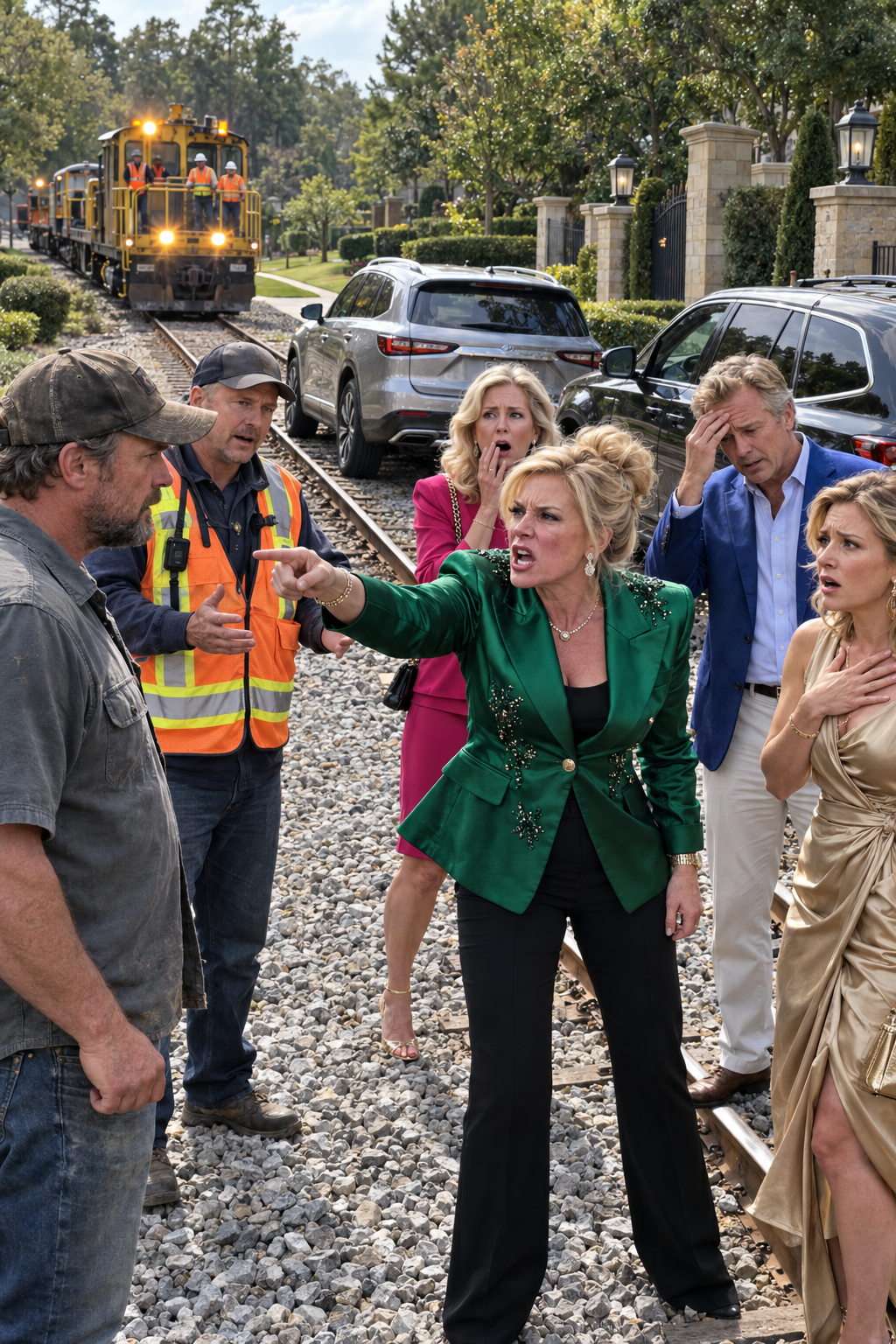
HOA Karen Turned My Private Rail Spur Into Guest Parking—Then a Maintenance Train Came Through at Sunrise
The first car was parked directly on the railroad tracks.
The second one had a handwritten HOA permit tucked beneath its windshield wiper.
By the time I reached the old loading shed behind my property, there were thirty-seven vehicles lined up across a rail spur that Karen Whitmore had absolutely no legal right to touch.
And standing in the middle of it all, wearing a white blazer and holding a clipboard like she owned the county, Karen smiled at me and said, “You’re going to have to learn that unused property doesn’t stay private forever.”
I looked past her.
Two rental SUVs.
A catering van.
A black Range Rover parked with its rear tires between the steel rails.
Orange traffic cones had been set beside the track.
Someone had hung little gold arrows from temporary stakes.
LAKEVIEW ESTATES GUEST PARKING.
Karen had even paid to have crushed limestone spread between the ties.
I didn’t yell.
That seemed to disappoint her.
Instead, I reached into my pocket, took out my phone, photographed the sign, the cars, the cones, the license plates, and Karen’s smiling face.
Then I checked my watch.
Thirty-six hours.
Maybe less.
“You should move these cars,” I said.
Karen laughed.
Not a nervous laugh.
The kind of laugh people use when they believe the argument ended before you arrived.
“Daniel, please.”
My name is Daniel Mercer.
I’m forty-six years old.
For seventeen years I worked industrial logistics across Ohio, Pennsylvania, and West Virginia.
Before that, my father ran Mercer Feed & Milling on the same seventy-three acres I now owned outside Briar Glen, Ohio.
The property wasn’t glamorous.
It had a redbrick warehouse from 1928.
Two grain bins.
An old machine shop.
Four acres of woods.
And a half-mile rail spur that split from the old Midwestern Central freight line, crossed the southern edge of my property, and ended beside our loading shed.
Most people thought the track was abandoned.
That distinction was about to become expensive.
Karen folded her arms.
Behind her, men in polo shirts carried cases of wine toward the Lakeview Estates clubhouse, which sat on the other side of my fence.
They were preparing for the HOA’s annual Founders Dinner, apparently some kind of black-tie fundraiser.
The subdivision had been built fifteen years after my father bought the mill.
I remembered when that land was corn.
Now it held 186 houses, stone entrance pillars, fake gas lamps, two fountains, a pool, and a clubhouse designed to look like a miniature country club.
Karen Whitmore had been HOA president for six years.
She liked saying the neighborhood had “standards.”
Mostly that meant she liked telling other people what they were allowed to do.
Her problem with me had started three months earlier when she asked to lease part of my back field for overflow parking during neighborhood events.
Not because I hated the HOA.
Because their proposed access route crossed the rail right-of-way.
That mattered.
Karen didn’t believe me.
“You haven’t run a train on this track in twenty years,” she said now.
She blinked.
“The last commercial freight delivery was sixteen years ago.”
She gave me the little smile again.
“Fine. Sixteen. Thank you for proving my point.”
I looked down at the steel.
Rust-colored on top.
Grass around the ties.
“What did you do to the switch?”
For the first time, her expression changed.
Only slightly.
Her eyes moved toward the far tree line.
That was enough.
I walked around her.
I kept going.
“Daniel, this is HOA property tonight.”
“No,” I said. “It isn’t.”
A few guests looked over.
Karen lowered her voice.
“We’ve discussed the boundary issue.”
“No. You’ve discussed it. I’ve shown you the survey.”
“The board has documentation.”
“You have a landscaping map.”
“Our attorney disagrees.”
“Your attorney has never contacted mine.”
That was true.
Karen loved mentioning lawyers.
Actual lawyers seemed less interested in joining her arguments.
I continued toward the switch.
The spur connected with Midwestern Central’s active secondary line about four hundred yards south of my loading shed.
The connection sat beyond a stand of sycamores.
When I reached it, I stopped.
Someone had removed my chain.
The lock was gone.
The switch stand had fresh orange paint on it.
And a steel clamp had been installed across part of the mechanism.
I crouched.
Photographed everything.
Behind me, gravel crunched.
Karen had followed.
“You modified railroad equipment?”
“We secured dangerous abandoned infrastructure.”
“That isn’t what I asked.”
“The HOA’s contractor handled it.”
“What contractor?”
“You don’t need to know.”
I looked at her.
“That answer is going to age badly.”
Her jaw tightened.
“Stop trying to intimidate me.”
“I haven’t started.”
I sent six photographs to a contact in my phone.
Then I called him.
He answered on the second ring.
“Tom. You busy?”
“Depends how much trouble you found.”
“Somebody tampered with Spur 14.”
“Your spur?”
“Main switch?”
“What kind of tampering?”
“Clamp. Lock removed. Looks like somebody tried to secure the switch out of service.”
Another pause.
“Don’t touch anything.”
“I wasn’t planning to.”
“You still have that inspection window scheduled?”
“That’s why I’m calling.”
“What time?”
“Current estimate? Sunday morning. Could move earlier.”
I looked back toward the parking lot.
Karen was watching me.
I put Tom on speaker.
“How much earlier?”
“Possibly dawn.”
Karen’s smile disappeared.
Tom continued.
“Track geometry crew is coming westbound with the maintenance consist. They’re checking the industrial sidings before the fall bridge program. Yours is on the list because of the easement renewal.”
Karen took one step toward me.
“What did he say?”
I raised one finger.
Tom was still talking.
“They won’t necessarily enter your spur if the switch is tagged wrong, but they are required to inspect the connection. If there’s unauthorized equipment on railroad-controlled hardware, that’s a problem.”
“How big a problem?”
“Depends who did it.”
Karen said, loudly, “This is ridiculous.”
Tom heard her.
“Who’s that?”
“The HOA president.”
That one syllable contained more judgment than I could have managed in a paragraph.
I almost smiled.
Tom said, “Daniel, keep everyone off the track. Email me the photos. I’m calling operations.”
I ended the call.
Karen stared at me.
“You arranged this.”
“You called them because of the dinner.”
“You expect me to believe a railroad suddenly decided to send a train down an abandoned track the weekend of our biggest event?”
“I don’t care what you believe.”
She stepped closer.
“How many cars are coming?”
“Thirty-seven when I counted.”
“I mean train cars.”
“I don’t know.”
“Will they actually come onto this property?”
“I don’t know.”
Her voice sharpened.
“You own the track.”
“Part of it.”
That was when she finally heard the problem beneath the problem.
Her eyes narrowed.
“What does that mean?”
“It means I own the underlying land and parts of the spur improvements. Midwestern Central retained operating rights under an easement recorded in 1954.”
She stared at me.
I continued.
“They can inspect it.”
“They can maintain it.”
Her face had gone pale.
“They can enter it with rail equipment.”
She glanced toward the parking area.
Thirty-seven vehicles.
Maybe three million dollars’ worth of metal sitting on steel rails.
“You’re bluffing.”
I shook my head.
“You should move the cars.”
For years, Karen had made people move mailboxes.
For years, Karen had made people repaint doors.
For years, Karen had made people remove basketball hoops.
For years, Karen had made people hide work trucks behind fences.
For years, Karen had mistaken compliance for authority.
Now thirty-seven cars were parked where something weighing hundreds of tons might need to go.
And for the first time since I’d met her, Karen Whitmore had nothing useful to say.
She turned and walked away.
I thought that would be the end of it.
I was wrong.
Twenty minutes later, another twelve cars arrived.
By p.m., there were fifty-three.
Karen had decided the best response to a warning was apparently to double down.
I stood on my porch with a cup of coffee while headlights curved through the temporary opening they’d made in my south fence.
They had cut my fence too.
Not the whole thing.
Just one forty-foot section.
The posts had been removed neatly.
The wire rolled beside the trees.
A temporary gravel entrance crossed my land from the HOA clubhouse directly onto the spur.
That part made me stop drinking.
I walked down with a flashlight.
A young parking attendant in a yellow vest waved an SUV forward.
“Sir, event parking is around the loop.”
“This is my property.”
He looked about nineteen.
“I just work for the valet company.”
“I know. What’s your name?”
“Evan, I’m not mad at you. Who told you this was authorized?”
He pointed toward the clubhouse.
“Lady in white blazer.”
“Did she say the railroad track was abandoned?”
“It’s not.”
His eyes widened.
I showed him the email confirmation on my phone.
MIDWESTERN CENTRAL RAILWAY.
INDUSTRIAL SPUR 14 ACCESS AND INSPECTION.
He read it twice.
“You’re serious?”
“Completely.”
He looked at the Range Rover nearest us.
“Should I start moving these?”
Before he could, Karen appeared.
She had changed outfits.
Now she wore an emerald evening dress under a cream coat.
She looked like she’d stepped out of a charity-gala brochure.
“What are you doing?”
Evan looked between us.
I said, “I’m telling him the truth.”
Karen held up a hand.
“Evan, continue parking guests.”
He hesitated.
She snapped her fingers.
That bothered me more than the trespassing.
He was a kid working a weekend event, not her servant.
I handed him my business card.
“If anyone tries blaming you tomorrow, call me.”
Karen waited until he walked away.
Then she smiled.
“Very theatrical.”
“You cut my fence.”
“We opened a legacy access point.”
“That’s a new phrase.”
“Our legal committee reviewed historical plats.”
“Your legal committee is Susan Fletcher and a retired dentist.”
Her mouth tightened.
“Dr. Harris has extensive board experience.”
“His last board was a golf club.”
“Property governance is property governance.”
“No, Karen. Dentistry is dentistry. Rail law is rail law. Trespassing is trespassing.”
“You’re obsessed with technicalities.”
“Property ownership is a technicality now?”
“We offered you compensation.”
“You offered me six hundred dollars to use four acres for three days.”
“A fair neighborhood rate.”
“You planned to park two hundred cars here.”
“We’re at seventy-four.”
I looked behind her.
She realized what she’d admitted.
“Interesting,” I said.
She glared.
The truth was beginning to take shape.
This wasn’t just overflow parking.
Karen had planned this.
The cut fence.
The limestone.
The new signs.
The switch clamp.
This was infrastructure.
Temporary infrastructure, but deliberate.
“Who installed the clamp?” I asked again.
She didn’t answer.
“Good night, Daniel.”
She turned.
I said, “Train could arrive before sunrise.”
She paused.
Just half a second.
Then she walked back toward the clubhouse.
At 10:14 p.m., Deputy Marcus Lane pulled into my driveway.
I knew Marcus.
Everybody around Briar Glen knew Marcus.
He’d been with the county sheriff’s department for twelve years and had the unfortunate talent of looking exhausted even when he was in a good mood.
He climbed out holding a tablet.
“Want to guess why I’m here?”
“Noise complaint?”
“Property dispute.”
He rubbed the back of his neck.
“Says you threatened to destroy guests’ vehicles with a train.”
I laughed once.
Marcus didn’t.
“That’s almost creative.”
“She also says you’ve been harassing event staff.”
“Want video?”
I showed him everything.
The original empty spur from two days earlier.
The removed fence.
The switch clamp.
The photographs with timestamps.
Then the Midwestern Central email.
Marcus read it.
He whistled quietly.
“Could be earlier.”
“And she knows?”
“I told her twice.”
He stared toward the clubhouse lights.
Music drifted across the field.
“So why are the cars still there?”
“You’re asking the wrong person.”
We walked down together.
Karen intercepted us before we reached the parking area.
This time she had an attorney with her.
At least I assumed he was an attorney.
Leather folder.
Nervous eyes.
“Deputy,” Karen said, “thank you for coming.”
Marcus nodded.
“This man continues disrupting our permitted event.”
Marcus pointed at the rail spur.
“Who authorized parking here?”
“Our board.”
“Who owns the land?”
Karen gestured toward the attorney.
He opened his folder.
“There’s a disputed boundary interpretation.”
I said, “No, there isn’t.”
He avoided looking at me.
Marcus asked, “Do you have a deed?”
“We have recorded neighborhood plats indicating a transportation corridor.”
“Transportation corridor doesn’t mean parking lot.”
The lawyer cleared his throat.
“We believe the corridor reverted to common recreational use following abandonment.”
I said, “Show me the abandonment order.”
He didn’t move.
“Show me the Surface Transportation Board filing.”
“Show me the railroad release.”
“Show me anything from Midwestern Central surrendering operating rights.”
His jaw moved.
No words came out.
Marcus looked at Karen.
“Ma’am, I’m going to recommend you remove the vehicles until ownership is resolved.”
Karen’s expression hardened.
“Recommend?”
Marcus recognized the trap immediately.
“Yes. Recommend.”
“So you are not ordering us.”
She smiled.
It was astonishing.
She had just been handed an escape route and chose arrogance instead.
“Thank you, Deputy.”
Then she looked at me.
“We’ll see you at the hearing.”
“What hearing?”
Her smile widened.
“You haven’t checked your mailbox?”
When I returned to the house, there was a certified-looking envelope taped to my front door.
Not mailed.
Inside was a “Notice of Emergency Compliance Review.”
Lakeview Estates HOA claimed my property contained a “hazardous abandoned rail structure” affecting adjacent residents.
They were scheduling an emergency board hearing Monday night.
The remedies listed included fencing orders, cleanup requirements, nuisance abatement, and something called “cost recovery assessment.”
I read the document twice.
Then I laughed.
My property wasn’t even inside the HOA.
That’s not an exaggeration.
My deed predated Lakeview Estates by nearly four decades.
I had never joined.
Never signed covenants.
Never paid dues.
Never attended a meeting.
Karen knew that.
They had tried sending me violation notices before.
Equipment storage.
One unforgettable letter claimed my grain bins violated the subdivision’s skyline guidelines.
I framed that one.
But this notice was different.
At the bottom was a line I’d never seen:
EMERGENCY ACCESS AUTHORIZATION GRANTED SEPTEMBER 28.
My amusement vanished.
September 28 had been eleven days ago.
I called my attorney, Laura Bennett.
She answered even though it was nearly eleven.
“This better involve a body.”
“That sentence worries me.”
I emailed the notice.
She read it while I waited.
Then she said, “Daniel?”
“Who signed this authorization?”
“Karen, apparently.”
“No. Page two.”
I turned the page.
Below Karen’s signature was another.
MARTIN VESEY.
County Development Review.
I knew the name.
Vesey was an assistant county zoning administrator.
Not a senior one.
Certainly not somebody with authority to give an HOA access to private railroad property.
Laura went quiet.
“What?” I asked.
“I’m pulling county records.”
I heard typing.
More typing.
“That a good huh?”
“There was a filing.”
My stomach tightened.
“What kind?”
“Lakeview Estates submitted a nuisance complaint against your spur six weeks ago.”
“Nobody notified me.”
“Looks like they claimed owner contact was unsuccessful.”
“They have my phone number.”
“They have my email.”
“My mailbox is fifty yards from Karen’s house.”
She kept reading.
Then she said, “Daniel, they represented the spur as abandoned.”
“Of course they did.”
“And unsafe.”
“Of course.”
“And they attached photographs.”
Laura didn’t continue.
“What photographs?”
“I’m sending one.”
My phone vibrated.
I opened the image.
For a moment, I didn’t understand what I was seeing.
It was my track.
But something was wrong.
Then I saw it.
Two rail sections had been photographed with deep cracks across the heads.
Another showed rotted ties collapsed beneath the gauge.
Another showed a broken switch point.
Except none of those conditions existed.
I had walked the line three days earlier.
“These aren’t my tracks.”
“The captions say they are.”
“They’re not.”
“You sure?”
“Absolutely.”
I enlarged one.
There was a yellow milepost behind the damaged rail.
Spur 14 had no mileposts.
“I see it.”
“These pictures came from somewhere else.”
“Looks that way.”
I sat on the edge of my kitchen table.
“So Karen used fake photos to get a county employee to sign an emergency authorization.”
“You said maybe.”
“Because we don’t know whether Karen knew the photos were fake.”
“We prove things, Daniel. We don’t guess them.”
That’s why I hired Laura.
She never allowed anger to substitute for evidence.
“What’s the authorization actually say?”
“Permission for Lakeview Estates maintenance personnel to secure hazardous infrastructure adjacent to HOA property pending formal inspection.”
“Does it authorize parking?”
“Removing my fence?”
“Installing gravel?”
“Clamping the railroad switch?”
“Absolutely not.”
Outside, music thumped across the field.
Laura said, “Document everything. Do not touch their vehicles. Do not move their equipment. Do not argue.”
“And Daniel?”
“Call the railroad again. Now.”
Tom answered after five rings.
He sounded less amused this time.
I told him about the county authorization.
Then I sent the fake photographs.
He called me back seven minutes later.
His voice had changed.
Professional.
“Those photos aren’t your spur.”
“One appears to be from an out-of-service siding near Canton. Another may be from Pennsylvania.”
“Can you prove it?”
Tom added, “Operations moved the inspection.”
“Tomorrow.”
“Tomorrow Sunday?”
“No. Tomorrow Saturday.”
My eyes went to the clock.
Saturday was twenty-nine minutes away.
“What time?”
“Maintenance consist departs Wellington at .”
I calculated.
“Your area between and .”
I looked toward the dark field full of cars.
“How long is the consist?”
“Locomotive, inspection car, two maintenance flats, ballast hopper, hi-rail support behind.”
My mouth went dry.
Not because I thought they would crash into anything.
Rail crews aren’t idiots.
They would stop.
But the scene tomorrow morning would be catastrophic in a different way.
Operations.
Railroad police.
County deputies.
Blocked infrastructure.
Tampered switch.
Dozens of civilian vehicles.
And an HOA president who had already been warned.
Tom said, “Daniel, we’re notifying county dispatch.”
“Do not attempt to clear the vehicles yourself.”
“Is the track physically obstructed?”
“How many vehicles?”
I looked outside.
Cars were still arriving.
“Probably over a hundred now.”
Then Tom said, “You’re kidding.”
“On the rails?”
Another pause.
At midnight, the Founders Dinner officially ended.
At 12:20, it became an after-party.
At a.m., perhaps thirty people left.
But most didn’t.
Because Karen had arranged shuttle vans to nearby hotels.
The parked cars stayed.
That detail would matter.
Around , Evan the valet knocked on my door.
His yellow vest was zipped to his chin.
“What’s wrong?”
He looked over his shoulder.
“The HOA lady told us to leave the cars overnight.”
“I figured.”
“She said anybody removing one without owner authorization gets fired.”
“Your company said that?”
“No. She did.”
“Who’s your supervisor?”
“Mr. Vega.”
“Call him.”
“He said the contract says HOA controls parking operations.”
Poor kid looked terrified.
I handed him a bottle of water.
“Evan, you didn’t create this problem.”
Then reached into his pocket.
“I thought you should see something.”
He showed me a photo.
The switch.
Timestamped that afternoon.
One man wore a high-visibility vest.
The other had a toolbox.
“You took this?”
“I thought it looked weird.”
“Send it to me.”
I enlarged the vest.
CLAYTON SITE SERVICES.
I knew the company.
Excavation.
Light construction.
Not railroad.
“Did they tell you what they were doing?”
“One guy said they were locking out the old rail line.”
“Exact words?”
“Pretty much.”
“Would you write that down?”
He hesitated.
“You think I’m in trouble?”
“No. I think you might be the smartest person working that event.”
He gave a nervous laugh.
I had him email himself a copy first.
Then send one to me.
Preserve the original.
Metadata intact.
Never depend on screenshots when you can preserve source files.
At a.m., the clubhouse lights finally went dark.
I slept for two hours.
At , I woke before my alarm.
Work boots.
Heavy jacket.
I walked the entire spur with a flashlight.
No movement.
One hundred and sixteen vehicles remained.
I counted twice.
The most absurd part was how orderly they looked.
Perfect rows.
Luxury cars lined up across private railroad infrastructure.
Little white parking tags hanging from mirrors.
As though labeling something made it legal.
At , headlights appeared at the subdivision entrance.
Not the train.
Railroad police.
A dark Ford Explorer rolled onto my gravel drive.
Special Agent Christopher Hale stepped out wearing a navy jacket with MIDWESTERN CENTRAL RAILWAY POLICE across the chest.
Behind him came a track supervisor named Eddie Foster.
Eddie looked at the cars and said nothing for several seconds.
That was it.
Just “well.”
I appreciated the restraint.
Hale photographed the switch.
Eddie crouched beside the clamp.
“Who installed this?”
“Contractor called Clayton Site Services.”
“Rail contractor?”
He stood slowly.
“You have contact information?”
“Working on it.”
Hale looked toward the rows of cars.
“Were they warned?”
“Not initially. Verbal, then deputy presence, then railroad call.”
“Any recording?”
“Security cameras.”
The sky was beginning to lighten.
Birds started in the trees.
That soft gray color before sunrise spread across the field.
Then another vehicle approached.
Karen’s Lexus.
She parked crooked beside my barn and got out in workout clothes, sunglasses pushed into her hair.
“What is this?”
Hale turned.
Karen pointed at me.
“He called you?”
Hale showed his badge.
“Railroad police.”
She stopped.
Only for a second.
Then recovered.
“Good. You’re exactly who I need.”
That surprised even Hale.
Karen marched toward the switch.
“This man has been using railroad threats to interfere with a private community event.”
Hale waited.
She continued.
“Our counsel has documentation establishing that this rail spur was abandoned and that we received county authorization to secure it.”
“Do you have that documentation?”
“Of course.”
She opened her phone.
I said nothing.
Never interrupt someone who is voluntarily building your case.
Karen showed Hale the county authorization.
He read it.
Then looked at Eddie.
Eddie read it.
Then Hale asked, “Who installed this clamp?”
“A licensed contractor.”
“What kind of license?”
“Construction.”
“Railroad qualification?”
“I’d have to check.”
“Did Midwestern Central authorize modification of the switch mechanism?”
“The railroad abandoned this spur.”
Hale pointed behind him.
“No, ma’am.”
She looked.
Far down the main line, a signal changed.
Red to green.
Eddie checked his radio.
Karen heard the static.
Her face changed.
“What is happening?”
Eddie said, “Maintenance movement is approaching.”
“You can’t run a train through parked vehicles.”
“Nobody intends to.”
“Then stop it.”
Hale tilted his head.
“You understand you’re currently asking the railroad to stop authorized operations because your HOA parked civilian vehicles on an active rail easement?”
She stared at him.
“They’re guests.”
“That doesn’t answer my question.”
“This is harassment.”
Hale actually looked around.
At the hundred-plus cars.
Then back at Karen.
She didn’t answer.
At , Deputy Marcus Lane arrived.
Then another county unit.
Then Karen’s attorney.
Gray suit again.
Different tie.
He climbed out carrying the same leather folder.
The moment he saw the railroad police jacket, he stopped walking.
That was the first smart decision I’d seen from the HOA side all night.
Karen rushed toward him.
“Peter, tell them.”
Peter did not tell them.
Instead he asked Hale for five minutes to review documents.
Hale said, “You can review whatever you want. Operations won’t enter an occupied spur until we’ve established it is clear.”
Karen crossed her arms.
I could see relief on her face.
She thought she’d won.
Train can’t enter.
Event parking successful.
Then Eddie spoke.
“But the switch inspection still happens.”
Karen’s relief faded.
“What does that mean?”
“It means the consist will stop on the main line.”
“So the main line may be blocked during inspection.”
“How long?”
Eddie looked at the clamp again.
“If this has damaged the mechanism? Could be a while.”
The attorney closed his eyes.
Eddie continued.
“And if a non-qualified contractor modified controlled railroad hardware, we may have to remove the device, test the switch, inspect alignment, verify signal integration, document obstruction, and complete an incident report.”
Karen looked at me.
“This is your fault.”
I almost answered.
Marcus beat me to it.
She turned.
Marcus had finally had enough.
At , we heard the horn.
Two long blasts rolling through the morning air.
Everything stopped.
The deputies.
The railroad agents.
Even Evan, who had returned with his valet supervisor.
Another horn.
People began stepping out of houses along Lakeview Drive.
Porch lights came on.
Phones appeared.
Some residents walked toward the clubhouse in pajamas and jackets.
Then the locomotive emerged around the tree line.
Yellow nose.
Black body.
Headlight burning through the dawn.
It wasn’t moving fast.
Maybe fifteen miles per hour.
But speed doesn’t matter much when you’re looking at machinery weighing hundreds of tons.
The maintenance consist rolled toward the spur connection.
Steel clicked over joints.
The ground carried that subtle vibration rail equipment makes before it reaches you.
Karen stood completely still.
The locomotive horn sounded again.
Then brakes hissed.
The consist stopped with the locomotive just beyond the switch.
Not dramatic.
Not dangerous.
Not even close to the parked vehicles.
But it didn’t need to be.
The railroad had arrived.
Reality had arrived with it.
The engineer climbed down.
Then two inspectors.
One carried a camera.
The other carried paperwork.
Within five minutes, the entire argument changed.
Nobody cared about Karen’s landscaping map.
Nobody cared about her “legacy access corridor.”
Nobody cared about HOA resolutions.
The inspectors cared about one thing.
The switch.
Eddie pointed out the unauthorized clamp.
The inspector photographed it.
Then photographed the missing lock.
Then the wheel marks where contractor vehicles had driven beside the rails.
Then the limestone dumped between ties.
Then the rows of guest cars.
Finally, he photographed the cut fence.
He asked Karen, “Who directed this work?”
Peter stepped forward.
“I advise my client not to answer questions until we establish jurisdiction.”
The inspector nodded.
“That’s fine.”
Then he turned to Hale.
“Get contractor identification from the work order.”
Karen whispered something to Peter.
He didn’t respond.
The crowd was growing.
Guests returning from hotels.
Two board members.
A man in golf clothes who kept asking whether his Porsche could be moved.
Hale told everyone to stay away from the track until inspection cleared it.
The Porsche owner pointed at me.
“He won’t let us leave.”
“No,” Hale said, “the railroad won’t let you enter the controlled area until we’re done.”
The man’s tone changed instantly.
That was another tiny thing I’d learned over the years.
People argue differently with uniforms.
At , Peter finally approached me.
“Daniel, can we talk privately?”
Laura had arrived three minutes earlier.
Perfect timing.
She stepped beside me holding a coffee.
“You can talk to both of us.”
Peter’s face tightened.
So they knew each other.
Of course they did.
Small county.
Peter looked at the parking area.
“We’d like to resolve access this morning without escalating.”
Laura sipped her coffee.
“You parked 116 cars on my client’s property.”
“There’s a boundary dispute.”
“No, there isn’t.”
“You’ve seen our plats?”
“Then you understand—”
“I understand your plat shows the railroad corridor.”
Peter paused.
Laura continued.
“It doesn’t convey ownership.”
His eyes changed.
That landed.
“Furthermore,” she said, “your client’s emergency authorization permits limited hazard mitigation.”
Peter said nothing.
“It does not authorize conversion to event parking.”
Still nothing.
“It does not authorize removal of fencing.”
“It certainly doesn’t authorize modification of railroad infrastructure.”
Peter finally said, “We may disagree on scope.”
Laura smiled.
“No, you may regret the scope.”
I nearly laughed.
Karen was watching us from twenty feet away.
She stormed over.
“We need the vehicles out.”
Laura turned.
“So instruct your client to open the property.”
“My client isn’t stopping anyone.”
“The railroad is.”
“Because he called them.”
“No. Because you altered their switch.”
Karen pointed at me.
“He orchestrated this.”
I said, “I told you to move the cars at last night.”
“You knew a train was coming.”
“And you let us keep parking.”
I stared at her.
“Read that sentence back to yourself.”
A few residents nearby went quiet.
Karen realized too late how ridiculous it sounded.
Her voice dropped.
“You could have forced us to leave.”
“Call the police.”
“Block the entrance.”
“That would trap cars.”
“Tow them.”
“One hundred sixteen vehicles?”
“You could have done something.”
“I warned you.”
Her cheeks flushed.
I kept my voice low.
“You wanted authority, Karen. You got it. You made the decision.”
That shut her up.
For about thirty seconds.
Then Eddie walked over holding the clamp.
They had removed it.
He handed it to Hale as evidence.
“Switch point has lateral scoring.”
“How bad?” Hale asked.
“Don’t know yet.”
Karen crossed her arms.
Eddie looked at her.
“Meaning nobody moves through this switch until I’m satisfied it locks correctly.”
“How long?”
He shrugged.
Karen’s eyes widened.
“You can’t just trap people’s cars.”
Eddie pointed at the parking area.
“Ma’am, the railroad didn’t put them there.”
Mini-payoff number one.
The entire crowd heard it.
One of the board members slowly walked away from Karen.
At , another Midwestern Central truck arrived.
Signal technician.
Then another.
Track maintenance.
Word spread through Lakeview Estates.
By , dozens of residents were standing along the property line.
Some were angry at me.
Most didn’t understand what had happened.
Karen moved through them like a campaign manager trying to control a scandal.
“This is a misunderstanding.”
“We have legal access.”
“The railroad changed its schedule.”
“Daniel is exploiting an old easement.”
That last one was my favorite.
An old easement.
As though age invalidated property rights whenever they became inconvenient.
Then an elderly man named Robert Keller walked over.
I’d seen him around the subdivision.
Retired accountant.
Never involved in HOA politics.
He held one of the parking permits.
“Mr. Mercer?”
“Daniel’s fine.”
“Did the HOA have permission to use this land?”
Karen, standing ten feet away, said, “That’s disputed.”
Robert looked at her.
“Karen, I asked him.”
She stopped.
Robert turned back to me.
“Did they ask you?”
“What did you say?”
Karen cut in.
“It was an initial proposal.”
I opened my phone.
Found the thread.
Showed Robert.
Karen’s request:
The board proposes temporary event parking on approximately four acres of the southern Mercer parcel, including access adjacent to former industrial rail infrastructure.
My response:
No. The rail spur remains subject to Midwestern Central operating rights and cannot be used for vehicle parking or unapproved crossings.
Robert read it.
Then scrolled.
Karen’s reply:
Understood. We’ll explore other options.
He looked up.
There are moments when a room changes even though you’re outdoors.
This was one.
Robert looked at Karen.
“You knew.”
She stepped forward.
“That email predates our legal review.”
“You knew he said no.”
“We later discovered—”
“You knew.”
A woman beside him pulled out her phone.
Another resident asked to see the email.
I forwarded it to Robert.
Karen’s face tightened.
“Daniel, distributing selective correspondence could expose you to liability.”
Laura nearly choked on her coffee.
“Karen,” she said, “please keep talking.”
Karen did not.
At , the track supervisor found the second problem.
Not the switch.
The crossing.
To create the temporary parking lane, Clayton Site Services had poured crushed limestone directly across the rails near my loading shed.
Normally that wouldn’t necessarily destroy track.
Private industrial crossings exist everywhere.
But they had compacted material over drainage gaps and around fasteners.
Worse, somebody had driven steel landscaping stakes near the inside rail to hold the event signage.
One stake was close enough to interfere with flange clearance.
Eddie called me over.
“You see that?”
“Your crew?”
He photographed it.
Karen approached despite Peter trying to stop her.
“That is decorative.”
Eddie stared at the metal stake.
“Decorative?”
“It holds a sign.”
“In the gauge.”
“I don’t know what that means.”
She looked at him.
Eddie pointed between the rails.
“Anything installed here has clearance requirements. You don’t drive stakes next to active rail because you feel like putting up an arrow.”
Karen said, “The train isn’t going down there.”
Eddie’s expression went flat.
“You keep saying that like it’s your decision.”
Mini-payoff number two.
This time three residents laughed.
Karen heard them.
Her shoulders stiffened.
At , cars were finally allowed to leave one row at a time under railroad supervision.
Some guests apologized to me.
Others glared.
One woman in a champagne-colored dress and sneakers stopped beside me.
“We were told this was HOA-owned parking.”
“Karen said the abandoned rail line belonged to the neighborhood.”
“She charged us.”
I looked at her.
“For parking.”
“How much?”
“Fifty dollars.”
That stopped everything inside my head.
“Who collected it?”
“No. QR code.”
She opened her phone.
LAKEVIEW FOUNDERS DINNER PREMIUM PARKING.
I took a photo with permission.
“How many people paid?”
“I don’t know. Everyone in this section, I think.”
There were 116 cars.
Even if only eighty paid, that was $4,000.
Not life-changing money.
But it changed motive.
This wasn’t simply emergency overflow.
They monetized unauthorized use.
Laura saw my expression.
I showed her.
She read the receipt.
Then looked toward Karen.
“That helps.”
“How much?”
At , Robert Keller came back carrying a folder.
He had gone home.
Inside were printed HOA emails.
“I served on the finance committee until May,” he said.
Karen saw the folder and started walking toward us.
Robert continued.
“We approved twelve thousand dollars for event logistics.”
Karen quickened her pace.
“There was nothing about paying for parking land.”
“What was it for?” Laura asked.
“Temporary lighting. Valet. Shuttle service.”
Karen arrived.
“Robert, those are confidential board materials.”
“They were sent to the finance committee.”
“They remain association property.”
Robert ignored her.
He pulled out a budget sheet.
One line was highlighted.
SITE PREPARATION / SOUTH LOT — $8,750.
Clayton Site Services.
Laura looked at me.
I looked at Karen.
Karen looked at Peter.
Peter looked like a man mentally pricing malpractice insurance.
Laura asked, “South lot?”
Robert nodded.
“That’s what confused me. We don’t own a south lot.”
Nobody spoke.
Robert pulled out another page.
Vendor description:
Clear vegetation, remove temporary barrier, stabilize abandoned transportation corridor, install aggregate surface, secure inactive switch hardware.
There it was.
Not a misunderstanding.
Not guests accidentally parking in the wrong place.
Planned work.
Paid for by HOA money.
On my property.
On active railroad infrastructure.
Karen tried to take the paper.
Robert pulled it back.
Her face turned red.
“That document is confidential.”
“So sue me.”
It was the most emotion I’d ever seen from Robert Keller.
I liked him immediately.
Peter whispered, “Karen, stop.”
She spun toward him.
“You stop.”
Wrong person.
Wrong moment.
Peter’s expression changed.
Something between embarrassment and surrender.
Laura took a photograph of the document.
Then another.
Then she asked Robert whether he’d be willing to provide copies voluntarily.
Karen said, “Robert, if you disclose privileged association records—”
He turned on her.
“Privileged?”
His voice rose for the first time.
“My wife paid fifty dollars last night to park on land you already spent our dues illegally modifying.”
The residents around us went silent.
Robert shook the papers.
“You charged us to park on property we don’t own.”
Karen looked around.
Too many people.
Too many phones.
She changed tactics.
“The board relied on legal advice.”
Every face turned toward Peter.
I almost felt sorry for him.
He spoke slowly.
“For clarity, my office did not advise the association to modify railroad infrastructure.”
Karen stared at him.
He kept going.
“We were asked to review potential HOA use rights related to what was represented to us as an abandoned access corridor.”
“What does that mean?” Robert asked.
“It means,” Peter said carefully, “the legal analysis was based on facts supplied by the board.”
Karen’s face went white.
That was the moment she lost the room.
Not because anyone had proven fraud.
Because blame had started moving.
And nobody wanted to be standing beneath it when it stopped.
At 10:20, the final guest vehicle left.
Railroad crews still weren’t finished.
The maintenance train remained on the main line while technicians inspected the switch.
Midwestern Central diverted one local freight movement onto another route.
That mattered too.
Delays cost money.
Railroads remember costs.
At 10:44, Hale asked Karen for the name of the person who supplied the damaged-track photographs.
She refused.
Peter requested that all further questions go through counsel.
Fair enough.
At 11:03, a county sedan arrived.
Martin Vesey stepped out.
Assistant zoning administrator.
Mid-fifties.
Tan jacket.
He looked at the railroad train.
Then the police vehicles.
Then the residents.
Then Karen.
He seemed to age five years in ten seconds.
Marcus approached him.
“Mr. Vesey?”
“We need to talk about the emergency authorization.”
Vesey swallowed.
“Of course.”
They moved toward the barn.
Karen followed.
Laura and I stayed back.
Fifteen minutes later, Vesey emerged alone.
His face was gray.
He got into his sedan.
He did not look at Karen.
Marcus came to us.
“What happened?” I asked.
“Can’t discuss an active matter.”
Then he added, “But you may want to preserve every communication you received from the HOA over the last ninety days.”
“Already done.”
That was enough.
Around noon, the maintenance train finally moved.
Not down my spur.
The switch needed additional work before Eddie would certify it.
The locomotive rolled west.
Its horn sounded once.
Residents watched it disappear behind the trees.
Karen stood beside the clubhouse with her arms folded.
For the first time all morning, nobody stood beside her.
I thought that was the story.
HOA president trespasses.
Railroad arrives.
Residents discover the truth.
Expensive embarrassment.
Maybe lawsuits.
Maybe resignations.
Clean ending.
Life rarely gives you those.
At p.m., Laura and I sat at my kitchen table reviewing evidence.
Parking receipts.
Work orders.
The fake track images.
The county authorization.
Evan’s timestamped photograph.
Laura tapped the photograph of Karen at the switch.
“This contractor is going to matter.”
“You have cameras covering the south entrance?”
“How long do recordings go back?”
“Six months.”
I opened the security system.
Selected September.
Then stopped.
September 27.
A truck entered my property through the same fence line.
Clayton Site Services.
The footage was black-and-white infrared, but the logo was visible.
“What were they doing here two weeks ago?”
Laura leaned closer.
I opened the next camera.
The truck drove toward the rail spur.
Two men got out.
A third person stepped from the passenger side.
Light-colored coat.
Even in grainy footage, the posture looked familiar.
They walked the track.
One man photographed the switch.
Another measured beside the rails.
Then the strangest thing happened.
They continued past the switch.
Toward the main line.
Laura whispered, “Back up.”
Played it again.
Karen remained near the switch.
The two contractors walked south with flashlights.
One carried something long.
Maybe a measuring rod.
Maybe a pry bar.
Hard to tell.
At 12:06 a.m., they returned.
At 12:11, the truck left.
Laura sat back.
“She was planning this before the emergency authorization.”
“Looks like it.”
The county authorization was dated September 28.
They entered September 27.
Unauthorized.
Before approval.
Then I remembered something.
“The fake photographs.”
Laura looked at me.
“What about them?”
“Metadata.”
We checked the copies obtained from county records.
Image metadata had mostly been stripped when uploaded.
But filenames remained.
Nothing useful.
Then one filename appeared:
CANTON_SPUR_DAMAGE_03.jpg.
Laura stared.
“Well,” she said.
“That seems subtle.”
“It seems incompetent.”
“Sometimes those overlap.”
She started drafting a preservation request.
I kept scrolling through camera recordings.
September 15.
September 20.
September 23.
Then September 12.
A silver SUV.
Not Karen’s Lexus.
It stopped near my fence at a.m.
Someone got out.
Baseball cap.
Took photographs of my rail line from outside the property.
“That could be anyone,” Laura said.
I moved to another camera.
The plate wasn’t clear.
But the rear window had a county parking sticker.
Laura saw it too.
Neither of us said anything.
At p.m., someone knocked.
Still wearing yesterday’s jeans.
His father stood beside him.
“Sorry to bother you,” Evan said.
“You’re fine.”
He looked uncomfortable.
“My company fired me.”
I felt my jaw tighten.
“For what?”
“Taking unauthorized photos.”
His father said, “They got a complaint from the HOA.”
Laura stepped into view.
“About an hour ago.”
“Did they put the reason in writing?”
Evan held up his phone.
TERMINATION FOR BREACH OF CLIENT CONFIDENTIALITY.
Laura read it.
“Would you forward that to me?”
His father looked suspicious.
“You an attorney?”
She pointed at me.
“Currently.”
“Can you help my son?”
“I can at least make sure nobody turns him into a scapegoat.”
Evan’s shoulders dropped slightly.
He looked at me.
“There’s something else.”
“The photo I sent you wasn’t the first time I saw those guys.”
Laura and I exchanged a look.
“When else?”
“Thursday.”
“No. At the HOA clubhouse.”
“What were they doing?”
“Meeting with Mrs. Whitmore.”
“Anything unusual?”
He thought.
“One guy had maps.”
“Maps of what?”
“I don’t know. Big rolled-up sheets.”
His father said, “Tell him the other part.”
Evan looked embarrassed.
“I heard them arguing.”
“The train track.”
He said, “One guy told her they shouldn’t touch the switch because it wasn’t in their scope.”
Laura’s eyes sharpened.
“What exactly did Karen say?”
“I don’t remember exactly.”
“Close as you can.”
Evan swallowed.
“She said something like, ‘Once it’s locked out, Mercer can’t pretend it’s active anymore.’”
There it was.
Not quite confession.
Not quite intent.
But close enough to make every lawyer at the table very interested.
Evan continued.
“The contractor said locking it didn’t make it abandoned.”
“And then?”
“She told him the county paperwork would cover them.”
Laura asked, “Did anyone else hear that?”
“Mr. Vega.”
“The valet supervisor?”
“Would he confirm it?”
Evan gave a bitter laugh.
“Probably not if he wants to keep his job.”
I thanked them.
Laura gave Evan her card.
At , Lakeview Estates sent an email to all residents.
Robert forwarded it to me.
SUBJECT: CLARIFICATION REGARDING RAIL CORRIDOR INCIDENT.
The message blamed “unexpected railroad activity.”
It claimed the HOA had acted “in good faith reliance upon governmental documentation.”
It claimed the disputed land had historically functioned as shared access.
It did not mention:
My July refusal.
The cut fence.
The paid contractor.
The switch clamp.
The parking fees.
The fake photographs.
Or the county employee.
Then came the best line:
At no time was resident safety compromised.
Technically true.
Because railroad professionals stopped before reaching the parked cars.
Not because Karen had acted safely.
At , Robert replied-all.
One sentence.
Then why were we not told Daniel Mercer denied permission in writing?
Five minutes later, another resident replied.
Then another.
Then twelve.
Then forty.
Karen shut down the email thread.
By p.m., screenshots were circulating anyway.
At , somebody taped a handwritten sign to the HOA clubhouse door.
I didn’t do it.
I wish I had.
By evening, I was exhausted.
Laura left after instructing me for the fifth time not to speak publicly.
“No Facebook.”
“I don’t use Facebook.”
“No Nextdoor.”
“I’d rather step on a nail.”
“No interviews.”
“Who would interview me?”
She gave me a look.
Fair point.
I ate leftovers.
Fed my dog, Cooper.
Checked the locks.
At , my phone rang.
Unknown number.
I almost ignored it.
Then answered.
“Daniel Mercer?”
“My name is Angela Reeves. I’m with the county auditor’s office.”
That got my attention.
“I’m sorry to call this late. Your attorney provided this number as an authorized contact.”
I sat down.
“What happened?”
“I’m reviewing documents associated with Lakeview Estates’ emergency access request.”
“Do you have the original deed package for the Mercer property?”
“And the railroad easement documents?”
“Would you be willing to provide copies Monday?”
“Mr. Mercer, I need to ask something unusual.”
“Go ahead.”
“Have you ever authorized Lakeview Estates HOA to act as your property manager?”
“Ever signed an access agreement?”
“Ever granted them agency authority?”
Longer pause.
“I’m here.”
“Why are you asking?”
“I can’t discuss an internal review yet.”
“Then ask whatever you can.”
“Did you sign anything on August 4?”
“Were you in Ohio August 4?”
“Where were you?”
“Pittsburgh. Vendor conference.”
“Can you prove it?”
“Yes. Hotel receipt. Toll records. Conference badge. Probably fifty people.”
Angela exhaled slowly.
Nobody says good when they ask whether you can prove you were out of state.
“What happened August 4?”
“I need you to speak with your attorney.”
“I am going to.”
Now my stomach tightened.
“I can’t say more.”
Then she did.
Just enough.
“There is a document in the county file bearing what appears to be your signature.”
I stood up.
“What document?”
“I’ve already said more than I should.”
“What does it authorize?”
The call ended three minutes later.
I phoned Laura.
She answered immediately.
I told her.
For once, she didn’t lecture me about assumptions.
She said, “Send me three samples of your signature.”
At , she called back.
“I requested an emergency copy from the county portal.”
“I have the document.”
That worried me more.
“I’m coming over.”
Twenty minutes later, she walked through my kitchen carrying a laptop.
She locked the door behind herself.
I’d never seen her do that.
“Sit down.”
She opened the computer.
County document.
Scanned PDF.
Three pages.
The title read:
TEMPORARY CORRIDOR ACCESS AND MAINTENANCE CONSENT.
Daniel R. Mercer.
Beneficiary:
Lakeview Estates Homeowners Association.
The document claimed I had voluntarily granted the HOA temporary rights to maintain, improve, secure, and utilize the southern rail corridor “for community access and parking purposes.”
My signature appeared at the bottom.
It was good.
Wrong, but good.
The middle initial curve was slightly too wide.
The M in Mercer had a loop I stopped using years ago.
Still, to most people?
Convincing.
My eyes dropped farther.
Signed before:
NANCY C. WHITMORE.
I read the name again.
“Whitmore?”
Laura nodded.
“You know her?”
“She shares Karen’s last name.”
“Could be coincidence.”
Laura gave me a look.
We searched.
It took fourteen seconds.
Nancy Claire Whitmore.
Commissioned notary.
Address in Dayton.
Age sixty-two.
Karen Whitmore’s older sister.
I sat very still.
There are moments when anger feels hot.
This wasn’t one.
This felt cold.
Karen hadn’t merely trespassed.
Someone had created a document carrying my forged signature and Karen’s sister’s notarization.
That document had apparently been used to support the county filing.
The parking disaster wasn’t the main event anymore.
It was smoke.
Something had been burning long before Friday night.
Laura said, “We call the sheriff.”
“We preserve the document.”
“You don’t contact Karen.”
“I said I know.”
She studied me.
Then nodded.
Marcus arrived at 10:18.
He brought a detective.
They photographed my original signatures.
Collected travel proof.
Downloaded the county file.
The detective asked whether anyone could have accessed old signed documents.
“Employees. Vendors. Accountant. Insurance company. HOA had copies of some correspondence.”
“What about Karen?”
“She received letters signed by me.”
“How many?”
“Enough to imitate it?”
“Apparently.”
By midnight, they left.
Laura stayed.
We sat in silence.
Then she asked the question I’d been avoiding.
“To get parking.”
I looked at her.
She tapped the forged document.
“You don’t forge this just for one dinner.”
“She wanted permanent access.”
“She asked to lease the field.”
Laura opened another file.
My July email exchange.
Karen had requested four acres.
But the forged consent covered the entire southern corridor.
Nearly twelve acres.
Including the rail spur.
The switch.
The old loading shed.
And a strip extending toward County Route 18.
Laura zoomed in on the attached map.
I leaned closer.
The corridor continued farther east than the parking area.
Through my woods.
To the subdivision’s undeveloped parcel.
I’d forgotten Lakeview Estates owned that parcel.
Twenty-eight acres.
Landlocked except for a narrow utility easement.
“What’s over there?” Laura asked.
“Nothing else?”
“Not on my property.”
“I mean theirs.”
She searched county planning records.
Lakeview Estates parcel.
Twenty-eight acres.
Zoned residential.
Then we found a planning application filed three months earlier.
Whitmore Development Partners LLC.
Not the HOA.
Whitmore Development.
Karen’s last name.
The proposal?
Thirty-six luxury townhomes.
Laura and I looked at each other.
The project map showed the obvious problem.
The parcel lacked a road wide enough to satisfy fire-code requirements for a development that size.
The nearest feasible route?
Across my southern property.
Exactly where the rail corridor ran.
Suddenly the July request made sense.
Karen didn’t need parking.
She needed precedent.
Temporary event use.
Improvement.
“Legacy access.”
Then later, maybe a claim that the corridor had functioned as shared access.
I felt my pulse in my throat.
Laura said, “We still don’t know this is connected.”
“We can suspect.”
She didn’t argue.
At 12:44 a.m., we found Whitmore Development’s ownership records.
Karen owned forty percent.
Her husband owned twenty.
Another investor held the rest.
That was motive.
A real one.
Thirty-six townhomes near Briar Glen could be worth fifteen or twenty million dollars.
Maybe more.
Suddenly eight thousand dollars in illegal gravel work looked small.
Parking wasn’t the objective.
Parking was the rehearsal.
I slept badly.
Sunday morning, I woke to engines outside.
Not police.
Eddie’s crew had returned.
They were replacing hardware at the switch.
He found me near the barn.
“Switch will be functional today.”
He looked toward the spur.
“You planning to reactivate freight?”
“Long story.”
He laughed.
“Seems like your weekend specializes in those.”
Then he handed me an envelope.
“Found this wedged inside the old switch cabinet.”
“What is it?”
“Don’t know. Figured you’d want to see it before I hand it to Hale.”
The envelope was dirty.
No address.
Inside was a photocopy of a survey.
Maybe 1950s.
Mercer Milling Company.
Rail easement.
Property boundaries.
Someone had marked the southern corridor in red.
At the edge of the map, handwritten:
ACCESS EXPIRES IF INDUSTRIAL RAIL USE CEASES.
I read it twice.
“That isn’t true,” I said.
Eddie shrugged.
“I’m no lawyer.”
“The easement doesn’t say that.”
He pointed to the copy.
“Then somebody wanted someone to think it did.”
At the bottom of the page was another handwritten note.
And initials.
Martin Vesey?
I gave the paper back.
“You said it was in the switch cabinet?”
“Locked cabinet?”
“Supposed to be.”
“Who has keys?”
“Railroad.”
“Anyone else?”
“Old industrial owner might’ve had one decades ago. Your dad?”
“He died nine years ago.”
Eddie’s face changed.
“Then somebody’s been more interested in this spur than we thought.”
Hale arrived thirty minutes later.
He bagged the document.
Photographed the cabinet.
Checked the lock.
No obvious damage.
At 10:17, Marcus called.
“Daniel, stay on your property today.”
“Just do it.”
“Something happened?”
“Not something I can discuss yet.”
“Related to Karen?”
“Stay home.”
At noon, two Lakeview Estates board members resigned.
At , the HOA canceled Monday’s emergency compliance hearing against me.
At , residents received notice that Karen was “temporarily stepping back from executive duties.”
At , her Lexus left the subdivision.
At , a county investigator visited Martin Vesey’s house.
I knew that because Robert texted me a photo someone else had taken.
By , rumors were everywhere.
Secret development.
Most were probably nonsense.
Rumors are lazy.
Evidence takes work.
I ignored all of it.
At , I walked the repaired spur with Cooper.
The sun was dropping behind the grain bins.
The rails glowed orange.
For the first time in two days, the place was quiet.
Just steel, weeds, old timber, and the low hum of insects.
I stopped beside the loading shed.
My father had stood there thousands of times.
He loved the railroad.
Not romantically.
He loved what it represented.
Connection.
A tiny family mill in Ohio could load a car and send product hundreds of miles.
He used to say ownership didn’t mean much if you couldn’t defend the boundary.
Back then I thought he meant fences.
Now I understood.
My phone rang.
“Where are you?”
“Rail spur.”
“Go inside.”
“That sentence is becoming popular.”
Her tone made me move.
I called Cooper and headed toward the house.
“What happened?”
“I found another filing.”
“Townhomes?”
“Railroad.”
“What about it?”
“Someone filed a petition six months ago asking Midwestern Central to declare Spur 14 inactive.”
“Not Karen.”
“Whitmore Development?”
“Then who?”
Laura exhaled.
“Mercer Industrial Holdings.”
I almost laughed.
“No such company.”
“There is.”
“Not mine.”
“When was it created?”
“Seven months ago.”
“Hidden behind a registered agent.”
I started walking again.
“What did the petition claim?”
“That it had acquired successor industrial rights associated with your property.”
“That’s insane.”
“It gets worse.”
“Of course it does.”
“It submitted a copy of a purchase option.”
“For my land?”
“For the rail corridor.”
“I never signed one.”
Another forged document.
“I already did.”
My phone buzzed.
I opened the PDF while walking.
Purchase Option Agreement.
Daniel Mercer.
Mercer Industrial Holdings LLC.
Option price:
Purchase price:
Property description:
Southern transportation corridor and associated rail improvements.
My signature sat on page four.
This forgery wasn’t as good.
The date was January 19.
I was home January 19.
That didn’t help much.
Then I saw the witness signature.
MARTIN VESEY.
Not notary.
My skin went cold.
“I saw it.”
“What the hell is happening?”
“I don’t know.”
That was the first time all weekend she’d said those words.
And that scared me.
At , we joined Marcus by phone.
He asked for the document.
Laura sent it.
Twenty minutes later, he called back.
“Do not contact Vesey.”
“I wasn’t planning to.”
“Do not contact Karen.”
“Still wasn’t.”
“Do you know a man named Eric Dalton?”
I searched my memory.
“You sure?”
“Railroad consultant?”
“Surveyor?”
“Developer?”
Marcus paused.
“He submitted the petition on behalf of Mercer Industrial Holdings.”
“Who is he?”
“We’re finding out.”
At , Hale called.
Different question.
“Daniel, who owns your loading shed?”
“Completely?”
“Any leases?”
“Me. Spare in my office.”
“You been inside lately?”
“Last week.”
“Go look at the east door.”
“Just look.”
I walked out with a flashlight.
The loading shed sat ninety yards from the house.
Steel roof.
Heavy sliding doors.
I reached the east personnel door.
Nothing obvious.
Then I saw fresh scratches around the deadbolt.
Bright metal.
Someone had tried a tool.
Maybe a pick.
Maybe a copied key used badly.
I called Hale.
“Scratches.”
“How fresh?”
“Hard to know.”
“Don’t enter.”
“I was about to.”
“We pulled historical rail records after today’s filing.”
“Your spur’s operating agreement references stored signal documentation.”
“The original industrial switch control records were supposed to remain with the property owner.”
“Dad kept everything.”
My heart began beating faster.
Old filing cabinets filled half the loading shed office.
Rail manifests.
Equipment manuals.
Property surveys.
Decades of paper.
Someone wasn’t trying to get into the building for tools.
They wanted records.
Hale said, “I’m coming out.”
He arrived with another officer.
They cleared the shed.
Nobody inside.
Nothing obviously disturbed.
Then we went through the office.
File cabinet one.
Accounting.
Cabinet two.
Maintenance.
Cabinet three.
Drawer after drawer.
Track diagrams.
Shipping invoices.
Old correspondence.
Then I reached the bottom drawer.
I had a key.
Inside was a dark-green binder.
MERCER MILLING — RAIL AGREEMENTS.
I hadn’t opened it since my father died.
Hale put on gloves.
We moved everything to the workbench.
Most documents were copies of records I already had.
Then we found an envelope taped beneath the rear binder cover.
My father’s handwriting.
DANIEL — PROPERTY FILE.
I stared at it.
Hale said, “Your call.”
I opened it.
Inside was a letter dated February 14, 2016.
Three months before my father died.
If anyone ever challenges the south rail access, do not rely only on the county deed copy. Our recorded deed is correct, but the railroad’s 1954 survey contains an additional reservation that does not appear on later neighborhood plats.
I stopped reading.
Hale leaned slightly closer.
I continued.
The original right-of-way is wider than the visible track corridor. I discovered this when the old Wallace farm was sold for development. Their surveyor knew. Their attorney knew. I was asked to sign a boundary adjustment and refused.
Lakeview Estates.
The Wallace farm became Lakeview Estates.
My hands felt cold.
The letter continued.
They may revisit this someday because the original rail reservation crosses land now shown as part of the subdivision’s common property.
I looked at Hale.
He said nothing.
I unfolded the next page.
An old survey.
Not a copy I’d seen before.
The railroad corridor widened near the switch.
Then continued east.
Across what everyone now believed belonged entirely to Lakeview Estates.
Straight through the clubhouse parcel.
Hale whispered, “Well, that’s interesting.”
Interesting wasn’t the word.
If the survey was valid, the HOA’s problem was bigger than parking on my land.
Their clubhouse entrance.
Part of their pool deck.
A maintenance building.
Possibly several landscaped common areas.
All might sit inside or overlap an old rail reservation.
No wonder someone wanted the spur declared inactive.
No wonder someone wanted false evidence of abandonment.
No wonder someone wanted me to “consent.”
If the operating rights disappeared, the survey became far less dangerous to future development.
I kept reading my father’s letter.
The final paragraph made my stomach drop.
I never signed the adjustment. But someone recorded one anyway. I challenged it privately. The county promised correction. I do not know whether it was ever fixed.
Attached is the name of the attorney who handled the filing.
The next page contained one typed name.
Peter Langford.
Karen’s attorney.
The same man who had stood beside her yesterday morning.
The same man who had said his office relied on facts supplied by the board.
The same man who looked terrified when railroad police arrived.
Hale stared at the page.
“You know him?”
My phone rang.
I answered.
Before I could speak, she said, “Daniel, turn on your exterior cameras.”
I opened the security app.
Front gate.
South field.
Then Camera Seven loaded.
A vehicle sat beside the switch.
Dark pickup.
Headlights off.
Someone stood beside the repaired cabinet.
Heavy jacket.
Baseball cap.
Holding something.
Hale moved toward the door.
I stopped him.
The man opened the switch cabinet.
With a key.
Hale’s face changed.
“Record that.”
“It records automatically.”
The man worked quickly.
Not vandalism.
He knew exactly what he was touching.
Then another vehicle appeared on camera.
A silver SUV.
The same shape as the one from September 12.
It stopped.
Driver stayed inside.
The man at the cabinet removed something.
Rectangular.
Put it inside his jacket.
Then closed the cabinet.
Hale called dispatch.
I switched cameras.
The pickup started moving toward County Route 18.
The silver SUV followed.
Laura was still on the phone.
“I’m here.”
“What’s happening?”
“Someone just accessed the railroad switch cabinet.”
“You need to hear what I found.”
“I traced Mercer Industrial Holdings.”
“The registered agent is a shell company.”
“I know that.”
“The shell company has one manager.”
She told me.
For three seconds, I thought I’d misheard.
“What did you say?”
Laura repeated the name.
Peter Langford.
Karen’s attorney.
Hale heard it.
His eyes narrowed.
But Laura wasn’t finished.
“And Peter didn’t create Mercer Industrial Holdings for Karen.”
My grip tightened on the phone.
“What do you mean?”
“I pulled the original formation records from before the ownership was masked.”
My throat went dry.
“Who hired him?”
Another pause.
“Your father.”
I said nothing.
Laura continued.
“Mercer Industrial Holdings was first incorporated in 2015.”
“That doesn’t make sense.”
“It was administratively dissolved after your father died, then reactivated seven months ago.”
“By Peter?”
“I don’t know.”
I looked down at my father’s letter.
He had warned me about Peter.
But apparently he’d also hired Peter.
Both couldn’t make sense.
Unless the story was bigger than Karen.
Unless the HOA hadn’t started this.
Unless they had stumbled into something older.
Hale’s radio crackled.
A deputy had located the dark pickup.
Less than two miles away.
No rectangular object.
The silver SUV was gone.
Then my security system chimed again.
Motion detected.
Loading shed.
We both turned toward the building.
Camera Eight loaded.
The office door was open.
Impossible.
We were twenty feet from it.
Hale drew his weapon.
“Stay here.”
He moved through the shed with the second officer.
I watched cameras.
No movement.
Then the computer monitor inside my office flickered.
I hadn’t turned it on.
The old desktop was disconnected from the internet.
It had been for years.
The screen lit anyway.
Not the desktop.
A black background.
White text.
I walked closer despite Hale shouting for me to stop.
The message read:
DANIEL — YOUR FATHER NEVER OWNED THE SOUTH CORRIDOR.
Then a second line appeared.
Neither did Karen.
A file opened automatically.
Scanned deed.
Midwestern Central Railway.
I leaned toward the monitor.
At the bottom was a signature I’d never seen.
Not my grandfather’s.
Not the Wallace family’s.
Not the railroad president’s.
A federal seal sat beside it.
Hale came up behind me.
“What the hell is that?”
I scrolled down.
One paragraph had been highlighted.
The corridor, including all associated access lands, shall revert upon cessation of qualifying rail use to the United States government under the former wartime industrial transport reservation.
I read it again.
Federal reservation.
The land wasn’t simply mine.
Or Karen’s.
Or the railroad’s.
There was another layer beneath all of us.
Then the office printer woke up by itself.
One page slid into the tray.
Hale grabbed it with gloved hands.
A photograph.
Taken from across my field.
Peter Langford.
Martin Vesey.
And a fourth man I’d never seen.
They were standing beside the spur.
Behind them was a black SUV.
On its door was a small government emblem.
The date printed below the image was six months ago.
Underneath, someone had typed five words:
ASK WHO ORDERED THE ABANDONMENT.
My phone vibrated.
Unknown number.
No greeting.
No signature.
Just a photograph of my father taken in 2016.
Three months before he died.
He was sitting at this same workbench.
Across from him sat the same unknown fourth man.
And beside the photograph was a message:
YOUR FATHER DIDN’T DIE BEFORE HE COULD FIX THE RAIL TITLE.
HE DIED AFTER HE FOUND OUT WHO OWNED IT.
Then another message appeared.
This one contained an address.
A storage facility thirty miles north.
Followed by:
PETER HAS A KEY.
SO DOES KAREN.
AND SOMEONE IS ALREADY ON THE WAY THERE.
✓ Lynn R. Adams
HOA Karen Turned My Private Rail Spur Into Guest Parking—Then a Maintenance Train Came Through at Sunrise The first car was parked directly on the railroad tracks. The second one had a handwritten H…