HOA Karen Threatened to Foreclose on My Farm—So I Raised a 10,000-Volt Fence and Watched Her Lose $500,000 in Court
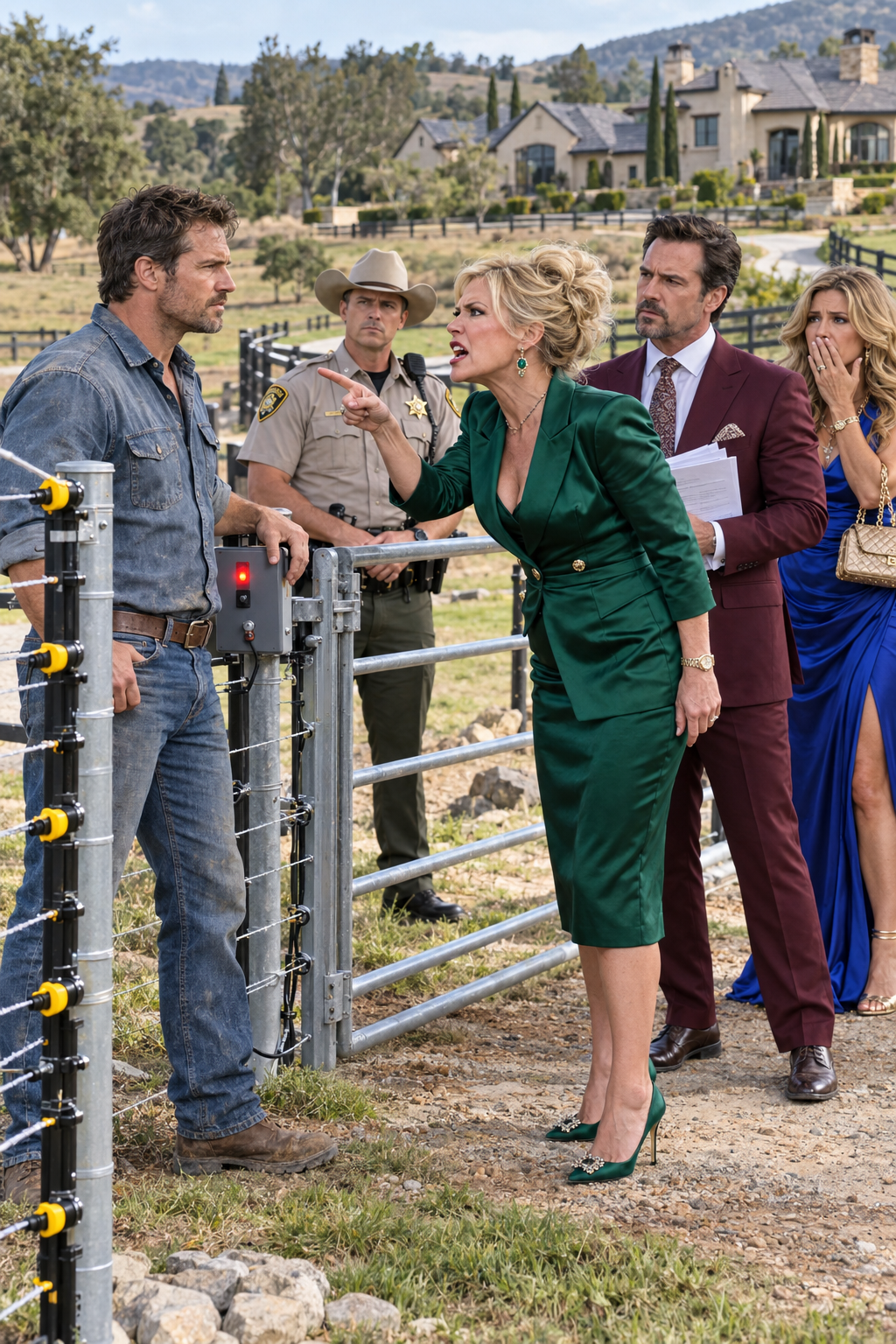
HOA Karen Threatened to Foreclose on My Farm—So I Raised a 10,000-Volt Fence and Watched Her Lose $500,000 in Court
“You have five days to get out of that house.”
Karen Whitmore said it from the bottom step of my porch as if she were telling a waitress to clear a dirty plate.
Then my own son handed me the foreclosure packet.
He wouldn’t look me in the eye.
That hurt more than Karen’s smile.
There were six people standing in my front yard that Tuesday morning.
Karen, president of the Stonegate Ridge Homeowners Association.
Her attorney, Nolan Price.
Two board members.
A property manager with a tablet.
And my forty-year-old son, Caleb.
Behind them, three black SUVs sat on the gravel turnaround beside the maple tree my husband planted the year Caleb was born.
Karen wore a cream-colored jacket, pearl earrings, and sunglasses too large for her face.
She glanced past me into my house.
Into my house.
As if she were already deciding where her furniture would go.
“Five business days,” she repeated. “After that, possession transfers.”
I looked at Caleb.
He swallowed.
“Mom, don’t make this ugly.”
Those six words did something strange to me.
I didn’t cry.
I didn’t yell.
I didn’t ask how my only son could stand beside people trying to take the farm where he had learned to walk.
I simply took the packet from his hand.
Then I said, “Coffee?”
Karen lowered her sunglasses.
“I just made coffee. Anyone want some?”
Nobody answered.
That was the first moment Karen’s confidence flickered.
Only for a second.
She had expected screaming.
She had expected threats.
She had expected an old widow to collapse on the porch while the HOA attorney calmly explained liens, assessments, fees, penalties, collection costs and the inevitable machinery of foreclosure.
She had prepared herself for my fear.
She had not prepared herself for hospitality.
I stepped back into the kitchen.
On the counter beside the coffeepot sat a small brass key.
I had found it four nights earlier inside one of my late husband’s work boots.
I had not told anyone.
Not my sister.
Not my attorney.
Not even the man who had installed the new electric fence along my western pasture two days before Karen came to my porch.
That little brass key was why I could offer coffee while six people stood outside discussing how quickly they intended to remove me from my own home.
My name is Evelyn Mercer.
I was sixty-one years old when Stonegate Ridge decided my farm belonged to them.
My husband, Thomas, had been dead for nineteen months.
We had lived on Mercer Farm outside Cedar Ridge, Virginia, for thirty-six years.
Two hundred and twelve acres.
White farmhouse.
Sixty-seven head of cattle when Thomas died.
Forty-nine after I sold part of the herd to cover his hospital bills.
People driving past saw pretty land.
They saw rolling pasture and oak trees.
They saw a farmhouse with a porch swing.
They saw acreage that developers would kill for.
They did not see the thirty-six years beneath it.
They did not see Thomas repairing fence posts at midnight because a storm had dropped a tree.
They did not see me coming home from a twelve-hour shift at the county school cafeteria and changing clothes in the mudroom so I could help pull a calf before dinner.
They did not see the years we skipped vacations.
The years we drove old trucks.
The years I packed lunches because buying lunch five days a week seemed extravagant.
The years I sent Caleb money.
The years I cosigned.
The years I forgave.
I paid Caleb’s community-college tuition after he failed out of Virginia Tech.
I paid the lawyer when his first contracting business collapsed.
I paid thirteen thousand dollars in back taxes on the little house he almost lost after his divorce.
Thomas and I never put any of that in a ledger.
Parents don’t keep score when they still believe love matters more than accounting.
That turned out to be one of our mistakes.
Stonegate Ridge had been built twelve years earlier on land east of us.
At first, it was thirty-two homes.
Then seventy-eight.
Then one hundred and forty-six.
Then came the clubhouse.
The tennis courts.
The decorative stone entrance.
Then Karen Whitmore.
She arrived in year seven.
Her husband owned Whitmore Development Group, which had built half the newer homes.
Karen got elected HOA president after promising “professional management” and “protection of neighborhood value.”
Within three years, the annual assessment nearly doubled.
Rules multiplied.
Mailboxes had approved colors.
Holiday lights had approved dates.
Trash cans had approved locations.
A man received three violation letters because his basketball hoop was supposedly two inches too close to the curb.
Another family was fined for leaving a child’s bicycle beside their garage overnight.
None of that involved me.
Mercer Farm had existed eighty-four years before Stonegate Ridge.
We were not part of their HOA.
Thomas made sure of that.
Whenever one of their management companies mailed us something, he wrote the same sentence across the envelope.
NOT A MEMBER.
Then he sent it back certified.
It became a joke between us.
Until Thomas got sick.
Pancreatic cancer does not arrive politely.
It took him from repairing a hay rake in March to struggling to lift a glass of water in November.
Eight months.
That was all.
During those eight months, the rest of the world became background noise.
Invoices accumulated.
Certified mail sat unopened.
I stopped caring about boundary disputes and zoning notices.
I cared about morphine schedules.
I cared about whether Thomas could sleep.
I cared about making soup he could smell even when he could not eat it.
I cared about getting one more good morning.
One more story.
One more laugh.
One more night with his hand resting over mine.
Karen apparently cared about timing.
Three months after Thomas died, Stonegate Ridge began sending me assessment bills.
The first was $1,840.
I called their management office.
“This property is not in Stonegate Ridge.”
The woman on the phone said their map showed otherwise.
“Your map is wrong.”
She said I would have to dispute the charge in writing.
The next bill arrived with late fees.
Then legal fees.
Then something called an infrastructure enhancement assessment.
Then another special assessment.
By the end of the year, they claimed I owed $18,760.
I sent copies of my deed.
No response.
I sent county parcel records.
No response.
I sent Thomas’s old correspondence showing we had refused every annexation request.
No response.
Instead, Nolan Price sent me a formal demand letter.
The HOA’s attorney had the kind of stationery meant to make ordinary people feel small.
Heavy paper.
Embossed letterhead.
Three pages of citations.
At the bottom, in bold, was a warning that collection remedies could include foreclosure.
I called Caleb.
He sighed before I finished explaining.
“Mom, maybe just pay it while you sort it out.”
“Eighteen thousand dollars?”
“You have land.”
“That isn’t money in a checking account.”
“You could sell a few acres.”
Thomas had been dead seven months.
My son was already suggesting that I cut pieces from the farm like meat from a carcass.
After that, Caleb began visiting more often.
At first I thought grief had softened him.
Then he started asking questions.
Was the farm still mortgaged?
How much insurance money had I received?
Had Thomas updated the will?
Would I ever consider moving someplace smaller?
One afternoon I caught Caleb photographing papers on my desk.
He said he was looking for a contractor receipt.
He was lying.
I knew he was lying.
I didn’t confront him.
That was another thing Thomas taught me.
“When somebody is showing you who they’ve become,” he once told me, “don’t interrupt the demonstration.”
So I watched.
Karen increased the pressure.
Stonegate Ridge’s management company sent notices to my mailbox.
Then by certified mail.
Then by courier.
A photographer parked on the county road and took pictures of my barn.
A drone appeared above the south field.
Two men in khaki pants walked along my fence line carrying survey equipment until I drove out in the farm truck and asked what they were doing.
They said they had permission.
“From whom?”
“This isn’t HOA property.”
They packed up.
Three days later, orange survey stakes appeared anyway.
That was when I called my attorney, a quiet woman named Rebecca Shaw.
Rebecca had represented Thomas years earlier in a dispute over a drainage culvert.
She listened while I laid every notice across her conference table.
Then she removed her glasses.
“Evelyn, something about this doesn’t make sense.”
“I’ve been saying that for a year.”
“No. I mean financially.”
She tapped the balance.
By then Stonegate Ridge claimed I owed $41,326.
“They wouldn’t normally spend this much in attorney time chasing this amount unless there was something else they wanted.”
I knew exactly what they wanted.
Stonegate Ridge had nowhere left to expand east.
The highway boxed them in.
North was protected wetland.
South was already developed.
West was Mercer Farm.
Two hundred and twelve acres of open ground beside a subdivision where new homes were selling between $700,000 and $1.1 million.
The answer had been sitting in front of me the entire time.
Rebecca ordered a full title search.
Two days later, Caleb showed up for dinner carrying peach cobbler.
He had never brought me peach cobbler in his life.
We sat at the kitchen table.
He talked about ordinary things for twelve minutes.
His daughter’s soccer team.
Gas prices.
A roofing job.
Then he folded his hands.
“Mom, I think you should settle with Karen.”
There it was.
Not the HOA.
I looked at him over my coffee.
“You two on a first-name basis now?”
His neck turned red.
“It’s a small town.”
“Not that small.”
He pushed his chair back.
“Why do you always make everything a fight?”
“Caleb, they are trying to foreclose on my house.”
“Nobody wants your house.”
He said it too quickly.
I put my cup down.
He looked toward the window.
Then he changed tactics.
“Stonegate needs access.”
“Access to what?”
“The new phase.”
I said nothing.
Caleb realized his mistake.
His jaw tightened.
Eventually he said, “There’s a proposal. That’s all.”
“What proposal?”
“Some development on the western side.”
“Of my land?”
“Adjacent to your land.”
There was no large undeveloped tract adjacent to my western boundary.
Not one Stonegate Ridge could reach.
Unless they crossed mine.
Caleb rubbed his forehead.
“They just need a road corridor. Maybe thirty acres total. You’d still have almost two hundred.”
Thirty acres.
He said it the way people say thirty dollars.
“How much are they paying you?”
He stared at me.
That was answer enough.
He did too.
“How much?”
“It isn’t like that.”
“How much?”
His silence lasted four seconds.
“Karen’s husband offered me a partnership on some of the construction contracts.”
“And in exchange?”
“No exchange.”
“They thought I could help you see reason.”
There are betrayals that arrive with screaming.
There are betrayals that arrive with slammed doors and broken dishes.
And then there are betrayals that sit at your kitchen table eating peach cobbler.
I looked at the son whose braces I had paid for.
The son whose first pickup Thomas rebuilt from an engine block.
The son I sat beside all night when he had pneumonia at eight years old.
He couldn’t meet my eyes.
I did not call him ungrateful.
I did not remind him what I had sacrificed.
I did not beg him to choose me.
I simply carried his plate to the sink.
“You should go home now.”
His face hardened.
“Mom, this stubbornness is exactly why Dad worried about you.”
That nearly got me.
But I had learned something during Thomas’s illness.
Pain is not the same thing as permission.
Someone can hurt you without earning the right to control what you do next.
I opened the back door.
Caleb left.
I locked it behind him.
Then I stood in the dark kitchen until my hands stopped shaking.
I did not call him back.
I did not chase him.
I did not bargain.
I did not apologize.
I did not surrender.
I did not give them the satisfaction of watching me break.
The next morning, Rebecca called.
“We have a problem.”
“What kind?”
“Someone recorded an amended annexation declaration thirteen years ago claiming your eastern forty-eight acres were voluntarily added to Stonegate Ridge.”
I sat down.
“That never happened.”
“Thomas would never have signed it.”
“Then whose signature is on it?”
Rebecca was silent.
“Evelyn, it appears to be Thomas’s.”
My kitchen went cold.
Not because I believed Thomas had signed away our land.
I knew that man’s handwriting better than my own.
I had watched him sign birthday cards, mortgage papers, cattle receipts, school forms, tax returns and thousands of checks.
If someone forged Thomas Mercer’s name, they had made a dangerous mistake.
Because Thomas kept everything.
Everything.
Receipts from 1998.
Warranty cards for appliances we no longer owned.
Canceled checks.
Old surveys.
Every deed.
Every contract.
Every certified-mail stub.
The problem was, I had no idea where the most important papers were.
After Thomas died, I found a note in his desk.
Just one line.
If they ever try to take the west field, don’t stop the lien.
Underneath it, he had written:
Let them record it.
I thought grief had made the message feel more mysterious than it was.
I tucked it into my Bible.
Then I forgot about it.
Until Rebecca told me somebody had filed an annexation document with Thomas’s signature.
That night I pulled the note out again.
If they ever try to take the west field, don’t stop the lien.
Let them record it.
On the back was a tiny drawing.
Two vertical lines.
And beneath them:
I searched Thomas’s desk.
His workshop.
The barn office.
I opened tool cabinets, old tax boxes, tackle cases, even the steel cabinet where he stored tractor manuals.
At nearly midnight, tired and angry, I sat on the bench beside the mudroom.
Thomas’s old work boots were underneath it.
He had worn the same brand for twenty-two years.
I hadn’t been able to throw away his final pair.
I picked one up.
Something rattled.
Inside the left boot, under the removable insole, was a brass key.
That was the object sitting beside my coffee four days later when Karen came to give me five days to leave.
I finally understood.
Behind the red barn sat an old feed room Thomas rarely used during his final years.
Inside were rusted tools, empty mineral tubs and a metal cabinet bolted to the wall.
I had opened that cabinet a hundred times.
Paint cans.
Fence staples.
Old gloves.
Nothing important.
But behind the bottom shelf was another lock.
One I had never noticed because Thomas had painted over it years earlier.
The brass key fit.
I turned it.
A narrow inner compartment opened.
Inside was a black waterproof document case.
My heart started pounding.
There were four folders.
A flash drive.
A handwritten letter.
And a photograph of Thomas sitting on our porch six months before his diagnosis.
I opened the letter first.
If you’re reading this, either I finally remembered to show you the safe or I ran out of time.
Knowing me, probably the second one.
I laughed once.
Then covered my mouth.
Even dead, he could still sound like himself.
The next sentence erased the laugh.
Stonegate has been trying to acquire our western corridor for years. They offered money. Then favors. Then pressure. I refused all of it.
I kept reading.
Thomas had discovered that the original Stonegate developer had recorded two conflicting subdivision maps.
One public.
One submitted privately to lenders.
On the private map, a proposed access road crossed twenty-seven acres of Mercer Farm.
That road was essential to a planned second entrance and another one hundred and eighty luxury homes.
Without it, the expansion could not satisfy county traffic requirements.
Thomas had refused an easement.
That should have ended the matter.
According to his letter, someone later inserted a fabricated annexation page into Stonegate’s governing documents.
Thomas discovered it during a routine refinance.
He confronted the developer.
The developer withdrew the immediate proposal.
Thomas assumed they would try again after his death.
So he prepared.
The second folder contained certified copies of our deeds going back forty-seven years.
The third contained letters from Stonegate.
Threats disguised as offers.
Requests for “voluntary integration.”
A final letter from Nolan Price’s law firm warning Thomas that continued refusal could create “future complications regarding access and assessment obligations.”
Thomas had written one word across it.
The fourth folder changed everything.
It contained a survey.
Not the survey I knew.
A second survey.
Mercer Farm was larger than the acreage listed on our current tax card.
Much larger.
In 1996, before Stonegate existed, Thomas’s father had transferred an oddly shaped forty-one-acre parcel into a family trust.
Because of an indexing error at the courthouse, the parcel had been taxed under a neighboring tract number for years.
Thomas discovered the error in 2017 and quietly corrected it.
That forty-one-acre parcel ran like a narrow hook around Stonegate’s western boundary.
It included something Karen apparently did not know.
The land beneath most of Stonegate’s decorative western entrance road.
A stormwater retention basin.
And fourteen acres where Whitmore Development planned to build its next phase.
Legally, those acres were ours.
But Thomas had done something stranger.
He had not put the corrected parcel directly in my name.
He had transferred it into the Mercer Family Stewardship Trust.
I was the lifetime beneficiary.
After my death, it would not go to Caleb.
It would fund something Thomas and I had once talked about but never had enough money to start.
Scholarships for local farm kids whose families could not afford agricultural or trade-school tuition.
The property everyone thought was simply a development opportunity had been turned into something else.
Thomas knew our son.
Maybe better than I wanted to admit.
There was one more page.
Evie, if they ever file a lien based on that false annexation, let them.
Do not correct their mistake too early.
A recorded lien will force them to state, under oath, the legal basis for claiming our property.
Once they do that, Rebecca will know what to file.
Love you past the fence line.
I sat on the feed-room floor until sunrise.
Not crying.
Not exactly.
I held his letter against my chest and listened to the cattle shifting in the barn.
By seven, Rebecca had copies of everything.
By noon, she stopped sounding worried.
By three, she sounded almost cheerful.
“Do exactly nothing publicly.”
“Pay no assessment. Sign nothing. Don’t threaten anybody. Don’t post on social media.”
“What about the lien?”
“Let them record it.”
Karen mistook silence for surrender.
People like Karen often do.
Two weeks later, the HOA recorded a lien against Mercer Farm for $53,908.
Rebecca obtained a certified copy.
Then Stonegate filed a foreclosure action based on the lien.
Rebecca smiled when I brought her the notice.
“They did it.”
“What happens now?”
“Now we let them explain.”
The legal process moved slowly.
Karen did not.
She began behaving as if ownership had already changed.
A landscaper entered my eastern field to mark a proposed road.
I escorted him out.
The HOA sent me a warning about “interference with association contractors.”
I framed it.
Then came the fencing dispute.
I had always used standard four-strand livestock fencing along the western pasture.
But the old wire needed replacement.
More importantly, trespassers had begun cutting through my fields.
Survey crews.
Contractors.
Two teenagers on dirt bikes.
Once, I found a Whitmore Development truck parked beside my hay barn.
So I hired a licensed agricultural fencing company.
They installed new high-tensile wire around the cattle pasture with a professionally fitted pulsed electric-fence energizer rated at 10,000 volts under no-load conditions.
It was ordinary farm equipment.
Designed to deter cattle and wildlife.
Noncontinuous pulse.
Proper grounding.
Warning signs.
Locked power unit.
County-compliant placement.
Nothing hidden.
Nothing booby-trapped.
Nothing remotely resembling the monster Karen would later describe in court.
The yellow warning signs were visible every hundred feet.
ELECTRIC FENCE.
Karen saw them the day after installation.
She arrived in her white Range Rover with Nolan Price.
I was filling a water trough.
She got out and stared at the new wire.
“You installed this after receiving a foreclosure notice?”
“I replaced a livestock fence.”
“You’re altering association property.”
I kept the hose running.
“This isn’t association property.”
“That question is being resolved.”
“No, Karen. You’re trying to have that question resolved in your favor.”
Nolan stepped forward.
“Mrs. Mercer, any material changes to disputed property could be construed—”
“It keeps cows in.”
He stopped.
I looked at Karen.
“If your HOA starts keeping cows, have your lawyer send me a letter.”
Nolan coughed into his fist.
Karen did not appreciate the joke.
Three mornings later, my phone showed an alert from a trail camera.
Karen’s Range Rover was beside the western gate.
She had two men with her.
One wore a Whitmore Development jacket.
The second carried bolt cutters.
I called Rebecca.
She told me not to confront them.
“Stay inside. Record everything.”
So I watched.
The men examined the gate.
One pointed at the electric-fence warning.
Karen waved her hand sharply.
The taller man shook his head.
Karen took the bolt cutters from him.
Then she cut a section of wire.
The fence snapped loose.
There was no dramatic lightning bolt.
No explosion.
No movie-style electrocution.
The energizer pulsed.
Karen jerked backward, dropped the cutters and shouted something the camera microphone did not clearly catch.
She was more frightened than injured.
She stumbled into the Range Rover’s front quarter panel.
The contractor grabbed her arm.
They retreated.
Fourteen minutes later, an ambulance arrived.
Twenty-seven minutes after that, a sheriff’s deputy.
An hour later, Nolan Price emailed Rebecca accusing me of creating a “dangerous electrified barrier intended to cause bodily injury.”
Rebecca replied with three attachments.
The installer’s certification.
The county agricultural exemption.
And the camera footage.
Nolan did not respond again that day.
But Karen had already found her next weapon.
Public outrage.
By evening, the Stonegate neighborhood Facebook page claimed I had “electrified a residential boundary at lethal voltage.”
Someone posted that a child could die.
Another person called me unstable.
A woman I had never met wrote that elderly landowners should be required to undergo competency evaluations before maintaining dangerous agricultural equipment near subdivisions.
Caleb called at .
“What the hell are you doing?”
“Watching television.”
“Karen got shocked.”
“She cut my fence.”
“She could have died.”
“How do you know?”
“Because I know what kind of fence I installed.”
“You’re making yourself look crazy.”
That sentence hurt less than the peach cobbler.
Maybe because by then I understood which side he had chosen.
“Did Karen tell you to call me?”
“You need to settle this before you destroy what’s left of the family.”
I looked around the living room Thomas and I had painted ourselves.
“What’s left of the family?”
He hung up.
Two days later, the sheriff came back.
Not to arrest me.
To hand me a civil filing.
Karen Whitmore was suing for personal injury.
She alleged negligence, reckless conduct, emotional distress and lost income.
She wanted $500,000.
When Rebecca read the complaint, she laughed.
Actually laughed.
“This may be the dumbest thing they’ve done yet.”
“It doesn’t feel dumb from here.”
“She trespassed onto posted agricultural property, ignored multiple warning signs, took bolt cutters to an energized livestock fence and did it on camera.”
“She says the HOA owns the land.”
“And their foreclosure case says the HOA owns the land.”
“And if they prove that?”
Rebecca leaned back.
“That’s the beautiful part, Evelyn. They can’t prove that without relying on the annexation document.”
Thomas’s forged signature.
The mine he had buried years before.
Karen had stepped closer to it every time she tried to crush me.
The system around her kept helping.
Stonegate’s property manager produced internal maps showing my acreage shaded inside HOA boundaries.
Whitmore Development produced engineering drawings showing the future road crossing my pasture.
The HOA treasurer submitted sworn figures claiming assessments had been “consistently applied” to Mercer Farm.
Nolan Price filed an affidavit saying the annexation had been valid for thirteen years.
And then my son signed one.
That was the moment something inside me finally broke cleanly instead of painfully.
Caleb swore that Thomas had “generally supported eventual integration of Mercer Farm into Stonegate Ridge.”
He claimed he remembered conversations.
He claimed his father believed joining the HOA would increase property values.
He never said Thomas had signed the annexation.
He was careful.
But he pushed as close to that lie as a man could stand without stepping directly into it.
Rebecca slid the affidavit across her desk.
“You don’t have to read it.”
“Yes, I do.”
“I need to know exactly what he chose.”
So I read every word.
At the bottom was Caleb Mercer’s signature.
Not forged.
Not copied.
My son had signed it himself.
I folded the paper.
Rebecca watched me.
“I’m sorry.”
“Don’t be.”
“What do you want to do?”
That afternoon I changed my will.
Not out of revenge.
Out of clarity.
Caleb had spent years assuming the farm would eventually become his.
Karen knew it.
Whitmore Development knew it.
They had not just been negotiating with my son.
They had been negotiating with a future owner they assumed already existed.
Thomas’s trust had destroyed that assumption.
The farm would never become Caleb’s development jackpot.
Not because I hated him.
Because Thomas had understood something before I did.
Inheritance without character can turn sacrifice into ammunition.
Three weeks later, Karen returned to my porch.
This time she brought the foreclosure packet.
The one she claimed gave me five days.
The actual court case had not concluded, but Stonegate had conducted what it called an association sale under powers Rebecca immediately disputed.
A shell company named SR Property Holdings had submitted the winning bid.
For a farm worth several million dollars.
Karen spoke as if the matter were finished.
Caleb stood beside her.
“Five business days,” she said.
I offered coffee.
Nobody accepted.
So I looked at the document.
Then I looked at Caleb.
“Did you know about the sale?”
“Mom, it’s done.”
“Did you know?”
He exhaled.
“Who owns SR Property Holdings?”
Karen interrupted.
“That’s irrelevant.”
I kept looking at my son.
“Who owns it?”
He said nothing.
That was enough.
I signed the acknowledgment showing I had received the notice.
Karen smiled.
Not a little smile.
The full one.
The victorious one.
The kind people save for photographs when they think history has already chosen them as the winner.
“You should begin packing immediately,” she said.
“I already have.”
That surprised everyone.
Especially Caleb.
“Where are you going?”
“Somewhere with decent coffee.”
I closed the door.
Rebecca had told me to leave voluntarily for a few days.
Not because Karen had legal possession.
Because Rebecca wanted Stonegate to commit one more mistake.
Possession.
If they entered the property under their disputed sale, represented themselves as owners and began altering trust land, the damages changed.
The case changed.
The evidence changed.
So I packed one suitcase.
Thomas’s letters.
Two pairs of jeans.
Three shirts.
Medication.
A framed photograph.
I did not take furniture.
I did not take dishes.
I did not empty closets.
I drove fifteen miles to my sister Margaret’s house.
Margaret opened the door.
Then looked at my suitcase.
Then started crying.
I hugged her.
“I’m so sorry.”
“Don’t cry yet.”
“What do you mean?”
“They haven’t won.”
That evening, Karen had a locksmith at Mercer Farm.
My cameras recorded it.
The next morning, a Whitmore Development truck entered.
Then another.
By noon, contractors were inside the red barn.
They removed my mower.
Moved fencing supplies.
Stacked survey stakes.
Someone placed a temporary development sign beside the driveway.
COMING SOON.
WESTGATE AT STONEGATE RIDGE.
LUXURY ESTATE HOMES.
The sign lasted thirty-eight minutes.
A gust of wind knocked it over.
I took that as Thomas expressing an opinion.
On day two, Karen held a private event at the farmhouse.
Catered food.
Potential investors.
My kitchen.
A neighbor sent me a photograph.
Karen was standing beside my fireplace holding a champagne flute.
Caleb was in the background.
He was smiling.
That one hurt.
I let it hurt.
Then I put the phone facedown and went back to helping Margaret peel apples.
Pain is allowed.
Surrender is optional.
On day three, Whitmore Development brought an excavator onto the forty-one-acre trust parcel.
Rebecca had been waiting.
At 10:06 a.m., she filed for an emergency injunction.
At 10:31, she filed a counterclaim alleging wrongful foreclosure, slander of title, trespass, civil conspiracy and fraudulent recordation.
At 10:42, she filed a separate complaint on behalf of the Mercer Family Stewardship Trust.
At 11:03, she delivered the certified trust deed, corrected survey and title history to Stonegate’s attorneys.
At 11:19, Nolan Price called her.
According to Rebecca, his first sentence was:
“What the hell is this?”
Thomas would have loved that.
At 12:14, the circuit judge issued a temporary restraining order.
At 12:36, sheriff’s deputies arrived at my farm.
The contractors left.
The excavator remained.
Karen did not leave.
She argued.
The camera over the barn caught most of it.
“This is HOA property.”
The deputy looked at the court order.
“Ma’am, the judge says everybody except the owner and authorized representatives stays off pending hearing.”
“I am the authorized representative.”
“No, ma’am.”
“Do you know who I am?”
“Yes, ma’am.”
Thomas would have loved that even more.
By , Karen was standing on the county road.
The gate closed behind her.
The electric fence ticked softly beside it.
One pulse at a time.
I returned home that evening.
Nothing looked dramatically different.
That made it worse.
My coffee mugs had been moved.
Someone had opened Thomas’s desk.
A wineglass sat beside the sink.
There were heel marks on the hardwood floor.
One of Karen’s caterers had rearranged photographs on the mantel.
My husband’s picture had been placed facedown.
I stood there for a long time.
Then I picked it up.
Wiped the glass.
Set Thomas back where he belonged.
That was the only moment I came close to rage.
Not when they threatened foreclosure.
Not when Caleb lied.
Not when Karen entered my home.
When someone turned Thomas’s photograph facedown.
I called Rebecca.
“Take everything.”
“Every legal claim we can prove.”
“You’re sure?”
“No settlement?”
The first major hearing happened seventeen days later.
Courtroom Three smelled like old wood and paper.
Karen arrived in navy blue.
Nolan had two associates carrying banker’s boxes.
Caleb sat behind them.
I wore a gray dress Thomas liked.
Rebecca carried one leather folder.
Karen looked at it and smiled.
She should have known better.
The judge first addressed ownership.
Nolan argued that Mercer Farm had been annexed thirteen years earlier.
Rebecca asked him to authenticate the annexation.
He introduced the recorded copy.
Thomas Mercer’s signature appeared on page nineteen.
Rebecca introduced three things.
First, Thomas’s passport.
Second, his employer’s payroll record.
Third, a hospital visitor log from Nashville, Tennessee.
On the date the annexation document claimed Thomas personally signed and notarized paperwork in Cedar Ridge, Virginia, Thomas had been nine hours away visiting his dying older brother.
Not for an afternoon.
For six days.
The notary listed on the document had also died three months before the supposed signing date.
The courtroom went completely still.
Nolan looked at the paper.
Then at Karen.
Karen looked at the former Stonegate property manager sitting behind her.
He looked at the floor.
Rebecca was not finished.
She introduced an expert comparison showing the “signature” had likely been digitally derived from Thomas’s signature on a 2009 road-maintenance agreement.
Then she introduced metadata from an old development file recovered from the flash drive in Thomas’s safe.
The fabricated annexation page had been created on a Whitmore Development office computer.
Karen stopped smiling.
The judge removed his glasses.
Nolan stood.
“Yes, Your Honor.”
“I assume you were unaware of these facts when you filed the foreclosure petition.”
Rebecca did not move.
Nolan hesitated.
That hesitation cost him more than any answer.
“I relied on records provided by my client.”
Karen turned toward him.
The first crack in their alliance.
The foreclosure sale was voided that afternoon.
The lien was released.
Stonegate’s claim over Mercer Farm collapsed.
People in town thought that was the victory.
That was only the door opening.
Because once the forged annexation died, another question remained.
Who owned the forty-one acres Stonegate and Whitmore had been using?
The Mercer Family Stewardship Trust.
The same trust Stonegate’s stormwater basin partially occupied.
The same trust land beneath a section of its secondary entrance.
The same land Whitmore had represented to investors as Phase Seven.
The county planning office suspended Whitmore’s pending approvals within forty-eight hours.
Lenders began calling.
Buyers began asking questions.
And for the first time, residents inside Stonegate Ridge began looking at Karen instead of me.
A retired accountant named Harold Gaines came to my door one Saturday.
He carried a folder.
“I think they’ve been lying to all of us.”
Inside were seven years of HOA financial statements.
Assessment increases.
Special-project invoices.
Payments to management companies.
Payments to contractors.
Several contracts had gone to businesses connected to Whitmore Development.
One company that received $186,000 for drainage repairs had the same mailing address as Karen’s husband’s accounting office.
Another resident came forward.
Then another.
Then twelve.
They had complaints about assessments.
Legal bills.
Reserve funds.
Karen’s system had worked because every homeowner believed their own problem was isolated.
A fence violation.
A pool fee.
A roof approval.
A late charge.
A special assessment.
Nobody had stepped far enough back to see the machine.
Once they did, it was ugly.
Karen did not personally steal every dollar.
That would have been too simple.
Instead, money traveled through management agreements, consulting fees, preferred vendors and development reimbursements.
Everything had paperwork.
Everything had explanations.
Everything was just complicated enough to discourage questions.
Caleb came to see me four days before the personal-injury trial.
I saw his truck through the kitchen window.
For a moment, I considered not answering.
Then I opened the door.
He looked exhausted.
“Can I come in?”
That shocked him.
He looked past me into the house.
The same house where he had stood drinking champagne while Karen thought she owned it.
“What do you need?”
“I need to talk to you.”
“You’re talking.”
He rubbed his face.
“Karen lied to me.”
I almost laughed.
Instead, I waited.
“She said the farm was going to be sold no matter what. She said if I cooperated, I could protect part of it.”
“And receive construction contracts.”
He looked away.
“I thought I could keep things from getting worse.”
“You signed an affidavit against your dead father.”
“I never said he signed the annexation.”
“You didn’t have to.”
“Mom, I’m trying to apologize.”
“No. You’re trying to reduce the consequences.”
His face changed.
That sentence landed.
He stepped closer.
“You think Dad was perfect?”
“You think he never lied to you?”
“He kept that trust from you.”
“He protected it.”
“He kept it from me.”
There it was.
The real wound.
Caleb had discovered Thomas never intended to leave him full control of the farm.
“You think I deserved nothing?”
“I think your father knew exactly what development money would do to you.”
His face went pale.
“That’s cruel.”
“But I didn’t write the trust.”
He stared at me.
“Are you cutting me out too?”
I thought of all the nights I had defended him to Thomas.
All the times I said Caleb would mature.
All the times I paid debts and called it helping.
All the times I confused rescue with love.
“I’m done paying people to treat me badly.”
He looked as if I had struck him.
Then anger saved him from shame.
“You’re going to die alone in this house.”
Maybe he wanted me to flinch.
“Then it will still be my house.”
The personal-injury trial started Monday.
Karen still wanted $500,000.
By then, most reasonable people would have dismissed the claim.
Karen was not most reasonable people.
She needed the electric-fence case.
Not just for money.
For narrative.
If she could convince a jury that I had deliberately created a dangerous trap, she could turn herself from aggressor into victim.
She could make everything else look like a feud between two reckless women.
Her lawyer called her first.
Karen described the fence as “industrial.”
“Terrifying.”
She said she went to inspect “association property” after receiving complaints.
She claimed she never intended to damage anything.
Then Rebecca played the video.
Karen taking bolt cutters.
Karen ignoring the warning sign.
Karen cutting my wire.
The courtroom watched in silence.
On cross-examination, Rebecca stood.
“Mrs. Whitmore, what do bolt cutters inspect?”
Karen blinked.
“I’m sorry?”
“What feature of land is inspected with bolt cutters?”
Nolan objected.
Karen’s mouth tightened.
“I believed the fence was improperly installed.”
“So you intended to remove it?”
“I intended to protect residents.”
“Were any residents present?”
“Children?”
“Pedestrians?”
“Was the fence on a public sidewalk?”
“Was it beside the road?”
“How far onto Mercer property had you traveled?”
Karen looked at Nolan.
“Approximately sixty feet?”
“Past a NO TRESPASSING sign?”
“I don’t recall.”
Rebecca displayed a still image.
Karen’s Range Rover beside the sign.
“You parked next to it.”
Karen’s cheeks reddened.
Rebecca walked back to counsel table.
Then she lifted the bolt cutters, sealed in an evidence bag.
“Mrs. Whitmore, are these yours?”
“Who brought them?”
“One of the contractors.”
“The contractor testified you requested them.”
“He misunderstood.”
“The video shows him refusing to cut the fence and you taking the tool from him.”
Karen said nothing.
The jury watched.
That was the moment she lost them.
Not because of voltage.
Because everyone understands a locked gate.
Everyone understands a warning sign.
Everyone understands the difference between entering by mistake and arriving with bolt cutters.
My fence installer testified next.
He explained how agricultural energizers worked.
Short pulses.
High voltage, extremely low energy.
Designed as deterrence.
Visible signage.
Code-compliant installation.
Routine equipment used on farms across the country.
Nolan tried to make 10,000 volts sound like a lightning strike.
The installer smiled.
“Voltage alone is not a measure of danger.”
He explained the system.
Then Rebecca asked one question.
“Would you touch it intentionally?”
“Would you cut it?”
“Absolutely not.”
A few jurors smiled.
The emergency-room physician testified that Karen had suffered a minor electrical shock, a bruised wrist from falling against her vehicle and anxiety.
No cardiac injury.
No burns requiring treatment.
No permanent impairment.
The supposed half-million-dollar injury claim began shrinking in front of everyone.
Then came lost income.
Karen claimed the event had cost her consulting opportunities.
Rebecca asked for tax records.
Karen resisted.
The judge ordered production.
That opened another door.
Her “consulting income” came largely from companies doing business with Stonegate Ridge.
The jury was instructed not to decide the HOA finance questions.
But jurors are human.
They could see the shape of it.
When I testified, Nolan expected anger.
He tried to provoke it.
“Mrs. Mercer, you disliked Mrs. Whitmore before the fence incident, correct?”
“I distrusted her.”
“You were angry about HOA collection efforts.”
“I believed they were illegal.”
“You resented development near your property.”
“I resented people claiming ownership of property they did not own.”
“You installed the fence during a legal dispute.”
“I replaced a livestock fence during calving season.”
“You chose a 10,000-volt system.”
“My installer chose an agricultural system appropriate for cattle.”
“But you approved it.”
“You knew Mrs. Whitmore might come to the property.”
“I knew people had been trespassing.”
“So the fence was intended to stop them.”
“The fence was intended to stop my cattle.”
“And trespassers?”
“If a warning sign helps with both, I consider that efficient.”
A juror coughed to hide a laugh.
Nolan stopped smiling.
He switched subjects.
“Mrs. Mercer, isn’t it true you could simply have negotiated with Stonegate?”
“You could have sold the corridor.”
“I could have.”
“You refused.”
“Even though development could have benefited your son financially?”
Rebecca stood.
“Objection.”
Before the judge ruled, something changed in Nolan’s expression.
He realized too late that he had opened a door.
The judge allowed limited questioning.
Nolan asked, “Your refusal created conflict within your own family, didn’t it?”
I looked at Caleb sitting in the rear row.
Then at the jury.
“My refusal revealed conflict that was already there.”
That was the truest sentence I spoke all week.
Nolan returned to his table.
Rebecca’s closing argument lasted thirty-one minutes.
She did not call Karen evil.
She did not call Caleb greedy.
She did not dramatize my widowhood.
She simply arranged facts.
Visible warnings.
Karen’s trespass.
Bolt cutters.
A fabricated ownership claim.
Then she said:
“Property rights mean very little if the person with the better lawyer can simply declare your land theirs, enter it, cut what they dislike and sue you for resisting.”
Karen’s attorneys asked for $500,000.
The jury deliberated two hours and fourteen minutes.
They awarded Karen zero.
Then they found in my favor on the counterclaim for property damage and trespass.
$18,400 in compensatory damages.
$95,000 in punitive damages.
The judge later awarded attorney fees on specific claims.
That alone would have been enough.
But the larger case—the wrongful foreclosure, fraudulent filings and damage to the Mercer Trust—was still pending.
Settlement discussions began.
Stonegate’s insurer offered $260,000.
We declined.
Then Nolan called Rebecca with a proposal totaling just over $500,000 between Stonegate, its management company and Karen’s side, conditioned on confidentiality and broad releases.
Rebecca asked me what I wanted.
I sat on my porch looking over the west field.
The electric fence clicked softly.
Sunlight moved across the grass.
Thomas’s favorite oak threw a long shadow toward the barn.
“Can we make them correct every homeowner’s account?”
Rebecca paused.
“The illegal assessments. Can we force an independent audit?”
“That’s not normally part of your personal settlement.”
“It would complicate things.”
That became my demand.
Money mattered.
I had legal bills.
Farm expenses.
But Thomas’s hidden parcel had taught me something.
The secret asset wasn’t valuable because it could make me rich.
It was valuable because it gave me leverage.
Leverage for people who had none.
For the widow fined because her grass grew too long while she was in chemotherapy.
For the young couple charged thousands over a roof color they had been told was approved.
For the retired teacher whose account somehow accumulated legal fees larger than her original debt.
For every person Karen’s system had treated as a line item.
An independent audit became part of the settlement framework.
So did corrected property records.
So did permanent recognition that Mercer Farm and the trust parcel were outside Stonegate Ridge.
Karen resigned from the board three days before the final agreement.
She called it a personal decision.
Nobody believed her.
Whitmore Development withdrew its western expansion application.
Its lender froze additional funding.
The HOA scheduled a recall meeting anyway.
Eighty-three percent of voting homeowners supported replacing the remaining board.
Caleb did not call me.
For nearly two months.
Then, one cold morning in November, I found an envelope in my mailbox.
His handwriting.
Inside was a single sheet.
I was wrong.
I know that isn’t enough.
I kept telling myself I was protecting my future. I didn’t realize how much I was willing to destroy to get it.
Dad saw it before I did.
Maybe you did too.
I read it twice.
Then folded it.
I did not forgive him that morning.
I did not throw the letter away either.
Some things do not need immediate endings.
The farm became quiet again.
The contractors vanished.
The orange stakes disappeared.
Cattle grazed where Whitmore had planned its luxury entrance.
The WESTGATE sign lay facedown behind the county evidence building until someone eventually hauled it away.
The electric fence stayed.
Not because of Karen.
Because it was a good fence.
Life became almost ordinary.
That should have been the end.
Three weeks after the settlement papers were signed, Rebecca called me at in the morning.
Her voice sounded wrong.
Not frightened.
“Evelyn, are you home?”
“Is anyone with you?”
“Lock your doors.”
I sat upright in bed.
“What happened?”
“We received something overnight.”
“An attorney representing the estate of Stonegate Ridge’s original developer delivered a storage box to my office.”
I was already getting dressed.
“He died last month. Apparently he left instructions.”
“What kind of instructions?”
“For the box to be released if litigation ever established that the Mercer annexation was fraudulent.”
Thomas’s warning came back to me.
Let them record it.
“What’s in the box?”
“I’ve only gone through the first folder.”
Then she said, “The forged annexation wasn’t the beginning.”
My fingers tightened around the phone.
“What does that mean?”
“There are original subdivision plats in here. Private ones.”
I thought about Thomas’s files.
The corrected forty-one acres.
Stonegate’s entrance.
Its stormwater basin.
“What do they show?”
“They show parcel lines that do not match the county records.”
“How many?”
“How many?”
“At least sixty-three homes.”
I couldn’t speak.
Rebecca continued.
“There’s also a ledger. Payments to county officials. Survey revisions. Notary fees. Legal reimbursements.”
“I don’t know yet.”
“Her husband’s company appears several times.”
I walked to the window.
Dawn was breaking over the field.
The fence posts were black silhouettes against pale sky.
“Why tell me to lock the door?”
Rebecca took a breath.
“Because your son’s name is in the ledger.”
I closed my eyes.
“Evelyn, listen to me. His name appears next to a payment made eleven years ago.”
“Eleven years ago? He didn’t know Karen then.”
“That’s what worries me.”
My stomach turned cold.
“What payment?”
“I can’t interpret the notation yet.”
Paper moved on her end.
Then Rebecca said slowly:
“Mercer access. C.M. cooperation. Twenty-five thousand.”
I stared toward the barn.
Eleven years ago.
Thomas had still been alive.
Caleb had been twenty-nine.
I remembered that year.
His contracting business had suddenly paid off a tax lien.
He told us he had landed a commercial roofing job.
Thomas had looked skeptical.
I had defended our son.
Rebecca spoke again.
“There’s something else.”
Of course there was.
“A photocopy of a cashier’s check.”
“To Caleb?”
Her voice dropped.
“To Thomas.”
I stopped breathing.
“Thomas never took money from them.”
“I know what you believe.”
“I know my husband.”
“The check wasn’t deposited.”
“Then why is it there?”
“That’s what we need to figure out.”
My eyes moved toward the red barn.
Toward the feed room.
Toward the hidden compartment Thomas believed I might someday need.
“How much was the check?”
“One million dollars.”
The room became very still.
Then someone knocked on my front door.
Three hard knocks.
Not Caleb’s knock.
Not Margaret’s.
I looked through the upstairs window.
A dark sedan sat beside the maple tree.
A man in a charcoal coat stood on my porch holding a thick evidence envelope.
Behind him was a county sheriff’s cruiser.
Rebecca heard the knocking through the phone.
“Do not open that door until you know who it is.”
The man looked directly up toward the window.
Then held something against the glass beside the front door.
State fraud investigations.
My phone buzzed.
A text from Caleb.
Only seven words.
Mom, don’t give them Dad’s blue folder.
I read it again.
Blue folder?
There had been no blue folder in the barn safe.
Four folders.
I typed with one thumb.
What blue folder?
Three dots appeared.
Disappeared.
Appeared again.
Then Caleb replied.
The one he hid under the house.
My heart began pounding.
The investigator knocked again.
Rebecca was still speaking into my ear.
“Evelyn, whatever Caleb is telling you, don’t answer questions until I arrive.”
I walked slowly toward the stairs.
Thirty-six years in that house.
Thirty-six years beside Thomas.
I thought I knew every board.
Every cabinet.
Every crawlspace.
Every place a tired farmer might hide something he hoped his wife would never need.
At the bottom of the stairs, my phone buzzed one final time.
Caleb had sent a photograph.
Karen’s husband.
The original Stonegate developer.
And a fourth man I recognized immediately.
The county judge who had signed Stonegate’s first foreclosure order.
All four were standing beside my western fence.
The photograph was dated fourteen years earlier.
On the back, in Thomas’s handwriting, were nine words:
If this reaches Evie, ask Caleb who took it.
I stared at the picture.
Then at my son’s warning.
Then at the investigator waiting outside.
And for the first time since Karen Whitmore stood on my porch and told me I had five days to leave my own home, I felt genuinely afraid.
Not because they might take the farm.
They had already failed at that.
I was afraid because Thomas had known something big enough to hide beneath our house.
Something worth forging deeds for.
Something worth paying people for.
Something worth turning my own son against me.
I put my hand on the deadbolt.
But before I opened it, I called Caleb.
He answered on the first ring.
Neither of us spoke.
Finally, I asked the smallest question I could think of.
The question a frightened mother might ask her son.
The question Karen, the board, the developers, and maybe even Thomas himself had spent fourteen years making sure I never knew enough to ask.
“Caleb… what exactly is buried under my west field?”
✓ Lynn R. Adams
HOA Karen Threatened to Foreclose on My Farm—So I Raised a 10,000-Volt Fence and Watched Her Lose $500,000 in Court “You have five days to get out of that house.” Karen Whitmore said it from the bot…