HOA Karen Threatened My 3,800-Acre Lake Ranch—She Never Knew Her $52M Resort Couldn’t Survive Without My Water
HOA Karen Threatened My 3,800-Acre Lake Ranch—She Never Knew Her $52M Resort Couldn’t Survive Without My Water
“You have seventy-two hours to get your things off this property.”
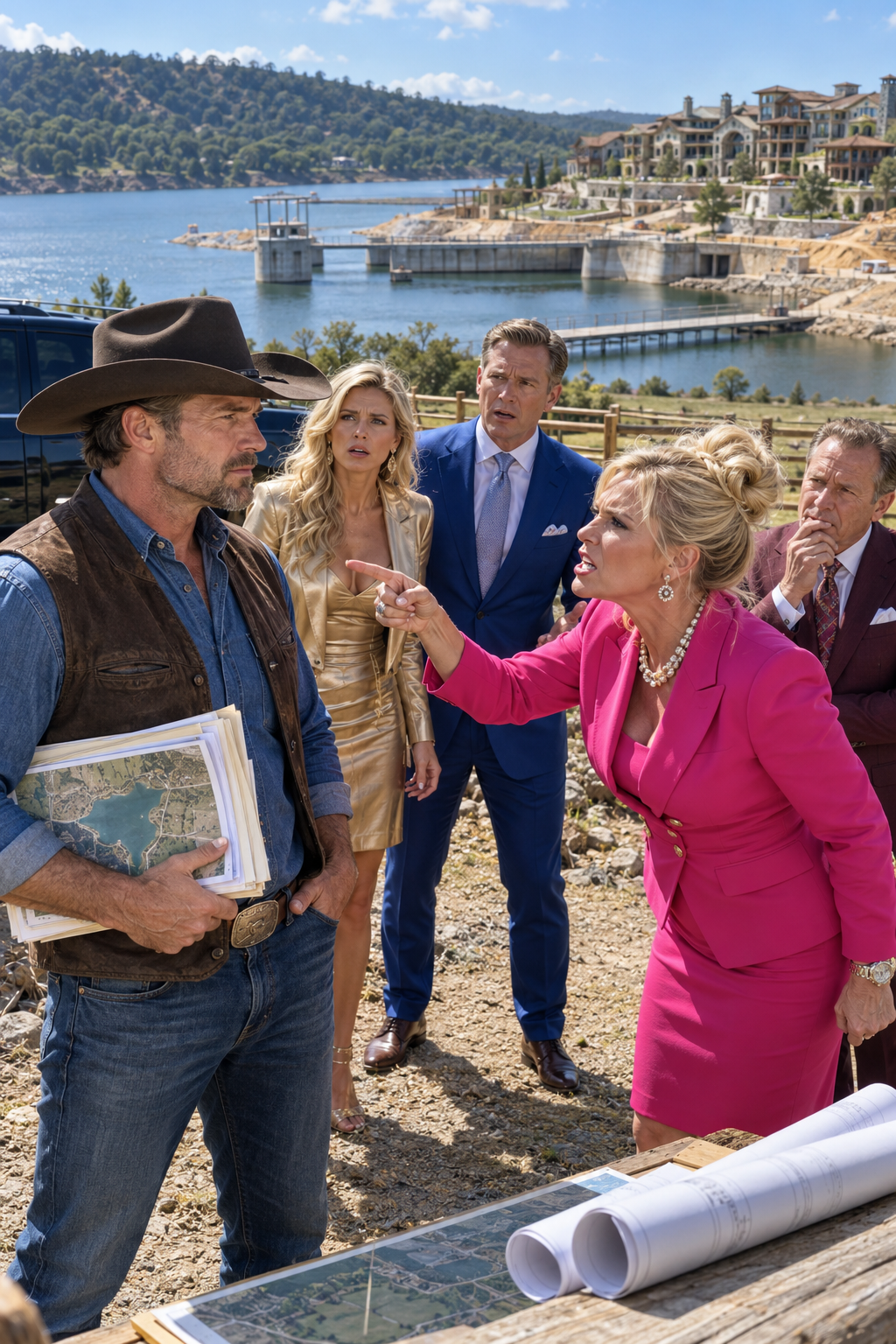
Karen Whitfield said it while standing on my front porch with six men behind her, as though my family’s 3,800-acre ranch had somehow become a conference room she had reserved for the afternoon.
Then my younger brother stepped out from behind her.
He wouldn’t look me in the eye.
That hurt more than Karen’s threat.
Daniel had my father’s jaw, my mother’s gray eyes, and the same nervous habit of rubbing his thumb across his wedding ring whenever he lied.
He was rubbing it now.
“You should listen to her, Evelyn,” he said quietly. “This is already done.”
I stared at him.
Not the attorney holding a leather folder.
Not the developer in loafers standing in ranch dust like the ground had offended him.
My little brother.
The boy I had practically raised after our mother died.
The man whose mortgage I had quietly paid for nine months after his construction company collapsed in 2017.
The brother who had called me at two in the morning when his daughter needed emergency surgery and his insurance refused the hospital transfer.
I had wired $38,000 before sunrise.
He had promised to pay me back.
I told him never to mention it again.
Now he was standing beside the woman trying to throw me off the ranch where we had both been born.
Karen smiled.
“There. See? Even your own family understands.”
I didn’t answer.
That seemed to make her uncomfortable.
People like Karen Whitfield depended on noise.
They expected anger.
They expected tears.
They expected you to scream so they could lower their voices and call you unstable.
I gave her nothing.
Behind us, Mercer Lake was perfectly blue beneath the Colorado morning sky.
Cottonwoods trembled along the northern bank.
Three hundred yards downhill, a pair of horses stood beside the old stone watering trough my grandfather built in 1951.
Farther west, beyond the ridge, survey stakes covered land that had been empty sagebrush six months earlier.
That was where Whitfield Development Group planned to build Clearwater Crown Resort.
A $52 million “private alpine lake community.”
Luxury cabins.
A 140-room lodge.
A golf course.
Two heated pools.
Artificial waterfalls.
A spa complex.
And 212 vacation homes wrapped around a lakefront the brochures called “exclusive.”
The brochures did not mention me.
More importantly, they did not mention where all that water was supposed to come from.
Karen took one step closer.
She wore cream slacks, a fitted emerald blazer, oversized sunglasses, and boots too expensive to have ever stepped in manure before that morning.
“I am trying to make this pleasant,” she said.
“That’s kind of you.”
Those were the first words I had spoken.
Daniel glanced at me.
Karen’s smile widened.
“Then we understand each other.”
Her smile stopped.
I looked at the folder in the attorney’s hands.
“What exactly do you think you own?”
The attorney cleared his throat.
His name was Garrett Sloan.
Real-estate specialist.
I knew because I had already read his biography.
I had also read about the lawsuit his firm settled three years earlier after representing a developer accused of concealing groundwater depletion studies.
Garrett opened his folder.
“The Clearwater Crown Homeowners Association acquired the Mercer Ridge parcel, associated lake-access easements, historical utility corridors, and all appurtenant development privileges conveyed through Mercer Family Holdings.”
I looked at Daniel.
His thumb stopped moving.
Karen said, “Your brother had authority to execute the transaction.”
Daniel finally met my eyes.
“Dad made us both beneficiaries.”
“That isn’t what I asked.”
“That isn’t what I asked.”
His face flushed.
Garrett interrupted.
“The relevant documents have been recorded.”
I nodded once.
Then I asked the question that made Karen’s expression change.
“Recorded where?”
Nobody spoke for a moment.
Garrett looked annoyed.
“With San Miguel County.”
I nodded again.
“Interesting.”
Karen removed her sunglasses.
She had pale green eyes and the smooth, disciplined face of a woman accustomed to people saying yes before she finished asking.
“I don’t think you appreciate your position.”
“Oh, I appreciate it.”
“We have an approved development plan. Investors are committed. Construction financing has closed. Your brother’s company has executed the transfer. The county planning commission approved the revised use designation last month.”
That answer bothered her more than anything else I had said.
“You know?”
I walked to the porch railing and picked up a small brass key.
It had been sitting beside my coffee cup the entire time.
Daniel’s eyes immediately dropped to it.
That was the moment I knew.
He recognized it.
Maybe not what it opened.
But he knew it mattered.
I closed my fingers around the key.
My father had given it to me six days before he died.
He had been eighty-two.
His hands were shaking so badly he could barely hold the envelope.
We had been sitting in Room 417 of St. Catherine’s Medical Center in Grand Junction.
The window faced west.
Snow was coming down in soft sheets.
Daniel had already gone home.
He said hospitals made him uncomfortable.
Dad waited until the elevator doors closed behind him before reaching under his blanket.
He hadn’t called me that since I was fourteen.
He handed me the key.
“What’s this?”
“Something your grandfather was smarter about than I was.”
Then he gave me an envelope.
On the front, in his handwriting, were six words.
NOT UNTIL THEY COME FOR THE WATER.
I laughed at first.
Not because it was funny.
Because Dad had always been dramatic about land.
Fence lines.
Well heads.
Grazing rights.
Mineral claims.
He could make a county tax assessment sound like the Battle of Gettysburg.
But he didn’t laugh.
He gripped my wrist.
“You hear me?”
“The land will tempt them.”
I leaned closer.
“Doesn’t matter.”
His breathing had become shallow.
“The lake will fool them.”
“The water is what they’ll kill for.”
That was the last serious conversation we ever had.
He died four days later.
For eight months, I kept the key in a coffee tin behind a stack of flour bags in my pantry.
I never opened the envelope.
Not until Karen Whitfield’s first certified letter arrived.
That had been eleven days earlier.
She demanded I stop “interfering with planned community infrastructure.”
The interference?
I had locked my own north pasture gate.
Apparently her survey crew wanted to cross my land.
Her second letter demanded access to Mercer Lake for “environmental assessment.”
Her third threatened fines.
$2,500 per day.
That was when I opened Dad’s envelope.
Inside was a hand-drawn map.
A deed reference.
And one sentence underlined twice.
THE SURFACE IS YOURS.
THE WATER IS OLDER THAN ALL OF US.
Back on the porch, Karen pointed toward my house.
“We’ve arranged temporary accommodations for you in Montrose.”
I almost smiled.
“You arranged accommodations?”
“For thirty days.”
“How generous.”
“The resort partnership is prepared to compensate you for relocation costs as a courtesy.”
Daniel shifted his weight.
I watched him.
There was something I had learned after thirty years of managing payroll, cattle contracts, land leases, insurance claims, feed prices, and men who assumed a woman with gray in her hair didn’t understand numbers.
When people believe they’ve already won, they become generous with things they never owned.
Karen believed she owned my ranch.
Garrett believed he owned the paperwork.
Daniel believed whatever money they had promised him was safe.
And all three believed I was standing on my porch because I had nowhere else to go.
They were wrong.
They were wrong about the ranch.
They were wrong about the lake.
They were wrong about my father.
They were wrong about what Daniel had signed.
They were wrong about the quiet woman standing in front of them.
I slipped the brass key into my pocket.
Then I looked directly at Karen.
“When do you intend to start pumping?”
Garrett’s eyes flicked toward her.
Small movement.
But I saw it.
Karen smiled again.
“I have no idea what you mean.”
“Of course.”
“We’re discussing property.”
“No,” I said. “You’re discussing scenery. I’m discussing water.”
Daniel swallowed.
There it was.
The first crack.
I stepped down from the porch.
“Is that all?”
Karen stared at me.
“You need to leave by Friday.”
“Then I suppose Friday will be interesting.”
She frowned.
“You think this is a joke?”
I looked toward the lake.
“I think this is arithmetic.”
Then I walked past all of them and went to feed my horses.
I heard Karen call after me.
“You cannot stop this project!”
I didn’t turn around.
That was another thing my father taught me.
Never interrupt a person when they are confidently describing the mistake they’ve already made.
By noon, three white SUVs were parked at the northern gate.
I recognized two of them from the week before.
This time they had a sheriff’s deputy with them.
Deputy Aaron Pike was thirty-something, sunburned, polite, and visibly unhappy to be there.
He held up both hands when I approached.
“Ms. Mercer, I’m not here to arrest anybody.”
“Good start.”
One of the surveyors looked irritated.
“We have recorded access rights.”
I held out my hand.
He gave me a copy.
I read it against the hood of his truck.
Utility access.
Thirty-foot corridor.
Mercer Family Holdings to Clearwater Infrastructure LLC.
Signed by Daniel Mercer.
And the legal description was wrong.
Not dramatically wrong.
That would have been easy.
It was wrong by 460 feet.
The corridor described on the document followed an old telephone easement abandoned in 1988.
Their survey stakes followed the lakeshore.
Two completely different paths.
I folded the paper.
“You can use the recorded corridor.”
The man pointed toward the lake.
“That is the corridor.”
“Yes, ma’am.”
He looked at Deputy Pike.
Pike looked at the document.
Then at me.
“You have a survey?”
“In my truck.”
I brought him the 1989 boundary survey.
Then the 1997 utility abandonment.
Then the 2004 county GIS correction.
I had color tabs on all of them.
The surveyor’s face changed.
“You had those ready?”
Deputy Pike studied the pages.
Then he handed the surveyor his copy.
“She’s right.”
The man’s jaw tightened.
“We have authorization.”
“Not for that route.”
“Our engineering schedule—”
Pike shook his head.
“That isn’t my problem.”
The surveyors left.
That was the first mini-payoff.
Almost boring.
But by four o’clock, Karen called.
“You embarrassed my contractors.”
“They embarrassed themselves.”
“You are deliberately obstructing a lawful development.”
“I allowed them to use the lawful easement.”
“There is no practical access from that side.”
“Then your engineers should buy better boots.”
Then she said something revealing.
“The intake has to be near the north basin.”
I leaned against the kitchen counter.
Another silence.
Longer this time.
Karen recovered.
“For fire suppression.”
“Of course.”
“We have state requirements.”
“Then I’m sure your engineers have handled them.”
She hung up.
I wrote the time in a yellow legal pad.
Then I wrote:
Whitfield verbally confirms planned north-basin intake.
Dad would have approved.
My father believed memories were sentimental.
Paper was evidence.
The next morning, Daniel arrived alone.
He came through the kitchen door like he still lived there.
For fifty-one years, family had never knocked at Mercer Ranch.
That was before betrayal made manners necessary.
“You should knock.”
He stopped.
For a second, he looked ashamed.
Then the shame hardened.
“We need to talk.”
“You’ve had opportunities.”
“Karen’s furious.”
“That sounds exhausting.”
“This isn’t funny.”
I poured coffee.
Only one cup.
Daniel stared at it.
Growing up, I always made his coffee before my own.
Two sugars until college.
One sugar after he married Leah.
Black after his doctor complained about his blood pressure.
I knew every version of my brother.
Apparently, I had missed one.
He pulled out a chair.
“Do you understand how much money is involved?”
“Fifty-two million just for phase one.”
“I read the filing.”
His eyes narrowed.
“You’ve been digging.”
“I can read.”
“Don’t do that.”
“Act like you’re the only adult in the room.”
I took a sip.
“You brought an HOA president to my house to evict me from property she doesn’t own.”
“Dad left Mercer Family Holdings to both of us.”
“Forty-nine percent to you.”
“Forty-nine point five.”
“Congratulations.”
“And you have fifty point five. I know.”
He rubbed his face.
“Garrett found a provision allowing a managing member to dispose of non-core assets.”
“The north ridge parcel was classified as non-core.”
“The company.”
“Which officer signed the classification?”
He didn’t answer.
I already knew.
Daniel had appointed himself managing member two weeks after Dad’s funeral using a resolution I had never signed.
That was serious.
But it wasn’t the real trap.
I let him keep talking.
“They offered twelve million for land Dad bought for almost nothing.”
“Granddad bought it.”
“Same difference.”
“Jesus, Evelyn. Listen to yourself. We could spend the rest of our lives fighting over dirt.”
“Then why are you selling it?”
“Because I have children.”
“Your daughter is a doctor.”
That sentence told me more than he intended.
His resentment had grown quietly.
My daughter, Rachel, had become a pediatric surgeon in Seattle.
His son bounced between business ventures.
His daughter had divorced young and moved home.
Somewhere along the way, my brother had turned our children’s lives into a scoreboard.
“You think I had it easier?” I asked.
“I think Dad trusted you with everything.”
“No. Dad trusted me with work.”
“Same thing.”
“No, Daniel. It isn’t.”
“Karen offered me a seat on the resort board.”
There it was.
Not all of it.
But enough.
“And my excavation company gets a five-year site contract.”
“How much?”
His face tightened.
“That isn’t your business.”
“It became my business when you tried to sell my ranch.”
“I sold a corporate parcel.”
“You sold paper.”
His eyes sharpened.
“What does that mean?”
I smiled faintly.
“Ask your attorney.”
He stared at me.
Then at the brass key lying beside my legal pad.
I had placed it there on purpose.
“What’s that?”
“Nothing you need.”
His gaze stayed on it.
“Was it Dad’s?”
I drank my coffee.
Daniel’s voice lowered.
He knew that silence.
When we were children, he once stole thirty dollars from Dad’s dresser.
I found the money under his mattress.
I didn’t yell.
I simply sat on the edge of his bed until he confessed.
He had hated my silence then too.
“What did Dad give you?”
I looked at him.
“A warning.”
Daniel laughed, but it came out thin.
“About me?”
That was the truth.
“About men who think signatures can move rivers.”
His face went still.
For the first time since this began, my brother looked afraid.
He left without another word.
That afternoon, I drove twenty-seven miles south to an abandoned pump house near the old Mercer orchard.
The brass key opened it.
The building was smaller than I remembered.
Dad had stopped using the orchard after a freeze destroyed most of the trees when I was twelve.
Inside, dust coated the floor.
A rusted irrigation pump filled one wall.
Mice had eaten through two feed sacks.
At first, I thought the key had led me nowhere.
Then I remembered the map.
Three circles.
One at the lake.
One at the pump house.
One beneath it.
I found the trapdoor behind the old motor housing.
The padlock opened with the same key.
Below was a concrete stairwell.
Twelve steps.
At the bottom sat a steel cabinet.
Inside were forty years of documents.
Original deeds.
Water-court filings.
Engineering reports.
Handwritten ledgers.
A 1973 reservoir adjudication.
A 1956 ditch-company agreement.
A 1982 decree from Colorado District Water Court.
And a sealed letter addressed to me.
I sat on the concrete floor.
For a moment, I could smell my father.
Cedar shavings.
The envelope trembled slightly in my hands.
Not because I was scared.
Because grief has a strange way of hiding in practical objects.
You think you have buried someone.
Then you recognize their handwriting and lose them again.
I opened it.
If you are reading this, somebody has finally figured out what your grandfather protected.
Do not blame Daniel too quickly.
He understands land value.
He has never understood water.
That sentence hurt.
Because it meant Dad had known.
He continued.
Mercer Lake is not merely private surface water attached to the ranch.
The lake stores senior adjudicated rights dating to 1891, consolidated through Mercer Basin Agricultural Trust in 1956.
The ranch company does not own the controlling right.
I stopped reading.
Then read the sentence again.
My breathing slowed.
I turned the page.
Dad explained everything.
In 1956, my grandfather, Walter Mercer, had nearly lost the ranch during a drought.
Instead of selling water rights to a mining company, he placed the oldest rights into a separate family trust.
The purpose was not tax avoidance.
It was protection.
The trust required that the water remain available first for agriculture, domestic wells within an old service district, livestock, and emergency fire suppression.
Development use required consent from the controlling trustee.
That position passed from Walter to my grandmother.
Then to Dad.
Then, through a 2009 amendment nobody in Mercer Family Holdings had ever bothered reading, to me.
Daniel inherited company shares.
I inherited control of the water.
And the lake Karen intended to build her resort around?
It was physically on Mercer Ranch.
But almost every gallon legally available for withdrawal was governed by the trust.
My father’s letter ended with a warning.
DO NOT USE THIS TO GET RICH.
USE IT TO KEEP SOMEBODY ELSE FROM MAKING EVERYONE POOR.
I sat there for a long time.
That sentence explained my father better than any obituary ever could.
He had not hidden a fortune.
He had hidden a responsibility.
The valley below Mercer Lake contained seven working cattle ranches, four small hay farms, thirty-eight rural homes, and the Dunbar Volunteer Fire District.
During drought years, releases from our reservoir kept the old Henderson Ditch flowing.
Nobody became wealthy from that arrangement.
That was the point.
Water reached people who needed it.
If Clearwater Crown obtained the withdrawals described in the engineering report I found two folders later, summer flow into the Henderson Ditch would drop by as much as thirty-one percent in dry years.
Thirty-one percent.
For Karen, that number meant greener golf-course grass.
For Jim Holloway, seventy-two years old, it meant losing his alfalfa crop.
For the Navarro family, it meant cutting their cattle herd.
For thirty-eight homeowners with shallow wells, it meant watching pumps suck air in August.
For the fire district, it meant fewer emergency reserves during wildfire season.
Suddenly this was no longer about my ranch.
That was when I decided Karen Whitfield wasn’t getting one drop until every document was in front of the right people.
I called one person.
Margaret Shaw.
Water attorney.
Sixty-three.
Silver hair.
Voice like sandpaper.
Dad hated lawyers.
He loved Margaret.
That told you everything.
She answered on the fourth ring.
“Evelyn Mercer.”
“You recognize my number?”
“No. I recognize trouble.”
“Your father paid my retainer for twenty years and never once called when things were going well.”
I looked at the stacks around me.
“I found the pump house.”
Then Margaret said, “Oh.”
“You knew?”
“I knew there was a pump house.”
“Margaret.”
“I was prohibited from discussing the trust until you discovered the documents or a triggering action occurred.”
“What triggering action?”
“A third-party commercial claim against the stored water.”
I closed my eyes.
“Someone filed one?”
“Three weeks ago.”
My hand tightened around the phone.
“Clearwater Infrastructure LLC.”
There it was.
The system behind Karen.
They hadn’t just bought land.
They had already applied to convert part of the water use.
Without telling me.
“Can they do that?”
“They can file anything they can afford to print.”
“Can they win?”
“Not if these documents say what I think they say.”
I heard paper moving on her end.
“Evelyn, listen carefully. Do not threaten them. Do not shut anything off. Do not move equipment. Do not confront your brother. Do not post anything online.”
“I wasn’t planning to.”
“Because if the trust is intact, we don’t want them scared.”
That made me smile.
“What do we want?”
“We want them confident.”
Friday came.
The day Karen expected me to leave.
At a.m., a moving van arrived.
Not one I had ordered.
At , two Clearwater security vehicles parked beside it.
At , Karen stepped onto my porch holding a clipboard.
I was sitting in a rocking chair drinking coffee.
“You’re still here.”
“So are you.”
She looked behind me through the screen door.
“Have you packed?”
Her mouth tightened.
Daniel arrived five minutes later.
Then Garrett Sloan.
Then, to my surprise, a representative from Summit Western Bank.
That told me financing had become nervous.
Karen handed me a notice.
“Your occupancy authorization has expired.”
I read the first paragraph.
Then the second.
The notice treated my own residence as though I were a tenant of Mercer Family Holdings.
I handed it back.
“This is creative.”
“It is enforceable.”
Garrett stepped forward.
“Ms. Mercer, I strongly advise you—”
“Mr. Sloan.”
“Did your title team review the 1956 Mercer Basin Agricultural Trust?”
Nothing moved.
Not Daniel.
Not the banker.
Garrett’s face barely changed.
But barely was enough.
“I’m not familiar with that instrument.”
“That surprises me.”
Karen looked at him.
“What trust?”
The morning wind lifted the corner of the notice in her hand.
“Did nobody tell you?”
Daniel’s face had gone pale.
I turned toward him.
He whispered, “What did you find?”
I ignored him.
Karen stepped forward.
“What trust?”
Very slightly.
Then I said, “You’re standing on land you think you bought, beside a lake you think you control, for a resort whose financing assumes a water supply you never acquired.”
The banker looked at Garrett.
Garrett said, “That is not an accurate characterization.”
“Then you won’t mind waiting until the water court answers.”
Karen stared at me.
“Water court?”
“What did you file?”
“Nothing dramatic.”
That wasn’t entirely true.
Margaret had filed an emergency objection at that morning.
She had also submitted notice to the Colorado Division of Water Resources.
And because Clearwater’s development financing documentation publicly represented “secured long-term water access,” she sent the relevant documents to the lender’s counsel.
That explained the banker standing on my porch.
Karen turned on Garrett.
“You told me the rights transferred with the property.”
“They ordinarily would.”
“Ordinarily?”
“The title materials indicated—”
“You said they transferred.”
Daniel took two steps backward.
Karen saw him.
That was the instant the alliance cracked.
Not shattered.
Enough for everyone to begin wondering who would be blamed first.
I picked up my coffee.
“The moving van can leave.”
Nobody answered.
“The security vehicles too.”
Karen’s cheeks reddened.
“This isn’t finished.”
I looked at her.
“It isn’t.”
For the next six days, Clearwater Crown stopped pretending I was irrelevant.
They hired another law firm.
Then another consultant.
County commissioners who had ignored my emails suddenly returned calls.
The planning department asked Clearwater for supplemental water verification.
The bank suspended two construction draws pending clarification.
Work did not completely stop.
But concrete deliveries slowed.
Excavators sat idle.
Contractors began asking questions.
Investors began asking better ones.
Karen responded the way powerful people often do when quiet pressure works against them.
She made it personal.
On Monday, the HOA board issued me $17,500 in “community compliance penalties.”
I did not live in their community.
On Tuesday, they accused my cattle of contaminating “shared recreational watershed assets.”
The cattle had grazed the same pasture since 1948.
On Wednesday, someone reported my barn as an illegal commercial structure.
It was built in 1936.
On Thursday, a county inspector appeared to examine my septic system.
I handed him a folder.
He laughed when he saw the permit.
“Ma’am, this is older than I am.”
“Still valid?”
“Unfortunately for whoever complained, yes.”
Mini-payoff number two.
Friday brought the first real escalation.
A contractor began trenching near the northern creek.
The trench was headed straight toward a planned intake point.
I drove there in my dusty Ford pickup.
No shouting.
No dramatic confrontation.
I photographed the excavator.
The coordinates.
The crew truck numbers.
The exposed pipe.
Then I called Margaret.
“Should I stop them?”
“Are they on your property?”
“About thirty yards.”
“You have witnesses?”
“Take more photos.”
Twenty minutes later, a state water commissioner arrived.
So did Deputy Pike.
This time Pike didn’t look confused.
He looked annoyed.
The state official, a compact woman named Dana Kim, examined the trench and asked the foreman for his permit.
He handed over three documents.
Dana read them.
Then she looked toward me.
“Ms. Mercer?”
“Did you authorize diversion construction?”
She looked at the foreman.
“Shut it down.”
The excavator stopped.
Karen arrived seventeen minutes later.
I know because I timed it.
She got out before her SUV fully settled.
“What is happening?”
Dana explained.
Karen pointed at me.
“She is interfering again.”
Dana’s expression remained neutral.
“No, ma’am. Your contractor appears to have commenced construction on an unapproved diversion structure.”
“It is a fire-suppression intake.”
“Not according to these drawings.”
Garrett arrived behind her.
He took one look at the exposed pipe and closed his eyes.
That was my favorite moment of the week.
Karen lowered her voice.
“This is becoming ridiculous.”
Dana handed her a temporary stop-work order.
“No withdrawals. No connection. No intake construction pending review.”
Karen stared at the paper.
Behind her, the excavator engine clicked as it cooled.
For the first time, Clearwater Crown’s future sounded like silence.
That evening Daniel came back.
He didn’t enter.
He stood outside my screen door.
“I didn’t know.”
I was making soup.
“I believe you.”
Relief crossed his face too quickly.
“I didn’t know about the water trust.”
He stepped closer.
“Then you understand.”
The relief disappeared.
“You signed documents you didn’t understand because you wanted what they promised.”
“That isn’t fair.”
“It’s exact.”
“I was trying to save my company.”
“You could have asked me.”
“You would have said no.”
“To selling the water?”
“To everything!”
His voice rose.
Mine didn’t.
“There it is.”
Daniel looked away.
For years, I had mistaken his pride for independence.
Maybe he had too.
He leaned against the porch post.
“My company owes $2.4 million.”
I stopped stirring.
That was worse than I expected.
“Equipment loans. Two projects failed. One client declared bankruptcy.”
“And Karen?”
“Guaranteed enough work to clear most of it.”
“In exchange for your signature.”
“She said the north ridge was worth twelve million.”
His eyes glistened.
“I thought there was enough for everyone.”
I turned off the stove.
“You thought there was enough for you.”
“That’s not what I meant.”
“You signed an affidavit saying I had notice.”
That was the part he hadn’t expected me to know.
“I saw the filing.”
“You swore under penalty of perjury that I attended the January 14 meeting.”
He rubbed his forehead.
“Garrett said it was procedural.”
“I was in Seattle on January 14.”
“Rachel had surgery.”
“Then why did you sign it?”
He had no answer.
I walked to the screen door.
Between us was a thin black mesh.
Almost nothing.
It felt like a wall.
“Do you remember when Mom died?”
His jaw tightened.
“What does that have to do with this?”
“You were eleven.”
“I was sixteen.”
“Dad couldn’t function for almost a year.”
“I cooked your breakfast. I signed your field-trip forms. I sat in the emergency room when you broke your wrist. I skipped the Denver college interview because you had pneumonia and Dad was three counties away buying cattle.”
“I never asked you to.”
That one landed.
Not because it was cruel.
Because it was true.
Children do not ask to be raised.
We do it because someone must.
“You’re right.”
Daniel stared at me.
“I never asked you to pay my bills either.”
“Or Leah’s surgery.”
“Or Dad’s care.”
“You chose all that.”
He looked almost triumphant.
As though he had finally found the argument that freed him.
I stepped closer.
“And I chose it because I loved you. That doesn’t make betrayal less ugly, Daniel. It makes it uglier.”
He looked down.
For several seconds, only the kitchen clock moved.
Then he whispered, “What happens to me?”
There was the real question.
Not what happens to the valley.
Not what happens to the ranch.
Not what happens to the farmers.
What happens to me?
“I don’t know.”
“You could withdraw the fraud claim.”
“I haven’t filed one.”
His head snapped up.
“You haven’t?”
“Margaret—”
“Margaret filed against the water transfer.”
His breathing changed.
“Then there’s still time.”
“For what?”
“To fix this.”
I studied him.
“What are you not telling me?”
He answered too fast.
I opened the screen door.
Daniel stepped backward.
He walked toward his truck.
Then I asked one question.
“Who changed Dad’s trust schedule?”
He stopped.
Completely.
That was the moment I knew there was another document.
He looked over his shoulder.
“The copy Clearwater submitted with its financing package lists the agricultural trust as dissolved in 2014.”
He said nothing.
“My copy says it was reaffirmed in 2014.”
Still nothing.
“Who changed it, Daniel?”
His face looked gray.
“I don’t know.”
Weak answer.
Which meant I was finally asking the right question.
The preliminary water hearing took place two weeks later in a courthouse that smelled like floor wax and old paper.
Karen arrived with nine people.
Two attorneys.
Three Clearwater executives.
A hydrologist.
A public-relations consultant.
And a man I had never seen before.
Silver hair.
He sat in the back row and never took notes.
Margaret noticed him too.
“Do you know him?” I whispered.
“Investor?”
She didn’t sound convinced.
The hearing was supposed to be narrow.
Was Clearwater entitled to proceed with its proposed diversion while ownership and trust authority were disputed?
Garrett’s side argued that delays threatened construction, jobs, tax revenue, and contractual obligations.
Margaret stood when he finished.
She carried one folder.
That was all.
“No one disputes that the project is expensive,” she said.
“Expense is not ownership.”
The judge looked over his glasses.
Margaret continued.
“The applicant purchased certain land interests from Mercer Family Holdings. It did not purchase the senior water rights governing Mercer Lake.”
Garrett objected.
The judge waved him down.
Margaret placed the 1956 trust document into evidence.
Then the 1982 decree.
Then the 2009 amendment.
Then my father’s 2014 reaffirmation.
Four documents.
Four small explosions.
Garrett asked for ten minutes.
The judge gave him five.
Karen leaned toward him so hard I thought she might crawl across the table.
Daniel stared at his hands.
The silver-haired man in the back row did not move.
When proceedings resumed, Garrett made his mistake.
He submitted the version of the 2014 schedule showing the trust dissolved.
Margaret looked at me.
I looked at Daniel.
Daniel would not meet my eyes.
The judge examined both versions.
“Counsel, these documents are inconsistent.”
“Yes, Your Honor.”
“Which instrument was recorded?”
Margaret answered.
Garrett frowned.
The judge looked at him.
“Your version?”
“Appears in corporate records.”
“Recorded where?”
Garrett paused.
“I’ll need to verify.”
That pause cost Clearwater more than any speech could have.
The judge leaned back.
“Then at present I have one document recorded with the county and acknowledged by the trustee, and another document of uncertain origin included in a private transaction file.”
Nobody moved.
“Temporary diversion authority is denied.”
Karen shut her eyes.
The judge continued.
“Applicant is prohibited from initiating withdrawals, constructing additional intake infrastructure, or representing the disputed water rights as secured pending adjudication.”
Margaret touched my sleeve under the table.
Not celebration.
Just confirmation.
We had won the first real battle.
Outside the courthouse, reporters waited.
Karen walked straight past them.
I would have too.
But one young reporter stepped in front of me.
“Ms. Mercer, are you trying to kill a $52 million development?”
“What are you trying to do?”
I looked directly into his camera.
“Keep people from selling water that isn’t theirs.”
That clip went everywhere locally.
Not millions of views.
This wasn’t Hollywood.
But enough.
Farmers called.
Homeowners called.
Former Clearwater contractors called.
One woman mailed me a copy of an investor presentation.
One page contained a phrase underlined in red:
CONTROL OF MERCER BASIN WATER CREATES LONG-TERM SCARCITY PREMIUM.
Scarcity premium.
They planned to reduce available agricultural water and then profit from controlling what remained.
That was the moral center of the whole fight.
It had never been about a pretty resort.
The lake was bait.
The water was leverage.
And my family’s signature had been their door.
Three days after the hearing, Summit Western Bank froze all future resort construction draws.
Two major investors requested independent title review.
The county planning board suspended final infrastructure approval.
Then the golf-course operator withdrew.
Karen called me at that evening.
No greeting.
“You’re destroying hundreds of jobs.”
“I thought we were discussing water.”
“You know exactly what you’re doing.”
“You could solve this tonight.”
I let silence answer.
She continued.
“Twenty million.”
I almost laughed.
Not because it wasn’t money.
Because she still didn’t understand my father.
“Twenty-five.”
“You haven’t even heard the terms.”
Her voice hardened.
“Everyone has a number.”
“Then you’ve met too few people.”
“You think those farmers care about you?”
“This isn’t about whether they care about me.”
“They’ll sell eventually.”
“And your brother already has.”
“He sold what he had.”
Karen took a breath.
“Thirty million.”
“You’re fifty-nine years old, Evelyn.”
“Fifty-eight.”
“Fine. Fifty-eight. What exactly are you protecting this for?”
I looked out the window toward the pasture.
The evening sun had turned Mercer Lake copper.
A fire truck from Dunbar Volunteer Station was filling its tanker at the emergency standpipe near the south road.
Training night.
Same as every Thursday.
“What am I protecting it for?”
I watched the tanker pull away.
“For whoever needs it after I’m gone.”
Then I hung up.
The next morning, someone cut the chain on the old pump house.
Nothing was taken.
That scared me more.
Someone had searched.
Drawers opened.
Documents disturbed.
Concrete dust on the stairs.
But Margaret had already copied everything.
The originals that mattered were in a bank vault.
Whoever came had found an empty cabinet.
Except for one thing.
My father’s handwritten note.
I had left a photocopy.
On it, I wrote:
YOU’RE LATE.
Deputy Pike did not find that funny.
Margaret did.
The investigation into the altered 2014 schedule widened.
Metadata from Clearwater’s corporate records showed the document had been scanned only seven months earlier.
Seven months.
The notary seal belonged to a woman who had died in 2019.
Her commission number did not match.
Her signature had been copied from a different transaction.
Then came the first major twist.
Daniel had not created the forged schedule.
He had used it.
He had signed an affidavit based on it.
But he had not made it.
Garrett hadn’t either.
The document came from Clearwater’s acquisitions department four months before Daniel ever negotiated his construction contract.
Someone had targeted the water rights before my brother became useful.
Karen was not improvising.
She had come looking for Mercer Basin.
That changed everything.
Margaret obtained a subpoena for internal acquisition records.
Clearwater fought it.
What arrived was 11,000 pages of emails, feasibility reports, water modeling, investor memos, and purchase strategies.
Buried on page 7,418 was the sentence that ended Karen Whitfield’s control of the project.
MERCER SIBLING D. LIKELY FINANCIALLY VULNERABLE; LEVERAGE CONTRACTOR DEBT TO OBTAIN INTERNAL CORPORATE AUTHORITY.
They had researched Daniel’s debt.
Before approaching him.
Before offering him work.
Before inviting him to the resort board.
They knew exactly where to press.
Daniel read the email in Margaret’s office.
He sat completely still.
I expected anger.
Instead, he whispered, “I thought they respected me.”
I looked at my brother.
For the first time in months, I did not see the man who betrayed me.
I saw the eleven-year-old boy who had once waited at the school gate because Mom forgot pickup day during chemotherapy.
He had always been desperate to be chosen.
Karen had figured that out.
It didn’t excuse him.
Understanding is not forgiveness.
But truth is useful even when it hurts.
“What are you going to do?” I asked.
He looked at the pages.
“What can I do?”
“Tell the truth.”
“They’ll destroy me.”
“You helped them try to destroy me.”
He flinched.
I hated saying it.
I said it anyway.
“If you want absolution, go to church. If you want to fix something, testify.”
Daniel testified.
Not heroically.
His lawyer objected constantly.
He admitted signing documents he had not fully read.
He admitted falsely claiming I received meeting notice.
He admitted accepting a promised contract connected to the sale.
Then he handed investigators something none of us knew existed.
A voice memo.
Karen had called him after the first court hearing.
Daniel recorded it because he thought she might blame him.
Her voice was calm.
That made it worse.
“Your sister is sentimental. Apply pressure where she lives. County complaints, livestock issues, whatever keeps her defending instead of attacking.”
Daniel asked, “What if she finds the original schedule?”
Karen answered:
“Then we make the original irrelevant.”
That sentence traveled fast.
Summit Western terminated financing.
The Colorado Attorney General’s office opened an inquiry into fraudulent development disclosures.
The county suspended every Clearwater Crown permit connected to the disputed water representation.
Karen resigned as HOA president “temporarily.”
Three board members resigned permanently.
Garrett Sloan’s firm withdrew from representation.
And Daniel’s promised excavation contract vanished.
By September, the half-built resort looked like the skeleton of a shipwreck.
Concrete foundations.
Steel beams.
Stacks of pipe.
Weeds growing through graded lots advertised six months earlier at $1.8 million each.
Karen’s $52 million dream had not been destroyed by me.
It had been built on an assumption she never bothered to own.
A settlement conference came next.
Karen entered wearing navy instead of emerald.
No sunglasses.
No entourage.
Just one attorney.
She looked older.
Maybe she was.
Maybe power had simply been good lighting.
Her attorney offered to abandon all claims to the Mercer water in exchange for release from civil liability.
Margaret slid the paper back.
Karen looked at me.
“What do you want?”
It was the first honest question she had ever asked.
I opened my folder.
Not a dollar figure.
A framework.
Clearwater would relinquish all claimed water interests.
Restore the damaged creek bank.
Remove the unauthorized intake infrastructure.
Pay for independent monitoring wells for the thirty-eight rural homes.
Fund five years of drought measurement.
Transfer 640 acres of undeveloped shoreline into a conservation easement.
And contribute $1.2 million to Dunbar Volunteer Fire District for wildfire response infrastructure.
Karen stared at the pages.
“You’re not asking for anything personally.”
“You could.”
She looked at me for a long moment.
Then she said something almost human.
I thought of Dad in Room 417.
Hands shaking.
Snow beyond the glass.
DO NOT USE THIS TO GET RICH.
USE IT TO KEEP SOMEBODY ELSE FROM MAKING EVERYONE POOR.
“Because this was never mine to waste.”
She signed three weeks later.
The resort partnership dissolved before Christmas.
Some land was sold.
Some construction was demolished.
A smaller lodge proposal surfaced the following spring, this time with a legal water plan based on conservation, limited wells, and purchased municipal allocations.
I did not object.
I had never been against development.
I was against theft wearing a planning permit.
Daniel lost his company.
There was no miracle there.
No sentimental ending where one confession erased what he had done.
He sold his house.
Leah stayed with him.
He took a job managing equipment for another contractor in Durango.
For almost seven months, we barely spoke.
Then one Saturday morning, I found him repairing the south pasture fence.
He had not asked permission.
But he had brought his own tools.
I walked over.
He kept working.
“Fence isn’t your property anymore,” I said.
“Then why are you fixing it?”
He drove another staple into the post.
“Because I broke something.”
I looked at the fence.
“That section wasn’t your fault.”
“I wasn’t talking about the fence.”
We stood there in the cold.
I could have hugged him.
Some wounds deserve time more than gestures.
I handed him a thermos.
He took it.
“One sugar?”
“I remembered.”
That was enough for that day.
By the following summer, the Henderson Ditch ran full through July.
Jim Holloway harvested both hay cuttings.
The Navarros kept their herd.
The fire district installed two new fill stations and bought a used brush truck.
Thirty-eight homeowners had monitoring meters on their wells.
Mercer Lake remained quiet.
No artificial waterfalls.
No championship golf course.
Cottonwoods.
Cattle moving through tall grass.
And on certain evenings, Rachel brought my two grandsons from Seattle and let them throw stones from the dock where my father taught me to swim.
I thought the story was finished.
I truly did.
Then, fourteen months after Karen first stood on my porch and told me I had seventy-two hours to leave, Margaret drove through my gate at on a Sunday morning.
She did not call first.
That alone frightened me.
I met her outside.
She stepped from her car holding a cardboard archive box.
“You need to see something.”
“I was reviewing the original trust chain for the conservation filing.”
“At six in the morning?”
Her face stopped me.
We went inside.
She placed the box on my kitchen table.
Inside were documents I had never seen.
Different paper.
Much older.
One bore a territorial seal from 1889.
Another was a handwritten survey.
The third was a water agreement signed two years before Colorado’s original Mercer Basin adjudication.
I stared at the signature.
Samuel Mercer.
My great-great-grandfather.
“What is this?”
Margaret sat down.
“Your father either never found it or never told me.”
“Tell you what?”
She slid the 1889 map toward me.
Mercer Lake was marked.
So was Henderson Creek.
But the boundary did not stop at my ranch.
A blue line continued twelve miles east.
Through the valley.
Through what was now county land.
Then beneath 6,200 acres owned by a company I recognized immediately.
Whitfield Western Holdings.
Karen’s family company.
I looked at Margaret.
“What am I looking at?”
She placed one finger on a sentence written in faded ink.
The language was old.
The meaning was not.
Mercer Basin’s senior diversion right had been granted together with a perpetual downstream reversion clause.
If water was commercially diverted beyond certain historical limits, controlling rights over a secondary spring system reverted to the Mercer trust.
My mouth went dry.
“How much water?”
Margaret didn’t answer immediately.
“Margaret.”
“Potentially more than the lake.”
I stared at her.
“How much more?”
“Enough to affect every development Whitfield Western owns east of the ridge.”
Silence filled the kitchen.
Then I saw something else.
A modern document clipped behind the old agreement.
Six weeks recent.
An application filed with the state.
WHITFIELD WESTERN WATER PARTNERS LLC.
They were trying to transfer the downstream springs before anyone connected them to the old Mercer agreement.
Karen hadn’t disappeared after Clearwater Crown collapsed.
She had been moving somewhere else.
I looked at Margaret.
“Does she know about the reversion clause?”
“We don’t know.”
“Does anyone else?”
“Someone does.”
She reached into the box one last time.
She removed a white envelope.
No return address.
My name typed across the front.
Inside was a photograph taken through a long lens.
It showed me and Daniel repairing the south fence three weeks earlier.
On the back, somebody had written one sentence in black ink.
YOUR FATHER HID THE WRONG WATER.
I read it twice.
Then I noticed the second line.
Almost an afterthought.
ASK DANIEL WHAT HE SIGNED ON MARCH 4.
I looked at Margaret.
She looked back at me.
March 4 had been six weeks after Daniel testified against Karen.
Three months before he told me he was done hiding things.
I picked up my phone.
My brother answered on the second ring.
I said nothing for a moment.
Then I asked the weakest-sounding question I had ever asked him.
“Daniel… what did you sign?”
The silence on the other end lasted nine seconds.
When he finally spoke, his voice was barely a whisper.
“How did you find out?”
And that was when I understood.
Karen Whitfield had never been trying to take only my ranch.
She had been trying to make sure I never discovered what my family actually owned.
✓ Lynn R. Adams
HOA Karen Threatened My 3,800-Acre Lake Ranch—She Never Knew Her $52M Resort Couldn’t Survive Without My Water “You have seventy-two hours to get your things off this property.” Karen Whitfield said…