HOA Karen Stole My Driveway During My Father’s Funeral — She Never Expected Me to Tow Her Entire Board Away
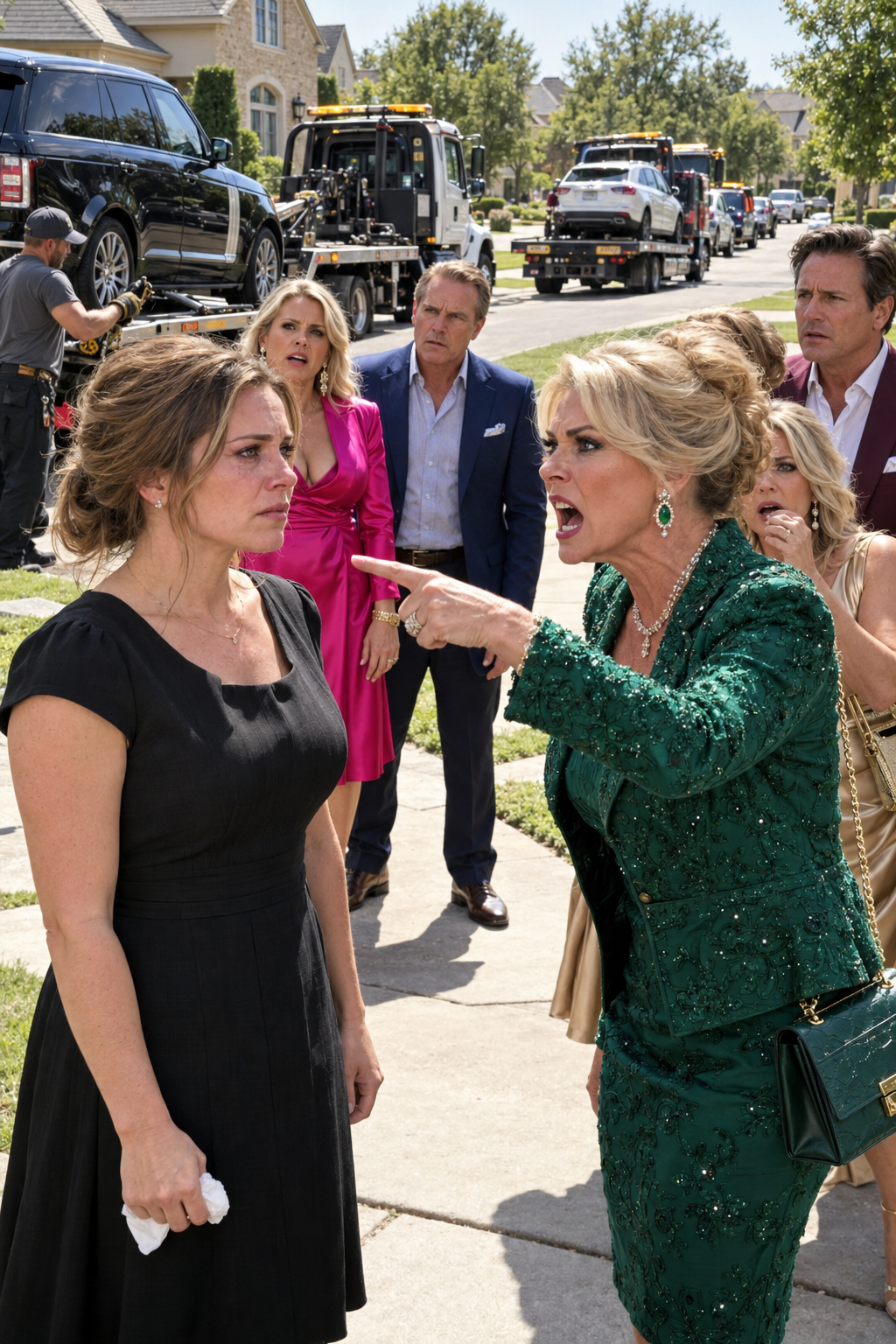
HOA Karen Stole My Driveway During My Father’s Funeral — She Never Expected Me to Tow Her Entire Board Away
I buried my father at 11:40 on a gray Tuesday morning.
At that afternoon, I came home and discovered my driveway no longer belonged to me.
At least, that was what the woman standing in the middle of it wanted me to believe.
There were six vehicles parked from my mailbox to my garage.
A white Mercedes.
A black Escalade.
Two luxury SUVs.
A red BMW convertible.
And a spotless pearl-gray Lexus parked sideways across the mouth of the driveway like whoever owned it wanted to make absolutely certain I couldn’t get onto my own property.
Behind them stood Karen Whitfield, president of the Cedar Ridge Homeowners Association.
She wore a cream blazer, white slacks, oversized sunglasses, and the little smile she used whenever she thought paperwork had already won the argument for her.
My father’s black funeral tie was still knotted around my neck.
The folded American flag from his memorial service was sitting on the passenger seat beside me.
Karen tapped the roof of my truck twice.
“You’re going to need to park on Hawthorne from now on, Ethan.”
I stared at her.
She removed her sunglasses.
Behind her, two landscapers were installing decorative stone posts on both sides of my driveway entrance.
There was also a new bronze sign.
PRIVATE HOA ACCESS
AUTHORIZED VEHICLES ONLY
I looked at the sign.
Then at Karen.
Then at the six vehicles blocking the driveway leading to the house I had owned for nine years.
“My father was buried three hours ago.”
Karen gave me the kind of sympathetic tilt of the head people use when they’re about to ignore everything you just said.
“I heard. I’m sorry.”
“No, you’re not.”
Her smile tightened.
“We’ve been delaying this project for months. The board couldn’t keep postponing community improvements because of your personal circumstances.”
I looked past her.
Fresh orange survey paint ran along the edge of my asphalt.
A section of my split-rail fence had been removed.
Two young maple trees my father had planted with me when I bought the house were gone.
Cut at the base.
The stumps were still bleeding sap.
That was when something inside me changed.
Not exploded.
There is a difference.
Explosions make noise.
Control gets quiet.
I shut off my truck.
I didn’t yell.
I didn’t threaten her.
I didn’t call her names.
I sat behind the steering wheel for several seconds and looked at the place where those trees had been.
My dad had been sixty-three when we planted them.
He had leaned on the shovel afterward, wiped sweat from his forehead, and said, “Give them ten years and they’ll make this driveway look like something.”
They almost had.
Karen followed my eyes.
“We’ll replace those with HOA-approved ornamentals.”
I stepped out.
“Who authorized you to cut my trees?”
“The access conversion required clearing.”
“What access conversion?”
She reached into a leather folder and handed me three stapled pages.
The first page carried the Cedar Ridge logo.
The second had a diagram.
The third had a signature.
My signature.
Except I had never signed it.
I read the title twice.
VOLUNTARY PROPERTY ACCESS TRANSFER AGREEMENT.
According to the document, I had permanently transferred the first seventy-eight feet of my driveway to the HOA in exchange for “community infrastructure considerations.”
The effective date was Monday.
Yesterday I had been at St. Joseph Medical Center signing paperwork for the release of my father’s body.
The forged signature was almost good.
But whoever had copied it had made the same mistake people always made when they tried to imitate me.
My capital E normally leaned backward.
This one leaned forward.
I looked up.
“Where did you get this?”
Karen crossed her arms.
“You signed it.”
“It’s notarized.”
“I was arranging my father’s funeral when this was supposedly signed.”
“Then perhaps you don’t remember.”
I laughed once.
Not because anything was funny.
Because that sentence told me exactly what kind of day this was going to become.
Around us, several neighbors had begun watching.
Some from their porches.
Some from windows.
Some openly from the sidewalk.
Cedar Ridge had forty-three houses, most built in the late nineties, arranged along three curved streets on the northern edge of Lexington, Kentucky.
My property was unusual.
The house predated the development.
So did the driveway.
So did the narrow strip of land connecting my two-acre lot to Hawthorne Road.
When my father bought the place in 1988, there had been farmland behind it.
When developers built Cedar Ridge years later, he sold them part of that farmland but kept our house, the driveway, and a thin utility corridor along the eastern edge.
I bought the house from him nine years earlier.
The HOA had disliked that arrangement from the moment Karen became president.
My driveway sat exactly where the board wanted a second entrance into the neighborhood.
I knew that.
My father knew that.
Apparently Karen had decided my father’s funeral was the perfect time to solve the problem.
Not while I was home.
Not while Dad was alive.
Not while anyone expected resistance.
They waited until the hearse arrived.
They waited until the church bells rang.
They waited until I stood beside a grave.
They waited until my phone was off.
They waited until they thought grief had made me weak.
I folded the supposed transfer agreement once.
Then again.
Karen extended her hand.
“I need that back.”
I put it into my jacket pocket.
“That’s HOA property.”
“You handed me evidence bearing my forged signature.”
Her expression flickered.
Only for half a second.
But I saw it.
So did the man standing near the white Mercedes.
I recognized him as Trevor Bell, HOA treasurer.
He suddenly became fascinated by his phone.
Karen lowered her voice.
“Ethan, I realize today has been emotional.”
“Which is why I don’t think this is the appropriate time to have this discussion.”
“You’re standing on my driveway.”
“It isn’t your driveway anymore.”
“We’ll find out.”
I walked toward my garage.
Karen stepped sideways.
“You can’t go through the restricted area.”
For a second, neither of us moved.
Then I looked down.
Her polished shoe was on the painted center seam my father and I had sealed together every other summer.
I lifted my eyes.
Maybe something in my face finally registered.
I walked between the parked vehicles toward the house.
She followed.
“Your vehicle can’t stay on HOA access.”
“My truck isn’t on it.”
“It will need to be relocated from the street by midnight. The board is implementing a permit system.”
“I’ll keep that in mind.”
“You should.”
I unlocked my front door.
The house smelled exactly the way it had when Dad was still alive.
Machine oil from the basement workshop.
He had been staying with me for the last six months after his health declined.
His reading glasses still sat on the side table.
His brown work jacket still hung on the hook by the laundry room.
There was a half-finished crossword on the kitchen counter.
For the first time all day, grief hit harder than anger.
I put both hands on the counter.
Closed my eyes.
And heard his voice.
Not literally.
Six weeks earlier, Dad had been sitting at that same counter while rain tapped against the windows.
He had asked me something strange.
“Karen still bothering you about that driveway?”
“Every month.”
“Don’t sign anything.”
“I mean anything.”
“Dad, I’m not giving the HOA my driveway.”
He had stared at me longer than necessary.
Then he’d said something I hadn’t understood.
“Good. Because they’re in deeper than they look.”
I had asked what he meant.
He waved me off.
There hadn’t been a later.
My phone buzzed.
A text from Karen.
BOARD WILL MEET AT YOUR DRIVEWAY AT TO FINALIZE ACCESS RULES. YOUR ATTENDANCE IS OPTIONAL.
I read it twice.
Then smiled for the first time since sunrise.
My father taught me three useful things.
Never sign a document you haven’t read.
Never start a fight you haven’t prepared to finish.
And never assume the loudest person in the room understands the rules better than you do.
I went upstairs.
Changed out of my funeral suit.
Put on jeans, work boots, and Dad’s old canvas jacket.
Then I called three people.
The first was my attorney, Rachel Mercer.
Rachel and I had gone to high school together. She specialized in property disputes and commercial real estate. More importantly, she hated bullies who misunderstood county records.
I sent her photographs of the agreement.
She called me twenty minutes later.
“This signature is supposedly notarized by Donna Klein.”
“Who is Donna Klein?”
“That’s the fun part.”
“Her notary commission expired eleven months ago.”
I looked out my kitchen window toward Karen’s Mercedes.
Rachel continued.
“And unless I’m reading the county GIS incorrectly, your driveway parcel hasn’t changed ownership.”
“So the transfer isn’t recorded.”
“Nothing has been recorded.”
“Could they have filed today?”
“They could try.”
“Can you stop it?”
“I’m already drafting notice.”
I heard typing.
Then she said, “Do not remove anything permanent yet.”
“What about vehicles?”
“What vehicles?”
“Six HOA board members parked across my driveway.”
“On your parcel?”
“According to the county map, yes.”
“Did you ask them to leave?”
“Karen told me I no longer own it.”
Another pause.
This one sounded happier.
“Send written notice. Give them a reasonable opportunity to remove the cars.”
“And after that?”
“If the parcel is yours, posted correctly, and Kentucky towing requirements are satisfied, privately parked unauthorized vehicles may be subject to removal. But don’t improvise. I’ll text you exactly what notice to use.”
“My father died Sunday.”
Her voice softened.
“I know. I’m sorry.”
“Karen says I signed this transfer yesterday.”
Rachel became quiet.
Then the softness vanished.
That one word sounded expensive.
“I’ll handle the filing issue,” she said. “You handle your property. And Ethan?”
“Photograph everything.”
That was call number one.
The second call went to Bluegrass Recovery & Towing.
The owner, Marcus Hall, had serviced Dad’s landscaping trucks for years.
When I explained the situation, Marcus said, “You want one truck?”
“How many do you have?”
“Three available.”
“Bring all three.”
He laughed.
Then realized I wasn’t joking.
“What’d they park?”
I listed the vehicles.
Marcus whistled.
“That’s a wealthy little impound lot.”
“Don’t touch anything until I give you the documents.”
“Wouldn’t dream of it.”
The third call went to the Fayette County Sheriff’s Office non-emergency line.
I reported a property dispute.
I reported unauthorized vehicles.
I reported suspected forged documents.
And I requested an officer because I had every reason to believe the situation would escalate once towing began.
Then I printed Rachel’s notice.
At p.m., I taped copies to every vehicle.
NOTICE TO REMOVE UNAUTHORIZED VEHICLE FROM PRIVATE PROPERTY.
Thirty-minute voluntary removal period.
Owner of record: Ethan Cole.
Parcel number.
Photographs taken.
At , I texted Karen.
Your vehicle and all HOA vehicles are parked on private property without permission. Please remove them by p.m. Written notices have been placed on each vehicle.
She replied in less than a minute.
THE BOARD REJECTS YOUR CLAIM.
Then I waited.
At , Trevor Bell came outside.
He read the notice on his Lexus.
Looked toward my house.
Looked toward Karen.
Then walked to her.
Their conversation became animated.
Trevor pointed at the paper.
Karen shook her head.
He pointed again.
She said something I couldn’t hear.
He dropped his hands.
Then he walked back into Karen’s house.
Interesting.
At , nobody had moved a car.
At , three tow trucks turned onto Hawthorne.
The neighborhood woke up.
Garage doors opened.
Phones appeared.
Someone across the street actually carried a lawn chair to the sidewalk.
Marcus climbed out of the first truck wearing a faded navy cap.
He saw the six vehicles.
Then he saw me.
“Tell me you did the paperwork.”
I handed him the folder Rachel had prepared electronically.
County property printout.
Tax parcel record.
Photographs.
Timestamped text messages.
Marcus looked through everything.
“Lawyer involved?”
“On the way.”
He grinned.
“Beautiful.”
The first vehicle he hooked was Trevor’s Lexus.
That was when Karen came running.
Not walking.
“What are you doing?”
Marcus didn’t stop.
She stepped in front of him.
“You cannot tow HOA vehicles!”
Marcus pointed to me.
“Property owner authorized removal.”
“I am the property owner!”
“No,” I said from behind her. “You claimed the HOA was.”
She spun around.
“This access has been legally transferred.”
“County says otherwise.”
“Our attorney approved it.”
“Great. He can explain that.”
Her face sharpened.
“You called the county?”
“I called several people.”
Trevor came outside again.
When he saw his Lexus lifting onto the flatbed, color drained from his face.
She didn’t answer.
“Tell them to stop.”
“They’re bluffing.”
The hydraulic lift rose.
Trevor stared at it.
“That does not look like bluffing.”
He hurried toward me.
“Ethan, listen, I don’t want trouble.”
“You had thirty minutes.”
“I thought Karen had authorization.”
“I suggest you discuss that with Karen.”
“Can I just move it?”
Marcus glanced at me.
Legally, I probably could have let him.
Emotionally, I wanted to watch that Lexus disappear.
But Dad had taught me something else.
Never confuse revenge with leverage.
“If the tow operator can safely release it and you pay whatever fee he requires, move it now.”
Trevor immediately pulled out his wallet.
Karen looked at him like he’d committed treason.
“You are a board officer.”
“I’m also not paying an impound fee because you picked a fight with Ethan.”
That was the first crack.
Almost invisible.
But cracks matter.
Trevor’s Lexus was lowered.
He paid Marcus a drop fee.
Then he drove it off my property and parked two blocks away.
The woman who owned the BMW followed him.
So did one of the SUV owners.
Three vehicles gone.
Three remained.
Karen’s Mercedes.
The black Escalade belonging to Vice President Glenn Porter.
And a silver Range Rover belonging to board secretary Melissa Crane.
Karen stood in the driveway with her arms folded.
Nobody moved.
At , Deputy Samuel Brooks arrived.
He was in his late forties with gray at his temples and the patient expression of a man who had spent twenty years listening to neighbors argue about fences.
He spoke with me first.
Then Karen.
Then Marcus.
I showed him the county records and the alleged transfer.
He examined the signature.
“You’re saying you didn’t sign this?”
“Where were you yesterday at p.m.?”
“St. Joseph Medical Center, then Gray & Sons Funeral Home.”
“You can document that?”
Karen interrupted.
“The HOA has counsel.”
Deputy Brooks looked at her.
“Ma’am, nobody has said you don’t.”
“This is an internal association matter.”
“Is Mr. Cole a member of your association?”
That was the question Karen hated most.
Because the answer was complicated.
My house sat beside Cedar Ridge.
My mailing address was Cedar Ridge.
But the original deed specifically excluded my parcel from mandatory association membership.
For years, I had voluntarily paid for snow removal on the shared section of Hawthorne.
Karen had repeatedly tried to convert that into full HOA jurisdiction.
She’d never succeeded.
“No,” Karen finally said.
Deputy Brooks looked back at the document.
“So why does your association believe it can take ownership of his driveway?”
Karen’s voice chilled.
“Because he transferred it.”
Deputy Brooks looked at me.
“I didn’t.”
He looked at Karen again.
She said nothing.
He handed me the paper.
“This appears civil at the moment, but a forged notarized document can become something else. Preserve the original.”
“I intend to.”
Karen stepped closer.
“Deputy, I am asking you to prevent these tow operators from interfering with HOA property.”
Brooks glanced at the Mercedes.
“Whose name is on that car?”
“So it isn’t HOA property.”
“It’s being used for official HOA business.”
He stared at her for half a second.
Then turned to Marcus.
“Are you compliant with private property towing requirements?”
Marcus handed him his paperwork.
Brooks reviewed it.
Then stepped aside.
Karen finally understood.
“You’re allowing this?”
“I’m not adjudicating a property dispute on a driveway. The current county record identifies Mr. Cole as owner. You’ve been told to remove your vehicle. If you believe the tow is unlawful, you can pursue remedies.”
Her mouth opened.
Nothing came out.
Marcus hooked the Mercedes.
Every phone on the block rose a little higher.
Karen rushed toward the driver’s door.
“I’ll move it!”
Marcus stopped.
“Drop fee.”
“You had notice.”
“This is extortion.”
“It’s seventy-five dollars.”
“I’m not paying you seventy-five dollars to move my own car!”
Marcus shrugged.
The winch tightened.
Her Mercedes rolled backward toward the flatbed.
She looked at me.
“Stop him.”
“You’ll regret this.”
“You think this is funny?”
I looked at the cut maple stumps.
“I think it’s documented.”
Her car disappeared first.
Glenn’s Escalade went second.
Melissa paid the fee and moved her Range Rover before Marcus could hook it.
By , my driveway was empty.
The decorative stone pillars remained.
The bronze HOA sign remained.
The orange paint remained.
And Karen remained.
She stood in the middle of the asphalt holding her phone so tightly her knuckles had turned white.
“You’re done here,” she said.
“I live here.”
“I mean with Cedar Ridge.”
“I was never part of Cedar Ridge.”
“We’ll see.”
Deputy Brooks was still within earshot.
Her tone changed immediately.
“Board meeting tomorrow. Seven p.m. You’ll receive notice.”
“I won’t attend.”
“You will if you care about what happens next.”
That caught my attention.
She smiled again.
Smaller this time.
Then she walked home.
That night, I didn’t sleep much.
Not because I was frightened.
Because grief and adrenaline make bad roommates.
At midnight I went downstairs and found Dad’s jacket hanging by the laundry room.
I put it on again.
His old carpenter pencil was still in the chest pocket.
So was a folded receipt from Miller’s Hardware.
Two screws.
Electrical tape.
A brass padlock.
Purchased three weeks earlier.
I stared at that receipt.
Then something clicked.
Dad had bought a brass padlock.
But there had been no new padlock anywhere in the house.
Not on the shed.
Not on his toolbox.
Not on the basement cabinets.
Why buy one?
At 12:47 a.m., I walked into the basement workshop.
Dad kept everything.
Old tax documents.
Survey maps.
He organized them in steel cabinets labeled with masking tape.
And one drawer labeled LAND.
I opened it.
Inside were forty years of surveys.
The oldest showed our original twelve-acre parcel before the developer purchased ten acres.
The newest was dated four months earlier.
My eyebrows lifted.
Dad had commissioned a new survey.
I spread it across the workbench.
The driveway parcel was outlined in red.
Along the eastern edge, the old utility corridor was marked separately.
Then I saw something handwritten near the bottom.
CHECK ACCESS LANGUAGE — THEY DON’T OWN WHAT THEY THINK THEY OWN.
Dad’s handwriting.
Below it was a phone number.
I recognized the area code but not the number.
I called even though it was after midnight.
“This is Martin Shaw. Leave your name and number.”
Martin Shaw.
The name bothered me.
I searched through Dad’s papers.
Twenty minutes later, I found it.
Martin Shaw.
Licensed land surveyor.
He had worked on the original Cedar Ridge development in 1997.
I sat back.
Now I understood why Dad had suddenly ordered another survey.
Karen hadn’t started planning this yesterday.
Dad had known something was coming.
At the next morning, Martin called.
“You Ethan Cole?”
A long pause.
“Your father passed?”
“I’m sorry. Robert was a good man.”
“Did he hire you to survey my property?”
Another pause.
Martin exhaled.
“You’d better come see me.”
His office sat fifteen minutes outside Lexington in a low brick building surrounded by pickup trucks and survey equipment.
Martin was seventy-one, thin, white-haired, and moved like his knees had negotiated separate retirement agreements from the rest of him.
He didn’t waste time.
“You know Cedar Ridge wants your driveway.”
“Yesterday they tried to take it.”
He stared at me.
“They what?”
I showed him the transfer agreement.
He read it once.
Then again.
“This wasn’t signed by you?”
He pushed back from his desk.
“Your dad said they’d get desperate.”
“What did he know?”
Martin walked to a flat-file cabinet and pulled out an old development map.
“The original Cedar Ridge plans called for two entrances.”
He pointed.
“Hawthorne Road here. Secondary access here.”
His finger landed directly on my driveway.
“But that second entrance was never built.”
“Because Dad kept the parcel.”
“Then why design it?”
“Developers assumed Robert would sell.”
“He didn’t.”
Martin smiled faintly.
“Your father enjoyed saying no when wealthy men expected yes.”
That sounded like him.
“So what changed?”
Martin’s finger moved deeper into the subdivision.
“Five years ago, Cedar Ridge began discussing expansion.”
“I’ve heard rumors.”
“Not rumors.”
He pulled out another map.
Sixty-two planned homes.
A clubhouse.
A small commercial strip.
The development sprawled north of the existing neighborhood.
“That’s huge.”
“About forty-three million dollars at current buildout projections.”
I looked at him.
“And they need my driveway.”
“They need a second legal access.”
“Could use another road.”
“They could.”
“Then why not?”
He pointed to the north boundary.
“Connecting here requires a bridge across Mill Creek, state wetland review, stormwater redesign, and negotiations with three owners.”
“How much?”
“Last estimate I saw was between four and six million.”
I looked back at my driveway.
“And mine?”
“Already paved.”
The answer sat between us.
I felt cold.
“Karen isn’t stealing seventy-eight feet of asphalt.”
“She’s trying to save the expansion project.”
Martin nodded.
“Your father figured that out four months ago.”
“Someone approached him.”
Martin hesitated.
“A development consultant.”
“Charles Danner.”
I knew that name.
Everybody in Lexington real estate knew it.
Danner Development Partners.
High-end subdivisions.
Shopping centers.
Golf communities.
“What did he offer Dad?”
“Two hundred thousand dollars for the access strip.”
I almost laughed.
The driveway alone wasn’t worth anything close to that under normal circumstances.
But as access for a forty-three-million-dollar development?
Two hundred thousand was nothing.
“Dad refused.”
“Immediately.”
“What happened next?”
“They raised it.”
“How much?”
“Six hundred fifty.”
I stared at him.
“He still refused?”
Martin actually smiled.
“Your father said he’d rather plant corn on it.”
I looked down.
That sounded exactly like Dad.
“They stopped negotiating with him.”
“But started dealing with Karen.”
Martin’s expression changed.
“I don’t know that.”
“You think it.”
“I think your father thought it.”
He slid a photocopy across the desk.
It was an email Dad had printed.
The sender was unfamiliar.
But the message was clear.
IF THE ASSOCIATION SECURES ACCESS RIGHTS INDEPENDENTLY, YOUR APPROVAL WILL NO LONGER BE NECESSARY. I HOPE YOU RECONSIDER WHILE YOU STILL HAVE CONTROL OVER THE OUTCOME.
Dad had circled one phrase.
WHILE YOU STILL HAVE CONTROL.
My throat tightened.
“When was this?”
“Seven weeks ago.”
Two weeks before Dad was hospitalized.
I took a picture.
“Is this all?”
Martin leaned back.
He opened a second file.
“The original development plat contains something unusual.”
“How unusual?”
“Potentially catastrophic.”
That got my attention.
“Catastrophic for who?”
“Cedar Ridge.”
He pointed to a shaded strip running beside my driveway and along the neighborhood boundary.
“Your father retained this utility and access corridor.”
“No, Ethan. You know part of it.”
He traced the line.
“It doesn’t stop at your driveway.”
The red line continued past my property.
Then behind six houses.
Then twelve.
Then almost the entire southern block.
My eyes narrowed.
“What exactly am I looking at?”
“A strip of land between eighteen and twenty-two feet wide.”
“Owned by who?”
Martin looked at me.
“According to the original deed?”
He tapped the map.
“Your father.”
I stared at him.
“That’s impossible.”
“That’s what Robert thought.”
“Those houses have fences across it.”
“Glenn Porter has a swimming pool back there.”
“Part of one.”
I looked at Martin.
“You’re telling me part of Cedar Ridge was built on Dad’s land?”
“Not the houses. Portions of rear yards, some fences, utility equipment, landscaping. It looks like a legal description error was never corrected.”
“For almost thirty years?”
“Apparently.”
“Does Karen know?”
“Your father believed she discovered it while researching your driveway.”
Everything suddenly shifted.
This wasn’t only about access.
Karen had discovered an old land defect.
A defect connected to my father.
If Dad owned that corridor when he died…
I swallowed.
“He left everything to me.”
Martin nodded slowly.
“Then I suggest you don’t miss tonight’s board meeting.”
I arrived at Cedar Ridge’s clubhouse at p.m.
For a meeting I hadn’t planned to attend, I brought an impressive amount of paper.
Rachel sat beside me.
Karen sat at the front with Glenn, Melissa, Trevor, and two other board members.
Thirty residents filled the folding chairs.
Conversation stopped when I entered.
Karen had expected me.
She had not expected Rachel.
Her eyes moved from me to Rachel’s legal briefcase.
Then to the rolled survey under my arm.
The meeting started at seven.
Karen spent ten minutes discussing trash collection.
Five minutes on holiday decorations.
Seven on landscaping.
She was trying to make everyone wait.
So I waited better.
At , she finally reached me.
“Next item. Hawthorne secondary access.”
Residents turned.
Karen folded her hands.
“The board has recently acquired the necessary driveway parcel to create emergency and service access for Cedar Ridge.”
Rachel whispered beside me.
“She’s committing to the lie publicly.”
I whispered back.
“I noticed.”
Karen continued.
“Unfortunately, the former owner is disputing the validity of the transfer.”
Former owner.
Someone in the back raised a hand.
“Is that why all the board cars got towed yesterday?”
Several people laughed.
Karen’s face hardened.
“That incident is being addressed separately.”
Another resident spoke.
“My wife filmed the whole thing.”
More laughter.
Karen hit the table with her pen.
The room quieted.
“We have counsel’s opinion that the transfer is valid.”
Rachel stood.
“Who is counsel?”
Karen looked at her.
“And you are?”
“Rachel Mercer. Counsel for Ethan Cole.”
A murmur moved through the room.
Karen’s expression barely changed.
“Our attorney is James Harlow.”
Rachel wrote something down.
“Thank you.”
Karen clearly wished she hadn’t answered.
She turned toward me.
“Mr. Cole, you have five minutes.”
Walked to the front.
Set Dad’s survey on the table.
Then placed the forged transfer beside it.
“I didn’t sign this.”
Karen sighed dramatically.
“We’ve established your position.”
“No. We’ve established your claim. I’m establishing facts.”
I held up my phone.
“At p.m. Monday, when this document says I signed it in front of a notary, I was inside St. Joseph Medical Center. Security records show my vehicle entered at and left at .”
I put down another sheet.
“The supposed notary’s commission expired eleven months ago.”
Trevor turned sharply toward Karen.
She didn’t look at him.
I continued.
“County property records still show me as owner.”
Another sheet.
“No transfer has been recorded.”
“The signature isn’t mine.”
Glenn leaned toward Karen and whispered something.
She ignored him.
I looked at the residents.
“Yesterday, while I was burying my father, members of your HOA parked six vehicles across my driveway, cut down two trees, removed part of my fence, installed pillars, and posted a sign claiming my property had been transferred.”
Someone near the back said, “Jesus.”
Karen stood.
“That’s enough.”
“I have two minutes.”
“This is becoming defamatory.”
Rachel spoke without standing.
“Truth supported by documents generally survives that concern.”
Karen’s eyes flashed.
I unrolled Martin’s survey.
“But the driveway isn’t why I came.”
That changed the room.
I pointed to the expansion parcel.
“How many residents here know Cedar Ridge is involved in a planned sixty-two-home expansion?”
Nobody raised a hand.
Trevor looked at Karen.
Melissa looked at Glenn.
A man in the second row said, “What expansion?”
Karen stood again.
“This material concerns confidential negotiations.”
“So it exists.”
She stopped.
Rachel almost smiled.
I continued.
“The expansion requires a second access route. Building another route may cost millions. My driveway provides the cheapest option.”
People began murmuring.
Karen raised her voice.
“The proposed expansion would significantly increase property values.”
I tapped the forged agreement.
“But you still don’t get to steal land for it.”
Trevor pushed back from the table.
“Karen, you told us Ethan had agreed.”
She turned on him.
“He had been negotiating.”
“No,” I said. “My father had been negotiating.”
Trevor looked confused.
I told them about Danner Development.
About the $200,000 offer.
Then $650,000.
About Dad refusing.
Residents started speaking all at once.
Karen’s control cracked.
The room quieted.
Her cheeks were red now.
“You are deliberately mischaracterizing a complicated transaction because you are angry about a personal dispute.”
I looked at her.
I rolled the survey open farther.
“I’m angry because you cut down trees my father planted while I was at his funeral.”
Nobody moved.
“And I’m curious because Dad ordered a full boundary survey four months ago.”
That was the moment Karen changed.
But I saw it.
Her right hand froze.
Her eyes dropped to the map.
Rachel saw it too.
I pointed to the corridor.
“This strip was retained by Robert Cole in the original 1997 transaction.”
Glenn stopped breathing.
His pool was clearly marked.
So were multiple fences.
Three sheds.
A section of HOA landscaping.
And part of the decorative brick wall at the neighborhood entrance.
“What does that mean?” someone asked.
Rachel answered.
“It means there may be a significant unresolved title issue involving land historically treated as common or residential property.”
The room exploded.
“Are you saying our yards aren’t ours?”
“Is my fence on his property?”
“How does that happen?”
“Did the title company miss it?”
Karen shouted over everyone.
“This is meaningless! Adverse possession and easement rights resolve old boundary discrepancies all the time.”
Rachel nodded.
“Sometimes.”
Karen glared.
Rachel continued.
“Which is why it was remarkable that someone apparently attempted to obtain a fresh transfer from Ethan this week.”
Silence again.
Perfect silence.
Because everyone understood.
If the old defect meant nothing, why forge a new agreement?
Karen looked at Trevor.
Then Melissa.
Then Glenn.
For the first time, the board members looked less like allies and more like people calculating which lifeboat still had room.
Trevor spoke first.
“I want an emergency vote.”
Karen stared at him.
“For what?”
“To suspend all Cedar Ridge expansion negotiations pending independent legal review.”
“I’m making a motion.”
“You don’t control the agenda.”
“I’m the treasurer.”
“And I am president.”
A woman in the audience stood.
“Then residents can call a special meeting.”
Another voice.
“I second that.”
Karen’s face went pale.
Rachel leaned toward me.
“There’s your first payoff.”
But I wasn’t celebrating.
I was watching Karen.
Because angry people look at enemies.
Scared people look at exits.
Karen was looking at her phone.
Then the door.
Then back at the survey.
The meeting collapsed twenty minutes later.
Trevor resigned as treasurer before leaving the room.
Melissa announced she wanted her name removed from all expansion documents until independent counsel reviewed them.
Glenn refused to speak to anyone.
Karen left through the side door.
Rachel and I stayed to answer questions.
At p.m., my phone buzzed.
Unknown number.
YOUR FATHER SHOULD HAVE LEFT THIS ALONE.
I showed Rachel.
Her face changed.
“Screenshot it.”
“I already did.”
“Send it to Deputy Brooks.”
Then another message arrived.
HE WAS WARNED.
Rachel stared at the screen.
“Okay. This isn’t an HOA dispute anymore.”
I called Brooks.
He asked me to forward everything.
Then he asked where I was.
“Clubhouse.”
“Don’t go home alone.”
That sentence bothered me more than the text.
Marcus from the towing company happened to be nearby.
He followed me home in his truck.
Nothing looked disturbed.
No broken windows.
No strange cars.
No lights inside.
Still, I walked the property before entering.
At the base of my driveway, the HOA’s bronze PRIVATE ACCESS sign remained.
I removed it.
Carried it to the garage.
Then cut the temporary landscaping stakes and stacked them neatly beside the road.
No theatrics.
No destruction.
Just my property returning to its previous condition.
Inside, the house felt different.
Dad’s absence was everywhere.
His coffee mug.
His reading chair.
His medicine organizer.
His old boots.
At 10:11, I stood in the basement again looking at his survey notes.
HE WAS WARNED.
The text kept replaying in my head.
Dad had never told me he was afraid.
But Dad didn’t talk about fear.
He prepared around it.
That was how he had always been.
When storms were forecast, he filled gas cans without mentioning storms.
When money was tight, he repaired things before they broke.
When Mom died, he organized every document before telling me how frightened he had been.
Preparation was Dad’s language.
So I stopped asking what Dad had said.
I started asking what Dad had prepared.
The padlock receipt.
Why a brass padlock?
I searched the workshop again.
Then I remembered something from childhood.
Dad loved obvious hiding places.
Not secret panels.
Not floorboards.
He said thieves search where smart people hide things.
So Dad hid valuables where boring people stored boring things.
I opened the cabinet marked PAINT.
Drop cloths.
Pipe fittings.
ELECTRICAL.
Extension cords.
A rusted breaker.
Then I opened the cabinet marked CHRISTMAS.
Dad hated Christmas decorations.
There shouldn’t have been an entire cabinet.
Inside sat one cardboard box.
I pulled it down.
No decorations.
A metal document case.
Locked with a new brass padlock.
My pulse jumped.
I checked Dad’s key ring.
Nothing fit.
So I used bolt cutters.
The lock snapped.
Inside were five things.
A flash drive.
A manila envelope.
A small digital recorder.
Three property deeds.
And a handwritten letter addressed to me.
My hands suddenly felt cold.
I sat on Dad’s workshop stool.
Opened the letter.
If you’re reading this, one of two things happened.
Either I finally told you everything and you think I’m being dramatic.
Or I didn’t get the chance.
For several seconds, I couldn’t continue.
Then I forced myself.
Karen Whitfield is not the real problem.
The development is.
Cedar Ridge’s board is being used to fix a title and access problem that should have killed the northern expansion years ago.
I found irregular signatures in the old land records. Mine is not the first.
Talk to Martin.
Talk to Rachel Mercer if she’ll help.
Do not confront Danner alone.
Most important: the driveway is leverage, but the corridor is evidence.
I read that last sentence again.
THE CORRIDOR IS EVIDENCE.
Not property.
I continued.
I made copies of what I found.
One set is here.
One set is somewhere they cannot reach.
If anyone tells you I agreed to sell, they’re lying.
If anything happens to me before we talk, assume the pressure was bigger than the HOA.
I sat motionless.
Upstairs, the refrigerator clicked on.
The house settled around me.
I looked at the flash drive.
Then the recorder.
I started with the recorder.
There were four audio files.
The first was Dad speaking to himself, listing parcel numbers.
The second was a conversation with Martin about the survey.
The third was twenty-three seconds of silence followed by a phone ringing.
The fourth was dated twelve days before Dad entered the hospital.
I pressed play.
Dad’s voice.
“You shouldn’t have come here.”
A woman’s voice answered.
“We need to settle this.”
Dad said, “I already gave you my answer.”
“You don’t understand what’s at stake.”
“I understand exactly what’s at stake.”
“You could take the money.”
“I’m not interested.”
“It’s more than fair.”
“For a driveway? Sure.”
Then Karen said something that made my skin tighten.
“It’s not just the driveway, Robert.”
Dad replied, “I know.”
Karen again.
“If the corridor issue becomes public, everyone loses.”
“Not everyone.”
“Forty-three families could face title problems.”
“Then maybe whoever created the problem should fix it.”
“That was thirty years ago.”
“Fraud doesn’t get honest with age.”
My heart began pounding.
Karen lowered her voice.
“You think Ethan wants this mess?”
“Leave my son out of it.”
“Then sign.”
Another pause.
Then Dad said, “Tell Danner I’m keeping copies.”
The recording ended.
I immediately called Rachel.
She answered on the second ring.
“You found something.”
“How did you know?”
“Your voice.”
I told her.
She was at my house twenty-five minutes later.
We copied the flash drive without opening files.
Then made another copy.
Then she called Deputy Brooks.
By midnight, Brooks was sitting at my kitchen table listening to the recording.
He played Karen’s final line twice.
Then Dad’s.
Tell Danner I’m keeping copies.
Brooks looked at me.
“How did your father die?”
The question landed badly.
“He collapsed at home.”
“Sunday morning.”
“Hospital said cardiac event.”
“Any reason one would have been ordered?”
“He had heart problems.”
Brooks nodded slowly.
“I am not suggesting anything.”
“Sounds like you are.”
“I’m asking questions because somebody sent you threatening messages after you publicly discussed documents your father had hidden.”
Rachel looked at me.
Brooks continued.
“Preserve everything. Don’t upload it. Don’t contact Karen. Don’t contact Danner.”
“What happens now?”
“I forward this.”
“People with more resources than me.”
That answer didn’t comfort me.
At a.m., Brooks left.
Rachel stayed.
We finally opened the flash drive.
Six folders.
We started with DANNER.
There were scanned letters.
Development diagrams.
Purchase offers.
Then a spreadsheet.
Sixty-two homes.
Projected average sale price: $698,000.
Retail frontage.
Infrastructure budget.
Access contingency.
Beside that line:
COLE ACCESS — PENDING RESOLUTION.
Estimated impact if unresolved:
$5,800,000.
Rachel leaned back.
“There’s Karen’s motive.”
“That’s Danner’s motive.”
We opened the HOA folder.
Meeting notes.
Draft agreements.
Most were boring.
Then Rachel found one dated three months earlier.
FROM: JAMES HARLOW TO: KAREN WHITFIELD CC: CHARLES DANNER
SUBJECT: ACCESS STRATEGY
Rachel read aloud.
“‘Absent voluntary conveyance by Robert Cole or successor owner, secondary access remains legally deficient for final development approval.’”
She scrolled.
“‘Association acquisition may provide cleaner optics than direct developer acquisition.’”
Cleaner optics.
It was the ugliest phrase I’d heard all week.
Then she kept reading.
“‘Recommend maintaining separation between Danner Development Partners and any HOA enforcement related to Cole parcel.’”
I looked at her.
“They knew.”
“They knew enough to avoid leaving fingerprints.”
Another email.
Karen to Harlow.
ROBERT WILL NOT MOVE. ETHAN MAY BE EASIER AFTER SUCCESSION.
Rachel stopped.
We looked at each other.
Succession.
After succession.
The email was dated six weeks before Dad died.
I felt something cold spread through my chest.
“That could mean inheritance,” Rachel said carefully.
“I know what it means.”
“Don’t jump farther than the evidence.”
But I was thinking it.
She knew I was thinking it.
I knew she was too.
At a.m., we opened the INSURANCE folder.
It contained title policies.
Old closing statements.
Correspondence from 1997.
Then one scanned memo.
The paper was yellow.
The typed header read:
CEDAR RIDGE PHASE I — TITLE DEFECT REVIEW.
The memo described an error involving the utility corridor.
According to the attorney who wrote it, the land had not been properly conveyed before final plat recording.
The recommended correction required Dad’s signature.
There was a handwritten note in the margin.
R. COLE REFUSED.
Then underneath, in different handwriting:
Proceed with assumption of prescriptive rights. Resolve later if necessary.
Rachel stared.
“That’s bad.”
“They built knowing there was a title problem.”
“Twenty-nine years ago.”
“Potentially.”
“And Danner knew.”
“Potentially.”
“And Karen knew.”
She nodded.
“More recently, yes.”
I thought about the forged driveway transfer.
Suddenly it made sense.
The driveway wasn’t merely convenient.
A legitimate transfer from me might have been used to clean up access issues before lenders, county planners, or title insurers looked too closely at the entire boundary history.
“They weren’t stealing my driveway because they needed pavement.”
Rachel nodded slowly.
“They may have been trying to create a clean new transaction.”
“To bury an old dirty one.”
At a.m., headlights swept across my front windows.
Rachel stood.
I killed the kitchen light.
A vehicle stopped near the mailbox.
No visible markings.
It idled for approximately twenty seconds.
Then drove away.
Rachel whispered, “Did you recognize it?”
Five minutes.
Then my phone buzzed.
Unknown number.
One photograph.
Taken from the street.
Below it, six words.
YOUR FATHER MADE THE SAME MISTAKE.
Rachel read it.
Then looked at me.
“Call Brooks.”
This time two patrol cars arrived.
They searched the area.
Rachel refused to leave, so she slept in the guest room while I sat in the living room holding Dad’s letter.
By sunrise, I had made a decision.
I wasn’t going to play Karen’s game.
Karen wanted private pressure.
Private negotiations.
Private threats.
Private paperwork.
So I was going to make everything public.
At nine, Rachel filed emergency notices concerning the driveway transfer.
At ten, we sent preservation letters to the HOA, Danner Development Partners, James Harlow, and the title company.
At eleven, three residents requested copies of the old corridor survey.
At noon, Trevor Bell called me.
He sounded exhausted.
“I need to talk.”
“With my attorney present.”
“Public place.”
We met at a coffee shop.
Trevor arrived alone.
He put a thick folder on the table.
“I didn’t know about the forged transfer.”
Rachel said nothing.
Neither did I.
Trevor continued.
“Karen told the board you had verbally agreed and paperwork was being finalized.”
“About two months ago.”
“My father was alive.”
“She said he had agreed too.”
“He hadn’t.”
“I know that now.”
He rubbed his forehead.
“Danner funded some HOA improvements.”
Rachel leaned forward.
“Define funded.”
“They donated.”
“How much?”
Trevor looked around.
“Four hundred thousand dollars over three years.”
I almost choked.
“For what?”
“Entrance renovation. Clubhouse roof. Landscaping. Legal review.”
Rachel asked, “Was that disclosed to residents?”
“Recorded in HOA financial statements?”
Trevor hesitated.
“Not clearly.”
There it was.
Not clearly.
Rachel’s favorite kind of confession.
Trevor opened the folder.
“I copied everything I could access this morning.”
“Why?” I asked.
He looked at me.
“Because Karen called me at six and told me to delete old board emails.”
Rachel became very still.
“Did anyone?”
“I don’t know.”
“Did she give a reason?”
“She said they were outdated and created liability.”
I laughed softly.
Trevor didn’t.
“There’s something else,” he said.
He removed an invoice.
DANNER DEVELOPMENT PARTNERS CONSULTING RETAINER CEDAR RIDGE COMMUNITY RELATIONS
K. WHITFIELD CONSULTING LLC.
Monthly payment:
My jaw tightened.
“Karen has a consulting company?”
“Apparently.”
“For how long?”
“At least fourteen months.”
Rachel photographed the invoice.
“So the HOA president negotiating access for Danner is being paid by Danner.”
Trevor nodded.
“Looks that way.”
There was our first real twist.
Karen hadn’t merely been an overbearing HOA president trying to improve Cedar Ridge.
She had been on the developer’s payroll.
Everything fit.
The sudden fines.
The pressure.
The letters.
The attempts to declare my driveway a “community safety concern.”
The endless requests for access.
She had disguised a multi-million-dollar development problem as neighborhood governance.
And she had expected me to be too distracted by Dad’s death to notice.
Trevor slid another document toward me.
“This is why I called.”
It was a calendar printout.
Karen’s schedule.
Two weeks before Dad died.
THURSDAY — ROBERT COLE — .
“She met with him.”
“I have the recording.”
Trevor blinked.
“I have enough.”
He shook his head.
“You may not.”
He pulled out his phone.
“I saw something in the security archive.”
“What security archive?”
“The HOA entrance cameras.”
My spine stiffened.
Cedar Ridge had installed license-plate cameras at both entrances eighteen months earlier.
Trevor opened a photograph.
The morning Dad died.
A black SUV entering Cedar Ridge.
The plate was partly visible.
Another image.
The SUV leaving.
Dad called me at .
He sounded strange.
He told me he felt dizzy.
I arrived at .
He collapsed twelve minutes later.
I looked at Trevor.
“Whose SUV?”
“I don’t know.”
Rachel zoomed in.
“Can you pull the full video?”
“The video from to was deleted.”
“Admin account.”
“Who has admin access?”
Trevor looked at me.
The coffee shop suddenly felt too warm.
Rachel put her hand flat on the table.
“We are not going to speculate.”
Trevor nodded quickly.
“I’m not saying she was there.”
“I’m saying someone deleted the footage.”
“Preserve the stills.”
“I already copied the database.”
Rachel stared at him.
He looked nervous.
“Not here.”
“Good answer.”
That afternoon, the sheriff’s office collected the drive.
By evening, Danner Development had issued a statement to Cedar Ridge residents claiming the company had “no involvement in internal HOA governance disputes.”
At , Karen sent the neighborhood an email accusing me of spreading misinformation.
At , twenty-one residents signed a petition demanding her removal.
At , thirty-two had signed.
At , Glenn Porter resigned from the board.
At , Melissa Crane did the same.
By bedtime, Karen was president of a board that barely existed.
The next morning, a county vehicle arrived at my house.
Then another.
Two planning officials spent three hours photographing the driveway and reviewing boundary markers.
By noon, the proposed Cedar Ridge expansion had been placed under administrative review.
By one, Danner’s attorneys were calling Rachel.
By two, Rachel had stopped answering and instructed them to put everything in writing.
At three, Marcus called.
“You still want that HOA sign?”
“Because Karen’s Mercedes is sitting outside the impound lot.”
I almost smiled.
“She hasn’t picked it up?”
“She disputed the tow fee.”
“Of course she did.”
Marcus laughed.
“I thought you’d appreciate that.”
More than I should have.
By Friday, Cedar Ridge felt like a neighborhood after a storm.
Nothing was physically destroyed.
But everyone was outside inspecting invisible damage.
Surveyors appeared.
Title companies made calls.
Residents dug through closing documents.
The HOA clubhouse remained locked.
Someone taped a handwritten sign to the front door.
SPECIAL ELECTION SATURDAY.
Karen’s name disappeared from the HOA website Friday afternoon.
Nobody admitted removing it.
I spent Friday evening repairing my fence.
Dad’s two maples couldn’t be repaired.
I cut the stumps clean.
Covered them.
Then ordered two new trees.
Not ornamental HOA trees.
Sugar maples.
The same kind Dad planted.
Saturday’s meeting drew almost every household.
Karen showed up.
That surprised everyone.
She entered wearing a navy suit and carrying an attorney’s folder.
No sunglasses.
James Harlow walked beside her.
Rachel leaned toward me.
“He’s representing her now, apparently.”
“That seems healthy.”
The residents voted seventy-eight percent to remove Karen as president.
She didn’t react.
Not visibly.
Then they voted to suspend all current contracts connected to the northern expansion.
Eighty-six percent.
Still nothing.
Then Trevor presented the Danner consulting invoice.
That did it.
People shouted.
Karen stood.
“The consulting work was unrelated to my board responsibilities.”
A man yelled, “Eight grand a month?”
Another woman shouted, “While you were negotiating our neighborhood with them?”
Karen looked at Harlow.
He whispered something.
She sat down.
The special meeting elected an interim board.
Then the strangest thing happened.
Karen walked toward me.
The room quieted.
She stopped three feet away.
“You think you won.”
I looked at her.
“I think you lost an election.”
“This is bigger than Cedar Ridge.”
“So I’ve heard.”
“You have no idea what Robert found.”
My chest tightened.
Rachel stepped closer.
“Karen, your attorney is standing fifteen feet away. You should use him.”
Karen ignored her.
She looked directly at me.
“Your father thought those old deeds would protect him.”
“From what?”
Her eyes flickered.
And for one moment, I thought she might answer.
Instead she said, “Ask yourself why nobody corrected that corridor in twenty-nine years.”
Then she walked away.
That sentence followed me home.
Why hadn’t anyone corrected it?
Money could fix boundary errors.
Lawsuits could fix them.
Settlements could fix them.
Insurance could fix them.
Twenty-nine years was a long time to leave a known defect unresolved.
Unless resolving it exposed something worse.
At home, I pulled the three deeds from Dad’s metal case.
I’d barely examined them because they looked like old property records.
The first was Dad’s original purchase.
The second was the 1997 partial sale.
The third was different.
No recording stamp.
No county seal.
Draft across the top.
The legal description covered not the corridor.
Not the driveway.
But 146 acres north of Cedar Ridge.
The exact land where Danner planned the expansion.
MILL CREEK AGRICULTURAL TRUST.
DANNER LAND HOLDINGS.
I read it twice.
The seller’s signature looked familiar.
Not because I knew the person.
Because I had seen the handwriting.
In Dad’s files.
Rachel arrived an hour later.
She compared the signature to another document.
Then another.
“Same name,” she said.
“Who is he?”
“Franklin Wade.”
“Never heard of him.”
She searched public records.
Franklin Wade had died in 1994.
I looked at the deed.
“What’s the date on this draft?”
We stared at each other.
A dead man had apparently sold 146 acres four years after his death.
Rachel called Martin.
He came over.
The moment he saw the deed, he sat down.
“Where did Robert get this?”
“In the lockbox.”
Martin rubbed his forehead.
“This land has always been strange.”
“Define strange.”
“The chain of title around Mill Creek was messy. Family trusts. Partition actions. Agricultural leases.”
“Could Danner’s ownership be invalid?”
“I don’t know.”
“Could someone have used a false deed?”
“I don’t know.”
“Then what did Dad know?”
Martin looked toward the window.
“Robert told me he found evidence that the access problem wasn’t the real defect.”
“What was?”
“The expansion land itself.”
Rachel said, “If the developer doesn’t own clean title to the expansion tract—”
“They can’t build.”
Martin nodded.
“And depending on the financing already attached to it…”
He didn’t finish.
He didn’t need to.
Maybe tens of millions.
Suddenly the driveway was small.
The HOA was small.
Karen’s eight-thousand-dollar payments were small.
Dad hadn’t uncovered a neighborhood dispute.
He had found something that could destroy an entire development.
Possibly more than one.
At that night, Deputy Brooks called.
“We identified the SUV from the entrance still.”
My heart kicked.
“It was registered to Danner Development Partners.”
I stood up.
“Who was driving?”
“We don’t know yet.”
“Don’t jump.”
“I’m asking.”
“We don’t know.”
“When did it enter?”
“You have the timestamp.”
“Six forty-two.”
“And left seven eleven.”
Dad had called me fifteen minutes later.
Brooks continued.
“There’s more.”
“The vehicle’s GPS system may have uploaded service telemetry.”
“Location history.”
“Can you get it?”
“Not without proper process.”
“But you think it exists.”
“Possibly.”
“Do not contact anyone from Danner.”
“Do not contact Karen.”
“And if you see that SUV, call us.”
The line went quiet.
“Do you think Dad’s death wasn’t natural?”
Another silence.
Then he said exactly what a careful deputy should have said.
“I think there are questions worth answering.”
After we hung up, I went outside.
It was cold.
The driveway was mine again.
No Mercedes.
No HOA sign.
No board members.
No luxury SUVs.
Just two ugly maple stumps and fifty yards of asphalt glowing under the security light.
Four days earlier, I had come home from my father’s funeral and thought Karen Whitfield had stolen the most important piece of property I owned.
I had been wrong.
The driveway had never been the important thing.
The important thing was what Dad had discovered because they wanted it.
I walked to the mailbox.
Inside was a padded envelope.
No address.
Someone had placed it there by hand.
My pulse accelerated.
I carried it inside.
Rachel had already told me not to touch unexpected packages unnecessarily.
So I called Brooks.
He came over.
Photographs.
Everything documented.
Inside the envelope was a single flash drive.
And one folded piece of paper.
Three typed words.
ROBERT KEPT TWO.
Brooks looked at me.
“Two what?”
I already knew.
Dad’s letter.
One set is here.
One set is somewhere they cannot reach.
Except this wasn’t Dad’s flash drive.
His was still locked in the evidence bag.
Brooks plugged the new drive into an isolated department laptop.
There was one video file.
No folders.
No documents.
Timestamped Sunday morning.
Dad’s driveway.
The camera angle came from somewhere near the garage.
A black SUV sat beside the house.
My stomach tightened.
The driver’s door opened.
A man stepped out.
Dark overcoat.
He walked toward my father’s back door.
I didn’t recognize him.
Then the passenger door opened.
A second person stepped out.
Karen Whitfield.
Brooks leaned closer to the screen.
Neither of us spoke.
Karen walked around the SUV.
The man said something.
They entered Dad’s house.
My father called me at .
The next visible clip jumped to .
Karen came out first.
She looked toward the road.
Then back at the door.
The man came out seven seconds later.
He was carrying something.
A small black case.
They got into the SUV.
Drove away.
Seven seventeen.
My phone vibrated on the kitchen counter.
Unknown number.
Brooks looked at me.
“Don’t touch it.”
The screen lit.
I could read it from where I stood.
YOU FOUND THE WRONG COPY.
Then another message arrived.
A photograph.
Not my house.
Not the driveway.
A photograph of my father standing beside a younger man nearly thirty years ago.
Behind them was an old Cedar Ridge development sign.
On the back of the photograph, someone had written a name in black marker.
Brooks zoomed in.
CHARLES DANNER.
I felt my mouth go dry.
Because Charles Danner wasn’t the man from the SUV.
The man standing beside my father in that old photograph was someone else.
Someone I recognized.
Someone whose name appeared on the forged transfer of my driveway.
Not as a witness.
Not as the expired notary.
As the attorney who had supposedly prepared it.
James Harlow.
Rachel’s phone rang at exactly the same moment.
She answered.
Her face drained of color.
She covered the phone.
“The county recorder’s office just called.”
I stared at her.
“Someone filed a deed twenty-three minutes ago.”
“For my driveway?”
She shook her head.
Her eyes moved to Dad’s old documents scattered across the kitchen table.
“They filed a deed claiming your father transferred the entire corridor before he died.”
“To Karen?”
“To Danner?”
“Then who?”
Rachel turned the speaker on.
The county clerk repeated the name.
I thought I had misheard it.
So I asked her to say it again.
The grantee wasn’t Karen Whitfield.
It wasn’t Charles Danner.
It wasn’t the HOA.
Ethan Cole.
My own name.
My own address.
My supposed signature.
A transfer I had never seen.
A transfer supposedly signed by my father forty-eight hours before his death.
Brooks stared at the screen.
Rachel stopped breathing.
And then the clerk added one final detail.
“Mr. Cole, there’s an attachment to the deed you need to see.”
“What attachment?”
“A sworn declaration from Robert Cole.”
My father’s name.
My father’s alleged signature.
My father’s supposed statement.
The clerk’s voice shook slightly.
“It says he discovered who falsified the original Cedar Ridge land records in 1997.”
I gripped the edge of the kitchen table.
“Does it name them?”
There was a pause.
Then the lights in my house went out.
✓ Lynn R. Adams
HOA Karen Stole My Driveway During My Father’s Funeral — She Never Expected Me to Tow Her Entire Board Away I buried my father at 11:40 on a gray Tuesday morning. At that afternoon, I came home and …