HOA Karen Sold My Back Forty to Loggers—Then Their Foreman Dug Up the Boundary Markers My Brother Buried
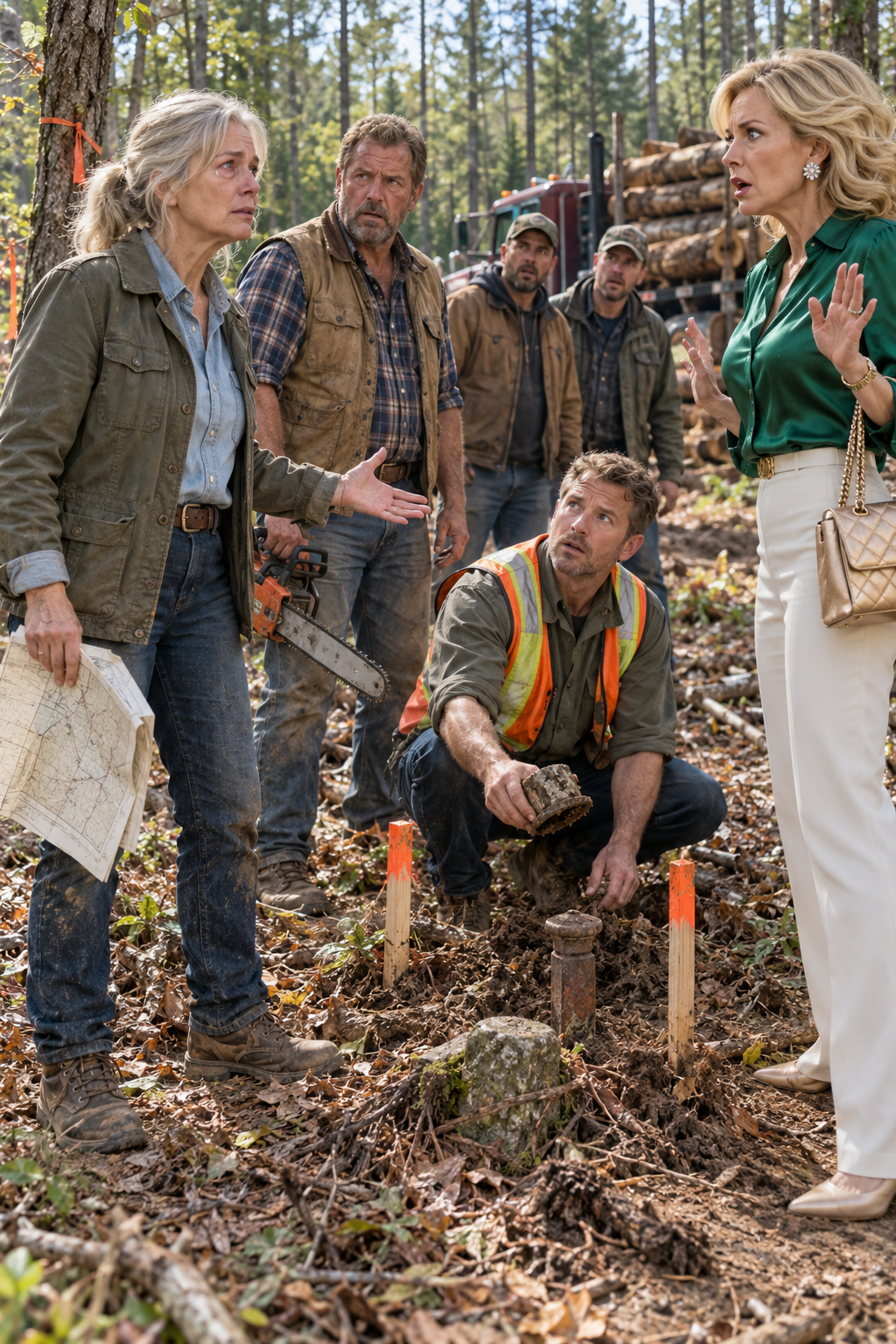
HOA Karen Sold My Back Forty to Loggers—Then Their Foreman Dug Up the Boundary Markers My Brother Buried
My brother gave me six days to leave the house our father had spent forty-three years building.
On the seventh morning, I woke to the sound of chainsaws cutting into my woods.
By noon, the president of Cedar Hollow Estates was standing in my driveway wearing white linen pants and a smile bright enough for a funeral, telling me the back forty acres were no longer mine.
“You should’ve signed when we offered you something,” Karen Whitfield said.
Behind her, a yellow logging skidder rolled through the opening where my father’s old split-rail fence had stood the night before.
I looked at the machine.
Then at Karen.
Then at my brother, Daniel, who had driven up beside her in Dad’s old Ford.
He wouldn’t meet my eyes.
That was the part that hurt.
Not the chainsaw.
Not the fresh stump bleeding pale sap.
Not Karen’s smug little smile.
Daniel refusing to look at me.
“I thought you said she’d be gone,” Karen said to him.
Daniel rubbed the back of his neck.
“She was supposed to be.”
I stood barefoot on the porch in an old blue sweater, holding a chipped coffee mug our mother had painted with tiny yellow sunflowers thirty years earlier.
I didn’t scream.
I didn’t ask Daniel how he could do this.
I didn’t threaten Karen.
I simply said, “Who signed the timber contract?”
Karen laughed.
It was an ugly, relieved little laugh.
The kind people make when they’ve rehearsed a fight and discover their opponent has arrived without a weapon.
“Sweetheart,” she said, “that question stopped mattering yesterday.”
I took one sip of coffee.
“That wasn’t an answer.”
Daniel finally looked at me.
He was fifty-three.
Two years younger than me.
Gray had started at his temples, but when he looked guilty, he still became the twelve-year-old boy who once blamed me for breaking Mom’s porcelain bird.
“Laura,” he said quietly, “don’t make this worse.”
Behind them, another pine cracked.
The sound rolled through the valley like distant gunfire.
I set my cup on the porch railing.
Then I reached into the pocket of my sweater and touched the small brass key I had been carrying for eleven years.
Karen couldn’t see it.
Daniel had forgotten it existed.
My father had told me never to use it unless the woods were threatened.
Three weeks before he died, he had placed that key in my palm, curled my fingers around it, and whispered words that had sounded paranoid at the time.
“If Danny ever tells you the boundaries changed, don’t argue with him. Open the green box.”
Dad had been eighty-two then.
Thin as fence wire.
Lungs ruined by decades of sawdust and cigarettes he’d quit twenty years too late.
I had smiled because I thought illness had made him suspicious.
He grabbed my wrist hard enough to surprise me.
“I’m listening.”
“No. You’re humoring me.”
His eyes had sharpened.
“The land isn’t where they think it is.”
I remembered that sentence now as another tree fell.
Karen pointed toward the gravel lane.
“You have until tomorrow morning to remove anything personal from the south parcel. Our contractor has liability concerns about you wandering around active equipment.”
Our contractor.
That was how she said it.
As if my woods had always belonged to her.
As if the tulip poplar where my mother’s ashes were scattered had been waiting for Karen Whitfield’s permission to exist.
As if the creek where Daniel and I learned to catch crawdads was an amenity on an HOA brochure.
As if forty-three years of my father’s sweat could be transferred by a woman with a clipboard.
I looked at Daniel.
“Did you tell them where Mom is?”
His face changed.
Just slightly.
Karen frowned.
“What does that mean?”
Daniel’s jaw tightened.
He looked toward the woods.
That answered me.
I nodded once.
Then I picked up my coffee.
Karen stared at me.
“That’s it?”
Something in my tone finally bothered her.
Her smile thinned.
“You understand the property was legally conveyed.”
“To Cedar Hollow Development Holdings.”
“That isn’t the HOA.”
“It is an affiliated entity.”
“Owned by?”
Karen gave me a long look.
Then she smiled again.
“You can discuss that with counsel.”
“I probably will.”
She expected anger.
She expected begging.
She expected me to accuse my brother of stealing our father’s land while the crew watched.
Instead, I went inside.
I closed the door.
And I locked it.
I did not slam it.
I did not cry behind it.
I did not call my brother.
I did not call the sheriff.
I did not call a lawyer.
I did not ask anybody to save me.
I walked straight through my father’s kitchen, down the narrow hallway, into the room where he had kept his maps, and pulled the brass key from my pocket.
The green box was not in the desk.
It wasn’t in the gun cabinet.
It wasn’t under the bed.
It was exactly where he had said it would be.
Behind the cedar panel in the west closet.
The panel looked permanent unless you knew the bottom-left knot was actually a wooden latch.
I pressed it.
The panel released.
Inside the wall sat a green metal document case coated in eleven years of dust.
I carried it to the dining table.
Outside, diesel engines growled.
I inserted the brass key.
The lock clicked.
Inside were five things.
An old survey map.
A sealed envelope with my name on it.
A property deed I had never seen.
A photograph of my father standing beside a stone marker in 1989.
And a handwritten note.
The note contained only fourteen words.
If they cut past the red oak, make them prove where the county line was in 1937.
I read it twice.
Then a third time.
Outside, somebody shouted.
A chainsaw stopped.
Another engine went quiet.
Then there was pounding at my back door.
Not polite knocking.
I slid the documents back into the case except for the photograph.
The man outside shouted, “Ma’am?”
I opened the door.
He wore an orange forestry helmet and a reflective vest. Mid-forties. Thick brown beard. Dirt along one cheek. His expression wasn’t hostile.
It was confused.
“You Laura Bennett?”
“I’m Wade Mercer. Site foreman.”
“I figured.”
He took off his helmet.
“We’ve got a problem.”
I glanced toward the trees.
Karen and Daniel were walking quickly down the slope.
“What kind?”
Wade scratched his beard.
“My excavator operator uncovered a monument.”
“What kind of monument?”
“Boundary stone.”
Karen was close enough to hear that.
She sped up.
“It’s obsolete,” she said immediately.
Wade looked at her.
“Didn’t ask you.”
For the first time that morning, I almost smiled.
Karen stopped beside us.
“That marker predates the subdivision survey.”
Wade turned back to me.
“It’s granite. About four feet long. Iron pin through the top.”
My father’s photograph suddenly felt heavier in my hand.
“What was carved into it?”
Wade’s eyes narrowed.
“You already know?”
“What was carved into it?”
I looked at the photograph.
On the stone beside my father’s boot, faint but visible, was B-17.
Daniel saw it too.
Color drained from his face.
Karen reached for the photograph.
I moved my hand away.
“Where did you get that?”
“My house.”
“That doesn’t establish anything.”
“I didn’t say it did.”
Wade looked from Karen to Daniel.
Then to me.
“There’s another issue.”
Karen folded her arms.
“We found it under fresh fill.”
Nobody spoke.
Wade continued.
“Not natural cover. Somebody dug a trench, laid the marker flat, then covered it with gravel and clay.”
Daniel looked toward the forest.
Karen said, “Old farm work. Those woods were used for equipment access for decades.”
Wade shook his head.
“Clay is clean.”
“So it’s recent.”
Karen’s voice sharpened.
“How recent?”
“My operator says maybe a year. Two at most.”
Then Wade added, “There were orange survey caps underneath.”
Daniel’s head snapped toward him.
That reaction was small.
But I saw it.
So did Wade.
I folded the photograph carefully and put it into my pocket.
“Stop cutting.”
Karen stepped forward.
“You don’t have authority to order that.”
I looked at Wade.
“Who hired you?”
“Red Creek Timber.”
“Who represented the seller?”
He hesitated.
Karen answered.
I kept my eyes on Wade.
“What title company?”
“Piedmont Land & Title.”
“And did they provide a timber warranty?”
His face changed.
Only slightly.
I knew my father had taught me more than I realized.
People thought farming made you simple because they saw mud on your boots.
Dad had negotiated easements, timber leases, mineral rights, drainage agreements, tax assessments, federal conservation grants, and property disputes before Karen Whitfield ever bought her first wine rack.
“Did they?” I asked.
Wade sighed.
“Then you know exactly why you should stop.”
Karen laughed.
“This is ridiculous. One buried marker doesn’t invalidate a recorded deed.”
“No,” I said. “But a deliberately concealed marker can make title insurance people very nervous.”
Daniel whispered, “Laura.”
I turned to him.
“Did you bury it?”
He answered too quickly.
Karen looked at him.
So did Wade.
Daniel corrected himself.
“I mean, of course not. Why would I bury a survey marker?”
He hated silence.
Always had.
When we were kids, I could get the truth out of him by simply looking at him and saying nothing.
He would eventually fill the empty air himself.
Daniel shoved his hands into his jacket pockets.
“Dad moved boundaries constantly. He sold strips, traded access, granted utility rights—”
“No, he didn’t.”
“You weren’t here.”
That landed where he intended.
I had moved to Richmond at twenty-three.
Daniel stayed.
For years, that had been the family story.
Daniel stayed.
Laura left.
Daniel helped Dad.
Laura built a career.
Daniel fixed fences.
Laura sent birthday cards.
Daniel handled the farm.
Laura visited on holidays.
What nobody ever added was that I sent Dad money almost every month for nineteen years.
When his heart surgery cost more than Medicare covered, I paid the difference.
When Daniel’s construction company failed in 2008 and Dad mortgaged the lower pasture to keep Daniel’s family from losing their house, I paid off the mortgage.
When Mom got ovarian cancer, I took an unpaid leave and came home for eight months.
Daniel came by after work.
I slept beside her hospital bed.
After she died, I returned to Richmond because somebody still had to pay Dad’s property taxes.
But the mythology remained.
Daniel stayed.
Laura left.
Karen knew that mythology because Daniel had sold it to everyone.
The HOA board believed I was the absent daughter who had appeared after Dad’s funeral looking for a payday.
It made everything cleaner.
More moral.
They weren’t taking land from a caretaker.
They were rescuing neglected woodland from a greedy outsider.
Karen had even said something like that at the probate meeting.
“Cedar Hollow wants to preserve the community character.”
Community character apparently required cutting down eighty-year-old oaks.
I looked at Daniel.
“You’re right.”
He blinked.
“You were here.”
Something like relief crossed his face.
“So you understand.”
Then I said, “Which means if survey markers were moved, you’re the obvious person to ask.”
His relief vanished.
Wade coughed into his fist.
Karen stepped between us.
“This conversation is over.”
“No,” Wade said.
She turned.
He placed his helmet back on.
“My company isn’t dropping another tree until title confirms the boundary.”
“You have a contract.”
“Which says seller warrants merchantable timber rights.”
“Then give me updated coordinates.”
Karen stared at him.
“I’ll call the owner.”
Wade nodded.
Then he walked toward the equipment and shouted, “Shut it down!”
One by one, engines died.
For the first time that morning, my woods became quiet.
Karen watched the machines stop as if each one were an insult.
Then she turned to me.
“You think this changes anything?”
“I don’t know yet.”
“Oh, please. Don’t pretend you’re confused. You’re trying to cause enough trouble to renegotiate.”
“Renegotiate what?”
“The buyout.”
“I never agreed to sell.”
“Your brother did.”
I looked at Daniel.
Karen realized what she had said.
Daniel’s eyes closed for half a second.
There it was.
I said, “My brother sold land he didn’t own?”
Daniel stepped toward me.
“We jointly inherited the property.”
“Yes, Laura.”
“Dad’s probate estate—”
“The house and north acreage were probate assets.”
He stopped.
Karen’s expression shifted.
“The back acreage wasn’t listed in the inventory.”
Daniel stared at me.
“How would you know?”
I almost told him about the green box.
Instead I said, “Because I read it.”
Karen’s phone buzzed.
She ignored it.
Daniel shook his head.
“You’re confused.”
“I might be.”
“Then we’ll clear it up.”
His confidence returned.
“You already signed the family settlement.”
“I signed distribution of listed probate assets.”
“It’s the same thing.”
“Did your attorney tell you it was?”
Daniel said nothing.
That was the first mini-payoff.
Not victory.
Just the moment I saw fear enter my brother’s eyes.
Karen noticed it too.
She grabbed his arm and pulled him aside.
They spoke in low voices.
I couldn’t hear the words.
I didn’t need to.
People reveal plenty with posture.
Karen leaned in aggressively.
Daniel kept looking toward the house.
Once, he pointed at me.
Once, she pointed toward the woods.
Finally Karen returned.
“This delay will cost you.”
“Interference with contractual activity.”
“Send me an invoice.”
She stared at me.
“Certified mail would be best.”
Karen left without another word.
Daniel followed.
But before getting into his truck, he turned.
His face softened.
Maybe genuinely.
Maybe strategically.
“You’ve been through a lot. Dad dying. Coming back here. Sorting everything. You don’t understand how much changed.”
“That sentence sounds familiar.”
“You should go back to Richmond.”
“I sold my condo.”
That surprised me.
“You told Aunt Melissa.”
“And she told you.”
“We’re family.”
I nearly laughed.
He continued.
“You can still start over.”
“Anywhere.”
“In other words, not here.”
His jaw tightened.
“Cedar Hollow is expanding.”
“Into Dad’s woods.”
“It’s inevitable.”
“Nothing involving forged ownership is inevitable.”
His face hardened.
“Be careful with that word.”
“Which one?”
“You know which one.”
I stepped off the porch.
For the first time, he backed up.
I wasn’t threatening.
I wasn’t loud.
But suddenly he remembered I was older.
He remembered who took the belt away from Dad when Dad got drunk after our grandfather died.
He remembered who broke his nose in eighth grade after three boys cornered him behind the bus garage.
He remembered that quiet had never meant weak.
I said, “Dad left me a warning.”
His eyes flickered.
Second crack.
“What warning?”
I studied him.
Then I gave him exactly what he wanted.
A smaller version of the truth.
“He told me not to trust new surveys.”
Daniel exhaled through his nose.
“That’s it?”
I tilted my head.
“Should there be more?”
For a second, he looked scared.
Then he forced a smile.
“That’s what I thought.”
He got into his truck and left.
I waited until his taillights disappeared beyond the sycamores.
Then I locked the house.
I carried the green box to my car.
And I drove thirty-seven miles to a bank in Franklin County.
Not to a lawyer.
My father had banked there since 1978, when it was still called Mountain Federal Savings and the lobby had green carpet.
Now it was Blue Ridge Community Bank, with glass offices and a coffee machine nobody used.
I asked for a safe-deposit attendant.
The woman behind the desk smiled.
“Do you have a box with us?”
“I don’t know.”
Her smile changed.
I placed the brass key on the counter.
Stamped into the metal were the numbers 214.
She studied it.
Then looked at me.
“One moment.”
She disappeared.
Ten minutes later, the branch manager came out.
His name was Robert Keene.
He looked about sixty.
He carried himself carefully, like a man who hated surprises.
“Ms. Bennett?”
“Could you come with me?”
He led me into his office and closed the door.
“Your father was Harold Bennett?”
Robert sat.
“May I see identification?”
I handed it over.
He studied it.
Then he opened a drawer and removed a sealed yellow envelope.
My name was written on it.
Not Dad’s handwriting.
A lawyer’s.
I recognized it immediately.
Eleanor Price.
Dad’s attorney.
She had died four years before him.
Robert slid the envelope across the desk.
“This was placed under conditional release instructions in 2015.”
“What condition?”
He looked uncomfortable.
“The presentation of key 214 by Laura Bennett after Harold Bennett’s death.”
I looked at the brass key.
“So there is a box.”
“Why wasn’t it in the estate inventory?”
“Because your father wasn’t the registered lessee.”
I looked up.
Robert didn’t answer immediately.
“Open the envelope.”
Inside was a letter.
Dated March 3, 2015.
Dear Laura,
If you are reading this, Harold has died and someone has given you reason to question the southern boundary.
Your father asked me to write this because he feared you would dismiss his concerns as family anxiety.
Do not do that.
Box 214 is held in trust under the Bennett Woodland Preservation Trust.
You are its successor trustee.
Do not discuss the contents with Daniel until you have reviewed every document.
If Daniel presents a survey commissioned after June 2014, assume nothing.
If any monument marked B-17, B-18, or B-19 has been moved, contact counsel before contacting law enforcement.
Most important: Harold did not transfer the southern forty acres through probate because he had already transferred them years before.
Below that sentence, Eleanor had underlined four words.
They are not Daniel’s.
My hands stayed steady.
But something inside me shifted.
Not triumph.
Because suddenly Dad’s warning wasn’t paranoia.
It was preparation.
He had known.
Maybe not exactly what Daniel would do.
But enough.
Robert watched me.
“You all right?”
“You don’t look surprised.”
“I’m trying not to be.”
Then he stood.
“Come with me.”
The vault was downstairs.
Box 214 was larger than I expected.
Inside were twelve folders, two ledgers, a cassette tape, a USB drive, an old pocket watch, three notarized deeds, and a manila envelope labeled FOR LAURA ONLY.
The first deed answered the immediate question.
In 1996, my parents had transferred forty-seven acres along the southern ridge into the Bennett Woodland Preservation Trust.
Forty-seven.
The trust terms prohibited sale for commercial subdivision without unanimous approval of three named trustees.
And eventually me.
After Mom’s death, Dad amended the successor clause.
I became sole successor trustee upon his death.
Daniel wasn’t named.
I read the document twice.
Then I found the tax map.
My stomach tightened.
The “back forty” Karen claimed to have purchased overlapped the trust parcel by thirty-nine acres.
But that wasn’t the worst part.
Cedar Hollow’s newest cul-de-sac appeared to overlap it too.
Seven finished houses.
Two empty lots.
A stormwater basin.
And approximately nine hundred feet of paved HOA road.
I sat in the vault staring at the map.
Robert stood nearby.
“How large?”
“Seven houses large.”
He stopped smiling.
That afternoon, I finally called an attorney.
Her name was Maya Grant.
Forty-one years old.
Property litigation.
She had represented farmers in pipeline easement cases and once forced a utility company to move a transmission access route after contractors destroyed a family cemetery.
I knew of her because Dad kept newspaper clippings.
When I told her what I had, she interrupted me exactly once.
“Do not confront your brother again.”
“He already knows there’s a boundary issue.”
“Does he know about the trust?”
“Keep it that way.”
“I thought I needed to notify him.”
“You need to let people continue believing what they believed this morning.”
That sentence sounded so much like Dad I hired her immediately.
By four o’clock, Maya had ordered certified copies of every deed associated with Cedar Hollow Development Holdings.
By six, she called back.
“You need to sit down.”
“I’m sitting.”
“Your HOA president didn’t buy your back forty.”
“No. You don’t understand. She didn’t even pretend to buy it directly.”
“What did she do?”
“Cedar Hollow Development Holdings bought a quitclaim deed from your brother for eighty thousand dollars.”
“That land is worth at least six hundred.”
“More if developed.”
“Why would Daniel sell for eighty?”
“Because the document doesn’t call it a sale.”
“What does it call it?”
“A settlement of disputed familial interest.”
I closed my eyes.
Maya continued.
“Your brother represented that he controlled all residual Bennett estate interests south of County Road 19.”
“He didn’t.”
“And Karen?”
“Signed as managing member of Cedar Hollow Development Holdings.”
There it was.
Her motive.
Not community beautification.
Not preserving property values.
Not trail access.
But even then, I didn’t think Karen was stupid.
Greedy, yes.
Arrogant, absolutely.
But not stupid.
She had spent fourteen years turning Cedar Hollow from a collection of forty modest homes into one of the most aggressive HOAs in the county.
She had lawyers.
Accountants.
A management company.
A development partner.
She wouldn’t risk a multimillion-dollar expansion on Daniel’s word alone.
“Something’s missing,” I said.
“I don’t know yet.”
The next morning, the logging crew remained idle.
By ten, Karen had sent me a formal cease-interference notice.
By noon, the HOA attorney sent another.
At one, Daniel called.
I didn’t answer.
At two, he texted.
Laura, this has gone far enough. Karen says the timber company may sue all of us. Dad would hate seeing us destroy each other over trees.
I read the message twice.
Then I forwarded it to Maya.
She responded with three words.
Do not reply.
At three, someone changed the lock on the old equipment barn.
That was how I learned Daniel had begun to panic.
The barn wasn’t on the disputed parcel.
There was no reason to lock me out.
Unless he believed something inside could hurt him.
I didn’t break in.
I photographed the new lock.
At five, I found a notice taped to the front door.
VACATE WITHIN 72 HOURS.
Daniel claimed exclusive possession of the farmhouse under a temporary estate distribution agreement.
He was trying to push me out before I could keep looking.
Maya read the notice and laughed.
Actually laughed.
“He filed this?”
“This is garbage.”
“So I can stay?”
I looked through the kitchen window toward the road.
Then I thought of Dad.
If Danny ever tells you the boundaries changed, don’t argue with him.
I said, “No.”
Maya paused.
“I’m leaving.”
“Let him think it worked.”
“That creates practical risk.”
“It also creates opportunity.”
Then she said, “You really are Harold Bennett’s daughter.”
I packed one suitcase.
I left the furniture.
I left the dishes.
I left Mom’s sunflower mug on the kitchen counter.
At dusk, Daniel arrived.
He seemed startled to see my car loaded.
“You’re actually going?”
His face relaxed so quickly it told me everything.
“I’m sorry it came to this.”
“No, you’re not.”
He looked away.
I carried my suitcase to the trunk.
He followed.
“You’ll get your share once everything settles.”
“My share of what?”
“The estate.”
“Of course.”
He reached into his pocket.
“I brought you something.”
Twenty-five thousand dollars.
I looked at it.
“What is this?”
“For leaving?”
“For peace.”
I took the check.
His eyebrows lifted.
He expected an argument.
Instead, I folded it once and placed it in my purse.
“That’s it?”
“That’s it.”
I got into the car.
Before closing the door, I asked him, “Daniel?”
“Do you remember Dad’s red oak?”
His expression went blank.
“The lightning tree?”
“What about it?”
I started the engine.
Then I asked the weak question.
The harmless question.
The question he would replay later.
“Did Dad ever tell you what he buried beside it?”
Daniel’s hand dropped from the top of my car door.
I smiled faintly.
“Good night.”
I drove away.
I watched him in the rearview mirror.
He stood in the driveway until I turned the corner.
That night I checked into a motel fifteen miles away.
At 11:43 p.m., a motion camera Maya had convinced me to place near the southern ridge sent an alert to my phone.
Daniel entered the woods carrying a shovel.
He wasn’t alone.
Karen was with him.
They walked directly toward the red oak.
I watched the live feed from my motel bed.
Neither spoke much.
Daniel dug.
Karen held a flashlight.
After twelve minutes, Daniel found something.
A metal tube.
He pulled it from the soil.
Karen grabbed it.
My pulse sped up.
I had no idea what was inside.
Dad had never actually told me he buried anything by the red oak.
I had invented the question.
But Daniel knew something was there.
That was the trick.
The weak question hadn’t been a question at all.
It had been bait.
Karen opened the tube.
She removed rolled papers.
Daniel shined the flashlight on them.
Even through the grainy night image, I saw his shoulders collapse.
Karen snatched the pages.
Then she slapped Daniel.
Karen shouted something the camera couldn’t capture.
Daniel pointed toward the farmhouse.
Karen shoved the papers back into the tube.
Then they did something I didn’t expect.
They didn’t rebury it.
They took it.
Maya answered on the second ring.
“They found a tube,” I said.
“What tube?”
“I don’t know.”
She was silent.
“You baited them.”
“You could have told me.”
“I didn’t know it existed.”
Another silence.
Then, despite herself, she said, “That’s annoyingly clever.”
“Karen hit him.”
“Your brother?”
“What was on the papers?”
“Couldn’t see.”
“Keep the footage.”
“Already backed up.”
The following morning, Wade Mercer called.
“We found another marker.”
“North of the creek.”
“What number?”
He hesitated.
“This one was cut.”
“What do you mean?”
“Top twelve inches sheared off. Looks like somebody tried to remove the marking with a saw.”
“Fresh rust on the exposed iron.”
My stomach went cold.
“What kind of saw?”
“Cutoff wheel, maybe.”
Then Wade said something that moved the entire situation into another category.
“My operator also found an underground utility conduit.”
“It feeds Cedar Hollow.”
“The subdivision?”
“Looks that way.”
I called Maya.
Within two hours, she had county utility maps.
By afternoon, we understood why Karen wanted the land so badly.
The southern ridge wasn’t just valuable timber.
It contained the only practical utility corridor for Cedar Hollow’s planned Phase Four expansion.
Sixty-two luxury homes.
A clubhouse.
Tennis courts.
Estimated project value: thirty-eight million dollars.
Without the corridor, the developers would need to reroute water, sewer, fiber, and power nearly four miles around protected wetlands.
Cost estimates ranged from six to nine million.
Karen’s eighty-thousand-dollar deal with Daniel wasn’t greed.
It was leverage.
If she controlled my father’s ridge, Cedar Hollow Development Holdings could make millions.
And if she didn’t…
Phase Four might die.
Now the system around her made sense.
Title company.
Maybe others.
They had not stumbled into a boundary mistake.
They had built a business plan on one.
Two days later, the title company suspended coverage.
Red Creek Timber formally withdrew equipment from the disputed area.
Karen responded by calling an emergency HOA meeting.
I attended.
Not in person.
Maya advised against it.
A neighbor named Ruth Calder streamed the meeting privately from her phone.
Karen stood at the front of the clubhouse wearing a navy suit and the expression of a woman who had decided outrage was a substitute for evidence.
“An individual with questionable standing,” she said, “has attempted to obstruct community progress using outdated agricultural records.”
Ruth whispered into her phone, “That’s you.”
“I figured.”
Karen continued.
“We will not allow outside agitators to threaten home values.”
Outside agitator.
I had been born three miles away.
Half the people in the room moved to Cedar Hollow after 2018.
Karen showed slides.
Road expansion.
Walking trails.
Forest management.
Wildfire mitigation.
Then she displayed an aerial photograph of Dad’s woods.
A red line outlined the disputed parcel.
Even through Ruth’s shaky camera, I saw something wrong.
Ruth whispered, “What?”
“Point your camera at the bottom-right corner.”
She zoomed.
Survey prepared by Latham Geographic Services.
Maya had mentioned that name.
I texted her.
Did Latham prepare Daniel’s 2023 survey?
Her answer came seconds later.
I asked another question.
Who commissioned it?
She responded.
Cedar Hollow Development.
There was the mine my father had warned me about.
If Daniel presents a survey commissioned after June 2014, assume nothing.
After the meeting, Maya dug into Latham.
What she found was our first major twist.
The surveyor who signed Cedar Hollow’s boundary map, Thomas Latham, had been disciplined once before.
Not for fraud.
For failing to disclose a financial relationship with a developer.
That developer was controlled by Karen Whitfield’s husband.
Suddenly this wasn’t a family dispute.
It was a network.
But we still lacked proof the markers had been intentionally moved.
Then Wade called again.
His voice was different this time.
“Laura, can you come out here?”
“South ridge.”
“I found something you should see.”
Maya and I drove together.
Wade met us beside a logging trail.
He led us past B-17.
Then downhill.
Near the creek, his crew had removed brush from what looked like an old fence line.
Thirty yards in, he stopped beside a shallow depression.
A steel post protruded from the dirt.
Not a boundary post.
A survey stake.
Orange cap.
Stamped LATHAM GEO.
Maya crouched.
“Don’t touch it.”
Wade nodded.
“We didn’t.”
She photographed it.
Then she looked around.
“Why is it down here?”
Wade pointed upslope.
“Because if that stake is the 2023 line, they shifted the boundary about a hundred and forty feet.”
“How much acreage?”
“Depends how far they carried it.”
He looked toward the subdivision.
“But probably enough to grab the road and utility corridor.”
Maya stood.
“We need an independent survey immediately.”
We got one.
Retired county surveyor.
Two assistants.
GPS equipment.
1937 county maps.
The trust deed.
Dad’s photographs.
It took three days.
Karen threatened legal action twice.
Daniel sent me seven messages.
I answered none.
On Friday afternoon, the surveyor handed Maya a preliminary map.
Cedar Hollow had crossed the Bennett trust boundary in eleven separate places.
Seven homes partly encroached.
Three homes significantly encroached.
A retaining wall sat entirely on trust property.
Nine hundred seventeen feet of road crossed it.
The stormwater basin was inside it.
The utility corridor was inside it.
And the HOA’s decorative stone entrance to Phase Three sat twenty-two feet over the line.
Maya stared at the map.
I said, “How bad?”
“For them?”
“Catastrophic.”
I expected satisfaction.
Instead I felt sick.
Seven families had bought homes believing they owned what they paid for.
Children slept in those houses.
People built decks.
Planted gardens.
Paid mortgages.
They weren’t Karen.
They weren’t Daniel.
They were collateral damage.
“Can they lose their houses?”
Maya looked at me carefully.
“You control how aggressive you want to be.”
“I don’t want their houses.”
“That matters.”
“I want the people who did this.”
“That matters more.”
That was the moral line.
Dad’s land wasn’t a lottery ticket.
It wasn’t revenge money.
I didn’t want seven families punished because powerful people had treated a dead farmer’s boundaries like pencil marks.
I wanted the people who buried markers.
The people who altered maps.
The people who sold what they never owned.
The people who assumed I was too absent, too female, too tired, too old, too emotional, too family-bound to challenge them.
The following Monday, we filed suit.
Not against the homeowners.
Against Cedar Hollow Development Holdings, Daniel Bennett, Latham Geographic Services, and several related entities.
Fraudulent conveyance.
Slander of title.
Timber damages.
Declaratory judgment.
Injunctive relief.
Interference with trust property.
Karen learned about the filing during a landscaping committee meeting.
Ruth told me she stopped speaking mid-sentence.
Read the first page.
Then sat down.
The temporary restraining order arrived the next morning.
No construction.
No timber cutting.
No utility work.
No land transfer.
No alteration of markers.
No removal of physical evidence.
The judge required preservation of electronic records.
That last part mattered most.
Because people can clean dirt.
They can burn papers.
They can move rocks.
But once a court orders preservation, deleting emails becomes dangerous.
Karen tried public pressure.
HOA emails accused me of threatening community safety.
Someone created a Facebook post claiming I wanted to bulldoze families out of their homes.
I responded once.
One sentence.
I have not sued a single homeowner, and I will not seek removal of any innocent family from an occupied residence.
The post changed everything.
Homeowners began asking Karen why she had implied otherwise.
Then someone leaked the Phase Four financial projections.
Then someone else leaked board minutes.
One line became particularly ugly.
Acquire Bennett south tract prior to successor appearance.
Successor appearance.
That meant me.
The meeting had taken place nine days after Dad’s funeral.
Karen had been planning before I even cleaned out his hospital room.
Daniel stopped calling.
Then, unexpectedly, he came to the motel.
He looked terrible.
He knocked at a.m.
I opened the door but kept the chain latched.
“I need to talk.”
“Call Maya.”
“This is family.”
“No. Family doesn’t require me to unlock the door.”
He closed his eyes.
I studied him.
Then I stepped outside and shut the door behind me.
We stood beside the ice machine.
He looked smaller than I remembered.
“What did Karen make you sign?”
His head jerked up.
“Why would you ask that?”
“Because you sold six hundred thousand dollars in land for eighty thousand.”
He said nothing.
“What was the rest?”
His mouth trembled.
I had never seen that before.
Not even at Mom’s funeral.
“What debt?”
“My company.”
“Your company closed fifteen years ago.”
“I started another.”
Of course he had.
Daniel always had one more plan.
Storage units.
Rental houses.
Land flipping.
Equipment auctions.
Crypto, briefly.
He mistook motion for progress.
“How much?”
“Four hundred and eighty.”
I stared at him.
“Thousand?”
“Private lenders.”
“Her husband.”
There it was.
She owned him before she bought the land.
Daniel rubbed his face.
“They offered to clear it.”
“In exchange for Dad’s property.”
“I thought it was ours.”
“No, you didn’t.”
His eyes dropped.
“You knew about the trust.”
“How long?”
“Dad mentioned something years ago.”
“How long?”
“How long?”
My chest tightened.
Dad had still been alive.
“You could have asked him.”
“What did he say?”
Daniel’s eyes filled.
“He said I’d already taken enough.”
The words landed harder than I expected.
Not because they were cruel.
Because I could hear Dad saying them.
Daniel continued.
“He said you had spent your life cleaning up everybody else’s mistakes. Mom’s medical bills. His taxes. My mortgage. He said the woods were the only thing he had left that nobody could guilt you into giving away.”
I looked toward the parking lot.
Morning sun hit windshields.
A truck started somewhere near the road.
For several seconds, neither of us spoke.
Daniel whispered, “I hated him for that.”
“You got to leave.”
“There it is.”
“You had a career.”
“I paid your mortgage.”
“I didn’t ask you to.”
“That’s what I mean. Everybody always saved me, then hated me for needing it.”
I looked at him.
For the first time, I saw his motive clearly.
Not just greed.
Resentment.
He believed my competence was an accusation.
Every bill I paid reminded him he couldn’t.
Every time Dad trusted me, Daniel heard judgment.
Karen hadn’t invented that wound.
She used it.
Daniel reached into his coat.
He pulled out a folded piece of paper.
“I copied this before Karen took the tube.”
My pulse changed.
“The red oak?”
“What was inside?”
“Dad’s old notes.”
“About what?”
“The markers.”
He handed me the paper.
It was a photocopy.
Dad’s handwriting.
June 18, 2014.
Tom Latham returned again with D. Says Karen wants corridor before east phase financing. Told them no. Danny present. Danny understands south monuments stay. If anything happens to me, Laura must get trust papers.
I looked at Daniel.
“You were there.”
“You lied to me.”
“You lied in the deed.”
“You buried B-17.”
His face broke.
Not dramatically.
Just enough.
I inhaled slowly.
“Who helped you?”
“Karen’s maintenance guys.”
He shook his head.
“Then leave.”
“She’ll destroy me.”
“You already helped her try to destroy me.”
“She has things.”
I held up Dad’s copied note.
“No. You don’t understand.”
“Then explain.”
His voice dropped.
“This isn’t just Karen.”
I almost laughed.
“No. You don’t.”
He stepped closer.
“The HOA board isn’t the top of it.”
My skin prickled.
He looked around the parking lot.
Then at me.
“Ask Maya who owns Piedmont Land & Title.”
Before I could respond, a black SUV pulled into the far end of the motel lot.
Daniel saw it.
His face changed instantly.
He backed away.
“Who is that?”
“I don’t know.”
He was already walking.
He got into his truck.
The black SUV remained parked.
Tinted windows.
Engine running.
Daniel drove away.
The SUV waited ten seconds.
Then followed him.
I called Maya.
I sent her a photo of Dad’s note and Daniel’s message.
Then I searched Piedmont Land & Title.
The public website listed officers.
Nothing unusual.
I searched state corporate records.
A holding company owned it.
That company belonged to another company.
Maya called as I was writing down the name.
“What happened?”
“Daniel confessed to moving B-17.”
“He gave me a copy of Dad’s 2014 note.”
“Send everything.”
“I’m looking now.”
“He said Karen isn’t the top.”
“Top of what?”
“I don’t know. He told me to find who owns Piedmont Land & Title.”
Keyboard clicks.
Then silence.
Longer this time.
“Where are you?”
“Stay there.”
“Because I know the parent company.”
She said the name.
At first, it meant nothing.
Then I remembered where I had seen it.
On county campaign-finance disclosures.
At charity banquets.
On the bronze donor wall at the courthouse.
Hawthorne Regional Partners.
The company belonged to Charles Hawthorne.
County commissioner.
Largest private developer in three counties.
And, according to old newspaper photographs, my father’s closest friend for nearly twenty years.
I sat down slowly.
“That’s impossible.”
“He and Dad hunted together.”
“He spoke at Dad’s funeral.”
“He said Dad was like a brother.”
I closed my eyes.
The betrayal widened.
Daniel was one thing.
Karen was another.
But Charles Hawthorne?
He had carried Dad’s casket.
Then Maya said, “There’s more.”
“The trust deed has an exhibit we haven’t fully explained.”
“What exhibit?”
“Mineral reservation.”
“There aren’t minerals.”
“Maybe not in the way you’re thinking.”
“What does that mean?”
“I pulled geological filings after you told me to check the 1937 county line.”
I stood again.
“The southern ridge sits over a documented vein of high-grade dimension stone.”
I almost laughed from sheer confusion.
“What am I supposed to do with granite?”
“Then why does it matter?”
“Because Hawthorne Regional filed preliminary plans six months ago for a luxury resort and conference center fourteen miles away.”
“They need exterior stone matching historic county buildings.”
My mouth went dry.
“And Dad’s ridge?”
“Historic quarry test pits are mentioned in a 1941 survey.”
“How much?”
“I don’t know yet.”
“But enough?”
“Enough that Hawthorne may have needed control of the parcel for more than a utility corridor.”
There was our second twist.
The land everybody called worthless woodland wasn’t just access.
It wasn’t just timber.
It wasn’t even just forty-seven acres.
It was the missing piece under two development projects.
And Dad had known somebody wanted it since at least 2014.
Maya told me not to move.
Ten minutes later, another camera alert hit my phone.
A white pickup had pulled beside the equipment barn.
Three men got out.
One was Daniel.
One was Thomas Latham.
The surveyor.
The third wore a gray overcoat.
Even from the camera, I recognized him.
Charles Hawthorne.
They cut the new barn lock.
My phone shook once in my hand.
Adrenaline.
“Are you seeing this?” I asked Maya.
“Court order says preserve evidence.”
“They’re inside the barn.”
“Call the sheriff?”
“I’m calling the judge’s clerk.”
“What good does that do right now?”
“More than sending a deputy who plays golf with Hawthorne.”
That shut me up.
Fifteen minutes later, a county investigator I had never met called.
Then a state investigator.
Then the judge’s staff attorney.
Apparently Maya had included enough evidence in our emergency filing that preservation violations could trigger immediate sanctions.
The men stayed in the barn for nineteen minutes.
When they emerged, Hawthorne carried a wooden records box.
Latham carried rolled maps.
Daniel carried nothing.
They loaded everything into the pickup.
The truck started moving.
Then stopped.
Two unmarked state vehicles blocked the driveway.
I watched from my motel room.
Hawthorne got out first.
Even without sound, I could see indignation in the way he moved.
One investigator showed papers.
Hawthorne pointed toward the barn.
Another investigator photographed the box in the truck bed.
Daniel sat on the ground.
Not because anyone forced him.
He simply sat down.
By evening, the story was everywhere.
Not the trust.
The preservation violation.
County Commissioner Charles Hawthorne questioned in property dispute.
Survey records seized.
HOA development documents requested.
Karen resigned as HOA president the next morning.
Her resignation email blamed “targeted harassment.”
By noon, four board members resigned too.
By Friday, Cedar Hollow’s management company terminated its contract.
The system that had looked untouchable began collapsing in small, satisfying pieces.
But I still hadn’t gone home.
I wanted one thing first.
Dad’s woods quiet.
A week after the lawsuit, Red Creek Timber removed its last machine.
Wade Mercer came to the motel personally.
He handed me a small plastic evidence bag.
Inside was a bent orange survey cap.
“B-19,” he said.
“You found it?”
“Creek bed.”
“Looks thrown.”
I studied it.
“Why bring it to me?”
“Because something bothered me.”
“When we started the job, Karen gave us a map.”
He handed me a photocopy.
“I compared it to the title package later.”
Two boundaries.
The logging crew had been instructed to cut farther west than the title company map allowed.
“How much farther?”
“About eleven acres.”
Maya arrived twenty minutes later.
She took one look and said, “They weren’t just hiding encroachment.”
“What were they hiding?”
She pointed to an irregular notch on Dad’s original trust map.
“This section.”
“What about it?”
“It follows the old 1937 county line.”
“So I finally found the archived plat.”
She spread a digital printout on the motel desk.
The historical county boundary cut diagonally through Dad’s property.
But Dad’s handwritten note had said make them prove where the county line was in 1937.
I stared at the old map.
Then I saw it.
The notch wasn’t random.
It surrounded a narrow strip along the ridge.
Nine acres.
A separate parcel number.
“Who owns that?”
Maya’s expression was strange.
“I thought you did.”
“I’ve never seen it.”
“Neither had I.”
She placed another document on the desk.
Transfer to Bennett & Sons Agricultural Cooperative.
“That’s my grandfather’s company.”
“It dissolved.”
“Officially, yes.”
“Then ownership would have passed somewhere.”
“Not according to the dissolution filing.”
I looked at her.
She slid the last page toward me.
I read the beneficiary clause.
Then I stopped breathing for a second.
The property was reserved for the maintenance, housing, education, or direct benefit of descendants of original workers employed on the Bennett timber tract between 1928 and 1955.
“What is this?”
“A charitable land covenant.”
“My grandfather?”
“Looks like he created a worker-benefit cooperative during the Depression.”
I sat down.
“My family never mentioned this.”
“Maybe they forgot.”
I looked at Dad’s note again.
Make them prove where the county line was in 1937.
Maya nodded.
“He probably did.”
My grandfather had employed Appalachian families during the Depression.
Dad used to talk about them.
The Carters.
The Millers.
Families who cut timber by hand, hauled stone, repaired fences, slept in bunkhouses up the ridge.
I had assumed those stories were family nostalgia.
Maybe they weren’t.
Maybe the land had never been merely ours.
Maybe that was the point Dad spent his final years protecting.
I thought about Karen treating the ridge as developable inventory.
Daniel treating it as debt relief.
Hawthorne treating it as infrastructure and quarry stone.
And Dad quietly leaving a trail toward a promise made almost a century earlier to people who had been forgotten.
The secret wasn’t wealth.
It was obligation.
That changed something in me.
I had spent weeks thinking I was defending my inheritance.
Now I wondered whether I was defending theirs.
Maya touched the old deed.
“If enforceable, Hawthorne has a much bigger problem.”
“Because part of his proposed resort access may cross covenant land.”
“And Cedar Hollow?”
“Possibly their utility corridor too.”
“How many descendants?”
“We don’t know.”
“Can we find them?”
“How long?”
She gave me a look.
“Don’t start.”
I smiled for the first time in days.
“I wasn’t going to.”
“You were.”
The hearings began two weeks later.
Daniel appeared with his own attorney.
Karen appeared with two.
Hawthorne arrived with four.
The courtroom was packed with Cedar Hollow homeowners.
Maya asked for three things.
Recognition of the trust boundary.
Continued injunction.
Forensic preservation of all surveys, board correspondence, title files, and related development records.
Hawthorne’s lawyers argued I was exploiting historical technicalities to interfere with legitimate development.
Then Maya displayed a photograph.
Standing beside B-17.
Then another photograph.
B-17 underground.
Then footage.
Daniel and Karen at midnight.
Digging beside the red oak.
The courtroom went silent.
Karen’s face turned gray.
Her lawyer whispered rapidly.
Daniel looked at the floor.
Then Maya played the motion camera video from the barn.
Hawthorne carrying records after the preservation order.
His attorney objected.
The judge overruled.
Mini-payoff after mini-payoff.
Not one dramatic confession.
Unforgiving.
The judge continued the injunction.
Then referred the survey-marker issue to the state licensing board and county prosecutor.
Outside the courthouse, reporters surrounded us.
I said only one thing.
“No homeowner who bought in good faith is my enemy.”
That line ran on the evening news.
Three days later, Cedar Hollow homeowners filed their own suit.
Against Karen.
The developer.
The title company.
And Hawthorne Regional.
The system turned inward.
People who had applauded Karen’s expansion plans began demanding financial records.
An accountant discovered HOA reserve funds had paid legal consulting fees for Phase Four, even though Phase Four belonged to a separate private development entity.
Another homeowner discovered road-maintenance assessments had subsidized engineering work outside HOA-owned land.
Then came emails.
Karen to Hawthorne.
Daniel manageable. Laura unlikely to return permanently.
Need markers corrected before timber contractor mobilizes.
Latham says old stones create ambiguity. We can resolve physically before final GPS.
Resolve physically.
That phrase ended Thomas Latham’s career before the licensing board even finished investigating.
He surrendered his license temporarily.
Then Daniel asked to meet me again.
This time at Maya’s office.
He brought counsel.
And a confession.
Not complete.
But enough.
He admitted helping remove B-17.
He admitted signing the quitclaim despite knowing Dad had discussed a trust.
He admitted taking eighty thousand dollars plus cancellation of four hundred eighty thousand in debt.
He admitted Karen’s husband had financed his failed business.
He admitted Hawthorne promised him another two hundred thousand after Phase Four approval.
He did not admit to forging documents.
Because he hadn’t.
That was Karen’s side.
Or Latham’s.
Or Hawthorne’s.
Maybe all three.
When he finished, Daniel cried.
I didn’t comfort him.
I didn’t enjoy it either.
That surprised me.
For years, I had imagined what justice would feel like if someone finally admitted how much I had carried for our family.
It didn’t feel sweet.
It felt like looking at a burned room after the fire was out.
Daniel said, “I’m sorry.”
I looked at him.
“For which part?”
His eyes closed.
“All of it.”
“That’s too easy.”
I studied him for a long time.
Then I said, “Mom used to tell me to take care of you.”
“Dad too, until the end.”
His mouth tightened.
“I paid your mortgage.”
“I paid Dad’s taxes after he mortgaged the pasture for you.”
“I sat with Mom while she died.”
Tears rolled down his face.
“And after all that, you decided the one thing Dad protected for me was the thing you were entitled to sell.”
He whispered, “Yes.”
“That’s the part I needed you to say.”
He covered his face.
Our relationship didn’t heal.
That would have been false.
Sometimes forgiveness is a bridge.
Sometimes it is a door you choose not to lock, even though you have no intention of opening it soon.
Daniel cooperated with investigators.
His plea arrangement came months later.
Fraud-related charges.
Evidence tampering.
Probation was possible because he cooperated early enough.
Karen faced more serious exposure.
Hawthorne’s case expanded beyond my land.
Investigators began reviewing three other developments.
Cedar Hollow homeowners elected a new board.
One of their first resolutions formally disclaimed any HOA interest in the Bennett trust parcel.
The seven families whose homes crossed the line met with me privately.
One woman arrived holding a toddler.
She looked terrified.
“We put everything into that house,” she said.
“Are you going to make us buy the land again?”
She stared at me.
“We’ll work out corrective deeds.”
Maya looked at me but said nothing.
The woman cried.
I had already decided.
Justice that crushed innocent people wasn’t justice.
We structured boundary adjustments.
No evictions.
No ransom prices.
The homeowners paid administrative costs.
The developer’s insurance absorbed most corrective expenses.
The trust recovered compensation for permanent encroachments.
A lot of money.
More than Dad had ever earned in his lifetime.
But the most important parcel remained untouched.
The old worker covenant.
Nine acres along the ridge.
Maya found twenty-eight living descendants connected to seven original worker families.
Some lived nearby.
Some were in Kentucky.
One was an elementary school teacher in Roanoke.
One was a mechanic in Asheville.
One was a nurse in Lexington.
None knew the covenant existed.
Eventually, with court approval, the nine acres were placed into a modern charitable trust providing trade-school scholarships, emergency housing assistance, and land-stewardship grants for qualified descendants.
Dad had spent his life being called stubborn.
Old-fashioned.
In the end, the thing he guarded wasn’t a fortune for himself.
It was a promise made before he was born.
That was the inheritance I had almost missed.
A year after the chainsaws first arrived, I moved back into the farmhouse.
I repaired the porch.
Repainted Mom’s kitchen.
Put her sunflower mug back beside the sink.
I left Dad’s map room almost exactly as it was.
The red oak still stood.
Wade’s crew had never touched it.
Neither had Karen.
Neither had Daniel.
On the anniversary of Dad’s death, I walked out there alone.
The woods were bright with October light.
Leaves moved across the ground like little copper coins.
I stood beside the place where Daniel had dug up the tube.
The soil had settled.
For the first time in months, nobody wanted anything from me.
No reporters.
No lawyers.
No board members.
No relatives asking what would happen to the settlement money.
I placed my hand against the red oak.
“Was this what you wanted?” I asked.
Naturally, Dad didn’t answer.
But I understood something I hadn’t when he was alive.
He hadn’t hidden the trust because he wanted drama.
He hid it because he knew our family.
He knew Daniel could be pressured.
He knew I could be guilted.
He knew people treated quiet women like unused land.
Something available.
Something unclaimed.
Something they could redraw if nobody objected.
Dad had left me proof because he knew one day silence alone wouldn’t be enough.
That afternoon, Maya came to the house carrying one final records box recovered from Hawthorne Regional.
“You’re not going to like this,” she said.
“That phrase has lost its power over me.”
“I’m serious.”
We sat at Dad’s dining table.
The same table where I had opened the green box while chainsaws cut outside.
Maya removed a sealed folder.
“Investigators released this because they don’t believe it’s relevant to the criminal case anymore.”
“Whose file?”
“Your father’s.”
“Hawthorne had a file on Dad?”
“Apparently.”
Inside were old letters.
Photographs.
Survey drafts.
A copy of the trust.
Then a document dated 2013.
Maya watched my face.
“Read the signature page.”
I turned to the last page.
My father’s signature was there.
Harold Bennett.
Below it was Charles Hawthorne.
And beneath his name was another signature.
I knew that handwriting.
Thin loops.
Long capital L.
Margaret Bennett.
“What is this?” I asked.
“A purchase option.”
“For what?”
“The ridge.”
My heart began beating harder.
“That makes no sense. Mom died in 2012.”
I looked at the date again.
One year after Mom’s funeral.
Her signature should not have been there.
Maya continued.
“The option would have transferred not forty-seven acres.”
“How much?”
“One hundred and eighty-six.”
I looked up.
“We never owned one hundred and eighty-six acres there.”
“According to current county records, no.”
“According to what records did we?”
She reached back into the box.
And removed a map.
Not the 1937 map.
My family name appeared across the top.
BENNETT TIMBER HOLDINGS.
The boundary extended far beyond Cedar Hollow.
Across the ridge.
Across what was now Hawthorne Regional land.
Across Phase Four.
Across the proposed resort access.
Across nearly every parcel people had been fighting over.
I stared at Maya.
“This is wrong.”
“It has to be.”
“Dad would have told me.”
She didn’t answer.
Her eyes moved toward the final object in the box.
A small envelope.
My name written across the front.
Not Dad’s handwriting.
Not Eleanor Price’s.
My mother’s.
I couldn’t move.
“She died before any of this,” I whispered.
I picked up the envelope.
Something hard was inside.
Maybe a key.
Maybe another marker.
Maybe something worse.
On the back, my mother had written one sentence.
Laura, if Harold tells you the southern land belongs to us, ask him who we took it from.
I read the sentence again.
Every victory of the past year suddenly felt smaller.
The buried markers.
The fake survey.
The logging contract.
I had believed I had finally uncovered the oldest lie.
But my mother’s handwriting told me I had only uncovered the newest one.
Maya leaned toward the envelope.
“Are you going to open it?”
I placed my thumb beneath the flap.
Then stopped.
Outside the kitchen window, beyond the pasture, a black pickup slowed on the county road.
It didn’t turn in.
It simply stopped.
A man stepped out.
Silver-haired.
He stood beside the mailbox looking toward the house.
In one hand, he held a rolled survey map.
In the other, he carried a stone fragment.
Even from the window, I could see the carving on it.
The first marker.
I walked onto the porch.
The old man raised his eyes to mine.
“Laura Bennett?”
He looked at the house, then the woods, then back at me.
“My name is Samuel Reed.”
One of the worker families.
My fingers tightened around my mother’s unopened envelope.
Samuel lifted the broken boundary stone.
“I think your mother knew my father.”
I didn’t answer.
His expression hardened.
“And before you open whatever Margaret left you, there’s something you should understand.”
He pointed toward the southern ridge.
“Your family didn’t inherit that mountain.”
A cold breeze moved through the red oak leaves.
Samuel looked directly at me.
“They stole it.”
And suddenly the only question I could think to ask was the smallest one.
The weakest one.
The one Dad had taught me to use when the truth was finally close enough to hurt.
“Can you prove it?”
✓ Lynn R. Adams
HOA Karen Sold My Back Forty to Loggers—Then Their Foreman Dug Up the Boundary Markers My Brother Buried My brother gave me six days to leave the house our father had spent forty-three years building…