HOA Karen Paved Over My Private Driveway—Then the County Shut Down Their $18 Million Luxury Project Overnight
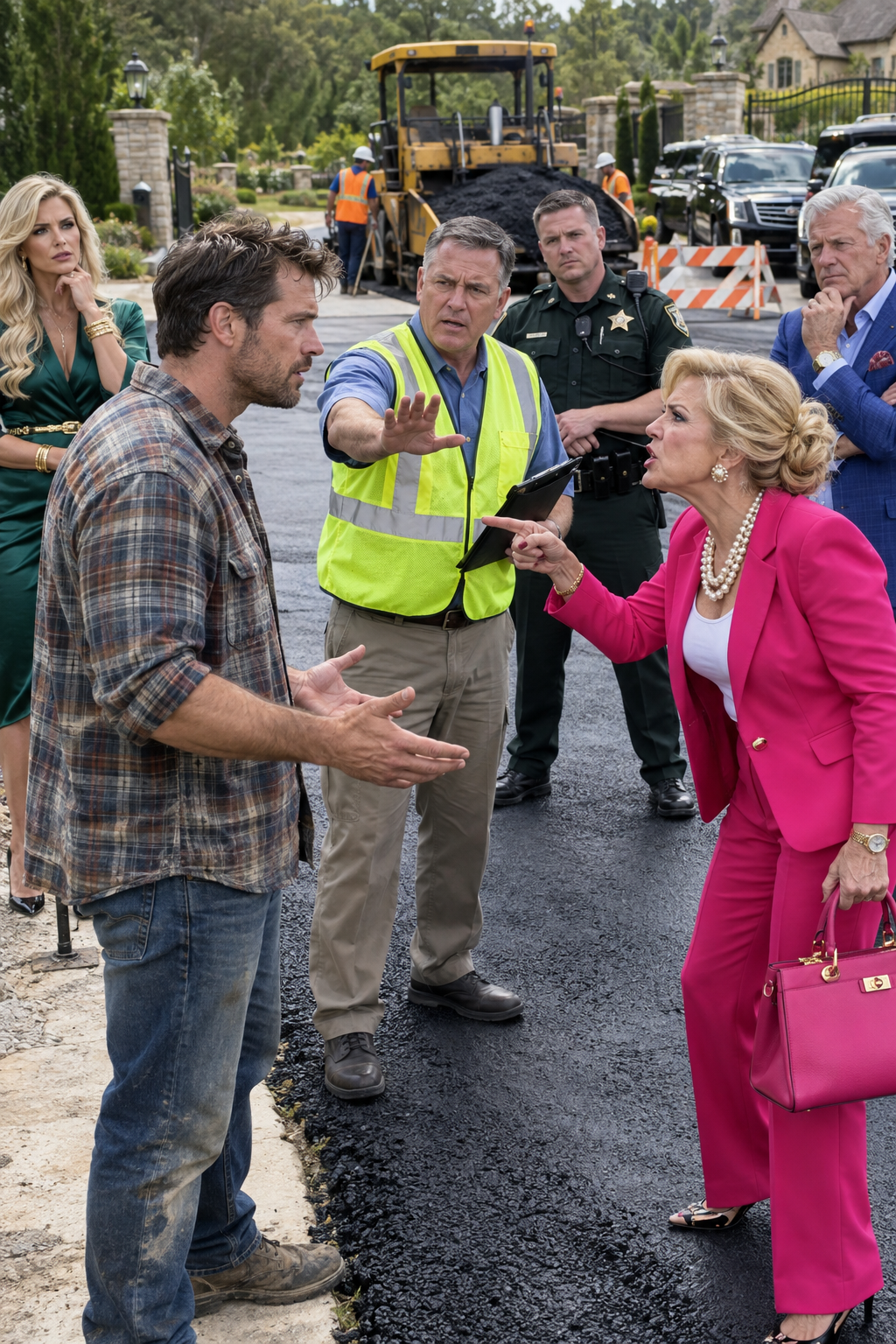
HOA Karen Paved Over My Private Driveway—Then the County Shut Down Their $18 Million Luxury Project Overnight
Three days after we buried my father, my sister changed the locks on the house I had spent fourteen years keeping alive.
Two weeks later, she sold the back half of our family land to a developer.
And six weeks after that, I came home to find forty tons of hot asphalt being poured over the private driveway my father had quietly put in my name twenty-eight years earlier.
My sister stood beside the paving crew in white jeans and expensive sunglasses.
The HOA president stood next to her.
Both of them were smiling.
“Don’t make this embarrassing, Evelyn,” my sister called over the machinery. “It isn’t really yours anymore.”
I didn’t answer.
That was the first thing that frightened her.
Not because I looked angry.
Not because I threatened anyone.
I simply parked my truck on the shoulder, turned off the engine, and watched six men in fluorescent vests roll black asphalt across the pale gravel road my father and I had maintained together since I was twenty-nine years old.
My sister, Denise Mercer, expected screaming.
Karen Whitmore, president of the Cedar Ridge Homeowners Association, expected a scene.
The foreman expected me to stand in front of the roller so they could call the sheriff and paint me as an unstable woman interfering with permitted construction.
Instead, I reached behind the passenger seat.
I pulled out an old green metal box.
And I set it carefully on my lap.
Denise stopped smiling.
Only for a second.
But I saw it.
My father had kept that box beneath his workbench for almost thirty years.
The paint had flaked away around the corners. One hinge was bent. The tiny brass latch never closed properly.
The week before he died, when morphine had made his voice thin but his mind remained sharp, he had pointed toward the workshop and whispered something I didn’t understand at the time.
“Green box.”
I leaned closer.
“What about it, Dad?”
“Take it before Denise comes.”
I almost laughed.
Denise lived two states away then.
She visited twice a year, usually on Christmas and Father’s Day, usually for less than forty-eight hours.
My father’s fingers tightened around mine.
“If anybody ever tries to make that driveway public, don’t fight them at the gate.”
I remember staring at him.
“What are you talking about?”
“Go to the recorder.”
He swallowed painfully.
“Book thirty-one twelve. Page four forty-eight.”
“Promise me.”
So I promised.
Then he added one more sentence.
“The road was never about gravel.”
At the time, I thought illness had carried him somewhere I couldn’t follow.
Now a ten-ton asphalt roller was crawling toward the place where his mailbox used to stand.
And my sister was telling me the road wasn’t mine.
I ran my thumb across the dented lid of the green box.
I said nothing.
Karen walked toward my truck.
She was sixty-one, tall, silver-blonde, and dressed as if she were heading to a charity luncheon instead of trespassing on someone’s land. Emerald blouse. Cream slacks. Gold bracelet flashing every time she moved her hand.
Behind her, the new Cedar Ridge expansion spread across what had once been my father’s east pasture.
Bulldozers had cleared the trees.
Orange stakes crossed the hills.
A temporary sign announced:
MERCER GLEN.
FORTY-EIGHT LUXURY HOMES.
FROM THE LOW $800s.
The name made something harden inside me.
They had taken my father’s land.
They had taken his name.
Now they were taking the road too.
Karen stopped beside my open window.
“This work has been approved,” she said.
Her voice was calm in the practiced way of someone who had spent years speaking to contractors, lawyers, homeowners, and people she considered too timid to challenge her.
I looked at her.
“Approved by whom?”
“The county.”
“Which department?”
Her smile tightened.
“Evelyn, I understand this is emotional.”
There it was.
The little knife people use when they want to turn facts into feelings.
I glanced at Denise.
She folded her arms.
Karen continued.
“The Cedar Ridge board has worked for months to ensure the Mercer Glen development is properly integrated into our community. This roadway is shown as an existing access corridor on the approved site plan.”
“This was a driveway yesterday.”
“It has always functioned as access.”
“To one house.”
“That distinction is no longer relevant.”
I looked down at the box again.
“Is that what your attorney told you?”
Karen hesitated.
Half a second.
Maybe less.
Then Denise stepped forward.
“Oh, for God’s sake, Evelyn.”
She sounded exactly like our mother when she was tired of hearing an inconvenient truth.
“Dad left me the property. I sold part of it. The developer needs access. Stop pretending you’re some kind of railroad baron because you spread gravel every few years.”
I turned toward her.
“You told them you owned the driveway?”
“I told them the truth.”
“That wasn’t my question.”
Her face changed.
But enough.
“You always do this.”
“Turn everything into some courtroom interrogation.”
I almost smiled.
I was not a lawyer.
I had spent thirty-two years managing insurance claims for a regional utility company.
That meant I had learned something much more useful.
When people lied, they usually answered the question they wished you had asked.
I closed the box.
“Finish paving.”
Denise blinked.
Karen actually frowned.
“I said finish.”
The paving foreman looked between us.
I nodded toward the roller.
“You’ve already covered most of it. No sense stopping now.”
Denise gave a short laugh.
“There. See? Finally.”
Karen’s expression did not relax.
She knew something was wrong.
Smart bullies understand resistance.
Silence bothers them more.
I started my truck.
Karen stepped back.
I drove away while the roller kept moving behind me.
I didn’t look in the mirror.
Not until I reached the county road.
Then I stopped.
And for the first time since my father died, I let myself put my forehead against the steering wheel.
I did not cry.
I wanted to.
But grief had become too crowded.
My father’s death was in there.
So was losing the house.
So was Denise changing the locks seventy-two hours after the funeral.
So was my nephew, Tyler, carrying two cardboard boxes of my clothes onto the porch like I was a tenant who had missed rent.
So was the memory of fourteen years of canceled vacations, medical appointments, grocery runs, midnight falls, broken water heaters, oxygen deliveries, property taxes, snowstorms, and hospital chairs.
For fourteen years, I was the one who stayed.
For fourteen years, I was the one who answered the phone.
For fourteen years, I was the one who drove him to chemotherapy.
For fourteen years, I was the one who repaired the fences.
For fourteen years, I was the one who heard him say, “Don’t tell Denise. She’s busy.”
Denise had been busy.
That part was true.
She had built a successful interior design business outside Charlotte.
She had a lake house.
A husband named Greg who spoke about money as if he had personally invented it.
Two grown children.
Beach trips.
Christmas photographs in matching sweaters.
I had a small apartment fifteen miles from the farm because after my divorce, Dad needed help and it seemed foolish to buy another house when I spent most nights sleeping in the room across from his anyway.
I never resented Denise for leaving.
Not until she punished me for staying.
Dad’s will was only eight pages long.
The farmhouse and sixty-three acres went to both of us equally.
At least, that was what the attorney read first.
Then he reached the codicil.
Signed eleven months before Dad died.
The farmhouse and thirty-five acres around it went solely to Denise.
The remaining acreage was to be divided according to several older recorded instruments.
Denise smiled before the lawyer finished reading.
Greg squeezed her hand.
I remember looking at Dad’s empty chair beside the fireplace and feeling something inside me go very quiet.
Later, Denise cornered me in the kitchen.
“You knew he was changing things.”
“You had him to yourself for years.”
“I took care of him.”
“You controlled access to him.”
I stared at her.
“You had a key.”
“That’s not what I mean.”
She lowered her voice.
“Don’t fight me over the house.”
“I haven’t said I would.”
“Because Tyler and Amanda are thinking about moving closer, and we may renovate.”
“You’re moving here?”
Denise laughed.
That answer told me everything.
She didn’t want the house.
She wanted to win it.
Three days later, Tyler changed the locks.
My legal right to remain during probate was something we could have argued about.
I chose not to.
That was when I took the green box from the workshop.
Tyler saw me carrying it.
“What’s that?”
“Your grandfather’s papers.”
“Mom should probably have them.”
He laughed.
It wasn’t cruel exactly.
Dismissive.
“Aunt Evelyn, it’s her house now.”
I looked at him.
“Then she has plenty.”
He didn’t stop me.
People rarely stop someone they’ve already decided is powerless.
That mistake saved me.
After the paving crew finished my driveway, I drove directly to the Briar County Recorder’s Office.
The building sat behind the courthouse between the tax assessor and veterans services.
I had been there hundreds of times over the years.
Property records.
Utility easements.
Lien searches.
Death certificates.
Today felt different.
A woman named Carla Jensen was behind the counter.
I remembered her from high school.
She remembered me too.
“Evelyn Mercer?”
“Hale now.”
“Lord, I haven’t seen you in twenty years.”
“Closer to thirty.”
She smiled.
“Your dad used to come in here all the time.”
That stopped me.
“How often?”
“Back when Cedar Ridge was being built? Constantly.”
My father had never mentioned that.
I set the green box on the counter.
“I need Book 3112, Page 448.”
Carla’s fingers paused over the keyboard.
She looked at me.
Then at the box.
“That old thing.”
“You know it?”
“I know your father carried it.”
My throat tightened.
“Can you pull the record?”
“Give me a minute.”
She disappeared into a back room.
While I waited, I opened the box.
The first thing inside was a folded survey map.
Beneath it were tax receipts dating to 1998.
A warranty deed.
A yellow legal pad with my father’s handwriting.
And a sealed blue envelope with my name on the front.
DO NOT OPEN UNLESS THE ROAD IS CHALLENGED.
My hands went cold.
I had seen the envelope before.
I thought it contained a letter.
I had never opened it because my father had given me one clear instruction in life that I had no reason to disobey.
I slid my finger under the flap.
Inside was a photocopy of a recorded deed and a handwritten note.
If you are reading this, someone has finally decided that asphalt can change ownership.
I had to put the page down.
That was my father.
Dry humor even on paper.
I kept reading.
The driveway parcel is yours.
Not an easement.
Not permission.
I transferred it in 1998 after Mason Development tried to force a secondary entrance across our land for Cedar Ridge Phase II.
They offered me $42,000.
They came back with $85,000.
I refused again.
They said the county would eventually condemn it.
They were wrong.
After they threatened litigation, I separated the road corridor from the farm and deeded it to you because you had paid for the first resurfacing and because I trusted you to understand the difference between value and price.
I looked away.
The fluorescent lights blurred.
I kept reading.
There is a recorded Declaration of Non-Dedication attached to the deed.
Any residential access easement retained for the farm is limited to the existing homesite and agricultural operations.
It does not permit subdivision traffic.
It does not permit HOA control.
It does not permit expansion.
If anyone tells you otherwise, ask them to put it in writing.
Do not argue.
Do not threaten.
Do not block equipment.
Let them create evidence.
My father had underlined that last sentence twice.
Let them create evidence.
I thought about the fresh asphalt cooling behind me.
The rollers.
The photographs I had taken.
Karen’s claim that the county approved everything.
Denise’s claim that the road was part of the property.
I turned the page over.
One more sentence.
If Denise is involved, give her one chance to tell the truth before you show your hand.
I closed my eyes.
That hurt more than everything else.
Because it meant he had known.
Maybe not exactly what she would do.
But enough.
Carla returned holding a thick scanned record printout.
She set it beside my box.
“There you go.”
I compared the instrument number to Dad’s copy.
The deed was recorded July 14, 1998.
Grantee: Evelyn Mercer Hale.
Description: a strip of land twenty-four feet in width, extending from Old Mill Road to Parcel 17B, together with the turning apron, culvert structures, drainage swales, and associated access improvements.
The next document was the declaration.
No dedication to public use.
No implied public access by maintenance, use, or adjoining development.
No conveyance to any homeowners association.
And then the clause that mattered most.
Any retained easement benefited one existing residential homesite and agricultural activity on the parent parcel.
Use for additional subdivision lots required my written approval.
I had never given it.
My pulse slowed instead of speeding up.
That always happened when a claim became clear.
Chaos was exhausting.
Paper was peaceful.
“Carla,” I said, “can you tell me whether anyone pulled this record recently?”
She looked at me carefully.
“Officially?”
“Officially.”
“How recently?”
“Three times in the last five months.”
“Title search company first. RidgePoint Communities.”
That was the developer.
“Whitmore & Kessler Legal.”
Karen’s HOA attorney.
My mouth went dry.
“And third?”
Carla looked up.
“Denise Mercer.”
There are moments when betrayal becomes easier because it becomes measurable.
A signature.
A document number.
Denise had not made a mistake.
She had looked up my deed.
I asked Carla for certified copies of everything.
Then I drove to the county planning office.
I did not demand a meeting.
I did not mention fraud.
I requested the approved Mercer Glen site plan, access plan, stormwater permit, grading permit, and every document showing authorization to modify the driveway corridor.
Public records.
Nothing dramatic.
The woman at the counter told me some documents would require a written request.
I submitted it before leaving the building.
Then I called one person.
A surveyor named Samuel Price.
Sam had worked with my father for decades.
He was seventy-two now and mostly retired.
When I said my name, he was silent for a long time.
“Your dad gone?”
“Last month.”
“I’m sorry.”
“Thank you.”
Another silence.
Then I said, “They paved the west drive.”
Sam exhaled.
“RidgePoint. Cedar Ridge HOA. Denise.”
He said one word.
“You knew?”
“I knew somebody would try eventually.”
That sentence chilled me.
“Can you survey it?”
“Tomorrow.”
“I’m retired.”
“I charge too much.”
“My knees are bad.”
“Eight a.m.”
The next morning he arrived before seven forty-five.
By nine, he had found three original iron pins.
By ten, he had confirmed what the recorded map already showed.
The new asphalt did not merely overlap my parcel.
Almost the entire new entrance sat on it.
They had widened the old twelve-foot gravel drive to twenty-two feet.
They had cut three mature dogwoods.
Removed my mailbox post.
Regraded a drainage swale.
Installed two concrete culvert extensions.
And painted temporary lane markings for construction traffic.
Sam stood beside his tripod staring down the black ribbon.
“They built themselves a boulevard.”
“They think they did.”
He looked at me.
“Your father would’ve chained a tractor across it.”
Sam smiled.
“You’re right. He would’ve wanted to.”
He pulled off his cap.
“He told me once why he put the road in your name.”
“I read the letter.”
“Not all of it.”
Sam looked toward the farmhouse in the distance.
“You paid off the mortgage.”
I stared at him.
“After your mother got sick.”
“That was Dad’s business.”
“No. It was yours.”
I remembered 1997.
Mom’s ovarian cancer.
Dad had mortgaged part of the farm to cover expenses their insurance refused.
I had cashed out a small investment account.
I gave him money.
Not enough to pay off the mortgage.
At least, I didn’t think so.
Sam continued.
“He sold equipment. You gave him the rest.”
“I gave him twenty-eight thousand.”
“That was the rest.”
I looked toward the asphalt.
“The driveway wasn’t payment.”
“Then what was it?”
Sam put his cap back on.
I didn’t say anything.
“Your dad told me he didn’t want Denise or some future husband or developer deciding you had no claim here because you didn’t have children living on the farm.”
My father had never been good at saying I love you.
He fixed brakes.
Sharpened knives.
Filled the gas tank before you borrowed his truck.
Apparently, he also recorded deeds.
At eleven thirty, a black Range Rover came up the new asphalt.
Karen stepped out.
So did Brandon Shaw, regional vice president of RidgePoint Communities.
I recognized him from the development sign.
Forty-something.
Perfect teeth.
Navy polo shirt.
The kind of man who called everyone “my friend” while calculating what they cost.
He looked at Sam’s equipment.
Then at me.
“Ms. Hale?”
“I’m Brandon Shaw.”
“I understand you have concerns about the access improvements.”
Karen looked annoyed.
Brandon stayed smooth.
“We’re happy to discuss reasonable accommodations.”
“Well, resurfacing your remaining private parking area. Landscaping. Perhaps some compensation for temporary inconvenience.”
He thought I was negotiating over inconvenience.
I glanced at Karen.
She knew better.
That made this useful.
“How much compensation?”
Karen turned toward Brandon.
He had clearly not expected that question either.
“We’d need to evaluate—”
“For ownership.”
“I’m sorry?”
“How much are you offering to buy the road?”
His expression changed.
Karen answered.
“The road is part of the recorded subdivision access.”
Sam actually chuckled.
Karen looked at him.
“Something funny?”
“No, ma’am.”
He adjusted the survey rod.
“Just old age.”
I looked at Brandon.
“Do you agree with her?”
He measured his answer.
“Our title review confirmed legal access.”
“Through my parcel?”
“The approved documents show existing access.”
“That wasn’t my question.”
He looked at Karen.
Then back at me.
“We have legal counsel handling title matters.”
I handed him a single sheet of paper.
A certified copy of the first page of my deed.
Nothing else.
He read my name.
The recording date.
The description.
The blood drained from his face so quickly it was almost impressive.
Karen stepped closer.
“What is that?”
Brandon did not answer.
She took the paper from him.
Her eyes moved down the page.
Then up to me.
“This proves nothing.”
“It proves one thing.”
“You knew my name before you paved.”
She stiffened.
“I knew who you were.”
“No. I mean legally.”
Karen said nothing.
I continued.
“Your attorney pulled this record six weeks ago.”
That landed.
Brandon turned toward her.
Karen’s mouth opened.
I looked at him.
“Your title company pulled it five months ago.”
Now it was Karen’s turn to look at Brandon.
Systems built on shared wrongdoing stay strong only while everyone believes everybody else is equally exposed.
The moment they suspect someone knows more than they do, they begin separating.
I gave them room.
“You have my number.”
Then I nodded to Sam.
“We’re done here.”
Brandon called after me.
“Ms. Hale.”
“If there’s an issue, we can resolve it professionally.”
I turned around.
“I’m counting on that.”
The following afternoon, RidgePoint’s attorney emailed me.
Not called.
Exactly what Dad had told me to make them do.
He described the paving as an “authorized improvement within an established access corridor.”
He stated RidgePoint had relied on recorded instruments and county-approved plans.
He denied trespass.
Then he offered me $25,000 for a “confirmatory access agreement.”
I read the email twice.
Then I forwarded it to an attorney named Rachel Boone.
Rachel had handled utility litigation with my old employer.
She was forty-six, sharp, patient, and almost impossible to intimidate.
She called three minutes later.
“Do not respond.”
“I wasn’t going to.”
“Good. Send me everything.”
I sent the deed.
The declaration.
Dad’s letter.
Sam’s survey.
Permit records.
Then I waited.
The county sent my public records packet the next morning.
That was when the story changed.
The Mercer Glen access plan showed my private driveway in gray.
Beside it were the words:
EXISTING PUBLIC ACCESS – MERCER FARM ROAD.
Not private.
The plan listed the road as a forty-foot right-of-way.
It had never been forty feet.
The supporting exhibit included an old survey.
Dad’s old survey.
But something was missing.
My parcel number.
Someone had covered the small rectangular box identifying the driveway as Parcel 17C.
Then the altered document had been scanned.
I sat at my kitchen table for almost ten minutes without moving.
The apartment was quiet.
A ceiling fan clicked once every rotation.
Outside, a delivery van stopped at the building across the lot.
I zoomed in on the digital copy.
There was a faint edge where white correction tape or paper had covered the parcel number.
A bad alteration.
Not something a professional title company should miss.
Rachel called.
“You saw it.”
“I saw it.”
“What does it mean?”
“It means nobody touches anything.”
“I wasn’t planning to.”
“Can the county shut them down?”
“Possibly.”
“Possibly?”
“If their development has no compliant primary access, yes. If they misrepresented ownership on the permit application, absolutely. But we don’t run into county offices yelling fraud.”
“We give them clean facts.”
Rachel paused.
“You’re disturbingly calm.”
“My father trained me.”
“That sounds ominous.”
“It was mostly fence repair.”
She laughed.
Then her tone changed.
“One other thing.”
“The seller access certification.”
I pulled up the document.
Denise’s signature appeared at the bottom.
“I saw it.”
“Read paragraph six.”
Seller warrants that all roadways, access points, easements, and ingress/egress corridors affecting the development parcel have been fully disclosed to purchaser, including any separately deeded access parcels known to seller.
I felt my jaw tighten.
Rachel said softly, “She signed that.”
“And the recorder shows she personally requested your deed before she signed it.”
“Do you want to call her?”
Dad’s letter flashed through my mind.
Give her one chance to tell the truth.
I called Denise.
She answered on the fourth ring.
“Did you know the driveway was in my name before you sold the acreage?”
Then irritation.
“Is this what you’ve been doing? Digging through Dad’s ancient paperwork?”
“That isn’t an answer.”
“Evelyn, nobody took your driveway.”
“It was paved without permission.”
“It needed paving.”
“That still isn’t an answer.”
She exhaled loudly.
“You’re trying to destroy an eighteen-million-dollar development because you’re angry about the house.”
There it was.
Not confusion.
A counteraccusation.
“Did you know?”
“Dad created so many weird little parcels over the years nobody knew what anything meant.”
“You pulled my deed from the recorder’s office.”
That silenced her.
I continued.
“August seventh. Eleven fourteen in the morning.”
“You’re spying on me now?”
“You sound insane.”
“Did you know?”
Denise’s voice hardened.
“The developer’s attorneys said it wasn’t a problem.”
The truth rarely arrives dramatically.
Sometimes it just gets tired of being avoided.
I lowered my voice.
“You told them?”
“I gave them everything I had.”
“Including my deed?”
“They had access to public records.”
“Did you give them my deed?”
“Stop twisting this.”
She filled the silence.
“You always thought Dad owed you more because you stayed.”
“I never said that.”
“You didn’t have to.”
“I’m asking about a road.”
“No, you’re not. This is about the house. You’re furious that Dad finally recognized I mattered too.”
I closed my eyes.
“Did you give them the survey that showed my parcel number?”
She stopped breathing for a moment.
I heard it.
Then she said, “I have to go.”
“Before you do.”
“Who removed the parcel number?”
She hung up.
That was her chance.
Rachel filed the formal notice with Briar County the next morning.
Ownership dispute.
Potential material misrepresentation in an approved access plan.
Unauthorized land disturbance on a separately deeded parcel.
Request for immediate administrative review.
We attached seven pages.
Not seventy.
Rachel said bureaucrats notice short packets faster.
At 10:17 a.m., the county acknowledged receipt.
At p.m., an inspector named Daniel Cates called me.
At , he was standing on my newly paved road with a hard hat and tablet.
By , three RidgePoint supervisors had appeared.
Karen arrived at .
She was furious.
Not loudly.
That would have been easier.
She walked directly toward me and said through clenched teeth, “Do you understand what you’ve done?”
I looked at the bulldozers beyond the hill.
“They’re still working.”
“Not for long if you keep interfering.”
Daniel Cates looked up from his tablet.
“Mrs. Whitmore, I need the approved right-of-way dedication.”
Karen turned.
“Our attorney submitted everything.”
“I don’t have a dedication.”
“The road predates the development.”
“That isn’t what I asked.”
I almost liked him.
Brandon Shaw came down the hill in a white pickup.
This time he did not smile.
“We’ve got a title issue being resolved.”
Daniel pointed toward the pavement.
“This isn’t just title.”
Brandon’s jaw moved.
“The access construction matches the approved plan.”
“The approved plan identifies this as public.”
“It functions as public access.”
I spoke for the first time.
“No, it doesn’t.”
Karen spun toward me.
“Please let the professionals talk.”
Daniel Cates looked at her.
“Ms. Hale is the recorded owner.”
I watched that sentence hit harder than shouting ever could.
Karen’s face went pale.
Brandon rubbed his forehead.
Daniel continued.
“Until I see a legal basis for public designation, this work may have been performed outside RidgePoint’s permitted development limits.”
Brandon lowered his voice.
“What does that mean?”
“It means I’m issuing a temporary stop-work order on access improvements.”
Karen laughed once.
“Fine. The driveway can sit for a few days.”
Daniel didn’t move.
“I said access improvements.”
“The approved subdivision permit requires one compliant construction entrance.”
Brandon stared at him.
Daniel tapped his tablet.
“If this one isn’t legal, you don’t currently have one.”
The air changed.
Behind us, an excavator bucket stopped in mid-swing.
Not because the operator could hear.
Because someone uphill was waving frantically.
A RidgePoint supervisor raised a radio.
Then another machine shut down.
Then another.
Karen looked around.
“What are they doing?”
Daniel answered.
“Stopping work.”
“All work?”
“You cannot shut down an entire development over one woman’s driveway.”
He looked at the map.
Then he looked at her.
“The approved plan is.”
By five o’clock, Mercer Glen was silent.
No bulldozers.
No dump trucks.
No graders.
The entire eighteen-million-dollar project sat behind orange plastic barriers and a red county notice.
Denise called me thirteen times that night.
I did not answer.
Greg called four times.
Tyler texted:
You’re hurting everyone just to prove a point.
I read it once.
Then deleted it.
The next morning, Karen sent an email to every Cedar Ridge homeowner.
She blamed “a neighboring property dispute.”
She warned that completion of the Mercer Glen amenities could be delayed.
She said the board was “working aggressively to defend community access rights.”
She did not mention my deed.
She did not mention the altered survey.
She did not mention the stop-work order was caused by a road the HOA had never owned.
By lunchtime, someone posted my name in the Cedar Ridge Facebook group.
People I had never met called me selfish.
Vindictive.
One man wrote that eminent domain would “solve the crazy lady problem.”
A woman said I should be ashamed for threatening property values.
Karen liked that comment.
I took a screenshot.
Rachel told me to stop reading.
I mostly listened.
Two days later, RidgePoint doubled its offer.
Then $110,000.
Then $250,000 for a permanent subdivision easement.
I rejected all three.
Rachel asked whether I had a number.
“Everyone has a number.”
“Not for that road.”
She studied me.
I thought about Dad’s letter.
About Mom riding beside him in an old Ford pickup.
About the dogwoods cut without permission.
About Denise telling me I was confused.
About Tyler putting my clothes on the porch.
About fourteen years of being treated as the daughter whose sacrifices were useful precisely because they were expected.
“It isn’t worth nothing,” I said.
Rachel waited.
“It’s just not for sale.”
The next week brought the first mini-collapse.
RidgePoint’s title insurer suspended coverage on the access corridor.
Then its construction lender froze new draws related to Mercer Glen.
Then three buyers under contract requested written clarification about road access.
Then the county planning director scheduled an administrative hearing.
That was when Karen came to my apartment.
She arrived at in the evening without calling.
I opened the door but left the chain latched.
Her hair was damp from rain.
No emerald blouse this time.
No jewelry.
She looked older.
“Can we talk?”
“Privately.”
“This is private.”
She glanced down the hallway.
She lowered her voice.
“RidgePoint is considering walking away.”
“That sounds like RidgePoint’s decision.”
“If they do, Cedar Ridge could be left with unfinished infrastructure and legal expenses.”
“That sounds like Cedar Ridge’s problem.”
Her mouth tightened.
“There are one hundred ninety-six families in this community.”
“None of them paved my driveway.”
“The board acted based on counsel.”
“Your counsel pulled my deed.”
She stared at me.
I continued.
“Before the paving.”
“Lawyers review hundreds of documents.”
“He reviewed mine.”
“Did he tell you about it?”
Karen looked past me.
There it was.
Another answer without words.
“You knew,” I said.
“We were advised the old deed did not defeat long-standing access rights.”
“Did your attorney put that in writing?”
Her eyes returned to mine.
Of course not.
My father had understood this kind of person before I did.
Karen changed tactics.
“If the project collapses, Denise could face a significant claim from RidgePoint.”
That was supposed to move me.
Just not the way Karen expected.
“You should tell her.”
“She’s your sister.”
“Your father would not have wanted this.”
That one almost worked.
I looked through the narrow opening in the door.
“You never met my father.”
“I know what family means.”
My voice stayed quiet.
“You know what leverage means.”
Karen’s expression turned cold.
“I came here in good faith.”
“No. You came because the lender froze money.”
She flinched.
I had guessed.
That was satisfying.
I closed the door.
The county hearing took place eleven days later.
The room was packed.
RidgePoint brought two attorneys.
Cedar Ridge brought one.
Karen sat in the front row.
Denise sat beside Greg.
She had not spoken to me since hanging up.
I sat with Rachel and Sam Price.
On the table in front of me was the green box.
Denise noticed it immediately.
Her face tightened.
The county planning director, Melissa Grant, opened the hearing.
She was not a judge.
There was no jury.
No dramatic objections.
That made the truth feel even sharper.
Permit records appeared on a screen.
The approved access plan.
The public-road designation.
The non-dedication declaration.
Sam’s updated survey.
RidgePoint’s attorney argued that decades of continuous use had created implied access.
Rachel asked who had used the road.
The attorney said Mercer family members, deliveries, agricultural vehicles, utility workers.
Rachel nodded.
“All with permission?”
He hesitated.
“That is disputed.”
Another hesitation.
Karen’s attorney argued that Cedar Ridge residents had occasionally used the driveway during storms.
Sam leaned toward me.
“That happened once.”
I whispered back, “1989 flood?”
Dad had opened the pasture gate when Old Mill Road washed out.
For six hours.
Apparently, kindness had become a legal theory.
Then Melissa Grant displayed the altered survey.
The room became still.
“This exhibit was included in the access certification packet submitted March third,” she said.
RidgePoint’s attorney leaned forward.
“We did not prepare the original document.”
“I didn’t ask who prepared it.”
Karen shifted in her seat.
Denise looked down.
Melissa continued.
“The recorder’s certified version contains Parcel 17C.”
She clicked.
The original appeared beside the permit version.
“Your submitted copy does not.”
RidgePoint’s attorney whispered to Brandon.
Karen whispered to her lawyer.
I watched Denise.
She did nothing.
Rachel stood.
“Director Grant, may I ask that the seller certification be displayed?”
Denise’s signature appeared.
I watched my sister see her own name ten feet tall on a county screen.
Rachel did not accuse her.
She simply said, “The seller warranted complete disclosure of separately deeded access parcels.”
RidgePoint’s attorney rose.
“My client relied on seller representations.”
Denise looked at Brandon.
His expression was flat.
For the first time, she understood that the system she thought she had joined was preparing to cut her loose.
Karen’s attorney stood.
“The HOA is not party to the land sale.”
Rachel replied, “Correct.”
He seemed relieved.
Then she added, “But the HOA’s law firm separately accessed Ms. Hale’s deed before voting to approve road improvements.”
His relief disappeared.
Melissa Grant leaned back.
Karen’s lawyer cleared his throat.
“The board received advice regarding historic use.”
“Did the board receive Ms. Hale’s deed?”
Karen stared straight ahead.
The lawyer finally said, “I would need to review privileged communications.”
Melissa Grant nodded.
“That is your right.”
Then she closed the folder.
“The county does not need privileged communications to determine whether its permit was issued based on inaccurate access information.”
The room became so quiet I could hear the ventilation fan.
She continued.
“Effective immediately, the Mercer Glen development permit is suspended pending submission of a lawful primary access plan and corrected title certification.”
Brandon stood halfway.
“Director—”
She raised one hand.
“I’m not finished.”
“Additionally, because land disturbance occurred on property outside the development boundary identified in the applicant’s ownership certification, enforcement staff will evaluate restoration requirements and civil penalties.”
Karen’s lips parted.
Melissa looked toward her.
“Any HOA claim to use this corridor must be resolved independently. It is not established by this permit.”
Then she looked at me.
“Ms. Hale, the county recognizes Parcel 17C as privately owned based on the current record.”
Twenty-eight years.
A green box.
One sentence.
I should have felt triumphant.
Instead, I felt tired.
Rachel touched my arm.
I hadn’t realized I was holding it.
Outside the hearing room, reporters waited.
Local television.
A newspaper.
Two bloggers.
I declined every interview.
Karen did not.
She called the decision “a procedural setback.”
Brandon said RidgePoint would “evaluate all options.”
Denise tried to leave through a side hallway.
I followed her.
She stopped.
Greg kept walking.
She turned slowly.
“What do you want?”
“Who altered the survey?”
Her eyes filled.
Not with grief.
With anger.
“You got what you wanted.”
“You shut down the project.”
“The county shut down the project.”
“Because of you.”
“Because somebody lied.”
She stepped closer.
“You think Dad would be proud of this?”
There it was again.
People using dead men as witnesses when living facts became inconvenient.
I held the green box against my side.
“He warned me.”
Her face changed.
“About what?”
“The road.”
She glanced at the box.
“What’s in there?”
“You tell me.”
“I don’t know.”
“Dad thought you might.”
“Dad was paranoid.”
“He was dying.”
“He spent years turning you against me.”
I stared at her.
“You think he had to?”
That hurt her.
For one moment, I almost apologized.
Then I remembered my clothes on the porch.
The altered map.
Her signature.
The paving crew.
“You knew the road was mine.”
She lowered her voice.
“It was supposed to be temporary.”
“The access issue.”
My heart slowed.
“What do you mean temporary?”
Her eyes shifted toward the hallway.
That was the moment I knew there was more.
She shook her head.
“What was temporary?”
“Forget it.”
She walked away.
That surprised Rachel.
“You’re not going after her?”
“She’ll come back.”
“How do you know?”
“Because she almost told me something.”
Rachel frowned.
“About the road?”
“I don’t know.”
Three days later, RidgePoint terminated its purchase agreement for the undeveloped portion of Mercer Glen and filed a claim against Denise for breach of seller warranties.
The number was $3.4 million.
Greg called me that night.
His voice shook.
“You need to sign the easement.”
“They’re suing us.”
“If you sign, they’ll withdraw the claim.”
“Did they tell you that?”
“Essentially.”
“Get it in writing.”
“Evelyn, Jesus Christ.”
“That’s advice.”
“This could bankrupt us.”
“I’m sorry.”
“You don’t sound sorry.”
“Then help us.”
I closed my eyes.
“Did you know?”
He said nothing.
“Denise handled the land paperwork.”
“That wasn’t my question.”
He hung up.
A week later, the county ordered RidgePoint to remove the unauthorized pavement from the portion of my parcel they had widened and restore the drainage swale.
I declined.
That surprised everyone.
Rachel asked me twice.
“You want to keep the asphalt?”
“Part of it.”
“Dad hated potholes.”
She laughed so hard she had to sit down.
We negotiated a restoration agreement instead.
RidgePoint removed the excess width.
Rebuilt the drainage.
Replaced the dogwoods.
Installed new boundary markers.
And paid for a gate designed by Sam.
I made them leave the central paved lane.
The road was mine before.
It was still mine after.
Only smoother.
The Cedar Ridge board called a special meeting two weeks later.
Karen faced a recall petition.
Eighty-eight homeowners signed it on the first day.
People who had called me greedy suddenly wanted copies of my documents.
I sent them.
All of them.
Karen resigned before the vote.
Her attorney resigned from representing the HOA four days later.
RidgePoint abandoned Mercer Glen entirely.
The county revoked the subdivision approval when no replacement access plan was submitted.
The property went back into legal limbo.
For a little while, I thought that was the end.
Not a happy ending.
Life is rarely that clean.
I still didn’t have my father.
Denise still had the farmhouse.
We still had years of bitterness between us.
But the bulldozers were gone.
The hill was quiet.
One October morning, I parked at the gate and walked the road alone.
Leaves moved across the fresh black pavement.
The new dogwoods were small.
They would take years to become what had been cut down.
That seemed honest.
Some damage cannot be reversed.
It can only be replanted.
I reached the old farmhouse mailbox.
Mine had been removed during construction, so I carried a new cedar post in the truck.
Sam was coming later to help install it.
For the first time since Dad’s death, I felt something close to peace.
Then a car stopped behind me.
Denise stepped out.
No sunglasses.
No expensive coat.
Just jeans and one of Dad’s old flannel shirts.
I hated seeing her wear it.
She stood beside the car for a long time.
“I found something.”
I said nothing.
She opened the back door.
Pulled out a cardboard banker’s box.
Set it on the hood.
“I was clearing Dad’s desk.”
“That took you three months?”
“I wasn’t clearing it before.”
She looked toward the farmhouse.
“I was selling it.”
I felt the words more than I expected.
“No one now.”
She opened the box.
Inside were folders.
Tax records.
Old survey notes.
Bank statements.
Then she pulled out a blue envelope.
The same color as mine.
My name was not written on it.
Karen Whitmore’s was.
I stared at Denise.
“Where did you get that?”
“Dad’s locked desk drawer.”
“Then why are you here?”
She looked at me.
And for the first time since we were children, my sister looked scared of something that wasn’t money.
“Because Karen knew Dad.”
“That’s impossible.”
“Karen moved here twelve years ago.”
“She lived here before that.”
“Cedar Ridge.”
“That development wasn’t built until—”
“Nineteen ninety-eight.”
The same year Dad deeded me the road.
Denise nodded.
“She worked for Mason Development.”
The name from Dad’s letter.
The company that had tried to buy the road twenty-eight years ago.
I opened the envelope.
Inside was a photocopy of a settlement draft.
Mason Development.
Thomas Mercer.
And a junior project coordinator whose signature appeared on the final page.
Karen Whitmore.
My skin went cold.
The settlement had never been executed.
But attached behind it was a handwritten note from my father.
Whitmore came back again.
Says they’ll build around us if I don’t sell.
Told her the road stays private.
She said someday Evelyn will need money more than principles.
She smiled when she said it.
I read it twice.
Then I found another page.
Not of Mercer Glen.
Of Cedar Ridge itself.
Several parcels were outlined in red.
The HOA clubhouse.
Two retention ponds.
A row of twelve homes along the western edge.
And Karen Whitmore’s house.
All of them touched a narrow shaded strip labeled:
MERCER RESERVED ACCESS AND DRAINAGE CORRIDOR.
I looked at Denise.
“What is this?”
“I don’t know.”
“You brought it here.”
“What did Dad say about it?”
I studied the map.
At the bottom was a handwritten instrument number.
Different from mine.
Rachel arrived forty minutes later.
Sam came too.
We spent the afternoon at the recorder’s office.
The document was real.
Recorded in 1998.
A drainage and access reservation my father had retained when Mason Development bought an adjoining tract.
It crossed beneath part of what was now Cedar Ridge.
Normally, that would mean little.
Utility corridors and drainage easements exist everywhere.
But this one contained an unusual clause.
If the developer or its successors materially obstructed the reserved corridor or used Mercer property to expand subdivision access without written consent, certain access rights granted by my father terminated automatically.
Rachel read the clause four times.
Sam stared at the map.
I stared at Karen’s house.
“Does this mean she doesn’t own her house?”
Rachel shook her head.
“No. Don’t jump there.”
“But it may mean Cedar Ridge has been using portions of your father’s retained corridor for drainage without the rights they think they have.”
Denise sat across from us.
Rachel looked at her.
“For whom?”
Denise looked toward me.
I knew what she was thinking.
This was no longer one driveway.
No longer one failed development.
No longer one family fight.
Dad had not separated that little road because he was stubborn.
He had been protecting something larger.
Something everyone else had forgotten.
Except Karen.
That night, I returned to my apartment with the green box.
I placed Dad’s map on the kitchen table.
At , my phone rang.
Unknown number.
I answered.
“Evelyn Hale?”
“This is Special Investigator Mark Ellison with the state Department of Real Estate Enforcement.”
I sat down.
“How can I help you?”
“We’re reviewing permitting documents connected to RidgePoint and several homeowners associations in Briar County.”
I looked at the map.
“Cedar Ridge?”
“That’s one.”
My pulse changed.
He continued.
“Your attorney provided an altered survey associated with Mercer Glen.”
“We found something similar in another project.”
I tightened my grip on the phone.
“How similar?”
“The same method.”
“What method?”
“Recorded parcel identifiers removed before submission.”
“How many?”
“We’re still reviewing.”
“Mr. Ellison.”
“Three so far.”
I looked through my apartment window toward the dark outline of the hills where Cedar Ridge sat.
Three developments.
Three altered maps.
Maybe more.
Karen had not invented this fight six weeks ago.
She had been part of it twenty-eight years earlier.
And my father had left her name in a sealed envelope because he had known someday I might need to understand why.
The next morning, I drove to Cedar Ridge.
Karen was loading boxes into the back of her Range Rover.
She saw my truck and froze.
I parked across the street.
For once, she didn’t tell me I was emotional.
For once, she didn’t mention attorneys.
For once, she didn’t pretend not to understand why I was there.
I walked toward her holding the green box.
Her eyes went straight to it.
“You found Thomas’s papers,” she whispered.
My father’s first name.
A name she had never once used in front of me.
I stopped ten feet away.
“How well did you know him?”
She looked toward her house.
Then toward the road.
“I knew enough.”
“Enough to remember 1998?”
Her face hardened.
“You don’t understand what happened.”
“That’s why I came.”
“You think your father was some innocent old farmer protecting his daughter.”
I said nothing.
Karen closed the hatch of her Range Rover.
“Mason Development wasn’t trying to steal his road.”
“What were they trying to do?”
She looked at the box again.
“Ask Denise.”
“She brought me your envelope.”
That hit her.
“Then she’s even stupider than Thomas thought.”
I stepped closer.
Karen laughed.
There was no humor in it.
“You still don’t see it, do you?”
“See what?”
“The road wasn’t what your father was protecting.”
Those words stopped me.
The same thing Dad had written.
The road was never about gravel.
Karen got into her SUV.
I put one hand on the door before she could close it.
She stared at me.
I kept my voice low.
“The state found three altered plats.”
All the color left her face.
That was my answer.
I let go of the door.
Then I asked the smallest question I had asked since this started.
A question that sounded almost harmless.
Almost curious.
Almost weak.
“Karen… how many other private roads did you pave?”
✓ Lynn R. Adams
HOA Karen Paved Over My Private Driveway—Then the County Shut Down Their $18 Million Luxury Project Overnight Three days after we buried my father, my sister changed the locks on the house I had spen…