HOA Karen Parked Her Range Rover in My Barn Doorway—Then Six Tons of Manure Exposed What My Family Had Been Hiding
HOA Karen Parked Her Range Rover in My Barn Doorway—Then Six Tons of Manure Exposed What My Family Had Been Hiding
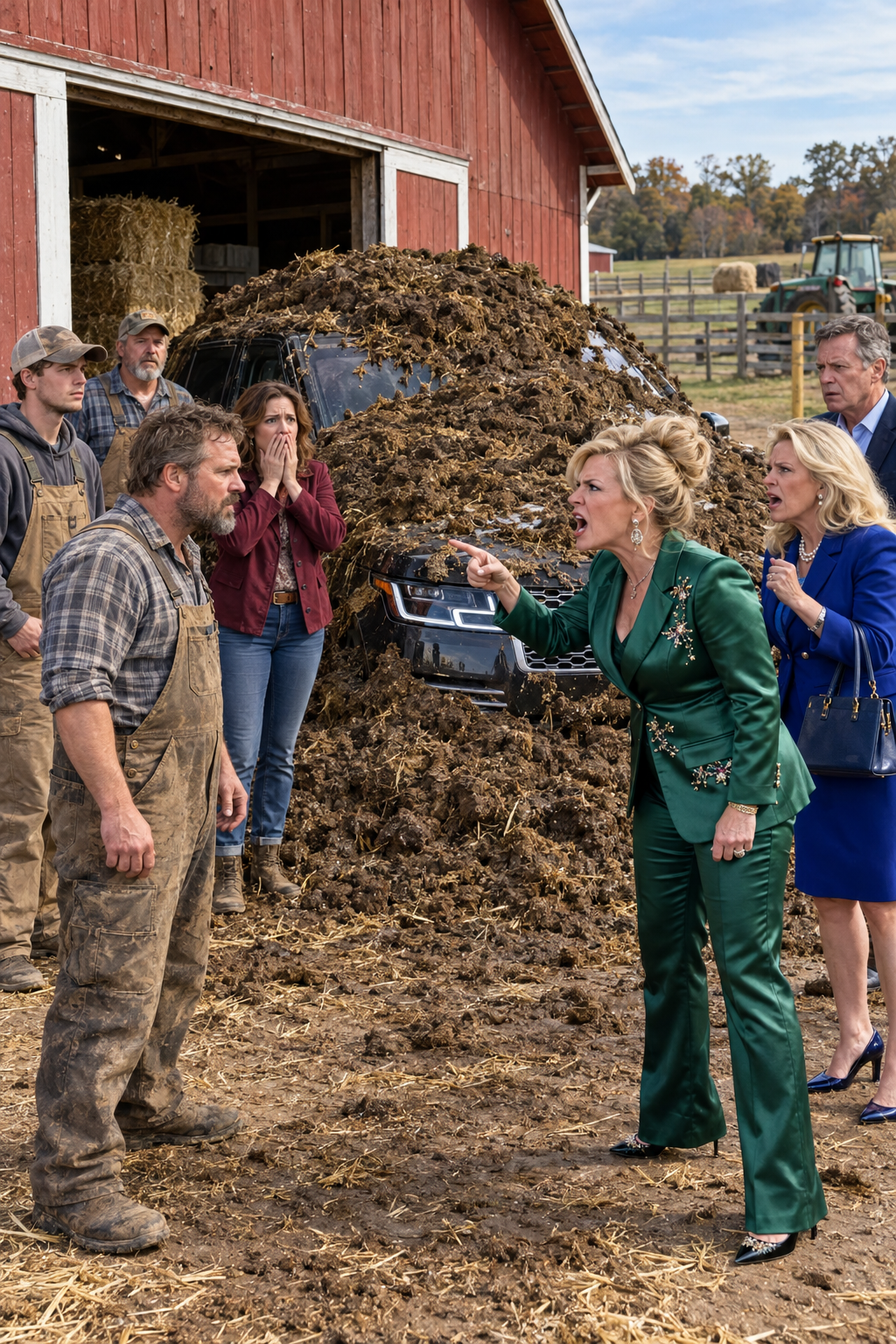
Karen Whitmore parked her white Range Rover sideways across my barn doors, tossed me the keys like I was hired help, and said, “Move it when you’re finished pretending this place still belongs to you.”
My younger brother laughed.
My sister-in-law took a picture.
Three days earlier, those same people had changed the locks on the farmhouse where I had spent twenty-seven years caring for our parents.
I didn’t yell.
I didn’t throw Karen’s keys back.
I simply looked at the Range Rover, then at the manure truck crawling up our gravel lane behind her.
Already paid for.
Already scheduled.
And the man driving it had known my father longer than Karen Whitmore had known there was a farm here.
“Morning, Ellen,” he called through his open window.
Karen turned around.
Her smile disappeared.
I picked up her keys from the dirt.
Then I asked the driver one question.
“Still delivering exactly where Dad told you?”
He grinned.
“Every October for eighteen years.”
That was when my brother stopped laughing.
My name is Ellen Mercer.
I was fifty-eight years old when my own family decided I had become an inconvenience.
For most of my adult life, inconvenience had been another word for Ellen.
When Mom’s arthritis got bad, I was the one who drove her to Columbus twice a month.
When Dad had his first stroke, I moved from Cincinnati back to Mercer Farm.
When my brother Tyler wanted to finish business school in Chicago, I told him to go.
When he needed money for his first house, Dad wanted to sell ten acres.
I talked him out of it.
I wrote Tyler the check myself.
When my sister Rebecca’s marriage collapsed, she moved into the upstairs bedroom with two children and stayed fourteen months.
I paid the heating bill.
I never sent her a spreadsheet afterward.
That was my mistake.
People remember sacrifice differently when nobody invoices them for it.
By the time Mom died, I had become part nurse, part accountant, part mechanic, part farmhand.
Dad lasted another six years.
The last two were ugly.
Not dramatic.
The kind of slow decline nobody posts photographs of.
I changed bandages.
Washed sheets at two in the morning.
Measured pills into little plastic compartments.
Learned which cough meant water and which cough meant I needed to call the doctor.
Tyler visited Christmas and sometimes Easter.
Rebecca came when she wanted to discuss “what would happen with everything.”
Dad always changed the subject.
The farm sat outside a fast-growing Ohio suburb called Briar Glen.
When my grandfather bought the first parcel in 1954, there was nothing around us except soybean fields, county roads, and a church with a leaking steeple.
By the time Dad got sick, land developers had surrounded Mercer Farm with stone entrance monuments, ornamental ponds, private gyms, and houses with six bathrooms for families of three.
The largest development was Briar Glen Estates.
One hundred and ninety-six homes.
An HOA clubhouse.
Two tennis courts.
A fake lake.
And a president named Karen Whitmore.
Karen was sixty-one, silver-blonde, polished, and permanently dressed as if a television crew might arrive to interview her about important matters.
She drove expensive SUVs.
She wore oversized sunglasses even when it was cloudy.
And she had the curious ability to say “community standards” the way other people said “God’s will.”
For years, Dad treated her as background noise.
She sent letters complaining about our tractor noise.
Dad mailed them back marked RETURN TO SENDER.
She complained about our red barn.
Dad painted it redder.
She complained that our cattle fence was “visually inconsistent with the architectural character of Briar Glen.”
Dad called the county to ask whether architectural character could be vaccinated for rabies.
The county clerk laughed so hard she had to hang up.
Then Dad got sick.
That was when Karen stopped sending complaints.
She started sending proposals.
The first offered $1.2 million for sixty acres.
Dad tore it in half.
The second offered $2 million.
The third came from something called Evergreen Residential Holdings and offered $3.8 million for nearly everything except the farmhouse.
Dad read that one twice.
Then he handed it to me.
I put it in the locked green metal box beneath his desk.
The box mattered.
I just didn’t know how much yet.
Dad had owned it since Vietnam.
Heavy steel.
Two handles.
One old combination lock.
When I was a child, I thought he kept war medals inside.
When I became an adult, I assumed it contained deeds and tax records.
During the final year of his life, he became strangely protective of it.
“Never let Tyler take this box,” he told me one evening.
He was sitting at the kitchen table with an oxygen tube under his nose and black coffee he wasn’t supposed to drink.
I thought his medication was making him suspicious.
“Tyler isn’t going to steal your papers, Dad.”
Dad stared at me.
“You always defend people one week longer than you should.”
“I’m listening.”
“When I’m gone, they’ll come fast.”
“Family first.”
I remember feeling irritated.
Not frightened.
I had slept four hours in two days.
Dad had refused physical therapy that morning.
The water heater was failing.
I thought he was being dramatic.
“Dad, nobody is coming to steal the farm.”
His fingers tightened around my wrist.
He still had astonishing strength in his right hand.
“That isn’t what they’re coming to steal.”
Then he let go.
Three weeks later, he was back in the hospital.
Two days before he died, he asked everyone except me to leave the room.
Tyler rolled his eyes.
Rebecca looked offended.
Karen Whitmore had somehow sent flowers.
Dad waited until the door closed.
Then he whispered, “Green box.”
“Inside the false bottom.”
“What false bottom?”
It was the last clear smile I ever saw on his face.
Then a nurse came in.
Dad never finished explaining.
He died forty-eight hours later.
At the funeral, Tyler cried louder than anyone.
Four days afterward, he asked when the will would be read.
That should have told me everything.
Dad’s visible will was simple.
The farmhouse went equally to the three of us.
Most farming equipment went to me because I had been operating it.
The remaining acreage was divided through something called Mercer Family Land LLC.
Each sibling received one-third of the membership interest.
At least, that was what the version read by Tyler’s attorney said.
I noticed one thing immediately.
Dad’s longtime attorney, Charles Bell, wasn’t there.
A younger lawyer named Kevin Shaw handled everything.
“Where’s Charlie?” I asked.
Tyler leaned back in Dad’s chair.
“He retired.”
“Three months ago he was here.”
“He retired suddenly.”
I looked at Kevin.
He adjusted his tie.
“Mr. Bell transferred several client files.”
“To the firm.”
“What firm?”
Tyler exhaled.
“Oh, come on, Ellen.”
That was the first time I understood something had shifted.
Not legally.
Atmospherically.
Like noticing smoke before finding the fire.
Rebecca wouldn’t meet my eyes.
Tyler kept saying phrases like maximize value and liquidity event.
Then he slid a contract across the dining table.
Evergreen Residential Holdings.
They had increased their offer.
$5.6 million.
For almost all of Mercer Farm.
My third would be enough to retire comfortably.
Rebecca had already signed.
Tyler had already signed.
My line was blank.
I looked toward the kitchen doorway.
Dad’s walker was still folded beside the refrigerator.
His coffee mug was still drying beside the sink.
He had been dead eleven days.
Tyler blinked.
“I’m not selling.”
His expression hardened.
“Ellen, don’t do this.”
“Turn Dad’s death into some sentimental crusade.”
That sentence landed harder than I expected.
Rebecca finally spoke.
“You can buy somewhere else.”
I looked at her.
“Somewhere else?”
“A smaller place. Easier to manage.”
“I manage this place.”
I almost laughed.
She hadn’t touched a tractor since high school.
Tyler tapped the contract.
“It takes two-thirds approval under the operating agreement.”
That got my attention.
“What operating agreement?”
“I never signed an operating agreement.”
Kevin Shaw opened a folder.
The agreement looked old.
It gave members holding two-thirds interest authority to approve disposition of LLC property.
Tyler had one-third.
Rebecca had one-third.
Together, they had two-thirds.
Convenient.
Very convenient.
I read every page.
Dad’s signature appeared on the last one.
I didn’t recognize the witness.
I did recognize something else.
The document listed an effective date of March 8, six years earlier.
On March 8 six years earlier, Dad had been in Cleveland undergoing surgery.
I knew because I had been beside his hospital bed.
I said nothing.
Instead, I looked at Tyler.
“When are you planning to close?”
His shoulders relaxed.
He thought the question meant surrender.
“Three weeks.”
Rebecca smiled cautiously.
“You’ll see. This is best for everyone.”
Best for everyone.
I had heard that sentence my entire life.
When Tyler needed tuition, helping him was best for everyone.
When Rebecca needed my room after her divorce, giving it up was best for everyone.
When Mom needed full-time care, my moving home was best for everyone.
When Dad couldn’t be left alone, quitting my job was best for everyone.
Best for everyone meant Ellen would absorb the cost.
Best for everyone meant Ellen would make herself smaller.
Best for everyone meant Ellen would say yes.
Best for everyone meant nobody would ask what Ellen wanted.
Best for everyone meant that when there was only one chair left, I was expected to stand.
So I stood.
I gathered the documents.
Then I said, “I’ll think about it.”
Tyler smiled.
That smile frightened me more than anger would have.
Because he thought I had already lost.
The next morning, I went to the green metal box.
It was gone.
I searched Dad’s office twice.
Then the barn office.
Then my room.
I called Tyler.
He answered on the fourth ring.
“You moved Dad’s green box?”
Then a sigh.
“We cleared out some junk.”
“That box wasn’t junk.”
“What was in it?”
“You tell me.”
Another pause.
“I don’t know.”
“Where is it?”
“Maybe storage.”
“Which storage?”
“I’ll check.”
He hung up.
That afternoon, the farmhouse locks were changed.
I had been at the feed store.
When I returned, my key wouldn’t turn.
I tried the back door.
Same thing.
Then the mudroom.
Same thing.
My suitcase was sitting on the porch.
Beside it was a cardboard box containing my toiletries, three sweaters, a framed photograph of Mom, and the blood-pressure monitor I had used on Dad.
Tyler came outside carrying a can of soda.
“Don’t make a scene.”
I stared at him.
“What did you do?”
“We’re preparing the property for inspection.”
“You changed the locks on my home.”
“It’s jointly owned.”
“So Kevin advised us that because you’re obstructing the sale, we need clean access to common areas.”
I looked past him.
Rebecca was standing inside the hallway.
She looked sick.
Not sick enough to stop him.
“Where am I supposed to sleep?”
Tyler rubbed the back of his neck.
“There’s a motel in town.”
That surprised him.
He had prepared himself for yelling.
Maybe tears.
Maybe a threat.
Instead, I bent down and picked up the framed photograph.
Mom and Dad stood in front of the barn on their fortieth anniversary.
Mom wore a pale blue dress.
Dad wore the tie she hated because it had tiny cows printed on it.
Behind them, barely visible, was the old green metal box sitting on a workbench.
I studied the photo.
Then I looked at Tyler.
“Did you find what you wanted?”
His eyes shifted.
Just slightly.
There it was.
“What does that mean?”
I carried my suitcase to my truck.
He walked down the porch steps.
His voice lowered.
“You’re going to sign eventually.”
“Probably.”
His eyebrows lifted.
The most useful word I had said all week.
He thought it meant defeat.
What it meant was that I needed time.
I spent that night at the Hawthorne Motor Inn off Route 23.
The air conditioner rattled every nine seconds.
I know because I counted.
At a.m., unable to sleep, I put Mom and Dad’s photograph under the bedside lamp.
I enlarged sections with my phone.
The green box.
The barn wall.
Dad’s old workbench.
And something written in chalk behind him.
Three letters.
Then numbers.
I stared at them for ten minutes.
Dad labeled everything.
He had codes for tools, gates, irrigation valves.
But I had never seen C.B.R.
At a.m., I remembered something he had said two summers before his stroke.
We had been repairing a fence near the creek.
He pointed toward the north barn.
“If they ever make you leave the house, don’t fight for the house first.”
I had laughed.
“Where would I go?”
He hammered another staple.
“The barn has better bones.”
I thought he meant construction.
At the next morning, I drove back to Mercer Farm.
The farmhouse was locked.
The barn wasn’t.
I walked to the north wall.
Dad’s workbench had been cleared.
I found the fourth vertical support.
Seventeen feet from the western corner.
Four feet up.
The wood looked ordinary.
I ran my hand across it.
One board moved.
Behind it was a narrow cavity.
Inside was an envelope wrapped in waxed cloth.
My hands started shaking then.
Not from fear.
From recognition.
Dad had known.
He had known they might search the obvious places.
He had known I might be pushed out.
He had known I would remember something everybody else dismissed.
Inside the envelope was a brass key.
A handwritten note.
And an old photograph.
The photograph showed Dad beside Charles Bell, his longtime lawyer.
They were standing at a bank.
Dad’s note contained only nine words.
ELLEN—BOX IS SAFE. TRUST CHARLIE. NOT THE FIRST WILL.
Underneath that:
If Tyler says two-thirds, ask who owns the third.
I read it six times.
Then I heard gravel crunching outside.
A white Range Rover swept around the barn.
Karen Whitmore stepped out wearing cream slacks, leather boots, a bright emerald coat, and sunglasses large enough to cover half her face.
Tyler followed in his pickup.
Behind him came two men from Evergreen Residential Holdings.
The invasion had officially begun.
Karen walked toward me with the confident pace of someone entering property she already imagined decorating.
“There she is.”
I folded Dad’s note and slipped it into my jacket.
Karen removed her sunglasses.
“We have survey crews coming Monday.”
“Tyler explained everything.”
“I’m sure he did.”
She glanced at the barn.
“We’ll need this cleared.”
“For what?”
She smiled.
“The future.”
Karen loved phrases like that.
The future.
Community improvement.
Responsible development.
They were attractive words you could use to cover ugly things.
She pointed beyond the barn toward the southern pasture.
“Evergreen wants the primary construction entrance here. Briar Glen’s board supports it.”
“This isn’t Briar Glen property.”
“It will be integrated.”
Her smile tightened.
“You’re still emotionally attached.”
“I’m still legally attached.”
One of the Evergreen men pretended to study his tablet.
Tyler stepped closer.
“Ellen, don’t embarrass yourself.”
Karen glanced at him, then back at me.
“Your family understands reality.”
Not because Karen said it.
Because Tyler nodded.
Such a beautiful word for people willing to stand beside strangers while those strangers measure the walls of your childhood home.
I looked at Tyler.
“Did you find Dad’s green box?”
He froze for half a second.
Karen noticed.
“What box?” she asked.
Tyler laughed too quickly.
“She’s obsessed with some old toolbox.”
“Not a toolbox.”
“Whatever.”
Karen lost interest.
She walked toward the barn doors.
“My contractor is coming tomorrow. I’ll leave my vehicle here for a few hours. We’re doing access measurements.”
“You won’t.”
She stopped.
“Excuse me?”
“This barn is in active agricultural use.”
“Not for long.”
“Today counts.”
Then I walked away.
That was another thing Dad taught me.
Never argue longer than the other person deserves.
I drove straight to Bell & Hartwell in Columbus.
Charles Bell had not retired.
His office had moved.
That was all.
He was seventy-four, narrow-shouldered, gray-haired, and furious before I finished the first sentence.
“Who told you I retired?”
Charlie closed his eyes.
“Of course.”
“You knew?”
“I suspected something when your father’s estate file was requested by another firm using an authorization I never signed.”
My stomach turned cold.
“Charlie, what did Dad do?”
He looked toward the brass key in my hand.
“First tell me where you got that.”
I gave him Dad’s note.
He read it once.
Then he stood.
“Come with me.”
We walked two blocks to Ohio Heritage Bank.
The brass key opened a safe-deposit box.
Inside was the green metal box.
Tyler had stolen a decoy.
Dad had moved the real one.
That was twist number one.
And inside it was enough paper to destroy nearly every assumption my family had made.
There was another will.
A later one.
Properly witnessed.
Properly notarized.
Filed copies referenced by date and attorney record.
There was also a trust.
The Mercer Agricultural Preservation Trust.
And the ownership was nothing like Tyler’s paperwork claimed.
Years earlier, Dad had transferred 67 percent of Mercer Family Land LLC into the trust.
Not one-third.
Sixty-seven percent.
The remaining 33 percent had been divided among the three of us individually.
Eleven percent each.
“Who controls the trust?” I asked.
Charlie didn’t answer.
He turned to another document.
“Your father did during his lifetime.”
He slid the page toward me.
Successor trustee: Ellen Mercer.
I stared at my own name.
Eleven percent personally.
Sixty-seven percent through the trust.
Seventy-eight percent voting control.
Tyler and Rebecca together held twenty-two.
Their two-thirds majority existed only in a version of reality where Dad’s trust didn’t.
Charlie opened another file.
“There’s more.”
Of course there was.
Dad had placed strict conditions on development.
No sale to a residential developer for twenty-five years unless the trustee determined the sale preserved agricultural operations.
No road easement to Briar Glen.
No transfer of groundwater rights.
No modification of the north creek corridor.
“What happens if someone tries?”
Charlie pointed to a clause.
“The trust can claw back certain individually distributed parcels if beneficiaries collude to circumvent preservation restrictions.”
I sat back.
“Dad built a land mine.”
Charlie almost smiled.
“Your father preferred the word safeguard.”
I thought of Dad at the kitchen table.
If Tyler says two-thirds, ask who owns the third.
“He knew Tyler would try.”
“He was afraid Tyler might.”
“Why didn’t he tell me?”
Charlie’s face softened.
“Because you would have spent his last months trying to reconcile the family.”
That hurt because it was true.
“Your father told me you’d forgive them too early.”
I looked down.
“You always defend people one week longer than you should.”
I could hear him saying it.
Charlie continued.
“There is one complication.”
I laughed once.
“Only one?”
“The documents must be presented carefully. The trust was created legally, but the competing operating agreement Tyler showed you suggests someone manufactured or altered records. If you reveal everything now, whoever did that will start destroying evidence.”
I thought of Kevin Shaw.
Not one villain.
People think corruption looks like men whispering in dark rooms.
Usually it looks like conference calls.
Email chains.
Friendly lunches.
Consulting contracts.
People telling one another that everyone does it.
People keeping their hands technically clean while somebody else signs.
“What do you want me to do?”
Charlie looked straight at me.
“Lose for forty-eight hours.”
I understood immediately.
“Let them think the sale is happening.”
“And watch.”
Charlie blinked.
“That was easier than expected.”
“My father was right about one thing.”
“What’s that?”
“I defend people too long.”
When I returned to the farm, Karen had parked the Range Rover directly in front of the main barn doors.
Not near them.
Across them.
Blocking both sliding doors.
She was inside the farmhouse with Tyler, Rebecca, Kevin Shaw, and two Evergreen executives.
Documents covered Dad’s dining table.
Champagne sat in the refrigerator.
They weren’t merely planning the sale.
They were celebrating it.
I entered through the unlocked kitchen door.
Nobody asked how I got there.
Karen was standing where Mom’s chair used to be.
She raised a glass.
“Well. The reluctant heir.”
Tyler looked nervous.
“You’re not supposed to be in here.”
“I’m still an owner.”
Kevin Shaw spoke without looking up.
“We’ve discussed this.”
“No. You talked. I listened.”
Rebecca gave me a pleading look.
“Ellen, please.”
I looked at the champagne.
“Celebrating?”
Tyler spread his arms.
“We’re moving forward.”
“Without my signature?”
Kevin finally looked up.
“As previously explained, your signature is not necessary.”
I nodded slowly.
“Two-thirds.”
His eyes narrowed.
I looked at Karen.
“How much are you getting?”
Tyler stood so fast his chair scraped the floor.
“What the hell does that mean?”
Karen didn’t move.
Interesting.
“I asked Karen.”
Her face remained smooth.
“For what?”
Tyler’s voice carried warning now.
I ignored him.
“Briar Glen needs a southern entrance if Evergreen builds here. Your current entrance is on County Road 9. Traffic studies already reject adding construction volume there.”
Nobody spoke.
Karen’s jaw tightened.
I had guessed correctly.
Dad had kept every letter.
Every traffic study.
Every proposal.
Briar Glen’s problem wasn’t expansion.
It was access.
Mercer Farm was the key.
Evergreen wasn’t just buying land.
They were buying a road through our land that would increase the value of Briar Glen’s planned second phase.
Karen put down her glass.
“You’re speculating.”
“Probably.”
There was that word again.
Tyler stepped around the table.
“Ellen, sign a consent and walk away with your money.”
“How much?”
“Your share is over a million and a half.”
“Not what I asked.”
He stared at me.
“How much are you getting?”
His face changed.
Just enough.
Someone was receiving more than the disclosed purchase price.
Maybe a consulting fee.
Maybe land in the new development.
Maybe debt forgiveness.
Greed wears many outfits.
“Never mind.”
Then I turned to leave.
Karen followed me outside.
She was furious now.
“Move my car.”
The Range Rover sat across the barn.
She tossed her keys toward me.
They landed in the dirt.
“Move it when you’re finished pretending this place still belongs to you.”
Tyler came out behind her.
He laughed.
Rebecca stood in the doorway.
And from the end of the lane came the low diesel growl of Earl Dugan’s manure truck.
Six tons of composted cattle manure.
Dad had ordered the same quantity every October for eighteen years.
The load was destined for the vegetable acreage behind the barn.
The route required backing through those barn doors.
Karen’s SUV blocked them completely.
Earl stopped twenty feet away.
He leaned out.
“Morning, Ellen.”
Karen frowned.
I picked up her keys.
“Still delivering exactly where Dad told you?”
“Every October for eighteen years.”
Tyler stopped laughing.
Karen looked from me to the truck.
“Move the vehicle.”
I held out her keys.
“They’re yours.”
She didn’t take them.
“You move it.”
“I don’t have permission.”
“I just told you.”
“I’d prefer not to operate someone else’s $120,000 vehicle.”
“It wasn’t $120,000.”
“Good. Then this will hurt less.”
Her eyes widened.
Earl covered his mouth.
Karen snatched the keys.
But before she could reach the Range Rover, two Evergreen trucks pulled in behind the manure truck.
Then a survey vehicle.
Then Kevin’s BMW.
Then Tyler’s pickup.
The narrow lane became a traffic knot.
Karen’s Range Rover couldn’t pull forward because the barn doors were closed.
She couldn’t reverse because Earl’s truck was there.
She screamed at Earl to move.
He calmly explained that reversing a loaded truck down the curved gravel lane with vehicles behind him would violate company safety policy.
She screamed at the survey crew.
They couldn’t move because Tyler had parked behind them.
She screamed at Tyler.
That part I enjoyed.
Then Earl checked his paperwork.
“Ellen, I’ve got another delivery in forty minutes.”
“What do you want me to do?”
I looked at the designated unloading area painted on the concrete apron years earlier.
Directly beside Karen’s SUV.
“Deliver Dad’s order.”
Karen spun toward me.
“If one shovel of that filth touches my vehicle, I’ll sue you.”
I looked at Earl.
“You heard her. Don’t touch the vehicle.”
Earl smiled.
“Wouldn’t dream of it.”
He raised the truck bed.
The first heavy slide of compost hit the concrete three feet from the Range Rover.
Karen screamed.
Earl adjusted the angle.
Another mound dropped.
Then another.
Not on the Range Rover.
Perfectly around it.
Three tons along the driver’s side.
Two near the front quarter.
One behind.
By the time Earl finished, Karen’s spotless white SUV sat in the middle of a brown steaming fortress.
Technically untouched.
Practically imprisoned.
Earl handed me the receipt.
“Six tons.”
“Six point zero four.”
Karen looked like she might explode.
“How am I supposed to get my car out?”
Earl scratched his chin.
Tyler turned away, but not fast enough to hide his smile.
Karen saw him.
That ended their friendship for approximately eleven seconds.
Then Karen pointed at me.
“You think this is funny?”
I actually didn’t.
That was the strange part.
Standing there beside six tons of manure and the woman who had spent years trying to erase my family from our own land, I didn’t feel triumphant.
I felt awake.
For the first time in years, I wasn’t trying to keep peace.
I wasn’t managing Dad’s pain.
I wasn’t protecting Tyler from consequences.
I wasn’t telling Rebecca everything would be okay.
I wasn’t explaining myself.
I was simply allowing people to stand in what they had created.
Karen called the police.
Deputy Lucas Grant arrived twenty-five minutes later.
He had grown up four farms over.
His father had baled hay with Dad.
Karen rushed toward him before his cruiser fully stopped.
“This woman deliberately buried my vehicle in manure.”
Lucas looked at the Range Rover.
Then at me.
Then at Earl’s delivery receipt.
“I can’t move it!”
“Did manure touch the vehicle?”
Karen opened her mouth.
Lucas walked around the mound.
“Looks like about three feet clearance on the passenger side.”
“I cannot climb through the passenger side in these boots.”
Lucas nodded solemnly.
“That does sound inconvenient.”
Earl coughed.
I’m almost certain he was hiding a laugh.
Karen demanded arrests.
Lucas asked who owned the barn apron.
Tyler said the LLC.
I said agricultural deliveries had used the marked unloading zone for eighteen years.
Earl confirmed it.
Lucas asked whether Karen had been told not to park there.
I said yes.
Tyler said nothing.
That silence cost Karen more emotionally than any citation could have.
Lucas finally shrugged.
“This looks civil.”
Karen said the word civil as if it personally offended her.
Then she climbed over the Range Rover’s passenger seat in cream slacks while Earl and three surveyors stared very seriously at the sky.
She drove out over the grass.
One tire sank into a soft drainage rut.
Mud sprayed across the rear quarter panel.
Earl whispered, “That part wasn’t us.”
By sunset, half of Briar Glen knew.
Someone posted a picture online.
Someone else captioned it:
COMMUNITY STANDARDS.
Dad would have loved that.
But the manure was only a mini-payoff.
The real fight started the next morning.
Tyler filed an emergency petition claiming I was interfering with the pending land sale and damaging jointly held property.
Karen submitted an affidavit describing me as “emotionally unstable following bereavement.”
That line almost impressed me.
She had turned grief into evidence.
Kevin Shaw requested temporary authority to complete the Evergreen transaction without my cooperation.
Charlie Bell told me to remain quiet.
At the hearing, Tyler wore navy.
Rebecca wore gray.
Karen wore burgundy.
I wore the same dark green jacket I had worn to Dad’s funeral.
The judge, Miriam Caldwell, read the filings.
Kevin spoke first.
He called the sale financially necessary.
He said Mercer Farm was “functionally obsolete as an agricultural operation.”
I wrote that sentence down.
Then Karen testified about traffic access.
She tried to avoid admitting Briar Glen benefited.
Charlie asked one question.
“Would your HOA’s planned second phase increase in value if it obtained road access through Mercer Farm?”
Karen crossed her legs.
“I’m not qualified to evaluate developer valuations.”
Charlie nodded.
“Did you sign a memorandum of understanding with Evergreen concerning that access?”
Kevin stood.
“Objection.”
Karen’s head snapped toward him.
That was the first real crack.
Charlie hadn’t produced a document.
He had merely asked whether it existed.
Karen’s reaction answered before she did.
Judge Caldwell noticed.
The objection was sustained on procedural grounds.
But the seed had been planted.
Then Tyler testified.
He said Dad wanted the family to benefit equally.
He said I was “unable to separate emotion from business.”
He said everyone had sacrificed.
That one nearly made me laugh.
Charlie leaned toward me.
“I’m fine.”
He studied my face.
“I know. That’s what worries me.”
When it was my turn, Kevin expected a grieving older sister.
He tried to build one.
“Ms. Mercer, you lived with your father?”
“You were his primary caregiver?”
“You were emotionally close?”
“His death has been difficult?”
“You oppose selling because the farm reminds you of him?”
Kevin paused.
“I oppose this transaction because I don’t trust it.”
“Based on your emotions?”
“Based on documents.”
His face tightened.
“What documents?”
Charlie stood.
“Counsel, unless you want the answer entered before discovery—”
Kevin stepped back immediately.
“No further question.”
That was mini-payoff number two.
He was afraid of documents he supposedly knew didn’t exist.
The judge declined to authorize immediate closing.
But she also declined to stop negotiations.
She scheduled another hearing ten days later.
Tyler considered that a victory.
Outside the courthouse, he approached me.
“You’re only delaying.”
I adjusted my purse strap.
“Probably.”
He hated that word now.
Rebecca stayed several feet behind him.
Karen stood near a black Mercedes because the Range Rover was being professionally detailed.
Tyler lowered his voice.
“Take your money, Ellen.”
“How much did Evergreen promise you separately?”
His face went white.
“What are you implying?”
“Stop doing that.”
“Doing what?”
“Acting like you know something.”
I looked at him for a long second.
Then I asked, very quietly:
“Should I not?”
He walked away first.
That evening, Rebecca came to the motel.
She knocked at .
I opened the door but didn’t invite her inside.
She looked ten years older than she had a week earlier.
“Can we talk?”
I stepped aside.
She entered.
She sat on the edge of the bed.
I remained standing.
She twisted her wedding ring.
“You have something.”
Not a question.
“Tyler thinks Dad hid documents.”
Still I said nothing.
“He’s panicking.”
Rebecca looked at me.
“Because of the date.”
There it was.
The forged operating agreement.
“March eighth,” I said.
Her face collapsed.
“You noticed.”
“Dad was in Cleveland.”
“I told Tyler that.”
“When Kevin brought the document.”
“He said the date didn’t matter.”
“It matters if Dad supposedly signed it in this kitchen while I was watching nurses prep him for surgery 140 miles away.”
Rebecca pressed her fingers to her forehead.
“I didn’t know it was forged.”
“Did you know something was wrong?”
That was her answer.
“How much are you getting?”
She looked up sharply.
“Same as you.”
“Separate agreement?”
More silence.
Her eyes filled.
“Tyler said it was normal.”
I almost laughed.
“Of course he did.”
“Evergreen offered each cooperating member an advisory payment after closing.”
“How much?”
“Two hundred fifty thousand.”
She nodded.
“So half a million dollars undisclosed to me.”
“It wasn’t part of the land price.”
“That’s the sentence Kevin gave you?”
She looked down.
I sat across from her.
For one dangerous second, the old instinct returned.
Comfort her.
Tell her she made a mistake.
Tell her we would fix it.
Tell her she wasn’t a bad person.
Then I saw my suitcase beside the door.
The suitcase she had watched Tyler put on the porch.
I let the silence work.
Finally Rebecca whispered, “I’m sorry.”
“You watched him lock me out.”
“I was scared.”
“Losing the deal.”
Not losing family.
Losing money.
Pain becomes cleaner when someone finally tells the truth.
She reached into her purse.
“I brought this.”
A flash drive.
“Tyler left his laptop open. I copied emails.”
I did not take it immediately.
“Because Karen called me this afternoon.”
“What did she say?”
“She said if the deal fails, Evergreen will enforce damages against us personally.”
“Can they?”
“I don’t know.”
“So now you’re afraid of losing money in the other direction.”
Rebecca flinched.
Some truths should sting.
I took the drive.
“Does Tyler know?”
“Does Kevin?”
I placed it on the nightstand.
Rebecca stood.
At the door, she stopped.
“Are you going to destroy him?”
I thought about that.
She exhaled.
Then I finished.
“He did that part himself.”
The flash drive changed everything.
Charlie reviewed it overnight with a forensic specialist.
The emails showed Tyler and Kevin had been negotiating with Evergreen for nine months before Dad died.
Nine months.
While I was helping Dad into the shower.
While I was changing oxygen tanks.
While Tyler was texting me that work was too busy for a visit.
There were discussions about Dad’s competency.
Discussions about whether his land restrictions could be “neutralized.”
Discussions with Karen about a southern road.
One email from Karen read:
Once the old man is gone, resistance should be limited to Ellen. She has no independent financial leverage and will eventually accept family consensus.
I read that sentence twice.
No independent financial leverage.
They had studied me.
Not as a sister.
Not as a neighbor.
As a weakness in a transaction.
Another email contained the advisory payments.
Another discussed hiring Kevin’s firm after closing for “ongoing entitlement work.”
Another was worse.
Tyler wrote:
If Bell surfaces, emphasize Dad changed counsel due to concerns about Ellen’s influence.
Dad had anticipated that too.
In the green box was a notarized statement written eight months before his death.
My daughter Ellen has never pressured me regarding my property. In every material discussion concerning Mercer Farm, she has urged me to preserve options for all my children, sometimes against her own financial interest.
If any person claims Ellen exercised undue influence, investigate that person’s motive.
I cried when I read that.
Not loudly.
Not dramatically.
I sat in Charlie’s conference room and let tears fall onto my hands.
Because Dad had seen the future.
And because even while dying, he had spent time protecting me from something I did not know was coming.
Charlie gave me a tissue.
“Your father loved you very much.”
But love wasn’t the whole thing.
For once, somebody had documented the cost of believing in my character.
Dad knew everyone else might rewrite me after he was gone.
So he left the truth in ink.
That was the inheritance that mattered most.
Not millions.
Proof that twenty-seven years of sacrifice had not made me foolish.
Proof that service was not surrender.
Proof that being quiet did not mean being weak.
The next hearing was packed.
Word about the manure incident had spread.
Word about the land dispute had too.
Half the gallery was Briar Glen residents.
Some supported Karen.
Some wanted answers.
Several had learned that a second development phase might dramatically increase HOA debt.
Karen did not look at me.
He looked angry.
Rebecca sat separately.
Kevin Shaw organized his papers with excessive precision.
Charlie placed one green metal box on our table.
Tyler saw it.
Everything in him stopped.
Just for a second.
Then he whispered something to Kevin.
Kevin turned.
His face changed.
Judge Caldwell entered.
Everyone stood.
What followed took less than two hours.
It felt like twenty years settling accounts.
Charlie first introduced the later will.
Kevin objected.
Then the Mercer Agricultural Preservation Trust.
Kevin requested time.
Then the LLC transfer records showing 67 percent held by the trust.
The judge looked toward Tyler.
“Mr. Mercer, your petition repeatedly represents that you and Ms. Rebecca Mercer collectively control two-thirds of the company.”
Tyler swallowed.
“That was our understanding.”
Charlie stood.
“Your Honor, we have emails suggesting otherwise.”
Kevin rose.
“We have not authenticated—”
Charlie held up his hand.
“Then perhaps Mr. Shaw would like to explain why his office received a scanned copy of the trust eight months ago.”
Real silence.
The kind where people are afraid to move because movement feels like confession.
Judge Caldwell stared at Kevin.
Kevin looked at Tyler.
That was mistake number one.
Lawyers should never look at clients when judges ask direct questions whose answers should be independent.
“Yes, Your Honor. A document was transmitted.”
“A document?”
“A draft trust instrument.”
Charlie slid forward a bank certification.
“Final executed copy. Same terms.”
Judge Caldwell read.
Then she looked over her glasses.
“So Ms. Ellen Mercer controls the trust?”
“Yes,” Charlie said.
“And the trust controls sixty-seven percent?”
“And she separately holds eleven percent?”
“So her effective voting authority is seventy-eight percent.”
A murmur spread through the courtroom.
Judge Caldwell struck her gavel once.
Tyler stared straight ahead.
Karen’s face had become rigid.
Evergreen’s attorney, seated behind Kevin, began typing furiously.
Then came the emails.
Not all of them.
Charlie was careful.
Advisory payments.
Road access.
Side compensation.
Discussion of my supposedly weak financial position.
And the operating agreement dated while Dad was hospitalized.
Judge Caldwell looked at Kevin.
“Do you wish to continue relying on this agreement?”
Kevin swallowed.
“No, Your Honor.”
Tyler turned toward him.
Kevin did not look back.
That was mistake number two.
When a system begins collapsing, everybody suddenly remembers where the exits are.
Karen’s attorney requested that Briar Glen be separated from any allegations of family misconduct.
Charlie introduced the memorandum of understanding.
Karen closed her eyes.
There it was.
Her HOA had agreed to support Evergreen’s rezoning application in exchange for a new southern access road, upgraded landscaping, and a developer contribution toward Briar Glen’s clubhouse debt.
The clubhouse debt was nearly $900,000.
Karen hadn’t disclosed that arrangement to all homeowners.
The gallery erupted.
This time the judge needed the gavel twice.
Karen’s motivation was finally clear.
She hadn’t wanted Mercer Farm because she hated tractors.
She needed Mercer Farm to rescue decisions she had already made.
Her board had overextended.
The clubhouse renovation ran over budget.
The second-phase development offered a lifeline.
But only if Evergreen could get access through us.
The polished SUVs.
The legal letters.
The community standards.
All of it sat on top of something very ordinary.
Karen was terrified of being exposed as the woman who had mortgaged her neighborhood’s future while pretending to protect property values.
Judge Caldwell issued an order freezing any proposed sale.
She referred questions regarding the disputed operating agreement to the county prosecutor.
She barred Tyler, Rebecca, and any third party from removing records from the farmhouse, barn, or company office.
She restored my immediate access.
Then she asked whether there were pending claims regarding personal property.
I leaned toward Charlie.
He whispered, “Don’t.”
“I have to.”
“Your Honor?”
“Yes, Ms. Mercer?”
“Could the order specify that HOA officers also may not park vehicles in agricultural loading zones?”
The gallery laughed.
Even Judge Caldwell almost smiled.
“Sit down, Ms. Mercer.”
“Yes, Your Honor.”
Outside, reporters waited.
I walked past them.
Karen tried to walk past me.
A Briar Glen homeowner blocked her.
Then another.
Then another.
Not aggressively.
They had questions.
Financial ones.
Very specific ones.
Karen looked toward me.
For a moment, I saw something in her face I recognized.
The realization that the people you assumed would remain quiet had started reading the paperwork.
Tyler caught me beside my truck.
“You set us up.”
I opened the driver’s door.
“You knew at the first hearing.”
“You let me testify.”
“You let me keep negotiating.”
His voice cracked.
“You could have stopped this.”
I looked at my brother.
“I tried stopping you for twenty-seven years.”
He stared at me.
“What does that mean?”
“It means every time you made a reckless choice, somebody softened the landing.”
“That has nothing to do with this.”
“It has everything to do with this.”
His face reddened.
“You think Dad loved you more?”
That answer surprised him.
“I think Dad trusted me more.”
That hurt him.
It should have.
Two weeks later, Evergreen terminated the purchase agreement.
A month later, Karen resigned as HOA president after homeowners forced a financial audit.
The clubhouse debt was real.
So were several undisclosed contracts.
No one went to prison over the Range Rover.
I know some people were disappointed.
Real life rarely ties a ribbon that neatly.
But Kevin Shaw withdrew from Tyler’s representation and later faced a professional conduct investigation over document handling.
Tyler hired another attorney.
Rebecca cooperated with investigators.
She and I began speaking again.
Forgiveness and access are not the same thing.
I can forgive someone without handing them another key.
That was a lesson it took me fifty-eight years to learn.
I moved back into the farmhouse.
The first night, I didn’t sleep upstairs.
I slept on the couch beside Dad’s old chair.
Not because I was sad.
Because I wanted to hear the sounds of the house again.
The furnace clicking on.
The refrigerator humming.
The oak branches brushing the roof.
At the next morning, sunlight crossed the kitchen table.
I made coffee.
Then I carried it outside.
The manure had been spread over the vegetable field.
The barn doors were open.
For the first time in weeks, nothing blocked them.
I should have felt victorious.
Instead, I thought about Dad.
About his stubbornness.
About the trust.
About how much planning it must have required.
There was one thing I still didn’t understand.
Why preserve so much acreage?
Dad loved farming.
But the trust restrictions were extreme.
Twenty-five years.
No development.
No groundwater transfer.
No modification of the north creek corridor.
The creek restriction especially bothered me.
It ran along only seventeen acres.
Beautiful land.
But not particularly productive.
Charlie had no explanation.
“Your father insisted.”
“He said the creek was the reason for the whole structure.”
“What’s special about it?”
“He wouldn’t tell me.”
That became the one loose thread I couldn’t ignore.
Three weeks after the hearing, I took Dad’s green box to the kitchen table.
I removed everything.
Tax records.
Veterans papers.
Trust documents.
Photographs.
I examined the false bottom again.
Then I remembered something.
Dad had said inside the false bottom.
Not under it.
I ran my fingers along the metal panel.
One corner lifted.
There was a second cavity.
Much thinner.
Inside were two folded maps.
One dated 1978.
One dated 2009.
And a sealed envelope.
My name was written across it.
Dad’s handwriting.
ELLEN—ONLY OPEN AFTER THEY TRY TO SELL.
I sat down.
My hands went cold.
The first map showed Mercer Farm and neighboring parcels before Briar Glen existed.
Dad had marked the north creek in red.
The second map was a county engineering survey.
Same creek.
Same red line.
But beneath Briar Glen Estates, extending from our creek corridor, Dad had drawn a series of blue lines.
I didn’t understand them.
Then I opened the envelope.
Inside was an old state geological report.
A letter from an environmental engineer.
And one handwritten page from Dad.
I read the engineer’s letter first.
The north creek wasn’t merely a creek.
It fed an underground spring system.
A large one.
The aquifer extended beneath Mercer Farm.
And beneath much of Briar Glen.
In 2008, during preliminary construction of the subdivision, engineers had apparently discovered contamination risk from an abandoned industrial dumping site two miles upstream.
The report recommended long-term monitoring.
I had never heard about it.
Dad’s note explained why.
Briar Glen’s original developer had approached him quietly.
They wanted an easement.
Not for a road.
For monitoring wells.
Dad refused to sign confidentiality papers.
The negotiations disappeared.
The subdivision was built anyway.
My heart began pounding.
Then I read the final paragraph.
If you are reading this, someone has already tried to sell the farm, which means they probably still don’t know what lies under it.
Do not sell the north creek parcel.
Do not allow excavation.
Do not let Briar Glen control the wells.
And before you trust anyone from the county, find the original 2009 test results.
Charlie does not have them.
I hid them somewhere only you would think to look.
I searched the envelope.
Then something slid onto the table.
A tiny brass tag.
Stamped with two numbers.
I stared at it.
The Hawthorne Motor Inn.
The room where I had stayed after Tyler locked me out.
Impossible.
Dad couldn’t have known which room I would receive.
Then I turned the tag over.
Not a motel tag.
A locker tag.
MERCER COUNTY FAIRGROUNDS.
I laughed under my breath.
Every September for decades, Dad and I exhibited produce at the county fair.
Locker 114 had been ours when I was a teenager.
Nobody else in the family ever came before opening day.
I drove there immediately.
The fairgrounds office was mostly empty in November.
The maintenance manager, Sam Haskins, remembered Dad.
Everybody remembered Dad.
When I asked about old exhibitor lockers, he frowned.
“Those haven’t been used in years.”
“Are they still there?”
Locker 114 was in a storage corridor beneath the grandstand.
The brass key from Dad’s safe-deposit box didn’t fit.
For one second I thought I had reached another dead end.
Then I noticed a tiny screw beneath the number plate.
I removed it with a coin.
Behind the plate was a keyhole.
The brass key turned.
Inside was a cardboard archive box wrapped in two layers of plastic.
On top sat another note.
This one said:
They’ll call this old history.
Underneath were laboratory reports.
Water samples.
Engineering correspondence.
Photographs.
And a binder containing names.
County officials.
Developers.
Consultants.
Several were retired.
Two were dead.
One name was not.
Karen Whitmore.
Not as HOA president.
As Karen Whitmore Hale.
Public relations consultant.
Paid in 2009 by Briar Glen Development Partners.
I sat on the concrete floor.
Karen had been involved before the HOA even existed.
Her husband had been one of the project’s early investors.
That explained why she treated Briar Glen like a kingdom.
She hadn’t simply moved there.
She had helped create it.
At the bottom of the box was the original water analysis.
I’m not a scientist.
But I understood bold print.
CONTAMINANT LEVELS EXCEED REPORTING THRESHOLD.
Additional testing recommended.
Then a second report.
Same result.
Then a third document stamped DRAFT.
The contaminant numbers had changed.
Much lower.
The final public version matched the draft.
Not the original lab sheets.
My mouth went dry.
I called Charlie.
He answered immediately.
“I found Dad’s 2009 test results.”
“Where are you?”
“County fairgrounds.”
“Don’t leave.”
“Because I want a copy secured before you travel with those originals.”
I looked back into the box.
“There’s more.”
“How much more?”
“Enough that Karen’s land deal may be the smallest problem we have.”
Charlie went quiet again.
Then I heard another voice on his end.
His assistant.
A moment later he returned.
“Ellen, somebody just delivered an envelope to my office.”
“What envelope?”
“No return address.”
“What’s inside?”
Paper rustled.
Charlie stopped speaking.
“I’m looking at a photograph.”
“Your father.”
“With who?”
Another pause.
“Karen Whitmore.”
“What are they doing?”
“They’re beside the north creek monitoring station.”
My grip tightened around the phone.
Then Charlie said something that made the concrete corridor feel suddenly colder.
“There’s writing on the back.”
“What does it say?”
He read it slowly.
ROBERT MERCER WAS GIVEN ONE CHANCE TO STAY QUIET.
HE REFUSED.
I stared at Dad’s archive box.
“Who delivered it?”
“We’re checking the cameras.”
I looked toward the empty corridor.
A door slammed somewhere above me.
Probably wind.
I lowered my voice.
“Dad didn’t die because of this, did he?”
Charlie didn’t answer immediately.
That silence frightened me more than if he had said yes.
Finally he said, “Ellen, leave the box where it is until I get there.”
I looked down at the final folder.
One tab was visible beneath the laboratory reports.
INSURANCE / MEDICAL.
My father’s medical records.
A toxicology report.
And underneath it, another handwritten note.
I didn’t open the folder.
Instead, I asked Charlie the quietest question I had asked since this began.
The kind of question people mistake for weakness because it isn’t shouted.
“Charlie… before we accuse anyone of anything, shouldn’t we first ask why my father kept a toxicology report hidden for seventeen years?”
✓ Lynn R. Adams
HOA Karen Parked Her Range Rover in My Barn Doorway—Then Six Tons of Manure Exposed What My Family Had Been Hiding Karen Whitmore parked her white Range Rover sideways across my barn doors, tossed me…