HOA Karen Ordered My Guests Off the Lake—Then Learned My Family Had Lied About Who Owned the Water
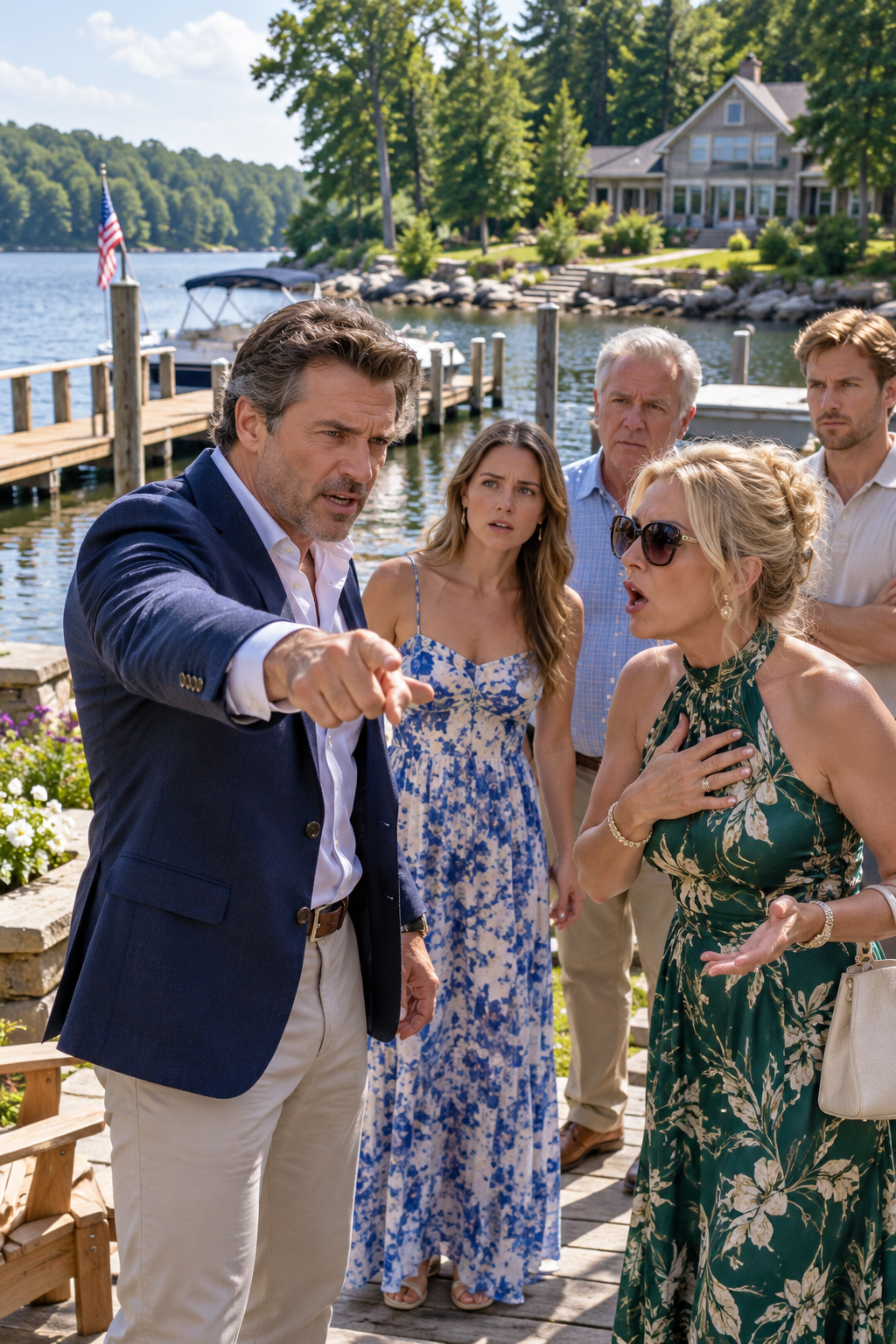
🔥HERE’S THE NEXT PART OF THE STORY, ENJOY !! The explosive twist and the final ending of this story ! ⬇️💬 Thank you ❤
There it was.
The familiar blade.
Not sharp enough to kill.
Just sharp enough to remind me where they believed I belonged.
I looked at the deputy.
“May I have your name?”
“Deputy Ellis.”
“Deputy Ellis, I’m going to ask everyone to remain calm while I retrieve something from inside.”
Denise shook her head.
“No. This ends now.”
I looked at her.
“This is my private property.”
Not because she believed me.
Because I said it without hesitation.
Grant snorted.
“Dad’s cottage might eventually be partly yours.”
I shook my head.
“I wasn’t talking about the cottage.”
He stopped smiling.
I turned and walked toward the house.
The lake cottage wasn’t impressive.
Cedar siding.
Two bedrooms.
A screened porch.
A stone chimney Daniel and I had rebuilt ourselves.
Grant had mocked it for years because it looked modest compared with the huge homes across the water.
What he never understood was that Dad had always valued land differently.
Buildings could burn.
Markets could crash.
Banks could fail.
Land remembered.
That was something he used to say.
I went inside, closed the door, and stood alone in the quiet kitchen.
For eleven days, I had been afraid of the green box.
Not because I thought it contained money.
Money would have been simple.
Money divided families every day.
My father’s warning suggested something worse.
Depending on which side of the truth you were standing on.
The green box sat beneath the floorboards of his old workshop closet.
The brass key fit perfectly.
Inside were four folders.
A trust agreement.
A handwritten ledger.
And a letter addressed to me.
I read the letter first.
If you are reading this, then either Grant has finally learned patience or, more likely, he has run out of it.
I am sorry.
Some fathers leave their children money. Some leave advice. I am leaving you a problem I should have solved while I was alive.
Your grandfather never sold Briar Lake.
He sold lots around it.
Those are not the same thing.
I stopped breathing for a moment.
Outside, I could faintly hear Denise’s voice.
I kept reading.
When Briar Development Corporation bought the western acreage in 1981, the original deed granted limited access rights to the water for specific parcels. It did not transfer ownership of the lakebed, dam, eastern shoreline, launch road, or southern woods.
Those remained with Maddox Land & Water Holdings.
Your mother and I placed those assets into the Maddox Stewardship Trust in 1998.
You are the successor trustee.
Grant is not.
My hand tightened around the paper.
There was more.
Do not confuse ownership with victory.
The trust exists because your grandfather believed water should never become a weapon for wealthy men to shut ordinary families out.
I watched what you and Daniel did every September.
That mattered to me.
More than I told you.
You gave the lake a purpose.
So I changed the trust twelve years ago.
You have authority to preserve access, negotiate easements, collect lawful maintenance fees, and revoke privileges for material breaches.
Read Schedule C carefully.
If Briar Lake Preserve has expanded roads, docks, utilities, rental activity, or commercial amenities outside the original easement, they may owe the trust a great deal of money.
Do not threaten them.
Do not brag.
Ask questions.
People tell the truth fastest when they believe you are powerless.
At the bottom he had written:
One more thing.
Grant knows about the farmhouse.
He does not know about the water.
I folded the letter once.
Then again.
My hands were steady.
That surprised me.
There are moments people imagine will feel triumphant.
They rarely do.
Mostly they feel quiet.
The truth does not arrive with music.
It sits in your hands.
Waiting to see what kind of person you become when you finally have power.
I opened the survey.
Briar Lake covered approximately 214 acres at normal pool elevation.
The HOA neighborhood occupied the western and northwestern shore.
The Maddox trust owned the dam, the submerged lakebed, seventeen acres of eastern shoreline, a boat launch, the southern access road, and several narrow strips of land that looked meaningless until you understood that three of the HOA’s newer docks crossed them.
Then I opened Schedule C.
I read it twice.
The original easement limited community lake access to residential use by owners of forty-two specifically listed parcels.
No short-term rentals.
No commercial events.
No expansion beyond eight shared docks.
No motorized watercraft above a certain horsepower.
No construction on trust property without written consent.
Briar Lake Preserve now had ninety-seven homes.
Fourteen short-term rentals.
Twenty-six docks.
A wedding pavilion.
A lakeside restaurant operating three nights a week during summer.
And, according to a newsletter Grant had proudly shown Dad the previous Christmas, plans for twenty-four additional luxury cottages.
I stared at the papers.
Then I understood my father’s last warning.
This was not an inheritance.
It was a loaded legal question.
And Denise Calder had just answered it in front of a deputy.
I slipped the letter into my jacket.
I did not carry the trust outside.
Instead, I took one photocopied page.
The 1981 property map.
When I returned, Denise was standing near my guests.
“Everyone needs to start gathering their belongings,” she said.
“Nobody needs to move,” I said.
She spun toward me.
“Did you find your little permission slip?”
Grant smirked.
I held up the map.
“I found a question.”
Melinda groaned.
“Oh, for God’s sake.”
I walked to Deputy Ellis.
“Would you look at this?”
He took the page.
I pointed to a line.
“Do you see the parcel boundary?”
“Do you see where this dock sits?”
He studied it.
“Is it inside the HOA boundary?”
He looked again.
Denise stepped closer.
“That map is ancient.”
“The HOA was created using this survey.”
“That doesn’t prove anything.”
“You’re right.”
That answer irritated her more than disagreement.
I looked at Grant.
“Who told Denise she could remove my guests?”
He hesitated.
“Based on what authority?”
“Based on Dad’s estate.”
“You’re executor?”
“I’m handling things.”
“That wasn’t my question.”
His jaw tightened.
“Our attorney filed paperwork.”
“Are you executor?”
“Personal representative?”
His face changed.
But enough.
“What trust?”
I smiled for the first time.
Not cruelly.
That would have ruined it.
Melinda looked at him.
He waved her off.
“Claire is playing games.”
“No,” I said. “I’m asking questions.”
Denise snatched the map from Deputy Ellis.
She glanced at it.
Then she looked toward the lake.
Then back at the paper.
“This is irrelevant. Our legal counsel has documentation granting full use of the water.”
“Full use?”
“To ninety-seven homes?”
“The restaurant too?”
“The wedding pavilion?”
She looked at Grant.
I continued.
“The rental cabins?”
Her expression hardened.
“That is none of your concern.”
“It might be.”
“This is absurd.”
I looked at Deputy Ellis.
“Has anyone committed a crime?”
“Not that I can determine.”
“Then I’d like the HOA’s security personnel off my parcel.”
One of the guards looked at Denise.
She went pale with anger.
“You do not order my people around.”
“I just did.”
The deputy stepped forward.
“Ma’am, until ownership is established, I think everyone needs to avoid escalation.”
Denise pointed at me.
“You’re going to regret humiliating this community.”
There were witnesses all around us.
She still said it.
People like Denise rarely realize how much evidence arrogance creates.
I looked at her.
“I’m not humiliating anyone.”
“You’re making threats.”
“I haven’t threatened you once.”
Grant stepped between us.
He spoke to me the way he had when we were children and he thought Dad wasn’t watching.
“You have four days to get your belongings out of the cottage.”
That surprised even Denise.
I stared at him.
He lifted his chin.
“I spoke with Patterson this morning. Once I’m appointed estate representative, we’ll be listing the remaining Maddox properties.”
Melinda smiled.
“There are buyers already interested.”
“The cottage isn’t estate property.”
“It’s Dad’s.”
Grant sighed.
He leaned closer.
“You have spent your entire life confusing access with ownership.”
The irony was so perfect I almost admired it.
Instead, I asked, “Four days?”
“Then what?”
“We change the locks.”
The old pain returned.
Not because of the cottage.
Because I remembered being nineteen and selling my first car so Grant could stay at Clemson after Dad’s business suffered a bad year.
I remembered being thirty-two and sending Mom grocery money every month while Grant was buying a boat.
I remembered Daniel asking me once why my family only seemed to notice me when something was broken.
I had defended them.
Now my brother stood on land I owned, beside a woman trying to throw grieving families off a lake I controlled, and gave me four days to disappear.
Something inside me became very calm.
“Okay,” I said.
Grant blinked.
Melinda looked almost disappointed.
“That’s it?”
“That’s it.”
Grant nodded slowly.
He thought he had won.
That was important.
Dad’s letter had told me exactly what to do.
Let them believe I was powerless.
The HOA vehicles left first.
Grant followed.
Before climbing into his SUV, he turned toward me.
“Don’t make this harder than it has to be.”
I looked at my brother.
Then I asked the weakest question I could think of.
“Would Thursday afternoon give you enough time?”
His shoulders relaxed.
He drove away.
Robert Hayes came beside me after the last vehicle disappeared around the curve.
“What the hell was that?”
I looked at the brass key in my palm.
“I think my father just introduced himself from the grave.”
Three hours later, after the families had eaten dinner and the children were roasting marshmallows, I called a lawyer.
Not the family attorney.
Not Grant’s attorney.
A woman named Rebecca Sloan.
She had been Daniel’s friend in law school before Daniel became a firefighter instead.
Rebecca specialized in land use, water rights, and conservation trusts.
She drove from Asheville that night.
At 10:17 p.m., she sat at my kitchen table surrounded by forty-five years of deeds, surveys, tax receipts, easements, letters, and maintenance records.
At 12:40 a.m., she removed her glasses.
“Do you understand what you have?”
“A headache?”
She almost laughed.
Then she became serious.
“Your father structured this well.”
“That sounds dangerous.”
She tapped the trust agreement.
“Maddox Stewardship Trust owns the lakebed and several critical surrounding parcels. More importantly, the 1981 easement was narrow.”
“How narrow?”
She pointed to Schedule C.
“The HOA has been behaving as though it owns the lake.”
“It doesn’t.”
“And the expansion?”
“Potentially unauthorized.”
“The marina?”
“Potentially unauthorized.”
“Restaurant?”
“Very likely unauthorized.”
“Wedding pavilion?”
“Depends where the foundation sits.”
I showed her the newer survey.
She stared at it.
Then she said one word.
“The pavilion is six feet over the trust boundary.”
I leaned back.
“How bad is this?”
“For them?”
Rebecca gave me a long look.
“Do you want the diplomatic answer?”
“They built a business model on somebody else’s property rights.”
I stared toward the window.
Moonlight stretched across the lake.
“What happens now?”
“That depends on what you want.”
“I don’t want ninety-seven families punished because five people got greedy.”
Rebecca nodded.
“I don’t want homes losing access overnight.”
“I don’t want revenge.”
She waited.
“I want them to stop using ownership as a weapon.”
Rebecca smiled.
“That is much more dangerous than revenge.”
The next morning, we began gathering evidence.
I kept my promise to Grant.
I packed boxes.
I carried them visibly from the cottage to my truck.
Melinda drove by twice.
The second time she slowed down enough to wave.
I waved back.
That afternoon, the HOA sent an email to residents announcing that “unauthorized recreational activity” on the southern shore had been resolved.
They wrote that word while my guests were still fishing.
Denise also announced a “Lake Preservation Initiative.”
The initiative included new annual access fees.
A mandatory boat registration program.
Expanded enforcement powers.
And restrictions on guests.
Residents would be allowed two nonresident guests per household unless they paid a seasonal hospitality surcharge.
The board scheduled a vote for Thursday evening.
The same Thursday Grant planned to change my locks.
Rebecca read the notice.
“They’re doubling down.”
“You sound like your father.”
“I’m trying not to.”
“Because he enjoyed this sort of thing.”
She grinned.
That night, we opened the handwritten ledger.
My father had kept records dating back to 1983.
Not financial records.
Violations.
Every time Briar Development asked for permission to modify access, Dad wrote it down.
Every time permission was denied, he saved the letter.
Every time the HOA crossed a boundary, he noted the date.
In 2007, they expanded a dock.
Dad sent notice.
They removed it.
In 2014, they proposed a commercial boat launch.
Dad refused.
In 2018, under Denise Calder’s first term as president, the HOA built a storage structure on trust land.
Dad sent certified notice.
Denise acknowledged receipt.
That mattered.
Because the HOA couldn’t claim ignorance.
Then we found the real problem.
A 2021 letter.
Briar Lake Preserve had requested permission to expand amenities for a planned luxury development called Northshore Reserve.
Dad denied it.
The letter was signed by Denise Calder.
And copied to another person.
Grant Maddox.
I stared at his name.
Rebecca noticed.
“Your brother knew?”
“Apparently.”
“He told you he didn’t know about the trust.”
“No. He asked what trust.”
“Different thing.”
I felt sick.
The distinction mattered.
Grant might not have understood the whole structure.
But he knew Dad had legal authority to reject lake expansion.
And he knew enough to keep that information from me.
We kept reading.
Three months after Dad denied the request, a company called Blue Heron Development LLC purchased forty acres north of the lake.
Rebecca searched state records.
The managing member was a holding company.
That holding company belonged to another LLC.
The registered agent?
Patterson & Lyle.
Grant’s attorney.
Rebecca looked at me.
“Do you know this company?”
We dug deeper.
At in the morning, we found Grant.
He owned eighteen percent.
Melinda owned another twelve.
Denise’s husband owned twenty percent.
The remaining shares were held by two HOA board members and an investment group.
Northshore Reserve was their project.
The twenty-four luxury cottages depended on lake access.
Without legal access, they were houses beside water.
Not lake homes.
The difference was worth millions.
My brother had not thrown me out of the farmhouse because he wanted his childhood home.
He wanted control of Dad’s papers.
He wanted me gone before I discovered what Dad controlled.
That was the first real twist.
And suddenly the four-day deadline made perfect sense.
Thursday morning, Grant arrived at the cottage with Melinda and a locksmith.
I was sitting on the porch drinking coffee.
Three boxes were stacked near the door.
“Glad you’re being reasonable.”
“I’m trying.”
The locksmith looked uncomfortable.
Grant held out his hand.
I gave him the cottage key.
Not the brass one.
He took it.
Melinda looked around.
“You got everything?”
“Everything important.”
“Where are you staying?”
“With a friend.”
She nodded sympathetically.
For one second, I wondered whether she truly believed the story they had built.
Then she said, “It’ll be easier once the lake project closes.”
Grant turned sharply toward her.
Her face changed.
So did mine.
“Lake project?” I asked.
Grant smiled too quickly.
“She means the estate.”
I looked down at my coffee.
He relaxed.
The locksmith changed the deadbolt.
Then Grant did something almost unbearable.
He sat beside me.
“Claire, I know this feels harsh.”
“Dad complicated everything.”
“He never made clean decisions.”
I thought about the trust.
It was one of the cleanest legal structures I had ever seen.
“He loved this place,” Grant continued. “But sentiment can’t guide business.”
“We have an opportunity to finally make the Maddox property worth something.”
I looked over the lake.
“What’s it worth?”
Grant smiled.
“How much?”
He hesitated.
“Potentially eight figures once everything is developed.”
There it was.
I kept my voice quiet.
“And what happens to the memorial weekends?”
He frowned.
“The families.”
“What happens to them?”
“You can do charity somewhere else.”
Some sentences close doors forever.
That was one of them.
I set down my cup.
“Dad knew, didn’t he?”
Grant’s face shifted.
“Knew what?”
“What you thought of this place.”
“Don’t make everything emotional.”
“You always do.”
“No, Grant. I spent most of my life cleaning up the consequences after everyone else got emotional.”
He stared at me.
For a moment, the little brother disappeared.
A businessman stood there.
Calculating.
Frightened.
Then it was gone.
“Board meeting tonight,” he said. “You should probably stay away.”
“Because Denise intends to formally establish HOA control over the lake access areas.”
I almost admired the arrogance.
“Can she do that?”
“Attorneys say so.”
“Which attorneys?”
“Patterson.”
“Then maybe I’ll come listen.”
Grant laughed.
“You’re not a resident.”
“You won’t be allowed to speak.”
“That’s okay.”
“I’m getting good at listening.”
The Briar Lake Preserve clubhouse looked like a mountain lodge designed by someone terrified of actual mountains.
Stone fireplace.
Massive windows.
Polished wood.
Leather chairs.
A chandelier shaped like antlers that had never belonged to a deer.
By seven o’clock, almost eighty residents filled the room.
Rebecca sat beside me in the back.
Denise stood at the front.
Grant and Melinda sat near the board.
Nobody introduced him.
That was interesting.
He wasn’t a resident either.
Yet he was seated with the decision-makers.
Denise began.
“Recent events have demonstrated the need for stronger control over access.”
She described my guests as “unregistered outsiders.”
She mentioned liability.
Property values.
Every ugly decision sounds better when wrapped in responsible nouns.
A resident raised his hand.
“Were those people causing trouble?”
Denise smiled.
“The issue is not whether trouble has already occurred. Good governance prevents problems.”
Another resident spoke.
“My daughter was swimming near them. They seemed fine.”
Denise’s smile tightened.
“This is larger than one incident.”
Yes, I thought.
Much larger.
She presented the new access rules.
Two guests maximum.
No organized gatherings without approval.
No shore access from non-HOA parcels.
No charitable events.
No outside fishing groups.
No launching watercraft from the southern road.
Then came the fee.
$1,800 annually per household.
People murmured.
One man stood.
“We already pay dues.”
“This fee supports lake management.”
“Since when does the HOA own the lake?”
The room went quiet.
Denise looked toward Grant.
Grant looked at Patterson.
Patterson stood.
He was a compact man with silver hair and the calm expression of someone who billed by the hour.
“The association possesses comprehensive easement rights and longstanding control sufficient to regulate usage.”
Rebecca whispered beside me.
“He didn’t say ownership.”
“I noticed.”
The resident pressed him.
“So do we own it?”
Patterson smiled.
“Ownership of water resources can involve multiple overlapping legal interests.”
Translation:
Denise stepped back in.
“The practical answer is yes.”
That sentence destroyed her.
She just didn’t know it yet.
Rebecca wrote it down.
The vote passed four to one.
Denise smiled.
Grant whispered something to Melinda.
She squeezed his hand.
They thought it was finished.
Then Denise said, “Before we adjourn, Mr. Grant Maddox has asked to discuss a development partnership that will substantially increase property values.”
Rebecca looked at me.
I felt my father’s letter inside my bag.
So I waited.
Grant stood.
A rendering appeared on the screen.
Northshore Reserve.
Twenty-four luxury vacation homes.
Private docks.
Club access.
Boat slips.
A new lakeside trail.
An expanded marina.
Homes beginning at $1.4 million.
Applause filled the room.
Grant beamed.
He spoke about legacy.
He spoke about responsible development.
He spoke about honoring the character of Briar Lake.
Then he said the line I had been waiting for.
“Our family has controlled the undeveloped side of this lake for generations, and now we’re finally opening it in partnership with the community.”
I raised my hand.
Denise saw me.
Her smile disappeared.
“You are not a member.”
“Then you cannot speak.”
“I have one question for my brother.”
Grant looked amused.
Denise hesitated.
Then nodded.
Every face turned.
I didn’t hold documents.
I didn’t announce ownership.
I didn’t threaten lawsuits.
“Grant, are you representing to everyone in this room that you have legal authority to grant Northshore Reserve access to Briar Lake?”
The room became still.
Grant smiled.
Rebecca did not move.
Neither did I.
“Thank you,” I said.
Then I sat down.
Grant laughed.
“That’s it?”
“That’s it.”
The meeting ended twelve minutes later.
At p.m., Rebecca emailed thirty-eight pages to Patterson.
At , we sent formal notice to the HOA.
At , another notice went to Blue Heron Development.
At , notice went to the title company handling Northshore Reserve.
At , notice went to the bank financing construction.
At , Rebecca filed an emergency action in county court requesting preservation of trust property pending review of unauthorized uses.
At , the title company responded.
They were suspending closing activity.
At , Grant called.
I let it ring.
At , he called again.
At , Melinda called.
At , Denise called.
At , Patterson called Rebecca.
She answered.
I could hear him from across the kitchen.
“Rebecca, what exactly are you claiming?”
She looked at me.
Then said, “Nothing yet.”
“We’re asking questions.”
My father would have loved that.
By Friday morning, Briar Lake Preserve knew.
Not the residents.
The same five people who had applauded Grant’s project were sitting in Patterson’s office staring at documents proving the lake beneath their docks had never belonged to them.
At 10:14, Denise sent me an email.
I believe recent events have created misunderstandings that would benefit from neighborly discussion.
I read it twice.
Then I forwarded it to Rebecca.
Her reply contained only three words.
That was fast.
Grant arrived at noon.
He didn’t knock.
He couldn’t.
He had changed the locks.
Unfortunately for him, the cottage sat on trust property and Rebecca had arranged for another locksmith at that morning.
Grant stood on the porch staring at the new deadbolt.
I opened the door.
“You changed the locks.”
“So did you.”
“That’s my property.”
He stared at me.
Then he pushed inside.
I stepped back.
Rebecca was sitting at the kitchen table.
Grant stopped.
She smiled.
“Mr. Maddox.”
His face hardened.
“What are you doing?”
“I’m talking to my sister.”
“Then talk.”
He turned to me.
“You froze the development.”
“The title company did.”
“Because of you.”
“Because you tried to sell access you didn’t own.”
His eyes burned.
“You knew.”
“Since Sunday.”
“You let me stand there last night.”
“You set me up.”
“You asked that question knowing exactly what I’d say.”
“I hoped you’d tell the truth.”
“That was a trap.”
“No, Grant.”
I held his gaze.
“The documents were the trap. Dad set it twenty-eight years ago. I only watched you step into it.”
He slammed his palm onto the table.
“My company has millions committed.”
Rebecca’s voice sharpened.
“Then you should have performed due diligence.”
“No. You used the same lawyer representing the HOA, the developer, and parties connected to the estate. That’s not diligence. That’s a circle.”
Grant looked at me.
“You’re going to destroy everything.”
“You’re going to destroy Dad’s legacy.”
“Then what do you want?”
There it was.
The first useful question he had asked.
“I want the memorial weekend protected permanently.”
“I want residents who bought homes believing they had lake access to keep reasonable residential access.”
Rebecca watched quietly.
“I want the commercial restaurant and wedding pavilion to pay fair market fees if they want continued use.”
Grant’s mouth tightened.
“I want the southern woods protected from development.”
“That land is worth millions.”
“You’re insane.”
“I want public safety access guaranteed for county rescue crews.”
He laughed bitterly.
“You think you’re some kind of saint now?”
I stepped closer.
“I think Dad left me responsibility instead of permission.”
Grant said nothing.
“And I want Blue Heron Development to disclose every investor, every payment, every side agreement, and every communication involving the estate.”
That hit him.
He looked at Rebecca.
I remembered the 2021 letter.
“Because Dad warned me there was more.”
Grant’s face went still.
That was the second twist.
And this time, he knew I had seen it.
“You don’t know what you’re talking about.”
“Maybe not.”
“Dad was confused at the end.”
Rebecca stood.
Grant ignored her.
“He was sick.”
“He knew what he signed.”
“You were manipulating him.”
I almost laughed.
That accusation was so predictable it felt borrowed.
“You really want to say that?”
“I’m saying you isolated him.”
Rebecca’s voice became cold.
“Mr. Maddox, stop.”
But he had already committed.
“You filled his head with this charity nonsense. You made him think I was trying to steal from him.”
“You poisoned him against me.”
“No, Grant.”
I looked at my brother.
“You did that yourself.”
His expression collapsed for half a second.
Then rage covered it.
“You always wanted him to choose you.”
The words landed harder than I expected.
Because somewhere underneath all the contracts, property, resentment, and money, that was our oldest wound.
Two children.
One father.
A lifetime of keeping score.
I answered quietly.
“I wanted him to see me.”
Grant laughed once.
“Same thing.”
I shook my head.
“It never was.”
For the first time in my life, I didn’t chase after him.
The following week was ugly.
Lawyers exchanged letters.
The HOA board sent residents a carefully worded announcement describing a “historic boundary clarification.”
They avoided the word mistake.
Then they avoided the word unauthorized.
Then they avoided the word lawsuit.
Residents started asking questions anyway.
Someone found the county deed records.
Someone else posted the 1981 easement.
By Wednesday, a group of homeowners had hired independent counsel.
By Friday, twenty-three residents demanded Denise resign.
She refused.
Of course she did.
Instead, she blamed “incomplete records inherited from prior boards.”
Then a retired accountant named Martin Voss found the 2018 certified letter signed by Denise.
He posted it to the residents’ forum.
Her explanation collapsed overnight.
The board scheduled an emergency meeting.
This time, they invited me.
The room was packed.
Denise sat at the center table, no gold HOA pin on her jacket.
Patterson sat beside her.
Grant wasn’t there.
The meeting opened with shouting.
Residents wanted to know why the board had collected lake-management fees without owning the lake.
They wanted to know why commercial facilities had been expanded after legal notice.
They wanted to know why board members were personally invested in Northshore Reserve.
Then an elderly man named Walter Dunn stood.
He had lived there twenty-seven years.
His hands shook.
“I bought here because I was told my grandchildren would always have access to the lake.”
Denise opened her mouth.
I spoke before she could.
“They will.”
The room quieted.
Walter looked at me.
“The trust will honor existing residential access for homeowners who purchased in good faith.”
Denise turned toward me.
Rebecca touched my arm.
She had warned me not to commit publicly.
But some things matter more than negotiation leverage.
Walter sat down slowly.
A woman near the aisle asked, “What about the fees?”
“That’s being reviewed.”
Another voice.
“Are you shutting down the marina?”
“The restaurant?”
“The docks?”
Someone shouted, “Then what do you want?”
I looked around the room.
I remembered Dad’s handwriting.
Water should never become a weapon.
“I want a new agreement that protects residents instead of using them as leverage.”
Nobody spoke.
“No surprise guest fees. No banning family because they don’t live here. No pretending the HOA owns something it doesn’t. Commercial operations can negotiate commercial terms. Ordinary homeowners should not be punished for mistakes made above them.”
A woman in the second row started clapping.
Others joined.
Denise stared at me.
I did not enjoy it as much as I thought I might.
Power is intoxicating when imagined.
In real life, it mostly feels like a room full of people waiting to see whether you will become what hurt you.
The HOA board lost the confidence vote forty-eight hours later.
Denise resigned three days after that.
Patterson withdrew as association counsel.
The county opened a review into permitting for the pavilion and marina.
Blue Heron Development suspended Northshore Reserve indefinitely.
That should have been the ending.
Because Dad had told me there was more.
Rebecca subpoenaed financial records tied to Blue Heron.
What came back changed everything.
The company had paid Grant $430,000 over four years in “consulting fees.”
Melinda had received another $160,000.
Denise’s husband had been paid through a subcontractor.
Two former HOA board members had ownership stakes.
And Patterson’s firm had been billing multiple sides of the same transactions.
But none of that was the worst part.
The worst part was a wire transfer dated nine months before Dad died.
From Blue Heron Development.
To Maddox Machine Works.
The business Dad had struggled to preserve for forty years.
Grant had taken control of the company’s daily operations three years earlier.
I looked at Rebecca.
“What was that payment for?”
“We don’t know.”
“Did Dad know?”
“We don’t know.”
I thought about his letter.
A problem I should have solved while I was alive.
We requested company books.
Grant refused.
Rebecca filed another motion.
Then the family attorney finally produced Dad’s full estate documents.
Grant had been right about one thing.
The farmhouse was estate property.
But he had been wrong about almost everything else.
Dad divided the farmhouse equally between us.
The machine shop too.
Then we found an amendment signed sixteen months before his death.
If either child attempted to transfer company assets connected to Briar Lake without approval of the stewardship trust, that child’s voting interest in Maddox Machine Works would convert into a nonvoting economic interest.
Rebecca read the clause again.
“Your father knew.”
“Knew what?”
“That Grant was trying to use company property or financing in connection with the lake development.”
I closed my eyes.
Dad had known enough to protect me.
But not enough to stop Grant.
Or maybe he had been waiting.
People imagine old age makes parents blind to their children.
Sometimes it does the opposite.
Sometimes time strips away every excuse.
Grant came to see me one final time in November.
No Melinda.
He stood beside the dock while cold wind pushed small waves against the posts.
The mountain leaves were mostly gone.
For the first time in years, he looked like my younger brother.
“I’m being sued,” he said.
“Blue Heron’s investors want their money back.”
“The bank is reviewing the company loan.”
He laughed without humor.
“You always know now.”
I said nothing.
He looked toward the water.
“I thought Dad was going to leave everything to you.”
That surprised me.
“Because you were there.”
“You think that didn’t matter?”
“It mattered because he needed help.”
“You got all the time with him.”
I stared at Grant.
For decades, I had envied him.
His freedom.
His career.
His vacations.
The ease with which he left responsibility behind.
And all that time, he had envied me.
Not the caregiving.
The proximity.
“I would have traded you some of that time,” I said.
“You never asked.”
“I didn’t know how.”
“That’s not my fault.”
It might have been the first clean admission he ever gave me.
Then he said, “The development was supposed to fix everything.”
“What everything?”
“The machine shop was failing.”
I turned toward him.
“Dad wouldn’t admit it.”
“He showed me the books.”
“Not the new debt.”
My stomach tightened.
Grant rubbed his hands together against the cold.
“We lost two contracts. Equipment financing went bad. I borrowed to cover payroll. Then borrowed against the warehouse.”
“How much?”
“Almost three million.”
I stared at him.
He kept going.
“Blue Heron was the exit. We develop the north shore, refinance the shop, everybody wins.”
“You mean you win.”
He finally looked at me.
“You think I wanted to destroy what Dad built?”
“I think you wanted to save it without admitting you were the one who put it in danger.”
His face went pale.
I knew I was right.
He looked away.
“Probably.”
The word floated between us.
Then I asked, “Why throw me out?”
He closed his eyes.
“Patterson said if you found Dad’s trust documents before the project closed, you could stop it.”
There it was.
No excuse left.
“You knew.”
“Not everything.”
“You knew enough.”
“And the lake confrontation?”
“Denise panicked when she saw your memorial event. She thought you were establishing some kind of public-use claim.”
I almost laughed.
“So she tried to remove grieving families to protect a development that didn’t legally have lake access.”
“When you say it that way—”
“How else would you say it?”
He had no answer.
I looked at him for a long time.
Then I asked, “Did you know Dad left me the brass key?”
“Because I needed one thing you hadn’t touched.”
He flinched.
I regretted it immediately.
Not because it was false.
Because it was true enough.
Grant turned to leave.
He stopped.
“The farmhouse.”
“What about it?”
“You own half.”
“Apparently.”
“I’m not fighting you for it.”
I almost smiled.
“That’s generous.”
“I deserve that.”
He turned again.
He looked back.
“Did you ever actually read Dad’s letter denying the 2021 project?”
“Your name was copied.”
“Patterson handled it.”
“Dad tried to warn you.”
“I know that now.”
He walked toward his truck.
Then stopped.
“I’m sorry.”
He didn’t ask me to forgive him.
That was why I believed him.
The legal mess took seven months to resolve.
Blue Heron Development collapsed.
Northshore Reserve was canceled.
The investors reached a settlement without forcing Maddox Machine Works into bankruptcy.
Grant surrendered operational control of the company.
He kept a minority economic interest but lost voting authority under Dad’s amendment.
I became co-chair of a temporary restructuring board despite having absolutely no desire to run a machine shop.
We sold unused equipment.
Renegotiated debt.
Closed one failing division.
Saved forty-one jobs.
The farmhouse remained jointly owned for another six months.
Then Grant signed his share into a family land trust.
No payment.
I did the same.
We turned the farmhouse into housing for visiting families during the annual memorial weekend.
The HOA changed too.
The new board negotiated a fifty-year access agreement with the Maddox Stewardship Trust.
Homeowners kept their docks.
Guest restrictions were relaxed.
Commercial facilities paid separate fees.
A portion of those fees funded water safety, shoreline restoration, and the memorial program.
The first agreement contained one sentence I insisted on personally.
No person may be excluded from ordinary recreational use solely because they are the invited guest of a lawful resident or trust beneficiary.
Denise sold her house the following spring.
I heard she moved to Florida.
I wished her well.
On the first Saturday of September, nearly a year after she tried to remove my guests, forty-seven people gathered at the lake.
Lucy caught her first fish.
Robert Hayes taught three teenagers how to paddle a canoe.
Walter Dunn brought his grandchildren from Ohio.
Grant came too.
He stood awkwardly near the grill for twenty minutes until Robert shoved a tray of hamburgers into his hands and told him to make himself useful.
That made me laugh harder than it should have.
Near sunset, I walked alone to the old stone boundary marker.
The HOA logo had been scrubbed away.
Dad’s original initials were visible beneath it.
Samuel Maddox.
I touched the stone.
For most of my life, I thought justice would feel like finally getting what other people had denied me.
Recognition.
A larger share.
The lake taught me something different.
Justice was not Grant losing.
Justice was Lucy being allowed to swim.
Justice was homeowners keeping access they had paid for honestly.
Justice was forty-one machinists keeping their jobs after somebody else’s reckless gamble.
Justice was my father’s land becoming something more meaningful than an asset line on a balance sheet.
Justice was knowing that all those years I had been called ordinary, dependable, emotional, difficult, invisible, or merely useful had not made me weak.
They had made me patient.
And patient people are dangerous to anyone depending on them to react too soon.
Rebecca joined me beside the marker.
She was holding a cardboard document tube.
“What now?” I asked.
“You’re not going to like this.”
“That sentence has become very expensive.”
She smiled faintly.
Then handed me the tube.
“County archives found something while processing the updated lake agreement.”
I opened it.
Inside was a survey.
Not Granddad’s.
The map showed Briar Lake before the dam expansion.
A line crossed the eastern shore and continued far beyond the acreage I knew the trust owned.
“What am I looking at?”
Rebecca pointed toward a shaded section.
“Original Maddox tract.”
I followed the boundary.
My stomach dropped.
It extended beneath part of the current highway.
Across the marina access road.
And into a hillside where three luxury homes had been built fifteen years earlier.
“That can’t be right.”
“Maybe not.”
“There was a deed recorded in 1947 transferring most of this acreage.”
“Then what’s the problem?”
Rebecca handed me a photocopy.
The deed contained a signature.
My great-grandfather’s.
Below it, a notary seal.
I stared at the date.
Then at the death certificate Rebecca placed beside it.
My great-grandfather had supposedly signed the transfer eleven months after he died.
For a long moment, neither of us spoke.
Across the lake, children were laughing.
Grant was arguing with Robert about charcoal.
Everything we had fought over seemed suddenly small.
Rebecca folded her arms.
“If that deed was forged, Claire, the title problem doesn’t stop at the lake.”
“How many properties?”
“We don’t know.”
“How much land?”
“We don’t know.”
“Who filed it?”
“We know that.”
She handed me the final page.
At the bottom was the name of the attorney who recorded the deed in 1947.
Not the Patterson I knew.
His grandfather.
I looked across the water toward the clubhouse, toward the marina, toward half a century of expensive homes built around a lake my family had supposedly almost sold before the seller was even alive to sign.
Rebecca watched me.
“What do you want to do?”
I thought about my father’s letter.
Do not threaten them.
Do not brag.
Ask questions.
People tell the truth fastest when they believe you are powerless.
So I pulled out my phone.
Grant answered on the third ring.
“Where are you? Robert says I’m burning these burgers.”
“I need to ask you something.”
He heard my voice and became quiet.
I looked down at the forged deed.
At the dead man’s signature.
At the legal seal that had survived nearly eighty years.
Then I asked the gentlest question I had asked anyone all year.
“Grant… did Dad ever tell you why he never trusted the Patterson family?”
✓ Lynn R. Adams
🔥HERE’S THE NEXT PART OF THE STORY, ENJOY !! The explosive twist and the final ending of this story ! ⬇️💬 Thank you ❤ There it was. The familiar blade. Not sharp enough to kill. Just sharp enoug…