HOA Karen Laughed at My $420,000 Repair Bill—Three Days Later, 137 Lake Houses Learned Who Actually Owned Their Only Road
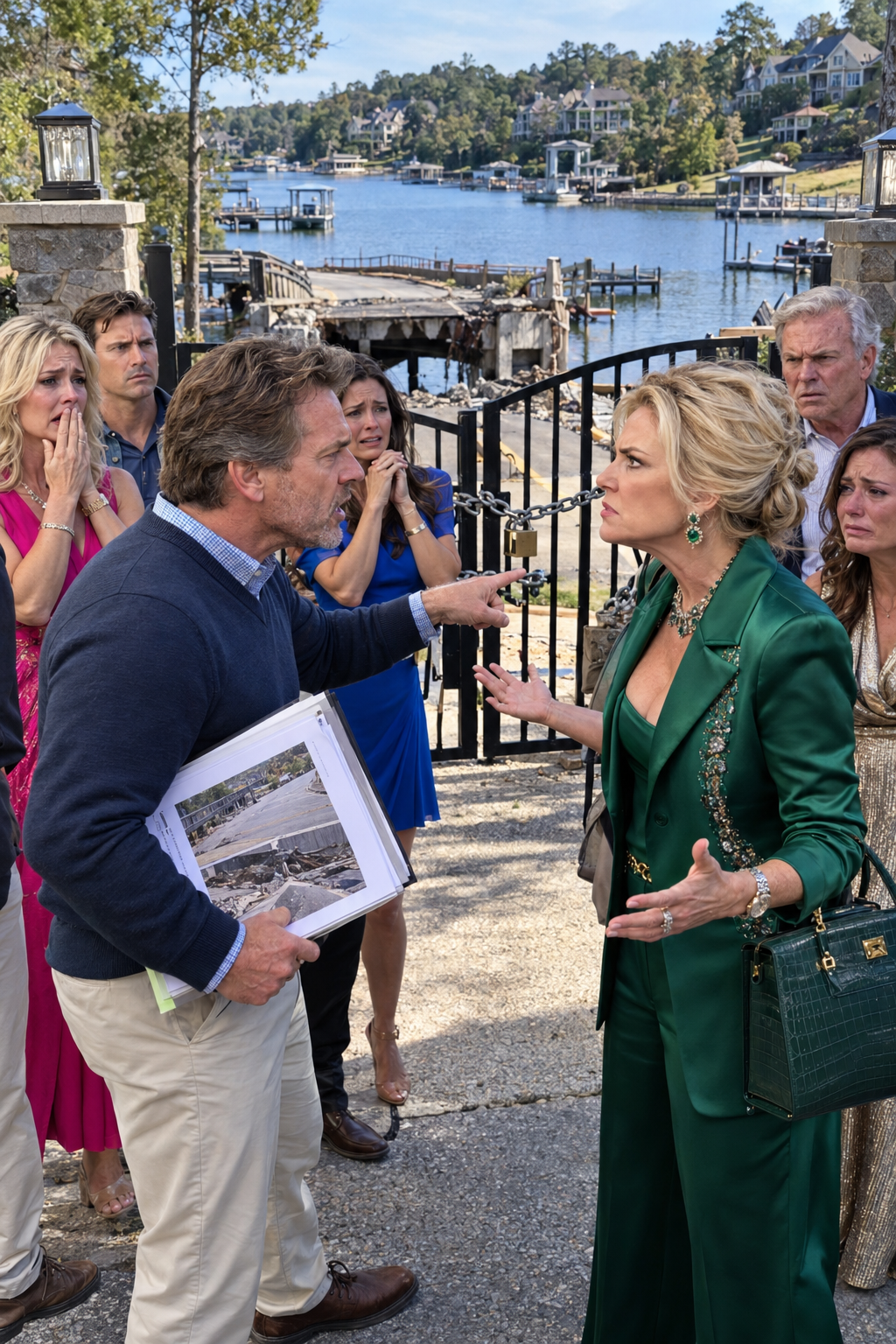
HOA Karen Laughed at My $420,000 Repair Bill—Three Days Later, 137 Lake Houses Learned Who Actually Owned Their Only Road
Karen Whitfield slid my $420,000 repair estimate back across the HOA conference table with two fingers, as if the paper itself smelled bad.
“Then sell something,” she said. “Your mother left you enough junk. We are not paying four hundred and twenty thousand dollars because an old woman can’t afford her own bridge.”
My brother laughed.
That was the part I remember most clearly.
Not Karen’s diamond bracelet knocking against the polished walnut table.
Not the seven board members looking away.
Not the HOA attorney quietly closing his folder.
My brother Greg laughed.
Three days earlier, he had given me seventy-two hours to get out of our mother’s house.
Three days later, he was sitting beside Karen Whitfield while she explained why 137 families should continue driving across a failing bridge without paying one dollar toward its repair.
I didn’t argue.
I didn’t raise my voice.
I didn’t remind Greg that I had spent fourteen years caring for our mother while he visited twice a year carrying expensive wine she could no longer drink.
I simply picked up the estimate.
Then I placed a small brass key on the table.
Karen looked at it.
“What’s that?”
I slipped it back into my purse.
“Nothing you need to worry about tonight.”
Greg smirked.
He had always mistaken silence for surrender.
He had made that mistake when we were children.
He made it again when our father died.
And sitting in that HOA conference room at fifty-nine years old, with eight people deciding I was too tired, too broke, and too alone to be dangerous, I realized my brother had learned absolutely nothing.
Karen leaned back in her chair.
“So we’re finished?”
I looked directly at her.
“Just so I’m clear, the board is refusing the repair assessment?”
Her smile widened.
There it was.
That look people get when they think they have forced you to ask permission.
“We are refusing your ridiculous invoice.”
“All of it?”
“All of it.”
“And the board’s position is that the HOA has no financial responsibility for the causeway?”
“Our attorney has explained our position.”
The attorney, a narrow man named Dennis Cole, stared at the table.
Interesting.
I looked at him.
Karen’s smile disappeared for half a second.
Dennis finally raised his eyes.
“The association disputes the amount and the allocation methodology.”
“That isn’t what she said.”
Karen slapped one palm on the table.
“Oh, for God’s sake, Margaret. Stop playing courtroom games.”
Nobody called me Margaret except my mother.
Karen knew that.
She also knew I hated it when she did.
So I smiled.
“Then I’ll write down exactly what you said.”
Greg leaned toward me.
“Maggie, this is embarrassing.”
Embarrassing.
I had been embarrassing him since the day I stopped being useful.
When Mom fell after her stroke, Greg was “too busy” in Atlanta.
When she needed help bathing, I was there.
When she forgot Dad had died and set two plates for dinner, I was there.
When the insurance company denied the lift chair, I paid for it.
When the roof leaked over the back bedroom, I paid for that too.
When Greg needed Mom’s signature on a refinancing document for one of his developments, he somehow found time to drive four hours north.
I remembered the groceries.
I remembered the medications.
I remembered the midnight ambulance rides.
I remembered the years Greg called sacrifice “your choice.”
I remembered the afternoon he stood in Mom’s kitchen after her funeral and told me the house belonged to him now.
That was five sentences.
Five identical beginnings.
Five pieces of my life that he had reduced to nothing.
I folded the repair estimate, placed it in the leather folder on my lap, and stood.
Karen’s expression became almost cheerful.
She thought I was leaving defeated.
Greg certainly did.
“Where are you staying?” he asked.
It sounded almost kind.
That made it worse.
“The cottage.”
His face tightened.
“What cottage?”
“The old gatekeeper cottage.”
“That place is condemned.”
“No. It’s ugly.”
I picked up my purse.
“There’s a difference.”
A few board members laughed nervously.
Greg did not.
He knew the cottage.
More importantly, he knew where it sat.
At the eastern end of Cedar Hollow Causeway.
On the narrow strip of land between County Route 18 and the black iron gates of Cedar Hollow Lake Estates.
The same strip of land every resident crossed every single day.
Karen waved dismissively.
“You can live in a tent for all I care. Just don’t send us another fantasy invoice.”
I stopped at the door.
“One last question.”
She groaned.
“If the county engineer closes the bridge, what’s your alternate road?”
Greg answered first.
“They’re not closing anything.”
I looked at him.
“How do you know?”
“Because it’s been there sixty years.”
“Sixty-three.”
“Whatever.”
“And you’ve read the inspection report?”
His jaw moved slightly.
That was a no.
Karen snapped her laptop shut.
“Meeting adjourned.”
“Good night.”
The rain had started by the time I stepped outside.
Not a storm yet.
Just a cold March rain that turned the asphalt silver beneath the parking lot lights.
My old Subaru sat between Karen’s pearl-white Range Rover and Greg’s black Mercedes.
The contrast might have embarrassed someone else.
I felt nothing.
That car had carried Mom to seventy-eight medical appointments.
It had hauled lumber, groceries, oxygen tanks, fertilizer, dog food, a wheelchair, and once a frightened goat that had escaped from the county fair.
It started every morning.
That was more than I could say for most people.
I sat behind the wheel but didn’t turn the key.
Instead, I opened my purse.
The brass key lay inside.
It was old.
Cut for a lock nobody used anymore.
Mom had pressed it into my palm six weeks before she died.
Her hand had been cold.
Her voice had barely risen above the oxygen machine beside her bed.
“Blue box,” she whispered.
“Gatehouse. Floor. Blue box.”
I had thought she was confused.
Morphine and congestive heart failure had blurred her final weeks.
But she squeezed my fingers hard enough to hurt.
“Not Greg.”
Then she said something I didn’t understand.
“Road first. House second.”
I leaned closer.
“Mom, what road?”
Her eyes opened.
For a few seconds, they were perfectly clear.
“Never let them combine the titles.”
Two days later, she slipped into unconsciousness.
A week after that, she was gone.
I had buried her on a Tuesday.
Greg had changed the locks on Friday.
There had been no screaming confrontation.
No dramatic inheritance scene.
No broken dishes.
He simply arrived with a locksmith, two cardboard boxes, and a copy of Mom’s will.
The lake house went to him.
Technically, that part was true.
The will named Gregory Hale as beneficiary of the residence known as 14 Willow Point Lane.
He stood in the kitchen where I had cooked Mom’s meals for more than a decade and tapped the page with his finger.
“You knew this was coming.”
I stared at him.
“No, Greg.”
“Well, you should have.”
His wife, Tessa, remained near the door with her sunglasses on.
At ten in the morning.
“Greg needs to list it quickly,” she said. “The market is peaking.”
I looked around the kitchen.
Mom’s coffee cup was still beside the sink.
Her grocery list was still attached to the refrigerator with a magnet shaped like a trout.
Applesauce.
The last ordinary things she had wanted.
Greg avoided my eyes.
“Seventy-two hours.”
I almost laughed.
“You’re evicting me three days after we buried her?”
“You’re not being evicted. You were living here to care for Mom. Mom is gone.”
The cruelty was so clean that it didn’t leave me anything to argue with.
I had spent years imagining grief as something loud.
Real grief could be a man standing in your mother’s kitchen checking his watch while you tried to decide which sweaters to put in a cardboard box.
I didn’t beg.
I didn’t tell him how much of my savings I had spent keeping that house standing.
I didn’t mention the property taxes I had quietly covered when Mom’s retirement account became too thin.
I packed my clothes.
I took Mom’s recipe box.
I left the family photographs.
And before sunset on the third day, I drove to the gatekeeper cottage.
Greg was right about one thing.
It was ugly.
The cottage had been built in 1961 when Cedar Hollow Lake was still a private fishing retreat owned by our grandfather, Walter Hale.
One bedroom.
One bathroom.
A rusting wood stove.
Brown linoleum curling at the edges.
A porch leaning just enough to make a marble roll toward the steps.
But the electricity worked.
The well pump worked.
And under three layers of dust in the bedroom closet, I found a square trapdoor.
The brass key opened it.
Beneath the floor was a blue steel document box.
Inside were forty-three years of deeds, surveys, invoices, easement agreements, inspection reports, photographs, tax statements, handwritten notes, and correspondence between my parents and three different law firms.
I sat cross-legged on the floor until two in the morning.
Then I understood why Mom had told me road first, house second.
The house Greg inherited was worth $1.8 million.
The strip of land beneath my cottage looked almost worthless.
Eleven-point-four acres.
Long and narrow.
Mostly asphalt, drainage ditch, pine trees, and the Cedar Hollow Causeway bridge.
According to the county tax assessment, it was worth $212,000.
But value is not always measured in acreage.
Sometimes value is measured in what everyone else needs to cross.
The Cedar Hollow development had started in 1987.
One hundred thirty-seven homes wrapped around the north shore of the lake.
Million-dollar cabins.
Boat houses.
Stone fireplaces.
Golf carts.
Imported landscaping.
A clubhouse with copper gutters.
But there was only one public connection to the subdivision.
Cedar Hollow Causeway.
The road beneath it belonged to the Hale Access Trust.
And according to the trust amendment Mom signed nine years earlier, the successor trustee was me.
I read that page six times.
Then I found the easement.
That was when my hands began to shake.
Not because I was rich.
The trust couldn’t simply sell the road without several approvals.
I couldn’t bulldoze it.
I couldn’t block homeowners out because I was angry.
Mom had designed the document better than that.
The HOA held a permanent access easement.
But it came with obligations.
The association was required to pay seventy-five percent of ordinary maintenance and eighty-five percent of major structural repairs because the residents generated nearly all vehicle traffic.
Invoices supported by a licensed engineer had to be paid within thirty days.
If the HOA disputed an invoice, it had fifteen days to request binding engineering review.
If it did neither, its vehicular easement could be suspended until the safety defect was cured.
Fire, police, ambulance, utility, school transportation, and emergency access remained protected no matter what.
Mom had thought of everything.
And handwritten across the first page in blue ink were five words.
MAGGIE—SAFETY BEFORE THEIR MONEY.
I cried then.
Not because of the land.
Because for fourteen years I had wondered whether my mother noticed.
She had noticed everything.
The next morning, I called the engineer listed on the most recent inspection.
His name was Peter Lawson.
He was sixty-four, permanently sunburned, and spoke in the impatient tone of a man who had spent his life explaining gravity to people who thought money could negotiate with it.
“You found Evelyn’s file?” he asked.
“About time.”
“You knew?”
“I knew she had a successor. Didn’t know who.”
“Tell me about the bridge.”
He went silent.
Then he asked, “Where are you?”
“The cottage.”
“Stay there.”
He arrived forty minutes later in an old Ford pickup with survey equipment rattling in the bed.
We walked the bridge in light rain.
Cedar Hollow Causeway crossed a narrow creek inlet feeding the lake.
To most people, it looked solid.
Stone-faced guardrails.
Decorative lanterns added by the HOA eight years earlier.
But Peter showed me what casual eyes missed.
A crack along the eastern abutment.
Rust bleeding through concrete.
Spalling beneath the deck.
A support bearing shifted almost an inch.
He crouched and touched a thin line near the expansion joint.
“This grew seven millimeters since October.”
“That sounds small.”
“It isn’t.”
He opened his tablet.
“The bridge needs immediate structural work. The estimate I sent your mother in January was three hundred eighty thousand.”
“The new one says four twenty.”
“Steel increased. And water intrusion got worse.”
“What happens if nobody repairs it?”
He looked toward the subdivision gates.
“Best case? County posts a weight restriction.”
“And worst?”
“Someone finds out what ten tons of wet concrete sounds like when it stops being a bridge.”
That afternoon, I sent the HOA the full engineering package.
Certified mail.
I even hand-delivered a copy to the management office.
Karen called me the next morning.
“What exactly are you trying to pull?”
“I’m trying to repair the bridge.”
“For four hundred twenty thousand dollars?”
“You expect us to write you a check?”
“No. I expect the association to comply with the recorded easement.”
Then her voice became sweeter.
Dangerously sweet.
“Margaret, your mother indulged a lot of strange legal habits. That doesn’t mean we’re going to continue them.”
“You’ve been paying road maintenance for thirty-two years.”
“Maintenance. Not reconstruction.”
“The engineer classified it as major structural repair.”
“Our lawyer disagrees.”
“Did your lawyer inspect the bridge?”
“Don’t be ridiculous.”
I looked out the cottage window.
A yellow school bus rolled across the causeway.
My stomach tightened.
“Karen, request the engineering review.”
“It costs the HOA three thousand dollars.”
“We’re not spending one more cent validating your scheme.”
“Then put that in writing.”
She laughed.
“You really think you’re your mother now, don’t you?”
I watched the school bus disappear beyond the gates.
“I think she was more patient than I am.”
Karen hung up.
Two hours later, Greg arrived.
He didn’t knock.
He opened the cottage door and stepped inside as if he owned the place.
“You need to stop.”
I was sanding one of the kitchen cabinet doors.
I kept sanding.
“Good morning.”
“Karen says you threatened the HOA.”
“I sent an invoice.”
“Same thing.”
I set the sandpaper down.
Greg looked around with disgust.
“You’re really living here?”
“Jesus, Maggie.”
He wore a navy sport coat, designer boots, and the expression of someone who believed poverty might be contagious.
“Why do you care whether the HOA pays?”
He hesitated.
Just slightly.
“Because I live there.”
“No, you don’t.”
“We’re renovating Mom’s house.”
“The house you’re listing?”
“We changed our minds.”
That interested me.
“Tessa likes the lake.”
“Tessa hates the lake.”
His jaw tightened.
“You don’t know everything.”
“No. That’s becoming very clear.”
He walked toward the table.
The blue steel box sat beneath a folded blanket beside my chair.
His eyes landed on it.
Only for a second.
But that second told me something.
He knew about the box.
“Mom leave you anything else?” he asked casually.
“Her recipe cards.”
“I mean legally.”
“You read the will.”
“The will isn’t always everything.”
There it was.
The first real crack.
I leaned against the counter.
“What are you worried about, Greg?”
He laughed.
“Then why are you here?”
“Because you’re making us look stupid.”
“The neighborhood. Karen. Me. Everybody.”
“Interesting group.”
“Just fix the bridge.”
“With what?”
“You have investments.”
I stared at him.
He knew exactly how little I had left.
“I spent most of my savings caring for Mom.”
“That was your decision.”
“And she gave me the house.”
“So sell the cottage parcel if you need money.”
I let several seconds pass.
“It’s complicated.”
His eyes narrowed.
I picked up the sandpaper again.
“You should go.”
He stepped closer.
“What did Mom put in that box?”
I looked down at the cabinet door.
“Old papers.”
“What papers?”
I smiled without looking up.
“You sound worried.”
He left ten minutes later.
That afternoon, a tow truck arrived at the bridge carrying two portable concrete barriers.
The driver handed me an invoice.
I hadn’t ordered them.
“Just precautionary,” he said when I called.
“Sensor reading changed.”
My throat went dry.
“Eleven forty-two this morning.”
“Enough that I’m coming back.”
At p.m., a county public works truck pulled into the cottage driveway.
At , another arrived.
At , three men wearing reflective jackets were underneath the eastern side of the bridge.
At , Peter climbed back up the embankment.
His face told me before his mouth did.
“We need to close it.”
I looked toward the gates.
People were returning from work.
Delivery trucks.
Landscapers.
A woman towing a boat.
“Can we give them a few hours?”
He pointed beneath us.
“Concrete doesn’t care about convenience.”
That was when the moral decision became easy.
I called the county sheriff.
Then the school district.
Then fire and EMS.
Then the HOA.
Karen answered on the fifth ring.
“What now?”
“The county engineer is closing the causeway.”
“The bridge is unsafe.”
“You cannot close our road.”
“You literally just said—”
“The county is.”
“You did this.”
“You vindictive little—”
“Karen, listen carefully. The school bus needs to unload the children at the county turnout until we establish a safe transfer route. I have arranged access through the old forestry lane for emergency vehicles only. The sheriff is sending deputies for traffic control.”
She went quiet.
I continued.
“Nobody will be trapped in a medical emergency. Nobody is losing emergency service. But ordinary vehicle traffic stops today.”
“You planned this.”
“I planned for the possibility that you would refuse to repair a dangerous bridge.”
“You’re blackmailing us.”
“No. Blackmail would be asking for something I’m not legally owed.”
I heard voices behind her.
Board members.
Maybe Greg.
Then she said, “Open the road.”
“Concrete doesn’t care about convenience.”
At p.m., deputies blocked both ends.
At , the first resident began shouting.
At , twenty-three cars were backed up along County Route 18.
At , Karen Whitfield arrived in her Range Rover and tried to drive around a sheriff’s cruiser.
A deputy stepped in front of her.
She rolled down the window.
“This is private property!”
“Yes, ma’am.”
“I live here!”
“Yes, ma’am.”
“You can’t stop me from going home!”
The deputy pointed toward the county engineer.
Karen got out.
I watched from the cottage porch.
The rain had stopped.
People stood beside their cars filming with phones.
Within minutes, the Cedar Hollow residents’ Facebook page exploded.
I knew because my neighbor from years earlier, Linda Patel, still liked me enough to send screenshots.
WHAT IS HAPPENING???
WHO CLOSED THE BRIDGE?
MY KIDS ARE STUCK OUTSIDE THE GATE.
KAREN SAID SOME WOMAN IS HOLDING THE HOA HOSTAGE.
CALL THE POLICE.
WE PAY $9,800 A YEAR FOR THIS.
Several residents blamed me immediately.
Then Linda posted the engineering report.
That changed the temperature.
Photographs of the cracks spread through the group.
Then somebody uploaded the invoice.
Then somebody else asked a very simple question.
WHY DID THE BOARD REFUSE TO PAY FOR AN UNSAFE BRIDGE?
Karen’s answer appeared twelve minutes later.
The HOA has no legal responsibility for privately owned infrastructure outside association boundaries. Certain individuals are exploiting an engineering concern to pursue personal financial gain.
I read it twice.
Then I opened Mom’s blue box.
The original 1987 easement sat exactly where I had left it.
I photographed page six.
Section 11.
Association Maintenance Obligation.
Then page nine.
Section 16.
Suspension for Uncured Safety Default.
I did not post them.
Because Mom had taught me something during the years when her mind was still sharp.
Never interrupt someone while they are building the record you will later use against them.
By sunset, Karen had given three interviews to local television crews.
She stood near the roadblock wearing a cream raincoat and told Channel 8 that I was “an emotionally distressed heir attempting to extort a residential community.”
Greg stood ten feet behind her.
He knew the easement existed.
I knew he knew.
And still he let her say it.
That hurt more than I expected.
I had protected Greg my entire life.
When he wrecked Dad’s truck at seventeen, I told our parents I had borrowed it.
When his first business collapsed, I loaned him twelve thousand dollars I never got back.
When his daughter Lauren needed someone to stay with her during Greg’s divorce, she lived with me for seven months.
Family loyalty had always traveled one direction.
Toward Greg.
Never back.
That night, my niece called.
Lauren was twenty-eight now.
A pediatric nurse in Chattanooga.
“Hi, sweetheart.”
“Dad says you closed the bridge because the HOA wouldn’t buy your land.”
There are moments when betrayal almost becomes funny.
Not because it hurts less.
Because the lie is so much bigger than necessary.
“Is it true?”
“What’s true?”
“The bridge is structurally unsafe. The county closed it.”
“And the land?”
“I’m not selling anything.”
“Dad said Grandma left him all the lake property.”
“She left him the house.”
Another silence.
Then quieter:
I heard hospital sounds behind her.
An announcement.
A rolling cart.
“Grandma told me something last Christmas.”
My hand tightened around the phone.
“She said Dad thought he was inheriting the view, but you were inheriting the reason the view was worth anything.”
I sat very still.
“When did she say that?”
“Christmas Eve. You were washing dishes.”
“Why didn’t you tell me?”
“I thought she was being poetic.”
I almost laughed.
Mom hated poetry.
“What else did she say?”
Lauren hesitated.
“She said, ‘Your aunt paid for everybody’s comfort. I’m making sure they can’t make her pay for theirs forever.’”
I closed my eyes.
“Thank you.”
“Aunt Maggie?”
“Dad sounds scared.”
Lauren paused.
“He sounds different.”
The next morning, Cedar Hollow looked like a gated luxury development after a natural disaster.
Residents parked outside the subdivision along the county shoulder.
Golf carts lined the inside of the gates.
People carried groceries across the pedestrian inspection walkway one bag at a time under supervision.
The HOA hired two passenger shuttles.
A landscaping company began moving equipment through a neighboring marina after paying the marina owner $300 per trip.
Karen called an emergency board meeting for noon.
I was not invited.
At 12:17 p.m., Dennis Cole, the HOA attorney, called me.
“Ms. Hale, we need to discuss temporary access.”
“You already have emergency access.”
“General vehicular access.”
“The bridge is closed.”
“We are exploring a temporary crossing.”
“Across whose land?”
“Your eastern field.”
“That field is unused.”
“It’s saturated.”
“We could install gravel.”
“The association would compensate you.”
“Still no.”
His voice hardened.
“Ms. Hale, one hundred thirty-seven households are being significantly harmed.”
“You don’t sound concerned.”
“I’m concerned enough not to let them drive forty-five hundred pounds across a failing bridge.”
“We believe the bridge can support passenger traffic.”
“Which engineer told you that?”
“We may seek injunctive relief.”
He sounded surprised.
“Yes. Please file everything.”
“Because I’d like a judge to read the easement.”
He hung up.
At p.m., Greg’s Mercedes appeared in my driveway.
This time Karen sat in the passenger seat.
I opened the cottage door before they reached it.
Karen wore enormous sunglasses and the expression of a woman who had not enjoyed her morning.
Greg carried a document folder.
“We need to talk,” he said.
“You keep saying that.”
Karen stepped onto my porch.
“You’ve had your little show.”
I leaned against the doorframe.
“What show?”
“The barricades. The television cameras. The poor grieving daughter act.”
I said nothing.
Her mouth twisted.
“Do you know what people are saying about me?”
“Then you know this has gone far enough.”
“Has the HOA approved the repair?”
“Then apparently it hasn’t.”
Greg opened his folder.
“We have another solution.”
He handed me a three-page document.
TEMPORARY ACCESS LICENSE AND OPTION TO PURCHASE.
I read the first paragraph.
Then the second.
Then the purchase price.
One hundred seventy-five thousand dollars.
For the entire road corridor.
The cottage.
The causeway.
The eleven-point-four acres.
The easement rights.
Everything.
I looked up.
“That’s generous.”
Greg mistook my tone.
“We thought so.”
“Considering the county values it at two hundred twelve thousand.”
“So you’re offering me less than assessed value.”
Karen crossed her arms.
“You’re living in a shack and driving a fifteen-year-old Subaru.”
“Fourteen.”
“Do you understand what this legal fight will cost you?”
“No, you don’t.”
She stepped closer.
“You don’t have money, Margaret. Your brother told us about your finances.”
There it was.
Greg looked away.
I stared at him.
“You discussed my finances with the HOA?”
“How much did you tell them?”
“It matters because—”
“How much?”
Karen answered for him.
“You burned through nearly three hundred thousand dollars caring for your mother.”
Not our mother.
Greg’s face turned red.
I looked back at the contract.
“So the offer is based on the assumption that I can’t afford litigation.”
Karen smiled.
“It’s based on reality.”
I turned to page three.
There was a signature block for the Hale Access Trust.
Interesting.
Very interesting.
I looked at Greg.
“Who told you that name?”
His eyes flickered.
“Public records.”
“It’s recorded.”
“The deed is recorded under Hale Transportation Corridor Trust.”
“The internal trust agreement uses Hale Access Trust.”
Karen’s head turned toward him.
Greg recovered quickly.
“Mom mentioned it years ago.”
“I don’t remember.”
“Before or after she became ill?”
“Oh, come on.”
I folded the agreement.
Then I handed it back.
Karen’s smile disappeared.
“You haven’t even considered it.”
“I just did.”
“You are going to lose.”
“You could walk away with money.”
“I don’t need your money.”
Greg laughed sharply.
“That’s ridiculous.”
I looked at him.
“No. What’s ridiculous is that you still think this is about money.”
Karen stepped closer.
“What else would it be about?”
I looked past her.
Past the Range Rover.
Past the bridge.
Past the stone entrance sign where CEDAR HOLLOW LAKE ESTATES had been carved into granite in letters tall enough to impress strangers.
“Responsibility.”
She actually laughed.
“Spare me.”
I opened the cottage door wider.
“You should leave.”
Greg lowered his voice.
“Maggie, think about what you’re doing.”
“You’re turning the entire neighborhood against you.”
“Then you should probably stop giving them reasons.”
Karen descended the porch steps.
At the bottom she turned.
“You know what your problem is?”
“You spent your whole life being useful, and now you think that makes you important.”
That one landed.
I felt it under my ribs.
My face didn’t change.
Karen smiled because she thought silence meant pain had beaten me.
She was half right.
It had hurt.
But pain and defeat are different things.
I looked at her.
“You should ask Dennis to read Section Sixteen before Monday.”
“What’s Section Sixteen?”
I looked at Greg.
His face went gray.
Karen noticed.
Greg said nothing.
I shut the door.
For the next forty-eight hours, everything accelerated.
The HOA filed for an emergency injunction to force temporary access across my eastern field.
The judge denied the request without prejudice after reviewing Peter’s engineering affidavit.
Karen posted that the ruling was “procedural.”
Residents began demanding a special board meeting.
Three homeowners hired their own structural engineer.
He agreed with Peter.
A fourth homeowner, retired prosecutor Harold Benson, drove to the county recorder’s office.
At Saturday morning, he called me.
“I owe you an apology.”
“We haven’t spoken in eleven years, Harold.”
“That’s a long apology.”
“I believed Karen.”
“So did a lot of people.”
“I found the easement.”
He exhaled.
“Why didn’t you post this immediately?”
“Because the board had it.”
“They had it?”
“The HOA signed it.”
“No, I mean now.”
“How do you know?”
“My mother’s file contains annual correspondence confirming the maintenance formula. Karen signed two of the acknowledgments herself.”
“Oh, hell.”
By noon, Harold had posted the recorded easement to the residents’ group.
That was the first mini-explosion.
At 12:06, someone highlighted Section Eleven.
At 12:11, someone highlighted Section Sixteen.
At 12:20, somebody found HOA budgets showing annual causeway maintenance payments going back twenty-nine years.
At 12:44, a homeowner named Rebecca Lane posted a screenshot from the previous year’s board minutes.
Motion approved: Reserve $500,000 for Cedar Hollow Causeway rehabilitation, anticipated FY26.
Five hundred thousand dollars.
I stared at the screenshot.
That was new.
Peter’s original estimate had been submitted in January.
The HOA had apparently prepared for the expense.
So where was the money?
By , residents were asking the same question.
Karen deleted several posts.
That made things worse.
At , someone uploaded photographs of the clubhouse renovation completed six weeks earlier.
Italian tile.
Outdoor kitchen.
New lakeside fire pits.
Custom bar.
Four hundred eighty-six thousand dollars.
The comments stopped being polite.
At , Dennis Cole sent me a settlement proposal.
The HOA would pay $210,000 toward bridge repairs if I waived the remaining obligation, granted temporary construction access across all trust property, and amended the easement to remove the automatic suspension clause.
I declined.
At , he called.
“You’re making a mistake.”
“The residents are suffering.”
“Then fund the repair.”
“We cannot immediately access that amount.”
“You had five hundred thousand reserved.”
I continued.
“Where did it go?”
“That’s internal association business.”
“You’re asking me to waive two hundred ten thousand dollars.”
“The association believes—”
I lowered my voice.
“Where did the reserve go?”
Another silence.
Then he said, “I advise you to obtain counsel.”
“I already did.”
That startled him.
“Yesterday.”
“You’ll know Monday.”
I ended the call.
My attorney’s name was Sarah Bell.
She had been one of Mom’s lawyers twenty years earlier.
Sixty-eight now.
Five-foot-two.
White hair.
Black glasses.
A courtroom voice that could sand paint off a wall.
She arrived Sunday morning carrying two banker’s boxes and cinnamon rolls.
“You look terrible,” she said.
“Good morning to you too.”
“Have you slept?”
“That means no.”
She placed the cinnamon rolls on my table.
Then she tapped the blue steel box.
“Evelyn told you?”
“Eventually.”
Sarah’s expression softened.
“She worried you’d refuse it.”
“Because you confuse accepting something with taking something.”
I didn’t answer.
She knew me too well.
Sarah removed the trust documents and spread them across the kitchen table.
“Your mother created this structure after your father died.”
“Because Greg approached her about folding the access corridor into a development company.”
My stomach tightened.
“Nine years ago.”
“Why would he do that?”
“Financing.”
“For what?”
“Phase Four.”
“There is no Phase Four.”
Sarah slid an old site plan toward me.
It showed Cedar Hollow Lake.
The 137 existing homes.
The clubhouse.
The marina.
And on the western side of the lake, sixty-two additional lots drawn in red.
I looked up.
“What is this?”
“A proposed expansion.”
“I’ve never seen it.”
“It was never approved.”
“Mom knew?”
“Your mother stopped it.”
“She refused to pledge the road corridor as permanent expanded access.”
I stared at the red lots.
“Greg was involved?”
Sarah nodded.
“His company was going to handle site preparation.”
I sat back.
My brother had been financially tied to Cedar Hollow long before Mom died.
“Not then. She joined the board later.”
“Does she know?”
“I don’t know.”
I looked at the plan again.
“Why would they still care about an expansion from nine years ago?”
Sarah did not answer immediately.
Instead, she reached into her box and removed a sealed envelope.
My name was written across the front in Mom’s handwriting.
Sarah pushed it toward me.
“Your mother told me to give you this if Greg ever tried to acquire the corridor.”
I stared at the envelope.
“You’ve had this nine years?”
“You could have called me.”
“She was very specific.”
“What did she say?”
Sarah smiled sadly.
“She said you would forgive Greg too early if you knew too much.”
That sounded exactly like Mom.
I opened the envelope.
If you are reading this, Greg has decided a road is only dirt and paper.
A road is permission.
Permission to enter.
Permission to build.
Permission to borrow money against what you claim can be reached.
Your brother once asked me to combine the road title with Cedar Hollow because a bank would not finance expansion without guaranteed access. I refused.
He called me selfish.
Maybe I was.
But I watched your father spend half his life building roads for people who believed maintenance was somebody else’s problem. Everybody loves a road until the bill arrives.
If they ever pressure you to transfer the corridor, do not sign quickly.
If they refuse a lawful repair assessment, do not rescue them from the consequence.
And above all, never assume the fight is about the road you can see.
Ask what they need behind it.
I read the last line twice.
Ask what they need behind it.
Sarah watched me.
“You’re thinking about the western lots.”
Monday morning, the HOA held its emergency meeting in the clubhouse ballroom.
Normally, maybe thirty residents attended.
That morning, more than two hundred people crowded inside.
Some stood along the walls.
Others watched through a livestream.
I arrived with Sarah.
Conversation dropped almost immediately.
Karen sat at the front table.
Greg sat beside her.
That answered one question.
He wasn’t merely supporting the HOA.
He was advising them.
A new nameplate sat in front of him.
DEVELOPMENT LIAISON.
I almost laughed.
Sarah saw it too.
“Well,” she murmured, “that’s subtle.”
Karen called the meeting to order.
The first twenty minutes were chaos.
Residents demanded the road reopen.
Residents demanded the bridge be repaired.
Residents demanded to know where the reserve money had gone.
Karen repeatedly struck her gavel.
Finally, Harold Benson stood.
“Madam President, did this board receive the structural assessment in January?”
“Did this board budget five hundred thousand dollars for causeway repair?”
“Where is that money?”
Murmurs spread across the room.
Karen straightened.
“The reserve allocation was redirected toward an urgent amenity capital project.”
“You mean the clubhouse bar?”
“That is a gross oversimplification.”
“It cost four hundred eighty-six thousand dollars.”
“The renovation involved multiple—”
Harold held up one hand.
“Did you spend the bridge reserve on the clubhouse?”
Karen’s face reddened.
“The board exercised its lawful discretion to reallocate reserve funds.”
A woman in the second row shouted, “My daughter walked half a mile in the rain because you bought a pizza oven!”
The room exploded.
Karen pounded the gavel.
Greg leaned over and whispered to her.
Then she looked toward me.
“This entire crisis exists because Ms. Hale refuses to cooperate.”
Sarah touched my arm.
Karen continued.
“The board has offered fair compensation for temporary access across unused private land. She refuses.”
A man shouted, “Because it’s her land!”
Another voice:
“Pay the damn repair bill!”
Applause erupted.
Karen pounded harder.
Then Greg stood.
That changed the room.
My brother could be charming when he needed to be.
It was one of the reasons people gave him money.
“My sister is grieving,” he began.
I almost admired it.
He had found a way to use Mom’s death against me and sound compassionate.
“She has been under tremendous pressure.”
Sarah whispered, “Don’t react.”
Greg looked directly at me.
“I love Maggie.”
That hurt more than Karen’s insults.
Because once, years ago, it had been true.
“But the reality is that this corridor was never intended to be weaponized against the community.”
“The original family arrangement was cooperative. My mother understood that.”
I reached into my folder.
Sarah shook her head.
Greg continued.
“I believe Mom would be heartbroken to see what’s happening.”
Something inside me went very still.
Mom in the hospital.
Mom learning to walk after her stroke.
Mom waiting every Sunday for Greg to call.
Mom asking me whether he had remembered her birthday before I lied and said yes.
Greg had not earned the right to borrow her heart.
He finished with a proposed motion authorizing the HOA to pursue condemnation proceedings if necessary to obtain permanent control of the corridor.
There it was.
Not repair.
Karen asked for discussion.
Sarah stood.
The room quieted.
“My name is Sarah Bell. I represent Margaret Hale in her capacity as trustee of the Hale Access Trust.”
Greg’s head snapped toward us.
Sarah continued.
“I have one document to enter into the association record.”
Dennis Cole looked alarmed.
“What document?”
“The 2017 trust amendment.”
His expression changed.
Greg’s did too.
Sarah walked forward and handed copies to the board.
Karen flipped pages impatiently.
“What am I supposed to be looking at?”
“Page eight.”
Karen found it.
Sarah waited.
I watched Karen read.
Then watched her read it again.
“What is this?”
Sarah smiled.
“A restrictive covenant.”
Greg stood.
“That amendment isn’t enforceable.”
Sarah looked at him.
“You’ve seen it before?”
He realized his mistake.
The room went silent.
Sarah turned slightly toward the residents.
“The trust amendment prohibits transfer of the corridor to any homeowners association, developer, related entity, or party financially participating in adjacent subdivision expansion unless approved by a supermajority of all dominant easement beneficiaries.”
Harold frowned.
“In English?”
Sarah nodded toward the residents.
“It means Ms. Hale could not sell the road to Karen even if she wanted to without approval from the homeowners who depend on it.”
The room shifted.
Karen had spent four days telling everyone I was holding the road hostage for money.
Now they discovered Mom had legally blocked me from cashing out behind their backs.
One woman near the aisle actually laughed.
Karen glared at Greg.
“You said she could sell.”
“I said there were options.”
Sarah continued.
“There is more.”
Dennis stood.
“Counsel, if you intend to—”
Sarah ignored him.
“The easement suspension is valid. The HOA received notice. The HOA refused the repair allocation. It did not invoke engineering arbitration within fifteen days. And the bridge is now subject to a county safety closure.”
She looked toward Karen.
“Ms. Hale cannot legally reopen that bridge merely because you demand it.”
A man in the back called out, “So who can?”
Peter Lawson stood near the door.
“I can recommend reopening after emergency stabilization.”
Karen turned toward him.
“How much?”
Peter didn’t blink.
“Four hundred twenty thousand dollars.”
The room erupted.
Not with confusion this time.
With laughter.
Karen’s face turned crimson.
She looked toward Greg.
He stared at his hands.
Then Harold asked the question that ended Karen’s morning.
“Madam President, will the board authorize the repair?”
Karen looked trapped.
Because she was.
If she said no, she became responsible for keeping 137 homes without regular vehicle access.
If she said yes, she publicly admitted the bill she had called extortion was legitimate.
Her mouth opened.
Then opened again.
“The board will… review funding mechanisms.”
The boos were immediate.
Harold stood again.
“I move for an emergency membership vote directing the board to fund the repair from available accounts and assess any shortage pursuant to association bylaws.”
Another homeowner seconded.
Dennis objected.
Twenty minutes later, after a procedural war involving three bylaws, two microphones, and one retired judge shouting from the second row, the membership forced a special vote for that evening.
The result was 121 to 9.
Fund the repair.
Karen had lost.
Or at least that was what everyone thought.
By Tuesday morning, a contractor mobilized.
Steel plates arrived.
Temporary shoring arrived.
Crews worked twelve-hour shifts.
The HOA wired its eighty-five percent share into an escrow account controlled by the engineering firm.
I paid the trust’s fifteen percent share from an account Mom had funded years earlier specifically for corridor maintenance.
Another surprise.
She had never intended me to carry the whole burden.
Emergency stabilization reopened one passenger lane six days later.
Residents cheered when the first school bus crossed.
Someone brought coffee to the construction crew.
Someone else left flowers on my porch.
I received apologies.
Some sincere.
Some embarrassed.
Some clearly written because people worried I might control something else they needed.
I accepted all of them.
I trusted none automatically.
Karen resigned as HOA president eleven days after the closure.
Three other board members resigned with her.
The membership elected Harold as interim president.
Dennis Cole withdrew as HOA counsel.
For the first time in years, Cedar Hollow’s board meetings began with financial reports instead of landscaping complaints.
Greg disappeared.
Not literally.
He stopped answering calls.
His Mercedes vanished from Mom’s driveway.
Tessa removed their lake photographs from social media.
A real estate sign appeared in front of the house.
For two weeks, I thought that was the ending.
I should have known better.
Mom’s letter had warned me.
Never assume the fight is about the road you can see.
Ask what they need behind it.
She requested every public filing connected to the western side of Cedar Hollow Lake.
Then she found Cedar Hollow Phase Four LLC.
Created fourteen months earlier.
Managers listed through a registered agent.
She dug deeper.
Greg owned twenty-two percent.
Karen’s husband owned eighteen.
Two former HOA board members held smaller interests.
The company had options on forty-nine acres west of the lake.
Enough for sixty-two homes.
Exactly like the old plan Mom had stopped nine years earlier.
And three months before Mom died, Phase Four LLC had applied for a $31 million construction loan.
The bank rejected it.
Insufficient evidence of permanent legal vehicular access.
I sat in Sarah’s office reading the loan denial.
“They needed the road.”
“Karen refusing the repair wasn’t just arrogance.”
“Probably not.”
I looked at her.
“If the HOA couldn’t pay?”
“They could pressure you to sell.”
“If the bridge failed?”
“They could argue the existing arrangement was unworkable.”
“If residents got angry enough?”
“They could support condemnation.”
Sarah nodded slowly.
“The chaos increased pressure on you.”
I felt cold.
“So spending the reserve money may have been deliberate.”
“We cannot prove that yet.”
“But they were willing to let the bridge deteriorate.”
“We can prove they were warned.”
“And Greg knew.”
I looked at the city through Sarah’s office window.
For years I had believed my brother’s worst quality was selfishness.
Selfishness I understood.
Selfish people take the larger slice of cake.
They forget birthdays.
They make excuses.
This was different.
This was using 137 families as leverage against his own sister.
That evening, I drove to Mom’s house.
The for-sale sign leaned near the driveway.
Greg’s car wasn’t there.
I still had no key.
So I sat on the stone wall near the mailbox.
The house glowed gold in the sunset.
Fourteen years of my life were inside those walls.
There were marks on the laundry-room doorway showing Lauren’s height as a child.
A burn on the back deck where Dad dropped a grill pan.
A cracked tile in the kitchen Mom refused to replace because she said it looked like Florida.
Greg could sell all of that.
Mom had given him the house.
For the first time, I understood why.
She had not punished him.
She had tested him.
She gave him the thing that looked valuable.
She gave me the thing that carried responsibility.
And then she let our choices determine what those gifts became.
Greg turned his into leverage.
I turned mine into a bridge.
Three days later, the permanent repair contract was signed.
Four hundred seventeen thousand eight hundred sixty dollars.
Under estimate.
Peter called it a miracle.
I called it competitive bidding.
The new bearing assemblies would last decades.
The drainage system would be rebuilt.
The cracked abutment reinforced.
The association established a protected infrastructure reserve requiring membership approval before major reallocation.
The residents approved it overwhelmingly.
I remained in the gatekeeper cottage.
Not because I had to.
Because I liked it.
I repaired the porch.
Painted the kitchen.
Replaced the brown linoleum.
Lauren visited one weekend and helped me plant hydrangeas.
“You could probably build something nice here,” she said.
“I already have something nice.”
She looked at the crooked porch.
“Aunt Maggie.”
“It has character.”
“It has termites.”
“Judgmental child.”
She laughed.
It felt good.
Almost normal.
Then, on a Thursday morning in late April, Sarah called.
Her voice was different.
“Maggie, where are you?”
“The cottage.”
“Are you alone?”
“I’m coming over.”
“What happened?”
“I found the second loan application.”
My fingers tightened around the coffee mug.
“What second application?”
“Phase Four reapplied.”
“After the first denial.”
“With what access?”
“That’s why I’m coming.”
She arrived thirty-five minutes later carrying no cinnamon rolls.
That scared me more than anything.
She placed a document packet on my kitchen table.
A loan application.
Thirty-eight million dollars.
Different lender.
Different date.
Approved pending title verification.
Attached was a warranty deed.
I recognized the parcel immediately.
Eleven-point-four acres.
The corridor.
The causeway.
The cottage.
The document claimed the Hale Transportation Corridor Trust had transferred ownership to Cedar Hollow Phase Four LLC.
I stared at it.
“That never happened.”
“There’s a signature.”
I leaned closer.
The signature read:
Evelyn M. Hale, Trustee.
My stomach twisted.
“When was this notarized?”
Sarah did not answer.
I looked at the date.
I read it again.
My mother had died the previous July.
Eight months earlier.
For a few seconds, all I could hear was the refrigerator humming.
Then headlights crossed the cottage window.
A black Mercedes pulled into the driveway.
He got out slowly.
No sport coat this time.
No confident smile.
Just jeans, a wrinkled shirt, and a face that looked ten years older.
Sarah moved toward the door.
I stopped her.
I picked up the forged deed.
Then I walked onto the porch.
Greg stopped halfway up the path.
His eyes went directly to the papers in my hand.
That was all the confirmation I needed.
He didn’t ask what they were.
I held up the deed.
“You want to explain this?”
His face changed.
“Maggie, listen to me.”
“It wasn’t supposed to—”
He stopped.
Behind me, Sarah said nothing.
Greg looked toward the road.
Then back at me.
“I can fix this.”
I almost smiled.
For the first time in my life, I saw my brother clearly.
Not as the boy I protected.
Not as the man Mom kept forgiving.
Not as the brother I wanted him to become.
Just the man standing in front of me.
“You forged her signature?”
His face drained.
“I didn’t say that.”
“You used a deed signed by a dead woman.”
“It’s more complicated.”
“It usually is when people are lying.”
“Maggie, Karen handled the title package.”
“Karen says you handled the title package.”
He stared at me.
So did Sarah.
That was new.
I hadn’t spoken to Karen.
But now I knew.
Greg took one step backward.
I lowered the document.
“The state fraud unit already has a copy.”
That part was true.
Sarah had sent it before coming.
Greg looked suddenly sick.
“You shouldn’t have done that.”
There it was.
Not fear for himself.
“You don’t understand what this connects to.”
“Then explain it.”
“You mean you won’t.”
He shook his head.
“No, Maggie.”
His voice dropped.
“I mean I can’t.”
A vehicle turned onto the causeway behind him.
Dark blue sedan.
Government plates.
It stopped near the cottage.
A woman in a charcoal suit stepped out carrying a thick evidence envelope.
She introduced herself as Special Investigator Rachel Monroe with the state financial crimes division.
Then she looked at Greg.
“You saved me a drive.”
Greg went white.
Rachel stepped onto the porch.
“I received Ms. Bell’s submission.”
Sarah nodded.
Rachel held up the envelope.
“But the forged corridor deed isn’t the part that concerns me most.”
I looked at her.
She removed a larger folded survey.
Not Cedar Hollow Phase Four.
Something older.
Much older.
A 1987 subdivision plat.
Red marks covered the lakefront.
Parcel numbers.
Boundary corrections.
Handwritten notes.
My pulse slowed.
“What am I looking at?”
Rachel glanced toward the 137 homes beyond the bridge.
“Possibly the reason someone needed your mother’s signature badly enough to use it after she died.”
Greg whispered, “Rachel.”
She ignored him.
Then she placed one finger on a line running behind every lakefront lot.
A narrow strip.
Continuous.
Owned, according to the original notation, by the Hale family trust.
My breath caught.
“That can’t be right.”
“We don’t know yet.”
“Those houses have deeds.”
“They’ve been sold for thirty years.”
“Then what is that?”
Rachel looked directly at Greg.
He refused to meet my eyes.
She turned back to me.
“The access road may not be the only property your mother kept outside the HOA.”
Sarah inhaled sharply.
Rachel unfolded another page.
A title certification.
Same notary.
Same law office.
Same month as the forged road transfer.
Different parcel.
Much larger.
I saw Mom’s name again.
Evelyn M. Hale.
Signed eight months after her funeral.
Greg took another step backward.
I looked at my brother.
At the man who had thrown me out of Mom’s house seventy-two hours after we buried her.
At the man who had laughed when Karen told me to sell something.
At the man who believed he inherited everything worth having.
Then I placed the forged deed on the porch railing between us.
My voice was almost gentle.
He swallowed.
I pointed to the date beside Mom’s signature.
“Just one small question.”
His eyes lifted to mine.
“What date did Mom die?”
✓ Lynn R. Adams
HOA Karen Laughed at My $420,000 Repair Bill—Three Days Later, 137 Lake Houses Learned Who Actually Owned Their Only Road Karen Whitfield slid my $420,000 repair estimate back across the HOA conferen…