HOA Karen Demanded $80K or My Ranch — One Problem: My Land Was Outside Their HOA
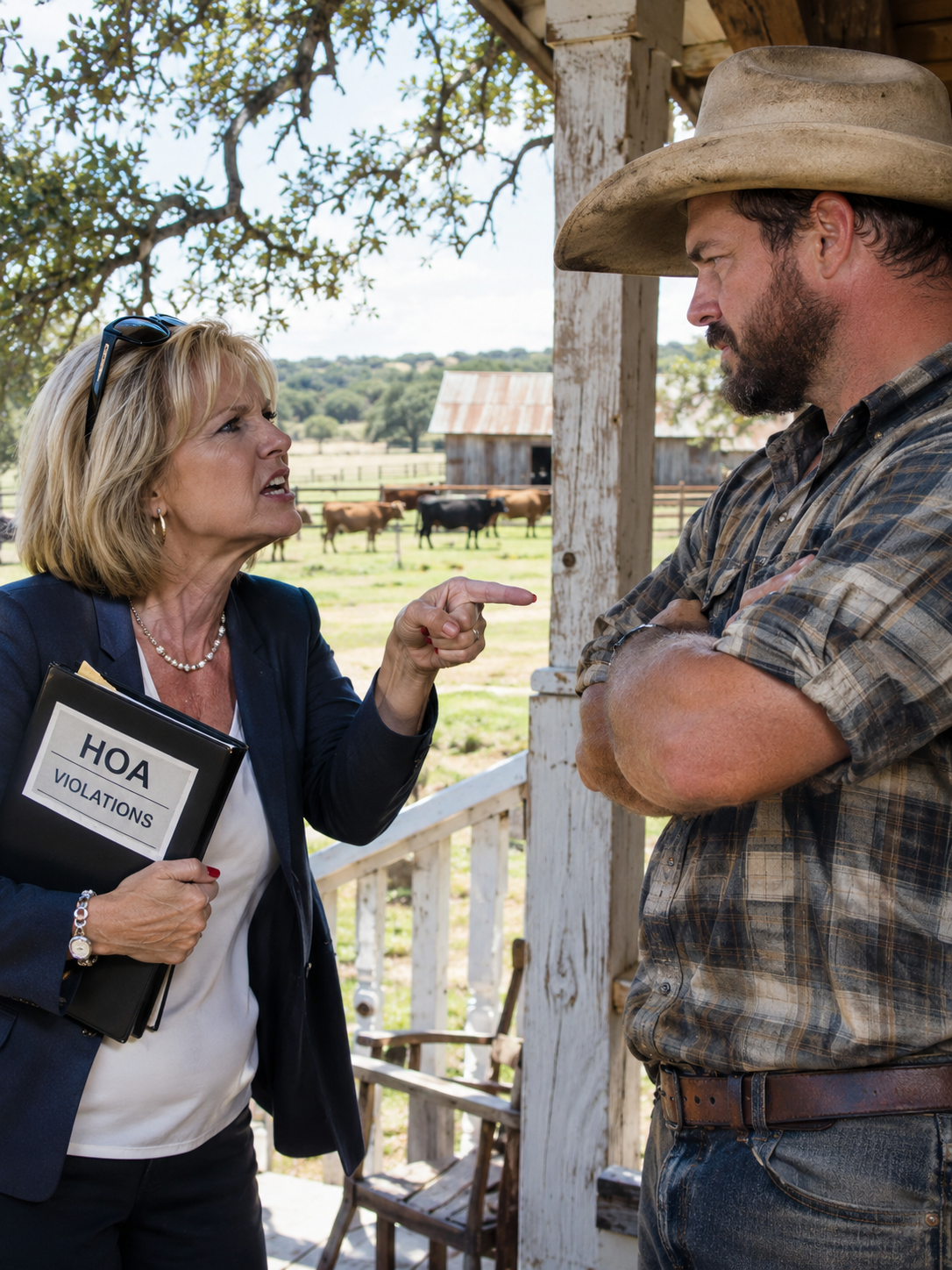
The president of the new subdivision stood on my Texas ranch porch and said I had until Friday to pay her HOA $80,000 or lose the land my grandfather bought. I’d never joined her association, and she’d been sending me fines for three years. Then a threatening letter sent me to the county records office, where one boundary line told a very different story…
“Eighty thousand dollars, Kyle. By Friday. Otherwise, this HOA is coming for your ranch.” Brenda Sutter stood on my front porch with a clipboard pressed against her blouse, looking past me toward the cattle barn as though she’d already decided what should happen to it. I told her, as calmly as I could, that my property had never belonged to Ridgecrest Estates.
“You’re on the same road,” she said. “You answer to us.” She said the smell from my cattle was hurting property values and that the fines had been accumulating for three years. I didn’t argue about the smell or the road. I watched her walk back to her white golf cart, then went inside to the kitchen table where I’d been keeping her letters.
That porch visit came late in a dispute that had already worn me down. By the time Brenda demanded eighty thousand dollars face-to-face, I had learned to take her threats seriously, even when her claims made no sense. But the whole mess had started much more quietly, with a new neighborhood beyond our fence and a single envelope in my mailbox.
My name is Kyle Owens. I’m a third-generation cattle rancher in the Texas Hill Country, working forty acres that my grandfather bought and a barn he built in 1963. There were thirty head of beef cattle depending on me, and I’d been running the place for twelve years. It wasn’t fancy, but every gate, water trough, and stubborn old board in that barn belonged to a life my family had built.
My father died eight years ago. Along with the ranch, he left me a filing cabinet packed so tightly that the bottom drawer wouldn’t shut. It held deeds, surveys, tax receipts, and paperwork going back to my grandfather. Dad’s advice was simple: “Paper outlives people, Kyle. Keep it all.” I did, even when I didn’t see the point.
Most mornings I was outside by five, listening to the bucket ring against the trough and checking the cattle before the heat set in. My old John Deere smelled of diesel, the barn roof showed its age, and the mud didn’t care how clean my boots had been. I was proud of that ordinary work. I never expected I’d have to defend it from people who had arrived long after my grandfather.
For years, the land north of our fence had been pasture and cedar. About six years earlier, a developer turned that acreage into Ridgecrest Estates: a gated neighborhood of 120 homes, a pool, and houses selling for roughly $350,000 to $500,000. I had no objection. Families needed places to live, and I figured there was room on that road for both new houses and old ranches.
Brenda had moved there from Houston about five years earlier. She’d retired from an insurance office and was elected HOA president when hardly anyone else wanted the position. Soon she was riding around in her golf cart with a red pen and a clipboard, issuing violations for trash cans left too far out or grass cut a little too high. I heard neighbors grumble, but I had no reason to think her rules involved me.
Then, three years ago, an envelope appeared in my mailbox. It carried the Ridgecrest Estates logo and accused me of keeping “unsightly agricultural structures” visible from the community road. Fine: $250. I read it twice, looked through the window at the barn my grandfather had built, and threw it in the trash. Nobody from Ridgecrest had ever asked me to join, and I had never signed its covenants.
Another envelope came the following month, then another. The fines rose from $250 to $500 and eventually $1,000, with Brenda’s signature stamped at the bottom. I called the number on one notice and left a voicemail explaining that I owned a separate ranch. Nobody returned the call. After that, I saved every envelope on the kitchen shelf beside the coffee pot.
I wasn’t trying to be brave by ignoring her. I was trying to get cattle fed, fences fixed, and bills paid, and it seemed foolish to spend money on a lawyer for demands from an association I didn’t belong to. Still, each new letter stayed in my head longer than the one before it. I began checking the mailbox before I let myself sit down to supper.
Around the fourteenth month, the paperwork changed. An envelope arrived with a legal-looking letterhead: Gentry and Associates, supposedly counsel for Ridgecrest Estates. Instead of another small violation, it demanded $62,000 in fines, late fees, and administrative costs. It gave me sixty days to pay or face lien proceedings against my property.
I sat at the kitchen table with that letter in one hand and my coffee cooling beside the other. A lien wasn’t like an angry note about an old barn. If somebody recorded a claim against my land, it could reach into how I borrowed money and kept the ranch operating. Whatever Brenda believed about my cattle, she was now threatening something my family had spent three generations protecting.
The letter bothered me for another reason. The office address was a post office box, and the formatting looked careless for a law firm’s demand. I didn’t yet know that a freelance paralegal had been involved rather than an actual attorney, and I wasn’t about to gamble the ranch on a suspicion. I needed a record that mattered more than anybody’s letterhead.
At six the next morning, I drove twenty-two miles to the county recorder’s office. I asked the woman at the counter for the original plat map filed when Ridgecrest Estates was created. She found it in a few minutes and handed me a large photocopy, still warm from the machine. I spread it across the counter so I could follow the dark line around the subdivision.
I traced the edge of the HOA boundary with my finger. Ridgecrest stopped well north of my fence, and my forty acres lay entirely outside it. There was no narrow strip crossing my pasture, no confusing corner that might have explained the notices. The official map showed my ranch wasn’t even within a hundred feet of the association’s jurisdiction.
I checked the labels twice before folding the paper. I’d been living with Brenda’s demands for months, wondering whether some rule I’d never heard of could reach backward through my grandfather’s deed. There, in black ink, was the answer: my ranch had never been part of Ridgecrest. I put the map in my truck’s glove box, knowing I finally had something stronger than my word.
I drove home without calling Brenda. I wanted to understand the rest of the paperwork before making another move, especially with a lien threat hanging over my head. The land outside my windshield looked the same as it always had, but I was looking at that northern fence a little differently now. Part 2…..
IF FACEBOOK BROUGHT YOU HERE, HERE’S THE CONTINUATION YOU’VE BEEN WAITING FOR. ENJOY! 👇 Two weeks later, while checking the north fence, I found four orange survey stakes driven about fifteen feet inside my property. No one had asked permission to survey my pasture. I pulled the stakes up and stacked them by the front gate, then stood there trying to imagine who thought they could walk onto my land and start marking it.
Wade Harmon, a sixty-eight-year-old rancher up the road, told me to look at the Ridgecrest Facebook group. Brenda had posted that the property at the south end was dragging down home values and that its owner refused to cooperate. Somebody asked whether the ranch even fell within the HOA. That question disappeared from the thread before the day was over.
Three weeks after the stakes appeared, Brenda called a special board meeting. Her two fellow board members approved a resolution claiming an “adverse interest” in my ranch if I didn’t pay within thirty days. Another notice soon arrived, and the demand had climbed to $80,000. Eighteen thousand dollars of that was a special assessment for roads inside Ridgecrest, roads that didn’t even connect to my gate.
At the bottom Brenda had written, in blue ink, “Pay or pack. Your choice.” Around then she came to my porch and delivered the same ultimatum in person, the conversation I couldn’t get out of my mind. I waited until her cart was gone before I opened the filing cabinet and pulled out the oldest land papers Dad had saved.
This time I went back to the county records for Ridgecrest’s covenants, conditions, and restrictions, the CC&Rs. They ran seventeen pages and listed the parcels actually subject to the HOA. My parcel number wasn’t there. My grandfather’s deed didn’t attach us to any subdivision covenants either. I had both the official boundary and the recorded rules telling the same story.
That evening I took the documents to Wade’s porch. He poured iced tea and told me Brenda had sent him similar notices two years earlier. He’d told her to leave him alone, and she had, but he thought she’d simply turned her attention to me. Then he said, “Before you do anything, look at the map on their website.”
I opened my laptop when I got home and put Brenda’s website map beside the county copy. The line on Ridgecrest’s site had been pushed south to swallow my ranch, Wade’s property, and several more lots near the road. No recorded map I’d seen authorized that change. I saved a copy of the page, my hands feeling colder than they should have on a Texas summer night.
The summer heat grew brutal, sometimes reaching 102 degrees. One afternoon I noticed the cattle crowding a dry trough, nudging one another toward a spout that wasn’t running. The holding tank had emptied. Thirty animals needed water, and I couldn’t afford to treat that as a neighborly misunderstanding.
At the tap point off the county road, I found a shiny blue padlock on the valve and a sticker identifying it as Ridgecrest property. The water main belonged to the county, and my connection had been approved long before the subdivision existed. I called the county water department and told them exactly what I was seeing.
A crew arrived about two hours later and cut off the lock. Their lead worker confirmed that the valve wasn’t HOA property and told me to document any further interference. I went straight back to the trough and waited while the cattle drank. Watching them crowd around that water, I felt a kind of anger no letter had managed to produce.
I bought four security cameras that week and mounted them on the barn, gate, tap point, and northern fence line. While working on the last one, I saw an unfamiliar white sedan parked along the county road. An HOA parking sticker was visible on the bumper. It stayed ten minutes and drove off toward Ridgecrest; I couldn’t see who was inside.
The next day Brenda complained to county code enforcement about odors, flies, noise, and livestock conditions. An inspector walked my barn, water system, and pasture, then found no violations. That should have given all of us something useful to work from, but Brenda posted that the county was letting me get away with it and the neighborhood might have to take matters into its own hands.
Four days later a different kind of letter arrived. A real attorney writing for Lone Star Ridge Development LLC asked whether I’d meet to discuss selling my forty acres. I checked public business information: the company had been registered six months earlier, listed one officer, and used a registered agent address in Houston. It didn’t prove any connection to Brenda, but I set the letter beside the HOA notices instead of throwing it away.
For the first time, I hired a licensed surveyor. Colton Briggs was fifty-five, with a sunburned neck and equipment that looked more expensive than my truck. He walked the boundary and then spread his results beside the county plat on my kitchen table. My ranch was plainly outside Ridgecrest, just as I’d been told.
Then Colton tapped six lots along the subdivision’s southern edge. Those houses were outside the recorded HOA boundary too. I stared at their positions and thought about the families who’d paid dues, followed rules, and received fines because a map on a website said they belonged. This was no longer just a dispute about my barn.
With typical dues of about $3,500 per household each year, six households over five years could have paid roughly $105,000 before adding fines. It was an estimate, not an audit, but it was enough to make me uneasy about where the money had gone. I also wondered why a development company might want forty acres of pasture immediately south of those houses. I had questions, not proof, and I knew the difference mattered.
Part 3 Wade came by that night and said I should meet Norma Prescott, a sixty-one-year-old retired CPA living inside Ridgecrest. She’d asked Brenda for financial records and been told to mind her own business. When I called, Norma sounded as though she’d been waiting for someone to give her a reason to pull out a calculator. She visited the ranch that afternoon.
We sat at my kitchen table with the plat map, the recorded covenants, and Colton’s survey spread between our coffee mugs. Norma put on her glasses and read the parcel list herself. Then she looked at the six houses Colton had marked and asked how long they’d been paying. “About five years,” I said. She wrote the figures on a legal pad and told me we needed proper records before accusing anyone of taking money unlawfully.
Wade recommended Craig Dawson, a real estate attorney from Fredericksburg. Dawson reviewed the documents and told us that the official records strongly supported my position and raised serious questions about dues charged to the six homeowners. He also cautioned us that the website map alone wouldn’t prove who changed it or why. That was the first legal advice I’d heard that made me feel both steadier and more careful.
Dawson planned a cease-and-desist letter to Brenda, a challenge to any lien she filed, and a formal request for HOA financial records from Norma. He asked when Ridgecrest held its annual meeting. “Six weeks,” I said. He nodded and suggested we prepare a clear presentation for residents rather than trying to settle the matter through Facebook arguments.
Norma and I spent the following weeks visiting the six households. Four families agreed to compare their records with ours; two didn’t want to get involved. Glenn Moore, a sixty-two-year-old retired postal worker, brought out a folder and showed me he’d paid $22,000 in dues and fines over five years. He sat on his porch steps, quiet for a moment, then said, “I want my money back.”
We gathered in my barn one Saturday with Wade, Norma, Dawson, and the homeowners who wanted answers. Norma set her neat folder on a hay bale and complained that the place smelled of transmission fluid. Dawson walked through the records while I held down the corner of a map against a stray breeze. We’d compare the county map with the website version at the meeting, then let residents ask for an accounting.
I had a poster-size copy of the official plat printed in town and tucked it behind my truck seat. I thought we might finally have a fair chance to explain why the HOA had no authority over my land. Then someone told Brenda we’d been visiting neighbors, and she stopped waiting for the annual meeting.
At an emergency board meeting, Brenda and the other two members authorized filing a lien against my ranch. The document was recorded, despite the parcel not appearing in the HOA’s recorded covenants. Dawson said we could challenge it, but we’d need a legal process and time. I sat in his office listening to the word “time” and thinking about the feed bill coming due.
Henderson Feed and Supply, where I kept an agricultural credit line secured against the ranch, discovered the lien during a title check. The next business day my credit was frozen. I could no longer put hay, diesel, or veterinary supplies on that account. The feed store staff knew me, and I could hear the regret in the clerk’s voice, but she couldn’t override the decision.
I spent that week counting cattle and dollars. The pasture was drying in the heat, and the bills weren’t waiting for a hearing. On Friday I sold four cows to a buyer from San Marcos for less than I believed they were worth. I watched them climb the trailer ramp at dawn, and when the truck pulled away there were twenty-six cattle left in the pasture.
At breakfast I left my plate untouched. Dad had spent his life keeping that herd going, and I had sold four animals not because the ranch was failing but because a disputed claim on paper had cut off my supplies. I didn’t want to tell Wade how much the sale hurt. He could see it without asking.
Brenda meanwhile posted my name on the Ridgecrest page, called me a deadbeat, and said I owed the community $80,000. Thirty residents signed her petition asking the county to condemn the ranch as a health hazard. Another inspector came out, checked the property, and again found no violations. He looked over the barn before leaving and said, “Somebody really doesn’t like you.”
Dawson had Brenda served at her home with a demand to stop claiming authority over my property, withdraw the lien, and retract the accusations. After that, the Facebook group went quiet for a few days. I used the quiet to sort every envelope by date and print another set of county records. I was learning how quickly a false claim could become a real expense.
One of those records was a registration tied to Lone Star Ridge Development. Its registered agent was Sutter Property Consulting, with a Houston post office box. Seeing the name beside Brenda’s did not tell me the whole business arrangement, but it gave Dawson a concrete lead to investigate. I placed the printout under the letter offering to buy my ranch.
Three weeks before the annual meeting, I heard a diesel engine by the north fence before sunrise. A flatbed truck had stopped on the county easement, and workers were unloading six-foot chain-link fence posts. Their foreman said a woman from Ridgecrest had hired them and called it HOA land. I told him it was a county easement and called code enforcement.
Part 4 The county inspector arrived, found no permit, and stopped the work. After the crew left, Brenda came over in her golf cart and insisted she’d authorized the fence. The inspector explained that HOA approval didn’t give her the right to build on public land and wrote down her statements. I stayed on my side of the fence while she climbed back into the cart and drove away.
That same week Brenda contacted the Hill Country Register, telling a reporter named Dale Finch that a negligent rancher was spoiling a neighborhood and bullying a volunteer board. Dale called me before printing anything. I told him there was another side and invited him to the Ridgecrest annual meeting, Thursday the nineteenth at seven. “Bring your notebook,” I said.
By then my four cameras had recorded weeks of activity around the barn, gate, tap, and fence, including the attempted fence work and the argument with the county inspector. They couldn’t show the earlier water shutoff, which happened before I installed them. I kept the recordings and reports organized in case Dawson needed them, but our main evidence for the meeting was still the county paperwork.
Six days before the meeting, Wade helped me roll the big plat map into a cardboard tube. The wind caught an edge and nearly tore it out of his hands. “If that map blows into Ridgecrest,” he said, “Brenda’ll probably fine it for trespassing.” It was the first time in weeks I laughed without immediately thinking about the cows I’d sold.
Eighty-three people turned up at the Ridgecrest clubhouse, far more than the usual handful. Folding chairs filled the room. Glenn and three other affected households sat together, Norma held a manila folder in the front row, Wade stood at the back, and Dawson took a seat near the door. Dale Finch sat off to one side with his notebook and phone.
Brenda read through the budget and landscaping items as though it were an ordinary meeting. Then she announced that the HOA would take full legal action against the neighboring ranch that had refused to comply for three years. Some people applauded. A man in a gray suit rose, introduced himself as Russell Vance, and said he was the HOA board’s attorney.
Vance told the room the board believed its operational boundary included my property and that it was prepared to pursue foreclosure on the recorded lien. The room became still at that word. I could see Glenn’s wife tighten her grip on his arm. I waited for Vance to finish, then stood up with the map tube in my hands.
“I’m Kyle Owens,” I said. “My family’s ranched those forty acres since my grandfather’s day, and I have never belonged to Ridgecrest Estates.” I unrolled the county plat and fixed it to the whiteboard. My finger followed the official boundary line, then moved to the forty acres south of it. “That’s my ranch. The line doesn’t cross it.”
People leaned forward. Norma stood beside the board table and opened the recorded CC&Rs to the list of covered parcels. She explained that my parcel was absent, then placed the official map alongside a printout of the map on Ridgecrest’s website. Residents could see that the southern boundary on the website had been moved. No one needed to read the fine print to notice the difference.
“Six houses are outside that recorded boundary too,” Norma said. Glenn stood up and told everyone he’d paid $22,000 over five years. Three other owners described their own payments: about $18,000, $14,000, and $11,000. They weren’t making speeches. They were people asking why they’d been billed for rules that the recorded documents didn’t appear to apply to them.
Brenda insisted the county maps were old and that her board had approved a new boundary. Dawson stood and explained that a board vote or an edited website map wasn’t a substitute for the legally required recorded changes and property-owner agreements. He said he had found no such amendment. Brenda gripped the edge of the table while people turned toward the two maps.
Then Dawson raised the separate issue of Lone Star Ridge Development, the company that had approached me about buying my ranch, and its registered agent, Sutter Property Consulting. He said that connection deserved an explanation and review, not an assumption about anybody’s intentions. Brenda shouted that she had built the community and that without her, property values would collapse. Glenn answered, “We just want to know where our money went.”
The room broke into overlapping questions. Brenda collected her clipboard and purse, walked through the crowd, and went out the clubhouse door. She didn’t answer the homeowners who called after her. I stood at the whiteboard, holding a corner of the map flat, feeling the room shift from an argument about my cattle to a demand for the association’s own records.
The remaining board members moved to suspend Brenda pending a financial review. Residents supported the motion, and plans began for a special meeting to choose new leadership. Dale was still taking notes. Dawson quietly reminded us that a loud meeting wasn’t a court order; the lien was still on my title, and we still had work to do.
Four days later Dale’s article appeared in the Hill Country Register. It described the disputed boundary, the dues the six families had paid, the $80,000 demand, the lien, and the development company’s connection to the Sutter name. He quoted the documents, the residents, and Brenda’s comments. Regional outlets picked up the report, but I spent that morning doing chores as usual.
Final Dawson submitted a forty-three-page complaint to the Texas Attorney General’s office with the plat maps, covenants, survey, notices, website screenshots, and business records. Within thirty days the office opened an investigation. I didn’t confuse an investigation with a finding of guilt. It meant people outside that clubhouse were finally examining the paperwork.
At a special meeting two weeks after Brenda walked out, Ridgecrest elected a new board. The board arranged a full financial audit, with Norma volunteering to help oversee the work. The audit found that six households outside the recorded boundary had paid approximately $128,000 in dues and fines across five years. The board voted to give them full refunds.
Glenn called me when he heard the vote. He was relieved, but his voice still carried the weight of having written those checks year after year. He and three of the other homeowners joined me in a civil lawsuit against Brenda personally. Our complaint sought more than $200,000, accounting for the homeowners’ payments and my losses, including the cattle sale, credit problems, and legal costs. Those were claims to be resolved, not money already awarded.
Six weeks after the annual meeting, a court order discharged the lien on my ranch. Henderson Feed and Supply reopened my credit line that day. I drove there and bought feed without having to explain a false-looking title problem at the counter. I didn’t buy back four cows; the sale was done, and the loss stayed with me even after the paperwork changed.
The investigation involving Lone Star Ridge Development remained open at the time I told this story. I believed Brenda had wanted my acreage for expansion, but I couldn’t say a court had proved that motive. What I could say was that her pressure campaign, the altered website boundary, and the company’s approach to me were now documented for the people examining the dispute.
The new board invited Wade and me to serve on a neighborhood advisory committee. We told them plainly that neither ranch belonged to the HOA and we weren’t joining or paying dues. They said they wanted a better relationship with the people who’d lived along that road before the subdivision. That was a change I could welcome without surrendering an inch of land.
Last fall, Ridgecrest held a barbecue for residents and neighboring ranchers. I smoked two hundred pounds of brisket in the pit my dad had built, and the neighbors brought side dishes and folding tables. Children took turns riding Wade’s old quarter horse in the pasture. A banner between two cedar posts said, “Good fences make good neighbors,” and Wade wondered aloud whether Brenda would have fined the banner.
The smell of smoked beef drifted toward Ridgecrest, and no one complained. I watched people who had once known me only as the rancher in Brenda’s posts talking to Wade about the weather and asking about the cattle. Nobody pretended the money or the legal trouble hadn’t happened. They just made room for one another in the ordinary ways neighbors can.
I also started a free monthly workshop called Know Your Boundaries at the Ridgecrest clubhouse. At the first session, about sixty people came to learn how to locate recorded plat maps, read covenants, and check what applied to their property. The county library system asked me to bring it to three other locations. Dad would’ve liked seeing his old filing habits turn into something useful to strangers.
Most mornings I’m still out by five, carrying the bucket to the trough and counting twenty-six head, with hopes of building back to thirty. The barn my grandfather built is standing, and the old fence is still doing its job. I open the filing cabinet more often now, and its bottom drawer still refuses to close. Every time I tug at it, I hear Dad saying, “Paper outlives people.” This time, I know exactly what he meant.
THE END. I’ve shared the complete story, and I truly hope it touched your heart. If this story moved you, please , like, and share the post. Thank you for reading! ❤️
✓ Lynn R. Adams
The president of the new subdivision stood on my Texas ranch porch and said I had until Friday to pay her HOA $80,000 or lose the land my grandfather bought. I’d never joined her association, and she’…