HOA Karen Crushed My Trash Cans Every Friday—So I Installed One Quiet Barrier That Tore the Front Off Her SUV
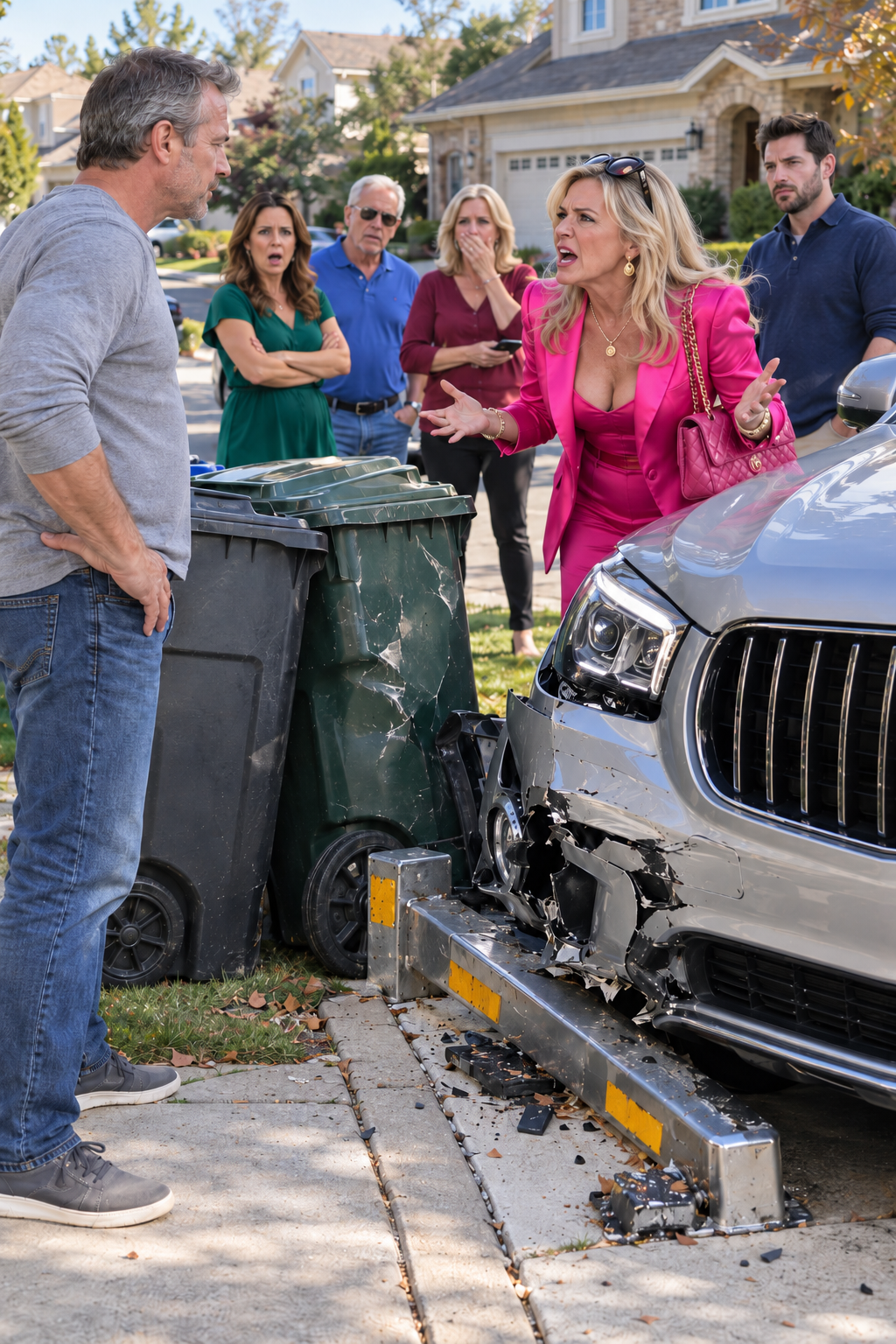
HOA Karen Crushed My Trash Cans Every Friday—So I Installed One Quiet Barrier That Tore the Front Off Her SUV
The fifth time Karen Whitfield crushed my trash cans, she didn’t even bother pretending it was an accident.
She stopped her white Cadillac Escalade ten feet past my driveway, lowered the window, looked straight at me, and smiled while two shattered plastic wheels rolled into the gutter behind her.
Then she called out, “Maybe eventually you’ll learn where things belong.”
I didn’t yell.
I didn’t chase her.
I didn’t even answer.
I stood there in my work boots with one hand wrapped around a coffee mug and watched ninety-eight dollars of county-issued plastic lie flattened beneath the tire marks of a seventy-thousand-dollar SUV.
Karen wanted anger.
Angry people make mistakes.
I wanted receipts.
So I took out my phone and photographed everything.
The broken axle.
The white paint transfer.
The tire tread.
The position of the pieces.
Every Friday, another trash can disappeared beneath her tires.
Every Friday, I photographed the damage.
Every Friday, she told the HOA I had created a “roadside hazard.”
Every Friday, I ordered another replacement.
Every Friday, Karen became more confident that I would eventually surrender.
What she didn’t know was that after the fourth Friday, I had stopped replacing trash cans.
I had started building a case.
My name is Owen Mercer.
I was forty-four years old, divorced, and living in the same brick ranch house my father bought outside Richmond, Virginia, in 1987.
Nothing glamorous.
Three bedrooms.
A detached garage.
A narrow vegetable garden my mother had planted before she died.
An oak tree big enough that two adults couldn’t wrap their arms around it.
And 1.8 acres at the corner of Hawthorne Road and Briar Glen Drive.
That last part mattered.
My land was older than Briar Glen.
Much older.
The subdivision didn’t exist when Dad bought the house.
Back then, everything behind us had been pasture and pine.
Then developers arrived.
First came twenty houses.
Then forty-seven.
Then the clubhouse.
Then decorative ponds.
Then stone signs.
Then gates they weren’t legally allowed to close because Briar Glen Drive remained a public road.
By the time Karen Whitfield became HOA president, Briar Glen had eighty-six homes, a tennis court, two ponds, three committees devoted to landscaping, and enough rules to make parking a lawn mower feel like a federal offense.
My house, however, wasn’t part of it.
Never had been.
That drove Karen crazy.
My parcel sat directly beside the subdivision entrance like an old tooth that refused to fall out.
Their manicured stone wall stopped at my property line.
Their decorative crepe myrtles stopped at my property line.
Their irrigation pipes stopped at my property line.
Their authority stopped there too.
Karen had never accepted that last part.
She was fifty-eight, silver-blonde, always perfectly dressed, usually in bright jackets that looked expensive enough to require their own insurance policies.
She drove the Escalade like it was a parade float.
She spoke slowly when she wanted to insult you, as though stupidity might be contagious.
And for six years, she had treated Briar Glen like a small country that had accidentally forgotten to elect her president for life.
Our trouble started eleven months before the trash cans.
Karen knocked on my door carrying a leather folder and a smile.
She looked past me into my house.
She always did that.
Some people entered conversations.
Karen inspected them.
“The board is making improvements to the entrance.”
“Congratulations.”
Her smile tightened.
“We’ll need your cooperation.”
There it was.
Not request.
Cooperation.
She opened the folder.
Inside was a survey sketch showing a twelve-foot strip running along the eastern edge of my property.
The strip began at Hawthorne Road, followed Briar Glen Drive for about 190 feet, then narrowed behind my detached garage.
The HOA wanted a permanent easement.
Landscaping.
Utility access.
Construction access.
“Perpetual access,” I read.
“Standard language.”
“Indemnification of Briar Glen Homeowners Association.”
“Also standard.”
“Right to modify grade elevations.”
“Owen, it’s landscaping.”
“Then why do you need permission to change my grade?”
Her smile disappeared for half a second.
Then returned.
“The entrance needs modernization.”
I handed the folder back.
She blinked.
Karen wasn’t accustomed to single-syllable obstacles.
“You haven’t heard the compensation.”
“I don’t care about the compensation.”
“Five thousand dollars.”
She stared toward my driveway.
“There could be consequences if the board has to redesign.”
“I’m not on your board.”
“You benefit from our property values.”
“My taxes benefit from my property value.”
Her eyes came back to mine.
“This would be easier if you didn’t make everything adversarial.”
“You walked onto my porch asking for permanent control of twelve feet of my land.”
“It’s an easement.”
She closed the folder.
The leather edges snapped together with a soft clap.
“All right.”
That was it.
No shouting.
Just those two words.
Two weeks later, I received my first HOA violation notice.
It said my mailbox color was noncompliant.
I mailed it back with a copy of my deed and one sentence.
NOT A MEMBER OF BRIAR GLEN HOA.
Next came a notice about my garage door.
Then my vegetable garden.
Then an alleged unauthorized vehicle because my brother’s pickup had stayed overnight.
Then a letter demanding that I relocate my trash cans behind my house so they would not be visible from the Briar Glen entrance.
I called their management company.
A nervous young man named Trevor answered.
He apologized within thirty seconds.
“Our records show your address was added to the compliance database.”
“I don’t have that information.”
“You absolutely have that information.”
Another pause.
“I can see the account was manually entered.”
“By whom, Trevor?”
Longer pause.
“HOA president access.”
There it was.
I asked Trevor to remove me.
Three days later, I was added again.
That became the pattern.
Karen pushed.
I documented.
Karen pushed harder.
I documented more.
Then the trash cans started dying.
Henrico County collected garbage Friday mornings.
I rolled my two cans down Thursday night and placed them three feet inside my property line beside my gravel turnout.
There was plenty of room.
The nearest can sat almost nine feet from the asphalt.
The first Friday, I found both cans flattened.
I assumed somebody had lost control pulling out of Briar Glen.
I ordered replacements.
The second Friday, one can was crushed and the second had been shoved twenty feet into my ditch.
That was strange.
The third Friday, my neighbor across Hawthorne Road called.
“Was that HOA lady supposed to be in your yard?”
“The one with the white SUV.”
I crossed the street.
His Ring camera had caught the rear quarter of Karen’s Escalade.
Not enough to show the impact.
Enough to show her entering my gravel turnout at .
At , she backed out.
My cans were already destroyed when the garbage truck arrived six minutes later.
I saved the clip.
On the fourth Friday, I mounted a small camera beneath the eave of my detached garage.
It wasn’t hidden.
I didn’t need hidden.
Karen came at .
She slowed.
Crossed my property line.
The Escalade’s front bumper pushed the first can sideways.
Then she accelerated.
Plastic folded under the SUV.
The second can disappeared beneath the passenger tire.
Karen reversed.
Then drove forward over the remains again.
That changed everything.
An accident happens once.
Carelessness happens twice.
Four Fridays is a schedule.
I filed a police report.
An officer named Daniel Ruiz came to the house.
He watched the footage twice.
“You two have some kind of dispute?”
“She wants an easement.”
“For the subdivision?”
“Twelve feet.”
He looked back at the frozen frame of Karen’s Escalade.
“Keep your originals.”
“I intend to.”
“Don’t confront her.”
“I don’t intend to.”
Ruiz gave me the report number.
Then he said something important.
“If she comes onto your property again, call while she’s still here.”
The following Monday, Karen arrived instead.
She didn’t ring the bell.
She stood outside my garage where I was repairing an old workbench.
“Heard you contacted the police.”
“I reported property damage.”
She folded her arms.
She was wearing an emerald jacket, cream slacks, and sunglasses large enough to cover most of her face.
“You’re turning neighborhood issues into criminal issues.”
“You drove over my property.”
“Your trash containers obstructed visibility.”
“Nine feet off the road?”
“You know what I mean.”
Her jaw shifted.
“This community has standards.”
“This property isn’t part of your community.”
“You live at our entrance.”
“I live beside your entrance.”
“It affects everyone.”
“Then tell everyone to stay off my land.”
She removed her sunglasses.
That was when I saw the anger.
Not wild anger.
Something colder.
“You’re making a very small issue unnecessarily expensive.”
I leaned against the workbench.
Her expression changed.
Only slightly.
But I caught it.
“For everyone.”
Then she walked away.
That sentence stayed with me.
Not because it sounded threatening.
Because it sounded financial.
The entrance project mattered more than decorative stone.
I just didn’t know why yet.
Friday number five was the day she smiled after crushing the cans.
I photographed everything.
Then I stopped buying replacements.
Instead, I called a surveyor.
Not some friend willing to guess.
A licensed surveyor.
I paid $1,460 to have the eastern boundary of my parcel located, pinned, and recorded.
The crew spent most of a day working along Briar Glen Drive.
Karen drove past them three times.
On the fourth pass, she stopped.
I was standing near the garage when she called through the open passenger window.
“Planning something?”
“Learning where my property ends.”
“You already know.”
“Now everybody will.”
She looked toward the orange survey flags.
For the first time since the trash cans started, Karen looked worried.
Two days later, I submitted a simple residential improvement plan to the county.
Not a fence.
Not spikes.
Not a trap.
Two steel protective bollards.
Six-inch diameter.
Concrete-filled.
Thirty-six inches above ground.
Reflective bands.
Set well within my surveyed property, behind the roadside clear zone, positioned beside a small pressure-treated enclosure where my replacement trash cans would sit.
It was the same type of protection people used around propane tanks, utility equipment, and garage entrances.
The county reviewer approved the location.
I hired a contractor.
We dug below frost depth.
Poured concrete.
Installed the posts.
Painted them bright safety yellow.
Then I put two brand-new trash cans between them.
You could see those bollards from fifty yards away.
That was the point.
My neighbor Mark looked at them and laughed.
“Those things stop a car?”
“They stop mistakes.”
“And Karen?”
“We’re about to find out whether Karen is making mistakes.”
Thursday evening, I rolled the cans into place.
Then I went inside.
Friday morning, I woke at .
Made coffee.
Checked both cameras.
At , the first commuter left Briar Glen.
At , a school bus passed.
At , a landscaping truck turned into the subdivision.
At , Karen’s Escalade appeared.
My pulse didn’t jump.
That surprised me.
She stopped near the entrance.
The cameras caught sunlight flashing across her windshield.
Then she reversed six feet.
Straightened the SUV.
And turned toward my gravel turnout.
The Escalade crossed the white edge line.
Crossed the gravel.
Crossed the survey boundary.
Her front tires entered my property.
She had plenty of time to stop.
She had plenty of room to avoid the cans.
She could clearly see two bright yellow steel posts.
She kept coming.
The front bumper touched the first trash can.
Plastic flexed.
Then the SUV lurched.
Karen hit the accelerator.
The can shot backward.
The left side of her bumper struck the bollard.
There was a sound like someone slamming a metal dumpster lid.
The Escalade stopped instantly.
Karen didn’t.
Momentum twisted the SUV sideways.
The plastic fascia tore away from the front corner.
One parking sensor ripped loose.
A wiring harness stretched like black spaghetti.
Part of the grille cracked.
When Karen reversed, the bumper cover hooked around the bollard.
She pressed the accelerator harder.
The bumper came off.
Not part of it.
Almost the entire front cover.
It dropped onto my gravel with the Cadillac emblem still attached.
For three seconds, nothing moved.
Then the driver’s door flew open.
Karen stepped out.
Her face was red.
She stared at her SUV.
Then at the bollard.
Then at my house.
I took one sip of coffee.
Set the mug down.
Picked up my phone.
And called the police.
Karen reached my porch before I opened the door.
“You booby-trapped my car!”
I remained behind the storm door.
“You’re on my property.”
“You installed that deliberately!”
Her eyes widened, as if my admission had proven murder.
“You admit it?”
“I installed two visible protective bollards on my property with county approval.”
“You knew I drive through there!”
That sentence hung between us.
Karen heard it too.
Her mouth closed.
I almost smiled.
Instead, I said, “Please wait for the police.”
“You’ll pay for this.”
“Probably not.”
Her hands curled.
“You did this to hurt me.”
“No. I did it to stop my trash cans from being crushed.”
“You expected me to hit it!”
“I expected you not to enter my property.”
Sirens sounded in the distance.
Karen turned toward the road.
Her anger became calculation.
By the time Officer Ruiz pulled into my driveway, she had transformed.
Shoulders lowered.
Voice shaking.
One hand resting dramatically against her chest.
“I could have been killed.”
Ruiz recognized both of us.
He glanced at the Escalade.
Then the yellow bollard.
Then the torn-off bumper lying three feet away.
“Anybody injured?”
“My neck,” Karen said.
“Do you need an ambulance?”
Ruiz took out his notebook.
“What happened?”
Karen answered instantly.
“I was exiting Briar Glen when something came into the roadway.”
I said nothing.
Ruiz looked at the bollard.
The bollard was thirty inches inside the marked property boundary and several feet from pavement.
“What came into the roadway?”
“That metal post.”
“The post moved?”
“He installed it maliciously.”
“That wasn’t my question.”
Karen’s face tightened.
Ruiz looked at me.
We walked into the garage.
Karen followed.
The first camera showed the entire approach.
The second showed the side angle.
We watched the Escalade stop.
Straighten.
Turn onto my gravel.
Ruiz paused the video before impact.
“You were leaving the subdivision?” he asked.
Karen didn’t answer.
The frozen image showed her SUV pointed almost forty degrees away from the road.
Directly toward my trash enclosure.
Ruiz pressed play.
The SUV accelerated.
Bumper gone.
He replayed the last six seconds.
Karen said, “He knew I would—”
She stopped again.
Ruiz turned.
“Knew you would what?”
“I’m not discussing this without counsel.”
“That’s probably wise.”
He walked outside.
Measured distances.
Photographed the survey stakes.
Photographed the reflective tape.
Photographed my county approval.
Then he called a second unit.
Karen became less dramatic when the second officer arrived.
Especially after they told her they were documenting a potential intentional property-damage complaint.
“My SUV is damaged!”
Ruiz nodded.
“That doesn’t change where your SUV was.”
“You cannot possibly think I intentionally hit his trash cans.”
“I’m not telling you what I think.”
“I’m HOA president.”
Ruiz stared at her.
I will remember his answer until the day I die.
“Ma’am, that is not a law enforcement rank.”
Mark heard it from across the street.
He laughed loudly enough that Karen heard him too.
She whipped around.
“Is this funny to you?”
Mark raised both hands.
He went inside.
Still laughing.
A tow truck came because part of Karen’s bumper had become tangled around the bollard base.
The driver disconnected it carefully.
Karen stood ten feet away making phone calls.
Her husband.
The HOA management company.
Her insurance carrier.
Then someone named Curtis.
That name meant nothing to me at the time.
Before Ruiz left, he gave me another case number.
“Back up the footage.”
“Already did.”
“Somewhere off-site.”
“Already did.”
Then he looked toward Karen.
“She may claim you created an unsafe condition.”
“I expected that.”
“Your paperwork helps.”
“I expected that too.”
That afternoon, I received a certified letter from Briar Glen’s attorney.
Fastest legal threat I had ever seen.
The HOA alleged that my “unapproved steel obstruction” created a danger to residents and demanded immediate removal.
They also claimed the bollards violated Briar Glen architectural standards.
I emailed the attorney one page.
No HOA covenants.
No annexation.
No membership.
No architectural authority.
Three hours later, he replied.
Mr. Mercer,
We are reviewing jurisdictional applicability.
That phrase made my entire weekend.
Saturday morning, someone placed a handwritten note in my mailbox.
Not mailed.
No envelope.
You made your point. Remove the posts before someone gets hurt.
No signature.
I put it in a plastic sleeve.
Sunday night, another camera caught Karen’s Escalade crawling past my property at 11:38 p.m.
Different bumper.
Temporary repair.
She didn’t stop.
Monday morning, the HOA attorney emailed again.
The architectural complaint disappeared.
Now they wanted to negotiate “mutual resolution.”
They offered $12,000 for the easement.
That was nearly twice Karen’s original number.
I declined.
At noon, they offered $20,000.
I declined.
At , $30,000.
That made me stop.
Nobody triples an offer in a day for flower beds.
I called a friend named Laura Benton.
Laura was a real estate attorney.
She had handled my divorce, my father’s estate, and a boundary dispute involving a neighbor who once believed moving a fence at night somehow changed county maps.
I sent her everything.
Easement draft.
Violation letters.
Police reports.
Offer emails.
Laura called at .
“You didn’t sign anything with these people?”
“Not when your father died?”
“Refinance paperwork?”
“Utility permission?”
“Are you absolutely certain?”
Then she said, “I want to pull the county land records myself tomorrow.”
“Because thirty thousand dollars is not landscaping money.”
That was exactly what I had been thinking.
Tuesday passed quietly.
Wednesday morning, Karen parked across from my house.
She never got out.
Just sat in the Escalade for twelve minutes.
At , Laura called.
Her voice was different.
“Owen, are you sitting down?”
“Sit down.”
I sat at the kitchen table.
“I found the easement.”
“What easement?”
“The one you didn’t sign.”
My kitchen suddenly felt too quiet.
“Briar Glen filed a recorded easement seven months ago.”
I looked toward the window.
Across the yard, the yellow bollards stood beside my trash cans.
“They filed what?”
“A permanent access and drainage easement along the eastern twelve feet of your parcel.”
“That’s impossible.”
“It has your name.”
“Anybody can type my name.”
“It has a signature.”
I said nothing.
“It’s notarized.”
My fingers tightened around the phone.
Thirty seconds later, the PDF arrived.
I opened it.
There was my parcel number.
My legal description.
Briar Glen Homeowners Association as beneficiary.
Twelve-foot perpetual easement.
Construction.
Everything Karen had asked me to sign.
And at the bottom—
OWEN J. MERCER.
The signature resembled mine.
Not perfectly.
But enough that someone glancing at it wouldn’t hesitate.
Below that was a notary stamp.
Laura spoke through the phone.
“I’m looking.”
“You didn’t sign it?”
“You weren’t in front of this notary?”
“Do you know her?”
I zoomed in.
Patricia M. Lowe.
Laura exhaled.
“Then we have a bigger problem than trash cans.”
I called Officer Ruiz.
He told me not to confront Karen.
Laura sent formal notice to the county recorder disputing the instrument.
She also contacted the county attorney and requested preservation of every file associated with the easement.
At that afternoon, something changed.
Three county vehicles entered Briar Glen.
Public works.
Stormwater management.
Karen followed them in her Escalade.
At , a contractor’s pickup arrived.
Black truck.
Magnetic door sign.
BRIGHTON CIVIL CONSTRUCTION.
At , Karen came to my house.
She didn’t look angry anymore.
She looked pale.
I stayed on the porch.
“We need to discuss something privately.”
“My attorney handles land matters now.”
“This doesn’t require attorneys.”
“A forged easement generally does.”
Her face froze.
There are moments when somebody learns that their private disaster has become public.
That was one of them.
She recovered quickly.
“I don’t know what you’re talking about.”
“Then there’s nothing to discuss.”
She lowered her voice.
“Documents get filed incorrectly.”
“My signature was forged.”
“You should be careful using words like that.”
“You should be careful filing things with my signature.”
Her eyes moved toward the camera above my garage.
She took one step backward.
“The board uses outside contractors.”
“You’re assuming I personally handled filings.”
“I’m not assuming anything.”
“You’ve been hostile from the beginning.”
“I said no to an easement.”
“You obstructed a community project.”
“I declined to donate my property.”
“It wasn’t a donation.”
“Five thousand dollars for perpetual control might as well be.”
She glanced toward Briar Glen.
One of the county SUVs was parked beside the entrance wall.
A man in a reflective vest was photographing drainage grates.
Karen’s voice became softer.
“Owen, eighty-six families live back there.”
“People have mortgages.”
“Retirement savings.”
“Children.”
“If you create panic over a clerical problem, property values could be damaged.”
Not denial.
Not anymore.
I looked at her carefully.
“What exactly did you build using my forged easement?”
For the first time, Karen had no answer ready.
Her lips parted.
She stepped off my porch.
“You’ll hear from counsel.”
“I look forward to it.”
She turned toward her SUV.
I called after her.
“One thing.”
Karen stopped.
“The trash cans.”
She looked over her shoulder.
“Was all that because you wanted me to stop using this part of the property?”
Her eyes flicked toward the yellow posts.
Then to the road.
Then back to me.
“You always did insist on making simple things difficult.”
She got into the Escalade.
And drove away.
That was enough for me.
Not a confession.
But close enough to tell me the cans had never been about appearances.
My trash cans were physical markers.
Every Thursday night, I placed them inside my surveyed boundary.
Every Friday morning, they reminded anyone driving into Briar Glen that the twelve-foot strip beside their entrance belonged to me.
Karen needed those markers gone.
She needed the edge of my property to look like HOA-maintained roadside space.
She needed residents accustomed to seeing HOA vehicles use it.
She needed contractors to treat it like common property.
And most of all, she needed nobody asking why.
That evening, Laura came over.
She spread county maps across my kitchen table.
“The easement was recorded seven months ago,” she said.
“Karen asked me to sign eleven months ago.”
“Which means somebody waited four months, then filed a fake version.”
Laura tapped the map.
A blue line ran from Briar Glen’s stormwater pond toward Hawthorne Road.
It crossed my property.
“What is that?”
“Proposed drainage.”
“Proposed?”
“According to the original plan.”
She opened another document.
“According to the completion certificate, it’s already installed.”
I stared at her.
“That’s what I’m trying to figure out.”
“There’s no open ditch.”
“Underground.”
A cold feeling settled in my stomach.
“The plan says thirty-inch reinforced concrete.”
I laughed once.
Not because it was funny.
Because sometimes your brain needs somewhere to put disbelief.
“They installed a thirty-inch storm drain under my land?”
“Potentially.”
“Without telling me?”
“Potentially.”
“Using a forged easement?”
“That’s what it looks like.”
I stood up.
“About six months ago.”
I remembered contractors near the entrance that spring.
Orange fencing.
Excavators.
Dump trucks.
Karen had told everyone the HOA was replacing irrigation.
The work stayed mostly behind their stone wall.
But one week, a pile of dirt appeared near my boundary.
I had assumed it belonged to the county shoulder project happening two blocks away.
Laura watched my face.
“You remember something.”
“I remember equipment.”
“On your property?”
“I don’t know.”
“Think carefully.”
I closed my eyes.
A compact excavator.
Gray morning.
A worker near the oak tree.
I had been leaving for work.
Karen had stood near the subdivision monument talking to a man in an orange vest.
The name from her phone call after the crash suddenly returned.
“She called somebody named Curtis.”
“After she hit the bollard.”
Laura wrote it down.
“You know his last name?”
We searched the contractor registration.
Brighton Civil Construction.
Operations manager: Curtis Dane.
There it was.
Thursday morning, Laura sent Brighton Civil a preservation letter.
By Thursday afternoon, Brighton’s lawyer responded.
They refused to discuss the project without authorization from Briar Glen HOA.
That was interesting.
Friday morning arrived.
For the first time in six weeks, my trash cans survived.
They stood peacefully between the bollards after collection.
No crushed lids.
No broken wheels.
No Escalade.
I actually laughed when I rolled them back toward the garage.
One small victory.
At 10:30, Mark crossed the street holding his phone.
“You seen the neighborhood page?”
“I’m not in the neighborhood group.”
“I know. That’s why I came over.”
Karen had posted a statement.
Recent events involving a non-member adjacent property owner have created unnecessary tension and misinformation concerning routine HOA infrastructure projects.
She described the Escalade incident as a “vehicle accident caused by a newly installed roadside obstacle.”
She said the board was reviewing “aggressive legal claims.”
Then came the important sentence.
Briar Glen possesses all required access rights for completed improvements.
All required access rights.
Not “we believe.”
Not “we are reviewing.”
I sent the screenshot to Laura.
She replied three minutes later.
That afternoon, another Briar Glen resident knocked on my door.
Her name was Denise Crawford.
I knew her by sight.
Early sixties.
Short brown hair.
Usually walking a golden retriever.
She served as HOA treasurer.
She looked behind her twice before stepping onto my porch.
“Can we talk?”
I hesitated.
Then opened the door.
Denise sat at my kitchen table but didn’t remove her coat.
“You didn’t get this from me.”
“That sentence usually means I’m about to get something important.”
She slid a folded paper from her purse.
Bank statement.
Briar Glen Homeowners Association.
One transfer was highlighted.
Paid to Brighton Civil Construction.
Project code:
EAST ENTRANCE DRAINAGE / PHASE 1.
I looked at Denise.
“That’s not thirty thousand dollars.”
“What aren’t you telling me?”
Her eyes filled with fear.
“The board never approved a hundred and eighty-four thousand dollars.”
I sat back.
“What did it approve?”
“Sixty-eight.”
“For what?”
“Drainage improvements inside Briar Glen.”
“How did it become one eighty-four?”
“I don’t know.”
“You’re treasurer.”
“Then who authorized payment?”
“One person can authorize that?”
“Not legally.”
Denise pulled out another paper.
It was a board resolution.
My stomach tightened.
The resolution approved expanded drainage construction and authorized expenditure up to $210,000.
Five board signatures appeared at the bottom.
Denise pointed to hers.
“That isn’t my signature.”
I looked up.
She pointed to two others.
“Those aren’t theirs either.”
For several seconds, the only sound in my kitchen was the refrigerator compressor.
Finally I said, “Have you gone to the police?”
“I wanted to.”
“Karen told us the project had emergency authorization.”
“Based on what?”
“Flood risk.”
“Was there a flood?”
“We had standing water near the south pond.”
“That’s not the same thing.”
“Why come to me?”
Denise looked toward my driveway.
“Because yesterday I asked for the complete Brighton invoices.”
“Karen removed my access to the HOA banking portal.”
That got my attention.
“You’re the treasurer.”
“She called an emergency board session last night.”
“What happened?”
“She said I had compromised confidential material.”
“By asking to see expenses?”
Denise gave a humorless smile.
“I was removed three to two.”
“And you think Karen crushed my cans because of this drainage project?”
“I think the cans were part of it.”
“What does that mean?”
She shook her head.
“I don’t know.”
“I really don’t.”
Then stopped.
“There’s one more thing.”
She reached into her purse again.
This time she placed a USB drive on the table.
“What is that?”
“I copied what I could before they shut me out.”
“Financials?”
“What else?”
Denise looked at me.
“One folder mentions your address twenty-three times.”
My skin prickled.
“Did you read them?”
“What did they say?”
Her hand tightened around the back of the chair.
“The first said, ‘Mercer still refusing. Proceed under existing paperwork.’”
“And the second?”
Denise swallowed.
“‘Keep the frontage clear until inspection.’”
The trash cans.
I looked through the kitchen window.
Two ordinary green bins sat beside my garage.
For six weeks, I had thought Karen was crushing them because she was petty.
Then because she wanted an easement.
Now I understood something worse.
She had been trying to keep inspectors from seeing physical evidence that the frontage was privately controlled.
My cans weren’t garbage containers to Karen.
They were boundary markers.
Denise left through the back door.
I called Laura.
She told me not to open the USB on my computer.
We took it directly to her office.
Her IT consultant imaged the drive.
We didn’t touch the original.
Then we started reading.
There were invoices.
Meeting minutes.
Bank reports.
Most were mundane.
Pool maintenance.
Landscaping.
Roof repairs.
Then we found the Mercer folder.
Twenty-three emails.
The earliest was ten months old.
Karen to Curtis Dane.
Owner rejected voluntary access. Revising approach.
Three weeks later:
Do not place permanent visible infrastructure on Mercer side until paperwork finalized.
Need frontage looking continuous with common area before site review.
Then the sentence Denise had mentioned:
Mercer still refusing. Proceed under existing paperwork.
Laura leaned closer to the monitor.
“What existing paperwork?”
“The fake easement.”
“Probably.”
We kept reading.
A month later:
Trash placement remains recurring problem Fridays. I will handle.
I stared at those words.
I will handle.
My crushed cans.
My police reports.
My cameras.
Karen hadn’t been losing her temper every Friday.
She had assigned herself a task.
Another email mentioned county site review.
Another mentioned “Phase 2.”
Then we found something strange.
Curtis wrote:
Concerned field condition does not match recorded line. Need confirmation before final connection.
Karen replied:
Recorded documents control. Finish before fiscal close.
Laura read it twice.
“Field condition.”
“My survey?”
“Recorded line?”
“Could mean property.”
Then the IT consultant scrolled lower.
One email had an attachment.
SITE REVISION C.
We opened it.
A construction plan appeared.
Most of it was technical.
Elevation numbers.
Pipe sizes.
Slope percentages.
But even I could understand the thick blue line crossing my property.
The thirty-inch storm drain.
It entered from Briar Glen.
Crossed the twelve-foot easement.
Not at Hawthorne Road.
Not at a county culvert.
At a rectangular structure drawn near the corner of my parcel.
“What is that?” I asked.
Laura zoomed in.
A label appeared.
JUNCTION VAULT — FUTURE CONNECTION.
“Future connection to what?”
We searched the rest of the file.
No continuation.
No receiving drain.
No discharge route.
Just a thirty-inch pipe carrying stormwater from eighty-six homes into a buried concrete vault on my property.
I leaned back.
“Where does the water go?”
Laura’s expression hardened.
“That is a very good question.”
We contacted county stormwater.
A senior engineer named Harold Pike agreed to meet us Monday morning.
He brought two inspectors.
They had the recorded easement.
They had the construction completion certificate.
And they had expressions that became worse every five minutes.
Pike walked my frontage with a utility locator.
Near the oak tree, the instrument chirped.
He marked the grass.
Thirty feet farther south, it chirped again.
Then again.
A straight line.
Across my property.
My chest felt tight.
It was real.
They had buried something beneath my land.
Without permission.
Using forged paperwork.
Pike asked, “Were you present when this was installed?”
“Did you receive notice?”
“Did you authorize restoration?”
He rubbed his forehead.
One inspector whispered something.
Pike looked toward Briar Glen.
“Stay here.”
The three county employees crossed the road.
Karen appeared within six minutes.
I couldn’t hear the conversation.
I didn’t need to.
Her body language said enough.
Arms folded.
Finger pointing.
Head shaking.
Then Curtis Dane arrived.
Black Brighton Civil pickup.
He spoke to Pike for fifteen minutes.
At one point, Curtis looked directly at me.
Not angrily.
Pike came back alone.
“Mr. Mercer.”
“We’re issuing a stop-work and use review.”
“Use review?”
“For the drainage system.”
“What does that mean?”
“It means we need to determine whether this infrastructure can lawfully operate as constructed.”
“Is it operating now?”
Pike hesitated.
“That’s one of the questions.”
I looked at the blue utility markings across my grass.
“What’s inside the vault?”
Another hesitation.
“We need access.”
“So open it.”
“We’re locating it precisely.”
“You have plans.”
“We have a plan.”
The distinction bothered me.
Pike lowered his voice.
“The county copy does not match the revision your attorney sent this morning.”
I stared at him.
“How different?”
“Different enough.”
Karen shouted something across the road.
Pike glanced back.
Then said, “Do not excavate anything yourself.”
“I wasn’t planning to.”
“Don’t let the HOA excavate either.”
“That I was planning to prevent.”
He handed me his card.
“If anyone arrives with equipment, call me and call law enforcement.”
That afternoon, Karen’s lawyer sent Laura a settlement offer.
In exchange, I would confirm the validity of the recorded easement and release all claims relating to prior access.
Laura laughed when she read it.
“Seventy-five thousand dollars means they’re terrified.”
“We’re getting closer.”
We rejected the offer.
At , it became $125,000.
At , $200,000.
That one made Laura stop smiling.
Nobody offers two hundred thousand dollars to preserve landscaping rights on twelve feet of suburban roadside.
Karen wasn’t buying land anymore.
She was buying silence.
At , Laura received a call from Brighton Civil’s attorney.
The contractor wanted separate counsel.
That meant Brighton no longer trusted the HOA.
At , Curtis Dane called Laura directly.
She put him on speaker with his permission.
His voice sounded exhausted.
“I need something clear.”
Laura said, “Go ahead.”
“My client constructed according to documents provided by Briar Glen.”
“Which documents?”
“Recorded easement and approved drawings.”
“Who provided the easement?”
“Karen Whitfield.”
There it was.
“What about Revision C?” Laura asked.
Longer pause.
“I’m not discussing plans without counsel present.”
“You called us.”
Curtis exhaled.
“Because your client needs to secure his property tonight.”
I looked at Laura.
She looked at me.
“Explain,” she said.
“Then this call is useless.”
“No, it isn’t.”
Curtis lowered his voice.
“If someone from Briar Glen says they need emergency access, do not authorize it.”
“I can’t say more.”
“Secure the property.”
The line disconnected.
I drove home.
Mark helped me stretch a chain across the gravel turnout.
Not to trap anyone.
Just a visible barrier.
PRIVATE PROPERTY.
I parked my pickup near the garage.
Turned on every exterior camera.
Then I called Officer Ruiz and told him what the county engineer had said.
Ruiz increased patrols on Hawthorne Road.
At 11:02 p.m., nothing had happened.
At 11:20, nothing.
At 11:37, a sedan left Briar Glen.
At 11:46, my phone buzzed.
Motion alert.
East camera.
I opened the feed.
A black pickup was parked fifty yards down Briar Glen Drive with its lights off.
Not Brighton Civil.
Different truck.
A second vehicle appeared behind it.
Karen’s Escalade.
My body went cold.
I called 911.
“I have people approaching my private property after a county engineer warned me not to allow excavation.”
The dispatcher asked if I could see weapons.
“Stay inside.”
Karen got out.
Two men stepped from the black pickup.
Both wore work jackets.
One carried a tool bag.
The other carried something long and dark.
For one second, I thought it was a weapon.
Then he turned.
They didn’t approach my house.
They walked toward the oak tree.
Toward the blue utility markings.
Karen carried a flashlight.
My cameras caught everything.
One man knelt in the grass.
He swept leaves aside.
Then pushed a thin metal probe into the soil.
On the fourth try, the probe struck something.
He whispered to the others.
Karen stepped closer.
They scraped away dirt by hand.
Beneath three inches of soil was a circular steel access plate.
A vault lid.
Not shown on the county plan.
Not visible from the road.
Hidden on my land.
One man inserted the pry bar.
I heard sirens.
Karen heard them too.
Her head snapped toward Hawthorne Road.
The men froze.
Then something happened I still can’t fully explain.
Instead of running, Karen shouted, “OPEN IT!”
The man with the pry bar looked at her.
The lid shifted.
Police lights washed blue across my windows.
Karen dropped the flashlight.
The man pulled again.
The lid opened six inches.
Then Ruiz’s patrol car swung into my driveway.
“STEP AWAY FROM IT!”
Everything stopped.
A second cruiser blocked the black pickup.
Karen stood beside the hidden vault with mud on both knees of her cream slacks.
Ruiz walked toward her.
“What are you doing?”
“Emergency maintenance.”
“At midnight?”
“There’s a drainage concern.”
“County says nobody touches this property.”
“They don’t understand the system.”
Ruiz looked at the open vault.
Then at me standing on my porch.
“Mr. Mercer, did you authorize these people?”
Karen spun toward me.
“Owen, you don’t know what you’re interfering with.”
“That’s why nobody’s touching it.”
One of the workers slowly raised both hands.
“I was told this was HOA property.”
“It isn’t,” Ruiz said.
Karen pointed toward the vault.
“If that system backs up, homes could flood.”
Ruiz said, “Then the county can address it.”
“You don’t understand.”
“Then explain.”
Karen looked at the workers.
Then at the vault.
Then at Ruiz.
For a moment I thought she might finally tell us.
Instead she said, “I want my attorney.”
The officers separated everyone.
The workers were contractors from a different company.
Karen had called them less than an hour earlier for what she described as an “emergency obstruction removal.”
Ruiz photographed the hidden lid.
Then County Engineer Pike arrived.
I hadn’t called him.
Apparently the dispatcher had.
Pike looked furious.
He walked directly to the vault.
“Who opened this?”
Nobody answered.
He shined a light through the six-inch gap.
Then his expression changed.
Completely.
“What?” I asked.
Pike didn’t answer.
He crouched.
Shined the light again.
Then stood.
“Close it.”
Karen stepped forward.
Pike turned.
“Excuse me?”
“You can’t close it.”
“It’s on private property under active investigation.”
“You need to clear the line.”
“What line?”
Karen stopped.
Pike stared at her.
“What line, Mrs. Whitfield?”
She said nothing.
Pike called one of his inspectors.
“Get utilities out here.”
It was after midnight, but within forty minutes we had county workers, police, stormwater staff, and a public works supervisor standing under temporary floodlights near my oak tree.
The vault lid was removed properly.
I stood behind the taped perimeter.
Pike climbed down a short ladder.
Five minutes passed.
He came back up carrying something.
Not pipe debris.
A plastic document tube.
Waterproof.
About eighteen inches long.
He handed it to Ruiz.
Karen made a sound.
Barely more than a breath.
But everyone heard it.
Ruiz looked at her.
“You know what this is?”
He opened the tube.
Inside were rolled papers sealed in plastic.
Pike took one.
Unrolled it on the hood of a county truck.
Property lines.
Utility routes.
Parcel numbers.
Laura arrived twenty minutes later after I called her.
She studied the first sheet.
Then the second.
Then looked at Karen.
“This isn’t drainage.”
Karen said nothing.
Laura pointed to a red line.
“What is this?”
Pike leaned closer.
The red line traveled through my property, crossed Hawthorne Road, then continued north.
Far beyond Briar Glen.
“This wasn’t in any county submission,” he said.
“What is it?” I asked.
Pike traced the symbols.
“Utility corridor.”
“For stormwater?”
My stomach tightened.
“Then what?”
Before Pike could answer, Ruiz unrolled another document.
At the bottom was a list of parcels.
Forty-one of them.
Each with an owner name.
Each with an instrument number.
Each with a notation beside it.
My parcel was there.
MERCER, OWEN J.
I moved closer.
“Those are forged easements?”
Laura didn’t answer.
She was reading another column.
Her face drained of color.
“What?” I asked.
She looked at me.
“These aren’t easements.”
Karen suddenly pushed past one of the officers.
Not toward her Escalade.
Toward the vault.
Ruiz grabbed her arm.
“I need my property!”
“That’s not your property.”
“You don’t understand!”
“What don’t we understand?”
Karen struggled once.
Then froze.
The mask finally cracked.
Laura lifted one of the documents.
“Karen, what did you promise these people?”
Karen stared at her.
Nobody spoke.
I took the page from Laura.
Across the top, in block letters, was a project name I had never seen.
MID-ATLANTIC PRIVATE INFRASTRUCTURE CORRIDOR.
Below that:
OPTION AGREEMENT — 4.7 MILES.
And beside my parcel number was a figure.
I looked at Karen.
“What is this?”
She said nothing.
Pike took another sheet from the tube.
Then another.
His eyes moved faster.
He held up the map.
The proposed corridor began on the far side of Briar Glen.
Crossed the HOA’s common land.
Crossed my property.
Crossed Hawthorne Road.
Then continued through dozens of privately owned parcels.
Someone had assembled a continuous route.
Or at least made it look like they had.
I thought about Karen’s first offer.
Five thousand dollars.
Her violation letters.
The trash cans.
The forged easement.
The buried pipe.
The midnight contractors.
None of it had been about a prettier subdivision entrance.
Briar Glen was being used as the front door to something much bigger.
Ruiz handcuffed Karen after she tried a second time to reach the documents.
She stopped speaking.
One of the contractors gave a statement.
Then the other.
Pike sealed the vault.
County staff collected the plans.
At a.m., Karen was placed in the back of a patrol car.
She looked at me through the window.
No arrogance left.
I thought that would be the end of the night.
I was wrong.
At , while everyone was packing up, a dark gray sedan pulled onto Hawthorne Road.
It didn’t enter my property.
It stopped across the street.
Headlights off.
Engine running.
Ruiz noticed it.
An officer walked toward the sedan.
Before he reached it, the car pulled away.
No plates on the rear.
Ruiz immediately radioed the direction.
Laura stood beside me.
“That wasn’t a resident.”
Pike approached holding a photocopy from the document tube.
His voice was quiet.
“You need to see this before it goes into evidence.”
He handed me the sheet.
It was another property list.
Different from the first.
Only seven parcels.
Mine was number four.
The heading read:
CONTROL POINTS REQUIRED BEFORE CLOSING.
Beside six parcels were dates.
Beside mine there was no date.
Only one word.
Below the table was a handwritten note.
Not Karen’s handwriting.
I knew that immediately.
The note said:
WHITFIELD FAILED TO SECURE MERCER. MOVE TO ALTERNATE ACQUISITION.
I read it twice.
“What does alternate acquisition mean?”
Pike didn’t answer.
Laura took the paper.
Her expression changed.
She pointed lower.
I hadn’t noticed the final line.
It was partly hidden beneath a fold.
Ruiz stepped closer as Laura flattened the page against my truck hood.
Three more words appeared.
PROPERTY OCCUPIED — OWNER.
Then a date.
Tomorrow’s date.
And beneath it:
CLEAR BEFORE MONDAY.
Nobody said anything for several seconds.
Then my phone buzzed.
Motion alert.
Garage camera.
I opened it.
The image loaded.
My detached garage door was open.
I had closed it before going outside.
The camera angle shifted automatically.
A man in a dark jacket stepped into view inside my garage.
Not a police officer.
Not a county worker.
Not anyone I recognized.
He looked directly at the camera.
Then reached up.
The feed went black.
Ruiz grabbed his radio.
I turned toward the garage.
And from somewhere inside my house, behind the locked back door, I heard glass break.
✓ Lynn R. Adams
HOA Karen Crushed My Trash Cans Every Friday—So I Installed One Quiet Barrier That Tore the Front Off Her SUV The fifth time Karen Whitfield crushed my trash cans, she didn’t even bother pretending i…