HOA Karen Claimed My Ranch Road for Her Charity Gala—By Noon, the Sheriff Had Locked Every Gate She Needed
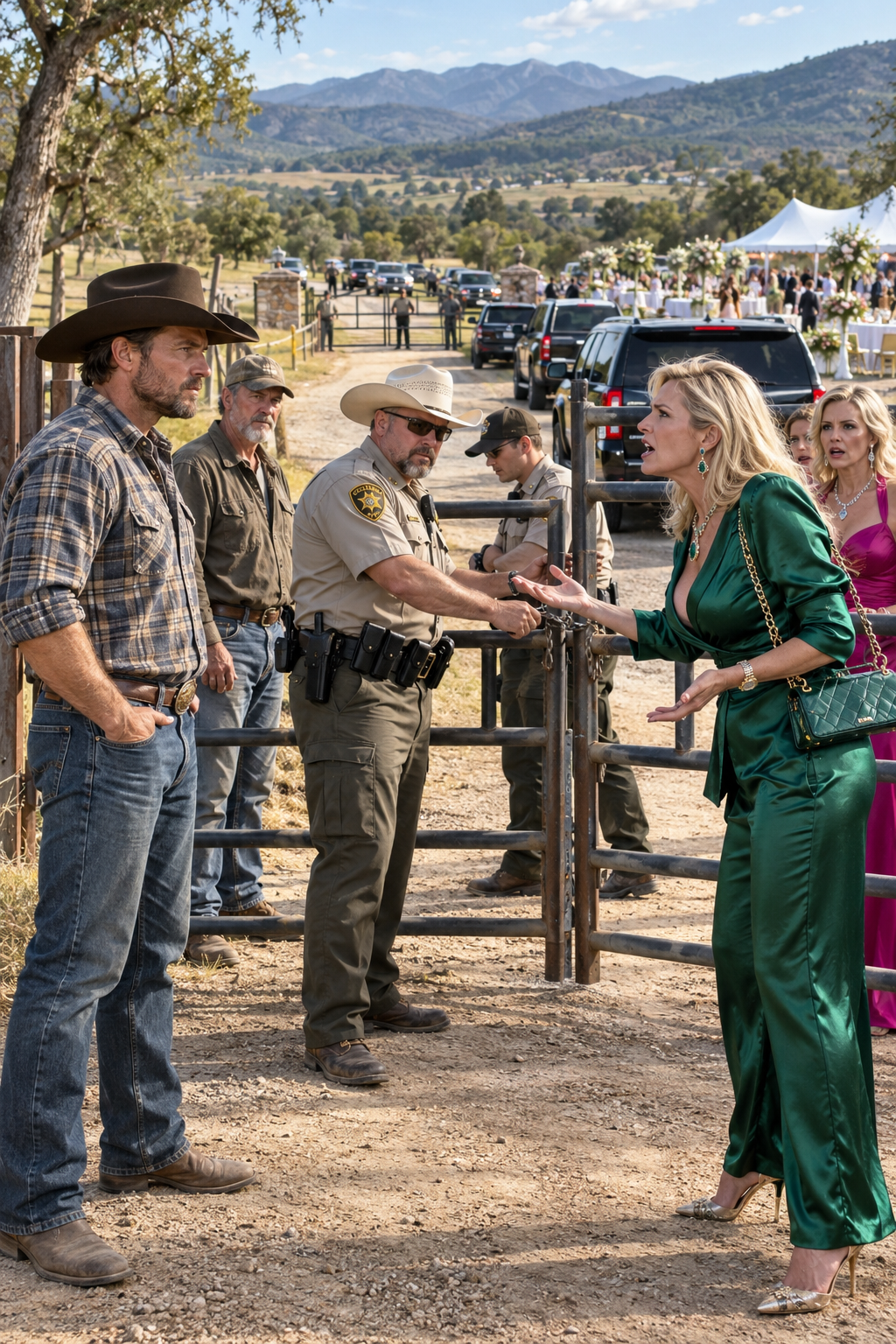
HOA Karen Claimed My Ranch Road for Her Charity Gala—By Noon, the Sheriff Had Locked Every Gate She Needed
Three days after we buried my father, my brother handed me a cardboard box and told me I had forty-eight hours to get out of the house where I had cared for Dad for eleven years.
Then Karen Whitmore, president of the Cedar Ridge Homeowners Association, walked into my kitchen without knocking and informed me that the ranch road my family had owned since 1948 now belonged to her community.
“You can keep the sentimental things,” my brother said.
Karen smiled at me across my father’s oak table.
“We just need the useful parts.”
I looked at both of them.
Grant had Dad’s old leather ranch ledger tucked under his arm.
Karen had a glossy event binder pressed against her emerald blazer.
Outside the window, two men in yellow safety vests were already measuring the width of our west gate.
I didn’t raise my voice.
I didn’t ask how Grant could do this.
I didn’t remind him that I had slept in a recliner beside Dad’s hospital bed during his final winter while Grant visited twice.
I only reached into the pocket of my jeans and touched the little brass key Dad had given me six hours before he died.
It was smaller than my thumbnail.
Dark around the edges.
One word had been scratched into it by hand.
Karen mistook my silence for surrender.
Grant mistook it for grief.
That was their first mistake.
My name is Eleanor Hale.
I was fifty-eight years old when my family decided I was finally weak enough to erase.
For most of my adult life, people had mistaken quiet for weakness.
Dad never did.
“Silence makes impatient people careless,” he once told me.
He had said it twenty-three years earlier while we sat on the tailgate of his Ford watching a thunderstorm crawl over the Wyoming hills.
Back then, I thought he was talking about cattle.
I learned later he meant people.
By the week of his funeral, I had already lost my mother, my marriage, the teaching career I’d loved, and most of my savings.
I had left Colorado at forty-seven when Dad suffered his first stroke.
Grant had said he couldn’t come home because his real estate company was “finally taking off.”
My younger sister Melissa had two children and a husband who considered ranch work beneath him.
At first, everyone called it temporary.
Temporary became one year.
One year became four.
Four became eleven.
I handled Dad’s insulin.
I drove him seventy-four miles to his cardiologist.
I fixed fence posts in February.
I learned how to change the hydraulic line on a 1998 John Deere because there was nobody else to do it.
I refinanced my small condo in Fort Collins when the ranch had a terrible winter and Dad was too proud to ask Grant for money.
Grant still posted Christmas pictures from ski resorts.
Melissa still called me lucky because I “got to live rent-free.”
Dad heard her say that once.
He didn’t respond.
He only looked down at his coffee.
That look stayed with me.
I remembered the ambulance lights.
I remembered the unpaid bills.
I remembered the nights Dad couldn’t stand without my arm under his shoulder.
I remembered every family dinner where Grant discussed what he would “modernize someday.”
I remembered the way they spoke about Hale Ranch as if I were merely the woman keeping it warm until the real heirs arrived.
And I remembered Dad’s final lucid evening.
He had been fading for two days.
His breathing had become shallow.
The room smelled like antiseptic, cedar oil, and the chicken soup Mrs. Bell from down the road had left untouched on the stove.
At eleven twenty-six that night, Dad opened his eyes.
I leaned closer.
“I’m here.”
His fingers moved beneath the blanket.
“Your desk?”
“Bottom drawer.”
I went to the rolltop desk in the corner.
The bottom drawer appeared empty.
“Under,” he whispered.
I ran my hand beneath it.
My fingers found tape.
A brass key came loose.
When I returned to his bed, Dad’s eyes were still open.
“Don’t use it until they take something that isn’t theirs.”
I thought medication had confused him.
Dad’s mouth tightened.
“Family first.”
He drew another breath.
“Then Cedar Ridge.”
That woke me up.
Cedar Ridge was the luxury development built along the eastern boundary of Hale Ranch.
Eight years earlier, eighty-six oversized houses had appeared where cattle pasture had once stretched to the creek.
The developers had sold residents a fantasy.
Mountain views.
Private trails.
“Historic ranch access.”
A country lifestyle without the inconvenience of actual country people.
Their HOA president, Karen Whitmore, was a fifty-two-year-old former event planner who wore riding boots that had never touched manure.
She had spent five years trying to turn our private gravel road into the subdivision’s western entrance.
Dad refused every request.
Then every offer.
Then every threat disguised as an offer.
Cedar Ridge’s main entrance opened onto Highway 14.
Our ranch road connected to County Road 6.
Using our property would shorten the drive to town by nearly twelve minutes.
It would also double the value of the lots on their western side.
Dad understood that.
Karen definitely understood that.
Three months before he died, she had offered him $380,000 for a permanent easement.
He laughed.
Two weeks later, she offered $600,000.
He told her the road wasn’t for sale.
Then came a letter claiming Cedar Ridge had “historical access rights.”
Dad took the letter to his attorney.
Nothing happened.
Or so I thought.
On his deathbed, he squeezed my hand.
“Make them show you the paper.”
“What paper?”
“The one they think I never saw.”
Then he closed his eyes.
Those were nearly his last words.
Six hours later, he was gone.
The funeral was held on Monday.
Grant arrived Sunday afternoon in a black Mercedes SUV with California plates.
Melissa arrived with her husband Wade and two matching suitcases.
They cried beautifully at the funeral.
Grant delivered a speech about Dad teaching us “the value of the land.”
Melissa talked about summers riding horses.
Neither mentioned that Dad’s last five Christmases had been spent with me, our ranch foreman Caleb Ruiz, and whatever pie Mrs. Bell dropped off.
Tuesday morning, Grant announced there would be a “family meeting.”
By Wednesday, I was being evicted.
“You can’t evict me from Dad’s house two days after the funeral,” I said.
Grant sighed like I had disappointed him.
“It’s an estate property, Ellie.”
“So the estate needs to be managed professionally.”
“I’m executor.”
That part was true.
Dad’s will, written fourteen years earlier, named Grant executor.
At the time, Dad still believed Grant would eventually come home.
Karen stepped closer to the table.
“This doesn’t need to be unpleasant.”
I looked at her.
“I don’t remember inviting you into this conversation.”
Grant rubbed his forehead.
“Karen is here because there’s a time-sensitive issue.”
She opened her binder.
On top was a color rendering of tents, parking rows, shuttle routes, portable stages, and a giant white rectangle labeled CEDAR RIDGE LEGACY WEEKEND.
Our ranch road ran straight through the middle.
I looked up.
“What is this?”
Karen brightened.
“Our largest annual community event.”
“On my road?”
“The west access corridor.”
“You mean my road.”
She gave me the careful smile adults use with difficult children.
“The legal situation is more nuanced than that.”
I almost smiled.
“What legal situation?”
Grant placed Dad’s old ledger on the table.
“Dad was apparently mistaken about some old access boundaries.”
There it was.
The paper they thought Dad never saw.
Not literally.
Grant pushed a photocopy toward me.
It was a road-use agreement dated September 18, 1979.
The agreement appeared to grant “successors, assigns, residents, guests, and invitees” the right to use the western ranch road.
Dad’s signature was at the bottom.
I recognized it immediately.
And just as quickly, I knew something was wrong.
Dad signed his name Thomas J. Hale.
The document said Thomas James Hale.
Karen watched my face carefully.
“Your father granted access decades ago.”
I didn’t argue.
That disappointed her.
She flipped to another page.
“Cedar Ridge has relied upon the recorded right-of-way.”
“Has anyone in Cedar Ridge ever used this road?”
“The access was dormant.”
Karen’s jaw shifted slightly.
“It remains legally valid.”
I looked at Grant.
“And you believe this?”
Grant spread his hands.
“It’s recorded.”
“The county archive.”
“You saw the original?”
His hesitation lasted less than a second.
“No reason to.”
Interesting.
I folded the photocopy once and put it in my pocket.
Karen reached for it.
“That is our copy.”
“I’ll return it.”
She stared at me.
Grant said, “Ellie.”
“Forty-eight hours, right?”
His shoulders relaxed.
He actually thought I had surrendered.
I nodded toward Karen.
“And the event?”
“Saturday,” she said.
Four days away.
“How many people?”
“Approximately nine hundred.”
I looked out the window again.
The men in yellow vests were driving orange stakes beside Dad’s cattle guard.
“How many vehicles?”
She hesitated.
“Several hundred.”
“And you’re sending them through an active ranch?”
“We’ll have professional traffic control.”
“Livestock?”
“Grant has agreed that the cattle can be moved temporarily.”
My eyes returned to my brother.
“You agreed?”
“It’s one weekend.”
“They’re calving.”
“Caleb can handle it.”
That was the moment Grant stopped being my irritating younger brother and became something else.
He had never watched a calf freeze beside its exhausted mother.
He had never spent two hours in sleet pulling one backward through a difficult delivery.
But he was willing to move a herd of pregnant cows because Karen wanted decorative hay bales and easier parking.
I felt something inside me become very still.
“How much?”
Grant frowned.
“How much is she paying you?”
Karen’s expression changed.
Grant’s did not.
That gave me the answer.
“Nothing,” he said too quickly. “This is about preserving the value of the estate.”
“Of course.”
Then I carried my coffee to the sink.
Behind me, Karen said, “There’s one more thing.”
“The ranch residence may need to remain vacant through the event for insurance purposes.”
“So now I’m leaving tonight?”
Grant looked uncomfortable.
“Friday morning.”
Karen smiled.
“Thursday would be easier.”
I dried my hands.
“Thursday it is.”
Neither of them expected that.
Melissa arrived an hour later with boxes.
Not to help me.
To claim furniture.
Mom’s china.
The walnut sideboard.
Dad’s saddle collection.
A cedar chest our grandfather had built.
She put yellow sticky notes on things she wanted.
By lunch, half the house looked like a yard sale planned by vultures.
I packed one suitcase.
Then another.
I took my clothes.
My mother’s recipe book.
Three photographs.
Dad’s pocketknife.
And a battered green metal cashbox I found under the floorboard in his office.
The brass key marked RUTH opened it.
Inside was no cash.
No jewelry.
No stock certificates.
There were four things.
A folded survey map from 1951.
A handwritten letter from my grandmother Ruth.
A sealed envelope addressed to me in Dad’s handwriting.
And a small black flash drive.
I sat on the office floor with dust on my jeans.
For several seconds, I couldn’t move.
Then I opened Dad’s envelope.
If you are reading this, they have finally tried to take the road.
Do not fight them over the house.
Do not fight them over the furniture.
Do not fight them over anything they are prepared to brag about owning.
Make them put every claim in writing.
Make them use the road.
Make them commit.
Then call Samuel Mercer.
Trust no copy dated 1979 unless you have seen Book 418, Page 72.
The road is not mine to give them.
It was never mine.
It was Ruth’s.
And Ruth made certain it would outlive all of us.
I had to read that last paragraph twice.
Then I unfolded my grandmother’s letter.
Ruth Hale had died when I was seven.
My memories of her were small.
Peppermint candies.
Strong hands.
Blue dresses.
A laugh that frightened birds from the porch railing.
The letter was dated June 2, 1988.
One day somebody will offer you enough money that selling the west road will feel reasonable.
That road was paid for twice.
Once with money.
Once with humiliation.
Your father’s people nearly lost this ranch because the Mercer Bank foreclosure was designed to take the water and leave us the debt.
My sister Evelyn stopped it.
She used the settlement from the railroad case to buy the western strip under her own name, then placed it into the Ruth-Evelyn Agricultural Preservation Covenant.
You may maintain the road.
You may cross it.
Your children may cross it.
But nobody may sell access to a private development.
If anyone tries, the covenant transfers enforcement authority to the direct descendant who has continuously worked or maintained Hale agricultural operations for five consecutive years.
Land remembers who cared for it.
Make sure your children do too.
I stared at those words.
Continuously worked or maintained Hale agricultural operations for five consecutive years.
Grant hadn’t spent five consecutive days working the ranch since college.
Melissa hadn’t repaired a fence since she was sixteen.
I had been here eleven years.
I reached for my phone.
Samuel Mercer answered on the fourth ring.
“Mercer Law.”
“Is this Samuel Mercer?”
“My name is Eleanor Hale.”
Then his voice changed.
“Thomas’s daughter?”
“He died Saturday.”
Samuel exhaled slowly.
“I’m sorry.”
“He told me to call you if anyone tried to take the west road.”
Another silence.
This one felt different.
“Who tried?”
“Cedar Ridge.”
“How far have they gone?”
“They’ve scheduled nine hundred people to drive across it Saturday.”
Samuel swore softly.
“Has Grant signed anything?”
“I don’t know.”
“Find out.”
“He thinks I’m leaving.”
I looked around Dad’s office.
The empty shelves.
Melissa’s yellow stickers.
My suitcase by the door.
That surprised me.
“Your father hoped they would try this while you were still on the ranch.”
“What exactly is Book 418, Page 72?”
“You need to see it yourself.”
“Can you tell me?”
“I can tell you this much. Your father spent six years making sure nobody could dismiss it as an old family misunderstanding.”
My pulse tightened.
“Six years?”
“He knew what Cedar Ridge wanted.”
“Why didn’t he tell me?”
“Because Thomas believed Grant would come back to his senses.”
I looked toward the kitchen.
My brother was laughing with Karen.
Samuel continued.
“Apparently he didn’t.”
By Thursday morning, my belongings fit into the back of Caleb Ruiz’s pickup and my old Subaru.
Caleb was sixty-three, bowlegged, sunburned, and had worked Hale Ranch since I was twenty-one.
He watched Grant direct a moving company toward Dad’s antique desk.
“You letting him take that?”
Caleb spat into the gravel.
“Desk belonged to your grandfather.”
“He doesn’t.”
“I know that too.”
He studied me.
“You’ve got that face.”
“What face?”
“The one your dad used to get right before somebody lost a lawsuit.”
I almost laughed.
Instead I handed him the cashbox.
“Keep this in your truck.”
His expression sharpened.
“What is it?”
“Insurance.”
At nine fifteen, Karen arrived with contractors.
By ten, temporary event signs appeared along the ranch road.
CEDAR RIDGE LEGACY WEEKEND.
VIP PARKING.
SHUTTLE ROUTE.
FOUNDERS PAVILION.
A contractor drove steel posts into the ground twenty feet from Dad’s hay barn.
Another crew stretched electrical cable across pasture.
A catering truck rolled over our cattle guard.
I photographed everything.
Karen noticed.
“You don’t need to document this, Eleanor.”
“I like pictures.”
“Grant authorized the work.”
“That’s good.”
She narrowed her eyes.
“You’re taking this surprisingly well.”
“I’ve had a difficult week.”
Her expression softened with false sympathy.
“Grief can make legal conflicts feel more personal than they are.”
“I’m sure.”
She waited for more.
I gave her nothing.
At eleven, Melissa cornered me in the mudroom.
“Why are you acting like this?”
“Like what?”
“Would you prefer screaming?”
“No. It’s just weird.”
That almost made me laugh.
She lowered her voice.
“Grant says the road deal could help all of us.”
There it was.
“What deal?”
“What road deal, Melissa?”
She looked toward the kitchen.
“Ask Grant.”
“I’m asking you.”
She sighed.
“Cedar Ridge wants a permanent access agreement.”
“How much?”
“I don’t know.”
I kept looking at her.
“Okay. Around two million.”
The number landed exactly where I expected.
“And Grant signed?”
“Because the estate isn’t settled.”
“So Saturday is what?”
Melissa looked irritated.
“A demonstration.”
“A demonstration of what?”
“That access works.”
I nodded slowly.
Karen wasn’t hosting a charity event on our road because it was picturesque.
She was using nine hundred invited guests to establish a pattern of use.
And Grant was helping.
“How much do you get?” I asked.
Melissa flushed.
“That isn’t fair.”
“How much?”
“One-third. Same as you.”
That unsettled her more than anger would have.
“You really think I’m getting a third?”
She said nothing.
I leaned closer.
“Did Grant tell you Karen’s offering two million?”
“Did Karen tell you?”
“Interesting.”
“What’s that supposed to mean?”
I picked up my suitcase.
Melissa followed me outside.
“You’re not going to challenge Dad’s will, are you?”
There it was.
The family’s true fear.
Not my grief.
Not my home.
Not whether I had somewhere to sleep.
“I haven’t decided.”
She folded her arms.
“Dad wanted things divided equally.”
“Then you have nothing to worry about.”
I placed my suitcase in the Subaru.
She stood behind me.
“Grant thinks you might claim caregiver reimbursement from the estate.”
I closed the hatch.
“That could get ugly.”
“Because we’re family.”
I looked at her for a long moment.
Then I said the one thing that finally made her look ashamed.
“So was Dad.”
I drove away at noon.
Caleb had a spare room above his detached garage three miles south.
From the window, I could see the western ridge of Hale Ranch.
Friday morning, Samuel Mercer met me at the county recorder’s office.
He was seventy-one, tall, silver-haired, and moved like a man who still believed every hallway was a courtroom.
He carried no briefcase.
Only a yellow legal pad.
The clerk brought us Book 418.
It was enormous.
Heavy canvas binding.
Dust along the spine.
Page 72 held a covenant recorded August 4, 1952.
I read it once.
Then again.
Ruth Hale and her sister Evelyn had placed a 63-foot-wide strip of land stretching 4.7 miles from County Road 6 to the interior ranch boundary into an agricultural preservation covenant.
The west road.
The covenant was permanent.
Nontransferable.
And explicitly prohibited use “for residential subdivision access, commercial event traffic, speculative development, or purposes materially inconsistent with agricultural operations.”
My skin prickled.
Samuel turned the page.
Attached was a later amendment.
One year before Karen’s mysterious access agreement.
It required any future road-use modification to be signed by three people.
The current ranch owner.
The agricultural operations beneficiary.
And the trustee.
Dad could never have granted the easement alone.
“Who was trustee?” I asked.
Samuel pointed.
“Mercer County Agricultural Trust.”
“And in 1979?”
“My father.”
“Would he have approved Cedar Ridge access?”
Samuel smiled faintly.
“My father once sued a shopping mall because its drainage pipe frightened his chickens.”
I laughed for the first time since Dad died.
Then Samuel placed another document beside the book.
A forensic report.
“What is this?”
“Your father ordered it last year.”
My smile vanished.
The 1979 agreement Karen had shown me had been examined by a document specialist.
The ink was modern.
The paper was old.
Dad’s signature had been copied from a livestock lease executed in 1981.
I stared at Samuel.
“Dad knew.”
“Why didn’t he go to the sheriff?”
“Because a forged document by itself doesn’t tell you who forged it.”
“Did he suspect Karen?”
“He suspected somebody wanted Cedar Ridge’s developers to believe the road rights existed before the subdivision was built.”
My mind moved quickly.
“If Cedar Ridge’s original developer knew they had no access—”
“Some western lots may have been marketed using a representation that was never legally true.”
“How much money?”
“Depending on what was disclosed?”
He looked at me.
“Millions.”
That was the first twist.
Karen wasn’t trying to create access.
She was trying to protect a lie somebody had already sold.
And my brother was about to help her.
“Why Saturday?” I asked.
Samuel tapped his pen.
“What has Karen told local government?”
“I don’t know.”
“Find out.”
By Friday afternoon, we had copies of Cedar Ridge’s event application.
Karen had requested a county mass-gathering permit for 900 attendees.
The application listed two emergency exits.
The main Cedar Ridge entrance.
And Hale Ranch Road.
She had certified that the HOA possessed legal use rights to both.
Without our road, the event did not meet emergency evacuation requirements.
Samuel looked at me.
“There’s your leverage.”
I shook my head.
“I don’t want leverage.”
“What do you want?”
I thought about Grant’s cardboard box.
Melissa’s yellow stickers.
Karen telling me grief made legal problems personal.
Dad gasping through his last night.
“I want them to keep going.”
Samuel studied me.
Then slowly smiled.
“You are definitely Thomas Hale’s daughter.”
Friday evening, I called Grant.
He answered on speakerphone.
Music was playing behind him.
Probably at the ranch house.
“Quick question.”
“Did Dad ever sign a permanent Cedar Ridge access agreement?”
Then, “We’ve already discussed this.”
“No. You showed me a 1979 document. I’m asking whether you’ve signed anything new.”
His voice hardened.
“That’s estate business.”
“I’m an heir.”
“And I’m executor.”
People hate silence when they’re lying.
Grant filled it.
“I may have signed a limited temporary event license.”
“For Saturday?”
“Did Karen pay the estate?”
“This isn’t your concern.”
“How much?”
“Did she pay you personally?”
That answer was fast.
I wrote it down.
He sounded confused.
“That’s it?”
“Why did you call?”
“I wanted to make sure the event was authorized.”
I heard him exhale.
Before hanging up, I asked, “Grant?”
“Did you read everything Dad left in the office?”
“What do you mean?”
Then I ended the call.
Saturday morning dawned bright and cold.
Perfect Wyoming September weather.
By seven, shuttle vans were lined along County Road 6.
By eight, caterers were entering Hale Ranch through the west gate.
By eight thirty, two men wearing Cedar Ridge security jackets had replaced Dad’s chain with an electronic temporary gate.
They had attached a sign.
AUTHORIZED EVENT ACCESS ONLY.
At nine fourteen, Karen texted me.
Your remaining storage items must be removed by Sunday evening. After that the estate cannot guarantee them.
I saved the message.
At nine thirty, Samuel and I parked at the Crossroads Diner.
He ordered black coffee.
I ordered nothing.
“Still sure?” he asked.
“Once we send these documents, this gets large.”
At nine forty-three, he emailed the recorded covenant, forensic report, original survey, and event permit to the county attorney.
At nine forty-five, I sent them to Sheriff Daniel Reeves.
At nine forty-seven, I sent the sheriff photographs of event crews opening cattle pens and moving fencing.
At nine fifty-one, Caleb called.
“They opened North Three.”
My chair scraped backward.
“Event crew moved the temporary panel because they wanted shuttle parking.”
“There are cows in North Three.”
“Forty-eight pairs.”
I was already moving.
“Close the inner cattle gate. Don’t confront anyone.”
“I can handle Karen.”
“I know. Don’t.”
Samuel followed me outside.
“What happened?”
“They opened a pasture.”
That changed the moral equation immediately.
Legal games were one thing.
Putting animals and drivers at risk was another.
We drove toward the ranch.
Traffic was already backing up along County Road 6.
Luxury SUVs.
Rental vans.
Pickup trucks polished too clean for ranch use.
Women in wide-brimmed hats.
Men in sports coats.
A local TV van.
Karen had turned my father’s gravel road into a parade.
When we reached the west gate, a private security guard raised one hand.
“Event credentials?”
I rolled down my window.
“This is my family’s ranch.”
“Event credentials?”
Samuel leaned toward me.
“Stay calm.”
I was calm.
I looked at the guard.
“What company are you with?”
“Frontier Event Security.”
His confidence slipped.
“Because you’re blocking a beneficiary of the estate from entering estate property under authority issued by someone who may not have legal control of this road.”
He stepped back.
“I’ll get my supervisor.”
A sheriff’s cruiser appeared behind us.
Then another.
The first deputy got out.
“Ms. Hale?”
“I’m Deputy Collins. Sheriff Reeves needs to speak with you.”
The security guard suddenly became very interested in the gravel.
Sheriff Reeves arrived eight minutes later.
He was forty-six, broad-shouldered, and had the permanently tired expression of a man who had spent twenty years listening to neighbors argue about fences.
He shook Samuel’s hand.
“I’ve reviewed what you sent.”
“I have some questions.”
Karen’s golf cart appeared before he could ask them.
She wore a cream-colored riding jacket, dark sunglasses, and the expression of someone irritated that law enforcement had arrived without being scheduled.
“What’s going on?”
Sheriff Reeves turned.
“Karen Whitmore?”
“You’re the applicant for today’s mass-gathering permit?”
“I’m the HOA president.”
“That’s not what I asked.”
Her mouth tightened.
He held up a printed copy.
“You certified two emergency evacuation routes.”
“One is this road.”
“Show me your recorded right of access.”
Karen looked toward me.
“This is an estate dispute.”
Sheriff Reeves didn’t move.
She opened a leather folio.
Of course she had the 1979 copy ready.
He read it.
Then looked at Samuel.
Samuel handed him the forensic report and Book 418 copies.
Karen’s face remained calm.
But her fingers tightened around the folio.
Sheriff Reeves asked, “Have you seen the underlying covenant?”
“That document is irrelevant.”
“Our agreement supersedes it.”
“According to whom?”
“Our counsel.”
“Richard Cole.”
Samuel looked at me.
I knew that name.
Richard Cole was Cedar Ridge’s original development attorney.
The man who would have reviewed title before the first house was sold.
Sheriff Reeves handed the photocopy back.
“I’m suspending use of this entrance until county counsel reviews the conflict.”
Karen laughed once.
“You cannot close our emergency access during an active event.”
“If it isn’t legal access, it isn’t your emergency access.”
“We have nine hundred guests.”
“You have how many on site now?”
“Approximately six hundred.”
“And how many vehicles?”
“I don’t know.”
“You signed the permit.”
“Perhaps two hundred fifty.”
Reeves turned to Deputy Collins.
“Stop incoming traffic.”
Karen stepped forward.
He looked at her.
“You don’t want more cars entering a site that may have only one lawful exit.”
Her face changed.
Just slightly.
“That’s unnecessary.”
“No,” Reeves said. “It’s math.”
At ten twenty-seven, deputies stopped incoming vehicles.
That was our first payoff.
It was small.
But satisfying.
Then Caleb came racing down the ranch road in his pickup.
He braked hard near the gate.
I hurried toward him.
“What happened?”
“Two calves are loose.”
Sheriff Reeves heard him.
“South drainage.”
Karen removed her sunglasses.
“That’s nowhere near the event.”
Caleb stared at her.
“Your contractor opened North Three.”
“That pasture was supposed to be empty.”
“According to who?”
She looked toward Grant.
I hadn’t noticed him arriving.
He stood beside the white registration tent wearing Dad’s brown felt ranch hat.
Something in me nearly broke.
Not loudly.
Not dramatically.
Just one clean crack inside my chest.
Grant approached.
“I told them the cattle would be relocated.”
“You told them?” I asked.
“You were supposed to handle that.”
“You still manage operations.”
“So I’m too irrelevant to live in the house but important enough to move forty-eight cow-calf pairs for your party?”
His face reddened.
“This isn’t the time.”
Sheriff Reeves stepped between us.
“Mr. Hale, did you authorize opening occupied cattle pasture?”
“I authorized event use.”
“That isn’t what I asked.”
Grant glanced at Karen.
That was another mistake.
The sheriff noticed.
“I assumed the livestock had been moved,” Grant said.
Caleb muttered something in Spanish.
The sheriff continued.
“Do you hold current legal authority over ranch operations?”
“I’m executor.”
Samuel finally spoke.
“Executor of the estate, yes. The road parcel appears to be held outside the probate estate.”
Grant turned toward him.
“Who the hell are you?”
“Samuel Mercer.”
Recognition hit him.
Dad had mentioned Samuel before.
Grant’s confidence changed.
“Dad’s old lawyer?”
“Among other things.”
Karen cut in.
“This is becoming absurd.”
Then we heard screaming.
Not human panic exactly.
More like startled shouting.
A black yearling calf came running around the bend between parked cars.
People scattered.
A woman dropped a champagne glass.
A man jumped onto the hood of a Lexus.
The calf slipped on gravel, recovered, and bolted toward a row of catering tables.
Behind it came Caleb’s border collie, Maggie, working low and fast.
I was moving before anyone else.
“Clear the road!”
A security guard tried to grab the calf.
“Don’t touch it!”
He ignored me.
The calf spun.
Its hind leg clipped his knee.
He went down.
Maggie pushed the animal away from the crowd.
Caleb whistled.
The calf turned toward open pasture.
I grabbed a temporary crowd barrier, swung it across the catering entrance, and created a funnel.
Caleb shouted, “That’s it!”
Maggie drove the calf through.
Ten seconds later, it was back behind a closed panel.
Nobody was seriously hurt.
But six hundred wealthy guests had just learned why ranch gates existed.
Sheriff Reeves looked at Karen.
“Your event is suspended.”
She stared at him.
“You cannot be serious.”
“We paid forty thousand dollars for today.”
“That does not make the cattle disappear.”
“We can contain the animals.”
“They were contained.”
His gaze shifted to the opened pasture.
“Before you arrived.”
That was the second payoff.
At ten forty-six, event staff began telling guests to remain in designated areas.
At eleven, county emergency management arrived.
At eleven seventeen, the fire marshal appeared.
At eleven twenty-three, things became much worse for Karen.
The fire marshal discovered Cedar Ridge had placed decorative tents across twelve feet of the subdivision’s main entrance to create what their brochure called a “grand arrival corridor.”
Vehicles could still enter single-file.
Emergency trucks could not.
He ordered the tents removed immediately.
Karen argued.
The fire marshal didn’t.
Then Deputy Collins returned from the eastern gate.
He spoke quietly to Sheriff Reeves.
The sheriff’s expression hardened.
“What?” I asked.
Reeves looked at Karen.
“Who authorized locking the service gate?”
Karen blinked.
“What service gate?”
“The north emergency service gate between Cedar Ridge and County Fire Access 9.”
“That gate is normally locked.”
“Not during permitted events.”
“It keeps residents from cutting through.”
“Your permit requires it open.”
Grant muttered, “Jesus.”
Karen snapped, “That gate belongs to the HOA.”
The sheriff’s eyes narrowed.
“You currently have six hundred people inside a development with a disputed western exit, a narrowed eastern entrance, and a locked northern emergency gate.”
“We can open it.”
Karen grabbed her phone.
Nobody answered.
She called again.
Then a third time.
Finally she looked at her event coordinator.
“Where is the north-gate key?”
The coordinator went pale.
“I thought you had it.”
Karen’s face went perfectly still.
The sheriff asked, “Nobody knows where the key is?”
He turned to Collins.
“Bolt cutters.”
Karen stepped forward.
“You are not cutting HOA property.”
Reeves looked at her.
“Watch me.”
At eleven thirty-six, deputies cut the chain on Cedar Ridge’s north service gate.
That was the third payoff.
And it should have ended there.
Because when the chain hit the ground, Deputy Collins found something zip-tied to the inside of the gate.
A laminated notice.
PROPERTY UNDER PRIVATE EVENT CONTROL.
AUTHORIZED BY HALE ESTATE.
Below it was Grant’s signature.
Except I had never signed it.
I stared at the page.
Sheriff Reeves stared at me.
“Ms. Hale?”
“Not my signature.”
Grant said, “What?”
I walked closer.
The name Eleanor Marie Hale had been written in a smooth imitation of my handwriting.
Not terrible.
But passable.
Samuel’s voice went flat.
“Where did that come from?”
Karen answered too quickly.
“The estate.”
Sheriff Reeves looked at Grant.
“Did you give them this?”
Grant was staring at my forged signature.
“Did you sign it?”
“My name, yes.”
“Did your sister?”
“I thought she did.”
“You thought?”
“Karen’s office sent the completed version.”
Every eye moved toward her.
Karen’s cheeks had lost color.
“This is administrative paperwork. Eleanor may have signed electronically.”
“No,” I said.
Karen looked at me.
“You were given multiple documents.”
“I signed nothing.”
“You may not remember.”
I almost admired the nerve.
She lifted her chin.
“My father died seven days ago.”
The crowd nearby had become quiet.
“I remember every document I signed this week.”
Sheriff Reeves took the notice.
“Mr. Hale, did you personally witness your sister sign?”
“Who delivered the document?”
The sheriff folded it carefully and slipped it into an evidence sleeve from his cruiser.
Karen’s voice rose for the first time.
“You’re treating a clerical issue like a crime.”
Reeves looked at her.
“Because forging somebody’s signature can be one.”
That was twist number two.
The system around Karen was no longer merely greedy.
Someone had started manufacturing consent.
At eleven forty-nine, Sheriff Reeves received a phone call from the county attorney.
He listened for nearly three minutes.
Then he hung up.
He looked at Samuel.
Then at me.
“County counsel agrees there is substantial evidence the west road cannot legally be used for this event.”
Karen stepped closer.
“Substantial evidence is not a court order.”
“So reopen the gate.”
“On what authority?”
“Public safety.”
“You are exceeding your office.”
His voice remained quiet.
“But I’d rather explain a locked gate to a judge than explain nine hundred trapped guests to a coroner.”
Karen stared at him.
At eleven fifty-eight, he told Deputy Collins:
“Secure every ranch-side access gate connected to this event.”
Karen looked stunned.
“Every gate?”
“Every one.”
“This is insane.”
The sheriff glanced at his watch.
At exactly twelve, the west gate was chained under sheriff’s order.
The temporary electronic gate was disabled.
The north cattle crossing was closed.
The maintenance gate beside the hay meadow was locked.
Deputies stationed cruisers at each ranch entrance.
Every Cedar Ridge vehicle still inside the ranch had to be directed back through the subdivision’s main entrance in controlled groups.
The Legacy Weekend collapsed before lunch.
Nine hundred printed programs became trash.
A string quartet packed up beside a portable restroom.
A local TV reporter stood near the entrance describing “an unfolding property and public-safety dispute.”
Three caterers demanded instructions nobody could give.
Guests waited in lines.
Golf carts buzzed uselessly.
Karen Whitmore stood in the middle of Dad’s road with her event binder hanging from one hand.
She had spent all week acting as though she owned the land.
At noon, she couldn’t legally open a single gate.
Grant found me beside Caleb’s truck.
“What did you do?”
I looked at him.
“Don’t give me that.”
“What exactly are you accusing me of?”
“You called the sheriff.”
“You sabotaged the event.”
“No. Karen did that when she filed a permit using property she didn’t control.”
“You knew this would happen.”
“I hoped someone would read the documents.”
He lowered his voice.
“You don’t understand what you’ve just cost us.”
“The estate.”
“How much?”
He stared at me.
“How much, Grant?”
He looked away.
I knew then two million wasn’t the real number.
“What did you sign?”
“Nothing permanent.”
“That wasn’t my question.”
He rubbed both hands over his face.
“Karen paid a nonrefundable access deposit.”
“How much?”
“Two hundred fifty thousand.”
“To the estate?”
I felt cold.
“What does mostly mean?”
“Some expenses were reimbursed.”
“Your expenses?”
“It was legitimate consulting.”
“How much?”
He didn’t answer.
Samuel walked toward us.
Grant saw him and stepped back.
“I’m not discussing estate business without my attorney.”
“Good idea,” Samuel said.
Grant walked away.
I watched him go.
I should have felt triumphant.
Instead, I felt tired.
That was my brother.
The same boy who once broke his arm jumping from the loft because I dared him.
The same boy who cried into my shoulder when our mother died.
Greed rarely arrives wearing a villain’s face.
Sometimes it wears the face you grew up across from at the breakfast table.
By two, the event had been fully evacuated.
By three, the fire marshal had issued three citations.
By four, the county had opened an investigation into the permit application.
At five fifteen, Sheriff Reeves asked Karen to come to his office Monday morning with all documents relating to Hale Ranch access.
She left without looking at me.
Grant disappeared before cleanup ended.
Melissa called me that evening.
I didn’t answer.
She called again.
Then texted.
PLEASE CALL ME. GRANT DIDN’T TELL ME EVERYTHING.
I stared at the message for nearly a minute.
Then put my phone face down.
Caleb made chili.
Samuel stayed for dinner.
We sat at Caleb’s kitchen table beneath an old ceiling fan that clicked every third rotation.
For the first time in seven days, nobody asked me for anything.
After dinner, Samuel opened his yellow legal pad.
“Now comes the difficult part.”
“I thought today was difficult.”
“Today was spectacle.”
He tapped the page.
“Monday is law.”
He explained that the preservation covenant gave me standing to challenge unauthorized road use.
Because I had continuously maintained ranch operations for more than five years, enforcement authority likely transferred to me upon Dad’s death.
But the ranch house, cattle, equipment, mineral rights, and most agricultural acreage remained part of Dad’s estate.
Grant was still executor.
Unless removed.
“Can we remove him?”
“Possibly.”
“For taking Karen’s money?”
“That helps.”
“For letting her forge my name?”
“If he knew.”
“He says he didn’t.”
Samuel nodded.
“And we need evidence before claiming otherwise.”
“What about the road?”
“The road is easier.”
“How easy?”
“Would you like to know why Thomas told you not to fight over the house?”
I leaned back.
“Because the house isn’t where the value is.”
I thought about the map inside Dad’s cashbox.
“The road?”
“Not exactly.”
He pulled out a copy of the 1951 survey.
“Look here.”
A thin shaded line ran beneath the western strip.
“What is that?”
“Old irrigation conveyance.”
“There hasn’t been irrigation on that side in forty years.”
He pointed farther north.
“The original Ruth-Evelyn covenant included water delivery rights from Mercer Creek.”
My heart started beating faster.
“Cedar Ridge has a water problem.”
I knew that.
Everyone did.
Their wells had fallen dramatically after several dry summers.
The HOA had spent years fighting over restrictions.
Samuel continued.
“Your father discovered six years ago that Cedar Ridge’s backup municipal connection crosses the western strip.”
I stared at him.
“They buried a pipe under our road?”
“With Dad’s permission?”
I thought of Karen.
“What did he do?”
“Nothing immediately.”
“Dad would never ignore that.”
“He didn’t.”
Samuel’s eyes sharpened.
“He documented it.”
Of course he had.
“For six years?”
“Photos. Surveys. contractor invoices. utility correspondence.”
“Why not sue?”
“He was waiting to determine who authorized it.”
My stomach tightened.
Samuel closed the map.
“That’s what the flash drive is for.”
We plugged Dad’s black drive into Caleb’s laptop.
There were seventeen folders.
CEDAR RIDGE.
That folder stopped me.
Samuel saw it too.
Neither of us spoke.
I opened WATER first.
Dozens of scanned documents appeared.
Engineering drawings.
A 2019 construction agreement.
The contractor listed the property contact as Thomas Hale.
The signature was fake.
Same pattern.
Someone had used Dad’s identity to authorize underground work.
Then I opened one email.
From Richard Cole, Cedar Ridge’s attorney.
To Karen Whitmore.
May 6, 2019.
Need clean landowner authorization before installation. Existing covenant language remains problematic. Do not circulate old title report outside board.
Karen replied:
Grant believes his father will not pursue litigation as long as family benefits are preserved.
My mouth went dry.
Samuel leaned toward the screen.
“Open the attachment.”
It was a payment ledger.
Three transfers.
HALE DEVELOPMENT CONSULTING LLC.
Grant’s company.
I stared at the screen.
The room became very quiet.
Caleb whispered, “Son of a bitch.”
Grant had not stumbled into Karen’s scheme after Dad died.
He had been inside it for years.
Dad knew enough to investigate.
Maybe not enough to confront him.
Maybe he hadn’t wanted to believe it.
My phone buzzed.
Melissa again.
This time I answered.
She was crying.
Not delicate funeral crying.
Real crying.
“Ellie, you need to listen to me.”
“I’m listening.”
“Grant said the road agreement was old. He said Dad knew.”
“I found his contract.”
“What contract?”
“With Cedar Ridge.”
Samuel reached for a pen.
Melissa continued.
“It’s in Dad’s desk. Grant left his briefcase here.”
“What does it say?”
“I don’t understand all of it.”
“Read the heading.”
Paper rustled.
“Strategic Access and Infrastructure Settlement.”
Samuel’s eyes met mine.
“March 4, 2025.”
Dad had still been alive.
“Hale Development Consulting, Cedar Ridge HOA, and RidgeLine Residential Holdings.”
I knew that last name.
RidgeLine was the original developer.
“Keep reading.”
Melissa sniffed.
“There’s a clause about payments upon establishment of continuous western access.”
“How much?”
“Seven point eight million dollars.”
Even Samuel sat back.
Not two million.
Not a weekend event.
$7.8 million.
My brother’s consulting company would be paid if permanent access was established.
The “charity gala” had been evidence.
If hundreds of guests used the road without objection, Karen and Grant intended to argue the access right had been recognized.
They thought Dad’s death had finally removed the obstacle.
They thought my eviction removed the witness.
They thought my silence meant I didn’t understand.
Melissa whispered, “There’s another clause.”
“RidgeLine gets an option.”
“The western ranch acreage.”
“How much acreage?”
Paper rustled.
“Four hundred eighty acres.”
The best developable land on the ranch.
Mountain views.
Creek frontage.
Direct highway access if the road became theirs.
“What price?” I asked.
“Four point two million.”
Caleb laughed without humor.
“That land’s worth four times that.”
Grant knew too.
That wasn’t a sale.
It was a transfer.
“Melissa,” I said quietly, “take photographs of every page.”
“Do not tell Grant.”
“He’s already asking where his briefcase is.”
“Where are you?”
“Dad’s house.”
“Take pictures and leave.”
For once, my younger sister didn’t argue.
Twenty-three minutes later, the documents arrived on my phone.
Samuel reviewed them in silence.
Then he pointed to page eleven.
An indemnification clause.
Hale Development Consulting guaranteed that no descendant, beneficiary, agricultural operator, trustee, or covenant holder possessed a conflicting claim capable of blocking access.
Grant had signed beneath it.
He hadn’t merely betrayed me.
He had legally promised that I did not matter.
That hurt more than the money.
I sat there looking at his signature.
All those years I drove Dad to physical therapy, Grant had been planning how to profit when he died.
All those evenings I changed dressings on Dad’s legs, Grant had been assuring developers I had no claim.
Every sacrifice had made me invisible enough for the scheme to work.
Or so he thought.
On Monday morning, Samuel filed an emergency petition in district court.
By ten thirty, the judge issued a temporary restraining order.
No party could use, alter, encumber, sell, license, or develop the western road parcel.
No permanent access documents could be recorded.
No excavation could occur within the covenant boundaries.
Grant’s authority over the road was suspended pending review.
At eleven seventeen, another order arrived.
The probate court froze unusual estate transactions.
At noon, Sheriff Reeves executed a search warrant on Cedar Ridge’s HOA office for records connected to the forged event authorization.
Karen was not arrested.
Neither was Grant.
That disappointed Caleb.
“It takes time,” Samuel reminded him.
Tuesday brought another mini-payoff.
The bank handling Dad’s estate froze the $250,000 event deposit after discovering Grant had transferred $90,000 to his consulting company.
Wednesday brought another.
Two Cedar Ridge board members hired separate attorneys.
Thursday brought the best one yet.
Richard Cole resigned as HOA counsel.
Friday morning, his attorney contacted the county prosecutor.
He wanted to talk.
Karen stopped answering reporters.
Grant stopped answering everyone.
Melissa moved into a hotel.
And I returned to Hale Ranch.
Not because the estate had been settled.
Not because I owned the house.
That was still disputed.
I returned because the judge appointed me temporary agricultural operations manager until probate issues were resolved.
When I walked through Dad’s front door, the house looked wounded.
Furniture gone.
Drawers open.
Pictures missing from walls.
His brown ranch hat was on the kitchen counter.
Grant had left it behind.
I picked it up.
Dust clung to the brim.
For a moment, I pressed it against my chest.
Then I set it back exactly where Dad used to leave it.
I didn’t want Grant’s theft to be the final memory attached to that hat.
Caleb came inside carrying mail.
“Certified letter.”
“RidgeLine.”
I opened it.
Their attorneys claimed they had been deceived about the road rights.
They threatened Grant.
They threatened Cedar Ridge.
They denied knowledge of forgery.
Samuel called that “stage one corporate amnesia.”
I called it panic.
Over the next month, the truth began coming apart layer by layer.
Grant had accepted more than $640,000 from entities connected to Cedar Ridge over six years.
Some payments were disguised as market research.
Others as consulting.
One invoice billed $42,000 for “rural transportation feasibility analysis.”
Grant’s analysis consisted of three pages.
Dad found out about the first payment eighteen months before his death.
That explained the folder.
It also explained something else.
His final year.
Dad had become colder toward Grant.
I had assumed illness made him withdrawn.
Now I understood.
He had discovered what his son was doing.
But Dad had done something Grant never expected.
He rewrote the future without rewriting his will.
Because Grant watched the will.
He didn’t watch the covenant.
He didn’t watch the agricultural trust.
He didn’t watch the water rights.
He didn’t watch the separate land instruments my grandmother had created seventy-four years earlier.
And he definitely didn’t watch me.
Three months after the failed Legacy Weekend, the court ruled that the western road was not part of Dad’s probate estate.
The preservation covenant remained valid.
The 1979 access agreement was declared fraudulent.
The road could not legally become residential subdivision access.
And because I was the only direct descendant who had continuously maintained agricultural operations for five years, enforcement control transferred to me.
Karen sat twenty feet away when the judge read the order.
For the first time since I met her, she didn’t look angry.
She looked small.
Grant sat beside his attorney.
He never looked at me.
The forged signature investigation continued.
So did the water-line investigation.
Cedar Ridge eventually admitted its emergency backup pipe crossed protected property without valid recorded authorization.
I could have demanded immediate removal.
Samuel asked what I wanted.
I thought about the eighty-six families living there.
Most had nothing to do with Karen.
Some had children.
Some were elderly.
Water wasn’t a weapon.
Dad taught me that too.
So I offered a legal utility easement.
The payments would not go to me.
I created the Ruth and Evelyn Agricultural Fund.
It would pay for veterinary scholarships, rural emergency services, and legal help for family farms facing fraudulent land claims.
Samuel read the trust documents twice.
Then looked at me.
“You realize you could personally make several million dollars from this.”
“You’re sure?”
I looked out his office window toward the winter hills.
“My grandmother didn’t protect that road so I could become Karen with better paperwork.”
The HOA voted Karen out eleven days later.
Seventy-one to nine.
Grant was removed as executor.
Melissa testified that he had misrepresented the road agreement to her.
Our relationship did not magically heal.
Real betrayal doesn’t disappear because someone apologizes.
But she started coming to the ranch on Sundays.
At first she stayed an hour.
Then three.
One afternoon she asked Caleb to teach her how to repair a fence.
He stared at her like she had requested instructions for landing a plane.
Then he handed her gloves.
Grant eventually accepted a plea agreement involving financial misconduct and falsified estate representations.
He avoided prison.
Caleb hated that.
Grant lost his company.
Most of his money.
His reputation.
And any future authority over Hale Ranch.
I thought that was enough.
Six months after Dad died, I stood beside his grave at sunset.
The grass was starting to green.
I told him the road was safe.
I told him the cattle had come through winter well.
I told him Melissa was trying.
I told him Grant wasn’t ready.
Then I placed my hand on the stone.
“You should have told me.”
Wind moved through the cottonwoods.
That was all.
No miracle.
I walked back toward the truck.
For the first time in almost a year, I thought the fight might actually be over.
I was wrong.
Caleb was waiting at the ranch house when I returned.
He stood beside the kitchen table with his hat in both hands.
That alone scared me.
“What happened?”
“Somebody came by.”
“Didn’t give a name.”
“What did they want?”
He pointed to the table.
A package sat there.
Brown paper.
No return address.
Inside was a metal document box.
Older than Dad’s.
Older than the green cashbox.
The lock had already rusted open.
Inside were photographs.
Dozens of them.
Aerial shots of Hale Ranch.
Survey markers.
Drainage channels.
Construction crews.
One photograph showed my father standing beside a man I recognized as Richard Cole.
The date printed on the back was 2004.
Eleven years before Cedar Ridge was built.
That made no sense.
Another photograph showed Dad beside Karen Whitmore.
She looked younger.
Much younger.
They were standing on the west road.
I turned it over.
April 1998.
My hands went cold.
Karen had told everyone she first learned about Hale Ranch when Cedar Ridge was developed.
That was seventeen years later.
Beneath the photographs was a sealed envelope.
My name was written across the front.
Not Dad’s handwriting.
My grandmother Ruth’s.
I stopped breathing.
Ruth had died in 1975.
Years before I was born.
Yet the envelope said:
FOR ELEANOR HALE.
I looked at Caleb.
“Did you open this?”
Samuel was forty minutes away.
Sheriff Reeves was twenty.
I should have called one of them.
Instead, I opened it.
Inside was one page.
The paper had yellowed.
The handwriting was Ruth’s.
I knew because I had spent months reading her old ranch journals.
The first sentence made me sit down.
If Thomas gives this to Eleanor, then our first plan has failed.
I kept reading.
Eleanor will believe the west road was protected because of land.
That is only partly true.
The road was protected because of what lies beneath it.
I looked at Caleb.
He whispered, “What?”
I read the next line silently.
Then again.
In 1951, during excavation after the spring flood, Evelyn and I discovered something under the western ridge that did not belong to the Hale family and could never legally be sold.
My pulse hammered.
The final paragraph was shorter.
We notified the county.
Two men came.
They told us to bury the trench and remain silent.
One was a federal official.
The other was a Mercer.
If Cedar Ridge has reached the road, somebody has forgotten the agreement.
Do not trust the county records.
Do not trust the original survey.
And if Samuel Mercer tells you he knows nothing about this, ask him why his grandfather was paid $18,000 on June 14, 1951.
I lowered the letter.
Caleb stared at me.
Neither of us spoke.
Then headlights swept across the kitchen wall.
A vehicle had entered the west road.
After dark.
Without calling.
Caleb moved toward the window.
I grabbed my phone.
The vehicle stopped outside.
A black SUV.
Government plates.
A man stepped out wearing a dark coat.
He carried a leather case.
And behind him, another vehicle appeared.
Then another.
Three black SUVs rolled to a stop in front of the ranch house Dad had spent his life protecting.
My phone rang.
Samuel Mercer.
I answered.
His voice sounded strained.
“Eleanor, whatever was delivered to you tonight, do not show it to anyone.”
I looked through the window at the men walking toward my porch.
I held Ruth’s letter in one hand.
Dad’s brass key rested beside me on the table.
And I asked the weakest-sounding question I could think of.
“Why would I have anything you’re afraid for me to read?”
✓ Lynn R. Adams
HOA Karen Claimed My Ranch Road for Her Charity Gala—By Noon, the Sheriff Had Locked Every Gate She Needed Three days after we buried my father, my brother handed me a cardboard box and told me I had…