HOA Karen Changed My Locks While I Was Deployed for Christmas—She Smirked Until Federal Marshals Sealed Her Own House
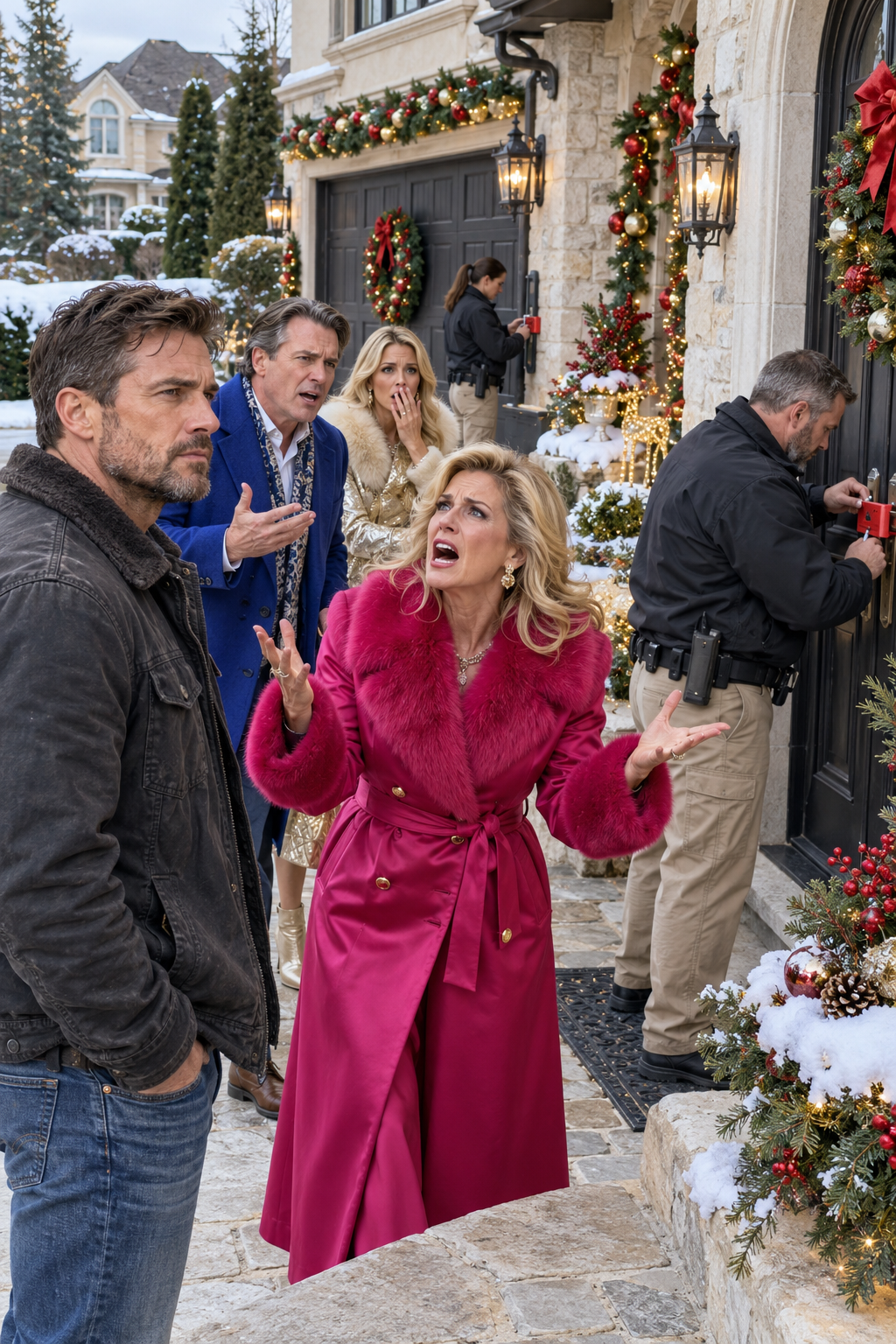
HOA Karen Changed My Locks While I Was Deployed for Christmas—She Smirked Until Federal Marshals Sealed Her Own House
The first thing I saw when I came home from deployment was a red Christmas wreath hanging on a front door I could no longer open.
The second thing I saw was a stranger standing in my kitchen.
The third was Karen Whitfield, president of the Cedar Ridge Homeowners Association, smiling from my porch and telling me, “You don’t live here anymore.”
For about three seconds, nobody moved.
Snow came down in slow, dry flakes over the quiet Virginia cul-de-sac. My duffel bag sat beside my boots. A military transport had dropped me at Richmond before sunrise, my sister had driven me the last hour, and I had spent most of that drive imagining one thing.
My own bed.
My own coffee mug.
The ridiculous wooden reindeer my late father had built twenty years earlier.
Instead, there was a silver SUV parked in my driveway.
A woman I had never seen was standing behind the living-room window holding what looked like my blue ceramic coffee mug.
And my key would not turn.
I looked at Karen.
She was fifty-eight, blond in the expensive salon way, wrapped in a white quilted coat with a fur-trimmed hood. Her boots were spotless despite six inches of snow. A Christmas pin glittered on her scarf.
She looked delighted to see me confused.
That was her first mistake.
I had spent nine months working logistics for an Army unit where confusion got people hurt. When something unexpected happened, I did not scream first.
One unfamiliar vehicle.
One unknown civilian inside my property.
One changed deadbolt.
One newly installed keypad.
One security camera attached above my garage that did not belong to me.
One woman who seemed far too comfortable committing a crime in front of witnesses.
I put my hand in my coat pocket and started recording audio on my phone.
“Say that again,” I said.
Karen’s smile widened.
“You don’t reside here anymore, Rebecca.”
My sister Lisa made a choking sound beside me.
I lifted one finger without looking at her.
“What makes you believe that?” I asked.
Karen tilted her head.
“You were gone for almost a year.”
“Nine months.”
“Whatever.”
“It matters.”
“Not to the association.”
That sentence told me more than she realized.
I glanced through the window again.
The stranger holding my mug had disappeared.
“Who’s inside my house?”
Karen sighed like I was slowing down a checkout line.
“The property has been placed under temporary community stewardship.”
“That wasn’t my question.”
“Who is inside my house?”
“A maintenance representative.”
Her mouth tightened.
“I’m not required to provide that information.”
I looked at Lisa.
“Call the sheriff’s office. Tell them the homeowner has returned from active military deployment and there are unauthorized occupants inside her residence.”
Karen laughed.
Actually laughed.
“Oh, please.”
Lisa already had her phone out.
Karen stepped toward her.
“You are wasting law enforcement’s time.”
I moved between them.
Karen stopped.
I am five foot eight. I was still wearing my travel clothes and an Army field jacket over them. I wasn’t trying to look threatening.
I didn’t need to.
“Don’t approach my sister again,” I said.
For the first time, Karen’s expression changed.
Calculation.
She took one step back.
Then she smiled again.
“Fine. Call whoever you like.”
She pulled a folded envelope from her handbag.
“I anticipated this.”
She held it out.
I didn’t take it.
“What is it?”
“Notice of abandonment.”
The snow seemed to get quieter.
Lisa lowered her phone.
Karen tapped the envelope against her glove.
“The HOA determined that the residence was vacant, unsecured, inadequately maintained, and creating a potential community hazard.”
I almost smiled.
“Unsecured?”
“You changed the locks.”
“After it was determined to be unsecured.”
“How did you determine that?”
“Our inspection team.”
“Entered my house?”
Her eyes shifted half an inch.
There it was.
“No,” she said.
Too quickly.
I looked at the new keypad.
“Then how did you know the interior condition?”
Karen’s confidence slipped again.
Only for a moment.
“You should read the notice.”
She extended it once more.
I took a photograph of it without touching it.
Karen frowned.
“Aren’t you going to take your copy?”
“Because I don’t know what’s on it, what substances are on it, or whether you’ll later claim I accepted service of something by taking possession.”
Lisa stared at me.
Karen did too.
Then I photographed the envelope front and back.
“Hold it closer,” I said.
“The postmark.”
“There isn’t one.”
“I noticed.”
Her cheeks colored.
I zoomed in on the date printed beneath the HOA logo.
December 18.
Six days earlier.
Christmas Eve was tomorrow.
According to the document, Cedar Ridge HOA had declared my home abandoned after “multiple unanswered notices,” assessed emergency maintenance charges, authorized lock replacement, and taken temporary control to prevent “further deterioration.”
The total amount they claimed I owed was $14,860.
I read it twice.
Then I looked at the wreath.
The cedar one my sister had mailed me a picture of after she hung it here three weeks earlier.
The property wasn’t abandoned.
Lisa had been checking it twice a week.
A landscaping company had been paid through March.
My utilities were on autopay.
My alarm system sent weekly status reports to my phone overseas.
My property taxes were current.
My mortgage had been paid off four years earlier.
And Cedar Ridge did not even maintain my road.
My house sat on 2.7 acres at the edge of the subdivision, grandfathered outside several sections of the newer HOA declaration because my father had purchased the parcel before Cedar Ridge existed.
Karen knew that.
Everybody on the board knew that.
Which meant this was not a misunderstanding.
This was a plan.
I looked past Karen toward the row of decorated houses.
Curtains moved.
People were watching.
“Who authorized this?” I asked.
“The board.”
“The board acted lawfully.”
“You received correspondence.”
“I was deployed.”
“You still had responsibilities.”
“I arranged for them.”
“Clearly not well enough.”
Lisa started forward.
I touched her wrist.
Karen kept going.
“You can’t expect a neighborhood to freeze in place every time you disappear.”
I said nothing.
“You can’t ignore association notices for months.”
I said nothing.
“You can’t leave your property unattended and then appear on Christmas expecting everyone to accommodate you.”
Still nothing.
She mistook silence for weakness.
People like Karen often did.
They thought power was measured by who spoke the most.
My father had taught me otherwise.
He had been a federal prosecutor for sixteen years before cancer took him.
When I was fourteen, he told me something I never forgot.
When someone is lying, don’t interrupt.
Give them room.
A liar with room eventually builds the room they get trapped inside.
So I gave Karen room.
She built fast.
“The board had contractors enter only after the emergency determination,” she said.
Entry confirmed.
“They secured valuables.”
Property removed.
“They documented the condition.”
Photographs existed.
“And since you had not responded, the house was made available for a short-term occupancy arrangement to offset community expenses.”
There it was.
The stranger in my kitchen.
Not maintenance.
Lisa whispered, “Oh my God.”
I looked at Karen.
“You rented my house.”
Her chin rose.
“Temporarily.”
“You rented my house.”
“To protect the community from financial loss.”
“You rented property you do not own.”
“We exercised authority under the declaration.”
“My parcel isn’t subject to that section.”
“That is your interpretation.”
“No. That’s recorded at the county courthouse.”
Karen’s eyes hardened.
“Then you can challenge us through the proper process.”
“I intend to.”
A sheriff’s cruiser turned onto the street.
Karen looked toward it and smiled.
That smile interested me.
She wasn’t worried.
Deputy Aaron Mills stepped out.
I knew him vaguely. His family had lived near Cedar Ridge for years.
He approached slowly, taking in the changed lock, my uniform jacket, Karen, Lisa, the silver SUV.
“Deputy,” Karen said brightly. “Thank goodness.”
I almost laughed.
Mills looked at me.
“Major Carter?”
“Rebecca is fine.”
“Your sister said someone may be unlawfully occupying the residence?”
Karen jumped in.
“That’s not accurate. This is a civil association matter.”
Mills held up a hand.
“Ms. Whitfield, I’ll get to you.”
That annoyed her.
He turned back to me.
I showed him my driver’s license.
Then my county property record on my phone.
Then my deployment orders.
Then the HOA document.
Then the timestamped security report showing my alarm system had been disconnected at a.m. on December 18.
Deputy Mills’ expression changed at that.
“Who disconnected this?”
“I was hoping someone here could tell us.”
He looked at Karen.
She folded her arms.
“Our contractor had to disable the obsolete alarm to perform emergency work.”
“What emergency?” Mills asked.
“Potential frozen plumbing.”
I pointed toward the side of the house.
“See the vapor?”
White steam drifted from the high-efficiency furnace vent.
“Heat was running,” I said.
Karen’s jaw shifted.
Deputy Mills walked to the door and knocked.
He knocked harder.
“Sheriff’s office.”
A man finally opened it.
Gray sweatshirt.
Nervous eyes.
He looked at me.
Then Karen.
Then the deputy.
“Can I help you?”
“Eric Bowman.”
“Mr. Bowman, what are you doing inside this residence?”
He hesitated.
“I’m renting it.”
Karen closed her eyes for half a second.
Mills caught it.
“So you’re not maintenance?”
“How long have you been here?”
“Five days.”
“Who rented it to you?”
Bowman pointed directly at Karen.
The entire street seemed to hold its breath.
Karen’s face went pale.
“He means the association,” she said quickly.
Bowman looked confused.
“No. I mean her.”
He pointed again.
“She met me here.”
Lisa turned away because she was trying not to laugh.
Deputy Mills asked, “Do you have a lease?”
“May I see it?”
Bowman disappeared inside.
Karen stepped closer to the deputy.
“This is becoming inappropriate. That document is confidential.”
Mills looked at her.
“Lady, you rented someone else’s house. I’m already past inappropriate.”
Bowman returned carrying a folder.
The lease had the Cedar Ridge HOA logo at the top.
Under “Property Manager” was Karen Whitfield.
Monthly rent: $3,200.
Security deposit: $3,200.
Payment instructions directed the money to something called Cedar Ridge Community Preservation LLC.
Not the HOA.
I photographed every page.
Karen noticed.
“You do not have permission to photograph that.”
“I’m photographing a contract concerning my house.”
“It’s association property.”
I looked at Deputy Mills.
“Are you hearing this too?”
He nodded slowly.
“Oh, I’m hearing all of it.”
For the next twenty minutes, everything Karen had built started coming apart.
Not dramatically.
Piece by piece.
Which was better.
Bowman showed us the online listing.
My house had been advertised as a “furnished executive winter residence.”
The photographs included my bedroom.
My kitchen.
My father’s study.
Even the locked den where I stored family records.
Somebody had opened it.
Somebody had photographed inside.
The listing claimed Cedar Ridge Community Preservation LLC managed “premium distressed and transitional properties.”
Mine was not the only listing.
I counted six before Karen snatched her phone out and began making calls.
Deputy Mills told Bowman he wasn’t being arrested, but explained that ownership was disputed and strongly advised him not to remove anything from the house except his personal belongings.
Bowman looked horrified.
“I paid six grand.”
“I’m sorry,” I told him.
He looked at Karen.
“She said the owner died.”
That stopped me.
Even Karen went still.
“What did you say?” I asked.
Bowman swallowed.
“She said the owner had died overseas.”
Lisa made a sound beside me.
I felt something cold settle behind my ribs.
Karen said, “That is not what I said.”
Bowman stared at her.
“You absolutely did.”
“I said the owner was unavailable.”
“You said she died while serving overseas.”
“I did not.”
“You said that was why the house was furnished.”
Karen’s voice rose.
“You misunderstood.”
Bowman laughed once.
It was an ugly sound.
“No. You told me some tragic story about respecting a fallen soldier’s home, and you charged me an extra cleaning deposit because you said her personal property had to be preserved.”
Nobody spoke.
Across the street, someone lowered a phone they had been recording with.
That was when I understood something important.
Karen’s real problem wasn’t that she had underestimated me.
Karen’s real problem was that she had assumed nobody would compare stories.
I looked at the house.
At the wreath.
At the changed lock.
At the stranger packing his belongings.
And suddenly the last nine months looked different.
The unanswered HOA emails.
The weird notice Lisa found taped to my garage in October.
The inspector who claimed he needed access to check a drainage easement that did not exist.
The man who photographed my back gate in November.
The Christmas card from Karen three weeks earlier.
It had said:
We’ll keep Cedar Ridge safe until all our neighbors come home.
I had thought it was sentimental.
Now I wondered if it had been a threat.
I remembered every email I had ignored because it looked petty.
I remembered every warning Lisa had brushed off because Karen always sounded official.
I remembered every camera alert that stopped arriving after December 18.
I remembered every time someone said, It’s probably nothing.
It was not nothing.
It was never nothing.
It was not about landscaping.
It was not about frozen pipes.
It was not about fourteen thousand dollars.
It was not about community safety.
It was not about a lock.
It was about what Karen believed she could do once she decided I was too far away to stop her.
And Karen had picked the worst possible person to test that theory on.
By noon, Eric Bowman was gone.
Deputy Mills documented the property.
A locksmith replaced the deadbolt again, this time at my request.
I stood beside him and watched every pin go into the new cylinder.
Karen remained on the sidewalk with two board members who had arrived in matching expressions of panic.
One was HOA treasurer Richard Cole.
The other was vice president Nancy Bell.
Richard kept rubbing the side of his face.
Nancy kept saying, “We didn’t know.”
That phrase would become very popular over the next forty-eight hours.
We didn’t know she rented it.
We didn’t know about the LLC.
We didn’t know the house was furnished.
We didn’t know Rebecca was still deployed.
We didn’t know Karen told anyone she was dead.
Maybe they were telling the truth.
I didn’t argue.
I asked questions.
“When did the board vote to declare my property abandoned?”
Nancy looked at Karen.
Karen answered.
“December seventeenth.”
“Meeting minutes?”
“You can request them.”
“I am requesting them.”
“In writing.”
I typed an email while she watched.
Her phone chimed.
Nancy blinked.
Richard stared at the snow.
“When was Cedar Ridge Community Preservation LLC formed?” I asked.
Nobody answered.
I had already looked it up.
Eight months earlier.
Two weeks after my unit left the United States.
Registered agent: Karen Whitfield.
Business address: a post-office box in Richmond.
I turned my phone toward Richard.
“Did the board authorize this company?”
His face changed.
Nancy whispered, “What company?”
Karen stepped between us.
“This conversation is over.”
“No,” Richard said.
It was the first time he had contradicted her.
Karen turned.
He looked sick.
“What company, Karen?”
She laughed.
“You know exactly what it is.”
“I know you proposed forming a maintenance entity.”
“And you approved it.”
“I approved exploring it.”
“You signed the resolution.”
“What resolution?”
Karen’s eyes flashed.
Another crack.
Deputy Mills was still nearby.
He noticed too.
I didn’t push.
I had my house back.
The next move was evidence.
That afternoon, while Lisa scrubbed my coffee mug three times and complained about strangers touching kitchen utensils, I walked through every room with my phone recording.
Nothing obvious was missing.
That worried me more.
Thieves take televisions.
People looking for something specific leave televisions behind.
My father’s study had been searched.
I knew it immediately.
The desk looked untouched.
Too untouched.
Dad had taught me to keep a certain kind of harmless disorder.
A pen angled against the blotter.
A legal pad shifted half an inch over the edge.
A brass letter opener pointing toward the window.
If those positions changed, I knew someone had been there.
The letter opener was pointing toward the door.
One drawer stuck slightly when I opened it.
Someone had removed it and put it back incorrectly.
Inside were tax folders.
Old insurance policies.
My father’s law-school notebook.
The property file was gone.
I stood still.
Lisa came in behind me.
“The deed packet.”
“What about it?”
“Could you have moved it?”
She gave me a look.
“How sure?”
I walked to the built-in bookcase.
Pulled down a copy of The Federalist Papers.
Behind it was a small recessed steel safe.
Lisa blinked.
“You have a wall safe?”
I entered the code.
Inside were certified copies of the deed.
The parcel map.
Original easement records.
An amendment showing exactly which HOA covenants applied to my property and which did not.
Dad never trusted a single copy of anything important.
Neither did I.
Lisa exhaled.
“Thank God.”
I took the documents out carefully.
Then stopped.
The small envelope beneath them had been moved.
I knew because the flap used to face the wall.
Now it faced me.
I picked it up.
“What was in that?” Lisa asked.
“My father’s safe-deposit box.”
Her face changed.
“You still have one?”
“No. The bank closed it after he died.”
“Then why keep the key?”
“Because Dad told me never to throw away a key until I knew why I’d been given it.”
Lisa stared at me.
“That sounds exactly like him.”
And suddenly I wanted very badly to know why someone else had wanted that key.
I called the bank.
Holiday hours.
Closing in twenty minutes.
The woman who answered transferred me twice before I reached an assistant branch manager named Tom Alvarez.
I explained who I was.
He was quiet for a moment.
“Major Carter, your father’s box was closed in 2018.”
“That’s what I thought.”
“The contents were released to the estate.”
“I handled the estate.”
“Did anyone inquire about that box recently?”
“I probably shouldn’t discuss—”
“I’m not asking you to disclose anyone’s banking information. I’m asking whether someone attempted to access an account belonging to me or my father.”
Another pause.
I sat down.
“Last month.”
“I need to speak to our legal department before giving you details.”
“Was access granted?”
“Because the person lacked the original court documentation.”
“What did they have?”
“A photocopy of something that appeared to appoint them as a representative for the estate.”
My fingers tightened around the phone.
“My father’s estate has been closed for eight years.”
“I understand.”
“Did they present identification?”
“Was it Karen Whitfield?”
Long enough.
I closed my eyes.
“Thank you, Mr. Alvarez.”
“I didn’t say that.”
“You didn’t need to.”
“Major Carter.”
“You should contact an attorney.”
“I already intend to.”
“And perhaps federal law enforcement.”
That got my attention.
“Why federal?”
His voice lowered.
“Because the document they presented wasn’t just a local estate form.”
“What was it?”
“A military casualty document.”
The room seemed to tilt without moving.
Lisa watched my face.
“What kind?”
“It appeared to state that you had been killed while deployed.”
I did not speak.
Alvarez continued carefully.
“It included your full name, service information, and what looked like a Department of Defense casualty notification reference.”
I stared at the Christmas lights reflected in my father’s study window.
Someone had created paperwork saying I was dead.
This was no longer an HOA dispute.
This was identity fraud.
Maybe more.
“Can you preserve everything?” I asked.
“We already have.”
“Because our compliance officer flagged the document.”
“Did you report it?”
Before he could answer, my doorbell rang.
Lisa looked toward the hallway.
I checked the security camera on my phone.
Two men stood outside.
Dark winter coats.
Badges visible.
Not local police.
One held a leather credential wallet.
The other looked directly into the camera.
“Major Carter?”
His voice came through the doorbell speaker.
“My name is Daniel Ross. United States Marshals Service.”
Lisa whispered something I won’t repeat.
I told Alvarez I would call back.
Then I opened the door.
Deputy U.S. Marshal Daniel Ross was in his mid-forties, broad-shouldered, calm, with the tired eyes of somebody who had spent too many Decembers working.
His partner introduced herself as Deputy Marshal Erin Shaw.
Ross looked past me only after asking permission.
“Can we come in?”
We sat in the living room.
My half-unpacked duffel was still by the stairs.
Ross noticed it.
“Just returned?”
“This morning.”
“That timing is either extremely good or extremely bad.”
“Depends what you’re here to tell me.”
The corner of Shaw’s mouth moved slightly.
Ross opened a folder.
“We’re part of a task force working a financial fraud investigation involving multiple counties.”
I felt Lisa sit straighter beside me.
“Does it involve Cedar Ridge Community Preservation LLC?”
Ross looked at Shaw.
That told me I had surprised them.
“How do you know that name?” he asked.
I explained the morning.
Not emotionally.
Chronologically.
Lock changed.
Property occupied.
Lease produced.
Karen identified.
False abandonment notice.
Claim that I had died overseas.
Missing documents.
Bank inquiry.
Ross wrote almost nothing.
Which meant he already knew plenty.
When I finished, he asked one question.
“Did Ms. Whitfield know when your deployment ended?”
“She knew the general month.”
“HOA emergency-contact form.”
“Who had access?”
“The board.”
Ross nodded.
Shaw asked, “Did you ever authorize Cedar Ridge HOA to manage or lease your residence?”
“Did you ever sign a power of attorney for Karen Whitfield?”
“Did you authorize anyone to represent you as deceased?”
Lisa actually laughed.
Shaw gave her a sympathetic look.
“Unfortunately, I have to ask.”
“No,” I said. “Absolutely not.”
Ross closed the folder.
“We need copies of everything you received today.”
“You can have them.”
“Do you know where Karen Whitfield lives?”
“Three streets over.”
Ross nodded.
He and Shaw exchanged another look.
“What?” I asked.
“We were already preparing to visit her.”
“I can’t discuss the full investigation.”
“Then discuss the part involving my forged death certificate.”
“It wasn’t a death certificate.”
“Casualty notification.”
“How many?”
Ross didn’t answer.
That was answer enough.
Lisa went pale.
I leaned back.
“How many service members?”
He looked at me for a long moment.
“Major Carter, please don’t make assumptions.”
“I’m asking because you specifically said service members.”
“No. You said service members.”
“You corrected me when I called it a death certificate. That means you’ve seen the document.”
He said nothing.
“And you asked when Karen knew my deployment ended.”
Still nothing.
“This happened before.”
Ross exhaled slowly.
Shaw looked out the window.
Finally he said, “We have been investigating a pattern of fraudulent property-control documents.”
“How many properties?”
“I can’t answer.”
“How many belong to deployed military personnel?”
“I can’t answer.”
Lisa whispered, “Jesus.”
I looked at Ross.
“Does Karen know you’re investigating her?”
“We don’t believe so.”
“She might now.”
“Because Deputy Mills took a report.”
Ross stood.
“We need to go.”
Everything after that moved quickly.
Not loudly.
They asked me to send photographs of the lease and abandonment notice.
They photographed the lock Karen had installed, which the locksmith had left on my workbench.
They took the serial number from the keypad.
They asked whether Karen had access to HOA databases containing travel notices, emergency contacts, or military deployment information.
They asked me not to contact her.
I had no intention of warning her.
At p.m., an unmarked black SUV turned onto Pine Hollow Lane.
At , another followed.
At , Deputy Marshal Ross called me.
“Stay home.”
I went upstairs instead.
From the window in my guest room, I could see the upper half of Karen Whitfield’s large brick colonial beyond a stand of leafless trees.
Not clearly.
But enough.
Lisa joined me carrying two mugs of coffee.
“Are we spying?”
“We’re observing.”
“That’s military for spying.”
“It really isn’t.”
At , three marked vehicles entered her street.
At , Karen called me.
I stared at the screen.
Lisa stared too.
“Don’t answer.”
“I wasn’t planning to.”
Karen called again.
Then texted.
Rebecca, there has been a misunderstanding. We need to resolve this privately before outside parties create unnecessary problems.
I took a screenshot.
Another message came.
The board acted based on information provided to us. I am trying to HELP you.
Screenshot.
Call me immediately.
Screenshot.
Do not give anyone HOA documents without counsel present.
Screenshot.
Lisa looked at me.
“She’s panicking.”
“How can you tell?”
“She stopped calling me irresponsible.”
At , my phone rang again.
Richard Cole.
The treasurer.
I answered on speaker.
His breathing sounded fast.
“Federal officers are at Karen’s house.”
“I’m aware.”
“How are you aware?”
“Because they were at mine first.”
“Richard, I need you to listen carefully.”
“Do not delete anything.”
“Do not call Karen.”
“I already—”
“Don’t call her again.”
“What is happening?”
“I don’t know all of it.”
“Did she steal money?”
Interesting question.
Not, What did she do?
Did she steal money?
“Why would you ask that?”
He hesitated.
“There are discrepancies.”
“What discrepancies?”
“In the reserve account.”
“How much?”
“I don’t know exactly.”
“Estimate.”
“Maybe two hundred thousand.”
Lisa nearly dropped her coffee.
I stayed quiet.
Richard corrected himself immediately.
“Possibly more.”
“How much more?”
“I need to check.”
“You’re the treasurer.”
“Then why don’t you know?”
“Because Karen moved several expenses through special project accounts.”
“Cedar Ridge Community Preservation?”
“Oh, God,” he said again.
“You didn’t know?”
“I knew the name. I didn’t know it was an LLC.”
“What did you think it was?”
“A bookkeeping category.”
“I know how that sounds.”
“It sounds impossible.”
“She handled the management software.”
“You’re the treasurer.”
His voice cracked.
I let him breathe.
“What expenses?” I asked.
“Emergency property preservation. Legal compliance. Vacant-home stabilization.”
“How many vacant homes?”
“I assumed foreclosures.”
“You never checked?”
“Karen provided addresses.”
“Were any owners deployed?”
“I don’t know.”
“Find out.”
“I can’t access the system.”
“She changed my login.”
There was typing.
I looked toward Karen’s house.
Dark shapes moved near the front entrance.
“Back up anything you still have.”
“And Richard?”
“If anyone tells you to destroy records, forward that message to law enforcement.”
He went quiet.
Then said, “Rebecca, I think she’s been doing this for years.”
That was the first twist.
Not my house.
Not one opportunistic Christmas rental.
Before I could ask another question, he hung up.
At p.m., Karen’s front door opened.
Even from several hundred yards away, I recognized her white coat.
She was standing on the porch arguing with someone.
Then she disappeared inside again.
Lisa whispered, “Are they arresting her?”
Another twenty minutes passed.
Christmas lights came on automatically along the street.
Inflatable snowmen glowed.
A plastic Santa waved mechanically on somebody’s lawn.
And in the middle of that cheerful suburban display, federal officers began carrying boxes out of Karen’s house.
File boxes.
Two desktop towers.
Plastic evidence containers.
Then something I did not expect.
A locksmith van arrived.
I watched a man walk to Karen’s front door carrying a tool bag.
Lisa looked at me.
The locksmith removed the deadbolt.
Then the keypad on the side entrance.
Then the garage access cylinder.
Then he moved around back.
Ten minutes later, Deputy Marshal Ross called.
“You still home?”
“What’s happening?”
“I can tell you that a federal seizure warrant has been executed on the residence.”
I stared through the window.
“Her residence?”
“The property is alleged to be traceable to proceeds from financial crimes under investigation.”
Lisa put both hands over her mouth.
“What happens now?”
“It will be secured.”
“With new locks?”
I almost smiled.
Ross must have heard something in my silence.
“This morning she told me changing locks was simply responsible property management.”
There was a pause.
Then Ross said, very professionally, “I would advise against making that observation to Ms. Whitfield tonight.”
“I wasn’t planning to.”
Another van pulled up.
Two marshals stretched yellow federal seizure tape across Karen’s front entrance.
Then another.
The garage door received a notice.
The side gate received one.
The rear entrance too.
Every exterior lock on Karen Whitfield’s house was sealed under federal authority before six o’clock on Christmas Eve.
Neighbors gathered at the ends of driveways.
Phones came out.
Nobody needed an HOA newsletter that night.
Karen emerged carrying two suitcases.
A marshal handed her paperwork.
She read the first page.
Then looked up.
From hundreds of yards away, I could still see the moment she understood.
Her house was no longer hers to freely enter.
At least not while the seizure order stood.
She started shouting.
I could not hear the words.
I didn’t need to.
Lisa stood beside me.
“That,” she whispered, “is poetic.”
She looked at me.
“It’s evidence.”
Because that was the difference between Karen and me.
She wanted humiliation.
I wanted the truth.
The next morning was Christmas.
At a.m., someone pounded on my door.
I checked the camera.
Nancy Bell stood outside wearing pajama pants beneath a long camel coat.
I opened the door without removing the chain.
“Merry Christmas.”
“Rebecca, please.”
“What happened?”
“Richard’s missing.”
I stared at her.
“What do you mean missing?”
“His wife woke up and he wasn’t there.”
“When did anyone last see him?”
“Last night.”
“At my house.”
“What was he doing?”
Nancy looked over her shoulder.
“Can I come in?”
She smelled like cold air and coffee.
Her hands were shaking.
“I shouldn’t be here.”
“Probably not.”
“He brought records.”
“What records?”
“Financial statements.”
“Where are they?”
“I don’t have them.”
“Who does?”
“He took them with him.”
Nancy sat on the edge of my couch.
“He found something.”
She looked at the Christmas tree.
“I thought Karen was difficult.”
That was almost funny.
Nancy continued.
“I thought she was controlling. Arrogant. Maybe careless.”
“What did Richard find?”
“He said the reserve account wasn’t just short.”
“How short?”
“He wouldn’t tell me.”
“He said the number wasn’t the problem.”
“What was?”
“The deposits.”
My skin prickled.
“What deposits?”
“He found incoming payments connected to properties.”
“What else?”
“He called them acquisition fees.”
I sat opposite her.
“Acquisition of what?”
“He didn’t know.”
“Or wouldn’t say.”
Nancy nodded.
“He kept repeating one thing.”
“Dead owners don’t complain.”
The room became very still.
I thought of Eric Bowman.
She said the owner died overseas.
I thought of the forged casualty notice at the bank.
I thought of my father’s missing property packet.
And I thought of Karen trying to access his old safe-deposit box.
“Did Richard contact law enforcement?”
“I begged him to.”
“I don’t know.”
“When did he leave?”
“About eleven.”
“Where was he going?”
“He said he needed to verify one address.”
“What address?”
Nancy reached into her pocket.
“I copied it.”
She handed me a folded grocery receipt.
An address was written on the back.
416 Hawthorne Farm Road.
Not personally.
But I knew the name.
It was an old farmhouse outside Cedar Ridge owned by Colonel Matthew Briggs, retired Army.
I had met him twice at Memorial Day events.
He had died three years earlier.
Heart attack.
At least that was what everyone said.
“Why this property?”
Nancy swallowed.
“Because Cedar Ridge has been collecting money from it for thirty-one months.”
“From whom?”
She shook her head.
“Not from it.”
“What do you mean?”
“Richard said somebody has been paying Cedar Ridge for the right to control it.”
Before I could ask more, headlights swept across my front windows.
Nancy froze.
A dark sedan stopped outside.
Not federal.
Not police.
Two men sat inside.
Neither got out.
Nancy stood.
“Do you know them?”
The sedan remained for twelve seconds.
Then drove away.
I photographed the rear license plate.
The plate was partially obscured by snow.
I caught five characters.
Enough to start somewhere.
“Call your husband,” I said.
“He’s home.”
“Tell him to lock the doors. Then call Deputy Mills.”
“Because if Richard found something important enough to vanish over, we stop assuming this is just Karen.”
Nancy’s face went white.
I called Marshal Ross.
He answered on the third ring.
“Merry Christmas, Major.”
“Richard Cole is missing.”
His tone changed immediately.
I explained.
He did not interrupt.
When I gave him the Hawthorne Farm address, silence followed.
“Do not go there.”
That sentence guaranteed the address mattered.
“I wasn’t planning to.”
“Why do you know it?”
“I can’t answer that.”
“Is Richard in danger?”
“I don’t know.”
“What is Hawthorne Farm?”
“Karen tried to access my father’s safe-deposit box using forged military casualty paperwork. My house was illegally rented. Your office seized her residence. The HOA treasurer discovered payments involving a dead colonel’s property and disappeared. You can keep telling me what you can’t answer, or you can tell me enough to keep people from making stupid decisions.”
Ross sighed.
“Stay where you are.”
“I am staying where I am.”
“We’ll come to you.”
Twenty-eight minutes later, Ross and Shaw arrived.
They brought another man.
He introduced himself as Special Agent Mark Ellison from the Department of Defense Office of Inspector General.
That explained the military documents.
We sat around my dining table while snow gathered against the windows.
Ellison was careful.
Extremely careful.
But careful people still reveal the shape of things by what they refuse to say.
They had been investigating fraudulent documents involving deceased and deployed service members.
Property ownership was part of it.
So were survivor benefits.
So were insurance proceeds.
So were estate transfers.
Karen Whitfield was not the beginning of the operation.
Probably not the top either.
That was the second twist.
Karen, who had seemed enormous yesterday morning, suddenly looked smaller.
Still dangerous.
Still responsible.
But smaller.
“You believe someone used HOAs?” I asked.
Ellison folded his hands.
“We believe access to private resident information may have been exploited.”
“Emergency contacts.”
“Travel notices.”
“Deployment status.”
“Names of relatives.”
“Property records.”
“And Karen had all of that.”
“We’re examining that.”
“What about Hawthorne Farm?”
Ellison looked at Ross.
Ross nodded slightly.
Ellison spoke.
“Colonel Briggs had no surviving spouse.”
“One adult daughter.”
“Where is she?”
“Military?”
“Civilian contractor.”
“Does she know what’s happening with the property?”
“We’re trying to determine that.”
“What is happening?”
Ellison opened a thin folder.
“Hawthorne Farm was transferred eighteen months ago.”
“Cedar Ridge Community Preservation LLC.”
Nancy made a strangled sound.
I stared at Ellison.
“Transferred how?”
“Quitclaim deed.”
“Signed by whom?”
“Colonel Briggs.”
“He was dead.”
Nobody spoke.
There it was.
Not abandoned houses.
Not overreaching HOA enforcement.
Property theft.
A dead man had supposedly signed away a farmhouse fifteen months after his burial.
“And the county recorded it?”
“The notarization appeared valid.”
“Appeared?”
“The notary stamp belonged to a legitimate notary.”
Ellison looked at his notes.
“Patricia Warren.”
Nancy gasped.
“You know her?”
“She’s Karen’s sister.”
Everything clicked one notch deeper.
Not complete.
Just deeper.
“What happened to Hawthorne Farm after the transfer?” I asked.
Ellison hesitated.
“Three short-term loans were taken against it.”
“How much?”
“Approximately $740,000.”
Nancy started crying quietly.
Not dramatically.
She covered her mouth and stared at the table.
I understood.
She had spent years sitting in HOA meetings debating fence colors while somebody beside her may have been stealing houses from dead people.
“What about my property?” I asked.
“No transfer was recorded.”
Ellison looked at me.
My father’s missing deed packet suddenly made perfect sense.
They had needed examples.
Signatures.
Parcel descriptions.
Prior recordings.
Estate history.
And perhaps that key had mattered because somebody believed the safe-deposit box contained originals they could use.
I asked, “What would have happened if I hadn’t come home yesterday?”
No one answered immediately.
That answer hurt more than words.
Finally Ross said, “We don’t know.”
“Yes, you do.”
He looked at me.
“They may have attempted to establish authority over the property through fraudulent estate documents.”
“How long?”
“Could be weeks. Could be months.”
“And if the forged casualty document had been accepted?”
Ellison’s expression was grim.
“It could have supported additional filings.”
Lisa, who had been quiet for almost an hour, finally spoke.
“They were trying to erase her.”
Nobody corrected her.
Christmas afternoon did not feel like Christmas anymore.
My sister made turkey sandwiches because nobody wanted the dinner she had planned.
Federal agents came and went.
Deputy Mills stopped by.
Nancy’s husband picked her up.
Richard remained missing.
Karen’s location was technically known—she had gone to stay with her daughter outside Fredericksburg—but her attorney had instructed her not to answer questions without counsel.
By evening, two more Cedar Ridge residents had called me.
I had no idea how they got my number.
One was Navy Commander Jason Hale, stationed in California.
He owned a house three blocks away.
His property had supposedly been cited as vacant.
Another was Denise Morton, whose son was deployed with the Air Force.
Karen had pressured her into signing something called a “temporary stewardship authorization” for her son’s townhouse.
Denise thought it allowed snow removal.
It actually granted a management entity power to collect rent.
Her son’s house had been occupied for four months.
The rent never reached him.
At p.m., someone slid an envelope under my front gate.
The camera caught only a hooded figure.
Inside were photocopies.
HOA board rosters.
Resident lists.
Deployment dates.
Names highlighted in yellow.
Mine was one.
Jason Hale’s was one.
Three others I recognized.
Seven I did not.
Beside each name was a code.
Mine had originally been marked V.
Then crossed out.
Replaced by D.
I stared at that letter for a long time.
Lisa stood beside me.
“They literally categorized you.”
At the bottom of the final page was handwriting.
Phase after Jan 1—confirm probate status before filing.
No signature.
I photographed everything and called Ross.
He arrived alone.
When he saw the pages, he stopped smiling entirely.
“Where did these come from?”
“Someone left them.”
He read the list twice.
Then he took a picture of one code.
“Do these letters mean what I think?”
“We don’t know.”
“You know.”
“We suspect.”
“V vacant. D deceased.”
He pointed to E.
“What’s that?”
I shook my head.
He looked at P.
“And that?”
Neither of us guessed aloud.
Ross put the papers into an evidence sleeve.
Then he asked something strange.
“Major Carter, did your father ever work a federal case involving real-estate fraud?”
“Probably.”
“Anything involving Virginia homeowner associations?”
“I don’t remember.”
“My father prosecuted fraud for years.”
“I was a teenager for most of it.”
He pulled out his phone.
“Karen Whitfield ever mention knowing your father?”
“Her sister?”
“Patricia Warren?”
Ross looked toward my father’s study.
“Can I see where the property file was kept?”
I showed him.
He examined the desk.
The wall safe.
The empty key envelope.
He photographed the safe.
Then stopped at a framed picture on the bookshelf.
My father shaking hands with a younger man outside a federal courthouse.
I barely noticed the photo anymore.
Ross picked it up.
“Who’s this?”
“I don’t know.”
“Your father never told you?”
He turned the photograph over.
There was handwriting on the back.
Dad’s handwriting.
Alex Mercer—sentenced 2006.
Ross went completely still.
“What?” I asked.
He looked at me.
“You’re sure your father prosecuted Mercer?”
“That’s what the picture says.”
Ross took a photograph.
“Who is he?”
Ross didn’t answer immediately.
Then he said, “Alexander Mercer ran one of the largest deed-fraud operations in northern Virginia in the early 2000s.”
My skin went cold.
“What happened to him?”
“Federal prison.”
“Still there?”
“When was he released?”
“About eight years ago.”
The same year my father died.
I looked at the photograph.
Alexander Mercer was younger in it.
A smile that did not reach his eyes.
Something about him felt familiar.
Not the face itself.
The posture.
The shape of the shoulders.
I had seen someone stand that way recently.
I just couldn’t place where.
Ross took the photo with my permission.
He left around ten.
At 11:46, Richard Cole’s SUV was found.
Parked behind a closed garden center twelve miles away.
His phone was on the passenger seat.
The financial records were gone.
There was no blood.
No sign of a struggle.
And no Richard.
By midnight, Cedar Ridge had gone from Christmas lights and gossip to patrol cars moving slowly through the streets.
I did not sleep.
At a.m., my security camera sent an alert.
Motion detected.
Back property line.
I opened the feed.
A figure stood near the old shed behind my house.
Not moving.
I called 911 first.
Then I turned on the rear floodlights remotely.
The figure ran.
Not toward the road.
Toward the woods.
Deputies arrived within seven minutes.
They found footprints.
Men’s boots.
Size eleven or twelve.
The tracks led through the trees toward the subdivision’s old drainage trail.
Then disappeared near the creek.
Deputy Mills searched the shed.
Nothing seemed disturbed.
Until he opened the small metal cabinet in the corner.
Inside was something that had not been there before.
A key ring.
Twelve keys.
Each with a white plastic tag.
Names printed in black marker.
And eight others.
I took a step closer.
“Those aren’t mine.”
Mills didn’t touch them.
He called Ross.
The marshals returned before dawn.
By a.m., my backyard was an evidence scene.
Nobody could explain why the keys had been placed there.
Maybe someone was dumping evidence.
Maybe someone wanted to implicate me.
Maybe someone wanted me to find them.
The R. CARTER key opened my old side door lock.
The one Karen’s contractor had removed.
Jason Hale later confirmed his key opened his house.
Investigators would test the others.
But one tag bothered me.
Colonel Matthew Briggs.
Dead three years.
His farmhouse stolen by a deed he supposedly signed after death.
Ross stared at that key longer than the others.
Then he said, “We’re going to Hawthorne Farm.”
“I thought you told me not to.”
“I’m still telling you not to.”
“You’re going.”
“What changed?”
He held up the key ring.
They left just before sunrise.
At a.m., Ross called.
His voice sounded different.
Controlled.
Too controlled.
“We need you to come to the federal field office.”
“What happened?”
“I’d rather explain in person.”
“Is Richard alive?”
“We haven’t found him.”
“What did you find?”
Another pause.
“Major Carter, bring any photograph you have of your father from the last two years of his life.”
It was the first time I had used his first name.
He exhaled.
“We found a room beneath the farmhouse.”
I said nothing.
“It appears to have been used for document production.”
“Forgeries?”
“What does that have to do with my father?”
“We found photographs.”
My stomach tightened.
“What photographs?”
“Surveillance photographs.”
“Some recent.”
“And the others?”
He did not answer.
“One is dated October 2017.”
My father died in February 2018.
I closed my eyes.
“Who was photographed?”
“Your father.”
The house around me seemed suddenly unfamiliar.
“Doing what?”
“Meeting someone.”
“We don’t know yet.”
“Send me the image.”
“You need me to identify someone.”
“Then describe him.”
Ross went silent.
“Older white male. Probably mid-sixties at the time. Gray hair. Scar near the left ear.”
My hand tightened around the phone.
I knew a man with that scar.
I had been looking at him every month for the last six years.
He sat three seats from Karen at nearly every HOA meeting.
Walter Greene.
Cedar Ridge’s attorney.
I whispered the name.
Ross stopped breathing for half a beat.
“You know him?”
“He’s the HOA lawyer.”
Then I heard Shaw in the background say something sharply.
Ross covered the phone.
When he came back, his voice was urgent.
“Rebecca, lock your doors.”
“They’re locked.”
“Do not open them for anyone.”
“Greene’s office is empty.”
“Computers gone. Files gone. His car is gone.”
My pulse slowed instead of speeding up.
That always happened when things became serious.
My mind narrowed.
“What aren’t you telling me?”
Ross hesitated.
“We found another photograph.”
“Three weeks before your deployment.”
I looked toward the dark kitchen window.
Outside, morning was beginning to gray the snow.
Someone had been watching me before I ever left.
“How many pictures?”
“How many?”
Lisa appeared in the hallway, saw my face, and stopped.
Ross continued.
“There’s more.”
“We found property folders.”
“How many?”
“Forty-three.”
My throat tightened.
“And mine?”
“What was written on it?”
Another silence.
Then Ross said, “Your folder wasn’t labeled vacant.”
I already knew what came next.
“Deceased?”
That surprised me.
“What was it labeled?”
Before Ross could answer, a heavy knock struck my front door.
Three times.
Deliberate.
Lisa looked toward it.
I checked the camera.
Nobody appeared on the porch feed.
The image was black.
Someone had covered the lens.
“I heard it.”
Another knock.
Then something slid beneath the door.
A photograph.
I did not approach it.
Ross was shouting now.
“Move away from the entry. Deputies are coming.”
I backed toward the kitchen.
Lisa moved with me.
The knocking stopped.
No footsteps followed.
Seven minutes later, Deputy Mills and two officers cleared the yard.
Whoever had been there was gone.
Only then did Ross allow Mills to pick up the photograph.
He wore gloves.
He turned it over.
I forgot how to breathe.
My father stood in the picture.
Taken shortly before his death.
Beside him was Walter Greene.
And beside Greene stood Karen Whitfield.
Younger, but unmistakable.
All three were standing outside Hawthorne Farm.
On the back of the photograph, someone had written one sentence in black ink.
REBECCA WAS NEVER THE TARGET.
Below that was a date.
Nine days from now.
And beneath the date was an address I knew better than my own.
The federal courthouse where my father had spent most of his career.
Mills looked at me.
“What happens January third?”
“I don’t know.”
My phone rang.
Unknown number.
Everyone froze.
Ross, still on speaker, said, “Do not answer.”
The call stopped.
A voicemail appeared immediately.
Eleven seconds.
Mills looked at me.
I played it.
At first there was only static.
Then a man’s voice.
Almost amused.
“Major Carter, your father kept one file he was supposed to destroy.”
My skin went cold.
The voice continued.
“Karen wanted your house because she thought he hid it there.”
Then six words that changed everything.
“She was wrong. Richard found it.”
The recording ended.
Nobody moved.
Then another message arrived.
A photograph.
Richard Cole sat in a wooden chair somewhere dark, still wearing the sweater he had disappeared in.
He was alive.
His face was bruised.
And on his lap rested a thick federal case file stamped with my father’s name.
Across the folder, written in red ink, were four words:
CEDAR RIDGE — ORIGINAL OWNERS.
But it was the second photograph that made Deputy Marshal Ross swear out loud.
Someone had opened the file.
Inside was a county map dated twenty-four years earlier.
Forty-three properties were circled.
Karen’s house.
Colonel Briggs’s farm.
My property.
Nearly half of Cedar Ridge.
And in my father’s handwriting, across the top of the map, was a sentence I had never seen before:
NONE OF THESE HOMES WERE LEGALLY SOLD.
✓ Lynn R. Adams
HOA Karen Changed My Locks While I Was Deployed for Christmas—She Smirked Until Federal Marshals Sealed Her Own House The first thing I saw when I came home from deployment was a red Christmas wreath…