HOA Karen Bulldozed My ‘Ugly’ Firebreak to Protect Home Values—Then the Wildfire Found the Neighborhood She’d Exposed
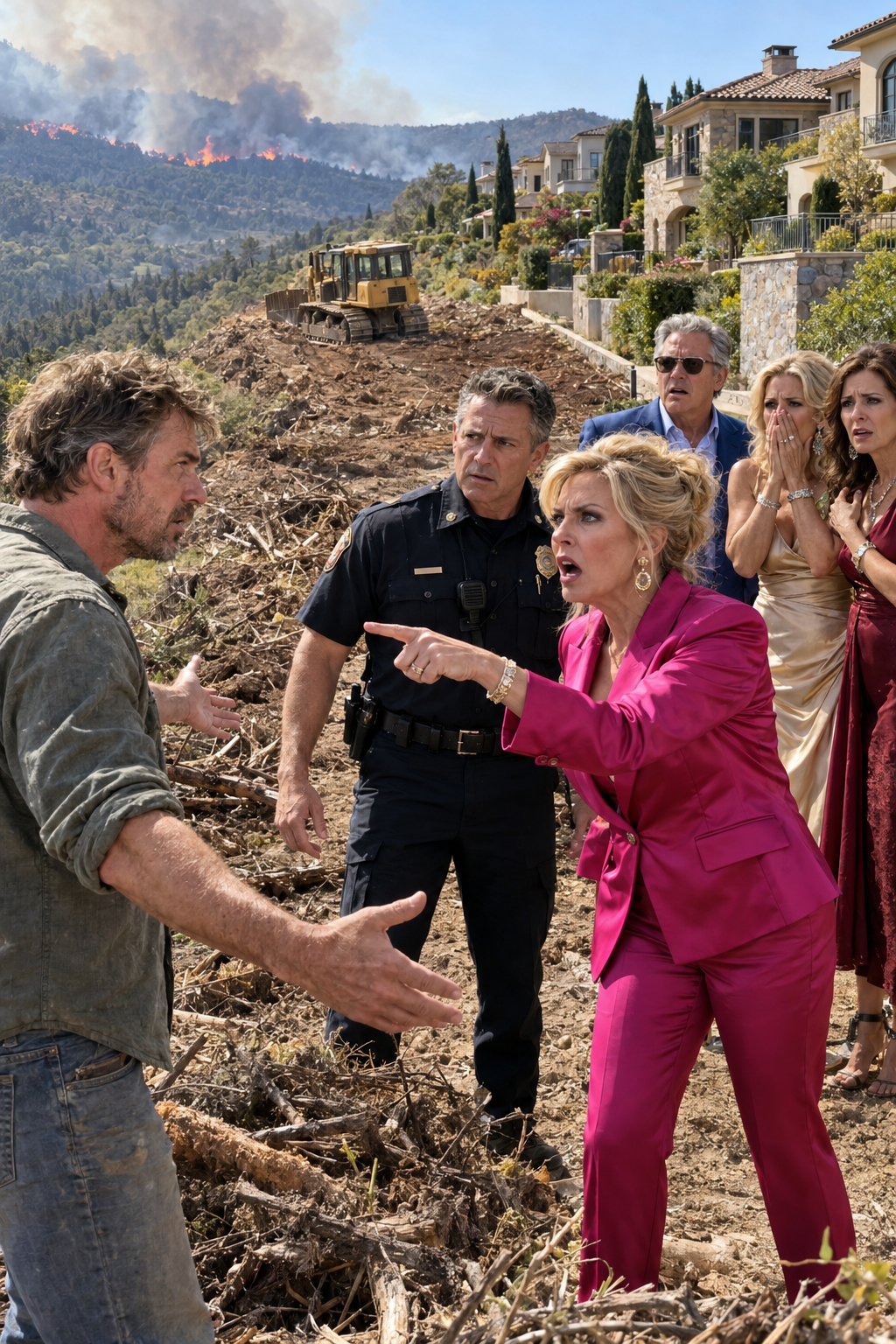
HOA Karen Bulldozed My ‘Ugly’ Firebreak to Protect Home Values—Then the Wildfire Found the Neighborhood She’d Exposed
The first thing Karen Whitfield did after destroying my firebreak was send me a bill for $18,740.
The second thing she did was threaten to put a lien on my property if I didn’t pay it within thirty days.
Three weeks later, with a wildfire climbing the western ridge and forty-eight homes trapped behind the line she had erased, Karen stood in my driveway and asked me to save her neighborhood.
I looked past her.
The sky behind her had turned orange.
Not sunset orange.
Not pretty orange.
The kind of orange that meant trees were burning somewhere you couldn’t see yet.
Ash floated between us like dirty snow.
Karen’s white linen blouse had gray flecks on the shoulders. Her perfectly curled auburn hair was coming loose around her face. For once, she wasn’t carrying her leather HOA binder.
She was carrying nothing.
People who believe they control everything rarely know what to hold when control disappears.
“Ethan,” she said, breathing hard. “We need to talk.”
I closed the steel toolbox in the bed of my truck.
Her mouth opened.
I walked past her toward my barn.
Behind me, she followed.
“You don’t understand.”
“I understand perfectly.”
“The sheriff says evacuation might be ordered.”
“I heard the scanner.”
“The western entrance could become unsafe.”
She stopped.
That finally got through.
“What do you mean, it will?”
I turned around.
Fifty yards beyond her stood the bright green strip of lawn the HOA had installed through the center of what used to be my firebreak.
Decorative cedar trees had been planted in little islands.
Juniper shrubs lined the walking path.
Fresh brown mulch covered the ground.
There were even two wooden benches.
Karen had called it the Ridgeline Beautification Corridor.
I called it fuel.
“You planted resinous shrubs in a wind channel,” I said. “You put ornamental cedar where cleared mineral soil used to be. You spread bark mulch three inches deep across the only defensible break between West Ridge and Cedar Hollow.”
Karen glanced toward the smoke.
“The landscaping company said everything was fire-conscious.”
“The landscaping company sells landscaping.”
“The board approved it.”
“The board isn’t a fire department.”
Her face tightened.
There she was.
For half a second, the old Karen returned.
The woman who could turn embarrassment into anger faster than a match could take dry grass.
“You could have explained that instead of being combative for six months.”
I stared at her.
Then I laughed once.
Not because it was funny.
Because there are moments when your brain refuses to accept the size of someone’s lie.
“I explained it at the February meeting.”
“You were aggressive.”
“I showed the county mitigation map.”
“You interrupted three times.”
“I brought the original easement.”
“You embarrassed board members.”
“I gave you photographs from the 2008 Quarry Fire.”
“You accused us of negligence.”
“I gave your attorney a letter from the former fire marshal.”
“You were threatening litigation.”
“I put orange survey flags on every corner before your contractor arrived.”
Her jaw hardened.
I stepped closer.
“I explained it, Karen.”
Smoke rolled over the ridge behind her.
“I explained it when you called it ugly.
“I explained it when you called it wasted land.
“I explained it when you called it an embarrassment.
“I explained it when you ordered me to stop maintaining it.
“I explained it when your bulldozer crossed my boundary.
“I explained it while your crew was killing the only thing built to stop exactly what is coming toward us right now.”
She didn’t answer.
For several seconds, the only sound was the dry metallic rattle of cottonwood leaves in the rising wind.
Then Karen whispered, “Can it be rebuilt?”
I looked toward the ridge.
“Not before that gets here.”
My name is Ethan Cole.
I’m forty-six years old.
I own eighty-seven acres outside Redstone, Colorado, where the foothills start lifting west of town and expensive subdivisions grow wherever developers can squeeze roads between ravines.
My place isn’t fancy.
I have a three-bedroom farmhouse built in 1974, two equipment barns, an old horse shed, seven acres of hay meadow, forty-three acres of mixed pine and scrub oak, and a steep western boundary that climbs toward federal land.
I also had something most people never noticed.
A firebreak.
Sixty feet wide in some places.
Nearly ninety feet in others.
It ran for almost three-quarters of a mile along the lower slope where my land met Cedar Hollow Estates.
No decorative shrubs.
No privacy screen.
Just short grass, patches of exposed mineral soil, a gravel maintenance lane, and drainage swales kept clear of dead vegetation.
It wasn’t beautiful.
It wasn’t supposed to be.
It had been cut after the 1998 Redstone Ridge Fire, when flames jumped the old logging road and burned eleven homes before crews stopped it at the county highway.
My father helped build that break.
So did volunteer firefighters, ranchers, county road crews, and anyone else who owned a shovel.
Later, when Cedar Hollow was approved, the firebreak became part of the subdivision’s wildfire mitigation plan.
My land remained private.
The HOA’s homes remained on their side.
But the county planning documents were clear: the cleared strip was supposed to remain functional because the subdivision had one main paved entrance and one narrower secondary road.
For twenty-seven years, nobody had a problem with it.
Then Karen Whitfield became HOA president.
Karen lived in the largest house in Cedar Hollow.
Six bedrooms.
Stone facade.
Slate roof.
Three-car garage.
Outdoor kitchen.
Infinity pool overlooking the valley.
Her husband, Greg, owned a chain of orthodontic clinics.
Karen didn’t work outside the home anymore, but she managed the HOA like she had been appointed governor of Colorado by divine decree.
Within four months of becoming president, she replaced the entry signs.
Then the mailboxes.
Then the streetlamps.
Then the landscaping at the clubhouse.
Then she created what she called the Visual Harmony Committee.
That was when she noticed my firebreak.
I learned this from a certified letter.
“NOTICE OF EXTERIOR NUISANCE CONDITION.”
I remember reading the first sentence twice because I thought they had mailed it to the wrong address.
According to Cedar Hollow, the “barren linear tract” adjacent to the community negatively affected property values.
They demanded I “restore natural visual screening.”
I called the management company.
A young woman named Tessa answered.
“Cedar Hollow HOA.”
“This is Ethan Cole. I received a violation notice.”
She clicked her keyboard.
“What’s the address?”
I gave it to her.
Then she said, “Oh.”
That “oh” told me everything.
“I’m not in Cedar Hollow,” I said.
“I see that.”
“My property isn’t subject to the HOA.”
“I see a note saying your parcel affects the community viewshed.”
“My viewshed isn’t governed by your covenants.”
She lowered her voice.
“I understand.”
“Then why did you send me a violation notice?”
Another pause.
“The president requested it.”
“Is the president a county official?”
“Then tell the president the answer is no.”
I thought that would end it.
Two weeks later, Karen appeared at my gate.
She wore an emerald-green riding jacket, white jeans, expensive boots that had never stepped in mud, and sunglasses large enough to qualify as structural engineering.
She smiled like we were old friends.
“You must be Ethan.”
“You must be the president who mails fake violations.”
Her smile thinned.
“Could we start again?”
“You came onto my property. You can start however you want.”
She explained that residents had complained about the strip.
I asked how many.
She said “numerous.”
I asked for the number.
She said privacy rules prevented disclosure.
That told me the number was probably three.
She pointed across the slope.
“You’ve got this gorgeous land, Ethan. Pine, meadow, mature oak. Then there’s this giant scar.”
“Firebreak.”
“I understand what you call it.”
“That’s also what the county calls it.”
She smiled.
“I’ve lived in Colorado eighteen years.”
“My father fought wildfire here before your subdivision existed.”
That annoyed her.
I could see it.
People like Karen don’t enjoy history when history means they arrived late.
She explained her vision.
Native shrubs.
Strategically planted evergreens.
Rock features.
A walking path.
“Soft screening.”
She said Cedar Hollow would even pay for the improvements.
She smiled again.
I said no again.
Then I showed her why.
We walked fifty yards uphill to a rusted steel post sunk into concrete.
The metal plaque attached to it was faded but readable.
FIRE MITIGATION CORRIDOR.
MAINTAIN VEGETATION CLEARANCE.
COUNTY RESOLUTION 98-441.
Karen leaned closer.
“That looks ancient.”
“Fire doesn’t care.”
“The neighborhood has hydrants now.”
“Hydrants need firefighters.”
“We have emergency services.”
“Emergency services need access.”
“We have access.”
“One main road and one secondary road through timber.”
She folded her arms.
“People aren’t living in 1998 anymore.”
“No. There are more houses now.”
Her sunglasses reflected my face.
For the first time, she stopped pretending the conversation was cooperative.
“This strip lowers the appearance of the entire west side of the neighborhood.”
I shrugged.
“Then don’t look at it.”
Within a month, I received four letters.
Then Cedar Hollow’s attorney sent one.
I had my lawyer reply.
That should have ended it too.
Instead, Karen changed tactics.
She stopped claiming the HOA controlled my property.
Now she claimed the firebreak was mostly on HOA land.
That argument sounded better.
It was also wrong.
The property boundary wasn’t a straight line.
My land wrapped around the western edge of Cedar Hollow because the original ranch parcel followed an old irrigation alignment.
In several places, my property extended farther east than people assumed.
The original firebreak straddled both sides.
About sixty percent was mine.
Forty percent fell within a recorded county easement crossing HOA common land.
None of it was supposed to be landscaped without review.
I paid a surveyor.
Not because I needed to.
Because I had learned that Karen respected bright orange stakes more than old legal descriptions.
The survey cost me $3,900.
The stakes went in.
Karen complained they were ugly.
I left them.
Then came the February HOA meeting.
I normally wouldn’t attend one.
But Karen had placed “Ridgeline Improvement Proposal” on the agenda.
A Cedar Hollow resident named Mark Alvarez called me.
Mark was a retired firefighter from Fort Collins.
He lived three houses from the western edge.
“You need to see this,” he told me.
About sixty people filled the clubhouse.
Karen stood at the front beside an architectural rendering.
It showed my firebreak covered with green.
Stone benches.
A walking path.
Children riding bicycles.
A golden retriever.
No representation of reality.
Karen introduced a landscape architect who described the current corridor as “ecologically underutilized.”
That phrase nearly made Mark choke.
Then Karen explained that the project would “heal a visual wound.”
I raised my hand.
She ignored me.
I raised it again.
She kept speaking.
Mark finally said, “Karen, the landowner is sitting right there.”
Everyone turned.
Karen looked at me as though I had arrived carrying a dead elk.
“Mr. Cole was not scheduled to speak.”
I stood anyway.
“You’re showing improvements on my property.”
“Our counsel disputes that characterization.”
“Your counsel received the survey.”
A few heads turned toward Karen.
She clicked to another slide.
“The board is currently evaluating several boundary interpretations.”
“There aren’t several.”
“Mr. Cole—”
“Survey monuments were set in 1986. I didn’t move them.”
Someone laughed.
Karen’s cheeks darkened.
I walked to the front with a rolled map.
“This is Cedar Hollow’s original wildfire mitigation plan.”
Karen tried to interrupt.
I kept going.
“The firebreak appears here, here, and here.”
“This drainage carries prevailing wind during western-slope events. The break was retained specifically because flame fronts can move downhill through the oak, then run uphill into your homes when afternoon wind shifts.”
A woman in the second row frowned.
“I’ve never heard that.”
“You should have.”
Karen crossed her arms.
“Could we avoid fear-based speculation?”
Mark spoke from behind me.
“That’s not speculation.”
Karen looked at him.
Mark continued.
“I worked wildland interface calls for twenty-two years.”
The room changed.
Not dramatically.
Just enough.
Karen sensed it too.
That was why she made the mistake.
She laughed.
A small dismissive laugh.
“Well, fortunately, current fire science has advanced since all of these old plans were written.”
Mark stared at her.
“You mean fire still burns uphill?”
Nobody laughed that time.
The board table went silent.
I handed copies of the documents to residents.
Mini-payoff number one.
Karen’s beautification vote was postponed.
For eleven days.
Then she scheduled an “emergency electronic vote” after claiming the existing corridor created an erosion hazard.
I hadn’t heard that argument before.
Neither had the county.
No erosion citation existed.
I emailed Cedar Hollow residents.
Karen accused me of harassment.
I asked her to identify one false statement.
She didn’t.
Then she found a consultant.
His report changed everything.
The letterhead said Front Range Environmental Design.
The report said the existing firebreak was “over-cleared,” “aesthetically disruptive,” and potentially contributing to surface runoff.
It recommended revegetation with “firewise ornamental species.”
There was one problem.
The consultant wasn’t a wildfire mitigation specialist.
He was a landscape designer.
I looked up his name.
Trevor Lang.
Then I looked up Front Range Environmental Design.
Small company.
Nice website.
Lots of luxury backyard projects.
Retaining walls.
Outdoor kitchens.
No wildfire certification listed.
Then I noticed something in the company registration.
Trevor Lang’s business partner was Scott Whitfield.
Karen’s brother-in-law.
I printed the page.
At the next meeting, Karen talked for sixteen minutes about erosion.
When she finished, I placed the corporate filing on the projector.
Karen looked at it.
Then at me.
I said, “You forgot to mention your consultant is your husband’s brother’s business partner.”
Mini-payoff number two.
The board table looked like somebody had thrown a grenade under it.
Karen’s vice president, Susan Bell, whispered, “Is that true?”
Karen said the relationship was irrelevant.
Susan asked again.
Karen accused me of trying to “poison community dialogue.”
Mark leaned toward me and whispered, “That means yes.”
The project was delayed again.
I should have realized delay wasn’t defeat.
Karen didn’t.
She simply stopped asking permission.
It happened on a Tuesday morning in May.
I was twenty miles away picking up hydraulic hose for my tractor when my phone buzzed.
Motion alert.
Western gate camera.
I opened the feed.
A yellow excavator was crossing my property.
Behind it came a skid steer.
Then a dump truck.
Then another.
For three full seconds, I just watched.
The excavator bucket swung over one of my orange survey stakes.
The machine crushed it.
I called the sheriff.
Then I called Mark.
Then I turned around.
By the time I reached my road, there were six vehicles parked along the boundary.
Karen was there.
Of course she was.
She wore a white hard hat.
A white hard hat with CEDAR HOLLOW printed across the front in green vinyl letters.
The contractor had already ripped out nearly two hundred yards of compacted firebreak.
Topsoil was being spread over mineral ground.
A crew was cutting the drainage swale.
Another excavator was pulling gravel from the maintenance lane.
I parked sideways across the access point.
Karen marched over.
“You cannot obstruct an authorized contractor.”
“You’re trespassing.”
“This work is occurring on association-controlled land.”
“You crossed my gate.”
“We have easement access.”
“For fire mitigation.”
“This is mitigation.”
“You destroyed my survey markers.”
“They were within the project area.”
“You entered posted private property.”
“Our legal counsel approved access.”
“Your lawyer isn’t the sheriff.”
That was when a deputy cruiser rolled up.
Karen straightened.
I almost smiled.
Deputy Hannah Ruiz stepped out.
She was in her early thirties and had the calm expression of someone who’d learned not to believe the first person who ran toward the uniform.
Karen ran toward the uniform.
“This man is interfering with permitted HOA work.”
Ruiz looked at me.
“Mr. Cole?”
“They crossed a locked private gate, destroyed survey markers, and started excavation on my parcel.”
Karen held out a folder.
“We have easement rights.”
Ruiz took the folder.
Read one page.
Then another.
She glanced toward the crushed stake.
“Who removed that?”
Karen said, “The contractor.”
Ruiz looked at the foreman.
The foreman suddenly found the ground fascinating.
Ruiz asked, “You know tampering with a survey monument can become a separate issue, right?”
Karen’s voice changed.
“We were told the markers were temporary.”
“They were.”
I pointed fifty feet away.
“The permanent pin is underground beside that post.”
Ruiz walked over.
The excavator operator shut off his machine.
I pulled the county survey from my truck.
Within twenty minutes, the contractor stopped work.
Mini-payoff number three.
But the damage was already ugly.
Nearly a quarter mile of the break had been torn up.
That should have been enough to end Karen’s project.
Instead, two days later, Cedar Hollow obtained a temporary civil order claiming the disputed section posed erosion danger and that the HOA had maintenance rights pending boundary review.
I called my attorney.
Her name was Dana Pike.
Dana was fifty-eight, spoke quietly, wore navy suits, and treated dramatic people the way surgeons treat infected tissue.
She read the order.
Then she said, “They found a judge on emergency rotation.”
“Can they keep working?”
“On part of the easement corridor, temporarily.”
“On my land?”
“They already did.”
“What do we do?”
“We document everything.”
That answer frustrated me.
I wanted an injunction.
Dana wanted evidence.
She was right.
We installed cameras.
We photographed every machine.
We logged every truck.
We marked property lines again.
We notified the county.
We notified the fire district.
We notified the HOA insurer.
Most importantly, I sent Cedar Hollow a written warning.
Not emotional.
Not dramatic.
Three pages.
It explained exactly what removal of the break could do under red-flag conditions.
Karen replied with two sentences.
“Your speculative concerns have been received. The association will continue relying on qualified professionals.”
I printed that too.
Then June turned dry.
July turned worse.
By the first week of August, the grass on south-facing slopes had faded from gold to gray.
Humidity dropped.
Afternoon winds sharpened.
The county moved to Stage Two fire restrictions.
The Forest Service signs at trailheads went red.
Everyone who had lived there long enough began watching the western horizon.
Karen scheduled the grand opening of the Ridgeline Beautification Corridor for August 19.
There would be food trucks.
Live acoustic music.
A ribbon cutting.
Residents received invitations describing the project as “a triumph of community stewardship.”
Mark sent me a photograph of his invitation.
Under it, he texted:
Want to bring marshmallows?
I didn’t laugh.
By then, I was getting worried.
Not because wildfires are unusual in Colorado.
Because the new landscaping had transformed the break into a continuous fuel bed.
The HOA planted seventy-three young evergreens.
Clusters of ornamental juniper.
Native rabbitbrush.
Tall bunchgrass.
Decorative wood fencing near the path.
Mulch around every tree.
Some plants were technically fire-resistant under maintained residential conditions.
That wasn’t the issue.
The issue was continuity.
They had connected fuels from the lower oak slope directly toward homes.
Fire doesn’t read plant labels.
It follows heat.
The old break had interrupted those things.
The new corridor invited them.
On August 11, I drove to Redstone Fire Protection District headquarters.
Fire Marshal Lucas Bennett met me outside.
He was a broad-shouldered man in his fifties with silver at his temples.
I showed him photographs.
He knew the area.
His expression changed almost immediately.
“When did they do this?”
“May through July.”
“Who approved the mitigation modification?”
“They claim a consultant did.”
“Not what I asked.”
“I don’t know.”
Bennett pulled the original subdivision file.
We spent forty minutes comparing maps.
Then he pointed at a shaded strip.
“This was conditional.”
“What does that mean?”
“Subdivision approval depended on maintaining this corridor.”
“Can the HOA remove it?”
“Not without review.”
“Did they get review?”
He looked at me.
“If they had, I’d have the record.”
Mini-payoff number four.
Finally, somebody with authority had said what I had been saying for six months.
Bennett opened an investigation.
Karen found out within twenty-four hours.
She sent a community-wide email accusing “outside parties” of attempting to undermine the board.
She didn’t use my name.
She didn’t need to.
Then something strange happened.
Bennett stopped returning calls.
Not completely.
Just gradually.
One voicemail.
Then an email saying the review was ongoing.
Then nothing.
Dana submitted a public-records request.
The county said older approval documents were archived.
Meanwhile, Karen held her ribbon cutting.
Mark attended.
He sent me a video.
Karen stood beneath a green ribbon with maybe forty residents around her.
She praised “persistence.”
She praised “beautification.”
She praised the board for refusing to be intimidated.
Then she cut the ribbon.
People clapped.
Behind them, a red-flag warning banner flashed on Mark’s weather app.
Five days later, lightning hit federal land twelve miles west.
At in the afternoon, smoke was reported near Mason Creek.
By , the fire was estimated at twenty acres.
At , forty-five.
At , one hundred sixty.
At , winds increased to twenty-seven miles an hour.
At , the Mason Creek Fire jumped the first containment road.
At , Mark called me.
“I’m watching.”
“You think it can reach us?”
“How long?”
“I don’t know.”
I looked west.
Smoke towered above the ridge.
“Not today unless it runs hard.”
“And tomorrow?”
I didn’t answer.
He understood.
That evening, Cedar Hollow held an emergency board call.
Mark dialed me in.
Karen sounded calm.
She said county officials had assured residents there was “no immediate threat.”
That statement was technically accurate.
Immediate means now.
Wildfire strategy lives in the hours before now.
Mark asked whether the secondary gate was open.
Karen said management would verify.
A woman named Denise asked whether residents should prepare livestock trailers.
Karen said people should avoid creating panic.
I muted myself.
That phrase bothered me more than anything else.
Avoid creating panic.
I had heard variations of it before.
Usually from people who mistook preparation for fear.
At the next morning, I fueled my diesel tank.
I filled two portable water totes.
I checked hoses.
I moved propane cylinders away from the barn.
I cleared pine needles from the farmhouse roof.
I put important documents in my truck.
Then I drove my small dozer along my remaining intact firebreak.
The western half still existed.
The central section had been landscaped.
The southern section had been narrowed.
I could improve my side.
I could not legally bulldoze HOA property without emergency authority.
So I did what Dana had told me.
I documented.
At , I recorded video.
I stood beside the green corridor.
“August seventeenth,” I said. “Wind west-southwest, estimated fifteen. County under red flag. Mason Creek Fire active west of Redstone. Current condition of former mitigation corridor—continuous vegetation, wood mulch, planted conifers, decorative fencing.”
I slowly turned the camera.
Just evidence.
At , the fire doubled.
At 10:15, it crossed Black Elk Trail.
At 10:50, voluntary evacuation notices were issued for two communities north of us.
At 11:07, Cedar Hollow residents received a text telling them to “remain alert.”
At 11:23, Mark drove into my yard.
His truck bed held two plastic tubs, three suitcases, and an old yellow Labrador named Daisy.
“You leaving?” I asked.
“Getting Linda and the dog out early.”
He looked at my dozer.
Then toward the ridge.
“You planning something?”
“Planning options.”
That was the difference between Mark and Karen.
Mark didn’t need certainty before acting.
He understood probability.
At noon, Karen posted in the Cedar Hollow residents’ group that the neighborhood was “well protected by modern hydrant infrastructure and professional emergency response.”
At 12:18, I took a screenshot.
At 12:26, the county announced that multiple engines had been diverted north because another subdivision was under direct threat.
At 12:44, Karen deleted her post.
Another screenshot.
At , voluntary evacuation expanded.
At , wind shifted.
That was the moment everything changed.
The fire had been moving northeast.
Now the smoke column leaned east.
My phone started vibrating nonstop.
Weather alert.
County alert.
Two neighbors.
Then Karen.
I ignored Karen.
I answered Mark.
“It shifted,” he said.
“I see it.”
“Bad enough.”
“Linda’s gone. I’m coming back.”
“I can help.”
“Stay out.”
“You’re staying.”
“I own equipment and open acreage. You’ll just add another person I have to worry about.”
Then said, “Fine.”
That was when Karen drove into my yard.
The conversation at the beginning happened six minutes later.
“Can it be rebuilt?”
“Not before that gets here.”
Karen stared toward the ridge.
“What can we do?”
I pulled gloves from my back pocket.
“You can evacuate.”
“What about the homes?”
“People matter more.”
“Some residents are refusing.”
“Then tell them the truth.”
“No. You’ve reassured them for two days.”
Her face flashed.
“That is not fair.”
“Fair is irrelevant.”
She stared at me.
I continued.
“Send a message. Tell everybody to leave now. Tell them use the southern exit while it’s clear. Tell them don’t wait for mandatory status.”
“I can’t issue evacuation orders.”
“You don’t have to. You can recommend leaving.”
“What if the county says—”
She stopped.
I pointed toward the smoke.
“Stop worrying about whose authority you’re borrowing. Tell people to go.”
For once, she listened.
She pulled out her phone.
Her hands were shaking so badly she mistyped her password twice.
I walked toward my barn.
“Where are you going?”
“To reopen what I can.”
“You said it can’t be rebuilt.”
“The whole thing can’t.”
She followed me inside.
My dozer sat near the west doors.
“Then what are you doing?”
“Making my property harder to burn.”
“And Cedar Hollow?”
I looked at her.
“You landscaped Cedar Hollow’s protection.”
She flinched.
Not because I enjoyed it.
Because she needed to understand the equation before she made another decision.
I started the dozer.
Then a sheriff’s SUV came flying down my road.
Deputy Ruiz stepped out.
I shut the engine down.
She jogged toward me.
“Mandatory evacuation is probably coming. Fire district wants this road available.”
“I’m not blocking it.”
“What are you doing?”
“Expanding the break on my side.”
She looked at the dozer.
Then at Karen.
Then at the green corridor.
Her expression changed.
“Oh, hell.”
Karen said, “Deputy, can emergency services cut the landscaping?”
Ruiz looked at her.
“All of it?”
“If necessary.”
Ruiz gave a short laugh with no humor.
“I’m pretty sure the fire isn’t checking HOA approval.”
She radioed someone.
Then listened.
Her face hardened.
“What?” I asked.
“Spot fire.”
“West drainage.”
My stomach tightened.
“Two miles, maybe less.”
Karen whispered, “Two miles?”
In that wind, two miles was not distance.
It was time.
Ruiz pointed at me.
“You have twenty minutes before I come back and physically drag you out.”
“Understood.”
Karen said, “What about me?”
Ruiz stared at her.
“You should have left ten minutes ago.”
Karen finally sent the evacuation recommendation.
My phone received it thirty seconds later.
CEDAR HOLLOW RESIDENTS: OUT OF AN ABUNDANCE OF CAUTION, THE BOARD RECOMMENDS IMMEDIATE VOLUNTARY DEPARTURE VIA SOUTH GATE.
Then handed the phone back.
“Out of an abundance of caution?”
Karen swallowed.
“Tell them the fire is approaching.”
“That could create panic.”
I looked at her.
She closed her eyes.
Then sent another.
ACTIVE WILDFIRE IS APPROACHING FROM THE WEST. LEAVE NOW IF YOU CAN DO SO SAFELY. USE SOUTH GATE. DO NOT WAIT FOR FURTHER HOA COMMUNICATION.
Cars started appearing within minutes.
One minivan towing a little utility trailer.
Another truck with two horses loaded behind it.
People were finally moving.
I climbed onto the dozer.
The next fifteen minutes were the most useful fifteen minutes I had spent all year.
I widened the intact northern break.
Not pretty.
Not careful.
I pushed brush downhill.
Scraped grass.
Exposed soil.
Pulled deadwood away from the barn.
Then I angled east toward the first section of HOA landscaping.
I stopped at the property line.
Legally, I could go no farther.
Karen stood twenty feet away.
She understood why I had stopped.
“Do it,” she said.
I killed the throttle.
“Take it out.”
“You don’t own the common area personally.”
“I’m president.”
“You spent six months explaining that presidents have authority. Now you’re about to learn the limits.”
“Ethan, please.”
“You need emergency authorization.”
“From who?”
“Fire district. Sheriff. County. Somebody.”
She looked ready to scream.
Then Ruiz’s SUV returned.
This time she was followed by a brush truck from Redstone Fire.
Fire Marshal Bennett was in the passenger seat.
I hadn’t seen him in weeks.
He climbed out before the truck fully stopped.
He ran toward me.
“I need your equipment.”
“For what?”
He pointed at the corridor Karen had built.
“To put the firebreak back.”
Karen went pale.
Bennett turned toward her.
“President Whitfield?”
“You’re going to stay clear of operations.”
“This is HOA property.”
His expression was extraordinary.
He looked at her the way a teacher looks at a student who has somehow answered an exam question with a drawing of a sandwich.
“I am aware.”
“Do you need written board approval?”
Karen blinked.
Bennett pointed toward the ridge.
“That is my approval.”
Mini-payoff number five.
I opened the throttle.
The first cedar tree went under the blade in three seconds.
The next took two.
Juniper ripped from the ground.
Mulch rolled forward in dark waves.
Decorative stone scattered.
The wooden edging cracked.
I tore through the Ridgeline Beautification Corridor while Karen watched seven weeks of landscaping disappear beneath steel tracks.
There was no satisfaction in it.
The smoke had grown too close.
Bennett guided me through the priority line.
We didn’t try to recreate everything.
We created distance.
Scraped fuel away from the densest structures.
Opened a wider gap near the drainage.
Removed fencing.
Cut through shrub islands.
A Redstone crew used chainsaws ahead of me.
Another brush truck soaked the downhill edge.
Residents were still evacuating.
A black Range Rover stopped in the road.
A man rolled down the window and yelled, “What the hell are you doing to the common area?”
Karen herself walked over.
“Drive south,” she shouted. “Now.”
He pointed toward me.
“That’s the guy who’s been fighting the HOA!”
Karen slapped the side of his vehicle.
I almost smiled.
At , the mandatory evacuation order hit.
At , we saw flame.
Not a wall.
Just orange flickers moving through the trees beyond the drainage.
Then one pine crowned.
Flame ran to the top like gasoline had been poured upward.
Bennett shouted.
Everyone moved faster.
At , he ordered the volunteer crews back.
I parked the dozer behind my gravel berm.
“Leave it!” he yelled.
I jumped down.
Karen was still there.
Bennett saw her.
“Why are you here?”
She pointed toward Cedar Hollow.
“My husband.”
“He went back.”
My stomach dropped.
“For what?” I asked.
“Our safe.”
I stared at her.
She shouted toward me, “He thought we had time!”
“What street?”
“Falcon Crest.”
“That’s western edge.”
Bennett radioed.
No response.
Then he looked at Karen.
“We don’t send people into an evacuation zone for property retrieval.”
“He’s a person.”
“He chose to go back after warning.”
Karen’s face collapsed.
Not theatrically.
The arrogance vanished first.
Then the anger.
What remained was simply a woman whose husband had done something stupid.
That, I understood.
“Vehicle?” I asked.
Bennett looked at me sharply.
I ignored him.
Karen said, “Silver Mercedes SUV.”
“When did he leave?”
“Eight minutes ago.”
“He may already be coming out.”
She shook her head.
“I called. He said a tree was blocking Falcon Crest.”
Bennett cursed.
That changed it.
A blocked road meant more than Greg.
There could be anyone behind it.
He radioed Ruiz.
This time she answered.
She was at the south gate.
Bennett told her.
Then he pointed at me.
“You stay here.”
I didn’t argue.
Being calm isn’t the same as being reckless.
Fire crews had gear.
I had a cotton shirt and gloves.
Bennett’s brush truck disappeared toward Cedar Hollow.
Karen tried to follow.
I caught her arm.
“My husband—”
“You’ll become another rescue.”
“He’s trapped.”
“And you don’t have equipment.”
She tried pulling away.
I didn’t tighten my grip.
I just stood there.
Finally, she stopped.
It was the longest eleven minutes of the day.
Embers began landing around us.
Small ones.
Glowing at the edges.
I stamped one near the barn.
Karen watched the road.
“Why are you still here?” she asked.
“Bennett hasn’t told me to leave.”
“No. I mean after everything.”
I looked at the firebreak.
“What do you think I should do? Let forty-eight houses burn because you’re difficult?”
She stared at me.
“That isn’t what I meant.”
Another ember landed.
I crushed it under my boot.
She said, “You hate me.”
She looked surprised.
“Hate takes energy.”
That shut her up.
Then we heard an engine.
Bennett’s brush truck appeared first.
Behind it came the silver Mercedes.
Behind that came a pickup.
Behind that, another SUV.
Four vehicles.
The blocked tree had trapped three other residents who were still packing.
Bennett’s crew had cut the tree.
Greg Whitfield climbed from the Mercedes when they reached us.
Karen ran to him.
For five seconds, they were just two frightened people holding each other.
Then Bennett exploded.
Not dramatically.
Professionally.
Which was worse.
“You entered an active evacuation zone after a mandatory order.”
Greg tried to explain.
Bennett cut him off.
“You were warned.”
“I needed medication.”
Karen looked at him.
Greg hesitated.
There it was.
Karen released him.
“You told me the safe.”
Greg glanced toward me.
I looked away.
Some humiliations belong inside a marriage.
Bennett pointed south.
“Everybody leaves. Now.”
This time, we did.
I took my truck.
Karen and Greg left separately.
Halfway down the road, I looked in my mirror.
Flames reached the western drainage.
Then smoke swallowed my farm.
For the next six hours, I knew almost nothing.
That was the hardest part.
Not the noise.
Not the flames.
I parked at a grocery store lot being used as an informal evacuation point.
Families stood beside cars.
Children held pets.
People refreshed phones.
Rumors spread every three minutes.
Cedar Hollow was gone.
No, only two houses.
No, fire had turned north.
No, fire crossed the highway.
No, crews stopped it.
No, hydrants had failed.
That last rumor caught my attention.
Mark found me near sunset.
He handed me coffee.
“Linda and Daisy are safe.”
“Your place?”
He leaned against my truck.
“Cedar Hollow?”
At , Bennett called.
“You somewhere safe?”
“Your house is standing.”
I closed my eyes.
“Main barn is standing.”
“Equipment?”
“Dozer got scorched on one side. Probably okay.”
I let out a breath.
Then asked, “Cedar Hollow?”
“That break held more than I expected.”
I opened my eyes.
“How many homes?”
“We’ve confirmed exterior damage to six. Two structures with major damage. No total losses reported yet.”
Forty-eight homes.
No confirmed total losses.
I sat on the tailgate.
Mark watched my face.
Bennett said, “One firefighter treated for heat. One resident smoke inhalation. No fatalities.”
I told Mark.
He lowered his head.
Then Bennett said something I didn’t understand.
“But we had a serious water issue.”
“What issue?”
“The west hydrant loop lost pressure.”
“Right when the front reached the drainage.”
I looked toward the dark ridge.
“Pump failure?”
“Don’t know yet.”
“Reservoir low?”
“Don’t know.”
“You’re saying hydrants failed?”
“I’m saying we got insufficient pressure from three hydrants.”
I thought of Karen’s posts.
Modern hydrant infrastructure.
Professional emergency response.
“What stopped the structures?” I asked.
“Tankers. Your pond. And the break.”
“We drafted from it.”
I nodded slowly.
There was an old irrigation pond behind my hay field.
Maybe 180,000 gallons when full.
I had cleaned the access lane in spring.
Not because Karen told me to.
Because my father had.
Bennett continued.
“Don’t repeat the hydrant issue yet. Investigation tomorrow.”
“Understood.”
The evacuation order lifted the following afternoon.
Driving home felt unreal.
Burn scars covered the western slope.
Fence posts smoked.
Pines stood black against the sky.
The place smelled like wet charcoal and chemicals.
My farmhouse had ash packed against the doors.
One window had cracked from heat.
The western barn wall was scorched.
But everything stood.
Then I climbed the ridge.
That was where I saw it.
The fire had reached the landscaped corridor.
You could follow its path.
Blackened mulch.
Burned shrubs.
Charred cedar trunks.
A clean line where our emergency dozer work had stripped the fuel away.
On the far side of that line, grass remained brown but unburned.
Behind it stood the Cedar Hollow homes.
The firebreak Karen called an eyesore had done exactly what it had been designed to do.
Even wounded.
Even narrowed.
Even rebuilt at the last minute.
It had broken the fire.
Mark walked up beside me.
He didn’t say anything for a long time.
Then he pointed.
“You should photograph that.”
I already had my phone out.
We took hundreds.
The county did too.
So did insurance adjusters.
So did the state fire investigators.
Karen did not come to see me for three days.
When she finally did, she wasn’t wearing an emerald jacket or white jeans.
She wore old blue denim and a gray sweatshirt.
She stopped at my gate.
This time, she waited.
I walked over.
“Can I come in?” she asked.
That was new.
I opened the gate.
She followed me to the barn.
For a minute, neither of us spoke.
Then she held out an envelope.
I didn’t take it.
“What’s that?”
“The board rescinded the assessment.”
“The $18,740?”
“And all prior violation notices.”
“I wasn’t subject to them.”
“The lien threat?”
“Withdrawn.”
I took the envelope.
Mini-payoff number six.
Karen looked toward the burned ridge.
“Two homes may need rebuilding.”
“But everyone lived.”
She nodded.
Then said, “I was wrong.”
It was probably the hardest sentence she had spoken in years.
I didn’t make it easier.
Her mouth tightened.
She deserved at least enough respect not to pretend otherwise.
She sat on the edge of an overturned feed bucket.
“I keep thinking about that meeting.”
“Which one?”
“The first one.”
“You’ll need to narrow it down.”
She almost smiled.
“The one where you brought the map.”
I leaned against the workbench.
“What about it?”
“I thought you were trying to make me look stupid.”
“I was trying to keep trees out of a firebreak.”
“I know that now.”
“That was also true then.”
She nodded.
A fly buzzed near the window.
Outside, an insurance truck rolled slowly along the road.
Karen rubbed her hands together.
“I wanted the neighborhood to look finished.”
“That was your motivation?”
She looked at me.
“Part of it.”
There was something in her tone.
“What’s the other part?”
She didn’t answer immediately.
Then she stood.
“Property values.”
“You already told me that.”
She shook her head.
“I mean actual property values.”
She looked toward Cedar Hollow.
“There was supposed to be an appraisal.”
“For what?”
She hesitated.
That was the first lie she had told me since the fire.
And unlike all the others, she was bad at it.
I stepped closer.
She picked at the cuff of her sweatshirt.
“The board was reviewing refinancing options for the clubhouse.”
“That doesn’t require landscaping my property.”
“It wasn’t just the clubhouse.”
“What was it?”
She looked at the gate.
“I shouldn’t have said anything.”
That told me more than an answer would have.
“You bulldozed a county mitigation corridor because of an appraisal?”
“Then explain.”
“Can’t or won’t?”
She looked directly at me.
For the first time since I had met her, Karen Whitfield looked afraid of something other than fire.
“Ask Dana to look at the original development bonds.”
Then she left.
No explanation.
No apology beyond what she had already given.
Just that sentence.
Ask Dana to look at the original development bonds.
I called Dana before Karen’s SUV reached the highway.
She listened.
Then said, “That’s oddly specific.”
“I’ll pull them.”
“What are we looking for?”
“Don’t know yet.”
She found the first problem that afternoon.
Cedar Hollow’s original infrastructure bond referenced a secondary emergency access route.
Not the little road everyone used today.
A different route.
One that should have crossed the northwestern common area.
It was shown on the 1997 plat.
Then disappeared from later maps.
I drove to the county archives the next morning.
Dana met me there.
We looked through rolled plans.
Old planning commission minutes.
Engineering reports.
Subdivision conditions.
The firebreak appeared repeatedly.
So did the secondary access.
Then, in a 2003 amendment, the access route vanished.
No explanation.
No replacement approval.
Dana frowned.
“That’s a problem.”
“For Karen?”
“For whoever recorded this amendment.”
“Because if the emergency route was a condition of subdivision approval, you can’t just remove it.”
“What’s there now?”
We both knew.
Karen’s house.
Not just Karen’s house.
Falcon Crest.
The most expensive row in Cedar Hollow.
Eight luxury homes.
Built directly across the corridor where the original emergency road had been planned.
Suddenly the firebreak argument looked different.
The HOA hadn’t merely wanted the western edge to look nicer.
An ugly, maintained strip attracted questions.
Questions about mitigation maps.
Questions about access routes.
Questions about why the subdivision’s modern maps didn’t match its original safety plan.
Dana leaned back.
“Now we have a reason someone might want that old corridor visually erased.”
“She told me to check.”
“That suggests she’s afraid of somebody else.”
That afternoon, the state fire investigation team released preliminary information.
The Mason Creek Fire had been lightning-caused.
No surprise.
The emergency firebreak work at Cedar Hollow had reduced structure exposure.
No surprise.
Then came the sentence that changed the investigation.
“Water delivery irregularities within Cedar Hollow’s private distribution system contributed to suppression delays.”
Private distribution system.
I called Bennett.
He answered immediately this time.
“I saw the report.”
“I figured.”
“What happened?”
“You’ll get the public version.”
“I’m asking you.”
“One valve was closed.”
“What valve?”
“The feed valve between the upper reservoir and west hydrant loop.”
“Mechanical failure?”
“How does a feed valve close?”
“Someone closes it.”
I didn’t speak.
Bennett continued.
“It’s in a locked utility enclosure.”
“Who has keys?”
“That’s under review.”
“Management company. Maintenance contractor. Board emergency access.”
“I didn’t say that.”
“You didn’t need to.”
“Don’t jump ahead.”
I walked outside.
Across the valley, helicopters were still dropping water on hot spots.
“Could the valve have been closed accidentally?”
“Could it stay closed accidentally?”
That pause mattered.
“What aren’t you telling me?”
“Let investigators work.”
Then he hung up.
I found Mark that evening at his house.
His west-facing fence was blackened.
His home was fine.
He was sweeping ash from the patio.
I told him about the valve.
He stopped sweeping.
“That’s what Bennett said.”
“Before the fire?”
“I don’t know.”
Mark leaned on the broom.
“Who services it?”
“Trying to find out.”
He looked toward the ridge.
Then said, “I saw someone up there.”
“The night before evacuation.”
My pulse changed.
“Reservoir access.”
“White pickup.”
“HOA maintenance?”
“What time?”
“Around nine.”
“Did you see a person?”
“Not clearly.”
“Why didn’t you mention it?”
“Because a pickup near a utility enclosure wasn’t suspicious until you just told me somebody closed the valve.”
That was fair.
“My driveway camera might catch the road.”
We checked.
At p.m., a white pickup passed Mark’s house uphill.
At , it came back down.
No logo visible.
Plate unreadable.
But one detail showed clearly.
Amber beacon on the roof.
The HOA maintenance contractor used amber beacons.
So did half the contractors in Colorado.
But something.
Dana filed another records request.
I started building a timeline.
Not because I thought I was a detective.
Because documentation had saved us once already.
Contractors.
County inspections.
Firebreak work.
Reservoir maintenance.
At 11:30 that night, I noticed a name.
Trevor Lang.
Karen’s consultant.
Front Range Environmental Design.
His company hadn’t only produced the report supporting the landscaping.
Six months earlier, it had received a $62,000 subcontract for “reservoir slope stabilization.”
Same upper reservoir.
Same utility enclosure.
I called Dana.
She answered on the fourth ring.
“You know it’s almost midnight?”
“Trevor worked at the reservoir.”
I told her.
Keyboard noise.
Then more silence.
“Where did you find that?”
“HOA budget attachment from March.”
Dana read for a moment.
Then said, “Ethan, go to bed.”
“That doesn’t sound reassuring.”
“It isn’t.”
The next morning, three state investigators were at the reservoir.
By noon, Karen’s brother-in-law’s business partner had hired an attorney.
By two, Cedar Hollow’s management company announced it was “cooperating fully.”
By four, Karen resigned as HOA president.
That surprised everyone.
It surprised me most.
Her resignation email was only four sentences.
No defense.
No accusations.
No mention of me.
She said the community needed “independent leadership during ongoing reviews.”
Mark called.
“You think she closed the valve?”
“You sound confident.”
“If Karen did it, why point me toward old documents?”
“Maybe to blame somebody else.”
“Possible.”
“You trust her now?”
That was the important distinction.
Trust wasn’t required.
Patterns were.
Karen liked control.
She liked appearances.
She liked winning.
But sabotaging firefighting water during an active wildfire?
Nothing I had seen supported that.
Something else was happening.
The next mini-payoff came from the most boring document in the entire pile.
An invoice.
Twenty-seven dollars and eighty-four cents.
Replacement padlock.
Reservoir utility enclosure.
Purchased three months before the fire.
Authorized by HOA vice president Susan Bell.
I called Susan.
She didn’t answer.
No response.
I drove past her house.
Empty driveway.
Curtains closed.
A neighbor watering flowers said Susan and her husband had left that morning.
“Vacation?” I asked.
The neighbor shrugged.
“Looked rushed.”
Dana told me not to chase people.
So I didn’t.
Instead, I checked public records.
Susan’s husband, David Bell, was a commercial real estate attorney.
One of his former clients appeared in Cedar Hollow’s original development files.
A company called Raven Peak Development.
Raven Peak had dissolved in 2006.
Its principals had moved on.
But one name kept appearing.
Charles Voss.
County planning donor back in the day.
And Greg Whitfield’s uncle.
I sat at my kitchen table staring at the screen.
Now Karen’s behavior made more sense.
Not better.
Just more understandable.
She hadn’t invented the beautification project from nothing.
She had inherited a neighborhood full of people connected by old business relationships.
The landscaping had covered the corridor.
The corridor pointed toward the missing emergency road.
The missing emergency road ran beneath eight luxury homes.
And the hydrant reservoir had been serviced by the same consultant who helped justify destroying the firebreak.
One coincidence is coincidence.
Four begin to look like architecture.
At that evening, someone knocked on my door.
She looked over her shoulder before I let her in.
“Is Greg with you?”
“You two okay?”
“Not relevant.”
Fair enough.
She placed a USB drive on my kitchen table.
I looked at it.
“What’s that?”
“I don’t know exactly.”
“You brought me a mystery flash drive?”
“Greg keeps records.”
“What records?”
“He doesn’t tell me everything.”
“That marriage sounds efficient.”
She ignored that.
“I found it in our safe.”
“The one he drove into a wildfire for?”
Her eyes met mine.
That erased the joke.
I sat down.
“What’s on it?”
“Scans. Contracts. Maps. Emails.”
“You opened it?”
“A few files.”
“Why bring it to me instead of police?”
“Because I don’t know who knew what.”
“About the fire?”
“About Cedar Hollow.”
“Karen, state investigators aren’t secretly working for your HOA.”
Her voice dropped.
“But county people signed some of these documents.”
I stared at her.
She continued.
“I pushed the landscaping project.”
“I wanted the appraisal.”
“Because Greg told me the west-side homes were being undervalued due to visible utility and mitigation corridors.”
“What appraisal?”
She swallowed.
“A bulk appraisal.”
“For refinancing?”
There was the truth.
“For sale.”
I leaned back.
“What was being sold?”
“Common property.”
“Raven Peak Holdings.”
“That company dissolved.”
“Not the old one.”
She shook her head.
“New LLC. Similar name.”
“Who owns it?”
“I don’t know.”
“I don’t know.”
“Your brother-in-law?”
“I don’t know.”
“You expect me to believe that?”
She stared at the drive.
“That’s why I’m giving you this.”
I didn’t touch it.
“Take it to Dana.”
“I already called her.”
That surprised me.
“She told you to bring it here?”
“She told me not to plug it into anything and meet both of you tomorrow.”
Dana was smarter than both of us.
Karen moved toward the door.
Then stopped.
“I really did think the firebreak was ugly.”
I raised an eyebrow.
She gave a weak laugh.
“I know how ridiculous that sounds now.”
“It sounded ridiculous before.”
She opened the door.
Then turned back.
“But Greg cared about it too much.”
“What do you mean?”
“I wanted landscaping because I wanted landscaping. Greg hated that strip.”
“He used to ask when you cleared it.”
“Every year.”
My skin prickled.
“Why would he care?”
“I thought he was interested because of the view.”
Karen looked toward Cedar Hollow.
“Now I think he was checking whether the old road was still visible.”
Dana arrived at the next morning with a forensic laptop that never touched the internet.
We copied the USB.
Then opened it.
Tax documents.
Scanned contracts.
Property plats.
Old emails.
Most were mundane.
Then Dana found a folder named WR-2.
Inside was a map dated 2002.
It showed the original emergency access corridor.
A red line had been drawn through it.
Beside the line were handwritten notes.
MOVE ACCESS EAST.
BUILDABLE LOTS: 8.
VALUE RECOVERY: $6.4M.
Dana said nothing.
I felt cold despite the summer heat.
Then we opened a scanned letter.
Raven Peak Development.
September 18, 2002.
It discussed modifying wildfire mitigation requirements.
A paragraph near the bottom referenced “coordination with district personnel.”
Below it were three initials.
One belonged to Charles Voss.
One belonged to David Bell.
The third was unreadable.
Dana leaned closer.
“That could be anybody.”
“Keep going.”
At 10:43, we found the photograph.
Eight men standing beside the upper reservoir during Cedar Hollow construction.
Rolled plans.
Pickup trucks.
One was Charles Voss.
One was younger David Bell.
One looked like Greg’s father.
And one man stood at the edge of the frame, twenty years younger, dark-haired, clean-shaven.
I knew the face.
So did Dana.
Fire Marshal Lucas Bennett.
I stared at the photograph.
“That doesn’t prove anything.”
“No,” Dana said.
But her voice had changed.
We kept opening files.
Then the lights went out.
Not flickered.
My refrigerator stopped humming.
Dana froze.
I walked to the window.
My barn still had power.
Security light on.
Only the house was dark.
Someone had cut the main disconnect.
Dana whispered, “Don’t go out.”
I already had my phone in my hand.
That was wrong too.
I normally had three bars.
Dana checked hers.
Then we heard an engine.
Coming up my driveway.
Not Karen’s SUV.
Not Mark’s truck.
It stopped beyond the kitchen window.
We stayed still.
A door opened.
Then another.
Dana quietly slid the USB into her pocket.
I moved toward the back hallway where I kept a flashlight and bear spray.
Not a heroic plan.
Just options.
Footsteps crossed the gravel.
Then stopped.
A hard knock hit the front door.
Three times.
I looked through the side window.
A white utility pickup sat in my driveway.
Amber beacon on the roof.
Same shape as the truck on Mark’s camera.
Two men stood on my porch.
One wore a gray work shirt.
The other wore a county emergency-services jacket.
He held something up toward the glass.
“Mr. Cole?” he called.
Dana looked at me.
I didn’t answer.
He knocked again.
“Mr. Cole, county fire investigation. We need to speak with you regarding evidence taken from Cedar Hollow.”
Dana whispered, “Nobody knows about the drive.”
She was right.
Karen knew.
Nobody else was supposed to.
The man knocked harder.
“Mr. Cole?”
Then my phone vibrated.
A text came through.
From Karen.
Only seven words.
DON’T OPEN THE DOOR. GREG IS MISSING.
A second message followed before the signal disappeared.
It was a photograph.
Greg’s silver Mercedes sat abandoned beside the old reservoir road.
Driver’s door open.
Windshield shattered.
On the hood, written through the ash with one finger, were three characters.
Then came a third message.
This one wasn’t from Karen.
Unknown number.
An image attachment.
I opened it.
A scanned map.
My property.
My farmhouse.
My western firebreak.
But the map was older than everything else we had seen.
Dated 1996.
Two years before the Redstone Ridge Fire.
Across my land ran a thick red line labeled:
PHASE II EMERGENCY CORRIDOR.
Dana read it over my shoulder.
Her face went pale.
Because the firebreak my father had supposedly helped build after the 1998 wildfire was already drawn on a developer’s map two years before the fire ever happened.
And underneath the red line, in typed capital letters, was a sentence that made both of us stop breathing.
CLEAR CORRIDOR AFTER ACQUISITION EVENT.
Outside, the man in the county jacket knocked one final time.
Then he called through the door.
“Ethan, we know you found the original plan.”
And behind him, on the burned western ridge, a fresh column of black smoke began rising from land that had already burned once.
✓ Lynn R. Adams
HOA Karen Bulldozed My ‘Ugly’ Firebreak to Protect Home Values—Then the Wildfire Found the Neighborhood She’d Exposed The first thing Karen Whitfield did after destroying my firebreak was send me a b…