HOA Karen Bulldozed My Thirty-Year-Old Hedges While I Was Gone—She Never Expected What I Put There Next
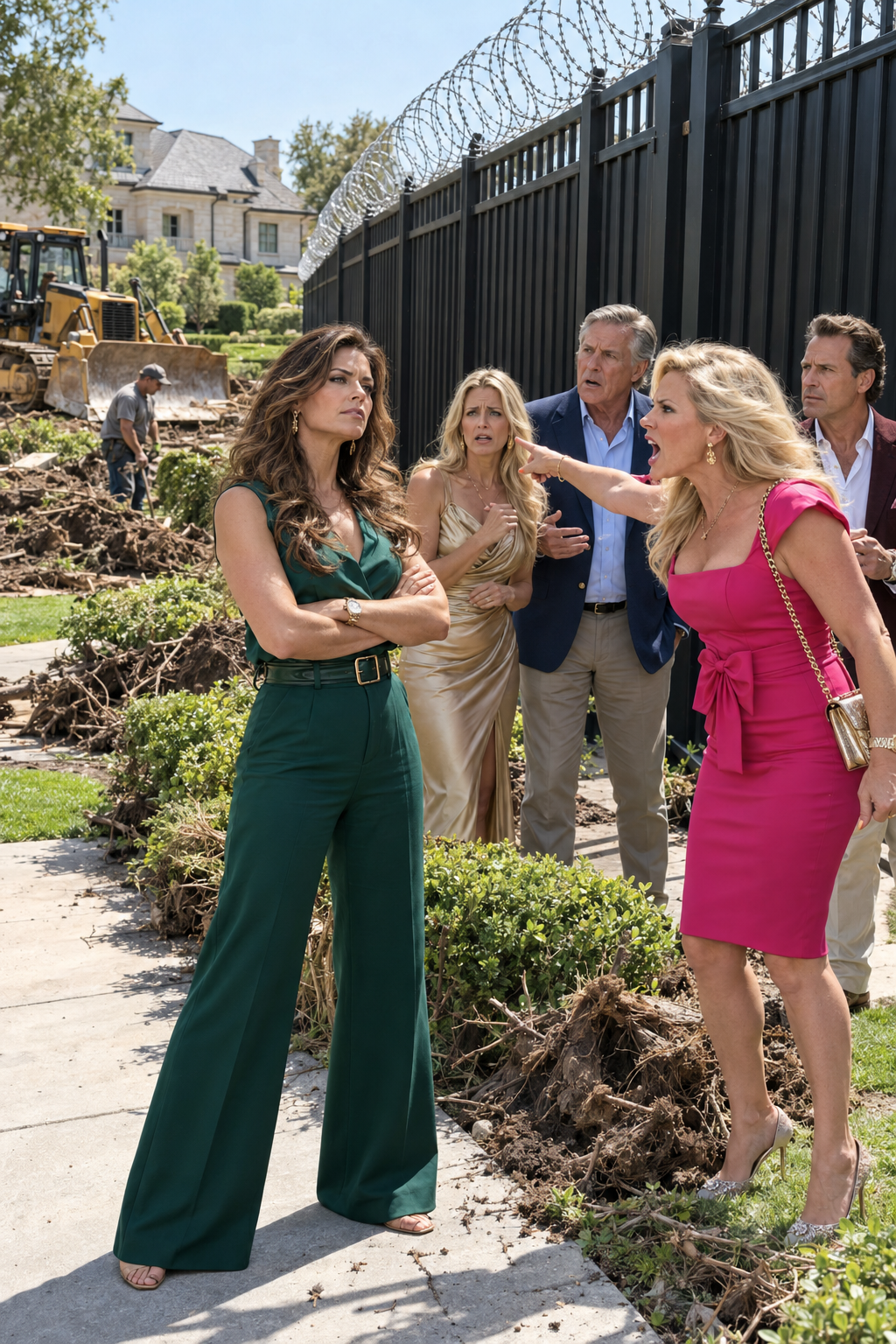
HOA Karen Bulldozed My Thirty-Year-Old Hedges While I Was Gone—She Never Expected What I Put There Next
At on a Tuesday morning, my phone showed me an excavator ripping through the hedge my father had spent thirty years growing.
At , my HOA president stood in the middle of my property, smiled directly at my security camera, and gave the operator a thumbs-up.
At , she sent me a text.
“Problem solved. You’re welcome.”
I read it twice.
Then I put my phone facedown beside my coffee.
I didn’t scream.
I didn’t call Karen.
I didn’t race home.
I was sitting in a conference room forty-seven miles away in Richmond, Virginia, reviewing drainage plans for a municipal project, and the last thing I intended to do was give Karen Decker the reaction she was expecting.
Instead, I asked my assistant to move my afternoon meetings.
Then I opened the folder on my laptop labeled CEDAR RIDGE PROPERTY.
Karen had just made the most expensive mistake of her life.
She simply didn’t know it yet.
My name is Claire Whitaker.
I’m forty-four years old, divorced, child-free, and I design civil infrastructure for a living.
Stormwater systems.
Access roads.
Retaining structures.
Municipal easements.
Property-line disputes.
The boring things nobody thinks about until somebody puts a bulldozer in the wrong place.
My house sat on 4.8 acres outside Ashland, Virginia.
The neighborhood around it was called Cedar Ridge Estates, a polished little community of stone mailboxes, black SUVs, manicured lawns, and people who complained if somebody left a basketball hoop visible from the street.
My property was older than all of it.
Much older.
My grandfather bought the land in 1968 when the surrounding area was mostly soybean fields.
My father built the house in 1984.
And in 1994, when the first developer started buying farmland around us, Dad planted a hedge along the eastern property line.
American holly.
Arborvitae.
Wax myrtle.
A few cedars mixed in.
He planted them six feet apart.
He watered them by hand during the first summer.
He replaced the weak ones.
He pruned them every spring.
By the time I inherited the house, that hedge was nearly sixteen feet tall in places and thick enough that deer usually walked around it instead of through it.
Four hundred and thirty-seven feet of living privacy.
To Karen Decker, it was “an obsolete visual obstruction.”
To me, it was the last thing on the property my father had touched every year until cancer made him too weak to carry pruning shears.
Karen knew that.
She had heard me say it.
She bulldozed it anyway.
When I finally drove home that afternoon, I turned onto Cedar Ridge Lane and immediately saw sunlight where there had never been sunlight before.
The entire eastern edge of my property looked naked.
The hedge was gone.
Not trimmed.
Not reduced.
Branches were piled in ugly heaps beside the road.
Roots had been torn from the ground.
Dark trenches cut through the soil.
Chunks of old cedar lay scattered across the grass.
One section of my irrigation line had been ripped open and was spraying water into the air.
And right in the middle of the destruction stood Karen Decker.
She was wearing cream-colored slacks, a bright coral blouse, oversized sunglasses, and white sneakers that had somehow remained perfectly clean.
Three HOA board members stood behind her.
So did a landscaping contractor.
Karen crossed her arms when I parked.
“You’re home early.”
I shut off my engine.
“Apparently.”
She smiled.
Not apologetically.
Triumphantly.
“I know this looks dramatic, but it needed to happen.”
I stepped out of my car.
My neighbor, Tom Alvarez, was standing near his mailbox across the road.
He raised his phone slightly.
Karen noticed him too.
Her smile became even sweeter.
“The board has received multiple complaints about visibility,” she said. “Your vegetation created a safety issue.”
I looked down the road.
My hedge wasn’t near an intersection.
It wasn’t near a driveway entrance except mine.
It didn’t block a traffic sign.
It didn’t interfere with power lines.
It didn’t touch the sidewalk because there was no sidewalk.
“Which visibility?” I asked.
Karen blinked.
“Excuse me?”
“Visibility of what?”
“The roadway.”
“From where?”
Her mouth tightened.
“The community.”
“That’s not a location.”
One of the board members, Greg Holloway, looked at his shoes.
Karen removed her sunglasses.
She was fifty-seven, blond, polished, and permanently possessed by the expression of someone who believed the world was one customer-service manager away from surrendering.
“You’ve been warned about those hedges for months.”
“No,” I said. “You’ve sent me letters asking me to reduce their height.”
“And I responded to each one.”
“You refused.”
“I informed you that Cedar Ridge HOA has no jurisdiction over my landscaping.”
Karen laughed.
Actually laughed.
“Claire, your house is physically inside Cedar Ridge.”
“Geographically adjacent to Cedar Ridge.”
“Same thing.”
“It really isn’t.”
She stepped closer.
“Your legal technicalities don’t change the fact that everyone has to cooperate.”
There it was.
Karen’s favorite word.
Karen said cooperate when she meant obey.
She said community when she meant authority.
She said safety when she meant control.
She said improvement when she meant somebody else paying.
She said rules when she meant whatever she had decided that morning.
I looked past her toward the destroyed hedge.
A piece of gray concrete was sticking out of the torn soil.
My stomach tightened.
I walked toward it.
Karen said something behind me, but I ignored her.
I crouched.
The excavator had exposed a small rectangular survey monument.
Stamped with numbers.
I brushed away soil with my fingertips.
My father had shown it to me when I was twelve.
One of four original boundary markers.
He had built the hedge eighteen inches inside our property line specifically so nobody could ever argue that the plants crossed onto neighboring land.
Karen’s contractor had bulldozed right over it.
I took three photographs.
Then four more.
“What are you doing?” Karen asked.
“Documenting.”
“For what?”
Her expression changed slightly.
Only slightly.
But I saw it.
“Who authorized the excavation?” I asked.
“Who specifically?”
“The board.”
“Do you have the vote recorded?”
“Of course.”
“The contractor’s certificate of insurance?”
Karen frowned.
“The contractor’s insurance information.”
“That’s between us and them.”
“No. You authorized commercial excavation on private property.”
“It’s HOA-maintained frontage.”
“It absolutely is.”
“No, Karen. It isn’t.”
She stepped toward me.
“This attitude is exactly why nobody can work with you.”
I almost smiled.
Karen mistook quietness for weakness.
A lot of people did.
They expected anger to announce danger.
They expected shouting.
But I had spent twenty-one years sitting across tables from contractors, developers, attorneys, city planners, inspectors, and engineers who could burn through half a million dollars with one careless signature.
The dangerous people in those rooms rarely shouted.
They took notes.
So I took notes.
Contractor name.
Excavator identification.
Truck license plate.
Board members present.
Damage to irrigation.
Approximate hedge length removed.
Approximate soil disturbance.
Survey monument exposure.
Then I walked to the contractor.
He looked about thirty-five.
His company logo was embroidered on his shirt.
“Are you the site supervisor?”
He looked at Karen.
Karen said, “You don’t need to answer her.”
I smiled at him.
“That tells me yes.”
His face went pale.
“My name’s Brent.”
“Brent, did the HOA tell you this property belonged to them?”
He hesitated.
Karen snapped, “Brent.”
I held up one hand.
“I’m not blaming you. I’m asking a factual question.”
Brent swallowed.
“They said it was common-area landscaping.”
“Did anyone show you a plat?”
“A survey.”
“Written permission from the landowner?”
Karen stepped between us.
“I am the HOA president.”
I looked at Brent.
“I’m the landowner.”
The kind that changes things.
Brent stared at Karen.
Then at the ruined ground.
Then back at me.
“You own this?”
“All the way to the drainage swale?”
Karen snapped, “She’s disputing the boundary.”
“No, I’m not.”
I pointed at the exposed monument.
“The boundary is right there.”
Brent’s color disappeared completely.
He walked toward his excavator.
Karen followed.
“What are you doing?”
“Stopping.”
“You’re almost finished.”
“I’m finished now.”
“We have a contract.”
“Call my office.”
“You cannot leave this looking like this.”
Brent climbed into the machine.
“I’m not touching anything else.”
Karen stood frozen.
That was my first payoff.
But satisfying.
The excavator left fifteen minutes later.
The dump truck followed.
Karen and her board remained.
Greg Holloway finally spoke.
“Claire, maybe we can all discuss remediation.”
I looked at him.
“Remediation for what?”
He glanced at Karen.
“Landscaping.”
Karen’s head snapped toward him.
He lifted both hands.
“I’m just saying maybe we should talk.”
“You should,” I said.
“But not with me.”
I walked toward my house.
Karen followed me halfway up the driveway.
“Where are you going?”
“We’re not finished.”
“Yes, we are.”
She laughed sharply.
“You think you can ignore the HOA?”
I turned around.
“Karen, I’ve never ignored the HOA.”
“No. I’ve saved every letter you’ve sent me.”
That stopped her.
Every notice.
Every fake violation.
Every demand.
Every email.
Every certified envelope.
Every one of my responses.
Every deed map.
Every tax record.
Every survey.
Everything.
Karen stared at me.
I watched the first flicker of uncertainty enter her face.
Then she covered it with a smile.
“You’re being dramatic.”
“You bulldozed thirty-year-old landscaping from land you don’t own.”
“It was necessary.”
“That’s something your attorney can explain.”
Her smile vanished.
“My attorney?”
I unlocked my front door.
Then I went inside.
I didn’t call the police that evening.
I didn’t post pictures online.
I didn’t confront neighbors.
I didn’t send angry emails.
I made tea.
Then I opened a document and started building a timeline.
At p.m., Tom knocked on my door.
He held a flash drive.
“I got most of it.”
“Most of what?”
He handed me the drive.
Tom had filmed from his porch.
Not just the argument after I arrived.
The demolition.
Karen directing the excavator.
Karen standing inside my property line.
Karen pointing at individual sections.
And something else.
Something I hadn’t seen.
At 10:06 that morning, before most of the hedge was gone, Karen walked along the exposed dirt with Greg Holloway.
She stopped beside the old survey marker.
She pointed down.
Greg bent over.
They talked for almost thirty seconds.
Then Karen waved the excavator forward.
The machine drove directly over the marker.
I replayed the clip.
Three times.
Tom leaned against my kitchen counter.
“What is that thing?”
“Boundary monument.”
“Important?”
“You think she knew?”
I paused the video on Karen’s finger pointing straight at it.
That changed things.
Destroying vegetation could be dismissed as an HOA overreach.
Destroying or disturbing a known boundary marker was something else entirely.
“Why would she care about that?” Tom asked.
“I don’t know yet.”
Tom nodded slowly.
Then he said something that stayed with me all night.
“She wasn’t looking at the bushes, Claire.”
“When they started this morning, she kept watching the ground.”
I looked at him.
“She barely looked at the hedge. She kept watching what got uncovered.”
At the next morning, I called a licensed surveyor.
At , I contacted my attorney, Melissa Grant.
At , I reported the unauthorized excavation to Hanover County.
At , I contacted the contractor’s corporate office.
At 10:05, their insurance carrier called me.
At 10:40, Karen sent her first email.
Yesterday’s landscaping maintenance became unnecessarily confrontational due to your refusal to acknowledge the authority of the Cedar Ridge Estates Homeowners Association.
The board acted under its responsibility to preserve neighborhood safety, appearance, and property values.
We expect you to cooperate with restoration plans.
KAREN DECKER President Cedar Ridge Estates HOA
I forwarded it to Melissa.
She responded four minutes later.
Do not reply.
At noon, Karen sent another.
Please confirm that you will not interfere with HOA contractors returning to complete cleanup.
I forwarded that too.
Melissa called me.
“She’s helping us.”
“I noticed.”
“Do you have proof your parcel predates the HOA?”
“Original deed, subdivision plat, tax records, title insurance.”
“And no later declaration?”
There was a pause.
“Don’t build anything yet.”
I looked out my window at the empty dirt line.
“I wasn’t planning to.”
That was technically true.
I wasn’t planning to build anything yet.
First, I wanted the survey.
The surveyors arrived Thursday morning.
Karen arrived seven minutes after them.
Of course she did.
She walked across my driveway carrying a leather folder.
“You can’t authorize surveying of HOA property.”
The surveyor, a sixty-three-year-old man named Walter Briggs, stared at her.
“Ma’am, I’m surveying Ms. Whitaker’s parcel.”
“This border is disputed.”
Walter looked at me.
He looked back at Karen.
“There you go.”
Karen’s jaw tightened.
She followed us anyway.
Walter’s crew located the western monument.
Then the northern one.
Then the southern.
The eastern marker Karen’s contractor had crossed was damaged but still partly intact.
They took measurements.
Coordinates.
Historical references.
Walter kept staring at his tablet.
Then he frowned.
He walked ten yards south.
Measured again.
Karen watched.
“What is it?” I asked.
Walter scratched his gray beard.
“I want to check the original plat.”
Karen suddenly spoke.
“If there’s uncertainty, you should stop.”
Walter glanced at her.
“Because this could become a legal issue.”
“Ma’am, property boundaries are already legal issues.”
He continued.
Two hours later, he asked me to step over to his truck.
Karen tried to come too.
Walter stopped her.
“Client only.”
Karen looked offended enough to rupture something.
Walter opened an old scanned plat on his screen.
“Your father’s survey was right.”
“I knew that.”
“But there’s something else.”
He zoomed in.
The line separating my parcel from what became Cedar Ridge Estates wasn’t straight.
There was a shallow jog about two hundred feet south of my driveway.
A seventeen-foot offset.
Small on paper.
Nearly invisible unless you knew what to look for.
“What does that mean?”
Walter pointed toward the HOA side.
“It means their decorative wall is on your land.”
I looked toward Cedar Ridge’s entrance landscaping.
Stone pillars.
Flower beds.
An ornamental fence.
Then the small visitor parking area beside the community mail pavilion.
“How much?”
“Depends on final verification.”
“Approximately?”
Walter looked at his measurements.
“Your parcel extends roughly seventeen feet farther east here than the HOA appears to believe.”
My eyes followed the line.
The visitor parking area.
Part of the flower bed.
A row of ornamental trees.
Possibly one edge of the pavilion walkway.
All inside my property.
Karen was standing thirty yards away.
Watching us.
And for the first time since this started, she didn’t look angry.
She looked afraid.
That was when I understood.
This wasn’t about my hedge.
Not really.
The hedge had hidden the old line.
And Karen knew something was under it.
Walter lowered his voice.
“Claire, I’m going to research every recorded plat from 1968 forward.”
“I wouldn’t touch anything over there until I’m done.”
Karen waited until Walter left.
Then she approached me.
Her voice had changed.
Almost friendly.
“Maybe we should reset.”
I nearly admired her nerve.
“Reset what?”
“This situation.”
“Yesterday I had an attitude problem.”
“I didn’t say that.”
“You said nobody could work with me.”
“Well, tempers were elevated.”
“Mine wasn’t.”
She ignored that.
“The hedge removal may have been too aggressive.”
“May have?”
“We can replace it.”
“With what?”
“New landscaping. Professionally designed. Something attractive.”
“My old landscaping was attractive.”
“It was overgrown.”
“It was mine.”
Karen breathed through her nose.
“We could offer mature evergreens.”
“Privacy trees.”
“A six-foot privacy fence.”
Her eyes narrowed.
“What do you want?”
That was the first useful question she had asked.
“I want you off my property.”
“I mean as a settlement.”
“I haven’t offered to settle.”
Karen’s face hardened again.
“You’re enjoying this.”
“You always thought you were better than us.”
That surprised me.
Not because it was true.
Because it revealed something.
“This isn’t about Cedar Ridge,” I said.
“Everything affects Cedar Ridge.”
“Not my hedge.”
“It absolutely affected us.”
She hesitated.
Half a second.
Maybe less.
But enough.
I stepped closer.
“How did my hedge affect you, Karen?”
She looked toward the road.
Then at me.
“It created an outdated appearance.”
“A safety concern.”
“A property-value issue.”
Her eyes flashed.
“You don’t get to interrogate me.”
“And you don’t get to bulldoze my land.”
She turned and marched away.
That afternoon I received a certified notice from the HOA.
$1,500 fine.
Violation: installation or maintenance of nonconforming exterior landscaping.
I laughed for the first time all week.
Melissa didn’t.
She sent a response on law-firm letterhead.
Three pages.
I only needed one sentence.
Cedar Ridge Estates HOA has no covenant authority over the Whitaker parcel.
The fine disappeared from the HOA portal by lunchtime the next day.
That was payoff number two.
Friday afternoon, the county land-use inspector arrived.
His name was Dennis Hart.
Karen arrived too.
This time with Greg and another board member.
Dennis examined the excavation.
The irrigation damage.
The exposed monument.
He photographed tire impressions.
Then he asked Karen who ordered the work.
“The board.”
“On what property?”
“Common frontage.”
Dennis looked at his map.
“This parcel is taxed to Claire Whitaker.”
Karen crossed her arms.
“Our declarations include architectural oversight for properties affecting community appearance.”
Dennis shrugged.
“That might be a private covenant question. I’m asking why commercial excavation occurred on property owned by somebody else.”
“The board believed it was common area.”
I spoke for the first time.
“Yesterday she offered to replace the landscaping.”
Karen shot me a furious look.
Dennis wrote something down.
Then he asked her, “Do you have a survey identifying this as common area?”
Karen didn’t answer.
“Ms. Decker?”
“We are reviewing our records.”
Dennis nodded.
“Until you finish reviewing them, no HOA contractor should enter this property.”
Karen straightened.
“Are you issuing an order?”
“I’m telling you what will keep this from getting worse.”
“I’m the elected president of this association.”
Dennis capped his pen.
“And I’m the guy standing here with the county map.”
Tom laughed from across the road.
Karen heard him.
Her neck turned red.
That evening, Brent—the excavation supervisor—called me.
His company had discovered the HOA signed a work authorization stating it had ownership or legal control of the excavation area.
Karen signed personally as authorized representative.
He emailed me a copy.
I forwarded it to Melissa.
Another piece.
Another mistake.
Saturday morning, I went to the county records office.
I stayed three hours.
My parcel began as part of a forty-one-acre tract.
Over decades, surrounding parcels had been sold.
Cedar Ridge’s developer bought most of the neighboring land in 1996.
The HOA formed in 1999.
My parents had been asked to join.
They declined.
There it was.
Twenty-seven years old.
Dear Mr. and Mrs. Whitaker,
We respectfully request voluntary annexation of your property into the Cedar Ridge Estates community…
My father’s handwritten response was attached.
No, thank you.
That was it.
Three words.
Dad never wasted language.
I photographed everything.
Then I found something else.
A 2002 site plan.
Cedar Ridge Phase II.
The visitor parking area near the mail pavilion stopped exactly at my boundary.
No encroachment.
A 2008 revision showed the parking area expanded.
Across the line.
There was no easement attached.
No deed transfer.
No recorded permission.
Someone had expanded Cedar Ridge infrastructure onto my family’s land.
I requested every related document.
By Monday, Walter confirmed the survey.
Four hundred and ninety-eight square feet of ornamental landscaping.
Two stone columns.
Eleven parking spaces.
Part of the community pavilion walkway.
All encroaching.
My property.
Melissa called after reviewing it.
“You realize this changes our leverage.”
“What do you want?”
I looked through my kitchen window.
For thirty years, that window had faced green.
Now it faced Cedar Ridge.
Karen’s perfect little kingdom.
“I want my privacy back.”
Melissa was quiet.
“Reasonably?”
“That’s a different word.”
I had already called the county zoning office.
My parcel had another unusual feature.
Because it predated residential subdivision development, a portion of the eastern boundary retained an agricultural-service classification.
My father used to keep equipment on the back acreage.
That designation had never been changed.
And under the existing land-use rules, security fencing for agricultural and equipment-protection purposes could exceed normal residential fence height with administrative approval.
I asked the county what would be permitted.
Not what would be popular.
Not what Karen would like.
What would be permitted.
There is an important difference.
Three days later, I filed plans.
Karen found out by Friday.
I know because at that evening she appeared at my front door.
No coral blouse this time.
Navy blazer.
Pearl earrings.
Leather binder.
War uniform.
“I heard you submitted a fence application.”
“Fifteen feet?”
“That’s insane.”
“Thank you for stopping by.”
I started closing the door.
She pushed one hand against it.
“Razor wire?”
“Security topping.”
“This is a neighborhood.”
“My property boundary is not HOA common space.”
“You’re trying to punish everyone.”
“You’re trying to make Cedar Ridge look like a prison.”
“Then what exactly are you doing?”
I looked past her toward the raw line where my hedge had been.
“Replacing the security and privacy barrier you destroyed.”
“With razor wire?”
“With a permitted fence.”
“Nobody puts a fifteen-foot security fence beside luxury homes.”
“Then perhaps nobody should bulldoze the barrier that was already there.”
Her mouth opened.
Then she tried a different strategy.
“We’ll replace the hedge.”
“You already offered.”
“I’m officially offering.”
“We’ll put in twelve-foot mature arborvitae.”
“Fourteen-foot.”
“We’ll cover irrigation.”
“Claire, be reasonable.”
“I was reasonable for thirty years.”
“What does that mean?”
“My father planted a living barrier eighteen inches inside our land. We maintained it. We asked nothing from Cedar Ridge. We charged nothing for the land underneath your parking spaces. We complained about nothing. We left you alone.”
Karen’s jaw clenched.
“You’re threatening our parking area now?”
“I didn’t mention your parking area.”
“You just did.”
“No, Karen.”
I watched her eyes.
She realized it a second too late.
That was the moment.
But confirmation.
She knew about the encroachment.
I opened the door wider.
“How long have you known?”
She stared at me.
“Known what?”
“The parking spaces cross my boundary.”
“That survey is disputed.”
“I never told you what Walter found.”
Beautiful, absolute silence.
Karen stepped backward.
“You people have been discussing this all over the neighborhood.”
“Greg told me.”
“Greg wasn’t present when Walter gave me the preliminary result.”
“He heard afterward.”
“From whom?”
She had no answer.
I let the silence sit there.
Karen tightened her grip on the binder.
“You’re making a mistake.”
“Another favorite phrase.”
“This fence will destroy your relationship with everyone here.”
“I’m not in your HOA.”
“You live beside us.”
“I did that peacefully for twenty-seven years.”
“You think a judge will support this?”
“I think a permit officer will approve or deny my application.”
“And if it’s denied?”
“Then I’ll build whatever is legally allowed.”
She stared at me.
That answer bothered her more than anger would have.
Because I wasn’t attached to one method.
I was attached to the boundary.
And Karen was finally beginning to understand that.
She turned toward the driveway.
Then stopped.
“You know why people don’t like you?”
“Because you think knowing rules makes you powerful.”
I leaned against the doorframe.
“No, Karen.”
She looked back.
“Knowing where the rules stop does.”
I closed the door.
The fence permit was approved twelve days later.
With conditions.
Professional installation.
No obstruction of road visibility.
No interference with drainage.
No extension into the public right-of-way.
No electrification.
All perfectly reasonable.
I accepted every one.
The contractor started Monday morning.
Cedar Ridge nearly lost its mind.
By , six residents were standing on the opposite side watching.
By , Karen arrived.
By , Greg arrived.
By 10:00, somebody had called the county.
By 10:40, Dennis Hart drove up, inspected the permit posted near my driveway, spoke with the contractor, and left.
Karen followed him to his truck.
He kept walking.
“Dennis, this cannot be acceptable!”
“Permit’s valid.”
“It has razor wire!”
“It meets the approved security-fence specification.”
“Beside homes!”
He looked toward the nearest Cedar Ridge house.
It was almost two hundred feet away.
“Not very beside.”
A few neighbors laughed.
Karen heard them.
By Wednesday, black steel posts rose along the entire exposed boundary.
Impossible to ignore.
The design wasn’t pretty.
That wasn’t the point.
It was clean.
And entirely on my property.
The upper security section reflected silver in the afternoon light.
By Thursday evening, Cedar Ridge’s open view across my acreage had become a fifteen-foot wall of consequences.
I stood on my porch with coffee and looked at it.
My father would have hated it.
That part hurt.
He liked trees.
He liked birds nesting in the hedge.
He liked the smell of cedar after rain.
If Karen had simply asked to discuss trimming one small section, I probably would have done it.
If Cedar Ridge genuinely needed a safety improvement, I would have listened.
If she had accidentally damaged twenty feet, I would have taken an apology.
But she hadn’t made a mistake.
She had hired machinery.
Signed authorization.
Directed the destruction.
Watched the ground.
And pointed at my boundary marker.
So no, I didn’t feel guilty.
I felt sad.
There’s a difference.
Friday morning, eleven Cedar Ridge residents showed up at my driveway.
Tom called it “the delegation.”
I called it predictable.
A woman named Diane spoke first.
“This has gone too far.”
She blinked.
Apparently she expected an argument.
“We want the fence removed.”
“It’s ugly.”
“It lowers everyone’s property value.”
“Possibly.”
“You admit that?”
“I’m not a real-estate appraiser.”
An older man stepped forward.
“We didn’t bulldoze your bushes.”
“Whatever.”
“I know you didn’t.”
“Then why punish us?”
He pointed.
“You call that nothing?”
“I call it a boundary fence.”
Diane folded her arms.
“Karen said you refused replacement landscaping.”
“That’s true.”
“She said the hedge removal happened because of a safety recommendation.”
“Did she show you the recommendation?”
Diane hesitated.
“Ask her for it.”
Another neighbor said, “She said the county recommended removal.”
“Ask the county.”
I continued.
“She also told the contractor the hedge sat on HOA-controlled property.”
Diane frowned.
“She said the line was disputed.”
“It has been professionally surveyed.”
The group became quieter.
Tom, standing behind them, smiled.
Then I asked the question that changed the mood.
“Did Karen tell you eleven HOA parking spaces are on my land?”
Nobody spoke.
Diane looked genuinely confused.
“The visitor parking beside the mail pavilion.”
“That belongs to the HOA.”
“Part of it doesn’t.”
“That can’t be right.”
The older man looked toward the pavilion.
“How long?”
“At least eighteen years.”
Now people started murmuring.
I didn’t need to push.
That was the useful thing about facts.
Once properly placed, they usually did their own work.
Diane looked at me.
“What are you going to do about the parking spaces?”
“I haven’t decided.”
That answer traveled through Cedar Ridge faster than lightning.
By dinner, three residents had emailed me.
By Saturday morning, seven.
Two apologized for the hedge.
One asked me not to block parking before her daughter’s wedding shower.
Another blamed Karen entirely.
Greg Holloway called at 10:30.
“I think we should meet.”
“With attorneys?”
“Does everything need attorneys now?”
“You tell me.”
“Karen has… strong opinions.”
“You voted with her.”
“We were told your property was subject to architectural control.”
“You had twenty-seven years to verify that.”
“No. You know now.”
Another pause.
Then Greg lowered his voice.
“There are things you don’t understand.”
I nearly laughed.
“That sentence has had a bad week.”
“I’m serious.”
“The hedge wasn’t just about appearance.”
There it was.
I sat down.
“What was it about?”
“I can’t discuss it by phone.”
“Then email me.”
“Then call Melissa.”
“Your lawyer?”
He exhaled.
“Claire, can we please talk like neighbors?”
“We were neighbors when you watched an excavator remove my property.”
He had nothing to say to that.
Before hanging up, he said one last thing.
“You need to ask Karen about the Ridgeview project.”
I wrote it down.
Then I searched public county filings.
I searched state corporate registrations.
Three results.
Ridgeview Development Partners LLC had been formed seven months earlier.
Registered agent: a Richmond law office.
I searched planning commission agendas.
A preliminary discussion from four months earlier.
Proposed development: thirty-six luxury townhomes on eleven acres east of Cedar Ridge Estates.
Access requirements pending.
I opened the map.
My pulse slowed.
Not quickened.
That happens when something finally makes sense.
The proposed Ridgeview development sat behind Cedar Ridge.
Its most convenient construction access crossed the eastern edge of Cedar Ridge.
Near the mail pavilion.
Near the visitor parking.
Near my former hedge.
I overlaid Walter’s survey.
Then stared.
The shortest proposed access route crossed the seventeen-foot strip that Cedar Ridge had treated as its own.
Karen hadn’t bulldozed the hedge because it was ugly.
She bulldozed it because somebody needed a road.
Monday morning, Melissa and I requested public planning documents.
Tuesday, we got them.
Meeting notes.
Traffic studies.
One preliminary diagram showed a twenty-two-foot temporary construction access corridor.
The line passed directly through the former hedge area.
I zoomed in.
There was a notation.
EXISTING HOA CONTROLLED STRIP.
Not HOA controlled.
Whitaker parcel.
Someone had represented my land as available.
The financial documents weren’t public.
But by Wednesday, we had enough to send preservation letters to Cedar Ridge HOA, Ridgeview Development Partners, and Karen personally.
No records regarding my parcel were to be destroyed.
No construction was to cross my property.
No contractor was to enter.
By Thursday, Ridgeview’s attorney called Melissa.
By Friday, their proposed access map disappeared from the planning portal.
Karen stopped driving past my house.
For four days.
Then came the HOA emergency meeting.
Tom texted me at .
You should come.
Not a member.
Come anyway.
At , I walked into the Cedar Ridge clubhouse.
The room went quiet.
About eighty residents filled folding chairs.
Karen sat at a long table with the board.
She wore red.
Bright red.
Power color.
Melissa walked beside me.
Karen’s face changed when she saw her.
“Nonmembers aren’t permitted at association meetings.”
A man in the second row called out, “We invited Claire.”
Karen stared at him.
“This is an official board proceeding.”
Another resident spoke.
“About her land.”
Then another.
“Let her stay.”
Then Diane.
“She stays.”
Karen realized she had lost the room before the meeting even started.
That was payoff number three.
She adjusted her microphone.
“We’re here to address misinformation.”
Tom whispered behind me.
“Here we go.”
Karen began.
She talked about safety.
Property values.
Community unity.
Hostile actions.
She described my fence as retaliatory.
She described the survey as preliminary.
She described the parking encroachment as “a decades-old technical inconsistency.”
Then she made her mistake.
She mentioned Ridgeview.
“The board has explored opportunities that could substantially strengthen Cedar Ridge’s financial position.”
A man raised his hand.
“What opportunities?”
Karen kept talking.
“Potential partnerships.”
“With Ridgeview?” someone shouted.
She paused.
Diane turned around and looked at me.
I said nothing.
Karen glared at the crowd.
“Yes. Ridgeview Development Partners approached Cedar Ridge concerning a limited access arrangement.”
The room erupted.
“How much?”
“What arrangement?”
“Through where?”
“Did we vote?”
Karen hit the microphone.
“One at a time!”
Nobody stopped.
Finally, Greg Holloway stood.
His face was gray.
“There was no homeowner vote.”
The room quieted.
Karen stared at him.
He continued.
“The board was negotiating a temporary access license.”
“How much?” someone asked.
Greg swallowed.
“Initial figure was six hundred and fifty thousand dollars.”
The room exploded again.
Karen stood.
“These negotiations were confidential!”
Greg snapped.
“They were confidential because you told us disclosure would damage the deal.”
“Sit down.”
It was the first time I’d seen Greg stand up to her.
Karen’s face went rigid.
“You signed the confidentiality resolution.”
“I also signed the work authorization because you told me counsel confirmed we controlled that strip.”
Karen pointed at him.
“This is inappropriate.”
Greg turned toward the residents.
“She said the hedge had to come out before Ridgeview’s site inspection.”
There it was.
Not from Karen.
The room changed.
People weren’t whispering anymore.
They were staring.
At each other.
Diane stood.
“You bulldozed Claire’s hedge for a developer?”
Karen slapped one palm against the table.
Greg laughed bitterly.
“No. The hedge had documented maintenance problems.”
“I don’t have the file here.”
“Show us the safety report.”
“It’s with counsel.”
“Which counsel?”
Diane looked at me.
“Was there a safety report?”
Melissa answered.
“None has been produced to us.”
Karen’s voice sharpened.
“This lawyer does not represent Cedar Ridge.”
Melissa nodded.
That tiny response somehow made Karen angrier.
Another homeowner stood.
“If Ridgeview paid us $650,000, where was the money going?”
Karen seized the opportunity.
“Reserve funds. Road improvements. Amenities.”
Greg shook his head.
“That wasn’t the final arrangement.”
Karen whipped around.
“Stop talking.”
Every person in that room heard it.
Not “you’re wrong.”
Not “that’s inaccurate.”
Stop talking.
Greg stared at her.
Then looked at me.
“The final proposed payment was $1.2 million.”
The room fell silent.
That number landed differently.
A million dollars makes people listen.
“Why?” somebody asked.
Greg’s voice was almost a whisper.
“Because Ridgeview couldn’t get practical construction access from the state road.”
A resident near the back said, “So they needed Cedar Ridge.”
Greg nodded.
Then he looked at me.
“And Claire’s strip.”
Karen stood so quickly her chair rolled backward.
“This meeting is adjourned.”
Nobody moved.
“I said adjourned.”
Diane laughed.
Karen stared at her.
Diane folded her arms.
“You don’t get to adjourn eighty homeowners because we finally asked the right question.”
Someone applauded.
Then another.
Within seconds, half the room was clapping.
Karen gathered her papers.
Melissa leaned toward me.
“Don’t say anything.”
I didn’t need to.
Karen marched toward the exit.
As she passed my chair, she stopped.
Her voice was low enough that only Melissa and I heard it.
“You have no idea what you’re interfering with.”
I looked at her.
“The hedge?”
Her eyes were cold.
“The land.”
Then she left.
Melissa and I looked at each other.
That was different.
Not the HOA.
Not Ridgeview.
The next morning, Cedar Ridge residents began circulating a recall petition.
By noon, thirty-four homeowners had signed.
By evening, fifty-eight.
Karen emailed the entire community calling it an “emotionally manipulated uprising.”
That added nine signatures.
Three days later, the board placed her presidential authority on temporary suspension pending a records review.
Greg resigned.
Two other directors requested independent counsel.
Ridgeview Development Partners formally withdrew its access proposal.
The county notified them that any future plan would require verified property control.
And the landscaping contractor’s insurer sent me an initial settlement offer.
It wasn’t enough.
But it existed.
For the first time in weeks, things became quiet.
The fence stood.
The parking encroachment was being negotiated.
Karen’s power was collapsing.
Ridgeview had backed away.
It would have been easy to believe the story was ending.
Then Walter Briggs called me.
His voice sounded strange.
“What happened?”
“Are you home?”
“I need to show you something.”
“Email it.”
“I’d rather not.”
That got my attention.
“Because I found something that doesn’t belong in the county’s current digital index.”
Twenty minutes later, Walter pulled into my driveway carrying a cardboard document tube and an old leather portfolio.
We sat at my dining table.
He removed three maps.
The first was my grandfather’s 1968 deed plat.
The second was Cedar Ridge’s 1996 development survey.
The third was something I had never seen.
A hand-drawn utility and access plan dated 1971.
“What is this?”
“Found it referenced in an old highway department archive.”
I leaned closer.
A dotted line crossed my family’s original forty-one-acre tract.
Not east-west.
North-south.
Walter pointed.
“This corridor was proposed for a county connector road.”
“Proposed?”
“Never built.”
“So proposed rights can die, get released, get transferred, or occasionally become attached to later agreements.”
He opened another document.
“This is a release.”
The county abandoned the proposed corridor in 1978.
Rights returned to the property owner.
My grandfather.
Walter slid another paper toward me.
“But look here.”
A deed recorded in 1997.
Cedar Ridge’s original developer purchased land bordering my family property.
The legal description referenced the old abandoned corridor.
Incorrectly.
I looked up.
“They thought they owned it?”
“How much land?”
Walter didn’t answer immediately.
He unfolded a larger map.
My dining table disappeared beneath it.
A long narrow strip extended past my current parcel, through Cedar Ridge, then south toward undeveloped woodland.
Nearly three-quarters of a mile.
“What am I looking at?”
“A chain-of-title problem.”
“For whom?”
“If the 1978 release is controlling, your grandfather retained interest in this entire corridor until later conveyances specifically disposed of it.”
“That’s what I’ve been researching.”
“I can’t find any conveyance.”
My stomach tightened.
“Meaning your family may never have sold this strip.”
I looked at Cedar Ridge on the map.
The clubhouse.
A detention pond.
Walter began pointing.
“This rear section of the clubhouse parcel.”
“This landscaped drainage basin.”
“This part of Oak Crest Drive.”
“And potentially portions of fourteen residential lots.”
I stared at him.
“I said potentially.”
“Fourteen houses?”
“Parts of lots. Not necessarily the structures themselves.”
“This can’t suddenly appear after thirty years.”
“It didn’t suddenly appear. The paperwork has been sitting in archives the entire time.”
I stood and walked to the window.
The fence gleamed beyond my yard.
For weeks I thought Karen wanted seventeen feet.
A shortcut.
A construction corridor.
A million-dollar access deal.
But she had told me I didn’t understand the land.
Not access.
“Does Karen know about this?”
“I don’t know.”
“Could Ridgeview know?”
“I don’t know.”
“Could Cedar Ridge’s original developer have known?”
Walter paused.
That answer chilled me more than everything else.
I called Melissa.
She arrived before sunset.
For three hours, the three of us traced deeds.
Parcel splits.
Old surveys.
Recorded easements.
Missing references.
The pattern was messy.
But not random.
Several modern legal descriptions carefully avoided mentioning the old corridor.
Almost too carefully.
At p.m., Melissa leaned back.
“This is bigger than the hedge.”
Walter nodded.
“Much bigger.”
My phone buzzed.
Unknown number.
STOP DIGGING.
Melissa saw it.
“Don’t answer.”
Another message arrived.
YOUR FATHER KNEW WHEN TO LEAVE THINGS ALONE.
I stopped breathing for a second.
Not because it threatened me.
Because it mentioned Dad.
He had been dead four years.
I showed Walter.
His face changed.
Melissa immediately photographed the screen.
Then another message arrived.
CHECK YOUR MAILBOX.
Nobody moved.
Melissa said, “You’re not going outside alone.”
We walked together.
Walter carried a flashlight.
My mailbox sat at the road.
Then I felt something taped under the metal box.
A small brown envelope.
No address.
Inside was a photograph.
Maybe twenty years old.
My father stood beside the eastern hedge.
Next to him was another man.
I recognized him after a few seconds.
Charles Decker.
Karen’s late husband.
He had died in 2018.
On the back of the photograph, someone had written a date.
May 14, 2004.
And four words.
THEY BOTH SIGNED IT.
Melissa took the photograph carefully by the edges.
“Signed what?”
I didn’t know.
We went back inside.
I locked the door.
At 10:03, another unknown text arrived.
This one contained an image.
A scanned document.
Only the bottom third.
Two signatures.
Charles Decker.
And my father.
Robert Whitaker.
Above them, one partially visible sentence:
…in consideration of future development proceeds and permanent access rights…
My chest went cold.
Then I noticed the third signature.
Karen Decker.
Walter leaned toward the screen.
Melissa whispered, “Claire, don’t touch anything.”
“I’m holding my phone.”
“You know what I mean.”
Another message appeared.
YOU THOUGHT KAREN BULLDOZED THOSE HEDGES TO BUILD A ROAD.
Then the final text arrived.
SHE BULLDOZED THEM BECAUSE YOUR FATHER BURIED THE ORIGINAL AGREEMENT UNDERNEATH THEM.
All three of us turned toward the black window.
Toward the raw earth behind my fifteen-foot fence.
Toward the place where my father had spent thirty years carefully tending the same stretch of ground.
And for the first time since Karen’s excavator entered my property, I stopped thinking about what she had destroyed.
I started wondering what she had been trying to find.
✓ Lynn R. Adams
HOA Karen Bulldozed My Thirty-Year-Old Hedges While I Was Gone—She Never Expected What I Put There Next At on a Tuesday morning, my phone showed me an excavator ripping through the hedge my father ha…