HOA Karen Auctioned My $310K Farm Equipment—Then the Judge Sold Her Own Office to Pay Me Back, but One Envelope Changed Everything
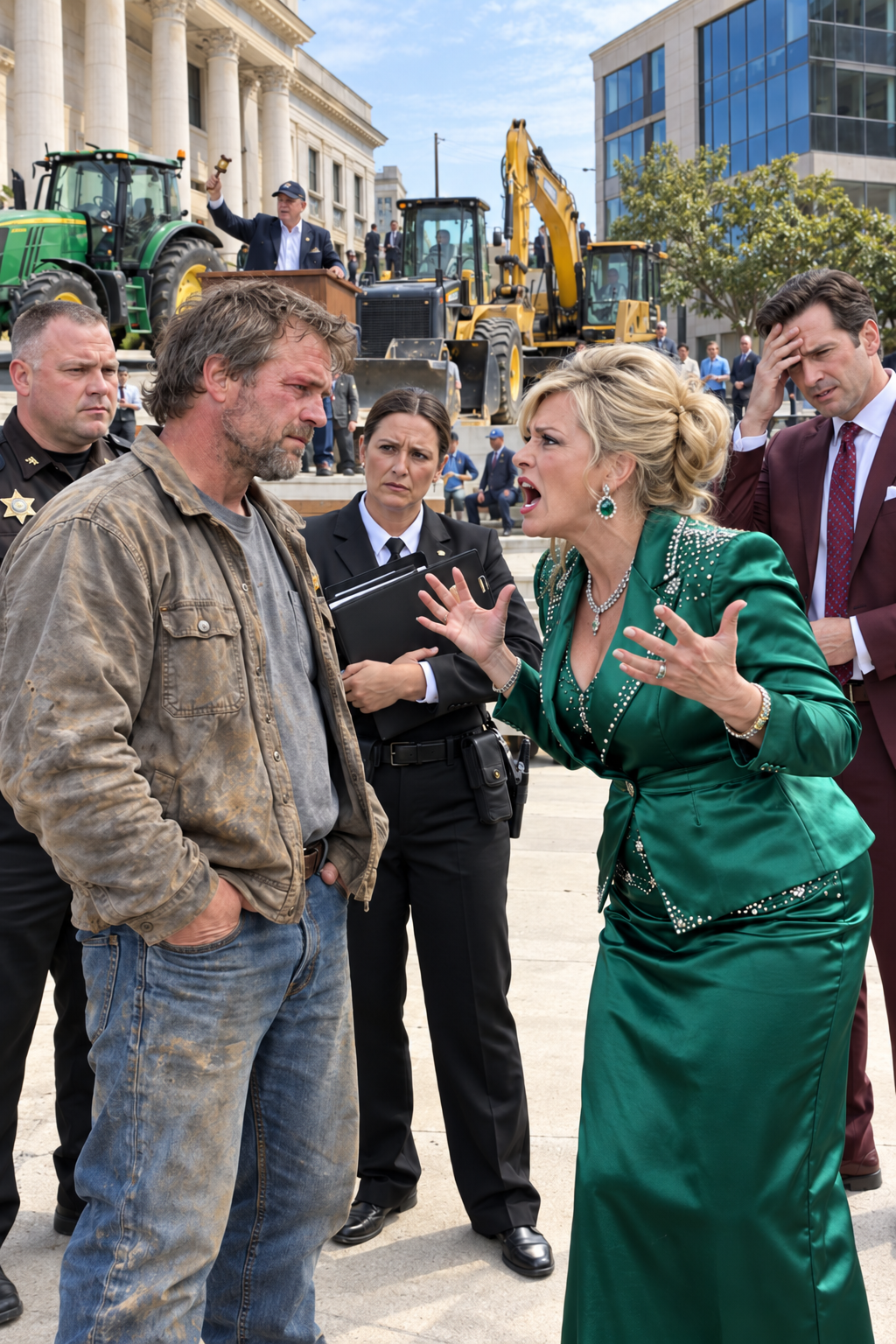
HOA Karen Auctioned My $310K Farm Equipment—Then the Judge Sold Her Own Office to Pay Me Back, but One Envelope Changed Everything
The first thing Karen Whitfield sold was my dead husband’s tractor.
The second was the excavator I had paid off by cleaning motel rooms at night for six straight years.
The third was my dignity, or at least she thought it was, when she stood on a folding stage in the Cedar Ridge HOA parking lot and announced to fifty-seven strangers that I was “a delinquent woman who had finally learned that rules apply to everyone.”
People laughed.
My own brother laughed with them.
I stood at the edge of the crowd holding a paper cup of coffee that had gone cold twenty minutes earlier.
I didn’t scream.
I didn’t run toward the auctioneer.
I didn’t beg anyone to stop.
I just watched a man in a camouflage cap raise his bidder card and buy the yellow Caterpillar skid steer for $31,500.
It was worth almost twice that.
Karen looked directly at me when the auctioneer slammed his wooden gavel down.
Her smile widened.
She wanted me to break.
Instead, I reached into the pocket of my old canvas coat and touched the small brass key my husband, Thomas, had given me three nights before he died.
That key was the only reason I had come to the auction at all.
Not to save the machines.
Not to argue.
Not to humiliate myself in front of the neighbors.
I had come to see exactly who bought what.
Because Thomas had once told me something I had dismissed as the cautious rambling of a man who had spent thirty-two years repairing heavy equipment and distrusting anyone who wore polished shoes to a farm.
“If they ever come for the machines, Mara, let them take the machines.”
I had laughed then.
He had closed my fingers around the brass key.
“Don’t fight over the first thing they steal.”
That sentence had bothered me for fourteen months.
That morning, standing beneath the red-and-white AUCTION TODAY banner Karen had hung over the HOA office entrance, it finally made sense.
Karen thought she was selling my future.
She had no idea she was selling evidence.
The auctioneer pointed toward my John Deere loader.
“Next item. 2019 model, excellent condition. HOA repossession. We’ll start at forty thousand.”
“Thirty-five!”
My brother, Daniel, stood beside Karen wearing a navy blazer I had bought him for our mother’s funeral.
He avoided my eyes.
That hurt more than the tractor.
Daniel was three years younger than me.
When we were children, I packed his school lunches because Mom worked mornings at the county hospital.
When he wrecked his first truck at seventeen, I emptied my savings account to help Dad pay the repair bill.
When his first marriage collapsed, he lived in our spare bedroom for nine months and never paid a dime.
When he started a landscaping company and needed a guarantor for his first commercial mower, Thomas and I signed.
When the company failed, we paid off the note.
When Dad developed Parkinson’s, Daniel visited on Christmas and Father’s Day.
I changed Dad’s sheets.
I lifted him into the shower.
I learned how to crush his pills into applesauce.
I slept in a chair beside his hospital bed during the last week of his life.
And after Dad died, Daniel stood in my kitchen, crying against my shoulder, and told me he didn’t know what he would have done without me.
Apparently, what he did without me was sign a document claiming he owned half my land.
Karen had paid him $42,000 for that signature.
I wouldn’t learn the amount until later.
At the auction, all I knew was that my brother had helped strangers drag $310,000 worth of equipment off property that had belonged to our family since 1968.
And now he was standing beside them.
Karen noticed me looking at him.
She leaned over and whispered something.
Daniel finally turned.
For one second, guilt moved across his face.
Then Karen touched his arm.
It disappeared.
The gavel fell again.
“Sold for forty-seven thousand.”
My loader was gone.
Something strange happens when people expect you to collapse and you don’t.
They become irritated.
Karen came down from the platform during a break and walked toward me in high-heeled boots that kept sinking into the soft October grass.
She was fifty-three, blond, careful, expensive.
Her smile always looked professionally installed.
“Are you enjoying the show?” she asked.
I sipped my cold coffee.
She waited for more.
I gave her nothing.
She glanced toward the crowd.
“You could have prevented this.”
“By cooperating.”
“With what?”
Her jaw tightened.
“The community.”
I looked behind her at the HOA office, a renovated brick building with white columns, black shutters and a bronze plaque that read CEDAR RIDGE PROPERTY OWNERS ASSOCIATION.
Karen loved that building.
She called it “the administration center,” even though everyone else called it the office.
She had redesigned the lobby twice in three years.
Italian tile.
Walnut conference table.
Leather chairs.
A chandelier that looked ridiculous in a building that used to be a veterinary clinic.
“You mean by giving you my south field?” I asked.
Karen’s smile disappeared.
“We offered you fair compensation.”
“You offered me eighty thousand dollars for eleven acres.”
“It’s scrubland.”
“It’s road frontage.”
She crossed her arms.
“Road frontage the community needs.”
There it was.
Not exactly.
Karen’s motive had always been more respectable than greed.
That was what made her dangerous.
Cedar Ridge had been built in stages around my family’s farm outside Franklin, Tennessee. What started as forty-seven homes in the late nineties had become three hundred and twelve houses, tennis courts, walking paths, a pool, a clubhouse and enough landscaped entrances to make the place look like a small country pretending to be a subdivision.
The problem was access.
The original entrance opened onto a two-lane county road that backed up every weekday morning.
Karen wanted a second entrance.
My south field was the only practical route.
A developer had offered the HOA nearly $2 million toward a new road because the road would also unlock another 180 acres for luxury homes.
Karen called it safety.
She talked about ambulances.
School buses.
Wildfire evacuation.
Responsible planning.
Those were good words.
The kind that made decent people uncomfortable saying no.
But Thomas had spent twenty years restoring that field after a chemical company upstream contaminated the creek.
He planted trees there.
He rebuilt the soil.
He dug drainage swales by hand before we could afford machinery.
He refused three offers from developers.
After his cancer diagnosis, I asked him if he wanted to reconsider.
He shook his head.
“Some things don’t become less important because you’re dying.”
So I had told Karen no.
She fined me for an unapproved barn color.
I wasn’t in the HOA.
She fined me for commercial vehicle parking.
I wasn’t in the HOA.
She fined me for an agricultural fence that violated architectural standards.
I wasn’t in the HOA.
She fined me for refusing a drainage easement.
I wasn’t in the HOA.
She fined me for signs.
For gravel.
For fuel tanks.
For “visual disharmony.”
I wasn’t in the HOA.
That was the sentence Karen couldn’t stand.
My property sat inside the geographic shape of Cedar Ridge, but it had never been legally annexed.
Dad had refused membership when the first developer came through in 1997.
Thomas had checked the records before we built our second equipment barn.
Our deed had no HOA covenant.
No declaration.
No assessment obligation.
For years, that had been inconvenient for Karen.
Then Daniel appeared with his signature.
Suddenly, she claimed everything had changed.
She said Dad had intended the farm to belong equally to both children.
She said Daniel had inherited an ownership interest.
She said Daniel had voluntarily executed an annexation consent.
She said the property was now subject to Cedar Ridge rules.
Her attorney mailed me a packet thick enough to stop a door.
Assessments.
Legal fees.
Enforcement charges.
By the time they were finished, they claimed I owed $186,440.
I laughed the first time I saw the number.
Thomas would have laughed too.
Then Karen’s people filed something at the county recorder’s office.
Then a collection company sent demands.
Then a private security truck began driving past my gate.
Then Daniel stopped returning my calls.
Three months later, men arrived with tow trucks.
I called the sheriff’s department.
The deputy who came was young.
He looked at Karen’s papers, looked at the tow company supervisor’s papers, called somebody, then told me it appeared to be a civil dispute.
I told him they were stealing my equipment.
Karen told him the association had a lawful lien and a contractual right of possession.
The deputy said he couldn’t determine property rights on the roadside.
So he stood there while they took the skid steer.
The loader.
The excavator.
Two commercial mowers.
A utility trailer.
Thomas’s restored 1974 Ford tractor.
And the service truck with his old toolbox still bolted inside.
That night I sat alone at my kitchen table.
There were muddy tracks across the yard.
Empty rectangles where the machines had stood.
A broken chain beside the equipment barn.
I made one cup of tea.
Then I took the brass key from my coat pocket.
For the first time in fourteen months, I used it.
Thomas had installed an old fireproof cabinet behind the false wall in his workshop.
I had known about the cabinet.
I had not known he’d changed the lock.
Inside were three things.
A red ledger.
A flash drive.
And two sealed envelopes.
One envelope had my name on it.
The other said:
ONLY IF THEY TAKE THE FARM.
I opened mine.
Thomas’s handwriting leaned sharply to the right, the way it always did when his hands were tired.
If you’re reading this because Whitfield or anyone connected to Cedar Ridge is claiming Daniel can sign for this property, do not panic.
Your father knew Daniel might cause trouble someday.
The farm is protected better than either of you knows.
Do not show them everything.
Call Rebecca Sloan.
Show her the ledger first.
Then the 1997 folder.
Do not open the second envelope unless they try to remove you from the house.
Trust documents, not family promises.
At the bottom he had added one sentence.
The law is slow, honey, but slow doesn’t mean asleep.
I read that sentence six times.
Then I cried.
Not loudly.
Not beautifully.
I put my forehead against the cool metal cabinet and let fourteen months of missing him come out without witnesses.
After five minutes, I washed my face.
Then I called Rebecca Sloan.
She answered at 11:43 p.m.
I remembered the time because later it appeared in an affidavit.
Rebecca had been Thomas’s attorney for almost twenty years.
She was sixty-two, silver-haired, and had the calm voice of someone who had watched rich men lie under oath for a living.
When I told her about the equipment, she stopped me.
“Did you open the cabinet?”
“The envelope?”
“My envelope.”
“Good. Did you open the other one?”
“Rebecca, what did Thomas know?”
She was quiet.
Then she asked, “How quickly can you come to Nashville tomorrow?”
That was four days before the auction.
By the morning Karen sold my equipment, Rebecca and I already knew enough to stop it.
That was the part Karen never understood.
We could have filed for an emergency injunction immediately.
We could have run into court waving documents.
We could have sent a sheriff’s deputy to the auction.
Instead, Rebecca told me to wait.
I stared at her across a conference room table when she said it.
“For forty-eight hours.”
“They’re selling everything Thomas and I built.”
“They’ll scatter it across three states.”
“Probably.”
“And you want me to let them?”
“I want them to complete the conversion.”
I hated the word because it sounded clean.
Legal words often do.
Conversion.
Like coffee becoming energy.
Or a garage becoming an apartment.
Not strangers taking a dead man’s tractor while his widow watches.
Rebecca folded her hands.
“Mara, if we stop the auction, they’ll claim it was a paperwork error. A misunderstanding. An aggressive interpretation of a disputed ownership interest.”
“And if we don’t?”
“They take proceeds.”
I stared at her.
She continued.
“They distribute funds. They create invoices. They pay vendors. They document exactly who benefited. Right now Karen can blame counsel, management, Daniel, the tow company, anyone. Once money moves, everyone leaves fingerprints.”
“So I let them steal from me.”
“For forty-eight hours.”
I looked through the glass wall of her office toward downtown Nashville.
Cars moved below us.
People carrying coffee.
People living normal lives.
“Thomas knew this?”
“He suspected they would overreach if you refused the road.”
“Why didn’t he tell me?”
“Because you would have tried to fix it.”
That sounded like him.
Rebecca slid the red ledger toward me.
“Your husband was very good at waiting.”
The ledger contained twenty-two years of records.
Every conversation with Cedar Ridge.
Every boundary survey.
Every letter from developers.
Every proposed easement.
Every payment related to the land.
Thomas had stapled business cards beside handwritten notes.
He had photocopied envelopes.
He had written dates, times and names.
In 1997, the original developer offered my father $61,000 to annex twenty-three acres into the first subdivision phase.
Dad refused.
The developer then signed something called a Nonparticipation and Perpetual Exclusion Agreement.
That agreement specifically stated that our entire 84.6-acre tract would remain outside any existing or successor homeowners association unless every record owner consented in a notarized instrument.
Daniel’s signature alone could never annex anything.
But that wasn’t the best part.
My father had not left Daniel half the farm.
He had left Daniel money.
Dad’s will was explicit.
Daniel received $214,000 from investment accounts and life insurance.
I received the farm because I had worked it with him.
Daniel knew that.
He had signed a receipt acknowledging his distribution.
He had signed another document waiving any claim against the real property.
Rebecca had copies.
So why was Karen relying on Daniel’s supposed ownership?
Because someone had created a new document.
A quitclaim deed.
It purported to show Dad transferring an undivided fifty-percent interest in the farm to Daniel six months before Dad died.
There were three problems.
Dad’s signature was wrong.
The notary commission number belonged to a woman who had retired the previous year.
And the deed claimed it was executed on March 14, 2016.
Dad had spent March 14, 2016, unconscious in Saint Thomas Hospital after emergency brain surgery.
I knew because I had been sitting beside him.
Rebecca knew because Thomas had saved the hospital paperwork.
Karen had built her entire attack on a deed a dead man could not possibly have signed.
I asked Rebecca the obvious question.
“Why would Daniel do this?”
She looked at me for a long moment.
It sounded too small.
Daniel and I had survived our parents’ divorce.
Our mother’s drinking.
Dad’s Parkinson’s.
Years when the electric bill got paid late and Christmas gifts came from church donation boxes.
Money could explain lying.
Could it explain helping strangers take my husband’s tractor?
I didn’t want it to.
Sometimes betrayal hurts less when you pretend it must be complicated.
Most betrayal isn’t.
Sometimes someone simply decides your pain costs less than their comfort.
At 12:20 p.m., the auction resumed.
Karen stood beside the auctioneer with a clipboard.
Daniel had disappeared.
My excavator came up next.
A contractor from Murfreesboro bought it for $79,000.
A man behind me said, “That’s a steal.”
I turned around.
He realized who I was.
His face reddened.
“It is,” I said.
Karen heard me.
She walked over again.
“You know, Mara, continuing to stand here isn’t helping you.”
“Maybe I like auctions.”
“You’ve made your point.”
“What point?”
“That you’re angry.”
I looked at her.
“I’m not angry.”
That unsettled her.
People like Karen understand anger.
Anger can be photographed.
Called instability.
Used in meetings.
Calm is harder to weaponize.
She lowered her voice.
“You need to understand something. This is over.”
“The board owns your debt. Your brother confirmed the property’s legal status. Counsel confirmed our enforcement authority. Your equipment is being liquidated. Once the remaining balance is applied, we’ll proceed on the real property.”
There it was.
“You’re going to foreclose?”
“If necessary.”
I rubbed my thumb over the rim of the coffee cup.
“How long do you think that takes?”
Karen smiled.
“Less time than you think.”
Behind her, the auctioneer called for bids on Thomas’s Ford tractor.
I watched strangers raise cards.
Twenty-five hundred.
Three thousand.
Thirty-five hundred.
A young man in a work jacket raised his hand.
Four thousand.
Karen leaned closer.
“You should accept the road offer while you still have something to negotiate with.”
“You mean the eighty thousand?”
“That offer expired.”
“Of course it did.”
“Given enforcement costs, we’d be willing to release all claims if you transfer the eleven acres.”
That was the real transaction.
Not lawn rules.
Not architectural harmony.
Eleven acres.
A development deal.
And Karen thought the machinery had finally made me desperate enough to surrender.
The Ford sold for $6,800.
Thomas had spent nine years restoring it.
He had repainted every panel.
Rebuilt the transmission.
Tracked down original gauges.
On Sundays he used to drive it around the pond with our granddaughter Sophie sitting on his lap.
When the auctioneer called “sold,” I felt something tear inside me.
Karen watched carefully.
I did not let it reach my face.
“Anything else?” I asked.
Her confidence returned.
“You’ll receive a final accounting.”
I turned to leave.
Karen’s voice carried just enough for nearby bidders to hear.
“You can’t ignore rules your whole life just because you think your family name makes you special.”
A few heads turned.
I looked at her.
“My family name?”
“You’ve behaved like that farm puts you above everyone else.”
I almost laughed.
Dad had spent forty-one years fixing diesel engines.
Mom cleaned patient rooms.
Thomas and I bought our first couch from a yard sale.
I had worn the same winter coat for eleven years.
Special was not the word most people used.
But Karen needed a moral story where she was the responsible leader and I was the selfish holdout blocking community progress.
Without that story, she was just a woman trying to take a widow’s land.
So she had built one.
I nodded toward the HOA office.
“That building makes you feel important, doesn’t it?”
She blinked.
“The columns. The plaque. The conference room. You like having somewhere people have to come ask your permission.”
Her eyes sharpened.
“You’re upset.”
I looked at the bronze plaque.
“I was just wondering how attached you are to it.”
For the first time all day, Karen looked confused.
I walked away.
The next morning at , someone knocked on my door.
It was not a sheriff.
It was Cedar Ridge’s property manager, Denise Caldwell, accompanied by two security officers and a locksmith.
Denise held a folder against her burgundy coat.
She looked uncomfortable.
That gave me hope for about three seconds.
Then she spoke.
“Mara, under the association’s emergency possession provision, the property has been secured pending foreclosure.”
I stared at her.
“Emergency possession?”
She wouldn’t meet my eyes.
“You received notice.”
“No, I received threats.”
“The association has determined that the structures and remaining personal property are collateral connected to the outstanding assessment obligation.”
I actually smiled.
One of the security men shifted his weight.
Denise noticed the smile too.
“Mara, I need you to pack essential belongings.”
“How much time?”
“Until noon.”
It was .
“You’re evicting me from a house you don’t own in less than five hours?”
“This isn’t an eviction.”
“What is it?”
“A protective possession action.”
“That sounds expensive.”
Denise sighed.
“Please don’t make this difficult.”
I looked at the locksmith.
Then the security men.
Then Denise.
“Did Karen send you?”
“The board authorized it.”
“Was Daniel at the meeting?”
She hesitated.
That was the knife.
Not the HOA.
My brother voted to put me out of our father’s house.
I nodded once.
Denise stared.
“I’ll pack.”
She looked almost disappointed.
People had become very disappointed by my cooperation.
I went upstairs.
I packed two suitcases.
Thomas’s old flannel shirt.
My medication.
The framed photograph from our twenty-fifth anniversary.
Dad’s watch.
Mom’s pearl earrings.
Then I went to the workshop.
The security officer followed.
“You can’t remove secured assets.”
“I’m getting personal documents.”
I opened the false wall.
The fireproof cabinet was empty except for one sealed envelope.
ONLY IF THEY TAKE THE FARM.
I put it into my handbag.
The officer said nothing.
At 10:06, I carried my suitcases down the front steps.
Karen was standing beside her Range Rover.
Of course she was.
She wore cream slacks and a pale blue jacket.
Daniel stood behind her.
I set my bags beside Rebecca’s car.
She had arrived ten minutes earlier but remained in the driver’s seat because I had asked her to.
Karen walked toward me.
“This doesn’t have to be permanent.”
I looked at Daniel.
He stared at the gravel.
“You voted for this?”
His mouth tightened.
“Mara, you wouldn’t listen.”
“The farm is drowning you.”
“Is that what Karen told you?”
“Then look at me.”
I walked closer.
“Look at me, Danny.”
He raised his eyes.
There were tears in them.
At least something inside him still knew shame.
“You could sell eleven acres,” he said. “You could pay everything off. You could keep the house.”
“I don’t owe anything.”
“That’s what you keep saying.”
“Because it’s true.”
Karen stepped in.
“Daniel is trying to help.”
I turned to her.
“My brother doesn’t need you to translate his betrayal.”
Her face hardened.
Daniel flinched.
For a moment, nobody spoke.
Wind moved through the maple trees.
Somewhere behind the barn, a loose piece of sheet metal clicked against a post.
I remembered Thomas fixing that same panel three summers earlier.
The memory came so sharply I could smell cut grass and motor oil.
Daniel lowered his voice.
“Dad would have wanted both of us to benefit.”
I studied him.
There it was.
The sentence he had probably repeated until it became permission.
“You received two hundred fourteen thousand dollars.”
His face changed.
Karen’s head turned toward him.
Daniel said, “That was different.”
“You signed a waiver.”
“That was years ago.”
“You acknowledged the farm passed solely to me.”
“I was under pressure.”
“From who?”
He said nothing.
I reached into my handbag.
Karen stiffened.
I pulled out the sealed envelope.
Thomas’s handwriting was visible across the front.
Daniel recognized it.
His skin went pale.
“What’s that?”
I watched him.
“A letter.”
“From Thomas?”
“What does it say?”
“I don’t know.”
Karen gave a small laugh.
“You’re carrying around unopened letters now?”
I turned the envelope over.
The wax seal Thomas had used as a joke was still unbroken.
“No. I was told to open this one only if someone removed me from the farm.”
Rebecca finally stepped out of the car.
Karen’s expression changed immediately.
She knew Rebecca.
Everyone involved in Cedar Ridge development knew Rebecca Sloan.
Karen looked at the envelope.
Then Rebecca.
Rebecca walked up the driveway holding a slim black folder.
“Morning, Karen.”
“What are you doing here?”
“Picking up my client.”
Denise came out of the house.
When she saw Rebecca, she stopped.
Karen recovered quickly.
“You’re too late.”
Rebecca smiled.
“I hear that often.”
She handed Karen the folder.
“What is this?”
“Preservation notice.”
“Everything.”
Karen opened it.
Her eyes moved across the first page.
Rebecca continued.
“Emails, texts, board minutes, invoices, security recordings, auction records, communications with Daniel Ellison, communications with Horizon Development, communications with Ridgecrest Management, draft easements, deed records, notary records, legal billing entries and every document concerning yesterday’s sale.”
Karen closed the folder.
“You’re trying to intimidate me.”
Rebecca looked at the house.
“I’m trying to keep you from deleting something you may later wish you hadn’t deleted.”
Denise sat down on the porch step.
Karen turned toward her.
Denise whispered, “I told you we should wait.”
That was the first crack.
Almost invisible.
But I heard it.
Karen did too.
Her voice became icy.
“You told me counsel approved possession.”
“I said Mark believed—”
Rebecca looked at me.
“Mara, ready?”
I picked up my suitcases.
Daniel moved toward me.
“Where are you going?”
I almost said home.
But I no longer knew what that word meant.
“Somewhere you didn’t vote me out of.”
He closed his eyes.
I put my luggage into Rebecca’s trunk.
Then I opened Thomas’s second envelope.
Inside was not a letter.
It was a photocopy of a check.
The payer was Horizon Development Partners.
The payee was Ridgecrest Management LLC.
Karen’s company.
The memo line read:
PHASE II ACCESS CONSULTING.
Behind it was a copy of an agreement.
I read the first page.
Then the second.
My hands went cold.
Horizon had agreed to pay Ridgecrest Management another $825,000 if a secondary access road across my property was legally secured before December 31.
Karen wasn’t just fighting for the community.
She had a personal million-dollar contract tied to my land.
But that still wasn’t the part Thomas wanted me to see.
A yellow sticky note was attached to the back.
Check page 14.
I turned to page fourteen.
A schedule listed project acquisition costs.
Engineering.
Community mitigation.
Then one line:
ELLISON FAMILY RESOLUTION — $50,000.
Someone had handwritten an update beside it.
$42K accepted — D.E.
I looked across the driveway at my brother.
He saw the paper.
His shoulders dropped.
“How much?” I asked.
He didn’t answer.
“How much did they pay you?”
Karen stepped forward.
“Mara, whatever you think—”
He swallowed.
“Forty-two.”
“Thousand?”
Rebecca exhaled slowly.
Karen said, “It was compensation for his cooperation as a stakeholder.”
“He wasn’t a stakeholder.”
“That remains disputed.”
“No,” Rebecca said. “It doesn’t.”
Karen glared at her.
Rebecca removed another document from her folder.
“Daniel executed a full disclaimer and property waiver after his father’s estate closed. Recorded May 2, 2017.”
Daniel looked at her.
“You had no interest to convey.”
Karen went still.
Daniel looked from Rebecca to Karen.
“You said your attorney checked.”
Karen said nothing.
“You said Dad’s old deed superseded the estate papers.”
“You said—”
“Daniel,” Karen snapped, “not here.”
He stepped away from her as if she had shoved him.
Rebecca looked at the security men.
“I suggest nobody changes those locks.”
The locksmith slowly lowered his drill.
Karen’s face turned red.
“This is theater.”
“No,” Rebecca said. “The theater was yesterday. This is discovery.”
By noon, Rebecca had filed suit.
By , a judge issued a temporary restraining order prohibiting Cedar Ridge, Ridgecrest Management, Karen, Daniel and their agents from transferring, altering, encumbering or entering my property.
At , the sheriff’s department informed the HOA security team they had to leave.
At , I walked back into my house.
I had been “removed” for less than nine hours.
But those nine hours mattered.
Because Karen’s possession notice triggered the second envelope.
And the second envelope gave us Horizon.
Horizon gave us the contract.
The contract gave us the payment.
The payment gave us Karen’s motive.
Three days later, the auction proceeds gave us the system.
The auction had generated $181,700.
My equipment had been worth roughly $310,000.
Where did the money go?
The HOA claimed legal fees.
Tow charges.
Administrative fees.
Collection expenses.
Special assessments.
Emergency enforcement costs.
But Rebecca traced the first disbursements.
$28,000 went to Karen’s management company.
$17,500 went to the law firm that had approved the seizure.
$11,200 went to a towing company owned by the HOA vice president’s brother.
$9,800 went to a “compliance consultant” whose mailing address matched Denise’s home.
$42,000 was credited against an “acquisition reimbursement” supposedly owed to Ridgecrest.
The equipment auction had never really been about paying my alleged debt.
It was a feeding trough.
Karen had built a system where every enforcement action produced money for the people authorizing the enforcement.
The more aggressive the HOA became, the more certain individuals earned.
My case was simply the biggest meal they had attempted.
Rebecca subpoenaed board emails.
That was when people started turning on one another.
Denise came first.
She asked for her own lawyer.
Then she gave us ninety-three pages of internal emails.
The HOA vice president resigned.
The treasurer claimed he had never seen the Horizon agreement.
The law firm suddenly insisted Karen had misrepresented Daniel’s ownership status.
The auction company froze undistributed funds.
The tow operator’s attorney contacted Rebecca about returning my service truck.
Karen remained defiant.
She sent residents a letter claiming Cedar Ridge was the victim of “an organized legal attack by a disgruntled noncompliant property owner.”
Someone forwarded it to me.
I read it while sitting in Thomas’s recliner.
I laughed so hard I spilled coffee on myself.
Then came the first hearing.
Karen wore navy.
I wore gray.
Daniel sat behind her.
He had not called me since the driveway.
The courtroom smelled like old paper and floor polish.
Rebecca started with the deed.
She displayed the supposed 2016 transfer to Daniel.
Then she displayed Dad’s Saint Thomas Hospital records.
The judge looked over his glasses.
“Mr. Ellison was admitted from March twelfth through March twenty-first?”
“Yes, Your Honor.”
“Intubated?”
“And this deed was allegedly notarized at his residence on March fourteenth?”
Karen’s attorney stood.
“We have not conceded the deed is fraudulent.”
The judge looked at him.
“Counsel, unless Mr. Ellison learned to sign property instruments while unconscious, you may wish to choose a more precise word.”
Someone in the gallery coughed to hide a laugh.
Mini-payoff number one.
Then Rebecca introduced the nonparticipation agreement.
The judge read the clause aloud.
“No successor association may impose covenants, assessments, liens, architectural restrictions or compulsory membership upon the excluded tract absent unanimous notarized consent of all record owners.”
He looked toward Karen’s table.
“Ms. Whitfield, what precisely did your association believe authorized collection activity against this parcel?”
Her attorney answered.
“We relied on title information provided by an apparent co-owner.”
“Who was not a co-owner.”
“That is now disputed.”
Rebecca stood.
“No, Your Honor. That is now disproved.”
Mini-payoff number two.
Then came the auction.
The judge asked whether Cedar Ridge had obtained a court order permitting seizure of personal property.
A writ of execution?
A secured financing agreement?
A perfected personal property lien?
A landlord’s lien?
A mechanic’s lien?
“So,” he said slowly, “what legal mechanism did the association use to physically remove and auction approximately three hundred thousand dollars in equipment?”
Karen’s lawyer looked down at his notes.
“Contractual self-help provisions.”
“In what contract?”
The judge waited.
Karen moved in her chair.
Finally her attorney said, “The association declaration.”
The judge tapped the nonparticipation agreement with one finger.
“The declaration that does not apply?”
No one coughed this time.
The courtroom was too quiet.
The judge entered a preliminary injunction.
He ordered remaining auction funds frozen.
He ordered any unsold property returned immediately.
He prohibited Cedar Ridge from collecting any assessment against me.
He ordered the HOA to produce financial records.
And then he said the sentence that changed everything.
“There appears to be a substantial likelihood that personal property was taken and sold without lawful authority.”
Karen’s face lost all color.
Outside the courthouse, reporters waited.
Only two at first.
Then a television crew.
I didn’t speak.
That was another mistake.
She called the ruling preliminary.
She said misinformation had been presented.
She said the association had always acted in good faith.
Then a reporter asked about her Horizon contract.
Karen stopped walking.
“What contract?”
The reporter read the amount.
“One million dollars contingent on securing access through Ms. Ellison’s property.”
Karen looked toward her attorney.
His expression told her he had not expected the question.
I stood twenty feet away beside Rebecca.
Karen saw me.
For the first time since the auction, she looked afraid.
Not defeated.
There is a difference.
Defeat comes after judgment.
Fear comes when someone realizes judgment is possible.
Two weeks later, I got Thomas’s Ford tractor back.
The young man who bought it called me personally.
His name was Luke Granger.
He was twenty-six and restoring his grandfather’s farm.
He said he had seen the news.
“I didn’t know,” he told me.
“You bought it legally from what looked like a legitimate auction.”
“But it isn’t mine.”
He hauled it back himself.
When the trailer rolled down my driveway, I stood beside the barn with my hand over my mouth.
The tractor looked small behind his truck.
Luke unloaded it.
I offered to reimburse him.
He shook his head.
“I already filed with the auction company.”
“That could take months.”
“Then it takes months.”
I looked at him.
“You sure?”
“My granddad would haunt me.”
It was the first clean laugh I had laughed since Thomas died.
Three other buyers returned equipment voluntarily.
The excavator had already been resold to a company in Kentucky.
The skid steer disappeared into Alabama.
The loader had been financed by its buyer through a commercial lender, creating a mess Rebecca said would keep three lawyers billing by the hour until retirement.
But the case no longer depended on getting every machine back.
The evidence was enough.
Then Daniel came to the farm.
He parked outside the gate and waited.
I saw his truck from the kitchen window.
He stayed there for eighteen minutes before I walked out.
He looked older.
Not dramatically.
Just smaller somehow.
He held an envelope.
I stayed on my side of the gate.
“I’m sorry,” he said.
“I know that doesn’t fix it.”
“I thought you were sitting on something that should have belonged to both of us.”
“You mean the farm.”
“Dad always chose you.”
That surprised me.
“Dad chose me?”
“He trusted you. He gave you the farm. Thomas respected you. Everybody called you when something went wrong.”
“Daniel, I was there.”
His mouth tightened.
“So was I.”
“No. You visited.”
That hurt him.
It needed to.
“Dad didn’t give me the farm because he loved me more. He gave it to me because I spent fifteen years helping him keep it.”
“I had a business.”
“I had two jobs.”
“I had kids.”
“So did I.”
“You always make everything sound simple.”
“No. I make it sound expensive. Because it was.”
He looked away.
I continued.
“You want to know what the farm cost me?”
He said nothing.
“It cost me college. It cost me weekends. It cost me a promotion because Dad couldn’t be alone after his diagnosis. It cost Thomas vacations because there was always a fence, a pump, a tax bill or a machine needing repair. It cost us savings. Sleep. Time.”
My voice never rose.
“That’s why you didn’t understand the inheritance. You saw eighty-four acres. Dad saw thirty years of receipts.”
Daniel wiped his eyes.
“I needed the money.”
“You always need money.”
“Karen said the deed was legitimate.”
“You knew Dad didn’t sign it.”
He closed his eyes.
That was my answer.
“How much did you know?”
“She said there was an old draft deed. She said because Dad intended to split things before he changed his will, I might still have equitable rights.”
“And forty-two thousand dollars helped you believe that.”
A true word.
He handed me the envelope.
Inside was a cashier’s check.
“I didn’t spend it.”
I stared at him.
“Because when it hit my account, it felt wrong.”
“But not wrong enough to return.”
His honesty was ugly.
It was also the first useful thing he had given me.
“I’m giving it to your lawyer,” he said. “And I’ll testify.”
He looked toward the barn.
“Because after they put you out of the house, Karen called me.”
“What did she say?”
“She said the next step was forcing a sale.”
“She said once they controlled the farm, the road deal would close.”
I felt cold.
Daniel continued.
“I asked what happened to your share.”
“What did she say?”
His mouth twisted.
“She said you’d get whatever was left after liens.”
The house behind me had belonged to Dad.
Before him, Grandpa.
Thomas died in the upstairs bedroom.
I had buried three dogs under the pecan tree.
Measured my daughter’s height on the pantry door.
Hosted Thanksgiving dinners.
Washed Dad’s hair in the kitchen sink when he could no longer stand in the shower.
Karen had spoken about all of it like residue after liens.
Daniel looked at me.
“I finally understood.”
“No,” I said. “You finally got scared they’d do it to you too.”
He flinched.
I took the check.
Not because I forgave him.
Because evidence does not require forgiveness.
The final trial began seven months after the auction.
By then Cedar Ridge had spent more than $400,000 defending itself.
Residents were furious.
Assessments increased.
Two board members resigned.
Denise reached a settlement and agreed to testify.
Horizon terminated its agreement with Karen.
The county prosecutor opened an investigation into the forged deed.
The retired notary whose commission number had been used gave a sworn statement that she had never notarized anything for my father.
Karen’s legal team changed twice.
Her confidence didn’t.
That fascinated me.
Some people mistake survival for vindication.
Every month without consequences convinced her consequences would never arrive.
At trial, she explained everything.
Not confessed.
That distinction mattered.
She said Cedar Ridge had an urgent traffic problem.
She said emergency access was inadequate.
She said hundreds of families would benefit from the south road.
She said I had refused reasonable compromise.
From her perspective, true.
She said Daniel had represented himself as an owner.
She said counsel had advised the association it possessed enforcement authority.
Partly true.
Each sentence built a respectable staircase toward an ugly conclusion.
Then Rebecca asked one question.
“Ms. Whitfield, did you personally earn money if the road was secured?”
Karen paused.
“I performed consulting work.”
“How much had Ridgecrest Management already received?”
“Compensation was confidential.”
The judge allowed the question.
Karen swallowed.
“One hundred seventy-five thousand.”
“And how much additional compensation was due upon acquisition of access?”
Her attorney objected.
“Eight hundred twenty-five thousand.”
“One million total?”
The jury changed.
You can feel it when twelve strangers suddenly understand a story.
Rebecca walked back to the table.
“So while telling residents this was about ambulance access, you personally held a million-dollar contract dependent upon obtaining my client’s land.”
“It was disclosed.”
“The executive committee.”
“Not the residents?”
“Not Ms. Ellison?”
“Not in the enforcement notices?”
“Not in the auction ?”
Karen’s attorney objected.
The judge sustained.
Rebecca nodded.
Then she put up an email.
FROM: KAREN WHITFIELD TO: DENISE CALDWELL SUBJECT: ELLISON
The date was six weeks before my equipment disappeared.
Karen had written:
If we squeeze the operating assets, she won’t be able to maintain the acreage. Once cash flow stops, she’ll take the access settlement.
Karen stared at the screen.
Rebecca asked, “What did you mean by squeeze the operating assets?”
Karen’s mouth opened.
“That was poor phrasing.”
“Did ‘operating assets’ mean Ms. Ellison’s equipment?”
“And ‘cash flow’ meant her ability to earn income?”
“And ‘access settlement’ meant surrendering the eleven acres necessary for your million-dollar contract?”
Karen’s face flushed.
“It meant resolving a community dispute.”
Rebecca let the silence sit.
Good trial lawyers know silence can cross-examine better than questions.
The jury saw the sentence again.
Squeeze the operating assets.
Then Rebecca showed another email.
This one Karen had sent after the tow trucks removed my machinery.
She stayed calm, which worries me. Push the possession timeline. I want her out before Sloan gets involved.
Karen looked at Rebecca.
Rebecca looked back.
“Who is Sloan?”
No answer was necessary.
Everyone in the courtroom looked at Rebecca.
She raised one eyebrow.
Even the judge almost smiled.
The trial lasted eleven days.
The jury deliberated for five hours and fourteen minutes.
I sat beside Rebecca holding Thomas’s brass key.
When the clerk entered, my hands were steady.
Conversion.
Civil conspiracy.
Wrongful interference.
Punitive damages.
The numbers came last.
Compensatory damages against Cedar Ridge, Ridgecrest Management and Karen jointly: $612,000.
Additional damages for lost business and property loss: $188,400.
Punitive damages against Karen and Ridgecrest: $1.4 million.
Attorney fees and costs would be determined separately.
Karen stared straight ahead.
Daniel sat behind me.
I thought of Thomas.
Not the sick Thomas.
Not the final months.
I saw him at forty-six, standing beside the pond with mud to his knees, yelling because I had accidentally backed the tractor over his new irrigation hose.
Rebecca squeezed my hand.
The legal fight did not end with the verdict.
People like Karen rarely hand over checks because a courtroom tells them they were wrong.
She appealed.
Moved assets.
Changed accounts.
Claimed Ridgecrest Management was nearly insolvent.
The HOA’s insurer disputed portions of coverage.
For three months, paper moved.
Then Rebecca called me one morning.
“Are you free Thursday?”
“For what?”
“What sale?”
She paused.
“You remember Karen’s office?”
I laughed because I thought she was joking.
She wasn’t.
The Cedar Ridge office building did not belong to Cedar Ridge.
That was another thing residents hadn’t known.
Ridgecrest Management LLC owned it.
Karen’s company.
The HOA paid Ridgecrest $8,900 a month in rent.
After judgment, Ridgecrest failed to satisfy the amount owed.
Rebecca recorded the judgment.
The sheriff levied against company property.
Karen tried to transfer the building to another LLC.
The court reversed the transfer.
Then the judge authorized execution.
The building was scheduled for public sale.
The same building where my equipment had been auctioned.
When I arrived Thursday morning, there were more reporters than bidders.
Karen stood near the steps.
No stage this time.
No polished speech.
No auction banner.
Just a legal notice taped inside the glass door.
SHERIFF’S SALE.
I wore the same canvas coat I had worn when she sold Thomas’s tractor.
That was deliberate.
Karen noticed.
Of course she did.
She walked toward me.
“You’re enjoying this.”
“You expect me to believe that?”
“I don’t need you to believe anything.”
Her eyes were tired.
The perfect hair was gone.
The controlled smile was gone.
She looked human now.
That did not make me happy.
It made the whole thing sadder.
She looked back at the office.
“I built this organization.”
“No. Three hundred families built it.”
“I made Cedar Ridge what it is.”
“You charged Cedar Ridge rent to sit in your building while you told everyone you were volunteering.”
Her lips tightened.
“You have your money. What else do you want?”
That question stayed with me.
Because fourteen months earlier, I might have said I wanted my equipment.
Or my peace.
Or Thomas back.
But justice changes shape once you finally reach it.
It stops being about recovering what was taken.
It becomes about deciding what the taking meant.
“I wanted you to understand that my land wasn’t empty space waiting for someone more important to use it.”
Karen stared at me.
“You ruined this community over eleven acres.”
I stepped closer.
“You almost ruined me because you thought eleven acres mattered more than the person standing on them.”
The sheriff’s deputy called everyone together.
The sale began.
Bidding opened at $450,000.
A local commercial investor offered five.
Another bidder offered five-fifty.
The building had recently appraised for $910,000.
Bidding climbed.
Six hundred.
Seven hundred.
Karen stood with her arms crossed.
At $735,000, the investor in the gray suit stopped.
The other bidder offered $750,000.
The deputy looked around.
“Seven hundred fifty thousand. Any advance?”
I raised my hand.
Karen turned.
“Seven sixty.”
Every camera pointed at me.
Rebecca whispered, “You don’t have to.”
The other bidder studied me.
“Seven seventy.”
“Seven eighty.”
I hesitated.
The building was worth more, but not much more after liens and repairs.
Rebecca touched my sleeve.
“Don’t make it symbolic.”
She was right.
Justice becomes dangerous when you start buying souvenirs.
I lowered my hand.
The other bidder won at $800,000.
The deputy announced the sale.
Karen’s building was gone.
Proceeds, after superior liens and costs, would be applied to my judgment.
A reporter asked how I felt.
I looked at the bronze Cedar Ridge plaque.
Seven months earlier Karen had stood beneath it while strangers bought my life piece by piece.
Now a deputy was taping instructions to the door about transfer of possession.
“How do I feel?” I repeated.
I thought about it.
“Like paperwork finally caught up.”
That quote ended up on the evening news.
I hated how pleased Thomas would have been with it.
A week later, Cedar Ridge residents voted to remove the remaining board.
The new board withdrew every claim against my farm.
They terminated the management contract with Ridgecrest.
They also asked to meet with me about emergency access.
Not because Karen had been right.
Because emergency access actually mattered.
I offered a narrow easement along the far north edge of my property, nowhere near the development road Horizon wanted.
Ambulances and fire trucks only.
No residential traffic.
No developer access.
No commercial expansion.
Cedar Ridge paid for fencing and maintenance.
I charged them one dollar.
Some people asked why.
Because Thomas had never objected to helping neighbors.
He objected to being robbed.
There is a difference.
The south field stayed green.
The old trees stayed.
The pond stayed.
The road never came.
Horizon sold its adjoining land to a conservation investment group two years later.
Daniel testified for the state investigation.
He pleaded guilty to filing a false instrument and received probation, restitution requirements and community service after prosecutors agreed he had cooperated early.
I did not ask the judge for mercy.
I did not ask for punishment either.
Daniel visits now.
He never enters without calling.
He once asked whether I would ever forgive him.
I told him I didn’t know.
That answer hurt him more than hatred would have.
Hatred is a relationship.
Uncertainty is a locked door.
I used part of the judgment money to rebuild the equipment business.
Bought another excavator.
Another loader.
A new skid steer.
I kept Thomas’s tractor exactly as it was.
Luke eventually got his auction money back.
He brought his fiancée to the farm the next spring.
They got married under our pecan trees.
No HOA approval.
No architectural committee.
Thomas would have loved that too.
For a while, I thought that was the end.
Karen lost the office.
Lost Ridgecrest.
Lost her place on the board.
Lost the Horizon contract.
Her civil appeal failed.
The criminal investigation into the forged deed remained open, but Rebecca told me those cases move slowly.
Slow doesn’t mean asleep.
I went back to work.
Seasons changed.
Grass grew over the ruts left by the tow trucks.
The auction became a story other people told me about as if I hadn’t been there.
Then, eleven months after the sheriff sold Karen’s office, I received a package.
No return address.
Brown paper.
About the size of a hardcover book.
It was sitting on my porch when I came home from picking up hydraulic fittings.
I carried it inside.
Set it on the kitchen table.
Cut the tape.
Inside was a black flash drive.
And a photocopy of Thomas’s death certificate.
My stomach tightened.
Beneath those was a photograph.
Two men I didn’t recognize.
And Thomas.
Sitting with them in the Cedar Ridge conference room.
The date printed in the bottom corner was eight months before his cancer diagnosis.
On the back, someone had written:
HE KNEW BEFORE YOU DID.
I called Rebecca.
She answered on the second ring.
“I got something.”
“A photo of Thomas with Karen.”
“Send it to me.”
“There’s more.”
I unfolded the final sheet.
It was a copy of a bank transfer.
Not from Horizon to Karen.
From Ridgecrest Management to a company I had never heard of.
MERCER LAND HOLDINGS.
The transfer date was three days after Thomas sat in that conference room.
The memo said:
ELLISON OPTION — CONFIDENTIAL.
Rebecca’s voice changed.
“Do not plug in the flash drive.”
“I wasn’t going to.”
“Photograph everything. Don’t touch the surfaces more than necessary. I’m coming over.”
I stared at Thomas’s face in the photograph.
He wasn’t smiling.
One of the unidentified men had his hand on a folder.
Thomas had one palm flat on the conference table.
I knew that posture.
He used it when he was angry but refusing to show it.
Then I noticed something under his hand.
A corner of paper.
Barely visible.
A familiar red border.
I went to the fireproof cabinet.
Pulled out Thomas’s ledger.
Flipped to the date printed on the photograph.
There was no entry.
That was impossible.
Thomas recorded everything.
Every call.
Every meeting.
Every offer.
Every threat.
That page had been removed.
Not torn recently.
Cut neatly along the binding.
I had never noticed.
My phone rang.
Unknown number.
I let it ring twice.
Then answered.
No one spoke.
I could hear breathing.
“Who is this?”
A man’s voice said, “Mrs. Ellison?”
“You received the drive?”
“Who are you?”
“Your husband asked me to send it if Whitfield ever lost control of Cedar Ridge.”
My knees weakened.
I sat down.
“Before he got sick.”
“What’s on it?”
The man breathed out.
“Proof that the road wasn’t the first thing they wanted from your farm.”
“What did they want?”
He didn’t answer.
Instead he said, “Did Thomas ever tell you why your father refused the original developer in 1997?”
“Because he didn’t want the subdivision.”
I looked toward the dark window over the sink.
“What do you mean, no?”
“Your father was willing to sell.”
I gripped the phone.
“That’s not true.”
“He changed his mind after the survey.”
“What survey?”
“The one they buried.”
My heart began beating harder.
“Who buried it?”
“Everyone who got paid.”
The line crackled.
Then he said six words that made the auction, the forged deed, the million-dollar road contract and Karen’s office suddenly feel small.
“Your south field isn’t eleven acres.”
“There are forty-three acres missing from the recorded boundary.”
“That’s impossible.”
“No, Mrs. Ellison. It’s expensive.”
The call disconnected.
Rebecca arrived twenty-six minutes later.
We did not touch the flash drive.
We photographed the package.
Called an investigator.
Bagged everything.
At that night, a forensic technician opened the drive on an isolated machine.
There were sixty-one files.
Scanned deeds.
Bank transfers.
And one video.
Thomas appeared on the screen.
He looked healthy.
He was sitting inside his workshop.
Behind him was the red Ford tractor.
He looked into the camera for several seconds before speaking.
“Mara, if you’re watching this, then Karen finally did something stupid enough to expose the rest of them.”
Rebecca turned toward me.
I couldn’t move.
Thomas continued.
“The HOA was never the real problem.”
He lifted a folder.
“The boundary fraud started before Cedar Ridge existed.”
He opened it.
“The people involved include a developer, a title company, two county officials and someone in your family.”
My mouth went dry.
Thomas leaned closer to the camera.
“And before you assume I mean Daniel, I don’t.”
The video ended.
Just stopped.
Rebecca clicked the next file.
Password protected.
The filename was simple.
MARA — ASK HER ABOUT MOM.
I stared at it until the letters blurred.
My mother had died twenty-three years earlier.
She had never owned the farm.
At least, that was what I had always been told.
Rebecca whispered, “Did Thomas ever mention Mercer Land Holdings?”
“Did your father?”
She looked at the photograph again.
Then at the bank transfer.
Then at me.
Outside, headlights appeared at the end of my driveway.
One vehicle.
Then another.
Then a third.
They stopped beyond the gate.
Nobody got out.
Rebecca reached for her phone.
I reached for Thomas’s brass key.
For fourteen months, Karen had believed the most valuable thing on my land was an eleven-acre road.
For eleven months after the judgment, I had believed the court had finally shown me what justice looked like.
Then I remembered the first sentence Thomas had written to me.
Don’t fight over the first thing they steal.
I looked at the locked file on the screen.
Then at the three vehicles waiting beyond my gate.
And for the first time since the auction, I understood that Thomas had never been warning me about Karen.
I turned to Rebecca.
My voice sounded almost weak.
“Should we finally find out what they were afraid my mother owned?”
✓ Lynn R. Adams
HOA Karen Auctioned My $310K Farm Equipment—Then the Judge Sold Her Own Office to Pay Me Back, but One Envelope Changed Everything The first thing Karen Whitfield sold was my dead husband’s tractor. …