HOA Dug a Drainage Ditch Across My Farm—Then They Hit Something Worth $12 Million and Tried to Claim It
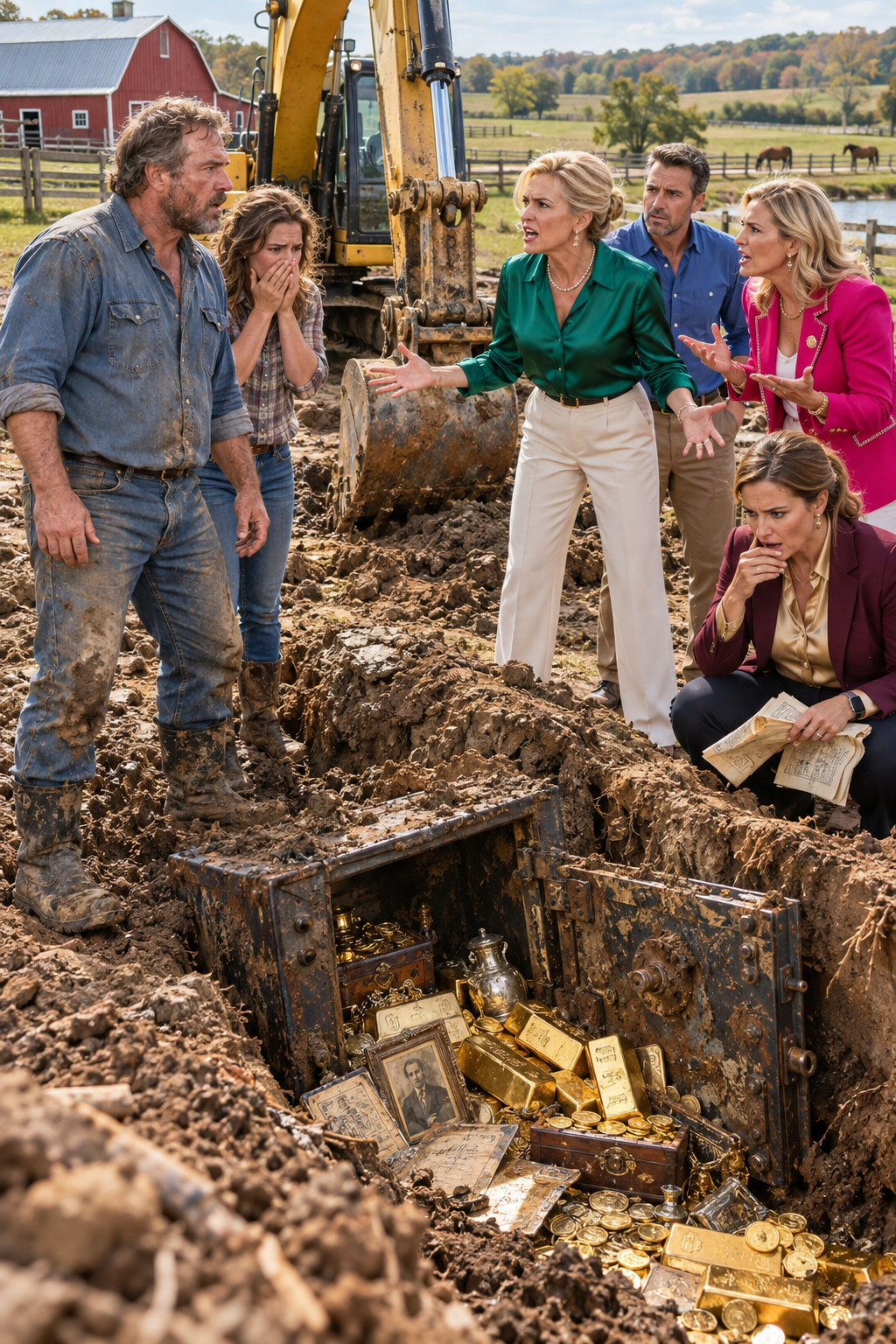
HOA Dug a Drainage Ditch Across My Farm—Then They Hit Something Worth $12 Million and Tried to Claim It
The excavator tore through my north pasture at on a Tuesday morning, and the woman who ordered it smiled while telling me I should be grateful.
“You weren’t using that strip for anything important anyway,” HOA president Patricia Caldwell said.
Then the bucket struck metal.
The sound was so deep and violent that every man on the work crew stopped moving.
Patricia stopped smiling.
I stood beside my rusted red Ford pickup with one hand resting on the hood, watching six men in orange vests stare into a twelve-foot trench they had no legal right to dig.
Behind them, the manicured roofs of Brookstone Ridge rose above the tree line like a row of polished teeth.
In front of me lay two hundred and seventeen acres of Tennessee farmland my husband had spent thirty-eight years protecting from developers, lenders, county planners, and people exactly like Patricia Caldwell.
My name is Margaret Hale.
I was sixty-three years old that morning.
And for most of my life, people had mistaken quiet for weakness.
Patricia was only the latest.
She stepped over a clump of torn grass in cream-colored riding boots that had never seen a horse and waved at the machine operator.
“Keep going.”
The operator, a broad-shouldered man named Eddie, looked at me instead.
Patricia snapped her head toward him.
“I’m the president of the Brookstone Ridge Homeowners Association. The board approved this project.”
Eddie frowned.
“That isn’t what I asked.”
His eyes returned to me.
“Mrs. Hale, is this your land?”
Patricia laughed sharply.
“Technically, it’s an easement corridor.”
“No,” I said.
That was all.
Her smile tightened.
Behind Patricia stood two board members, Martin Webb and Cheryl Dawson, both holding folders. Martin was a retired insurance broker who liked to threaten people with liens. Cheryl ran the HOA Facebook page like a small dictatorship and once fined a widow seventy-five dollars because her trash can stayed visible for eleven minutes after collection.
They had been after my farm for four years.
Not all of it.
Just the profitable pieces.
The creek access.
The western hill.
The old stone barn.
And lately, the north pasture.
Brookstone Ridge had been built against my eastern boundary in 2008, during the last years of my husband Samuel’s life. The development sat higher than our fields, and every heavy storm sent runoff pouring toward our property.
When Samuel was alive, the developers installed retention ponds and underground culverts exactly where their engineers had specified.
After Samuel died, things changed.
First the HOA stopped maintaining the lower retention basin.
Then they built a tennis court over one drainage swale.
Then they approved six new houses without expanding stormwater capacity.
Last spring, three basements flooded.
Patricia needed someone to blame.
She chose me.
The HOA’s lawyer sent a letter claiming our “obsolete agricultural drainage pattern” caused water to back up into Brookstone Ridge.
I sent them the original county engineering maps.
They ignored them.
They demanded permission to dig a drainage channel across thirty-four acres of my pasture.
They scheduled the work anyway.
That was why I was standing there that morning.
Not because I was surprised.
Because I had been expecting them.
Patricia didn’t know that.
She pointed toward the trench.
“This ditch will protect eighty-six families.”
“It crosses private property.”
“It benefits the community.”
“It crosses private property.”
“You’re being selfish.”
“It crosses private property.”
Her cheeks colored.
I had learned long ago that people like Patricia hated repetition when repetition removed all the places they could hide.
Martin Webb stepped closer.
“Margaret, we tried to resolve this reasonably.”
“We sent three notices.”
“You sent three demands.”
“The county knows about this project.”
“That isn’t the same thing.”
Cheryl folded her arms.
“We have children in this neighborhood.”
I looked at her.
“So do farmers.”
She blinked.
“My grandchildren play here. My late husband’s ashes are under the sycamore by the creek. My daughter learned to walk in that farmhouse. My son broke his collarbone falling from that fence. Don’t explain community to me.”
For a moment, nobody spoke.
Then Patricia sighed theatrically.
“This is exactly the emotional nonsense that has made negotiations impossible.”
That sentence hurt more than she knew.
Not because it was clever.
Because I had heard versions of it my whole life.
Samuel’s brother had called me sentimental when I refused to sell our east field.
My own son had called me stubborn when I wouldn’t mortgage the farm to help him finance a restaurant.
Bankers called me emotional.
Developers called me unrealistic.
County consultants called me resistant to progress.
After Samuel died, people spoke to me as though the land had somehow become ownerless because the man was gone.
They saw an aging widow.
They saw unpaid labor.
They saw old barns.
They saw acreage.
They saw what they could take.
They never saw the ledger I kept.
They never saw the deeds Samuel taught me to read.
They never saw the metal box beneath the bedroom floor.
They never saw the letter he wrote six months before he died.
And they never asked why a man who distrusted banks had spent twenty years paying a surveyor to walk the same northern boundary every October.
The excavator operator climbed down from his cab.
“Something’s buried here.”
Patricia waved him off.
“Probably farm junk.”
He peered into the trench.
“Not farm junk.”
A second worker crouched near the edge.
“There’s concrete.”
Patricia moved closer.
That mattered.
Later, Eddie would tell a sheriff’s deputy that my stillness was the first thing that made him nervous.
Everyone else wanted to see what the machine had hit.
I already knew.
Not exactly.
But enough.
Samuel’s letter had told me enough.
IF ANYONE EVER DIGS NORTH OF THE WHITE OAK, STOP THEM BEFORE THEY CROSS THE SECOND STONE MARKER.
And beneath that:
IF THEY CROSS IT ANYWAY, DO NOT TOUCH WHAT THEY FIND.
CALL A LAWYER BEFORE YOU CALL FAMILY.
I had read those sentences hundreds of times.
I had never understood them completely.
Samuel had refused to explain before his cancer took the last of his strength.
“Not yet,” he whispered from his hospital bed.
“Samuel, what’s buried there?”
“Something that doesn’t belong to the people who’ll come looking.”
“What people?”
He smiled faintly.
“The kind who arrive after a man dies.”
Three weeks later, he was gone.
For eleven years, I kept his warning inside a fireproof envelope beneath my floor.
I never dug.
I never hired anyone to investigate.
Some secrets don’t tempt you when the person who left them earned your trust.
But Patricia had just put an excavator through the place Samuel told me never to disturb.
And now every instinct I had was screaming.
Eddie wiped mud from one glove.
“It looks like a vault.”
Patricia’s head jerked toward him.
“Concrete chamber. Steel top.”
Martin moved closer.
“Could be an old septic tank.”
“No pipes.”
Patricia looked at me.
I gave her nothing.
That seemed to frighten her more than anger would have.
“You knew something was there.”
“You’re lying.”
“Be careful.”
Her chin lifted.
“Is that a threat?”
“No. It’s advice.”
The board members exchanged glances.
Then Patricia did what arrogant people often do when caution becomes inconvenient.
She ordered the operator to continue.
Eddie refused.
“I’m not putting my bucket into an unknown underground structure.”
“You’re under contract.”
“With Oakline Civil, not with you personally.”
“I signed the authorization.”
“And she says this is private property.”
Patricia turned to Martin.
“Call Nathan.”
Nathan Cole was the HOA attorney.
He arrived forty minutes later in a black Mercedes that became stuck in the mud before he even reached us.
I watched him walk the last hundred yards in polished shoes, carrying a leather briefcase above the wet grass.
He was younger than I expected.
Early forties.
Expensive navy suit.
The kind of lawyer who looked at land the way a butcher looked at meat.
Patricia met him halfway.
They spoke quietly.
He opened a folder.
She pointed toward me.
He looked at me.
Then at the trench.
Then back at the documents.
The confidence left his face for half a second.
That half second told me more than any speech could have.
Something was wrong.
Not just legally.
Specifically.
He knew something.
Nathan approached me.
“Mrs. Hale.”
“Mr. Cole.”
“You’re alleging trespass?”
“I’m not alleging it.”
“I’d like to review your deed.”
“My attorney can send you a copy.”
“You have counsel?”
“I do now.”
That was not entirely true.
But it became true twelve minutes later.
I called Rebecca Shaw.
Rebecca had been Samuel’s estate lawyer twenty-three years earlier, back when she worked out of a converted bungalow in Franklin and answered her own phone.
Now she was a partner at a Nashville firm with her name on the building.
When I told her where the trench was, she went silent.
“Margaret.”
“Did they open anything?”
“Do not let them.”
“I wasn’t planning to.”
“Do not sign anything.”
“I haven’t.”
“Do not let Patricia Caldwell remove anything.”
Then Rebecca asked something strange.
“Is Nathan Cole there?”
I looked across the pasture.
Her voice changed.
Not louder.
“Put your phone in your pocket. Keep the call connected.”
Nathan was still speaking with Patricia.
They moved away from Martin and Cheryl.
The wind carried pieces of their conversation.
“…could complicate…”
“…county recorded…”
“…Hale tract…”
“…we need control of the site…”
Not safety.
Not drainage.
Rebecca’s voice whispered through my coat pocket.
“I heard enough. Call the sheriff.”
Patricia noticed me reaching for my phone.
“What are you doing?”
“Calling law enforcement.”
Her entire posture changed.
“You don’t need to escalate this.”
I looked directly at her.
“You brought a thirty-ton excavator onto my farm at sunrise.”
The workers stared at the ground.
Martin suddenly found his folder fascinating.
Cheryl stepped backward.
Patricia spread both hands.
“This was authorized by the HOA board after legal review.”
“That doesn’t make my deed disappear.”
“The drainage easement—”
“Show it to me.”
Nathan stepped in.
“Mrs. Hale, easement interpretation can be complicated.”
“Then explain it simply.”
He opened his mouth.
I pointed at the ground.
“Show me where my signature gives your clients the right to excavate here.”
He said nothing.
That was the first mini-victory.
Almost invisible.
But everyone felt it.
Patricia had arrived with machines.
Board members.
A private security truck parked by my gate.
She wanted me to feel surrounded.
Instead, one question made them look like what they were.
People standing on somebody else’s farm without permission.
The sheriff’s department arrived at .
Deputy Lucas Grant was twenty-nine, red-haired, polite, and clearly wishing he had been sent anywhere else.
Property disputes were rarely simple.
Property disputes involving lawyers, buried structures, and HOA presidents were worse.
He listened to Patricia first.
She used words like infrastructure, mitigation, emergency, easement, public interest.
Then he listened to me.
I handed him a certified copy of my deed and the latest survey.
“I own everything from the creek to County Road 16, including the location where they excavated.”
He studied the map.
Nathan interrupted.
“Our position is that a historic drainage easement survives under—”
Deputy Grant held up one hand.
“Sir, I’ll get to you.”
Nathan stopped.
The deputy checked the parcel lines on his tablet.
Then he walked to the trench.
Then he came back.
“Work stops until this is sorted out.”
Patricia exploded.
“You can’t do that.”
He looked at her.
“I just did.”
“We have eighty-six homeowners at risk.”
“Then you can seek an emergency court order.”
She pointed at me.
“She’s obstructing necessary drainage.”
Grant’s expression stayed neutral.
“She owns the dirt.”
That sentence nearly made me smile.
Patricia saw it.
Her face hardened.
“You think you won.”
I looked toward the concrete edge visible beneath the torn earth.
“I think you should leave.”
Patricia stepped closer until only a few feet separated us.
“You have no idea how many people are depending on this project.”
“Neither do you.”
“What is that supposed to mean?”
I glanced toward Nathan.
He looked away.
Patricia noticed.
For the first time, real uncertainty crossed her face.
She lowered her voice.
“Margaret, what’s buried here?”
There it was.
The question she had been trying not to ask.
I could have lied.
Instead, I told the truth.
“I don’t know.”
She searched my expression.
“But your husband did.”
I said nothing.
Her eyes narrowed.
Nathan heard her.
So did Rebecca through my phone.
Later, that sentence would matter.
At the time, I only knew it confirmed something I had begun to suspect.
Patricia hadn’t chosen the north pasture randomly.
The ditch wasn’t only about drainage.
Someone had wanted them to dig exactly there.
The crew packed up.
The board members left.
The security truck drove away.
Nathan stayed behind with Patricia for another ten minutes.
They argued beside her white Range Rover.
At one point, Nathan said, “You told me you had verified it.”
Patricia hissed something I couldn’t hear.
Then he answered louder.
“That is not what the document says.”
They both saw me watching.
Their conversation stopped.
Patricia climbed into her SUV and drove away fast enough to throw mud across my fence.
I waited until the last vehicle disappeared.
Then I went inside my farmhouse.
I locked the door.
I pulled back the braided rug beside Samuel’s old dresser.
Under it was a loose pine board.
Beneath that was a steel lockbox.
Inside were our marriage certificate.
Samuel’s Purple Heart.
A photograph of our children when they were small.
A silver pocket watch that belonged to his father.
And the letter.
The paper had yellowed at the folds.
If you are reading this because someone dug north of the white oak, then I was right to worry.
The first thing you must understand is that what lies there is not ours in the ordinary sense.
The second thing you must understand is that someone will claim it is.
The third thing is the most important.
Let them claim first.
Do not tell them what you know.
Do not argue.
Do not threaten.
Make them put everything in writing.
If they say there is an easement, ask them to record it.
If they say the chamber belongs to the county, ask them to claim it.
If they say the land was transferred, ask for the deed.
Every lie becomes useful once someone signs their name beneath it.
I had read those words before.
But that afternoon, one line felt different.
Let them claim first.
Samuel had expected a dispute.
Maybe not Patricia.
Maybe not Brookstone Ridge.
But someone.
At the bottom of the second page, Samuel had written a name.
Arthur Bell.
And a phone number.
The number had long ago disconnected.
Arthur had been dead for seven years.
But his daughter, Emily Bell Mercer, still lived in Murfreesboro.
I called Rebecca.
She came to the farm that evening with two associates, a title researcher, and a retired surveyor named Dennis Voss.
Dennis walked straight to the white oak.
He found the first stone marker.
Then the second.
Brushed away moss.
And whispered, “Well, hell.”
Rebecca looked at him.
Dennis pointed.
Carved into the stone was a symbol.
A triangle inside a circle.
Below it were three letters.
Tennessee Valley Authority.
Rebecca stared toward the trench.
“That chamber may predate the subdivision by decades.”
Dennis stood.
“More than decades.”
He looked toward my farmhouse.
“Margaret, did Samuel ever tell you this property had federal utility history?”
Dennis rubbed his jaw.
“My father surveyed around here in the seventies. There were rumors.”
“What kind?”
“During the war and after, the government acquired temporary access corridors all over this region. Transmission routes. mineral surveys. strategic infrastructure. Some were abandoned. Some were buried.”
Rebecca pointed toward the chamber.
“You think this is federal?”
“I think we don’t touch it until we know.”
The next morning, Patricia sent a certified letter.
Not an apology.
The HOA claimed the buried structure was located within a “community drainage improvement corridor” and therefore any “infrastructure, materials, utilities, or mineral assets discovered during lawful excavation” fell under Brookstone Ridge’s control pending classification.
Rebecca read the letter twice.
Then she laughed.
It wasn’t a happy laugh.
It was the sound of a lawyer discovering that the other side had voluntarily driven into a ditch.
“She claimed it.”
I remembered Samuel’s words.
Let them claim first.
Rebecca looked at me.
“What happens now?”
“Now we ask them to be more specific.”
Rebecca sent Nathan a two-page response requesting clarification.
Did Brookstone Ridge claim ownership of the buried chamber?
Did it claim ownership of any contents?
Yes, subject to legal classification.
Did it claim its alleged easement predated my deed?
Would it record the easement?
Patricia’s answer arrived three days later.
That was the mine Samuel had told me to plant.
And Patricia stepped on it willingly.
The HOA filed an easement affidavit with the county recorder.
It included a map.
The map showed a forty-foot corridor crossing my north pasture.
The signature authorizing the easement supposedly belonged to Samuel Hale.
Dated May 14, 2004.
I stared at the page for a long time.
Rebecca asked, “You recognize the signature?”
“Could it be his?”
She studied me.
“You’re certain?”
Walked to the kitchen desk.
Opened the top drawer.
And took out a small blue notebook.
On May 14, 2004, Samuel had not been in Tennessee.
He had been in Germany.
Our daughter Laura had suffered complications during the birth of her first child while stationed near Ramstein Air Base with her husband.
Samuel flew over for three weeks.
I had his boarding passes.
I had photographs.
I had his passport stamp.
And because Samuel was the kind of man who recorded the purchase of every bag of cattle feed, I had his handwritten expense log from Frankfurt.
Rebecca closed her eyes.
“Dear God.”
“They recorded a forged easement.”
I felt something cold settle inside me.
Patricia wasn’t merely entitled.
Someone had fabricated my husband’s signature.
A dead man’s signature.
That changed everything.
Still, I did not call Patricia.
I did not confront Nathan.
I did not post on social media.
I did not tell my children.
Silence makes dishonest people nervous.
Nervous people move.
And Patricia moved quickly.
Within forty-eight hours, the HOA sent a second crew onto the edge of my property.
This one didn’t have an excavator.
They had cameras.
Survey poles.
Ground-penetrating radar.
I met them at the gate with Deputy Grant.
The next day, Martin Webb called me personally.
“We can settle this.”
“What are you offering?”
“Two hundred thousand dollars for the easement.”
“Margaret, that’s more than fair for unused pasture.”
“Three hundred.”
“You haven’t even heard the full proposal.”
“I heard enough.”
“You’re making enemies.”
I looked out my kitchen window at Samuel’s sycamore.
“People keep telling me that as though I’m supposed to be afraid.”
He hung up.
That afternoon, my son Ethan arrived.
Without calling.
That was unusual.
Ethan was thirty-nine, handsome, restless, and always carrying the faint smell of a life that cost more than he could afford.
I loved my son.
I did not always trust his judgment.
Three years earlier, I had refused to put the farm up as collateral for his restaurant expansion.
He called me selfish.
We barely spoke for six months.
He eventually apologized.
But some apologies repair a bridge.
Others simply reopen it to traffic.
He walked into my kitchen holding a folder.
“Mom, what are you doing?”
“Making coffee.”
“You know what I mean.”
I looked at the folder.
“Did Patricia send you?”
His expression changed.
“Why would you say that?”
“Because you brought paperwork.”
He dropped the folder on the table.
“Brookstone made an offer.”
“To the family.”
“There is no family ownership. There’s my ownership.”
His jaw tightened.
“This is what I mean. Everything has to be technical with you.”
“Land ownership is technical.”
He sat across from me.
“They’ll pay 1.8 million dollars for the north forty.”
My stomach tightened.
Not because of the number.
Because Patricia had contacted my son.
“They told you about the chamber?”
He hesitated.
“What did they tell you?”
“That there may be mineral rights.”
“What kind?”
“Lithium-bearing deposits. Maybe rare earth elements. I don’t know.”
There it was.
Twelve million had not entered the story yet.
But greed had.
Ethan leaned forward.
“Mom, listen to me. You’re sixty-three. That section floods. You don’t run cattle anymore. You lease half the acreage. Take the money.”
His face reddened.
“Dad is dead.”
I went still.
He knew immediately he had crossed a line.
But pride kept him from retreating.
“You’re protecting this place like he’s coming back.”
“You’ve spent eleven years freezing everything exactly how he left it.”
“Then what are you doing?”
I looked at my son.
“Protecting what belongs to me.”
He laughed bitterly.
“There it is.”
“You always make it about ownership.”
“Because people keep trying to take things.”
“Maybe because you refuse to share anything.”
I stood and carried my coffee to the sink.
My hands did not shake.
That seemed to anger him.
He wanted a fight.
He wanted tears.
He wanted guilt.
Anything he could push against.
Instead I rinsed the cup.
He spoke behind me.
“Patricia says the county can condemn the drainage corridor anyway.”
“Then she should try.”
“She says you’re making the neighborhood hate us.”
“I don’t live there.”
That made me turn.
Ethan looked away.
Six months earlier, he and his wife Melissa had bought a house in Brookstone Ridge.
I helped with the down payment.
Thirty-five thousand dollars.
He had not mentioned that the HOA dispute was affecting him.
“How much do you owe?”
He stiffened.
“To Patricia.”
“To the HOA?”
“To somebody.”
His silence answered me.
Finally, he said, “The restaurant is behind.”
“That’s not relevant.”
“Two hundred eighty thousand.”
I closed my eyes once.
Opened them.
“And Patricia offered to help.”
“She knows investors.”
“In exchange for what?”
“She thinks you’ll listen to me.”
There was the knife.
Not a stranger.
Not a lawyer.
Patricia had found the weakest seam in my family and pressed her finger into it.
Ethan stood.
“Mom, I’m trying to save my business.”
“And you decided to sell my land to do it.”
“I decided to ask you to consider reality.”
“Reality is that you don’t own it.”
His face hardened.
“You know what? Maybe Dad was right about you.”
I felt my heartbeat slow.
“What did he say?”
“That you could hold onto a grudge longer than anybody alive.”
Samuel had said that once.
During an argument.
Twenty years earlier.
In front of Ethan.
I almost smiled.
Not because it was funny.
Because my son had searched backward through his childhood for a weapon.
That meant he was desperate.
“You should go.”
He stared at me.
“That’s it?”
“You’re kicking me out?”
“I’m asking you to leave my kitchen.”
“For disagreeing with you?”
“For trying to negotiate the sale of property you don’t own on behalf of people trespassing on it.”
“Go home, Ethan.”
He shoved the folder toward me.
“At least read it.”
I waited until his truck disappeared.
Then I opened the folder.
The offer was not for forty acres.
It was for an option to purchase sixty-three acres, including the farmhouse, old barn, north pasture, and creek frontage.
The buyer was not Brookstone Ridge.
It was a limited liability company.
Blue Ridge Resource Partners LLC.
Formed nineteen days earlier.
Registered agent: Nathan Cole.
I called Rebecca.
She arrived before sunset.
When I showed her the document, she stopped halfway through the first page.
“This isn’t about drainage.”
“This isn’t even about the chamber.”
“What is it?”
She pointed at the parcel map.
“They want the entire northern mineral tract.”
The next morning, we hired a geologist.
Dr. Aaron Pike had spent thirty years evaluating mineral deposits across Appalachia.
He reviewed historical maps.
Took soil samples outside the disturbed area.
Studied old government survey records.
Then he asked me for permission to access the trench under controlled conditions.
We brought Deputy Grant.
A county environmental officer.
A structural engineer.
And a representative from the Tennessee Department of Environment and Conservation.
The concrete chamber was smaller than we imagined.
Roughly eight feet by fourteen.
Stamped numbers.
No explosives.
No utility hazard.
Inside were six sealed core-sample canisters, maps, drilling logs, and waterproof document tubes dating from 1962 through 1969.
Dr. Pike opened nothing until everything was documented.
When the first tube was unsealed at the county office two days later, the room became quiet.
The records belonged to a federal geological subcontractor.
They showed exploratory drilling across what was now my farm.
The reports identified a deposit containing industrial-grade fluorspar, barite, and trace rare earth concentrations beneath portions of the north acreage.
Not a gold mine.
But valuable.
Potentially very valuable.
Dr. Pike spent four more days reviewing data.
Then he sat in my kitchen with Rebecca and placed a yellow legal pad between us.
“Assuming the old tests are accurate, assuming modern extraction is economically viable, assuming permitting, environmental compliance, access, commodity prices, and a dozen other variables…”
“How much?”
He tapped the page.
“Estimated mineral value in place could exceed twelve million dollars.”
I looked at him.
Rebecca watched me carefully.
“Twelve million?”
“Potential gross value. Not what someone hands you tomorrow. Extraction costs could be enormous. Some deposits may never be worth mining. I don’t want you hearing twelve million and thinking there’s twelve million dollars under your mattress.”
“Understood.”
But I wasn’t thinking about money.
I was thinking about Samuel.
Maybe not the modern valuation.
Maybe not the exact minerals.
But he knew the government had surveyed our farm.
He knew someone might return someday.
And suddenly his stubbornness made sense.
Every time a developer offered us money for the north pasture, Samuel refused.
Every time his brother called him foolish, Samuel shrugged.
Every time I asked why we needed to keep land that barely paid its property taxes, he said, “Because someday somebody will want it for a reason they won’t tell us.”
I thought he meant sentiment.
He meant geology.
That evening, I sat alone on the back porch.
The sun went down behind the sycamore.
For the first time since the excavator arrived, I cried.
Not loudly.
Not for long.
I cried because Samuel had carried this knowledge while he was dying.
I cried because my son had tried to trade my land for relief from his own mistakes.
I cried because strangers had put a dead man’s forged signature on a public record.
Then I wiped my face.
And I opened Samuel’s letter again.
There was still one sentence I had not understood.
What lies there is not ours in the ordinary sense.
If the minerals were beneath our farm, why would Samuel say that?
Rebecca found the answer.
The mineral rights had been severed from the surface estate in 1947.
Placed into a trust.
A trust Samuel inherited partial control over when his father died.
The beneficiary was not Samuel.
It was something called the Hale Agricultural Education Foundation.
I had never heard of it.
Neither had Ethan.
Neither had anyone in Brookstone Ridge.
The foundation’s charter had been dormant for decades.
But legally, it still existed.
And the charter was extraordinary.
Samuel’s grandfather, Walter Hale, established it after returning from World War II.
Its purpose was to preserve farmland and fund agricultural education for children from low-income rural families.
Mineral royalties from the Hale tract, if ever realized, could never be distributed to private heirs.
Not to Samuel.
Not to Ethan.
They had to fund the foundation.
That was why Samuel said it wasn’t ours in the ordinary sense.
The land was mine.
The wealth beneath it was meant for children Samuel would never meet.
For farm kids whose parents could not pay tuition.
For FFA programs.
For veterinary scholarships.
For soil conservation.
For the very rural families people like Patricia treated as obstacles between subdivisions and profit.
When Rebecca finished explaining, I sat quietly.
Then I smiled.
But it wasn’t nothing.
For the first time, twelve million dollars felt bigger than a number.
Patricia thought she had found buried wealth.
Ethan thought I was refusing to share it.
Nathan thought he could package it through an LLC.
But Samuel had already made the money impossible to steal in the easiest way.
It never belonged to us.
That did not stop them.
Three days later, Brookstone Ridge held an emergency HOA meeting.
I attended.
Not because I was invited.
Because Ethan texted me the time.
The clubhouse was packed.
Eighty folding chairs.
Standing room along the walls.
Patricia stood at the front under recessed lights, wearing a red blazer and the expression of someone who believed the room belonged to her.
Nathan sat beside her.
Martin and Cheryl occupied the board table.
A projector displayed a map of my farm.
People turned when I entered.
Whispers moved through the room.
“That’s her.”
“The farm lady.”
“She stopped the drainage.”
“Patricia said she wants twelve million.”
I took an empty chair in the back.
Ethan sat near the front beside Melissa.
His face tightened.
Patricia called the meeting to order.
For twenty minutes, she described flooding risks.
Infrastructure burdens.
Insurance exposure.
Community safety.
Then the slide changed.
Blue shading appeared across my north acreage.
“Recent discoveries,” Patricia said, “suggest that the land adjacent to Brookstone Ridge contains commercially valuable mineral resources.”
The room changed instantly.
People leaned forward.
Phones came out.
Patricia continued.
“Because these resources were discovered during an HOA-authorized infrastructure project conducted within a lawful drainage corridor, our counsel believes Brookstone Ridge may possess a legitimate financial interest.”
Nathan did not look comfortable.
That interested me.
A homeowner raised his hand.
“How much?”
Patricia paused perfectly.
“Preliminary estimates may exceed twelve million dollars.”
The room erupted.
I watched greed spread faster than floodwater.
People whispered about dues reductions.
A new pool.
Property values.
Reserve funds.
A second entrance.
One man joked about free roofs.
Patricia let them dream.
That was smart.
Once eighty-six families believed they owned part of twelve million dollars, I became the woman taking it away.
She looked toward the back.
“Mrs. Hale is here tonight. Perhaps she’d like to explain why she has refused to cooperate.”
Every head turned.
I did not walk forward.
“What would you like explained?”
Patricia smiled.
“Why one person’s private financial interest should override the safety and prosperity of an entire community.”
I heard murmurs.
Ethan stared at the floor.
I looked at Patricia.
“My financial interest?”
“Do you have documentation showing I own the mineral rights?”
Her smile flickered.
Nathan looked at her sharply.
Patricia recovered.
“You own the farm.”
“That wasn’t my question.”
I repeated it.
“Do you have documentation showing I own the mineral rights?”
Nathan stood.
“Mrs. Hale, this meeting isn’t the appropriate forum for title litigation.”
I sat down.
That was all.
The room buzzed.
Patricia lost control for nearly five minutes.
After the meeting, homeowners surrounded her.
I walked out alone.
Ethan followed me into the parking lot.
I kept walking.
“Mom, wait.”
I stopped beside my truck.
He looked exhausted.
“What aren’t you telling them?”
“Why do you care?”
“Because they’re saying you’re sitting on twelve million dollars while people’s homes flood.”
“Are homes flooding tonight?”
“Did homes flood before they built over the retention swale?”
He looked away.
“You know that isn’t the point.”
“It’s exactly the point.”
He rubbed both hands over his face.
“Patricia says if the HOA gets rights to the deposit, she can help restructure my debt.”
There it was again.
He looked at me.
“She is using your fear.”
That surprised me.
His eyes were red.
For the first time since he entered my kitchen days earlier, he sounded like my son instead of Patricia’s messenger.
“She already advanced me fifty thousand.”
I felt sick.
“For what?”
“A consulting agreement.”
“Doing what?”
“Talking to you.”
I closed my eyes.
He continued quickly.
“I didn’t understand what this was at first.”
“You signed something?”
“Did you give her any documents?”
He hesitated.
My stomach tightened.
“What documents?”
“Dad’s old papers.”
Every sound in the parking lot seemed to disappear.
“What papers?”
“She asked if we had old surveys. I remembered boxes in the barn loft.”
“You went into my barn?”
“I still had the key.”
“I gave her copies. Not originals.”
“What did you copy?”
“Maps. Some deeds. Dad’s notebooks.”
My voice became very quiet.
“Which notebook?”
He swallowed.
“The brown one.”
Samuel’s 2004 farm ledger.
The one proving he was overseas on the date of the forged easement.
For a moment, I couldn’t speak.
Not because I was weak.
Because anger, when it is large enough, deserves precision.
Ethan stepped toward me.
“Mom, I’m sorry.”
“Did Patricia know what was in that notebook?”
“I don’t know.”
“Did Nathan see it?”
That mattered.
I opened my truck door.
Ethan touched the frame.
“What happens now?”
I looked at my son.
“You tell Rebecca Shaw everything.”
“I could get in trouble.”
His face collapsed.
“You’d let them prosecute me?”
“I would let the truth go where it goes.”
“I’m your son.”
“And Samuel was your father.”
He flinched.
I climbed into the truck.
Then I stopped.
He looked up.
“When Patricia asked for the notebooks, what reason did she give?”
“She said Dad might have signed drainage permissions years ago.”
I felt the final piece slide into place.
They had not forged Samuel’s signature blindly.
They had searched our records first.
Maybe they found an old signature.
Maybe they copied it.
Maybe Ethan unknowingly delivered the sample used to fabricate the easement.
He had been manipulated.
But manipulation did not erase responsibility.
That night, Ethan met Rebecca.
He handed over emails.
Text messages.
The consulting contract.
Bank transfer records.
And one text from Patricia that changed the case.
NEED THE OLD MAN’S SIGNATURE PAGES IF YOU CAN FIND THEM. NATHAN SAYS WE HAVE TO CLEAN UP THE CHAIN BEFORE MARGARET STARTS DIGGING.
Rebecca read it twice.
Then she asked Ethan to forward the entire message history to law enforcement.
The investigation moved beyond Deputy Grant.
The county district attorney became involved.
Then the state attorney general’s office.
Nathan Cole hired his own criminal-defense attorney.
He stopped representing the HOA.
Within a week, Patricia’s confidence began cracking.
She still posted cheerful updates.
Still called the ditch “essential stormwater infrastructure.”
Still blamed me for delays.
But her Range Rover stopped appearing at my gate.
Martin resigned from the board.
Cheryl deleted six months of HOA Facebook posts.
The new attorney representing Brookstone Ridge sent Rebecca a settlement proposal.
The HOA would withdraw the easement claim.
They would pay to restore my pasture.
They would compensate me seventy-five thousand dollars.
In exchange, I would release all civil claims and agree not to pursue individual board members.
Rebecca looked at me.
I shook my head.
She smiled slightly.
“I hoped you’d say that.”
But I did something nobody expected.
I offered my own settlement.
Brookstone Ridge would restore every inch of damaged farmland.
The HOA would rebuild the neglected retention basin at its own expense.
The board would commission an independent forensic audit.
All communications concerning my property would be disclosed to homeowners.
And the HOA would contribute two hundred fifty thousand dollars to reactivate the Hale Agricultural Education Foundation.
In exchange, I would waive punitive civil damages against the association itself.
Not the individuals.
The homeowners did not deserve to lose their reserve fund because Patricia and her circle broke the law.
That was the moral line Samuel would have understood.
Justice was not burning down eighty-six households to punish four people.
Justice was making the people who chose the wrongdoing answer for it.
The membership voted.
Seventy-three to nine.
Patricia was recalled as president that same night.
Martin was already gone.
Cheryl resigned before the ballots were counted.
Three weeks later, Patricia Caldwell was arrested.
Not for digging a ditch.
For conspiracy to commit forgery, filing a false instrument, attempted property fraud, and obstruction related to deleted records.
Nathan was not arrested.
He became a cooperating witness.
That angered some people.
It didn’t anger me.
Rebecca explained why.
“You don’t have to like a witness for his testimony to matter.”
Nathan admitted Patricia had approached him months earlier with an undocumented “historical drainage easement.”
He said he warned her the paper would not survive scrutiny.
According to Nathan, Patricia told him Samuel had intended to sign it but died before formal recording.
Nathan claimed he believed they were reconstructing a lost agreement.
That story might save his license.
It might not.
But his records exposed something worse.
Blue Ridge Resource Partners had three members.
And a third person.
Someone whose identity was hidden behind another LLC.
When investigators finally traced it, Rebecca called me at one morning.
“Sit down.”
“I’m feeding the dog.”
“Margaret.”
The third investor was Ethan.
My son owned fifteen percent.
He had signed the paperwork before Patricia ever paid him the consulting fee.
He had not merely been manipulated.
He had expected to profit.
When I confronted him, he did not deny it.
We met in my kitchen.
The same place he had tried to persuade me to sell.
He looked smaller.
Not physically.
There are moments when you see an adult child and the little boy still exists somewhere inside him.
I saw Ethan at six, running through corn rows.
At ten, carrying a lamb into the barn during a storm.
At seventeen, borrowing Samuel’s truck without permission.
At thirty-nine, sitting across from me after trying to take part of the farm.
“I thought it was going to solve everything,” he whispered.
“My debt. Melissa’s panic. The restaurant. The house.”
“So you invested in a company designed to buy my land.”
“I didn’t think of it that way.”
“You signed a document.”
“You knew.”
He cried then.
“I’m sorry.”
I believed him.
That was the hardest part.
People imagine betrayal becomes easy once the betrayer regrets it.
It doesn’t.
Regret does not reverse signatures.
It does not erase meetings.
It does not restore trust.
I reached into the drawer beside me.
Ethan looked terrified.
I placed one thing on the table.
The brass key to the north barn.
“You changed the locks?”
He looked at the key.
“Are you cutting me off?”
“What does this mean?”
“It means you no longer enter my property unless I invite you.”
His face crumpled.
“I love you.”
He covered his eyes.
“But love is not a deed.”
He lowered his hands.
I continued.
“Love is not permission.”
He stared at me.
“Love is not immunity from consequences.”
He nodded slowly.
Then I asked the weakest-sounding question I could think of.
The question Samuel would have asked.
“Why did you all think I wouldn’t read what you put in front of me?”
Ethan had no answer.
Neither did Patricia.
That was the thing.
They thought I was old.
They thought I was grieving.
They thought farming meant ignorance.
They thought silence meant confusion.
They thought motherhood meant surrender.
They thought widowhood meant there was no man left to challenge them.
They never understood that Samuel had spent forty-two years teaching me exactly where every boundary stood.
Not only on the farm.
By spring, the trench was filled.
Topsoil restored.
Grass reseeded.
The retention basin above Brookstone Ridge was rebuilt.
Flooding dropped dramatically after the first major storm.
The HOA held new elections.
Their new president was a retired civil engineer named Caroline Frost who came to my porch with no lawyer, no demand letter, and no folder.
She brought pie.
“I want to start over.”
I looked at the pie.
“Blackberry.”
“You can come in.”
We became friends.
Not close friends.
But respectful ones.
That was enough.
The Hale Agricultural Education Foundation was formally reactivated.
Rebecca helped restructure it.
The mineral rights were leased for further non-invasive exploration under strict environmental protections.
No excavation would occur without independent review.
No strip mining.
No poisoned creek.
No destroyed farmland.
If commercial extraction ever became viable, royalties would fund agricultural scholarships across three Tennessee counties.
I insisted on one addition.
A scholarship in Samuel’s name.
The first Samuel Hale Agricultural Stewardship Scholarship went to an eighteen-year-old girl named Kayla Mendoza whose parents grew tomatoes on leased land outside Columbia.
She wanted to study soil science.
At the ceremony, she shook my hand so hard I laughed.
“My dad says farmers need people who understand dirt and contracts.”
“Your dad is a smart man.”
She smiled.
“So was your husband?”
I looked toward Samuel’s photograph on the display table.
Then I corrected myself.
Life moved forward.
Patricia eventually pleaded guilty to two felony charges and received a suspended sentence, probation, restitution obligations, and community service.
People online complained it was too light.
Maybe it was.
But she also lost her real estate license.
Her consulting company collapsed.
Her marriage ended.
She sold her Brookstone house.
I never celebrated any of that.
I did not need her destroyed.
I needed her stopped.
Nathan Cole surrendered his role in Blue Ridge Resource Partners and faced bar discipline.
Martin moved to Florida.
Cheryl stopped running community pages.
Ethan sold his restaurant.
He used the proceeds to pay down debt.
Melissa stayed with him.
For nearly eight months, he and I spoke only occasionally.
Thanksgiving.
Necessary things.
Then one Saturday morning, he called.
“I’m at the gate.”
I looked through the front window.
His truck was parked outside.
He did not use his old key.
That mattered.
“What do you need?”
“I brought fence posts.”
“The north line still has three bad sections.”
I said nothing.
“I thought you might want help.”
I watched him through the curtain.
“Did you bring coffee?”
I unlocked the gate.
Forgiveness did not arrive like sunlight.
It came like fence repair.
One post at a time.
By early summer, I thought the story was finished.
I thought Patricia’s ditch had exposed the secret Samuel protected.
I thought the twelve-million-dollar mineral deposit was the final answer.
I thought the forged easement was the final betrayal.
I thought the foundation was why Samuel had warned me.
I was wrong.
The second secret arrived in a cardboard evidence box.
Rebecca brought it to my farmhouse on June 14.
She did not call first.
She walked into the kitchen carrying the box with both hands.
Ethan was there replacing a hinge on the pantry door.
He looked at her face and stopped working.
“What happened?”
Rebecca placed the box on my table.
“Federal archive retrieval.”
My skin prickled.
“From the chamber?”
“I thought we had everything.”
“So did I.”
She opened the box.
Inside were photocopies from records recovered through the National Archives.
Most were routine geological documents.
Drilling logs.
Equipment inventories.
Correspondence.
But one folder was sealed separately.
CONFIDENTIAL PROPERTY ACQUISITION REVIEW.
Dated 1971.
Rebecca slid out a map.
Not just my farm.
The map included Brookstone Ridge.
County Road 16.
The old Miller property.
Two neighboring farms.
Nearly six hundred acres.
Across the entire area was the same triangle-inside-circle symbol carved into Samuel’s boundary stone.
I leaned closer.
“What is that?”
Rebecca did not answer immediately.
Ethan moved beside me.
On the bottom corner of the map was a handwritten note.
SURFACE ACQUISITION DEFERRED.
SUBSURFACE RIGHTS SECURED THROUGH HALE TRUST.
Then another line.
CRITICAL: DO NOT RELEASE RESERVE ESTIMATE TO LOCAL OWNERS.
My mouth went dry.
“Reserve estimate?”
Rebecca turned the page.
The mineral valuation we had been discussing was twelve million dollars.
The number on the federal report was not twelve million.
It was not twenty million.
It was not even fifty million.
Adjusted for modern commodity estimates, the potential underground reserve across the larger mapped zone exceeded one hundred and forty million dollars.
Ethan whispered, “Jesus.”
But that was not the worst part.
I kept reading.
Page four contained a list of people who had been notified in 1971.
Walter Hale.
Arthur Bell.
Two federal geologists.
A county official.
And one private attorney.
The attorney’s last name was Caldwell.
I looked at Rebecca.
She nodded slowly.
“Patricia’s grandfather.”
The room went silent.
Every hair on my arms lifted.
Patricia had not stumbled into Samuel’s secret.
Her family had known something for fifty-five years.
Maybe not everything.
Maybe not the updated value.
But enough.
Enough to understand the north pasture mattered.
Enough to know the Hale trust existed.
Enough to know a drainage project could create access.
I sat down.
Ethan’s face had gone pale.
“There’s more,” Rebecca said.
I looked at her.
She pulled out one final document.
It was not from 1971.
It was from 2009.
One year after Brookstone Ridge opened.
The document was a private memorandum requesting title research into the dormant Hale mineral trust.
The requesting party was concealed behind a corporate entity.
But attached to the memo was a photocopy of Samuel’s signature.
The same signature later used on the forged drainage easement.
And beneath it was a handwritten note.
OLD MAN WON’T SELL.
WAIT FOR SUCCESSOR.
My chest tightened.
They had been waiting for Samuel to die.
Ethan gripped the edge of the table.
“Who wrote that?”
Rebecca turned the page.
The next sheet was a payment authorization.
Twenty-five thousand dollars.
Recipient: Bell Land & Title Services.
Arthur Bell’s old company.
The dead surveyor Samuel told me to contact.
Suddenly Samuel’s letter felt different.
Arthur had not merely known about the buried chamber.
He had been involved.
Maybe protecting us.
Maybe betraying us.
Maybe both.
Rebecca laid one more photograph on the table.
A scanned image from an archived inspection file.
Four men stood beside the white oak in 2009.
One was Samuel.
One was Arthur Bell.
One was a man I did not recognize.
The fourth man made me forget how to breathe.
Ethan saw him too.
Rebecca looked at me.
“I had the image enhanced.”
“Margaret.”
“That’s impossible.”
But it wasn’t.
The fourth man was Ethan.
Twenty-two years old.
Standing beside his father.
Standing beside the exact marker Patricia’s crew later dug past.
Ethan stared at the photograph.
“I’ve never seen this.”
“You’re in it.”
“I know what it looks like.”
“What were you doing there?”
“I don’t remember.”
His voice sounded genuinely frightened.
I turned the photograph over.
Someone had written a date.
October 3, 2009.
And beneath it, four words.
Ethan knows where it is.
He stumbled backward.
“Mom, I swear to you—”
Rebecca lifted a hand.
“There’s another problem.”
I could barely hear her.
“The handwriting.”
She placed Samuel’s original warning letter beside the photograph.
Same capital E.
Same angled K.
Same unusual loop in the W.
The note on the photograph had been written by my husband.
Samuel believed Ethan knew.
My son shook his head.
He looked at me.
“I don’t remember this.”
I wanted to believe him.
Maybe I did.
But then something struck me.
Samuel had not warned me to call the police.
He had not warned me to call our children.
He had specifically written:
CALL A LAWYER BEFORE YOU CALL FAMILY.
I had always assumed he meant greedy relatives might come after the money.
Now I wondered if he meant something else.
I looked at Ethan.
He looked terrified.
Then his phone rang.
Unknown number.
He declined it.
It rang again.
Same number.
Rebecca glanced at me.
“Answer it.”
Ethan put the phone on speaker.
For three seconds, there was only breathing.
Then an elderly woman spoke.
“Is this Ethan Hale?”
He looked at us.
“My name is Emily Mercer.”
I knew the name.
Arthur Bell’s daughter.
The woman I had been trying to reach for weeks.
Ethan’s face tightened.
“How did you get this number?”
“Your father gave it to mine.”
The kitchen went silent.
Emily continued.
“My father left instructions for me to call you if anyone ever opened the north chamber.”
Ethan looked at me.
Not Rebecca.
“What instructions?”
The woman paused.
“When Patricia Caldwell was arrested, I knew it had happened.”
My heartbeat thudded.
Rebecca leaned toward the phone.
“Ms. Mercer, I’m Rebecca Shaw, counsel for Margaret Hale. We need to speak with you.”
“I know who you are.”
Another pause.
Then Emily said the sentence that turned every answer we had found into another question.
“The minerals were never the reason Samuel hid that chamber.”
Nobody moved.
I stared at the evidence box.
“What was the reason?” I asked.
Emily’s voice softened.
“Mrs. Hale, is Ethan with you?”
“Then I can’t tell you.”
Ethan’s face drained of color.
“Because my father wrote one warning in capital letters.”
She inhaled shakily.
“Never tell Margaret while Ethan is in the room.”
My son whispered, “What the hell does that mean?”
Emily ignored him.
“Mrs. Hale, there should be a second container inside the chamber. Smaller. Steel. It was installed beneath the concrete floor in 2009.”
Rebecca stood.
“Our inspection found no second container.”
“Then someone removed it.”
“I don’t know.”
“What was inside?”
Emily went quiet again.
Then she asked me a question that sounded almost gentle.
“Margaret… did Samuel ever tell you who actually paid for Brookstone Ridge before the developers bought the land?”
She exhaled.
“Then you still don’t know what they took from you.”
The call disconnected.
Ethan and I stared at each other across the same kitchen table where, months earlier, he had asked me to sell my farm.
Outside, a truck slowed on County Road 16.
It stopped near my gate.
No plates on the front.
Rebecca moved toward the window.
My phone buzzed.
Unknown number.
I opened it.
There was no message.
Only a photograph.
Taken seconds earlier.
Through my kitchen window.
The picture showed me.
And Samuel’s letter lying open on the table.
Under the photograph were seven words.
YOU SHOULD HAVE LEFT THE DITCH BURIED.
I raised my eyes toward the black SUV beyond the fence.
Ethan whispered, “Mom… what do we do?”
I folded Samuel’s letter once.
Then again.
I slipped it into my pocket.
And for the first time since Patricia Caldwell’s excavator crossed my pasture, I understood that the twelve million dollars had never been the treasure.
It had been the bait.
So I looked at my son, looked at the road, and asked the only question that mattered now.
“Ethan… what happened on this farm in October of 2009 that your father was too afraid to tell me?”
✓ Lynn R. Adams
HOA Dug a Drainage Ditch Across My Farm—Then They Hit Something Worth $12 Million and Tried to Claim It The excavator tore through my north pasture at on a Tuesday morning, and the woman who ordered …