HOA Called the Cops When I Said I Wasn’t a Member — Then They Learned I Was Their Landlord
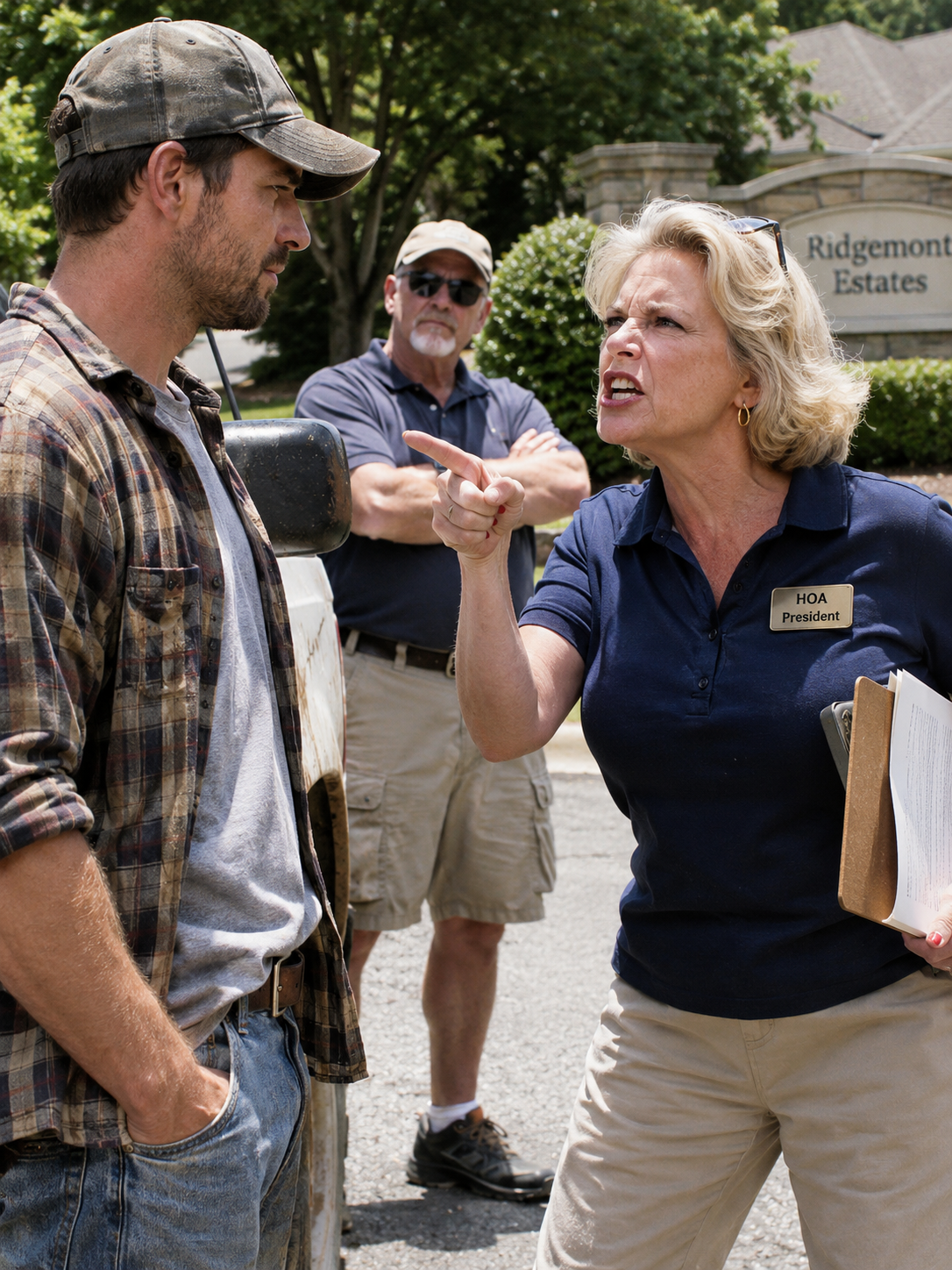
When the HOA president spotted my beat-up truck near the trees, she told me I didn’t belong on her street and called the sheriff after I said I wasn’t a member. I had my late father’s survey in my jacket and a lease she had never bothered to read. What the deputy discovered in those papers changed the look on her face, but it didn’t settle what she’d done…
The first time Brenda Holloway saw my truck at Ridgemont Estates, she looked at it like somebody had dumped a broken refrigerator beside her neighborhood. Three days later, she fined me $500 for walking with a survey map. By the time she called 911 on me, she was certain the police would finally make me disappear.
My name is Colton Ward. I’m 34, a general contractor in Hollis Creek, North Carolina, and until that summer I thought I knew pretty much everything worth knowing about my father. Earl Ward spent 41 years working concrete, pouring foundations and driveways, then coming home with cement dust in the creases of his hands. He rarely raised his voice, and he never talked about what he owned.
Four months after Dad died, his longtime attorney, Hatch, called me into his office. He slid an old gray steel lockbox across the desk, the combination still sticking on the third number. Inside were faded surveys, bank records for the Ward Family Trust, and a ground lease signed in March 1989. I kept looking for something that explained why Dad hadn’t mentioned any of it.
The lease said he owned 14 acres beneath Ridgemont Estates, a subdivision of 68 homes. The homeowners owned their houses, but the HOA leased the ground from my father’s trust for $3,200 a month. Residents saw that payment buried in their statements as a land maintenance fee. The agreement had 11 months left before renewal required both sides to agree, and I was now responsible for Dad’s interest in it.
I drove past the feed store and volunteer fire station to see the place for myself. The lawns were clipped neatly, and a pool sat behind an iron fence. I stopped my old work truck near the east-side trees and walked with one of Dad’s maps, comparing the property lines to what I could see. A riding mower hummed somewhere beyond the houses.
A golf cart rolled up. Brenda Holloway, 58 and president of the HOA for six years, sat behind the wheel with a clipboard on her lap. She told me it was a private community and asked why I was making measurements. I said I was checking boundaries, but she didn’t ask whose boundaries. Instead she told her husband, Dale, to get my license plate number.
Dale circled the truck with his phone while Brenda said she would report me to the sheriff for security reasons. Neither introduced themselves; neither waited for an explanation. I folded the survey, got back behind the wheel, and drove home. That night I read every page of the lease at my kitchen table, Dad’s lockbox open beside my coffee cup.
The violation notice came three days later on HOA letterhead, stamped urgent in red. It accused me of unauthorized surveying in common areas, demanded $500 within 30 days, and warned that the board could place a lien against my property. I didn’t own a house or even a mailbox there. What I owned was the ground, and Brenda was treating the HOA’s right to use it as if that were ownership.
At the county records office, I brought up the parcel maps Dad had taught me to trust. Ridgemont’s published neighborhood map included another 2.3 wooded acres to the east that weren’t part of the ground lease. The HOA had put parking for its community pool on some of that land and a garden on the rest. I couldn’t find any agreement from my father allowing the expansion.
I asked Gil Prescott, a 62-year-old licensed surveyor who’d known Dad for decades, to verify it. His certified measurements confirmed that the extra 2.3 acres were outside the lease. Gil studied the HOA map and asked if my father had ever complained. He hadn’t, as far as I knew. Dad could let an argument sit for years; Brenda couldn’t let a stranger stand beside a tree for an afternoon.
Soon all 68 households received a community safety alert about a suspicious man measuring near the playground. Dale’s video of my truck and license plate was attached. Brenda also complained to county code enforcement about Gil’s work, naming him directly. He spent two weeks proving his credentials and insurance, losing work time he shouldn’t have had to lose. I apologized; he told me to keep my records straight.
Then Owen Barrett and Juny Kesler knocked on my truck window while I reviewed Gil’s survey near the trees. Owen was 65, a retired structural engineer who’d lived there since 2004. Juny, 49, managed a barbecue restaurant on Route 12. They warned me Brenda was calling the sheriff again. When I said my late father had owned the land and I’d inherited it, they went quiet. Owen invited me to Thursday’s board meeting.
Twenty-two residents sat in the community center that night. Brenda proposed around-the-clock patrols costing $1,800 a month, about $26.50 more per household. Naen Greer, 71, asked why the leaking roof hadn’t been repaired when each of the 68 households already paid $340 a month in dues. Brenda refused to discuss the budget. Dale pushed for a vote, and the security contract passed, 12 to eight with two abstentions.
Then Brenda held up what she called a formal order banning me from the property. It had a county seal, but no one in that room could read the small print from their folding chair. Later Owen photographed it and found the same layout on a free restraining-order template, without a case number or judge’s signature. I started keeping every notice she sent me, including that supposed order.
Gil also obtained six years of HOA permit records at my request. Five projects were listed as common-area improvements but used Brenda’s home address, 41 Ridgemont Lane: an $18,400 patio, a $12,600 cedar fence, a $22,000 heated driveway, a $31,000 pool and a $5,000 sunroom. The permits indicated $89,000 paid from the HOA operating account. Each bore Brenda’s signature as president. I knew the residents needed to see those records.
Before I could work out how, I returned to the east parcel with Gil’s certified survey, the county overlay and a camera. I wanted photographs of the boundaries while the evidence was still plain to see. I hadn’t gone forty feet past the tree line when the golf cart approached again. Brenda stopped a short distance away, took out her phone, and called 911 while looking straight at me.
She said a trespasser had ignored repeated warnings and refused to leave. I told her, as evenly as I could, that I wasn’t a member of her HOA. She repeated that fact into the phone as though I’d confessed to a crime. The September pavement still held the day’s heat. I stood there with the papers in my jacket instead of trying to talk over her.
Two cruisers arrived within minutes. Deputy Stokes spoke with Brenda first while porch doors opened along the street. Then he came to me, asked for identification and accepted my license, Gil’s certified survey, the county parcel overlay and the ground lease. He read slowly, checked the name against my driver’s license, and went back through the pages while the radio on his shoulder crackled.
Finally he turned toward Brenda. He asked whether she knew the Ward Family Trust held title to the land under the subdivision and leased it to the HOA. She stared at him, then insisted the place belonged to the association. He explained that the papers showed a lease, not ownership by her board. For the first time since she’d met me, Brenda had nothing ready to say.
Deputy Stokes told both of us to handle any remaining property dispute through attorneys, noted what he’d seen, and returned my documents. I walked to my truck as Brenda stood beside her idling golf cart, phone still in her hand. In my mirror, I watched Dale hurry toward her and saw her start another call. The police knew who owned the land now, but I was beginning to wonder what else her board had signed without my father’s permission. Part 2…..
IF FACEBOOK BROUGHT YOU HERE, HERE’S THE CONTINUATION YOU’VE BEEN WAITING FOR. ENJOY! 👇 The next morning I called Ruth Danvers, a real-estate and land-use attorney who practiced out of a converted bungalow in Milford. Her office had four parking spaces and a desk crowded with survey plats. I put Dad’s lockbox in front of her and told the story from Hatch’s office to the sheriff’s visit. Ruth let me finish before she turned the lease back to page eleven.
She put her finger on clause 14B. The HOA wasn’t allowed to change, sublease or encumber the leased property without written permission from the landowner, and it had to maintain the property according to applicable codes. She asked me if I understood what encumber meant. I told her it meant putting the land up as security for a debt, and she nodded.
The survey and permits already raised questions about construction and unauthorized use of land. Ruth identified the community pool as another improvement that appeared to lack Dad’s written consent. Then she uncovered a $220,000 loan from First Regional Bank for the community center, with the leased land identified as collateral. Nothing in our trust records showed my father had agreed to pledge it.
Ruth was careful about what that meant. A missing copy in our box wasn’t proof that a lender had done anything wrong, and a signature wasn’t something we could declare forged just because we disliked Brenda. We needed the actual loan file. She requested the relevant records, and eight days later she called me back to her office.
On page fourteen, Brenda had signed for Ridgemont Estates HOA. Below her name was a line for the landowner’s consent, signed Earl T. Ward. It was dated fourteen months earlier, while Dad was still alive, but the writing wasn’t the way he wrote. My father had crossed a capital T with a slight downward slant all my life; this crossbar lay flat, like someone tracing a sample.
I remembered his lettering on estimates, birthday cards and the back of a photograph he carried in his wallet. Ruth studied the two signatures and said the possibility of forgery needed to be taken seriously and investigated. The loan had used Dad’s land to support the HOA’s borrowing, and no one had ever asked me about it. I sat staring at the paper long after Ruth finished speaking.
My first thought was to end the lease. Ruth showed me the clause that could give the landowner that remedy after an uncured material breach, but she also reminded me that 68 families had bought houses there. A lease termination would leave them facing uncertainty they hadn’t created. I told her I wouldn’t punish families for the board’s decisions if there was another way.
She proposed a formal sixty-day notice to cure the alleged violations. It would identify the unauthorized construction, the extra 2.3 acres and the loan secured without documented landowner consent. During that window we’d ask residents to demand financial records, and if the board still refused to act, we’d hold a meeting where everyone could see the evidence. It was a schedule I could understand: a deadline, documented work and no shortcuts.
Owen opened his dining-room table to us and started running the numbers. Sixty-eight homes at $340 a month produced about $277,000 in annual dues and roughly $1.66 million over Brenda’s six years as president. The five permits at her address accounted for $89,000, while the $220,000 loan had placed another burden on members who didn’t know the details. Owen estimated the financing burden at around $4,500 per household over time.
Naen started knocking on doors with a clipboard and reading glasses swinging from a chain. Some homeowners wanted answers; others said Brenda had warned them I was trying to steal the subdivision. Naen didn’t argue with the people who shut their doors. She asked the ones who listened to request the books and decide from the numbers for themselves.
Juny invited a dozen concerned residents to her living room, where she set out lemonade and cornbread. I explained that their houses were theirs, while the land underneath was held by Dad’s trust and governed by the lease. One man asked if they could lose their homes when the lease ended. I told him I wanted a fair agreement that would let families remain, not a neighborhood full of people frightened of their own mortgage payments.
Three weeks after Naen began, 41 of the 68 households had signed a request for financial disclosure. It was delivered to the board’s mailing address at a UPS store on Cadam Road. North Carolina law gave members rights to association records, as Ruth explained it, but I wasn’t a member and couldn’t make the request myself. Brenda had fourteen days to answer the petition and chose not to provide the requested books.
Instead she retained an HOA attorney named Garrett Pool in Charlotte. His letter arrived at my home accusing me of harassing board members and interfering with community governance. He called the ground lease disputed and threatened a defamation claim if I kept making allegations about board spending. Ruth read it, drafted a short response pointing to the public county records, and reiterated that the notice to cure remained in effect.
On day twenty-six of the sixty-day period, I went back to check Gil’s boundary markers and found a new chain-link fence stretched across the frontage of the east parcel. The posts were sunk into fresh concrete, and a sign on the gate claimed it was private HOA property. I knew that wet, chalky smell from years of pouring footers. Somebody had just paid to block access to land outside the HOA’s lease.
The fence ran about 480 feet. Based on the materials and labor, I estimated a cost around $6,200; I couldn’t yet prove who had paid the bill. I photographed the posts, recorded the locations and passed it all to Ruth. The barrier didn’t settle a property line. It showed how far Brenda was willing to go to pretend the line wasn’t there.
Part 3 Another email went to all 68 homes, this time with my picture and a warning about a hostile takeover. Brenda urged everyone to stand united behind the board. Instead, six families who hadn’t supported the disclosure request called Owen to ask what had happened. By that Sunday, Naen had 48 signatures. The more Brenda tried to make me the story, the more people began asking for receipts.
Dale called contractors and suppliers around Hollis Creek, threatening that anyone working with me would lose future jobs in Ridgemont. One of my drywall subcontractors, Puit, telephoned after Dale contacted him. He wasn’t impressed, but it bothered me that a dispute over Dad’s property had reached the people who helped me earn a living. Ruth added the calls to her log alongside the notices, emails and photographs.
At the halfway point of the cure window, the board still hadn’t corrected a violation. Then, on day forty-five, Ruth learned Brenda was seeking to refinance the $220,000 community-center loan and pull out another $85,000 for what she called emergency structural repairs. The center’s roof had leaked since March, according to residents, but there had been no explanation of how the additional money would be spent. Ruth moved quickly to notify the bank of the ownership and consent dispute.
She sent First Regional the ground lease, certified survey and pending notice to cure. The bank responded that it needed verified ownership documents and time to review the collateral issue. Its request for proof came with a fifteen-business-day review period. That delay worried us: Brenda was pushing to change the debt before the bank resolved the questions we had raised.
Two days later the homeowners received notice of an emergency board meeting. Brenda wanted authority for a special assessment and financial restructuring, framed as a legal defense against an outside threat. Fifty-two of the 68 households came, the largest turnout anyone could remember. I stayed away so she couldn’t claim I had come to intimidate the room.
Brenda asked for $1,000 per household. Naen rose and reminded her that the board still hadn’t opened its budget after the disclosure petition. Dale stood and told the room I wanted to throw every family out of its house. Owen answered quietly that I’d had chances to press for termination but hadn’t done so. People had more to think about than Dale’s volume.
The proposed special assessment failed, 23 votes to 29. Brenda left with Dale after the count, her folder tucked against her side. I heard the result from Owen and sat on the edge of my bed, letting the numbers settle. For the first time, homeowners had refused to hand Brenda more money without seeing where the last money went.
Three days later Pool sent a letter to every household challenging the lease because it had never been recorded with the register of deeds. That part was true: Dad had kept the original signed 1989 agreement in his lockbox rather than filing it. Pool suggested the omission meant my claim might not stand against current homeowners. Eleven families removed their names from Naen’s petition, taking us from 48 signatures down to 37.
I took the letter to Ruth expecting bad news. She said an unrecorded agreement could still bind the parties to it and their successors, though any broader title questions had to be considered carefully. We went to the county register of deeds with the original lease, filed it and paid the $26 recording fee. I held the stamped receipt, then learned it could take ten business days for the document to appear in the public index.
Those ten days felt longer than the whole sixty-day notice. Naen kept visiting porches. Owen checked numbers with anyone willing to listen. Juny left her living room available for questions, and I spent evenings sitting on Dad’s truck tailgate wondering why he had never told me about the lease, the trees or even the money coming into his trust.
On day fifty-nine, the county indexed the lease. Ruth sent its recording number to Pool and the homeowners. By the next morning nine of the eleven families had signed Naen’s petition again, bringing the count to 46. Ruth invited every household to Hollis Creek Town Hall on Saturday at ten. The invitation carried my name and described me plainly as the landowner.
The town hall parking lot was full before ten. Fifty-four households showed up, some with spouses, some with coffee thermoses and folding chairs. Brenda arrived with Pool, while Dale sat behind them looking straight ahead. Margot Sills of the Hollis Creek Gazette took a seat with her notebook; Deputy Stokes came in plain clothes as an observer at Ruth’s invitation. Nobody was there to make an arrest or declare a verdict.
Ruth had borrowed an old projector, and I stood beside it feeling less comfortable than I ever had on a jobsite. I told the room my father had owned the fourteen acres for thirty-five years and the association had leased the land. I wasn’t asking anyone to give me their house. I wanted to show how their board had treated the property and their dues.
We began with the March 1989 lease and the county parcel map. On the next slide Ruth placed the actual boundary against the HOA’s published one. The lines split along the east side, enclosing an extra 2.3 acres the association had never leased. I pointed out where the parking area and garden had been added, without anyone showing us Dad’s permission.
Then I put up the five permits for 41 Ridgemont Lane. I read each number slowly: $18,400 for a patio, $12,600 for a cedar fence, $22,000 for a heated driveway, $31,000 for a pool and $5,000 for a sunroom. The paperwork designated them common-area improvements paid from the HOA’s operating funds. Together they came to $89,000 at Brenda’s own address.
Final Chairs scraped. People looked down at their hands or at neighbors who had sat next to them for years. Pool rose and objected that this wasn’t a formal proceeding. Ruth replied from her seat that residents were entitled to see the documents and ask questions. He sat down, and I switched to the bank file.
The loan agreement showed $220,000 borrowed for the community center with the leased land listed as collateral. On one page was Brenda’s authorization as board president. On the next was the consent line bearing my father’s name. Beside it, Ruth projected an authenticated signature from Dad’s original lease so the room could compare them. I explained the differences I’d noticed in the T, the W and the spacing, and said I believed someone had signed without Dad’s permission.
The silence was different from anything I’d heard in a meeting before. Naen asked Brenda directly whether the landowner’s signature was genuine. Brenda said Dad had agreed to everything verbally. Naen asked why his written signature looked different. Brenda didn’t answer. She pushed away Dale’s hand when he reached for her elbow, picked up her purse and walked toward the side door.
Dale followed, and Pool left with his briefcase. Stokes, who had taken notes, didn’t block anyone’s exit. Margot kept writing. I looked across the rows of people who had come expecting a fight over a stranger and saw homeowners trying to understand what had happened inside their own association. I told them I wanted responsible oversight, not their homes.
Owen began clapping, and Naen joined him. I didn’t feel like a winner. I could still picture Dad at the tailgate after a long pour, wiping his hands before touching any paper. I wished I could ask him why he’d carried that lease in a lockbox instead of telling me what it protected.
Two weeks later Brenda and Dale resigned from the HOA board, effective immediately. Margot’s Gazette reporting detailed the disputed $89,000 in improvement spending and the loan consent signature, after checking permits and interviewing residents. Other outlets picked up the story. The district attorney’s office opened a preliminary investigation into possible financial and signature offenses, but Ruth reminded me that investigating an allegation was not the same thing as a conviction.
The residents held a special election and chose Owen as board president. Naen became treasurer, and she arranged for an independent auditor to examine six years of association transactions. Meetings grew longer because people actually stayed to ask about expenditures, repairs and contracts. There was no instant cure for the distrust, but at least the questions were no longer treated as disloyalty.
Ruth and I negotiated with the new board rather than terminating the lease. We reached a twenty-five-year agreement, increased the monthly ground rent from $3,200 to $5,800 and wrote the maintenance and consent requirements more clearly. The new terms also required an independent financial audit each year with results available to the homeowners. I wanted the rules visible instead of locked in somebody’s desk.
The HOA gave up its claim to the 2.3 acres beyond the original lease. A volunteer crew Owen organized removed the new chain-link fence, and Juny arrived with pulled pork for everybody working. First Regional also worked with the new board to restructure the community-center loan at a lower rate. Homeowners finally had a repayment schedule they understood and had voted on.
I kept thinking about the east-side woods, the land Dad had never rented out. Gil came back to survey a footpath down to the creek, about a quarter mile beneath sweetgum and tulip poplar trees. I spent two weekends clearing brush, laying gravel and river stone, and building a simple footbridge where the water narrowed. Owen helped with drainage, and Juny painted the trailhead sign.
Naen bought a bench for the halfway point and had a small brass plaque attached. We called it Earl Ward Trail. Anybody in Hollis Creek could walk it, not just residents, and there was no fee or HOA gate. On opening day, neighbors walked dogs and children ran ahead while Naen sat on the bench with a paperback. I could hear the creek even with people talking around me.
Brenda put her house up for sale three weeks after resigning. The in-ground pool she’d added extended onto the 2.3 acres returned to me, and her real-estate agent asked through Ruth whether I’d grant an easement for a buyer to keep using it. I declined. I didn’t need to turn the property dispute into another public confrontation, but I also wasn’t going to sign away land Dad had never agreed to lease.
Standing beside that trail sign, I thought again about how little Dad had said about his property. I’d mistaken his silence for a willingness to let people have their way, and maybe at times it had been. Yet he had kept the documents, paid attention to the boundaries and left something lasting for me to care for. I couldn’t ask him what he’d have done about Brenda; I could only decide what to do with the land now.
Families still lived in their homes. The board had to answer for its money. And the creek ran past a trail anyone could use without proving they belonged to an association. For all the shouting Brenda had done beside my truck, that quiet path felt closer to what Earl Ward had meant to leave behind.
THE END. I’ve shared the complete story, and I truly hope it touched your heart. If this story moved you, please , like, and share the post. Thank you for reading! ❤️
✓ Lynn R. Adams
When the HOA president spotted my beat-up truck near the trees, she told me I didn’t belong on her street and called the sheriff after I said I wasn’t a member. I had my late father’s survey in my jac…