HOA Bulldozed My Private Road at Dawn—By Sunset, Their $18 Million Resort Had No Legal Way In or Out
HOA Bulldozed My Private Road at Dawn—By Sunset, Their $18 Million Resort Had No Legal Way In or Out
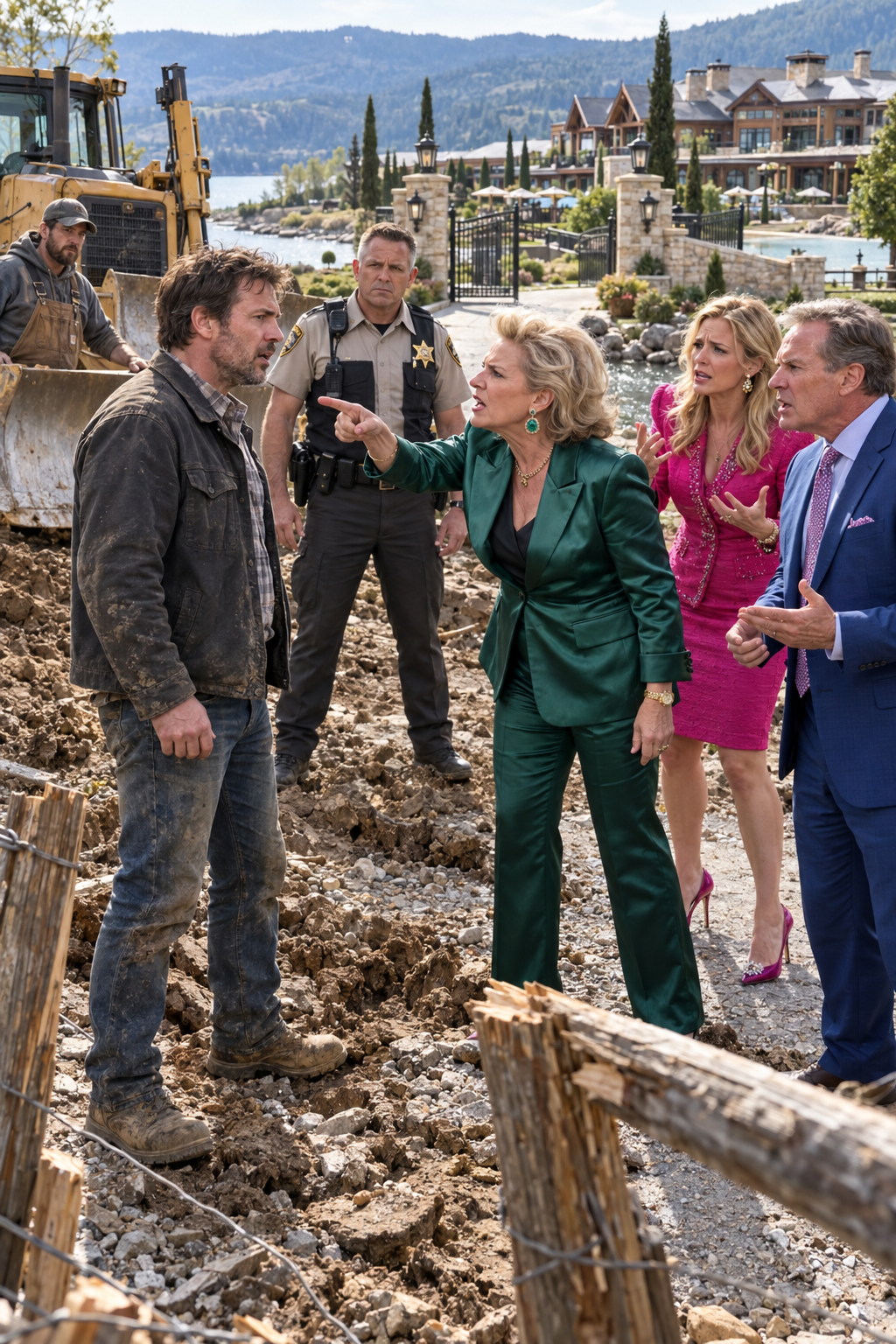
At on a Thursday morning, my older brother stood beside a yellow bulldozer and told me I had ten minutes to get off my own front porch.
Four days earlier, we had buried our father.
Now Mason Whitaker was pointing at the gravel road Dad had built with his own hands and telling an excavation crew to destroy it.
“You’re making this harder than it needs to be, Nora.”
Mason wore a cream golf shirt under a navy vest with the gold logo of Laurel Crest Estates stitched over his heart.
Behind him stood Celeste Barron, president of the Laurel Crest Homeowners Association, in white slacks, oversized sunglasses, and shoes that had never touched mud until that morning.
Beside her was Grant Vale, the developer whose company had spent eighteen million dollars converting the mountain property behind ours into a luxury resort with glass cabins, an infinity pool, a spa, and a clubhouse designed to look like a European lodge.
Three county SUVs sat near the gate.
Two private security guards stood beside them.
A survey crew waited farther downhill.
And idling ten feet from the oak tree where my mother used to hang Christmas lanterns was a Caterpillar D6 bulldozer.
Mason glanced at his watch.
“Eight minutes.”
I looked at my brother.
Then I looked at the bulldozer.
Then I looked at the narrow gravel lane curling through the poplars toward County Road 17.
I didn’t yell.
I didn’t beg.
I didn’t stand in front of the machine.
I walked inside the farmhouse.
Celeste smiled.
That was the first mistake she made that morning.
The second was assuming I was frightened.
The third was believing my silence meant I had nothing left.
I had something.
It was sitting inside an old green ammunition box beneath my father’s workbench.
Dad had handed me the key three weeks before he died.
His fingers had already gone thin by then.
The cancer had taken most of his strength, but not his sense of timing.
“Don’t open it unless Mason comes for the road,” he had whispered.
I thought he was confused.
Dad had been drifting in and out of sleep for days.
I leaned closer.
“What road?”
His eyes opened.
The same gray eyes that could spot a broken fence post half a mile away.
“He’ll come with papers,” Dad said. “Maybe lawyers. Maybe county people. Maybe somebody with a machine.”
I remember smiling because I wanted him calm.
“Mason wouldn’t do that.”
Dad’s fingers tightened around my wrist.
“He already did worse.”
That was all he said.
Until the next morning.
Then he asked me to promise him one thing.
“If they widen the lane,” he said, “don’t stop them.”
“Take pictures.”
“The centerline.”
I thought the medication was talking.
Dad shook his head.
“And the stone culvert. Make sure you get the stone culvert.”
“What am I supposed to do with pictures of a culvert?”
He breathed through the pain for several seconds.
Then he said a name I hadn’t heard since I was a teenager.
“Call Ruth Mercer.”
Three days later, he was gone.
At that Thursday morning, I knelt under his workbench and unlocked the green ammunition box.
Inside was a folded survey map.
A small brass key.
A sealed envelope with my name written in Dad’s handwriting.
An old black-and-white photograph.
And a deed dated April 12, 1987.
Outside, an engine revved.
I heard Mason shout.
I unfolded the deed just far enough to see one line highlighted in yellow.
I read it twice.
Then I put everything back into the box except the brass key.
I slid the box behind a loose board in the pantry.
And I walked outside.
Mason was halfway up my steps.
“This is ridiculous,” he said. “You’ve got five minutes.”
“Four,” Celeste corrected.
I looked at her.
She smiled as if we were discussing a delayed brunch reservation.
“You received notice.”
At Dad’s funeral.
Not the next morning.
At the funeral.
We had just lowered him into the ground at Pine Ridge Cemetery when Mason touched my elbow.
I thought he was going to hug me.
Instead, he handed me a white envelope.
“What’s this?”
“Just paperwork.”
I opened it beside Dad’s grave.
Inside was a seventy-two-hour notice to vacate the farmhouse where I had lived for thirty-one years.
Mason had watched me read every line.
Our cousin Daniel had watched too.
So had Mason’s wife, Heather.
Nobody spoke.
Finally I looked up.
“You’re evicting me?”
Mason sighed the way people sigh when a waitress gets their order wrong.
“The Whitaker family trust sold the residential parcel as part of the Laurel Crest consolidation.”
“I live here.”
“You lived here.”
“This was Dad’s house.”
“It was trust property.”
“You’re trustee.”
“And you sold it?”
“I executed an agreement that benefits the whole family.”
There were three people in our immediate family.
Mom had died eleven years earlier.
So when Mason said “the whole family,” he meant himself.
I folded the notice carefully.
Then I placed it in my purse.
Heather whispered, “Nora, don’t make a scene.”
That sentence hurt more than the eviction notice.
Not because Heather mattered.
Because I suddenly understood what all of them expected from me.
They expected tears.
They expected pleading.
They expected me to mention the twenty-two years I had spent taking care of our parents while Mason built his real-estate company two states away.
They expected me to talk about the job I had turned down in Charlotte when Mom’s arthritis became too painful for her to drive.
They expected me to mention the nights Dad’s blood pressure crashed and I slept in a kitchen chair because I was afraid he wouldn’t wake up.
They expected me to remind Mason that he had missed three Christmases, two surgeries, Mom’s last birthday, and Dad’s first round of chemotherapy.
I said none of it.
I had begged enough in my life.
I had explained enough.
I had forgiven enough.
I had waited enough.
I had been useful enough.
I looked at Mason beside our father’s grave and said only, “Seventy-two hours?”
That little question made him relax.
He thought I was surrendering.
I was actually confirming the deadline.
By Wednesday night, I had packed exactly two suitcases.
Not because I intended to leave permanently.
Because Dad had taught me never to stand inside a structure when someone else believed they owned the demolition permit.
At Thursday morning, Celeste handed Mason a clipboard.
He signed something.
Grant Vale spoke to the bulldozer operator.
I stood beside the porch railing holding my phone.
Mason looked at me.
“You ready to be reasonable?”
“What does that mean?”
I lifted my phone.
“Would you mind standing a little farther left?”
His eyes narrowed.
“So I can get the machine in frame.”
Grant gave a short laugh.
“Oh, Jesus.”
Celeste crossed her arms.
“Document whatever makes you feel better.”
I photographed Mason.
The machine.
The survey stakes.
The county vehicles.
The old stone culvert under the lane.
And the white oak Dad had used as a reference point when he taught me how to read property maps.
Then I stepped off the porch.
Mason smiled.
“There we go.”
I walked across the grass instead of using the driveway.
“Nora,” he called.
I kept walking.
“Where are you going?”
“To make coffee.”
He stared at me.
“You’re leaving?”
“You have to vacate.”
“I’m off the porch.”
His jaw tightened.
The bulldozer engine rattled behind him.
Dust drifted through the early light.
“You cannot interfere with the improvement project.”
“I’m not interfering.”
“We’re removing an unsafe private lane and replacing it with the Laurel Crest access boulevard.”
I looked past him at the lane.
“Are you sure that’s the road you want to bulldoze?”
There was a pause.
Grant smiled first.
It was the smile of a man who had spent his career discovering that money usually arrived in the room before consequences.
“Yes,” he said.
Celeste adjusted her sunglasses.
“The current road is completely inadequate.”
Mason shook his head.
“Nora, this is why nobody includes you in business discussions.”
That one landed.
He knew it would.
Mason had been saying versions of that sentence since we were children.
Dad would ask for help fixing a tractor, and Mason would tell me to bring lemonade.
Mom would balance the household accounts, and Mason would joke that numbers gave me headaches.
When I turned nineteen and won a scholarship to study civil engineering, Mason told everyone I would quit within a semester.
I finished in four years.
Then Mom got sick.
I came home temporarily.
Temporary became permanent.
By the time Mason decided I was “the family caretaker,” people had forgotten I once designed drainage systems for the state highway department.
Including, apparently, Mason.
He pointed toward the house.
“Go pack whatever you forgot.”
“All right.”
Then I walked across the pasture toward Dad’s old equipment shed.
Thirty seconds later, the bulldozer dropped its blade.
The first bite of steel tore through the edge of the road at a.m.
I took a picture.
The second pass ripped out twenty feet of gravel.
I took another.
At , the operator reached the old stone culvert.
He stopped.
Grant walked down the slope and gestured impatiently.
The operator leaned from the cab.
“That stone’s old.”
“Exactly,” Grant said. “Take it out.”
“Could be historic drainage.”
Grant pointed at the plans.
“Not on my site map.”
Mason joined him.
“It’s fine.”
I zoomed in.
The operator hesitated again.
Celeste shouted from beside her SUV.
“We’re already behind schedule!”
The blade lowered.
The stone culvert Dad had told me to photograph cracked down the middle.
Something inside me cracked with it.
Not because I loved a drainage pipe.
Because Dad had built it with his father in 1968.
Because Mom had carved our initials into one of the stones before she and Dad were married.
Because thirty-one years of my life had taught me that there are two kinds of destruction.
The first kind is unavoidable.
The second kind is chosen.
That kind deserves witnesses.
So I kept filming.
By , the old road was gone.
By 10:15, dump trucks were delivering crushed stone.
By noon, a thirty-foot-wide graded corridor cut through my property.
By two, workers were installing drainage pipe and compacting the base for a landscaped entrance boulevard.
Celeste walked through it like a queen inspecting a conquered city.
Mason stood beside her.
Grant shook his hand.
Someone brought sandwiches.
They ate lunch beneath the oak tree.
My oak tree.
At three, Mason came to the equipment shed.
I was sitting on Dad’s old stool.
He leaned against the door.
“You see how much easier this is when you cooperate?”
I looked at him.
“You’ll get a relocation payment.”
“How generous.”
“Don’t be sarcastic.”
He walked inside.
His expression softened in a way I remembered from childhood.
Mason had always been most convincing when he pretended kindness cost him something.
“I know this is emotional for you.”
I said nothing.
“You’ve spent your whole life here.”
Still nothing.
“And that’s exactly why I’m trying to help.”
“By evicting me four days after Dad’s funeral?”
His face hardened.
“There was a schedule.”
Of course there was.
There was always a schedule when rich people wanted something from poor people.
“Grant’s investors are arriving Saturday,” Mason continued. “The resort opens in two weeks. We had to complete the access upgrade.”
“What happens to the farmhouse?”
He looked away.
There it was.
“What happens to it, Mason?”
“The current master plan shows a reception pavilion.”
He studied me.
“That’s it?”
“What do you want me to do?”
“I don’t know.”
His face changed.
“Tell you how much this place means to me?”
He pushed away from the wall.
“I’m trying to be decent.”
“No. You’re trying to feel decent.”
He stared at me.
For a moment, I saw the boy who used to steal peaches from Mom’s kitchen and blame me.
Then he was gone.
“If you challenge this,” he said, “you’ll lose.”
“The trust documents are clear.”
“We have county approval.”
“The HOA has the right to improve access.”
“Then you should be fine.”
He exhaled through his nose.
“You always do this.”
“Act like you know something nobody else knows.”
I looked at the brass key resting beside my coffee cup.
Mason noticed it.
His eyes moved from the key to me.
“What’s that?”
I closed my hand around it.
He watched my fist for a second too long.
Then he smiled.
“Dad’s safety-deposit box?”
I didn’t answer.
“He emptied it years ago.”
“He told me.”
“That sounds settled, then.”
Mason’s smile disappeared.
He left without saying goodbye.
At p.m., the last grader pulled away.
At , Celeste posted a photograph on the Laurel Crest community page.
I found it because one of Dad’s neighbors sent me a screenshot.
Celeste stood in the new road beside Grant and Mason.
The caption read:
ACCESS SECURED.
That was the exact phrase.
Not “road upgraded.”
Not “construction completed.”
Access secured.
I stared at those two words for a long time.
Then I called Ruth Mercer.
Her number was on the back of the black-and-white photograph in Dad’s ammunition box.
She answered on the fourth ring.
“My name is Nora Whitaker.”
Then, very quietly, she said, “Henry’s daughter?”
Another pause.
“Is your father alive?”
“I’m sorry.”
“Did you know him well?”
“I knew him when people still kept promises in ink.”
That was a strange answer.
I looked at the photo.
Dad was maybe twenty-eight.
Beside him stood another man I recognized as my grandfather.
A younger woman with dark hair stood between them.
I turned the picture over again.
RUTH MERCER — 1987.
“Dad told me to call you if someone came for the road.”
Ruth did not ask which road.
She said, “Did they widen it?”
“How wide?”
“About thirty feet.”
“Did they destroy the stone culvert?”
Her breath left slowly.
“Did you photograph it first?”
“Did you photograph the centerline?”
“Good girl.”
I was fifty-six years old.
Nobody had called me that in twenty years.
I didn’t mind.
“What is happening?”
“Where’s the original deed?”
“In front of me.”
“Don’t photograph it.”
“Because your brother is not the only person who has been waiting for Henry to die.”
A cold feeling moved through me.
“Who else?”
“Tomorrow morning. Nine o’clock. My office.”
“Asheville.”
“That’s two hours away.”
“Can’t you tell me now?”
Ruth went quiet again.
Then she asked, “Is the farmhouse still standing?”
“Sleep somewhere else tonight.”
The call ended.
At that evening, Mason knocked on my motel-room door.
I hadn’t told him where I was staying.
I opened the door but left the chain on.
He held a paper bag from a barbecue restaurant.
“I brought dinner.”
“How did you find me?”
“You used the trust credit card.”
“No, I didn’t.”
His eyes flickered.
“Then I guessed.”
There were fourteen motels within twenty miles.
Mason had never been lucky.
I kept the chain on.
“What do you want?”
“You talked this morning.”
“I was angry.”
“You were efficient.”
He looked past me into the room.
“You alone?”
“That’s a strange question.”
“Yes. I’m alone.”
Then his eyes went to my purse on the desk.
“You talk to anyone today?”
“The motel clerk.”
His mouth tightened.
“I’m serious.”
“So am I. She gave me two extra towels.”
“Nora, Dad wasn’t always organized near the end.”
“He was dying.”
I stared at him.
He shifted the food bag from one hand to the other.
“If you find old documents, don’t assume they still matter.”
There it was.
Not a confession.
Not even close.
Just a man stepping carefully around a hole he wasn’t sure I could see.
“What kind of documents?”
“Surveys. Deeds. Farm agreements. Dad kept everything.”
“Some were superseded.”
“Some might create confusion.”
“Then I’ll try not to get confused.”
He leaned closer to the gap in the door.
“This resort matters to a lot of people.”
“Everyone.”
“The homeowners.”
“Hundreds of jobs.”
“Is that what we’re calling investors now?”
His face went flat.
“Don’t turn this into something ugly.”
I almost laughed.
He had bulldozed my road before breakfast.
But I didn’t laugh.
I looked at my brother and understood something Dad had probably understood years earlier.
Mason did not think of himself as cruel.
That would have required honesty.
Mason thought the world naturally belonged to whoever moved fastest.
If you hesitated, you consented.
If you sacrificed, you volunteered.
If you cared for someone, you had chosen not to compete.
And if, after years of being useful, you discovered everyone had mistaken your patience for surrender, that was apparently your own fault.
I unhooked the chain.
Mason relaxed.
I took the barbecue bag from him.
“Thank you.”
His shoulders dropped another inch.
Then I shut the door.
I waited thirty seconds.
I locked the deadbolt.
I lifted the curtain.
Mason stood beside his SUV, texting someone.
At the next morning, I walked into the law office of Mercer & Bell in downtown Asheville carrying the green ammunition box inside a canvas grocery bag.
Ruth Mercer was seventy-four.
Silver hair.
Red glasses.
No patience for small talk.
She led me into a conference room, locked the door, and pulled the blinds.
“Let me see the deed.”
I handed it to her.
She read the first page.
Then the second.
Then the attached survey.
When she reached the fourth page, she looked up.
“They destroyed the culvert?”
“You’re sure?”
“I watched them.”
“Who authorized it?”
“Mason Whitaker, Celeste Barron, and Grant Vale were all there.”
“Three vehicles.”
“Any county employee direct the excavation?”
“I have video.”
She closed her eyes.
Not in relief.
In concentration.
When she opened them again, she slid the deed back to me.
“Your father knew.”
“Knew what?”
“That they would become overconfident.”
I sat across from her.
“Ruth, I’ve had people throw me out of my house, tear up my road, and tell me everything I remember about my family property is wrong. I would really appreciate the short version.”
She almost smiled.
“The short version is that Mason sold land he controlled.”
My stomach tightened.
“He did not sell the road.”
I didn’t move.
Ruth tapped the deed.
“Your grandparents separated this parcel from the family trust in 1987.”
I laughed once because the answer sounded absurd.
“I was seventeen.”
“I didn’t own property at seventeen.”
“You didn’t.”
“Then what does that mean?”
“It means your father and grandfather created a remainder interest that vested when you turned twenty-five.”
I stared at her.
“Say that like I’m not a lawyer.”
“The road parcel became yours on your twenty-fifth birthday.”
I looked down at the deed.
“No, because I would have known.”
“Henry held it in an unrecorded family conveyance until 1996.”
“Unrecorded?”
“The original was placed in escrow with my old firm because your grandfather did not trust Mason.”
My mouth went dry.
“Mason was twenty-one.”
“Mason was already forging Henry’s signature to borrow against farm equipment.”
I said nothing.
Ruth continued.
“The document was eventually recorded under an abbreviated parcel description after your grandfather died. It has been sitting in the county register for thirty years.”
“Then how did Grant’s title company miss it?”
“They didn’t.”
That was the first real twist of the knife.
Ruth pulled a folder from her desk.
“Laurel Crest’s title insurer requested clarification eleven months ago.”
I stared at her.
“How do you know?”
“Because I received the request.”
My heart started beating harder.
“You talked to them?”
“I sent them the recorded deed, the 1987 survey, and the restrictive access covenant.”
“What covenant?”
Ruth turned the deed to the fourth page.
“This one.”
The language was old-fashioned and dense, but one paragraph had been underlined in Dad’s pen.
A twenty-foot right of passage could be used by the rear mountain tract for agricultural, residential, and emergency purposes.
It could not be widened, paved, relocated, or materially altered without the written consent of the road owner.
Commercial lodging was specifically excluded.
Any substantial unauthorized alteration would terminate the easement.
I read the last sentence again.
Then again.
“What does terminate mean here?”
“Exactly what you think.”
“The resort can’t use my road?”
“Not legally.”
“What about before yesterday?”
“Their resort use was already questionable. But they had arguments. Ambiguous historical use. Estoppel. Implied consent. They could have tied you up for years.”
Ruth folded her hands.
“Now they removed the original roadbed, destroyed the historic drainage structure identified on the 1987 survey, widened the corridor by more than ten feet, and did it without permission from the fee owner.”
I leaned back.
Through the window blinds, sunlight striped the conference table.
I thought of Celeste standing in white slacks while the bulldozer tore through the culvert.
I thought of Mason eating sandwiches beneath Mom’s oak tree.
I thought of Grant saying yes when I asked whether he was sure.
“How bad is it?”
“For them?”
Ruth took off her glasses.
“Where is the resort’s other access?”
“They’ve been talking about a north entrance.”
“Permitted?”
“I don’t know.”
“It isn’t.”
She stood and walked to a filing cabinet.
“The north boundary borders protected wetland and a state-managed creek corridor. The environmental application was denied in February.”
“So my road is—”
“The only currently usable route from a public road to the resort parcel.”
I whispered the number.
“Eighteen million dollars.”
“Construction cost, according to their financing memorandum.”
“You have their financing memorandum too?”
Ruth looked at me over her red glasses.
“Nora, your brother has not been playing a family game. He has been playing a bank game.”
She laid another document in front of me.
A loan summary.
Vale Mountain Hospitality LLC.
Forty-two-million-dollar credit facility.
Phase One collateral included the resort tract.
Completion certification required legal access.
I felt the room get very quiet.
“Forty-two million?”
“The eighteen million is only what they admit spending so far.”
My brother had handed me an eviction notice beside Dad’s grave.
Not because the farmhouse mattered.
Not even because the road mattered.
Because a bank closing was coming.
Because Grant needed legal access.
Because the resort had investors arriving Saturday.
Because Dad had died before the last problem could be forced out of the way.
I looked at Ruth.
“Did Mason know I owned the road?”
That hurt differently.
There are betrayals you feel in your chest.
And betrayals you feel in your bones.
This one reached back through decades.
Every grocery run.
Every hospital drive.
Every Thanksgiving Mason arrived late and left early.
Every time Dad said, “Your brother’s busy.”
Every time Mom whispered, “Don’t be hard on him.”
Every time I convinced myself family imbalance was not the same thing as family cruelty.
Mason knew.
Maybe not every detail.
But he knew enough.
“He expected me to leave.”
“Why give me seventy-two hours?”
“Because Grant needed possession before the lender’s inspection Monday.”
“And the bulldozer?”
Ruth’s mouth tightened.
“That was arrogance.”
I looked at the deed.
“That was fear.”
Ruth watched me.
“Mason came to my motel last night. He didn’t ask if I was angry. He asked whether I’d found documents.”
Ruth sat again.
“Did you tell him about me?”
“What happens now?”
“That depends.”
“How angry you are.”
“I’m not angry.”
She studied me for several seconds.
“Henry said you’d say that.”
My throat closed unexpectedly.
“You talked to Dad recently?”
“Three weeks ago.”
“What did he say?”
“That you would try to be fair even after everyone else stopped.”
I looked away.
Ruth’s voice softened.
“He was afraid of that.”
I swallowed.
A strange laugh escaped me.
Dad had spent half my life asking me to keep the peace.
Now, from the grave, he was apparently worried I would keep too much of it.
Ruth opened my sealed envelope.
I had forgotten about it.
She stopped.
“It has my name on it.”
“I should open it.”
She handed it over.
The paper inside was a single handwritten page.
If you are reading this, Mason has probably told you that you were left the least because you did the least with your life.
Do not believe him.
You stayed when leaving would have been easier.
Your mother lived at home because of you.
I died at home because of you.
The farm survived long enough for me to fix what I should have fixed years ago because of you.
The road was never meant to make you rich.
It was meant to make sure nobody could make you small again.
I taught Mason to chase value.
I taught you to carry weight.
I was wrong to praise one more than the other.
The land below the ridge is yours.
The road is yours.
The house is yours.
And if somebody tells you family peace requires you to surrender those things, remember that peace bought by one person’s silence is only obedience with better manners.
There is one more thing.
Do not sign anything involving Cedar Hollow.
I read the last three lines twice.
“Cedar Hollow?”
Ruth’s expression changed.
“What is Cedar Hollow?”
“You have spent one hour telling me everyone around me has known pieces of my life that I didn’t. I’m done being protected by missing information.”
Ruth leaned back.
She looked at Dad’s letter.
“Cedar Hollow is a separate parcel.”
“How separate?”
“Geographically? Adjacent to Laurel Crest.”
“Financially?”
“That’s more complicated.”
“Who owns it?”
She hesitated.
I almost laughed again.
“How much land did my father secretly give me?”
“Technically, Henry didn’t give you Cedar Hollow.”
“Then who did?”
“Your mother.”
That landed harder than anything else.
Eleven years gone.
Mom, who kept cookie tins full of sewing buttons.
Mom, who saved wrapping paper.
Mom, who apologized when she needed help getting out of the bathtub because she hated being a burden.
“What is Cedar Hollow?”
“Seventy-three acres below the resort ridge.”
“Why have I never heard of it?”
“Because it was placed in a testamentary trust after your mother’s death.”
“For a purpose.”
“What purpose?”
Ruth closed the folder.
“We deal with the road first.”
I stared at her.
She did not blink.
Finally I nodded.
“What do we do?”
“We give them one chance.”
“Tell the truth.”
At 11:40 a.m., Ruth sent a preservation letter and notice of ownership to Mason, Celeste, Grant, the HOA attorney, the county planning office, the title company, and Vale Mountain Hospitality.
At 12:06, Mason called me.
I did not answer.
At 12:07, he called again.
At 12:09, Celeste called.
At 12:13, Grant called.
At 12:21, Mason texted:
WHAT THE HELL ARE YOU DOING?
CALL ME NOW.
YOU DO NOT UNDERSTAND THE DAMAGE THIS COULD CAUSE.
At 12:33, I replied.
I understand the road is mine.
Three dots appeared immediately.
Then disappeared.
Then appeared again.
WHO TOLD YOU THAT?
I sent one photograph.
The old stone culvert before demolition.
Mason stopped texting.
At , Ruth received an email from Laurel Crest’s attorney demanding that I cease “interference with established community access.”
Ruth replied with the covenant.
At , the attorney requested a conference call.
At , the lender’s lawyer joined.
At , Grant Vale arrived personally at Ruth’s office.
I watched him enter from the conference room window.
He no longer looked amused.
His expensive blue blazer was unbuttoned.
His face was red.
He came into the room without waiting to be invited.
“This is extortion.”
Ruth did not look up from her notes.
“Good afternoon, Mr. Vale.”
Grant pointed at me.
“You knew.”
“I knew the road was important to my father.”
“You stood there and watched us.”
“You let us destroy it.”
“I asked if you were sure.”
His mouth opened.
Then closed.
Ruth looked at him.
“My client was under no obligation to protect you from your own construction crew.”
Grant turned to her.
“We have an easement.”
“You had an easement.”
“That’s not how property law works.”
Ruth slid a copy of the covenant across the table.
Grant didn’t touch it.
“Our counsel reviewed that.”
“Then you should speak with your counsel.”
“The use has existed for decades.”
“For farm vehicles and three residences.”
“It runs with the land.”
“Subject to express restrictions.”
“You cannot terminate access to an eighteen-million-dollar development over an old culvert.”
Ruth’s voice remained pleasant.
“No. Your client apparently terminated it by destroying the servient estate configuration specifically protected by the granting instrument.”
Grant looked at me again.
“You want money.”
I thought about Dad’s letter.
The road was never meant to make you rich.
I folded my hands.
He laughed.
Everybody wants money.
Men like Grant built entire careers on that sentence.
“How much?”
“I don’t want your money.”
“Then what?”
“Restore the road.”
“The way it was.”
“That’s impossible.”
“No, it isn’t.”
“We’ve already graded it.”
“I noticed.”
“We have engineering work completed.”
“I noticed.”
“The entrance monuments arrive Monday.”
“Then I’d cancel delivery.”
His jaw jumped.
“You’re enjoying this.”
That accusation surprised me.
Because I wasn’t.
I had imagined justice would feel warm.
It felt cold.
Almost clinical.
I saw Dad coughing into a towel.
Mom gripping my arm while I helped her down the hall.
Mason smiling beside a bulldozer.
And all I felt was tired of being told someone else’s urgency had to become my sacrifice.
“I don’t enjoy any of this,” I said. “But I’m done paying for it.”
Grant sat down.
For the first time.
“What do you want?”
“Written acknowledgment that I own the road parcel.”
He frowned.
“Written withdrawal of the eviction notice.”
“That’s Mason’s issue.”
“It’s attached to your purchase agreement.”
His eyes flickered.
He hadn’t expected me to know that.
“Restoration of the original twenty-foot lane.”
“We cannot rebuild a sixty-year-old culvert.”
“Then you should have left it alone.”
He leaned forward.
“Mrs. Whitaker—”
“Ms. Whitaker, eight million dollars in reservations depend on opening this property.”
“That sounds serious.”
“Families have booked weddings.”
“That’s unfortunate.”
“Employees were hired.”
“I hope you keep paying them.”
“Vendors have contracts.”
“Then you should honor them.”
“You are going to hurt hundreds of people because you’re angry at your brother.”
There it was.
The moral trick.
I had heard versions of it my whole life.
If I refused, somebody else would suffer.
If I objected, I was selfish.
If I protected what was mine, I was hurting the family.
The burden always landed on the person least willing to drop it.
I looked directly at Grant.
“You knew there was a title problem.”
His face changed.
Ruth said nothing.
Grant looked at her.
“What makes you think that?”
“Because your title insurer contacted Ruth eleven months ago.”
“We were told the issue was curable.”
He said nothing.
I already knew.
Ruth slid a legal pad toward me but I didn’t need it.
I asked one more question.
“Did my brother tell you I would sign?”
Grant looked at the table.
That was enough.
At , he left.
At , Mason called.
This time I answered.
“You set me up.”
His voice shook.
“You knew what we were doing.”
“Not until yesterday.”
“You never told me.”
“You knew there was a resort.”
“I knew there was construction behind the ridge. You said it was an HOA amenity center.”
“It evolved.”
“Into a hotel?”
“It is not technically a hotel.”
“Does technical language make lies easier?”
“Nora, listen to me.”
His breathing filled the line.
“The family has exposure.”
“You have exposure.”
“Our name is on this.”
“You put it there.”
“Dad agreed to development.”
“Show me his signature.”
“We have authorization.”
“Then send it.”
“You think Dad was some saint?”
“You think he didn’t use you?”
My fingers tightened around the phone.
“He kept you there.”
I said nothing.
“He loved that you never left. He loved having a nurse, a driver, a bookkeeper, somebody to keep the property going. He could have paid for help. He didn’t. He used your guilt.”
Some betrayals hurt because they are lies.
Others hurt because they contain enough truth to find the softest place.
For years, in my worst moments, I had wondered the same thing.
Would Dad have pushed me harder to build my own life if I had been his son?
Would Mom have accepted professional care if Mason had been the one washing her hair?
Had my devotion become convenient?
Love and unfairness can live in the same house.
That was one of adulthood’s uglier lessons.
But Mason was not calling to free me from Dad’s shadow.
He was trying to drag me back into mine.
“I know Dad wasn’t perfect,” I said.
Mason went quiet.
“I know Mom wasn’t perfect either.”
“And I know I wasn’t forced to stay.”
“You sacrificed your whole life.”
“You have nothing to show for it.”
I looked at the deed.
“I wouldn’t say nothing.”
Then he lowered his voice.
“You want the truth?”
“The resort deal saves everything.”
“What does that mean?”
“The old trust has debt.”
“How much?”
“Not your problem.”
“You made it my problem at Dad’s funeral.”
“If this financing fails, creditors come after the remaining Whitaker holdings.”
“Which holdings?”
“The farm parcels.”
“My house?”
“The trust believed it controlled the house.”
“The trust believed?”
“Mistakes were made.”
By noon, the system had begun speaking in passive voice.
Nobody bulldozed my road.
Mistakes were made.
Nobody tried to evict me.
The trust believed.
Nobody hid documents.
There was confusion.
I had seen bureaucracies do it when I worked for the highway department.
Passive voice is where responsibility goes to hide.
“What did you borrow against?” I asked.
“That doesn’t matter.”
“Did you borrow against Dad’s land?”
“How much?”
“How much?”
“For what?”
He hung up.
At five that afternoon, the resort gate was closed.
By the county fire marshal.
Ruth had sent him the access covenant and photographs.
He inspected the new boulevard and discovered the final paved width had not been approved for the existing bridge load configuration.
More importantly, once ownership of the corridor became disputed, the fire department would not certify the resort’s emergency access until legal access was confirmed.
Celeste posted another community message.
TEMPORARY DELAY DUE TO ADMINISTRATIVE CONFUSION.
Residents blamed the county.
Then the contractor.
By six, my name was in the comments.
CRAZY ROAD LADY.
ONE WOMAN HOLDING 300 HOMEOWNERS HOSTAGE.
I read exactly seven comments.
Then I closed the page.
At , a black Mercedes stopped outside my motel.
Heather got out.
Mason’s wife had always looked expensive even when she was wearing gardening gloves.
That evening she wore a camel coat and carried no purse.
I met her in the lobby.
“We need to talk privately,” she said.
Her eyebrows lifted.
“I’m not going to your room.”
“I didn’t invite you.”
She looked around.
Two construction workers watched a baseball game near the vending machines.
The desk clerk was doing homework.
Heather lowered her voice.
“Mason is panicking.”
“He didn’t sleep.”
“That sounds difficult.”
“You’re being cruel.”
“No. I’m being factual.”
She stared at me.
Then she sat.
I remained standing.
After a moment, she said, “Grant can sue him personally.”
“For what?”
“Misrepresentation.”
“So Mason misrepresented something.”
“I didn’t say that.”
“You almost did.”
Heather pressed her lips together.
“He relied on information.”
“From Dad?”
“From old trust files.”
“Did the files say I owned the road?”
She looked away.
There it was again.
Not an admission.
Just gravity pulling eyes toward the floor.
“Why did you come?”
“To ask you to sign temporary access.”
“You didn’t even read it.”
“It’s ninety days.”
“They’ll restore the lane later.”
“You can name your price.”
Her face reddened.
“You’re destroying your brother.”
I sat down then.
Across from her.
Close enough that she could see I wasn’t trembling.
“Do you remember the night Mom died?”
Heather’s anger faltered.
“Do you remember?”
“Mason was in Atlanta.”
“He had a conference.”
“Mom asked for him at 10:15.”
“I called him eight times.”
“He was presenting.”
“She died at 11:06.”
Heather looked toward the television.
“I was holding her hand.”
“Dad was crying so hard he couldn’t stand.”
Heather whispered, “I know.”
“Mason called me the next morning and asked whether Mom had signed the updated life-insurance beneficiary form.”
Heather closed her eyes.
“I forgave him.”
“When Dad had heart surgery, Mason sent flowers. I forgave him.”
She didn’t speak.
“When he sold the south pasture without telling Dad the buyer planned to clear the timber, I forgave him.”
“When Dad found out Mason had borrowed against the equipment company, I sat at that kitchen table for six hours helping them restructure the debt because Dad begged me not to let the family break apart.”
Heather’s eyes filled.
Mine didn’t.
“And four days after I buried the man I spent nine months bathing, feeding, lifting, medicating, and listening to at three in the morning because he was afraid to die, your husband handed me an eviction notice beside his grave.”
“Nora, please.”
“He did not ask where I would go.”
“He did not ask whether I had money.”
“He did not give me a week.”
Heather’s mouth trembled.
“He gave me seventy-two hours because Grant had a lender coming.”
She wiped beneath one eye.
“You’re right.”
“No. I’m finished being wrong on purpose so Mason can feel right.”
Heather looked down at her hands.
After a long silence, she whispered, “There’s something else.”
I didn’t move.
“Mason thinks the green box has the Cedar Hollow papers.”
My skin went cold.
“How do you know about the box?”
“He saw Henry hide it once.”
“In the pantry.”
The motel lobby suddenly felt too bright.
“Has Mason been inside the farmhouse?”
Heather did not answer.
“After Dad died?”
Still nothing.
“He searched it Tuesday.”
The day after the funeral.
The day before he evicted me.
“What was he looking for?”
“I don’t know.”
“Yes, you do.”
“I’ve said enough.”
I stood too.
“What is Cedar Hollow?”
Heather’s face went pale.
“Nora, whatever Ruth tells you, be careful.”
“With what?”
“Mason isn’t the one you should be afraid of.”
She walked out.
At , I called Ruth.
At , we drove to the farmhouse with a sheriff’s deputy.
The back door had fresh scratches near the lock.
The pantry board had been moved.
The green ammunition box was gone.
Mason had taken it.
What he didn’t know was that I had removed the deed and Dad’s letter that morning.
The box still contained the old photograph.
The survey map.
And the envelope marked CEDAR HOLLOW.
I had not opened that envelope.
Because it was addressed to Ruth.
For the first time since the bulldozer arrived, I felt afraid.
Not because I had lost paperwork.
Because Mason had risked breaking into a house he claimed already belonged to him just to get it.
Ruth stood in the pantry doorway.
“He knows.”
“Knows what?”
“That Henry changed the Cedar Hollow trust.”
“What trust?”
She looked at the deputy.
“Not here.”
We went back to her office.
At that night, Ruth finally told me.
My mother had inherited Cedar Hollow from her aunt in 1993.
Seventy-three acres.
Mostly woodland.
A limestone shelf.
And an abandoned maintenance road.
Mom placed the land in a trust for one purpose.
Long-term care.
I stared at Ruth.
“I wasn’t disabled.”
“I wasn’t sick.”
“Then why?”
“Because your mother knew you were the child most likely to spend your life caring for everybody else.”
I stopped breathing for a second.
Ruth pushed a tissue box toward me.
I ignored it.
“She told me once,” Ruth continued, “that Mason would always know how to ask for his share. She wasn’t sure you ever would.”
That almost broke me.
Not the land.
Not the money.
Being seen.
After decades of becoming invisible through usefulness, I discovered my mother had noticed.
Every missed promotion.
Every canceled trip.
Every relationship I ended because I couldn’t move away.
Every time somebody said, “Nora doesn’t mind.”
Mom had known I minded.
She had simply been too ashamed to say it.
“What changed?” I asked.
Ruth took a breath.
“Originally, the trust would transfer Cedar Hollow to you at sixty.”
“I’m fifty-six.”
“What did Dad change?”
“He couldn’t change your mother’s trust. But three months ago, he exercised a power she had given him as co-trustee to accelerate distribution if the family trust became insolvent or if Cedar Hollow was threatened by outside development.”
“Did that happen?”
I stared at her.
“The resort?”
Ruth nodded.
“Laurel Crest’s current site plan shows a service road crossing Cedar Hollow.”
I felt sick.
“Partially.”
“I’ve never seen it.”
“It’s behind the ridge.”
“So they’re using my land on both sides?”
“For what?”
“That’s the problem.”
“What problem?”
Ruth hesitated.
Then said, “We need the envelope Mason took.”
Saturday morning, Laurel Crest’s investor preview was canceled.
Sunday, three wedding parties demanded refunds.
Monday, the lender’s compliance team arrived.
Tuesday, Vale Mountain Hospitality filed for emergency injunctive relief, asking a judge to force temporary access across my road.
By Wednesday, every person who had called me irrelevant had learned my name.
The hearing was held Thursday morning.
Exactly one week after the bulldozer arrived.
Mason sat behind Grant’s lawyers.
Celeste sat beside him.
Heather was absent.
Grant had four attorneys.
The HOA had two.
The title company had one.
I had Ruth.
And a grocery bag full of photographs.
Grant’s lead attorney argued economic catastrophe.
He spoke about employees.
Homeowners.
Public interest.
Emergency services.
He called the destroyed road an “ordinary infrastructure modernization.”
Then Ruth played my video.
The room heard Grant’s voice.
Take it out.
Then Mason’s.
Then Celeste’s.
We’re already behind schedule.
The judge watched the entire clip.
Nobody moved.
Next came the photograph of the intact stone culvert.
Then the 1987 deed.
Then the covenant.
Then the title insurer’s request from eleven months earlier.
Then Ruth’s response.
Grant’s lawyer asked for a recess.
The judge refused.
Mason leaned toward his attorney.
His attorney did not look at him.
Ruth called the county surveyor.
He confirmed that the original twenty-foot easement corridor followed the old centerline.
The widened resort boulevard did not.
At one point, it veered eighteen feet outside the recorded easement.
Onto my property.
Grant’s lawyer stood.
“Mrs. Mercer, this is a technical encroachment measured in feet.”
Ruth looked at him.
“Property ownership is frequently measured in feet.”
A few people laughed.
The judge didn’t.
Then came the mini-payoff I had not expected.
The county planning director testified that Laurel Crest’s resort approval had been conditional on proof of legal permanent access before occupancy.
“Was that proof provided?” Ruth asked.
The director checked his file.
“Mason Whitaker.”
Mason stopped moving.
“What did Mr. Whitaker provide?”
“A trustee affidavit.”
Ruth looked at me.
Then at the judge.
“May I see that document?”
The judge nodded.
The director handed it over.
Ruth read silently.
Her expression did not change.
She approached the bench.
“Your Honor, we have a serious problem.”
Grant’s attorney stood.
“What problem?”
Ruth turned.
“This affidavit states that the Whitaker Family Trust owns the road parcel free of adverse claims.”
The courtroom went silent.
The judge looked at Mason.
“When was this signed?”
“Seven months ago,” Ruth said.
I felt something inside me settle.
Not explode.
Like a key turning.
Because the deed proving I owned the road had been recorded for thirty years.
Because Ruth had sent it to Grant’s title insurer eleven months ago.
Because Mason had sworn, four months after that, that the trust owned everything.
Grant looked at my brother.
And for the first time in my life, Mason had nobody else to blame quickly enough.
The judge denied temporary access.
Effective immediately.
Grant’s resort could not use my road for commercial traffic.
No vendors.
No employees except emergency maintenance approved by the county.
No construction deliveries.
Celeste made a small choking sound.
Mason looked gray.
Grant’s lawyer whispered furiously.
Ruth touched my arm.
“Stay still.”
The judge continued.
He ordered preservation of all title documents, trust records, financing representations, survey files, emails, and access certifications.
He referred the trustee affidavit to the district attorney for review.
Then he looked directly at Grant.
“You built an eighteen-million-dollar resort before confirming the legal status of its only access road?”
Grant swallowed.
“We relied upon representations, Your Honor.”
The judge glanced at Mason.
“I imagine several people will soon be discussing those representations in great detail.”
Outside the courthouse, reporters waited.
So did Celeste.
She came toward me before Ruth could stop her.
Her face was red.
“You happy?”
“You ruined us.”
“Property values are collapsing.”
“You bulldozed my property.”
“Over a road!”
“It mattered when you wanted it.”
She stepped closer.
“You could fix this with one signature.”
“Then sign.”
“You selfish—”
A reporter lifted a microphone.
Celeste stopped.
I almost admired the speed.
Her face changed instantly.
Presidential.
She turned toward the cameras.
“This unfortunate dispute demonstrates why communities need stronger authority to maintain safe shared infrastructure—”
I walked away.
That evening, I returned to the farmhouse for the first time since the demolition.
The county had posted a notice preventing alteration until the ownership dispute was resolved.
My furniture was still inside.
Dad’s boots were beside the mudroom door.
His coffee mug sat upside down near the sink.
I stood there for a long time.
Then I made tea.
At , headlights crossed the front window.
He knocked.
I opened the door.
He looked ten years older than he had a week earlier.
“Can I come in?”
He nodded as if he expected that.
Then he handed me something.
The green ammunition box.
I stared at it.
“You broke in.”
“You took it.”
“Why are you bringing it back?”
“Because it doesn’t matter anymore.”
I took the box.
It felt lighter.
“The envelope is gone.”
Mason looked past me.
“Which envelope?”
“Cedar Hollow.”
He smiled faintly.
“You always were bad at bluffing.”
“So you took it.”
“I took a lot of things this week.”
“What was inside?”
“You don’t know?”
For the first time, his confidence returned.
Just a trace.
“That’s almost funny.”
“Because you think the road is the big secret.”
I felt the old instinct rise.
Explain yourself.
Find out what he means.
Instead I waited.
Silence makes dishonest people overwork.
Mason rubbed the back of his neck.
“Grant’s finished.”
“Probably.”
“Celeste too.”
“The HOA board is already voting to remove her.”
“That’s their business.”
“You’ll probably get the house.”
“It’s already mine.”
His mouth tightened.
“Dad filled your head.”
“Dad left records.”
“Dad left land.”
“That too.”
He laughed softly.
“You still don’t understand.”
“Then explain.”
He looked toward the ridge.
Through the trees, the top floor of the resort glowed against the night.
Millions of dollars sitting above us.
Dark road below.
No legal way in.
“Cedar Hollow isn’t valuable because of the acreage,” he said.
“What makes it valuable?”
“You’ll find out.”
“Why did you need the envelope?”
“To know what Dad knew.”
Mason looked at me.
“He knew enough to ruin everybody.”
“Everybody meaning you?”
“Who, then?”
Mason’s face changed.
Not the fear of lawsuits.
Not bankruptcy.
Something deeper.
He stepped off the porch.
“I came to tell you one thing.”
“Sell the road.”
“Take whatever they offer and walk away.”
“Because you think you won.”
I held the green box against my hip.
“Didn’t I?”
He walked to his SUV.
He stopped.
“What was in the envelope?”
For a moment, I thought he might answer.
Instead he said, “Ask Ruth why Mom never let you swim in the spring.”
Then he drove away.
I called Ruth.
At , I drove to her house.
Her front door was open.
The lights were on.
Her car was in the driveway.
I called her name.
I called 911 before going inside.
The dispatcher told me to wait outside.
Three sheriff’s vehicles arrived.
They cleared the house.
Ruth was not there.
Nothing looked disturbed except her study.
One drawer was open.
Papers covered the floor.
Her laptop was gone.
The deputy asked whether anything else was missing.
I remembered the black-and-white photograph from Dad’s ammunition box.
“Maybe a file.”
“What kind?”
“I don’t know.”
That was when my phone rang.
Unknown number.
I showed the deputy.
I answered.
My knees almost gave way.
“Where are you?”
“What happened?”
“Someone came to the office.”
“I don’t know.”
“Where are you?”
“Listen carefully.”
The connection crackled.
“I found the Cedar Hollow backup file.”
“What’s in it?”
“Your mother ordered soil and water testing in 1998.”
“Because she found drums buried near the spring.”
I looked toward the ridge.
The resort lights glittered above the black trees.
“What kind of drums?”
“We don’t know yet.”
My mouth went dry.
“There’s more.”
“Laurel Crest did environmental testing before construction.”
“They found the same contamination.”
The deputy beside me stopped writing.
“Fourteen months ago.”
“Before the resort?”
“Did they report it?”
“Who knew?”
“The engineering consultant.”
“Almost certainly.”
“His signature is on a confidentiality agreement.”
My hand tightened around the phone.
The road suddenly seemed small.
Forty-two million dollars in financing.
An eighteen-million-dollar resort.
Three hundred homeowners.
Wedding bookings.
A swimming pool.
And below the ridge, a spring my mother had kept me away from since childhood.
“Why would Mom put contaminated land in a trust for me?”
“She didn’t.”
“The parcel was clean when she inherited it.”
“Then when were the drums buried?”
“That’s what the old photograph proves.”
“What photograph?”
“The one from the ammunition box.”
“What does it prove?”
“That the drums were not buried by your family.”
“Then who buried them?”
Ruth went silent.
“I sent you a photograph. Check your messages.”
My phone vibrated.
An image arrived.
Not the old photo.
A scanned corporate document.
A land-use agreement from 1989.
I enlarged the signature at the bottom.
The company name meant nothing to me.
BARRON DEVELOPMENT SERVICES.
I stopped breathing.
Celeste Barron.
Ruth spoke again.
“Celeste’s father operated a disposal subcontractor on that ridge for six years.”
I looked at the deputy.
He had heard everything.
“Does Celeste know?”
“She signed the resort’s environmental disclosure.”
A truck moved slowly along the county road below us.
I watched its headlights through the trees.
“So the HOA president knew the land might be contaminated.”
“And Grant knew.”
“And Mason knew.”
“Why build a resort there?”
“Because the contamination isn’t under the resort.”
“Where is it?”
“Mostly Cedar Hollow.”
I understood.
If I owned the contaminated parcel, the resort could present the problem as neighboring private land.
Not theirs.
My stomach turned.
“They wanted me to inherit the liability.”
“They wanted you to accept title quietly,” Ruth said.
“But Dad accelerated the trust.”
“Because he discovered something in the groundwater maps.”
Ruth took a breath.
“The spring doesn’t flow away from Laurel Crest.”
I looked toward the ridge.
“It flows toward it?”
Her voice dropped.
“It flows underneath it.”
The next morning, state environmental investigators arrived.
By noon, the resort pool was closed.
By two, the spa was closed.
By three, every drinking-water fountain carried red tape.
Grant issued a statement calling the shutdown “precautionary.”
Celeste resigned from the HOA board at .
Mason stopped answering calls.
At five, the sheriff located his SUV at a regional airport.
At six, the district attorney announced a criminal investigation into the trustee affidavit.
At seven, Ruth and I sat in Dad’s kitchen with two state investigators while rain struck the new gravel boulevard outside.
The road Grant had destroyed.
The road they had widened.
The road that had exposed the drainage trench.
One investigator, Daniel Price, opened a topographic map.
“We believe the grading work may have disturbed a buried lateral drainage channel.”
I stared at the map.
“The bulldozer did this?”
“Possibly.”
Ruth looked at me.
Dad’s warning.
Photograph the centerline.
Photograph the culvert.
He hadn’t only been protecting the easement.
He had been documenting the exact location of the old drainage system.
Price traced a line downhill.
“The historic culvert diverted runoff away from this depression. Removing it changed the surface flow after Tuesday’s rain.”
“Toward Cedar Hollow?”
“Is that bad?”
“We don’t know.”
The second investigator slid a photograph toward me.
Rust-colored water.
A broken pipe sticking out of the bank.
“We found this this afternoon.”
“What is it?”
“Old industrial discharge line.”
Ruth became very still.
“Connected to what?”
“We’re excavating tomorrow.”
My phone buzzed.
A message from Mason.
First contact in twenty-three hours.
Don’t let them dig near the spring.
I showed Ruth.
She read it.
Then Price.
“Why would he say that?” Price asked.
I typed a reply.
Mason answered almost immediately.
Because Dad lied to you about what happened there.
My hands went cold.
What happened?
Three dots appeared.
Disappeared.
Appeared again.
Then a photograph arrived.
An old photograph.
Not the one from Dad’s box.
This one showed Cedar Hollow in winter.
Bare trees.
Three trucks.
My father standing near the spring.
And beside him—
Behind them were two men.
One was Celeste Barron’s father.
The other was a younger man I recognized even before my brain accepted it.
Grant Vale’s father.
Price took the phone.
“Where did he get this?”
“I don’t know.”
Another message came.
Dad wasn’t trying to expose them.
He was part of it.
I felt the room tilt.
Ruth grabbed my hand.
I pulled away gently.
Not because I was angry.
Because I needed to stand on my own.
Dad’s letter sat on the table.
The land below the ridge is yours.
The road is yours.
The house is yours.
Justice had felt clean for exactly one day.
Now mud was seeping through every memory.
“Did you know?” I asked Ruth.
“I don’t know.”
Price’s phone rang.
He answered.
His expression changed.
He hung up.
“The excavation crew found something.”
He looked toward the dark ridge.
“Not drums.”
My throat tightened.
“What did they find?”
“A concrete vault.”
Nobody spoke.
“Approximately twelve feet by twenty.”
“What’s inside?”
“They haven’t opened it.”
Ruth closed Dad’s letter.
Rain hammered the windows.
Then came another message from Mason.
One sentence.
If they open that vault, the road will be the least of what this family loses.
Price read it over my shoulder.
“Do you know what he means?”
At , we drove to Cedar Hollow.
Floodlights turned the forest white.
State trucks lined the old maintenance trail.
The concrete structure sat half exposed beneath a slope, stained black with decades of soil.
A steel hatch was set into the top.
The environmental team had cleared the area.
One technician held a radiation meter.
Another wore a respirator.
I looked at Price.
“Why radiation equipment?”
“Standard precaution.”
That answer didn’t comfort me.
Ruth stood beside me beneath an umbrella.
“You can leave.”
“I spent thirty-one years staying home so other people wouldn’t have to face difficult things alone.”
I looked at the vault.
“I’m not leaving when it finally belongs to me.”
At , a state hazmat supervisor authorized opening the hatch.
Two workers loosened the corroded bolts.
The first snapped.
The second turned.
The third had to be cut.
At , the hatch lifted six inches.
Everyone stepped back.
Air monitoring began.
The hatch rose farther.
A worker shone a light inside.
He didn’t speak.
Price called out.
“What do you see?”
The worker moved the flashlight.
Then he looked up.
“What kind?”
“Metal document cases.”
Ruth and I looked at each other.
One case was removed.
Then another.
Then six more.
The first had a faded label.
WHITAKER / BARRON / VALE.
My knees almost failed.
Price caught my elbow.
The second case carried a bank logo.
A bank that had collapsed in the savings-and-loan crisis decades earlier.
The third was marked COUNTY LAND TRANSFERS.
The fourth simply said ACCESS.
The fifth had my mother’s name.
ELEANOR WHITAKER.
The sixth had mine.
I stepped forward.
Price blocked me.
“That box has my name.”
“We’ll find out.”
At 10:03, a forensic technician photographed every container.
At 10:20, the state attorney on scene authorized opening the one marked NORA because it appeared to contain paper rather than hazardous material.
The latches clicked.
Inside was a plastic sleeve.
One document.
Twelve years before the road deed.
The old boundaries were drawn in red.
The Whitaker farm.
Cedar Hollow.
The future Laurel Crest development.
And one additional tract extending beyond all of them.
Nearly nine hundred acres.
At the bottom, in handwriting I recognized from my grandfather’s old tool labels, were six words:
Hold for Nora. Never record with Mason.
I stared at the map.
Ruth whispered something I couldn’t hear.
Price leaned closer.
“What does that mean?”
I didn’t know.
Then I saw the parcel number.
I had seen it earlier that week.
On Grant Vale’s forty-two-million-dollar financing memorandum.
The collateral schedule.
I pulled out my phone and found the photograph Ruth had allowed me to take.
Parcel 09-7714.
Same number.
The resort.
The luxury cabins.
The clubhouse.
The land under every building Grant had financed.
Not the road.
The ground itself.
Ruth took the old survey with gloved hands.
“This can’t be right.”
“This parcel number predates the Whitaker family trust.”
“So Mason could never have sold it.”
The rain suddenly felt very cold.
“Who owns it?”
Ruth kept reading.
Then she looked at the sealed case carrying my mother’s name.
“We need the chain of title.”
Price’s radio crackled.
A deputy’s voice came through.
Vehicle approaching.
Thirty seconds later, headlights tore through the trees.
A pickup truck stopped behind the state barricade.
Mason jumped out.
Two deputies moved toward him.
He raised both hands.
“I’m not armed.”
I walked toward the barricade.
He looked past me.
At the open vault.
At the metal cases.
His face collapsed.
“You opened it.”
“You have no idea what Dad did.”
“Then tell me.”
He shook his head.
“You think he left you land because he loved you?”
I didn’t answer.
“He left it because he needed somebody clean.”
Ruth stepped beside me.
“What does that mean?”
Mason laughed once.
A broken sound.
“He knew the old transfers would come back someday.”
“What transfers?”
“The resort land.”
Grant’s collateral.
Nine hundred acres.
Mason looked at me.
“Dad didn’t hide your inheritance from you.”
My skin went cold.
“He hid you from the inheritance.”
“What does that mean?”
Before Mason could answer, Price’s radio crackled again.
This time the voice was urgent.
They had opened Eleanor Whitaker’s case.
My mother’s.
Price listened.
His face changed.
He lowered the radio.
Inside my mother’s case was a notarized affidavit dated three weeks before her death.
Attached to it was a deed.
A deed transferring the nine-hundred-acre ridge parcel.
The resort land.
The surrounding forest.
And all mineral and water rights.
Not to Mason.
Not to the family trust.
Not even directly to me.
To something called the Nora Whitaker Stewardship Foundation.
Created eleven years ago.
On the same day my mother signed the document.
Ruth covered her mouth.
I stared at her.
“What foundation?”
“I’ve never heard of it.”
I could see it.
He backed toward his truck.
A deputy stopped him.
He closed his eyes.
“What is the foundation?”
He said nothing.
Price handed me a photocopy transmitted from the field scanner.
The first page listed the foundation’s purpose.
Land conservation.
Groundwater protection.
Affordable housing grants.
Long-term support for unpaid family caregivers.
I couldn’t breathe.
The woman who apologized every time I lifted her from bed.
The woman I thought had watched my life shrink without ever understanding the cost.
She had built something around that cost.
Not a fortune for me to spend.
A structure to make sure other women like me did not disappear inside their own families.
Then I saw the final clause.
If the foundation was ever suppressed, concealed, or deprived of its property by a trustee, officer, beneficiary, developer, lender, or related party, all controlling authority would transfer automatically to the named successor trustee.
Nora Elizabeth Whitaker.
Ruth looked at Mason.
“You knew.”
His silence was answer enough.
“How long?”
He stared at the mud.
“Eleven years.”
The words barely came out.
Eleven years.
He had known while Mom was dying.
He had known while I cooked his Thanksgiving dinner.
He had known while Dad declined.
He had known when he offered me a three-thousand-dollar “relocation payment.”
He had known when he told me I had nothing to show for my life.
Something in my chest finally hurt.
Not loudly.
The kind of pain too deep for tears.
I walked to my brother.
The deputies watched us.
He looked up.
His mouth trembled.
“I thought Dad would dissolve it.”
“Because it wasn’t practical.”
“That isn’t an answer.”
“Nora, nine hundred acres tied up in a caregiver charity? Do you understand what that land is worth?”
“No, you don’t. With development rights? Water rights? Resort density? More than sixty million.”
There it was.
The number.
But somehow the money felt smaller than Mom’s paragraph about unpaid caregivers.
“You sold land belonging to the foundation?”
“I developed a plan to unlock value.”
“You sold it.”
“I intended to replace the assets.”
“With what?”
“Equivalent investments.”
Ruth laughed bitterly.
“You pledged charitable trust land as commercial collateral.”
Mason looked at her.
“Dad approved.”
“He signed papers.”
“Then we’ll examine them.”
His face hardened.
“You still think this ends with me.”
The phrase echoed.
County documents.
The old bank.
Buried records.
Not one villain.
A structure built over decades because everyone assumed the quiet daughter would never ask to see the books.
Price’s phone buzzed.
He read the message.
Then another.
“We’ve got another document.”
He looked at me.
“A financing addendum.”
“From the vault?”
“Whose name?”
He hesitated.
“What does it say?”
“The resort loan apparently wasn’t the largest loan tied to this property.”
My stomach tightened.
“How large?”
“Two hundred and twelve million.”
Nobody spoke.
“For what?”
Price scrolled.
“A second phase.”
“What second phase?”
“Residential towers. Golf course. Medical spa. Private club.”
Ruth whispered, “There isn’t enough buildable acreage.”
Price looked at the map.
“There is if you include Cedar Hollow.”
I remembered the contaminated spring.
The buried drums.
The resort.
The rushed eviction.
Everything aligned.
They had never just needed access for the eighteen-million-dollar resort.
They needed clean title to hundreds of acres for a development worth hundreds of millions.
I was not an inconvenience.
I was the last signature.
And Dad knew it.
Maybe Mom knew it first.
The state attorney ordered the entire site frozen before midnight.
No transfers.
No excavation.
No document destruction.
No financing closings.
By 11:40, bank counsel had been notified.
By 11:52, federal investigators had been contacted because charitable trust assets had apparently been used in interstate financing representations.
Mason sat in the back of a sheriff’s vehicle while deputies waited for instructions from the district attorney.
I stood beside the open vault.
Dad’s letter was folded inside my coat.
The road was mine.
The house was mine.
Maybe the ridge was not really mine at all.
Maybe it belonged to a promise my mother had made to people she would never meet.
People who gave up salaries to care for dying parents.
People who moved home “for a few months” and woke up fifteen years later with no retirement account.
People whose brothers called them failures because caregiving didn’t come with stock options.
For the first time, the inheritance felt like justice instead of property.
And justice was heavier.
At 11:58, Ruth opened the final document case.
The one marked ACCESS.
Inside were easement maps.
Dozens of them.
Old county roads.
Utility corridors.
Water lines.
The resort entrance.
Cedar Hollow.
And one document newer than all the others.
Dated six months ago.
Signed by Grant Vale.
Signed by Celeste Barron.
Signed by Mason Whitaker.
And witnessed by someone whose name made Ruth sit down on the wet ground.
I took the page.
The witness was the county judge who had approved Laurel Crest’s original development settlement three years earlier.
The agreement created a hidden emergency access route.
Not across my gravel road.
Across another parcel.
A parcel the public records showed as landlocked forest.
A parcel belonging to the Nora Whitaker Stewardship Foundation.
“Why hide an emergency road?” I asked.
Price took the document.
“Maybe it isn’t for emergencies.”
At the bottom was a handwritten note.
PHASE II — PRIVATE ENTRY ONLY.
A second page listed construction specifications.
Twenty-four feet wide.
Reinforced base.
Security gate.
No public signage.
Designed for heavy trucks.
It wasn’t an emergency road.
It was a construction road.
The road they planned to use after they forced me out.
The private lane they destroyed that morning had only been temporary.
Once Phase II began, the entire mountain would have opened from the other side.
My eviction was not the end of their plan.
It was the beginning.
Ruth looked toward the ridge.
“Where does this hidden road start?”
Price traced the map.
Then stopped.
His finger rested on a location far beyond Laurel Crest.
An industrial parcel near the interstate.
I recognized the company name beside it.
Barron Development Services.
Celeste’s family.
Price looked at me.
“If this map is accurate, that road was designed to move something between the Barron industrial property and Cedar Hollow without using county roads.”
The buried drums.
My mother’s testing.
Grant’s environmental reports.
Mason’s panic.
Dad telling me to photograph the culvert.
I looked at the vault.
Then at my brother in the sheriff’s vehicle.
And suddenly I understood why Dad had not simply exposed everything himself.
Maybe he couldn’t.
Maybe he had participated years ago.
Maybe guilt had taken thirty years to become courage.
Maybe leaving the evidence to me was his final attempt to repair something too large for one dying man.
At 12:11 a.m., another vehicle arrived.
Two people stepped out.
Federal environmental investigators.
One of them approached Daniel Price and showed credentials.
They spoke quietly.
Then Price looked at me.
“There’s been an additional discovery at the Barron property.”
“Aerial thermal scans.”
“Possible underground storage.”
“How much?”
He didn’t answer immediately.
Then he said, “Large enough that this may not be a local contamination case.”
Behind me, Mason shouted from the sheriff’s SUV.
Everyone turned.
He leaned toward the open window.
His face was wet with rain.
I couldn’t tell.
“Nora, don’t let them connect the road.”
“What are you talking about?”
“The old service road.”
“What about it?”
“You think Dad told you to protect that lane because it gave the resort access.”
He shook his head wildly.
“He wanted you to protect it because it was the only thing covering what runs underneath.”
I stared at him.
“Underneath what?”
“The road.”
Price stepped closer.
“What runs under the road, Mr. Whitaker?”
Mason shut his mouth.
The investigators moved toward him.
He looked only at me.
Dad’s words came back.
Photograph the centerline.
Not the boundary.
Not the gate.
The centerline.
I looked down at the new boulevard Grant had carved through the earth.
At the fresh trench.
At the broken drainage line.
At the place where the old stone culvert had stood for more than half a century.
One of the excavation workers shouted from the darkness.
Everyone turned.
His flashlight pointed into the cut bank.
Something metallic had appeared beneath the gravel bed.
Not a pipe.
Not drainage.
A long steel conduit ran directly beneath the center of my private road, disappearing toward Cedar Hollow in one direction and the Barron industrial land in the other.
The federal investigator walked toward it.
Price followed.
Ruth gripped my arm.
Mason began pounding on the inside of the sheriff’s vehicle.
Nobody stopped.
The worker scraped away another layer of soil.
A faded warning plate appeared on the steel.
Three words were still readable beneath the rust.
RESTRICTED TRANSFER LINE.
The federal investigator turned toward Mason.
“What was transferred through this line?”
Mason stared at me from behind the glass.
His face had lost all color.
I walked toward the SUV.
No screaming.
No threats.
Just the same silence they had mistaken for weakness every day of my life.
I stopped beside the window.
Mason whispered, “Nora, please.”
And because my brother had spent fifty-nine years believing the quietest question in the room was always the weakest, I asked him one last thing.
“Mason… are you absolutely sure Dad was the only one who knew what you buried under my road?”
✓ Lynn R. Adams
HOA Bulldozed My Private Road at Dawn—By Sunset, Their $18 Million Resort Had No Legal Way In or Out At on a Thursday morning, my older brother stood beside a yellow bulldozer and told me I had ten m…