HOA Built a Luxury Clubhouse on My Ranch—Then Sued Me for $1.4 Million When I Took My Land Back
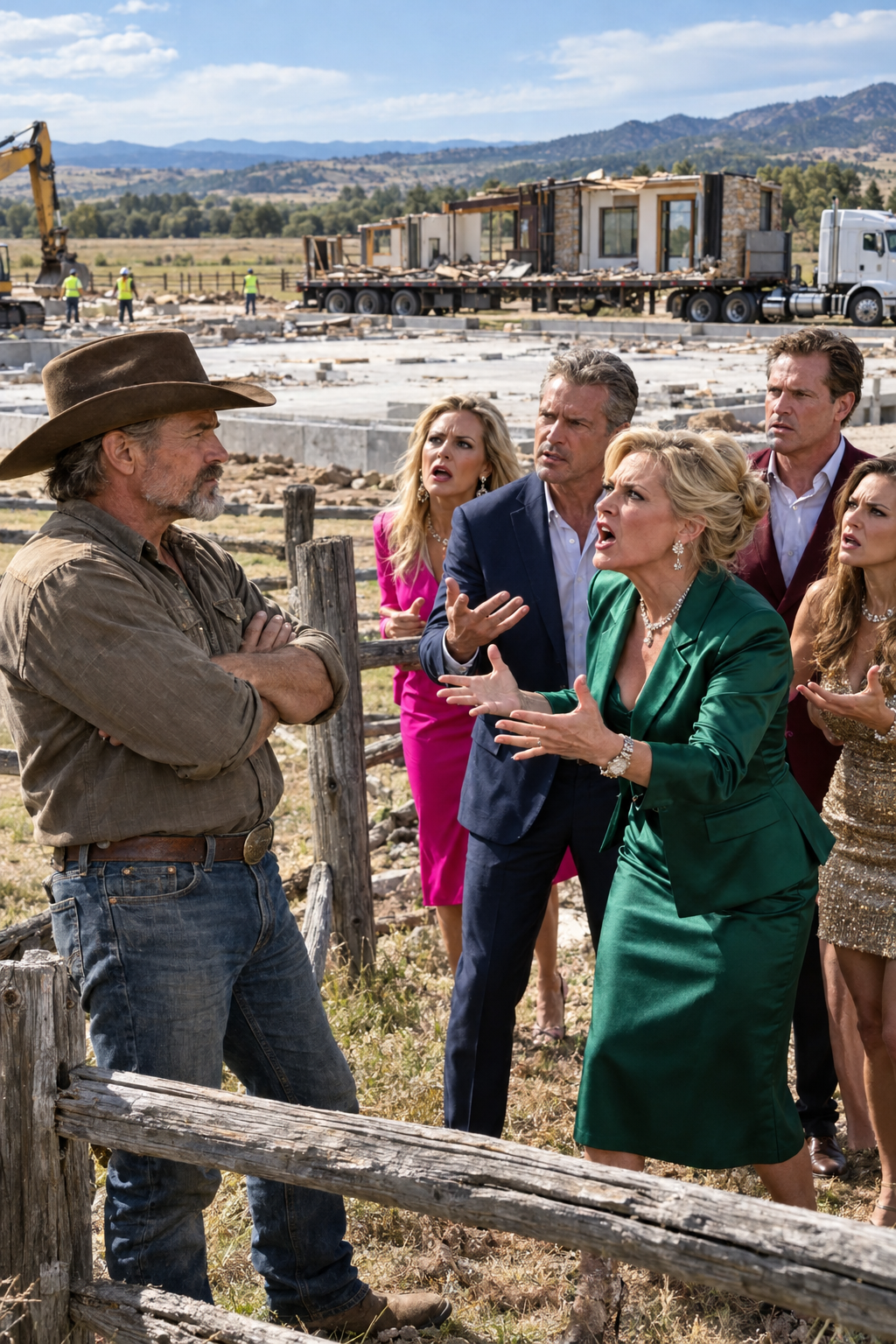
HOA Built a Luxury Clubhouse on My Ranch—Then Sued Me for $1.4 Million When I Took My Land Back
The first time Vanessa Whitmore called me a trespasser, she was standing on my land with a champagne glass in her hand.
The second time, my own son was standing beside her.
And three days later, they changed the locks on the house where I had buried twenty-seven years of my life.
“You’re embarrassing yourself, Mom,” Caleb said.
He didn’t raise his voice.
That made it worse.
He stood beneath the stone archway of the new Cedar Ridge Country Club, one hand in the pocket of a navy blazer I had bought him for his thirty-fifth birthday, while a string quartet played under white canvas canopies behind him.
Beyond the terrace, fifty acres of my ranch rolled toward the cottonwood creek.
My fence line.
My grandfather’s irrigation ditch.
My late husband’s red cattle barn in the distance.
And sitting directly on the south pasture was a $1.4 million cedar-and-stone clubhouse I had never authorized.
Women in bright dresses sipped wine beneath heaters.
Men from the HOA board laughed near a carving station.
A brass plaque beside the entrance read:
CEDAR RIDGE COMMUNITY LODGE.
Beneath that:
BUILT FOR GENERATIONS.
I looked at Caleb.
Then at Vanessa Whitmore, president of the Cedar Ridge Homeowners Association.
Then at the bronze plaque.
I didn’t scream.
I didn’t throw the wine in Vanessa’s face.
I didn’t ask my son how he could do this to me.
I simply reached into my leather handbag and touched the edge of a small brass key wrapped in my husband’s old blue handkerchief.
Vanessa noticed.
Her smile changed.
Only slightly.
But I saw it.
“What’s that?” she asked.
“Nothing you need to worry about.”
Her eyes narrowed.
Behind her, applause broke out as someone announced the grand opening buffet.
Vanessa recovered quickly.
She was sixty-one, silver-blonde, polished, and wealthy in the way some people become wealthy after spending thirty years making sure everyone notices. Emerald silk dress. Diamond earrings. White coat draped over one arm though the October afternoon was warm.
She stepped closer.
“Eleanor, we’ve tried to be patient with you.”
I almost laughed.
They had poured a foundation on my ranch.
They had cut down nineteen cottonwoods my husband planted.
They had moved my fence three hundred yards west.
They had convinced my son that stealing from his mother was called development.
They had invited two hundred people to celebrate the theft.
I said nothing.
Caleb rubbed a hand over his jaw.
“Mom, please. Just go back to the house.”
“The house whose locks you changed?”
His face tightened.
“It’s temporary.”
“You changed them yesterday.”
“For your own good.”
There it was.
The phrase cowards use when they need cruelty to sound responsible.
Vanessa tilted her head.
“Caleb told us you’ve been struggling since Richard passed.”
My husband had been dead eleven months.
She said his name as if they had known each other.
Richard had disliked Vanessa Whitmore so much that he once crossed a grocery store parking lot to avoid having a conversation with her.
“He also told us,” Vanessa continued, “that you’ve had difficulty understanding the new property arrangement.”
I turned toward my son.
His eyes dropped.
Only for half a second.
But half a second was enough.
That was the moment I understood something I had been refusing to understand for months.
Caleb wasn’t confused.
He wasn’t pressured.
He wasn’t being manipulated by Vanessa.
He had chosen a side.
And it wasn’t mine.
I looked past them toward the clubhouse.
Its enormous windows reflected the mountains.
Beyond the terrace, landscapers had planted blue spruce in a neat arc where Richard’s Angus cattle used to stand in winter.
A golf cart rolled across what had once been our calving pasture.
Two children chased each other around a stone firepit installed directly over the place where Richard and I had buried our first sheepdog, Molly.
My throat tightened.
But grief is not always loud.
Sometimes grief is a door quietly closing.
Vanessa smiled.
“You’ll get used to it.”
I looked at her.
She waited.
I let the silence become uncomfortable.
Then I asked, “Who gave you permission to build?”
Her smile widened.
“Your legal representative.”
Caleb shifted beside her.
I nodded slowly.
“Which document?”
“The authorization agreement.”
“Recorded where?”
That disturbed her.
But enough.
Vanessa glanced toward Caleb.
Caleb answered.
“Mom, we’re not doing this here.”
“Which county recording number?”
He stared at me.
A caterer walked past carrying silver trays.
Somewhere behind us, glasses clinked.
The string quartet began playing something light and cheerful.
Caleb stepped closer.
“You need to leave.”
I looked into the face of the boy I had driven four hundred miles to rescue after his freshman-year truck accident.
The boy whose college tuition came from cattle sales after beef prices collapsed.
The boy Richard had spent two winters teaching to repair fencing because Caleb said he wanted the ranch someday.
The boy who had once fallen asleep against my shoulder during his father’s first cancer surgery.
Now he held out one hand.
“Give me your house keys.”
I almost admired the nerve.
“You already changed the locks.”
“Then give me the property keys.”
I looked at Vanessa.
Her attention had moved to the leather bag hanging from my shoulder.
Still thinking about the brass key.
Interesting.
“What keys?” I asked.
“The gate keys. Equipment shed. Storage buildings. The old office.”
Caleb exhaled.
“Because legally I’m managing the property right now.”
His face hardened.
Vanessa stepped between us.
“This is exactly why Caleb had to intervene.”
I looked at her.
She lowered her voice.
“Your husband is gone. You’re alone on eight hundred acres. You’re sixty-three years old. There comes a point when holding onto everything becomes selfish.”
That sentence hurt more than I expected.
Not because it was true.
Because Richard had predicted someone would eventually say it.
Six weeks before he died, when morphine made his hands shake, he had gripped my wrist in our bedroom and whispered, “Ellie, when I’m gone, somebody will decide your grief makes you stupid.”
I had told him not to talk like that.
He had squeezed harder.
“Listen to me.”
I listened now.
Vanessa continued.
“Cedar Ridge needs room to grow. Caleb understands that. The clubhouse increases property values, provides a community gathering space, and brings families together.”
“My cattle pasture brought my family together.”
“That chapter is over.”
I looked toward my son.
He didn’t correct her.
I reached into my handbag.
Caleb tensed.
Vanessa’s eyes went immediately to my hand.
I pulled out a folded white envelope.
Richard’s handwriting covered the front.
FOR ELLIE ONLY.
Caleb went pale.
That told me he had seen it before.
Or had been looking for it.
I slipped it back into my bag.
Vanessa said, “What is that?”
“Nothing you need to worry about.”
This time, I smiled.
Then I walked away.
Nobody stopped me.
That was their first mistake.
Their second mistake came the following morning.
At a.m., a sheriff’s deputy parked outside my ranch house while a locksmith drilled out the back lock.
I was standing thirty yards away beside my truck.
Deputy Aaron Wells looked uncomfortable.
“Mrs. Mercer, I’m just here to keep things civil.”
“I am being civil.”
Caleb stood on the porch with his wife, Brooke.
Brooke wore cream-colored pants, riding boots that had never seen manure, and a camel coat despite the fact that she had hated the ranch from the first day Caleb brought her there.
She had once asked why we didn’t “sell the ugly parts.”
I asked which parts.
She pointed toward three hundred acres of native grassland.
Caleb held several papers.
“You agreed I could manage things during Dad’s illness.”
“And afterward, while you got settled.”
“So for the next few weeks, Brooke and I are staying here while we sort the estate.”
“You were allowed to pay invoices, renew insurance, manage livestock contracts, and speak to the county during Richard’s hospitalization.”
He glanced at the deputy.
“That’s not all it says.”
“Did you read page four?”
Brooke crossed her arms.
“Eleanor, this is becoming ridiculous.”
I looked at her.
She continued.
“You’ve been sleeping badly. You barely eat. You wander outside at three in the morning.”
“I check pregnant cows at three in the morning.”
“You don’t even have cows anymore.”
That one landed.
They had sold the final thirty-eight animals while I was visiting my sister in Nebraska.
Caleb told me feed prices were too high.
I had believed him.
At the time.
Deputy Wells cleared his throat.
“Mrs. Mercer, if ownership is disputed, this really needs to go through civil court.”
He looked relieved.
Caleb looked surprised.
I reached into my pocket and handed the deputy my keys.
“Eleanor,” Brooke said, almost suspiciously, “you’re leaving?”
“Just like that?”
I looked at Caleb.
He had expected a fight.
That realization gave me an odd kind of strength.
When someone expects you to beg, silence becomes a weapon.
“I’ll take a few clothes.”
Caleb nodded too quickly.
“Of course.”
I walked into my home while the locksmith replaced hardware behind me.
I climbed the staircase Richard and I had refinished ourselves in 1998.
Our wedding photograph still hung in the hallway.
My mother’s quilt remained folded over the guest bed.
Richard’s boots were still in the mudroom.
His coffee mug still sat beside the sink because I hadn’t been able to move it.
I packed one suitcase.
Five shirts.
Two pairs of jeans.
Toothbrush.
Richard’s envelope.
The brass key wrapped in the blue handkerchief.
And one photograph of the two of us standing beside the north fence when we were thirty-seven.
I left everything else.
Brooke stood in the kitchen when I came downstairs.
“You’ll be comfortable at the Hampton in town,” she said.
“I’m not going to the Hampton.”
Caleb frowned.
“Where are you going?”
“To the old foreman’s cottage.”
“That place isn’t livable.”
“It has a roof.”
“The heat barely works.”
“I know how to light a stove.”
Brooke exchanged a look with Caleb.
She thought I was being pathetic.
People make terrible mistakes around someone they pity.
I walked outside.
Deputy Wells opened my truck door for me.
Before I climbed in, he lowered his voice.
“Mrs. Mercer?”
“My father worked this ranch when I was a kid.”
“I remember.”
“He always said Mr. Mercer was careful with paperwork.”
The deputy glanced toward the porch.
“If I were you, I’d talk to a lawyer.”
I looked at him.
“I already have.”
That was a lie.
Technically.
But only for another forty-three minutes.
By noon I was sitting in the office of Rebecca Shaw, fifty-four years old, Harvard-trained, Wyoming-born, and famous in three counties for making developers regret learning her name.
Richard had hired Rebecca fifteen years earlier after a pipeline company tried to claim an easement across our north pasture.
She had destroyed their case in six weeks.
Then sent Richard a bill handwritten on yellow paper.
He framed it.
Rebecca read the HOA documents twice.
Then a third time.
Finally she removed her glasses.
“How much do you know?”
“That depends.”
“Whether my husband was being paranoid.”
Rebecca leaned back.
“Richard Mercer was many things. Paranoid wasn’t one of them.”
I placed the envelope on her desk.
Her eyes changed.
“You haven’t opened it?”
“He told me not to unless someone tried to take the south pasture.”
Rebecca looked at me for a long moment.
Then she said, “They built on the south pasture.”
She pushed the envelope back toward me.
“Then I think Richard would say it’s time.”
I broke the seal.
Inside were six pages.
The first five were copies of legal filings.
The sixth was a handwritten letter.
If you’re reading this, then somebody finally decided I wasn’t around to stop them.
Don’t panic.
Don’t threaten.
Don’t sign anything.
Most important: do not tell them about Parcel 7C until Rebecca confirms the original filing remains active.
Rebecca was already opening her computer.
“What is Parcel 7C?” I asked.
She didn’t answer immediately.
Instead she pulled up county records.
Typed again.
Then she whispered, “Oh, Richard.”
I leaned forward.
She turned the monitor toward me.
The ranch I knew as 812 acres had been assembled over nearly a century from smaller parcels.
Most had been consolidated under the Mercer Ranch property description.
Except one.
Forty-six acres.
Running like a narrow hook along Cedar Ridge’s western boundary.
Including the entire clubhouse site.
But the owner listed on the filing wasn’t Mercer Ranch LLC.
It wasn’t Richard.
It wasn’t Caleb.
It wasn’t even me.
It was the Eleanor Mercer Agricultural Preservation Trust.
Created seventeen years earlier.
Sole beneficiary: Eleanor Grace Mercer.
Successor beneficiaries: the Mercer County Youth Agricultural Foundation and the Wyoming Veterans Ranch Program.
Trustee: Rebecca Shaw.
I stared at the screen.
“I didn’t know.”
“You signed it.”
I remembered.
Richard had brought a pile of papers into the kitchen after a neighboring ranch was broken up and sold to developers.
He said he wanted to make sure part of ours could never be turned into subdivisions.
I had signed where Rebecca marked.
“You told me it protected the creek.”
Rebecca looked back at the documents.
“But Richard amended it five years later.”
“Because Cedar Ridge started expanding.”
I remembered that too.
The original development had eighty-two houses.
Then one hundred forty.
Then nearly three hundred.
Their roads crept closer each year.
Rebecca opened another filing.
A restrictive covenant.
No permanent residential or commercial structures.
No community facilities.
No recreational development.
No transfer or lease without written consent from both trustee and beneficiary.
My pulse slowed.
That was how I knew I was angry.
When other people got angry, their hearts raced.
Mine became steady.
Very steady.
“Did you approve a clubhouse?”
Rebecca almost smiled.
“Could Caleb approve one under the power of attorney?”
“Could Vanessa?”
“Could the HOA?”
“Absolutely not.”
I looked through the window at the courthouse across the street.
“So they built a $1.4 million building on protected land they don’t own.”
Rebecca tapped one document.
“That’s the simple part.”
“There’s a complicated part?”
She turned another page toward me.
“The HOA filed a lease.”
Ninety-nine years.
One dollar annual rent.
Authorized by Caleb Mercer acting as representative of Mercer Ranch LLC.
“They knew this parcel wasn’t part of the LLC.”
“Someone should have known.”
Rebecca’s finger moved down the page.
“Look at the survey attachment.”
I recognized the shape immediately.
The boundaries had been changed.
Not dramatically.
Just enough.
Parcel 7C had vanished into the main ranch description.
My husband used to say the most dangerous lies were the ones drawn with rulers.
“Who prepared this?”
Rebecca read the name.
“Harrison Land & Title.”
My stomach turned.
Harrison Land & Title belonged to Vanessa Whitmore’s brother-in-law.
There was our system.
Not one villain.
A title company.
A developer.
A property manager.
A contractor.
And my own son holding the pen.
Rebecca leaned forward.
“Eleanor, listen carefully. Don’t confront Caleb.”
“I wasn’t planning to.”
“Don’t mention the trust.”
“Don’t mention the survey.”
“And absolutely do not demand that they remove the building yet.”
I looked at her.
“Because I want to know who paid for it.”
That was the first twist.
The second arrived five days later.
By then, Cedar Ridge believed they had won.
I let them.
I moved into the foreman’s cottage.
It smelled like cedar smoke and mice.
The kitchen faucet rattled.
The refrigerator froze lettuce.
Wind came under the west door hard enough to move the rug.
I slept beneath two quilts with Richard’s old flannel shirt hanging from a nail beside the bed.
Every morning I made coffee in a dented metal pot and watched SUVs drive toward the clubhouse.
Nobody waved.
On Wednesday, Brooke posted photographs online from what she called “our new family ranch chapter.”
She was standing in my kitchen.
My mother’s copper pans behind her.
One of Richard’s paintings above the fireplace.
The caption read:
Sometimes new beginnings require difficult decisions.
I stared at it for about ten seconds.
Then I shut off my phone.
By Thursday, Caleb had moved his boat into our equipment barn.
By Friday, Vanessa parked a new Range Rover beside the clubhouse with a CEDAR RIDGE BOARD placard on the windshield.
Saturday night, the HOA hosted a harvest gala.
Rebecca told me to go.
I wore a black dress Richard loved.
Pearl earrings.
Nothing dramatic.
Nothing angry.
At the entrance, a twenty-year-old security guard looked at his tablet.
“Eleanor Mercer.”
He scrolled.
His face changed.
“I’m sorry, ma’am. You’re not on the list.”
Vanessa appeared behind him as if she had been waiting.
Of course she had.
“Oh,” she said brightly. “Eleanor.”
Music drifted through open doors.
Inside, people danced beneath chandeliers installed over the foundation of my old hay shed.
Vanessa stepped outside.
“I thought Caleb explained.”
“Explained what?”
“This is a private community event.”
“On my land.”
Her mouth tightened.
“The land is under long-term lease.”
“Then you have nothing to worry about.”
She blinked.
That sentence bothered her.
“Why are you here?” she asked.
“To see what you built.”
“You’ve seen it.”
“Not finished.”
She glanced toward the security guard.
Then back to me.
“You need to leave.”
“Of course.”
Vanessa called after me.
“Caleb says you’re considering contesting the property transfer.”
I looked over my shoulder.
“You should know the HOA has already invested $1.4 million here. We have legal protections.”
“I’m sure you do.”
“And if you interfere with community property, we will pursue damages.”
“How much?”
Her posture straightened.
“The full value, if necessary.”
“Good to know.”
She stared at me.
I walked away.
The next morning I hired a man named Wade Turner.
Wade was sixty-eight and had operated heavy equipment since before most of the Cedar Ridge board members were born.
He arrived at the cottage in a dusty Ford pickup.
Rebecca sat at my kitchen table with us.
Wade looked at the legal documents.
Then at me.
“You want it gone?”
“All of it?”
“Stone too?”
“Stack anything reusable.”
He rubbed his chin.
“Building looks expensive.”
“People are going to be upset.”
He grinned.
“I can start Tuesday.”
Rebecca raised one finger.
“After the injunction hearing Monday.”
Monday morning, Cedar Ridge HOA’s attorney entered courtroom three wearing a charcoal suit and the expression of a man expecting ten easy minutes.
His name was Bradley Kent.
He had represented subdivisions, golf resorts, shopping centers, and one famous developer who built fourteen houses before discovering he didn’t own the road leading to them.
Vanessa sat behind him.
Caleb beside her.
Neither looked at me.
Rebecca placed a single folder on our table.
Judge Miriam Holt entered at nine.
Bradley stood.
“Your Honor, this is essentially a family property disagreement being unnecessarily escalated.”
Rebecca didn’t move.
Bradley continued.
“The Cedar Ridge Homeowners Association entered a valid ninety-nine-year lease with the authorized manager of Mercer Ranch LLC. In reliance on that lease, the association invested approximately $1.4 million constructing a community facility.”
Judge Holt looked at Rebecca.
“Ms. Shaw?”
Rebecca stood.
“The problem, Your Honor, is that Mercer Ranch LLC doesn’t own the land.”
Bradley looked annoyed rather than surprised.
“The survey—”
Rebecca handed the clerk a document.
“Original county plat, recorded May 18, 2009.”
Another document.
“Trust declaration.”
“Restrictive covenant.”
“2014 amendment.”
Bradley’s face lost color gradually.
Vanessa leaned toward him.
Caleb looked at me.
For the first time in weeks, my son looked frightened.
Judge Holt spent twelve minutes reading.
Nobody spoke.
Finally she looked over her glasses.
“Mr. Kent, why does your lease describe land owned by this trust as an asset of Mercer Ranch LLC?”
Bradley cleared his throat.
“We relied upon a certified survey.”
“Prepared by whom?”
“Harrison Land & Title.”
Vanessa stopped whispering.
Judge Holt turned to Rebecca.
“What are you asking for today?”
“An order confirming my client’s right to secure and restore trust property, plus preservation of all HOA financial records and communications related to construction.”
Bradley stood quickly.
“Your Honor, demolition would cause irreparable harm.”
Rebecca replied, “The building itself is irreparable harm.”
“They invested significant funds.”
“On land protected by a recorded agricultural covenant.”
“They acted in good faith.”
Rebecca finally looked at Vanessa.
“That remains to be established.”
Judge Holt issued a temporary order.
Cedar Ridge could not use the clubhouse.
They could not alter it.
They could not enter Parcel 7C without written permission.
And they had ten days to produce the complete chain of authorization.
Outside the courthouse, reporters were waiting.
I hadn’t called them.
Vanessa probably assumed I had.
She pushed past the cameras.
Caleb stayed.
I kept walking.
Rebecca stood beside me.
Caleb looked older than he had a week earlier.
“You’re really doing this?”
“You’re going to destroy the clubhouse?”
“If necessary.”
“People paid for that.”
“So did I.”
“What does that mean?”
I studied him.
“Where did the money come from?”
His expression changed.
But there it was.
Rebecca noticed too.
“What money?” he asked.
“The $1.4 million.”
“The HOA reserves.”
“All of it?”
“That’s what Vanessa told me.”
I stepped closer.
“Did you verify that?”
He looked away.
“You need to stop treating me like I’m a criminal.”
“I didn’t call you one.”
“You think I stole from you.”
His eyes snapped back to mine.
Just the question.
He had no answer.
So I asked another.
“Did you read Richard’s letter?”
His face drained.
Rebecca went still.
“I don’t know what you’re talking about.”
“Yes, you do.”
“Did you read it?”
People moved around us on the courthouse steps.
A camera shutter clicked.
Caleb whispered, “I saw the envelope.”
I believed him.
But then he said something that mattered much more.
“Vanessa asked about it.”
“Before Dad died.”
Rebecca and I looked at each other.
“When before he died?” I asked.
Caleb rubbed his forehead.
“Maybe two months.”
“What did she ask?”
“She said Dad had mentioned something about a trust.”
That made no sense.
Richard would never have discussed Parcel 7C with Vanessa.
“Where were you?”
“At the clubhouse planning meeting.”
“There was a planning meeting before Richard died?”
There was the second twist.
The clubhouse hadn’t been some opportunistic project started after my husband was gone.
They had planned it while he was dying.
I could smell cold courthouse stone.
Hear traffic at the intersection.
Feel Rebecca’s fingers close lightly around my elbow.
Caleb looked sick.
“I didn’t know they were going to build there.”
“But you attended meetings.”
“How many?”
“I don’t know.”
“How many?”
“Four. Maybe five.”
“And your father?”
“He knew Cedar Ridge wanted expansion.”
“That isn’t what I asked.”
“No. He didn’t know about the clubhouse.”
“Not at first.”
I let him sit in that answer.
Rebecca said quietly, “Caleb, you need your own attorney.”
He looked at her.
Then at me.
“Mom, please.”
I had spent thirty-five years answering that phrase.
Mom, please pick me up.
Mom, please don’t tell Dad.
Mom, please loan me money.
Mom, please sign this.
Mom, please watch the kids.
Mom, please help with the down payment.
Mom, please cover payroll.
Mom, please.
I had always heard love inside those words.
Now I heard habit.
He expected rescue because I had trained him to expect it.
“I love you,” I said.
His eyes filled.
“But I’m not saving you from this.”
Then I walked away.
Tuesday morning Wade Turner arrived with an excavator, two flatbed trucks, six workers, and a thermos the size of a fire extinguisher.
At a.m., we cut the clubhouse power.
At , a plumber shut off water.
At , workers removed doors, windows, copper fixtures, appliances, and anything reusable.
At , Vanessa arrived.
Her Range Rover stopped so hard gravel sprayed.
She jumped out wearing a burgundy coat and heels completely wrong for pasture dirt.
“What the hell are you doing?”
I stood near the old fence line with Rebecca.
“Restoring agricultural property.”
“You cannot demolish HOA property!”
Rebecca handed her a copy of the court order.
Vanessa didn’t read it.
She slapped it against her palm.
“You are going to regret this.”
Wade’s excavator idled behind us.
I looked at him.
Vanessa stepped between me and the machine.
“I am warning you, Eleanor. We will sue you for every dollar.”
“For removing an unauthorized structure?”
“For destruction of community assets.”
Rebecca said, “Move away from the equipment, Mrs. Whitmore.”
Vanessa ignored her.
She pointed at me.
“One point four million dollars.”
“You mentioned that.”
“We will take your ranch if necessary.”
That was supposed to frighten me.
Instead, something inside me became calm.
Because there it was.
The real goal.
Not the clubhouse.
Cedar Ridge had expanded until my property was the only undeveloped land between the subdivision and the county highway.
Eight hundred acres.
Water rights.
Creek frontage.
Two access roads.
Developable hills.
They didn’t want one clubhouse.
They wanted the doorway to everything else.
I stepped closer to Vanessa.
“Is that what you promised them?”
Her face froze.
“Promised who?”
“The board?”
“I don’t know what you mean.”
“Did you tell them I’d lose the ranch?”
She laughed.
Too quickly.
“You’re delusional.”
I looked past her at the clubhouse.
She didn’t.
Rebecca lifted her phone.
“I’ll call the sheriff.”
Vanessa moved.
Wade lowered the excavator bucket.
The first section to come down was the stone chimney.
It cracked at .
A deep sound rolled across the pasture.
People from Cedar Ridge stood along the road filming.
Some shouted.
Some cursed.
One woman cried.
I understood.
They had been told this place belonged to them.
They had paid dues.
Bought furniture.
Reserved weddings.
Planned Christmas dinners.
Vanessa had turned them into beneficiaries of a theft without telling them.
That mattered to me.
So I walked toward the road.
A man shouted, “You selfish bitch!”
Another yelled, “We paid for that!”
I raised one hand.
The noise lowered.
“Ask your board where the money came from.”
Vanessa shouted, “Don’t engage with her!”
I looked at the homeowners.
“Ask for the construction account.”
A woman in a red coat frowned.
“What construction account?”
Vanessa moved toward me.
“Ask why your reserve fund dropped by only four hundred thousand dollars when they claim they spent one point four million.”
Rebecca turned toward me sharply.
I hadn’t told her I knew.
Because I had only learned two hours earlier.
A retired accountant named Frank Delaney from Cedar Ridge had slipped an envelope under my cottage door before dawn.
Inside were copies of six HOA financial statements.
The math did not work.
The crowd began murmuring.
Vanessa shouted, “Those documents are confidential!”
Frank Delaney, standing near the road, raised his voice.
“No, they aren’t.”
Everyone turned.
Frank stepped forward.
He was seventy-two, gray-haired, and furious.
“I was treasurer for nine years. Members have inspection rights.”
Vanessa’s face changed.
Frank held up a binder.
“You told us the clubhouse cost came from reserves and a bank facility.”
He walked closer.
“Four hundred twelve thousand came from reserves.”
Vanessa said nothing.
Frank opened the binder.
“Two hundred thousand came from the bank line.”
Silence spread.
I asked the question everyone was thinking.
“Where did the rest come from?”
Frank looked directly at Caleb, who had just arrived in his pickup.
My son stopped walking.
Frank said, “That’s what I’d like to know.”
By noon, half the clubhouse was gone.
By sunset, the roof lay in organized stacks.
I did not celebrate.
Watching that building come down hurt.
Not because I loved it.
Because beneath every torn wall was evidence of how much effort people had spent trying to erase me.
The next day, Cedar Ridge filed suit.
Exactly as Vanessa promised.
$1.4 million.
Property destruction.
Interference with contractual rights.
Economic damages.
Lost event revenue.
Attorney fees.
Emergency relief.
They wanted a lien on the ranch.
Vanessa gave an interview outside the county administration building.
She called me “an unstable widow acting out of grief.”
Brooke shared the video.
That hurt more than Vanessa’s words.
Then she added a caption.
Families shouldn’t be destroyed by one person’s bitterness.
I stared at my daughter-in-law’s post from the foreman’s cottage.
The stove popped beside me.
Snow had begun outside.
I could see my old house glowing across the pasture.
Brooke and Caleb had put white lights around the porch.
They were already decorating for Christmas.
For one terrible minute, I wanted Richard.
Not justice.
Not victory.
Just Richard.
I wanted him to come through the cottage door smelling like cold wind and diesel fuel.
I wanted him to look at the papers spread across the kitchen table and say, Ellie, this is nonsense.
I wanted to be tired without being watched.
I wanted to be sad without someone turning sadness into evidence against me.
I wanted my son back.
Then I remembered Richard’s letter.
I unfolded the final page.
At the bottom, after his signature, he had written one extra paragraph in darker ink.
If Caleb is involved, don’t mistake protecting him for loving him. I made that mistake too many times. Let truth cost what truth costs.
I covered my mouth with one hand.
That was when I cried.
Not loudly.
Not for long.
Five minutes.
Then I washed my face.
Made coffee.
And called Rebecca.
“Subpoena the construction financing.”
She was quiet.
“You sure?”
“If Caleb signed something—”
“You may not like what we find.”
I looked through the dark window at my house.
“Subpoena everything.”
What we found destroyed Cedar Ridge faster than Wade Turner’s excavator ever could.
The missing $788,000 had not come from HOA members.
It came from a company called West Basin Residential Partners.
I had never heard of it.
Rebecca had.
Denver-based.
Specialized in master-planned communities.
Golf courses.
Luxury subdivisions.
Retirement developments.
West Basin had transferred money to the HOA through something labeled an amenity advancement agreement.
In exchange, Cedar Ridge promised to support a future rezoning application.
Not directly.
The agreement described it as “the adjacent Mercer tract.”
Projected acquisition window: eighteen months.
Projected development: 1,900 residential units.
Commercial village.
Boutique hotel.
School site.
Recreational lake.
Estimated finished value: $640 million.
My hands went cold.
Richard hadn’t been protecting forty-six acres.
He had been blocking the first domino.
The clubhouse was never the destination.
It was an anchor.
Once built and operating, Cedar Ridge planned to argue that my south pasture had already been converted to community use.
Then came roads.
Mounting taxes.
Eventually a sale.
Caleb had signed two documents.
One was the lease.
The other was worse.
A memorandum of cooperation.
It stated that, as “anticipated successor owner,” he intended to support eventual sale of Mercer Ranch following resolution of the Richard Mercer estate.
Anticipated successor owner.
My son had planned around my death while I was still alive.
Rebecca watched me read the line.
I read it again.
Then again.
There are betrayals that arrive like gunshots.
This one arrived like snow.
Covering everything you thought you recognized.
“How much was he promised?”
Rebecca hesitated.
“Three million.”
I laughed once.
A small sound.
Thirty-five years of motherhood.
Three million dollars.
I thought about all the cheap things we had done because Caleb needed something.
I wore the same winter coat twelve years so we could help him with college.
Richard sold his restored 1967 Ford because Caleb wanted seed money for a landscaping company.
We refinanced one barn after Caleb’s first business failed.
When his daughter was born premature, I slept in a hospital chair for nine nights while Brooke recovered.
Three million.
That was the price West Basin put on his mother.
Rebecca reached across the table.
I shook my head.
“I’m fine.”
“You don’t need to be fine.”
“Yes, I do.”
“No, you don’t.”
I looked at her.
She softened.
“You need to be accurate. That’s different.”
That stayed with me.
So I became accurate.
I documented every fence moved.
Every tree removed.
Every invoice.
Every email.
Every board vote.
Every transfer.
Every signature.
I stopped thinking like a mother.
I started thinking like a witness.
The HOA’s lawsuit collapsed in stages.
First, Judge Holt denied the lien.
Then she ruled the lease unenforceable pending fraud review.
Then the county planning office suspended Cedar Ridge’s expansion application.
Then Harrison Land & Title lost its certification after investigators discovered the survey metadata had been altered three months before Richard died.
The title company blamed a junior employee.
The junior employee produced an email from Vanessa.
Vanessa blamed West Basin.
West Basin said the HOA had represented all land agreements as legitimate.
The HOA board blamed Vanessa.
Vanessa blamed Caleb.
Caleb hired an attorney.
Brooke deleted her social media posts.
People had screenshots.
By December, Cedar Ridge homeowners were demanding a recall election.
Frank Delaney showed up at my cottage with two women from the neighborhood.
One was the same woman in the red coat who had stood beside the road during demolition.
Her name was Melissa Grant.
She held a casserole dish.
“I owe you an apology.”
“You don’t owe me food.”
“I didn’t know what else people bring when they’ve been terrible.”
I almost smiled.
They sat around my tiny kitchen table.
Melissa looked around the cottage.
“You’re really living here?”
“While your son lives in the ranch house?”
She looked ashamed.
“We thought you were some rich ranch owner refusing to cooperate with the community.”
“I am a ranch owner refusing to cooperate with the community.”
Frank snorted.
Melissa laughed despite herself.
Then she grew serious.
“Vanessa told us Cedar Ridge had an option to purchase the whole ranch.”
“She lied.”
“She showed us maps.”
“She said after your husband died, your son would inherit.”
I looked at Frank.
“Half the board believed it.”
“And the other half?”
Frank’s jaw tightened.
“They knew more.”
There it was again.
The system.
People like Vanessa survive because every circle contains different levels of knowledge.
One person knows the lie.
Another knows the money.
Another knows the pressure.
Another knows only enough to look away.
Frank pushed a thumb drive toward me.
“What’s this?”
“Board meeting audio.”
Melissa said, “Vanessa started recording meetings after a lawsuit two years ago.”
“Why do you have it?”
Frank smiled without humor.
“Because she fired the wrong treasurer.”
Rebecca listened to the files that night.
At 11:42 p.m., she called me.
“I need you to hear something.”
She played a recording.
Vanessa’s voice.
Controlled.
“…once Eleanor is moved out of the main residence, Caleb can demonstrate operational control. After six months, West Basin believes lenders will view him as de facto manager…”
A man asked, “What if she fights?”
Vanessa replied, “She won’t.”
Someone laughed.
Then Vanessa said the sentence that erased the last fragment of mercy I had for her.
“Women like Eleanor are trained to protect family embarrassment. She’ll accept humiliation before she publicly destroys her son.”
The room in the recording went quiet.
Then another voice asked, “And Richard’s trust?”
Vanessa answered.
“If it exists, we neutralize it through use.”
My skin prickled.
Rebecca stopped the recording.
“Use,” I said.
“That’s why the clubhouse mattered.”
“If they maintained open community use long enough—”
“They could try to build an equitable estoppel argument around improvements, reliance, access, and your apparent acquiescence.”
“Would it work?”
“Probably not.”
“Probably?”
“Lawyers charge money because certainty is expensive.”
I looked toward the black window.
Snow covered the pasture.
The last pieces of clubhouse stone were stacked beneath tarps.
“They needed me quiet.”
“They needed me embarrassed.”
“They needed Caleb in my house.”
Rebecca didn’t answer.
Three days before Christmas, I returned to the ranch house.
Not because Caleb invited me.
Because Judge Holt voided his property-management authority.
The sheriff came again.
This time Deputy Wells stood beside me.
Caleb opened the door.
Brooke was behind him.
A Christmas tree glowed in my living room.
Presents sat beneath it.
My mother’s crystal bowl rested on the coffee table.
For a moment nobody moved.
Then Deputy Wells handed Caleb the order.
“You have forty-eight hours to vacate.”
Brooke stared at me.
“You’re throwing us out before Christmas?”
I looked around my own entryway.
My own walls.
My own floor.
My husband’s hat still hanging on the hook where he left it.
“You changed my locks eleven days after his funeral.”
“That was different.”
Brooke opened her mouth.
Nothing came out.
Caleb stepped forward.
“Mom, please.”
There it was again.
Mom, please.
I looked at him.
For the first time, he looked like the little boy I remembered.
That almost broke me.
“You have forty-eight hours.”
His face collapsed.
“Where are we supposed to go?”
“You own a home in town.”
“We rented it out.”
“Then call the tenant.”
“You know we can’t do that.”
I picked up Richard’s hat.
Ran my thumb along the brim.
Then looked at my son.
“You knew I couldn’t change what you did after Dad died.”
His eyes filled.
“You knew I wouldn’t want people to know.”
He lowered his head.
“You knew I’d protect you.”
“And you built your whole plan around that.”
He whispered, “I’m sorry.”
I believed him.
That was the tragedy.
He was sorry.
But sorry is not the same as innocent.
Two days later, they left.
Brooke slammed her car door.
Caleb stood beside his truck in the snow.
I watched from the porch.
He walked toward me.
“I never wanted them to take everything.”
“But you wanted three million dollars.”
His eyes closed.
“I was drowning.”
“How much?”
“Almost nine hundred thousand.”
I stared at him.
He told me then.
The landscaping company.
A failed commercial project.
Personal guarantees.
A second mortgage Brooke didn’t know about.
Credit cards.
He had hidden everything.
Vanessa knew.
West Basin knew.
They offered rescue.
All he had to do was help them get a foothold on the ranch.
“I thought you’d eventually sell anyway.”
“You thought wrong.”
“I thought after Dad…”
He stopped.
“After Dad what?”
He looked at the snow.
“After Dad died, you didn’t seem like you wanted any of this.”
I looked over eight hundred acres of winter pasture.
Richard’s barn.
The cottonwoods.
The hills we had watched turn gold every September for nearly three decades.
“You mistook grief for surrender.”
He wiped his face.
“I know that now.”
Then he said, “There’s something else.”
Every nerve in my body sharpened.
He glanced toward Deputy Wells waiting near the gate.
“Vanessa wasn’t the one who approached me.”
For a second I thought I misheard him.
“What did you say?”
“Dad talked to West Basin first.”
The world seemed to tilt.
“About eighteen months before he died.”
I stared at him.
Caleb reached into his coat.
He pulled out a folded photocopy.
“Dad met with them three times.”
A letter of intent.
West Basin Residential Partners.
Richard Mercer.
Discussion of potential sale.
My husband’s signature at the bottom.
I knew that signature.
It was real.
“What is this?”
“I don’t know everything.”
“Where did you get it?”
“Last year.”
“Before he died?”
I read the page again.
Richard had discussed selling 520 acres.
Not Parcel 7C.
Not the creek.
But most of the eastern ranch.
He had sworn he would never sell.
I looked at the date.
Then remembered.
Richard’s diagnosis.
The first one.
Before he told me.
He had known for months that the cancer was worse than he admitted.
Maybe he thought I couldn’t run the ranch alone.
Maybe he wanted money secured for me.
Maybe West Basin approached him during that fear.
But something still didn’t fit.
“If Dad wanted to sell,” I said, “why did he strengthen the trust?”
Caleb shook his head.
“I don’t know.”
“Why hide Parcel 7C?”
“I don’t know.”
“Why warn me about you?”
That hit him.
I looked at him.
Richard’s letter had said: If Caleb is involved, don’t mistake protecting him for loving him.
Caleb went white.
“He mentioned me?”
“What did he say?”
I folded the copy.
“I think you need to leave.”
“Forty-eight hours is almost over.”
He stared at me.
Then nodded.
He walked toward his truck.
Before getting in, he turned.
“Dad had another meeting the week before he went into hospice.”
“With West Basin?”
“I don’t know.”
He shook his head.
“Vanessa said she wasn’t invited.”
“Then how do you know?”
“Because Dad left here with a metal lockbox.”
The brass key in my pocket suddenly felt heavy.
Very heavy.
“What lockbox?”
Caleb looked confused.
“You don’t know?”
“Dad kept it beneath the floorboards in the old ranch office.”
My skin went cold.
The old office.
The one Caleb had asked me for keys to.
The one Richard’s brass key might open.
“When did you last see the box?” I asked.
“Night before he went to hospice.”
“Did he bring it home?”
“Where did he go?”
Caleb looked past me toward the western hills.
“To the abandoned Harrow Creek schoolhouse.”
I had not heard that name in twenty years.
The schoolhouse sat six miles beyond our fence on land that had once belonged to Richard’s father.
County records showed it had been sold in 1997.
Richard rarely spoke about it.
“Who was he meeting?”
“I don’t know.”
Caleb opened his truck door.
Then he looked at me.
“Vanessa wanted that key.”
I said nothing.
“That’s why she kept asking about Dad’s envelope. She thought the key was inside.”
“How do you know?”
“Because she offered me fifty thousand dollars if I found it.”
The truck engine started.
Caleb drove away.
I stood in the snow until his taillights disappeared.
Then I went inside.
I locked the door.
Closed the curtains.
And unwrapped Richard’s blue handkerchief.
The brass key was old.
Older than our ranch office.
One side had three tiny letters stamped into it.
Harrow Creek School.
I called Rebecca.
I called again.
Straight to voicemail.
Outside, wind pushed snow against the kitchen windows.
I put on Richard’s coat.
Took a flashlight.
Drove west.
The county road disappeared beneath fresh snow.
At 10:36 p.m., I reached the abandoned schoolhouse.
Boarded windows.
Sagging porch.
The building looked exactly as I remembered except for one thing.
Fresh tire tracks.
Someone had been there recently.
Very recently.
I parked fifty yards away and killed the headlights.
For a minute I listened.
I walked to the porch.
The front door had a modern padlock.
The brass key didn’t fit.
I circled the building.
Behind the schoolhouse, half buried beneath snow and weeds, was a storm-cellar door.
The lock was old brass.
My hand shook for the first time in weeks.
The key turned.
Inside, stone steps descended into darkness.
The flashlight beam caught shelves.
Broken chairs.
And against the far wall, a steel lockbox.
Two feet wide.
Richard’s initials scratched into the lid.
I crouched.
The same key opened it.
Inside were folders.
Photographs.
A sealed envelope with my name.
And one black ledger.
I opened the envelope first.
If you found this, then the clubhouse was never the real problem.
I stopped breathing.
The next sentence was underlined twice.
Do not trust the county ownership map.
Beneath the letter was a survey dated 1968.
I unfolded it across the dusty floor.
Our ranch boundary extended far beyond the property line I had known my entire marriage.
Past Cedar Ridge.
Past the golf course.
Past forty-one existing homes.
Past the clubhouse parcel.
Nearly twelve hundred additional acres.
My flashlight trembled.
There was a second page.
A mineral deed.
A water-rights schedule.
And a court judgment from 1974.
The name at the top made my stomach drop.
WHITMORE FAMILY HOLDINGS v. MERCER.
Vanessa’s family.
I heard a vehicle outside.
Headlights swept through cracks in the boards.
I killed my flashlight.
A car door slammed.
Then another.
Footsteps crossed the snow.
I reached into the lockbox and found one final photograph.
Richard stood beside Vanessa Whitmore.
Both were younger.
Between them stood a man I had never seen.
On the back, Richard had written six words.
SHE THINKS HER FATHER DESTROYED THIS.
The cellar door rattled.
Someone tried the lock.
Then a man’s voice said, “She’s here.”
A woman answered.
I folded Richard’s letter and slipped it inside my coat.
The lock above me scraped.
Vanessa said, almost gently, “Eleanor, I know you found the box.”
I said nothing.
She waited.
Then she added, “Before you open anything else, you should ask yourself one question.”
I looked down at the black ledger in my hands.
“What question?”
There was a pause on the other side of the door.
Then Vanessa laughed softly.
“Why do you think Richard hid those records from you for twenty-seven years?”
I stared at my husband’s handwriting.
At the forgotten acreage.
At forty-one houses that might be standing on Mercer land.
At water rights worth more than the ranch itself.
At a lawsuit between our families that began before Caleb was born.
And at the last line Richard had written beneath the map.
If they ever demand money from you, Ellie, don’t ask what you owe them.
Ask the question they have spent fifty years making sure nobody asks.
Outside, Vanessa pulled on the cellar door again.
I closed the ledger.
Pressed my palm against the steel lockbox.
And through the darkness, I asked the weakest-sounding question I had left.
“Vanessa… whose land did your father actually sell?”
✓ Lynn R. Adams
HOA Built a Luxury Clubhouse on My Ranch—Then Sued Me for $1.4 Million When I Took My Land Back The first time Vanessa Whitmore called me a trespasser, she was standing on my land with a champagne gl…