HOA Built a $14 Million Resort Pool on My Land—Then I Walked In Holding the Original Deed
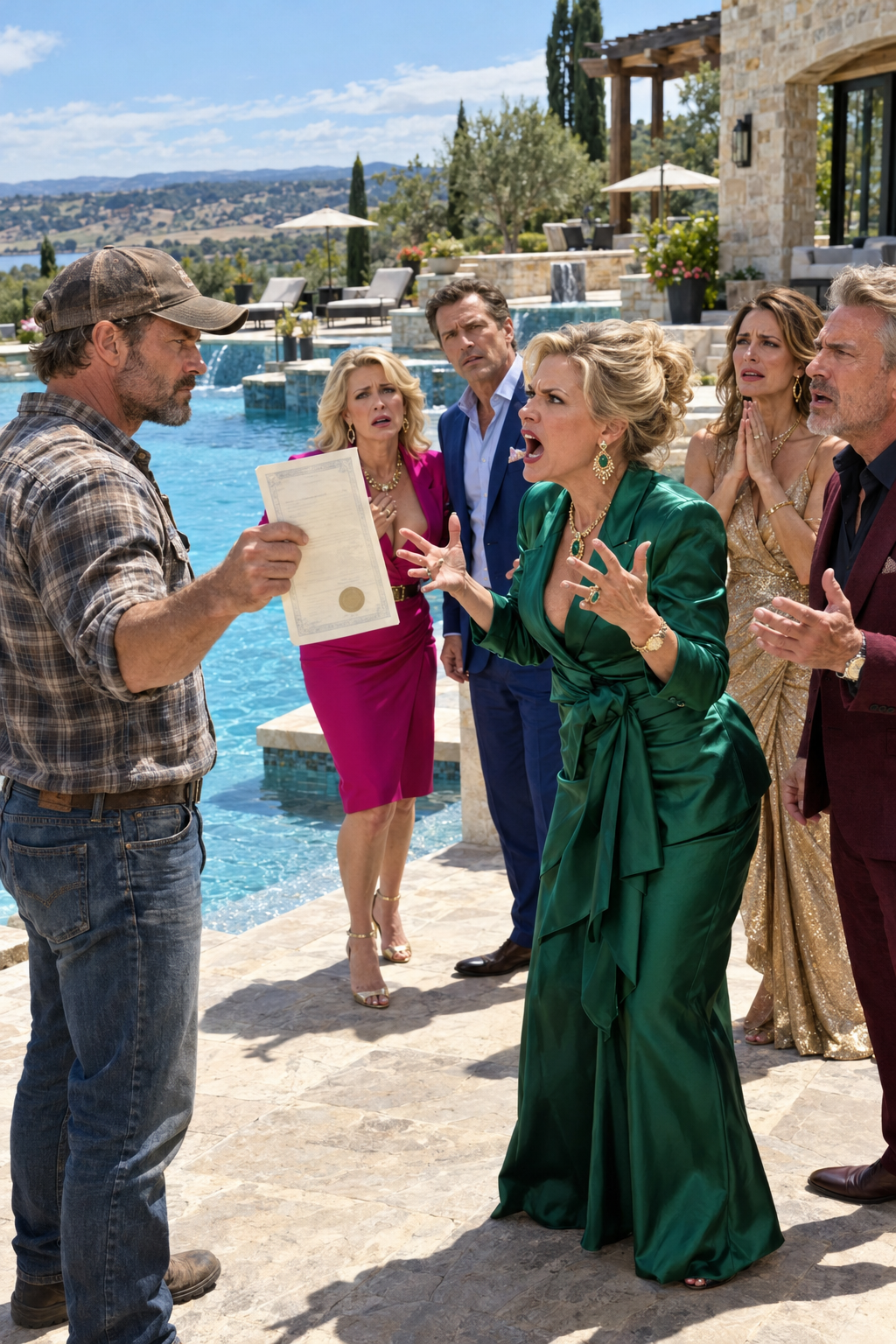
HOA Built a $14 Million Resort Pool on My Land—Then I Walked In Holding the Original Deed
The first thing Patricia Caldwell said when I walked into the HOA’s grand-opening party was, “Security, remove that man before he ruins the photographs.”
The second thing she said was louder.
“He has no right to be here.”
She was standing beside a fourteen-million-dollar swimming pool built almost entirely on my land.
And inside the leather folder under my arm was the deed proving it.
Two security guards started toward me.
I didn’t raise my voice.
I didn’t argue.
I didn’t even stop walking.
I just looked past them at the enormous turquoise pool glittering under the June sun, at the stone waterfalls spilling into it, at the private cabanas, the outdoor kitchen, the children’s splash park, the artificial river looping around a landscaped island, and the giant champagne-colored banner stretched between two columns.
CEDAR RIDGE AQUATICS CLUB A NEW ERA OF COMMUNITY LUXURY
Three hundred homeowners were applauding.
A jazz trio played near the clubhouse.
Waiters carried trays of champagne.
Patricia stood on a temporary stage in an emerald-green dress, smiling like she’d personally conquered the Atlantic Ocean.
Then she saw the county surveyor walking in behind me.
Her smile disappeared.
That was when I knew she finally understood.
I wasn’t there to protest the pool.
I was there to claim it.
My name is Ethan Mercer.
I’m forty-six years old, a civil engineer by training, a ranch owner by inheritance, and until eleven months before that afternoon, I had absolutely no interest in the politics of Cedar Ridge Estates.
My grandfather, Samuel Mercer, bought our property outside Franklin, Tennessee, in 1968.
Back then, Cedar Ridge wasn’t Cedar Ridge.
It was pasture.
Dense oak woods.
A narrow county road.
And about six hundred acres of rolling Tennessee hills where my grandfather raised Black Angus cattle and complained that every new stoplight meant civilization was getting too close.
By the time I inherited the ranch, developers had swallowed most of the surrounding countryside.
Our six hundred acres became four hundred and twelve.
Granddad sold some parcels before he died.
My father sold another piece to pay medical bills.
But we kept the heart of the ranch.
Two hundred and eighty-seven acres.
A limestone ridge.
And one long, oddly shaped strip on the eastern boundary that nobody ever cared much about.
That strip was twenty-three acres.
And those twenty-three acres became very important.
Cedar Ridge Estates had been developed beside us about twelve years earlier.
It was exactly the kind of place my grandfather hated.
Stone entrance monuments.
Decorative ponds.
Perfect lawns.
Strict architectural rules.
Matching mailboxes.
Luxury SUVs.
Five-bedroom houses advertised with phrases like “curated lifestyle” and “elevated community experience.”
The first few years, we got along fine.
The residents waved when I drove past.
Kids sometimes watched my cattle through the fence.
A few homeowners bought eggs from me.
Then Patricia Caldwell became HOA president.
I met her for the first time at my front gate.
It was a Tuesday morning in August.
She arrived in a white Mercedes SUV with a Cedar Ridge magnetic logo on the door.
Patricia was about fifty-five, silver-blonde hair cut perfectly at her jaw, oversized sunglasses, cream pants, and the kind of posture that suggested she had spent her entire adult life expecting people to move when she entered a room.
I was repairing a hydraulic line on my tractor.
She stepped out.
“Mr. Mercer?”
“That’s me.”
She glanced at my grease-covered hands.
“I’m Patricia Caldwell. President of the Cedar Ridge Homeowners Association.”
“What can I do for you?”
She smiled.
“We’re planning something wonderful.”
That sentence cost her fourteen million dollars.
She unfolded a glossy rendering.
It showed a sprawling resort-style pool complex.
Lazy river.
Fitness pavilion.
Tennis courts.
Outdoor restaurant.
Landscaping.
The title at the top read:
CEDAR RIDGE AQUATICS & WELLNESS CAMPUS
“It’ll raise property values significantly,” she said.
“Looks expensive.”
“Fourteen million, approximately.”
I gave a low whistle.
“Your residents approved that?”
“Overwhelmingly.”
I studied the picture.
“Where are you putting it?”
She pointed east.
My stomach tightened.
“On the undeveloped green tract beside Phase Four.”
I looked at her.
“That’s my property.”
Patricia laughed.
Not nervously.
Not politely.
She laughed as if I had made a joke.
“No, Mr. Mercer. The HOA owns that parcel.”
“I’m quite certain.”
She pushed her sunglasses higher.
“Our attorney has reviewed the development plat.”
“I don’t care what your attorney reviewed.”
That ended the smile.
Patricia wasn’t used to people answering her like that.
She rolled the rendering and slipped it under her arm.
“The tract was transferred to Cedar Ridge Development Corporation in 2009.”
“No, it wasn’t.”
“We have records.”
“Then perhaps your records are outdated.”
I wiped my hands on a rag.
“My records include the deed.”
Something flickered behind her sunglasses.
Then it vanished.
“Well,” she said, “I’m sure this can be resolved.”
“It already is.”
She started toward her Mercedes.
I called after her.
“Patricia.”
She turned.
“Don’t put anything on that land.”
Her mouth tightened.
“We’ll let the attorneys determine that.”
“Attorneys don’t determine ownership.”
I nodded toward the ground beneath her shoes.
“Deeds do.”
She drove away.
I assumed that would be the end of it.
That was my first mistake.
Three weeks later, an excavator crossed my eastern fence.
My ranch manager, Luis Ortega, called me at in the morning.
Something in his voice made me sit up.
“What happened?”
“You need to get down here.”
“East field.”
I pulled on jeans and boots.
By the time I reached the field in my truck, four construction vehicles were parked beyond the fence.
A yellow excavator was ripping cedar trees out of the ground.
A bulldozer had already flattened about sixty yards of pasture.
Orange stakes marked a broad rectangle running north toward Cedar Ridge.
Luis came toward me.
“They cut the chain.”
He pointed.
Our gate chain lay in the dirt.
The padlock had been sliced cleanly with bolt cutters.
I took out my phone and photographed it.
Then I photographed the trucks.
License plates.
Company logos.
Survey stakes.
Everything.
Luis stared at me.
“You’re not going to stop them?”
He frowned.
“Because I want to know exactly what they think they’re doing.”
A man in a white hard hat approached.
“You Ethan Mercer?”
“I’m Doug Tanner. Site superintendent.”
He held out a folded sheet.
“We’ve got authorization from Cedar Ridge HOA.”
“You’re standing on private property.”
Clearly somebody had warned him about me.
“Sir, ownership has been verified.”
“The client.”
“That’s not verification.”
He offered me the paper.
It was a construction access authorization signed by Patricia Caldwell.
I photographed it.
Doug shifted his weight.
“You need to contact their legal department.”
“You need to contact your legal department.”
He frowned.
“Because right now your company is knowingly operating heavy equipment on land I’m telling you belongs to me.”
He glanced at the bulldozer.
I continued.
“I’m not threatening you. I’m giving you notice.”
Then I took out my wallet.
I handed him my attorney’s card.
“Call her.”
Doug stared at it.
I walked back toward my truck.
Luis followed.
“That’s it?”
“For today.”
“You’re letting them build?”
I looked at the excavator tearing another cedar from the ground.
“I’m letting them create evidence.”
What Patricia didn’t know was that my family’s relationship with that twenty-three-acre strip had always been complicated.
It appeared useless.
The land was narrow at the southern end, widened near the creek, and then hooked behind Cedar Ridge’s Phase Four like a bent finger.
When the subdivision was developed, the developer tried to purchase it.
My father refused.
They negotiated an easement for underground utilities instead.
Nothing more.
That distinction mattered.
Because seventeen years earlier, somebody had drawn the subdivision’s marketing map as if the tract belonged to the developer.
The marketing map was wrong.
The county tax map was wrong for nearly six years.
But the recorded deed?
The deed had never changed.
I knew that because five years earlier I had refinanced the ranch.
The bank demanded a complete title examination.
Three separate title professionals confirmed the same thing.
The Mercer family still owned the twenty-three acres.
The following Monday, my attorney, Rachel Donovan, sent the HOA a cease-and-desist letter.
Rachel was forty-one, sharp-eyed, calm, and one of those lawyers who could make a threat sound like a weather forecast.
The letter was five pages.
Ownership documentation attached.
Parcel numbers attached.
Survey attached.
Title history attached.
Demand to stop construction attached.
Patricia responded with one sentence.
“Cedar Ridge HOA rejects your unsupported claim.”
Rachel read the email twice.
Then she looked at me across her desk.
“Unsupported?”
“Apparently.”
She lifted my deed.
“This was recorded in 1998.”
“Your father’s deed references the 1968 conveyance.”
“The county register confirms both.”
“She’s either catastrophically incompetent or hiding something.”
I leaned back.
“Which one would you prefer?”
Rachel smiled without humor.
“Incompetence is cheaper.”
That afternoon, we filed for an injunction.
But legal proceedings move slowly.
Construction didn’t.
Patricia had spent months arranging financing.
The HOA had issued a special assessment.
Each household had been charged between $18,000 and $31,000 depending on lot size.
Some residents paid cash.
Others financed it.
Patricia had promised completion before the following summer.
Every delay cost money.
So she accelerated.
They poured foundations.
They installed drainage.
They brought in crews seven days a week.
And every single week, Rachel sent another formal notice.
This is disputed property.
You have actual notice of our ownership claim.
Construction continues at your financial risk.
They didn’t stop.
Patricia didn’t slow down.
Patricia didn’t negotiate.
Patricia didn’t check the deed.
Patricia didn’t ask why I wasn’t panicking.
Patricia didn’t understand that every truck crossing my fence was adding another line to the bill.
By November, the main pool excavation looked like a quarry.
By December, concrete forms curved through the field.
By February, the clubhouse walls were standing.
By March, palm trees arrived.
Palm trees.
In Tennessee.
Luis watched a landscaping crew unload them.
He shook his head.
“Fourteen million dollars and they bought trees that hate Tennessee.”
“Seems consistent.”
He laughed.
“You’re taking this really well.”
“You look calm.”
“That’s different.”
At night, I wasn’t calm.
I walked the ranch after dinner and watched construction lights glowing beyond the ridge.
Machines rumbled until ten.
Sometimes eleven.
The property my grandfather had protected for more than fifty years was being transformed by people who had never even asked permission.
Anger can make you stupid.
That’s what my father used to say.
Anybody can smash a gate.
Anybody can start a fight.
Anybody can make one bad decision because somebody else made the first one.
Control is harder.
So I documented everything.
Every tree removed.
Every yard of dirt excavated.
Every delivery.
Every concrete pour.
Every drainage line.
Every electrical trench.
Every building.
Rachel hired a forensic title specialist named Martin Hale.
Martin was sixty-eight and looked like a man who had been born inside a courthouse basement.
He wore brown jackets, carried mechanical pencils, and trusted no document created after 1985.
Three weeks into his investigation, he called us.
“I found your problem.”
Rachel put him on speaker.
“What problem?”
“The 2009 development transfer.”
I leaned forward.
“There was no transfer.”
“Then what did you find?”
“A reference to one.”
Martin continued.
“When Cedar Ridge Phase Four was financed, someone supplied the lender with a schedule of parcels. Your tract is listed.”
Rachel’s face hardened.
“Listed as collateral?”
“But they didn’t own it.”
“Who prepared the schedule?”
Martin paused.
“Caldwell Development Services.”
I looked at Rachel.
“Caldwell?”
Martin said, “Same family.”
Patricia’s husband, Leonard Caldwell, had been an executive for the original Cedar Ridge developer.
He died three years before Patricia became HOA president.
That was the first twist.
Patricia wasn’t simply relying on bad HOA records.
The bad record originated from her husband’s company.
Maybe she didn’t know.
Maybe she did.
We couldn’t prove either.
Rachel warned me.
“Don’t accuse her publicly.”
“Don’t confront her.”
“Don’t post online.”
“I don’t even have Facebook.”
She blinked.
“That may be the most legally responsible thing you’ve ever told me.”
In April, Patricia finally requested a meeting.
We met at the Cedar Ridge clubhouse.
She brought three board members and their attorney, Grant Holloway.
I brought Rachel.
Patricia sat at the head of a long walnut table.
Behind her hung architectural drawings of the nearly completed pool complex.
She looked tired.
But confident.
Grant began.
“We’re here in the interest of resolving what has become an unnecessary dispute.”
Rachel opened her notebook.
“Wonderful.”
Grant continued.
“Our client remains confident in its ownership position. However, litigation is expensive.”
Rachel smiled.
“Especially when you’re building a pool on somebody else’s property.”
Patricia’s jaw tightened.
Grant slid a document across the table.
“The HOA is willing to offer Mr. Mercer two hundred thousand dollars to release any claim he believes he may have.”
I looked at the paper.
Then at Patricia.
“You spent fourteen million dollars on the site.”
Patricia folded her hands.
“The amount spent improving the land is irrelevant.”
That answer surprised her.
I continued.
“Because improvements made without the owner’s permission don’t automatically belong to the person who paid for them.”
Grant interrupted.
“That is a drastic oversimplification.”
Rachel said, “Not drastic enough.”
Patricia leaned forward.
“Mr. Mercer, you have become emotionally attached to an antiquated boundary description.”
I almost smiled.
“Antiquated?”
“The community has treated this tract as Cedar Ridge property for years.”
“You mean you’ve mowed part of it?”
“We maintained it.”
“You installed three benches.”
“We improved it.”
“You planted azaleas.”
“Mr. Mercer—”
“And I sent you trespass notices about those too.”
One board member looked at Patricia.
That was useful.
Apparently she hadn’t told them that.
Patricia’s face reddened.
“The fact remains that Cedar Ridge acted in good faith.”
Rachel finally looked up.
The room went still.
Grant frowned.
“Excuse me?”
Rachel tapped her notebook.
“Good faith ended on August 18th.”
She turned a page.
“That is when Mr. Mercer personally informed Ms. Caldwell that the tract belonged to him.”
Another page.
“August 23rd. Written notice.”
“September 2nd. Title report.”
“September 9th. Cease-and-desist.”
“September 21st. Filing notice.”
She closed the notebook.
“You may argue mistake before August 18th.”
Rachel looked directly at Patricia.
“Everything afterward was a choice.”
Patricia’s eyes shifted toward Grant.
Only for a second.
But I saw it.
So did Rachel.
Grant cleared his throat.
“Our offer expires Friday.”
“So does mine.”
Patricia looked up.
“What offer?”
“Stop construction.”
I buttoned my jacket.
“Restore the property.”
I picked up the proposed settlement.
“Pay damages.”
Then I tore the document once.
I placed the two halves on the table.
“Or finish the pool.”
One of the board members stared at me.
Patricia narrowed her eyes.
“You want us to finish it?”
“I want you to make your own decisions.”
“What does that mean?”
“It means I’ve told you who owns the land.”
I walked toward the door.
“What you build on it now is between you and your insurance company.”
That was the moment Patricia made the decision that ruined her.
Two days later, construction accelerated again.
Extra crews arrived.
Weekend shifts doubled.
The HOA newsletter announced that “frivolous outside claims” would not interfere with Cedar Ridge’s grand opening.
They didn’t name me.
They didn’t need to.
Residents began driving past my gate and glaring.
One man stopped his pickup while I was checking fence posts.
“You trying to shut down our pool?”
“My assessment was twenty-four thousand dollars.”
“You should ask your board where they built it.”
He stared at me.
“You’re trying to steal something we paid for.”
I pointed toward the ranch.
“I didn’t bring it here.”
He drove away.
Another resident mailed me a handwritten note.
STOP HARASSING OUR COMMUNITY.
A woman left a voicemail calling me a “land hoarder.”
Someone spray-painted GREEDY across one section of my fence.
I photographed it.
Replaced the board.
Saved the damaged one in the barn.
Always evidence.
Then something strange happened.
Residents started contacting me privately.
The first was a woman named Melissa Avery.
She lived in Cedar Ridge Phase Three.
She came to my house one evening carrying a folder.
“I can’t stay long.”
“What’s going on?”
She looked back toward the road.
“I’m on the finance committee.”
That got my attention.
We sat at my kitchen table.
She opened the folder.
Inside were printed HOA financial statements.
“The pool isn’t fourteen million anymore.”
“How much?”
“Sixteen-point-eight.”
I stared at her.
“Change orders.”
“For what?”
“That’s the problem.”
She pushed a spreadsheet toward me.
Several payments were highlighted.
Caldwell Development Consulting.
Caldwell Project Management.
LRC Procurement.
The first two were obvious.
The third wasn’t.
“What’s LRC?”
Melissa swallowed.
“Leonard Richard Caldwell.”
Patricia’s late husband.
I looked at her.
“The company still exists?”
“Apparently.”
“How much?”
“More than eight hundred thousand dollars.”
“For what?”
“Consulting.”
“Consulting by a dead man?”
Melissa shook her head.
“The company is controlled by a trust.”
“Whose trust?”
“I don’t know.”
She glanced toward the window again.
“Patricia shut down my questions at the last finance meeting.”
“Why bring this to me?”
Melissa’s expression changed.
Her anger had fear underneath it.
“Because people mortgaged their houses for this project.”
I said nothing.
“My neighbor is seventy-two. She took a home equity loan to pay the assessment because Patricia told everyone property values would rise at least fifteen percent.”
Melissa pushed another document across the table.
“If this pool gets tied up in litigation, people are going to lose money they don’t have.”
I studied the numbers.
“You need to give this to your attorney.”
“Our HOA attorney works for Patricia.”
“Then hire your own.”
“I’m trying.”
She gathered the papers.
Before leaving, she stopped at the door.
“Mr. Mercer?”
“Did you really tell them before construction started?”
“All of them?”
“Patricia. Their attorney. The contractor. The board.”
Melissa looked sick.
“Then why did she tell us you showed up halfway through construction demanding money?”
I didn’t answer.
I didn’t need to.
By May, the project was essentially complete.
The main pool held 420,000 gallons.
The lazy river wrapped around a landscaped island.
There were eight cabanas with televisions.
A restaurant kitchen.
A heated lap pool.
A zero-entry children’s area.
At night, underwater lights made the entire complex glow blue against my pasture.
It was beautiful.
That was the ridiculous part.
It was genuinely beautiful.
And ninety-one percent of it sat inside the boundary described in my deed.
The other nine percent crossed onto actual HOA property.
That created an engineering nightmare.
The entrance came from Cedar Ridge.
The parking lot was partly theirs.
The main facilities were mostly mine.
The pump infrastructure straddled the line.
The electrical service entered from their side.
The sewer connection crossed my property under the recorded utility easement.
It was almost perfectly designed to create a legal disaster.
Rachel called it “the world’s most expensive hostage situation.”
Then the county judge finally scheduled our preliminary injunction hearing.
Three days before the hearing, Patricia announced the grand opening.
She knew the timing.
The announcement read:
SATURDAY, JUNE 14 CEDAR RIDGE AQUATICS CLUB GRAND OPENING CELEBRATION 11:00 A.M.
Local media.
Ribbon cutting.
Patricia intended to open the pool before the court could rule.
Rachel called me immediately.
“She wants possession to look established.”
“She wants hundreds of people using it.”
“She’s trying to create political pressure.”
Rachel sighed.
“You sound disturbingly happy.”
“I’m not happy.”
“What are you?”
I looked at the deed on my desk.
Friday afternoon, Martin Hale called.
He had completed a historical survey comparison.
His voice sounded different.
“You need to come to my office.”
“Can you tell me over the phone?”
“I’d rather show you.”
An hour later, Rachel and I stood over a drafting table covered in old plats.
Martin pointed to a survey from 1968.
Then one from 1991.
Then a development plat from 2008.
Finally, he pointed to a photocopied document dated 2009.
“This is what Cedar Ridge has been using.”
I examined it.
At first glance, it looked like a deed transfer.
Legal description.
Signatures.
Notary stamp.
Parcel reference.
Then I saw my father’s name.
Robert Mercer.
My throat tightened.
“What is that?”
“A purported quitclaim deed.”
Rachel leaned closer.
The document claimed my father had transferred the twenty-three-acre tract to Cedar Ridge Development Corporation for ten dollars.
There was just one problem.
My father never signed it.
I knew his signature.
I had seen it on birthday cards, checks, contracts, permission slips, tax returns, veterinary invoices, and eventually his hospice paperwork.
The signature on that deed was close.
Too smooth.
Too deliberate.
And the date made it impossible.
“Dad was in Vanderbilt Hospital that week.”
Martin nodded.
“I checked.”
Rachel looked at him.
“You checked medical records?”
“Public probate filings. Your client’s father referenced his hospitalization later.”
I stared at the document.
“What about the notary?”
Martin slid another page toward us.
“Notary commission expired eleven months before this date.”
Rachel went very still.
“Where did you get this?”
“Cedar Ridge’s archived loan package.”
“Was this ever recorded?”
“Then it wasn’t in the chain of title.”
“Who submitted it to the bank?”
Martin pointed to a transmittal sheet.
One name appeared at the bottom.
Leonard R. Caldwell.
Patricia’s husband.
Rachel slowly exhaled.
There it was.
The larger secret.
Somebody hadn’t simply made a mapping error.
Somebody had tried to manufacture ownership.
But one question remained.
Had Patricia known?
We still couldn’t prove it.
Rachel immediately called the county clerk, our litigation consultant, and the title insurer.
I stood at the window.
“You’re not thinking about going to that grand opening tomorrow, are you?” she asked.
“They invited the media.”
“That’s exactly why you shouldn’t create a scene.”
“I’m not creating anything.”
“What are you planning?”
“Patricia says the community owns that pool.”
Rachel studied me.
“I think it’s time somebody asks her to prove it.”
Saturday arrived cloudless.
By ten-thirty, Cedar Ridge was packed.
Cars lined both sides of the road.
Families walked toward the new complex carrying towels.
Children wore inflatable swim rings.
A local television van was parked near the clubhouse.
Someone had hired a drone videographer.
I parked outside my ranch gate.
Luis stood beside me.
“You want company?”
“You sure?”
He nodded toward the leather folder in my hand.
“You have everything?”
Rachel pulled up behind me.
She stepped out wearing a navy suit despite the heat.
“I’ve reconsidered.”
“About what?”
“I’m coming with you.”
“I thought you said not to create a scene.”
“I said you shouldn’t create a scene.”
She adjusted her sunglasses.
“I never said anything about me.”
Not through Cedar Ridge.
Across my field.
We followed the old boundary markers toward the newly landscaped complex.
At the edge of the property, an eight-foot decorative fence now stood where my cattle fence had once been.
There was a locked maintenance gate.
Rachel looked at me.
“They locked me out of my own property.”
She smiled.
“That sentence is going in the complaint.”
We walked another hundred yards to the main entrance.
Nobody recognized us at first.
Families streamed past.
Music played.
The smell of barbecue drifted from the patio.
Inside, the pool looked like something from a Florida resort.
Then Patricia saw me.
She was on stage.
The microphone was in her hand.
“Today represents what Cedar Ridge can accomplish when neighbors share a vision.”
I kept walking.
Her voice faltered.
Only slightly.
“Together, we have transformed unused ground into something extraordinary.”
Rachel whispered beside me.
“Unused ground?”
“I’m putting that in the complaint too.”
Patricia continued speaking.
But more people were noticing us.
Especially when Martin Hale entered behind us.
He wore his brown jacket despite the temperature.
And beside him was county surveyor Daniel Brooks.
That got attention.
Daniel had performed the new certified boundary survey under court authorization.
He carried a rolled map under one arm.
Patricia finished quickly.
“Thank you, and welcome to Cedar Ridge Aquatics Club.”
Applause broke out.
She handed the microphone to an assistant.
Then she came straight toward me.
Her smile remained fixed because cameras were nearby.
“Mr. Mercer.”
“Patricia.”
“This is a private community event.”
“You weren’t invited.”
“I don’t need an invitation.”
“You absolutely do.”
She gestured.
Two security guards approached.
That was when she said it.
“Security, remove that man before he ruins the photographs.”
People nearby turned.
Phones came out.
The guards stepped closer.
Then Patricia raised her voice.
“He has no right to be here.”
I looked at her.
“Are you sure?”
Her face tightened.
“Completely.”
I opened the leather folder.
Rachel said quietly, “Ethan.”
I knew what she meant.
Stay controlled.
I removed one document.
Not the forged deed.
The real one.
Certified copy.
I held it out.
“What is that?” Patricia asked.
“The deed.”
“I’ve seen your supposed deed.”
I looked around at the crowd.
“You’ve seen copies my attorney sent you.”
Then I handed it to Daniel Brooks.
“You haven’t seen what the county surveyor did with it.”
Daniel unrolled his map on a nearby cocktail table.
A few homeowners stepped closer.
Patricia didn’t move.
Daniel placed the deed beside the survey.
He pointed to the legal description.
Then to the boundary.
The boundary line cut directly through the pool complex.
It ran across the parking lot.
Around the entrance plaza.
Then swept behind the clubhouse.
Everything west of the line belonged to me.
Lazy river.
Children’s pool.
Six of eight cabanas.
Restaurant patio.
Mechanical building.
Fitness center.
Patricia stared.
Her attorney, Grant Holloway, pushed through the crowd.
“What is happening?”
Rachel smiled.
“Perfect timing.”
Grant saw the survey.
His face changed.
Daniel spoke.
“This survey was completed from the controlling recorded instruments and surviving monuments.”
Grant looked at him.
“Controlling according to whom?”
“The county.”
“That is not a judicial determination.”
“No,” Rachel said.
“But Tuesday will be.”
People began whispering.
A homeowner called out.
“Patricia, what does that mean?”
Another shouted.
“Does he own the pool?”
Patricia finally regained her voice.
“This is a publicity stunt.”
I almost admired her.
Three hundred people.
Television camera twenty feet away.
Document showing her fourteen-million-dollar project sitting on another man’s land.
And she still tried to bluff.
She raised her voice.
“The HOA has ownership documents.”
Rachel turned toward her.
“Excellent.”
Patricia stopped.
Rachel continued.
“Would you like to show everyone?”
Grant stepped between them.
“This is not the appropriate forum.”
A man from the crowd shouted, “We paid twenty-eight thousand dollars for this!”
Another voice.
“Show us the documents!”
Patricia’s face went pale.
I watched her hands.
For the first time since I met her, they were shaking.
Only slightly.
But shaking.
She looked at me.
“You planned this.”
“You waited until today.”
“I warned you before the first shovel hit dirt.”
“You knew what this would do to our community.”
“You knew whose land you were building on.”
“That is false.”
“Then show them.”
The jazz trio had stopped playing.
Even the children near the pool seemed quieter.
Patricia looked toward Grant.
He wouldn’t meet her eyes.
That told me something.
Maybe Grant had finally seen Martin’s document.
Maybe he knew.
Maybe he’d known longer than we realized.
Rachel saw it too.
She stepped forward.
“Ms. Caldwell, we are formally providing you notice that any continued operation of facilities located on Mercer property after today occurs without the owner’s permission.”
A homeowner shouted.
“What does that mean?”
Rachel answered without looking away from Patricia.
“It means the HOA cannot legally pretend the ownership dispute does not exist.”
Patricia snapped.
“You cannot shut down this facility.”
I said, “I haven’t.”
“You intend to.”
“I intend to protect my property.”
“This community invested millions.”
“That was your decision.”
“Our residents relied on us.”
“Also your decision.”
“You’re going to punish hundreds of innocent families?”
That line was designed for the cameras.
So I answered carefully.
I turned slightly toward the crowd.
“I’m not asking one homeowner here for a dollar.”
People quieted.
“I never sold this land.”
I held up the deed.
“I never leased it.”
I never gave construction permission.
I notified your board before excavation started.”
Someone yelled, “Is that true?”
Melissa Avery stepped out of the crowd.
Patricia looked at her.
Melissa’s voice shook.
But she kept going.
“I’ve seen the notices.”
More murmuring.
Patricia stared at her.
“You had no authority to disclose internal documents.”
Melissa laughed once.
“Internal documents?”
She raised a stack of papers.
“You mean the bills?”
Patricia’s expression changed.
That wasn’t supposed to happen.
Melissa looked around.
“The project didn’t cost fourteen million.”
People went silent again.
“It’s over sixteen million.”
Somebody cursed.
Melissa held the papers higher.
“And hundreds of thousands were paid to Caldwell-controlled companies.”
Patricia stepped toward her.
“Those allegations are defamatory.”
“Then explain them.”
“This is not the place.”
“When is the place?”
Melissa’s voice grew stronger.
“You told us Mr. Mercer showed up halfway through construction demanding money.”
Patricia said nothing.
“You told us there was no credible ownership claim.”
Still nothing.
“You told us the lawyers had confirmed everything.”
Grant looked down.
That was almost worse than an answer.
Someone behind me said, “Jesus Christ.”
Patricia reached for the microphone.
I thought she might try to regain control.
She never got the chance.
A sharp whistle came from the mechanical building.
Then another.
A maintenance employee ran out.
“Kill the pumps!”
Several people turned.
Water began spilling over one edge of the lazy river.
Not violently.
A landscaped retaining wall near the mechanical building was leaking muddy water.
Workers ran toward it.
Children were called out of the pool.
The crowd became restless.
Luis had warned me about that wall months earlier.
They had built part of it against an old drainage swale.
I had included the warning in two letters.
The HOA ignored those too.
A maintenance manager shouted instructions.
Patricia stood frozen.
Her perfect grand opening was unraveling in every direction at once.
Financial records.
Drainage failure.
Then a black Chevrolet Tahoe entered the parking lot.
Rachel noticed it first.
“So much for keeping this small.”
Two men stepped out.
One wore a county badge clipped to his belt.
The other carried a document envelope.
Patricia stared at them.
Grant whispered something I couldn’t hear.
The man with the badge approached Rachel.
“You Ms. Donovan?”
“I’m Investigator Collins. District Attorney’s Office.”
That changed everything.
The homeowners heard him.
So did the camera crew.
Patricia looked at me.
“What did you do?”
That was true.
Rachel had forwarded Martin’s forged deed evidence the previous afternoon.
I knew she planned to.
I didn’t know anyone would appear that quickly.
Collins looked around.
“Is Leonard Caldwell’s former development documentation maintained at the HOA office?”
Grant immediately stepped in.
“My client will not answer questions without counsel.”
Collins nodded.
“That’s fine.”
He held up the envelope.
“We have a preservation order.”
Patricia’s face emptied.
No arrogance.
Just calculation.
Rapid calculation.
That scared me more.
She wasn’t thinking about embarrassment anymore.
She was thinking about exposure.
The crowd was becoming chaotic.
Residents demanded answers.
Phones were recording everything.
The TV crew moved closer.
Security gave up trying to control anyone.
Then Patricia looked directly at me.
For several seconds.
And smiled.
Not warmly.
Not confidently.
It was a tiny, strange smile.
The smile of someone who knew something I didn’t.
She stepped closer.
“You think this deed saves you?”
Rachel moved between us.
“Patricia.”
But I raised one hand.
“What does that mean?”
Patricia glanced toward the county investigator.
Then back at me.
“You have no idea what your father did.”
My chest tightened.
“Leave my father out of this.”
“I wish Leonard had.”
Grant grabbed her arm.
“That is enough.”
She pulled away.
For the first time, Patricia seemed angry at him.
She looked back at me.
“Ask your lawyer why twenty-three acres were so important.”
“I know why.”
“No, Ethan.”
She used my first name.
She had never done that.
“You know where the boundary is.”
Her eyes shifted toward the landscaped hill behind the lazy river.
“You don’t know what’s under it.”
Then Grant physically guided her away.
Rachel turned to me.
“Don’t follow her.”
I wasn’t listening.
I was staring at the hill.
That hill had once been part of my grandfather’s lower pasture.
During construction, the crews had excavated nearly twelve feet of soil there.
Then they rebuilt the grade.
I remembered something.
Something small.
Something I had photographed in January.
A concrete structure.
Half-buried.
I had assumed it was an abandoned agricultural cistern.
The construction crew covered it two days later.
I took out my phone.
January 17.
The photograph.
A concrete slab exposed beneath the dirt.
A rusted steel hatch.
And barely visible beneath the mud was a stamped marking.
Martin Hale looked over my shoulder.
His face changed immediately.
“Where did you take that?”
“Right there.”
I pointed toward the hill.
Martin enlarged the picture.
“That’s not a cistern.”
“What is it?”
He looked at Daniel Brooks.
The county surveyor had gone pale.
Daniel took the phone.
“Where exactly was this located?”
I pointed again.
“Maybe forty feet beyond the retaining wall.”
Daniel stared at the hill.
Then at my deed.
Then back at the photograph.
“What?” I asked.
Nobody answered.
“What is it?”
Daniel finally spoke.
“Possibly a geodetic monument vault.”
Rachel frowned.
“In English?”
“A federal survey reference.”
Daniel looked at me.
“If that vault contains the original benchmark I think it does, your property line may not be where we just marked it.”
Everything inside me went still.
“How far off?”
“I don’t know.”
Martin was already pulling old maps from his case.
Daniel continued.
“The current boundary was reconstructed from secondary monuments because several original reference points were believed destroyed.”
I looked toward the pool.
“What happens if that’s one of the originals?”
“We resurvey.”
“And if the old measurement differs?”
“Then the controlling line could move.”
“How much?”
Daniel hesitated.
“Potentially hundreds of feet.”
Rachel stared at him.
“Which direction?”
Daniel looked toward Cedar Ridge.
I followed his gaze.
Past the pool.
Past the clubhouse.
Past the parking lot.
Into the subdivision.
Rows of expensive houses stretched beyond the trees.
“What are you saying?” I asked.
Martin found the map he wanted.
It was dated 1954.
His finger moved along an old government survey line.
Then stopped.
I didn’t like his voice.
“If this benchmark survived…”
He looked up.
“…the twenty-three acres may not be the real problem.”
Rachel leaned over the map.
“How many acres are we talking about?”
Martin didn’t answer immediately.
He traced the old line again.
Then he whispered a number.
“One hundred and six.”
My mouth went dry.
Cedar Ridge Phase Four sat on roughly eighty acres.
Forty-one homes.
The clubhouse.
Half the main entrance road.
I stared at Patricia across the parking lot.
She was standing beside her Mercedes.
Watching us.
That was why she smiled.
She had always known there was something under that hill.
But before I could move, Investigator Collins called my name.
“Mr. Mercer.”
He held a second envelope.
Not the preservation order.
Something older.
Yellowed at the edges.
“We found this in the Caldwell company records this morning.”
Rachel stepped beside me.
“What is it?”
Collins handed me the envelope.
Inside was a letter dated October 4, 2009.
Addressed to Leonard Caldwell.
Written by my father.
Robert Mercer.
My hands suddenly felt cold.
The first sentence read:
I know what you buried beneath the eastern field, and if you move the boundary marker again, I will go to the federal authorities.
I stopped breathing.
Rachel read over my shoulder.
“Oh my God.”
There were three more pages.
Before I could turn to the second one, someone screamed near the parking lot.
A car engine roared.
Patricia’s white Mercedes shot backward out of its space.
People jumped aside.
Grant shouted after her.
She slammed the transmission into drive.
The SUV accelerated toward the exit.
Investigator Collins ran for his Tahoe.
And that was when I looked back at the pool.
At the fourteen-million-dollar pool.
At the hill behind it.
At the place where a federal survey monument might have been buried for seventeen years.
And suddenly I understood something that made the pool look small.
Patricia hadn’t built fourteen million dollars of luxury on my land because she misunderstood a deed.
She had built it there because concrete, retaining walls, utility lines, landscaping, and hundreds of thousands of gallons of water were now covering the one piece of evidence that could prove her entire neighborhood had been built in the wrong place.
Then Daniel Brooks shouted from the hill.
He had walked behind the damaged retaining wall.
Mud and water had washed away part of the fresh landscaping.
A corner of old concrete had appeared beneath the soil.
Daniel dropped to one knee.
He cleared dirt away with both hands.
Metal scraped against stone.
A rusted hatch emerged.
And on the edge of that hatch was a second marking.
Not U.S.G.S.
Something else.
Three letters.
Nobody spoke.
Daniel looked back at me.
Rachel whispered, “Do not touch that.”
Investigator Collins stopped running toward his vehicle.
He stared at the hatch.
Then he slowly reached for his phone.
I was still holding my father’s letter.
And from somewhere beneath the fourteen-million-dollar swimming complex, we heard three heavy metallic knocks.
Three deliberate knocks.
Then silence.
✓ Lynn R. Adams
HOA Built a $14 Million Resort Pool on My Land—Then I Walked In Holding the Original Deed The first thing Patricia Caldwell said when I walked into the HOA’s grand-opening party was, “Security, remov…