HOA Built 96 Luxury Homes on My Family’s Land—They Laughed Until I Opened My Husband’s Hidden Deed in Court
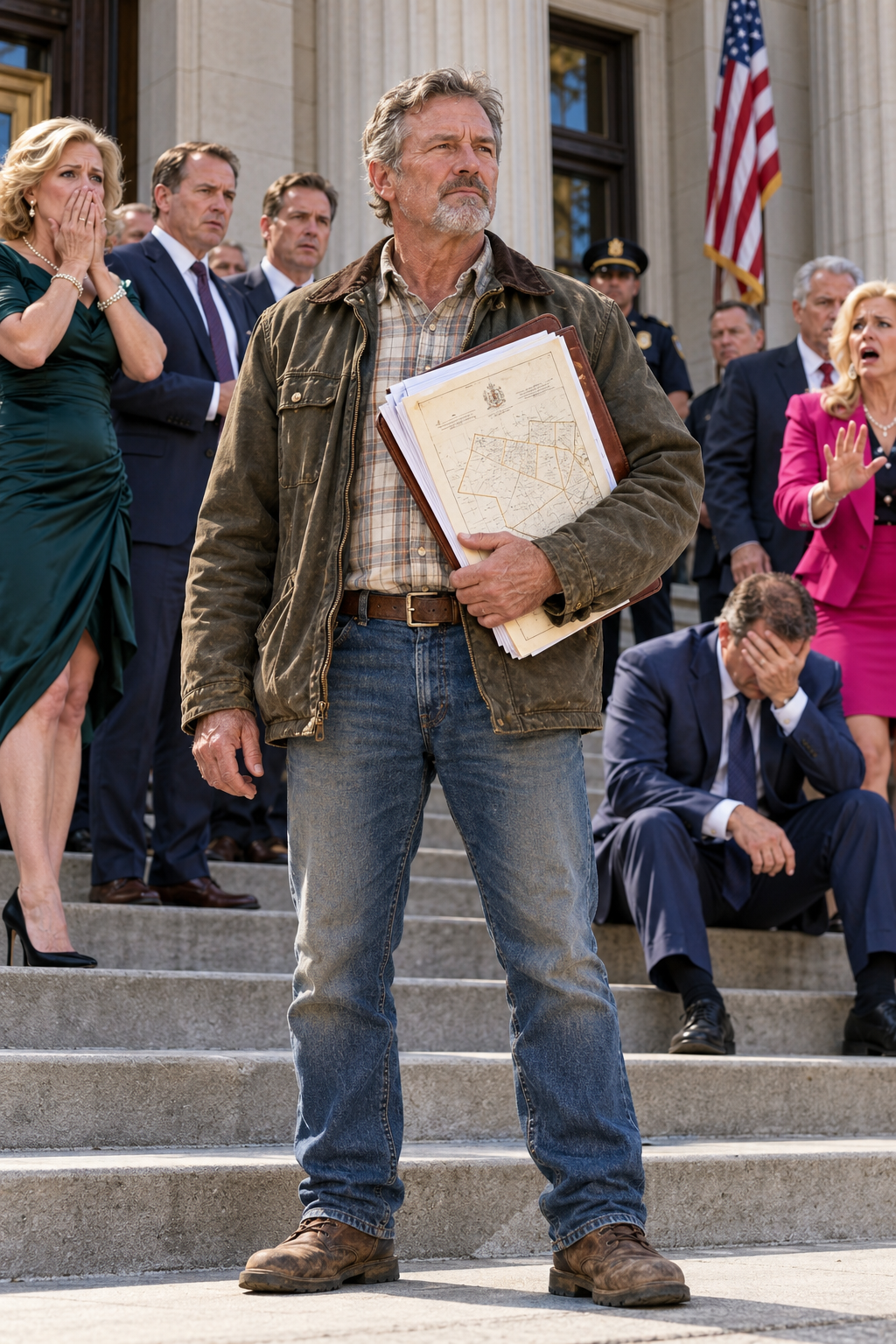
🔥HERE’S THE NEXT PART OF THE STORY, ENJOY !! The explosive twist and the final ending of this story ! ⬇️💬 Thank you ❤
“Did you record this deed?”
Kessler glanced at Raymond.
“At the county recorder’s office?”
“What date?”
Raymond leaned forward.
I looked directly at him.
“What date, Ray?”
For the first time that morning, my brother stopped looking comfortable.
“June fourteenth.”
Then I asked another question.
“Did Thomas sign it in front of a notary?”
Kessler answered.
“Of course.”
“Which notary?”
He looked down.
“Mrs. Hale, those records are—”
“Which notary?”
Raymond stood abruptly.
“We’re done here.”
He gathered his papers.
Steven Mercer closed the development plan.
At the door, Raymond stopped.
“You need to understand something.”
“This is already happening.”
Behind him, Steven Mercer glanced toward the south field.
Survey stakes had appeared there two days earlier.
Orange ribbons moved in the wind.
Raymond continued.
“There are permits. Investors. Contracts. Buyers. Millions of dollars. You can’t stop something this big because you’re having trouble accepting that Thomas made decisions without you.”
That was the knife.
Not the house.
Not the land.
He wanted me to believe my husband had betrayed me before dying.
He wanted to leave that poison behind.
I opened the door.
“You should go.”
Raymond shook his head.
“You always were stubborn.”
I said nothing.
He stepped onto the porch.
Then I asked softly, “Ray?”
“Did you read everything Thomas left behind?”
His eyes narrowed.
“What does that mean?”
I let the silence sit between us.
Then I closed the door.
That night, I climbed into the attic.
Thomas had built the attic stairs himself in 1998.
They creaked on the fourth and seventh steps.
I knew because I had heard him climb those stairs hundreds of times.
Christmas decorations.
Old photographs.
Our daughter’s school projects.
His father’s Army trunk.
I moved all of them.
At the far end was a cedar chest.
Inside were quilts.
Beneath the quilts was a false bottom.
Thomas had shown it to me seventeen years earlier.
Back then, I laughed.
“What are you hiding in there, cash?”
He had smiled.
“Something more useful.”
After he died, grief had erased that memory for nearly two days.
Now it returned.
I pressed the brass latch beneath the chest.
The bottom lifted.
Inside was a brown leather document case.
It smelled faintly of cedar and machine oil.
My hands began trembling.
Not because I was afraid of Raymond.
Because Thomas had put my name on the case.
Nothing else.
I carried it downstairs.
I did not open it immediately.
I made tea.
I locked the doors.
I closed the curtains.
Then I sat in Thomas’s chair.
The zipper stuck halfway.
Inside were six envelopes, a flash drive, three original deeds, two survey maps, an old abstract of title, a sealed letter from a law firm in Jefferson City, and one handwritten note from my husband.
I recognized his handwriting before I read the first word.
If somebody is showing you papers saying I transferred the south acreage, do not argue with them.
Let them talk.
Let them sign.
Let them record whatever they’re foolish enough to record.
Then call Rebecca Shaw.
Do not call Ray.
Do not give anybody the originals.
And remember what Dad taught us:
A fence can lie.
A map can be wrong.
A man can swear to anything.
But land remembers.
I read it three times.
Then I put my hand over my mouth.
That was the closest I came to breaking.
Not because of the land.
Because even while dying, Thomas had known there might come a day when I would need him to protect me.
His note did more than warn me.
It confirmed something I had felt at the dining room table.
Thomas had expected this.
Maybe not the timing.
Maybe not ninety-six houses.
But Raymond?
Thomas had expected Raymond.
The first envelope was labeled ORIGINAL WARRANTY DEED — 1978.
The second was labeled BOUNDARY CORRECTION — 1991.
The third contained a recorded conservation restriction signed by Thomas’s father, Edward Hale.
The fourth contained something I did not understand.
A notarized affidavit from Thomas dated eleven months before his death.
I, Thomas Edward Hale, being of sound mind and under no coercion, state that I have not transferred, conveyed, pledged, optioned, assigned, or authorized the transfer of any portion of the Hale South Tract…
I kept reading.
Then I stopped.
One sentence had been underlined.
If any instrument appears bearing my signature to the contrary after the date of this affidavit, my wife, Margaret Hale, is instructed to contact Rebecca Shaw immediately and request forensic examination.
I picked up my phone.
It was almost eleven.
I called Rebecca Shaw.
She answered on the fourth ring.
“My name is Margaret Hale.”
Then her voice changed.
“Thomas’s wife?”
“Are you alone?”
I looked toward the dark kitchen window.
“Do you have the brown case?”
Every hair on my arms lifted.
Rebecca exhaled.
“Then don’t leave the house tonight.”
The next morning, I met her at a diner forty miles away.
She was fifty-six, silver-haired, compact, and unimpressed by almost everything.
She did not touch the documents until I had placed them on the table myself.
She put on reading glasses.
For forty minutes, she barely spoke.
Then she asked me what Raymond had said.
I told her.
What Mercer had said.
I told her.
The recorded deed date.
June fourteenth.
She wrote it down.
Then she asked something strange.
“When was Thomas in St. Louis for surgery?”
“June twelfth through June seventeenth.”
Her pen stopped.
“Hospitalized?”
“Could he leave?”
“He could barely walk.”
“Interesting.”
She turned the photocopied quitclaim deed toward me.
It claimed Thomas had signed it before a Mason County notary on June fourteenth.
At p.m.
Rebecca smiled for the first time.
It was not a pleasant smile.
“Thomas was ninety-seven miles away in a cardiac unit.”
I stared at her.
“Legally? Very.”
Then she looked at me over her glasses.
“Margaret, I need you to understand what’s about to happen. Merrick-Holt will not simply apologize. Silver Pines will not simply back away. Raymond will not suddenly discover a conscience.”
“They will have lawyers.”
“They will have political relationships.”
“They will say you knew.”
“They may say you agreed.”
“They may try to make you look confused.”
She studied me.
“Thomas said you wouldn’t scare easily.”
My throat tightened.
“What else did Thomas say?”
Rebecca looked at the documents again.
“That you had spent your entire life letting other people underestimate you because correcting them was usually more trouble than it was worth.”
That sounded exactly like him.
For the next two days, I packed.
I did not pack because Raymond owned my house.
He did not.
I packed because Rebecca wanted me away from the construction site.
“Don’t give them a confrontation,” she said. “Give them evidence.”
Thursday morning, Raymond arrived with a locksmith.
He brought a deputy too.
Deputy Carlos Bennett had known Thomas since high school.
He looked sick when he stepped onto my porch.
“Margaret.”
He glanced at Raymond.
“I was told this is a civil possession matter.”
Raymond stepped forward.
“The property belongs to the trust.”
I handed Carlos a sealed envelope.
Inside was a copy of Rebecca’s notice disputing title.
Carlos read it.
Then he looked at Raymond.
“Maybe everybody should slow down.”
Raymond laughed.
“Deputy, the deed has already been recorded.”
Carlos looked at me.
“Where are you going?”
“My daughter’s.”
Emily lived in Columbia.
I had loaded one suitcase, Thomas’s photographs, my mother’s dishes, his father’s Army medals, and the brown leather case.
Nothing else.
Raymond saw the case.
His eyes rested on it for half a second too long.
“What’s that?”
He forced a smile.
“Margaret, you don’t have to be dramatic.”
I walked past him.
As I reached my truck, I turned.
Men were already unloading chain-link fencing.
A yellow excavator waited beside the barn.
My brother stood on my porch with the key to my house.
He believed he had won.
He believed the recorded deed was the truth.
He believed Thomas was dead, I was old, and money could convert fraud into ownership if enough concrete was poured over it.
I looked at him and thought of every Thanksgiving I had hosted after our mother died.
Every year I mailed his children birthday cards.
Every time Thomas repaired something at Raymond’s first house for free.
Every Sunday our father asked when Raymond was coming home.
Every hospital night I sat beside Dad because Raymond was “too busy.”
Every acre Thomas refused to sell because his father had begged him to keep the land intact.
Every sacrifice had seemed small when I made it.
Every sacrifice had been remembered by someone.
Every sacrifice had become a reason not to walk away now.
Every sacrifice had turned that old farm into more than dirt.
Every sacrifice was standing behind me when I drove through the gate.
Five hours later, the excavator crushed my front porch.
Rebecca had a photographer across the road.
Raymond never noticed.
The barn came down the next morning.
My house was gone by Sunday.
By Monday, Merrick-Holt had earthmovers on the south field.
Rebecca filed suit.
Merrick-Holt responded in forty-eight hours.
Their lawyers called our claims “unsupported allegations by a displaced beneficiary.”
They requested dismissal.
They produced the recorded quitclaim deed.
They produced the trust.
They produced Raymond’s authority.
They produced a title report.
They produced a preliminary survey.
And then they produced something that made Rebecca go very still.
Purportedly written by me.
Dated nine months earlier.
In it, I thanked Raymond for helping us “unlock the value” of the farm.
My signature was at the bottom.
Again, it was excellent.
Rebecca looked at me.
“You didn’t sign this.”
“Can you prove where you were that day?”
I looked at the date.
November eighth.
“With Thomas.”
“Mayo Clinic.”
She leaned back.
Then she laughed once.
It was the same unfriendly laugh she had given the hospital date.
“Your brother has terrible luck choosing forgery dates.”
The court refused Merrick-Holt’s first motion to dismiss.
But it also refused Rebecca’s request for an emergency injunction shutting down construction.
The judge said ownership questions required discovery and the developer had presented facially valid recorded documents.
That ruling cost them dearly later.
At the time, Silver Pines treated it like total victory.
Construction accelerated.
So did the humiliation.
The local paper ran a story titled:
WIDOW CHALLENGES MAJOR SILVER PINES EXPANSION.
Anonymous comments appeared online.
Sour grapes.
She probably sold and regretted it.
Old people get confused.
Her brother is trustee. End of story.
Then Raymond gave an interview.
He said he loved me.
That was the part that hurt most.
“My sister is grieving,” he told the reporter. “The family is trying to handle this compassionately.”
I watched the interview once.
Then I turned it off.
Emily wanted to respond publicly.
“Mom, he’s lying.”
“People believe him.”
“You need to say something.”
I looked at the brown case on my kitchen table.
Because we had not shown them everything.
That was Rebecca’s strategy.
Challenge the fraudulent deed.
Demand the original.
Demand notary logs.
Demand metadata.
Demand bank transfers.
Demand communications.
But do not reveal the 1991 boundary correction.
That was the land mine.
The county’s digital parcel map showed the Hale South Tract as roughly 161 acres.
The recorded original legal description showed 212.7.
A surveying error in 1989 had shifted a section line on tax maps by almost 800 feet.
Thomas’s father had discovered it in 1991.
He paid for a full boundary survey.
He recorded a correction deed.
Then the county changed software systems in 2004.
The correction never appeared correctly on the public GIS map.
Tax records did.
The legal title did.
The physical monuments did.
But the easy online map developers liked to use did not.
Merrick-Holt’s people had relied heavily on the wrong digital boundary.
Their plan crossed deeper onto our land than even Raymond understood.
Much deeper.
Rebecca called it “a catastrophic title problem.”
I called it Thomas’s insurance policy.
Construction continued through winter.
The clubhouse foundation went in first.
Then roads.
By March, twelve houses had frames.
By May, thirty-four were under roof.
Silver Pines held a groundbreaking celebration.
Someone sent me photographs.
Steven Mercer stood beneath a white tent holding a ceremonial shovel.
Raymond was beside him.
So was County Commissioner Allen Pike.
Behind them a sign read:
PHASE FOUR — 96 EXCLUSIVE RESIDENCES.
Emily slammed the photograph onto my table.
“How can you look at this?”
“Because I need to.”
“They’re building houses on Dad’s field.”
“You’re just letting them.”
I looked at her.
That silenced her.
“I sent six certified notices.”
“I filed a lis pendens.”
“I challenged the title.”
“I appealed the injunction.”
“I warned their lender.”
“I warned every subcontractor Rebecca could identify.”
Emily swallowed.
“So why don’t they stop?”
“Because they think finishing makes them untouchable.”
She sat down slowly.
That was exactly what Merrick-Holt believed.
Too much money invested.
Too many buyers.
Too much infrastructure.
Too many politicians embarrassed if the project failed.
They thought scale was protection.
By summer, buyers were touring model homes.
Rebecca obtained internal emails in discovery.
One was from a Merrick-Holt regional vice president.
HALT IS NOT AN OPTION. ONCE WE HAVE OCCUPIED UNITS, EQUITIES CHANGE.
HALE CLAIM NEEDS TO BECOME A DAMAGES CASE, NOT A LAND CASE.
Translation?
Build enough.
Sell enough.
Move enough families in.
Make returning the property impossible.
Then offer the old widow money.
They assumed I would take it.
What they did not understand was that I had never been fighting for a payout.
Thomas’s father, Edward, bought the south tract after coming home from Vietnam.
He worked nights at a feed mill for nine years to pay it off.
During the farm crisis of the 1980s, he nearly lost it.
Thomas was nineteen when he dropped out of community college to help.
Later, Thomas and I borrowed against our house to keep the property from foreclosure.
I worked twenty-three years in the school cafeteria.
Thomas repaired combines after dark.
We skipped vacations.
We drove used cars.
When Emily needed braces, Thomas sold his restored motorcycle.
When my mother needed assisted living, I cleaned offices at night.
There was never much extra money.
But we kept the land.
Not because we were sentimental fools.
Because Edward had protected a creek running along the southern ridge.
A small spring-fed stream crossed the property and fed into a larger watershed.
He planted trees there.
He refused offers from gravel companies.
He put part of the tract under a conservation restriction decades before developers considered the area valuable.
His final request to Thomas was simple.
Don’t let somebody turn every inch of it into profit.
Thomas honored that.
So would I.
In August, Raymond came to see me.
I had rented a small house outside Columbia.
He arrived in a Mercedes I had never seen before.
I did not invite him inside.
He stood on the porch and looked around.
“This is unnecessary.”
He gestured at my rental.
“The lawsuit. The hostility. All of it.”
“You knocked down my house.”
“The house was outdated.”
I stared at him.
Even Raymond heard how ugly that sounded.
He softened his voice.
Nobody called me that except Thomas.
Then handed me an envelope.
Inside was a settlement offer.
Three million dollars.
I read it once.
Then folded it.
Raymond watched me.
“That’s more money than you’ve ever had.”
“You could buy any house you want.”
“You could travel.”
“You could help Emily.”
“Then we agree.”
The smile disappeared.
“Margaret.”
“You forgot something.”
“I didn’t ask for money.”
His face changed.
Only slightly.
But I saw it.
That was when I knew he was frightened.
Not worried.
Frightened.
“Everybody asks for money eventually,” he said.
I handed the envelope back.
“Thomas didn’t.”
“What does that mean?”
I looked at him.
“Did you know he met with Rebecca eleven months before he died?”
Raymond’s eyes shifted.
Toward the brown leather case visible through my doorway.
I almost admired the performance.
“Rebecca Shaw.”
“He left an affidavit.”
Raymond went still.
I had given him one piece.
Rebecca had approved it.
We wanted him moving.
People made mistakes when they moved.
Sure enough, three days later Raymond called Daniel Kessler.
The call itself was privileged.
But Raymond made the mistake of calling Steven Mercer immediately afterward.
Mercer was not his lawyer.
Discovery got us the phone records.
A later email from Mercer was even better.
Ray says T may have created separate affidavit regarding conveyance. Need locate before deposition.
Not review.
Two weeks after that email, somebody broke into my rental.
Nothing obvious was stolen.
The television remained.
Jewelry remained.
Cash in my desk remained.
But the cedar chest had been opened.
Every drawer in my study had been searched.
And the brown case?
It was gone.
Emily cried when she saw the empty shelf.
I called Rebecca.
Then I called the police.
Then I sat at my kitchen table and drank coffee.
Emily stared at me.
“The deed was in there.”
“The copies were.”
She looked at me for a long moment.
“Where are the originals?”
“Your father married a suspicious woman.”
The originals were in Rebecca’s bank vault.
The case contained certified copies and a tracking device the size of a quarter.
Police recovered it two days later from a commercial dumpster behind an office complex in Kansas City.
One mile from Raymond’s consulting office.
No fingerprints usable.
No camera image clear enough for charges.
But the break-in did something important.
It convinced Rebecca to accelerate.
We subpoenaed Raymond’s financial records.
His lawyers fought.
That was the first major crack.
Sixteen months before Thomas died, Raymond had received $85,000 from a consulting company affiliated with Merrick-Holt.
Three months later, another $120,000.
Then $250,000 after the trust documents were filed.
All described as consulting fees.
Raymond claimed legitimate work.
Rebecca asked for deliverables.
There were none.
No reports.
No market analysis.
No contracts showing services.
Just invoices with vague phrases.
Strategic land advisory.
Acquisition facilitation.
Stakeholder management.
The second crack came from the notary.
Her name was Paula Wexler.
She worked in Raymond’s office.
Under oath, she initially said Thomas and I both appeared before her.
Rebecca showed her Thomas’s hospital records.
Paula’s face lost its color.
She asked for a break.
After lunch, she had a lawyer of her own.
Two weeks later, her testimony changed.
She admitted Thomas had never appeared before her.
She said Raymond brought her documents that were “already signed.”
He told her both signers had personally acknowledged them earlier.
She knew that was improper.
She notarized them anyway.
Then Rebecca asked the question that mattered.
“Did Mr. Cole tell you where the signatures came from?”
Paula cried.
“Did you see Mr. Thomas Hale sign the deed?”
“Did you see Margaret Hale sign the deed?”
“Did either of them authorize you to notarize the document?”
That evening, Merrick-Holt offered me $8.5 million.
By then, eighty-seven houses were complete.
Sixty-two were under purchase contracts.
Twenty-nine families had moved in.
I hated that part.
Those families were not villains.
They were teachers.
Retired couples.
A firefighter.
A young surgeon with two little boys.
People who had trusted title companies, developers, and attorneys.
Rebecca and I agreed on something early.
Whatever happened, we would not punish innocent homeowners if another solution existed.
That decision mattered later.
The ninety-sixth home was finished in April.
Silver Pines held a ribbon cutting.
They invited television cameras.
Steven Mercer stood in front of the clubhouse.
Raymond stood ten feet away.
The county commissioner cut the ribbon.
The neighborhood applauded.
Someone had planted ornamental pear trees along the main boulevard.
The street signs were black with gold letters.
Hale View Drive.
They named a street after my family.
Without asking me.
That was almost funny.
Rebecca called me that afternoon.
“They finished.”
“You know what that means.”
“Are you ready?”
I looked at Thomas’s photograph beside the window.
Trial began six weeks later.
The courthouse overflowed.
By then the case was no longer local gossip.
Ninety-six houses made it news.
Millions of dollars made it bigger news.
Alleged forged deeds made it statewide news.
Raymond sat behind three attorneys.
Steven Mercer had four.
Merrick-Holt had six.
Title insurers had two.
The homeowners had separate counsel.
I sat beside Rebecca with one brown folder and a legal pad.
Raymond looked at me across the courtroom.
For the first time since Thomas died, my brother did not look superior.
He looked tired.
The first three days were technical.
Recording statutes.
Trust formation.
Notary requirements.
Hospital records.
Signature analysis.
Financial transfers.
Survey standards.
Then Merrick-Holt’s attorney tried to make the case about delay.
He stood in front of me during cross-examination.
“Mrs. Hale, you saw construction occurring, correct?”
“You watched roads being built?”
“Dozens of them?”
“And yet you did not physically prevent construction.”
“You could have stood in front of the bulldozers.”
Rebecca objected.
The judge sustained.
He changed course.
“You understood significant capital was being invested.”
“You understood families might eventually purchase homes.”
“And still you waited.”
“I filed suit before the first foundation was poured.”
A few people in the gallery shifted.
He tried again.
“But you did not obtain an injunction.”
“The court denied it.”
“You appealed.”
“And lost.”
“So you allowed construction to continue.”
I looked at the jury.
Then I looked back at him.
“I documented trespass while your client continued construction.”
That answer appeared in newspapers the next morning.
He did not like it.
“Mrs. Hale, isn’t it true you hoped the project would become more valuable so you could demand more money?”
“You rejected three million dollars.”
“Eight and a half million.”
“Seventeen million.”
A murmur moved through the gallery.
That offer had not previously been public.
He leaned closer.
“Because it wasn’t theirs to buy.”
“It was land.”
“It was my husband’s promise.”
The attorney gave the jury a skeptical glance.
“Promises do not determine title.”
Then I looked at Rebecca.
“Deeds do.”
The courtroom became very quiet.
That was the moment.
Rebecca stood.
“Your Honor, may we approach?”
After a short conference, the judge nodded.
Rebecca returned to our table.
She placed the brown folder in front of me.
Across the room, Raymond’s face changed.
I opened it.
Inside was the original 1978 warranty deed.
Then the 1991 correction deed.
Then the recorded survey.
Then Edward Hale’s conservation restriction.
Then Thomas’s affidavit.
Rebecca called surveyor Martin Ellis.
He was seventy-four.
He had surveyed the property with his father in 1991.
He remembered Edward Hale.
“Stubborn man,” Ellis said.
A few people laughed.
“Accurate man,” he added.
Rebecca displayed the county GIS map.
Then the legal survey.
The difference appeared on a large screen.
A red line marked the boundary Merrick-Holt had used.
A green line marked the actual legal boundary.
The green line cut through Silver Pines Reserve like a knife.
Not twelve homes.
Not twenty.
All ninety-six homes.
The clubhouse.
Two retention ponds.
Most of the main road.
And the association’s new recreation center.
The entire Phase Four development stood inside the Hale South Tract.
The courtroom erupted.
The judge struck his gavel.
Raymond whispered furiously to his lawyer.
Steven Mercer stared at the screen.
Merrick-Holt’s regional director actually stood up before his attorney pulled him back down.
Rebecca let them react.
Then she asked Ellis one final question.
“Mr. Ellis, based on the recorded legal description, the 1991 correction, the monuments you personally placed, and your recent field survey, who owns the land beneath Phase Four?”
He looked at me.
“Margaret Hale.”
The judge called recess.
In the hallway, reporters crowded around.
I said nothing.
Inside the courtroom, Merrick-Holt’s lawyers filed emergency motions.
The title insurer began pointing fingers at the developer.
The developer pointed at Raymond.
Silver Pines pointed at Merrick-Holt.
Raymond blamed the county map.
The county produced records showing that the legal documents had always been available to anyone performing a full title examination.
Then came the second twist.
Rebecca called Raymond.
He did not want to testify.
He had no choice.
She began gently.
“Mr. Cole, you have worked in real estate for twenty-two years?”
“You understand recorded legal descriptions?”
“You understand GIS maps are not definitive evidence of ownership?”
His attorneys shifted.
Rebecca approached.
“Did your father ever tell you about the 1991 boundary correction?”
Raymond hesitated.
Rebecca picked up a small black notebook.
It had belonged to our father.
We found it in the brown case.
One page contained three lines.
June 12, 1991.
Survey corrected south line.
Ray upset. Says extra acreage could be worth millions someday.
Rebecca held it up.
“Still no?”
Raymond’s lawyer objected.
The judge allowed limited questioning.
Raymond looked at me.
I did not look away.
“No,” he said.
Rebecca nodded.
Then she produced an email recovered from an old account.
It was dated eight years before Thomas died.
Raymond had written to a developer.
Hale tract is larger than county GIS suggests. Old correction survey exists. Brother will never sell while alive.
For several seconds, nobody breathed.
Rebecca read nothing more.
She did not need to.
The email was displayed on the screen.
Brother will never sell while alive.
Thomas had been alive when Raymond wrote that sentence.
The forged deed appeared years later.
The timing was no longer a coincidence.
The financial payments were no longer innocent consulting fees.
The notary’s false acknowledgment was no longer a technical problem.
The system that had looked powerful began collapsing in public.
Raymond invoked the Fifth Amendment on several later questions after consulting with criminal counsel.
Steven Mercer testified that Silver Pines relied on Merrick-Holt.
Merrick-Holt testified it relied on Raymond’s authority and its title vendor.
The title vendor produced an internal warning email.
That email had been sent before construction.
POTENTIAL HISTORIC BOUNDARY DISCREPANCY — RECOMMEND FULL ABSTRACT REVIEW BEFORE CLOSING.
Someone at Merrick-Holt had marked the warning CLOSED — BUSINESS DECISION.
That was the moment the homeowners turned.
They were no longer sitting behind the developer.
Their attorneys moved seats.
Two days later, the judge issued partial findings.
The forged quitclaim deed was void.
The Hale Family Property Trust had never legally obtained the South Tract.
Raymond therefore had no authority to convey it.
Merrick-Holt had not acquired title.
Silver Pines did not own the common areas.
The actual owner was me.
Margaret Hale.
Sixty-three years old.
Former school cafeteria manager.
Temporary renter.
The woman they had given three days to leave her own home.
The damages phase lasted another month.
The final judgment was complicated.
The judge refused to punish innocent homeowners who had purchased without knowledge of the fraud.
Rebecca and I supported that.
Instead, the court imposed a constructive purchase framework.
The title insurers, Merrick-Holt, associated entities, and responsible parties would fund acquisition of the residential footprints at court-determined value.
The homeowners would keep their houses.
They would receive clean title.
No family would be evicted.
No child would wake up and discover somebody else’s crime had made them homeless.
But the developer did not get everything.
The clubhouse stood inside a restricted conservation corridor.
So did twelve acres of planned commercial amenities.
Those structures could not remain.
The recreation center was transferred to a land trust and later converted into a watershed education facility.
The remaining undeveloped acreage returned fully to me.
The creek was protected permanently.
Merrick-Holt paid enormous damages, attorney fees, restoration costs, and fraud-related penalties.
The total civil exposure across all entities passed $41 million.
Silver Pines dissolved the Phase Four board.
Several executives resigned.
County Commissioner Pike lost his development committee position after unrelated disclosure failures surfaced during the investigation.
Steven Mercer sold his house the following year.
Raymond did not attend the final civil hearing.
Federal and state investigators had already begun examining bank transfers, forged instruments, wire communications, and the attempted disposal of records.
His Mercedes disappeared.
So did his consulting office.
One morning, Emily called me.
“They arrested Uncle Ray.”
I sat at the new kitchen table in my new house.
Not a mansion.
I did not want one.
I built a modest farmhouse on the northern ridge.
From the porch I could see the white oak.
Thomas’s tree.
I could also see Silver Pines in the distance.
Ninety-six roofs.
Ninety-six families.
Ninety-six reminders of what happens when powerful people confuse momentum with ownership.
Raymond eventually pleaded guilty to several felony charges related to fraudulent instruments and financial misconduct.
Paula Wexler cooperated and received probation on reduced charges.
Merrick-Holt reorganized its regional operations.
The homeowners sued multiple parties separately.
I never learned the final total of all settlements.
People assumed I became fabulously wealthy.
Technically, I did receive more money than Thomas and I had ever imagined seeing.
But the first thing I bought was not a Cadillac.
It was not jewelry.
It was not a vacation house.
I bought back eleven acres Merrick-Holt had lawfully purchased years earlier along the creek.
Then I donated a conservation easement covering nearly the entire restored watershed.
Emily thought Thomas would laugh.
“Dad spent his whole life refusing to sell it,” she said.
“Now nobody can.”
That was the point.
Two years after the trial, Silver Pines invited me to its annual meeting.
I almost declined.
Then I saw the agenda.
Item seven.
Rename Hale View Drive.
I attended.
The new HOA president was a retired firefighter named Marcus Lane.
He shook my hand.
“We thought the name might bother you.”
“We can change it.”
I looked around the room.
Children drawing on paper beside their parents.
A couple I recognized from court.
A woman who had cried on the courthouse steps because she believed her new home might disappear.
I thought about anger.
How righteous it can feel.
How addictive.
How easily justice can become revenge if nobody is careful.
“Change it,” I said.
Marcus nodded.
I looked out the clubhouse window toward the south ridge.
“Edward Lane.”
He frowned.
“Edward Hale.”
Thomas’s father.
“The man who saved the creek.”
Three months later, the sign went up.
EDWARD HALE WAY.
No ceremony.
No newspaper.
That suited me.
On the anniversary of Thomas’s death, I walked to the white oak.
I carried his old coffee mug.
The one I had repaired after it cracked.
I sat beneath the tree and told him everything.
About Raymond.
About the trial.
About Emily.
About the creek.
About the families.
About the new farmhouse.
“I wish you’d been here,” I said.
Wind moved through the branches.
I laughed quietly.
Then I took his note from my coat pocket.
The paper was soft from being unfolded too many times.
A fence can lie.
A map can be wrong.
A man can swear to anything.
But land remembers.
I had believed that sentence was about property.
It was about truth.
Truth can be covered by signatures.
Truth can be buried under concrete.
Truth can be laughed at by people wearing expensive suits.
Truth can be called outdated, inconvenient, emotional, confused.
But truth has patience.
That was what Raymond never understood.
I had waited while he mocked me.
I had waited while bulldozers destroyed my home.
I had waited while foundations hardened.
I had waited while streetlights appeared.
I had waited while they toasted themselves beneath white tents.
Not because I was weak.
Because once I knew innocent families were involved, I wanted the law—not rage—to decide what came next.
And because Thomas had taught me something long before he died.
Never interrupt a greedy man while he is creating evidence.
I stood beneath the white oak as the afternoon light crossed the field.
For the first time in years, I felt finished.
Then a black SUV turned onto the gravel road.
It stopped near my gate.
A woman stepped out.
Early forties.
Federal badge clipped to her belt.
My stomach tightened.
I recognized her.
Special Agent Hannah Price.
She had worked on Raymond’s case.
She walked toward me carrying a thin evidence envelope.
“Mrs. Hale?”
“Agent Price.”
“I apologize for coming without calling.”
“Is something wrong?”
She looked toward the house.
“Can we speak privately?”
We went inside.
I made coffee.
She did not drink hers.
That told me more than anything she could have said.
“What happened?”
Price placed the envelope on my table.
“During a secondary review of your brother’s seized records, forensic technicians recovered files from a damaged external drive.”
“They were older than the Silver Pines transaction.”
“How much older?”
“Almost twelve years.”
Thomas had been alive and healthy then.
Price slid a photograph across the table.
It showed a scanned document.
Another property map.
Different county.
Different acreage.
But I recognized one name immediately.
My father’s.
Walter Cole.
Then another.
Raymond Cole.
My mouth went dry.
“What is this?”
“We’re still verifying.”
“Verifying what?”
She opened the envelope.
Inside was a copy of a transfer document involving 640 acres in northern Arkansas.
Land I had never heard of.
The listed beneficiaries were Raymond Cole…
and Margaret Cole Hale.
I looked up.
“I don’t own land in Arkansas.”
Agent Price did not answer.
She removed one final page.
At the bottom was my father’s signature.
Beside it was Thomas’s.
My husband’s signature.
Dated nine years before his death.
I stared at it.
“This can’t be right.”
“We believe those two signatures may be genuine.”
For the first time in the entire Silver Pines fight, I felt genuinely afraid.
“Thomas never told me about Arkansas.”
“Because your brother’s notes say you weren’t supposed to know.”
The kitchen seemed to shrink.
Price leaned forward.
“There’s something else.”
Of course there was.
“There always is.”
She placed a photograph beside the deed.
It showed the inside of a safe deposit box.
Old land records.
A small brass key.
And a sealed envelope.
On the front, written in Thomas’s unmistakable handwriting, were four words.
FOR MAGGIE — NOT YET.
My fingers went cold.
Price watched me carefully.
“We haven’t opened it.”
“Because legally, we believe it belongs to you.”
I stared at my husband’s handwriting.
Two years earlier, I had thought the brown leather case contained his final secret.
Apparently, I had been wrong.
Agent Price pushed the sealed envelope toward me.
For a long time, I did not touch it.
Then I thought about Raymond’s first morning at my dining room table.
The forged deed.
The bulldozers.
The ninety-six houses.
The courthouse.
Thomas’s warning.
My father’s notebook.
And one sentence Raymond had written years before any of it began.
Brother will never sell while alive.
I looked at Agent Price.
Then at the unopened letter.
And I asked the quietest question I had asked since this whole nightmare started.
“If Raymond wanted my land badly enough to forge a deed after Thomas died…”
I placed my hand on the envelope.
“…what was he willing to do while Thomas was still alive?”
Agent Price did not answer.
She didn’t have to.
Outside, beyond the kitchen window, the wind moved through the white oak.
And for the first time since I had won everything back, I understood that the ninety-six houses had never been the biggest secret buried beneath my family’s land.
✓ Lynn R. Adams
🔥HERE’S THE NEXT PART OF THE STORY, ENJOY !! The explosive twist and the final ending of this story ! ⬇️💬 Thank you ❤ “Did you record this deed?” Kessler glanced at Raymond. “At the county record…