HOA Branded Me an Armed Squatter on My Own Ranch—Then the Sheriff Unsealed Their Evidence Bag
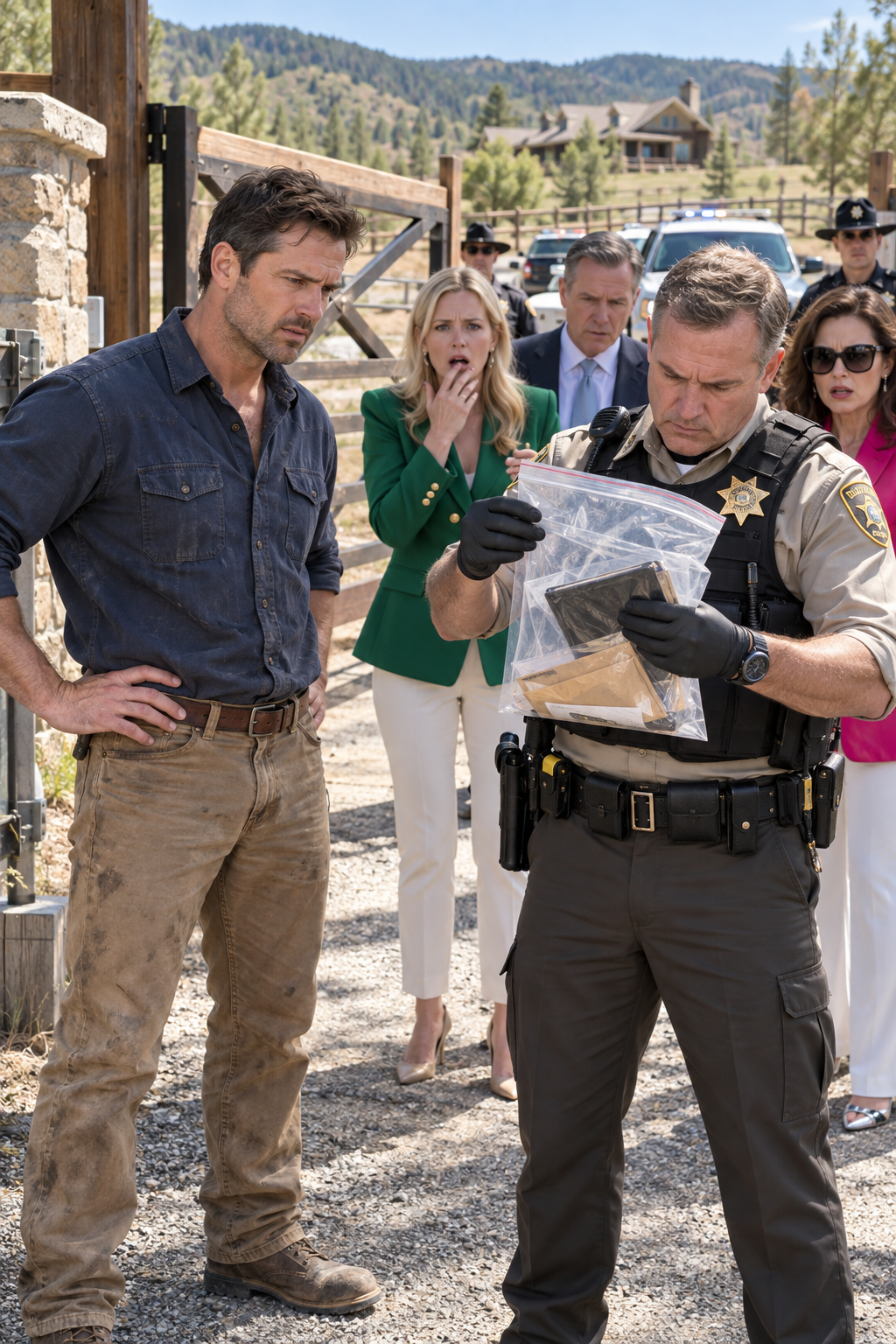
HOA Branded Me an Armed Squatter on My Own Ranch—Then the Sheriff Unsealed Their Evidence Bag
The first deputy pointed a rifle at my chest while the HOA president stood behind him smiling like she had already watched me lose everything.
“He’s armed,” she said. “He’s dangerous. And he doesn’t own this property.”
I kept both hands where the deputies could see them and looked directly at Sheriff Wade Holloway.
“Sheriff,” I said calmly, “before anyone puts me in cuffs, you might want to open the evidence bag she brought you.”
That was the moment Karen Bellamy’s smile disappeared.
Ten minutes earlier, I had been drinking coffee on the porch of a cabin my grandfather built in 1968.
Now three county cruisers blocked my driveway.
Two deputies had weapons ready.
An HOA security truck sat behind them.
And Karen Bellamy, president of the Silver Pines Homeowners Association, was holding a plastic evidence bag that supposedly proved I was an armed squatter occupying HOA land.
It was on a Saturday morning.
Cold October air rolled down from the foothills west of Fort Collins, Colorado. Frost silvered the grass along the fence line. My old red cattle gate stood open behind the cruisers, exactly where Karen’s people had cut the chain sometime before sunrise.
I noticed things like that.
I had spent eleven years managing commercial construction projects where a missing bolt could become a lawsuit and a changed measurement could cost seven figures.
Panic had never been useful to me.
Details were.
Sheriff Holloway was fifty-eight, broad-shouldered, gray at the temples, and possessed the exhausted expression of a man who had been pulled into too many neighborhood disputes that should never have involved law enforcement.
He looked at me.
Then at Karen.
Then at the black rifle locked inside the hard case sitting beside my porch steps.
“Mr. Mercer,” he said, “are there any weapons on your person?”
“Any loaded weapons inside the cabin?”
“My grandfather’s twelve-gauge is locked in a wall safe. There’s a .22 in another safe. Both legal. Both registered where required. The rifle you’re looking at is unloaded and locked.”
Karen laughed sharply.
“That’s not what our security team found.”
“Our security team?”
I looked at her.
Karen wore a cream wool coat, oversized sunglasses pushed into her blond hair, and riding boots that had never seen a horse. At fifty-two, she had mastered the expression of someone permanently disappointed that the world had not recognized her authority quickly enough.
Silver Pines sat east of my ranch.
Four hundred and twelve houses.
Two artificial ponds.
A clubhouse with fake stone columns.
A private fitness center.
A board that fined residents seventy-five dollars for leaving trash cans visible after six in the evening.
And one increasingly aggressive HOA president who had spent six months insisting that sixty-three acres of my family’s property belonged to her subdivision.
The problem was simple.
She was wrong.
My grandfather bought 740 acres in 1967.
My father inherited them.
I inherited them after Dad died three years ago.
Silver Pines had been constructed on neighboring land in 2009.
Their developer purchased 318 acres from a different family.
Nothing in our chain of title overlapped.
At least, nothing legitimate.
But Karen had recently discovered something valuable.
A county transportation proposal showed a future connector road potentially running along the southern edge of my ranch.
If built, that road would place commercial frontage less than half a mile from Silver Pines.
Land that had been worth around fourteen thousand dollars an acre could eventually become worth four or five times that.
And the sixty-three acres Karen suddenly claimed?
They sat directly between the subdivision and the proposed road.
She had called them “community preservation property.”
Her attorney called them “historically associated open space.”
Her board called them “Silver Pines South Meadow.”
My grandfather had called them pasture number four.
I called them mine.
Karen stepped toward the sheriff.
“Tell him about the gun.”
Sheriff Holloway didn’t move.
One of the deputies, Nate Dawson, looked uncomfortable.
That interested me.
“What gun?” I asked.
Karen gave me a look full of theatrical disbelief.
“The handgun our security personnel discovered near the south maintenance shed.”
“You mean my hay shed?”
“It’s HOA property.”
“It isn’t.”
She ignored that.
“It was loaded. Our security director found it after you threatened him.”
I almost smiled.
“I’ve never threatened your security director.”
“You pointed a weapon at him Thursday.”
“I was holding a grease gun.”
Deputy Dawson lowered his eyes for half a second.
Sheriff Holloway rubbed his jaw.
Karen continued.
“He also told us Mr. Mercer said he would shoot anyone who came onto the land.”
“No,” I said. “I told him that opening livestock gates without permission could get somebody hurt.”
“You said there would be consequences.”
“There are 1,400-pound cattle behind those fences, Karen. That wasn’t a threat. It was agricultural advice.”
Her face tightened.
Two weeks earlier, an HOA security guard named Travis Cole had driven onto my ranch without permission to photograph survey markers.
I had found him near the southern pasture.
He claimed Karen had authorized his presence.
I told him Karen couldn’t authorize anyone to enter land she didn’t own.
Then I photographed his vehicle, copied the plate number, and called the county sheriff’s non-emergency line.
That should have ended it.
A week later, orange stakes appeared inside my fence.
Then someone installed temporary signs claiming the area was under HOA management.
I removed them.
The next morning, Karen emailed me accusing me of destroying HOA property.
Three days after that, she brought in a private survey crew.
They left after I showed them my recorded plat.
Thursday, Travis Cole returned.
He walked toward me while I was servicing a tractor.
I had a grease gun in my right hand.
He took a photograph from thirty yards away.
Apparently, from that angle, Karen believed she could turn a tool into a firearm.
And now there were deputies standing on my porch.
Sheriff Holloway turned toward Karen.
“You said your security team found a handgun.”
“Where is it?”
Karen pointed toward the evidence bag in Deputy Dawson’s hand.
There was something black inside.
I could see the grip through the plastic.
My stomach tightened.
That was not one of my guns.
But I didn’t react.
Karen watched my face.
She wanted fear.
She wanted outrage.
She wanted me to do something stupid enough to justify everything she had told them.
So I gave her nothing.
“I’ve never seen that weapon,” I said.
“Of course you haven’t,” Karen replied.
Sheriff Holloway glanced at her.
She stopped talking.
He took the plastic bag from Dawson.
“Who placed this firearm into evidence?”
Karen answered before Dawson could.
“Travis discovered it.”
“That wasn’t my question.”
The sheriff repeated himself.
“Who physically placed the weapon into this bag?”
Deputy Dawson cleared his throat.
“Travis handed it to Mrs. Bellamy. Mrs. Bellamy brought it to our satellite office around six-forty this morning.”
The sheriff’s head turned slowly.
“He handed you a loaded handgun?”
Karen shifted.
“He was wearing gloves.”
“That also wasn’t my question.”
“I was preserving evidence.”
Sheriff Holloway stared at the bag.
That was when I saw something change in his expression.
Recognition.
But unmistakable.
He looked at the evidence label.
Then at the plastic seam.
Then at Karen.
“Where did you get this bag?”
“The sheriff’s department.”
He said it quietly.
Karen blinked.
Sheriff Holloway lifted the bag toward the morning light.
“This is an evidence bag, but it was never issued to you.”
Karen laughed nervously.
“Travis works in security. Maybe he—”
“Travis does not work for this office.”
“I didn’t say he did.”
“You just implied he had access to our evidence supplies.”
“I’m saying maybe he received it from—”
The sheriff used her first name.
That changed the entire temperature of the porch.
“Where did this bag come from?”
Her lips parted.
Nothing came out.
I looked at the label.
A handwritten number was visible through the plastic.
Then I saw the date.
Three years earlier.
Sheriff Holloway noticed me looking.
His eyes met mine.
“Mr. Mercer, stay where you are.”
“Wasn’t planning to go anywhere.”
He turned toward Dawson.
“Nate, photograph the bag exactly as it is. Front and back.”
Karen stepped forward.
“Sheriff, the important issue is that this man has been illegally occupying association property while armed.”
Holloway held up one hand.
“No, ma’am. Right now the important issue is that somebody brought me a handgun inside an old county evidence bag.”
Karen’s face turned pale.
And suddenly, for the first time that morning, the rifles weren’t pointed at me.
They were pointed toward the ground.
Sheriff Holloway told Deputy Dawson to retrieve gloves.
I stayed beside the porch railing.
Karen stayed near her Mercedes.
Her security director, Travis Cole, was nowhere in sight.
That was another detail.
If Travis had discovered the gun that supposedly proved I was dangerous, why hadn’t he come with her?
Why wasn’t he giving a statement?
Why wasn’t he standing there to identify where he found it?
Because Karen expected the gun to do the talking for him.
Dawson returned with nitrile gloves.
Sheriff Holloway carefully opened the outer flap.
Karen took another step backward.
He removed the handgun.
A black Glock.
Compact model.
Loaded magazine.
No round in the chamber.
The sheriff examined it without touching more than necessary.
Then he read the serial number.
His jaw tightened.
“Son of a bitch.”
Deputy Dawson looked at him.
Sheriff Holloway didn’t answer immediately.
“What is it?”
He looked at her.
“You don’t know?”
“You brought it here.”
“I told you, Travis found it.”
The sheriff turned to Dawson.
“Run this serial.”
Dawson walked toward his cruiser.
Karen crossed her arms.
“You’re wasting time. Mr. Mercer should be detained until ownership of the land is established.”
“Ownership is established,” I said.
She snapped toward me.
“Not according to the corrected deed.”
There it was.
The corrected deed.
The document Karen had been waving around for six weeks.
According to her version of events, a survey error from 1989 had mistakenly assigned sixty-three acres to the Mercer ranch.
A recently “discovered corrective deed” supposedly fixed that mistake and transferred the property back to land that eventually became Silver Pines.
There were several problems.
My father never signed it.
My grandfather never signed it.
The supposed notary died eight months before the date on the document.
And the legal description contained a road name that did not exist until 2007.
I had already given those facts to my attorney.
I had also given them to the county clerk.
I had not given them to Karen.
I wanted to know how far she would push it.
That was something my father taught me.
When someone lies badly, don’t interrupt them too early.
Sometimes the lie gets bigger.
Sometimes the lie gets expensive.
Sometimes the lie becomes evidence.
Karen looked at the deputies.
“He has refused every reasonable demand from the association. He removed our markers. He threatened security. He blocked access. Now we find a weapon.”
I looked at her.
“You forgot the part where your corrected deed was notarized by a dead woman.”
Her face froze.
Just for a second.
But Sheriff Holloway saw it.
Karen recovered quickly.
“I don’t know what you’re talking about.”
“Yes, you do.”
“I rely on counsel.”
“Your attorney emailed me the deed personally.”
“That doesn’t mean I examined the notary.”
“No. But you examined the acreage closely enough to send me three certified letters demanding that I vacate my own hay shed.”
“I’m not discussing this with you.”
“You came to my house with armed deputies.”
Her cheeks reddened.
Sheriff Holloway stepped between us.
“That’s enough.”
Karen didn’t.
She pointed at me.
“He’s trying to distract you.”
“No,” Holloway said. “Right now I’m waiting on a serial number.”
The radio on Dawson’s shoulder crackled.
He came walking back from the cruiser more quickly than before.
His face had changed.
Holloway looked at him.
Dawson lowered his voice.
But not enough.
“The Glock was reported stolen.”
Karen’s mouth opened.
Holloway asked.
Dawson stared at the report on his tablet.
“Three years and two months ago.”
Dawson looked at Karen.
Then at the sheriff.
“Thomas Bellamy.”
Nobody moved.
A raven called from somewhere beyond the cottonwoods.
I heard the sound of my windmill squeaking near the stock tank.
Karen’s husband, Thomas Bellamy, had died three years earlier.
Car accident outside Cheyenne.
I remembered because Silver Pines put black ribbons on its entrance signs.
According to the report, his handgun disappeared from their home sometime during the week after his funeral.
Karen reported it stolen herself.
Now that gun had somehow traveled from her house to my hay shed.
And she had delivered it to the sheriff.
Inside a three-year-old county evidence bag.
Karen whispered, “That’s impossible.”
Sheriff Holloway looked at her for a long time.
“You filed the theft report.”
“You identified the serial number.”
“And this morning you brought the weapon back to us.”
“I didn’t know it was Thomas’s.”
“Who else had access to it?”
“I don’t know.”
“Who had access after he died?”
“I told you, it disappeared.”
“Who knew where it was stored?”
“Sheriff, what exactly are you implying?”
“I’m not implying anything yet.”
The word yet landed harder than an accusation.
Karen’s hand trembled as she reached for her phone.
Holloway noticed.
“Please keep your hands visible.”
She stared at him.
“Am I being detained?”
“At this moment, nobody is leaving.”
That included me.
I didn’t mind.
For six weeks Karen had controlled the narrative.
Now the narrative had a serial number.
And serial numbers don’t care who sits on the HOA board.
I remember looking across my pasture that morning and thinking how quickly respectable people became reckless when property was involved.
Karen had started with letters.
Then came markers.
Then trespassers.
Then a fake deed.
Then a gun.
Not because she hated me.
Not because she wanted my cabin.
Not because she cared about weeds or fences or architectural guidelines.
She wanted access.
She wanted acreage.
She wanted the future road.
She wanted control.
She wanted the one piece of ground her subdivision couldn’t expand without.
And every time I said no, she became more certain that my no was simply an obstacle waiting to be converted into a yes.
I had watched it happen in slow motion.
I had watched her send certified letters to an address she knew was occupied.
I had watched her guards photograph my gates like they were documenting a crime scene.
I had watched orange stakes move twenty feet deeper onto my property each week.
I had watched her board members arrive in expensive SUVs and stand on my fence line whispering over printed maps.
I had watched them behave as though repetition could transform a lie into ownership.
I had watched them forget one important thing.
I was paying attention.
Deputies separated us.
Karen stood near her Mercedes with Dawson.
I stayed on the porch with Sheriff Holloway.
He looked toward the cabin.
“Daniel, I need to ask you something.”
It was the first time he used my first name.
“Go ahead.”
“Has anyone been inside your hay shed recently?”
“Other than me?”
“Travis Cole.”
“Thursday. Maybe five minutes before I told him to leave.”
“Did you see him enter?”
“No. I saw his SUV parked beside it.”
“Anybody else?”
“Not that I know of.”
I looked toward the barn.
His eyebrows lifted.
Karen didn’t know about them.
The old camera mounted above the hay shed door was obvious.
The newer one wasn’t.
Three months earlier, after equipment started disappearing from farms east of town, I installed small cellular trail cameras along the interior fence lines.
No local recording box.
Images went directly to cloud storage.
The south pasture had two.
One watched the gate.
The other watched the hay shed from a cottonwood thirty yards away.
“Do they work?” Holloway asked.
“Do they record Thursday?”
He exhaled slowly.
“Why didn’t you mention that before?”
“Because nobody asked.”
For the first time that morning, Sheriff Holloway almost smiled.
“Can you access the footage?”
I pulled my phone out only after he nodded.
I scrolled.
There was Travis’s SUV coming through the gate.
Travis walking toward the hay shed.
Travis coming back out.
He was carrying something under his jacket.
He stood beside his SUV using his phone.
Another vehicle appeared outside the fence.
Karen’s white Mercedes.
Sheriff Holloway leaned closer.
Karen never entered the ranch.
She stopped on the county road.
Travis walked toward her.
They spoke through her open driver’s window.
She handed him something.
A small clear package.
Even on the phone screen, the plastic reflected sunlight.
Holloway’s expression went flat.
“Send me copies.”
“I’ll preserve the originals.”
“There’s more.”
He looked at me.
“Last night.”
I changed the date.
A vehicle approached the south gate with its lights off.
Travis Cole’s.
He parked outside.
Walked to the chain.
At , the cottonwood camera captured him walking directly toward the hay shed.
In his gloved right hand was a black handgun.
Sheriff Holloway watched the clip twice.
Then he took his hat off.
Rubbed the back of his head.
Put the hat on again.
“Daniel, don’t delete anything.”
He turned toward Dawson.
The deputy approached.
“Get another unit over to Mr. Cole’s house.”
Karen heard him.
Her head snapped around.
Nobody answered.
She stepped forward.
“Sheriff, Travis was acting under instructions from our legal counsel.”
That was the first real mistake she made.
Holloway turned slowly.
“What instructions?”
Karen stopped.
Her face changed again.
“I mean generally.”
“Generally?”
“Our attorney instructed us to document unauthorized occupation.”
“By planting a stolen gun?”
“I did not say that.”
“You just volunteered that Mr. Cole was acting under legal instructions after I said I was sending deputies to his house.”
“That isn’t what I meant.”
“Then tell me what you meant.”
Karen’s mouth worked.
Nothing useful came out.
Holloway pointed toward Deputy Dawson.
“Stay with her.”
Then he looked at me.
We entered the cabin.
The place hadn’t changed much since my grandfather died.
Pine walls.
Stone fireplace.
Brown leather chairs.
A clock shaped like a horseshoe above the kitchen doorway.
Dad had renovated the plumbing but refused to modernize anything people could see.
The sheriff stood near the kitchen table.
“You have copies of the deed dispute?”
“In a binder.”
I brought him everything.
Original deed.
1972 survey.
1989 boundary confirmation.
2008 subdivision plat.
Aerial photographs.
Karen’s letters.
Her so-called corrective deed.
He studied the first page.
“Who prepared this?”
“According to the footer, Marlowe Land Services.”
He frowned.
“I know that name.”
“They went out of business nine years ago.”
“That’s not why.”
He looked closer.
“Marlowe did evidence surveys for the county.”
I watched him.
“What kind?”
“Property seizures. Tax cases. Boundary disputes.”
He flipped the page.
Then stopped.
There was a faded stamp in the lower corner.
I had noticed it before but assumed it belonged to the old surveying company.
Holloway traced it with one finger.
“That mark.”
“What about it?”
“This was copied from something in our records.”
“How can you tell?”
“Because that triangle wasn’t Marlowe’s company logo.”
He looked at me.
“It was the county property-evidence archive mark.”
I didn’t speak.
The fake deed.
The stolen gun.
The old evidence bag.
Now the survey.
All three touched county evidence storage somehow.
That was no longer an HOA dispute.
Someone had access.
Sheriff Holloway pulled out his phone.
He called the office.
“Get me records on anything Marlowe Land Services submitted involving Mercer property, Silver Pines, Bellamy, or parcels around County Road 18. Go back twenty years.”
He listened.
“Also lock the old evidence room. Nobody goes in without me.”
Another pause.
“No. I’m serious. Lock it.”
He ended the call.
“Sheriff,” I said, “how many people can access that room?”
“And three years ago?”
His expression answered before his mouth did.
Outside, Karen was arguing with Deputy Dawson.
We could hear her voice through the cabin wall.
Holloway looked toward the window.
“Your HOA president may have just created a very bad morning for several people.”
“Sheriff, I think this started long before this morning.”
Around , another deputy arrived.
Then another.
A detective named Maria Ellison came from the county office.
Karen was advised of her rights but not arrested immediately.
That seemed to make her bolder.
She demanded her lawyer.
She demanded to leave.
She demanded that I be arrested for trespassing.
Then she demanded that deputies retrieve the “HOA files” from my cabin.
Detective Ellison asked whether she had a court order.
Karen said the corrected deed was sufficient.
Ellison actually laughed.
Not loudly.
Karen stopped making demands after that.
At , the deputy sent to Travis Cole’s home radioed back.
Nobody answered the door.
His truck was gone.
At , they located it.
Abandoned behind a self-storage facility seven miles away.
At , Detective Ellison asked Karen if she knew where Travis was.
Karen said no.
At , Ellison showed her a phone record indicating Karen had called Travis eleven times since that morning.
Karen stopped answering questions.
By noon, the ranch driveway looked like the county fair had moved in.
Five sheriff’s vehicles.
One crime-scene van.
Karen’s Mercedes.
And a growing audience of Silver Pines residents standing along the county road.
Word had spread.
It always does.
Someone posted on the neighborhood Facebook group that an armed standoff was happening at the Mercer ranch.
Someone else said I had taken hostages.
Another person wrote that federal agents had discovered explosives.
By lunch, I was apparently running a militia.
Then an older Silver Pines resident named Frank Delaney walked up to a deputy carrying a manila envelope.
He asked to speak with me.
The deputy brought him inside.
Frank was seventy-one.
Retired civil engineer.
He lived two streets from Karen.
He had attended every HOA meeting for years because, as he once told me, retirement had left him with “too much time and not enough enemies.”
He placed the envelope on my kitchen table.
“I think you need this.”
“What is it?”
“HOA meeting minutes?”
“Not the public ones.”
Sheriff Holloway looked at him.
Frank nodded.
“I used to be on the board.”
Karen had removed him the previous year after he objected to spending association money on preliminary engineering work outside HOA boundaries.
“Outside the boundaries where?” I asked.
He pointed toward my southern pasture.
There it was.
Frank opened the envelope.
Inside were photocopies of board emails and handwritten notes.
According to the documents, Karen had been discussing acquisition of my sixty-three acres for nearly eighteen months.
Before the supposed corrective deed had been “discovered.”
Before she claimed the land already belonged to Silver Pines.
Before she accused me of squatting.
One note changed everything.
PROJECT SOUTH MEADOW — ACQUISITION CEILING $2.8M.
Underneath it:
IF OWNER REFUSES, REVIEW LEGACY TITLE PATH.
I looked at Frank.
“What does legacy title path mean?”
“I asked that exact question.”
“They removed me from the executive session.”
Another page contained an estimate from a commercial developer.
If Silver Pines controlled access to the future connector road, the association could sell development rights along the southern strip.
Estimated value?
Between $9.6 million and $13.2 million.
There was Karen’s motive.
Not ideology.
Not neighborhood safety.
Not a boundary misunderstanding.
A lot of it.
The HOA was carrying debt from clubhouse renovations, pool repairs, and a badly structured loan used to purchase an adjoining recreation parcel.
According to Frank, assessments were likely to rise dramatically within two years.
Unless the board found new revenue.
Sixty-three acres of my ranch had become their solution.
Frank tapped one email.
“This is the one that bothered me.”
Karen had written it.
We don’t need Mercer to agree that the land is ours. We need enough official paper to make refusal financially impossible.
Sheriff Holloway read that sentence three times.
Then Detective Ellison photographed it.
Karen’s attorney arrived at p.m.
His name was Spencer Vale.
Forty-five.
Perfect suit.
Perfect teeth.
The kind of lawyer who walked onto rural property wearing polished loafers and somehow never got mud on them.
He spoke privately with Karen.
Then he asked to speak with Sheriff Holloway.
Five minutes later, his composure cracked.
I watched from the porch.
He kept looking at Karen.
Then at the evidence bag.
Then back at Karen.
Finally, he pulled her aside.
Whatever he whispered made her face turn gray.
At , Spencer Vale asked Detective Ellison if he could make a statement.
Not for Karen.
For himself.
That was when I knew the day had changed direction again.
Vale admitted he had sent me the corrective deed.
But he said Karen provided it.
She claimed it came from archived documents belonging to the original Silver Pines developer.
Vale said he had advised her that the deed required independent verification before the HOA asserted ownership.
Karen ignored that advice.
He produced emails.
One from him said:
Do not represent this document as legally established until chain of title and notarial validity are confirmed.
Karen replied:
Understood.
Six hours later, she sent me a letter titled NOTICE TO VACATE ASSOCIATION PROPERTY.
Detective Ellison asked Vale why he continued representing her.
His answer was painfully simple.
“She told me verification was underway.”
It wasn’t heroic.
But it was useful.
Then Vale handed over something worse.
An invoice.
$18,500 paid by the HOA to a consulting company called Front Range Asset Recovery.
Nobody on the public board records had approved it.
The company’s registered manager?
Travis Cole.
The HOA security director.
Karen had been paying him separately.
The invoice description said only:
Historical property verification and possession services.
Possession services.
That phrase sat in the air.
At , deputies found Travis.
He was at a motel near the Wyoming border.
He didn’t run.
He didn’t fight.
He asked for a lawyer.
But the search warrant on his SUV produced gloves, bolt cutters, photocopies of my property records, and two empty county evidence bags.
That was enough to arrest him on multiple preliminary charges.
It wasn’t enough to explain how he got the evidence bags.
That answer came after sunset.
At , Sheriff Holloway’s records clerk called.
The old evidence room inventory had been checked.
Thirty-seven evidence bags from a retired lot were unaccounted for.
That by itself meant little.
Old supplies disappear.
They get discarded.
Miscounted.
But then they checked the archived property records.
Someone had accessed the Mercer file four months earlier.
The electronic access log showed the employee ID.
Holloway went silent when he saw it.
Detective Ellison looked over his shoulder.
Then she swore.
I was standing near my truck.
Neither answered immediately.
Finally Holloway looked at me.
“The account belonged to former Deputy Chief Robert Gaines.”
“Retired eight months ago.”
I recognized the name.
Everyone in the county did.
Robert Gaines had spent thirty-one years in law enforcement.
Church deacon.
Little League coach.
Veterans’ breakfast every Wednesday.
His retirement party filled an entire banquet hall.
I had shaken his hand once at a charity auction.
“What does he have to do with Silver Pines?”
Sheriff Holloway’s expression hardened.
“He lives there.”
I looked toward the crowd gathered along the road.
Several people turned away.
Frank Delaney didn’t.
“Which house?” I asked.
Frank answered.
“Next door to Karen.”
Suddenly the old evidence bag made sense.
The archive mark made sense.
The property file access made sense.
But the gun still didn’t.
Not completely.
Because Karen’s husband reported it stolen three years ago.
Long before the current land dispute exploded.
That meant either the gun had been sitting somewhere waiting to be used…
Or this wasn’t the first time someone in Silver Pines had needed a convenient piece of evidence.
Sheriff Holloway left immediately with Ellison.
Karen was taken to the county office for questioning.
She was not marched away in dramatic handcuffs.
There was no screaming confession.
No movie-style breakdown.
Just a woman climbing into the back of an unmarked vehicle while dozens of her neighbors watched.
That somehow felt worse.
At p.m., the last deputies left my ranch.
I replaced the chain on the gate.
Fed the horses.
Checked the cattle.
Then I sat on the porch with cold coffee and watched lights flicker across Silver Pines.
My phone had 127 notifications.
I ignored all of them.
Around nine, Frank called.
“You should check the HOA portal.”
“Karen’s been removed.”
“Emergency vote.”
“What about the land claim?”
“Suspended pending investigation.”
I leaned back.
For six weeks, Karen had tried to bury me beneath paperwork.
In one day, her paperwork buried her instead.
But I didn’t celebrate.
My father used to say the most dangerous moment in a fight is when you think it’s over.
At 10:12 p.m., Sheriff Holloway called.
They had searched Robert Gaines’s home.
No arrest yet.
But they found county property records.
Old evidence supplies.
Copies of survey maps.
And a handwritten ledger containing parcel numbers throughout the county.
Not just mine.
Thirty-two parcels.
Some beside HOAs.
Some beside planned roads.
Some owned by elderly residents.
Some tied to probate disputes.
My parcel number was near the bottom.
Sheriff Holloway told me not to discuss the ledger publicly.
Then I asked the question that had bothered me all day.
“What about it?”
“Why was Thomas Bellamy’s gun in evidence packaging?”
Another silence.
Longer this time.
“We don’t know yet.”
“You have a theory.”
“I have too many theories.”
“Was Thomas Bellamy connected to Gaines?”
“They were friends.”
“How close?”
“Close enough to hunt together.”
I stared into the dark pasture.
“What happened in Thomas’s accident?”
“I’m asking.”
“He lost control on an icy road.”
“That’s the official report?”
“Who investigated?”
Holloway said nothing.
I already knew.
The sheriff exhaled.
That was the second time that day the temperature seemed to drop without the weather changing.
“Sheriff, are you reopening it?”
“I can’t answer that yet.”
“Fair enough.”
“Lock your doors tonight.”
“I always do.”
His voice changed.
“Lock them tonight.”
Then he hung up.
Karen Bellamy was arrested two days later.
Not for trying to steal my ranch.
That investigation was still growing.
She was charged initially in connection with providing false evidence, conspiracy, trespass-related offenses, and obstruction.
Travis Cole faced additional charges.
Robert Gaines hired an attorney and refused interviews.
Within a week, state investigators joined the county case.
The corrected deed collapsed almost immediately.
The county recorder formally flagged it as fraudulent.
The HOA withdrew every claim against my ranch.
They reimbursed me for damaged fencing.
They paid my legal fees.
Their insurance carrier opened its own investigation.
Three board members resigned.
Spencer Vale withdrew as HOA counsel.
Frank Delaney became interim board president after residents held the most chaotic meeting in Silver Pines history.
He called me afterward.
“I tried to say no.”
“How hard?”
“Not very.”
A month later, Silver Pines sent me a formal written apology.
I framed it.
Not because I needed validation.
Because the sentence was beautiful.
The Silver Pines Homeowners Association recognizes that Daniel Mercer is the lawful owner of the disputed property and regrets all unauthorized actions taken in relation to it.
My grandfather would have enjoyed that.
I hung it beside his old cattle-branding iron.
For a while, life returned to normal.
Winter came.
Snow covered the southern pasture.
The future connector road remained nothing more than lines on a county planning map.
Karen’s house went dark after she moved in with her sister pending trial.
Travis stayed in custody because investigators believed he had attempted to destroy records.
Robert Gaines remained free.
That bothered me.
But I understood investigations.
Build slowly.
Document everything.
Don’t move until you know what the other side can’t explain.
By February, prosecutors had identified at least seven property disputes where documents connected to Gaines appeared.
Three involved elderly owners pressured to sign easements.
One involved a widow who sold six acres to an HOA after receiving repeated code complaints from agencies that later claimed they had never issued them.
Another involved a rancher whose access road suddenly appeared on a “historic shared-use map.”
All of it looked less like random corruption and more like a business model.
Acquisition.
Karen’s HOA had not invented the machine.
It had simply used it.
That should have been the end of my story.
Karen lost her position.
The deed was exposed.
The gun was proven to have been planted.
The ranch stayed mine.
The sheriff cleared me publicly.
Silver Pines paid.
The investigation expanded.
For once, the system seemed to work exactly the way people hope it will.
And then, on March 18, at in the morning, someone knocked on my cabin door.
Three knocks.
I checked the camera first.
Sheriff Holloway stood outside.
No cruiser lights.
He looked older than he had five months earlier.
I opened the door.
“You want coffee?”
That told me everything.
He stepped inside carrying a small cardboard evidence box.
He placed it on my kitchen table.
“What happened?”
“We finally processed everything from Gaines’s basement.”
He opened the box.
Inside was a clear evidence sleeve containing a tiny black memory card.
Nothing remarkable.
Nothing dramatic.
Just a piece of plastic smaller than my thumbnail.
“This was hidden inside the lining of the evidence bag Karen brought to your ranch.”
I stared at him.
“The gun bag?”
“How did nobody find it?”
“It was between the double layers near the bottom seam. Lab technician spotted the weight difference.”
“What’s on it?”
Holloway didn’t answer.
He took out a printed photograph and slid it across the table.
It showed a frozen frame from a video.
Poor lighting.
Two men standing beside a truck.
One was Robert Gaines.
The other was Thomas Bellamy.
Karen’s dead husband.
A third person stood farther back.
His face was partially hidden.
I didn’t recognize him.
There was a date stamp on the original footage.
Six days before Thomas Bellamy died.
I looked up.
“What are they doing?”
“Talking about parcels.”
“Which parcels?”
“Yours is one.”
My stomach tightened.
“Three years before Karen claimed it?”
I looked back at the photograph.
“What else is on the card?”
“Audio files. Scanned documents. Videos.”
“How many?”
“Hundreds.”
Holloway pulled out another photograph.
This one showed my father.
Standing in the county courthouse parking lot.
Speaking with Thomas Bellamy.
The date was eleven months before Dad died.
I didn’t touch the photograph.
For several seconds, I forgot how to breathe.
“My father knew him?”
“We think so.”
“My father never mentioned him.”
“You knew my father.”
“Did you know about this?”
I believed him.
That was the part that scared me.
Sheriff Holloway sat across from me.
“There’s a recording on the card.”
“Of my father?”
I looked toward the kitchen window.
Sunrise was beginning over the pasture.
Thin gold light across snow.
The same land Karen had called hers.
The same land men had apparently been discussing years before she ever sent me a letter.
“What does he say?”
Holloway hesitated.
Then he reached into the box one last time.
He removed a folded copy of a transcript.
At the top was my father’s name.
Underneath were eleven words highlighted in yellow.
I read them once.
Then again.
Then a third time.
My father had said:
“If Daniel ever finds the original survey, they’ll know what’s buried there.”
I looked at the sheriff.
Neither of us spoke.
Outside, beyond the cabin window, sixty-three acres of snow-covered pasture stretched toward the foothills.
Land Karen had risked prison to control.
Land Robert Gaines had accessed records about.
Land Thomas Bellamy had discussed six days before his death.
Land my father had warned someone about before his own death.
I had spent months believing this was about a future road worth millions.
I had been wrong.
Sheriff Holloway leaned forward.
“Daniel, do you know what original survey your father was talking about?”
“Did your grandfather ever mention anything buried on the south pasture?”
He nodded slowly.
Then he said the one thing I never expected to hear from a county sheriff sitting in my grandfather’s kitchen.
I stared at him.
“Why is that good?”
His eyes moved toward the southern window.
“Because somebody dug there last night.”
“We found fresh tire tracks behind your west fence. Excavator tracks.”
My heart started pounding.
“Did they find anything?”
Holloway looked back at the memory card.
“We don’t know.”
Then my phone vibrated on the table.
Unknown number.
A photograph appeared.
Taken minutes earlier.
My south pasture.
A hole in the frozen earth.
Beside it sat an old rusted steel box.
The message underneath contained six words.
YOU SHOULD HAVE SOLD THE LAND.
Before I could answer, another message arrived.
This one was a photograph of me and Sheriff Holloway sitting inside my kitchen.
Taken through the window.
Taken right then.
The sheriff reached for his weapon.
I turned toward the glass.
Across the white pasture, beyond the cottonwoods, a dark vehicle was already disappearing behind the ridge.
And for the first time since Karen Bellamy called me an armed squatter on my own land, I understood something that made the planted gun seem almost small.
Karen had never been the person trying hardest to take my property.
She had only been the loudest.
✓ Lynn R. Adams
HOA Branded Me an Armed Squatter on My Own Ranch—Then the Sheriff Unsealed Their Evidence Bag The first deputy pointed a rifle at my chest while the HOA president stood behind him smiling like she ha…