His Wife Lay in a Coma for Two Months — Their Son Refused to Leave Her Side, Until Tonight He Whispered Something That Changed Everything
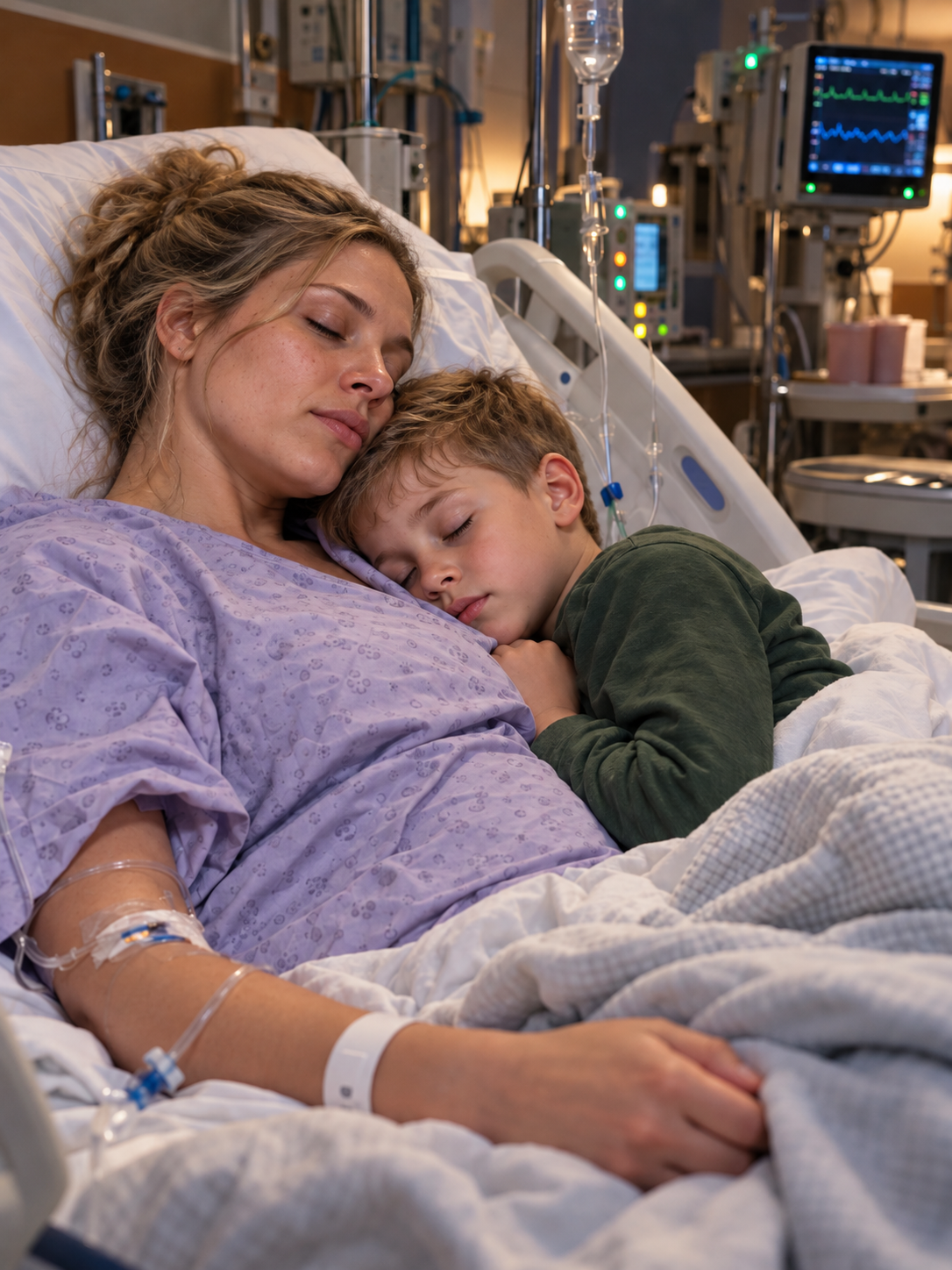
His Wife Lay in a Coma for Two Months — Their Son Refused to Leave Her Side, Until Tonight He Whispered Something That Changed Everything
What do you do when your seven‑year‑old knows something about the woman you love that the doctors and you cannot see?
I knelt beside the hospital bed and spoke as gently as I could. “Buddy, it’s late. Mom is resting. She won’t know you’re not here.” He didn’t look up. He held her hand—small fingers wrapped tight around hers—and shook his head hard. “She does know, Dad. She listens. And I promised.” I froze. Those words. The way he said them. Not like a child wishing. Like someone who had heard her answer.
I did not scoop him up and carry him out against his will. I did not tell him his mother could not hear a single word he said. I did not brush off his devotion as a sad little habit. I did not dismiss what he felt just because I could not see what he saw. I did not realize then that he was not just keeping vigil—he was talking to her.
I watched him walk into this room every afternoon, backpack slung small between his shoulders. I watched him pull the chair close and climb up so he could reach her hand. I watched him tell her about math class, about the dog next door, about the way the sky turned pink over the playground. I did not know she was answering him. I did not know he had been waiting for me to listen too.
I told myself it was grief. I told myself it was a child’s way of holding on. I told myself I was being strong for both of us. I was wrong. I was the one who wasn’t listening.
My name is Leo Mercer. My wife, Sarah, slipped into a coma two months ago—sudden, severe, unexplained. The doctors ran every test. They shook their heads. They said she was stable. They said she might wake up tomorrow. Or next month. Or never. They said there was no way to know.
Our son, Noah, turned seven while she lay there. He brought her a drawing of a dragon with purple wings and left it on her pillow. He brought her a dandelion from the front yard, pressed flat between pages of his reader. He never missed a day. Rain or shine, right after school, he was here.
I sat with him as much as I could. But I also had to work. To pay the bills. To keep our home. I would drop him off, then pick him up late. And every time I arrived, he was still talking—softly, steadily, as if she were answering.
Tonight, the nurses had gently suggested again. “He needs his own bed. He needs routine.” I agreed. I tried. And Noah said the one thing that stopped my breath.
“I can’t, Dad. She’s trying to tell me something. But it’s hard. And I have to help her.”
I forced a smile. “Noah, Mom can’t speak right now. Her body is resting.”
He looked at me then—eyes wide, serious, old beyond his years. “She doesn’t speak with her mouth. She speaks with her hand. And her eyes. When they flutter. And her fingers squeeze mine. She does it every day. You’re just not watching.”
Something shifted in my chest. A quiet, sharp wonder. “Show me.”
I pulled the chair closer. I sat. Noah took her hand. “Hi, Mom. It’s me. Noah. Dad is here too. We’re both listening.”
We waited. Minutes passed. Her chest rose and fell. Monitors beeped steady and soft. I was about to speak when I saw it—her fingers, curled limp around his hand, tightened. Faint. Faltering. Real.
Noah smiled. “Hi. I know. I’m here. I told Dad you listen.”
He turned to me. “See? That means ‘I’m here too.’ And when she does it twice fast, that means ‘I love you.’”
He looked back at her. “Tell Dad what you told me. About why you’re sleeping so long.”
Her fingers moved again—slow, deliberate, three short squeezes. Then two long ones. Then three short.
Noah nodded. “She says it’s not just sleeping. She says something happened before she got sick. Something she couldn’t tell anyone. She says she’s trying to remember the words. But it’s hard.”
My heart thudded slow and heavy. “What else, Noah?”
“She says she’s safe. But she needs us to find something. A box. Under the floorboards in the closet. The one with the blue ribbon.”
I went cold. There was no box there. I would have known. I had cleaned that closet. I had packed her things.
“She says you’ll find it,” Noah said. “And when you do, you’ll know why she couldn’t say it out loud.”
I stood up slowly. “Stay here. I’ll be right back.”
I drove home fast. The house was quiet. Empty. I went straight to our bedroom. To the back of the closet. I moved the boxes. I ran my hand along the floor. And there—along the baseboard, hidden beneath a loose strip of molding—was a faint crack. I pried it up. Beneath it, wrapped in oilcloth, was a small wooden box. Tied with a faded blue ribbon.
I carried it to the bed. My hands shook. I untied the bow. Inside was a letter, a USB drive, and a folded stack of papers. The letter was addressed to me, dated three days before she fell ill.
My dearest Leo,
If you are reading this, I couldn’t tell you face to face. I was afraid. Afraid they would listen. Afraid they would hurt you and Noah too. Something is very wrong at the hospital. People are not who they say they are. Records are being changed. Results are being hidden. I saw something I was not supposed to see. I tried to speak up. And then I got sick.
This is not a coincidence. I know it isn’t. But I don’t have proof—not yet. The drive has everything I could gather: names, dates, the patterns no one should have missed. Look at the emergency room logs. Look at the medication batches. Look at who signed for what. Follow the trail. Please. Don’t let it happen to anyone else.
Tell Noah I love him more than the stars. Tell him to be brave. And tell him—when I squeeze his hand three times—it means I am still fighting.
I sank onto the edge of the bed. The room tilted. This wasn’t an illness. It wasn’t bad luck. It was deliberate. And she had known. She had tried to warn me. And I had thought she was just sleeping.
I drove back to the hospital faster than I should. Noah was exactly where I left him—holding her hand, quiet, watching her face. He looked up when I stepped in. “Did you find it?”
“I did,” I said, my voice thick. “And you were right.”
I knelt beside him. “Noah, has she said anything else? Anything about who hurt her? Or what they gave her?”
He thought for a moment. “She says a man came in. Before she got really sleepy. He gave her something in a cup. He said it was vitamins. And she didn’t feel right after that. She says his name is Dr. Hale. But that’s not his real name.”
My blood ran cold. Dr. Hale was the lead attending physician. The one who had called me. The one who had reassured me. The one who had said there was nothing to find.
“Did she say anything else?” I asked.
“She says he’s watching,” Noah whispered. “He comes in when we’re not here. He checks her hand. He checks her eyes. He’s afraid she’ll wake up.”
I stood up. I tucked the drive into my pocket. “Noah, I need you to do something for me. Stay right here. Don’t let go of her hand. Don’t talk to anyone but me. Can you do that?”
He nodded solemnly. “I won’t let go. I promised.”
I stepped out into the hallway. I pulled up the hospital’s public records portal on my phone. I cross‑referenced the names Sarah had listed. I matched dates to shifts. And there it was—Dr. Elias Hale had been hired exactly six weeks before she fell ill. No prior local history. No references listed from his last three years. And the batch numbers he had signed for on the day she was admitted were all redacted. Removed.
I called the state medical board. I called a lawyer I trusted. I told them what I knew. I sent them the files. And as I ended the call, I saw him—Dr. Hale—walking down the hall toward the room. Slow. Calm. Carrying a small tray.
He stepped inside. He saw me. He paused. “Leo. You’re back early. I was just coming to check on her vitals.”
I stood between him and the bed. “No you weren’t.”
His smile faded. “Excuse me?”
“You know what I mean,” I said. “You gave her something. You made sure no one would find out. And you’ve been coming back to make sure she stays quiet.”
He didn’t flinch. He didn’t deny it. He just looked at Noah, then back at me. “You don’t know what you’re dealing with. Walk away. For your son’s sake.”
“Tell me why,” I said. “What did she see?”
He took a step closer. “Something that doesn’t concern you. Something that’s been running much longer than you or her. Walk away, or things get worse.”
“Worse for who?” I said. “Her? Me? Or the people you’re still hurting?”
He stiffened. “You have no proof.”
“She left proof,” Noah said, small but clear from the bed. “And she’s going to tell everyone.”
Hale looked at the boy. His expression shifted—from calm to cold. “She can’t tell anyone. She can’t even speak.”
“She speaks to me,” Noah said. “And she says you’re scared. Because you know we’re going to find the rest.”
Hale’s jaw tightened. He looked at the door. Then at me. “There is no ‘rest.’ You found what there is. That’s the end of it.”
He turned and walked out. Fast. Not slow. Not professional. Gone.
I went to the bed. I stroked Noah’s hair. “You did good, buddy. Very brave.”
He looked up at me. “Dad? She says there’s more. Something she didn’t write down. Because she didn’t have time. She says the man isn’t alone. There are others. And they’re watching us right now.”
I looked at the window. The blinds were closed. But a shadow moved across the glass—distinct, human, gone before I could be sure.
I pulled the chair close. I held Sarah’s hand in one of mine, Noah’s in the other. “We’re listening,” I whispered to her. “Tell us everything.”
Noah waited a moment. Then her fingers moved—once, twice, three times. Stronger than before. Clearer than before.
“She says they’re coming tonight,” Noah said. “And they’re not just coming for the papers.”
He paused, his eyes wide and steady.
“She says they’re going to make it look like we left. Like we gave up. Like none of this ever happened.”
Outside in the hallway, the lights flickered once and went dark. The monitor beeping beside her bed fell silent. The door handle turned. Slow. Quiet. From the outside.
✓ Lynn R. Adams
His Wife Lay in a Coma for Two Months — Their Son Refused to Leave Her Side, Until Tonight He Whispered Something That Changed Everything What do you do when your seven‑year‑old knows something about…