Her Stepmother Took the House and Fortune, but the Old Barn Her Father Left Her Hid the One Thing They Feared
Her Stepmother Took the House and Fortune, but the Old Barn Her Father Left Her Hid the One Thing They Feared
“You have seventy-two hours to get your things out.”
That was how Rebecca Hale learned that twenty-six years of being a daughter could be erased with one sentence.
Her father had been buried four days earlier.
His coffee mug was still beside the kitchen sink.
His brown work jacket still hung from the brass hook by the mudroom door.
And across the dining-room table, in the farmhouse where Rebecca had cared for him through three surgeries, two winters of chemotherapy, and the final eight months when he could barely climb the stairs, her stepmother slid a typed eviction notice toward her as casually as if it were a restaurant bill.
Diane Hale did not look sad.
She looked relieved.
Beside her sat Diane’s son, Travis, wearing Rebecca’s father’s Rolex.
Across from him sat Diane’s daughter, Melissa, flipping through photographs of the property on her phone.
And at the end of the table sat Martin Kessler, the family attorney, who had represented Rebecca’s father for nearly fifteen years.
He would not meet Rebecca’s eyes.
That was the part that hurt the most.
Not Travis.
Not even the eviction notice.
Rebecca had known him since she was seventeen.
He had eaten Thanksgiving turkey in this house.
He had drunk bourbon with her father on the porch.
He had once told Rebecca that Frank Hale trusted her more than anyone alive.
Now he adjusted his silver cuff link and said, “The documents are valid.”
Rebecca looked down.
The farmhouse.
The cattle acreage.
The north timber.
The equipment sheds.
The commercial leases along Highway 28.
The mineral interests.
The Hale agricultural corporation.
Everything, apparently, belonged to Diane.
Everything except one structure.
Rebecca read the final paragraph again.
“The old barn?”
Travis laughed.
Not a polite laugh.
“That’s your inheritance.”
Melissa covered her mouth, failing to hide a smile.
Diane leaned back in Frank’s chair.
The sight of her sitting there almost caused Rebecca to lose control.
Diane folded her hands over her cream-colored sweater.
“Your father was sentimental,” she said. “Apparently he wanted you to have something.”
Rebecca said nothing.
“Five acres around it too,” Travis added. “Generous.”
More laughter.
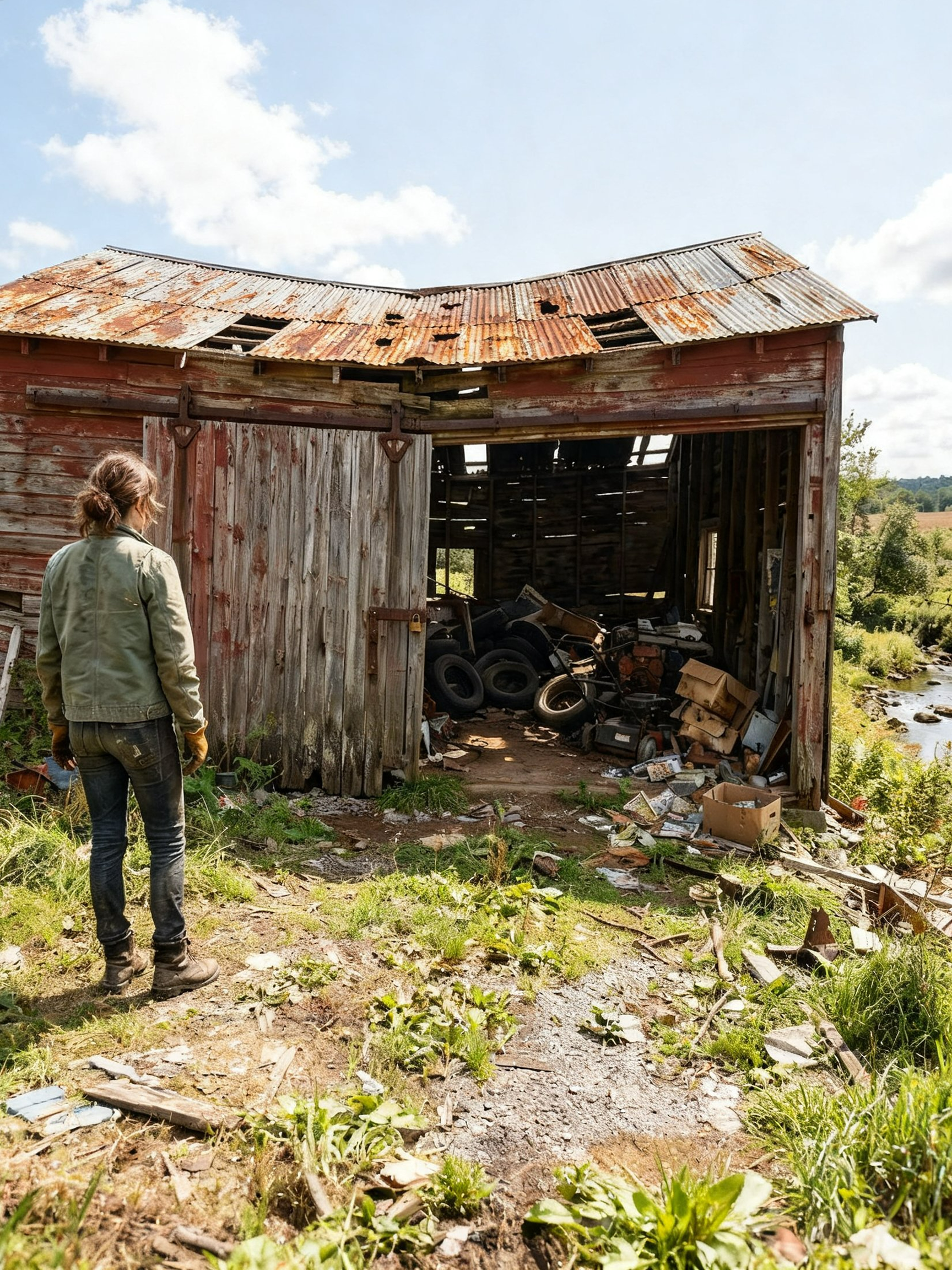
The old barn sat nearly half a mile behind the farmhouse, beyond the dried creek bed and the abandoned orchard.
Its roof sagged.
One wall leaned six inches east.
The loft had been unsafe since a storm tore away part of the siding in 2012.
Frank had stopped keeping cattle there years ago.
It looked worthless.
Rebecca stared at the paper.
Five acres.
One collapsing barn.
Everything else to Diane.
The father Rebecca had sacrificed almost a decade of her adult life to help had left her a building nobody wanted.
Diane watched her carefully.
Perhaps hoping Rebecca would scream.
Perhaps hoping she would cry.
Perhaps hoping she would accuse them.
Instead Rebecca slowly lifted her gaze.
“How soon do you need me gone?”
The room changed.
Just slightly.
Travis stopped smiling.
Melissa looked up from her phone.
Even Martin finally met Rebecca’s eyes.
Diane hesitated.
“Three days.”
Rebecca nodded.
“All right.”
That was all.
No pleading.
No accusations.
She folded the eviction notice once, placed it in her purse, and stood.
Diane seemed almost offended.
“You understand that once you leave, you can’t come back into the residence without permission.”
“I understand.”
“And the furniture stays.”
Rebecca nodded.
“The furniture stays.”
“Your father’s truck too,” Travis said.
Rebecca looked at him.
The Rolex hung loosely on his wrist.
Frank’s wrist had become so thin during the final weeks that the watch had slid halfway down his forearm.
Rebecca remembered fastening it for him one morning.
His fingers had been too weak.
Travis grinned.
“Company property.”
Rebecca held his gaze for several seconds.
Then she said, “Take care of it.”
Something in her voice made the grin disappear.
She walked upstairs.
Behind her, Diane called, “Rebecca?”
Rebecca stopped on the fourth stair.
“We should try to handle this like adults.”
Rebecca turned.
Diane smiled faintly.
Rebecca returned the smile.
“I think we are.”
Then she continued upstairs.
That frightened Diane more than anger would have.
Rebecca packed for less than two hours.
She took her clothes.
Her mother’s Bible.
Three framed photographs.
A cedar jewelry box.
A stack of nursing journals.
Her father’s handwritten recipe for peach cobbler.
And an old brass key she found inside the back pocket of the denim jacket she had worn to the hospital the night Frank died.
She nearly threw the key onto the dresser.
Then she stopped.
It was large.
Too large for any lock inside the farmhouse.
A strip of faded red electrical tape circled its neck.
Rebecca stared at it.
Something tugged at her memory.
Her father standing near the old barn the previous October.
Wind pushing dry leaves across the pasture.
Rebecca had brought him lunch because he had disappeared from the house despite barely being strong enough to walk fifty yards.
She had found him leaning against the barn door.
“What are you doing out here?”
“Remembering.”
“You’re going to kill yourself remembering.”
Frank had smiled.
Then he had looked at the barn.
Not casually.
As if it were listening.
“This place kept more than cattle,” he had said.
Rebecca had assumed he meant family memories.
Now she rolled the brass key between her fingers.
There was something scratched into one side.
Not initials.
She put it in her pocket.
By sunset, Rebecca had loaded everything she intended to take into her twelve-year-old Subaru.
She slept one final night in her childhood bedroom.
At the following morning, she heard laughter downstairs.
Diane had invited a real estate broker over.
Frank had been dead five days.
Rebecca lay still beneath the quilt and listened as strangers discussed how beautiful the farmhouse would look with lighter flooring.
One of them suggested tearing down the wall between the kitchen and breakfast room.
Another said the red barn in the distance hurt the view.
Diane replied, “Fortunately, that isn’t our problem anymore.”
Rebecca closed her eyes.
That sentence did something useful.
It burned away the last remaining doubt.
By noon, she was gone.
She did not hug Diane.
She did not shake Martin’s hand.
She did not ask Travis why he thought wearing a dead man’s watch made him important.
She drove past the mailbox her father had installed when she was eight, past the maple trees her mother had planted, and down the gravel road without looking in the rearview mirror.
For the first time in thirty-eight years, Rebecca Hale had no home.
But she owned a barn.
And she had a key.
Rebecca rented a room at the Cedar Ridge Motor Lodge for $68 a night.
The carpet smelled faintly of bleach and cigarettes.
The heater clanked every twelve minutes.
Her window faced a dumpster.
She sat on the edge of the bed that evening eating crackers and cheddar cheese from a gas station bag.
Her phone vibrated repeatedly.
Family members.
People who had attended the funeral.
Most had heard some version of Diane’s story already.
Frank had supposedly worried Rebecca had “put her life on hold too long.”
Diane was supposedly encouraging her to “finally become independent.”
The barn was supposedly Frank’s “little gesture” to help Rebecca start over.
It was astonishing how quickly theft could become generosity when enough people repeated the correct version.
Rebecca ignored the messages.
She opened the small fireproof folder she had carried from the farmhouse.
Inside were records from nearly nine years of her life.
Pharmacy receipts.
Hospital parking stubs.
Home health schedules.
Mortgage transfer confirmations.
Equipment invoices.
She had paid many of them herself when Frank’s farming operation had struggled during two drought years.
No one knew that.
Frank had been proud.
Rebecca had protected that pride.
When his first major surgery happened, she left a hospital administration job in St. Louis and returned home “for a few months.”
A few months became nearly nine years.
She handled payroll when Frank could not.
She negotiated feed contracts.
She drove him to oncology appointments.
She administered injections.
She cleaned surgical drains.
She cooked.
She changed dressings.
She slept on a recliner outside his room when he was too weak to call for help.
She never asked for wages.
Frank occasionally tried to pay her.
She always refused.
“Put it back into the farm.”
Diane had joined their lives six years ago.
At first Rebecca liked her.
Frank had been lonely since Rebecca’s mother, Ellen, died.
Diane seemed bright and energetic.
She organized dinners.
She convinced Frank to travel.
She redecorated the upstairs bedrooms.
Gradually, however, Diane began speaking about the farm as if Rebecca were a temporary guest.
“Our land.”
“Our future.”
“Our retirement.”
Then Travis appeared more often.
Then Melissa.
Then Martin started meeting privately with Diane and Frank.
Rebecca noticed.
She did not question it.
That failure now felt expensive.
At 10:07 p.m., Rebecca took the brass key from her pocket.
She searched her father’s old text messages.
She searched emails.
Then she remembered his desk calendar.
The previous year.
She opened photos on her phone, scrolling backward.
Three photographs from the farm.
One showed Frank asleep in a hospital recliner.
One showed a sunrise.
The third made Rebecca sit upright.
The old barn.
She did not remember taking the picture.
She enlarged it.
Frank stood near the barn doors.
Behind him, almost hidden in shadow, was a small rectangular steel plate mounted beside the original stone foundation.
Rebecca had seen that plate a thousand times.
She had assumed it covered an old electrical junction.
Her pulse changed.
At the next morning, she drove back to Cedar Ridge.
She did not approach the farmhouse.
She turned onto County Road 11, then used an old maintenance track that reached her five-acre parcel from the south.
The boundary had already been marked.
Bright orange survey ribbons fluttered from new stakes.
Rebecca parked beside the barn.
The October air smelled of wet grass and cedar.
The structure looked worse in daylight.
Boards silvered by age.
Broken gutter.
Rust along the hinges.
One missing window.
Rebecca stood silently.
This was what her father had left her.
She should have felt humiliated.
Instead she felt watched.
She walked to the stone foundation.
There was the steel plate.
It had no visible keyhole.
She brushed dirt from its surface.
Three narrow slots.
Rebecca examined the brass key.
Three teeth.
Her hand began trembling.
She inserted it.
The key turned.
There was a heavy click inside the wall.
Nothing happened.
Rebecca pulled the plate.
It swung outward.
Behind it sat a recessed metal compartment.
Inside was a waterproof document pouch.
And an envelope.
Her name was written across it in Frank’s handwriting.
She stared at the letters for nearly a minute.
Then she sat down in the wet grass.
Her fingers refused to cooperate.
Finally, she opened it.
If you found this, things went the way I was afraid they might.
First, I am sorry.
Second, do not confront anyone yet.
Third, the barn is not the inheritance.
It is the door.
Rebecca stopped breathing.
She read the lines again.
The barn is not the inheritance.
It is the door.
Beneath the letter lay a small flash drive.
A second key.
And a folded survey map.
Frank’s message continued.
There are people around us who learned to confuse access with ownership. I allowed that to happen longer than I should have because I kept believing blood, marriage, and friendship would restrain greed.
I was wrong.
You gave nine years of your life to keep me alive and this farm standing. I know you never kept score.
Do not trust any will dated after June 14 three years ago until Laura sees it.
Rebecca frowned.
Laura Benton.
She had been Frank’s attorney before Martin Kessler.
Rebecca had not heard the name in years.
The next line made her stomach tighten.
Do not trust Martin.
Rebecca slowly looked toward the distant farmhouse.
The page trembled in her hand.
Frank had known.
At least part of it.
His letter continued.
Your mother and I created Hale Land Preservation Trust in 1998. The trust owns more than the house acreage. It owns the ground beneath nearly every major asset that has been represented as belonging to Hale Agricultural Holdings.
Read that again before you do anything.
Rebecca did.
Then a third time.
The trust owns the ground.
Her eyes dropped to the survey map.
Red outlines covered nearly 1,400 acres.
The farmhouse.
The north timber.
The cattle fields.
The leased highway parcels.
The equipment yard.
Even land Rebecca believed Frank had purchased years after Ellen’s death.
Beside several parcels were handwritten initials.
Hale Land Preservation Trust.
Rebecca continued reading.
Your mother made me promise that no spouse, creditor, investor, or child who did not understand the land could ever sell the heart of this place for pieces.
The trust cannot be revoked by a surviving spouse.
It can be controlled only by its successor steward.
That steward is you.
Rebecca covered her mouth.
For the first time since the funeral, tears came.
Not because of the land.
Because of her mother.
Ellen had died when Rebecca was twenty-two.
She had spent her entire adult life assuming her mother had left behind nothing but memories, recipes, and an old cedar jewelry box.
Yet here was Ellen’s hand reaching forward across sixteen years.
Protecting something.
Protecting Rebecca.
Protecting the farm.
Frank’s letter went on.
This is not about making you rich.
If you use it only for that, I failed twice.
The trust exists because land gave this family work when we had no money, dignity when we had no status, food when we had no security, and a place to return when everything else failed.
Keep what should be kept.
Sell what should be sold.
But never let the people who laughed at sacrifice define ownership.
Then came the warning.
One more thing.
The trust holds a first-priority ground lease on every structure built by Hale Agricultural Holdings on trust property.
If anyone attempts to transfer, mortgage, subdivide, or materially alter those assets without trustee consent, ownership of certain improvements can revert to the trust.
Laura has the original documents.
The copies in this compartment are evidence, not your weapon.
Do not swing before you know where they are standing.
If Diane gives you the barn willingly, let her.
Rebecca read that final sentence five times.
Then she laughed.
A quiet, stunned laugh inside a collapsing barn.
Diane had not thrown her a worthless bone.
Diane had handed her the only doorway capable of destroying everything Diane thought she owned.
Rebecca put the documents back into the pouch.
Then she called Laura Benton.
The number in Frank’s letter still worked.
A woman answered on the fourth ring.
“Benton Legal.”
“My name is Rebecca Hale.”
Not confusion.
Recognition.
“Where are you?”
Rebecca looked around the barn.
“At my father’s old barn.”
Laura exhaled.
“Did he leave you the key?”
“Did you open the foundation compartment?”
Another silence.
Then Laura said, “Do not leave those documents there.”
“I already have them.”
“Did my father know what Diane was doing?”
Laura’s response came carefully.
“He knew enough to become afraid.”
Rebecca closed her eyes.
“What happens now?”
“That depends.”
“On whether Diane has already tried to sell anything.”
Rebecca looked toward the house.
Through the trees, she could see vehicles near the driveway.
Not family cars.
Two black SUVs.
A white Mercedes.
People in coats walking the property.
“I think she has.”
Laura’s voice hardened.
“Then your stepmother may have just made this much easier.”
Diane did not merely believe she had won.
She believed she had won spectacularly.
Within ten days of Frank’s funeral, she signed a preliminary agreement with Crestmoor Development Partners, a regional developer based in Nashville.
Crestmoor wanted 612 acres.
Luxury homes.
An equestrian center.
A boutique hotel.
A private golf club.
The initial valuation was $18.6 million.
Travis told half the county about it.
He posted photographs online from the farmhouse porch with captions about “the next chapter.”
Melissa began interviewing interior designers for a condominium in Charleston.
Diane ordered architectural renderings.
She also fired three of Frank’s longtime farm employees.
One of them, Earl Dobson, had worked for the Hale family for thirty-one years.
Rebecca found him sitting outside Miller’s Feed & Supply two days later.
“You heard?” he asked.
Rebecca nodded.
“She said Crestmoor won’t need cattle hands.”
“You all right?”
Earl laughed without humor.
“I’m sixty-three years old, Becca.”
Rebecca sat beside him.
“I’m sorry.”
“You got nothing to be sorry about.”
“I should have seen more.”
Earl glanced at her.
“You saw plenty. You just kept believing decent people were embarrassed by greed.”
Rebecca looked at him.
Earl shrugged.
“Some people aren’t.”
That evening, Laura arrived at Rebecca’s motel.
She was seventy-one now, with white hair cut bluntly at her jaw and the posture of someone who had spent forty years making arrogant men regret interrupting her.
She carried two leather cases.
For three hours, she explained what Frank and Ellen had built.
The trust had started modestly.
Four hundred acres inherited from Ellen’s grandfather.
Over time, Frank added parcels.
Some purchases were made directly by the trust.
Others were transferred later.
The agricultural corporation owned operating assets, equipment, livestock, certain buildings, and business interests.
But much of the land remained inside HLPT.
The distinction had been invisible because Frank controlled both.
“Like owning a restaurant but leasing the building from yourself,” Rebecca said.
“And Diane owns the restaurant.”
“Some of it.”
“But I control the building.”
Laura’s expression barely changed.
“You control considerably more than the building.”
She opened a binder.
“The trust also owns the water rights.”
Rebecca stared.
“Which water rights?”
“All adjudicated surface and groundwater rights attached to the original parcels.”
“Crestmoor plans a golf course.”
Rebecca slowly leaned back.
Laura turned another page.
“And there is the access road.”
“The main road from Highway 28?”
“Trust property.”
Rebecca covered her face.
For several seconds neither woman spoke.
Then Rebecca started laughing.
Not from happiness.
From disbelief.
“They’re trying to buy a development site they can’t legally enter or water.”
Laura allowed herself a thin smile.
“Among other complications.”
“How could Martin miss this?”
“He may not have.”
The laughter stopped.
Laura opened another file.
“Frank contacted me fourteen months ago. He believed Diane was pressuring him to consolidate ownership into the corporation.”
“Did she know about the trust?”
“She knew something existed. She did not know its scope.”
Laura’s expression hardened.
“Martin prepared a series of documents that, had Frank signed all of them, would have attempted to collapse the lease structure.”
“Attempted?”
“The trust is irrevocable.”
“So they couldn’t.”
“They could create years of litigation. They could confuse title. They could pressure a sick man into creating apparent conflicts.”
Rebecca stared at the pages.
“Did Dad sign?”
Her stomach dropped.
Laura slid a photocopy across the table.
Frank’s signature.
Rebecca knew every curve of it.
But something looked wrong.
The F leaned too far forward.
The H lacked the small hook Frank always made.
“When was this signed?”
“Eleven days after his second stroke.”
Rebecca went very still.
“He couldn’t hold a fork eleven days after that stroke.”
The motel heater clicked loudly.
Rebecca looked at Laura.
“Are you saying his signature was forged?”
“I’m saying I hired a forensic examiner before Frank died.”
Rebecca’s pulse accelerated.
Laura reached into her case.
She removed a sealed report.
“Highly probable simulation.”
Rebecca said nothing.
Laura watched her.
“This is where I need you to be careful.”
“Because anger makes people hurry. Your father specifically did not want you to hurry.”
Rebecca looked down at the forged signature.
She thought of Martin at the dining-room table.
The silver cuff links.
The sentence.
The documents are valid.
“What did Dad want?”
Laura slid over a second envelope.
“To see what they would do if they thought nobody was watching.”
Inside was another letter.
A trap only works if the animal feels safe enough to step all the way inside.
Do not interrupt greed too early.
Rebecca looked up.
“You knew about this?”
“I knew he intended to leave the barn to you.”
“Why the barn?”
“Because the barn parcel contains the trust’s registered administrative situs.”
Rebecca blinked.
“In English.”
Laura smiled.
“The legal home of the trust is located on your five acres.”
Rebecca stared.
“They laughed because I got the barn.”
“They gave me seventy-two hours to leave.”
“And in doing that…”
“They ensured that the successor trustee possessed the trust’s administrative property without dispute.”
Rebecca sat back.
For the first time, she understood why her father had apologized.
Frank had not merely left her protection.
He had left her a test.
He needed Diane to believe she had everything.
He needed Martin to believe the danger was dead with him.
He needed Crestmoor to move.
Because greed hidden behind family language was difficult to prove.
Greed signed onto paper was much easier.
Rebecca spent the next three weeks doing something Diane found increasingly unnerving.
At least nothing visible.
She repaired the barn roof.
She replaced three rotten boards.
She hired Earl for twenty hours a week.
She moved an old desk into a cleaned corner and set up a coffee maker.
People drove by and laughed.
Travis stopped once in his new Range Rover.
“Settling into your empire?”
Rebecca stood on a ladder replacing gutter brackets.
He laughed.
“You know Crestmoor might buy your five acres eventually too.”
“Everything has a price.”
Rebecca climbed down.
“What’s mine worth?”
Travis glanced at the barn.
“Maybe sixty grand if they’re generous.”
“Generous.”
“Probably less because demolition isn’t cheap.”
Rebecca wiped her hands on her jeans.
“Would Diane sell it to them if she still owned it?”
“In a heartbeat.”
“Then I’m lucky she gave it away.”
Travis smirked.
“You always did know how to make losing sound noble.”
Rebecca smiled.
He drove away.
That afternoon, she recorded the exchange in a legal notebook.
Exact language.
Laura had instructed her to document everything.
Meanwhile, Crestmoor moved faster.
They spent $240,000 on preliminary engineering.
They commissioned soil studies.
They hired lobbyists to discuss rezoning.
They placed an option on adjoining parcels.
They paid Diane a nonrefundable $1.2 million exclusivity deposit.
Diane used part of it immediately.
New Cadillac.
New kitchen plans.
European cruise reservation.
Travis bought two horses despite having ridden exactly once in his life.
Melissa listed herself online as “Creative Director, Hale-Crestmoor Estates.”
The illusion of ownership grew so complete that they stopped speaking conditionally.
Not if the sale closed.
Not potential development.
Our development.
Not Frank’s farm.
Our property.
Rebecca heard all of it.
She remained quiet.
That silence began to irritate Diane.
One Sunday afternoon, Diane appeared at the barn.
She wore boots too clean for mud and a camel-colored coat Rebecca had given her for Christmas two years earlier.
Rebecca was sorting old tools.
Diane looked around with visible distaste.
“I don’t understand why you’re doing this.”
“Doing what?”
“Pretending this place matters.”
Rebecca placed a wrench into a toolbox.
“It mattered to Dad.”
“Frank couldn’t think clearly at the end.”
There it was.
Rebecca kept her face still.
Diane continued.
“He felt guilty.”
“About what?”
“About you wasting your life.”
Rebecca paused.
Diane saw the opening and stepped into it.
“You came back when he got sick. Fine. That was your choice. But sometimes you behaved as though the rest of us owed you something for it.”
Rebecca turned.
“I never asked you for anything.”
“No. That was worse.”
Rebecca almost smiled.
Diane crossed her arms.
“You acted like a martyr.”
“I changed Dad’s drainage bags.”
Diane flinched.
Rebecca continued calmly.
“I cleaned him when he lost bowel control. I slept in the hallway because he was afraid he’d fall. I learned every medication. I handled payroll when he forgot employee names. I drove him to fifty-three appointments.”
Diane’s expression tightened.
“You see? This is exactly what I mean.”
“You kept score.”
Rebecca looked at her for a long moment.
“No, Diane. You did.”
Wind moved through the gaps in the barn siding.
Diane stepped closer.
“Crestmoor needs part of this parcel for utility access.”
“I thought they didn’t need my barn.”
“They don’t need the barn.”
“What do they need?”
“A utility easement.”
“How wide?”
“Forty feet.”
Rebecca nodded.
“And what are you offering?”
“Twenty-five thousand.”
Rebecca almost laughed.
Instead she said, “No.”
Diane stared.
“Don’t be childish.”
“This project is worth nearly twenty million dollars.”
“Then twenty-five thousand seems low.”
Diane’s face changed.
Not frustration.
Rebecca saw it.
Diane recovered quickly.
“You really have become bitter.”
“Frank would hate this.”
Rebecca looked directly at her.
That was the knife Diane had been saving.
Rebecca let it enter.
Then she said, “Which Frank?”
Diane frowned.
“The one who couldn’t think clearly at the end?”
Diane’s mouth opened.
Rebecca returned to the toolbox.
The conversation was over.
Two days later, Martin Kessler called.
Rebecca let it ring twice before answering.
“We need to discuss an easement.”
“Diane mentioned it.”
“She says you refused.”
“Rebecca, Crestmoor is prepared to improve access and utilities throughout the entire area. This benefits everyone.”
“I own five acres.”
“You also have family interests.”
Rebecca stared at the barn wall.
“Family interests.”
“Martin, did you know Dad couldn’t hold a pen after his second stroke?”
But present.
“I don’t know what that has to do with an easement.”
“Nothing, probably.”
“Send the proposal to Laura Benton.”
This time the silence lasted much longer.
Finally Martin said, “Why are you speaking to Laura?”
Rebecca smiled.
“Shouldn’t I?”
“Laura hasn’t represented Frank in years.”
“That wasn’t my question.”
Martin’s voice lowered.
“Be careful.”
Rebecca’s smile disappeared.
“Is that advice?”
She looked toward the steel compartment in the foundation.
“Dad left me some advice too.”
Martin hung up.
That evening, Laura called.
“What did you tell him?”
“Almost nothing.”
“He contacted the county recorder thirty minutes after your call.”
Rebecca leaned against the barn desk.
“Looking for what?”
“The trust.”
“Did he find it?”
Rebecca closed her eyes.
“What happens now?”
Laura chuckled softly.
“Now they panic.”
Quietly at first.
Crestmoor’s attorneys requested additional title documents.
Diane called Martin seventeen times in two days.
Travis stopped posting development photographs.
Melissa deleted “Hale-Crestmoor Estates” from her profile.
A survey crew appeared near the access road, then left after forty minutes.
Three days later, Diane’s Cadillac came flying down the maintenance lane.
She entered the barn without knocking.
“What did you do?”
Rebecca was sitting behind the old desk.
“Hello, Diane.”
“What did you do?”
“The trust.”
Rebecca said nothing.
Diane slapped a folder onto the desk.
“Your father dissolved it.”
“Three years ago.”
Rebecca opened the folder.
A photocopy.
Frank’s alleged signature.
The same suspicious F.
Rebecca looked up.
“This one?”
Diane’s face tightened.
“You know exactly what it is.”
Rebecca placed it gently on the desk.
“Martin prepared it. Frank signed it.”
Rebecca tilted her head.
Diane’s voice rose.
“Stop playing games.”
“I’m not playing.”
“You’re trying to sabotage a sale that affects the entire family.”
“What family?”
Diane froze.
Rebecca’s voice stayed quiet.
“The family that gave me seventy-two hours?”
“That house became mine legally.”
“The assets became mine legally.”
“I didn’t challenge them.”
“Then what is this?”
Rebecca looked around.
Diane stared at her.
For the first time, Rebecca saw Diane without the confidence.
Without the polished grief.
Without Frank’s chair behind her.
She looked smaller.
Diane pointed at the photocopy.
“That trust was terminated.”
“Then you have nothing to worry about.”
The sentence landed exactly where Rebecca intended.
Diane took the document and left.
That afternoon, Crestmoor suspended its purchase agreement.
Not canceled.
The difference mattered.
Their $1.2 million deposit remained at risk.
Their engineering costs continued.
Their option contracts had deadlines.
The machine Diane had started could no longer stop cleanly.
Then Frank’s real trap appeared.
Crestmoor filed a petition in county court seeking declaratory relief.
They wanted a judge to confirm that the Hale Land Preservation Trust had been dissolved.
Martin submitted the termination document.
Under oath.
That was what Laura had been waiting for.
“Now?” Rebecca asked.
Laura looked at her over the conference table.
Their response contained four things.
The original 1998 trust agreement.
The 2009 reaffirmation.
The trust clause requiring consent from two independent protectors for termination.
And sworn statements from both protectors saying Frank had never requested termination.
Then Laura added the forensic handwriting report.
Then Frank’s medical records.
Then one final item Rebecca had not known existed.
Frank had recorded it nine months before his death.
The courtroom was silent when Laura played it.
Frank appeared thin.
He sat in the very barn Diane had mocked.
Behind him hung the original iron horseshoe Rebecca remembered from childhood.
“My name is Franklin James Hale,” he said to the camera. “I am making this statement because I have reason to believe documents may later appear claiming I revoked or dissolved the Hale Land Preservation Trust.”
Diane stopped breathing.
Rebecca sat beside Laura.
Frank continued.
“I have not dissolved it.”
Martin stared at the table.
“I do not intend to dissolve it.”
Travis shifted in his seat.
“My daughter Rebecca will become successor trustee upon my death.”
Diane turned slowly toward Rebecca.
Rebecca did not look back.
Frank continued.
“If any document suggests otherwise, I ask that its authenticity be investigated.”
The courtroom became so quiet Rebecca could hear the ventilation system.
Then Frank leaned closer to the camera.
“There is something else.”
Laura glanced at Rebecca.
Rebecca had never seen the recording.
Frank spoke more slowly.
“My daughter spent the better part of a decade holding together what illness took from me. She did it without salary, ownership demands, or public recognition. If anyone later claims I forgot that sacrifice, understand this clearly.”
“I did not forget.”
Rebecca’s eyes filled.
She kept her back straight.
“I was ashamed that I allowed her generosity to become convenient for everyone around me.”
Diane looked down.
Frank continued.
“I watched people begin treating her service as proof that her time was worth less.”
Rebecca covered her mouth.
“I watched people assume that because she did not demand credit, she did not deserve any.”
His voice broke.
“And I waited too long to correct it.”
Rebecca closed her eyes.
For years she had convinced herself she did not need acknowledgment.
That good work should be enough.
That love should be enough.
That being useful should be enough.
But hearing her father say it aloud cracked something she had kept sealed inside herself.
Frank looked straight into the camera.
“Silence is not the same as weakness.”
Then the video ended.
Nobody moved.
The judge called a recess.
Outside the courtroom, Diane approached Rebecca near the elevators.
“This is disgusting.”
Rebecca turned.
Diane’s eyes were wet with fury.
“You planned this.”
“You waited.”
“You let us spend money.”
Rebecca shook her head.
“You spent money.”
“You knew!”
“I knew what I owned.”
“You deliberately withheld it.”
Rebecca looked at her.
“You never asked.”
Diane laughed sharply.
“You think that makes you clever?”
“What do you want?”
That was the first honest question Diane had asked since Frank died.
Rebecca studied her.
“I wanted you to tell the truth before someone forced you.”
Diane’s face hardened.
“About what?”
Rebecca looked toward Martin, who stood twenty feet away speaking urgently into his phone.
“The signature.”
Diane went pale.
Just slightly.
Rebecca knew.
Diane knew too.
They stood facing each other.
Then Rebecca said, “You should get your own attorney.”
Diane whispered, “Martin is my attorney.”
Rebecca looked past her.
Martin was already walking away.
“No,” Rebecca said. “I don’t think he is anymore.”
The court ordered an evidentiary hearing.
Then the district attorney’s office requested the disputed original.
Then Martin claimed the original had been misplaced.
Then Crestmoor’s lawyers demanded reimbursement of their deposit.
Then the bank discovered Diane had used portions of the anticipated sale as collateral for a $3.6 million bridge loan.
Then everything began collapsing at once.
The family that had seemed like a unified system turned on itself.
Travis blamed Diane.
Diane blamed Martin.
Martin blamed a deceased paralegal.
Melissa claimed she had never understood the transaction.
Crestmoor sued everyone.
The bank froze several accounts.
The state bar opened an inquiry.
The district attorney subpoenaed electronic records from Martin’s office.
Rebecca watched from a distance.
She did not celebrate.
That surprised Earl.
“You’re not enjoying this nearly enough,” he told her one morning.
Rebecca smiled.
“I’m tired.”
They were replacing boards along the west wall of the barn.
Earl hammered in a nail.
“They’re destroying themselves.”
“Seems fair.”
Rebecca looked across the pasture.
“I spent years thinking winning meant making them feel what I felt.”
“Now I think winning means they never get to make anyone else feel it.”
Earl nodded.
“That sounds annoyingly mature.”
Rebecca laughed.
The criminal investigation uncovered what even Frank had not known.
Martin had not merely forged one signature.
Investigators found drafts of three different trust termination documents.
Metadata showed they were created after Frank’s stroke.
An email from Diane to Martin read:
He will sign whatever is put in front of him if we catch him before Rebecca gets home.
The trust problem has to disappear before Frank dies or Rebecca could control everything.
She doesn’t even know it exists.
That message was sent while Rebecca was at the hospital pharmacy picking up Frank’s anti-nausea medication.
Laura showed her the printout.
Rebecca stared at the timestamp.
She remembered that day.
Frank vomiting into a plastic basin.
Diane complaining that Rebecca had purchased the wrong sparkling water.
Something inside Rebecca finally became cold.
Laura watched her.
“You okay?”
Rebecca folded the page.
“You don’t look okay.”
“I’m done feeling sorry for people who planned around my kindness.”
Laura nodded slowly.
There was more.
The proposed Crestmoor development would have displaced fourteen tenant farming families leasing small parcels from Hale Agricultural Holdings.
Diane’s sale agreement gave them ninety days to vacate.
Rebecca knew most of them.
The Walkers.
The Suttons.
The Ramirez family.
Some had worked that ground for decades.
Nobody had told them.
One afternoon, Rebecca drove to the Ramirez house.
Carlos Ramirez opened the door.
He looked exhausted.
“We got the letter,” he said.
“They say January.”
“My father planted that east field twenty-nine years.”
Rebecca swallowed.
Carlos looked away.
“My wife found another place. Two counties over.”
“Don’t sign anything yet.”
He looked at her.
Rebecca hesitated.
Then smiled.
“Because January is a long way away.”
The trust did not just own land under Crestmoor’s proposed development.
It controlled the ground beneath eleven tenant farms.
As trustee, Rebecca had authority over those leases.
Within three weeks she issued new twenty-year agricultural leases to every active tenant family.
Fair rents.
Transfer protections.
Purchase options on certain improvements.
And clauses preventing arbitrary termination for luxury development.
Laura reviewed each one.
“You know what this does to valuation?”
“It knocks millions off the speculative development value.”
Rebecca signed the final lease.
Laura studied her.
“Your father said keep what should be kept.”
“So I’m keeping people where they belong.”
That decision changed the county’s opinion.
Until then, gossip had painted Rebecca as the bitter daughter fighting over inheritance.
But when the Ramirez family learned they could stay, Carlos told Earl.
Earl told everyone.
Soon people understood.
Rebecca was not blocking Diane’s deal to grab the $18.6 million for herself.
She was preventing hundreds of acres of working farmland from being erased.
The story changed.
People who had once whispered that Rebecca should “move on” began appearing at the barn.
Some brought coffee.
Some brought lumber.
Some brought memories of Frank.
An electrician rewired the barn for the cost of materials.
A retired carpenter repaired the loft stairs.
Two high school students volunteered on Saturdays.
Someone painted the old doors.
Rebecca refused to make the structure pretty.
She wanted it honest.
The barn became the temporary office of the Hale Land Preservation Trust.
A brass plaque appeared beside the door.
No polished lobby.
Just a restored barn where the person everyone dismissed now controlled one of the most valuable land portfolios in three counties.
The final civil hearing came eleven months after Frank’s death.
By then, Martin had been indicted on charges related to forgery, fraudulent instruments, and conspiracy.
His attorney advised him not to testify.
Diane had not been criminally charged yet, but prosecutors publicly confirmed the investigation remained open.
Crestmoor wanted out.
The bank wanted repayment.
Travis had sold Frank’s Rolex.
Rebecca learned about that from an investigator.
She thought it would hurt.
Oddly, it did not.
Frank was no longer inside the watch.
He was in a sentence scratched into a letter.
He was in a repaired beam.
He was in the fields outside the barn.
The judge’s ruling took fifty-three minutes to read.
The trust was valid.
The alleged termination was invalid.
Rebecca was confirmed as successor trustee.
All ground leases remained enforceable.
Several attempted transfers made without trustee consent were void.
And because Hale Agricultural Holdings had entered into prohibited financing secured against improvements located on trust land, specific reversion clauses had been triggered.
Laura slid a sheet of paper toward Rebecca.
Rebecca read it.
Then read it again.
She looked at Laura.
“What exactly does this mean?”
Laura’s mouth curved.
“It means Diane did not simply fail to sell the farm.”
Rebecca waited.
“She transferred control of several major improvements to the trust by violating the ground lease.”
“Which improvements?”
Laura pointed.
“The equipment complex.”
Rebecca swallowed.
“The grain storage facilities.”
Another line.
“The commercial buildings along Highway 28.”
Rebecca stared at her.
“All of them?”
“And the farmhouse?”
Laura paused.
Rebecca knew the answer before she spoke.
“The farmhouse sits on trust land.”
Rebecca looked toward Diane’s table.
Diane was speaking urgently to her lawyer.
“But the house belongs to the corporation.”
Rebecca’s pulse became audible in her ears.
“What happened?”
Laura tapped a clause.
“When Diane pledged the farmhouse structure as collateral without trustee consent, the improvement-reversion provision activated.”
Rebecca stared.
“You’re telling me…”
Laura leaned closer.
“The woman who gave you seventy-two hours to leave your father’s house no longer owns the house.”
Rebecca did not smile.
For several seconds, she simply breathed.
She remembered the eviction notice sliding across the table.
The cream sweater.
Travis wearing Frank’s watch.
Melissa laughing about the barn.
Three days.
Then Rebecca asked the only question that mattered.
“Does she know?”
Laura looked across the courtroom.
“She’s about to.”
Diane’s attorney received the order twelve minutes later.
Rebecca watched him read the relevant paragraph.
His face changed.
Then he whispered to Diane.
Diane turned.
Their eyes met across the courtroom.
Rebecca saw the exact moment understanding arrived.
Not the trust.
Not the development.
Not the forgery investigation.
Diane stood too quickly.
Her chair scraped against the floor.
Her attorney grabbed her arm.
Diane pulled away.
People turned.
The bailiff took a step forward.
Diane pointed at Rebecca.
“She cannot take my home.”
Rebecca did not move.
The judge called for order.
Diane’s voice cracked.
“That is my home!”
The words echoed.
Rebecca felt no triumph.
Only a terrible symmetry.
Outside the courthouse, reporters waited.
Rebecca declined to speak.
Diane did not.
She accused Rebecca of manipulation.
She said Frank would be ashamed.
She said a daughter had destroyed a family over money.
That evening, local television played the footage.
Rebecca watched from a folding chair inside the barn.
Earl sat nearby drinking coffee.
“You going to respond?” he asked.
“You should.”
“To her saying you stole the house.”
Rebecca looked around the barn.
Earl waited.
Rebecca smiled faintly.
“She knows where the paperwork is.”
Thirty days later, Rebecca drove to the farmhouse.
Diane had been given formal notice to vacate.
Laura recommended ninety days.
Rebecca chose six months.
Laura objected.
“She gave you seventy-two hours.”
“Then why six months?”
Rebecca looked out the office window.
“Because I don’t want to become good at what she was good at.”
Laura said nothing.
Rebecca continued.
“Cruelty doesn’t become justice because I’m holding the papers.”
So Diane received six months.
No harassment.
No public spectacle.
The decision confused everyone.
Especially Diane.
Two weeks before the deadline, Rebecca went to the house to inspect repairs required under the court order.
Diane opened the door.
She looked older.
Not dramatically.
But enough.
The polished confidence was gone.
Boxes lined the hallway.
For a moment neither woman spoke.
Then Diane moved aside.
Rebecca entered.
The house smelled different.
Less like Frank.
More like cardboard.
They walked through the kitchen.
The wall had never been removed.
Diane had canceled renovations after the development collapsed.
Frank’s coffee mug was gone.
Rebecca did not ask where.
At the dining-room table, Diane stopped.
“This is where you want me to apologize?”
Rebecca looked at the table.
Same place.
Same chair.
Diane gave a bitter laugh.
“Of course not. You want to be above it.”
Rebecca faced her.
“I want the truth.”
Diane’s eyes hardened.
“You already got it.”
“What truth do you want?”
Rebecca hesitated.
Diane looked away.
“Why what?”
“You had enough.”
“You would have inherited millions without doing any of this.”
Diane stared through the window.
“You had the house. The company shares. Retirement accounts. Insurance. You had more than enough.”
Diane said nothing.
“So why try to erase me?”
The question sounded weak.
Almost childish.
Rebecca knew that.
Diane probably knew it too.
For months Rebecca had imagined asking some devastating question.
Something sharp.
Something that would expose Diane.
Instead the truth came out quietly.
Diane sank into a chair.
Rebecca remained standing.
Finally Diane said, “Because Frank always looked for you.”
Rebecca frowned.
“All the time.”
“I lived here.”
“That’s not what I mean.”
Diane rubbed her hands together.
“If he bought a tractor, he asked what you thought. If the accountant called, he wanted you in the room. If he felt sick, he called your name.”
Rebecca stared.
Diane continued.
“When he woke up from surgery, he asked for you.”
Her voice tightened.
“When he was afraid, he wanted you.”
Rebecca felt something painful rise in her throat.
Diane shook her head.
“I was his wife.”
“But I was never necessary.”
Rebecca almost interrupted.
She did not.
Diane looked up.
“You were.”
There it was.
Not acreage.
Not Crestmoor.
The oldest thing in the world.
Jealousy dressed as entitlement.
Diane continued.
“After a while, I hated how everybody praised you.”
“Nobody praised me.”
“Frank did.”
“Not often.”
“To me he did.”
Rebecca froze.
Diane laughed bitterly.
“He talked about you constantly.”
Rebecca looked away.
“I didn’t know.”
Those two words cut deeper than any insult Diane had ever delivered.
Diane leaned back.
“And when Martin explained that Frank’s estate plan could leave you controlling the land…”
“You decided to remove the trust.”
“I decided to protect myself.”
“You forged his signature.”
“I didn’t forge anything.”
Diane looked at the floor.
Rebecca understood that was as close to confession as she would get.
She picked up her folder.
Diane suddenly looked afraid.
“You recorded that?”
“You expect me to believe you?”
Rebecca opened her purse and placed her phone on the table.
Screen visible.
No recording active.
“I came for the truth.”
Diane stared.
Rebecca thought for a moment.
“Because I spent too many years wondering what I did wrong.”
Diane’s face changed.
Rebecca continued.
“And I wanted to make sure the answer was nothing.”
She picked up her phone.
Diane whispered, “What happens to the house?”
Rebecca looked around.
“The trust keeps it.”
“Then what?”
Rebecca walked toward the door.
At the threshold she turned.
“Dad spent his last year worried about families who had nowhere to stay during long hospital treatments.”
Diane’s mouth opened slightly.
Rebecca continued.
“The farmhouse will become temporary housing for rural families with someone receiving cancer treatment at St. Vincent.”
“My mother’s sewing room becomes a children’s room. Dad’s downstairs office becomes an accessible bedroom. The trust will fund transportation to the hospital.”
Diane stared at her.
“You’re giving this house to strangers?”
Rebecca glanced around once more.
“I’m giving it back to what it was supposed to be.”
“And what was that?”
“A place people could come when life got bad.”
Rebecca stepped outside.
Diane followed her onto the porch.
She stopped.
Diane seemed to struggle with something.
Maybe remorse.
“Was any of it real?”
Rebecca turned.
The question came softly.
Rebecca could have punished her.
She could have said no.
She could have made every Christmas dinner, every birthday, every hospital night retroactively meaningless.
Instead she answered truthfully.
“It was to me.”
Diane looked as though she had been struck.
Rebecca walked away.
The farmhouse renovation took seven months.
The Hale Family Rest House opened the following spring.
Rebecca refused to put her own name on it.
A small plaque near the entrance carried only two names.
FRANK AND ELLEN HALE.
Below them:
FOR THOSE WHO NEED A PLACE TO LAND.
The barn remained Rebecca’s office.
The trust eventually sold 180 acres near the highway—but not to Crestmoor.
The buyer was a renewable-energy cooperative that agreed to lease revenue sharing with the county and preserve wildlife corridors.
The sale produced enough capital to stabilize the trust for decades.
Rebecca used another portion of the revenue to establish a medical caregiver fund.
It paid small grants to adults who had left jobs temporarily to care for aging parents.
No speeches.
No huge photographs of donors.
Just checks.
Mortgage assistance.
Respite care.
The kinds of things Rebecca once needed and never requested.
The tenant farms stayed.
Earl became property manager.
Carlos Ramirez eventually purchased the house on his leased parcel through the trust’s improvement program.
Martin Kessler accepted a plea agreement and lost his law license.
The criminal case against Diane ended differently.
Prosecutors ultimately charged her with conspiracy and attempted fraudulent transfer.
She pleaded guilty to a reduced felony count in exchange for cooperation.
She served nine months in a minimum-security facility and three years of supervised probation.
Travis moved to Florida.
Melissa stopped using the Hale name in business.
Rebecca rarely heard from either.
And Frank’s Rolex?
Two years after the funeral, a package appeared at the barn.
No return address.
Inside was the watch.
Nothing else.
Rebecca recognized a scratch beneath the clasp.
She wound it.
The second hand moved.
She sat alone at her desk while rain tapped the repaired roof.
For several minutes she watched the watch tick.
Then she placed it inside the old steel foundation compartment.
Beside Frank’s letter.
Beside Ellen’s trust documents.
Beside the brass key with red tape around its neck.
The barn no longer leaned.
Its roof no longer leaked.
Children from local schools occasionally visited to learn about land stewardship.
Farmers held meetings there.
Caregiver families wrote thank-you letters that Rebecca kept in a wooden box.
People sometimes asked why she had not torn it down and built something impressive.
Rebecca always gave the same answer.
“Because impressive things are often overrated.”
Five years after Frank’s death, Rebecca stood outside the barn on a late September evening.
The fields were gold.
The old orchard had begun producing again after decades of neglect.
Cars were parked near the farmhouse in the distance.
A family from Kentucky was staying there while their twelve-year-old daughter received leukemia treatment.
The girl’s younger brother had decorated the porch railing with paper airplanes.
Rebecca could see them fluttering in the wind.
Laura Benton, now mostly retired, sat nearby with a cup of coffee.
“You ever think about what would have happened if Diane hadn’t left you the barn?”
Rebecca smiled.
“She didn’t leave it to me.”
“You know what I mean.”
Rebecca considered the question.
Her father had built an elaborate legal defense.
Her mother had planted its foundation decades earlier.
But all of it had depended on one simple thing.
Greedy people overlooking something that looked useless.
The quiet daughter.
The caregiver.
The woman who did not keep score.
The land nobody valued until someone wanted to sell it.
Laura looked toward the sunset.
“Your father took a risk.”
“He couldn’t know for certain how Diane would behave.”
“Or that you’d find the key.”
Rebecca smiled.
“I think he knew I’d clean out my jacket eventually.”
Laura laughed.
Then her expression softened.
“Are you happy?”
Rebecca looked toward the farmhouse.
At the paper airplanes.
At Earl’s truck parked beside the equipment shed.
At the fields that still belonged to working families.
At the barn everyone once laughed at.
Laura nodded.
Sometimes that was enough.
After Laura left, Rebecca locked the barn and walked toward her car.
Halfway there, she stopped.
Something had been bothering her all day.
Just enough.
She returned to the barn.
Unlocked it.
Crossed to the stone foundation.
Opened the hidden compartment.
Frank’s letter lay inside.
She unfolded it once more.
The final lines had faded slightly along the creases.
If Diane gives you the barn willingly, let her.
Rebecca smiled.
Below that line, nearly hidden beneath the fold, was another sentence she had somehow never noticed.
Maybe the paper had been bent over it.
Maybe she had been too overwhelmed the first day.
Maybe she simply had not been ready to see it.
She read the words.
A person who believes you are worthless will often hand you the very thing that proves otherwise.
Rebecca lowered herself onto the old wooden chair.
She looked around the barn.
For years she had believed the great secret buried beneath it was the trust.
The acreage.
The water rights.
The leases.
The legal power.
She had been wrong.
The real inheritance was not $18 million in land.
It was not commercial buildings.
It was not a farmhouse.
It was not even justice against Diane.
It was proof.
Proof that the years Rebecca had given away were seen.
Proof that quiet work had value even when nobody applauded.
Proof that sacrifice did not become worthless simply because selfish people learned to benefit from it.
Her father had not paid her back.
He could not.
Nobody could return nine years.
Nobody could give Rebecca the career she left, the relationships that faded, the nights she slept on hospital vinyl, or the mornings she woke afraid her father had stopped breathing.
That time was gone.
But Frank had done the next best thing.
He had made sure the people who mistook her sacrifice for weakness could never profit from that mistake.
Rebecca folded the letter.
Outside, thunder rolled somewhere beyond the ridge.
She closed the compartment and turned the brass key.
Before leaving, she stood for a moment in the center of the barn.
Years earlier, Diane had laughed when Frank left it to her.
Travis had called it an empire.
Melissa had joked about demolition.
Martin had believed a forged signature could bury the truth.
Crestmoor had calculated everything in dollars per acre.
Every one of them had looked at the same broken barn and seen something worthless.
Rebecca had almost believed them.
She shut off the lights.
At the door, she glanced back into the dark structure where her parents had hidden not merely property, but a final defense for the daughter everyone assumed would remain quiet forever.
Then Rebecca stepped into the rain and locked the door behind her.
And for the first time, she understood the question Frank had really left waiting for them all:
If they were so certain she had inherited nothing worth fighting for…
why had they been so afraid of what she might find?
✓ Lynn R. Adams
Her Stepmother Took the House and Fortune, but the Old Barn Her Father Left Her Hid the One Thing They Feared “You have seventy-two hours to get your things out.” That was how Rebecca Hale learned t…