Her Sister Laughed When She Bought the $71 Cottage — Then the Chimney Started to Breathe Again…
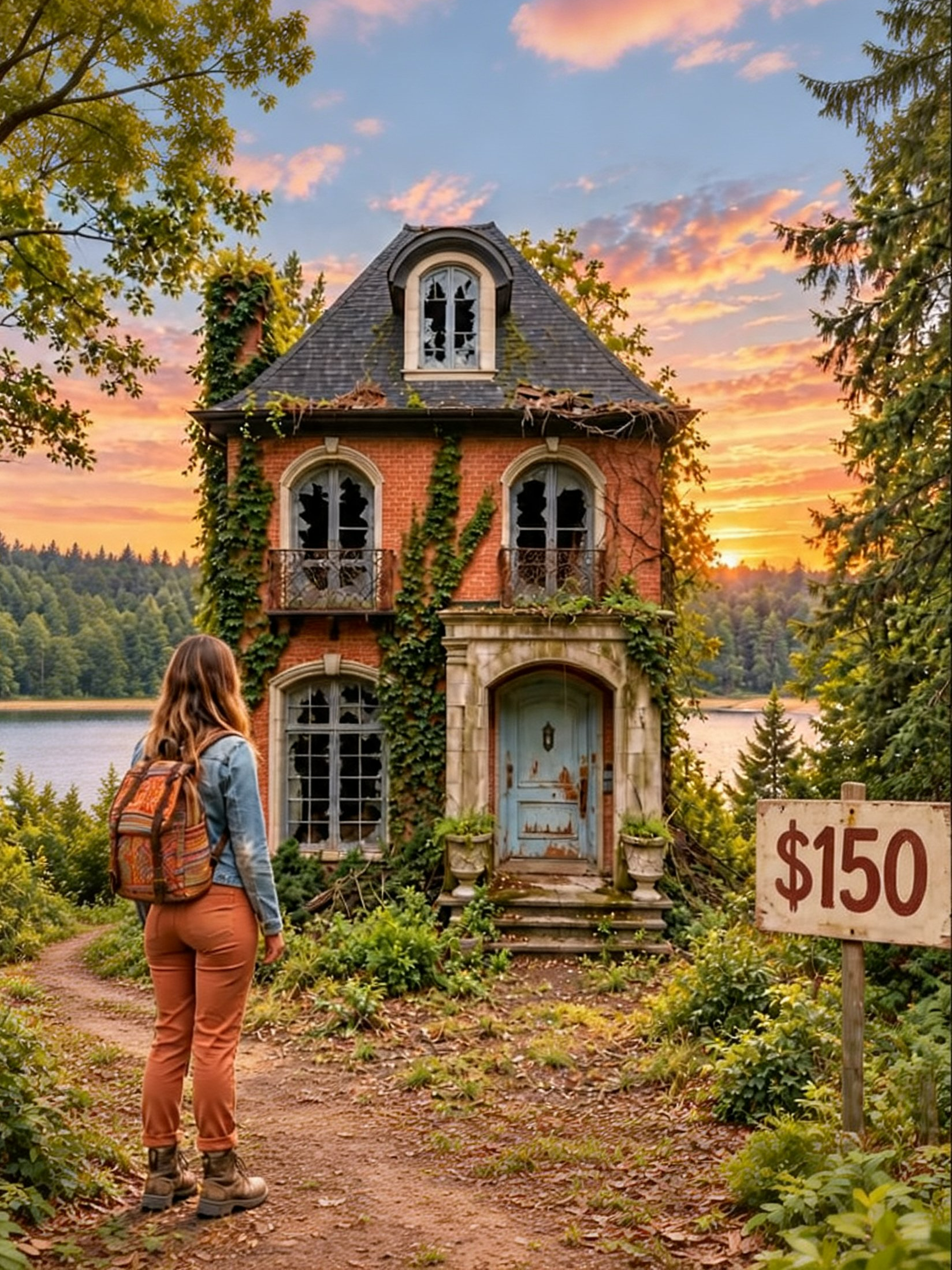
When my sister sold our family home while I was away grieving my brother, I had $287, an old pickup full of his cassette tapes, and nowhere I wanted to go. Then I paid $71 for an abandoned cottage beside an Adirondack lake, found a fireplace somebody had deliberately boarded shut, and discovered an envelope marked “Not until the hearth breathes again”…
The county clerk looked from my tax-parcel printout to my face. “You understand this is a liability, right?” she asked. On the counter between us was a picture of a crumbling brick cottage with a faded blue door, four acres of woods, and a strip of lakefront. I was twenty-seven years old, and I had never bought anything more expensive than my battered 2004 Toyota Tacoma.
Four months earlier, my brother Finn had died at twenty-two. For the last years of his life, I had been the person who managed his equipment, spoke to nurses, carried him upstairs, and slept near his bed when he needed help. I would have done it again. What I hadn’t learned was what to do with my hands when there was nobody left to care for.
Our father’s house in Montpelier had been the center of all of it. Three days after the funeral, my sister Tamson said we couldn’t afford to keep it. I asked her for one month, just one, before we made a decision. Then I went to a grief retreat in Craftsbury and returned to find a FOR SALE sign on the lawn.
The house sold in July. I took Dad’s old Carhartt jacket out of a Goodwill box, packed Finn’s twenty-two cassette tapes in a shoebox, and put them in my truck. Finn had recorded the tapes when his hands became too weak to write, but I couldn’t bring myself to play them. By October I had $287 left and a tremor in my left hand that hadn’t gone away since the hospice nurse closed his bedroom door.
I signed up with a trail-restoration crew in the Adirondacks because the work came with a bunk and meals. Our crew leader, Kira, gave me a hard hat and gloves that didn’t fit, then sent me to clear old drainage ditches and drag branches. My palms blistered, my shoulders ached, and for the first time in months I slept before dark. There was something merciful about being useful without being anybody’s sister or caretaker.
On our seventh day we worked along an abandoned forest road beside a creek. At lunch Kira told us not to go beyond a split oak because the path disappeared into swamp. When the crew headed back, I lingered, followed the creek around a bend, and walked through ferns almost to my waist. The trees opened onto a quiet bay.
There it stood: two stories of weathered red brick beneath a steep slate roof, ivy climbing the chimney, broken arched windows, bent little iron balconies, and a blue door under a carved stone arch. The brass knocker was shaped like a leaf. A ruined stone pier reached crookedly into the water. I stood there for so long that Kira eventually called for me from the trail.
I didn’t tell anyone what I’d found. That night I stared at the ceiling of my bunk, trying to remember the exact shade of the door. On our next town day, a woman at the volunteer firehouse helped me find the parcel on the public map. The last owner was Odalis Puit, who had died in 2014; taxes had been unpaid since 2015.
That’s how I came to stand in front of Rita at the Essex County Clerk’s office. She explained that the property could be transferred under a county surplus covenant: about $62 in back taxes, a $9 administrative fee, $71 altogether. But I had to document $8,000 in qualified improvements or bring the house to habitable code within eighteen months, or the county could take it back without refund.
I counted the cash in my wallet twice. Then I put four twenties on the counter, signed and initialed the papers, and took back nine dollars. Rita wrote the compliance deadline on the manila envelope containing my deed. I walked outside knowing I had just traded most of my remaining certainty for a damaged house I couldn’t even drive all the way to.
I left the trail crew, parked at the old gate, and carried my things the last half mile. Rain was starting when I reached the cottage. The blue door had no working lock; it opened with a dry groan. “Well,” I told the empty kitchen, “I guess I live here now.” It was a ridiculous thing to say aloud, but I hadn’t had a place that felt like mine in months.
There was a cast-iron sink with a dead hand pump, curling linoleum, and a table propped up with a brick. The parlor had dusty oak floors and a fireplace covered by thick plywood, four screws countersunk neatly into it. Upstairs were two bedrooms and a bathroom. I brought in bread, peanut butter, a camp stove, Dad’s jacket, and Finn’s shoebox, but that first night I couldn’t make myself open the tapes.
The next morning a diesel engine stopped up the road. A solidly built woman in muddy rubber boots came through the ferns with donuts and a thermos. “I come in peace,” she said. Her name was Delphine Vance, she ran a boat business at the public launch, and Rita had called her because she worried somebody would freeze at the cottage.
Over coffee, Delphine told me Odalis had been a librarian for thirty-one years. She had lived here with a geologist named Pell until Pell died in 1991, then remained alone with her garden and her dog. Odalis had died at the hospital in Elizabethtown, and nobody had come forward to claim the house. The county had boarded up the fireplace because its chimney was cracked and unsafe.
Delphine gave me three names I could trust: Jarvis Boon for masonry, Petra at the historical society, and Brin Callaway at the Big Slide Diner for work. Before leaving, she laid a worn wooden spoon on the kitchen table. “My grandmother carved it,” she said. “A person can’t live in a house without a wooden spoon.” It was the first housewarming gift I’d ever been given.
After she drove away, I opened a kitchen drawer looking for a screwdriver. Under twine, old letters, and a dish towel lay a pale linen notebook marked HOUSE JOURNAL, O. PUIT. Inside were forty years of ordinary, meticulous notes: roof slates, garden plants, birds on the bay, repairs to the dock. On a hand-drawn floor plan, a star marked the chimney, with a warning that the flue had cracked again and must not be used without full replacement.
Taped inside the back cover was an ivory envelope sealed with red wax. Four words were written across it in heavy pencil: “Not until the hearth breathes again.” I had no idea who the message was for, but I knew it wasn’t a request to build a fire in a dangerous chimney. I set the journal aside and went into the parlor.
The screws in the plywood resisted, then turned. I lifted the sheet away and found a cold brick firebox, an open damper, and the gray remains of a fire that had gone out years before. When I knelt and tilted my head toward the left side of the chimney throat, something caught the daylight about eighteen inches above the opening: a small, flat tin box resting on a brick ledge, its lid bound with waxed red thread.
I didn’t reach for it. In the kitchen was a sealed envelope that wouldn’t be opened until the hearth worked; inside the unsafe chimney was a box that somebody had hidden with care. I sat back on my heels, looked up at that thread, and understood that getting this house warm might mean keeping a promise to a woman I’d never met. Part 2…..
IF FACEBOOK BROUGHT YOU HERE, HERE’S THE CONTINUATION YOU’VE BEEN WAITING FOR. ENJOY! 👇 Rain began tapping the slate roof as I stood up. I put Delphine’s wooden spoon on the mantel and set Finn’s shoebox beside it, then found the napkin with Jarvis Boon’s number. My phone caught one bar of signal, just enough for a message explaining who I was, what I’d bought, and why I needed a safe chimney before winter. His answer arrived after dark: “Thursday. Ten. Bring coffee.”
I spent the next three days cleaning ash from the firebox, sweeping oak floors, and trying to keep the rain out of the broken upstairs dormer. The house journal became my instructions for almost everything else. Odalis had listed garden plantings going back decades, noted which stones slipped each spring, and sketched a woodshed built with a neighbor’s help. I began to recognize her dry humor in notes written for nobody but herself.
On a trip to town I ate pancakes at the Big Slide Diner, a narrow place with twelve counter stools and a chalkboard worn almost white. A young waitress named April brought me coffee. I read the local weekly paper slowly, enjoying the fact that not one person there knew my family or asked how I was holding up. Back at the cottage, I found letters from the Keen Valley Library and a photograph of Odalis with a little girl whose dark braid hung over one shoulder.
That Wednesday I tried sleeping upstairs, under a quilt that smelled faintly of cedar. I dreamed Finn was fourteen again, washing an apple at the kitchen sink and asking what I’d been doing lately. I woke before dawn with an answer I couldn’t give him. I made coffee and waited for Jarvis on the stone steps.
He came down through the ferns just before ten, tall and broad-shouldered, with a scar through his left eyebrow and brick dust on his work pants. He took the spare mug and walked around the house, studying the chimney, roofline, and old flashing. When he came back, he sat beside me and said, “You can’t light a fire in that as it stands.” The words landed harder than they should have.
Then he explained what it would take: a stainless-steel liner, new cap, repointing above the roof, replacement damper, and smoke tests before any real fire. At ordinary rates, materials and labor would come to about $7,600. I told him I had $216. He looked over the lake, took another swallow of coffee, and told me he sometimes chose a job to do nearly at cost because he’d regret walking away.
I would pay supplier prices for materials, ten dollars an hour for his labor, and feed him lunch; he’d teach me what work I could safely do myself. His wife, Hilda, was a nurse, he said, and they could manage this arrangement. “Why?” I finally asked. He said Odalis had spent a year teaching his mother to read English when she cleaned the library at night. His mother already spoke four languages; she simply hadn’t known the letters in the books around her.
He wasn’t offering charity so much as paying forward an old kindness. I agreed not to touch the roof without him, to follow his repair plan, and to keep working toward the county inspection. After he left, I wrote in the first blank space in Odalis’s journal that Jarvis Boon was fixing the flue for his mother. It seemed important to record why, not just what.
That afternoon I asked for Brin Callaway at the Big Slide. She was fifty, with a steel-gray braid and the look of a woman who could carry three loaded trays while telling a man to get out of her way. She inspected my blistered hands and offered me four shifts a week, in the morning until one, at thirteen dollars an hour plus tips. When I mentioned the cottage, she said she had known Odalis and regretted never having the patience to be her friend.
For three weeks I worked the counter before sunrise, learned which regulars wanted their mugs filled without asking, and put my tips in a mason jar. By afternoon I’d be hauling supplies toward Still Hollow Bay. Some days the jar paid for mortar; other days it bought groceries and dry socks. It was not enough money for every repair, but it was money I’d earned for a future instead of money draining away from a past I couldn’t change.
Jarvis worked weekends, bringing a proper scaffold and safety harness for the chimney. I helped from the ground, handled materials under his direction, and listened while he explained why the old clay flue couldn’t simply be patched and forgotten. We replaced the failing parts, checked the draw, and watched test smoke travel cleanly through the new liner. When he climbed down after the final test in November, he wiped his forehead and said, “She breathes.”
I chose the following Sunday for our first proper fire. I called Delphine from the pay phone outside the diner because my cell signal was unreliable, and she asked whether Brin could come. She’d already invited her. Jarvis said he would bring Hilda, who apparently hugged people before they could find a way out of it. I was used to handling medical emergencies, not having four people rearrange their Sunday for me.
Delphine arrived with a dented coffee pot and a chair in her truck. Brin brought a pie wrapped in foil, while Jarvis and Hilda came through the ferns carrying extra mugs. Hilda had iron-gray hair braided around her head and a coat the color of moss. She hugged me so firmly I forgot what I’d been about to say, then took the pie into the kitchen as though she had been coming there for years.
Jarvis had arranged dry oak, birch bark, and newspaper in the firebox. He handed me the long match. “You own the house,” he said. “You light it.” I knelt while Delphine stood near the doorway, Brin settled into the chair with the bluebird cushion, and Hilda watched from the kitchen with the coffee pot. The match scratched, the bark caught, and smoke moved upward instead of rolling into the room.
Part 3 For nearly a minute nobody spoke. Outside, a narrow gray plume rose from the ivy-covered chimney into the cold November sky. The fire made a low pulling sound I could feel in the floorboards. Brin finally murmured, “There she is.” I looked at the mantel, where the wooden spoon and Finn’s tapes had been waiting through all the work, and knew it was time to take down Odalis’s journal.
I slid the ivory envelope from behind the back cover and broke its red wax seal. Inside were a hand-cut brass key with red thread through its bow, an address in Bend, Oregon, and three folded sheets of yellow writing paper. I sat near the fire to read, and without really deciding to, I read aloud. No one interrupted me.
Odalis had dated the letter October 29, 2013, and addressed it to whoever had finally made the hearth safe. She wrote that if I’d bought the cottage, repaired the chimney, and waited to open her envelope, she hoped I could be trusted with one more task. Eighteen inches up the left side of the chimney was a little tin box. I was to take it, unopened and unheard, to a woman in Bend named Vera Leah Olsen.
Odalis explained that in 1991 this woman had called herself Vera Leah Elgen. She had arrived at the cottage with a cassette she’d recorded and a plan to disappear. Odalis had agreed to guard the tape, and Vera had promised to send a postcard each year to show she was alive. The last postcard Odalis had received was from Oregon. If Vera was alive when the box reached her, only Vera was to receive it and decide its fate.
If Vera had died, Odalis instructed the finder to destroy the box and tape without listening. She didn’t say what the recording contained, only that it had given a frightened woman a way to leave and wasn’t anybody else’s story to own. The letter ended with homely requests: look after the garden, watch for loons in May, and keep a fire in the hearth. I reached the last line and found that the room had gone utterly quiet.
Brin knelt beside the newly repaired fireplace, reached carefully toward the brick ledge, and withdrew the little tin box. Its red thread had dried so thoroughly it broke when she touched it. She laid the box in my lap and said, “That’s not just a tape. That’s a woman’s life.” It was so light for something that had waited thirty-five years.
Delphine asked where the woman lived. I looked at the folded address and said, “Bend, Oregon.” Hilda said that was a plane ticket, and I started to explain that I couldn’t afford one. Brin went to the table, opened the leather coin purse she always wore, and put eight hundred dollars down. It was her spring tire money. Delphine added three hundred, and Hilda brought in a five-hundred-dollar check from the truck.
Jarvis said he couldn’t contribute cash, but he could drive us to Burlington airport and pick us up. Hilda told me Delphine had already agreed to go with me. When I protested, Delphine said I could repay her in coffee for the rest of my natural life. I hid my face in my hands; my shoulders moved, but I still couldn’t cry. For the first time in a long while, somebody else was insisting on doing the carrying.
On Monday Delphine sat with me at a library computer while I bought round-trip tickets through Chicago to Redmond, Oregon. Mine cost $382, and Delphine paid her own share. We arranged a modest motel and rental car, wrapped the tin in a wool sock for protection, and left room in the budget for getting home. I kept Odalis’s letter in my bag, separate from the box, and I didn’t try the key in its lid.
That night I called Tamson for the first time since July. I told her only that I was in New York and would be traveling for a few days. After a silence, she said she was glad I had called and that she was sorry. I wasn’t ready to have the conversation we’d been avoiding. I said I’d call again when I could, and for once I didn’t make a promise I wasn’t sure I could keep.
Jarvis drove us to Burlington before dawn on Tuesday. As I got out, he told me Vera might slam the door in my face and I had to let her. “It’s her door,” he said. Delphine and I flew west, collected a plain rental sedan in Redmond, and checked into the Juniper Inn on the north side of Bend. We ate meatloaf at a diner across the parking lot and agreed we would knock the next morning, not that night.
Vera’s address led to a small ranch house with gravel beds, neat juniper bushes, and a silver SUV in the drive. A hand-painted sign near the walk said the kiln studio was by appointment. Delphine parked across the street and stayed in the car. I carried the wool-wrapped tin in my backpack to a seafoam-green door and pressed the bell, feeling the familiar shake in my left hand.
A woman about sixty-seven opened it, tall with cropped white hair, strong clay-dusted hands, and a canvas apron over a navy flannel shirt. I introduced myself and said I’d come from New York because of Odalis Puit. She caught the doorframe with one hand. “Odalis is dead,” she said, not quite asking. I nodded, and her next question was whether the tape was in my bag.
She noticed Delphine in the car. I explained that my friend would wait unless invited, and Vera led me through a hallway of family photographs to a pottery studio behind the house. There were shelves of drying bowls, a wheel, buckets of clay, and a large electric kiln. Vera leaned against the cold kiln, folded her arms, and said, “Show me.” I unwrapped the tin but kept it in both hands until she reached for it.
When I told her Odalis had said the decision belonged to her, Vera took the box and held it against her chest. Then she told me something I wasn’t expecting: “You should not have come.” She wasn’t accusing me of stealing or prying. She meant I’d brought a past she’d carefully lived beyond into a life that had been peaceful for decades.
Part 4 Vera said her name had once been Elgen. She had left her first husband after years of violence, with a loaded shotgun under the seat of her station wagon because she feared he might follow. I listened without asking for the details she hadn’t offered. She had since become a potter, married a kind man, and raised a daughter and son; neither her husband nor her children knew the story of her former marriage or name.
She looked at the tin in her lap and said whatever happened next would touch more than just her. I realized I’d come expecting a delivery and a thank-you, not the responsibility of allowing her to be uncertain. Vera told me to go back to my motel and return at ten the following morning. She would make a decision, and I would have to respect it whether it pleased me or not.
At the door she asked who I had given my life to. “My brother,” I said. “He died in June.” She looked at me differently then and told me she was sorry. “You didn’t come to give me my old life back,” she said. “You came to give me a choice. There’s a difference.” I walked to the rental car empty-handed, while Delphine watched through the windshield without waving.
We ate at a small café called the Rimrock. I told Delphine only what Vera had permitted me to tell and admitted I had expected to return home feeling we’d finished something wonderful. Instead I felt as if I’d walked into a room where I had no right to rearrange the furniture. Delphine let me talk, and when I’d run out of words she ordered me another cup of coffee.
That night at the Juniper Inn, I lay awake listening to the heater cycle on and off. Delphine had a library book open across the other bed, though she hadn’t turned a page in ages. I said I might have been trying to turn someone else’s life into proof that my own still mattered. She shut the book and said caring for Finn had been love, but I couldn’t keep giving myself away just because I didn’t know who I was without somebody to carry.
It hurt to hear because I’d spent so many hours believing rest was a thing I had to earn. “I’m not asking you to fix that tonight,” she said. “Just notice it.” I stared at the water stain on the ceiling until the room blurred. Sometime before morning I slept.
At the next morning we drove back to Vera’s street. Delphine squeezed my elbow and remained in the car. Vera opened the door before I could ring, still wearing her apron, her white hair damp near the temples. In the studio she poured coffee into two small cups she’d made herself. The kiln was humming now, its indicator lights glowing, but she didn’t look at it while she began to speak.
She’d listened to the tape twice during the night. It was nineteen minutes long, recorded in Odalis’s spare bedroom in 1991, when Vera was thirty-two and frightened enough to need proof that the life she was leaving had really happened. The room had been the first place in years where she could shut a door without fearing someone would force it open. She had spoken into the recorder in case she never made it west.
Her mother had died believing she’d had a happy marriage. Vera wanted somebody to know otherwise, and Odalis had offered to be that somebody without demanding the whole story. Now Vera had a family, a studio she’d built with her own hands, and years of peace. She didn’t want the tape exhibited, documented, handed to her children, or guarded by another young woman. “I won’t give you my shadow to carry back across the country,” she said.
She had decided to destroy the recording in her kiln, where she’d made pottery for twenty years. It would be her choice, not an erasure forced on her by anyone else. She opened the tin and showed me the plain cassette, marked in her younger handwriting, “V for O only.” Beneath that she’d written four words in fresh black ink: “And now for me.”
Vera had prepared the kiln for the task and talked me through how to handle the tin without putting my hands near its heat. With protective equipment and her guidance, I placed it where she directed and closed the kiln. The old recording was gone beyond recovery. We sat on the concrete floor nearby while the equipment ran and cooled, neither of us trying to turn that decision into a speech.
After a while Vera cried, quietly and for longer than I expected. I sat close enough to be company but didn’t put an arm around her. Finn had taught me that sometimes a person wants a hand, and sometimes she wants the right not to be touched. When Vera finally rose, she wiped her face on the edge of her apron and told me she wanted the day to end here. She didn’t want us to meet again.
Before I left, she pressed a little blue-glazed bowl into my palm. On its underside were her initials and the year 2026. “For the next woman who sits by your fire,” she said. I thanked her and walked through the quiet house, past photographs of a family that belonged to her now, to the waiting car. Delphine said nothing until we reached the airport, when she took my hand and told me I’d done well.
We flew home through Chicago. Jarvis was at Burlington’s curb at the agreed hour, his truck heater running, and Hilda had brought soup in a thermos. Brin had checked on the cottage while we were gone. On the drive back I fell asleep with Vera’s blue bowl wrapped in a sock on my lap. For once, another person’s story had ended where its owner wanted it to end, not where I wanted to keep holding on.
Four days after I got back, I was tying on my apron at the Big Slide when Rita came in carrying a stack of papers. She slid a certified letter across the Formica counter and told me not to panic. A law firm in Albany claimed to represent the Puit Legacy Trust, which supposedly had a prior right to Odalis’s property. It demanded I give up my deed and leave within thirty days.
They offered to reimburse my seventy-one dollars and add five thousand as a “goodwill” payment. I read the letter twice while my first pot of coffee went cold. The house I’d worked to make safe was suddenly described as somebody else’s. I thought of the new chimney liner, the money in my mason jar, and the blue bowl on the mantel, and felt the old tremor wake in my hand.
Rita tapped the date on the papers. She’d personally checked the parcel status before approving my transfer, and no private claim had been pending. The trust named in the letter had been created on October 22, seven days after I signed. “Don’t sign anything, don’t move out, and don’t take the money,” she said. The county attorney would defend the county’s transfer, and she wanted me to keep every piece of correspondence.
Part 5 The listed trustee was a Brooklyn man named Cassen Wild. I didn’t know him, but Delphine remembered a stranger in a Rivian asking about the blue-door cottage at the boat launch. When I brought her the letter after my shift, she called Petra at the historical society. Petra recognized Wild as a man who had come through in August asking about filming a documentary involving Odalis’s abandoned property.
He’d asked whether the county could reserve the parcel for him. When Petra said its surplus process didn’t work that way, he had kept asking about the transfer rules. Delphine suspected he’d expected somebody poor to take on the repairs, grow desperate under the covenant, and then accept a cheap buyout. We didn’t know his whole plan, but the timing of the trust and the letter gave the county attorney something concrete to examine.
Delphine took me to meet assistant county attorney Michael Doran in Albany. He read the letter, checked the recorded deed and trust filing, and spoke with a state records contact about Wild’s previous entities. Several similar “legacy” organizations had been formed around other property disputes, which raised questions that needed proper review. Doran said the county would answer the claim, challenge its basis, and consider requesting sanctions; he told me not to mistake a threatening letter for a court order.
I asked if he could promise I’d keep the house. “I can tell you our record supports the transfer,” he answered. “Let us do our job.” On the ride north, Delphine said Wild had probably imagined I would take his money and tell everyone I’d tried. I looked at the folded letter in my bag and thought how close five thousand dollars would once have come to looking like rescue.
Nine days later the trust withdrew its claim. There was no dramatic confrontation and no man arriving at my door to apologize. Rita confirmed the withdrawal, the county kept its paperwork, and my covenant still applied. I still had to repair the rest of the house and pass inspection, but I wasn’t going to be bought out of the place I’d begun to build for myself.
By December, eighteen inches of snow lay around the cottage and ice was edging across the bay. The newly repaired fireplace worked, and Jarvis finished necessary roof repairs before Christmas. I continued my four diner shifts, budgeted carefully, and began paying Delphine back fifty dollars at a time. She wrote receipts and stacked them on a little stove in her office, promising that one day she’d burn the whole stack and call us even.
I still slept downstairs some nights, though Hilda eventually replaced my threadbare sleeping bag. The dock leaned into the water and would have to wait for spring. I kept a notebook of every repair and receipt for the county covenant. The work was never romantic when I was hauling wet supplies through half a mile of woods, but I liked being able to see what had changed at the end of a day.
On December 18 a six-page letter arrived from Tamson. She wrote that she’d sold Dad’s house because she was terrified of losing anything else and had mistaken getting things done for knowing what was right. She drove past the old place every week and still felt the absence of it. She hadn’t only lost a house, she said; in her rush to finish the painful business, she had pushed away her sister.
She didn’t ask me to say it was all right. She asked whether she could visit in April and bring our mother’s cookbooks, which she’d kept but couldn’t bear to open. I read the letter three times by the fire. Then I wrote back, “April. Bring the cookbooks. There’s a diner here you’ll like.” It was a small reply, but it was the first invitation I could mean.
Five days later, on December 23, snow was falling in slow, heavy flakes outside the arched parlor window. I had a good fire going, and I was wearing Dad’s old jacket. Finn’s shoebox sat on the mantel between the wooden spoon and Vera’s blue bowl. I had put new batteries in his old Walkman weeks before, but every time I reached for a tape I’d stopped.
That evening I didn’t stop. The first cassette had his uncertain handwriting on the label: “Tape one. Hi, Mave.” I put on the headphones and pressed play. There was a hiss, then his breath, then the voice I had spent months fearing I might forget. He laughed a little, and I recognized the sound so completely that I covered my mouth with both hands.
Finn said he knew I’d try to make up for being tired after he died. He knew I’d find somebody else who needed carrying, because carrying was the way I knew how to love. He loved that about me, he said, but he didn’t want it to become the only way I knew how to live. He had made the tapes on one condition: I wasn’t to play them until I had gone somewhere new.
Then he told his version of the time Dad took us fishing on Lake Elmore, caught his own ear with a hook, and said a word our mother would never allow inside the house. I knew the story, but Finn got the pauses wrong in exactly the way he always had. I laughed, then cried, then laughed again. I played those nineteen minutes five times before putting the cassette carefully back in its box.
I lay on the oak floor with Dad’s jacket over my legs and told Finn aloud, “I live here now.” I had traveled clear across the country for someone else’s cassette, then come back to find that the recording I most needed was waiting where I’d left it. It didn’t make losing him easier. It let me hear him without losing the rest of the room.
Part 6 In April the snow finally loosened its grip. Jarvis supervised rebuilding the crooked dock with pressure-treated lumber, and I carried and fastened what he instructed. Delphine brought materials across the inlet by canoe when the old forest road was too muddy for the truck. I found myself looking forward to May because Odalis had written so much about the loons that returned to Still Hollow Bay.
Tamson arrived April 22 with a Subaru full of cookbooks and an expression I recognized from our childhood: she was trying to decide whether to speak first. She stayed four days in the upstairs bedroom. We cooked a little, argued once over nothing important, and fell quiet over our grandmother’s cookbook when we found a note in Mom’s handwriting about a Christmas pie I’d made in 1998. We cried at different times, which turned out to be easier than trying to cry together.
On the stone steps before she left, Tamson hugged me carefully, as though we were both checking what might break. We agreed she would come again at Memorial Day. Neither of us claimed a single visit fixed what happened in July. I watched her Subaru disappear along the road and went back inside to put Mom’s cookbooks where I could reach them.
Three pairs of loons came in May, just as Odalis had once recorded in the journal. One pair nested near a floating log; Jarvis helped anchor it safely by the shore, while Delphine brought binoculars. We sat without speaking for long stretches, looking over the bay. There were days when keeping a house meant replacing rotted wood and days when it meant noticing that the birds had returned.
The county’s habitable inspection was June 3. Inspector Enrique Ruiz checked the repaired chimney and stove, roof, electrical work completed with a licensed electrician, and the rest of the cottage room by room. He had known Odalis a little, but he didn’t let sentiment take the place of his checklist. I followed him with my stack of receipts until, after forty-seven minutes, he signed the certificate and handed it to me.
“You’re legal,” he said, and drove away in his county truck. I stood alone in the parlor staring at the paper, then went out to the steps and called Delphine. “We did it,” I said. She already knew; Enrique had called her on the way down. I laughed at how impossible it was to keep news to myself in a town where nearly everybody had helped make it.
Passing inspection meant I could keep the cottage under the county agreement, but I knew I couldn’t treat that as the end of the story. Odalis had given Vera a room where a door could stay closed, and Vera had allowed me to understand why that mattered. I wanted other women to have a place where no one demanded an explanation, a plan, or a gratitude speech before they were allowed to rest.
That July we formed Still Hollow Rest as a nonprofit in New York, with me, Delphine, Brin, Hilda, and Petra on the board. Petra helped with paperwork at cost, and we worked out how to offer brief free stays without pretending we were a clinic or a shelter with trained staff. Our written purpose was simple: an adult woman who needed a quiet week to make a decision about her own life could stay up to seven nights, eat, sleep, walk, read, or do nothing.
If she wanted to bring a friend or child, the upstairs rooms could accommodate them. Nobody could come inside without the guest’s permission, and nobody was required to produce a breakthrough before leaving. We did not promise to solve problems we weren’t qualified to solve. We promised a safe, quiet place, an open notebook, and a fire when the weather called for it. I pinned the mission statement inside the kitchen door.
I also filled out an application to study library and information services part-time at North Country Community College in Saranac Lake. For years I’d made choices according to what someone else urgently needed. I wanted to learn something simply because I liked it, and perhaps because the careful woman who’d kept the house journal had shown me what attention could do. I was accepted in August and began planning two classes each semester while keeping my diner shifts.
Our first guest, Yolanda Reeves, arrived September 18 from Rochester. She was forty-three and carried an unopened envelope from a lawyer in her backpack. I showed her the bedroom, the kitchen, the path to the bay, and the rule about privacy. She stayed five nights, wrote nothing, and walked along the water every morning. I didn’t ask why she needed the week or what the letter said.
Final On her last morning we drank coffee on the steps. Yolanda said, quite calmly, “I know what I’m going to do.” I nodded and wished her a safe drive. She left in her Honda Civic, and three weeks later a postcard arrived that said, “I did it. Thank you.” I pinned it beneath the mission statement without trying to guess what she’d decided.
There would be twenty-one guests over the following twelve months. Some sent cards and some didn’t. One woman wrote that she had decided not to take the step she’d come there to consider, but that at least she now knew why. Another thanked us for a week with no questions. I kept their messages private except for the words each had freely offered, and I learned not to mistake silence for failure.
The evening Yolanda left, Delphine came down from her truck carrying two mugs of diner coffee. We sat on the stone steps while the last September sunlight faded across the lake. After a while she told me Vera had called her at the boat office. I went still, worrying she’d regretted her decision, but Delphine shook her head before I could ask.
Vera wanted me to know that the ash from her old recording had gone into the juniper bed, and the junipers had flowered in spring. She had planted white sage beside them, the way her grandmother once had after leaving her first home. Vera said we could tell the women who stayed at the cottage that the sage was doing well. I pressed my fingers to my mouth and watched the water until I could speak again.
Delphine asked whether I was eating, sleeping, going to class, and playing Finn’s tapes. I answered each question, and she seemed satisfied. Upstairs, on my bedside table, the Walkman and all twenty-two tapes now sat beside Odalis’s linen journal. I had begun adding my own entries after forty-one years of hers: the chimney repair, Tamson’s visit, the loons, and, on the day Enrique signed the inspection form, one word: “Home.”
I’d left the remaining pages blank, not because I expected nothing else to happen, but because I finally trusted myself to live it as it came. Below us, the lake turned pink with the evening sky, and smoke from my chimney rose in a steady, thin feather above the blue door. Somewhere out on the bay a loon called once. I was twenty-eight now, my left hand had stopped shaking, and for the first time I wasn’t afraid of what an unwritten page might hold.
THE END. I’ve shared the complete story, and I truly hope it touched your heart. If this story moved you, please , like, and share the post. Thank you for reading! ❤️
✓ Lynn R. Adams
When my sister sold our family home while I was away grieving my brother, I had $287, an old pickup full of his cassette tapes, and nowhere I wanted to go. Then I paid $71 for an abandoned cottage bes…