Her Family Threw Her Out After Four Days—Then Her Son Found a Hidden Staircase Beneath the House They Called Worthless
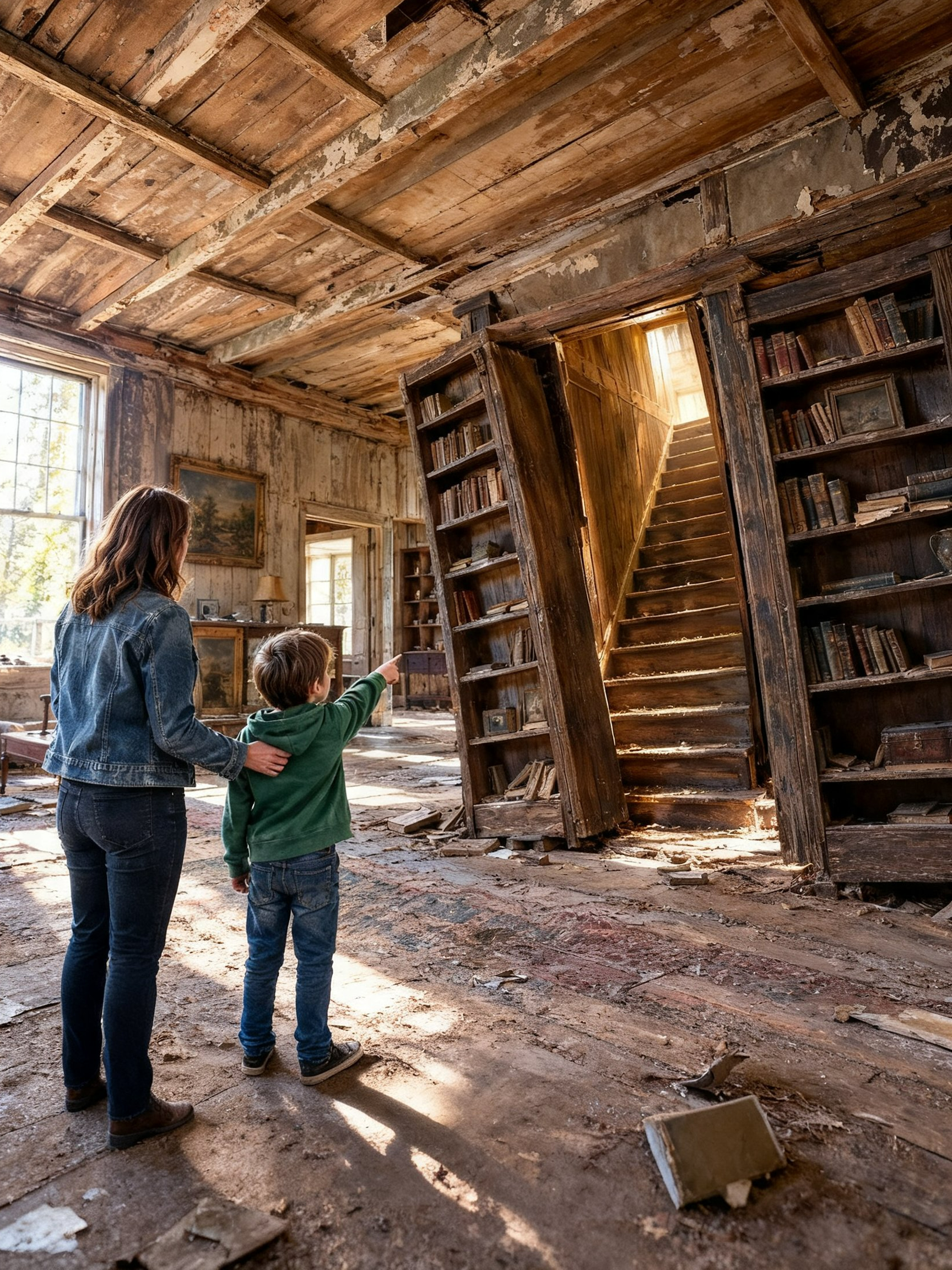
Her Family Threw Her Out After Four Days—Then Her Son Found a Hidden Staircase Beneath the House They Called Worthless
“Four days, Rebecca. That’s already four days longer than you deserved.”
Dean Hale said it from the front porch of the house where his sister had spent fourteen years changing their father’s bandages, cleaning his vomit from bathroom tile, sorting his medications into plastic boxes, and sleeping with her bedroom door open in case he fell during the night.
Behind Dean stood their mother, Carol, wearing a cream wool coat Rebecca had bought her for Christmas two years earlier.
Beside Carol stood Martin Pike, the family attorney.
No one looked embarrassed.
Not even a little.
Dean held out a cardboard box.
Inside were Rebecca’s son’s school papers, two framed photographs, three paperback novels, and the small ceramic bird their father had once given her.
“You need to be gone by six,” he said.
Rebecca Hale was thirty-eight years old.
She had eleven hundred and eighty-three dollars in checking.
A twelve-year-old son named Eli.
A ten-year-old Honda with a cracked passenger mirror.
And, according to her family, absolutely no claim on the house where she had sacrificed nearly half her adult life.
Eli stood behind her in the doorway.
He had heard everything.
Rebecca knew that because she could feel the boy looking at the back of her head.
Waiting for his mother to cry.
Waiting for her to beg.
Waiting for her to remind Uncle Dean about all those nights she had stayed with Grandpa while Dean went to Florida, Las Vegas, Chicago, or wherever else successful men went when unsuccessful sisters stayed behind to keep old people alive.
Rebecca did none of those things.
She took the cardboard box.
“Six o’clock?” she asked.
Dean blinked.
He had prepared himself for tears.
Rebecca glanced at Martin Pike.
“Is there an eviction order?”
Pike’s smile tightened.
“It’s an estate matter.”
“That wasn’t my question.”
Dean stepped forward.
“Don’t start acting like a lawyer now.”
Rebecca looked at him.
That was all.
No shaking voice.
No lecture about loyalty.
That silence unsettled Dean more than screaming would have.
He looked toward their mother as if asking her to finish the job.
Carol sighed.
“Your brother has responsibilities, Rebecca. The property has to be sold. We can’t keep putting everyone’s life on hold because yours didn’t turn out the way you wanted.”
Something moved in Rebecca’s face.
Not pain exactly.
Something colder.
Eli stepped closer to her.
Rebecca reached backward and took his hand.
Then she said the sentence Dean would remember months later, when reporters were waiting outside the Franklin County courthouse and federal investigators were carrying file boxes out of his company headquarters.
“All right.”
Nothing more.
By five thirty-seven, everything Rebecca and Eli owned fit inside the Honda.
She left the house cleaner than she had found it.
She even emptied the refrigerator.
Dean watched from the kitchen window.
He smiled when her taillights disappeared.
He believed he had finally removed the last inconvenience standing between him and the Hale family fortune.
He had no idea Rebecca was driving toward the one house his grandfather had spent twenty-six years making sure Dean would never understand.
Three weeks earlier, Harold Hale had been buried beneath a gray Ohio sky.
Rebecca’s father had died at seventy-one after a long decline involving kidney disease, heart failure, and finally pneumonia.
Dean had delivered the eulogy.
He spoke beautifully about sacrifice.
About family.
About carrying forward their father’s legacy.
Rebecca had sat in the second row and listened while people praised Dean for being such a devoted son.
No one mentioned that Dean had visited his father eleven times in the final eighteen months of Harold’s life.
No one mentioned that Rebecca had been there every day.
No one mentioned that she had quit her administrative job at a dental office when Harold’s insurance stopped covering overnight care.
No one mentioned that she had used the small retirement account from her divorce settlement to pay property taxes when Harold fell behind.
No one mentioned that Rebecca had once driven forty miles through an ice storm at two in the morning because Harold insisted he could breathe and refused to let her call an ambulance.
She had saved his life that night.
By breakfast, he was complaining that Dean never came around anymore.
Rebecca had spent most of her life being useful enough to need and ordinary enough to overlook.
At sixteen, she babysat Dean while their mother worked.
At twenty-two, she postponed college when Carol needed spinal surgery.
At twenty-six, she helped keep the books for Hale Residential after Dean convinced their father he needed “temporary assistance.”
Temporary became four years.
At thirty-three, her marriage collapsed after her husband announced that being married to Rebecca felt like “living beside someone permanently responsible for everybody except herself.”
After the divorce, she and Eli moved into Harold’s house.
She told herself it would be six months.
It became five years.
Through all of it, Dean had one explanation for her life.
“You chose this.”
Those three words absolved everyone.
She chose to help.
She chose to stay.
She chose to sacrifice.
Therefore nobody owed her anything.
Rebecca did not believe anyone owed her wealth.
She did believe people owed one another honesty.
That distinction was about to become expensive.
For six nights after leaving Harold’s house, Rebecca and Eli stayed at a roadside motel outside Westerville.
The carpet smelled vaguely like bleach.
The ice machine worked when it wanted to.
Every evening Eli did homework at a round table beneath a flickering lamp.
Rebecca searched property listings.
She could not afford rent near his school without burning through what little money she had left.
Then she found the house.
The listing contained eight photographs, all bad.
The first showed a two-story brick house behind dead weeds and a sagging maple tree.
The second showed plywood over three windows.
The third showed a kitchen that appeared to have lost an argument with a tornado.
The fourth showed a fireplace surrounded by dark built-in shelves.
The property sat twenty-eight miles outside Columbus near an old road called Mercer Pike.
Three bedrooms.
Built in 1912.
Tax foreclosure.
Sold through the county land reutilization program.
Price: $27,500.
Cash buyers preferred.
Rebecca stared at the address.
1186 Mercer Pike.
Something about it bothered her.
Not frightened her.
Bothered her.
She had seen that address before.
She searched through emails, old tax documents, and photographs she had backed up from her father’s computer.
The next morning she drove there.
Eli came with her.
The house stood beyond a rusted iron gate.
It was ugly in the way neglected things become ugly when nobody remembers what they looked like before.
The brick was faded.
The porch leaned slightly.
Ivy had eaten half the chimney.
But the foundation looked solid.
The roof had been replaced within the last decade.
And the land behind it stretched farther than the listing photographs suggested.
Eli stood in knee-high weeds and stared at the house.
“This place looks haunted.”
Rebecca unlocked the door.
“Cheap haunted.”
“That’s worse.”
She laughed for the first time since leaving Harold’s house.
Inside, sunlight cut through gaps around the plywood.
Dust floated in the air.
The floors were oak.
The staircase railing was hand-carved.
Someone had stripped copper pipe from the basement, but much of the original structure remained intact.
Rebecca walked slowly.
She felt something she had not felt at her father’s house in years.
Possibility.
No one was asking her for medicine.
No one was telling her which room she could use.
No one was reminding her that the roof over her head technically belonged to somebody else.
The place was wrecked.
But the wreckage was honest.
In the living room, Eli examined the shelves beside the fireplace.
“They don’t match.”
Rebecca looked over.
“The shelves.”
One unit on the left side of the fireplace had six shelves.
The one on the right had five.
“The bottom one is too tall.”
Rebecca smiled.
“You’ve been watching too many mystery shows.”
Eli shrugged.
Three days later, Rebecca bought the house.
Dean heard about it that afternoon.
He called immediately.
She almost didn’t answer.
Then she did.
“You bought that place?”
“Apparently.”
“You know what’s wrong with it?”
Dean laughed.
It was not a pleasant laugh.
“You spent what little money you had on an abandoned house?”
“On Mercer Pike?”
There was a pause.
For the first time, his amusement sounded forced.
“Why that one?”
Rebecca looked through the motel window at Eli loading a cardboard box into the Honda.
“It was cheap.”
“That’s it?”
“That’s it.”
Another pause.
Then Dean chuckled.
“Well. Good luck.”
He hung up.
Rebecca stood holding the phone.
Something had changed halfway through that conversation.
She could feel it.
Dean had called intending to humiliate her.
Instead, he had become curious.
Curious people asked questions.
Worried people asked why.
Rebecca did not yet know which one he was.
She and Eli moved into the Mercer Pike house two days later.
There was no working furnace, so they used electric heaters.
Only one bathroom faucet functioned.
They ate pizza on overturned paint buckets.
Rebecca slept on a mattress in the dining room because the upstairs ceilings needed inspection.
Eli called it camping with walls.
On their second night, rain hammered the roof.
Around nine thirty, the power flickered.
Eli was in the living room trying to straighten one of the built-in shelves.
Rebecca heard wood scrape against wood.
Then silence.
His voice had changed.
Rebecca walked into the room.
Eli stood beside the right-hand bookcase.
It had moved six inches away from the wall.
Behind it was darkness.
Rebecca stopped.
“What did you do?”
“I pushed the bottom.”
He pointed.
A section of molding had released.
The entire shelf unit was mounted on hidden iron hinges.
Behind it was a narrow opening.
And behind the opening—
Not basement stairs.
These were narrower.
Descending between the brick chimney wall and the foundation.
Eli whispered, “Okay. Maybe cheap haunted is actually awesome.”
Rebecca found a flashlight.
“Stay behind me.”
The staircase turned twice.
At the bottom was a wooden door with no knob.
Only a recessed brass ring.
Rebecca pulled it.
The door opened inward.
The room beyond was approximately twelve feet square.
No windows.
Concrete walls.
Metal shelving.
An old desk.
Two filing cabinets.
A steel document box.
And a framed photograph hanging above the desk.
Rebecca raised the flashlight.
Her breath stopped.
The photograph showed her grandfather.
Henry Hale.
He was younger in the picture.
Maybe fifty.
He stood in front of this same house.
Beside him were nine men and four women wearing work clothes.
On the back of the photograph, written in Henry’s unmistakable block handwriting, were six words.
For those who built it all.
Eli found the envelope.
It was taped beneath the desk.
The paper had yellowed.
Across the front was one name.
Her knees nearly gave way.
She did not answer.
She opened it.
Inside were two pages.
The first line made her sit down.
If you are reading this, someone has already told you this house is worthless.
Keep reading before you trust anyone.
Especially anyone named Hale.
Eli watched his mother.
Rebecca read the rest in silence.
Henry had written the letter nine years before his death.
He explained that 1186 Mercer Pike had once been the caretaker’s residence for Hale Tool & Machine, the small manufacturing company he had built before selling its operations in the late 1990s.
Most of the factory property had been redeveloped.
But not all of it.
A separate land trust remained.
Henry called it the Hale Stewardship Trust.
Its purpose, according to the letter, was to provide supplemental retirement payments, emergency medical assistance, and educational grants to former Hale Tool workers and their families.
Rebecca remembered the program vaguely.
When she was a teenager, Henry had sometimes asked her to help him address envelopes.
She remembered names.
Mrs. Alvarez.
Mr. Brooks.
The Callahan family.
Small checks.
Christmas cards.
Tuition reimbursements.
After Henry’s death, Harold and Dean told everyone the program had run out of money.
Rebecca had believed them.
According to Henry’s letter, it had not.
The trust still owned 142 acres.
And those 142 acres were no longer farmland.
They were beneath Westhaven Commons.
Rebecca knew Westhaven Commons.
Everyone in central Ohio did.
Luxury townhomes.
A grocery center.
Medical offices.
Restaurants.
A self-storage complex.
A cell tower.
Two undeveloped commercial parcels along the interstate.
Estimated combined property value: more than forty million dollars.
Dean’s company managed most of it.
Rebecca looked up from the letter.
Her mouth had gone dry.
Eli whispered, “Is that bad?”
She looked at him.
“I don’t know yet.”
The second page contained only instructions.
Do not contact Dean.
Do not contact Harold.
Do not contact Martin Pike.
Do not surrender possession of this house voluntarily.
Do not sell this property until a lawyer has examined the trust instrument in the blue ledger.
If anyone claims the trust was terminated, ask for the original termination authorization bearing my notarized signature.
It does not exist.
Then came the sentence Rebecca would eventually hear quoted in court.
I created the trust because wealth makes decent men careless and careless men dangerous. I named you as contingent successor because you are the only one in this family I have watched do the right thing when nobody was watching.
Rebecca stared at those words.
For years she had believed her grandfather barely noticed her.
Dean had been the charismatic grandson.
The athlete.
The business major.
The one Henry took to meetings.
Rebecca was the quiet granddaughter carrying coffee into the room.
Apparently Henry had been watching.
The letter continued.
The residence at 1186 Mercer Pike is not the inheritance.
It is the key.
If they have lied to you about that distinction, assume they have lied about everything else.
At the bottom was the name of an attorney.
Rachel Moreno.
Rebecca folded the letter carefully.
Eli sat beside her.
“What are you going to do?”
She looked around the hidden room.
At the ledgers.
The filing cabinets.
The photograph.
Then she did something Eli would remember for the rest of his life.
She turned off the flashlight.
In the darkness, she said quietly:
“Nothing tonight.”
That was Rebecca’s talent.
People mistook stillness for weakness.
They had done it for thirty-eight years.
Dean did it again the next morning.
He arrived at in a black SUV.
Rebecca was on the porch drinking coffee.
He climbed out wearing a navy jacket and expensive boots unsuited for mud.
“I was nearby.”
“No, you weren’t.”
Dean smiled.
“Still funny.”
“What do you need?”
He looked toward the house.
“Just wanted to make sure you understood what you bought.”
Rebecca took another sip.
“I bought a house.”
“With serious structural concerns.”
“So you said.”
“You had it inspected?”
Dean shook his head.
The old condescension was back.
The voice he used when explaining interest rates.
Investments.
Anything he assumed she could not understand because she had spent her adult life caring for people instead of accumulating titles.
“There are reasons that property sat vacant.”
“I’m sure.”
“I could take it off your hands.”
Rebecca lowered the cup.
Dean continued.
“Thirty-five thousand.”
“You’re offering me almost eight thousand more than I paid after two days?”
“I’m trying to help.”
His eyes shifted toward the living room window.
But Rebecca noticed.
“Because you’re my sister.”
She nearly smiled.
Not because it was funny.
Because it was useful.
“I’m keeping it.”
Dean’s jaw flexed.
“Suit yourself.”
He turned to leave.
Rebecca said, “Dean.”
He looked back.
“Did Grandpa ever live here?”
For less than a second, Dean stopped breathing.
Then he laughed.
“This house. Did Grandpa ever live here?”
“Not that I know of.”
“You sure?”
“Why would I know?”
Rebecca shrugged.
“Just wondering.”
That afternoon Rebecca called Rachel Moreno.
Rachel’s office occupied the third floor of an old brick building near downtown Columbus.
She was sixty-one, silver-haired, precise, and entirely uninterested in dramatic introductions.
Rebecca showed her Henry’s letter.
Then the trust documents.
Then the blue ledger.
Rachel spent forty minutes reading without speaking.
Finally, she removed her glasses.
“Where did you get these?”
“Hidden room.”
Rachel looked at her.
“Of course.”
Rebecca almost laughed.
Rachel did not.
“This is going to get unpleasant.”
“How unpleasant?”
“Your family will probably accuse you of theft, fraud, incompetence, emotional instability, and possibly grave robbery if they think a judge might listen.”
Rebecca nodded.
“That sounds like Dean.”
Rachel tapped the trust instrument.
“The good news is Henry knew exactly who he was dealing with.”
She showed Rebecca a paragraph.
The trust had been irrevocable after 2001.
Henry had retained limited administrative powers but could not transfer the trust assets to himself or his descendants.
The Westhaven land had been leased, not sold, to a development entity eventually controlled by Dean.
The lease required annual base rent plus percentage rent.
Most importantly, it prohibited the lessee from claiming fee ownership, mortgaging trust land without written trustee approval, or concealing trust income from beneficiaries.
Violation could trigger removal of the managing trustee and appointment of the designated successor.
There was more.
A handwritten amendment had been properly witnessed and notarized seven years before Henry’s death.
It named Rebecca as successor trustee if any current trustee concealed material trust assets, diverted beneficiary funds, or attempted an unauthorized termination.
Henry had also directed the trustee to maintain the Mercer Pike residence as the trust’s document repository.
Rachel looked at her.
“Your grandfather built a legal bear trap.”
Rebecca stared at the papers.
“Can Dean lose the development?”
“Not automatically. Courts dislike forfeitures, and innocent homeowners and commercial tenants are involved. We are not going to terrorize ninety-four families because your brother is dishonest.”
That answer mattered to Rebecca.
Rachel noticed.
She leaned back.
“But if these records are genuine, the trust owns the underlying land. Your brother’s company may owe years of unpaid rent. Any refinancing based on false fee ownership becomes a serious problem. The trust could seek a receiver, accounting, damages, injunctive relief, and possibly termination or restructuring of the ground lease.”
“How much?”
Rachel’s expression hardened.
“Potentially millions.”
Rebecca looked at the beneficiary ledger.
“What about these people?”
“That is where this becomes uglier.”
Payments had stopped almost eight years earlier.
Not because money ran out.
Because somebody redirected it.
The blue ledger showed trust income continuing.
More than $310,000 the first year.
$427,000 the next.
Then over half a million.
The beneficiary disbursements collapsed to nearly zero.
Rebecca recognized one name immediately.
Maria Alvarez.
She had attended Henry’s funeral.
She was seventy-four.
Rebecca remembered Maria saying she had sold her car to cover her husband’s chemotherapy copays.
The trust should have helped.
Someone had told her it was empty.
Rebecca felt anger for the first time.
Real anger.
Not the hot kind.
The kind that clarifies.
Rachel saw it.
“This is why your grandfather chose you, isn’t it?”
Rebecca said nothing.
Rachel continued.
“We need certified land records, banking records, tax records, the alleged trust termination, and your father’s probate file. We do not confront anyone yet.”
“What do I do?”
“You go home.”
“To Mercer Pike?”
“And act normal?”
Rachel’s mouth tilted slightly.
Rebecca thought of Dean.
“I’ve been acting normal around these people my entire life.”
Three days later, at in the morning, someone pounded on Rebecca’s front door.
A county code enforcement officer stood outside.
His name was Carl Renner.
Behind him were two fire inspectors.
Renner handed her a red notice.
UNSAFE FOR OCCUPANCY.
Rebecca read it.
Electrical hazards.
Foundation instability.
Suspected mold.
Emergency evacuation required.
“You inspected this house when?”
“Yesterday.”
“I was here yesterday.”
“Exterior inspection.”
“You determined internal electrical hazards from outside?”
Renner’s eyes hardened.
“Ma’am, I don’t make the rules.”
Rebecca looked toward the road.
A black SUV was parked beyond the bend.
She could not see the driver.
She did not need to.
Eli came downstairs carrying his backpack.
“Are we in trouble?”
Rebecca folded the notice.
Renner pointed toward the house.
“You cannot remain here after noon.”
Rebecca looked at him.
“May I have your supervisor’s name?”
He hesitated.
Then gave it.
Rebecca wrote it down.
No argument.
No shouting about corruption.
By eleven forty-five, she and Eli were gone.
That was how long she had lived in the first house she had ever owned entirely by herself.
Dean called that afternoon.
Rebecca sat on the motel bed while Eli watched television.
“Heard what?”
“About the house.”
“That was fast.”
“Small community.”
“Twenty-eight miles from you.”
He ignored that.
“Look, my offer still stands.”
“Thirty-five?”
“I’ll make it forty.”
Rebecca nearly admired him.
He thought pressure would make her grateful.
“You’re becoming generous.”
“I’m trying to solve your problem.”
“You always are.”
“What does that mean?”
Dean exhaled.
“Rebecca, take the money.”
His tone changed.
“You have a kid.”
“So do you.”
“Exactly. Which means you shouldn’t be trying to prove something by living in a condemned building.”
Rebecca looked at Eli.
He was pretending not to listen.
She lowered her voice.
“What do you think I’m trying to prove?”
Then Dean said, “That you mattered to Dad.”
Rebecca smiled sadly.
There it was.
Designed to cut through years.
Five years earlier, she might have defended herself.
Three years earlier, she might have cried after hanging up.
Now she simply said:
“Thanks, Dean.”
“For what?”
“For answering the question.”
She hung up.
Dean stared at his phone.
He had no idea what question she meant.
The following morning, Rachel filed an emergency administrative appeal of the condemnation order.
She did something else too.
She sent preservation notices to Dean Hale, Hale Residential Group, Martin Pike, the property management company at Westhaven Commons, First Meridian Bank, and the county recorder.
The notices instructed each recipient to preserve all records involving the Hale Stewardship Trust, 1186 Mercer Pike, and the Westhaven ground lease.
Dean called Rebecca thirteen minutes after his company received the letter.
She let it ring.
He called again.
She let that one ring too.
Then Carol called.
Rebecca answered.
“What are you doing to your brother?”
Rebecca closed her eyes.
Not “How are you?”
Not “Where are you and Eli staying?”
Not “Why was your house suddenly condemned?”
What are you doing to your brother?
“I hired a lawyer.”
Carol lowered her voice.
“Because I needed one.”
“Dean says you’re accusing him of stealing.”
“I haven’t accused him of anything.”
“Then why are lawyers contacting his company?”
“You should ask Dean.”
“Rebecca, this family has been through enough.”
Rebecca looked at the motel ceiling.
There it was again.
Family meant the people Rebecca was required to protect.
Never the people required to protect Rebecca.
Carol continued.
“Your father would be ashamed.”
That sentence landed.
Rebecca let it.
She did not block pain anymore.
She allowed it to arrive.
Then she decided what it was worth.
Carol hesitated.
“You don’t mean that.”
“You know how much your father loved you.”
Rebecca’s voice remained calm.
“No, Mom. I know how much work he let me do for him. That’s not exactly the same thing.”
Carol inhaled sharply.
“After everything he gave you—”
Rebecca interrupted for the first time.
“What did he give me?”
The question was so simple Carol had no prepared answer.
Rebecca continued.
“I’m not asking emotionally. Tell me. What did Dad give me?”
“You lived in his house.”
“I paid taxes for three years.”
“He fed you.”
“I bought groceries.”
“You needed somewhere after your divorce.”
“He needed twenty-four-hour care.”
Carol’s voice cracked with anger.
“Do you have to keep score?”
Rebecca looked at the beneficiary ledger on the bed.
People who had been promised help.
“No,” she said. “But apparently somebody did.”
She ended the call.
Two days later, Dean made his mistake.
He went to Mercer Pike.
The security camera Rachel had advised Rebecca to install captured him at 11:18 p.m.
Dean arrived with Martin Pike and a locksmith.
They entered through the back.
They stayed forty-three minutes.
They went directly to the living room.
Directly to the shelves.
Directly to the hidden staircase.
When they emerged, Dean was carrying an empty metal document box.
Rebecca watched the footage the next morning in Rachel’s office.
Neither woman spoke until it ended.
Rachel paused the video on Dean’s face.
“So much for him never knowing your grandfather lived there.”
Rebecca leaned back.
“They knew about the room.”
“They knew something was there.”
“They were looking for the documents.”
Rebecca stared at Dean’s frozen image.
“He thought I left them.”
Rachel nodded.
“We wanted him to think that.”
The originals were in a bank vault.
Copies were with Rachel.
Digital scans were stored in three separate locations.
The hidden room contained only one thing now.
A photocopy of Henry’s letter.
Not the entire letter.
Only the first sentence.
If you are reading this, someone has already told you this house is worthless.
Dean found it.
The camera showed him crushing the paper in his fist.
For the first time, Rebecca understood that her grandfather had not merely feared greed.
He had predicted behavior.
Every step.
The denial.
The pressure.
The effort to buy the house.
The forced evacuation.
The secret entry.
The search for records.
Henry had known his family.
Perhaps too well.
The condemnation order was overturned twelve days later.
An independent structural engineer found no imminent foundation failure.
A licensed electrician found defects but none meeting emergency-vacate standards.
Air samples showed ordinary levels of household mold.
More damaging was an internal county email Rachel obtained through public records.
Carl Renner had been asked to “take a hard look” at Rebecca’s property by County Development Commissioner Wesley Grant.
Grant’s reelection committee had received $18,500 from executives connected to Hale Residential over four years.
That did not prove bribery.
It proved enough for newspapers to become interested.
Dean stopped calling.
That worried Rebecca more than the calls had.
Then Martin Pike sent a settlement proposal.
Hale Residential would buy 1186 Mercer Pike for $400,000.
Rebecca would release all claims involving the Hale Stewardship Trust.
She would sign a confidentiality agreement.
No one would admit wrongdoing.
Rebecca read the offer twice.
Four hundred thousand dollars.
Three months earlier, that amount would have felt impossible.
She could buy a clean house.
Pay for Eli’s college.
Replace the Honda.
Sleep without calculating grocery prices.
Rachel watched her.
“You’re allowed to think about it.”
Rebecca looked at the ledger.
“How many beneficiaries are still alive?”
“Thirty-one direct beneficiaries. Another forty-seven family members may qualify for educational or medical grants depending on the trust terms.”
“How much money should they have received?”
“We don’t know yet.”
“Estimate.”
Rachel hesitated.
“Between four and six million in aggregate distributions and reserves.”
Rebecca pushed the settlement away.
Rachel did not smile.
But something in her eyes softened.
That evening, Rebecca drove to a small ranch house in Gahanna.
Maria Alvarez answered the door.
She was thinner than Rebecca remembered.
Rebecca explained who she was.
Maria invited her inside.
On the mantel stood a photograph of Maria’s late husband, Luis, wearing a Hale Tool work jacket.
“He gave that company thirty-two years,” Maria said.
Rebecca asked about the trust.
Maria looked confused.
“Your grandfather’s little fund?”
“They said it ended.”
“Who said?”
“Your father first. Then your brother’s office.”
Maria thought.
“Maybe eight years ago.”
“Did you receive anything after that?”
“One check. Nine hundred dollars.”
According to the ledger, Maria and Luis should have received more than forty-eight thousand dollars in medical support during that period.
Rebecca did not tell her the amount yet.
She asked one more question.
“What did Dean’s office say when you asked?”
Maria’s face changed.
The embarrassment was old but visible.
“They told me charity doesn’t last forever.”
Rebecca sat perfectly still.
That sentence decided everything.
Not the house.
Not forty million dollars.
Not revenge.
Charity doesn’t last forever.
Henry’s workers had not been receiving charity.
They had earned those benefits through a trust funded partly by the sale of the company they helped build.
Dean had taken something contractual and turned it into something humiliating.
He had made working people beg for what was already theirs.
Rebecca knew that humiliation.
She had lived inside a different version of it.
The next morning she told Rachel:
“We don’t settle privately.”
The lawsuit was filed at a.m. on a Monday.
Rebecca Hale, individually and as petitioning successor trustee, sought an accounting of the Hale Stewardship Trust, removal of existing trustees, injunctive relief, restoration of diverted assets, and a judicial declaration concerning ownership of the Westhaven property.
The filing was eighty-seven pages with exhibits.
By noon, Dean’s attorneys released a statement calling Rebecca “a distressed family member misinterpreting decades-old documents.”
By two, local television vans were outside Hale Residential.
By four, Carol left Rebecca a voicemail.
“You’re destroying your father’s legacy.”
Rebecca listened once.
Then deleted it.
The first hearing took place three weeks later.
Dean entered the courtroom surrounded by lawyers.
He did not look at Rebecca.
Martin Pike sat behind him.
Carol sat in the gallery.
So did several Hale Tool retirees.
Maria Alvarez was among them.
Dean’s argument was simple.
The trust had been legally terminated nineteen years earlier.
The Westhaven property had then transferred to Hale Development Partners.
Any later documents suggesting otherwise were obsolete drafts.
Martin Pike produced a photocopy of a trust termination authorization.
Signed by Henry Hale.
Dated March 14, 2007.
Rachel stood.
“Your Honor, we request production of the original.”
Dean’s attorney said it had been lost during an office relocation.
Rachel nodded.
Then she placed Henry’s passport records into evidence.
March 14, 2007.
Henry Hale had been in Vancouver, Canada.
That alone proved little.
Signatures could happen abroad.
Then Rachel introduced the notary log.
The supposed notary, Sandra Voss, testified she had never notarized Henry Hale’s signature.
Her stamp had been stolen from her office in 2006.
Martin Pike stopped taking notes.
Rachel was not finished.
She produced county imaging records.
The deed allegedly transferring trust land to Hale Development had been recorded eighteen months after the supposed trust termination.
Its legal description omitted one narrow strip connecting the Westhaven parcels to the interstate frontage.
That omission mattered because the trust amendment defined the omitted strip as the controlling parcel.
Without valid transfer of the controlling parcel, later instruments could not satisfy the trust’s disposal requirements.
Then came the blue ledger.
Lease income.
Bank transfers.
Beneficiary names.
The courtroom grew quieter with every page.
Trust revenue had not disappeared.
It had been redirected to entities controlled by Dean, Harold, and two other family members.
Some transfers were labeled management fees.
Some consulting expenses.
Some capital reimbursements.
One payment for $86,000 went to a company that existed for seventeen months.
Its registered agent was Dean’s wife.
Rebecca watched her mother.
Carol stared straight ahead.
For years Rebecca had wondered whether Carol knew.
Now she realized the answer was more complicated.
Carol had known enough not to ask.
The judge appointed an independent forensic accountant.
Then a temporary special fiduciary.
Then, after evidence emerged that Dean’s company had recently attempted to refinance two Westhaven parcels for $11.8 million, the court issued an injunction blocking new encumbrances.
Dean walked out of court without speaking.
Rebecca followed thirty seconds later.
Reporters shouted questions.
“How much are you seeking?”
“Do you want your brother prosecuted?”
“Are you trying to take people’s homes?”
That last question stopped her.
Rebecca turned.
The cameras quieted.
“There are families living at Westhaven who did nothing wrong. There are businesses that signed leases in good faith. Nobody is losing a home because of me. This is about determining who owned the land, who received the money, and who should have received it.”
Someone shouted, “Is this revenge?”
Rebecca looked at the courthouse doors.
She thought of Maria.
“This is an accounting.”
That clip spread farther than Dean’s statement.
Not because Rebecca sounded angry.
Because she didn’t.
Anger could be dismissed.
Calm was harder.
The accounting took four months.
The numbers were worse than Rachel predicted.
Over seventeen years, approximately $8.4 million in trust revenue had been diverted or misclassified.
Some had funded legitimate maintenance.
Some had supported development expenses that arguably benefited trust property.
But at least $3.7 million appeared to have no defensible trust purpose.
Retiree payments had been reduced while executive compensation increased.
Educational grants disappeared.
Emergency medical payments stopped entirely.
Dean had bought a lake house during the same period.
Harold had received annual “advisory fees.”
Martin Pike billed the trust for legal work related to its own supposed termination.
One transaction changed the case entirely.
Six years earlier, Dean had used trust-owned land as collateral for a commercial loan.
To obtain it, he signed a sworn ownership certification stating Hale Residential held fee-simple title.
The trust agreement explicitly defined such a representation as material adverse possession of trust assets and grounds for removal of the managing trustee.
Henry had anticipated exactly this.
The dead man’s legal warning was not sentimental.
It was architecture.
The more Dean fought, the deeper he stepped into it.
Then First Meridian Bank turned over a file.
Inside was an email from Dean to Martin Pike.
The date was fourteen months before Harold died.
Subject: REBECCA.
Dean wrote:
If she ever gets access to Mercer, we have a problem. Dad says she doesn’t know anything about the trust. Keep it that way.
Rebecca read the email alone in Rachel’s conference room.
She read it once.
Then again.
Then a third time.
Rachel sat across from her.
“You okay?”
Rebecca looked out the window.
For decades, Dean had claimed she was too emotional for business.
Too domestic.
Too ordinary.
Yet he had been afraid of her finding one house.
Not because she was powerful.
Because the truth was.
Rebecca folded the printout.
“You don’t look okay.”
Rachel waited.
Rebecca said, “I spent years wondering what I should’ve done differently to make them respect me.”
She laughed softly.
“That was a waste of time.”
Rachel said nothing.
Rebecca looked back at the email.
“They respected me enough to hide things from me.”
The case began collapsing for Dean after that.
Martin Pike retained his own criminal attorney.
The county opened an ethics investigation into Commissioner Grant and Carl Renner.
The state attorney general’s charitable trust division requested records.
First Meridian renegotiated several loans to protect innocent third parties.
Dean tried one final approach.
He came to Mercer Pike alone.
By then Rebecca and Eli were living there again.
The porch had been repaired.
The electrical system was safe.
The plywood was gone from the windows.
Rebecca was painting the living room when Dean knocked.
She opened the door but did not invite him inside.
He looked tired.
For the first time in her life, he did not look like the sibling who had won.
“Can we talk?”
“Privately.”
“This is private.”
Dean glanced toward the road.
“You’re enjoying this.”
Rebecca almost closed the door.
He raised a hand.
“Fine. Sorry.”
She waited.
Dean took a breath.
“Dad made mistakes.”
“Dad is dead.”
“So is Grandpa.”
“We’re the ones left dealing with it.”
“No. Maria Alvarez is dealing with it. So are thirty other people who were told money meant for them was gone.”
Dean rubbed his forehead.
“You don’t understand what Dad inherited. The company was dying. The development saved everything.”
“You could have developed the land and honored the trust.”
“It wasn’t that simple.”
“Because capital doesn’t appear from nowhere.”
“Neither do forged documents.”
Dean’s face tightened.
“I didn’t forge anything.”
“Then you’ll be fine.”
“Stop doing that.”
“Doing what?”
“Talking like you’re above everybody.”
Rebecca stared at him.
The accusation was almost impressive.
“I changed Dad’s diapers, Dean.”
He flinched.
She continued.
“I washed his sheets. I cleaned his house. I cooked for Mom after surgery. I watched your children when Allison went back to work. I did your books for four years for free. I moved out of Dad’s house in less than one day when you told me to because I didn’t want Eli watching adults fight over furniture.”
Her voice never rose.
“I have spent my whole life beneath everybody. You just got used to the view.”
Dean looked away.
For a moment, she saw the boy he had once been.
The kid who used to hide behind her when thunderstorms shook the windows.
The brother whose bicycle she had repaired.
The teenager she drove home when he got drunk at seventeen because he begged her not to call their parents.
Then his expression hardened again.
“There’s a settlement available.”
“You could take twelve million personally.”
Rebecca had not heard that number.
She showed nothing.
Dean continued.
“House stays yours. Trust gets funded. Everyone gets paid. We restructure Westhaven. This ends.”
“And what happens to you?”
He stared at her.
“There’s no admission of wrongdoing.”
Rebecca nodded slowly.
There it was.
Not reconciliation.
He still believed everything had a price.
Even truth.
“You think I’m doing this because I want your money.”
“You’ve never had money, Rebecca. Don’t pretend it doesn’t matter.”
She considered that.
“It matters.”
Dean seemed surprised.
She continued.
“Money is heat in January. It’s a doctor you don’t postpone. It’s a reliable car. It’s telling your kid yes when the school trip costs four hundred dollars.”
Dean said nothing.
“So yes. Money matters.”
“Then take it.”
Rebecca looked through the doorway toward the restored shelves.
Behind them lay the staircase.
Behind the staircase, the room.
Behind the room, decades of names.
Dean’s jaw hardened.
“Because Maria shouldn’t have had to sell her car.”
“Luis Alvarez worked for Grandpa thirty-two years. When he got cancer, the trust was supposed to help them. Your office told his wife charity doesn’t last forever.”
“I never said that.”
“Your company did.”
“That’s not the same thing.”
Rebecca looked at him.
“That sentence is your whole problem.”
Dean went still.
“You built a system where nothing is ever your fault because somebody else signs the letter, somebody else moves the money, somebody else posts the notice, somebody else locks the door.”
She stepped closer.
“But you still live in the house built by all those decisions.”
Dean stared at his sister.
For perhaps the first time, he had no answer.
He left without another word.
The final civil judgment did not arrive as a dramatic declaration that Rebecca suddenly owned forty million dollars.
Reality was more complicated.
And, Rebecca thought, better.
The court confirmed that the Hale Stewardship Trust had never been validly terminated.
It still owned the Westhaven ground estate.
The development company’s leases and contracts with innocent residents and commercial tenants remained protected while the trust was restructured under court supervision.
Dean and two other trustees were permanently removed.
A receiver took control of trust-related revenues.
Hale Residential agreed to surrender management rights to Westhaven, repay millions through asset transfers, insurance proceeds, and negotiated restitution, and release its claims against Mercer Pike.
Martin Pike surrendered his law license while separate criminal and disciplinary proceedings continued.
The county voided Rebecca’s condemnation citations.
Commissioner Grant resigned before the ethics investigation concluded.
Carl Renner was dismissed from the code enforcement department.
Harold’s estate was reopened.
The largest revelation came there.
For years, Dean had described Harold’s estate as modest.
It was not.
Assets had been transferred before death into entities controlled by Dean.
Some transfers were legal.
Some were challenged successfully.
Rebecca received a personal settlement large enough that she and Eli would never again be one broken transmission away from panic.
But the biggest asset remained the trust.
Rebecca did not own its forty-million-dollar portfolio.
She controlled it as fiduciary under judicial supervision.
That difference became her favorite fact.
News stories called her an heiress.
She corrected them every time.
“I’m a trustee.”
The first restored payments went to the retired workers.
Maria Alvarez received a check representing unpaid medical assistance, survivor benefits, and interest.
She cried at Rebecca’s kitchen table.
Rebecca did not.
Not until Maria took both her hands and said:
“Your grandfather remembered us.”
That night Rebecca went into the hidden room alone.
She sat at Henry’s desk.
The same desk where she had found the letter.
Eli had helped clean the room.
The ledgers were now preserved professionally.
The original photograph had been reframed.
On one wall Rebecca hung a new plaque.
Not with her name.
With the names of every worker who had been listed in Henry’s first beneficiary ledger.
She stared at them until her vision blurred.
Then, finally, she cried.
Not for the money.
Not even for the years.
She cried because being overlooked had shaped her so completely that she had mistaken invisibility for identity.
She had believed she was ordinary because ordinary was the word people used for the person who stayed behind.
The person who packed lunches.
The person who drove to appointments.
The person who remembered medications.
The person who signed school forms.
The person who covered shifts.
The person who listened.
The person who gave up Saturdays.
The person who said, “It’s okay, I’ll handle it.”
The person nobody photographed because she was usually the one holding the camera.
She had mistaken service for smallness.
Henry had not.
Months later, the Mercer Pike house looked entirely different.
The porch was straight.
The brick had been cleaned.
The maple tree survived.
Eli got the upstairs bedroom overlooking the back field.
Rebecca enrolled in evening classes to finish the degree she had abandoned years earlier.
The trust established a permanent medical assistance fund.
It restarted educational grants.
It also created a legal assistance program for retired employees facing benefit disputes.
Rebecca named it the Henry Hale Worker Stewardship Program.
Rachel told her the name was boring.
Rebecca said that was intentional.
“Boring programs survive.”
Rachel laughed.
Dean did not go to prison on the trust case.
At least not then.
Civil cases ended faster than criminal investigations.
He lost control of the company.
Sold the lake house.
Moved into a condominium outside Dublin.
Carol stayed with him for three months.
Then, unexpectedly, she called Rebecca.
Rebecca answered.
Carol sounded smaller.
“I found something.”
“A box of your things.”
Rebecca waited.
“From when you were in college.”
“I wasn’t in college long.”
Another silence.
Carol said, “There were acceptance letters.”
Rebecca remembered.
Ohio State.
Nursing program prerequisites.
A community scholarship.
She had declined after Carol’s surgery because someone needed to help at home.
“I remember.”
“I didn’t.”
Rebecca closed her eyes.
That hurt more than accusation.
Carol continued.
“I told people you dropped out because you weren’t serious.”
“I think I believed it.”
Rebecca looked through the kitchen window.
Eli was outside trying to teach himself how to repair an old bicycle.
Carol began crying.
Rebecca did not rescue her.
That was new.
Finally Carol said, “Because if I admitted what you gave up for us, I would have had to feel guilty.”
Rebecca leaned against the counter.
There it was.
Not conspiracy.
Something more ordinary.
The small selfishness from which larger cruelties grow.
People rewrite the sacrifices others make for them because gratitude can become uncomfortable.
They call devotion a choice.
They call unpaid work a favor.
They call endurance personality.
They call the person who always gives “simple.”
Then they are shocked when that person finally keeps something for herself.
Carol asked, “Can you forgive me?”
Rebecca took a long time before answering.
Carol sobbed harder.
Rebecca continued.
“But forgiveness isn’t the same as pretending.”
“I don’t think you do yet.”
She ended the call kindly.
That mattered too.
Justice did not require Rebecca to become cruel.
Only accurate.
One year after she bought the abandoned house, Rebecca hosted a picnic on the Mercer Pike property.
Former Hale Tool employees came with children and grandchildren.
Maria brought empanadas.
Mr. Brooks brought photographs from the factory.
Three teenagers who had received trust scholarships attended.
Rachel came carrying a bottle of sparkling cider and complained about the parking.
Eli gave tours of the house but was forbidden to show anyone the hidden room without Rebecca.
He violated that rule twice.
By sunset, folding chairs covered the yard.
Rebecca stood on the porch watching people laugh beneath string lights.
For years she had imagined security as a number in a bank account.
Now she understood it differently.
Security was knowing the roof could not be taken because someone was angry with you.
It was knowing your child would not hear relatives debating whether you deserved shelter.
It was reading a contract before signing.
It was having copies.
It was owning your decisions.
It was knowing that generosity did not require surrendering your dignity.
Near dusk, a dark sedan stopped beside the road.
Dean stepped out.
Conversation slowed.
Rebecca walked toward the gate.
He did not enter.
For a moment they simply looked at one another.
Dean appeared thinner.
There was gray at his temples she had not noticed before.
“I heard about the scholarship program.”
Rebecca nodded.
“It started last month.”
“Using Grandpa’s formula?”
“Updated version.”
He looked past her at the party.
“Looks nice.”
“Thank you.”
Another silence.
Then he said, “I found something too.”
He handed her a small envelope.
Inside was a photograph.
Rebecca at seventeen.
Sitting beside Henry Hale in the old factory office.
Stacks of envelopes on the desk.
Both of them laughing.
Rebecca had never seen it.
On the back, in Henry’s handwriting:
Becca remembered every widow’s name without looking at the list.
Dean watched her read it.
“I didn’t know he thought about you like that.”
Rebecca looked at him.
“That’s because you never asked.”
For once, he did not defend himself.
“I was wrong about some things.”
A faint smile crossed his face.
“Still you.”
He put his hands into his pockets.
“I’m sorry.”
Rebecca believed he meant it.
That did not erase anything.
But she believed it.
“Thank you.”
He looked toward the house.
“Can I ask you something?”
“You just did.”
He almost laughed.
Then his eyes became serious.
“Did you know? Before Dad died?”
“About the trust?”
“Not even Grandpa’s letter?”
“So everything that happened…”
“You did without knowing what I knew.”
Dean looked down.
That answer seemed to affect him more than she expected.
Because it meant there had been no strategy on Rebecca’s side when the cruelty began.
No secret leverage.
No hidden confidence.
When Dean had thrown her out, she really had possessed almost nothing.
When Carol humiliated her, Rebecca really had nowhere to go.
When Dean mocked the abandoned house, Rebecca truly believed she was purchasing a damaged building because it was all she could afford.
The family had not mistreated her because she threatened them.
They mistreated her because they believed she didn’t.
That truth was uglier.
Dean looked toward his car.
“I should go.”
Rebecca nodded.
He took three steps.
Then she called his name.
For months Rebecca had imagined all the things she might say if she ever had him standing there without lawyers.
She could ask whether the lake house had been worth it.
Whether humiliating Maria had been worth it.
Whether losing the company had been worth it.
Whether their father had died knowing what they had done.
But those questions were too easy.
They accused.
Dean knew how to defend himself against accusations.
So Rebecca asked something quieter.
Something almost gentle.
“Dean, when you believed that house was worthless and I was nobody… why were all of you so desperate to make sure I never opened that door?”
✓ Lynn R. Adams
Her Family Threw Her Out After Four Days—Then Her Son Found a Hidden Staircase Beneath the House They Called Worthless “Four days, Rebecca. That’s already four days longer than you deserved.” Dean H…