Her Brothers Took the Ranch, the Cash, and Her Name—But Their Father Had Locked the Truth Inside One Barn
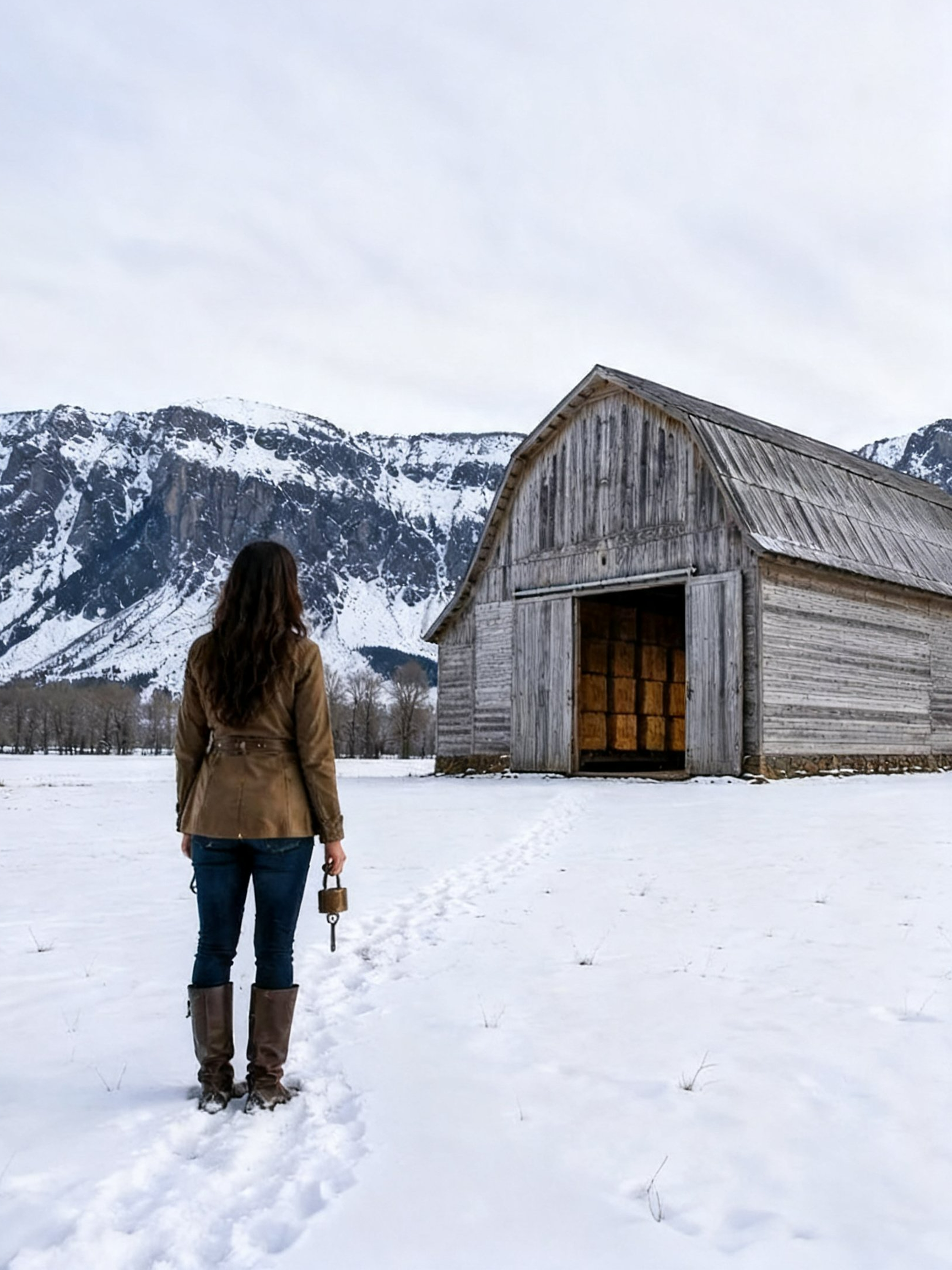
Her Brothers Took the Ranch, the Cash, and Her Name—But Their Father Had Locked the Truth Inside One Barn
Three days after they buried her father, Rachel Morrow’s brothers put her suitcase on the porch.
Not beside the porch.
Like garbage waiting for collection.
The November wind came down off the Montana foothills hard enough to lift the corner of her father’s old funeral program from the top of the suitcase and send it skittering across the boards.
Rachel watched it catch beneath one of her boots.
Behind her, the front door of the ranch house stood open.
Inside, her older brother Wade had already taken their father’s chair.
He sat in it with one ankle over his knee, drinking bourbon from the good crystal glasses their mother used to save for Christmas.
His wife, Brooke, stood near the fireplace in a cream-colored coat she had not bothered to remove. She was scrolling through listings on her phone.
Their younger brother, Travis, leaned against the kitchen doorway wearing their father’s sheepskin ranch jacket.
That hurt more than the suitcase.
Rachel looked at him.
Travis noticed.
“You weren’t using it,” he said.
Rachel said nothing.
Wade tipped his glass toward the porch.
“You’ve got until tonight.”
Brooke glanced up from her phone.
“That’s generous.”
Rachel looked from one face to the next.
Travis’s wife, Melody, sitting at the dining table with a yellow legal pad and a calculator.
And beside her, Nathan Sloane, the family accountant, who had handled the Morrow ranch books for fourteen years and had apparently decided mourning could be billed by the hour.
They had gathered like a board of directors after a successful hostile takeover.
Nobody looked ashamed.
That was the part Rachel would remember.
Not the cruelty.
The efficiency.
Her father, Samuel Morrow, had been dead seventy-two hours, and his children were already being sorted into assets and liabilities.
Rachel had become a liability.
“Where am I supposed to go?” she finally asked.
Brooke gave a small laugh.
There it was.
The laugh Rachel had heard for fifteen years whenever she said something the family considered too emotional, too simple, too inconvenient.
“You’re forty-one years old,” Brooke said. “Surely Dad wasn’t your retirement plan.”
Rachel’s gaze moved to Wade.
He did not correct his wife.
Instead he placed his bourbon on the side table.
“Dad left Travis and me the ranch operation, the house, the livestock accounts, the investment portfolio, the trucks, and the operating cash.”
He spoke slowly, almost kindly.
That made it worse.
“You got what the will says you got.”
Rachel looked toward the far western window.
From there she could see a weather-darkened roof beyond the cottonwoods.
The old north barn.
Locked for almost nine years.
“And the barn,” she said.
Travis snorted.
“The barn.”
Rachel turned back.
The will had been read that morning in attorney Gordon Bell’s office in Laurel Ridge.
Wade and Travis had inherited almost everything that sounded valuable.
The sixty-seven-room ranch house and guest structures.
Nearly five thousand head of cattle held through Morrow Cattle Company.
Farm machinery.
Horse trailers.
Three company pickups.
Investment accounts.
Cash reserves.
Shares in a feed cooperative.
A hunting cabin north of Lewistown.
A downtown commercial building their father had purchased in the 1990s.
Rachel had received five acres at the north edge of the property.
And the old barn standing on it.
The barn had no plumbing.
Half its cedar shingles were gone.
The north wall leaned enough that county inspectors had once threatened to condemn it.
It had not held livestock since Rachel was in high school.
Samuel Morrow had kept it padlocked anyway.
One sentence in the will had been dedicated to it.
To my daughter, Rachel Anne Morrow, I leave the five-acre North Field parcel and every structure and object contained upon it, including the original livestock barn, exactly as it stands at the time of my death.
Wade had laughed during the reading.
Not loudly.
Just enough.
“You finally got your inheritance,” he had whispered. “Dad left you a shed.”
Rachel had not answered him then either.
That bothered him.
It always had.
When they were children, Rachel cried easily.
When their mother died, she stopped.
Not because grief made her harder.
Because she discovered silence frightened people who expected tears.
Wade rose from Samuel’s chair.
“You have that barn,” he said now. “You have five acres. You can camp there if you want.”
“It doesn’t have electricity.”
“Then call an electrician.”
“The line comes from the ranch.”
“Not anymore.”
Rachel looked at him.
Wade smiled.
“I had Jake disconnect it this morning.”
A small sound came from the dining table.
Nathan Sloane clearing his throat.
Even he looked uncomfortable.
Rachel turned toward the accountant.
Nathan lowered his eyes.
Interesting.
She stored that away.
Rachel had spent half her life storing things away.
A sentence said too quickly.
A number that did not make sense.
A face that changed when a certain subject came up.
Her brothers had mistaken quietness for absence.
They had never understood that Rachel remembered almost everything.
She bent and lifted her suitcase.
That single word seemed to disappoint the room.
Wade frowned.
“That’s it?”
Rachel looked at him.
“What would you prefer?”
“I don’t know.”
Travis laughed.
“Maybe one of those big speeches about how you gave up your life for Dad.”
Rachel’s hand tightened around the suitcase handle.
She had given up her life for Dad.
Not all of it.
But enough.
Enough that the truth sounded ugly when somebody mocked it.
Rachel had been twenty-six when Samuel suffered the first stroke.
Wade had already moved to Billings and was working in commercial real estate.
Travis was living in Denver, chasing construction contracts and women with expensive sunglasses.
Rachel had been the one who came home.
Just temporarily, everyone said.
A few weeks.
Then a few months.
Then the physical therapist said Samuel could walk again if somebody worked with him twice a day.
Rachel stayed.
When the ranch office manager quit during calving season, Rachel learned payroll.
When Samuel’s vision worsened, Rachel drove him.
When their longtime foreman, Earl Jensen, developed prostate cancer, Rachel took over scheduling until Earl recovered.
When their bookkeeper’s husband died, Rachel covered invoices.
When a late freeze killed hay production, Rachel negotiated feed contracts.
When a wildfire jumped the eastern ridge, Rachel slept three nights in a horse trailer while helping volunteer crews cut firebreaks.
Wade visited on Thanksgiving.
Travis came for Christmas if the roads were clear.
Rachel stayed.
She stayed when their father became difficult.
She stayed when pain made him mean.
She stayed when he apologized the next morning and pretended he had not cried while saying it.
She stayed when doctors started using words like cognitive decline.
She stayed when Wade began telling people Rachel had “never really launched.”
She stayed when Brooke told friends at a wedding that Rachel was “basically Dad’s live-in helper.”
She stayed when Travis joked that Rachel’s job title was “professional daughter.”
She stayed because the ranch had men on it whose mortgages depended on Friday payroll.
She stayed because Earl Jensen had worked for Samuel since before Rachel was born.
She stayed because the cattle did not care that the family was tired.
She stayed because Samuel Morrow, for all his failures as a father, had once sat beside her hospital bed for three nights when she was eleven and had pneumonia.
She stayed because somebody had to.
That did not make her a saint.
It made her tired.
And now, apparently, homeless.
Travis pulled their father’s jacket tighter around himself.
“You going to cry?”
Rachel looked at him for so long his smile weakened.
Then she said, “No.”
She carried the suitcase down the porch steps.
Nobody stopped her.
At the bottom, Earl Jensen stood beside his pickup.
He was seventy-two now.
Thin from age.
White hair under an old Stetson.
His eyes were wet.
Rachel hated that more than anything.
She did not want witnesses grieving for her.
“Miss Rachel,” Earl said.
She shook her head gently.
He swallowed.
“They can’t do this.”
“They just did.”
“I mean legally.”
Rachel looked back at the house.
Through the front window, Brooke was pointing toward the west pasture as she showed Wade something on her phone.
Probably development plans.
Rachel had heard pieces during Samuel’s final weeks.
A luxury residential project.
Vacation homes.
A golf practice facility.
A private lodge.
Wade had contacts.
Travis had contractors.
Nathan had numbers.
Their father had land.
And now their father was dead.
Rachel looked at Earl.
“What did Dad say to you before he died?”
Earl’s expression changed.
Only slightly.
But Rachel caught it.
“About what?”
“The north barn.”
His eyes moved toward the distant roof.
“He said it belonged to you.”
“That’s in the will.”
“That ain’t all he said.”
Rachel waited.
Earl rubbed his jaw.
“He told me if your brothers tried to get you off the ranch, I was supposed to tell you one thing.”
A coldness moved through Rachel that had nothing to do with November.
“What thing?”
Earl looked toward the house, then lowered his voice.
“Don’t let them open the red cabinet.”
Rachel stared at him.
“What red cabinet?”
“He said you’d know when you saw it.”
“I haven’t been inside that barn since I was twenty.”
Earl shook his head.
“Neither have I.”
“Who has the key?”
“No, I don’t.”
Earl looked at her suitcase.
Rachel looked down.
The suitcase had belonged to Samuel before she was born.
Brown leather.
Brass hardware.
One of the side pockets bulged strangely.
Rachel crouched and opened it.
Inside was a key.
Long-necked.
Wrapped with electrician’s tape.
On the tape, in Samuel Morrow’s handwriting, were two words.
NORTH BARN.
Rachel felt Earl watching her.
“When did he put that there?”
“I don’t know.”
“You packed my suitcase?”
Earl gave a sad smile.
“Your daddy made me promise to.”
Rachel looked toward the house again.
For the first time since the funeral, something inside her grief changed shape.
Hope was too soft.
This felt sharper.
Like a match dragged once across the side of a box.
She put the key in her coat pocket.
Then she lifted the suitcase.
“I guess I’m sleeping in a barn.”
Earl opened the passenger door of his truck.
“No, ma’am.”
Rachel glanced at him.
“You’re sleeping in my guest room until that barn is fit.”
Rachel almost refused.
Then the ranch house door opened.
Wade stepped outside.
She turned.
He came halfway down the porch.
“I need the barn key.”
Behind him, Travis appeared.
Rachel’s fingers closed around the brass key in her pocket.
“Insurance.”
“You disconnected the power.”
“That doesn’t explain why you need the key.”
Wade’s face hardened.
“It sits on ranch property.”
Rachel’s voice remained calm.
“It sits on my five acres.”
Wade laughed once.
“You’re really going to do this?”
“Start some petty boundary war?”
Rachel held his gaze.
“You told me what was mine.”
The wind moved dead leaves across the gravel.
Wade’s jaw flexed.
“You know Dad kept old equipment in there. Some of it belongs to the company.”
“Then send me an inventory.”
“We don’t have an inventory.”
“Then how do you know?”
Travis came down the steps.
“Jesus, Rachel. Give us the damn key.”
Earl shifted beside the truck.
Rachel saw Wade notice.
She also saw Brooke standing in the doorway now.
Nathan Sloane behind her.
A small audience.
Exactly what men like her brothers disliked when they expected obedience.
Rachel removed her hand from her pocket.
She climbed into Earl’s truck.
Wade stepped toward it.
She closed the door.
Earl started the engine.
Through the window, Rachel watched Wade become smaller as the pickup rolled away.
Only when the ranch house vanished behind the cottonwoods did Earl exhale.
“Your father said one more thing.”
Rachel looked at him.
Earl kept his eyes on the road.
“He said if they asked for the key before you opened that barn, don’t trust anybody who was standing beside them.”
Rachel thought of Brooke.
Attorney Gordon Bell.
Gordon had not been at the house, but he had been at the will reading.
And his face had done something strange when the barn was mentioned.
Rachel had noticed that too.
“What exactly did Dad know?” she asked.
Earl shook his head.
“He never told me.”
Rachel looked through the windshield at the enormous Montana sky.
Gray clouds over winter grass.
Her father had spent his life saying very little.
Apparently, he had died with a great deal to say.
The north barn looked worse up close.
One door sagged.
Snow from the previous winter had bowed part of the roof.
A swallow’s nest clung above the loft opening.
The brass key turned anyway.
Rachel stood alone when she opened it.
She had insisted.
Earl waited fifty yards away by his truck.
The door groaned inward.
Dust floated through narrow shafts of afternoon light.
The barn smelled like old hay, cedar, machine oil, and the cold mineral scent of earth.
Nothing dramatic waited inside.
That was Rachel’s first thought.
No stacks of cash.
No gold bars.
No antique cars.
No painting worth millions.
There was an old Ford tractor under a tarp.
Two saddles.
A broken harrow.
Wooden tack trunks.
Lengths of fencing wire.
An army-green workbench.
Shelves holding coffee cans full of bolts.
And, against the north wall, a red metal cabinet.
Rachel stopped.
It was not large.
Maybe chest high.
Industrial steel.
Paint flaking at the corners.
Three locks ran down its front.
One combination dial.
One keyed lock.
One sliding brass clasp.
Rachel walked toward it.
Beside the cabinet sat a wooden chair.
On the chair was an envelope.
Her father’s handwriting.
She stared at it for almost a minute before touching it.
Then she sat.
The envelope contained one page.
If you are reading this, your brothers have probably already made you feel like I forgot you.
I need you to understand something before you open the cabinet.
Wade and Travis believe property is the same thing as value.
They always have.
You do not.
That is why I am trusting you.
Do not confront them yet.
Do not show them what you find.
Do not sign anything Gordon Bell puts in front of you.
Do not let Nathan Sloane know how much you know.
And whatever happens, do not let anyone persuade you that keeping peace is more important than telling the truth.
There are people besides us whose lives depend on what is inside this barn.
Your brothers may have inherited what they can see.
You inherited what holds it together.
I am sorry it took me this long to say what I should have said while I was alive.
Rachel read it twice.
The second time, the sentence blurred.
I am sorry it took me this long.
She lowered the paper.
For several minutes, she sat in the cold barn listening to wind move through the roof.
Then she cried.
Not loudly.
No collapse.
No theatrical grief.
Just tears traveling down a face that had learned over fifteen years to stay still.
She let them come.
Then she folded the letter.
Put it in her inside coat pocket.
The key to the red cabinet was taped beneath the chair.
The combination was carved into the underside of its seat.
April 18, 1972.
Her parents’ wedding anniversary.
Rachel opened the cabinet.
The top shelf held ordinary things.
Bank statements.
Three leather-bound notebooks.
A portable hard drive.
A small digital recorder.
A ring of safe-deposit keys.
A box labeled TAX RETURNS 2008–2025.
Below that were survey plats.
Original property deeds.
Water rights certificates.
Grazing agreements.
Insurance policies.
Two binders marked MORROW LAND STEWARDSHIP TRUST.
Rachel’s breathing slowed.
She took out the first binder.
The front page carried her father’s signature.
Dated nine years earlier.
The year he had locked the barn.
Rachel turned pages.
By the tenth page, she stopped understanding the legal language.
By the twentieth, she understood enough.
Her brothers did not own the Morrow Ranch.
Not really.
They owned the operating company.
The trucks.
The livestock.
The equipment.
Certain accounts.
The house and several structures had been transferred into the operating company years ago.
But the land beneath them—
the pastures,
the streams,
the mineral rights,
the water rights,
the conservation parcels,
the calving fields,
the employee housing parcels,
the access easements—
had been placed into the Morrow Land Stewardship Trust.
Rachel read the trustee page.
Her father had been trustee during his lifetime.
Upon his death, successor trustee:
Rachel Anne Morrow.
She sat down hard.
The beneficiaries took longer to understand.
But also Earl Jensen.
Ranch employees with more than ten years of service.
The widows of two former ranch hands.
A scholarship fund for agricultural students from Yellowstone and Stillwater counties.
And a land preservation foundation established to prevent the core ranch acreage from being divided into luxury development without unanimous trustee and beneficiary approval.
Rachel stared at the page.
Wade’s resort plan.
Brooke’s phone.
Travis’s contractors.
The confidence.
The champagne she had seen chilling in the refrigerator on funeral morning.
They thought they owned the ground.
Her father had left them houses sitting on land controlled by a trust their sister now managed.
Rachel kept reading.
A lease agreement allowed Morrow Cattle Company to operate across trust land at a nominal annual rate.
One dollar.
But the agreement contained conditions.
Employee housing could not be terminated without cause.
Historic grazing access could not be sold.
Water rights could not be pledged as collateral without trustee approval.
Core acreage could not be subdivided.
And one clause had been highlighted in Samuel’s handwriting.
If any director, officer, shareholder, or beneficiary of Morrow Cattle Company attempts through coercion, fraud, retaliatory eviction, physical exclusion, unlawful termination, document concealment, or misrepresentation to interfere with the successor trustee’s possession or administration of trust property, the nominal lease shall terminate automatically and the operating company shall become liable for fair-market rent effective retroactively from the date of interference.
Rachel read it again.
Retroactively.
She did not know what that meant in dollars.
But she knew it did not mean one.
Beneath the lease sat an appraisal.
Fair annual agricultural and commercial-access lease value:
$1.84 million.
Rachel leaned back.
For the first time, she almost laughed.
Then she saw a handwritten note clipped to the appraisal.
It was from her father.
Do not enjoy this too much.
Fairness is not revenge.
Make them pay what they owe.
Nothing more.
Rachel closed her eyes.
That was Samuel.
Even dead, correcting her before she had done anything.
She opened the second binder.
That one was worse.
Unauthorized distributions.
Three years of financial records suggesting Wade, Travis, Nathan Sloane, and Gordon Bell had been moving money from the cattle operation through consulting companies.
Sloane Advisory.
WBM Holdings.
High Mesa Construction.
Bell Land Services.
Some payments were legitimate.
Others were suspicious.
A lot were suspicious.
Rachel recognized dates.
The year Samuel’s cognition first became unreliable.
The year Wade began insisting on “taking pressure off Dad.”
The year Travis suddenly bought a lake house in Colorado.
The year Brooke opened a design firm that never seemed to have clients.
Her father had noticed.
He had marked transactions.
Asked questions.
Recorded conversations.
Saved emails.
There were medical assessments establishing periods when Samuel was fully competent.
There were copies of powers of attorney.
And two versions of one document.
Rachel compared them.
The first limited Wade’s authority to ordinary ranch business.
The second granted broad authority to sell real estate and modify trust arrangements.
The signatures looked identical.
Too identical.
Rachel felt cold.
The second was dated during a week Samuel had been hospitalized after a fall.
She remembered it.
She had slept beside his bed.
His right hand had been immobilized in a splint.
He could barely hold a spoon.
Yet the second document carried a smooth, perfect Samuel Morrow signature.
Rachel looked at the digital recorder.
For a long moment, she did not touch it.
Then she pressed play.
Her father’s voice filled the barn.
“Rachel, if this is you, I assume things went badly.”
She covered her mouth.
The recording continued.
“I have spent most of my life believing a father teaches his children by what he gives them. Land. Work. Rules. Responsibility. Turns out children also learn from what a father tolerates.”
“I tolerated too much from your brothers.”
Rachel sat very still.
“I tolerated Wade confusing ambition with entitlement. I tolerated Travis thinking charm excused laziness. I tolerated both of them speaking about you as if you stayed here because you had nowhere else to go.”
Rachel looked down.
Her father’s voice softened.
“You had somewhere else to go.”
“You just kept choosing us.”
Rachel shut her eyes.
The recorder nearly slipped from her hand.
Samuel continued.
“I also made a coward’s mistake. I depended on you without honoring what that dependency cost you. Every time somebody said you never built a life, I should have reminded them whose life you were holding together.”
Rachel lowered her head.
Outside, wind struck the barn wall.
“I cannot fix that,” Samuel said. “What I can do is make sure the truth outlives me.”
The recording ended.
Rachel sat for a long time.
Then she opened the bottom drawer of the cabinet.
Inside was a blue folder.
On the front:
IF THEY REMOVE RACHEL FROM THE HOUSE.
She stared at those words.
Then she smiled.
Not because it was funny.
Because Samuel had known his sons.
Inside was a letter addressed to an attorney in Bozeman named Caroline Finch.
Rachel knew the name.
Finch was a respected estate litigator and former state prosecutor.
Attached was an engagement agreement already funded through a separate legal reserve.
There was also a sealed instruction:
Call Caroline before you call anybody else.
If Wade and Travis have already evicted you, tell her Samuel was right.
She will know what to do.
Rachel walked outside holding her phone.
Earl straightened beside his truck.
His eyes searched her face.
“What was in there?”
Rachel looked back at the barn.
Earl frowned.
“In a manner of speaking.”
She dialed Caroline Finch.
The lawyer answered on the fourth ring.
Rachel almost hung up.
Instead she said, “My name is Rachel Morrow.”
“Did your brothers remove you from the main house?”
Rachel looked at Earl.
Caroline exhaled.
“Your father owes me fifty dollars.”
Rachel blinked.
“He bet me they’d do it within a week. I gave them a month.”
Despite everything, Rachel laughed.
It came out cracked.
Caroline’s voice softened.
“I’m sorry about Samuel.”
“Thank you.”
“Are you somewhere safe?”
“Do your brothers know you opened the north barn?”
“Because until we confirm every recorded document, every trust filing, every corporate interest, every banking instruction, and every piece of evidence your father preserved, you’re going to do something difficult.”
Rachel already knew.
Rachel looked at the ranch house roof beyond the trees.
“Can I ask you something?”
“Did Dad know they were stealing from him?”
Caroline was quiet.
“He suspected.”
“I suspected something.”
“Did Gordon Bell?”
Another silence.
“That is one of the questions we’re going to answer.”
By sunset, Rachel had moved into Earl’s guest room.
By morning, the war had begun.
Except only one side knew it was a war.
At a.m., Wade texted Rachel.
Need barn key by noon.
She did not reply.
Insurance inspector coming.
Don’t make this difficult.
This childish stuff is exactly why Dad didn’t trust you with anything important.
Rachel read that one twice.
Then she placed the phone face down.
Caroline Finch arrived at 11:20 driving a dusty Subaru instead of the black luxury sedan Rachel expected from a high-powered attorney.
She was sixty, silver-haired, sharp-eyed, and wore hiking boots under a charcoal pantsuit.
They spent four hours inside the barn.
Caroline photographed everything before touching it.
She brought an evidence specialist.
A forensic accountant.
A retired title examiner.
Nobody spoke more than necessary.
At , Caroline sat on the old wooden chair beside the red cabinet and removed her glasses.
“Your father wasn’t paranoid.”
Rachel leaned against the workbench.
Caroline looked around the barn.
“Bad enough that we do this carefully.”
“Do my brothers own anything they think they own?”
Rachel waited.
“They own the cattle company.”
“That’s good?”
“For them? Not necessarily.”
Caroline opened the trust binder.
“The company has approximately forty-eight million dollars in livestock, machinery, contracts, vehicles, inventory, and receivables.”
Rachel swallowed.
She had known the ranch was valuable.
Not that valuable.
“But it also carries debt,” Caroline said. “Significant debt.”
“How much?”
“Your father estimated around nineteen million, though we’ll verify.”
“And the land?”
“Separate.”
“How much is that worth?”
Caroline studied her.
“The latest complete appraisal in this cabinet is eleven years old.”
Rachel waited.
“One hundred and twelve million.”
Rachel laughed.
She could not help it.
Caroline continued.
“Your father acquired water rights that alone may have appreciated substantially. There are mineral interests. Development pressure has increased land values. The current number could be much higher.”
Rachel looked toward the doors.
“My brothers think they inherited all of that.”
“They’re already planning to develop it.”
“Can they?”
That single word landed more powerfully than any courtroom speech.
Rachel lowered herself onto an overturned bucket.
Caroline continued.
“The trust documents were properly executed. A memorandum of trust was recorded. The deeds transferring the core acreage were recorded. The water rights were assigned. Your father preserved certified copies here, but the originals are also reflected in public records.”
“Then why didn’t Gordon tell them?”
Caroline’s expression became interesting.
“That is a very good question.”
Rachel thought about the will reading.
Gordon Bell had emphasized the cattle company.
The residence.
The investment accounts.
He had read Rachel’s barn clause almost dismissively.
Had he assumed Samuel’s trust changes never happened?
Or had he hoped Rachel would hand over the key?
“Does Gordon know what’s in the barn?” Rachel asked.
“Samuel believed he knew some of it.”
“And Nathan?”
“He definitely knows enough to be nervous.”
Rachel remembered Nathan lowering his eyes when Wade said she had nothing but the barn.
“What happens now?”
Caroline closed the binder.
“Now we let arrogant people behave like themselves.”
Over the next twelve days, Rachel became very good at being underestimated.
She answered family messages politely.
She did not threaten.
She did not mention the trust.
She did not mention Caroline.
She did not mention the financial records.
She drove into town in Earl’s pickup.
Bought thermal sleeping bags and work lights.
Hired a licensed electrician from another county.
Paid to have the north barn connected to a separate utility meter from the public road.
Had the roof stabilized.
Had two security cameras installed.
Wade laughed when he saw the contractors.
“You’re renovating your inheritance?”
Rachel looked up from a clipboard.
“You know you could sell me the five acres.”
“I’d give you two hundred grand.”
Rachel raised her eyebrows.
The land itself was worth more than that.
But Wade believed desperation was a discount.
“I’ll think about it.”
His face relaxed.
He mistook consideration for surrender.
That happened often.
Brooke tried next.
She arrived wearing tall leather boots that had probably never touched manure.
“I hope there aren’t hard feelings,” she said.
Rachel was sorting old papers at a folding table.
“You know Wade gets intense.”
Rachel waited.
Brooke wandered through the barn.
“So rustic.”
Rachel almost smiled.
Brooke continued.
“We’re developing a portion of the ranch.”
“Nothing tacky. High-end residences. Maybe twenty-four homes. Low density.”
“Sounds expensive.”
Brooke smiled.
“The land is wasted as pasture.”
Rachel stared at her.
Brooke did not notice.
That was another family problem.
People said monstrous things around Rachel because they had trained themselves not to hear her silence.
“You should sell us this parcel before values fluctuate,” Brooke said. “Wade’s offer is generous.”
“Two hundred thousand?”
“He could possibly go to two-fifty.”
Rachel thought of the $112 million appraisal sitting twenty feet away behind locked steel.
“I’ll think about it.”
Brooke touched her arm.
“We’re family.”
Rachel looked down at Brooke’s hand until she removed it.
“I remember.”
Three days later, Travis came.
He did not pretend kindness.
He pulled up in Samuel’s old F-350.
Again wearing Samuel’s jacket.
“We need access through your parcel.”
“For what?”
“Survey crews.”
Travis’s face changed.
“It’s temporary.”
“There’s an old service road behind the barn.”
“It’s on my five acres.”
“We’ve used it for years.”
“Then you can stop.”
He laughed.
“You’re feeling powerful over five acres?”
Rachel continued sweeping.
Travis stepped closer.
“Dad gave us the ranch because he knew who could actually run it.”
Rachel stopped sweeping.
For the first time, she looked angry.
Not dramatic.
Just direct.
“Who ran payroll after Dad’s stroke?”
Travis blinked.
“Who negotiated the feed contracts in 2019?”
He said nothing.
“Who handled the state inspection after the runoff complaint?”
“Who stayed in the veterinary barn for nineteen hours during the calving outbreak?”
“That has nothing to do with ownership.”
“Who met the bank when you missed the equipment loan renewal deadline?”
His face tightened.
“How do you even know about that?”
Rachel resumed sweeping.
“I know more than you think.”
He stared at her.
Then laughed too loudly.
“You know what? Enjoy the barn.”
He walked out.
At the door, Rachel said, “Travis.”
She looked at the jacket.
“Dad left that to Earl.”
Travis glanced down.
“No, he didn’t.”
“Not in the will.”
“Personal memorandum.”
His face reddened.
Rachel held out her hand.
“Take it off.”
For once, he did.
That night Earl cried over the jacket.
Rachel pretended not to notice.
On the eighteenth day after Samuel Morrow’s death, Wade made his first serious mistake.
He signed a letter of intent with High Ridge Development Partners.
$38 million.
The developer would receive an option to purchase approximately 1,400 acres of the western ranch for a luxury subdivision and private recreation club.
The announcement appeared in the Laurel Ridge Gazette.
Wade posed for a photograph.
Brooke beside him.
Travis on the other side.
Nathan Sloane in the background.
The article described Wade and Travis Morrow as “owners of the historic Morrow Ranch.”
Rachel read it over coffee.
Earl swore.
Rachel folded the newspaper.
“Caroline said we wait.”
“Wait for what?”
“For them to promise somebody something they don’t own.”
Earl stared at her.
Then slowly smiled.
“You got more of your daddy in you than I thought.”
Rachel did not smile back.
She looked toward the barn.
“I think Dad had more of me in him than any of us noticed.”
The next mistake came from Nathan.
He emailed Rachel a document titled FAMILY PROPERTY RESOLUTION.
It offered $400,000 for her five-acre parcel and required her to release “any known or unknown claim against Morrow Cattle Company, the estate of Samuel Morrow, and all affiliated property interests.”
Rachel forwarded it to Caroline.
Caroline called within five minutes.
“He knows.”
“How much?”
“Enough to want your signature.”
“Should I reply?”
“What should I say?”
“Ask one question.”
Rachel typed.
Which property interests do you believe I might have a claim against?
Nathan did not respond for six hours.
When he did:
Standard language. Nothing specific.
Rachel forwarded that too.
Caroline replied:
Good. Keep everything.
Meanwhile, the ranch changed.
Wade fired two older cowhands.
Cut Earl’s consulting pay.
Raised rent on three employee houses.
Canceled a scholarship Samuel had traditionally funded.
Stopped allowing a widow named June Patterson to graze ten horses on a meadow her late husband had helped fence thirty years earlier.
Rachel heard about each one.
She wrote each one down.
Then came Luis Ortega.
Luis’s father had worked for Samuel.
Luis had been born in one of the employee cottages and grown up on Morrow land.
At thirty-nine he managed irrigation systems, wells, and miles of buried line nobody else fully understood.
Wade fired him during a Monday meeting.
Because Luis refused to redirect water from employee acreage toward a field planned for development surveying.
That evening Luis came to Earl’s house.
He stood on the porch with his wife and two sons.
“Mr. Morrow always said the house came with the job,” Luis said. “Wade says we have fourteen days.”
Rachel felt something settle inside her.
This was the reason her father had built the trust.
Not revenge.
Not inheritance theater.
June Patterson.
The scholarship.
People whose whole lives could disappear under the phrase maximizing asset value.
Rachel called Caroline.
“He’s evicting Luis.”
“He has kids.”
“Are we still waiting?”
Caroline was quiet.
Then she said, “No.”
The next morning, Wade received a certified letter at .
Travis got one at .
Nathan at .
Gordon Bell at .
High Ridge Development Partners at .
Morrow Cattle Company’s primary lender at .
By nine o’clock, the ranch office parking lot was full.
Rachel arrived at .
Wade met her outside.
His face had turned a color she had never seen.
“What did you do?”
Rachel closed Earl’s truck door.
“Good morning.”
“What did you do?”
Travis came out behind him holding the letter.
“This is bullshit.”
Rachel looked at the papers in his hand.
“Which part?”
“You don’t own the ranch.”
She walked toward the office.
Wade blocked her.
“You think because Dad put some acreage in some trust—”
“Some acreage?”
His jaw tightened.
That told her enough.
Nathan had explained the scale.
Rachel looked at Travis.
“The trustee inspection begins at ten.”
“You’re not inspecting anything.”
Caroline Finch stepped out of the passenger side of a black SUV that had just arrived.
Two other lawyers followed.
Then a land surveyor.
Then an accountant.
Then a representative of the trust company holding reserve funds.
Wade looked from them to Rachel.
Caroline walked over.
“Mr. Morrow.”
“Who the hell are you?”
“Caroline Finch. Counsel for the Morrow Land Stewardship Trust.”
Wade laughed.
“You’re trespassing.”
Caroline smiled.
“On trust property?”
That was the first crack.
But Rachel heard it.
Travis recovered first.
“We own the company.”
“Yes,” Caroline said.
“And the company leases this land.”
“So get out.”
Caroline opened a folder.
“The lease terminated eighteen days ago.”
Nobody moved.
Wade looked at Rachel.
Rachel answered.
“You evicted the successor trustee.”
For the first time in her life, Wade Morrow had absolutely nothing to say.
Caroline continued.
“The nominal one-dollar lease contained a termination provision triggered by retaliatory exclusion or interference with trust administration.”
“That’s insane.”
“It’s signed.”
“Dad was incompetent.”
Caroline’s eyes sharpened.
“That claim would create some fascinating discovery questions.”
Nathan Sloane emerged from the office.
He looked sick.
Caroline noticed him.
He stopped.
“You know Caroline?” Wade asked.
Nathan did not answer.
Caroline did.
“We’ve corresponded.”
Nathan’s face went gray.
Caroline handed Wade another document.
“Effective upon termination, Morrow Cattle Company occupies trust acreage under temporary holdover status subject to fair-market rent.”
Wade looked down.
His lips moved.
Then he stared at Rachel.
“One point eight million?”
“Annually,” Caroline said.
“You expect us to pay almost two million dollars a year to use our own ranch?”
Rachel finally spoke.
“It isn’t your ranch.”
The sentence was quiet.
That made it brutal.
Travis stepped forward.
“You vindictive—”
Caroline raised a hand.
“I would choose your next words carefully.”
“This is her doing.”
“No,” Caroline said. “This was your father’s.”
Wade shook the papers.
“He wouldn’t do this.”
Rachel watched him.
There it was.
Not betrayal.
Disbelief that Samuel had ever seen him clearly.
“He did,” Rachel said.
Wade looked at her.
“You manipulated him.”
Rachel almost felt sorry for him.
Then Luis Ortega’s wife came to mind.
Their sons.
The fourteen-day eviction notice.
Rachel said it gently.
“You just never listened when he wasn’t agreeing with you.”
Within forty-eight hours, High Ridge suspended the development agreement.
Within four days, the bank froze additional development lending.
Within six days, Wade hired three law firms.
Within eight, Gordon Bell resigned as counsel for Morrow Cattle Company.
Within nine, Gordon hired his own criminal defense lawyer.
That was when the story stopped being a family inheritance fight.
The forensic accounting report found more than eleven million dollars in questionable transfers over six years.
Some transactions had legitimate explanations.
Many did not.
Nathan Sloane had routed payments through related companies.
Travis’s High Mesa Construction received inflated maintenance contracts.
Brooke’s design company collected consulting fees for work no employee could document.
Wade’s holding company borrowed ranch money through unsecured internal notes.
Gordon Bell had prepared corporate resolutions authorizing certain transactions.
Several appeared to rely on Samuel’s disputed power-of-attorney signature.
Then investigators examined the signature.
The document granting Wade expansive control had been created electronically two months after the date printed on its first page.
The signature block had been imported from an older document.
Wade denied knowing.
Travis denied knowing.
Nathan blamed Gordon.
Gordon blamed Nathan.
Brooke said she never handled finances.
Melody said Travis told her everything was legitimate.
The system that had looked so united around Samuel’s dining table began eating itself.
Rachel watched from a distance.
She did not celebrate.
Not when the newspaper published the first article.
Not when Wade stopped coming to town.
Not when Travis’s construction lenders began asking questions.
Not when Nathan’s accounting license came under review.
Not even when investigators executed search warrants at the ranch office.
Because Caroline had been right.
Arrogant people behaved like themselves.
But frightened people were worse.
Wade came to the north barn one evening in January.
Snow covered the field.
Rachel saw him through the security monitor before he knocked.
She opened the door but did not invite him inside.
He looked ten years older.
“You happy?”
“Bullshit.”
Rachel leaned against the doorframe.
“What do you want?”
“End this.”
“I didn’t start it.”
“You know what I mean.”
“No. Say it.”
He looked past her into the barn.
His eyes landed on the red cabinet.
So he knew now.
“Nathan says Dad kept records.”
“What kind?”
“You should ask Nathan.”
She waited.
“Whatever money was moved, it was business.”
“Then investigators will agree with you.”
“You know how this looks.”
His face twisted.
“You always wanted this.”
Rachel’s expression changed.
“To be important.”
For several seconds, she simply stared at him.
Then she stepped outside and pulled the barn door closed behind her.
Snow moved lightly between them.
“You think I stayed here for fifteen years because I wanted to feel important?”
“I think you liked being indispensable to Dad.”
Rachel nodded slowly.
“Do you know why I stayed the first year?”
Wade said nothing.
“You called me.”
He frowned.
“September 18, 2011. Eleven forty-three at night.”
“I don’t remember.”
Rachel looked toward the dark ranch house in the distance.
“You were in Billings. Dad had fallen in the bathroom. I told you I couldn’t keep doing everything alone.”
Wade’s face remained blank.
“You told me your promotion review was coming up. You said if I could just hold things together six more months, you’d help.”
She looked back at him.
“Six months became fifteen years.”
Wade swallowed.
“I had a family.”
“So did I.”
“You never married.”
Rachel laughed softly.
“That’s what you think family means?”
He looked away.
Rachel continued.
“When your daughter broke her arm at twelve, who stayed with her while Brooke flew to Phoenix?”
Wade said nothing.
“When Travis went through rehab and didn’t want Dad to know, who drove him?”
Wade’s eyes flicked toward her.
“When Mom’s sister couldn’t pay for assisted living, who handled it?”
“When Earl got cancer?”
“When Dad forgot how to sign payroll checks?”
“I said stop.”
Rachel stopped.
The snow fell between them.
Then she said, “You’re right about one thing.”
Wade looked at her.
“I was indispensable.”
Her voice did not rise.
“And every one of you treated that like proof I was worthless.”
He stared at her.
For once, no answer came.
Rachel opened the barn door.
Wade spoke behind her.
“If the company collapses, hundreds of people get hurt.”
Rachel turned.
“You want that?”
“You’re charging rent we can’t afford.”
“The company can afford it if eleven million dollars isn’t being siphoned out.”
His face hardened.
“You don’t understand business.”
She looked at him evenly.
“I understand payroll.”
She went inside.
Wade stood in the snow.
The barn door closed.
The next two months changed everything.
Rachel did not liquidate the cattle company.
She could have pushed it toward insolvency.
Instead she negotiated.
That surprised everybody.
Even Caroline.
The trust agreed to temporarily reduce rent in exchange for conditions.
Employee housing protections were restored.
Luis Ortega was reinstated with back pay.
Earl’s consulting contract was restored.
The scholarship resumed.
June Patterson’s grazing rights were formalized for life.
A professional independent board took temporary oversight of Morrow Cattle Company.
Wade and Travis were removed from daily management while investigations continued.
All related-party contracts required independent review.
The ranch could continue operating.
Families kept their jobs.
Cattle stayed fed.
The land stayed whole.
When a reporter asked Rachel whether she had “won control of a $100 million ranch,” she refused the premise.
“I control a trust,” she said.
“What’s the difference?”
“Control is what my brothers wanted.”
She looked across the snowy valley.
“Responsibility is what my father left me.”
The quote ran statewide.
Wade hated it.
Rachel knew because he called.
She did not answer.
Spring arrived late.
By April, the first criminal indictments came.
Nathan Sloane was charged with financial crimes related to fraudulent accounting and transfers.
Gordon Bell faced charges connected to falsified documents and conspiracy allegations.
Travis was charged over several construction invoices prosecutors alleged were inflated.
Wade faced fraud-related charges tied to corporate borrowing and the disputed power-of-attorney paperwork.
Charges were accusations.
Caroline reminded Rachel of that repeatedly.
Trials would take time.
Some defendants might negotiate.
Some counts might fail.
Real justice, unlike television, did not arrive in a single dramatic envelope.
It crawled.
It postponed.
It billed by the hour.
It made everybody older.
But one thing did happen quickly.
The High Ridge deal died.
The western pastures stayed pasture.
That May, Rachel stood beside Luis as irrigation water returned to the employee meadow.
His youngest son ran through the sprinkler wearing rubber boots.
Rachel laughed when the boy aimed the spray at her.
For a moment, she forgot lawsuits.
Then Earl came walking across the field.
“You got visitors.”
Rachel turned.
Two black SUVs were parked near the barn.
Caroline stood beside them.
With another woman.
Rachel recognized her from childhood photographs.
Margaret Hales.
Her mother’s younger sister.
Rachel had not seen her in almost twenty years.
Margaret hugged her before Rachel could speak.
“You look like Evelyn.”
Rachel stiffened.
People had said that before.
It never got easier.
“What are you doing here?”
Margaret glanced toward Caroline.
“Your father left me something too.”
Inside the barn, Margaret handed Rachel a sealed envelope.
MARGARET — AFTER RACHEL FINDS THE TRUST.
Rachel opened it.
Inside was a second letter from Samuel.
This one was shorter.
There is one more thing.
The ranch did not begin with me.
Your mother made it possible for me to keep it.
You deserve to know how.
Ask Margaret about Evelyn’s inheritance.
Rachel looked up.
“Aunt Margaret?”
Margaret’s eyes filled.
“Your mother inherited money from our grandparents.”
“How much?”
“At the time? About nine hundred thousand dollars.”
In 1987, it had been enormous.
Rachel sat.
“She used almost all of it to save this ranch during the agricultural crash.”
Rachel stared at her aunt.
“Dad never told us.”
Margaret gave a bitter smile.
Rachel looked around the barn.
The ranch had always been Samuel Morrow’s legend.
Samuel’s hard work.
Samuel’s land.
Samuel’s cattle.
Samuel’s stubbornness.
But Evelyn Morrow had saved it.
And nobody knew.
Margaret opened her purse.
“There’s more.”
She placed an old photocopy on the table.
A letter from Evelyn to Samuel.
Rachel recognized her mother’s handwriting.
I don’t care whose name sits on the deed.
I care that our children inherit something worth keeping.
But promise me one thing.
If this place ever makes one of them cruel to another, the land goes to the child who still understands that people matter more than owning it.
Rachel could not breathe for a moment.
Her mother had died when Rachel was nineteen.
Samuel had created the trust years later.
But the idea had begun with Evelyn.
The land goes to the child who still understands.
Rachel looked toward the red cabinet.
All this time, the family story had been wrong.
The ranch was never only Samuel’s.
The inheritance was never only land.
It was her mother’s sacrifice.
Her father’s regret.
The workers’ labor.
Decades of people holding together something that two sons had mistaken for a prize.
Rachel folded the letter carefully.
“What do I do with this?”
Margaret smiled sadly.
“Knowing your mother?”
“She’d probably tell you to stop making everything so serious and feed me lunch.”
Rachel laughed through tears.
So they did.
The final family confrontation came nine months after Samuel’s death.
Not in a courtroom.
In the ranch dining room.
The same room where Rachel’s suitcase had been packed.
By then, Wade and Travis had both stepped away from the operating company under agreements negotiated by their attorneys.
Nathan had agreed to cooperate with prosecutors.
Gordon’s case remained pending.
Civil claims were still unresolved.
The brothers still owned shares in Morrow Cattle Company, though their distributions were restricted and subject to restitution claims.
Rachel controlled the land trust.
A professional manager ran the ranch operation.
And the old dining room table had been returned to what it once was.
A place people ate.
Not a command center.
Caroline requested the meeting because a settlement could prevent years of litigation over corporate assets.
Wade arrived first.
He looked thinner.
Brooke was not with him.
They had separated.
Travis arrived ten minutes later.
He looked angry before he sat down.
Melody had remained with him, but she waited outside.
Rachel sat across from her brothers.
Earl was present as a trust beneficiary.
Luis represented employees.
Caroline had documents arranged neatly before her.
For two hours, lawyers talked.
Share valuations.
Restitution.
Management rights.
Tax consequences.
Rachel listened.
Wade barely looked at her.
Travis looked too often.
Finally Caroline pushed a proposed settlement across the table.
Under it, Wade and Travis would surrender portions of their ownership interests to satisfy civil claims.
Remaining ownership would be held without management control.
The trust would keep the ranch intact.
Certain non-core assets could be sold.
No employee housing would be lost.
A permanent employee profit-sharing program would be established.
The agricultural scholarship would be endowed.
The old north barn would become a small archive and training center documenting ranch history—including Evelyn Morrow’s role in saving the property.
Wade read the final page.
“You’re putting Mom’s name on it?”
Rachel looked at him.
“Dad built this ranch.”
Her answer came so fast everyone looked at her.
Rachel continued.
“Dad ran it.”
Wade frowned.
“Same difference.”
Rachel took out Evelyn’s letter.
“Mom saved it.”
The brothers stared.
Rachel explained.
Not dramatically.
She gave them the facts.
The inheritance.
The foreclosure risk.
The promise.
When she finished, Travis looked shaken.
“Why didn’t Dad tell us?”
Rachel almost answered.
Then stopped.
Because suddenly she knew.
Samuel had been ashamed.
Not ashamed that Evelyn saved the ranch.
Ashamed that he let everybody believe he had done it alone.
Pride had made him smaller than the truth.
Maybe the trust had been his attempt to repair that too.
“I think he ran out of years to fix everything,” Rachel said.
Nobody spoke.
Wade looked at the letter for a long time.
Then he said, “You think you’re better than us?”
Rachel sat back.
There it was.
The question beneath every question.
Not who owned the ranch.
Not who got the money.
Who mattered more.
Rachel shook her head.
Wade seemed surprised.
“I think you forgot other people mattered at all.”
His face hardened.
“You’ve been waiting almost a year to say that?”
Rachel looked around the room.
“I stopped waiting for you a long time ago.”
Caroline slid a pen across the table.
The brothers signed.
Not happily.
Not because some sudden revelation repaired them.
They signed because the alternative was worse.
That mattered to Rachel.
She had grown tired of stories where cruelty disappeared after one speech.
Some people changed.
Some regretted.
Some simply lost leverage.
Justice did not require Wade and Travis to become good men.
It required boundaries strong enough that being bad men no longer paid.
A year after Samuel’s funeral, the north barn opened again.
Not as a museum exactly.
Rachel hated the word museum.
It became the Morrow Agricultural Archive and Training Barn.
Half the building held ranch records, historical photographs, and preserved tools.
One wall told Evelyn’s story.
Another listed every ranch employee who had worked more than ten years on the property.
Earl’s name was near the top.
Luis helped build a small classroom where local high school students learned irrigation management, livestock economics, welding, soil conservation, and bookkeeping.
The red cabinet remained in its original location.
Rachel kept it because she liked watching people ask what had been inside.
“Enough,” she always said.
Enough what?
Enough truth.
Enough paper.
Enough regret.
Enough evidence.
Enough love, hidden badly.
The trust eventually funded four scholarships a year.
Employee profit sharing began after two profitable seasons.
June Patterson kept her horses.
Luis bought a small home in town but continued managing water systems.
Earl finally retired for real.
He still showed up every morning at six.
Rachel moved into a modest house near the north field.
Not the main ranch house.
She could have.
She did not want it.
The big house was converted partly into executive offices and partly into guest housing for agricultural programs.
People thought that surprised her brothers.
Wade had spent his entire life believing the best room proved who had won.
Rachel no longer needed a room to prove anything.
One afternoon in early October, almost two years after Samuel’s death, Wade came to the barn.
No lawyers.
He stood in front of the wall dedicated to Evelyn.
Rachel watched from across the room.
His hair had gone noticeably gray.
The criminal case against him had ended in a plea agreement involving restitution, probation, and business restrictions.
Travis’s case ended differently, with a short custodial sentence connected to fraudulent contracting.
Nathan lost his accounting license.
Gordon Bell was convicted on document-related charges.
Nothing about it felt satisfying anymore.
Consequences were not fireworks.
They were quieter.
People selling houses.
Marriages strained.
Names disappearing from boards.
Old friends avoiding eye contact.
Rachel had learned not to celebrate destruction, even when people had built the fuse themselves.
Wade touched the edge of their mother’s photograph.
“I didn’t know.”
Rachel stood beside him.
“Neither did I.”
“She really gave Dad all that money?”
Wade nodded.
“He never told me.”
“Did he tell you?”
Wade looked at her.
For a moment they were children again.
Three siblings in a house before ambition.
Before illness.
Before grief hardened into roles.
Wade the heir.
Travis the charming one.
Rachel the useful one.
Families could imprison people inside descriptions for decades.
Wade looked toward the red cabinet.
“What exactly was in there?”
Rachel smiled slightly.
“You still want to know?”
He thought about it.
“I don’t know.”
That was perhaps the most truthful thing Wade Morrow had ever said.
Rachel opened the cabinet.
Empty steel shelves.
Wade stared.
“That’s it?”
He laughed once.
Then his face changed.
“I was awful to you.”
She waited.
“I don’t know what you want me to say.”
“I mean it.”
“You forgive me?”
Rachel looked out through the barn door.
Autumn light covered the north field.
Cattle moved in the distance.
Students from the community college were finishing a fencing workshop near the equipment shed.
Earl sat on an overturned bucket giving unsolicited advice.
Luis ignored half of it.
Life had continued.
That was perhaps the greatest surprise.
Rachel looked back at Wade.
No argument.
That was new.
He started toward the door.
Before he left, Rachel called his name.
Wade turned.
“There is something Dad wanted you and Travis to have.”
She opened a drawer beneath the workbench.
Inside were two envelopes.
Wade took his.
His name was written in Samuel’s hand.
“What is it?”
“I don’t know.”
“You didn’t read it?”
He studied her.
“You could have.”
“Why didn’t you?”
“Because it’s yours.”
His eyes lowered.
Such a simple idea.
What belonged to someone else remained theirs.
Samuel had apparently failed to teach that early enough.
Wade slipped the letter into his coat.
“Thank you.”
Rachel watched him cross the field.
Then she returned to the workbench.
A group of students would arrive the next morning.
She needed to finish organizing lesson materials.
There was always work.
There had always been work.
But now the work belonged to her by choice.
That difference changed everything.
Near sunset, Caroline Finch stopped by.
She had become less Rachel’s attorney than a friend who enjoyed expensive coffee and complaining about judges.
She carried a folder.
“Final accounting.”
Rachel groaned.
“You know how to make a woman’s evening.”
“You’ll survive.”
They sat outside the barn.
Caroline opened the folder.
The trust’s total current appraised value had finally been completed.
Water rights.
Mineral interests.
Conservation credits.
Road easements.
Agricultural leases.
Commercial access rights.
Rachel looked at the final figure.
$163.4 million.
She blinked.
Then closed the folder.
Caroline laughed.
“That’s all?”
“What am I supposed to do?”
“Most clients react to one hundred sixty-three million dollars.”
“It’s not mine.”
“You’re a major beneficiary.”
“It’s still not mine.”
Caroline looked across the ranch.
She smiled.
“That’s why Samuel chose you.”
Rachel thought about that.
Then shook her head.
Caroline raised an eyebrow.
“My mother chose first.”
The evening grew colder.
Somewhere beyond the ridge, a coyote called.
Rachel looked at the north barn.
For years, her brothers had believed the locked doors hid something valuable.
They had been right.
They had simply misunderstood value.
The cabinet had contained deeds worth more than they imagined.
But also payroll records.
Employee agreements.
Her mother’s sacrifice.
Her father’s confession.
Proof of fraud.
A legal trap.
A second chance.
And a question Samuel had apparently spent the final years of his life trying to answer.
What do you leave the child who gave up the most?
Money was too easy.
Land was too simple.
An apology came too late.
So he left Rachel responsibility.
The power to protect people who had never been powerful enough to protect themselves.
He left her the truth.
Weeks later, Rachel attended the final civil hearing connected to the Morrow estate disputes.
It should have been routine.
One remaining claim involved a development fee Wade’s old holding company insisted it was owed under an agreement supposedly authorized by Samuel shortly before his death.
The company’s attorney presented a signed approval.
Rachel had seen so many disputed signatures by then that another hardly surprised her.
The judge examined it.
Caroline examined it.
Dates were discussed.
The attorney insisted Samuel had approved the transaction.
Wade sat behind him.
Travis, recently released and looking much older, sat on the opposite side of the courtroom.
Rachel watched both brothers.
Then she looked again at the document.
Something bothered her.
Not the signature.
Samuel had died March 11.
Rachel leaned toward Caroline.
Caroline looked.
Her eyes narrowed.
The lawyer continued speaking.
Rachel whispered, “Did anybody check that?”
Caroline almost smiled.
Five minutes later she stood.
“Your Honor, before we continue, my client has one clarification.”
The judge looked at Rachel.
“Ms. Morrow?”
Rachel rose.
Across the courtroom, Wade’s attorney shifted.
Travis looked confused.
The old version of Rachel would have felt everyone watching and wished to disappear.
That woman was gone.
Or perhaps she had never existed.
Perhaps silence had never meant fear.
Perhaps it had always meant she was waiting until she had something worth saying.
Rachel held the disputed authorization lightly between two fingers.
Her voice was almost apologetic when she asked the question.
“Could someone help me understand one small thing?”
The opposing attorney frowned.
Rachel looked at the signature.
Then at the date.
Then at her brothers.
“If Dad signed this himself, which one of you would like to explain how he managed to do it three days after we buried him?”
✓ Lynn R. Adams
Her Brothers Took the Ranch, the Cash, and Her Name—But Their Father Had Locked the Truth Inside One Barn Three days after they buried her father, Rachel Morrow’s brothers put her suitcase on the por…