Her Billionaire Husband Paraded His Mistress at Fashion Week—Then His Pregnant Wife Asked Who Actually Owned the Runway
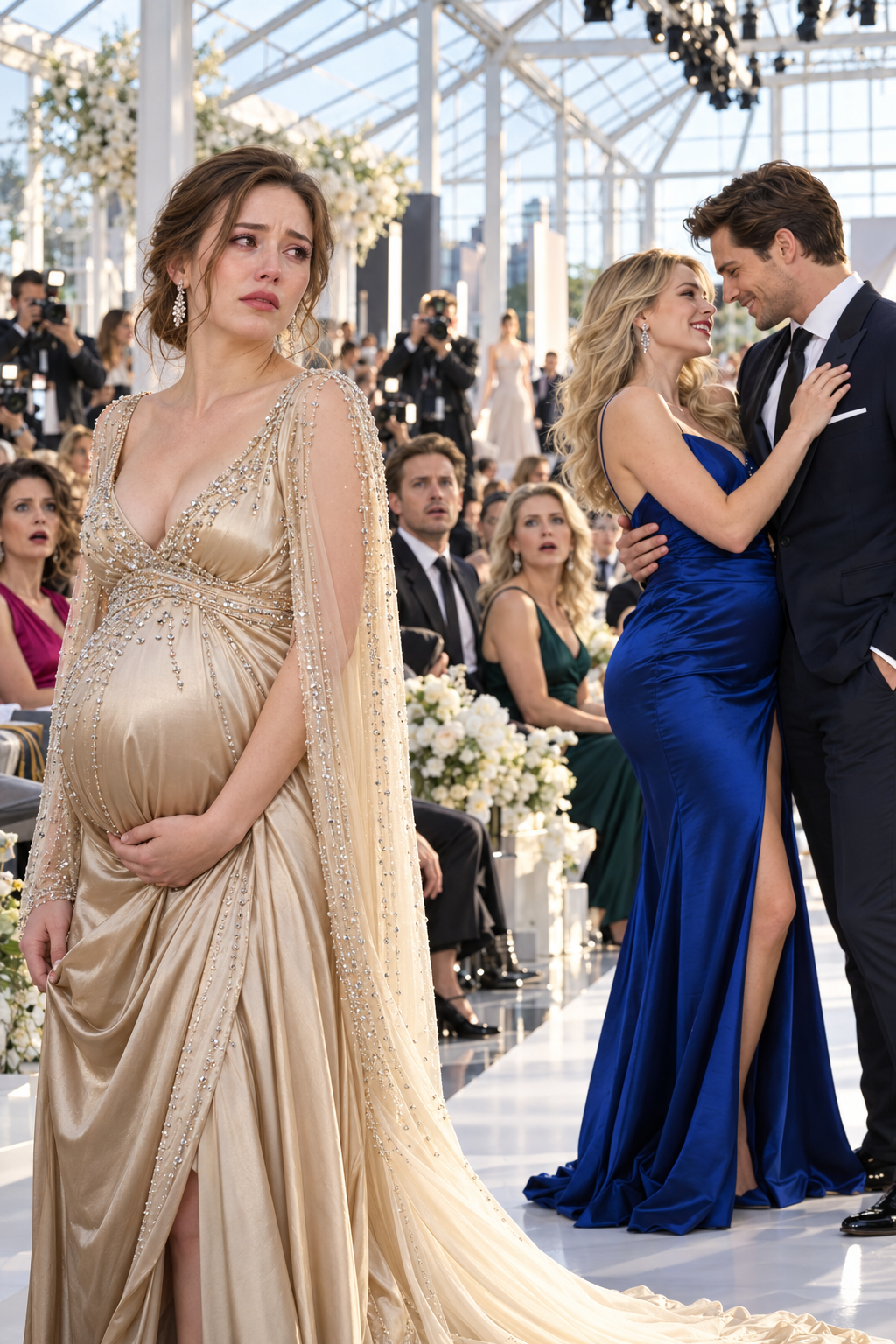
Her Billionaire Husband Paraded His Mistress at Fashion Week—Then His Pregnant Wife Asked Who Actually Owned the Runway
At thirty-one weeks pregnant, Evelyn Hart Cross learned there were humiliations worse than discovering your husband had a mistress.
There was watching him introduce her to six hundred people as the woman who represented his future.
The cameras were already rolling when Julian Cross placed one hand at the small of Sloane Mercer’s bare back and guided her toward the center of the runway.
Sloane wore silver silk and diamonds.
Evelyn wore a dark emerald maternity gown and carried a small black leather portfolio beneath one arm.
From the front row, she watched her husband smile in a way he had not smiled at her in almost a year.
“Fashion is about courage,” Julian told the reporters clustered around him. “It’s about recognizing when something has become outdated and having the nerve to move forward.”
A few people laughed.
Not loudly.
That made it worse.
Julian looked directly at his pregnant wife.
“Sloane understands that better than anyone.”
Sloane tilted her head, pretending embarrassment.
Julian’s mother, Patricia Cross, did not pretend.
She laughed openly.
Then she raised her champagne.
“To the future.”
Around her, executives from Cross International followed.
So did two editors.
A celebrity stylist.
Three board members.
Grant Vale, Julian’s chief financial officer, lifted his glass while staring straight at Evelyn.
And beside him stood the person whose presence hurt more than Sloane’s.
Evelyn’s younger brother.
Mason Hart.
Her own blood.
He lifted his champagne too.
Evelyn did not cry.
She did not stand.
She did not slap her husband.
She did not create the scene everyone seemed to be waiting for.
Instead, she rested one hand over the child moving beneath her ribs and looked down at the black portfolio on her lap.
Julian noticed.
His smile tightened.
“What is that?” he asked.
Evelyn looked up.
“Nothing you ever thought worth reading.”
A strange silence flickered across the front row.
Julian gave a dismissive laugh.
“Then let’s not ruin tonight with paperwork.”
“No,” Evelyn said softly.
“We wouldn’t want that.”
That was the first moment Julian should have been afraid.
Because Julian Cross believed he had already won.
Three months earlier, he had stopped coming home before midnight.
Two months earlier, he had moved half his wardrobe into the penthouse Cross International kept near Hudson Yards.
Six weeks earlier, photographs of Sloane leaving that building at dawn had appeared online.
Julian called them manufactured gossip.
Patricia called Evelyn insecure.
Grant called the photographs a temporary public-relations complication.
Mason told his sister the cruelest thing of all.
“Maybe if you weren’t always pregnant, tired, or dealing with charity work, he’d still see you as a woman.”
Evelyn had stared at her brother for several seconds.
Then she had said, “Interesting.”
Nothing else.
Mason mistook her silence for defeat.
They all did.
Because none of them understood what silence looked like when it belonged to a woman who had stopped negotiating with people she loved.
Evelyn had been silent when Julian spent their fifth anniversary in Singapore with Sloane.
She had been silent when Patricia removed Evelyn’s name from a foundation dinner because “pregnancy photographs badly beside couture.”
She had been silent when Grant transferred thirty-eight employees from Evelyn’s ethical-production initiative into departments that would eventually eliminate their jobs.
She had been silent when Mason accepted a consulting position at Cross International despite promising that he would never work for Julian.
She had been silent when Julian told her that the $118 million Fashion Week sponsorship package had come from his brilliance.
She had been silent when he said the runway existed because of him.
She had been silent.
She had been silent when she sold the first apartment she had ever owned to keep Mason out of bankruptcy at twenty-four.
She had been silent when she delayed graduate school to spend eleven months caring for their dying grandmother.
She had been silent when she used her private dividends to cover medical insurance for forty-seven workers after the Hart textile plant collapsed.
She had been silent when Julian’s first company was seventy-two hours from insolvency and she quietly arranged the bridge financing he later told Forbes he had “secured through instinct.”
She had been silent when everyone benefited.
She had been silent when nobody remembered.
She had been silent when the people she loved began confusing her generosity with emptiness.
But silence was not surrender.
Sometimes silence was where evidence accumulated.
Inside the black portfolio rested fourteen years of it.
And beneath those documents was something even Julian had never seen.
A cream envelope sealed nine years earlier by Evelyn’s grandmother, Eleanor Hart.
The woman had been dead for eight years.
Her warning had not been.
The show began.
Music thundered through the converted Manhattan rail terminal.
Models crossed beneath suspended glass lights while hundreds of phones rose in the darkness.
Julian sat beside Sloane instead of his wife.
Patricia had arranged the seating.
Evelyn had been moved one chair down.
The change was small enough to be deniable and cruel enough to be intentional.
Sloane leaned toward Julian.
He whispered something.
She laughed.
Then her fingers slipped over his wrist.
The photographers captured it.
They were supposed to.
Julian wanted the rumor confirmed without having to say the words.
His lawyers were already preparing his divorce strategy.
His board already knew.
His mother had already chosen a crisis-management firm.
Grant had already prepared projections showing what Cross International would look like after Evelyn’s charitable programs were stripped from the operating budget.
And Mason had been promised something extraordinary.
The presidency of Hart Meridian Ventures.
The company everyone believed Evelyn owned outright.
Everyone except Evelyn.
At intermission, Julian finally approached her.
“You could at least try to look happy.”
Evelyn looked at him.
“For whom?”
“You seem adequately happy for both of us.”
His jaw tightened.
“Don’t do this here.”
“I’m sitting quietly.”
“Exactly. You’re doing that thing.”
“What thing?”
“Making everyone feel like you’re judging them.”
Evelyn almost smiled.
“I haven’t said anything.”
“You don’t have to.”
Julian bent toward her so the nearest cameras could not hear.
“Sloane will be joining us at the after-party. I expect you to behave like an adult.”
Evelyn stared at him.
“Our home too?”
He hesitated.
That hesitation told her everything.
Julian straightened.
“We’ll discuss arrangements after tonight.”
“What arrangements?”
He glanced toward Patricia.
His mother was watching.
So was Grant.
So was Mason.
Not one betrayer.
A machine built from people who had each convinced themselves that hurting Evelyn was reasonable because somebody else had begun it first.
Julian lowered his voice.
“I think you should stay at the Connecticut house for a while.”
“The house my grandmother renovated?”
“My family maintains it.”
“That wasn’t what I asked.”
He exhaled sharply.
“Do you really want to have this conversation while pregnant?”
Evelyn’s gaze did not move.
“Interesting choice of words.”
“What does that mean?”
Again that word.
Julian hated it now.
He reached toward the portfolio.
Evelyn put her hand over it.
He stopped.
For the first time that evening, something changed in his face.
The animal awareness that a door somewhere had opened.
“What is in there, Evelyn?”
She looked toward the runway.
“You should enjoy your show.”
“Isn’t that what you’ve been telling everyone?”
Julian laughed.
“Cross International put one hundred eighteen million dollars behind this week.”
He looked at her.
Evelyn turned back to him.
“You announced one hundred eighteen million.”
“Same thing.”
Before Julian could answer, the lights dropped.
The second half began.
By midnight, Sloane Mercer was photographed leaving the venue on Julian’s arm.
Evelyn walked out alone through a service corridor.
Nobody photographed that.
She preferred it that way.
A black sedan waited outside.
Inside sat seventy-two-year-old attorney Samuel Price, who had represented Eleanor Hart for twenty-six years and had refused every invitation Julian had ever extended him.
Samuel looked at Evelyn’s stomach, then at her face.
“You all right?”
It was the first honest answer she had given anyone that night.
Samuel nodded.
She raised an eyebrow.
“Means you haven’t become numb.”
Evelyn handed him the portfolio.
“Activate it.”
Samuel did not open it.
He already knew what was inside.
“Once we do, it cannot be quietly reversed.”
“Cross International’s credit facilities may freeze.”
“Your brother could lose everything Julian promised him.”
Evelyn looked out the window.
“The fashion consortium will receive notice before sunrise.”
“The house issue?”
“Let them make their move.”
Samuel studied her.
“Your grandmother predicted this part.”
Evelyn finally looked at him.
“I used to think she was cruel for putting that clause in.”
“No. Eleanor was experienced.”
“That’s often the same thing after enough years.”
Samuel smiled sadly.
Then he removed the old cream envelope from the portfolio.
“You haven’t opened it since she died?”
“Read it again.”
Evelyn broke the aging seal.
Her grandmother’s handwriting slanted sharply across two pages.
My dearest Evelyn,
If you are reading this because someone you love is demanding access to what I left you, remember something the Hart women learned too late and too often:
Love may justify generosity.
It must never require surrender.
The controlling assets in the Meridian Trust were not left to make you rich. Money without purpose only breeds another form of poverty.
They exist because our workers were underpaid while men with our surname were praised for building an empire. They exist because your mother signed documents she did not understand while your father called obedience loyalty. They exist because I watched three generations of women build value that other people renamed after themselves.
If anyone—husband, sibling, director, partner, or heir—attempts to coerce, conceal, transfer, encumber, or appropriate these holdings, do not negotiate alone.
Trigger Article Nine.
Let the structure protect what your heart may hesitate to protect.
And Evelyn—
Never tell a man standing on your foundation that he built the ground.
Her grandmother had underlined the final sentence.
Evelyn folded the letter.
“Article Nine,” she said.
Samuel removed his phone.
“Everything.”
Samuel made the call.
By a.m., notices began moving through Manhattan.
By a.m., three banks had been informed that the collateral package underlying Cross International’s expansion facility was subject to independent trustee review.
At a.m., the Metropolitan Fashion Consortium received notice that seventy-three percent of its private underwriting came through Meridian Cultural Holdings.
At a.m., the management company controlling the runway venue received notice that its master lease was owned by another Meridian subsidiary.
At a.m., Grant Vale’s private inbox received an automated notice.
At a.m., he called Julian.
Julian did not answer.
He was asleep beside Sloane in the Hudson Yards penthouse.
At a.m., Mason received his notice.
He did answer.
“What the hell did you do?” he demanded when Evelyn picked up.
She was sitting in her kitchen drinking tea.
“Good morning, Mason.”
“My equity agreement is frozen.”
“Then you should call whoever promised it to you.”
“Julian says the Meridian transaction has been suspended.”
“Then call Julian.”
“You own Meridian.”
“I don’t own Meridian.”
“Don’t play games.”
“You told me Grandma left it to you.”
“She left me a beneficial interest.”
“That’s ownership.”
“No, Mason. That’s what you assumed.”
“What does that mean?”
“It means I couldn’t give Julian the controlling assets even if I wanted to.”
Mason’s breathing changed.
“What did we sign three weeks ago?”
There it was.
Not Julian.
Evelyn looked at the sunrise over the East River.
“You mean the papers you brought me during my prenatal appointment?”
Mason said nothing.
“The papers you told me were routine tax acknowledgments?”
“You read them.”
“Then why did you sign?”
Evelyn closed her eyes.
Because that was the question they should have asked earlier.
Why had a woman who checked restaurant receipts signed a thirty-two-page asset acknowledgment without argument?
Why had a woman who reviewed nonprofit grant contracts line by line failed to object to language involving marital property?
Why had a trustee’s granddaughter signed something presented by people she no longer trusted?
Because Evelyn had needed them to believe she was fooled.
“Did Julian tell you I signed away Meridian?” she asked.
“And did Grant?”
“Then you should probably ask them why they misunderstood the documents they drafted.”
She hung up.
At , Julian came home.
He arrived furious.
Not ashamed.
Not apologetic.
He walked into the kitchen without removing his coat and threw a stack of printed emails onto the counter.
“What did you do?”
Evelyn spread strawberry jam over toast.
“Good morning.”
“Stop saying good morning.”
“It’s morning.”
“Meridian froze the financing.”
“Temporarily.”
“The consortium is threatening to suspend the closing show.”
“Only if its funding source changes.”
“Which is Meridian.”
Julian stared at her.
“Your company.”
“Your trust.”
He slapped both hands against the counter.
“You signed the marital transfer.”
“I signed an acknowledgment of your claim.”
“You signed everything Grant put in front of you.”
“Then Meridian belongs to Cross marital holdings.”
His face slowly changed.
Evelyn took a bite of toast.
Julian stared at her as though she had suddenly begun speaking another language.
“What did you sign?”
“Exactly what was in front of me.”
“You waived your claim.”
“To assets legally capable of marital transfer.”
“Meridian is an asset.”
“Some pieces are.”
“And the rest?”
“Read Article Nine.”
Julian went still.
He had never heard of Article Nine.
Evelyn watched him understand that fact.
He had spent years believing the boring old trust documents beneath their marriage could be delegated to attorneys.
He had trusted Grant.
Grant had trusted Mason.
Mason had trusted his memories of family conversations.
Patricia had trusted entitlement.
Nobody had asked Evelyn.
Julian pulled out his phone.
Evelyn returned to her breakfast.
He paced while the call connected.
“What is Article Nine?”
More silence.
Then Julian looked at Evelyn.
“What do you mean independent trustees?”
Evelyn spread more jam.
“What do you mean nonassignable?”
His voice rose.
“What do you mean reversion rights?”
Evelyn finally smiled.
Not happily.
That would come later.
Three days passed.
Julian’s humiliation became anger.
Anger became strategy.
Strategy became cruelty.
On the fourth afternoon, Evelyn returned from an obstetric appointment and found her luggage on the front steps of the Manhattan townhouse.
Three suitcases.
Two garment bags.
A box containing prenatal vitamins, toiletries, and framed photographs.
The locks had been changed.
Patricia stood inside the glass entry doors.
Mason was beside her.
Evelyn remained beneath the stone portico, one hand supporting the ache in her lower back.
Julian opened the door.
“I told you we needed space.”
“You changed the locks.”
“This house is held through Cross Residential Holdings.”
“So it’s company property.”
Evelyn looked at Mason.
Her brother would not meet her eyes.
More than Julian.
More than Patricia.
More than Sloane.
Because Mason knew what it was like to lose a home.
Their parents had died nine months apart when Evelyn was twenty-six and Mason twenty-two.
Evelyn had been the one who kept the bank from taking their childhood property.
She had sold jewelry.
Emptied savings.
Taken consulting work at night.
She had slept four hours at a time while Mason finished business school.
When he suffered a panic attack before his final examinations, Evelyn had driven three hours through snow and sat on the floor beside his bed until morning.
Now he stood inside a house while his pregnant sister’s suitcases sat outside.
“Mason,” she said.
He looked at her.
Patricia folded her arms.
“Don’t manipulate him.”
Evelyn ignored her.
“Mason, are you really standing there?”
His jaw flexed.
“You’ve frozen everything.”
“I froze nothing.”
“Don’t lie.”
“An independent trustee froze transfers after attempted coercion.”
“We didn’t coerce you.”
“You brought asset papers to my medical appointment while I was sedated after a procedure.”
“It was an ultrasound.”
“It was an amniocentesis.”
Mason’s face went pale.
Julian interrupted.
Evelyn turned toward him.
He pointed at her suitcases.
“I’ll cover a hotel through the end of the month.”
For one second, nobody moved.
Then Patricia smiled.
That smile saved Evelyn.
It burned away the last soft place inside her.
“How generous,” Evelyn said.
Julian lowered his voice.
“Don’t make this ugly.”
Evelyn looked around at the limestone façade.
She remembered choosing the nursery wallpaper.
She remembered Julian carrying her across the threshold seven years earlier.
She remembered Christmas dinners.
Board celebrations.
Mason’s birthday.
Patricia’s surgery recovery.
The night Julian’s father died.
She had fed people in that kitchen.
Protected them in those rooms.
Financed Julian’s first acquisition from the small office upstairs.
And now the man standing before her believed changing a lock could erase history.
Evelyn nodded.
“All right.”
Julian blinked.
“All right?”
“I’ll leave.”
Patricia looked almost disappointed.
Mason stared at the ground.
Julian glanced at the neighboring buildings, perhaps worried she was planning a scene.
She wasn’t.
Evelyn picked up the smallest suitcase.
The doorman hurried forward to help.
Before leaving, she turned back.
“I have one question.”
Julian sighed.
“Are you certain this house belongs to Cross Residential Holdings?”
He laughed.
“This again?”
“Are you certain?”
Patricia said, “For heaven’s sake, Evelyn, don’t embarrass yourself.”
Evelyn looked at Julian.
She walked away.
Julian should have heard the trap close.
That evening, Sloane moved into the townhouse.
Patricia posted photographs from the dining room.
Mason attended a strategy meeting there.
Grant arrived carrying binders.
For seventy-two hours, they behaved like survivors celebrating after a war.
Julian authorized a press release describing the Meridian dispute as “administrative.”
Sloane was photographed wearing Evelyn’s robe on the balcony.
Patricia called three designers to discuss altering Evelyn’s gowns for Sloane.
Mason accepted a temporary executive title.
Grant assured lenders the freeze would be resolved because Julian’s attorneys possessed Evelyn’s signed waiver.
They thought they owned the house.
They thought they owned the company.
They thought they owned the fashion platform.
They thought they owned Evelyn’s silence.
Most dangerously, they thought they understood the inheritance.
On Monday morning, the Fashion Week closing show began at ten.
Julian arrived with Sloane at nine fifteen.
He had decided public confidence was the answer.
If investors saw him smiling, markets would calm.
If photographers saw Sloane beside him, nobody would imagine scandal had weakened him.
If Evelyn appeared at all, his security team had instructions to keep her away from the press corridor.
At , Grant received the first legal notice.
At , Patricia received another.
At , Mason called Julian six times.
At , the venue’s executive director asked Julian to come backstage.
Julian walked in smiling.
The smile disappeared when he saw Evelyn.
She stood beside Samuel Price.
She wore cream trousers, low heels, and a royal-blue coat draped over her pregnant belly.
No dramatic gown.
No diamonds.
No visible anger.
The black portfolio was in her hand.
Mason stood near the wall.
He looked sick.
Grant was arguing quietly with three lawyers.
Patricia arrived less than a minute later.
“What is she doing here?”
The executive director answered.
“Mrs. Cross is attending as principal beneficiary representative for Meridian.”
Julian laughed.
“No. She transferred her authority.”
Samuel Price looked at him.
“No, Mr. Cross. She acknowledged your claim that she transferred her authority.”
Julian turned.
“What’s the difference?”
“Approximately one hundred eighteen million dollars, a master lease, three classes of restricted voting units, and your current residence.”
Nobody spoke.
Evelyn watched Julian’s face.
“The house?” he said.
Samuel nodded.
“Cross Residential Holdings owns the structure.”
Julian looked at Evelyn.
She said nothing.
Samuel continued.
“The land beneath the structure is owned by Hart Ground Trust.”
Patricia scoffed.
“That is absurd.”
“It is publicly recorded.”
“The property was purchased by my husband.”
“The building was.”
Patricia’s mouth opened.
Samuel adjusted his glasses.
“Mr. Cross acquired the improvements through Cross Residential. Mrs. Hart’s family trust retained the underlying land through a ninety-nine-year ground lease.”
Julian’s face hardened.
“So,” Samuel replied, “that lease contains a morality, coercion, and fraudulent-transfer provision attached to trust-controlled residential use.”
Patricia laughed once.
“You cannot evict a man from his own home because he cheated on his wife.”
“No one is trying to.”
Samuel looked at Grant.
“The issue is not adultery.”
Then at Mason.
“The issue is an attempt to obtain restricted trust interests through material misrepresentation while the principal beneficiary was medically vulnerable.”
Mason went white.
Evelyn’s voice remained quiet.
“You told me they were tax acknowledgments.”
“You brought them into a medical clinic.”
“I didn’t know Grant changed—”
Grant turned on him.
“Don’t you dare.”
And there it was.
The system beginning to eat itself.
Julian stepped between them.
He faced Samuel.
“Whatever happened, Evelyn signed willingly.”
“Excellent,” Samuel said.
Julian frowned.
“Excellent?”
“We hoped you’d maintain that position.”
Samuel opened the black portfolio.
He removed the signed documents.
Then a second set.
Then a tablet.
“Mrs. Cross believed fraud was being attempted. On counsel’s advice, she permitted the attempt to continue so trustees could identify all participating parties.”
Grant’s expression changed first.
Because Grant understood.
The documents had been bait.
Not forged.
Not altered.
Not invalid.
Evelyn had signed exactly what they placed before her because the agreement explicitly excluded restricted trust assets.
Grant and Julian had assumed the exclusion language was boilerplate.
Then they had represented to lenders, directors, and family members that the papers gave Cross International control over Meridian.
Their own emails documented it.
Samuel tapped the tablet.
“Mason Hart’s messages describe convincing his sister that the papers were routine.”
Mason stepped backward.
“Grant told me—”
“Grant Vale’s messages discuss avoiding independent trust counsel until after execution.”
Grant stared at Julian.
Julian stared at nobody.
Samuel continued.
“Patricia Cross’s emails propose announcing control publicly before trustees can respond.”
Patricia’s face drained.
“And Mr. Cross’s messages indicate an intention to leverage the supposed transfer in order to secure an additional four hundred million dollars in credit.”
The room became utterly silent.
Julian looked at Evelyn.
“You recorded us?”
“Then where did he get private emails?”
Samuel answered.
“Company servers.”
Grant whispered something obscene.
Evelyn looked at her husband.
“Cross International’s compliance system archives executive communications involving regulated financing.”
“You accessed my company?”
“Our company,” Evelyn said.
Julian stared at her.
For the first time, fear arrived.
Evelyn opened the portfolio.
She removed one certificate.
Not ornate.
Not dramatic.
A legal document in a transparent sleeve.
“Your original company had twelve million dollars in debt when we married.”
Julian said nothing.
“I refinanced nine million through Meridian.”
He looked impatient.
“What does that have to do with ownership?”
“Do you remember the 2018 restructuring?”
“Of course.”
“Do you remember the preferred units issued to secure the bridge facility?”
Grant closed his eyes.
Julian looked at him.
Grant did not answer.
Evelyn did.
“Those units were never canceled.”
Julian’s face emptied.
“Impossible.”
“They were converted.”
“Into what?”
“Founder-control shares.”
“Who owns them?”
Evelyn held his gaze.
“Meridian Stewardship Trust.”
His mouth moved before sound came.
“How many?”
“How many?”
“Thirty-eight percent of economic preference.”
He exhaled, almost relieved.
“That’s not control.”
Evelyn waited.
“It carries fifty-one percent voting authority during a fiduciary breach.”
Nobody moved.
Even Patricia understood that sentence.
Julian looked toward Grant.
“You knew?”
“How could you not know?”
“The capitalization tables showed nonvoting preferred—”
“Until Article Nine,” Samuel said.
Grant slowly turned toward him.
Samuel’s expression did not change.
“During an attempted unauthorized acquisition of restricted trust assets, protective voting rights activate pending trustee review.”
Julian stared at Evelyn.
She could see every year of their marriage recalculating behind his eyes.
Every time she had let him stand at a podium.
Every magazine cover calling him self-made.
Every interviewer who asked Evelyn what it felt like being married to a financial genius.
Every dinner where Julian joked that his wife “didn’t care about business.”
Every board meeting she had skipped because somebody had to sit with his dying father.
Every child they had lost.
The miscarriage at eleven weeks.
The second at fourteen.
The third pregnancy that ended before they had told anyone.
This child had survived.
Thirty-one weeks.
A daughter.
A girl who would never watch her mother teach her that love meant disappearing.
Julian whispered, “You funded me.”
Evelyn shook her head.
“I invested in what I thought we were building.”
“You hid this.”
“I protected it.”
“From your husband.”
“From anyone who confused marriage with entitlement.”
His eyes became hard.
“So this is revenge.”
For the first time that morning, Evelyn sounded angry.
“You still don’t understand.”
She walked toward him.
“I could have shut you down the first time I saw Sloane leaving your penthouse.”
Julian looked away.
“I didn’t.”
She stepped closer.
“I could have exposed you when you moved employees out of the ethical-production program.”
Grant lowered his head.
“I didn’t.”
Another step.
“I could have blocked your acquisition when your accountants tried to classify garment-worker benefits as disposable costs.”
Nobody interrupted.
“I didn’t.”
She touched the black portfolio.
“I waited because Meridian was never built to punish an unfaithful husband.”
Her eyes met his.
“It was built to protect people who are easy to erase.”
The executive director of the fashion consortium stood silently near the curtain.
Evelyn looked toward the runway.
“My grandmother began that trust after discovering that women in Hart factories were sewing luxury garments while choosing between rent and medicine. My mother spent fifteen years correcting that shame. When the old textile company failed, forty-seven families lost their insurance in one morning. I paid it. When you needed financing, I approved it because you promised we would build a company where growth didn’t require treating human beings like waste.”
Her voice broke once.
She continued.
“The money was never the secret.”
Julian stared at her.
“The obligation was.”
Behind the curtain, music was beginning.
Hundreds of people waited outside.
Evelyn turned to the consortium director.
“The closing show continues.”
Julian blinked.
“The designers are not losing their show because of us.”
Sloane, who had been silent near the door, finally spoke.
“What about my collection?”
Evelyn looked at her.
Sloane flinched.
Perhaps she expected cruelty.
She did not receive it.
“If your designer fulfilled the worker standards, it stays.”
Sloane seemed confused.
“You aren’t canceling me?”
“After everything?”
Evelyn looked toward Julian.
“What you did with my husband was personal.”
Then toward Grant.
“What they did with the financing was institutional.”
Back to Sloane.
“I know the difference.”
Sloane’s face reddened.
For the first time since Fashion Week began, she seemed ashamed.
Julian did not.
He stepped closer.
“If you activate those voting rights, you’ll destroy Cross International.”
“No, Julian. I’m removing you from operational control pending investigation.”
“That’s the company I built.”
Evelyn’s eyes hardened.
“With whose money?”
His face twisted.
“There it is.”
“The truth. You’ve been waiting years to say that.”
Evelyn shook her head.
“I waited years hoping I would never need to.”
That hurt him more.
She could tell.
Samuel handed a document to the executive director.
“The trustees voted at eight twenty this morning. Mr. Cross and Mr. Vale are suspended from fiduciary decision-making effective immediately.”
Grant sat down.
Julian did not.
Patricia stepped forward.
“You cannot humiliate my son like this.”
Evelyn looked at her.
Patricia stopped.
“Do you remember my first Christmas with your family?”
Patricia said nothing.
“You gave every woman at dinner a place card.”
“What’s that got to do with anything?”
“Mine said Julian’s wife.”
Patricia’s expression shifted.
Evelyn smiled faintly.
“I remember wondering whether it was a joke.”
“You are being ridiculous.”
She turned to Mason.
He looked destroyed already.
His mouth closed.
“I could forgive you for taking the job.”
He swallowed.
“I could forgive you for liking the money.”
“I wasn’t—”
“I could even forgive you for resenting me.”
His eyes filled.
“But you stood behind that door while my luggage sat outside.”
Mason looked down.
“You knew what losing a home did to us.”
“I’m sorry.”
There were many ways to say sorry.
Some repaired.
Some merely confessed.
Evelyn studied him.
“I believe you.”
He looked up hopefully.
“But belief isn’t absolution.”
The hope disappeared.
Samuel handed Mason an envelope.
“Your provisional Meridian appointment is terminated. You retain whatever personal assets are legally yours. Nothing more.”
Mason nodded slowly.
Then Evelyn gave him the one mercy nobody else in that room expected.
“You are not going to prison because I am not asking prosecutors to turn your stupidity into a spectacle.”
Mason’s face collapsed.
“But if regulators ask whether you knowingly misrepresented those documents, tell the truth.”
“If Grant tells you to coordinate stories?”
“If Julian asks?”
Mason looked at the man who had promised him everything.
Julian laughed bitterly.
“Look at that. Thirty seconds and you’ve bought him back.”
Evelyn turned.
“No, Julian.”
Her expression was almost tired.
“You keep thinking every human relationship is an acquisition.”
Outside, applause erupted.
The closing show had begun.
Life continued.
That mattered.
The investigation lasted five months.
Evelyn gave birth to a daughter seven weeks after Fashion Week.
She named her Eleanor Rose.
Julian was at the hospital.
Not in the delivery room.
Evelyn allowed him to meet his daughter after the birth because his failures as a husband did not automatically erase his responsibilities as a father.
But she placed boundaries in writing.
There would be supervised transitions at first.
No photographs sold or distributed.
No using Eleanor in corporate rehabilitation campaigns.
Julian objected.
Then his lawyer explained the alternative.
Cross International survived.
Evelyn had meant what she said.
She did not destroy it.
The board removed Julian as chief executive after investigators concluded he had materially misrepresented potential control of trust assets during financing discussions.
Grant Vale resigned before he could be fired.
Two banks referred portions of the matter to regulators.
Grant eventually entered a civil settlement and was permanently barred from holding certain fiduciary roles within Meridian-controlled entities.
Patricia sold her Manhattan apartment after discovering that social status was considerably more expensive when corporations stopped paying for dinners, drivers, assistants, and private clubs.
Sloane ended her relationship with Julian six weeks after his suspension.
She issued no tell-all interview.
Years later, Evelyn would hear that Sloane had quietly started financing scholarships for seamstresses’ daughters.
Evelyn never asked whether guilt or growth had inspired it.
Sometimes the difference mattered less than the result.
Mason moved to Ohio.
He did not receive the Meridian presidency.
He did not receive family money.
He got a job managing supply contracts for a mid-sized manufacturer and spent two years repaying debts.
Every Sunday, he sent Evelyn a short message.
He never asked for forgiveness.
That was why, eventually, she began answering.
Their relationship did not return to what it had been.
Broken things rarely become original again.
Sometimes they become honest instead.
The Manhattan townhouse became the last disputed symbol.
Julian had vacated it after receiving notice that Cross Residential Holdings had violated provisions of the underlying ground lease.
His attorneys fought.
Meridian won.
Everyone expected Evelyn to move back.
She didn’t.
Instead, she transferred the building into a new housing foundation for pregnant women facing sudden financial abandonment.
The first floor became legal-aid offices.
The second and third became temporary apartments.
The nursery Evelyn had once prepared for her daughter became a quiet consultation room with two rocking chairs beside the window.
No plaque carried Evelyn’s name.
She refused one.
When reporters asked why she gave away a house worth more than twenty million dollars, Evelyn answered with a sentence that appeared in newspapers across the country.
“Because a locked door taught me what the property was actually worth.”
The Fashion Week funding changed too.
Meridian redirected part of its sponsorship toward independent designers who could document fair labor practices.
Garment workers received emergency health coverage.
Five apprenticeships were established in Eleanor Hart’s name.
A legal clinic was created for workers facing wage theft.
The runway remained glamorous.
Evelyn had no objection to beautiful things.
She simply stopped believing beauty required invisible suffering.
Eleven months after the night Julian paraded Sloane before the cameras, Evelyn attended Fashion Week again.
She was no longer pregnant.
Eleanor slept against her chest in a navy carrier while Evelyn stood behind the final row.
No front-row throne.
No entourage.
No dramatic entrance.
A young designer named Maribel Santos presented her first collection.
Maribel’s mother had sewn evening gowns for twenty-nine years.
Her father had driven deliveries at night.
Her entire collection had been financed through one of Meridian’s new grants.
When the applause rose, Maribel brought her mother onto the runway.
The older woman cried.
Evelyn did too.
For the first time in a very long time, her tears did not embarrass her.
Samuel Price found her afterward.
He looked older.
“Your grandmother would approve.”
“She’d find three things to criticize first.”
Evelyn laughed.
Samuel handed her a cream envelope.
Her smile disappeared.
“What is that?”
“Something I found in Eleanor’s final archive.”
Evelyn stared.
“Another warning?”
“Not exactly.”
She opened it.
Inside was one small card.
Eleanor’s handwriting.
If the day comes when they finally understand what you own, make certain you still remember who you are without it.
Evelyn read the sentence twice.
Then she folded the card.
Samuel watched her.
“You all right?”
This time Evelyn smiled.
Across the room, she saw Julian.
He had been invited by one of the participating brands.
He looked thinner.
There was no mistress beside him.
No crowd of executives laughing at his jokes.
For several seconds, they simply looked at each other.
Then Julian walked over.
Samuel started to move.
Evelyn touched his arm.
“It’s fine.”
Samuel stepped away.
Julian stopped several feet from her.
His gaze dropped toward Eleanor.
“She’s beautiful.”
“Thank you.”
He gestured toward the baby’s hand.
Evelyn hesitated, then nodded.
Julian touched one tiny finger.
Eleanor wrapped her hand around his.
Something moved in his face.
Pain, perhaps.
Or recognition arriving far too late.
“I’ve been thinking about what happened,” he said.
“I hope so.”
“I hated you for months.”
“I told myself you planned everything.”
“I planned some of it.”
“I told myself you wanted to humiliate me.”
“I didn’t.”
“I know that now.”
Evelyn shifted Eleanor gently against her chest.
Julian looked toward the runway.
“Do you know what the worst part was?”
“Finding out I wasn’t self-made.”
Evelyn said nothing.
He laughed softly.
“Bigger than losing the company. Bigger than the press. Bigger than the house.”
“You didn’t lose the company.”
“I lost the story I told myself about it.”
That, finally, sounded true.
Julian looked at her.
“Why didn’t you ever tell me how much you had done?”
Evelyn studied him.
Once, she would have answered carefully.
Once, she would have protected his pride.
Once, she would have softened the truth until it could enter the room without bruising him.
She did not do that anymore.
“Because every time I helped you, I thought we were building something together.”
Julian looked down.
“And every time you succeeded, you edited me out.”
He swallowed.
“I was awful to you.”
“I’m sorry.”
“I believe you.”
His eyes lifted.
He seemed startled by the phrase.
It was the same thing she had once told Mason.
Julian understood immediately.
Belief wasn’t absolution.
“You look happy.”
“Without me.”
Evelyn glanced toward the runway where workers, designers, editors, donors, and families were mingling beneath the lights.
Then down at her daughter.
“That isn’t why I’m happy.”
Julian waited.
“I’m happy because I finally stopped measuring my life by who stayed.”
Something in him broke quietly.
He nodded once.
Then he walked away.
Evelyn watched him disappear into the crowd.
She felt no triumph.
That surprised her.
For nearly a year, people had described what happened as revenge.
The newspapers called it a billionaire divorce war.
Commentators called it a spectacular power reversal.
Social media turned the black portfolio into a meme.
People debated whether Evelyn had been ruthless or brilliant.
They missed the point.
The trust had never been revenge.
The voting shares had never been revenge.
The ground lease had never been revenge.
Even Article Nine had not been revenge.
They were walls built by women who had learned what happened when love existed without boundaries.
Her grandmother had not left Evelyn a weapon.
She had left her an exit.
And Evelyn had turned that exit into a door other women could use too.
That was the inheritance.
Not the money.
Not the buildings.
Not the shares.
The refusal to disappear.
Later that evening, after the final photographs had been taken, Evelyn carried Eleanor outside.
Natural autumn light remained between the Manhattan towers.
Samuel waited beside the car.
Before getting in, Evelyn looked back at the Fashion Week venue.
Eleven months earlier, Julian had stood on that runway with his mistress and announced that the future belonged to people brave enough to discard what had become outdated.
Perhaps, in one accidental way, he had been right.
Evelyn had discarded something.
Not her marriage.
That had already been broken by choices she did not make.
Not her family.
Family could fracture without vanishing.
Not even her old life.
She had discarded the idea that goodness required allowing people unlimited access to her.
She had discarded the belief that silence meant agreeing.
She had discarded the habit of making herself smaller so other people could feel self-made.
Eleanor stirred against her chest.
Evelyn kissed her daughter’s forehead.
Samuel opened the car door.
Then he paused.
“One thing still bothers me.”
Evelyn smiled.
“Only one?”
“Julian’s lawyers spent months saying they never understood why you asked that question outside the townhouse.”
Evelyn remembered the suitcases.
The changed locks.
Patricia behind the glass.
Mason refusing to look at her.
Julian offering to pay for a hotel as though seven years of marriage could be checked out by noon.
She remembered asking whether he was certain the house belonged to him.
At the time, she had sounded almost uncertain.
Almost weak.
Almost like a discarded pregnant wife searching for one final thread of dignity.
But it had never been a plea.
It had been a warning.
Evelyn looked once more at the illuminated city.
Then she smiled.
“They spent years asking what I owned,” she said.
Samuel waited.
Evelyn tightened her arms around her daughter.
“Why did none of them ever think to ask what they were standing on?”
✓ Lynn R. Adams
Her Billionaire Husband Paraded His Mistress at Fashion Week—Then His Pregnant Wife Asked Who Actually Owned the Runway At thirty-one weeks pregnant, Evelyn Hart Cross learned there were humiliations…