He Threw Out His Wife and Silent Son
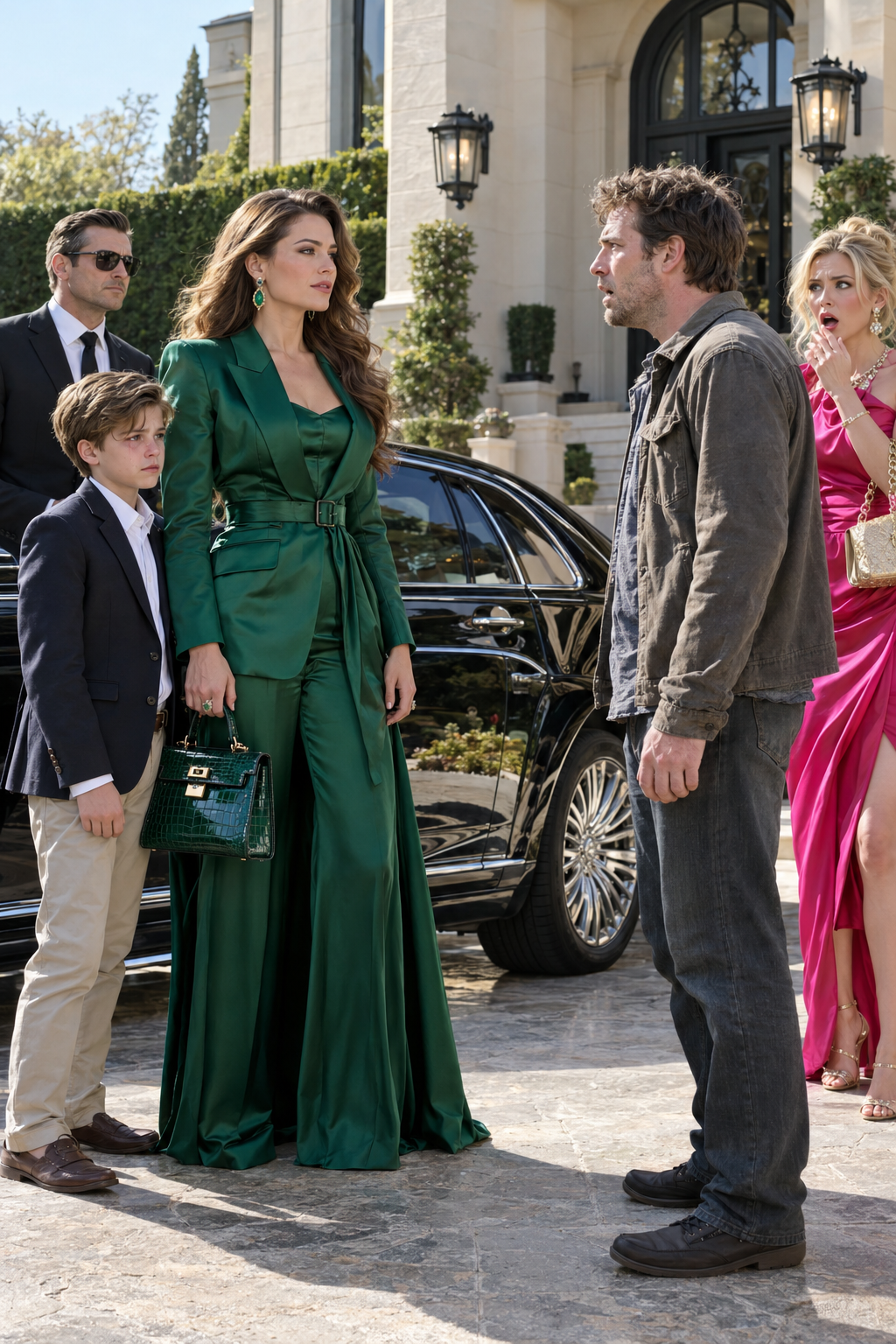
He Threw Out His Wife and Silent Son—Years Later, She Returned Owning Everything His Family Thought They Had Stolen
Three days after my father’s funeral, my husband put my suitcase on the front porch, set our eight-year-old son’s communication tablet on top of it, and told me neither of us belonged in his house anymore.
Then his mother stepped around him, looked directly at my son, and said, “Maybe if the boy could speak like a normal child, people wouldn’t find him so exhausting.”
My son heard every word.
He always did.
Eli simply couldn’t answer them.
Daniel expected me to scream.
His mother, Judith, expected me to beg.
My younger sister, Lauren, stood behind them in my own kitchen wearing the cashmere cardigan I had given her for Christmas, and she expected me to collapse when I realized she had chosen their side.
Instead, I bent down, picked up Eli’s tablet, wiped one fingerprint from the screen, and placed it carefully inside his backpack.
Then I looked at Daniel.
“Are you certain?”
That was all I asked.
He actually laughed.
That laugh stayed with me for years.
Not because it hurt.
Because it told me exactly how little he understood.
Behind me, the February wind pushed dry leaves across the brick walkway of the house I had spent eleven years helping him keep.
The house was in Westfield, Connecticut, four bedrooms, cedar shutters, white columns, a backyard that sloped toward a line of bare maple trees.
Daniel loved telling people he had bought it.
Technically, the mortgage was in both our names.
Technically, I had paid the down payment.
Technically, the $186,000 that made the house possible had come from selling the small bungalow my father gave me when I married Daniel.
But Daniel had spent so many years saying, “my house,” that eventually everyone around him started repeating it.
Including my own sister.
That afternoon, he stood in the doorway wearing a navy quarter-zip sweater, his wedding ring still on his hand, while Judith held a folder against her chest like she was already presiding over my execution.
“You heard him, Claire,” she said. “Don’t make this uglier than it needs to be.”
I looked at the folder.
I had seen Judith carry documents that way before.
Flat against her body.
One hand across the front.
Thumb covering the label.
She did it whenever she thought paper could frighten people.
“What’s in the folder?” I asked.
Daniel’s face tightened.
“Nothing you need to worry about.”
That meant I absolutely needed to worry about it.
But I didn’t reach for it.
I didn’t raise my voice.
I didn’t remind them that I had spent four years taking Daniel’s father to oncology appointments while Judith complained that hospitals made her anxious.
I didn’t remind Lauren that I had paid twelve months of her rent after her first marriage collapsed.
I didn’t remind Daniel that when his logistics company almost failed in 2018, I cashed out half my retirement account so thirty-one employees wouldn’t miss payroll.
I didn’t remind any of them that Eli had spent the first five years of his life inside specialist offices, developmental clinics, occupational therapy rooms, and speech labs while Daniel attended exactly six appointments.
There are moments when listing your sacrifices only cheapens them.
So I said nothing.
That silence disturbed Judith more than tears would have.
She shifted the folder.
Daniel frowned.
Lauren stared at me.
Eli stood beside my hip in his green winter coat, both hands clenched around the straps of his backpack.
His eyes moved from Daniel to me.
He was asking a question without words.
Are we safe?
I put my palm gently against the back of his head.
Whatever happened next, yes.
We were going to be safe.
I had already decided that.
What none of them knew was that twenty-six hours before Daniel put my suitcase outside, I had opened the final envelope my father left behind.
And what was inside that envelope made the house behind Daniel look very small.
My father, Arthur Bennett, had died at sixty-eight after a short fight with pancreatic cancer.
To most people, he had been a quiet man who owned three hardware stores across Connecticut.
That was how Daniel described him.
“Your dad sells nails and lawn mowers.”
That was how Judith described him.
“Comfortable, but hardly wealthy.”
That was how Lauren described him.
“Dad never understood money. He sat on property instead of enjoying it.”
They were all wrong.
My father owned the hardware stores.
But the stores had never been his real business.
Not glamorous land.
Not beachfront homes.
Not glittering Manhattan towers.
He bought forgotten things.
Industrial parcels beside abandoned rail lines.
Old warehouses near rivers.
Utility easements.
Storage lots.
Half-empty retail strips.
Small apartment buildings people dismissed because the carpet smelled old and the boiler rattled.
My father never chased what looked expensive.
He bought what would become necessary.
By the time he died, Bennett Holdings controlled pieces of land under distribution centers, parking structures, medical offices, fiber-optic routes, municipal access roads, and two large redevelopment districts that three national firms had spent years trying to acquire.
He almost never talked about it.
When I was little, I thought we were middle class because Dad clipped coupons.
When I was sixteen, I learned he owned the entire shopping center where he clipped them.
He taught me one rule.
“People show you who they are when they think the small thing in front of them is all you have.”
Then he would smile.
“Let them.”
My father had spent his final year reorganizing Bennett Holdings.
I knew some of it.
I did not know all of it.
Not until after the funeral.
The day before Daniel threw me out, I had gone alone to my father’s old office.
It sat above the original Bennett Hardware in New Haven, at the top of a narrow staircase that creaked under every step.
The office still smelled like black coffee, cedar shavings, and the peppermint candies he kept in a glass jar.
His attorney, Miriam Cole, was waiting for me.
Miriam was seventy-two, silver-haired, straight-backed, and so calm that even judges seemed to lower their voices around her.
She placed three things on Dad’s desk.
A brass key.
A blue envelope.
And a handwritten note.
The note said:
If they are kind to you when they believe you have nothing, reconsider everything I wrote below.
If they are cruel, do exactly as instructed.
Do not announce what you own.
Do not fight over furniture.
Do not warn anyone twice.
And under no circumstances sign anything presented to you by Daniel, Judith, Lauren, Mercer Development, or Holloway Private Bank until Miriam confirms it.
What belongs to you was designed to survive greed.
What belongs to Eli was designed to survive everyone.
I read the last line three times.
“What belongs to Eli?” I asked.
Miriam did not answer immediately.
Instead, she slid the brass key toward me.
“Arthur made me promise something.”
“That you would make one decision before I told you the full value of the estate.”
I stared at her.
“What decision?”
“Whether you still wanted to save your marriage.”
I almost laughed.
Not because it was funny.
Because Dad had somehow reached through death and found the exact pressure point I had spent years hiding.
Daniel and I had been deteriorating for a long time.
No dramatic affair.
No lipstick on collars.
No late-night hotel receipts.
Something colder.
The kind that arrives by inches.
He stopped asking how Eli’s appointments went.
He started making jokes about my “little bookkeeping work,” even though I had quietly managed accounting and vendor negotiations for two Bennett properties.
He stopped touching my shoulder when he walked behind me.
He started making decisions with Judith before talking to me.
He invited Lauren to family business dinners without me because, as he put it, “she knows how to socialize.”
Then, six months before Dad died, Daniel began pushing me to ask Dad for access to a seventeen-acre warehouse property outside Stamford.
Mercer Development wanted it.
Daniel had become close with Mercer’s regional vice president, Grant Holloway.
Grant played golf with Daniel.
Grant financed political fundraisers with Judith.
Grant’s younger brother worked at Holloway Private Bank.
And Lauren had recently accepted a consulting job with Mercer.
At first, Daniel called it coincidence.
Then he called it opportunity.
Then he called me selfish when I refused to pressure my dying father into selling.
“I don’t need to know the estate’s value,” I told Miriam.
She watched me carefully.
“That was not the question.”
I looked through the office window at the old brick rooftops outside.
“I don’t want to save my marriage.”
Miriam nodded once.
No sympathy.
No congratulation.
Just acceptance.
Then she opened the blue envelope.
Inside was a transfer summary.
I read the first page.
Then the second.
Then I stopped breathing for a moment.
My father had transferred controlling interest in Bennett Holdings into the Bennett Legacy Trust eighteen months before his death.
The voting beneficiary was me.
The protected successor beneficiary was Eli.
Estimated combined asset value, after debt and conservative valuation:
$2.14 billion.
I sat very still.
Miriam let the silence settle.
“That number may change significantly,” she said.
I looked up.
There were pending municipal approvals involving two industrial redevelopment corridors.
A medical technology company was negotiating a forty-year land lease.
A national shipping company wanted a rail-access easement.
And the Stamford property Daniel had been trying to get my father to sell?
It was not worth the $14 million Mercer Development had offered.
It was the central access point to a much larger project.
Without that parcel, Mercer’s proposed luxury development could not connect legally to the state road.
Without my signature, their $620 million project was effectively trapped.
I sat back in Dad’s chair.
Suddenly Daniel’s behavior over the past year looked different.
Not random.
Not merely cruel.
“Did Daniel know?”
“Not the estate value.”
“Did he know about the Stamford parcel?”
“He knew Arthur controlled it.”
“And Lauren?”
Miriam’s expression changed slightly.
“She made inquiries.”
My chest went cold.
“What kind?”
“On behalf of Mercer.”
There it was.
My sister had not simply taken Daniel’s side.
She had been standing on it long before my father died.
Miriam tapped the note.
“Arthur believed certain people might attempt to create the appearance that you agreed to a sale before probate was completed.”
“What does that mean?”
“It means your father expected fraud.”
I looked at the brass key.
“What does this open?”
“A safe-deposit box.”
“What’s inside?”
“I don’t know.”
That surprised me.
“Dad didn’t tell you?”
“He said you should open it only if someone tried to remove you from the house, isolate you financially, pressure you to sign estate documents, or use Eli’s disability against you.”
My fingers tightened around the key.
“Those are very specific conditions.”
“Dad knew.”
“He suspected.”
“How much?”
Miriam folded her hands.
“Enough to put safeguards in place.”
“I should go home.”
Miriam also stood.
“If this becomes what Arthur feared, do not react too quickly.”
I looked at her.
“Because greedy people are most careless during the short period when they believe they have already won.”
The next afternoon, my suitcase was on the porch.
Daniel wanted me gone within minutes.
Judith wanted me humiliated.
Lauren wanted me silent.
Eli wanted to know whether he had done something wrong.
And somewhere under Judith’s thumb was a folder she did not want me to read.
So I gave them exactly what they wanted.
Not because I was defeated.
Because I finally understood my father’s last lesson.
I didn’t fight for the sofa.
I didn’t fight for the wedding china.
I didn’t fight for Daniel’s approval.
I didn’t fight for Judith’s respect.
I didn’t fight to convince my sister that blood should have meant more.
I saved my strength for what mattered.
I saved my strength for my son.
I saved my strength for the truth.
Daniel mistook silence for surrender.
That was his first serious mistake.
I took Eli to a hotel in New Haven that night.
Nothing extravagant.
Dad could have afforded any suite in the state, but I chose a clean extended-stay place near Yale New Haven Hospital because Eli knew the neighborhood from therapy visits.
Routine mattered to him.
Predictability mattered.
Trust mattered.
He sat cross-legged on the bed while I unpacked his weighted blanket, toothbrush, two dinosaur shirts, headphones, and the battered red model train he had slept with since kindergarten.
Then he tapped his tablet.
DAD ANGRY ME?
I sat beside him.
He studied my face.
I repeated it.
“No. Dad is not angry because of you.”
He typed again.
GRANDMA SAY NORMAL.
My throat tightened.
I could have lied.
I could have said Judith didn’t mean it.
Adults often clean up cruelty because honesty makes them uncomfortable.
I never did that with Eli.
“Grandma said something cruel.”
He watched me.
“That was her failure. Not yours.”
He looked down.
Then he typed:
I looked around the hotel room.
The beige curtains.
The humming air conditioner.
Our two suitcases by the door.
“We’re going to build a new one.”
He stared at me.
I touched his hand.
“And no one will ever make you earn the right to stay in it.”
That night, after Eli fell asleep, I called Miriam.
“He removed us.”
There was a pause.
“Did he ask you to sign anything?”
“Did Judith have documents?”
“Did you see them?”
“How is that good?”
“Because if they are doing what Arthur suspected, they may now believe you left voluntarily and abandoned any immediate claim.”
I looked at Eli sleeping.
“What do I do?”
“Open the box tomorrow.”
The safe-deposit box was at First Connecticut Trust, an old independent bank where my father had kept accounts for forty years.
Inside were no diamonds.
No stacks of cash.
There was only a black flash drive, a sealed affidavit, copies of corporate ledgers, and an old green ledger book from 1997.
At the bottom was another note.
Money can be stolen.
Paper can be forged.
People can lie.
But timelines are stubborn.
If they come after you, follow the dates.
I spent six hours with Miriam and a forensic accountant named Nathan Price.
By evening, we understood why my father had created the box.
For seven years, Daniel’s company, Crosswell Freight Solutions, had been receiving preferential warehouse contracts from Mercer Development.
In exchange, Crosswell routed materials through properties connected to Bennett Holdings.
Nothing illegal by itself.
But several signatures authorizing those routes appeared to be mine.
They were not.
My name was on eleven documents I had never seen.
Lauren’s consulting company had received payments within days of four of those signatures.
Judith chaired a local redevelopment nonprofit that had promoted Mercer’s zoning petitions.
Grant Holloway had arranged bridge financing for Crosswell.
Not one villain.
They had used family dinners, medical emergencies, and my father’s declining health as cover while they built a paper trail suggesting that I supported the eventual sale of the Stamford parcel.
If Dad had died without restructuring his holdings, they might have had enough confusion to force a court battle.
Not necessarily win.
And delays in real estate can create leverage worth millions.
Dad had seen enough to worry.
So he had transferred control before they were ready.
I stared at one signature.
My fake signature.
It dated back almost two years.
“Whoever did this practiced,” Nathan said.
Miriam gave him a look.
“Speculation.”
“Right. The signature is consistent across documents.”
I knew exactly what that meant.
Someone close to me had access to my handwriting.
Birthday cards.
School forms.
Tax documents.
Someone close enough that copying me would be easy.
I thought of Daniel.
Then Lauren.
Then Judith.
I didn’t know which possibility hurt most.
I did know one thing.
I was done protecting any of them from consequences.
Within a week, I filed for divorce.
Daniel responded by freezing our joint checking account.
I had expected that.
What he did not know was that I already had access to a trust distribution account established by my father.
I could have rented a mansion.
Instead, I leased a modest furnished townhouse near Eli’s school.
I bought two mattresses.
A kitchen table.
A blue couch.
A secondhand oak desk.
Eli chose yellow curtains for his room because he said the color felt “awake.”
At least, that was how he described it on his tablet.
Daniel sent one text.
You’re being dramatic. Come to your senses and sign the temporary separation agreement.
Attached was a PDF.
Miriam reviewed it.
Buried on page nineteen was a clause stating that I disclaimed any marital or beneficial interest in future proceeds derived from certain “family-related commercial assets.”
The language was vague.
Very vague.
Except for one attached schedule.
Parcel 14-C.
The Stamford property.
I sent Daniel one response.
He called fourteen times.
I did not answer.
On the fifteenth attempt, he left a voicemail.
“You’re making this harder than it needs to be, Claire. Lauren says you’re emotional because of your dad. Judith thinks you need help. I’m trying to protect everybody here, including Eli.”
That last sentence changed something inside me.
Not loudly.
Permanently.
People had used Eli as a reason I should accept less for years.
Less respect.
Less professional ambition.
Less financial independence.
Daniel would say, “Someone has to prioritize Eli.”
What he meant was me.
Judith would say, “A child with his issues needs stability.”
What she meant was obedience.
Lauren would say, “You chose motherhood.”
What she meant was that my life should have stopped when hers kept going.
But Eli had never asked me to disappear.
He had never asked me to shrink.
He had never asked me to become dependent.
Those were choices other people made for me and then blamed on him.
So when Daniel said he was protecting Eli, I saved the voicemail.
Then I sent it to Miriam.
“Keep everything,” she said.
For the next four months, Daniel and his family behaved like people who believed victory was administrative.
They changed locks on the Westfield house.
Judith started renovating the guest bedroom.
Lauren posted photographs from my former kitchen with captions about “fresh beginnings.”
Mercer Development announced a preliminary partnership for its Stamford luxury district.
A glossy rendering appeared in a regional business magazine showing glass towers, landscaped courtyards, retail promenades, and a wide boulevard running directly across Parcel 14-C.
My property.
Grant Holloway gave an interview.
He called the project “inevitable.”
I cut out that word.
Inevitable.
I taped it above my desk.
Not because I was angry.
Because arrogance is useful evidence.
The divorce mediation happened in June.
Daniel arrived in a charcoal suit with a lawyer named Stephen Marks and the relaxed expression of a man expecting to negotiate the terms of my defeat.
He offered me $210,000 from the house.
Half the furniture.
Three years of limited spousal support.
Joint custody, but only if I agreed that major medical decisions concerning Eli would require Daniel’s written approval.
That clause was meant to hurt me.
Daniel had attended almost none of the appointments.
Now he wanted veto power.
I read every page.
Then I closed the folder.
Stephen leaned back.
“Mrs. Crosswell, this is a generous offer.”
“It is not.”
Daniel gave a small laugh.
“There she goes.”
Miriam sat beside me.
Daniel pointed at me.
“This is the problem. She thinks everything is some kind of attack.”
I looked at him.
“Do you want fifty-fifty custody?”
“What is Eli’s neurologist’s name?”
Daniel blinked.
Stephen moved slightly.
I continued.
“What is his occupational therapist’s name?”
Daniel’s jaw tightened.
“What dose of melatonin does he take when travel disrupts his sleep?”
“What symbol does he use on his tablet when he feels overwhelmed?”
“Stop performing.”
I folded my hands.
“What is the name of the teacher who has been working with him on assisted communication since September?”
Daniel’s face went red.
He knew none of them.
I turned to Stephen.
“Your client does not want fifty percent of the responsibility. He wants fifty percent of the authority.”
Nobody laughed after that.
That was the first miniaturized version of what would happen over the next several years.
They would arrive expecting me to fold.
I would ask one calm question.
And the room would change.
The first major shift came twelve months after my father died.
Bennett Holdings finalized the medical technology lease.
The press reported the transaction at $430 million over forty years.
My name appeared publicly for the first time as chairwoman of Bennett Legacy Group.
Daniel called within ten minutes.
I watched his name flash on my phone.
Then again.
Then again.
He left a voicemail.
“Call me. Now.”
Judith called.
Lauren texted:
You need to understand that Dad intended family assets to benefit all of us.
That one almost impressed me.
Dad had specifically left Lauren $4.2 million through a separate trust.
She had received it.
She wanted more.
I responded:
He put his intentions in writing.
She sent back:
You always were his favorite.
That was false.
Dad loved us differently because we behaved differently.
Lauren mistook consequences for favoritism.
Two days later, Mercer Development requested a formal meeting.
They wanted Parcel 14-C.
Their original offer had been $14 million.
Their new offer was $39 million.
I declined.
They offered $55 million.
I declined.
Grant Holloway asked to meet personally.
Not because I planned to sell.
Because I wanted to see his face when he realized who owned the door he needed opened.
We met at a private conference room in New York.
Grant was fifty-one, silver at the temples, tan in February, expensive without being flashy.
The kind of man who spoke gently because other people were usually more frightened than he was.
He shook my hand.
“Claire. I’m glad we can finally be reasonable.”
“My father was reasonable.”
Grant smiled.
“Arthur was stubborn.”
“He read contracts.”
The smile thinned.
“Same thing, sometimes.”
His attorney opened a presentation.
Traffic projections.
Tax benefits.
Job creation.
Public plazas.
Affordable housing commitments.
The usual stack of arguments used to make private profit sound like charity.
Some of it was valid.
Cities do need development.
Jobs do matter.
Housing matters.
Dad had taught me never to reject a deal simply because someone else made money.
The question was who carried the cost.
I listened.
Then I asked Grant one question.
“How many families are being displaced?”
His attorney paused.
Grant answered.
“Very few.”
“How many?”
“Thirty-seven residential units.”
“Families?”
I slid a folder across the table.
“Fifty-two households.”
Grant did not touch it.
I had already commissioned an independent review.
Mercer’s plan relied on demolishing three aging apartment buildings on land adjacent to the development.
Bennett Holdings owned a minority interest in two.
Many tenants were elderly.
Six families had disabled children.
Three residents had lived there more than forty years.
Mercer planned to offer relocation stipends and move them outside the district.
Legally possible.
Morally convenient.
Financially efficient.
I looked at Grant.
“My father bought those buildings because previous owners wanted to empty them.”
Grant’s mouth hardened.
“This project cannot be built around sentimental attachments.”
I leaned back.
“It can be built around people.”
He exhaled.
“What do you want?”
There it was.
The question everyone eventually asked.
What do you want?
They assumed the answer was money because money was the only language they trusted.
“I want ninety-six replacement apartments built before demolition begins. Forty percent permanently income-restricted. Ground-floor accessible units for residents with mobility limitations. A funded transition program. And a communication-access clinic for children with speech disabilities.”
Grant stared.
His attorney stopped writing.
“The economics don’t support that.”
“You can’t know our economics.”
“I own the access parcel.”
I continued.
“And if you cannot afford humane relocation, you cannot afford my land.”
Grant studied me for a long time.
“This is about Daniel, isn’t it?”
That answer bothered him more than yes would have.
“This is about my son.”
Grant glanced at his attorney.
Then back to me.
“He isn’t part of this project.”
“Children like him are.”
“You have thirty days to decide whether you want to build the district you advertised or the one you actually planned.”
I walked out.
Two weeks later, Mercer agreed.
Not because Grant became a better man.
Because the land made decency cheaper than refusal.
That was when Bennett Legacy Group began changing.
I stopped treating it as an inheritance.
I treated it as unfinished work.
Dad had accumulated leverage.
We bought failing apartment complexes before private equity firms could strip them.
We converted unused warehouse space into therapy centers, vocational workshops, and small-business incubators.
We created housing trusts around medical campuses.
We invested in communication technology startups.
One small company in Boston had developed eye-tracking software for nonverbal children but was months from shutting down.
We funded them.
Three years later, their software was used in twelve states.
Eli was one of the first children to test the upgraded system.
The first sentence he built with it was:
MOM TALKS TOO MUCH.
I laughed for almost a full minute.
He smiled so hard his entire face changed.
Then he typed:
That evening we ate pizza on the floor of our new house overlooking Long Island Sound.
Not because we were hiding anymore.
Because the furniture delivery was late.
Eli had grown tall.
He still did not speak aloud.
Maybe he never would.
By then, neither of us treated that fact like a tragedy.
His silence belonged to him.
What mattered was that the world finally had better ways to listen.
Five years after Daniel threw us out, Bennett Legacy Group’s assets were valued at just over $4.8 billion.
Financial publications started using the word billionaire beside my name.
I hated that word.
Not because it embarrassed me.
Because it reduced everything to a number.
They did not print photographs of the tenants who stayed in their homes.
They did not interview the mother whose eleven-year-old daughter used an eye-tracking device to tell her for the first time that she loved purple.
They did not show the former warehouse where autistic adults assembled medical kits for union wages.
They did not mention that my father had spent forty years buying ugly land because he believed ugly land could still protect beautiful lives.
They printed the number.
$4.8 billion.
And suddenly people who had ignored my emails wanted dinner.
Including Daniel.
By then, his life looked different.
Crosswell Freight had expanded rapidly during the Mercer project.
Then federal regulators began examining several route agreements.
Two major clients left.
Grant Holloway resigned from Mercer after an internal audit revealed undisclosed financial relationships with subcontractors.
Judith’s redevelopment nonprofit lost three donors.
Lauren’s consulting contract ended.
None of them had been charged with crimes.
But the machine that once looked untouchable had started making grinding noises.
Daniel and I communicated only about Eli.
Our custody arrangement gave me final medical authority.
Daniel received alternating weekends.
He used about half of them.
Eli never complained.
He simply began refusing to pack his red train.
That was how I knew the Westfield house no longer felt like home to him.
Then, six years after the day we were thrown out, Daniel called and asked me to attend a dinner.
I almost declined.
Then he said the reason.
“My mother is selling the Westfield property.”
“The house?”
“And the adjacent lots.”
“What adjacent lots?”
He hesitated.
That was interesting.
“Just come, Claire.”
“Who will be there?”
“That is not an answer.”
“Lauren. Mom. Stephen. A representative from Mercer.”
After six years.
“Send me the documents first.”
“It’s complicated.”
“Then explain it.”
Another hesitation.
“Just come.”
The dinner was held at Judith’s country club.
Of course it was.
She had always preferred rooms where staff called her Mrs. Crosswell.
I arrived alone.
No chauffeur.
No security procession.
No spectacle.
I wore a black dress and Dad’s old stainless-steel watch.
The host led me into a private dining room.
Everyone was already there.
Stephen Marks.
And a new Mercer executive named Peter Vaughn.
They had placed me at the far end of the table.
I almost admired the symbolism.
Judith looked older.
Her hair was white now, carefully shaped.
Lauren had the polished appearance of someone who had learned to conceal panic under expensive skincare.
Daniel looked almost exactly as he had the day he threw me out.
Same posture.
Same controlled irritation.
Only the confidence had thinned.
Peter stood.
“Ms. Bennett.”
Daniel flinched.
He hated that I had returned to my maiden name.
I shook Peter’s hand.
Dinner arrived.
Nobody ate.
Finally Judith spoke.
“We should put the past behind us.”
I looked at her.
“Which part?”
Her mouth tightened.
Daniel jumped in.
“This is about the property.”
“So you said.”
Stephen opened a folder.
I recognized the gesture.
Flat against the chest.
Thumb near the label.
For one second, I was standing on the porch again.
Eli beside me.
His tablet on my suitcase.
Judith calling him abnormal.
Then the moment passed.
Stephen laid out a site map.
The Westfield house sat on 2.3 acres.
Behind it were six narrow wooded parcels.
Judith explained that Daniel’s grandfather had purchased those parcels decades earlier under separate entities.
Mercer wanted to combine them for a luxury senior living complex.
The sale price was $27 million.
Lauren smiled carefully.
“Mom wants to distribute part of the proceeds among the family.”
I looked at the map.
“Why am I here?”
Daniel spoke.
“Because there’s a title issue.”
Of course there was.
Stephen slid another document toward me.
One of the wooded parcels included an old service road.
The deed referenced an easement granted in 1989 to Bennett Storage Company.
My father’s company.
The easement gave Bennett Storage permanent commercial access across the property.
Mercer could not obtain clean construction financing unless the easement was released.
They needed my signature.
I looked around the table.
Six years earlier, they had pushed me out of that house believing I had no power.
Now they needed me to make it valuable.
Judith folded her hands.
“We’re prepared to be fair.”
“How fair?”
Daniel leaned forward.
“Two million dollars.”
Lauren added quickly, “For a signature. That’s extremely generous.”
I looked down at the document.
Then I laughed.
Not because two million dollars was funny.
Because they still thought this was about a number.
Peter cleared his throat.
“We’re open to discussion.”
I turned to him.
“Has Mercer completed environmental review?”
His eyes shifted.
“Full review?”
“Groundwater?”
“Preliminary.”
“Historic waste storage?”
Another pause.
Daniel looked irritated.
“What does that have to do with anything?”
I ignored him.
He adjusted his cuff.
“There were industrial uses in the broader area.”
My father had bought Bennett Storage in 1994.
I had reviewed every file associated with it after his death.
Including a report about chemical dumping on land north of the service road.
Not Bennett land.
Crosswell land.
Judith’s father-in-law had operated a machine parts business there in the 1980s.
The report had never become public because the contamination was supposedly contained.
Supposedly.
“You shouldn’t sell this property,” I said.
Judith stared.
“Excuse me?”
“You heard me.”
Daniel pushed his chair back slightly.
“This is exactly what I knew you’d do. You come in here acting superior—”
He stopped.
I did not raise my voice.
I looked at Peter.
“Did Mercer receive the 1992 groundwater report?”
Peter went pale.
Stephen froze.
Judith looked from him to me.
“What report?”
There it was.
Lauren’s hand moved toward her glass.
I watched her.
Too nervous.
I looked directly at her.
“Did you tell them?”
“Tell them what?”
“The report.”
“I have no idea what you’re talking about.”
That was the wrong answer.
Not because I knew she had seen it.
Because I knew where the original was stored.
In a Mercer due-diligence archive.
Uploaded under Lauren’s employee credentials six years earlier.
Miriam had found the metadata three months before the dinner.
We had been waiting.
I leaned back.
“You should all understand something before anyone signs anything.”
Judith snapped, “Stop making threats.”
“It isn’t a threat.”
I looked at Peter.
“It’s notice.”
His lawyer instincts were visible even though he was not a lawyer.
He stopped touching the documents.
I continued.
“The easement stays.”
Daniel’s face hardened.
“You’re refusing?”
“You don’t even use it.”
“Then what do you want?”
That question again.
What do you want?
I looked at the woman who mocked my son.
The sister who helped strangers pressure my dying father.
The husband who put a suitcase on a porch and believed a mortgage gave him moral ownership of my life.
I could have demanded money.
I could have demanded apologies.
I could have demanded the house.
Instead, I said, “I want the site tested.”
Peter exhaled.
Judith stared at me like I had spoken another language.
Daniel slammed his palm on the table.
“This is revenge.”
“You’re trying to destroy the deal.”
“I’m trying to find out whether families who eventually live there will be drinking contaminated water.”
“Always the saint,” Lauren muttered.
I looked at her.
“No, Lauren. Just the person in the room who read the file.”
Then I asked the question that ended the dinner.
“Why are all of you more afraid of a soil test than losing twenty-seven million dollars?”
No one answered.
That silence became the beginning of the end.
The environmental review found trichloroethylene in groundwater beneath two parcels.
Then buried drums.
Then something worse.
Records showed that in 1991, Crosswell Machine Works had discovered contamination and moved several storage containers before inspectors arrived.
The transfer had been approved by Daniel’s late father.
But a secondary authorization bore Judith’s signature.
She claimed she had signed routine corporate paperwork without understanding it.
Maybe that was true.
Maybe it wasn’t.
The state opened an investigation.
Mercer withdrew from the purchase.
The property value collapsed.
Then investigators started looking at old redevelopment records.
That led back to Grant Holloway.
Then to Lauren’s consulting payments.
Then to my forged signatures.
The system finally began to unravel.
Not with one dramatic confession.
Real conspiracies rarely work that way.
They unravel through dates.
Bank transfers.
Email headers.
Calendar entries.
Signatures that appear on days someone can prove they were somewhere else.
My father had been right.
Timelines are stubborn.
One signature supposedly signed by me in Stamford was dated the same morning I had been at Boston Children’s Hospital with Eli.
We had parking records.
Medical intake timestamps.
Security footage.
Another document had been notarized in Connecticut while I was in Ohio attending my aunt’s funeral.
A third contained a version of my signature I had stopped using after college.
Then Nathan found the file that connected Lauren.
A scanned birthday card.
I had mailed it to her when she turned thirty.
My signature had been digitally isolated.
Lauren did not go to prison.
She cooperated early.
Her attorney negotiated.
She admitted that Grant’s assistant had asked her for examples of my signature.
She claimed she believed they were needed to “match archived records.”
I never asked whether she expected me to believe that.
Some betrayals do not deserve cross-examination.
Judith avoided criminal charges related to the forged Bennett documents.
But the environmental case cost her almost everything she controlled.
The Westfield property entered remediation.
Crosswell Freight collapsed under debt eighteen months later.
Daniel sold the house.
Not for twenty-seven million.
For less than the mortgage balance after cleanup obligations.
He moved into a rented condo in Norwalk.
I heard about it from Eli.
By then Eli was fourteen.
He had become wickedly funny through text.
After visiting Daniel’s condo for the first time, he came home and typed:
DAD HOUSE SMALL.
I raised an eyebrow.
“That’s not kind.”
DAD EGO STILL BIG.
I laughed despite myself.
“Definitely not kind.”
Then the smile faded.
He typed again.
That was Eli.
The same child they had dismissed as deficient.
The same child Judith had called exhausting.
He could see pain in the people who caused ours.
Sometimes I wondered whether that was strength or danger.
I told him both were possible.
“You can understand someone without giving them permission to hurt you again.”
He saved that sentence in his tablet.
A year later, Daniel asked to meet me.
We chose a coffee shop.
He looked older than sixty, though he was only fifty-two.
No polished shoes.
Just jeans and a brown jacket.
He stirred coffee without drinking it.
“I lost everything,” he said.
Old Claire would have rushed to soften the sentence.
Daniel looked at me.
“You probably enjoy that.”
He studied my face, trying to find cruelty.
I gave him none.
That seemed to hurt more.
“I thought you’d come back,” he said.
“After you threw us out?”
“I thought you’d cool down.”
“You threw an eight-year-old child out of his home.”
“I was angry.”
“You let your mother humiliate him.”
He looked away.
“You froze our account.”
“You tried to get me to sign away rights to a property you knew Mercer wanted.”
“I didn’t know what it was worth.”
“That makes it better?”
For the first time in years, Daniel seemed to have no prepared defense.
Then he said something I had not expected.
“I didn’t know Lauren was forging anything.”
I watched him.
He swallowed.
“I knew Grant wanted the parcel. I knew your dad was blocking it. I knew Judith and Lauren were pushing. But I didn’t know about the signatures.”
“Why are you telling me?”
“Because I need you to understand I wasn’t part of that.”
I sat back.
There are sentences people say when they want forgiveness.
Then there are sentences people say when they want to narrow liability.
Daniel’s sounded like the second.
I reached for my bag.
He panicked.
“Claire, wait.”
“There’s something else.”
He reached into his jacket and placed a small object on the table.
A brass key.
My father’s brass key.
Not the one I had.
Another one.
I stared at it.
“Where did you get that?”
“From my father’s safe.”
My skin went cold.
“Your father?”
“I found it after he died. I didn’t know what it opened.”
“Why didn’t you tell me?”
“Because there was a tag attached.”
Daniel pulled out an old piece of paper.
Folded twice.
He placed it beside the key.
On the paper, in my father’s handwriting, were four words.
For Thomas Crosswell only.
Daniel’s father.
The man I had driven to chemotherapy.
The man who once held Eli on his lap for three hours during a thunderstorm because Eli was terrified of the sound.
The man whose company had caused the contamination.
The man who had died believing, apparently, that my father trusted him with something.
“Where is the box?” I asked.
“I don’t know.”
“She says Arthur never mentioned it.”
“You spoke to Miriam?”
“Yesterday.”
That surprised me.
Daniel leaned closer.
“Claire, my father knew something.”
“About what?”
“About Grant. Judith. Maybe Lauren. Maybe all of it.”
I stared at the key.
“Because I found the other thing.”
He pulled out his phone.
There was a photograph of an envelope.
My father’s handwriting again.
If Claire ever becomes sole voting beneficiary, give her this before the Stamford transfer closes.
The envelope had been opened.
My eyes lifted slowly.
“You opened it.”
Daniel looked ashamed.
“What was inside?”
“One page.”
“Where is it?”
“I don’t have it.”
“Someone broke into my condo two nights ago.”
That stopped me.
“They took the page. Nothing else.”
“Did you call the police?”
“What did it say?”
He rubbed both hands over his face.
“I only read it once.”
“It said the Stamford parcel was never the real target.”
I felt something inside me shift.
“What was?”
Daniel looked up.
“The trust.”
We sat there without speaking.
Around us, coffee machines hissed.
A woman laughed near the window.
A man in a baseball cap typed on a laptop.
Ordinary life.
Daniel lowered his voice.
“Your father wrote that someone had been trying to trigger a succession clause.”
“What succession clause?”
“I don’t know.”
“There is no succession clause that transfers control away from me.”
“Maybe not anymore.”
I stared at him.
“What exactly did the note say?”
He closed his eyes.
Then repeated the line from memory.
“If Claire is removed as qualified beneficiary before Elias reaches twenty-one, control passes to the designated protector.”
My blood went cold.
Dad almost never called Eli by his full name.
“Who is the designated protector?”
Daniel shook his head.
“The page didn’t say.”
I called Miriam from the parking lot.
She answered on the second ring.
“Did Dad ever amend the trust to include a designated protector?”
“There was an early draft.”
My hand tightened around the phone.
“How early?”
“Seven years before Arthur died.”
“Who was the protector?”
“I need to check the archived documents.”
That was not like her.
Miriam remembered everything.
“You know.”
Another silence.
Then she said, “Claire, where are you?”
“With Daniel.”
I looked through the coffee shop window.
Daniel was still sitting at the table.
The second brass key lay beside his cup.
“Because if Thomas had the companion key, then Arthur may have placed original protector records somewhere outside the trust archive.”
“What does that mean?”
“It means the person named in that draft may have believed the clause still existed.”
“And if they believed that?”
“They would have had a reason to remove you from control.”
My heart began beating harder.
Recognition.
All those years.
The forged papers.
The pressure.
The attempt to isolate me.
The demand that I sign.
The sudden urgency after Dad died.
The way Judith held that folder.
The way Lauren had chosen their side before the funeral flowers wilted.
I whispered, “Remove me how?”
Miriam’s voice became very quiet.
“There were three disqualifying conditions in the early draft.”
“What conditions?”
“Criminal conviction. Legal incapacity.”
She stopped.
“Abandonment of a protected dependent.”
I turned toward the window.
Daniel was no longer at the table.
His coffee was still there.
His jacket was gone.
The brass key was gone.
I pushed open the café door.
I walked toward the parking lot.
His car space was empty.
My phone buzzed.
A message from an unknown number.
There was no text.
Only a photograph.
Fifteen years old.
Standing outside his school that afternoon.
The picture had been taken from across the street.
Under the photograph was one sentence.
Your father built the trust around the wrong child.
I stopped breathing.
Then a second message arrived.
A scanned document.
At the top:
BENNETT LEGACY TRUST — ORIGINAL PROTECTOR DESIGNATION.
The name beneath it had been blacked out.
But the signature at the bottom had not.
It belonged to the one person I had trusted enough to defend me when everyone else turned away.
Miriam Cole.
My phone rang.
Miriam’s name appeared on the screen.
I stared at it.
Then at the photograph of my son.
Then at the signature.
For six years, I had believed my father’s fortune was the secret everyone wanted.
For six years, I had believed justice meant exposing what Daniel, Judith, Lauren, and Mercer had done.
For six years, I had been looking backward at the people who threw me out.
But what if throwing me out had never been the real plan?
What if they had only been trying to make a court believe I abandoned Eli?
And if Miriam had once been named protector of a multibillion-dollar trust that could pass out of my control if I failed my son…
Why was the woman who warned me about everyone else calling me now?
✓ Lynn R. Adams
He Threw Out His Wife and Silent Son—Years Later, She Returned Owning Everything His Family Thought They Had Stolen Three days after my father’s funeral, my husband put my suitcase on the front porch…