He Mocked His Wife For Being “Too Simple”—Not Knowing Her Billionaire Father Was Standing Nearby
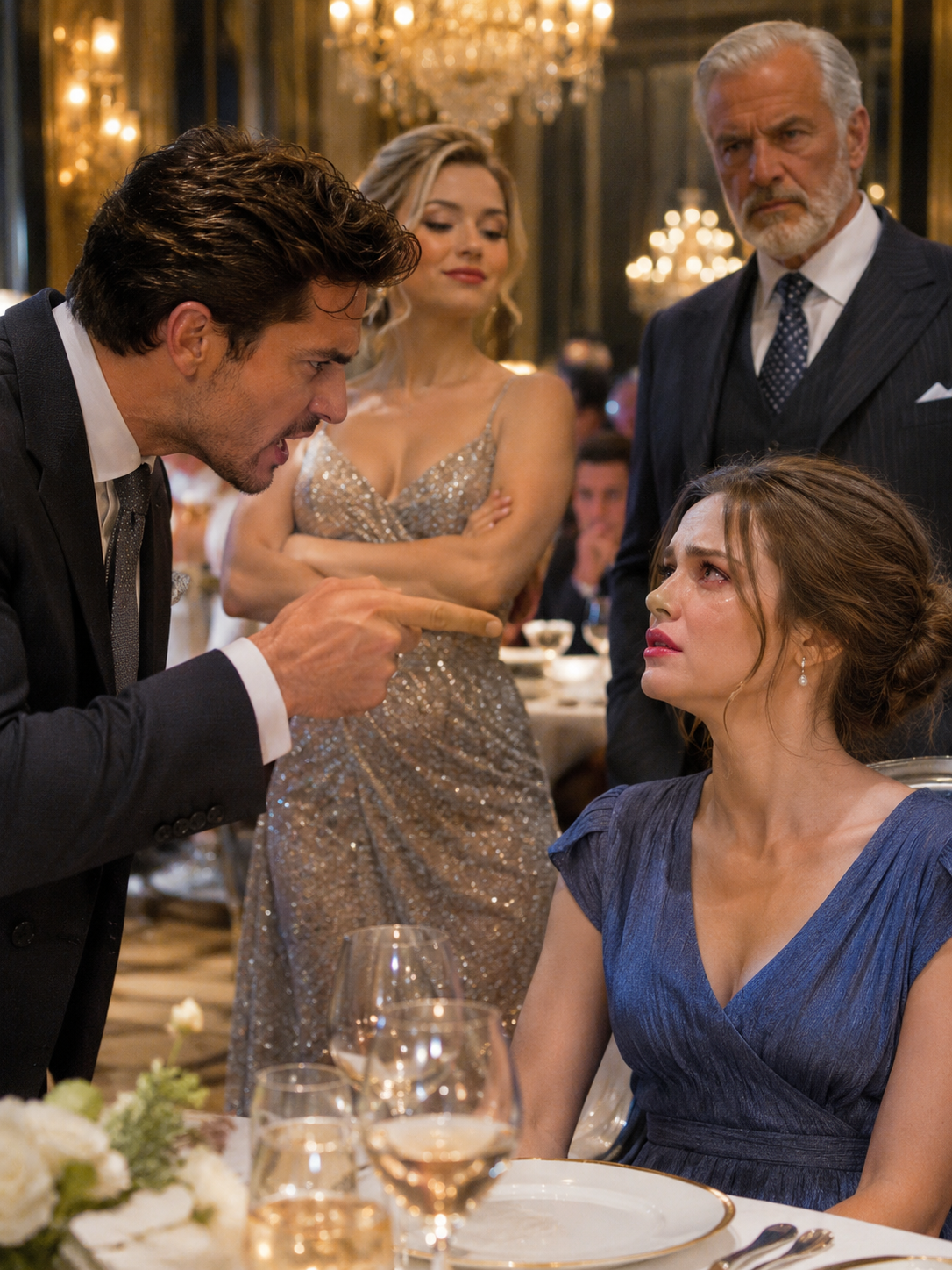
My husband told me my blue cotton dress would embarrass him at the dinner that might make him a partner. I wore it anyway. Then a glamorous woman said it looked like something she’d buy for her housekeeper’s daughter, and he sat there staring into his wine. I walked out alone while his boss’s wife laughed. None of them knew whose daughter I was…
I was kneeling beside the roses when Elias came home and reminded me about dinner with Marco Blackwood. There was soil on my cheek and compost under my nails, and I was wearing my old Cambridge sweatshirt. He looked at me as though I were another problem waiting for him at work.
“Eight o’clock,” he said, loosening his tie. “This matters, Ara.” I told him I remembered and that I’d planned to wear the blue dress he used to like. The muscle beside his jaw tightened before he even answered.
“The cotton one? Isabella Blackwood will be wearing Oscar de la Renta. Do you want them to laugh at me?” He gestured toward the garden, then at my clothes. “They’re meeting the wife of a future partner, not the gardener.”
I kept my hand resting on the edge of the flower bed until he went inside. Five years earlier, that same man had loved finding me in a garden or coming home from volunteer work with my hair undone. Back then, he said I made him feel he could finally stop performing for other people.
We met at a soup kitchen where I volunteered and his former employer had sponsored an event. Elias was smart, funny, and proud of how far he’d come from a middle-class home in Leeds. He stayed afterward to help stack chairs, even though nobody was taking pictures. I liked that version of him.
When he asked about my family, I said my father worked in logistics and lived a quiet life. That was true, though hardly the whole truth. My father was Lord Julian Russo, head of Russo-Villard Maritime, a vast private shipping and logistics business founded by my grandfather.
Papa had avoided photographers for twenty years and spent much of his time on a private island off Scotland. I was his only child and heir, but I had seen enough of wealthy people judging one another by names and numbers. I wanted one relationship in which I could simply be Elara, the woman everyone close to me called Ara.
Elias never asked much more. He pictured my father in a respectable office overseeing shipments, and I allowed him to keep that picture. I understand now that leaving out such a large piece of myself was a choice with consequences, but I didn’t make it to trick him out of anything. I was afraid of being loved for my family’s money.
Our life in Mayfair looked comfortable from the street: a four-bedroom house, a tidy garden, and help with the housework. I spent my days at the women’s shelter in Tooting and oversaw a private sustainable-agriculture endowment through the Elena Foundation, named for my late mother. Elias called it my little fund, and I didn’t correct him.
His career had become the center of our marriage. He was a senior vice president at Blackwood & Sons, chasing partnership and leading a waterfront development that he believed would make his name. The closer he got, the more frightened he seemed that someone would discover the boy from Leeds beneath his expensive suits.
He had once admired that I wore little makeup and kept my wedding band on even when I gardened. Now he sighed when I declined another shopping trip and spoke of my simple clothes as though they might cost him a promotion. I stopped trying to make jokes about it, because his face no longer softened when I did.
That afternoon, he told me to use the Harrods card and buy something appropriate. On the kitchen counter lay the American Express Centurion card Papa had given me; Elias thought it was merely a generous credit arrangement. I put it back in my wallet and took the blue dress from its hanger.
It was a Gabriela Hearst design, beautifully made and much more expensive than it appeared. I hadn’t bought it to prove anything. I wore it because the cotton felt comfortable against my skin and because I remembered a husband who had once told me I looked lovely in it.
At Valdor, the kind of London restaurant where the prices were never printed, Marco greeted Elias with a loud handshake. His wife, Isabella, inspected my pearl earrings, my plain flats, and my dress before managing a smile. “How quaint,” she said. “Elias never told us you were a minimalist.”
Elias gave a nervous laugh, and Isabella ordered an extravagant bottle of wine. She asked whether I drank wine at all or preferred herbal infusions. I thanked her for including me and tried to ask about her work with the Victoria and Albert Museum gala, but she seemed more interested in making me feel out of place.
Marco wanted to talk about the waterfront deal. I listened while Elias described the financing, then answered when Marco asked what I did with my days. I told him about the shelter and the private fund that supported sustainable agriculture. “The Elena Foundation,” I said when Isabella asked its name.
“A private fund?” Isabella glanced at her husband, and I could almost hear the word hobby forming between them. Elias looked into his glass. He knew the work mattered to me, but that evening he was determined to make us appear exactly as his boss expected.
Then a blonde woman in a fitted white blazer arrived at the table, greeting Marco and Isabella like old friends. Khloe Valdez was a public relations consultant whose name Elias had mentioned at work. When he introduced us, his voice sounded strange, and he moved his chair an inch away from mine.
Khloe shook my hand, her large yellow diamond catching the light. “Elias talks about you,” she said, looking me up and down. “I must have pictured someone different.” Her smile didn’t reach her eyes, and she held my hand a beat too long.
I let go and said it was nice to meet her. She admired my blue dress in a voice so sweet it made me uneasy, then asked where I’d found it. “I’m looking for something that simple for my housekeeper’s daughter,” she said, loud enough for the table to hear.
Isabella giggled. Marco watched me over his wineglass, and I turned to my husband. Elias knew how to fill a boardroom with words, yet he couldn’t find a single one for me. He stared down as if the answer to everything were waiting at the bottom of his glass.
I folded my napkin and set it beside my untouched plate. “Please excuse me. I’ve lost my appetite.” I rose without raising my voice, still giving Elias a chance to stand beside me.
He started to move, but Khloe leaned close and rested her hand against his leg beneath the table. “Let her go,” I heard her murmur. He sat back down, and I walked out of Valdor knowing the husband I’d come with had chosen to stay with someone else. Part 2…..
IF FACEBOOK BROUGHT YOU HERE, HERE’S THE CONTINUATION YOU’VE BEEN WAITING FOR. ENJOY! 👇 On the ride home, I kept expecting my phone to ring. Elias knew I wasn’t someone who stormed out over a careless joke; he’d watched me sit quietly through plenty of uncomfortable conversations. But that night there was no call, and when he came home later, he asked whether I was going to apologize for making dinner awkward.
I asked why he’d let Khloe speak to me that way. He said she had a sharp sense of humor and connections that could help with the waterfront project. When I asked if he knew her well, he said I was making an issue out of nothing and slept in the guest room.
The next few weeks answered questions he wouldn’t. Elias began working late, then announced he’d rented a small city apartment to be closer to the office. I noticed purchases on the card statements: designer clothes I hadn’t seen, dinner reservations for two at places we never visited, and a Cartier bracelet even though I never wore bracelets.
His explanations grew shorter while Khloe grew more visible. She appeared beside him in photographs from work dinners and began accompanying him to events where I used to be invited. At one gathering, I heard she’d described me as someone who couldn’t tell a zoning map from a garden plan. Elias had let the comment pass.
I learned that the affair had already been going on for six months by the time of the Valdor dinner. I wish I could say I confronted him as soon as I understood, but part of me kept remembering the young man stacking chairs beside me at the soup kitchen. I went to the shelter, cared for my roses, and waited longer than I should have for an honest conversation.
Khloe, meanwhile, was encouraging him to seek backing from the Villard group. Elias told her nobody could get an appointment with Julian Russo, the private businessman associated with the ports and financing the waterfront deal would need. Listening to him praise her supposed access, I realized how little he knew about the family name I’d never put in front of him.
Then a delivery driver brought a large flat package while I was pruning roses. The label was addressed to Khloe Valdez, care of Elias Gaston, at our house. I carried it to the kitchen island and stood there looking at the name before opening it.
Inside was a silver Versace evening gown and a handwritten note from Khloe to Elias. She said the dress would be perfect for the Property Guild Awards and that she couldn’t wait for everyone to see them together. The awards were next week, when Elias expected to receive recognition as a rising star in property development.
He hadn’t merely been hiding another relationship; he was planning to present it publicly as if ours were already over. I folded the dress back into the tissue paper, shut the box, and washed the dirt from my hands. For the first time in five years, I dialed Papa’s private number.
“It’s Ara,” I said when he answered. “I think I need to come home for a while.” His voice softened, and he told me the Odyssey was refueling in Lisbon and arrangements could be made. I said yes before I could talk myself into protecting Elias from what he had done.
I packed my things and left a short note on the kitchen counter. It told Elias I’d gone to my father for a while; it didn’t ask him to follow. When he found our house empty two days before the awards, he mistook my silence for surrender.
At the Grand Metropolitan Ballroom, Elias arrived in a carefully fitted tuxedo with Khloe on his arm. She was wearing the silver gown delivered to my house. From the way she held his sleeve and smiled at the Blackwoods, anyone watching might have thought they’d been together for years.
I arrived later in a simple black, high-necked dress, my hair pulled into a bun and my thin wedding band still on my finger. It was strange walking into a room where I knew so many of the donors and almost none of them knew me as Elias’s wife. I hadn’t come to make a scene; the Elena Foundation was being honored that evening.
When I approached their group, Marco and Isabella fell quiet. Elias looked from my dress to my face. “I thought you went to your father’s,” he said, as though being away meant I had no right to return.
“I did,” I answered. “I’m here to accept an award for the Elena Foundation.” Isabella asked in a suddenly cautious voice whether I meant the foundation that had anonymously given one hundred million dollars to the National Gallery. I told her I did.
Khloe stepped forward before Elias could say anything. She called my dress pathetic, told me he didn’t want me, and said I was a boring little wife with no family or influence. When she took hold of my arm, I gently lifted her hand away. I could feel Elias watching, but he still didn’t defend me.
“You need a warrior,” I said to him, repeating Khloe’s boast. Then I looked at her. “You’ve made a terrible mistake, but it isn’t the one you think.”
The lights shifted toward the stage. The guild president announced that the man presenting the foundation’s award was Lord Julian Russo, making his first public appearance in twenty years. Elias’s face changed when he heard the name, though he still looked as if he couldn’t make sense of it.
Part 3 Papa came to the microphone in a dark suit, silver-haired, serious, and plainly uncomfortable with the attention. He spoke about the Elena Foundation and the woman it was named after, my mother. Then he said the fund’s anonymous founder and director was his daughter, Elara Russo.
Standing beside the stage, I watched Elias put a hand against the back of a chair. Khloe looked from Papa to me and back again, her confidence gone. All the talk of a mysterious financier suddenly had a face, and it was a face I’d been trying to keep separate from my marriage.
Papa called me up. As I passed the table, I could hear the uncomfortable movement of chairs, but he was the only person I looked at. He kissed my forehead and pressed the crystal award into my hands, the way he used to hand me flowers from our old garden.
I thanked the room and spoke about the work our foundation did rather than the clothes anyone wore. I’d spent years believing it was possible to live quietly and let my actions explain me. Looking at my husband, I finally admitted aloud that my attempt to keep money out of our marriage hadn’t kept dishonesty out of it.
I told the guests I believed character mattered more than appearances, then said Khloe had badly misjudged mine. The foundation was not a pastime; it managed a fifty-billion-dollar endowment and supported major projects, including a cancer wing that a high-profile gala had been trying to support. I also knew that a bank controlled by our foundation held debt connected to the fashion house that made Khloe’s gown. My voice stayed steady, but the hand holding the award wasn’t quite as still.
There was another fact I had kept from Elias: the Elena Foundation had recently completed, through a subsidiary, the acquisition of Blackwood & Sons. Papa confirmed the transaction from the microphone. It meant I would have responsibility for the firm that Elias had treated as the most important thing in his life.
“You’re fired,” I said to him, and the words sounded smaller in my ears than I’d expected. I meant that he would no longer have a place in the company I was taking over. The necessary employment notices and board decisions would follow through proper channels; a microphone wasn’t a substitute for them.
Marco stared at Papa, then at the people around him. Elias lost his balance and sank to the carpet, pale and unsteady. The man who had once been willing to help stack chairs without an audience was now being watched by the very people whose approval he’d chased for years.
Khloe changed her tone immediately. She called the misunderstanding unfortunate and offered her services as a brand consultant, addressing Papa as though he might hire her before the evening was over. He told her his family’s name was built on a reputation, not a publicity campaign. Venue staff asked her to leave when she continued disrupting the ceremony.
I didn’t feel triumphant as she went. I saw the silver dress that had arrived at my kitchen counter, and I thought about how careful I’d been when folding it back into its box. It was a sad thing to recognize an ending in an object that somebody else had bought for a celebration.
I later learned that Elias spent the next morning in a hotel lobby with a wrinkled tuxedo, a depleted bank balance, and messages he’d been too shaken to answer. Marco told him not to return to the office. His employment was reviewed under the company’s new management, and his access to work accounts was suspended while the separation was handled.
His lenders were less interested in the ballroom gossip than in the terms of the loans he’d used to finance his life. A notice on his two-and-a-half-million credit line said further borrowing was frozen; another from Villard National Bank demanded that he address a default affecting the mortgage on the Mayfair house within thirty days. The letter made the prospect of losing that property real.
At the city apartment, the doorman informed him his access had ended and that arrangements would be made for his belongings. The lease had been paid for through a property holding associated with the Elena Foundation, a detail Elias hadn’t thought to ask about. Learning that didn’t erase the affair, but it did strip away another assumption he’d made about who supplied what.
My lawyers sent him the divorce papers later that day. Before our wedding Elias had insisted on a prenuptial agreement under which we would each leave with what we’d brought into the marriage. He had believed he was protecting his future earnings from my modest trust; he’d arrived with roughly eighty thousand in student debt and a leased car.
I wasn’t trying to use divorce to take anything more from him. I accepted the agreement’s basic separation, subject to the ordinary legal review, because I wanted my life back rather than a public argument about money. For all Papa’s influence, a marriage still had to be ended through documents and decisions, not a speech.
Part 4 Khloe’s reputation unraveled in a different way. Photographs from the awards circulated, clients who’d once prized her access began terminating contracts, and her public accounts and business website became unavailable. She tried to call the event a misunderstanding, but people she counted on to take her calls no longer did.
Problems with her finances had been building beneath the surface of her polished life. Authorities began examining undeclared client gifts, consulting fees, taxes, and transactions that raised fraud questions. Papa hadn’t invented those records, and I refused to make the investigation into an extension of our family quarrel; what the evidence proved was for investigators and courts to decide.
Months later, with legal advice, she pleaded guilty in the proceedings arising from her financial misconduct. The penalties and back taxes took much of what she’d shown off. Restrictions arising from the proceedings closed off her financial consulting work, and former clients made her public relations career untenable. She eventually took a job at a fragrance counter in Harrods, a real job that deserved none of the contempt she’d once shown the people serving her.
I didn’t go to see her there. I heard that people recognized her and whispered, and it made me uncomfortable rather than pleased. The cruelty that had hurt me at Valdor wouldn’t become kindness just because it was aimed in the opposite direction.
Elias’s fall wasn’t as public. He lost the Mayfair house after failing to resolve the lending problems and moved between a friend’s sofa and small rented rooms while the divorce was completed. The prenuptial agreement meant he couldn’t claim the wealth I’d inherited, and his damaged finances left him with little room to bargain.
After weeks of unanswered job applications, he found work managing logistics for a regional curtain-rod distributor in Slough. He spent his days tracking shipments and reconciling spreadsheets, a far quieter job than the waterfront project he’d once described as his future. There was an irony in that, but I’d never thought honest work in logistics was beneath anyone, least of all my father.
I learned afterward that Elias kept a photograph of me laughing in our garden. I don’t know whether he missed me or the version of himself who had once found that scene beautiful. Those were questions he would have to sit with, and I no longer needed him to answer them for me.
Six months after the awards, I was back in London for a board meeting at the restructured company, now called the Elena Development Group. The conference room high above the city felt a long way from my little patch of roses. I wore a cream sweater and linen trousers, and my hands were steady when I opened the meeting.
The old waterfront plan was still on the table: a skyline of eighty-story luxury buildings, projected to earn billions, much of it from buyers who would never live there. Thomas, an executive retained from Marco’s team, reminded me that the project was largely financed and that walking away meant giving up a possible four-billion-dollar return. He wasn’t wrong to ask how we would support the company without it.
I told the board that I wasn’t proposing to abandon the waterfront or ignore financial reality. I wanted to change what we built, and the foundation would be the sole investor in the redesigned development group. We would work through planning approvals, budgets, construction schedules, and the people already living near the site instead of pretending generosity alone could put up buildings.
On the screen was a new plan for the same stretch of land. Blocks one through six were marked for fully subsidized housing for people with no income. The next ten blocks would provide mixed-income, affordable homes, including homes intended for teachers, nurses, and artists who worked in the city but struggled to afford it.
There would still be one luxury tower, because sustainable funding mattered. The plan was to direct all its net profits into a dedicated trust supporting the Tooting women’s shelter over the long term, with proper oversight rather than an untraceable promise. That mattered to me more than naming another skyscraper after someone rich.
Final Thomas leaned back and said what several of the others were thinking. “That’s philanthropy, not a business model.” I said it was both a responsibility and a long-term financial commitment, and that the board’s job was to make it work without pretending the numbers were easy.
In the months after the meeting, we began the unglamorous work: redesigns, talks about planning permission, budgets, and conversations with housing partners. Some people supported the proposal; others doubted it or worried about what construction would bring. I didn’t expect an announcement in a high room to settle any of that.
One evening I came home with a folder of drawings under my arm and stood beside a row of herbs near the window. I still missed the garden at the old house sometimes, especially the smell of damp soil after rain. I also missed the ease Elias and I had once shared, before he learned to be ashamed of it.
Papa called to ask how the meeting had gone. I told him Thomas had challenged the plan and that I was glad someone had. He laughed softly and said, “Then you’ve got a board that might actually be useful.”
I used to think being a gardener meant choosing a small space and tending it carefully. That part of me hasn’t changed; I still notice when a plant needs water, and I still believe quiet work matters. What changed was my understanding of how many people are affected by the decisions made far beyond their own front doors.
I won’t pretend that my family’s money made every choice easy, or that I didn’t make mistakes by keeping such an important part of my life hidden. Elias’s betrayal was his decision, but my silence about my background had left us with a marriage in which neither of us was speaking plainly. I could acknowledge that without excusing what he did.
Khloe and Elias both learned that admiration is not the same as respect, and that appearances can disappear quickly. Their lives didn’t have to be measured by their worst moments forever; whether they built anything better was up to them. As for me, I had stopped treating simple as a word I needed to defend.
When I think about that dinner at Valdor, I don’t remember the price of the wine or the dress Khloe mocked. I remember setting my napkin down, waiting one last second for my husband to come with me, and leaving when he didn’t. The life I chose afterward was not a punishment for him. It was finally a choice made for myself.
THE END. I’ve shared the complete story, and I truly hope it touched your heart. If this story moved you, please , like, and share the post. Thank you for reading! ❤️
✓ Lynn R. Adams
My husband told me my blue cotton dress would embarrass him at the dinner that might make him a partner. I wore it anyway. Then a glamorous woman said it looked like something she’d buy for her housek…