He Divorced His Wife for a Pregnant Mistress—Then a DNA Report Sent Him Chasing Her Across the Atlantic
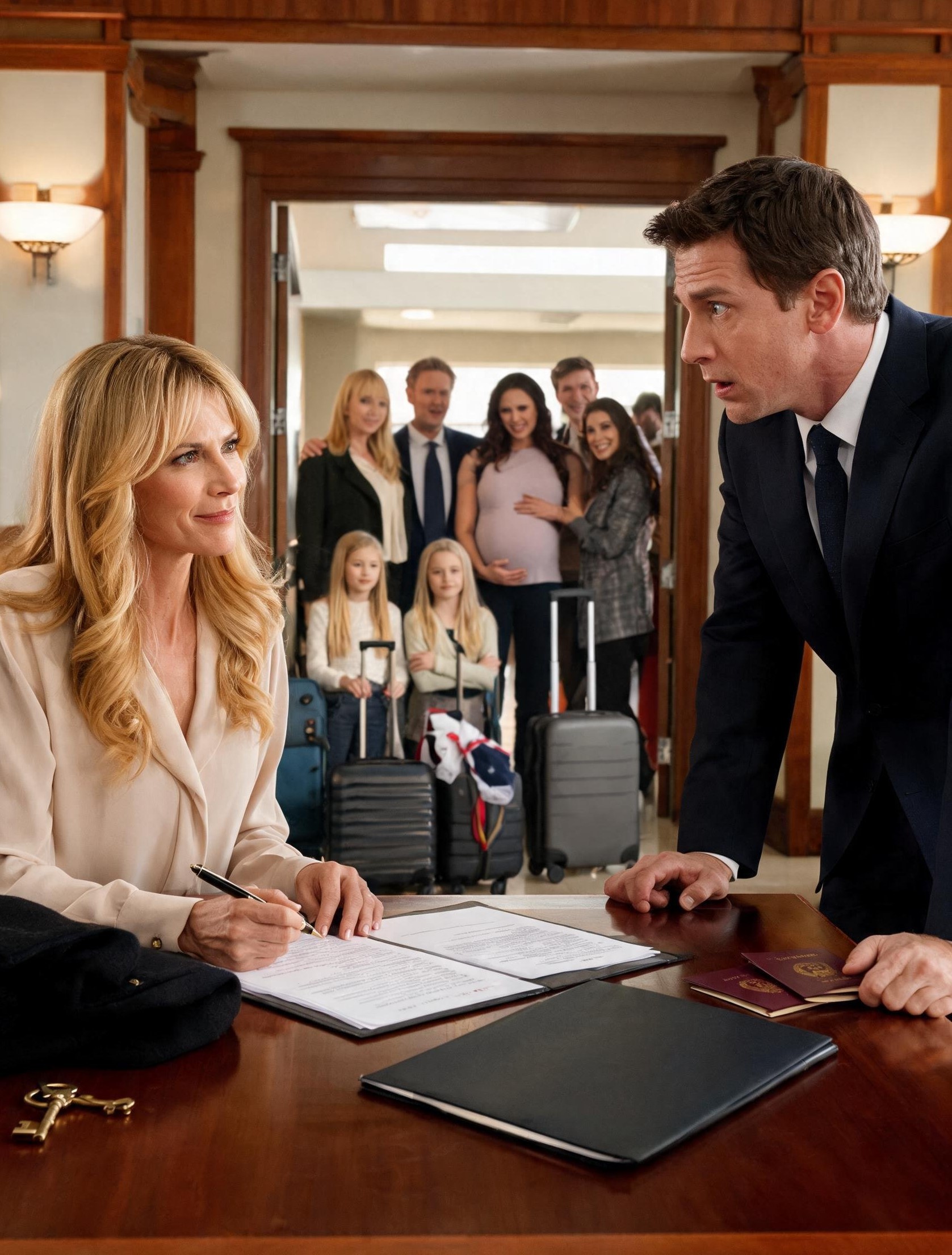
He Divorced His Wife for a Pregnant Mistress—Then a DNA Report Sent Him Chasing Her Across the Atlantic
Part 1: The marriage ended quietly, but the real betrayal was only beginning.
At on a Thursday morning, I signed away sixteen years of marriage while my husband stared at my smile as if it were proof I had finally lost my mind. Forty minutes later, his mother was arranging blue flowers for the unborn grandson she believed would replace the two daughters her son already had. What none of them knew was that the brass key inside my coat pocket opened a house three thousand miles away, and my girls were already waiting beside packed suitcases. I signed the last page, capped the pen, and slid it toward my attorney without shaking. Across the table, Daniel Ashford looked almost offended by how calmly I had disappeared from his life.
Sixteen years earlier, Daniel had been a thirty-one-year-old hotel developer with one failing property, two investors threatening lawsuits, and enough confidence to fill every empty room. I was Laura Bennett then, an interior architect who told him during our first meeting that his luxury hotel looked like a funeral home with room service. He argued with me for two hours and hired me before dinner. Within four years, we had redesigned three properties, doubled occupancy, married in a vineyard outside New Haven, and had our first daughter, Sophie. Four years later came Lucy, a loud, fearless little girl who believed every elevator button belonged to her personally.
Somewhere between our third hotel opening and Daniel becoming executive vice president of Ashford Hospitality, history began rewriting itself. Reporters called the redesigns Daniel’s vision, investors praised Daniel’s instincts, and his father Richard introduced me at parties as “Daniel’s creative wife.” Nobody mentioned the nights I slept on construction-site couches or the contract negotiations I salvaged when Daniel was ready to walk away. I noticed the erasure, but I let it happen because I believed marriage was not a competition. I thought the person beside me remembered who I was even when the room did not.
Then Madeline Cross joined the company as communications director. She was thirty-four, polished, ambitious, and very good at knowing exactly which powerful person needed to hear exactly which flattering sentence. At a charity dinner in Greenwich, she reached across Daniel’s chest and straightened his tie while I stood six feet away. Daniel saw me watching and smiled as if I were being ridiculous. “She’s PR, Laura,” he said later, “fixing things is literally her job.”
I remembered that touch when Daniel started turning his phone facedown. I remembered that touch when his Thursday meetings began ending after ten. I remembered that touch when he stopped asking me to review hotel concepts but started asking whether his navy suit made him look tired. I remembered that touch when he kissed my forehead on our anniversary instead of my mouth. I remembered that touch when my twelve-year-old daughter called me from outside a café and whispered, “Mom, Dad is here with her.”
Sophie was sitting on a cold metal bench two blocks from school when I arrived, her backpack squeezed between both knees. She climbed into the passenger seat and stared straight ahead while I pulled away from the curb. I did not ask questions until we reached the first red light because I had learned that scared children speak faster when adults stop filling the silence. “She was holding his hand,” Sophie finally said. Then she looked at me and asked, “Are you and Dad getting divorced?”
That night, I waited at the kitchen island until Daniel came home at 10:14. He loosened his tie, saw me sitting there, and immediately knew this was not a conversation he could charm his way around. “Her name is Madeline, isn’t it?” I asked. He stopped halfway through removing his watch and said, “Yes.” No denial, no outrage, no insulted innocence, just one exhausted syllable that ended the version of my marriage I had still been trying to protect.
“Six months,” he admitted after I asked how long. I wanted to throw the wineglass beside me, but instead I rotated it slowly by the stem and asked whether our Christmas trip to Vermont had been real. Daniel rubbed his forehead and said our marriage had probably been dying for years. “Funny,” I told him, “I seem to be the only person who wasn’t informed.” Two weeks later, standing across the same kitchen island, he told me Madeline was pregnant.
I felt the pain, but pain is not the same thing as panic. I asked whether the child was his, whether he planned to leave, whether Sophie and Lucy knew, and whether his parents knew. Daniel answered yes, yes, no, and yes. That last answer hurt more than I expected because Richard and Margaret Ashford had learned about the pregnancy three days before Daniel found the courage to tell his wife. The betrayal suddenly had a seating chart.
Margaret arrived the following afternoon carrying white roses and the expression she used when hotel guests threatened litigation. She told me everyone needed to behave with dignity because “there is going to be a baby.” I looked at the flowers and said, “There are already two children.” Her mouth opened, then closed. It was the first time in sixteen years I had seen Margaret Ashford enter a room without a prepared response.
The real break came a week later after Sophie spent Saturday at her grandparents’ house. At dinner, she pushed peas around her plate before asking, “Mom, what does finally mean?” I thought she was asking about homework until she explained that Grandma Margaret had said Daniel was “finally going to have a son.” Lucy stopped chewing. Sophie asked, very softly, “Were we not enough?”
That question killed my need for the Ashfords to understand me. The next morning, I hired Rebecca Sloan, a divorce attorney with silver hair, square glasses, and the pleasant voice of someone who had dismantled far more powerful families than mine. She asked what I wanted, and I gave her three answers: my daughters protected, my work valued, and the right to leave Connecticut. Then I placed an old brass key on her desk. Rebecca stared at it for two seconds and asked, “Where does that go?”
“Edinburgh,” I said.
That night, I climbed into the attic and opened a cedar box that had belonged to my grandmother. Beneath old photographs was the deed to a narrow Georgian townhouse she had left me twenty-one years earlier, a property I had rented out and almost forgotten while building Daniel’s American empire. The tenant’s lease had ended six weeks earlier, which meant the house was empty. I ran my thumb across the worn brass key and felt something unfamiliar. It was not revenge, and it was not grief; it was possibility.
Three days later, Daniel asked if we could make the divorce quick because he wanted to “avoid unnecessary damage.” I looked at him over my coffee and finally understood how much leverage his urgency gave me. Madeline’s pregnancy was advancing, the board was already nervous about gossip, and Richard wanted the old marriage legally finished before anyone publicly celebrated the new baby. Daniel thought I was the abandoned wife desperate for a settlement. He did not understand that I had already chosen my exit.
Rebecca hired an independent valuation specialist to examine the minority equity I had earned years earlier in one of Ashford Hospitality’s operating companies. The Ashfords offered me a number so low I laughed when Rebecca slid it across her desk. Three weeks later, our expert produced a valuation almost four times higher. Daniel called me personally that evening and accused me of making everything harder. “No,” I said, “I’m making it accurate.”
Then came the argument he never expected me to win. I wanted relocation permission for Sophie and Lucy, a detailed international parenting schedule, shared travel expenses, joint authority over medical and educational decisions, and enough flexibility for Daniel to remain their father if he actually chose to behave like one. He refused Edinburgh immediately. Richard changed his mind two weeks later after a photograph of Daniel and Madeline entered the hands of a gossip columnist. Forty-eight hours after that, Daniel approved the relocation.
The night before our final hearing, I placed three passports, three boarding passes, and the brass key inside my handbag. Daniel walked past the kitchen carrying an overnight bag because he and Madeline had an appointment the following afternoon at a private maternal-fetal clinic in Manhattan. His entire family planned to attend because early screening had already shown the baby was a boy. Richard had also ordered a legally authenticated prenatal paternity test before changing anything connected to the family voting trust. Daniel had agreed without hesitation.
He was certain the boy was his.
Months earlier, long before I discovered the affair, I had watched Madeline leave a company retreat after midnight with Grant Mercer, one of Daniel’s closest board allies. I had never followed her, never searched his phone, and never mentioned the moment because at the time it seemed meaningless. Now, sitting alone in my kitchen with our divorce papers ready upstairs, I remembered Grant’s hand against the small of her back. I closed my handbag and turned off the light. By the following afternoon, one of us would be flying toward a new life while the other walked into a room containing a report that could destroy his.
Part 2: While Laura crossed the Atlantic, one sentence shattered Daniel’s future.
The judge asked routine questions the next morning, and Daniel answered each one in the controlled voice he used during investor calls. At , I signed the final page and watched sixteen years become a stack of stamped paper. Daniel stood when it was over, adjusted his navy jacket, and said, “I hope Scotland gives you what you’re looking for.” My fingers closed around the brass key in my pocket. “It already did once,” I replied.
Sophie and Lucy were waiting outside with my friend Megan and six pieces of luggage. Lucy ran toward me while Sophie stayed back, searching my face. “Are you sad?” she asked. I said yes because children can survive uncomfortable truth better than comfortable lies. Then I took both girls to the airport.
At noon, while we moved through security at JFK, Daniel entered the clinic with Madeline. Richard was there, along with Margaret, Daniel’s sister Victoria, his brother Marcus, his aunt Celeste, and two family trustees. Margaret carried a silver box tied with a blue ribbon. Inside was a tiny engraved bracelet for the future Ashford grandson.
The ultrasound came first, and by every visible measure the baby appeared healthy. Daniel watched the monitor with one hand around Madeline’s fingers while she cried. For several minutes, according to what Victoria later told me, nobody mentioned divorce, scandal, lawyers, or succession. Daniel looked at the moving image and believed he was looking at the son for whom he had dismantled his family. Then the physician closed the ultrasound file and opened another report.
Richard asked for the parentage result.
The doctor looked toward Madeline before looking at Daniel. That hesitation was small, but Victoria noticed it immediately. The doctor explained that the samples had been processed by an accredited laboratory and confirmed through authenticated collection. Daniel leaned back, almost bored. Then the physician said, “Mr. Ashford, you are excluded as the biological father.”
Nobody moved.
Daniel actually smiled for a second because the sentence was too incompatible with reality for his brain to accept. He asked them to repeat the test. Richard asked whether there had been contamination. Celeste asked about probability thresholds. Madeline said absolutely nothing.
The doctor calmly explained the result again. Daniel turned toward Madeline and asked, “Who else?” She covered her mouth and began crying. He repeated the question, quieter this time. After nearly half a minute, she whispered, “Grant.”
Margaret lowered the silver box into her handbag.
Grant Mercer was not a stranger from a bar or a boyfriend from Madeline’s past. He was forty-one, married, and one of the seven directors voting on Daniel’s expected promotion to company president. He had played golf with Daniel, attended our Christmas parties, and toasted our anniversary at a Napa retreat. He had also spent the previous six months publicly supporting Daniel’s plan to restructure Ashford Hospitality. Richard understood the implications before his son did.
At the airport, my phone rang while boarding began. Daniel’s name appeared once, disappeared, then returned. He called seven times before the first message arrived: CALL ME. The second said, IT’S IMPORTANT. The third contained one word I had almost never heard from him during our marriage. Please.
Sophie saw his name flashing. “Are you going to answer?” she asked. I looked at the gate, then at my daughter, then at the phone. “Not right now.” I switched it to airplane mode.
Nine hours later, Edinburgh greeted us with wet stone, yellow streetlights, and rain moving sideways against the taxi windows. Lucy fell asleep against my shoulder. Sophie stayed awake, watching old buildings slide past as if the city belonged to another century. When we stopped before the narrow townhouse, she stared at the black door and whispered, “This is ours?” I held up the key and said, “It is now.”
The house smelled like dust, old wood, and cold fireplaces. We had no groceries, one working lamp, and sheets still packaged in moving boxes. Lucy declared the attic room hers within five minutes. Sophie found my grandmother’s height marks hidden behind a pantry door. That night, the three of us ate takeout fish and chips on the living room floor and laughed when the heating system made a noise like a trapped goose.
The following afternoon, I turned my American phone back on. There were nineteen missed calls, twelve messages, and one voicemail from Margaret asking me to contact Daniel because “the family situation had changed.” I deleted hers first. Then I answered Daniel’s twentieth call. His voice sounded smaller than I had ever heard it.
“The baby isn’t mine.”
I stood at the townhouse window watching rain darken the pavement. Daniel explained the test, the clinic, and Madeline’s admission. When he said Grant Mercer’s name, I went silent for half a second too long. Daniel caught it immediately. “You knew something.”
“I saw them leave a retreat together once,” I said.
“You never told me?”
I almost admired the absurdity.
“You were sleeping with her, Daniel,” I answered. “What exactly did you expect me to warn you about?”
He said nothing for several seconds, then whispered the sentence I had heard whenever investors panicked, contractors failed, or his father became impossible. “Laura, I don’t know what I’m supposed to do.” For sixteen years, those words had activated something inside me, the instinct to solve, soften, negotiate, and repair. This time, I looked toward the staircase where my daughters were unpacking their lives. “Call your attorney,” I said, “and then call Sophie and Lucy.”
Before I hung up, Daniel stopped me.
“There’s more.”
Richard had ordered an emergency board review after learning Grant might be the baby’s father. During that review, company counsel discovered that Grant had signed off on several transactions Daniel had personally championed, including one involving the subsidiary in which I still held my minority interest. The transactions were not illegal on their face. But several payments had moved through consulting firms nobody recognized.
Daniel sounded frightened now.
“One of those firms has your maiden name attached to it.”
My grip tightened around the phone.
I had never created any consulting company.
Part 3: A forged company tied Laura to millions she had never seen.
Within an hour, Rebecca Sloan was awake in Connecticut and furious. I emailed her every document I had retained from Ashford Hospitality, including old contracts, equity agreements, tax filings, and correspondence from my consulting years. She told me not to call Daniel again about the company. She also told me not to log into any old Ashford system, even if I still had credentials. “If someone used your identity,” she said, “we treat every digital footprint like a crime scene.”
The mysterious company was called Bennett Design Advisory LLC. It had been registered in Delaware four years earlier using my maiden name, an address belonging to a corporate filing service, and a digital signature that resembled mine closely enough to fool anyone glancing quickly. Over thirty-six months, it had received more than $2.3 million in “design consulting fees” from projects connected to Ashford acquisitions. I had received none of it. Someone had built a financial ghost wearing my name.
Rebecca hired a forensic accountant named Owen Price, a former federal investigator who spoke as if every sentence had already been tested under oath. He found that the money entered Bennett Design Advisory, moved through two other entities, then disappeared into investment accounts. One account belonged to a trust connected to Grant Mercer. Another ended at a company controlled by Madeline’s brother.
That should have made the mystery simple.
One of the authorization records appeared to contain Daniel’s electronic approval.
I sat in the small back room of my new Edinburgh studio staring at the scanned form while rain ticked against the skylight. Daniel’s initials appeared beside a payment authorization for $480,000. His authentication token had been used at 11:22 p.m. on a night I remembered clearly because we had been at Sophie’s school concert. Daniel had left halfway through, claiming there was an emergency acquisition call.
Rebecca asked the question I did not want answered.
“Could Daniel be involved?”
“I don’t know.”
“That’s not what I asked.”
“Yes,” I said. “He could.”
For the next six weeks, I rebuilt my life while lawyers reconstructed the financial wreckage behind me. I rented a small storefront near Stockbridge and reopened my design practice under my own name. Sophie joined a school debate club. Lucy discovered field hockey and returned from practice covered in mud with the expression of someone who had found religion.
Daniel called the girls regularly at first. To his credit, he never discussed Madeline with them and never asked Sophie to comfort him. He flew to Scotland during the October break, stayed at a hotel, took the girls to museums, and brought them home exactly when promised. I watched from the doorway as Lucy hugged him goodbye. Regret flashed across his face when he looked past her at me.
I did not mistake regret for transformation.
Meanwhile, Grant resigned from the Ashford board “for personal reasons.” Madeline went on leave. Richard postponed Daniel’s promotion indefinitely. The company told employees it was conducting an internal governance review, but Connecticut’s business press already smelled blood.
Then Owen found the first mini-payoff that changed everything.
The $480,000 payment bearing Daniel’s approval had not been authorized from Daniel’s office or home. It had been approved from an IP address assigned to a private suite at one of Ashford’s own hotels. Security records showed Daniel had never entered the building that night. Grant had.
Someone had cloned Daniel’s credentials.
Daniel was reckless, selfish, and catastrophically weak in his marriage, but on that payment, he had been framed.
I called Rebecca, not Daniel. She contacted company counsel and arranged a controlled disclosure. Richard’s attorneys confirmed three more suspect authorizations originated from places Daniel had not been. For the first time since the clinic, Daniel had evidence that Grant’s betrayal extended far beyond Madeline.
Then Madeline disappeared.
She left her apartment, abandoned her company phone, and withdrew thirty thousand dollars in cash from two banks. Her attorney claimed he did not know where she was. Grant denied helping her. Daniel became convinced they had fled together until Grant appeared at an emergency board meeting in Manhattan with three lawyers and enough confidence to make everyone uneasy.
He denied stealing company money.
He admitted the affair.
He admitted he might be the baby’s father.
He denied creating Bennett Design Advisory.
Then his lawyer placed a folder in the middle of the table.
Inside were copies of emails supposedly sent from my personal account authorizing consulting arrangements.
They looked real.
They included details only someone close to me should have known.
One referenced the Edinburgh townhouse.
My blood went cold when Rebecca read the message aloud over our secure call. Four years earlier, almost nobody in Connecticut knew I owned property in Scotland. Daniel knew. My accountant knew. Richard and Margaret knew because it had been disclosed during estate planning.
Madeline had never been told.
Grant, as far as I knew, had never been told.
That narrowed the circle.
Or so I thought.
Two nights later, someone pushed an envelope through the mail slot of my Edinburgh townhouse. There was no stamp, no return address, and no sound of footsteps when I opened the door. Inside was a single photograph taken through a telephoto lens. It showed Sophie and Lucy walking home from school.
On the back, someone had written four words.
STOP DIGGING INTO BENNETT DESIGN.
Part 4: The financial fraud became personal when someone followed Laura’s daughters.
I called Scottish police before I called anyone in America. Within twenty minutes, two officers stood inside my living room examining the photograph while another checked the street. I gave them the envelope without touching it again. Sophie and Lucy were upstairs, unaware of the message because I saw no reason to place adult terror inside children’s heads until necessary.
Rebecca’s voice sharpened when I told her. “This changes the posture completely.” She notified federal investigators already reviewing the suspicious transactions, while I temporarily changed the girls’ school transportation and moved our routine. I did not panic. I made lists.
New cameras.
New routes.
No predictable schedule.
No information shared with the Ashfords unless it directly concerned parenting.
Daniel learned about the photograph from Rebecca, not me. He called within minutes, furious that I had not contacted him first. I let him spend thirty seconds expressing anger before asking whether he wanted to help or perform outrage. The silence afterward was useful.
“Tell me what you need,” he said.
“Your complete cooperation with investigators.”
“You have it.”
“No warnings to your family before interviews.”
Another silence.
“That includes your parents.”
He exhaled. “Fine.”
The federal review expanded quietly. Owen traced one set of transfers to a dormant hospitality partnership created years earlier by Richard Ashford and two investors. The partnership should have contained almost nothing. Instead, nearly nine million dollars had moved through it over five years.
Richard claimed ignorance.
Margaret claimed complete ignorance.
Daniel believed them.
I didn’t know what to believe.
Then Sophie gave me a clue without realizing it.
We were making pasta one evening when she mentioned seeing “Grandpa’s old friend” outside her school in Connecticut several times before we moved. I asked what friend. She described a tall man with gray hair who had attended Ashford Christmas parties and once given Daniel a vintage watch. I showed her three company photographs.
She pointed to Graham Vale.
Graham was Richard’s oldest business partner and one of the family trustees.
He was also the man who had insisted the prenatal paternity test be completed before voting-trust changes were made.
I sent his name to Rebecca.
Owen called twelve hours later.
Graham Vale’s daughter controlled the filing service that had registered Bennett Design Advisory.
That was the first moment the case stopped looking like Grant’s private fraud and began looking like something embedded much deeper inside the Ashford structure. Grant may have stolen money. Madeline may have helped him. But someone else had created the vehicle that allowed the theft to hide under my identity.
Rebecca warned me not to jump from connection to guilt.
Waiting became surprisingly easy once I learned the difference between patience and passivity.
Three days later, Daniel flew to Edinburgh without telling me first. He did not come to the townhouse. Instead, he called from a hotel and asked whether I would meet him at a café in daylight. That small respect for my boundary was new.
When I arrived, he looked ten years older than he had at the divorce hearing.
He slid a flash drive across the table.
“I found this in my father’s home office.”
I did not touch it.
“What is it?”
“I don’t know exactly.”
“Then why bring it to me?”
“Because the label says Bennett.”
He explained that Richard had asked him to retrieve old board minutes from a locked cabinet. Inside the same drawer, Daniel found three flash drives, each labeled with a surname connected to former Ashford consultants. Bennett was one.
“Did your father know you took it?”
I pushed the drive back toward him.
“Then you need to give it to investigators, not me.”
Daniel stared at me.
“Don’t you want to know what’s on it?”
“Of course.”
“Then why not open it?”
“Because I spent sixteen years cleaning up problems created by powerful men who thought rules were for slower people.”
For the first time that day, he almost smiled.
Then the smile vanished.
“My father may be one of those men.”
The drive went to forensic investigators. Its contents were partially encrypted, but technicians recovered spreadsheets showing payments made to outside consultants over nearly a decade. Several names were legitimate. Others were shells.
Bennett Design Advisory was there.
So was Mercer Strategic Holdings.
And one more name stunned everyone.
Cross Communications LLC.
Madeline’s company.
The records began three years before Madeline officially joined Ashford Hospitality.
That meant her relationship with the company—and possibly with someone inside the family—started long before Daniel’s affair.
When investigators confronted Grant, his confidence finally cracked. He admitted he had used Madeline’s shell company to move money, but insisted the arrangement existed before he became involved. He claimed someone inside Ashford had taught him how the system worked.
“Who?” investigators asked.
Grant refused to answer without immunity.
The next morning, Richard Ashford suffered a mild heart attack.
By evening, Margaret had called Daniel nine times demanding he return to Connecticut.
He flew home.
Two days later, while Richard was still hospitalized, Rebecca received a certified package from an anonymous sender. Inside was a photocopy of a twenty-year-old partnership agreement. One signature belonged to Richard.
One belonged to Graham Vale.
The third belonged to someone I had not thought about in years.
Part 5: Laura discovered her marriage had been built over a secret older than Daniel’s affair.
My father, Thomas Bennett, died when I was twenty-six. He had been an architect, brilliant with buildings and terrible with money, the kind of man who could look at an empty warehouse and describe exactly where morning light should fall. He had once consulted for Ashford Hospitality. I knew that much.
I did not know he had owned part of it.
The partnership agreement showed Thomas Bennett receiving a twelve-percent interest in a development entity that later became the foundation for Ashford’s most profitable early hotels. The document was dated nine years before I met Daniel. According to the copy, my father’s interest could transfer to his heirs if certain conditions were met.
I was his only child.
Rebecca spent two days refusing to let me get excited.
“A photocopy is not ownership,” she warned. “We need the original, amendments, dissolution records, tax filings, everything.”
Owen searched.
Company counsel searched.
The state archives were searched.
Richard claimed he had no memory of the agreement.
Graham Vale suddenly became unavailable to investigators because of what his lawyer called a medical issue.
Then Daniel called.
“My father remembers.”
I was standing inside my studio surrounded by fabric samples when he said it. I locked the door and sat down.
“What does he remember?”
“Your dad.”
“That’s not an answer.”
Daniel’s voice broke slightly.
“He remembers Thomas owning part of the original partnership.”
The room went quiet.
“Why wasn’t it transferred after he died?”
Daniel said nothing.
My stomach tightened.
“My father says there was a settlement.”
“There wasn’t.”
“He says your mother accepted one.”
“My mother died before my father.”
Another silence.
I closed my eyes.
“So who signed it?”
That question triggered forty-eight hours of chaos.
Investigators located a supposed release of ownership signed six months after my father’s death. The signature read Laura Bennett. I was twenty-six at the time.
I had never seen the document.
I had never signed it.
The witness was Graham Vale.
The notary had been dead for eleven years.
The consideration listed on the release was $75,000, money supposedly paid to me in exchange for surrendering any inherited claim.
My bank records showed no such payment.
Rebecca stopped calling it suspicious.
She called it forgery.
Daniel came to Edinburgh again, this time for his scheduled parenting week. He took Sophie and Lucy to a castle, cooked them terrible spaghetti, and let Lucy beat him at cards without pretending to lose. On the final evening, after the girls went upstairs, he stood in my doorway but did not enter.
“I didn’t know,” he said.
I believed him.
That was the difficult part.
Daniel had cheated on me.
Daniel had allowed his family to minimize my daughters.
Daniel had rushed through our divorce because another woman was pregnant.
But I believed he had not known my father’s ownership had been buried.
Believing him did not make me want him back.
It simply made the truth more complicated.
“What happens if the partnership document is valid?” he asked.
“That depends on what happened afterward.”
“Could you own part of Ashford Hospitality?”
“I could own part of something that owns part of something.”
He gave a tired laugh.
“You always hated corporate structures.”
“I hate structures designed to make people stop asking questions.”
He looked toward the staircase.
“If my father knew—”
“Then he answers for it.”
“He’s seventy-three.”
“My father is dead.”
Daniel flinched.
I did not apologize.
Two weeks later, investigators found the original partnership agreement in an off-site legal archive belonging to a retired Ashford attorney. It matched the anonymous copy. Attached to it was a memorandum stating that Thomas Bennett’s ownership interest would survive his death unless purchased from his lawful heir through a documented independent transaction.
No valid independent transaction existed.
Rebecca calculated the possible present value conservatively.
I asked her not to tell me the number at first.
She told me anyway.
“Depending on dilution, distributions, and how the entities were reorganized, your claim could be worth between thirty-eight and sixty-two million dollars.”
I stared at her on the screen.
Not billions.
Not half the company.
But enough money to explain twenty years of lies.
Enough to explain the forged release.
Enough to explain why someone had used my name again through Bennett Design Advisory.
Whoever created the shell company had not chosen my identity randomly.
They were using a name already connected to a buried corporate liability.
My father’s name.
A name they believed had been safely erased.
Then came the second major twist.
Grant Mercer requested a formal proffer with prosecutors.
He wanted protection.
In exchange, he offered the identity of the person who introduced him to Ashford’s network of shell companies.
It was not Richard.
It was not Graham.
It was Margaret Ashford.
Daniel’s mother.
I reread Rebecca’s message three times.
Margaret had spent sixteen years smiling across Christmas tables, organizing charity galas, buying my daughters birthday dresses, and telling me family must behave with dignity. She had also been Ashford Hospitality’s unofficial financial gatekeeper before Richard’s expansion, though she never held a public executive title.
Grant claimed Margaret knew about Bennett Design Advisory from the beginning.
He claimed she approved payments.
He claimed she had used Madeline as an intermediary before Madeline ever met Daniel romantically.
That did not mean every allegation was true.
Grant was bargaining for his freedom.
But the investigators now had dates, transfers, and recovered emails worth examining.
Daniel refused to believe it.
Then Margaret disappeared.
Her driver found her car at a private airfield outside Hartford.
No luggage remained in the vehicle.
Her phone was on the passenger seat.
By midnight, federal agents were searching travel records.
Daniel called me from his parents’ empty house sounding almost numb.
“My mother knew about Scotland.”
I stood up.
“She knew you had the Edinburgh property before we married.”
I felt the room narrow.
Daniel explained that he had found a letter hidden inside Margaret’s desk. It had been written by my father, Thomas Bennett, twenty-two years earlier.
The letter was addressed to Margaret.
Daniel photographed the first page before agents seized everything.
He sent it to me.
My father’s handwriting appeared on my screen.
Margaret, if anything happens to me, Laura must never sign away her interest. The Edinburgh house contains the only complete record I kept outside the United States.
For several seconds, I could not move.
The Edinburgh house.
The house I had inherited.
The house my daughters and I had been living in for months.
I read the line again.
Then again.
My father had hidden records here.
Not in Connecticut.
Not in a bank vault.
I ended the call and walked slowly into the hallway.
The townhouse was silent.
Sophie was sleeping at a friend’s house.
Lucy was upstairs.
Rain tapped against the front windows.
I looked at my grandmother’s old photographs lining the staircase, then remembered something I had ignored since our first night in Edinburgh.
One picture frame in the pantry never sat flat against the wall.
I carried a screwdriver downstairs and removed it.
Behind the frame was plaster.
Behind the plaster was a narrow metal panel.
And behind the panel was a small steel compartment containing four leather notebooks, two sealed envelopes, a ring of unfamiliar keys, and a microcassette recorder wrapped in cloth.
My hands stayed steady until I saw the first envelope.
It was addressed to me.
FOR LAURA BENNETT—IF THE ASHFORDS EVER COME AFTER YOU.
I sat on the pantry floor.
Upstairs, a board creaked.
Another creak followed.
Lucy was asleep at the opposite end of the house.
I quietly picked up my phone.
The kitchen lights went out.
Then a man’s voice came from the dark hallway.
“Your father should have burned those.”
I did not scream.
I slid one hand around the brass fireplace poker beside me and pressed emergency call with the other.
The silhouette stepped closer.
And when moonlight from the window finally touched his face, I recognized him.
Graham Vale.
He looked at the open compartment, then at the letter in my hand.
“You have no idea what Thomas recorded,” he whispered.
I tightened my grip on the poker.
“No,” I said.
“But I’m guessing you’re terrified I’m about to find out.”
His expression changed.
Behind him, outside on the rain-dark street, blue police lights suddenly reflected across the windows.
Graham turned toward the door.
I reached into the compartment and grabbed the recorder.
Its batteries should have been dead after two decades.
They weren’t.
The machine clicked.
My father’s voice filled the pantry.
“If Laura is hearing this, Richard Ashford was never the real architect of what happened.”
Graham stopped moving.
The recording crackled.
Then my father said one more name.
A name that made Graham go completely white.
A name I knew.
A name that meant the betrayal had begun years before I ever met Daniel Ashford.
And before the recording could explain why, someone outside shattered the back window.
✓ Lynn R. Adams
He Divorced His Wife for a Pregnant Mistress—Then a DNA Report Sent Him Chasing Her Across the Atlantic Part 1: The marriage ended quietly, but the real betrayal was only beginning. At on a Thursday…