Grant Mercer arrived at his marina to find wedding tents, security guards, and a banner welcoming
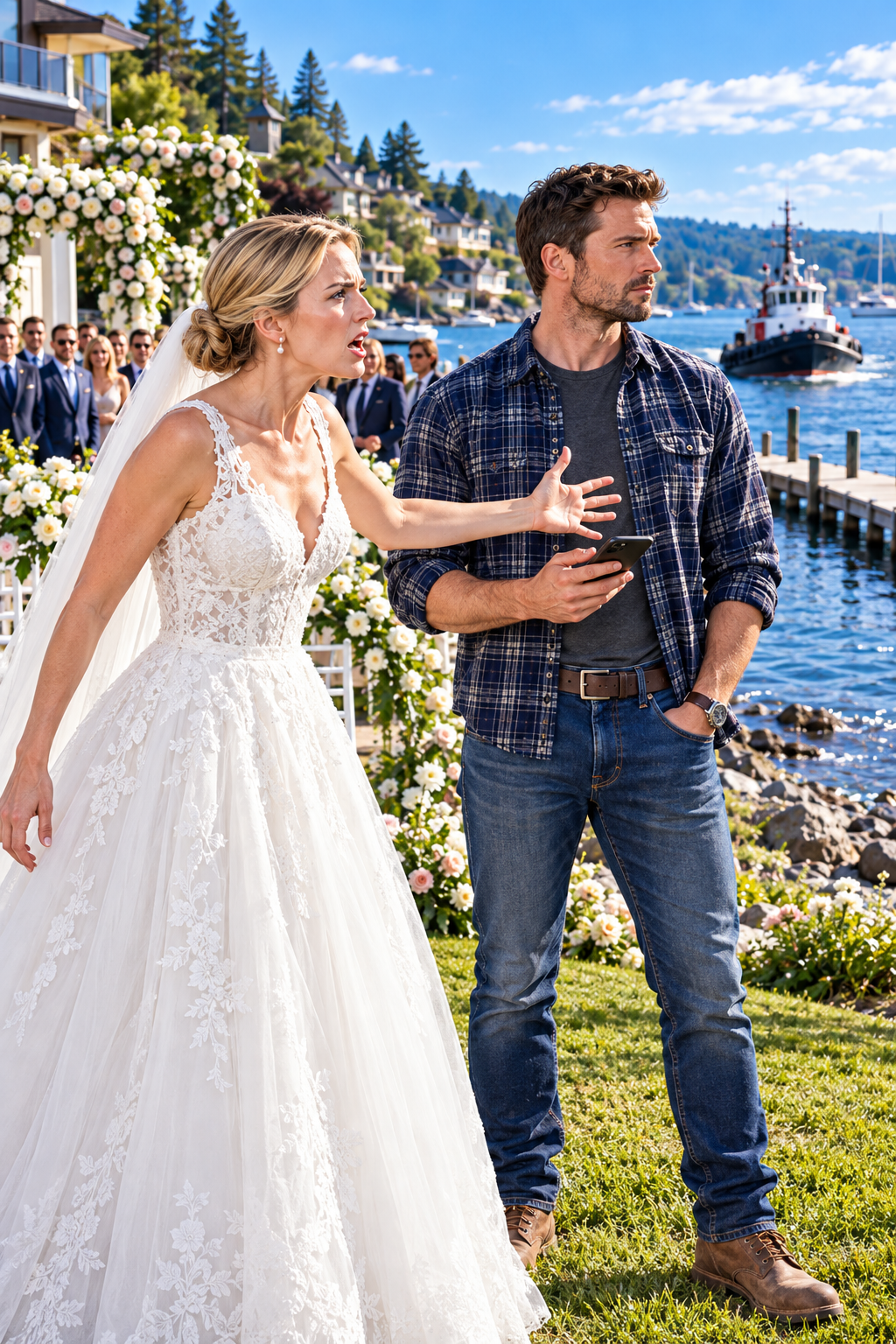
Part 2: Valerie twists emergency easement language to claim wedding authority illegally
Valerie told him he understood the situation correctly. Grant folded the folder shut without reading it and walked back toward his truck. She watched him go, certain that the association’s authority would settle the matter. Once inside the cab, he called Owen Caldwell, his longtime operations manager, and asked him to pull every ownership record for the docks. He also told Owen not to touch the wedding setup or confront the vendors.
They met at a diner a few miles away and spread the marina records across a booth table. The land was permanently registered to Grant, but the floating docks were separately registered as movable marine assets owned by Mercer Point Operations, his company. They were modular sections held by removable cables, connected by detachable bridges, and designed to be towed to another mooring site. Grant looked at the drawings and understood that Valerie’s entire event depended on equipment she had never asked to borrow.
Owen found the wedding’s public event page. It promised a lakefront arrival by private yacht, with twenty-six yachts bringing nearly three hundred prominent guests directly to the marina. A floating stage was planned for the central docks, with cocktail service spread across two adjoining sections. The main pier had been assigned as the photography location, and the remaining six hundred guests were expected by road. Every major feature required Grant’s docks to remain exactly where they were.
The vendor contracts Owen located placed the event’s cost above $1.4 million. Grant called his attorney, Rachel Whitmore, and asked her to review the 1978 clause Valerie had cited. Rachel read the entire document, not just the sentence Valerie had emphasized. The clause permitted emergency pedestrian access to the shoreline for evacuation, firefighting, and water rescue. It said nothing about weddings, parking, commercial events, docking rights, yachts, or private celebrations.
Rachel told Grant that Valerie had stretched a narrow safety provision into authority it did not grant. She drafted a formal notice requiring the association to vacate the marina by five o’clock, remove its equipment, and stop using the docks. Valerie called Grant after receiving the notice and warned that the association would sue him until he lost the marina if he ruined her wedding. Grant reminded her that she had placed the event on his property without permission. Then he asked, “Are you sure you need those docks?” and ended the call.
Part 3: Grant’s records reveal movable docks and a deliberate legal strategy
Grant did not want to give Valerie an opportunity to portray him as an aggressor. He would not tear down tents, touch flowers, or move chairs that belonged to the event company. He would only reclaim the assets his company owned. Rachel reviewed the marina’s insurance policies, operating permits, and state registration records. Nothing required the docks to remain in one position, and Grant had a second legally leased mooring site on the far side of the lake.
She advised him to issue a maintenance notice, close the marina temporarily, and hire a licensed marine crew to relocate the docks. The operation would be documented from beginning to end. Grant agreed, provided the work followed safety procedures and did not interfere with boats already using the water. Owen contacted a regional marine service and arranged two tugboats. He also notified the regular marina customers that access would be limited overnight.
Valerie received the formal notice and responded with another threat. She said the event had already been approved and that Grant’s refusal would damage the entire community. Grant asked her to show him the board vote and the full easement language. She repeated that the HOA had authority, but did not send the records. Instead, she told her staff to continue setting up the event as scheduled.
By early evening, white tents covered the parking lot and workers were arranging the reception area along the shore. Wedding planners checked seating diagrams while electricians ran temporary lines toward the docks. Grant watched from the marina office, recording the setup and keeping a careful distance from the workers. He felt no satisfaction watching people prepare for an event that might collapse. He felt only the weight of knowing that if he did nothing, his silence could later be treated as consent.
Around nine, the tugboats arrived, their running lights moving across the dark water. Owen’s crew shut down the shoreline connections, disconnected the access bridges, and secured the fuel and water lines. Each step followed the marina’s safety plan, and the crew kept a written record of the time and condition of every module. They began releasing the anchor cables one section at a time. Grant stood nearby, making sure the move stayed orderly and within the limits Rachel had reviewed.
Part 4: Tugboats remove the docks while Valerie threatens police and court
Valerie heard about the operation and arrived with four security guards. She shouted at the crew to stop, then ordered her guards to block the tugboats. Grant told her calmly that the docks were his company’s property and that the crew was relocating them for scheduled inspection and maintenance. Valerie accused him of sabotaging an event approved by the association. Grant replied that the association could not approve the use of property it did not own.
When the guards moved toward the crew, Grant called Sheriff Nolan Pierce. He did not ask for Valerie to be arrested or removed. He asked for an officer to witness that his employees were moving company assets and to prevent a physical confrontation. Sheriff Pierce arrived within twenty minutes and reviewed the ownership papers on the hood of his patrol car. Then he asked Valerie where the 1978 clause authorized weddings.
Valerie had no answer. Sheriff Pierce told the guards they had no authority to interfere with a property owner moving his own equipment. He also explained that any disagreement over the easement belonged in civil court, not in a standoff on the shoreline. Valerie warned that Grant would be forced to return every dock before Saturday. Grant asked who had obtained that order. She said a judge would. “Then I’ll wait for the judge,” he answered.
The first dock section moved across the lake shortly after midnight. Then the second followed, and then the third, each one carrying its lights away from the shoreline. Workers released the modules carefully, and the tugboats guided them toward the alternate mooring site. Valerie remained at the edge of the water, watching the wedding venue disappear piece by piece. By four in the morning, all fourteen docks had been relocated.
The shoreline looked empty in the first light of dawn. The floating stage had nowhere to attach, the yachts had no pier to approach, and the power connections had been shut down. Grant had not destroyed the equipment or touched a single wedding decoration. He had moved his own property to a site where it could not be used without his consent. Valerie still insisted the court would order everything returned, though she had not yet filed a motion.
By Friday morning, she had. The association requested an emergency order forcing Grant to restore the docks, reconnect electricity, and allow the wedding to proceed. Its filing claimed irreparable harm if the event was cancelled. Rachel read the motion with disbelief: the HOA was asking a judge to compel a private business owner to lend his equipment for a personal celebration. She organized the deed, licenses, tax records, dock registrations, the complete easement, and Grant’s written trespass notice.
Part 5: A judge rejects the HOA’s demand to restore the marina
At the emergency hearing, Valerie’s attorney described Mercer Point as a shared community amenity. Rachel laid out the property records and showed that the marina belonged to Grant and his company. Then she submitted the complete 1978 easement, including the sentence limiting access to emergencies. The association could use the shoreline when a fire, evacuation, or water rescue required it. The document did not give it a right to hold private events or control Grant’s docks.
Rachel also presented an email Valerie had sent to the wedding coordination company weeks earlier. It said the marina owner would complain, but the association’s authority overrode him regardless. The message showed that Valerie knew Grant objected before she signed event contracts. She had not misunderstood his position; she had planned to proceed over it. The judge denied the request to force the docks back into place, though he left the larger dispute for further proceedings.
Valerie walked out of the courthouse and told a reporter that Grant had sabotaged an innocent wedding. Grant did not answer the accusation. Rachel had just received a call from Douglas Avery, a longtime HOA board member who said the board had never voted to approve the event. He sent her the original meeting minutes. They showed a discussion about renting a ballroom at a local hotel, not the exclusive use of Mercer Point Marina.
The version Valerie had sent to the event planners contained an extra paragraph claiming the board had approved the marina. Douglas said he had never seen that sentence before. Two other board members confirmed they had not voted for the event. Rachel told Grant that this could turn a property dispute into an inquiry about altered association records. The wedding contracts had been signed based on an approval that might never have existed.
Douglas provided copies of the original minutes, the altered version, and the board’s email discussion. Digital records showed that the revised file had been uploaded after the meeting from an account associated with the association president’s office. The change had not been reviewed at the next meeting. Grant looked at the documents and realized Valerie had placed the board’s name behind decisions it had never made. The event was no longer just an unauthorized use of his docks.
The wedding planner, Megan, called Rachel to ask what could legally happen next. She had been told the venue was fully authorized and was now trying to understand whether the vendors should continue setting up. Rachel advised her to preserve all messages and contracts and not to misrepresent the status of the property. Grant did not want the workers blamed for a decision they had not made. He asked Owen to make sure the planner had the contact information for the marina’s counsel.
Part 6: Altered minutes and a forged guarantee expose Valerie’s deeper deception
Megan had spent months coordinating the wedding and believed the association had secured the marina properly. Valerie had given her the meeting minutes and repeatedly assured her that Grant had agreed to the arrangements. Megan had never spoken to Grant before the marina was blocked off. When she learned that the docks belonged to his company and the board had not approved their use, she began reviewing every contract herself. Several documents included promises that appeared to exceed the association’s authority.
The biggest problem involved the yacht charter company. Its contract said Preston Cole’s real estate firm would guarantee payment if the association failed to meet its obligations. Preston was Valerie’s fiancé. When Rachel asked him to review the document, he said he had never signed such a guarantee. The electronic signature looked like his name, but the authorization record did not match his company’s normal process. Preston asked his attorney to investigate before making a public statement.
He arrived at the marina that afternoon, expecting to see the venue Valerie had described for months. Instead, he found empty water and temporary fencing around the parking lot. Grant met him at the gate with Rachel beside him. He showed Preston the deed, the email proving Valerie knew he objected, and the trespass notice. Preston listened without interrupting, then asked Valerie whether she had known Grant opposed the event from the beginning.
Valerie tried to change the subject, saying Preston did not understand how association authority worked. He reminded her that she had told him Grant agreed to the venue and that the HOA had fully approved it. Rachel placed the yacht contract on the table between them. Preston looked at the guarantee and said it was not his signature. Valerie’s face lost color as he asked whether she had used his company’s name without his permission.
Preston did not shout or create a scene. He said his attorney would review every document and walked back to his car. Valerie followed him, calling his name, but he drove away. The wedding was scheduled to begin in less than three hours, and the groom had just withdrawn. Megan told Valerie that she had to choose between cancelling the event and relocating it immediately. Valerie demanded that Megan tell the guests Grant had ruined the wedding, but Megan refused to attach her company’s name to a claim she knew was false.
Part 7: The wedding collapses as Preston discovers his signature was forged
At two-thirty, the cancellation notice went out to nearly nine hundred guests. Yachts that had been circling near the shoreline turned back toward their original marinas. Limousines reversed course, catering crews repacked equipment, and the florists kept their arrangements sealed inside delivery trucks. The band never performed, and the reception tables remained in their shipping crates. The wedding did not collapse because Grant attacked it; it collapsed because the venue had never been secured and the groom no longer trusted the documents.
From the far side of the lake, Grant watched the traffic disperse. Owen asked whether it had been worth the disruption. Grant said he had not cancelled anyone’s wedding; he had taken back property that had been used without permission. He did not celebrate the empty shoreline or the money vendors might lose. He knew many workers had shown up believing they were part of a legitimate event. His concern had always been to protect his marina without turning the situation into something more dangerous.
That evening, the HOA board held an emergency meeting. Douglas arrived with the original minutes, the altered version, the event contracts, Valerie’s email, and a stack of invoices. One board member asked how much association money had been spent. Valerie described the wedding as a promotional event, but Douglas displayed a $46,800 invoice for floral installation. Then he showed an $18,500 charge for a private bridal suite and a $72,000 bill for a custom monogrammed pavilion.
The room fell silent. The association’s reserve funds had been committed to what was unmistakably a personal celebration, using approvals that the board denied giving. Members demanded to know who had authorized the contracts and why the original minutes differed from the event company’s copy. Valerie insisted she had acted for the community, but the invoices did not support her explanation. The board voted to suspend her as president pending a full financial investigation.
Over the next few weeks, vendors demanded payment for the cancelled event. The claims—from the yacht charter, caterers, florists, sound crew, tent company, transportation service, and planners—exceeded $620,000. The association’s insurer reviewed the claim and denied much of it, noting that the event had been scheduled on property the HOA had no authority to use. Residents demanded an independent audit covering the previous two years. The community’s anger turned toward the person who had risked its finances for one afternoon.
Part 8: Settlement restores the marina while the association confronts financial fallout
Grant filed a civil claim for direct losses: the cost of relocating the docks, lost operating revenue, legal fees, and the expense of restoring the marina. He did not seek an inflated sum to punish the association. Rachel also asked the court to formally declare that the HOA had no right to host events at Mercer Point Marina. Valerie claimed Grant had moved the docks out of spite, but Rachel asked whether she owned them, whether the association had leased them, and whether Grant had any legal duty to provide them for her wedding.
Valerie had no answer. Digital records confirmed that the altered meeting minutes had been uploaded from her account after the original meeting. She tried to blame the board secretary, but the system logs contradicted her. Preston’s attorney also confirmed that he had not authorized the guarantee bearing his electronic signature. He told Valerie he would accept no responsibility for obligations she had signed under his company’s name. Their engagement ended soon afterward.
The association’s attorney reviewed every vendor contract and determined that the board had formally approved only a small portion of the spending. Several contracts had been signed by Valerie as association president and personal event guarantor. Once the board disavowed the unauthorized agreements, vendors pursued her individually for those commitments. The association and Grant reached a settlement after months of legal proceedings. Grant received compensation for his documented losses, and the HOA signed a permanent agreement recognizing the marina’s boundaries.
The settlement stated that Black Ridge Estates had no ownership, control, event rights, docking rights, or commercial access rights over Mercer Point Marina. It also clarified that the 1978 emergency easement remained in force for its original purpose. First responders could still reach the shoreline during a fire, evacuation, or water rescue. Grant had never wanted to eliminate emergency access; he had objected to a narrow safety clause being turned into permission for a private wedding.
Valerie was removed from the presidency after a formal board vote. When several of her judgments went unpaid by their deadlines, a civil lien was placed against her lakefront home. There was no dramatic confrontation or unlawful seizure. She faced the ordinary financial consequences of contracts she had signed and spending she had approved. The social circle she had built through her position grew smaller, and vendors communicated with her only through attorneys.
Several weeks later, two tugboats returned to Mercer Point with the docks. One module after another slid into its original position until all fourteen sections were restored. Owen watched the final bridge lock into place and said the marina could reopen. Grant asked if he expected any weddings. Owen replied that from now on there would be paying customers. The modest sign at the entrance read “Mercer Point Marina—Private Property.”
The HOA sent every resident a formal notice confirming the marina had never been a community amenity. Grant placed the signed settlement in his office folder, not as a trophy, but in case anyone forgot what it said. Boats moved across the lake where Valerie had planned to host nine hundred guests beneath a floating stage. The wedding had disappeared, but so had the belief that an association title could make someone else’s property its own. Grant had never needed to tear down a tent or disrupt a ceremony by force; he had only needed to reclaim what belonged to him.
✓ Lynn R. Adams
Part 2: Valerie twists emergency easement language to claim wedding authority illegally Valerie told him he understood the situation correctly. Grant folded the folder shut without reading it and wal…