“Go to Your Mistress,” the Pregnant Wife Told the Port Tycoon on Christmas Eve—By Morning, She Ha…
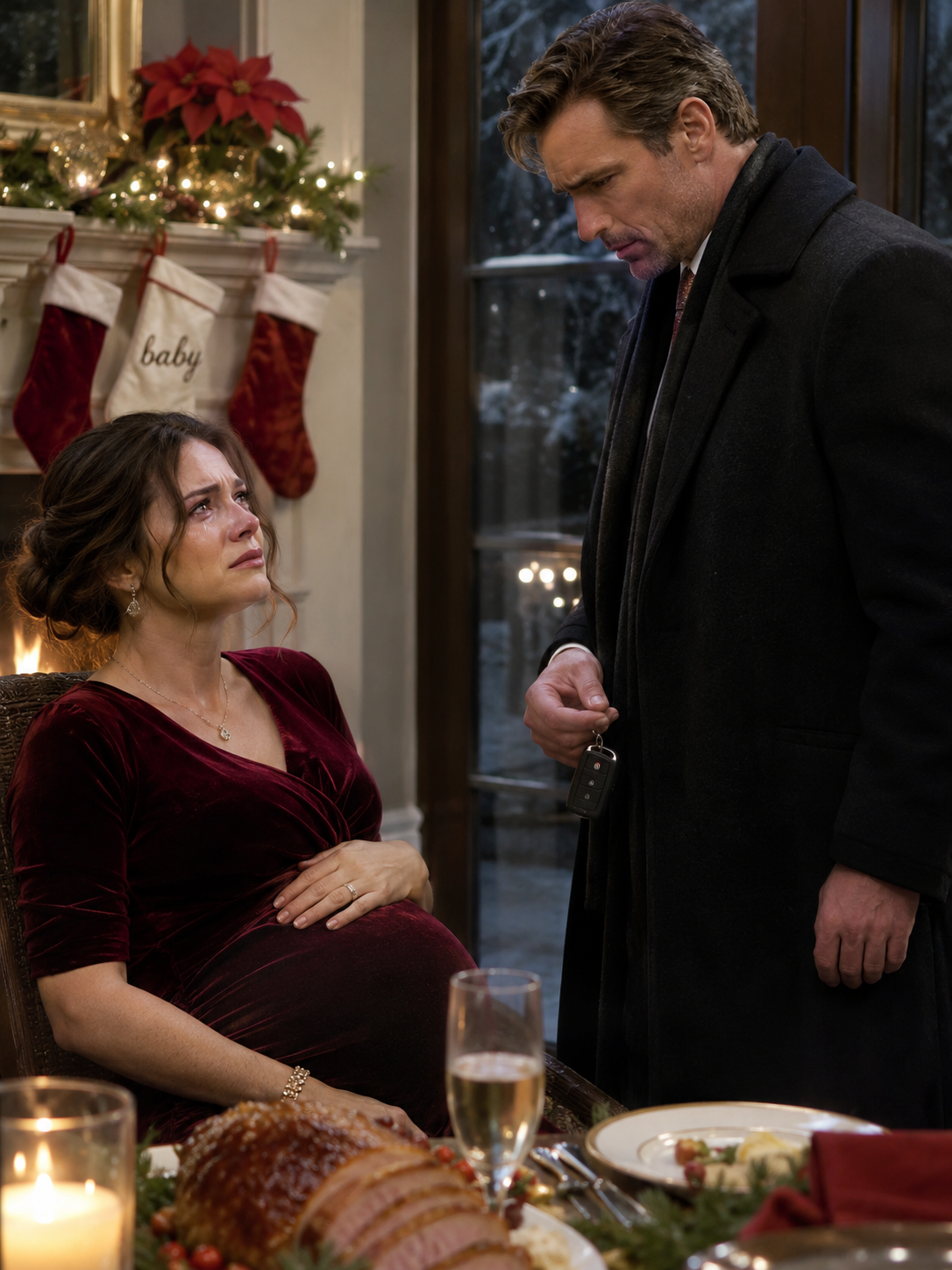
I told my husband, who ran a company handling a huge share of Baltimore’s port freight, to go spend Christmas Eve with his mistress while I was eight months pregnant. He walked out anyway. Before dawn, I left my wedding ring beside our unborn son’s silver rattle, and carried one insurance envelope out of our home that made a lawyer look at me differently…
At on Christmas Eve, I watched Scott fasten the platinum cufflinks I had given him for our eighth anniversary while the ham cooled on our dining table. Snow slipped past the windows of our Harbor East townhouse, and three stockings hung over the fireplace. The smallest one said baby. I was 34 weeks pregnant, after a miscarriage and 11 months of injections, and I had spent the evening waiting for my husband to sit down.
Scott Perry was 41 and ran Perry Marine Terminals, a company responsible for moving about nine percent of the freight through Baltimore’s port. In public, people called him a logistics executive. At home, I knew the man who remembered exactly how I took my coffee and somehow kept forgetting my prenatal appointments. I wanted to believe those two versions could still belong to the same husband.
“A crane operator got hurt at Seagirt,” he told me, sliding his phone into his coat. “Ambulance, union rep, the whole thing. I need to go.” It was a reasonable explanation for an unreasonable hour, which was Scott’s specialty. I’d spent 11 years in forensic accounting before stepping away, and I knew how easily a true detail could hide a lie.
Three hours earlier, his tablet had lit up on the kitchen counter. The message preview was from Ashley Simmons, his chief of staff since March: “Fire’s going at the cabin. Come in through the back road. I told Marcy not to open the gate till morning.” I never opened the conversation. Those two lines only gave shape to things I had been trying not to see for five months.
There had been a strange hotel soap smell on his collar, a second phone he said belonged to dock supervisors, and a dinner Ashley arranged on the night Scott missed an appointment to see our baby. Once, he had come home smelling of wood smoke, although our fireplace ran on gas. I kept filing each detail under stress because I was scared of what the folder would say when I finally opened it.
He reached for his keys. “Don’t wait up.” I put my palm against the baby shifting beneath my ribs and said, “Go to your mistress, Scott. Give Ashley the Christmas you were supposed to spend here.” His hand froze on the door, but his face stayed carefully blank. I knew that look; he had learned from his father to treat every visible reaction as a weakness.
“You went through my messages,” he said. I told him the preview had appeared on a tablet in our kitchen. He said Roy, his father, was meeting him about the Seagirt problem and Ashley was coordinating it. “Is the Seagirt problem sleeping in your bed?” I asked, and he told me to keep my voice down, even though he had sent our housekeeper home hours earlier.
I slipped off my ring and put it beside the boxed silver rattle I had bought for our son. Scott watched my hand as though I had broken something valuable. “Don’t perform for me,” he said. “I’m done rehearsing what I’ll say when you come back,” I answered, and told him that whatever he returned to would not be the marriage he was leaving.
For one foolish second, I imagined him taking his coat off. I pictured him calling Ashley in front of me and deciding that our child and eight years together deserved the truth. His phone buzzed; he glanced at the ring and opened the door. “We’ll talk when you’re calmer,” he said, and then the Range Rover disappeared down Alisana Street.
I cried quietly by the dining table until our baby kicked. “I know,” I whispered, pressing both hands against him. After a while I wrapped the ham in foil, but the ordinary motion of folding the edges nearly undid me. There was a Christmas card for my younger sister Hannah on the table, and beneath it lay a brown envelope that had been frightening me longer than Ashley’s text.
Wells Insurance had addressed it to Danielle Gray Perry, corporate officer, asking me to renew liability coverage for Mitchell Construction. I opened it December 19 and checked Maryland’s registry that night. According to the state, I was Mitchell’s president, treasurer, and sole director. I had never agreed to hold any of those positions, and I had never signed a document creating that company.
Mitchell Construction had been formed six years earlier using our townhouse address, with Scott’s attorney, Phil Watkins, as registered agent. Over those years, it had billed Perry Marine Terminals $14.2 million for dredging and berth repairs. My preliminary checks showed work that had not been done and equipment that had not been rented. I knew the Seagirt docks well enough to recognize the difference between a freshly repaired berth and an old one.
The affair hurt in a place I could hardly name. The envelope frightened the part of me that had spent a career following money to the person who would be blamed for it. My name was on a company I did not control, and the lawyer arranging its paperwork worked for my husband’s family. I had not yet told Scott that I knew, and I suddenly understood why that silence mattered.
I called my obstetrician’s after-hours line before making any plans. I had no bleeding, contractions, or unusual pressure, and the on-call doctor cleared the trip I described with instructions to stay hydrated and stop if anything changed. Then I called Corey Elliott, Scott’s driver and bodyguard of seven years, the only employee who consistently asked whether I needed something and stayed for the answer.
“I need a ride to someone I trust in Annapolis before dawn,” I told him. “And I need you to say no if the roads aren’t safe. Scott cannot know.” Corey was quiet before asking whether Scott had a way to track me. He knew about the Range Rover, but I told him I would not use it. “I’ll be there at four-thirty,” he said.
I packed my hospital bag, laptop, prenatal records, and passport. I photographed the insurance letter and registry papers, then sent encrypted copies to myself and Hannah in Arizona, who called every Sunday without fail. I left Scott’s money and watches where they were. At , dressed in a gray wool coat, I stood beside the Christmas tree and looked once more at the ring and rattle.
I did not leave a note. I left the ring exactly where I had placed it, turned off the lights, and walked outside. Corey was waiting with his gray Buick, not a Perry company car. As the snow thinned on the road to Annapolis, I opened my laptop and pulled together the payment trail, wondering how many times I had slept beside Scott while my name sat on those filings.
By the time I turned my phone back on, there were 23 missed calls. Scott’s first messages sounded worried; the later ones sounded angry. One warned, “Whatever you think you found, don’t take it to anyone. My father has people everywhere.” Corey listened while I read it aloud, then admitted he had once driven Phil Watkins to the registry office and had never asked why.
“I’m sorry, ma’am,” he said, keeping his eyes on the icy road. “Don’t be sorry,” I told him. “Be useful.” It was a sharp answer to a man who had done nothing but help me, and I regretted the tone immediately. Still, when he said, “Yes, ma’am,” I knew he understood that I was trying not to come apart.
At eight that morning, I sat in an Annapolis diner across from Naomi Feld, a litigator I had known since college. She had driven forty minutes in a parka thrown over her pajamas after I called from Corey’s phone. My eggs sat untouched while I showed her Mitchell Construction, 41 payments each under $400,000, approvals from controller Seth Davis, and wires to a Delaware account at Freeman Consulting.
Freeman’s registered address was a Wilmington mail drop. Naomi studied the registry entries, the insurance request, and the signatures I insisted were not mine. “You’re listed as the sole signatory,” she said. I nodded, unable to swallow. “Danielle, if those signatures were forged, they didn’t just move money. They built a place for the blame to land, and they put your name on it.” Part 2…..
IF FACEBOOK BROUGHT YOU HERE, HERE’S THE CONTINUATION YOU’VE BEEN WAITING FOR. ENJOY! 👇 I wanted to see every payment, every approval, and every person who had touched the money. Naomi put a hand over the edge of my laptop and told me that wanting answers was not the same as being safe enough to chase them alone. I was carrying a child, and someone had been willing to put my name on years of transactions without asking my permission.
Naomi arranged a rental house in Edgewater through her firm, and Corey slept on the couch. I called my doctor again and promised to rest. At noon I finally answered Scott, but I started a recording first; after the warning about his father, I was not willing to rely on anyone’s memory of what was said.
“Where are you?” he demanded. “Safe,” I said. He knew Naomi was involved and wanted me home, but when I asked why Mitchell Construction had my name on it, the line went quiet. “It’s a tax structure,” he finally said. “A convenience.” I asked whether six years, $14.2 million, and 41 wires to a Wilmington mail drop were convenient, too.
Scott asked who had given me those numbers. I said I had checked the records, then asked whether his father had created the arrangement. He said Roy had put it together before Scott took over the company and insisted he had simply signed what he was given. My next question felt like stepping barefoot onto ice: “Did you sleep with Ashley last night?”
“Yes,” he said, after trying to evade it. When I asked if it had been the first time, he said no. I kept my hand on my stomach until the baby settled, then asked who owned Freeman Consulting. Scott said it belonged to Roy and stopped talking as though he had heard himself say too much. I thanked him for answering and ended the call.
I had suspected the affair, but hearing my husband admit it left me shaking. The money was another kind of betrayal, one built over years instead of months. Naomi reminded me that a lawyer had to work from documents, not from what Scott claimed over the phone, and that we had to keep the original records untouched and safely accounted for.
Later, through Scott’s statements and the investigation, I learned what happened when he told Roy I had followed the Mitchell trail. His father was 71, accustomed to ordering people around, and unimpressed that I was pregnant or that Scott wanted me left alone. Roy’s response was to tell him to find me before I took the evidence to anyone. Scott insisted nobody was to touch me, but Roy made clear that his patience had limits.
For the first two days, the rental house felt too quiet. Corey checked the driveway before I walked outside, and Naomi kept calling with practical questions about records and medical appointments. Then my phone stopped ringing altogether, and on December 28 Naomi told me why: Phil Watkins had filed an emergency petition seeking to give Scott authority over my medical decisions.
The petition described my departure while heavily pregnant as evidence of impaired judgment. I stared at Naomi until she said what I was thinking. They were trying to make a woman’s decision to leave her husband look like proof she could not decide anything at all. If a court believed them, my account of the forged company could be dismissed as another sign that I was unstable.
Naomi gathered the obstetrician’s letter clearing my travel, Corey’s sworn statement about the roads, his service log, and the recording of Scott’s Christmas Day admissions. We went to court with everything organized and dated. Judge Barnes, a woman in her sixties, read the documents for several minutes before denying the petition and directing Watkins to explain why he had presented a medically cleared trip as dangerous.
Scott stood at the far end of the courthouse corridor when I came out. His overcoat looked expensive, but his face looked exhausted. “I didn’t write that motion,” he told me. I said, “You paid the lawyer who did. You let someone tell a judge I can’t make decisions about my own baby.” He had no answer, and when a reporter raised a phone near the exit, he walked away.
That afternoon Naomi contacted the U.S. Attorney’s Financial Crimes Unit. Prosecutor Marisol Kent asked to see the company filings, invoices, payment records, signature comparisons, and Wilmington address. I had spent my working life preparing evidence for people who made those requests, so I brought a binder sorted by year. Kent looked at the tabs and asked where I had worked.
“Anderson Engineering’s audit group, then Wright Forensics,” I said. She told me their office could use someone like me, and I almost smiled for the first time since Christmas. “I have a baby coming,” I replied. “We’ll wait,” she said. Before I left, she told me not to meet anyone who offered information in exchange for the papers, however useful it sounded.
On December 30, a photograph appeared on the prepaid phone Corey had bought for me. It showed me leaving my obstetrician’s office three months earlier, photographed from across the street. Someone had drawn a red circle around my pregnant stomach and added a demand to return the originals before the baby arrived. I read it twice without taking in the words.
My first reaction was to call back and offer whatever they wanted. I had spent years telling clients that a threat meant you preserved the evidence, but this was a threat aimed at my son. Naomi caught my wrist before I could dial. She did not tell me to stop being afraid; she called Kent and handed over the phone.
Part 3 Federal agents moved Corey and me to a safe house in Annapolis that night. A technician documented the threatening picture and its metadata, and Kent asked who knew the prepaid number. I listed Corey, Naomi, two investigators working for her, and Scott, who had asked Corey how to contact me after the hearing. Saying those names aloud felt like placing everyone I trusted under a cloud.
Then agents found a magnetic tracker under the rear wheel well of Corey’s Buick, equipped with a microphone as well as a transmitter. It had been there for six days. Someone had been able to hear Corey read my new number to me in the rental-house driveway. I felt a rush of relief that my closest helpers had not betrayed me, followed by the awful knowledge that every road and doctor’s visit had been exposed.
Scott requested a video call the next morning, with lawyers on both sides and Kent listening. He said the photograph had come from a security archive he had ordered during my pregnancy. He claimed the surveillance was meant to protect me, but Roy’s people could access the reports. “You built the file someone used to threaten our son,” I told him. He admitted he had never asked whether I wanted to be watched.
Kent asked if he would identify everyone who accessed the surveillance records. Scott’s lawyer warned him not to answer, but Scott said yes. I noticed the choice without mistaking it for an apology that covered everything else. He was still the man who had allowed my name to be used, hidden his affair, and let his father’s attorney question my ability to care for myself.
While I was living behind locked doors, Ashley Simmons discovered that she was not safe inside Scott’s world either. I learned the details from the records the independent directors preserved and from Ashley’s later statement. On New Year’s Eve, she opened a restricted folder she was authorized to access while preparing board certifications and found a draft statement blaming irregular payments on her.
The folder also contained a termination letter and a severance offer that depended on her silence. It was dated December 9, the same day Scott had told her that he would end our marriage once our baby was born. She had believed she was the woman he planned to choose. Instead, she found paperwork prepared to make her responsible for the same payments whose blame had first been parked in my name.
Scott walked into her office and asked her to leave the Freeman line out of a year-end vendor summary until legal reviewed it. Ashley refused to pretend that $14 million had simply disappeared from a spreadsheet. She asked whether he planned to fire her before or after he left me, and he called the draft a legal precaution. He could not explain why every precaution protected his father and endangered someone else.
Ashley took off her access badge and went to the independent board directors. Scott warned her that Roy would know she had seen the file, but she went anyway. By evening, board chair Kenneth Davis, a retired judge, had called an emergency session and ordered records preserved. Access to the Freeman files was frozen so neither Scott nor Roy could move, delete, or quietly reclassify the evidence.
I spent that New Year’s Eve at a folding table, cross-checking wire dates while Corey made tea. Just before midnight, our baby hiccuped so sharply that my pen jumped off the page. “Happy New Year, ma’am,” Corey said from the doorway. I told him he could call me Danielle, and his shy smile reminded me how much kindness there could be in one ordinary change.
On January 2, Scott entered Kent’s office with a different lawyer and offered to wear a wire when he met Roy. The prosecutors promised him nothing, and I declined to take part. I had given them records I could explain; what Scott chose to do with the truth now had to belong to him, not to a plea from his wife.
Ashley had already made her own statement. She said their affair began in August, three weeks after I entered my second trimester, and brought an email chain about the false company. Roy had instructed Scott to keep me on the paperwork through April and suggested Ashley would be useful as the next name on the record. Scott had answered that he understood and that nobody should go near me.
Another document was a transition plan Scott approved in October. It postponed a public separation until after the baby was born and proposed introducing Ashley six months later, with a settlement and an approved story for me to repeat. When Naomi laid the summary in front of me, I thought of the unfinished nursery and the ultrasound where Scott had squeezed my hand when we saw our son’s face.
“He already had it planned,” I said. Naomi gave me tissues but did not interrupt. The affair had begun while I was feeling the baby move for the first time, and the plan to leave me had existed while I was still making room in the closet for his little clothes. It was not only that Scott wanted a different life; he had expected me to live inside his version until he was ready to announce it.
Ashley asked to meet me, and we sat in Naomi’s conference room with counsel present. She wore a plain navy suit and had taken off the jewelry I associated with her. “I’m not asking you to forgive me,” she said. I told her that was good, because I was not ready, and she did not argue.
Part 4 Scott had told her our marriage was an arrangement, she said, and she had believed it because believing suited her. She admitted she went to the board partly because she discovered her own name in a false statement, partly because Roy frightened her, and partly because what had happened to me was wrong. “I wish that last reason had been enough sooner,” she said. I told her to testify truthfully and left without offering forgiveness or cruelty.
The meeting between Scott and Roy was arranged for January 5 at the family farm in Ruxton. Scott was supposed to say he had copies of my files to trade for Phil Watkins’s records of the Freeman wires. I was 35 weeks and five days pregnant, staying at the safe house with Corey, and Kent promised to call when it was finished. I did not ask where the agents would stand or what Scott was wearing.
At an unknown number called my phone. I let it go to voicemail, then heard Scott say that if something went wrong, I was not to come and nobody should tell me he had asked. Corey watched me turn the phone over on the table. “You can worry about him without wanting him back,” he said, and I was grateful not to have to explain that difference.
What happened in Roy’s study became clear afterward through recordings, testimony, and the investigation. Scott demanded the wire records and a promise that nobody would approach me again. Roy dismissed the idea of making a promise in writing, then admitted the false petition, the surveillance picture, and the tracker had been business decisions. On the recording, he described my unsigned paperwork and six years of mail at our address as reasons I had been the perfect person to blame.
Phil Watkins noticed the wire hidden beneath Scott’s shirt. Roy realized what was happening, a guard came through the doorway, and a struggle sent a pistol onto the rug. It discharged into the ceiling. As agents moved in, Roy drew a revolver from a desk drawer and fired, hitting Scott in the left shoulder before officers restrained him. Scott survived, but when I first heard there had been gunfire, none of that was known to me.
A local news report appeared on the safe house television, showing ambulances at the Ruxton gate and saying an executive had been injured. I was standing near the kitchen counter when pain tightened across my abdomen. Corey caught my arm. Six minutes later it happened again, and then five minutes after that. He called my doctor, and an ambulance took me to Johns Hopkins.
The maternity team was preparing monitors when Kent called. She told me Scott was conscious, that his shoulder wound was being treated, and that Roy and Watkins were in custody. I asked if he would live, and when she said doctors expected him to, I felt relief beside all the anger I had not lost. Then I told her I was in labor and asked her not to tell Scott just yet.
Doctors tried medication to slow the contractions for three hours, explaining that at 35 weeks our son might need help with breathing and feeding. I listened because I needed facts more than comforting guesses. At 11:42 that night my water broke, and the question stopped being whether we could delay delivery. It became how to help him arrive safely.
Scott was recovering from surgery in another part of the same hospital, with his arm supported and an agent outside his room. He later told me his lawyer had explained that the board had suspended him from all authority. When he learned I was delivering, he asked to come to me. I chose Corey to stay with me instead, and this time Scott did not turn my decision into an argument.
At in the morning, my son arrived with a thin cry that grew louder as the neonatal team helped him. “Is he breathing?” I asked before anyone had finished speaking. The doctor said he was, though he needed support, and they placed him on my chest briefly before taking him to the NICU. He weighed five pounds, one ounce, with damp dark hair and a tiny hand that opened against my skin.
“Hello, Asher,” I whispered. “Asher Grey Perry.” I had settled on his first name during labor, but his middle name had been important to me for months. Gray was the family name I had carried before I was a Perry, and I wanted my son to have it inside his name, not waiting somewhere outside it.
My obstetrician told me not to blame myself for going into labor after hearing the news. I had followed medical advice, she reminded me, and premature labor rarely had one simple cause. I nodded, but it took several days to stop mentally returning to the television, the first contraction, and every choice that had led us into the hospital.
I allowed Scott to see Asher’s first moments over a video call from my hospital bed, with Naomi holding the phone. I told him our son was stable but needed neonatal care. He cried and asked when he could see him in person. “When the doctors say it’s safe and an agent can bring you,” I said. “You can learn to be his father, Scott, but you won’t be my husband again.”
He looked at me without offering a deal or an explanation. “I know,” he said. I believed he understood the words, though I was no longer willing to confuse understanding with change. Being wounded while helping investigators did not erase the years of secrecy, the affair, or his signature on a plan for my future that I had never agreed to.
Part 5 Asher spent 22 days in the NICU. During the first week, my days shrank to oxygen readings, measured milk, weight checks, and the number of minutes I could hold him against my skin. I learned to put my hands through the incubator’s round openings without catching the wires. The old accountant in me still watched numbers, but now every small increase meant a child getting stronger.
Scott came on Asher’s fifth day, brought in a wheelchair by an agent because he was not cleared to walk that distance. He wore a gray gift-shop sweatshirt and hospital pants instead of a tailored suit, his left arm in a sling. I stood beside the incubator and said, “Wash your hands.” He did, then waited to be told where to sit.
When Asher closed his fingers around Scott’s right index finger, Scott bent his head and whispered, “Hey, buddy.” He stayed fifteen minutes without asking me to comfort him. At the door he asked if I needed anything. “Consistency,” I told him. “Not presents or influence. Show up when you’re allowed, tell the truth when it costs you, and never ask him to make you feel less guilty.”
“I can do that,” he said. “You can start,” I answered. “Neither of us knows yet what you’ll keep doing.” He accepted the correction, and after he left I went back to the incubator. I was learning that I could care what happened to Scott and still protect the boundaries I needed to raise our son.
Once Asher came home, the case continued through winter and spring. Investigators compared the signatures and traced the money, and a handwriting examiner identified Phil Watkins as the hand behind all 41 signatures purporting to be mine. The evidence gave prosecutors a way to show not merely that the company was false, but that I had not directed it.
At Phil’s March sentencing, I sat in court still adjusting to a body that had recently given birth. He had pleaded guilty to forgery, wire fraud, and filing the false petition that tried to take away my medical independence. I told the judge that for six years my name had been used without me, and when I finally left, the same lawyer had tried to turn my sensible departure into an illness.
Phil said he never meant for the arrangement to reach me. “You meant for it to land on someone,” I told him. “I was the someone.” He received four years in prison, and the misconduct also cost him his law license. Watching him leave with a marshal did not return the years he had put my name on paper, but it finally put his actions beside his name.
Seth Davis, the controller who approved the invoices, cooperated with investigators. His testimony and the Freeman records filled in the structure I had begun tracing over Christmas breakfast. Perry Marine Terminals removed Scott, installed outside management under Kenneth Davis, and recovered $9.3 million from frozen accounts. The company was no longer a place where the Perry name alone could settle every question.
Ashley testified, then moved to Chicago. She sent me a short note saying she was sorry and had believed what was convenient. I kept it without replying, because I did not need to prove my healing by absolving her. She had made her own choices, even when Scott had lied to her too.
Scott pleaded guilty to conspiracy, obstruction, and a false financial certification. He was sentenced to 26 months in federal prison. I heard the news while feeding Asher, and I kept rocking him until he finished. My sadness was real, but it was not a reason to ask the judge for a different outcome.
Our divorce was final that summer, and I returned to using Gray. I kept the criminal case separate from the parenting agreement, because Asher was not evidence against his father or a reward for good behavior. Before Scott reported to prison, he learned during supervised visits how to prepare a bottle, settle a fussy baby, and wait through the ordinary rhythms of being a parent.
Once he was incarcerated, we arranged scheduled video calls. Some calls were awkward, and some were unexpectedly tender, especially when Asher smiled at a familiar voice. I did not use them to revisit the marriage. I was offering our son a carefully bounded chance to know his father, not giving Scott a route back into my life as a husband.
Roy’s trial began in October. Prosecutors played the recording from his study, where he had called a pregnant woman an ideal person to carry blame and described the threatening photograph as a reminder. I sat through the testimony, remembering how carefully I had folded the ham in foil on the night I finally stopped believing my own excuses.
By sentencing, Roy was 72. He faced convictions for racketeering, extortion, witness tampering, forgery, conspiracy, and attempted murder of a federal cooperator. His family had stayed away from the courtroom. He looked at the empty seats, then at me, and called me furniture that should have stayed quiet and been gone by April.
I stood when the judge offered me a chance to speak. “I followed other people’s missing money for eleven years,” I told Roy. “You built a company assuming nobody would count. I counted.” It was not the sort of speech I had spent nights rehearsing; I said what was true, and then I sat down.
The judge sentenced Roy to 31 years. The board had already removed his name from the terminal gates, and forfeiture took the Ruxton farm, the lake cabin, and the Wilmington account. When I walked out into the cold, I did not feel triumphant. I felt as if a long-open ledger had finally reached its last line.
Final That spring I had opened Gray Forensic Advisory, with Marisol Kent referring my first client. Corey had left the Perry payroll to run security for my firm, and by then he could call me Danielle without hesitating. Work gave me a place to use the skills that had helped save me, but it also gave me ordinary days in which the case was not the first thing I thought about.
The following Christmas, snow covered Annapolis and our house on a quiet street near the water. Naomi and her husband came for dinner, Hannah traveled from Arizona, and Corey brought his sister. The table was too small for all of us, the ham smelled of cloves, and eleven-month-old Asher sat watching the tree lights while chewing on a wooden spoon.
At six I carried him into the study for Scott’s scheduled call. Scott appeared with shorter hair and tired eyes, then read a small picture book while Asher slapped his palms against the tablet and tried to chew another book. When it was over, Scott looked at me and said I seemed well. “I am,” I told him.
He said he used to think that meant I had forgotten him. “I haven’t forgotten anything,” I said. “Healing isn’t amnesia.” Then, without asking me to change my mind, he apologized for walking out the previous Christmas and for arranging an entire future behind my back while expecting me to live inside the lie.
I told him I believed he was sorry. It could not repair our marriage, but perhaps it could shape the kind of father he became, and that was what I would be watching. He nodded, and when our allotted time ended, I turned off the screen and took Asher back to the sound of people laughing over dinner.
Later, Hannah found me beside the front window. On the mantel, I had set the silver rattle, now a little tarnished, beside the wedding ring I had left on the dining table a year earlier. “Do you wish you had left sooner?” she asked. I looked at the snow and said I wished I had looked sooner, but I was finished blaming the woman I had been for not seeing what other people worked so hard to bury.
Asher laughed in the next room, a bright little sound that carried down the hall. I picked up the rattle and followed it, leaving the ring in its dish. Scott had gone to the cabin expecting to find the same wife waiting when he came home. By morning, I was already becoming someone he could no longer persuade to stay inside his story.
THE END. I’ve shared the complete story, and I truly hope it touched your heart. If this story moved you, please , like, and share the post. Thank you for reading! ❤️
✓ Lynn R. Adams
I told my husband, who ran a company handling a huge share of Baltimore’s port freight, to go spend Christmas Eve with his mistress while I was eight months pregnant. He walked out anyway. Before dawn…