For eleven years, Mara Callaway believed her marriage had made her part of a family.
Part 2: Their announcement revealed what they expected Mara to feel
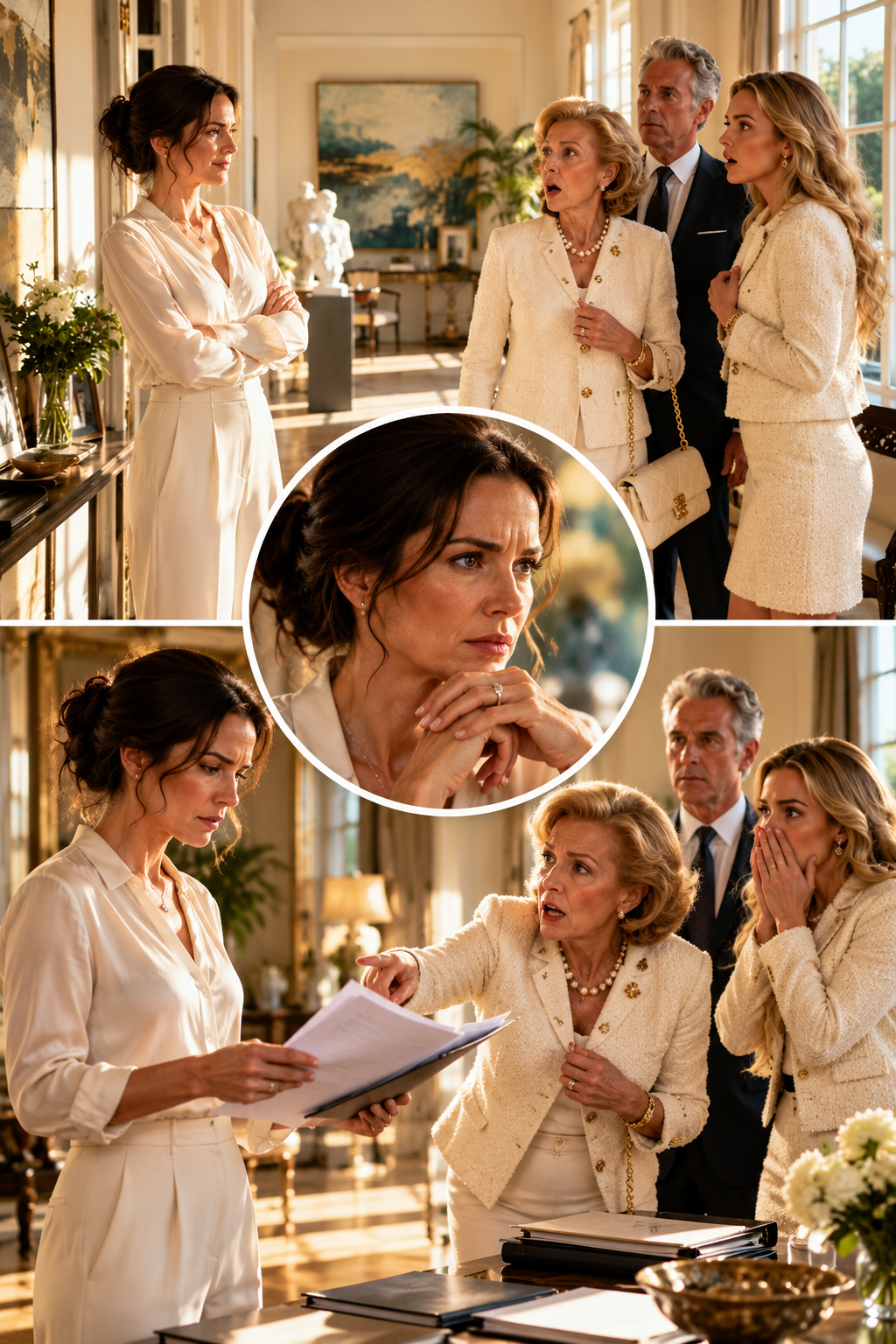
Diane made a small, unconvinced sound and lowered her cup to the saucer. “I only mean after everything—the adjustment.” Mara kept her expression calm. “I’ve adjusted well, thank you for your concern.” Neil shifted on the sofa, uncomfortable with direct answers. In their marriage, he had always preferred conversations that circled the truth without landing on it.
Mara had spent eleven years learning to speak that way. She had learned how to soften a disagreement before it could disturb a dinner, how to let Diane’s opinions pass without challenging them, and how to pretend that Neil’s silences were simply a different kind of conversation. She had spent two years after the divorce learning another skill: she could say what she meant without asking anyone’s permission to mean it.
“We’re actually here because I wanted you to hear this from us,” Neil said. He looked at his hands rather than at her. Cassidy sat beside him with her chin lifted, ready to receive whatever reaction Mara might offer. “Cassidy and I are engaged,” he said. The words seemed to settle over the room and wait for Mara to collapse beneath them.
She looked at Neil, then at Cassidy. There was a time when an announcement like that might have reopened every old hurt. There was a time when she would have wondered what Cassidy had that she did not, or whether Neil had found in her the version of himself he had always wanted. That time had passed, though not without leaving scars. “Congratulations,” Mara said. “I hope you’re happy.”
Neil seemed to search her face for an emotion he could identify. “I wanted you to hear it in person,” he said, as though the information required special handling. “I appreciate that.” Cassidy tilted her head. “Neil says you used to be an art teacher,” she said. Mara nodded. “I was. I’m not anymore.”
“What do you do now?” Cassidy asked. Mara lifted her tea. “A few things.” She did not explain, and the pause that followed was long enough for Cassidy’s smile to tighten. The woman had arrived with a picture of Mara in mind, and she was beginning to realize that the picture might be incomplete.
Diane had expected a woman trapped in the shape of the marriage she had lost. Perhaps she imagined Mara surrounded by boxes, old photographs, and furniture that still belonged to Neil. Perhaps she thought the house would be too quiet, the rooms too small, and the life inside them too plainly diminished. The visit had been designed to confirm that Neil had moved on and Mara had not.
But Mara had no interest in performing grief for an audience. The end of her marriage had been painful, and she would never pretend otherwise. Yet she did not owe anyone a demonstration of that pain. She had already spent enough years making herself understandable to people who had not been listening.
Diane turned her attention to the bookshelves. “These are all yours?” “They are.” Diane’s expression suggested that owning many books while living alone might be a questionable habit. Mara had once taken such looks personally. Now she saw them for what they were: someone else’s discomfort dressed up as concern.
Cassidy glanced down the hallway. “Do you mind if I use your bathroom?” “Last door on the left,” Mara said. As Cassidy disappeared from view, the living room settled into an uneasy silence. For the first time that morning, Mara was alone with Neil and Diane, two people who knew her history but had never been curious enough to understand who she had become.
“She’s very young,” Diane said after a moment. Mara looked at her. “She seems lovely.” Neil stared at the floor, where a narrow strip of sunlight crossed the rug. Diane placed her cup down with a decisive click. “I always thought of you as family.”
“You said that,” Mara replied. It was true that Diane had said it many times. It was also true that being called family had never stopped Diane from measuring Mara against a standard no one had asked her to meet.
Part 3: A quiet hallway led Cassidy into another version of Mara
“This hasn’t been easy for any of us,” Diane said. Mara heard the words for what they were: an attempt to put her back inside an old arrangement where everyone’s feelings mattered equally, even when her own had been ignored. “I imagine it hasn’t,” she replied. “But life goes on.” Diane straightened her back and arranged her hands in her lap.
“That’s all any of us can do,” she said. “Move forward.” Mara nodded. “I agree completely.” The answer left no opening for Diane to guide her toward regret, loneliness, or gratitude for being included in the announcement. The past was there, but Mara was not living inside it anymore.
Neil finally looked up. His face held something harder to name than guilt. It might have been confusion, or the uncomfortable surprise of someone who discovers that a story he has repeated for years no longer fits the person in front of him. He had expected Mara to seem smaller. He had expected the visit to make his new life look bright by comparison.
Cassidy returned from the hallway with the same polished posture, but something in her expression had shifted. She paused for a fraction of a second before crossing the room. Mara noticed. Cassidy had gone looking for a bathroom and found something else entirely. The hall ended at the door to Mara’s studio, which she always left open.
The room had once been the small, north-facing second bedroom. Mara had recognized the light immediately: steady and cool, without the harsh glare that flattened colors. After the divorce, she removed the bed, cleared out the closet, and built a long worktable beneath the window. Shelves climbed three walls, holding jars of ink, paper, tools, and the careful order of a life assembled one project at a time.
Her Vandercook press stood near the worktable. She had saved for it, then found it secondhand at a print shop in Vermont that was closing. The type drawers were organized by face and size. Drying racks hung overhead, filled with prints at different stages of completion. The work was not glamorous, and it was not easy. It required patience, pressure, precision, and the willingness to start again when a sheet came out wrong.
Most of the prints in the room were part of a series she had been making for months. Six weeks later, they would be shown at Aldrich Street Gallery, where the owner, Petra, had invited Mara after seeing her work through a collector in New York. Petra had sent an actual handwritten letter on cream-colored paper. Mara had read it twice, then placed it beside the press and returned to work.
The exhibition would be her fourth solo show. She had told very few people from her former life. Not because she wanted to hide it, but because she had learned to build things before inviting anyone to judge them. Her work belonged to her first. She did not need Neil’s approval to make it real.
Cassidy sat down beside Neil. Her eyes moved from Mara’s face to the open hallway. “What’s in the back room?” she asked. “My studio,” Mara said. “I’m a printmaker.” Cassidy’s attention sharpened. “I saw the prints hanging. They were remarkable.”
“Thank you.” Neil turned toward Mara. “I didn’t know you were a printmaker.” Mara met his eyes. “You didn’t ask.” She said it without anger. The truth did not need to be made louder to become clear.
Part 4: Her work changed the meaning of every room they dismissed
Neil opened his mouth, then closed it. He had once described Mara to friends as the art teacher, as though a job she had left years ago were the whole of her. The description had traveled farther than he knew. It had become the easy version of her: a pleasant woman with a hobby, still living in the shadow of a marriage that had ended.
“Are you selling the prints?” Cassidy asked. “I have been.” Mara could see Cassidy recalculating, not because selling art was impossible, but because Aldrich Street Gallery meant something in the world Cassidy inhabited. It was not a café wall or an occasional craft fair. The gallery showed established artists and drew collectors, critics, and designers.
“I have a show there in November,” Mara said. “At Aldrich Street?” Cassidy asked. The question came carefully, and the room changed around it. “That’s a respected gallery.” “I’m lucky to be there,” Mara replied. “I’ve worked hard for it.” She looked at Diane as she spoke, but Diane was staring at the framed print above the fireplace.
It was one of Mara’s earliest pieces, made during the first year after her divorce. Rust and gray crossed the paper in layered lines. She had run the sheet through the press three times to get the depth of color right. At first, she had not meant to hang it. Eventually she found she wanted to see it every day.
“Did you make that?” Diane asked. “I did.” Diane looked at the print for a long moment. Mara could almost see her rearranging the room in her mind. The books, the mixed paint, the repaired furniture, and the studio no longer seemed like evidence of what Mara lacked. They began to look like choices she had made with care.
“We should probably get going,” Neil said. He spoke to his hands. Mara stood with them. Cassidy picked up her bag, and Diane gathered herself back into the formality she wore as easily as a coat. Neil lingered by the door, looking like a man whose rehearsed conversation had wandered off the path.
“I hope you’re—” he began. “I’m well,” Mara said. This time she meant it without qualification. Neil nodded, though his face suggested there was more he might have wanted to say. The moment passed, and he followed Cassidy and his mother out onto the porch.
Mara watched them descend the front walk. Diane said something to Cassidy in a low voice, and Cassidy nodded, her gaze briefly returning to the house. Neil opened the car door for his mother, then for his fiancée. The car pulled away from the curb and disappeared around the corner.
Mara stayed on the porch for a few minutes. Her fig tree stood heavy with fruit, and the morning light moved quietly across the grass. Somewhere down the block, a dog barked at something invisible. The air smelled of fallen leaves and the first cold days waiting just beyond the warm afternoon.
She went back inside and washed the cups. She put away the tea tin and the strainer, then stood at the kitchen sink and looked out at the garden. The visit had lasted less than an hour, but the feelings it stirred seemed to have reached back through years.
She thought of Cassidy’s face when she returned from the hallway. The small pause. The adjustment. The look of someone who had arrived to confirm a story and discovered another one waiting. Mara understood the feeling because she had once carried a version of herself that someone else had handed her and called accurate.
Part 5: The life she built did not need their permission
For years, Mara had accepted that borrowed version. She had allowed Neil’s opinions to shape what she believed was practical, and Diane’s judgments to make her question what she enjoyed. She had become skilled at anticipating disappointment before anyone expressed it. By the end of her marriage, she was exhausted from managing a life that was supposed to be shared.
When the divorce came, she thought the hardest part would be losing the house. The colonial in Whitaker had four bedrooms, a finished basement, a broad lawn, and a neighborhood association Neil had always meant to attend. For six years, they had called it home. Yet Mara had increasingly felt like a guest in a place decorated without her input.
The settlement gave her enough to buy the smaller house and start again. It did not give her a map. She had to decide what mattered, which pieces of her old life to keep, and which habits she had mistaken for love. Some days she moved with confidence. Other days she sat at the kitchen table, staring at a bill, and wondered if freedom was supposed to feel so much like fear.
The answer arrived slowly, in ordinary decisions. She painted the living room dusty green because she wanted that color. She bought the Chesterfield because it was comfortable, then repaired the upholstery herself. She kept the books she loved, even when the shelves looked crowded. She planted the fig tree before she knew whether it would survive.
She returned to printmaking with the seriousness she had once reserved for other people’s expectations. At first, she worked late at night after teaching. Later, she cut back her hours and took small commissions. The press was a risk. The studio shelves cost more than she wanted to spend. But every sheet that emerged clean and vivid reminded her that she could make something lasting.
She had not set out to prove Neil wrong. She had not built a career to punish Diane or impress Cassidy. That distinction mattered. A life built as a rebuttal still belonged to the person being answered. Mara wanted something else: work that gave her pleasure, a home that felt like hers, and enough quiet to hear her own thoughts.
She walked down the hallway, past the hooks, the books, and the basket of shoes. In the studio, morning light filled the room. Fifteen prints hung from the drying racks, shifting slightly whenever the vent breathed. Mara tied on her apron, opened the jar of ink, and dipped her hand into the familiar work.
The ink was a deep, particular blue, like the ocean under an overcast sky. It was the color of looking at something vast without feeling afraid. Mara rolled the ink across the plate, listening to the soft, steady sound. For a while, the only urgency in the room was the work itself.
She laid a sheet of paper carefully against the plate. The press demanded attention, but it also offered a kind of peace. She turned the wheel, felt the pressure travel through the machine, and watched the paper pass beneath the cylinder. When she lifted the sheet, a line of blue appeared, crisp and strong.
The morning had begun in that room, in that light, with those hands. It would continue the same way now. Mara did not have something to prove. She had something to make, and the making was the point.
Part 6: The exhibition put her name in front of the world
In the weeks before the show, Mara worked until her shoulders ached and the ink stained the creases of her fingers. Petra visited the studio twice to discuss the exhibition. She asked about the series, the order of the prints, and the story Mara wanted the room to tell. Mara answered carefully, then changed her mind about the arrangement three days later.
The series was called “What Remains.” It began with images of doorways, windows, and empty chairs, but it did not stay with absence. Over time, the shapes opened. A line that first looked like a crack became a branch. A dark block of color became the shadow beneath a tree. The prints did not pretend that loss was gentle. They showed what could grow around it.
On the opening night, Mara wore a simple black dress and the silver earrings her sister had given her years earlier. Her hands were still faintly marked with blue ink, despite scrubbing them twice. Petra had hung the prints in a sequence that moved from darkness toward a wide, spare field of color. Mara stood by the entrance, nervous enough to forget what she had planned to say.
People arrived in clusters. A couple from New York studied one of the larger pieces for nearly ten minutes. A local critic asked Mara about the layered lines. A woman who had collected her smaller prints told her the work made her feel understood. Mara listened, answered, and tried not to let praise become something she needed in order to believe the work mattered.
Near the back of the gallery, she spotted Neil. He had come alone. He wore a dark suit, and for a moment he looked as if he had wandered into the wrong event. Mara felt an old reflex rise in her: the urge to make him comfortable, to offer context, to explain why he should be there. She let the reflex pass.
Neil approached one of the prints but did not touch it. “I didn’t know this was happening,” he said when she joined him. “I invited the people I wanted here,” Mara replied. There was no accusation in her voice. It was simply how the invitation list had been made.
“I read about the show,” he said. “Petra’s newsletter.” He looked at the art rather than at her. “It’s good.” Mara waited, then nodded. “Thank you.” The compliment was small and late, but she did not need to decide what it meant for him. She returned to speaking with a collector who had asked about the blue in one of the prints.
Neil stayed for twenty minutes. He did not introduce himself to Petra, and he did not ask for a private conversation. When he left, Mara watched him go only long enough to register the closing door. Then she turned back toward the room, where a couple was discussing the print of the open window.
By the end of the night, several pieces had sold. Petra told Mara the show was already a success. Mara felt relief first, then happiness, then an unexpected sadness for the woman she had been when she thought approval from Neil would make her life complete. She did not confuse that sadness with regret.
Part 7: An old marriage could not reclaim what she had reclaimed
The months after the exhibition brought new commissions, a feature in a regional arts magazine, and invitations to teach a weekend workshop. Mara accepted some and declined others. She learned that success did not always arrive as a dramatic breakthrough. Sometimes it looked like a calendar with enough work to keep the studio busy and enough empty space to remain curious.
Neil’s wedding took place in late spring. Mara learned about it through a mutual friend, not through a formal invitation. She was not offended. The wedding belonged to Neil and Cassidy, and Mara had no desire to be a witness to their new beginning. She sent no gift and wrote no note. She spent that Saturday teaching a class at the community arts center.
After class, a young student stayed behind to ask how Mara had learned to trust her own ideas. The question caught her off guard. She thought of the small house, the first print that came out wrong, the quiet evenings when she had stayed at the press anyway. “I kept practicing,” she said. “Eventually, I could hear my own judgment again.”
Over the next year, she expanded the studio into the small storage room beside it. She installed better lighting and bought a second-hand drying rack. The house was still modest. The windows were still drafty in winter, and one kitchen cabinet refused to close properly. But it had become the kind of place that welcomed work, friends, and the occasional mess.
She found new companionship in unexpected places. Her sister visited more often. Petra became a friend as well as a gallery owner. A neighbor began bringing over apples from her tree, and Mara traded her small prints for jars of homemade jam. None of these relationships demanded that Mara shrink to make someone else comfortable.
Two years after the morning visit, Diane sent a short letter. It was handwritten, formal, and addressed to Mara at the same house she had once called cozy. She wrote that she had seen one of Mara’s prints in the magazine and wanted to say she was proud of her. The last line read, “I hope you are well.”
Mara read the letter twice. It would have been easy to treat it as an apology. It would have been equally easy to dismiss it as a late attempt to regain a place in Mara’s life. She chose neither interpretation. She saw a woman trying to say something better than she had said before, without knowing how to say it.
Mara wrote back, “Thank you for the kind words. I am well, and I hope you are, too.” She did not offer more than she felt. She did not punish Diane for failing to become someone different, either. The letter went into a drawer, not on display, and life moved on.
Neil never wrote. Mara heard that he and Cassidy had moved to a larger condo. She heard that Cassidy’s design business was doing well. She was glad for them in the uncomplicated way one can be glad for people who no longer hold the keys to one’s happiness.
Part 8: The house became a home, and the past became a story
By the time Mara’s fifth solo exhibition opened, the fig tree had grown taller than the garden fence. Every October it dropped fruit onto the grass, and every autumn Mara gathered what she could before the birds found it. The tree had become a marker of time, not because it remembered her marriage, but because it had grown beside the life she made afterward.
The new exhibition was called “Open Ground.” It included prints of rooftops, long roads, and gardens seen from above. The images were still honest about uncertainty, but they no longer centered on what had been taken away. They explored possibility: the path around a wall, the light beyond a doorway, the small green shapes that appeared in soil no one had planted.
On opening night, Mara stood near the front window as guests entered the gallery. She was calmer than she had been the first time. People recognized her name now, and some had come from outside the state. A woman in a red scarf told Mara she had bought one of the earlier prints during a difficult year and kept it beside her bed. Mara thanked her, moved by the thought that the work had traveled somewhere she could not follow.
Near the end of the evening, Cassidy came in alone. She was still polished, but the expression she wore that October morning had softened. Mara recognized her immediately. Cassidy stopped several feet away, looking at a print of a narrow path cutting through dark trees.
“I wanted to tell you I saw your work in the magazine,” Cassidy said. “It’s extraordinary.” Mara looked at the print, then at her. “Thank you.” Cassidy seemed to wait for a question about Neil, the wedding, or the life they had built. Mara did not ask. The silence was not hostile. It simply belonged to the present.
“I’m sorry about the way I acted when we met,” Cassidy said at last. “I thought I knew what your life was.” Mara studied her face. “We all make assumptions,” she said. “The important part is what we do after we learn more.” Cassidy nodded, taking the answer without asking Mara to make it easier.
Before leaving, Cassidy asked whether the print was for sale. Mara told her it was. Cassidy bought it, then carried the wrapped piece carefully beneath her arm. Mara watched her step out into the evening, but she did not follow her with her thoughts.
When the gallery closed, Petra helped stack the chairs. Mara walked home beneath trees shedding their leaves, the cold air clean against her cheeks. The town seemed familiar and new at once. She thought of the morning Diane and Neil had arrived to announce an engagement, expecting perhaps to find an empty house and a woman waiting to be measured.
They had found a woman who was still becoming herself. She had not needed to defeat them, embarrass them, or make them regret their assumptions. She had only needed to keep living, one quiet morning and one difficult piece of work at a time. The life she built afterward had not erased the marriage. It had simply made the marriage one chapter among many.
At home, Mara set her keys on the table and walked to the studio. A fresh sheet waited beside the press. She mixed a blue that was a little darker than the last one, then rolled the ink across the plate. Outside, the fig tree moved in the wind, its branches bending without breaking.
Mara placed the paper carefully, lowered the cylinder, and turned the wheel. The press carried the sheet forward with a steady, familiar rhythm. When she lifted the paper, an open shape emerged from the blue: not a door, exactly, but a way through. She pinned it to the drying rack and watched it catch the light.
The story of her marriage had ended. The story of her life had not.
✓ Lynn R. Adams
Part 2: Their announcement revealed what they expected Mara to feel Diane made a small, unconvinced sound and lowered her cup to the saucer. “I only mean after everything—the adjustment.” Mara kept h…