For eight years, Ray Hollister believed the checks from Cypress Bluff Estates were helping keep
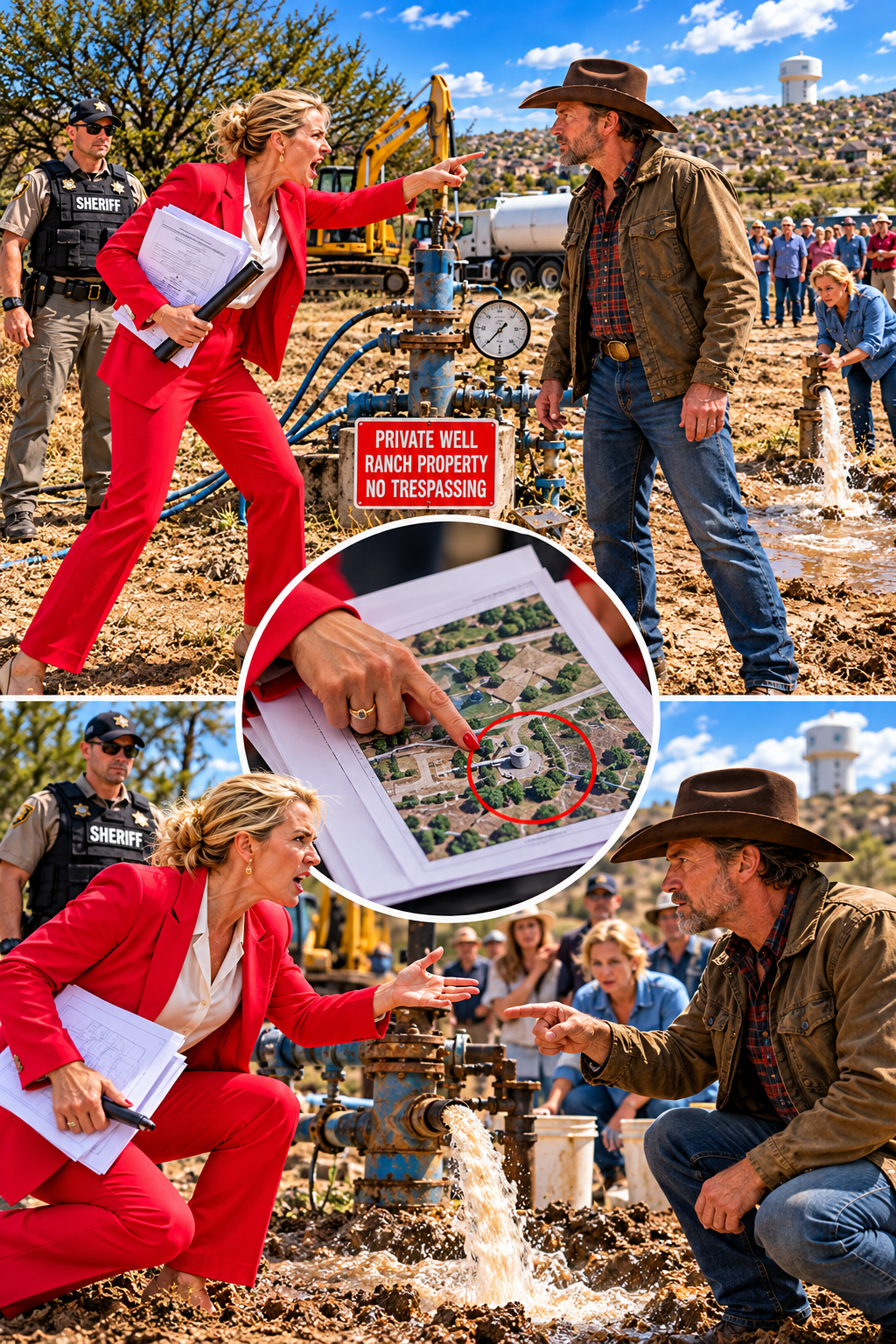
Part 2: The contract’s hidden amendment turns my own brother into evidence
Before dawn, I spread three years of quarterly statements across the workbench. The reported water use barely changed from season to season. That made no sense. People watered lawns in summer, filled pools in spring, and used less in winter. Even my own ranch’s water use rose and fell with the weather.
I wasn’t an engineer, but I had watched water all my life. The statements looked less like meter readings and more like numbers somebody had typed into a form. I checked my father’s well logbook, too. He had measured the water level every month for decades, lowering a steel tape into the sounding tube and writing down the wet line.
The well had drifted slowly for years: 176 feet in 2007, 181 in 2020, 191 the previous March. Then I found my April entry from three weeks before Denise cut the lock.
Two hundred and seventeen feet.
I stared at my handwriting. I had written the number myself and carried it home without understanding what it meant. By then, the water had dropped twenty-six feet in just over a year.
The next morning, I sent Lonear Community Management a certified letter. I asked for the raw meter data, any document assigning the contract, and the location of the subdivision’s backup well. Nineteen days later, they invited me to address the board.
At the amenity center, Denise put me at the end of the agenda. I had three minutes. I explained that the agreement was capped at twelve million gallons a year and sixty gallons a minute, and that it had been written for sixty homes. I asked to see the meter data and learn where the backup source was.
Someone in the third row said, “We have a backup well.”
“Then I’d like to know where it is,” I said.
Denise asked an employee to display the second exhibit. On the projector appeared an amendment dated August 2021. It extended the agreement through 2036, raised the annual limit to thirty million gallons, and erased the sixty-gallon-per-minute limit.
At the bottom, beside the name of our company, Hollister Land and Cattle LLC, was a signature.
“That’s not my signature,” I said.
“No,” Denise replied. “It’s your brother’s.”
I couldn’t tell you whether I sat down or fell into the folding chair. What I remember is the room going quiet and my face growing hot. Denise told the neighbors that my family had sold the water rights twice. Someone laughed.
After the meeting, a father holding a small child asked me whether their water was safe. I didn’t know. I told him that was why I had come. He looked back at the building and said he wanted to see the numbers, too.
That night I called my brother Curtis in Amarillo. “Did you sign a water amendment in 2021?”
He went quiet long enough for the television on his end to stop.
He told me a Cedar Gap representative had brought him paperwork and called it a renewal. He said he thought I knew. He had been living far from the ranch, dealing with a divorce, and the company had paid him thirty thousand dollars. “It was a piece of paper about a well,” he said. “I should have called you.”
Curtis was a member of the ranch company. His signature could give Cedar Gap an argument that it had relied on his authority in good faith. I didn’t yet know that our company’s operating agreement had a clause restricting what either member could sign alone.
What I knew was that the subdivision had an amendment, Denise had shown it to forty neighbors, and my brother had taken money to sign it.
Part 3: A new pipeline and an open gate make the dispute dangerous
Nine days after the meeting, I heard a track hoe start up near my east fence. A trench stretched for about ninety feet, with six-inch PVC pipe laid beside it. The old transmission line was still there, capped and abandoned. They were putting in another, larger one.
A concrete pad with rebar was taking shape nearby. It wasn’t for a pipe. It was for a booster station.
Denise sat in a folding camp chair at the end of the easement corridor, drinking coffee and studying the plat on her lap. I showed the foreman, Reuben, the recorded easement on my phone. It described one water transmission line.
He read the whole paragraph, then said he had a signed work order. If I wanted the work stopped, I needed to get someone who could pay his crew to stand around. It was the most honest answer I got that morning.
Denise told me the association’s engineer had approved everything. She also told me to have my lawyer contact hers. I didn’t have one yet. I called the management company instead, then called the county to ask about permits. Neither call solved anything.
On Wednesday, the crew cut four strands of my perimeter fence and installed a construction gate so trucks could enter directly from the road. When they left Thursday evening, the gate stood open.
At 11:40 that night, Dana woke me with her phone in her hand. A neighbor had spotted cattle on Farm to Market Road 165.
Twenty-two mother cows and their calves had gotten out. I worked the road with a flashlight and a bucket while Dana followed in the truck with the flashers on. Bobby Kessinger came to help with his son and a horse trailer. We got most of the cattle back, but one heifer didn’t make it home.
Bobby’s nineteen-year-old son hit her in his Silverado on his way home from work. He walked away with a cut lip and a bruise from the seat belt. The truck was totaled. I had to put the injured heifer down beside the fence while a deputy finished his report.
In Blanco County, cattle owners were responsible for their fences. The fact that a contractor had cut mine didn’t erase my liability. My insurance paid the young man for his truck, but I owed a $4,800 deductible and my premium went up.
A trail camera on the fence had captured three photographs: the crew leaving, the open gate, and the same gap hours later. I sent the pictures to the management company and asked them to close and secure the gate.
The following Tuesday, a glossy flyer arrived in Cypress Bluff mailboxes. It showed a child drinking from a garden hose and declared, “One rancher wants to shut off 300 homes.” My name appeared beside a claim that I was forcing the association to choose between my cows and its children.
There was no mention of the contract limit or the missing backup well.
I made the mistake of joining the neighborhood’s Facebook group and posting a long explanation. By morning, people were calling me a water squatter. Someone posted a picture of my home. Dana told me to take it down, and she was right.
Then a certified letter arrived warning me not to enter the association’s infrastructure or easement corridor. An off-duty deputy began sitting near the wellhouse on weekends. I drove to the sheriff’s office, expecting the uniform to mean what it usually meant.
A sergeant explained that the deputy was working a private security job and had no special authority over me on my own land. The county wouldn’t referee a contract dispute. A judge would have to.
So I stopped trying to win arguments in meeting rooms and online. I began measuring the well every morning, photographing the tape with the reading visible. I recorded each water truck that filled at the subdivision’s construction standpipe.
I didn’t know what I would do with the evidence. I only knew I wanted a record that didn’t depend on anyone believing me.
Part 4: A falling water table threatens cattle, family, and home
The records came at a cost. Doyle Prather, who had bought hay from me for nine years, called to say he was going elsewhere. His wife served on the neighborhood’s landscaping committee. Between Doyle and another customer, I lost about nine thousand dollars of summer income.
Then my sixteen-year-old daughter, Ellie, got into the truck after school and didn’t say anything for a mile. Someone had written “Cow Water” on her locker.
I told her it was stupid. She looked out the window and said, “Yeah.” Then we drove home with the radio on.
June was dry, and July was worse. Phase Three construction spread across a hundred lots. Scrapers ran all day, and water trucks kept the dust down. On July 19, my steel tape came back wet at 239 feet—sixty-one feet lower than it had been in March.
At home, Dana held a glass of water to the window. A gray haze hung in it, and fine grit settled at the bottom. When I ran my thumb over the bathroom faucet, I felt sand skip across my nail.
The west pasture trough was next. It sat at the end of a mile and a half of pipe, serving twenty-two cow-calf pairs. At noon, under a hundred-degree sun, I found only a few inches of hot water left in it. For two days, I hauled water from the barn in a five-hundred-gallon tank, making long trips along an old stock trail.
I lost a heifer to the heat.
On Monday, I called Dwayne Ruiz, who had serviced the well since 1998. He came out, took his own measurements, and watched the water level fall while the pump ran. The water was coming within about nine feet of the pump intake.
“That’s not a pressure problem,” he said. “The intake’s breathing air. It’s pulling sand from the formation.”
He recommended a camera inspection. We watched the image on his laptop as it descended through the casing. The casing looked sound until the picture turned cloudy. At the intake, sand covered much of the screen.
“If they keep running it like this, you could lose the well,” Dwayne said.
His report recorded the measurements and what he saw. It wasn’t written for a lawsuit. It was written by a licensed well driller doing a job in July.
Before he left, Dwayne mentioned that the subdivision had its own backup well. Its screen had collapsed, and he had bid on repairs. The board had voted to postpone the work in 2023.
The contract required a redundant source. The neighborhood had known its well was damaged and had chosen not to repair it.
A few days later, I enlarged one of my photographs of the subdivision’s meter. Its serial number didn’t match the number on the original construction drawings. The meter had been replaced in 2021—the same year as the amendment—and no one had told me.
I called Priya Ragavan, an attorney in San Marcos. She told me the amendment was central to the whole case. If it was valid, I was a man unhappy with a deal. If it wasn’t, the association might have been taking water beyond the original agreement.
She also told me not to touch the valve again and not to go up the hill. The contract gave the association sixty days to cure a breach after notice. Priya sent a formal demand requiring the association to reduce production, restore its backup source, and provide the raw meter data.
Then she said, “Now we wait. And you document.”
Part 5: Bypassed safety switches turn a strained well into a disaster
Waiting didn’t mean doing nothing. I sounded the well every morning and recorded the level. I kept photographing water trucks. I hauled water to the cattle whenever the troughs ran low.
My insurance company covered damage to the house’s softener and plumbing, but denied the claim for the well under a wear-and-tear exclusion. I read the denial several times before I could accept that the decision was probably correct under my policy.
A county hearing on the final plat for Phase Three was scheduled for September. The association needed a clean record showing dependable water. The well was already struggling.
On August 14, I saw a Kesler Pump and Controls truck drive up my two-track. I photographed it from a distance and wrote down the time. Then I went back to baling hay.
I didn’t learn what happened that day until more than a year later, in a deposition. A technician named Miguel Ochoa testified that the pump had been shutting itself off. A low-level cutout and an underload trip were protecting the motor when the water dropped near the intake.
Denise had emailed the dispatcher two days earlier: “Something keeps shutting the pump down. Turn off whatever’s causing it. We can’t have gaps in the flow data before the 14th. Bill it to the association.”
Ochoa told her the switches were stopping the pump from running dry. To keep the flow uninterrupted, he would have to bypass the float and disable the underload trip. He said he did not recommend it.
“Do it,” she told him.
He wrote what happened on the work order: “Bypassed low-level float and disabled underload trip per owner rep instruction. Advised against increased max frequency per same.” Denise signed the form.
I knew none of that in August. What I knew was that the pump stopped cycling. I had listened to it for years. Usually it ran, satisfied the system, shut off, then started again. In the third week of August, it ran continuously for eleven days.
I wrote that down, too. “Pump running continuous. No cycle heard.” A few days later, I added a question mark beside the water-level reading.
On September 1, the water dropped to the intake. There was no dramatic bang, no warning siren. The pump swallowed air, pulled sand, overheated, and burned out in the dark beneath my pasture.
Dana woke me at in the morning. There was no water in the house. The pressure gauge in the barn read zero.
The subdivision’s tanks were nearly empty, too. Without the well, three hundred homes lost water. That morning, a spark from a mower started a grass fire in the greenbelt between two cul-de-sacs. Firefighters reached the nearest hydrant and found no pressure. They tried another and got nothing there, either.
A rural water tender, a homeowner’s pool, and a long shuttle from town helped stop the fire before it reached the houses. No one was hurt. The fire chief, Alvin Sepeda, told me the wind could have carried the flames toward the homes.
The association arranged hauled water. Families waited in line with five-gallon jugs for six days. My own house was dry, and Ellie carried water to her heifers. Dana showered at her sister’s place before work. I hauled water to eleven troughs, up to twelve hundred gallons a day, for eleven weeks.
I had closed the valve once in April and reopened it two days later, after my lawyer told me to. I never touched it again. The pump had run with its safety devices bypassed, on a signed work order, until it failed.
Part 6: A burned pump and a brother’s confession reshape the case
Dwayne’s crane truck came through the cattle guard on September 5. Pulling a pump from a 340-foot well took two days. He and his crew laid each length of pipe across the grass in order, until the pasture looked like it had grown a spine of galvanized steel.
The motor came up last. Its blue paint had turned dark brown and black. Dwayne pulled the intake screen free, turned it over, and about a cup and a half of fine gray sand spilled onto the truck’s steel bed.
The impellers were worn nearly smooth. Before we talked about repairs, I asked Dwayne to preserve the motor and the sand, label them with the date, and keep them at his shop. Then we photographed and removed the meter. Its serial number didn’t match the original drawings. A date stamped on the register plate showed it had been made in 2021.
The association’s lawyers responded with a demand of their own. They claimed my April valve closure had caused a pressure event that damaged the pump and demanded seventy thousand dollars for hauling water and system repairs. Denise told residents that the outage came from an ongoing dispute with a landowner.
She didn’t say that a technician had disabled the well’s safety switches.
Priya sent litigation-hold notices to the association, its management company, the pump contractor, and Cedar Gap. We hired a hydrogeologist, Dr. Ellen Straoud, to test a nearby well and compare its data with my father’s old measurements. We got the association’s meeting minutes, which showed that Denise had moved to postpone repairs to the backup well.
I borrowed sixty thousand dollars against the calf crop to cover legal fees, temporary water, feed, and expert work. I wrote the reasons down for the bank, line by line. I still have that list.
In the meantime, the cattle came off the pasture forty pounds light on average. I didn’t bale hay in September or October. The water hauling, missed work, and lost income kept stacking up.
Then Curtis drove down from Amarillo without calling first. He stood in the yard with his hands in his pockets. I didn’t hug him. I asked him to sit at the kitchen table with Dana and tell us what he had done.
He brought the folder from 2021. There was a copy of the amendment, a photograph of the thirty-thousand-dollar check, the Cedar Gap representative’s business card, and an email sent three days before he signed. The email called the change “a formality to keep the payments coming” and said nothing would change on the ranch side.
Priya read it twice. “That’s the one,” she said.
Curtis asked whether I wanted him to testify. I told him yes. I also told him he would have to sit in a courtroom and admit he had taken the money. He said he understood.
We filed in district court in November, claiming breach of contract, trespass, negligence, and seeking a ruling that the amendment could not bind our company. The association answered with a strong case of its own. It argued that Curtis had authority as a company member and that I had accepted checks for years, thereby ratifying the amendment.
For months, I worried they might be right. The argument made sense on paper: Curtis had signed, and money had come to our company. But the checks were still calculated under the original agreement’s limits and rates.
The association had never paid under the amendment’s terms. I kept turning that over in my mind as we prepared for trial.
Part 7: At trial, old records and new testimony expose the truth
The association’s lawyers filed a counterclaim and asked for their costs. They argued that the outage had damaged their system and that the neighborhood depended on my well. For a while, it felt possible that I could lose the amendment fight and still owe them money.
Mediation took place in Austin. The association offered $185,000. Priya told me it was a serious number: it covered the well, hauling, lost cattle and hay, and much of the legal bill. If we lost the authority fight, she warned, we might recover nothing.
I said to take it. But the association’s lawyer came back forty minutes later and said the board wouldn’t authorize the settlement. Later, I heard that Denise had argued against paying me. Her explanation was blunt: “I’m not paying a man for water that sits under a subdivision.”
The association later imposed a special assessment of $1,650 per lot to fund a new water source. At the annual meeting, Barb—the woman in the cardigan who had asked about the backup well years earlier—stood up and asked Denise why the board hadn’t repaired its own well in 2023.
A recall vote followed. Denise lost her chair but remained an ordinary board member. She attended the remaining depositions, sitting in the back with a legal pad.
Trial began in February at the Blanco County Courthouse. It was a three-day bench trial, without a jury. The first day centered on the 2021 amendment and our company’s operating agreement. That agreement required both members to approve major changes affecting ranch property.
The association’s expert said third parties should be able to rely on a company member’s signature. Priya asked whether Cedar Gap had requested the operating agreement before accepting Curtis’s signature. The expert said it had not. She asked whether requesting a member resolution was common practice for a long-term property encumbrance.
He paused. “Yes,” he said.
Then Priya laid out the quarterly statements. The payments matched the old agreement: the same monthly base amount, the same price per thousand gallons, and reported volumes kept beneath the original annual cap. The amendment had increased the limit and changed the rate, but the association had never paid under those terms.
“You can’t ratify a contract you were never paid under,” she said.
On the second day, the meter and well data took the stand. Dr. Straoud compared the co-op’s electrical records with the pump’s output and manufacturer specifications. Her calculations showed that actual water production exceeded the reported total by roughly forty million gallons over three years. Even after the association’s expert challenged her assumptions, the excess remained substantial.
Then Priya asked me to read the well log aloud. My father’s handwriting filled the early pages; mine continued in the same columns. The water level had changed slowly for years, then plunged as the subdivision’s use rose.
Dr. Straoud’s analysis followed the same pattern. The judge asked whether I had used the same tube and tape each time. I said yes. My father had bought the tape in Fredericksburg.
The association’s lawyer pressed me about the valve. I admitted I had closed it, that I was angry, and that I should not have done it. I also told the court that I reopened it two days later. When he asked if I wanted the neighborhood to lose its water, I said no.
“I wanted them to fix their own well,” I said.
On the third day, Ochoa read his work order into the record. The note about bypassing the safety switches and his warning appeared on the screen. Then came Denise’s email asking for uninterrupted data before the plat hearing.
Denise testified that the well was a utility asset serving three hundred families. Priya asked one question: “Whose name is on the deed?”
Denise looked toward her lawyer. He did not look up.
Part 8: The judgment ends the contract and assigns the cost
The judge ruled from the bench. He found the 2021 amendment unenforceable because the association had not confirmed Curtis’s authority to commit the ranch to a long-term change. He rejected the claim that I had ratified the amendment by accepting payments, since the association had continued paying according to the original terms.
The original agreement ended after the sixty-day cure period. The association had produced water outside that agreement from 2021 forward.
The judge awarded $268,400 in damages. The amount covered the new well and the cost of properly plugging the old one, weeks of hauled water, the heifers lost on the road and in the pasture, lost hay income, the pump and diagnostics, and damage to the house’s water system.
He also gave the association a $6,200 offset for the pressure event caused by my April valve closure. I had done it. I had no right to do it, and it had caused damage. I accepted that part of the ruling, even though I wished I hadn’t given them an argument.
The judge denied the association’s counterclaim and awarded attorney’s fees under a clause in the original contract. There was no dramatic speech and no applause. The bailiff told everyone to rise, and then told us to clear the room.
I stood on the courthouse steps and called Dana. “It’s done,” I told her. She said, “Okay.” We both stayed quiet for a while.
No one went to jail. I took the meter evidence to an assistant district attorney, who said she believed me but could not prove which individual had installed the replacement meter or what that person had intended. The groundwater district later assessed a penalty for unpermitted production, and the state issued corrective orders about reserve management and recordkeeping.
Cypress Bluff paid for a repaired backup well and drilled another of its own. Residents covered the work through the assessment. Their homes had a redundant water supply for the first time.
Denise left the board. Cedar Gap pulled the Phase Three listing from her brokerage, and she moved her business to a larger market in New Braunfels. I saw her once at the Blanco co-op, buying tomato fertilizer. We looked at each other, said nothing, and went our separate ways.
Curtis still comes down twice a year. He helped work calves last October, though he was out of shape and got stepped on. What happened between us wasn’t erased. But we have learned how to work in the same pasture again.
The judgment cleared after the appeal deadline passed. I paid the operating note, replaced the well, and hired Dwayne to plug the old one to state standards. The new well cost more than seventy thousand dollars. I chose to do the job properly because my grandfather had drilled the old one, and it deserved better than being forgotten beneath a concrete cap.
Part 9: A new well and a family ritual offer a quieter ending
The ranch is running again. The cattle have water, the troughs stay full, and the new pump cycles the way it should. Doyle Prather called about hay in the spring, and I told him what I had and what it would cost. He bought 180 bales.
Ellie graduated in May and showed a heifer at the county fair in October. She won a red ribbon, which is a polite way of saying she got beat. She was fine with it. She had already been accepted into an animal science program and was thinking about what came next.
The new well stands three hundred yards west of the old one, drilled into a different fracture system. It has one electrical service, one meter, and one locked box on a post I set myself. The isolation valve sits in a concrete vault on my side of the fence. I have the only key.
I welded a short piece of chain onto the lid’s handle. Two links have a bright cut across one end, where bolt cutters went through the chain in April. Dwayne saw it when he set the lid and didn’t ask.
I used to think winning meant getting someone to admit what they had done. I wanted an apology for the cut fence, an explanation for the changed meter, and a room full of neighbors to understand that I had never wanted their children to go without water.
Some of those things never came. The judgment gave me money, not a confession. The district issued penalties, not handcuffs. Denise never apologized, and most of the homeowners who had believed the flyer never came to the ranch to ask what really happened.
But the truth did make it into the court record. The contract mattered. The backup well mattered. The meter mattered. So did my father’s logbook, the photographs I took from the truck, and a technician’s handwriting on a work order.
I learned that boring records can carry more weight than a furious speech. Each morning’s measurement looked insignificant when I wrote it down. Together, those pages showed the well’s decline more clearly than my anger ever could.
That August, Ellie came home before moving into her dorm. At six in the morning, I woke her up and asked if she wanted to help me measure the new well. She came out in a hoodie, still half asleep, and asked, “Every month?”
“Every month,” I said.
I took the cap off the sounding tube and lowered the same steel tape my father had used. Ellie held the flashlight while I listened for the pop and read the wet line. The water stood at 212 feet.
I opened the new logbook. I had copied my father’s columns by hand: date, static level, initials. Then I called out the number, and Ellie wrote it down in her own handwriting beneath mine.
We drove out to the west pasture as the sky turned gray. On the tailgate, we watched the trough’s float valve click shut. Clear water ran into the tank, and the cattle began to gather.
For a while, neither of us spoke. The ranch was quiet except for the cattle, the water settling in the trough, and the distant hum of a pump that had not been asked to do more than it could.
The number went into the book. The water kept flowing. This time, we knew exactly whose responsibility it was.
✓ Lynn R. Adams
Part 2: The contract’s hidden amendment turns my own brother into evidence Before dawn, I spread three years of quarterly statements across the workbench. The reported water use barely changed from s…