“Five days after I bought my first townhouse, my mother demanded that I give my older brother the keys so he and his fiancée could move in. When I refused, she told me to pack my belongings, leave her house, and never come back. I’d spent eighteen months paying my parents’ $2,460 monthly mortgage while saving for that townhouse, and Dad sat silently as she threw me out. Three weeks later, he called in a panic because their mortgage was overdue. But by then, a stranger had appeared at my new front door with a rental agreement bearing my name and a signature I had never written.
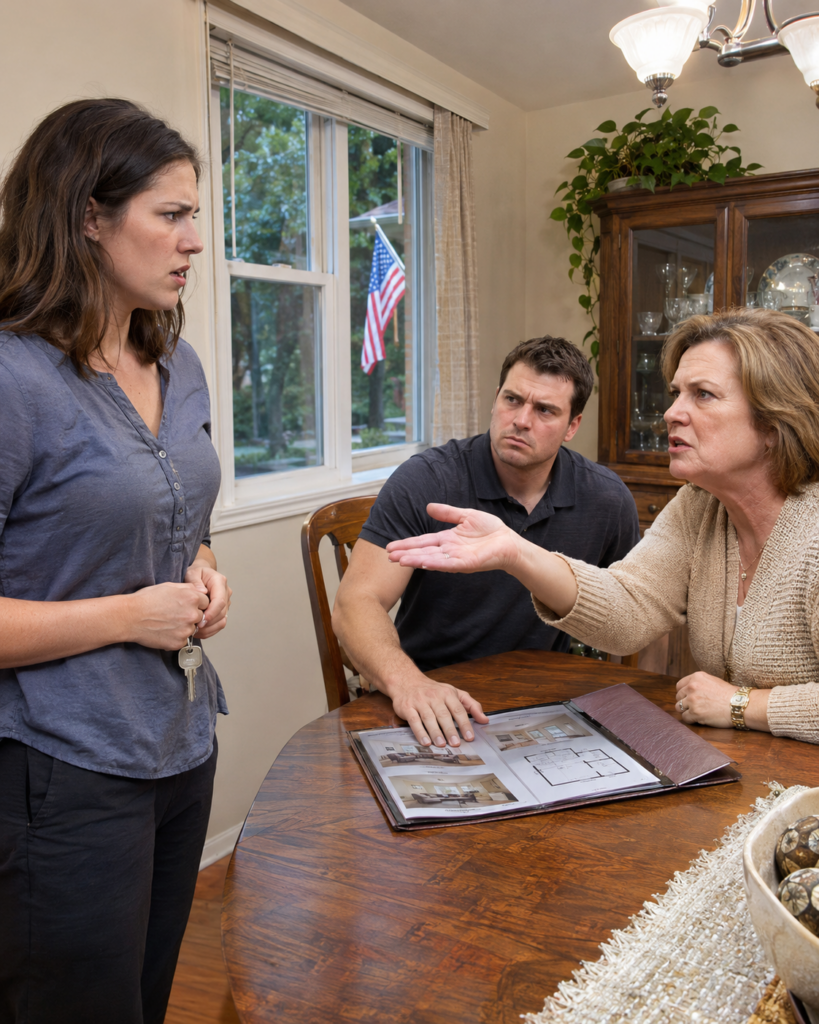
My Mother Threw Me Out. Then My Brother Rented Out the Townhouse I Owned.
The signature at the bottom of the lease looked enough like mine to make my stomach turn.
My name was printed above it: Rachel Morris, property owner. My older brother, Eric, was listed as the authorized property manager. On the last page, a woman I’d never met had agreed to pay $2,600 a month to live in the three-bedroom townhouse where I was standing.
She had already transferred $5,200.
“I don’t understand,” Elena Brooks said. “He told me you approved the rental.”
“I didn’t,” I said. “I’ve never given Eric permission to rent this house. I’ve never given him permission to enter it.”
Elena held the folder against her chest. She was a woman in her late fifties, with silver beginning to show in her dark hair and the kind of careful, practical shoes I’d noticed on my mother for years. She’d arrived at my door on October 15, expecting a quick visit to measure the rooms before moving in. Instead, she’d found the supposed owner carrying boxes into the kitchen and looking at the lease as if it had come from another planet.
“But I signed everything,” she said. “He sent me the agreement. He gave me the payment instructions. I can’t afford to lose that money.”
I pulled out a chair. “Please sit down. Let’s look at exactly what he sent you.”
I wanted to be angry at somebody, but Elena was clearly not the person who deserved it. Her hands were shaking as she opened her folder. She had saved the , the emails, the lease, and confirmation of two transfers totaling $5,200. Eric’s name appeared on the payment instructions. My name appeared on the lease, with a signature I had not written.
The move-in date was November 1. Elena explained that her apartment building had been sold and her lease wouldn’t be renewed. She’d looked at several places, but this townhouse seemed quiet, with a small backyard and a downstairs room she thought would be good for sewing. Eric had answered her questions promptly. He’d said the owner was busy and he handled everything.
“I checked the address,” she said. “I drove by twice. It was a real house.”
“It is a real house,” I answered. “It’s just not his to rent.”
I asked if I could photograph the papers. She agreed, watching me closely, perhaps wondering whether I would try to take them away. I photographed each page and sent the images to myself. The signature was especially unsettling. It had the same sweeping first letter I used and the same long final stroke, but the middle of my surname looked cramped, as though someone had copied it without being comfortable writing it.
I didn’t need to be a handwriting expert to know it wasn’t mine. I had signed exactly one property purchase that year, and this wasn’t part of it.
“Can you call him?” Elena asked.
I called Eric. It went to voicemail. I sent him a photograph of the first page and wrote: “A woman is at my house with a lease you issued in my name. You need to explain this immediately.”
His answer came several minutes later: “Don’t overreact. I was going to talk to you about it.”
I showed Elena the message. She read it without speaking. Then she asked a question that still embarrasses me to remember.
“If he’s your brother, can you make him give my money back?”
I wanted to promise her I could. For most of my adult life, people in my family had assumed I could make financial problems disappear. But I had no control over Eric’s account, and I wasn’t going to lie to another person just to make an unbearable moment easier.
“I can help you document what happened,” I said. “I’ll give you proof that I’m the owner and that I didn’t authorize him. We’ll contact your bank and report this. I can’t promise how quickly you’ll get the money back.”
She pressed her lips together and nodded. I made us coffee, though neither of us drank much. Then we began making the calls.
Three weeks earlier, I had believed the most difficult part of buying my first home would be moving furniture up the stairs. I’d never imagined that the extra bedroom I’d saved for guests would become the center of a family dispute, much less a rental scheme involving a stranger’s savings.
My name is Rachel Morris. I’m thirty, and I’m a financial operations analyst. My work involves tracking payments, reconciling accounts, and finding out why numbers don’t match. I know how to ask for receipts. I know how to read a contract. Apparently, I had been less willing to apply those skills to my own family.
For eighteen months before buying the townhouse, I paid my parents’ entire $2,460 monthly mortgage installment. My father’s working hours had been cut, and Mom told me they needed temporary help until his schedule improved. I was living with them while saving for a place of my own, so I agreed. I also bought groceries, paid for household supplies, and picked up other expenses without keeping a careful total.
The mortgage payments alone came to $44,280. I knew the number because I had checked it twice when I finally decided to leave.
Two months before closing, I told both parents that my financial help would end when I moved. I sent the same information by email, along with the date of the last payment I’d make. Dad said he understood. Mom nodded without looking up from her phone. I took their responses as agreement because I wanted to believe there would be no argument.
The townhouse was modest, with three bedrooms, a narrow kitchen, and a patch of backyard grass that needed attention. I planned to work from one bedroom and keep the other for guests. I pictured Sunday mornings with the kitchen window open, making coffee without somebody calling from upstairs to ask if I’d transferred money yet. I had saved for the down payment by working extra hours and taking fewer vacations than I wanted. The mortgage and closing costs were mine, and so was the quiet satisfaction of having made it happen.
Five days after I bought it, I invited my parents over. I had set out sandwiches and lemonade because I thought Mom would enjoy seeing the place. She walked through the rooms almost without speaking. Then, in the larger spare bedroom, she asked how soon I could have the furniture moved out.
“What furniture?” I asked.
“Your office things. Eric and Tessa will need this room. They can use the other bedroom for storage until they get settled.”
For a moment, I thought she’d misunderstood my plans. Eric was thirty-four, engaged to Tessa, and renting an apartment across town. He had complained about his rent and truck payments for years, but he had a job and a life of his own. I hadn’t offered him a room.
“Mom, no one is moving in here.”
She turned toward me, irritated rather than surprised. “Don’t be selfish, Rachel. You have all this space for one person. Your brother and Tessa need somewhere affordable.”
“Then they need to look for somewhere affordable. This is my house.”
Mom said she’d already promised them they could move in that weekend. She pointed to the rooms as if describing a plan she’d paid for. I explained again that I needed the office for work and wanted the guest room available for people I chose to invite. She said I was choosing an empty bedroom over family. Dad stood in the doorway and said very little.
I had spent eighteen months helping protect their home. I hadn’t expected gratitude every day. I did expect them to understand the difference between asking for help and assigning somebody else’s property.
That evening, I returned to my parents’ house to collect the last of my belongings. Eric sat at the dining table with Mom and Dad. In front of him was a folder containing photographs Mom had taken of my townhouse and a floor plan she’d somehow printed from the listing. Eric was talking about where his furniture would go and whether his moving truck could get around the corner.
“We can put your desk in the little bedroom,” he told me. “Tessa and I just need the larger room.”
“You’re not moving in.”
He looked at Mom. She gave him a reassuring nod, as if I were a child having a tantrum. Then Dad admitted that Mom had been transferring nearly $1,200 a month to Eric from their household account for rent, truck payments, and other expenses. He said it reluctantly, with his eyes on the tabletop. Until that moment, I hadn’t known they were supporting him at all.
The money I’d been sending for their mortgage had allowed them to keep helping my brother while telling me they could barely cover their own bills. When I asked why no one had told me, Mom said Eric’s situation was private. Mine, apparently, had never been.
Eric announced that he’d already told his landlord he would not renew his lease. He had relied on Mom’s promise and needed to be out by the end of October. I said I was sorry he’d made arrangements without speaking to me, but it didn’t change my answer. He called me stubborn. Mom demanded a spare key.
When I refused, she pointed upstairs and said, “Pack your things, leave my house, and don’t come back.”
I waited for Dad to say something. He stared at the floor.
I packed what remained in my old bedroom and drove away. It was not an elegant departure. I cried in my car, went back once because I’d forgotten my work shoes, and felt ashamed that I still wanted Mom to call and say she hadn’t meant it. That night, I canceled the upcoming transfer to my parents’ mortgage lender. The loan was theirs, not mine, and I’d warned them in writing that the help would end when I moved. I saved the cancellation confirmation.
Mom didn’t call to apologize. Instead, she left a message asking whether I’d reconsidered Eric’s move. I didn’t answer. I changed the garage keypad code at my townhouse because Mom had seen me use the old one when I’d given my parents the tour.
A few days later, my doorbell camera recorded Eric and Tessa on the porch. Eric tried the garage keypad. Tessa kept glancing toward the street, and I heard her say that perhaps they should leave. Eric tried the code again, then walked around the side of the house. By the time I saw the alert, they were gone. He later texted that Mom had said he could measure the rooms.
I saved the video and told him in writing that neither of them had permission to enter. He replied that I was making a family matter unnecessarily hostile.
Then a rental for my townhouse appeared online. It used photographs Mom had taken during her visit, including one showing my unopened boxes in the living room. The listing offered the entire property for immediate occupancy. I contacted the site, provided proof of ownership, and had the removed. I assumed it was another attempt to pressure me. I didn’t realize someone had already answered it.
That was how Elena came to my front door on October 15.
After she showed me the forged lease, we contacted her bank first. The representative explained that a transfer couldn’t simply be undone because the sender said she’d been deceived. Elena opened a fraud claim and requested whatever recovery the bank could attempt. She wrote down the case number with a pen she kept attached to her wallet.
We then called the police nonemergency line. An officer came to take our statements. I showed him the deed information from my closing packet, my identification, the lease, and Eric’s message saying he’d intended to discuss it with me. Elena provided the payment receipt and emails. The officer explained that the documents would have to be reviewed and that any investigation would take time. He gave us a report number, not a promise that somebody would be arrested that afternoon.
When he left, Elena stood at the door holding the folder. I had offered to make copies, but she wanted to keep the originals with her. She told me she was staying temporarily with her sister and had been counting the days until she could have her own kitchen again.
“I’m sorry this happened,” I said.
“I know you didn’t do it,” she answered. “I just wish I’d known whose house I was really dealing with.”
I watched her walk to her car. She didn’t look angry, only exhausted. It was an expression I recognized. My brother had made another person responsible for the consequences of something he wanted, and this time that person didn’t even know him.
That evening, Eric finally called. I put the phone on speaker and saved notes of what he said. He began by asking why I’d involved the police. I told him that a stranger had paid $5,200 under a contract bearing a forged version of my signature.
“You’re making it sound worse than it is,” he said. “I needed a little breathing room until you stopped being difficult.”
“How is taking money for a house you don’t own supposed to give you breathing room?”
“I was going to work something out.”
“With whom? Elena? Me? Neither of us agreed to this.”
He said Mom had given him the photographs and told him we’d find a family solution. I asked whether she’d told him to sign my name, too. There was a pause. Then he said he wasn’t discussing anything else until I stopped threatening him.
“You don’t have to speak to me,” I said. “But you do need to return Elena’s money. And you are not entering my house.”
He hung up.
I sat on the kitchen floor afterward, listening to the refrigerator hum. Part of me still expected Mom to call and tell me I’d been cruel to him. I was more worried about whether Elena would recover her money than about what Mom thought, and that frightened me in its own way. I was watching my priorities change while the family I’d spent years helping became angrier with me.
The next morning I contacted the title company from my purchase, the homeowners association, and my home insurer to ask what information they needed about the false listing and attempted access. I replaced the exterior locks, reset every access code, and kept the camera recordings. A lawyer named Julia Grant, whom I’d been referred to by a colleague, reviewed the lease and helped me prepare a clear written statement that I had never authorized Eric to act for me. She advised me to preserve the original messages and avoid negotiating with Eric on Elena’s behalf.
“She may need her own legal advice about recovering the payment,” Julia said. “You can cooperate fully without promising to cover your brother’s debt.”
I was relieved to hear someone say that. Not because I wanted to abandon Elena, but because I had spent so long confusing compassion with taking responsibility for other people’s actions.
On October 21, Dad called. It had been about three weeks since Mom ordered me out, and I knew before answering that something had happened at home. He sounded short of breath.
“Rachel, the mortgage payment didn’t come through.”
“I told you it wouldn’t.”
“We’re past the grace period. There’s a late fee. Your mother says you canceled it.”
“I did. I sent you an email two months before I moved and saved the cancellation notice. You said you understood.”
He went quiet. Then he asked whether I could cover one more month while they figured things out. The same request I’d heard in different forms for eighteen months. One more month, one more bill, one more chance for everything to improve.
“Dad, I have my own mortgage now,” I said. “I cannot keep paying yours.”
“I know. I just don’t know where we’re supposed to find twenty-four hundred dollars.”
“What happened to the money you were sending Eric?”
Another silence. “Your mother says she stopped the transfer this month.”
“Only this month?”
“Rachel, please.”
“You both knew I was paying the full mortgage while you gave him twelve hundred dollars every month. You knew I was saving for a home. And when I finally bought one, you let Mom tell me to get out because I wouldn’t hand it over.”
I heard him sit down. He said he hadn’t expected Mom to go so far. I reminded him that he’d been sitting at the table while she did it. He didn’t deny it.
“There’s something else,” I said. “Did Eric tell you a woman named Elena Brooks paid him $5,200 to rent my townhouse?”
Dad sounded confused. “What woman?”
I explained the , the lease, and the signature. He stopped interrupting. When I finished, he asked me to send him copies of the documents.
“I’ll send you the first page so you know what happened. The police have the rest,” I said. “I’m not asking you to fix it for him.”
“I didn’t know he’d done that.”
“Neither did I until Elena rang my doorbell.”
He said he would talk to Mom and Eric. I told him he needed to talk to his mortgage lender, too, about how they would bring the account current. Whatever happened with Eric, I wouldn’t be sending another payment.
Afterward, I opened the spreadsheet where I’d once tracked my parents’ bills. Eighteen rows of $2,460 payments filled the screen. I had started the file as a temporary arrangement, then kept adding rows because there was always a reason to wait. I made a copy for my records and closed it. I didn’t delete the history. I simply stopped adding to it.
Two days after Dad’s call, Tessa asked if she could come by. I was wary. The last time I’d seen her, she had been on my porch with Eric while he tried to get into my garage. But her message was specific: “I need to tell you what I knew, and what I didn’t. I don’t want you to think I helped him rent your house.”
She arrived alone. Tessa was usually cheerful and talkative, the person who remembered birthdays and brought homemade cookies to gatherings. This time she stood just inside the doorway, holding her purse with both hands. I offered coffee. She declined and followed me into the kitchen.
“I knew your mother said we could move in,” she began. “I believed her at first. I shouldn’t have. You told us no, and Eric kept saying you’d come around.”
“You were there when he tried the garage code.”
“I told him to stop.”
“I heard that on the recording.”
She seemed relieved, but only for a moment. She said that after the keypad failed, Eric had been desperate. His lease was ending, he was behind on his truck payment, and he’d turned down an apartment he and Tessa could have afforded because he believed Mom’s promise. Tessa had suggested staying with her sister temporarily. Eric refused. He said it would be humiliating when Rachel had three bedrooms sitting empty.
“He started working on his laptop late every night,” she said. “I thought he was looking for a rental. He told me he might be able to earn some money arranging housing for a client. I didn’t know the client was looking at your house.”
She had only learned about Elena when my father demanded an explanation. Eric told Tessa he had planned to persuade me to rent the townhouse to Elena and take a fee for finding a tenant. But he’d accepted the entire deposit and first month’s rent before asking me. He had also used my name on a lease.
“Where did he get my signature?” I asked.
Tessa stared at the table. “I saw him with some of your old paperwork at your parents’ house. I thought he was looking for information about the property. There was a paper with your signature on it. He took a picture. I didn’t ask what he was doing.”
My throat tightened. I’d left a few old files in my parents’ spare-room cabinet when I moved, including forms I’d signed years ago for my mortgage transfers. I hadn’t imagined that the paperwork I’d used to pay their bills might be used to make it look as if I’d signed away control of my own house.
“Did Mom give him the files?”
“I don’t know. I saw them on the dining table. Your mother was in the kitchen.”
I appreciated that she didn’t claim to know more than she did. She offered to tell the officer what she’d seen. I gave her the report number. Then she told me she was staying with her sister, not Eric. She had taken off her engagement ring and put it away for now.
“I don’t know what we’re doing,” she said. “I love him. But I can’t marry somebody who thinks taking a stranger’s money is a way out of a problem.”
I didn’t tell her to leave him or to stay. I hadn’t asked for her advice about my family, and she wasn’t asking for mine. Before she left, she looked toward my empty living room.
“It’s a lovely place,” she said. “I’m sorry we were part of making it feel unsafe.”
I believed her. I also knew her regret wouldn’t fix what had happened. Both things could be true.
Later that day, I took my old mortgage-transfer folder from a box in the hall closet. The forms were there in duplicate, including a signed authorization Mom had asked me to complete when we first arranged the payments. I could see how someone might have copied the opening stroke of my signature. Julia told me not to draw conclusions about handwriting from a visual resemblance alone. She asked me to preserve the form and share Tessa’s account with the investigator. The important facts were that I had not signed Elena’s lease, had never authorized Eric to manage the property, and could document my ownership.
Elena called that evening. The bank was still reviewing her claim. Her sister had told her she could stay through the end of the month, but not indefinitely. She sounded as though she had practiced keeping her voice calm.
“I found another place,” she said. “It’s smaller. The landlord will hold it until Friday, but I need a deposit.”
I asked whether she’d spoken to a local tenant-assistance service, and she said she had an appointment the next morning. We went through the list of documents she would take. I had no special access to housing assistance, and I wasn’t going to pretend I could pull strings. I could tell her which papers I’d already confirmed and send my statement promptly. That was something useful, and it was true.
“You keep apologizing to me,” she said. “You didn’t take my money.”
“My brother did.”
“Then let him be the one who owes me.”
I wrote that sentence on a scrap of paper after we hung up. I had to read it several times before I stopped feeling guilty about it.
Dad called again and asked whether I would meet the family on Sunday. I told him I would only come if the meeting was about what Eric had done, not another attempt to assign him my spare bedrooms or ask me to restart mortgage payments. I also said I wanted the conversation at his dining table, with everyone present, because I was finished with private versions of the story that changed depending on who was listening.
When I arrived, the first thing I saw was the floor plan of my townhouse still sitting on the sideboard. I picked it up, folded it, and put it in my bag. Mom watched from the kitchen doorway.
“That belongs to me,” I said. “You don’t need it anymore.”
Eric was at the table with Dad. Tessa had agreed to attend because she wanted to tell the truth about what she’d seen, but she’d arrived separately. There was a fresh pot of coffee in the middle of the table. Nobody poured any.
Dad began by saying they were not there to argue about who should live in my house. He looked at Mom until she sat down. Then he turned to Eric and asked what had happened to Elena’s money.
Eric leaned back. “I didn’t steal it. I was handling a rental arrangement.”
“For a property you don’t own?” Dad asked.
“Mom said Rachel was going to help us. Then Rachel changed her mind.”
“I never agreed,” I said. “Not before I bought the house, not after. You heard me say no.”
Eric looked at Tessa as though she’d back him up. She remained still. He said he’d posted the because he thought finding a paying tenant would make the townhouse useful and might persuade me to let him manage it. A tenant’s rent could cover part of my mortgage, he said, and he could earn a little money for arranging it. The idea sounded almost reasonable until I reminded him that he’d advertised the entire house, not a room, and signed a lease without asking me.
“You didn’t offer me an arrangement,” I said. “You sold somebody something that wasn’t yours.”
He insisted he’d meant to talk to me before November 1. Dad asked why he’d accepted payment first. Eric said Elena wanted to secure the house quickly and he hadn’t wanted to lose her as a renter.
“And the five thousand two hundred dollars?” Dad asked.
Eric rubbed a hand across his face. He admitted that he’d used part of it to bring his truck payments current and part toward a deposit on an apartment he’d found after the garage code stopped working. He had spent the rest on bills. The account no longer held enough to repay Elena. He said he expected to sort everything out before she moved in.
Tessa looked at him. “You told me the apartment deposit was from an extra job.”
“I was going to pay it back.”
“With what?” she asked.
He didn’t answer. It was the same question I’d been asking in different forms for years, and I’d never realized how many people had been taught not to expect a reply.
Mom reached across the table toward Eric. “He panicked. He had nowhere to go.”
“He had my sister’s couch,” Tessa said. “He had apartments he could have rented if we made changes to our budget. He wouldn’t consider them because he thought Rachel should give him something better.”
“Family should help family,” Mom said.
“We did,” I answered. “I paid your mortgage for eighteen months. You gave him money every month. And when I finally bought something for myself, you told me to leave because I wouldn’t give it to him.”
Mom’s face hardened. “We raised you, Rachel. We gave you a place to live.”
“And I paid forty-four thousand two hundred eighty dollars toward your mortgage while I lived there. We agreed that help would end when I moved. That doesn’t make us even, and I’m not asking you to be even. I’m asking you to stop claiming you own what I bought.”
She turned toward Dad, expecting him to say something in her defense. He looked at the table for a moment, and I felt the old disappointment gathering. Then he raised his head.
“She’s right,” he said.
Mom stared at him.
“We knew her payments were temporary,” Dad continued. “We also knew Eric was getting money from us. We should have talked about that openly. And I should have said something when you told Rachel to leave.”
“So now I’m the villain?” Mom asked.
“No. I’m saying I was wrong, too.”
I hadn’t expected that answer. Dad was not suddenly brave because he’d said one honest thing. But he had finally stopped acting as though silence was neutral. I watched Mom struggle to find a response that would return the conversation to Eric’s housing needs.
Instead, I placed a copy of the false lease on the table. I pointed to the signature.
“Where did you get this, Eric?”
He looked from the page to Mom. “I used one of Rachel’s old forms as a guide.”
Mom’s mouth opened slightly. Eric rushed to explain that he hadn’t thought it would matter because we were family and he expected me to approve the rental once he told me. I asked if he would have told Elena he’d signed my name. He stared at the table.
Tessa spoke before I could. “You didn’t even tell me.”
I asked Mom whether she’d given him the forms. She said she’d told him where some old files were because he wanted the house information, but she’d never instructed him to forge a signature. I believed she might not have known the full extent of his plan. She had, however, known that I’d refused him access and still helped him keep trying. The distinction mattered, but it didn’t erase her part in what happened.
Dad pushed the lease toward Eric. “You need to tell the police what you’ve done and work out how to repay that woman.”
Eric gave a short, disbelieving laugh. “You’re taking her side over your own son?”
“I’m taking the side of a person who paid for a house she was told she could rent,” Dad said. “She doesn’t deserve to lose her savings because you couldn’t take no for an answer.”
Eric stood up, knocking his chair against the wall. He accused me of ruining his relationship, costing him his apartment, and turning the family against him. I didn’t argue about each claim. I told him the police had his contact information and that Elena needed her money returned. Then I said he wasn’t welcome at my townhouse unless I invited him.
He left without looking at Tessa. She sat for another minute, staring at the door, then followed him outside. I heard her car start first. His truck remained in the driveway for several minutes before he drove away.
Mom began clearing the untouched cups. “I hope you’re satisfied,” she said.
“I’m not,” I answered. “A woman is out five thousand two hundred dollars. Eric lied to his fiancée. You and I can barely speak. None of that makes me satisfied.”
She set a cup down too hard. Dad put his hand over it to keep it from sliding off the counter. I picked up my bag and told them I was going home. Mom didn’t ask me to stay. Dad walked me to the front door.
“I should have stood up for you that night,” he said. “I was afraid of making things worse.”
“You made them worse by leaving me alone in it.”
He opened the door, and I stepped onto the porch where I’d grown up waiting for rides to school. Behind him I could see the familiar hallway and the old family photographs. I had missed that house, though I no longer wanted to live there. It hurt to realize I could miss a place without wanting to return to the way I’d been treated inside it.
On Monday, Dad contacted the mortgage servicer about the missed payment. He called me later, not for money but to tell me he’d arranged to submit financial information for a repayment option. He and Mom had stopped the monthly transfers to Eric and were reviewing their other expenses. Dad was picking up additional shifts where he could. None of that guaranteed they’d keep the house indefinitely. The lender still had to review what they could afford. But at least the problem was finally being handled by the people whose names were on the loan.
I asked him not to report every account detail to me. I wasn’t his financial manager anymore. He said he understood. This time I watched what he did rather than taking the answer as a promise.
The police investigation moved slowly. The officer took Tessa’s statement and asked for copies of the old transfer form. Elena provided her bank correspondence. Eric was interviewed. I wasn’t told everything he said, and I didn’t try to find out through family gossip. The evidence I’d supplied was real, but I knew an investigation could take time and wasn’t the same as a conviction or a refund.
Elena eventually found a smaller apartment. Her sister helped her with a temporary loan for the deposit, which Elena intended to repay. She sent me a photograph of her new kitchen after she’d moved in. There was a bright yellow curtain above the sink and a little wooden table by the window. She said it wasn’t what she’d planned, but it was hers for now.
I was relieved she had somewhere to go. I was also angry that she now owed her sister money because of my brother. I had to remind myself that helping Elena build a case was not the same thing as being responsible for funding her next home. She never asked me to do that. She asked only that I tell the truth, and I did.
Eric sent several messages over the following weeks. Some blamed Mom for making promises. Others blamed me for changing the garage code, which he called an unnecessary insult. Once, he wrote that if I’d simply let him and Tessa stay for a month, none of this would have happened. I saved the messages and forwarded the relevant ones to the investigator. I did not debate them.
Eventually, after Elena sought advice about recovering the money, Eric agreed to a written repayment arrangement. The criminal investigation was separate and remained outside my control. He made an initial payment after selling some belongings and agreed to regular installments from his wages. Elena told me when the first payment cleared. She was cautious, and so was I. A payment plan could fail, and she knew that. But there was now a written obligation in Eric’s own name instead of a false promise carrying mine.
Tessa postponed the wedding. She and Eric weren’t living together, and she told me she needed time to decide whether their relationship could survive what he’d done. She didn’t ask me to defend him or condemn him. Once, she thanked me for letting her tell the truth even though she’d been part of the earlier attempt to get into the garage. I told her that telling the truth late was better than continuing to hide it. I meant it, but I also thought about how different our lives might have been if any of us had spoken sooner.
Mom and I didn’t talk for nearly six weeks. She sent a birthday card with a check inside, a small amount I knew she couldn’t easily spare. I mailed the check back. I wasn’t trying to punish her. I didn’t want money to be our way of avoiding a conversation. I wrote a short note saying I would talk when she was ready to discuss what happened without asking me to change my answer about the house.
One Saturday, she called. She began with the weather and asked whether I’d planted anything in the backyard. I told her I’d put in two lavender plants and was hoping they’d survive the winter. We spoke for several minutes about ordinary things. Then she said, “I was wrong to tell you to leave.”
I waited. She went on to say she’d always imagined Eric would settle down if he had a stable place to live. She’d been afraid he’d lose his truck, his job, and eventually Tessa. Helping him had become the answer to every difficulty, even when the help came from someone else.
“I thought you could manage without the extra rooms,” she said.
“I could manage,” I answered. “That wasn’t the point. They were mine to decide about.”
“I know that now.”
I wanted to ask whether she knew it because Eric had committed fraud or because she had finally considered what it meant to me. I didn’t. She had taken one step toward an honest conversation, and I didn’t have to decide in that moment how much it repaired. I thanked her for the apology. I didn’t invite her over that day.
As the weeks passed, my parents worked with their lender on a plan to bring the mortgage current. It involved a tighter budget and payments they could document, not another transfer from me. Dad told me once that he’d taken a hard look at what they’d spent supporting Eric while assuming I’d cover their largest bill. He said he was embarrassed. I told him embarrassment was useful only if it changed what he did next. He accepted that without arguing.
Their first proposal wasn’t accepted exactly as they’d submitted it. The lender asked for updated income records and a payment amount they could support without assuming Dad’s hours would increase. They had to revise their budget, cancel some expenses, and admit that the monthly help to Eric was no longer possible. Mom took extra seasonal work. Dad picked up shifts when they were offered, but they built the budget around his regular pay. Several weeks later, they received written terms for bringing the overdue amount current over time. Dad told me when they’d made the first payment under those terms. I was relieved, but I didn’t offer to check the calculations. This was the kind of work I did all day, and for once I was allowed to leave it to someone else.
Later, he asked whether he might visit my townhouse. He said he wanted to see the backyard now that I’d done some work on it. I agreed to a Sunday afternoon, just the two of us.
When the doorbell rang, I checked the camera out of habit. Dad stood on the porch with a paper bag from the bakery and no one beside him. He was not trying the garage code, testing a lock, or waiting for someone to hand him a key. He had called ahead, come at the time we’d agreed, and was waiting to be invited inside.
I opened the door. He looked around the entryway and said the paint color was nice. It was an awkward compliment, but a sincere one. I led him through the kitchen and out to the little backyard. He admired the lavender and pointed out a loose fence board. I told him I’d already arranged to have it repaired.
We sat at the small patio table with the pastries. After a while, he asked about Elena. I said she had moved and that Eric had begun repaying her. Dad nodded. Then he said he’d found the old mortgage-transfer paperwork in the cabinet where Eric had been looking. He’d given the officer the information and had stopped trying to discuss it with Eric privately.
“I’m glad,” I said.
“I should have paid more attention to what was happening in our own house,” he answered.
“You knew Mom was sending him money.”
“Yes. I did. I told myself it was her decision, and I let you cover the mortgage because it made the numbers work. That wasn’t fair to you.”
I appreciated that he didn’t say he’d been powerless. He’d made choices, just as Mom had. They weren’t the same choices Eric had made, but they were part of the reason Eric believed somebody would always catch him when he fell.
Dad finished his coffee. Before leaving, he asked if there was anything he could do to help with the house. I told him there were plenty of things still on my list, but I wanted to handle them myself for now. He nodded and didn’t push. We hugged briefly at the door. It wasn’t a return to the relationship we’d had before, but it was a visit I had chosen, and he had respected that.
The townhouse began to feel like home after that. Not all at once. I still checked the doorbell alerts more often than necessary. I still saved every odd message from Eric. But I started inviting friends for dinner. I put up curtains in the living room and a bookshelf in the hall. I bought a secondhand table for the office and spent a whole Saturday arranging it without asking anyone whether the room would be more useful for something else.
I didn’t have to make the guest bedroom into a guest bedroom immediately, either. For a while it held boxes, an exercise mat, and a chair I wanted to reupholster. Sometimes I left the door closed for a week. The room didn’t earn its place by being occupied, and I no longer felt obligated to explain why it was empty.
There was no grand family reunion. Mom and I began speaking again in short calls. Dad occasionally came by for coffee. Eric remained angry with me, even as he made some payments to Elena. Tessa was deciding what she wanted for herself. The police case had not reached a neat conclusion by the time the holidays arrived. I didn’t pretend otherwise when relatives asked. I told them what I knew, and I said the rest was being handled through the proper channels.
One evening, Elena sent a message saying another installment had arrived. She also told me she’d started hanging pictures in her new place. I replied that I was glad. I looked at the little photograph she’d sent of her yellow kitchen curtain, then set my phone down and went upstairs to finish assembling a desk lamp.
The last box in my office contained a small framed picture of me at twenty, standing with Mom, Dad, and Eric outside my parents’ house. I held it for a while. I wasn’t ready to put it on the desk, but I didn’t throw it away. I wrapped it again and put it in the closet, where I could decide about it later.
Downstairs, I checked that the back door was locked. The guest-room light was off. My work laptop was on the new desk, ready for Monday. I took the spare townhouse key from the kitchen counter, slid it into a small envelope, and wrote my own name on the front.
Then I put it in the drawer and went to bed.
✓ Lynn R. Adams
My Mother Threw Me Out. Then My Brother Rented Out the Townhouse I Owned. The signature at the bottom of the lease looked enough like mine to make my stomach turn. My name was printed above it: Rach…