Fifteen years after Ray Mercer blamed my club for the fire that destroyed his clubhouse, his daughter was dying in a hospital with no matching blood left.
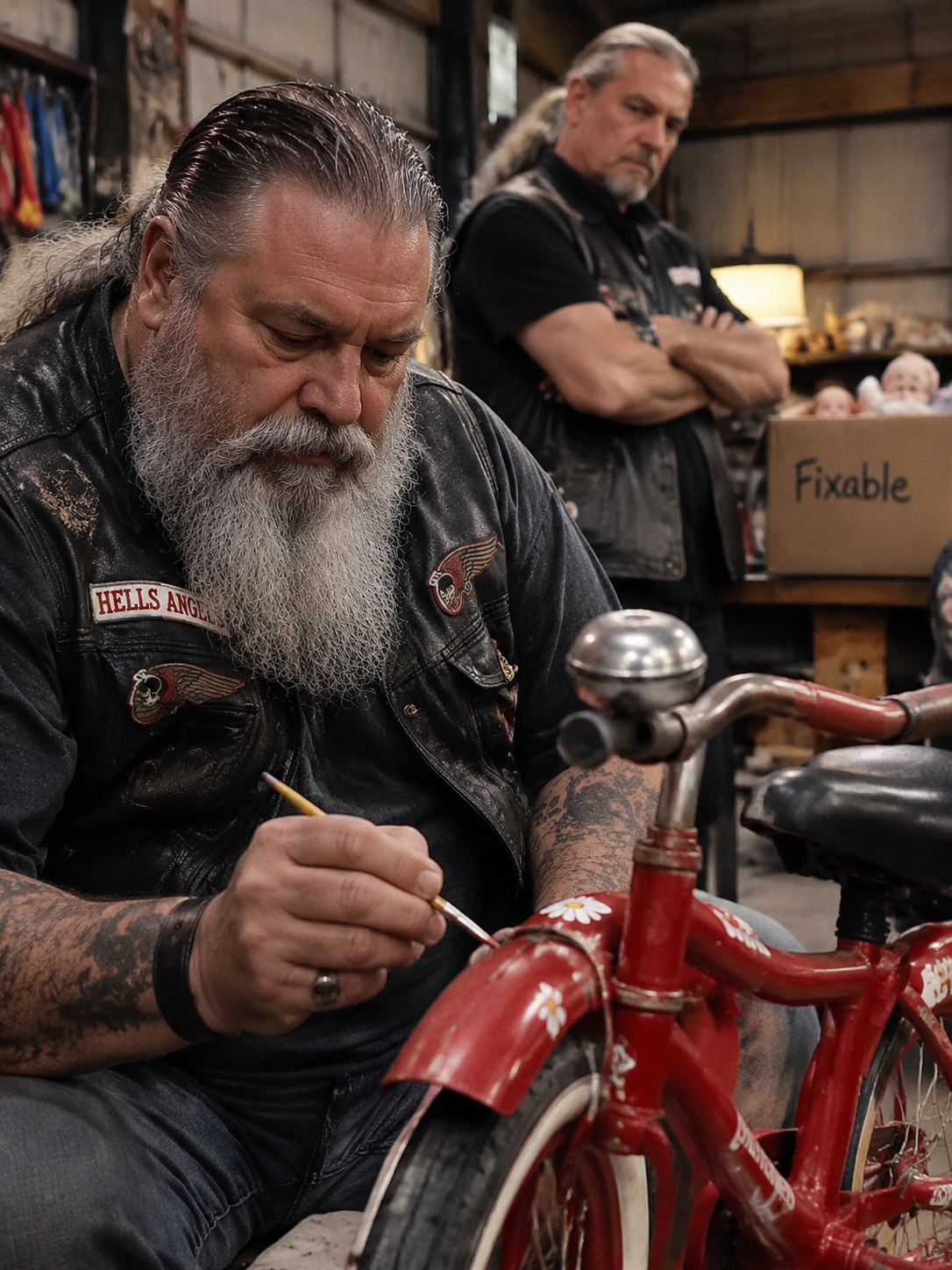
Fifteen years after Ray Mercer blamed my club for the fire that destroyed his clubhouse, his daughter was dying in a hospital with no matching blood left. I rode through a storm to help her anyway, then sat across from the man who had hated me for half my life—until he picked up my donor card and went pale…
Rain hammered the tin roof of our garage while I worked on a little red bicycle for the Christmas toy run. Doc was sorting donated toys nearby, and he teased me that the kid would probably ride it straight into a mailbox. I told him that would only make it a perfect bike with a story. It was an ordinary Thursday night, the kind of quiet I had learned to appreciate.
Then my phone rang at 11:00. An unknown number. A young woman was crying when I answered. It was Maya Torres, calling from St. Bridget’s Hospital. Lilly Mercer had collapsed during her clinical shift. There had been a highway pileup, the blood bank was empty, and they had no units of Lilly’s rare type left. Maya said she was on the donor registry and that my eight-week interval was up. She asked me to come.
I knew the name Mercer. Fifteen years earlier, a fire had destroyed the Iron Saints’ clubhouse across town. The next morning, Ray Mercer stood in the ashes and accused my Hells Angels of setting it. No one was charged, and no proof ever surfaced, but the accusation stuck. The Saints stopped speaking to us. People in town pulled their children closer when we walked by. Some of my men lost jobs. Doc lost his work at the lumber yard. I never forgot Ray’s finger pointed at my chest. I also never tried to force anyone to believe me. I kept my head down, fixed engines, and worked on the donated toys for our Christmas run. Around town, mothers drew their children closer when I passed, and men who had once shaken my hand suddenly found something else to look at. The years did not soften the accusation; they only made it familiar.
Doc heard enough of the call to understand. “That’s Mercer’s girl,” he said. “Could be a setup. They get you alone at that hospital, who knows?” I took my keys off the hook. “She’s somebody’s kid, Doc.” He had no answer. I leaned the unfinished bicycle against the wall, pulled on my rain jacket, and rode into the storm.
The highway to Harlan Creek was twenty-five miles of black pavement and standing water. I kept thinking about the little girl in surgery and the people waiting beside her bed. I had no way to know whether I would arrive in time, only the chance to try. Twice my rear tire slipped. I kept the throttle steady and told myself that getting there fast would do no good if I ended up in a ditch. A fallen tree limb blocked both lanes, thick as my waist. I got off the bike and dragged it to the shoulder, losing seven minutes I could not get back. I reached St. Bridget’s at 11:35, soaked through. Somewhere between the fallen branch and the hospital entrance, I remembered a plastic chair from long ago. My little sister Annie had been nine when she got sick and needed a rare type of blood. I had sat in that hospital hallway holding her stuffed rabbit, one ear missing, while our family waited for a call that never came. I had made a promise then that I would help if I ever got the chance. I had never thought to add an exception for enemies.
A security guard named Frank stepped in front of me when he saw my vest. Maya came running down the hall in blue scrubs, her hair falling loose from its clip and her eyes red from crying. She told him I was the donor she had called. He moved aside, and she led me toward the waiting room. A dozen Iron Saints stood shoulder to shoulder inside. Their black vests made a wall across the room. Dutch was at the front, his shaved head and clenched jaw familiar even after all those years. Ray stood behind him, gray at the temples, looking smaller than the man I remembered.
I stopped a few feet away and kept my hands open. “Tell me where to sit,” I said. Ray looked at me, then at the floor. After a long silence, he gave one small nod. Dutch stepped aside, and the wall opened. Maya took me to a donation room. Through the glass, I could see Ray watching from the hall.
The needle went into my arm at 12:03. Maya’s hands shook as she taped the line, so I covered one with mine. “Take your time, kid. I’m not going anywhere.” She told me Lilly was in surgery and that the doctors would run the unit upstairs as soon as it was ready. I held still while the bag filled. When the technician carried it away, Maya pressed gauze to my arm and handed me apple juice.
Back in the waiting room, the Saints were still standing. Ray finally sat across from me, six feet away, staring at his boots. Hours passed. The rain faded to a drip outside, a vending machine hummed in the corner, and nobody went for coffee. Every time a door opened, all of us looked up, only to see a nurse or a janitor. Ray kept opening and closing his hands as if he were trying to hold on to something slipping away. A little after three, he asked, “Why?” I told him the only answer I had. “She’s a kid.” Dutch came over and ordered me out, but Ray stopped him. “His blood is in my daughter right now. Sit down.” Dutch went back to the window without another word.
At , Dr. Anita Patel came down the hall. She told Ray the bleeding had stopped, Lilly was stable, and the transfusions had made the difference. Ray folded into a chair and covered his face. I stood, folded the blanket Maya had given me, and started for the door. My wallet slipped from my jacket. A small donor card skidded across the tile and stopped near Ray’s boot.
Ray picked it up. He looked at the numbers, then reached into his jacket and pulled out an old, worn envelope. Inside was a letter the hospital had sent fourteen years earlier, after an anonymous donor had saved eight-year-old Lilly’s life. The letter carried a registry code. Ray held it beside my card, checking every digit twice. His hands began to shake. He looked up at me as if he were seeing a ghost.
“Is it you?” he asked. Part 2…..
IF FACEBOOK BROUGHT YOU HERE, HERE’S THE CONTINUATION YOU’VE BEEN WAITING FOR. ENJOY! 👇 “Yeah,” I said. “It’s me.” I had no idea what else to say. I had given blood every eight weeks for fourteen years, but I had never expected Ray Mercer to be standing in front of me holding proof of it.
Maya came to the doorway with the tablet she used at the hospital. She checked the record and turned it toward Ray. St. Bridget’s had every donation logged. I had never missed an appointment, and there was a note on my file asking staff to call me first if Lilly Mercer ever needed blood. I had put that request there years ago, after I learned who the little girl was.
Ray stared at me. “You knew she was mine?” I nodded. A nurse had mentioned Lilly’s name after that first emergency. I found out she was Ray’s daughter, and I kept coming back anyway. “Even after everything?” he asked. “She was a kid, Ray. Kids don’t choose their fathers’ fights.” I rubbed the back of my neck because I could feel my ears turning red.
The doors opened, and Doc came in wearing yesterday’s jacket, followed by four of our men. They stopped when they saw the Saints and Ray holding the old letter. Nobody knew what to say. Ray folded the paper carefully, stood up, and faced both clubs. “This man saved my daughter twice,” he said. The room went still. Dutch, who had spent the night trying to keep me out, took off his cap and held it against his chest.
Later that morning, Ray brought me into Lilly’s room. She was twenty-two, pale from surgery but awake, with dark hair pulled into a messy knot. “So you’re him,” she said. I asked who she meant. “My angel donor. When I was little, I used to picture you with white wings and a gold halo.” I looked down at my boots. “No wings. And I don’t own a bow tie, either.” She laughed, then winced and pressed a hand to her side. “You’re better than the picture,” she said. “You’re real.”
Dr. Anita Patel came in and explained what had happened. Lilly had a malformed blood vessel in her abdomen, likely from birth. It had finally ruptured. The emergency bleeding was controlled, but she would need a planned operation after her body recovered. Because her blood type was extraordinarily rare, Dr. Patel wanted six matching units banked at the hospital before she made a single cut. I could safely donate one more unit after eight weeks. Five others had to be found.
She wrote a date on the whiteboard: ninety days away. Ray stared at it. Lilly stared at it. I stood there with my cap pressed against my chest, knowing one donation had bought her time but had not solved the problem. “Then we find the other five,” I said. Ray looked at me for a long moment. We were no longer quite enemies, but we were not friends yet, either.
That evening, I returned to our clubhouse. Doc was waiting with his arms crossed. He was angry that I had walked into the Saints’ territory without backup, and the younger men wanted to know whether Ray had threatened me. I told them what had happened, then told them about my little sister, Annie. She was nine when she got sick. The doctors needed a rare blood type, and nobody could find it in time. I had sat in a hospital chair holding her stuffed rabbit until a nurse came out with the news. I made a promise that day: if I could help it, no child would die waiting for blood.
“I’m not asking you to like Ray,” I told them. “I’m asking you not to make Lilly pay for a fight she never started.” Doc finally said he would hold the line. He did not promise the club would do more. I told him that was fair.
At midnight, Ray called. He said he did not know where to find five more donors and had nobody else to ask. I told him to meet me at the hospital cafeteria at seven in the morning. “Bring an appetite,” I said. We had fifteen years of anger between us and ninety days to find five people, but at least we had a place to start.
Part 3 Ray arrived two minutes late and stood beside my table as if he was waiting for permission to sit. I waved him into the chair. We drank coffee that tasted like burnt pennies and agreed on one thing: we would not talk about the fire. Not that morning, maybe not ever. We would talk about Lilly and the blood she needed. That was the deal.
When we went up to her room, Lilly called us her two favorite grumpy men. Maya was there, too, looking more like herself now that she was off shift. Over the next few days, Ray and I took turns visiting. I brought Lilly a little wooden truck from the toy-run pile and fixed its missing wheel while she watched. Ray told me he used to own a mechanic shop on Fourth Street and loved hearing an engine turn over after a repair. He said somewhere along the way he had stopped fixing things and started guarding them.
Lilly beat me at cards three games in a row. When I let her win the fourth, she called me a terrible liar. Then she told us something her mother, Grace, used to say when Ray came home angry: “Anger is a heavy thing to ride with.” Grace had died of cancer four years earlier. Ray looked down at his hands when Lilly said it, and I understood that he had been carrying more than one kind of grief.
When Dr. Patel said Lilly could go home, Ray mentioned Grace’s old motorcycle and sidecar. It had been sitting under a tarp in his shed since she died. Lilly kept asking about it, but he had not been able to bring himself to touch it. I told him to bring it to our garage. We could see what we could do.
The morning Lilly was discharged, Ray and I rode behind Maya’s little blue car, one on either side of it. Frank, the security guard who had stopped me at the hospital doors, gave me a short nod as I passed. At the Mercer house, Lilly sat at the kitchen table with four mismatched mugs while Maya told us why she had called me that night. She had grown up in foster care, moving through seven homes by the time she was eight. One Christmas, our toy-run van had come to her group home. She had hidden behind a couch, afraid of the men in leather, until one of us left a small brown teddy bear on the couch and walked away so she could choose it when she was ready.
A tag on the bear said, “Somebody thought of you. Call Bear if you ever need anything,” with my number. Maya had kept that tag in her wallet for sixteen years. When Lilly collapsed, her hands remembered the number before she had time to think. I remembered a little girl behind a couch, but I had never known it was Maya. “You never needed to,” she told me.
Lilly reached for Maya’s hand. Then she said we should hold a blood drive and charity ride, with both clubs, the church, and the firehouse involved. Ray worried people would see our vests and turn away. I told him I had spent thirty years watching doors close. Lilly answered quietly, “People can’t say yes to a question nobody asks.” Ray finally agreed to speak to his men, and I promised to speak to mine.
A week later, Ray and I stood outside his house with stacks of yellow flyers. The clubs had both refused to lead the effort, so we decided to start ourselves. We went door to door on Maple Street. One woman closed the door with the chain still on. A man took a flyer and said maybe, then shut his door. At Hanley’s Diner, the owner, Walt, listened to Ray explain Lilly’s rare blood type, then said he did not want bikers scaring his customers. We thanked him and walked out without arguing.
Ray looked at the sidewalk and said he had never understood what it felt like to have people judge you before you spoke. I put a hand on his shoulder and said we had one more street to try. At Harlan Creek Community Church, Pastor Sam Whitaker was sweeping leaves from the steps. He listened to the whole story, took the flyer, and asked what we needed: space, tables, coffee? He offered us the parking lot and forty folding tables for the Saturday before Lilly’s surgery. Ray wrote the date on the flyer with a hand that was not quite steady.
When we put the first flyer on the hospital bulletin board, Lilly clapped both hands over her mouth and laughed. For the first time, the plan felt possible.
Part 4 The following Saturday, Ray brought Grace’s motorcycle to our garage on a flat trailer under a blue tarp. No Iron Saint had set foot on our property in fifteen years. Our men gathered at the bay door, quiet and watchful. Ray stood beside his truck with his hands open. He said he had tried to repair the bike himself, but his hands remembered the work and the rest of him would not let them finish.
I told him to bring it in. Doc looked at me, then stepped aside. We rolled the bike down the ramp together. Under the tarp was a cream-and-black machine with rust on the fenders, a cracked sidecar seat, flat tires, and a little yellow sunflower painted on the tank. Ray touched the flower with his thumb. After that, he came by every evening. At first the men found reasons to be elsewhere. Before long, someone left a stool for him, then a cup of coffee.
We drained the old gas, cleaned the carburetor, replaced what needed replacing, and stitched a new brown leather seat for the sidecar. One night I told Ray about Annie, my nine-year-old sister, and the rare blood she needed. He told me Lilly had been three when Grace first let her ride in that sidecar, wearing a yellow helmet too big for her head. We did not talk about the fire. We just worked.
On the last night of the third week, Ray kicked the starter. The engine coughed, sputtered, and caught. Its steady rumble filled the garage. Ray covered his mouth, and tears ran into his beard. Doc put down the parts catalog he had been pretending to read and handed him a clean rag. Lilly and Maya were in the doorway when the engine started. Lilly called it her mother’s bike, and for once nobody had to explain what the sound meant.
Maya had two matching donors confirmed by then, both living hours away. It was a start, but not six units. We kept handing out flyers. Twelve bikes rode with us to a town beyond the reservoir, where nobody had heard about Lilly. Rain came down hard on the county road. At a flooded stretch near Miller’s Bridge, Dutch’s engine coughed and died. The rest of the convoy rounded the bend, leaving him on the shoulder in the downpour.
Dutch expected us to ride away. He had spent fifteen years hating our colors, and he had never hidden it. Doc turned around with two younger riders. He crouched beside Dutch’s bike, diagnosed water in the air box and soaked plugs, and asked for a tarp. One of the younger men held it over them while Doc dried the parts. Then Doc poured coffee from his thermos and handed Dutch a cup. “It’s strong,” he said. “Too much sugar. Drink it.”
Doc told me later that Dutch looked at the scar running from his wrist to his elbow. He told Doc he had earned it the night of the fire, when he climbed through a back window and carried seven-year-old Lilly out from under a bed. A beam came down across his arm. He had believed someone tried to kill her, and without proof he chose the Hells Angels to blame. He said he needed somebody to hate. Doc listened, then told him, “Then we owe you a thank you, too.” Dutch had no answer, but he nodded.
Eight weeks after the storm, I went back to St. Bridget’s and gave my next unit. Dutch sat in the waiting room while I did it. By Friday evening, the church lot was full of folding tables, cots, and riders from both clubs. Maya told us three units were confirmed, with more people signed up for the next morning. Pastor Sam carried in paper cups. The banner over the hall doors read, “Ride for Lilly. Give blood. Give hope.”
Then Walt Hanley’s rusty pickup pulled in. The diner owner who had turned us away climbed out with boxes of eggs, bacon, flour, and sausage. He said he was cooking breakfast for everybody, free. His wife had needed transfusions for years, and he had forgotten what it felt like to watch strangers give someone more time. Lilly had sat in his wife’s old booth and thanked him for tea. He had not slept well since. He shoved a box into my arms and told me to make myself useful. Dutch carried the sausage as carefully as if it were glass.
Part 5 Saturday morning, more than three hundred motorcycles filled the church lot. Hells Angels, Iron Saints, weekend riders, and older men on dented tourers stood together under blue ribbons tied to their handlebars. Pastor Sam prayed for safe roads, steady hands, and Lilly. Ray rode Grace’s restored motorcycle, with Lilly in the sidecar wearing a blue helmet. I rode beside them. Dutch brought up the middle, his scarred hand steady on the throttle.
People came out onto porches as we passed. Firefighters saluted from the station. Nurses held a sign outside the clinic. Families waved paper flags, and a boy on a bicycle pedaled alongside us for two blocks, shouting Lilly’s name. Ray cried as he drove, but he never took his eyes off the road. After the ride, Walt flipped pancakes in the church hall while donors lined up outside the check-in tables.
At noon, Maya wrote “Five of six” on a piece of poster board. The room cheered. Then the afternoon dragged. Donor after donor was tested, and every result came back wrong. At , Walt untied his apron and walked to Maya’s table. “Test me,” he said. The nurse pricked his finger. Maya checked the result, frowned, and ran it again. Then she looked up. Walt was a perfect match. He had spent forty years walking around with the rare type Lilly needed and never knew it.
He rolled up his sleeve and donated the sixth unit. Maya wrote “Six of six” on the board, and the hall erupted. Ray grabbed me in a hug so hard he nearly knocked the air out of me. He held my vest and started to say something, but Lilly came between us. She wanted to go home with Maya to get a photograph of Grace for the dinner tribute. Ray let her go.
That evening the church hall was full of food, flowers, and people who had once crossed the street to avoid us. Lilly came through the door at 10:06 holding her mother’s photograph. Her face was pale. She found Ray and asked him to come outside. In the side lot, she showed him a folded letter she had found in Grace’s keepsake box, tucked beneath her wedding ring. It was from Ray’s brother, Eddie.
The letter said Eddie had been repairing old wiring in the back room of the Iron Saints’ clubhouse. He had done the work carelessly, and a spark had started the fire. He had been too frightened to tell anyone. He asked Grace to keep the letter until he could find the courage. Lilly looked at her father and said the Hells Angels had never set the fire. It had been an accident.
Ray did not deny it. He told her he had found the letter four years earlier, after Grace died, and read it twice. Then he put it back. He had spent eleven years blaming my club by then, and he could not bear to admit he was wrong. He had let his men hate us, let the town turn against us, and let the lie stand because his pride would not let him speak.
Dutch had stepped into the doorway and heard enough. He went back into the hall and told everyone. The room went silent. Doc stood so fast his chair fell. Men from both clubs moved toward one another, a table shifted, and a pie hit the floor. I put both hands on the head table and shouted for them to stop. They froze.
I looked at Ray, and the hurt I felt was deeper than anger. We had spent weeks repairing Grace’s motorcycle together. We had shared coffee and stories about our families. All that time, he had known. He turned and left. Outside, Grace’s engine roared away, but the sidecar stayed behind.
Lilly stood in the middle of the hall, shaking. She said she would not go ahead with surgery until the truth was made right. Six units of her blood were waiting at the blood center, but she would not schedule the operation while the lie still stood between us.
Part 6 Ray later told me what happened after he rode away. He went to the burned clubhouse on Miller Road and sat among the blackened beams with Eddie’s letter in his hand. The place still smelled of wet ash to him, even after fifteen years. He remembered Dutch carrying Lilly out through the back window, and he remembered the promise he had made that somebody would pay. The wrong men had paid.
He thought about Grace, too. Four years earlier, in the hospice room where she was dying, she had held his hand and whispered, “Make it right.” He had promised, but he had been afraid of what the truth would cost him. At sunrise, he noticed a return address on Eddie’s envelope. It was a small town nine hours east. Ray sent Lilly a message saying he was going to bring back the truth, then left his bike at home, took his truck, and drove.
He found Eddie above a tire shop, a thin gray man with their mother’s eyes and grease on his hands. Eddie opened the door, saw his brother, and sank against the frame. He apologized for the fire, for running away, and for leaving the family to carry what he had done. Ray sat down on the floor across from him and took his wrist. He told him Lilly was alive, but still needed surgery.
Eddie went inside and brought out a shoebox full of money-order receipts. For fourteen years, he had sent money every month to St. Bridget’s patient assistance fund in Lilly’s name. He had heard she was in and out of the hospital and could not undo the fire, but he could help with her bills. After Grace died, he took a second job and sent more. Ray remembered a hospital clerk telling him that a kind fund had covered some of Lilly’s expenses. He had never known the stranger was his own brother.
The two men talked until midnight. Eddie told Ray he had been afraid to come home because he thought Ray would never forgive him. On the drive back, Ray admitted he had found the letter four years earlier and hidden it because he could not stand to be wrong. He had told his club who to hate, and his pride had let good men lose jobs and their reputations. He told Eddie that fear did not excuse what either of them had done. Then he apologized for making it so hard for his brother to tell the truth.
When they reached Harlan Creek, Eddie was trembling so badly the shoebox rattled in his hands. Lilly came out onto the porch with Maya beside her. Eddie walked up the steps and stopped a few feet away. He told her he had caused the fire, that he had run, and that he was sorry she had grown up without her uncle. Lilly cried, then stepped forward and hugged him. “I needed the truth,” she said. “I needed it more than I needed someone to blame.”
She told Ray I was at the hospital asking Dr. Patel to keep the surgery slot open. I did not know whether Lilly would come back to it. She said she would, but first her father had to say what he needed to say to my face. Maya sent a message to both clubs: six o’clock, hospital parking lot. Everyone.
When I came out of the hospital with Doc, bikes filled the lot. The Hells Angels stood on one side and the Iron Saints on the other, with an empty strip of wet pavement between them. Dr. Patel had agreed to hold Lilly’s surgery slot until the end of the week, but no longer. Ray climbed out of his truck. Eddie stayed near it, arms wrapped around himself. Ray walked across the gap and stopped beside my bike.
He took off his Iron Saints vest and laid it across my seat. “I let you carry my lie for fifteen years,” he said. “I’m sorry.” Eddie stepped forward and told both clubs what he had done: he had repaired the wiring badly, knew it was wrong, and stayed silent while the fire destroyed the clubhouse and our names. “You lost your jobs and your good name because of me,” he said. “Not Bear. Me.”
Dutch walked into the open space and pushed up his sleeve, showing the scar he had earned carrying Lilly out. He admitted he had chosen to hate us without proof. “I hated the wrong men,” he said. “And I’m sorry.” I picked up Ray’s vest and put it back on his shoulders. “You earned it by showing up.” Then I held out my hand. Ray took it, and neither of us let go.
Final Doc crossed the pavement and offered his hand to Dutch. Dutch stared at it, then shook it once, firmly. The empty strip between the clubs filled with people moving toward one another. A red-bearded Angel clapped an Iron Saint on the back. Two younger riders shook hands and laughed in surprise. The years did not disappear, but the men stopped standing on opposite sides of them.
Lilly and Maya arrived in the blue hatchback. Dr. Patel came out of the hospital with her tablet. Lilly looked at the hands joined between Ray and me, then at the two clubs standing together. She turned to the doctor and asked her to schedule the operation for the original Tuesday, fifteen days away. Dr. Patel said she would put it in that night. For the first time in weeks, Lilly looked relieved.
The next Tuesday, Angels and Saints gathered at the burned clubhouse on Miller Road. Pastor Sam brought a small cup of dirt from the church garden and said a simple prayer over the ground. Then we got to work. We hauled charred boards, bent pipe, melted wire, and fifteen years of weeds into dumpsters. Eddie worked beside Ray and me, taking the hardest jobs and pulling out the old wiring piece by piece. When Ray spotted a missed section, he told Eddie, “You missed a spot.” Then he pointed at his own face. “So did I.” Eddie laughed for the first time since coming home.
People from town helped. Someone’s wife brought cornbread. Maya stopped by on lunch breaks with water and bandages. Kids from Pastor Sam’s church used magnets to pick up nails. Within two weeks the lot was clear, and the new walls were marked out. When the concrete trucks arrived, Eddie and Ray worked one end of the boards while I finished the edges with a trowel. Doc looked at the smooth floor and said, “That’s a floor.” I told him, “That’s a start.”
On the first Tuesday of December, Lilly went into surgery. Six units of her exact blood type were waiting in the hospital cooler, thawed and labeled. Maya held Lilly’s hand in the prep room and told her she would see her on the other side. Lilly said she was still scared, but she was done letting fear make the decisions. Then the doors swung open, and her bed rolled down the bright hall.
We waited for four hours. Ray sat with his elbows on his knees. Eddie held his taped hands together. Doc leaned against the wall, and Dutch paced until Doc told him he would wear a trench in the floor. I sat beside Ray with one hand on his shoulder. When Dr. Patel finally came through the doors, she was tired, but she was smiling. “She’s going to be fine,” she said.
Ray dropped back into his chair with a sound that was half a sob and half a laugh. Eddie covered his mouth. Dutch wiped his face with his scarred arm. I went to the coffee machine and brought Ray a cup. He took a sip and said it was hot, which was better than the cold stuff we had been drinking. Then he laughed, a real laugh, and I laughed with him until we both had tears in our beards.
Walt Hanley arrived with a huge pot of chicken and rice, paper bowls, and crackers. He set them on the waiting-room table and told everyone to eat. Nobody argued with him.
By the following May, the Mercer Community Blood Center and Youth Garage had been open for two months on the rebuilt lot. A bright green sign hung over the doors. Eddie ran the garage as lead mechanic, teaching teenagers how to change oil and patch a tire. Maya ran the blood-drive program from a desk crowded with sticky notes. Walt showed up every Thursday with soup for the donors and reminded anyone who would listen that he had given Lilly the sixth unit.
Lilly spent weeks recovering, weak and impatient. She took a full semester off from nursing school, then went back with a bag of textbooks and a stubborn look on her face. By graduation, she was walking strong again. I stood in the gravel lot polishing my headlight even though it did not need polishing. Doc teased me that I looked like a man going to court. I told him it felt about right.
Ray rode Grace’s restored motorcycle, the sidecar polished until it shone. The Angels and Saints traveled to the community college together, two lines of bikes stretching down the road. People came out onto their porches. A man shut off his mower and took off his cap. Firefighters saluted from the station. In the auditorium, nobody looked twice at our vests. A woman in a church hat slid over to make room for Doc.
Maya had saved the front row and held up a sign that read “Lilly Mercer, RN.” When Lilly Grace Mercer’s name was called, she crossed the stage in her blue gown with her cap sitting crooked on her dark hair. Maya jumped to her feet and shouted, “That’s my girl!” The back of the auditorium erupted. Boots stomped, Dutch whistled, and Ray pressed his fist to his mouth. I blinked hard and let the tears run into my beard.
Afterward, Lilly came through the crowd and hugged her father, then Eddie. She stopped in front of me and handed me a small white envelope. On the card inside, in her careful handwriting, were five words: “To my angel donor.” I read them twice before I could get my throat to work. She wrapped her arms around my neck, and I held her gently, as if she were made of glass and iron at the same time.
Outside, Lilly climbed into the sidecar of her mother’s motorcycle and fastened her helmet. Ray settled into the saddle, and I rolled up beside them. We rode toward the center, where Grace’s photograph hung just inside the entrance. At the stop sign on Miller Road, I glanced over at Lilly. “Your mama had it right,” I told her. “Anger is a heavy thing to ride with, but love is lighter.” She smiled and squeezed my gloved hand. Ray eased forward beside me, and we rode on together.
THE END. I’ve shared the complete story, and I truly hope it touched your heart. If this story moved you, please , like, and share the post. Thank you for reading! ❤️
✓ Lynn R. Adams
Fifteen years after Ray Mercer blamed my club for the fire that destroyed his clubhouse, his daughter was dying in a hospital with no matching blood left. I rode through a storm to help her anyway, th…