Fake HOA Cops Walked Into My Barn—They Never Knew the FBI Was Recording the Deal That Could Destroy Them All
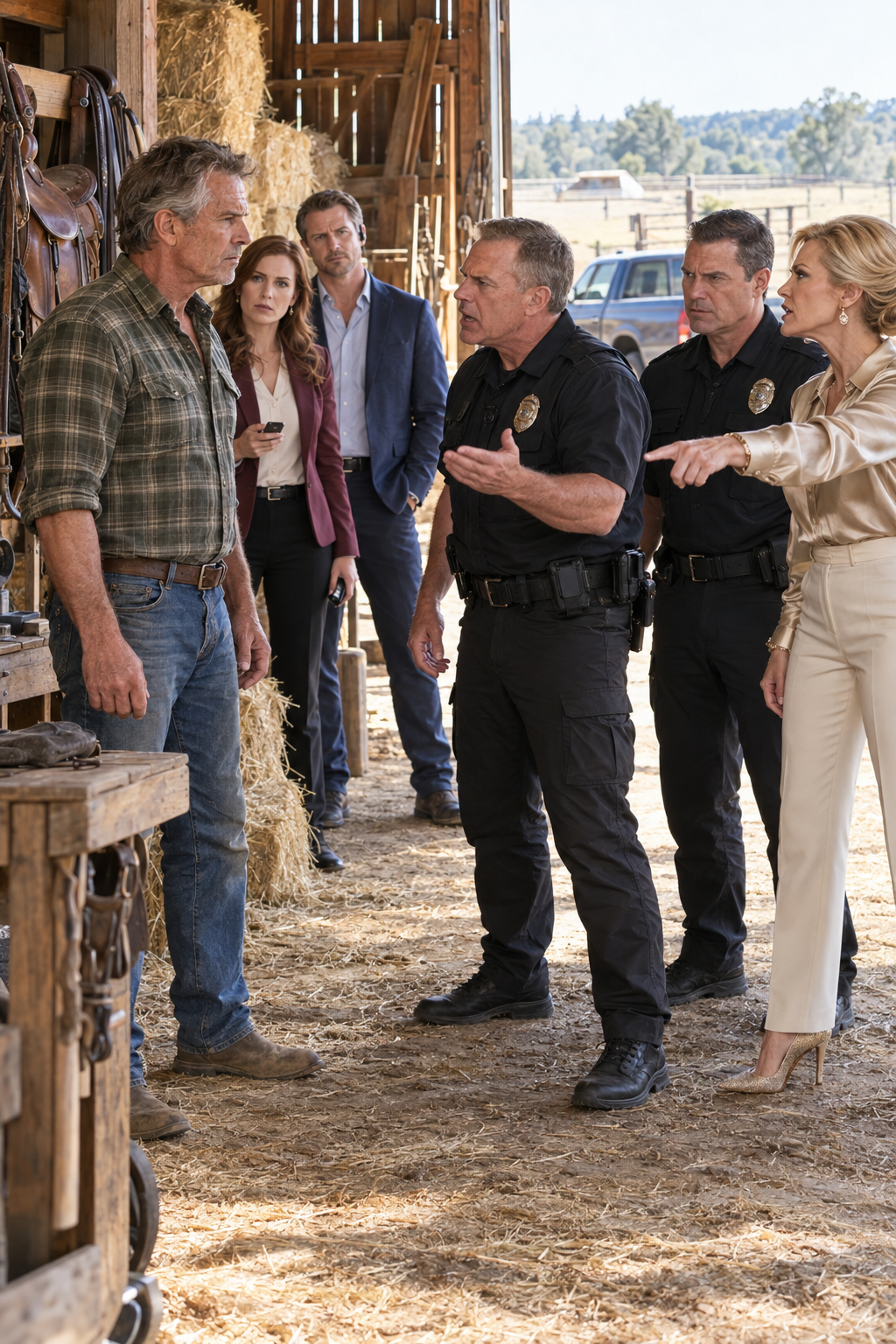
Fake HOA Cops Walked Into My Barn—They Never Knew the FBI Was Recording the Deal That Could Destroy Them All
The first man who called me homeless was wearing a fake police badge.
The second was my own son.
And neither of them noticed the tiny red light glowing behind the rusted horseshoe above my barn door.
“Mrs. Mercer, you have ten minutes to collect whatever personal property the association has agreed to release,” the man in the navy tactical shirt said. He rested one hand on the pistol at his hip and used the other to point toward the gravel road behind me. “After that, you leave Cedar Hollow Ranch and do not return.”
I looked at the badge clipped to his belt.
SILVER RIDGE COMMUNITY POLICE.
There was no Silver Ridge Community Police.
There was a Silver Ridge Homeowners Association.
There was a private security contractor the HOA had fired three months earlier.
There was a county sheriff’s department twenty-two miles away.
But there was no police department owned by the collection of stucco houses glittering beyond my eastern pasture.
I knew that.
The two federal agents sitting silently inside the hayloft knew it.
The four microphones hidden in the barn knew it.
And somewhere in Richmond, an FBI evidence server was preserving every word the man said.
My son Eric stood twenty feet behind him beside a pearl-white Range Rover, arms folded across his chest.
He wouldn’t look at me.
That hurt more than the badge.
I had changed Eric’s diapers in this house.
I had worked double shifts when his father, Samuel, broke his back in a tractor accident.
I had sold my mother’s jewelry to keep Eric in college after his scholarship disappeared.
I had paid the down payment on the first home he shared with his wife.
I had watched his children every summer without asking for gas money, grocery money, or gratitude.
Now my sixty-four years of life had apparently been reduced to ten minutes and whatever property a homeowners association had “agreed to release.”
Eric finally glanced at me.
“Mom,” he said, low enough that the fake officers probably thought he was being compassionate, “please don’t make this uglier.”
I said nothing.
His jaw tightened.
My silence always bothered Eric more than anger.
When he was a teenager, he knew yelling meant I was scared.
Silence meant I had decided something.
Behind him stood Vanessa Whitfield, the president of the Silver Ridge HOA, dressed like she was attending a country-club luncheon instead of an eviction she had manufactured. Cream blazer. Gold bracelets. Auburn hair arranged in the smooth, expensive waves women on local magazine covers seemed to wake up wearing.
Vanessa smiled.
Not kindly.
Victoriously.
The smile of someone standing in another person’s front yard while already choosing where the hydrangeas would go.
“You should listen to your son, Evelyn,” she said. “We’ve been more patient than most boards would have been.”
I turned my eyes toward her.
That was all.
The smile flickered.
People like Vanessa needed resistance. They fed on it. A shouted accusation gave them something to call unstable. Tears gave them something to call pathetic. Pleading gave them proof they held the power.
So I gave her nothing.
No shouting.
No begging.
No explanation.
No warning.
Five days earlier, Eric had arrived at my farmhouse carrying Chinese takeout and a bottle of the California cabernet Samuel and I used to buy on anniversaries.
I should have known something was wrong the moment Eric remembered the wine.
For the previous three years, my son had barely remembered my birthday.
He arrived alone, hugged me longer than usual, and asked whether we could eat at the old oak table in the kitchen.
He talked about his children.
He talked about work.
He talked about how exhausted he was.
Then, just before dessert, he put a blue folder beside my plate.
Inside were twenty-seven pages of legal language.
He told me the documents were part of a “family estate restructuring.”
I read three pages before I understood what they actually were.
The papers transferred management control of Cedar Hollow Ranch, including 1,840 acres, three houses, six barns, timber rights, mineral rights, two reservoir easements, and forty-seven acres bordering Silver Ridge, into a holding company called Mercer Family Land LLC.
Eric controlled the company.
I looked at him across the same table where I had once helped him glue together a fifth-grade solar system.
He rubbed both palms over his face.
“Because you’re sixty-four, Mom.”
“That’s your reason?”
“It’s part of it.”
“You think sixty-four is dead?”
“Don’t do that.”
“Turn everything into an insult.”
I almost laughed.
Then he told me Silver Ridge had made an offer.
Thirty-two million dollars.
The HOA’s development partners wanted my eastern fields for a second gated phase, a private golf practice facility, and a commercial access road connecting the neighborhood to Route 17.
They had already spent millions preparing.
Architects.
Engineering studies.
Promotional material.
They were so confident the deal would close that Vanessa Whitfield had shown prospective investors digital renderings of luxury homes sitting on land I had never agreed to sell.
Eric said thirty-two million dollars was “life-changing money.”
I told him my life did not require changing.
He said I was being emotional.
I reminded him that the eastern acreage contained Mercer Creek, which supplied irrigation water to five neighboring family farms under agreements Samuel and I had signed more than twenty years earlier.
Without that creek access, two of those farms would probably fail within a season.
One belonged to seventy-nine-year-old Harold Gibbs, whose wife was undergoing cancer treatment.
Another belonged to the Diaz family, whose oldest son had just taken over after his father suffered a stroke.
Eric rolled his eyes.
“Those agreements aren’t your responsibility forever.”
“They’re my signature.”
“You’re sacrificing thirty-two million dollars because you feel guilty about some farmers.”
“No,” I said. “I’m refusing thirty-two million dollars because a promise doesn’t become worthless just because somebody offers enough money.”
That was when Eric stopped pretending the conversation was about protecting me.
He leaned back in his chair.
“You know what your problem is?”
I folded my hands.
“You’ve spent your entire life acting like suffering makes you morally superior.”
I stared at my son.
He continued.
“You worked. Dad worked. Everybody works. You sacrificed. Every parent sacrifices. But you use it like some badge. Like everybody owes you forever because you kept this place running.”
I looked down at his hands.
Samuel’s hands.
Same broad fingers.
Same scar on the left thumb from the time Eric tried to repair a bicycle chain at fourteen.
For one terrible second, I saw my husband sitting across from me.
Then Eric said, “This ranch is too much for you. And if you won’t make a rational decision, somebody has to.”
I did not argue.
I did not tell him what Samuel had placed in the basement safe thirteen years earlier.
I did not tell him why the deed Eric had photocopied from the county archive was incomplete.
I did not tell him what had arrived from Washington two months before.
I simply closed the blue folder.
Then I asked one question.
“Did Vanessa tell you those papers give you the ranch?”
Eric hesitated.
Only half a second.
But I saw it.
“She had attorneys review everything.”
“That wasn’t my question.”
“Did Vanessa tell you those papers give you the ranch?”
His mouth flattened.
Then I carried our plates to the sink.
That silence frightened him.
He followed me.
“Are you signing?”
His voice hardened.
“You need to think about what you’re doing.”
“I already have.”
“You can’t stop this forever.”
I turned on the faucet.
Water struck porcelain.
“I don’t need forever.”
That was the first mine I planted.
Eric did not understand it.
Vanessa did.
I knew because he called her from the driveway before his taillights had disappeared beyond the sycamores.
What neither of them knew was that my kitchen phone system archived calls made through the property’s network.
That system had been installed eight weeks earlier.
By the FBI.
The investigation had begun with a dead man’s handwriting.
My husband Samuel had been gone nine years.
Pancreatic cancer took him in eleven months.
He had been fifty-eight.
Strong enough to lift fence posts alone in March.
Barely able to hold a spoon by December.
Three weeks before he died, he asked me to bring him a yellow legal pad.
He spent nearly an hour writing one paragraph.
His hands shook so badly that some letters looked like scratches.
Then he folded the paper twice and made me promise I would place it inside the old steel document box beneath our bedroom floor.
I didn’t read the note until after his funeral.
If anyone ever tries to separate Parcel Seven from the rest of Cedar Hollow, do not sign quickly. Do not trust a copy of the public deed. Open the black envelope in the bank box. Call the number inside before you call family.
Parcel Seven was our eastern land.
The land bordering Silver Ridge.
I had assumed Samuel was protecting the water agreements.
Not only that.
The black envelope contained a thirty-six-year-old federal conservation agreement signed by Samuel’s father, William Mercer, and the Department of Agriculture after Cedar Hollow helped absorb floodwater during the catastrophic James River floods of 1985.
The agreement placed Parcel Seven and several adjoining tracts inside a permanent conservation and watershed protection structure.
The land could be farmed.
It could pass to heirs.
It could support agricultural buildings.
But large-scale residential development, commercial road construction, and subdivision were heavily restricted.
More importantly, if anyone attempted to transfer control through fraud, coercion, forged authority, or concealment of the covenant, a dormant protective trust activated.
That trust was the secret.
Not because it was worth money.
Because it controlled what money could never buy.
Development rights.
And legal standing.
Over the decades, Cedar Hollow had become the hydraulic throat of that entire valley.
Two reservoirs crossed old Mercer easements.
A county stormwater channel crossed our southern meadow.
Mercer Creek fed ponds used for irrigation.
And one narrow strip of road beneath the Silver Ridge entrance—so narrow you could step across it in three long strides—was still technically part of Cedar Hollow.
Samuel had known developers would eventually come.
He had also known something else.
Someone inside the Mercer family had tried to hide the federal covenant once before.
That person was his older brother, Charles.
Eric’s beloved Uncle Charlie.
The man who taught him to fish.
The man whose investment company had quietly financed Silver Ridge’s first phase.
Charles died four years ago.
His son, my nephew Preston, now sat on the HOA’s “land acquisition committee.”
The first time I saw his name on a Silver Ridge document, I understood Samuel’s warning.
I called the number from the black envelope.
The number belonged to an attorney who had retired.
He referred me to another attorney.
That attorney referred me to the Inspector General’s office because someone had filed altered land records using a federal covenant number.
Three weeks later, two FBI agents sat at my kitchen table drinking terrible coffee.
Special Agent Claire Donnelly was forty-two, sharp-eyed, calm, and almost impossible to impress.
Her partner, Marcus Reed, spoke softly enough that people often forgot he was listening.
They showed me copies of documents I had never signed.
One purported to authorize Mercer Family Land LLC.
Another claimed I had surrendered management rights after a “documented cognitive decline.”
A doctor’s name appeared beneath the statement.
I had never met the doctor.
A notary seal appeared beside Eric’s signature.
The notary had been dead for eleven months when the document was supposedly executed.
Donnelly watched my face.
“Mrs. Mercer, did your son prepare these?”
“I don’t know.”
“Do you believe he knew they were fraudulent?”
“I don’t know.”
That was true.
I wanted it to remain true.
There are lies mothers tell themselves because reality is too expensive.
Maybe Eric believed Vanessa’s lawyers.
Maybe he thought he was protecting me.
Maybe Preston had manipulated him.
Maybe my son had signed something without reading it.
Maybe he had made one stupid mistake.
But there comes a moment when “maybe” stops being mercy and starts becoming cowardice.
Mine came when Agent Reed played a recording of Eric speaking to Preston in the back room of a Richmond restaurant.
Preston said, “Once she’s out of the house, nobody’s going to care what she says.”
Eric answered, “She’ll fight.”
Preston laughed.
“Then let her fight from a motel.”
I listened twice.
I did not cry.
Agent Donnelly finally asked, “Do you want to stop?”
She studied me.
“Most people need a minute.”
“I’ve had sixty-four years of minutes.”
That was when she slid the first photograph across my kitchen table.
A county planning official named Howard Pike.
And two men I recognized from HOA patrol vehicles.
The men standing in my barn five days later.
Fake police.
Their real names were Gary Lyle and Curtis Dean.
Both had once worked private security.
Gary had been fired from a sheriff’s auxiliary program after falsely implying he was a sworn deputy during a traffic dispute.
Curtis had been charged with impersonating an officer in another county, though the charge was reduced.
Silver Ridge hired them through a contractor owned by Preston’s college roommate.
The FBI believed they had been used to intimidate elderly landowners around the development.
One widow sold twelve acres after Gary allegedly told her county authorities could condemn her home.
An eighty-one-year-old man signed an easement after Curtis claimed refusal might result in environmental fines.
None of it was true.
But frightened people often signed before they asked.
That was the system.
Vanessa was the face.
Preston knew the land.
Howard Pike moved paperwork.
The fake officers supplied fear.
A real estate attorney cleaned the documents.
Investors supplied money.
And Eric—my Eric—gave them the one thing they still needed.
Family legitimacy.
Three days after our dinner, he returned with Vanessa, Preston, and an attorney named Graham Locke.
They found me packing one suitcase.
That pleased them.
I could see it.
Vanessa’s eyes moved toward the stairs as though she was already measuring curtains.
Graham placed a document on my kitchen counter.
“Mrs. Mercer, we’re trying to avoid unnecessary conflict.”
“What is it?”
“A temporary occupancy agreement.”
“For whom?”
I looked around my own kitchen.
“You’re giving me permission to live here?”
Graham’s expression tightened.
“For seven days while the ownership transition is completed.”
Eric stared at the floor.
Vanessa stepped in.
“You’ll be much happier somewhere manageable, Evelyn. Eric found a lovely townhome community near Charlottesville.”
I turned toward my son.
“You found me a townhome?”
He finally raised his eyes.
“It has maintenance included.”
“How thoughtful.”
He flinched.
That tiny flinch was the only satisfaction I allowed myself.
I signed nothing.
The next morning, an orange notice appeared on my front door claiming Mercer Family Land LLC held possessory control.
The afternoon after that, Gary and Curtis blocked my driveway and told my farm manager he needed written HOA authorization to enter.
By sunset, Silver Ridge contractors had installed temporary survey stakes in my eastern pasture.
Vanessa posted photographs on a private investor portal.
PHASE TWO LAND CONTROL SECURED.
She thought she had won.
Preston thought he had won.
The board thought it had won.
My son thought the ugly part was finished.
At the following morning, I carried one suitcase down the farmhouse steps.
Eric stood beside his truck.
“Where are you going?”
“The barn.”
His face changed.
“I want Samuel’s saddle.”
“You don’t need to make a production out of this.”
“Then don’t watch.”
I walked the quarter mile.
What Eric did not know was that Agents Donnelly and Reed had entered the barn at that morning through the western hay doors.
What he did not know was that the FBI had obtained authorization to record a planned meeting after intercepted messages indicated Vanessa had ordered Gary and Curtis to retrieve “the old Mercer box” before I left.
What he did not know was that I had moved the box.
What he did not know was that I had replaced it with something better.
Inside the old steel box were photocopies of incomplete deeds, a false map, three irrelevant tax records, and one handwritten note.
The note said:
Ask yourself why Samuel never sold Parcel Seven.
That was it.
Agent Donnelly had called it “bait with a pulse.”
At , Gary and Curtis walked into my barn.
Gary flashed the fake badge.
Curtis shut the door.
Eric, Vanessa, Preston, and Graham remained outside.
That detail mattered.
They wanted distance.
People who believe themselves sophisticated rarely commit the ugliest acts personally.
They hire someone.
Delegate someone.
Authorize someone.
Then, when the damage appears in court, they point to an organizational chart and say they were never there.
Gary told me I had ten minutes.
I glanced toward Samuel’s old saddle hanging from a beam.
“May I take that?”
Curtis laughed.
“You cooperating.”
Gary walked toward the tack room.
I stepped in front of him.
“That room is locked.”
“Not anymore.”
He produced a pry bar.
That was the moment everything became irreversible.
I heard a tiny movement overhead.
Marcus shifting near the hayloft camera.
Gary wedged the pry bar beside the tack-room door.
Wood cracked.
I did not stop him.
Curtis watched me.
“You seem pretty calm for someone losing thirty million dollars.”
“Thirty-two.”
He grinned.
“So you do understand.”
“I understand numbers.”
Gary forced the door.
Inside sat the steel box.
He whistled.
“There she is.”
Curtis took out his phone.
He typed something.
A second later, from outside the barn, Vanessa’s phone chimed.
I heard it through the open side window.
Gary knelt beside the box.
“You got the key?”
He looked up.
“Where is it?”
“I don’t know.”
He stood slowly.
“Mrs. Mercer, I don’t think you understand what kind of morning you’re having.”
“I think I do.”
“You interfere with association property, you could be detained.”
His face hardened.
“Is that a difficult question?”
Curtis stepped closer.
“You want us to call the county?”
“That depends.”
“Whether you want them to see your badge.”
Gary looked at Curtis.
Then at me.
That was the first time confidence left the room.
Only for a second.
But it left.
Gary recovered.
“You think you’re clever.”
“Your son warned us about this.”
That sentence nearly broke me.
Not because of what it meant legally.
Because somewhere between the Chinese food and the fake eviction, my son had apparently taken time to explain to two strangers how to handle his mother.
Gary continued.
“He said you hide behind technicalities. Said you always have.”
I looked at the floorboards until the ache passed.
Then I lifted my eyes.
“What else did my son say?”
Curtis snorted.
“Did he say where the key was?”
Gary froze.
A beautiful little freeze.
I knew I had him.
He wanted the box badly enough that he forgot to pretend he didn’t.
“Maybe,” he said.
“Then ask him.”
“He’s busy.”
“He’s twenty feet away.”
Gary stepped toward me.
His voice dropped.
“Open the box.”
“I told you I don’t have the key.”
“You better find it.”
That was the question.
Weak sounding.
Almost confused.
Exactly as Donnelly and I had planned.
A frightened widow might ask it.
An old woman losing her property might ask it.
Someone powerless might ask it.
But when a person committing a crime believes the victim does not understand, “why” can become the most expensive word in the English language.
Gary answered.
“Because Mr. Mercer wants the original papers gone before the bank’s people get here.”
My pulse struck once against my throat.
Upstairs, nobody moved.
I kept my face empty.
“Which Mr. Mercer?”
Gary realized it too late.
Curtis swore.
Gary pointed at me.
“Don’t play games.”
“My husband is dead.”
“You know who I mean.”
Curtis snapped, “Just shut up and give us the key.”
I looked at him.
“My son wants papers destroyed?”
“Nobody said destroyed.”
Gary shot him a furious glance.
Curtis lifted both hands.
“Whatever. Removed. Secured. Same thing.”
Not in federal court.
I let three seconds pass.
Then I asked, “Why before the bank arrives?”
Gary’s jaw clenched.
Curtis answered again.
Because stupid men often mistake silence for ignorance.
“The development loan closes at noon.”
Gary said, “Curtis.”
“What? She already knows they’re buying it.”
Curtis looked back at me.
“The bank sees that old covenant, everybody’s screwed. So open the box.”
There it was.
The heartbeat of the case.
Not merely fraudulent eviction.
Not merely impersonating police.
Not merely coercion.
Knowledge of the covenant.
Knowledge it was being concealed.
Knowledge the concealment was tied to a major financing transaction.
Bank fraud had just walked into my barn and introduced itself.
Gary must have understood from my face that something had changed.
His eyes moved upward.
Toward the horseshoe.
Toward the tiny red light.
“What’s that?”
I followed his gaze.
Curtis did too.
Nobody spoke.
Then Gary’s face drained.
He stepped backward.
I smiled for the first time.
Just enough.
The hayloft door opened.
Special Agent Claire Donnelly stepped into view wearing jeans, boots, body armor, and an FBI windbreaker that seemed to fill the entire barn.
Marcus Reed appeared beside her.
“Federal agents,” Claire said. “Hands where I can see them.”
Curtis made the worst decision available.
He reached toward his belt.
Marcus had his weapon drawn before Curtis’s fingers touched the holster.
Curtis stopped.
Gary stared at me.
Not Claire.
Not Marcus.
“You set us up.”
“No,” I said. “I asked why.”
The barn doors opened behind him.
Two more agents entered.
Outside, someone shouted.
A vehicle engine started.
Then another voice yelled, “Stop the car!”
I walked to the barn doorway as agents handcuffed Gary and Curtis.
The pearl-white Range Rover was angled across the gravel, rear tires kicking dust as Vanessa tried to reverse around an FBI SUV that had appeared from behind the equipment shed.
Preston stood frozen near my son’s truck.
Graham Locke had both hands raised.
Eric stared at me as though I had risen from a grave he had personally filled.
Agents surrounded Vanessa’s vehicle.
She stopped.
For five seconds, nobody moved.
Then she rolled down her window.
“This is outrageous!”
Claire came up beside me.
“Most memorable people say that.”
Vanessa pointed toward the barn.
“She orchestrated this! That woman has been obstructing a lawful property transfer for weeks.”
Claire’s expression did not change.
“What lawful transfer?”
Vanessa looked toward Graham.
The attorney looked away.
That was payoff number one.
The people who had arrived as a system began becoming individuals the moment handcuffs appeared.
Preston started walking toward his truck.
An agent blocked him.
“Sir, stay where you are.”
“I’m not involved in whatever those security guys did.”
Gary, being led from the barn, shouted, “You told us to get the box!”
Preston spun.
“Shut your mouth!”
Claire looked at me.
I looked at Claire.
Neither of us said anything.
Sometimes justice announces itself.
Sometimes idiots do it for you.
Eric finally walked toward me.
I did not answer.
“Mom, please.”
The word please sounded almost offensive.
He reached me.
“What did you do?”
I looked at him for a long moment.
“You mean besides keep my property?”
“You brought the FBI here?”
His eyebrows tightened.
“They came two months ago.”
The color left his face.
That was payoff number two.
Two months.
Every dinner.
Every phone call.
Every document.
Every pressure tactic.
Every boast.
The people around me suddenly understood the timeline.
Vanessa climbed out of the Range Rover under an agent’s instruction.
Her confidence was gone.
Not entirely.
People like Vanessa rarely lose it all at once.
But it had cracked.
She pointed toward me.
“You allowed us to continue negotiations while under federal investigation?”
I almost admired the entitlement of the question.
“You mean I allowed you to continue committing crimes?”
“I committed no crime.”
“Then today should be very convenient for you.”
Preston muttered something I couldn’t hear.
Claire stepped toward him.
“Mr. Mercer, we need your phone.”
“I want a lawyer.”
“You’re free to contact one.”
Graham cleared his throat.
“I represent Mr. Mercer.”
Preston stared at him.
Five minutes earlier, Graham represented all of them.
Now he represented whichever one he believed would survive.
Vanessa noticed.
“So that’s how it is?”
Graham said nothing.
The alliance had lasted exactly seven minutes under federal pressure.
But my son was still staring at me.
“What happens now?”
There are moments when motherhood becomes a courtroom with no judge.
I could see Eric at six, sleeping with one sock on.
Eric at twelve, running toward me with a split lip after his first fight.
Eric at nineteen, hugging me in a college parking lot while pretending not to cry.
Eric at thirty-one, handing me my first grandson.
And Eric five days earlier, saying somebody had to make rational decisions for me.
I wanted to reach up and touch his face.
I wanted to slap him.
I did neither.
“You tell the truth,” I said.
He swallowed.
“That’s it?”
“Mom, I never wanted you hurt.”
I glanced toward the broken tack-room door.
“What did you think eviction was?”
“I thought you’d move.”
“What did you think forged medical records were?”
He blinked.
That reaction was real.
Claire saw it.
And that was the first twist.
Eric knew more than I had wanted.
But less than I had feared.
“You didn’t know?” I asked.
“Know what?”
“Someone filed documents saying I had cognitive decline.”
He stared at Preston.
Preston stared at the ground.
Eric’s voice changed.
“Preston, what did you file?”
Vanessa stepped in.
“Eric, don’t say anything.”
He turned on her.
“What did you file?”
“Listen to your attorney.”
“You told me the transfer was based on the management agreement.”
Vanessa’s face hardened.
“This is not the place.”
“My mother just said somebody claimed she was mentally incompetent.”
“I said this is not the place.”
Eric moved toward her.
An agent put a hand out.
“Stay where you are, sir.”
Eric stopped.
Then he looked at me.
“What did they do?”
I wish I could say I felt triumphant.
Betrayal becomes more complicated when the betrayer discovers he was also used.
But used is not innocent.
Eric had still agreed to push me out.
Still helped them intimidate me.
Still decided thirty-two million dollars was worth breaking the mother who had trusted him.
The fact that somebody lied to him did not erase the lie he chose to tell me.
“I’ll show you later,” I said.
Agents spent six hours on Cedar Hollow that day.
Search warrants followed.
Phones disappeared into evidence bags.
Laptops were removed from Vanessa’s home and the Silver Ridge management office.
Howard Pike, the county planning official, reportedly left his office at lunch and never returned.
He made it as far as a gas station outside Fredericksburg before state police stopped his car.
By evening, local news helicopters circled the valley.
The fake badges became the headline.
But the badges were never the real story.
The money was.
Silver Ridge’s planned expansion was not a thirty-two-million-dollar development.
It was the anchor asset for a financing package worth almost $186 million.
Preston’s investment group had promised investors nearly four hundred residential units, a golf complex, retail frontage, and a private medical campus.
The eastern section of Cedar Hollow provided the only feasible road connection.
Without my land, the development became a peninsula surrounded by wetlands, steep hills, and protected forest.
Without that road, their projected values collapsed.
Without the projected values, the loan collapsed.
Without the loan, several previous debts came due.
They had not simply wanted my property.
They needed it.
Desperately.
That explained the speed.
The forged documents.
The fake officers.
The attempted eviction.
But it still didn’t explain Samuel’s warning.
Three days after the barn arrests, Claire returned to my kitchen.
Eric had moved out of his home.
His wife, Paige, had taken their children to her parents in Maryland.
Vanessa was out on bond.
Preston had not been charged yet.
Neither had Eric.
The internet had already decided everyone’s guilt anyway.
I turned off my television.
Claire sat at the oak table.
“You should know your son is cooperating.”
“I assumed.”
“He gave us access to accounts and messages.”
“He says Preston told him the federal covenant expired in 2005.”
“Did Eric verify that?”
“Then he believed what was profitable.”
Claire did not argue.
She slid a folder toward me.
“We found something else.”
Inside was a bank transfer.
Four million eight hundred thousand dollars.
Sender: Whitfield Development Partners.
Recipient: C.H. Legacy Holdings.
The transfer was eight years old.
One year after Samuel died.
“What is C.H. Legacy?”
“We were hoping you knew.”
I shook my head.
Claire turned the page.
Corporate registration.
Registered agent: Charles Mercer.
Samuel’s brother.
The company had been dissolved after Charles died.
But before dissolution, it transferred several assets.
One jumped off the page.
Beneficial claim: Mercer Watershed Trust.
I looked at Claire.
“You recognize it?”
“The trust isn’t his.”
“Whose is it?”
Technically, that wasn’t true.
The Mercer Watershed Trust belonged to no individual.
Samuel and I had created it eighteen years earlier.
Its beneficiaries were not our family.
They were six neighboring agricultural properties, a local volunteer fire district, and an emergency flood-retention program.
The trust existed to guarantee that no future Mercer heir could sell the valley’s water out from underneath everyone else.
Samuel had insisted.
He had grown up watching wealthy developers squeeze small farmers one easement at a time.
His father had nearly lost Cedar Hollow that way.
Samuel wanted our land to mean something after we were gone.
Not wealth.
A farmer should not lose his cattle because someone in a boardroom wanted lakefront condos.
A volunteer fire station should not lose its emergency reservoir because an investor wanted a golf course.
A widow should not sign away her well rights because a man wearing a badge that wasn’t real frightened her.
That was the inheritance.
Not acreage.
Not thirty-two million dollars.
The right to prevent powerful people from turning weaker people into rounding errors.
Claire tapped Charles’s name.
“Someone apparently pledged part of the trust’s development value as collateral years ago.”
“That’s impossible.”
“Legally? Probably.”
I stared at the document.
“Samuel knew.”
His yellow note came back to me.
Do not trust a copy of the public deed.
Call the number before you call family.
Not before you call Eric.
Samuel had suspected Charles.
Maybe more than suspected.
“Come with me.”
We went upstairs.
In my bedroom, I moved the cedar chest at the foot of the bed.
Underneath was the old floor compartment.
Inside lay the documents the fake officers had been sent to find.
Not in the barn.
Never in the barn.
I handed Claire the black envelope.
She read the covenant.
Then the trust agreement.
Then Samuel’s note.
At the bottom of the box was a small brass key.
I had forgotten it existed.
The tag read:
RIVER STATE BANK — 4471.
Claire looked at me.
“Safe deposit box?”
“You know what’s inside?”
The bank branch had closed seven years earlier.
River State had merged with Piedmont Commonwealth, then been acquired by Atlantic National.
It took Claire’s team a full day to trace the migrated box records.
Box 4471 still existed.
It sat in a regional storage vault outside Richmond.
The owner listed was Samuel Mercer.
Secondary access: Evelyn Mercer.
Nobody had opened it in fourteen years.
The vault room smelled like paper, steel, and recycled air.
Claire stood outside while a bank officer brought the box.
I inserted the key.
Inside were no jewels.
No secret stock certificates.
Just files.
Samuel would have laughed at how perfectly that suited him.
The first file contained old maps.
The second contained correspondence between Samuel and Charles.
The third contained copies of checks.
The fourth contained a cassette tape.
A cassette tape.
I stared at it until Claire stepped closer.
“You okay?”
“My husband refused to throw anything away.”
We found a machine at an FBI field office.
Samuel’s voice came through the speaker with static underneath.
I had not heard it in nine years.
For the first few seconds, I could not breathe.
“Evelyn,” he said on the tape, “if you’re hearing this, then Charlie did what I hoped he wouldn’t.”
Claire looked at me.
I pressed both hands flat on the table.
Samuel continued.
“Cedar Hollow isn’t valuable because it’s big. It’s valuable because everybody needs to cross it, drain through it, drink from it, or protect something with it. Dad knew that. Charlie knows it too.”
Paper rustled.
“I found out Charlie used the watershed trust as collateral on a development loan. I confronted him. He promised to unwind it. I don’t believe him.”
Another pause.
Samuel coughed.
I recognized that cough.
Cancer had already reached his lungs.
“If I die before this is fixed, don’t go after Charlie alone. And don’t let Eric get pulled into it. He worships his uncle. Charlie knows that.”
I closed my eyes.
Then came the sentence that changed everything.
“There is a second beneficiary schedule that Charlie never saw.”
Claire leaned toward the speaker.
Samuel explained.
When the Mercer Watershed Trust was created, Samuel inserted a contingency provision through a separate foundation.
If any trustee, heir, developer, association, or creditor knowingly attempted to destroy the water protections or fraudulently seize trust land, control did not revert to the Mercer family.
It transferred permanently to a public-benefit land foundation Samuel had quietly established.
And that foundation carried a restitution mechanism.
Any proceeds recovered from fraudulent use of the trust were to be distributed to property owners or farmers harmed by the scheme.
The widows.
The elderly owners.
The families pressured into easements.
The people fake authority had frightened into signing.
That was why Samuel hid it.
If Charles knew fraud would cost the family control forever, Samuel feared he might alter the trust before protections matured.
So Samuel buried the trigger inside a federally recorded supplemental instrument.
A legal land mine.
Waiting for greed to step on it.
Claire stopped the tape.
Neither of us spoke.
Then she whispered, “Your husband was terrifying.”
It became a sob before I could stop it.
The first tear I had shed since the eviction landed on my hand.
Not for the ranch.
Not for Eric.
For Samuel.
Because nine years after I buried him, he had reached through time and put his hand back on the gate.
The investigation widened.
A month passed.
Then another.
Silver Ridge residents discovered their HOA had spent nearly $1.7 million in legal and consulting expenses without proper disclosures.
Vanessa resigned before the recall vote could remove her.
Three board members claimed they had been misled.
Two probably had been.
One had approved payments to Gary’s security company personally.
Howard Pike pleaded not guilty to fraud and bribery charges.
Graham Locke stopped representing Preston.
Then he began cooperating.
Gary cooperated too.
Curtis waited longer.
Men who play cops often imagine loyalty makes them look tough.
Federal sentencing guidelines eventually cured him.
Eric came to Cedar Hollow on a cold November afternoon.
No Range Rover.
No blue folder.
He drove the ten-year-old Ford pickup I had given him after Samuel died.
He parked beside the barn but did not approach the house.
I watched him from the porch.
After five minutes, I walked down.
He looked thinner.
“Hello, Eric.”
He glanced at the barn doors.
“They fixed them.”
“I’m sorry about that.”
He knew immediately how inadequate it sounded.
“I’m sorry about all of it.”
His eyes filled.
Mine did not.
“I thought you were wasting everything Dad built.”
“Your father built a life, Eric. Not a liquidation event.”
He lowered his eyes.
“I thought if I could turn the ranch into enough money, nobody in our family would ever worry again.”
“You weren’t worried.”
He looked up.
“That’s the part I finally understand.”
The wind moved through the bare sycamores.
He shoved his hands into his jacket pockets.
“I wanted more.”
“Preston made it sound like if I didn’t help, you’d sell eventually and I’d get nothing.”
“I had no intention of disinheriting you.”
“You might be disinherited now.”
He almost smiled.
“I know that too.”
I studied my son.
“Did Vanessa tell you to evict me?”
“Preston did.”
“And you agreed.”
His face twisted.
Not from confusion.
From shame.
“Because I thought once you were out of the house, you’d stop fighting.”
The exact phrase from the restaurant recording.
He swallowed.
“I kept telling myself it was temporary.”
“People do terrible things with that word.”
“You don’t get to keep saying that.”
For the first time since this began, he sounded like my son rather than a man performing remorse.
He pulled an envelope from his pocket.
“My attorney says I shouldn’t give this to you.”
“Then why are you?”
“Because it’s yours.”
Inside was a handwritten list of names.
Seventeen homeowners.
I recognized four.
All elderly.
All owned property bordering Silver Ridge.
“What is this?”
“People Preston targeted.”
My eyes moved down the list.
Beside each name was an amount.
“What are the numbers?”
“What they were paid.”
“For what?”
“Easements. Land strips. Water access. Some sold because Gary or Curtis told them county condemnation was coming.”
My stomach went cold.
“How do you know?”
“Preston kept a spreadsheet.”
“Do the FBI have it?”
“Then why bring me this?”
Eric pointed to the last name.
Margaret Bell.
Age eighty-three.
Status: pending.
Pressure point: grandson medical debt.
I read it twice.
Eric’s voice cracked.
“They were going to tell her a road widening project would take half her property unless she sold voluntarily.”
“Was there a road project?”
“How much was her land worth?”
“Probably eight hundred thousand.”
“What were they offering?”
“Seventy-five.”
I folded the paper.
“Did you know about her?”
“Before the barn?”
I looked at him.
“Would knowing have stopped you?”
He tried to answer quickly.
Then stopped himself.
For once, he refused the easy lie.
“I don’t know.”
That answer hurt.
It also mattered.
I put the list back in the envelope.
“Thank you.”
He wiped his face.
“Is there any chance you’ll forgive me?”
The question floated between us.
A mother in a different story might have hugged him.
A crueler woman might have smiled and said never.
I did neither.
“Forgiveness isn’t a door, Eric.”
“What is it?”
He nodded slowly.
“Can I start walking?”
I looked toward the barn.
Toward the patched door.
Toward the field beyond it.
“You already did.”
That did not mean he got the ranch back.
It did not mean I trusted him.
It did not mean Thanksgiving magically became normal.
Consequences are not cruelty.
I removed Eric as successor trustee.
I changed my estate plan.
I froze every family-controlled development right.
Then I did something Samuel would have approved of.
I activated the restitution foundation.
By spring, attorneys representing eleven affected landowners entered settlement talks using evidence from the federal investigation.
Margaret Bell kept her land.
Harold Gibbs kept his irrigation.
The Diaz farm received a permanent protected easement.
The volunteer fire district received guaranteed reservoir access.
And Cedar Hollow’s eastern fields entered permanent conservation status.
Nobody would build luxury villas there.
Nobody would pour a six-lane access road across Mercer Creek.
Nobody would put a golf complex over Samuel’s hay fields.
The thirty-two-million-dollar offer vanished.
The theoretical value of the development rights vanished with it.
People asked whether that bothered me.
Because some assets are valuable only when you refuse to turn them into money.
Vanessa eventually pleaded guilty to conspiracy-related charges after prosecutors produced emails showing she knew the federal covenant existed before the bank financing presentation.
Gary pleaded guilty to impersonation and fraud offenses.
Curtis followed.
Howard Pike’s case dragged on.
Preston fought every charge.
Of course he did.
He claimed Charles had created the entire scheme.
A dead man is a useful business partner when blame arrives.
Eric avoided the most serious charges because the evidence supported what we had learned in the barn: he had participated in the coercive property transfer but had not known about several forged documents or the larger bank fraud.
That did not make him innocent.
He pleaded to a lesser offense connected to false filings and received probation, community service, financial penalties, and a career-ending stain he would carry longer than any prison sentence.
He accepted it.
That mattered too.
Almost a year after Gary and Curtis walked into my barn, I stood in the same doorway while volunteers from three neighboring farms set up tables for the first Mercer Valley Land Day.
No politicians.
No investors.
No HOA banners.
Just barbecue, folding chairs, children running between hay bales, and farmers arguing about weather as if weather had ever listened.
Eric arrived with his two children.
He stopped beside me.
“Am I allowed?”
I looked at my grandchildren.
My granddaughter held a pie.
My grandson held a plastic fishing rod.
“You’re already here.”
Not the old confident smile.
A smaller one.
We spent the afternoon without discussing deeds, fraud, attorneys, or the FBI.
At sunset, people drifted home.
The children left with Eric.
I stayed behind to lock the barn.
For the first time in months, Cedar Hollow was quiet.
I touched the old horseshoe above the doorway.
The camera had been removed long ago.
The tiny hole where its wire passed through the wood was still there.
I thought about how close they had come.
If Samuel had not written the note.
If I had trusted the public deed.
If I had signed Eric’s blue folder.
If I had argued instead of listening.
If I had confronted Vanessa before calling authorities.
Thirty-two million dollars sounded enormous.
But what almost disappeared was larger.
The right of ordinary people to stay on land they had spent their lives protecting.
I turned off the barn lights.
My phone rang.
Unknown number.
I almost ignored it.
Then something made me answer.
“Evelyn Mercer?”
Careful voice.
“My name is Thomas Bell.”
I stopped walking.
“Are you related to Margaret Bell?”
“She’s my mother.”
I relaxed slightly.
“Is she all right?”
“Yes. She asked me to call you.”
“About what?”
He took a breath.
“After the settlement, we cleaned out my father’s workshop. He died fourteen years ago.”
“I’m sorry.”
“Thank you. Mrs. Mercer, my father did surveying work for Silver Ridge before the first houses were built.”
I looked back at the dark barn.
“He left a locked metal tube with instructions that it should be opened only if somebody ever tried to develop Parcel Seven.”
Every muscle in my body went still.
Thomas continued.
“There are maps inside.”
“What kind of maps?”
“Original boundary maps.”
The wind moved across the pasture.
“There’s a letter from your husband.”
My hand tightened around the phone.
“What does it say?”
“I haven’t read all of it.”
“Read the first line.”
Paper rustled on the other end.
Then Thomas went silent.
“Mr. Bell?”
His voice sounded different when he returned.
“The first line says, ‘Evelyn, if they have already come for the eastern land, then Charles was never the real problem.’”
I did not move.
“Keep reading.”
Another pause.
“‘Look beneath Silver Ridge Phase One. The land was never theirs.’”
My eyes lifted toward the distant neighborhood.
Hundreds of porch lights glowed across the valley.
Three hundred and twelve houses.
A clubhouse.
A private lake.
Millions upon millions of dollars in property.
Thomas whispered, “Mrs. Mercer, there’s one more page.”
“What is it?”
He hesitated.
Then said the words that made the fake cops in my barn feel like the smallest part of the story.
“The ground under the entire Silver Ridge subdivision.”
I stared at those distant lights.
Then I asked the weakest-sounding question I could think of.
The kind of question powerful people always answered when they believed the woman asking it was too old, too frightened, or too insignificant to understand the answer.
“Thomas… whose name is on the deed?”
✓ Lynn R. Adams
Fake HOA Cops Walked Into My Barn—They Never Knew the FBI Was Recording the Deal That Could Destroy Them All The first man who called me homeless was wearing a fake police badge. The second was my o…