Evicted Days After Her Father’s Funeral, a Single Mom Bought a $9,000 Cabin—Then Her Daughter Found the Deed They Buried
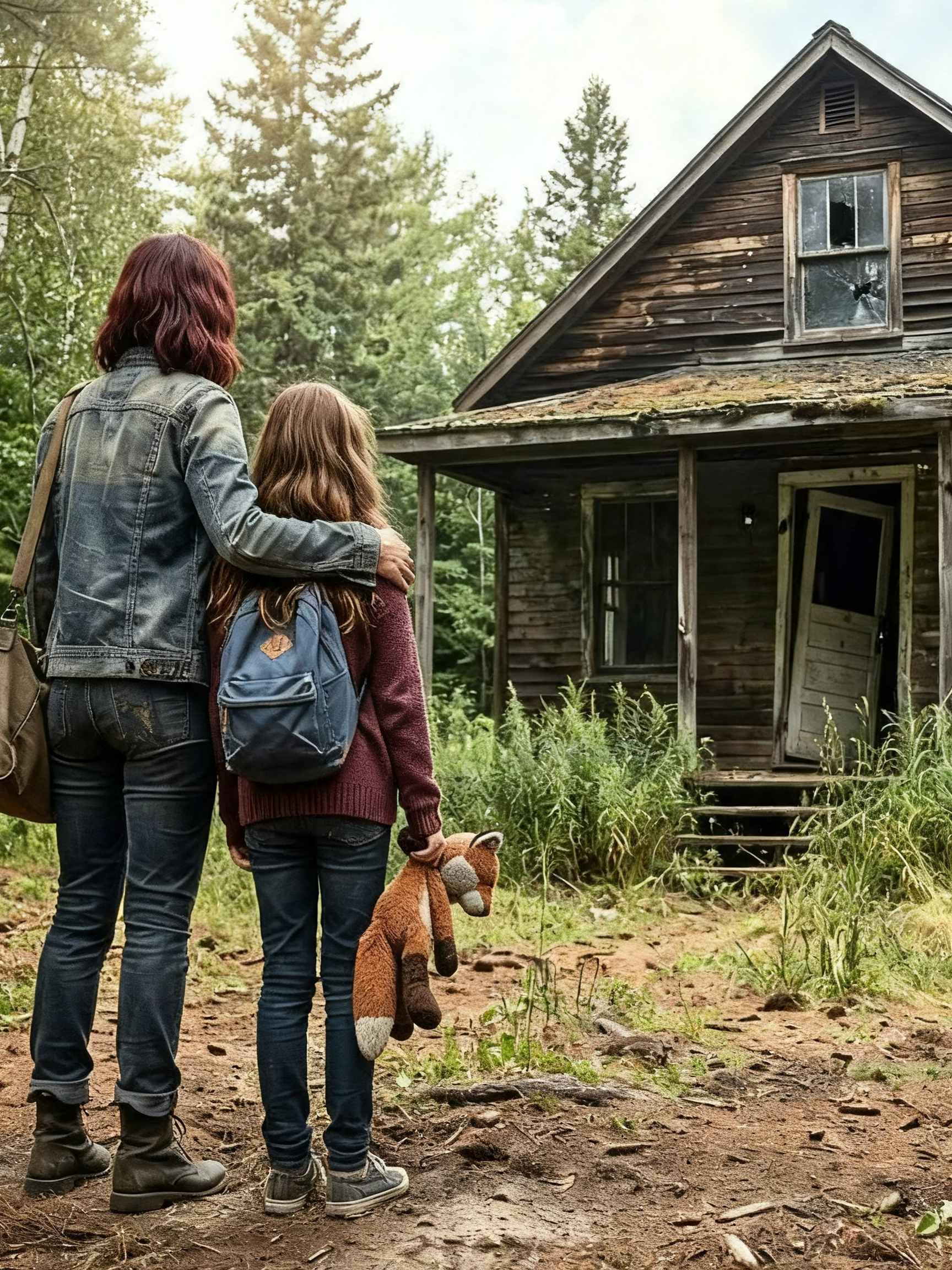
Evicted Days After Her Father’s Funeral, a Single Mom Bought a $9,000 Cabin—Then Her Daughter Found the Deed They Buried
“You have until five o’clock to get your junk off the porch.”
My brother said it four days after we buried our father.
Not four months.
Not four weeks.
I was standing in the kitchen where I had spent eight years measuring Dad’s medication, puréeing food after his second stroke, washing sheets at two in the morning, and doing remote bookkeeping jobs after my daughter went to sleep because somebody had to keep the lights on.
Evan stood on the other side of the granite island wearing Dad’s old Rolex.
His wife, Melissa, leaned against the refrigerator with her arms crossed.
My younger sister, Claire, was scrolling through her phone as if my eviction were a delayed flight announcement.
And beside them stood Clayton Voss, the attorney who had handled my father’s business affairs for almost twenty years.
Four people.
One kitchen.
One decision they had apparently made before Dad’s flowers had wilted.
My eleven-year-old daughter, Sophie, sat at the breakfast table with her backpack against her chest.
She was trying so hard not to look frightened that it broke something in me.
Evan slid a sheet of paper across the counter.
“The house transferred to me and Claire when Dad died,” he said. “You were allowed to stay here because you were helping him. That arrangement is over.”
Helping him.
That was what eight years had become.
Helping him.
I looked down at the paper.
NOTICE TO VACATE.
Melissa gave a little laugh.
“You should be grateful we gave you a few days.”
I looked at her.
She was wearing the diamond earrings my mother had left behind when she died.
Dad had promised those earrings to Sophie one day.
I said nothing.
Claire finally looked up from her phone.
“Don’t make this dramatic, Hannah.”
I turned toward her.
She sighed.
“You lived here rent-free for years.”
I almost smiled.
I had paid the property taxes twice when Dad’s medical bills drained his checking account.
I had replaced the furnace.
I had sold my little Honda and used the money to cover three months of nursing care after his first stroke.
I had missed Sophie’s third-grade Christmas concert because Dad aspirated during dinner.
I had turned down a full-time accounting position in Charlotte because Dad could no longer be left alone overnight.
I had done his laundry.
Changed his dressings.
Cut his food.
Driven him to cardiology appointments.
Argued with insurance companies.
Cleaned blood off bathroom tile.
Held his trembling hand when he woke confused at three in the morning and called me by my mother’s name.
But apparently I had lived there rent-free.
Evan leaned closer.
“You heard me, Hannah.”
I raised my eyes to his.
“Is that all?”
He blinked.
I think he had prepared himself for tears.
Maybe anger.
Maybe begging.
He had not prepared himself for that.
“Excuse me?”
“Is that all?” I repeated.
Melissa rolled her eyes.
“There she goes with the martyr routine.”
I folded the notice once.
Then again.
I put it in my pocket.
Sophie was watching me.
So I did the one thing I knew would frighten them more than screaming.
“All right.”
Claire frowned.
Evan actually looked disappointed.
“You understand that after five, anything left here is abandoned property.”
“I understand.”
“And Dad’s truck stays.”
“And the furniture.”
Melissa stepped forward.
“The silver serving set too.”
I looked at her earrings again.
Then I walked upstairs.
Sophie followed me.
The moment our bedroom door closed, she whispered, “Mom?”
I pulled two suitcases from the closet.
“Yes, baby?”
“Where are we going?”
I kept folding her clothes.
“I don’t know yet.”
Her mouth trembled.
I knelt in front of her and took both her hands.
“But wherever it is, nobody gets to make you feel ashamed for being there.”
That was the only promise I made.
By four-thirty, eight years of our lives had been reduced to two suitcases, six cardboard boxes, one plastic tub of photographs, Sophie’s school backpack, and an old cedar chest that had belonged to my mother.
Evan watched from the porch as I loaded everything into the ten-year-old Subaru I had bought after selling my Honda.
Melissa came outside carrying a black trash bag.
“You forgot these.”
She dropped it beside my feet.
Inside were my father’s old flannel shirts.
For a moment, I could not breathe.
Not because they were valuable.
Because Dad had worn the red one almost every day during the last winter of his life.
It still smelled faintly of cedar soap.
I picked up the bag.
“Thank you.”
That bothered her.
I could tell.
Cruel people rarely know what to do when they are denied the pleasure of watching something break.
Sophie climbed into the car.
I shut the hatch.
Then I looked back at the house.
My father had bought it when I was twelve.
A white Colonial with dark shutters on three wooded acres outside Asheville, North Carolina.
My mother had planted hydrangeas beneath the dining room windows.
Dad had built a swing in the oak tree.
Evan had broken his arm jumping from the garage roof when he was sixteen.
Claire had held her wedding shower in the backyard.
Sophie had taken her first steps in the hallway.
I thought leaving would feel like losing everything.
Instead, something strange happened.
For the first time in eight years, I realized nothing inside that house belonged to the version of me I was about to become.
Evan called from the porch.
“You’re not coming back, Hannah.”
I put my hand on the car door.
Then I looked at him.
That was all.
We spent the first night in a roadside motel beside Interstate 40.
The carpet smelled like bleach and old cigarettes.
Sophie slept with the television on because every time a truck passed outside, headlights swept across the ceiling.
I sat at the little desk near the window until almost three in the morning, looking at my bank account.
$13,482.17.
That was everything.
Eight years of part-time work.
Small tax refunds.
Birthday checks I never spent.
Money I had hidden away because some part of me must have known that depending on family was the most expensive form of housing there was.
The next morning, I took Sophie to school.
I told her teacher we were moving temporarily.
I did not tell her why.
Then I went to a coffee shop and opened every rental listing I could find.
The numbers made my stomach tighten.
First month.
Last month.
Security deposit.
Credit check.
Income verification.
I could technically afford two or three months.
After that, nothing.
At noon, I called a woman about a one-bedroom apartment above a garage.
She asked if I had a job.
“Full-time?”
“Then I’m sorry.”
At one-thirty, a landlord laughed when I said I had a child.
At two-fifteen, another wanted a six-month deposit.
At three, I closed the laptop.
That was when I saw the listing.
It had been posted in a county surplus property forum.
ABANDONED CABIN — CASH SALE — AS IS.
Price: $9,000.
Location: Laurel County, North Carolina.
One bedroom.
No central heat.
Well condition unknown.
Roof damage.
Possible foundation issues.
Eight acres.
The photographs were terrible.
The cabin sat at the end of a narrow gravel road thirty-eight miles north of Asheville.
Gray weathered siding.
Sagging porch.
Tin roof dark with rust.
Broken shutters.
Weeds waist-high around the steps.
It looked less like a home and more like a place where a movie villain buried evidence.
At the bottom of the listing was a sentence that made me pause.
Historic deed irregularities resolved by seller. Buyer encouraged to conduct independent title review.
I read it twice.
Then I called.
A woman named Mrs. Bell answered.
“You’re asking about the Mercer Gap cabin?”
“You understand it’s basically uninhabitable.”
“I understand.”
“You planning to flip it?”
There was silence.
“What are you planning to do?”
“Live there.”
Another silence.
Then she said, “Honey, you better come see it first.”
Sophie and I drove there after school.
The road climbed through thick stands of poplar and oak, twisting around ridgelines washed gold by late October.
Cell service disappeared ten minutes before we arrived.
The driveway was almost invisible.
The cabin looked worse in person.
One porch board cracked beneath my shoe.
A kitchen window had been covered with plywood.
The chimney leaned slightly east.
Inside, the rooms smelled like dust, pine, and damp stone.
There was an old woodstove.
Two small bedrooms instead of one.
A stone fireplace.
A kitchen with green cabinets from the 1970s.
No dishwasher.
No refrigerator.
Mouse droppings beneath the sink.
Sophie walked slowly through every room.
I expected her to hate it.
Instead, she stopped in front of the fireplace.
She ran her fingers over something carved into the heavy wooden mantel.
Then beneath it, almost erased by time:
My initials were Hannah Reed.
I laughed once.
“Guess another Hannah Reed lived here.”
Sophie looked at me.
“That’s creepy.”
“It’s wood, Soph.”
“Creepy wood.”
Mrs. Bell arrived five minutes later in a white pickup.
She was seventy if she was a day, with silver hair cut short and work boots muddy at the toes.
“This place belonged to my cousin Earl,” she told me. “He died in Arizona. Hadn’t been back here in twenty-seven years.”
“Why only nine thousand?”
“Because the county condemned the septic. Roof leaks. Nobody wants eight acres this far out. And because every contractor who sees it tells me to burn it down.”
I looked around.
“Does it have liens?”
“Back taxes?”
“Boundary dispute?”
“Not anymore.”
That last part made me look at her.
“What does that mean?”
She waved a hand.
“Old mountain records. Half the deeds around here were written when people measured property by white oak trees and creek bends. Lawyer cleared it before we listed.”
I thought about the sentence online.
Historic deed irregularities resolved by seller.
“Can I see the title report?”
I spent the next morning at the Laurel County recorder’s office.
I was not a lawyer.
But I was an accountant.
Numbers and paper trails had always made more sense to me than people.
The title report showed the cabin property had passed through six owners since 1971.
The current survey said 8.14 acres.
No mortgage.
No easement issues listed.
No obvious liens.
No reason not to buy except common sense.
At lunch, Evan called.
I almost ignored it.
Then I answered.
“You took Dad’s flannel shirts.”
I looked at my coffee.
“You put them in a trash bag.”
“They’re estate property.”
He continued.
“Melissa says some could be vintage.”
That was when I understood something important.
He was not calling because he wanted Dad’s shirts.
He was calling because I had left without asking his permission.
“Would you like them back?”
The question confused him.
“I can bring them.”
“No. Forget it.”
“All right.”
He lowered his voice.
“You need to sign the estate acknowledgment Clayton sent you.”
“I saw it.”
“It just confirms you’re not contesting Dad’s will.”
“I haven’t decided.”
His tone changed.
“Don’t start something you can’t afford.”
I looked through the coffee shop window.
Rain was starting.
“I’m serious.”
“We have lawyers.”
“The company alone is worth several million.”
“You’ll lose.”
I stirred my coffee.
“Then you have nothing to worry about.”
He hung up.
That afternoon, I bought the cabin.
With closing fees, title insurance, and recording costs, I had a little over $3,600 left.
It was probably the most irresponsible thing I had ever done.
It was also the first thing in years that was entirely mine.
The first night there, the temperature dropped to thirty-eight degrees.
We slept in sleeping bags in front of the fireplace because I did not trust the woodstove.
A raccoon crawled across the roof around midnight.
Sophie sat straight up.
“What was that?”
“Probably a serial killer.”
“A very small serial killer.”
She threw a rolled-up sock at me.
It was the first time she had laughed since we left Dad’s house.
The next morning, sunlight came through the broken kitchen blinds.
Dust floated above the floorboards.
Sophie ate cereal from a paper cup.
I was trying to reconnect an ancient faucet when she called from the living room.
“What now?”
“There’s something under here.”
I found her lying on her stomach beside the fireplace.
She had pushed aside the iron grate.
Behind it, one of the floorboards sat higher than the others.
“How did you see that?”
“My pencil rolled under.”
The board had two old screws.
That was strange.
I used a flathead screwdriver from the toolbox in my car.
The screws resisted.
Then turned.
When I lifted the board, cold air rose from a narrow cavity beneath the floor.
Inside was a canvas bundle wrapped in black plastic.
Sophie whispered, “Okay. That is definitely serial-killer stuff.”
I pulled it out.
It was heavier than it looked.
Inside the plastic was a rectangular steel document box.
Rust spotted the corners.
A tiny brass lock held the lid closed.
Sophie stared at it.
“Do we call somebody?”
“It’s our house.”
“That doesn’t answer the question.”
There was no key.
I carried the box into the kitchen.
We tried bobby pins.
A screwdriver.
A butter knife.
Finally, I used a hammer.
The lock snapped.
Inside were papers.
Dozens of them.
Some yellow with age.
Some sealed in plastic sleeves.
There were photographs.
Survey maps.
Tax receipts.
Two journals.
An envelope with my father’s name.
THOMAS REED.
My hands went cold.
Sophie saw my face.
I picked up the envelope.
The handwriting was Dad’s.
Not similar.
I sat down.
The envelope had been sealed.
On the front, beneath Dad’s name, someone had written:
If Thomas does not return, give this to Hannah.
I stared at those words for so long that Sophie touched my shoulder.
I opened it.
There were six pages.
The first sentence made my throat close.
Hannah, if you are reading this, then I was too cowardly to tell you while I was alive.
Sophie pulled out the chair beside me.
“You okay?”
I kept reading.
Dad wrote that the cabin had belonged to his mother, my grandmother Ruth Reed.
I remembered her only vaguely.
A woman with white hair, peppermint candies, and hands that always smelled like flour.
She died when I was seven.
According to Dad’s letter, this cabin had once been the heart of something much larger.
In 1954, my grandfather, Daniel Reed, and his younger brother purchased 1,146 acres across three ridges north of Asheville.
Two abandoned mica pits.
The family called it Reed Mountain.
Over the next thirty years, pieces were sold.
But in 1968, after discovering Daniel had secretly mortgaged part of the land to cover gambling debts, Ruth used money inherited from her own father to prevent foreclosure.
The refinancing deed did something Daniel apparently hated.
It placed 612 acres, including the main spring, two access corridors, timber rights, and all subsurface mineral rights beneath the remaining Reed properties, into Ruth’s separate ownership.
Not Daniel’s.
The cabin was the named homestead parcel.
Dad wrote that when Ruth died, Daniel told everyone she had left everything back to him.
She had not.
Her will divided the rights between her three children.
But one year later, documents were filed showing all three children had sold their interests to Daniel for one dollar each.
Dad admitted he signed.
His sister, Carol, signed.
But the third signature belonged to their older brother, William.
William had died eight months earlier.
My hands started shaking.
Dad’s next sentence was worse.
I knew it was false. I signed anyway.
I could hear my father saying it.
Not the weak, stroke-damaged voice he had at the end.
The voice from my childhood.
Dad wrote that his father used the fraudulent transfer to consolidate control of Reed Mountain.
When Daniel died, the family business—Reed Timber & Development—began building roads, leasing timber parcels, and eventually selling high-end lots.
Dad inherited controlling stock.
Aunt Carol received cash.
Years later, Dad transferred company ownership to a trust intended for his three children.
Evan eventually took over operations.
Claire handled marketing.
I stayed away.
Not because I was excluded at first.
Because I had never wanted anything to do with land development.
After my husband left, I moved back to Asheville.
Then Dad got sick.
Life narrowed.
The company became Evan’s world.
Dad became mine.
But according to the letter, Dad had spent the final twelve years of his life trying to undo what his father had done.
He had located Ruth’s original will.
The fraudulent transfer.
An old survey.
And something else.
In 2007, the state approved a corrected chain-of-title affidavit based on William’s death certificate and the original probate file.
Dad had never filed it publicly.
He said he was afraid.
Not of losing money.
Of destroying the family company and sending his own brother’s children into bankruptcy.
So he waited.
Then the company expanded.
Evan borrowed against it.
Developers became involved.
Roads were built.
And the lie became more expensive every year.
I told myself I was protecting the family. The truth is I was protecting my comfort from the consequences of doing the right thing.
Then I read the line that changed everything.
The cabin was never sold.
Ruth’s estate transferred it, together with her retained timber, water, access, and mineral interests, into a testamentary trust for the benefit of any descendant who provided uncompensated care to a disabled direct family member for more than five consecutive years.
I read it again.
Dad had discovered the trust clause in 2013.
At first, there had been no qualifying beneficiary.
Then I moved home.
Then five years passed.
Dad had signed a notarized affidavit recognizing me as the qualified beneficiary.
The trustee was supposed to be Clayton Voss.
My father’s attorney.
The same attorney who had stood in our kitchen while my brother evicted me.
The same attorney who had slid the notice across Dad’s granite island.
The same attorney who was now asking me to sign an acknowledgment that I had no claim against the estate.
I put the letter down.
Sophie whispered, “Mom?”
My mouth was dry.
“There’s more.”
Beneath Dad’s letter was a sealed envelope.
On the front were six words.
DO NOT GIVE THIS TO CLAYTON.
Inside was a copy of an email dated three years earlier.
From Dad to Clayton Voss.
Subject: Ruth Reed Trust.
Hannah has now exceeded the five-year caregiving condition. I want the beneficiary affidavit recorded immediately. I also want the cabin transferred into her name and the trust activated according to Mother’s instrument.
Clayton’s reply was beneath it.
I strongly advise delaying this action. Activating the trust at this stage would create severe complications for Reed Development’s current land holdings and financing agreements.
Dad answered:
Those complications exist because the underlying transfers were defective. That does not give us the right to continue hiding them.
We need to discuss this in person.
No. Record it.
There were no later emails in the box.
But there was a handwritten note.
Clayton never recorded it.
My skin prickled.
Sophie looked at the maps.
“So… what does all this mean?”
“I don’t know yet.”
“Are we rich?”
I almost laughed.
Children know exactly which question matters least and ask it first.
“I have no idea.”
She picked up one of the survey maps.
Red lines crossed more than a thousand acres.
Names were written beside parcels.
REED DEVELOPMENT LLC.
BLUE RIDGE VISTA PARTNERS.
WILLOW GLEN HOMEOWNERS ASSOCIATION.
MOUNTAIN CREST LODGE.
Sophie pointed to a blue line snaking through the center.
“What’s that?”
I checked the legend.
Spring easement.
“What’s an easement?”
“A legal right to use land.”
“So we own the road?”
“The water?”
“The mountain?”
I looked at the steel box.
“Maybe something more complicated than that.”
At the bottom was another envelope.
Dad had written my name on it.
If they ever force you out, do not fight them in the house.
Do not warn them.
Do not threaten them.
Let them believe you left with nothing.
Find Ruth’s cabin.
Everything you need is there.
And before you sign any waiver, settlement, acknowledgment, release, quitclaim, or family agreement, make them answer one question:
Which deed came first?
Dad had underlined the last sentence twice.
For the first time since his funeral, I cried.
Not loudly.
Not beautifully.
I put my forehead against the kitchen table and cried because my father had known.
He had known what Evan could become.
He had known what Claire would choose.
He had known Clayton had betrayed him.
He had known I might be humiliated in the house where I had cleaned his wounds and spoon-fed him oatmeal.
And instead of stopping it while he was alive, he had left me a trapdoor beneath a cabin floor.
That hurt more than losing the house.
Because love should not require a scavenger hunt after death.
Sophie put her arms around me.
I cried for maybe thirty seconds.
Then I stopped.
I wiped my face.
I stacked the documents.
And I became very quiet.
For the next six days, nobody in my family knew what we had found.
That was deliberate.
I hired a lawyer named Rebecca Sloan.
I found her through the state bar directory.
Property litigation.
Probate fraud.
Fiduciary misconduct.
She worked out of a brick office in downtown Asheville above a dentist.
I carried the steel box inside.
She spent twenty minutes reading Dad’s letter.
Then another forty examining the deeds.
Then she closed the office door.
“Where did you get these?”
“In the cabin.”
“Who knows?”
“My daughter.”
“No one else?”
She leaned back.
“Keep it that way.”
I asked the question I had been afraid to ask.
“Is any of this real?”
Rebecca looked at me.
“Oh, it’s real.”
My heart started pounding.
“How real?”
She pointed to Ruth’s 1968 deed.
“This document appears recorded.”
Then to the later family transfer.
“This one appears facially defective because one grantor was dead.”
Then to Dad’s affidavit.
“This was signed, notarized, but apparently never recorded.”
Then to the trust.
“This is where it gets dangerous.”
“For everyone.”
She explained it slowly.
Ruth’s trust had not given me ownership of every house, road, hotel, and development now sitting on the old Reed acreage.
That would have been absurd.
But it had retained certain underlying property interests.
Water rights.
Timber rights on specified tracts.
Subsurface mineral rights.
Two historic access corridors.
And a reversion interest tied to fraudulent or unauthorized transfers.
For decades, Reed Development had behaved as if those interests did not exist.
Banks had loaned money against properties assuming clean title.
Developers had sold lots assuming unrestricted access.
One luxury subdivision of 122 homes depended on water lines crossing an easement apparently controlled by Ruth’s trust.
A proposed $18 million resort expansion needed the old north access road.
And three parcels Evan planned to sell the following month appeared to include mineral rights the company did not legally own.
“Value?” I asked.
Rebecca shook her head.
“Too early.”
“Ballpark.”
She looked at me carefully.
“If these instruments survive challenge, the trust assets and associated claims could be worth tens of millions.”
I said nothing.
Sophie sat beside me coloring in a notebook.
She looked up.
“Like twenty million?”
Rebecca gave her a small smile.
“Possibly.”
“Possibly.”
Sophie’s eyes widened.
I said, “Stop.”
Rebecca’s expression changed.
“Most people hear fifty million and stop listening.”
I looked at Dad’s letter.
“I spent eight years changing an old man’s diapers while my brother called twice a month and my sister visited on holidays. Four days after the funeral, they put my daughter’s clothes on the porch. I don’t want a yacht.”
Rebecca nodded once.
“Then tell me what you do want.”
I thought about that.
“I want the truth recorded.”
That afternoon, Rebecca filed three things.
A notice of claim against the Reed family trust.
A petition to compel accounting from Clayton Voss.
And a notice of potential title defect affecting specified Reed Development parcels.
Not a lawsuit for millions.
Just enough to keep anyone from quietly selling the land before we understood what had happened.
The effect was immediate.
Evan called fourteen times.
I did not answer.
Claire texted.
WHAT THE HELL ARE YOU DOING?
I did not respond.
Clayton emailed.
Hannah, it appears there is confusion regarding certain obsolete family documents. Please contact my office before taking further action that could expose you to substantial liability.
I forwarded it to Rebecca.
She replied:
Do not answer.
Two hours later, Evan drove to the cabin.
I knew he had arrived because he leaned on the horn for twenty seconds.
Sophie looked through the front window.
“Uncle Evan.”
“Should I go to my room?”
I opened the door.
He stormed across the yard.
His shoes were too expensive for mud.
“What did you file?”
“Hello, Evan.”
He shoved a folded court notice toward me.
“What is this?”
“It looks like paper.”
His face reddened.
“You are claiming rights against company land?”
“I filed notice.”
“Based on what?”
I leaned against the doorway.
“Talk to my lawyer.”
He laughed.
“You have a lawyer?”
“With what money?”
I did not answer.
His eyes moved past me into the cabin.
For the first time, he saw where we were living.
Plywood window.
Bare floors.
Space heater.
Boxes stacked against a wall.
Something flickered across his face.
He thought the cabin proved he had won.
“You spent your savings on this?”
“How much?”
“Nine thousand.”
He laughed again.
Actually laughed.
“My God, Hannah.”
Sophie appeared behind me.
He saw her.
That should have stopped him.
It did not.
“You’re going to drag Dad’s company into court while you’re living in a condemned shack?”
I said, “Apparently.”
“You have no idea what you’re doing.”
“Probably not.”
“You know Clayton has handled these deeds for twenty years?”
“You think you found something he missed?”
I looked at him.
That made him pause.
“What’s that supposed to mean?”
“I don’t think he missed it.”
The change in his face lasted less than a second.
But I saw it.
Then it disappeared.
“You’re insane.”
“You’re going to lose what little you have left.”
“You’ll owe legal fees.”
He stepped closer.
“You want money? Is that it?”
“Then what?”
I looked at the man wearing our father’s watch.
“The truth.”
He snorted.
Then he turned and walked toward his SUV.
Before he reached it, I called his name.
He looked back.
I almost asked Dad’s question.
Which deed came first?
But not yet.
Dad had written:
Do not warn them.
So I simply said, “You forgot to return Dad’s medical file.”
He stared at me.
“The blue accordion folder from his office.”
“Why do you need it?”
“Insurance records.”
His face tightened.
“I’ll look.”
Then he left.
That blue folder mattered because Dad’s handwriting history was inside.
Three years earlier, a fall had shattered two bones in his right hand.
For almost seven months, he could barely sign his name.
Rebecca had noticed something I had not.
A deed transferring one of Ruth’s disputed access corridors to Reed Development carried Dad’s elaborate full signature during that exact period.
The signature looked perfect.
Too perfect.
Within two weeks, the dispute stopped being about inheritance.
It became about fraud.
Rebecca subpoenaed county recording records.
The documents showed eleven transfers involving old Reed property interests.
Four had been notarized by employees connected to Clayton’s former law office.
Two listed witnesses who could not be located.
One document had been filed six months after the purported signatory died.
Another used a legal description copied from a 1932 survey but changed one number in a way that moved a boundary nearly half a mile.
And then there was Dad’s beneficiary affidavit.
The original had not vanished.
Clayton’s office had scanned it.
A metadata audit showed the file existed on his firm server.
It had been opened twelve times.
The last time was two days after Dad died.
Then somebody deleted it.
That was when Rebecca told me to stop thinking of Clayton as the family lawyer.
“Think of him as a defendant who hasn’t been named yet.”
Evan still believed he was in control.
I knew because he announced the sale of Reed Ridge North to a national hospitality company.
Forty-two million dollars.
Luxury cabins.
Private event venue.
Mountain restaurant.
The project had been under negotiation for nearly a year.
At Dad’s funeral, Evan had even mentioned “something big” he was closing.
The sale was supposed to finalize Friday.
On Wednesday, the buyer’s title insurer received Rebecca’s notice.
Thursday morning, closing was suspended.
Thursday afternoon, Evan called me.
This time I answered.
“You just cost us forty-two million dollars.”
“I filed a title claim. Your title cost you the closing.”
“You vindictive little—”
He stopped.
I heard someone speaking behind him.
Then his voice lowered.
“Withdraw it.”
“We’ll give you fifty thousand dollars.”
I almost laughed.
“One hundred.”
“Two hundred fifty thousand.”
“Hannah, you live in a cabin that should be bulldozed.”
“You have three thousand dollars.”
“Less now.”
“You’re raising a child.”
“I know that too.”
“Then stop acting like you can afford principles.”
I went still.
That sentence stayed with me.
Stop acting like you can afford principles.
I had spent most of my adult life around people who treated morality like a luxury purchased after the mortgage was paid.
Dad had done it.
Clayton had done it.
Evan was doing it now.
I looked across the cabin.
Sophie was kneeling beside the fireplace doing math homework.
The loose floorboard was back in place.
The steel box was in Rebecca’s vault.
I said, “I think principles are usually most expensive right before somebody discovers they should have bought them.”
He hung up.
The family turned against me publicly after that.
Not just Evan and Claire.
Aunt Carol called relatives.
Melissa posted vague messages online about “greedy people who appear when someone dies.”
Claire told mutual friends I was emotionally unstable.
Clayton sent a letter suggesting I had removed documents belonging to Dad’s estate.
A cousin I had not heard from in six years wrote:
Your father would be disgusted.
That one almost got me.
Then Sophie saw it over my shoulder.
She asked, “Would Grandpa be disgusted?”
I looked at the letter he had hidden.
“How do you know?”
“Because he told us where to look.”
We repaired the cabin one piece at a time.
That mattered more than I expected.
A retired carpenter named Pete Dawson replaced the worst porch boards for almost nothing after hearing Sophie and I were living there.
A church group repaired part of the roof.
I traded bookkeeping help to an electrician for new wiring in the bedrooms.
Mrs. Bell brought us an old refrigerator.
Sophie painted the kitchen cabinets white.
I found a used woodstove online.
We learned the well worked.
We learned the septic could be repaired instead of replaced.
We learned cold mountain mornings smelled like chimney smoke and wet leaves.
And we learned that humiliation changes shape once you survive it.
At first, the cabin had felt like evidence of what my family had reduced us to.
Then it became evidence that we had survived without them.
One Saturday morning, Sophie was sanding the mantel when she called my name.
Not loudly.
Just strangely.
I came in from the porch.
She was staring at the carved initials.
“I think this doesn’t mean Hannah Reed.”
“What detective theory do you have now?”
She brushed dust from the letters.
“Grandma Ruth.”
R.R., not H.R.
Then Sophie pointed beneath the carving.
There was another mark.
It only looked like a six under layers of varnish.
I fetched a flashlight.
The inscription actually read:
H.R. — 1988.
My initials.
Hannah Reed.
I was born in 1987.
My heart started beating harder.
Sophie whispered, “Who carved your initials in this house when you were a baby?”
I called Aunt Carol.
She answered on the fourth ring.
Her voice was icy.
“I have nothing to say to you.”
“I’m not calling about the lawsuit.”
“Then what?”
“Did Dad ever bring me to Ruth’s cabin?”
“Aunt Carol?”
Another silence.
Then she said, “You need to leave that place alone.”
I looked at Sophie.
“Because your father should have burned it thirty years ago.”
The call ended.
That afternoon, I searched the photographs from the steel box.
Near the bottom was a Polaroid.
Dad looked about thirty.
He was standing on the cabin porch.
In his arms was a baby.
On the back, he had written:
Hannah at Ruth’s place. September 1988.
Underneath:
She wanted this kept for the girl.
I sat on the floor.
My grandmother had died the following year.
For thirty-eight years, my family had acted as though I had no meaningful connection to Reed Mountain.
But Ruth had known me.
Had apparently intended something for me before I could even walk.
Rebecca found the answer in an amendment to the trust.
Ruth had added a contingent beneficiary clause after my birth.
Not specifically naming me as owner.
But naming “the first female grandchild of my son Thomas who, through action rather than entitlement, demonstrates continued care of the family’s vulnerable.”
The language was strange.
Old-fashioned.
More moral than legal.
But the later caregiving condition made it enforceable.
Rebecca looked at me after reading it.
“Your grandmother built a character test into a property trust.”
I stared at the page.
“She never knew what my life would be.”
“She couldn’t know Dad would have strokes.”
“She couldn’t know my husband would leave.”
“Then why?”
Rebecca tapped the final paragraph.
Ruth had written:
Land makes men believe possession is proof of merit. It is not. I have watched property turn brothers against sisters, husbands against wives, and sons against mothers. What remains of mine should go, if possible, to one who has learned that care is also labor, though families seldom price it.
I had to stop reading.
Not because it promised wealth.
Because somebody had understood.
Decades before I spent nights sleeping in a chair beside Dad’s hospital bed, my grandmother had understood that families often treated caregiving as invisible work.
That the child who stayed became the child assumed to need less.
That loyalty was rewarded with expectation.
That sacrifice, once repeated often enough, stopped looking generous and started looking mandatory.
For eight years, nobody in my family had asked what caring for Dad cost me.
They only asked whether his medication was picked up.
Whether his insurance renewal was filed.
Whether the house was clean before Thanksgiving.
Whether I could handle “one more week” without outside help.
Then after he died, the people who had been free because I stayed told me I had lived there rent-free.
Ruth’s trust did not feel like winning the lottery.
It felt like a dead woman reaching across fifty-eight years to put a price tag on something everyone else had insisted was worthless.
The first major hearing happened six weeks after we moved into the cabin.
Evan arrived with three attorneys.
Claire came in an emerald coat and sat behind him.
Melissa wore Dad’s watch this time.
That made me smile.
Clayton sat at the other counsel table with his own lawyer.
That mattered.
For the first time, he and my siblings were no longer officially represented together.
Fear was dividing them.
Judge Eleanor Price was sixty-three, silver-haired, and unimpressed by drama.
Rebecca presented the original recorded deed.
Then Ruth’s trust.
Then William Reed’s death certificate.
Then the fraudulent transfer supposedly signed by William eight months after burial.
Evan’s attorney argued that decades of subsequent ownership created reliance interests.
Rebecca agreed.
That surprised them.
Then she said, “Reliance cannot convert forgery into title.”
Clayton’s lawyer argued he had only inherited the file from an older firm.
Rebecca produced the scanned beneficiary affidavit from his server.
Then the email from Dad telling him to record it.
Then the deletion log.
Clayton stopped taking notes.
Judge Price asked him directly, “Mr. Voss, did you receive instruction from Thomas Reed to record this affidavit?”
His attorney stood.
“My client invokes—”
Clayton whispered something.
The attorney sat.
Clayton looked at the judge.
“Did you record it?”
“I believed doing so would create title chaos and potentially harm Mr. Reed’s company.”
The judge stared at him.
“Did your client instruct you to protect his company or record his affidavit?”
Clayton swallowed.
“To record the affidavit.”
“Then why did you substitute your judgment for his lawful instruction?”
He had no answer.
That was the moment everything changed.
Until then, my family had treated me like a disgruntled daughter waving old papers.
After that hearing, the state bar opened an investigation.
The county clerk referred several suspicious instruments to the district attorney.
The title insurer froze multiple Reed Development transactions.
And the bank financing Evan’s resort project demanded a full title audit.
Within a month, the forty-two-million-dollar sale was dead.
But Evan still believed he could buy his way out.
He came to the cabin again.
This time alone.
Snow had started falling.
I was splitting kindling behind the porch.
He stood at the edge of the yard in a navy overcoat.
“You’ve made your point.”
I kept stacking wood.
“I heard you.”
“You’ve embarrassed Clayton.”
I looked up.
“Clayton committed malpractice.”
“You’ve frozen company assets.”
“Title defects froze them.”
“You’ve scared lenders.”
“Fraud scares lenders.”
His jaw tightened.
“You always do that.”
“Talk like you’re better than everybody.”
I almost laughed.
“I spent eight years cleaning Dad’s bathroom.”
“So I promise superiority wasn’t the emotion available to me.”
He stepped closer.
“You want me to apologize?”
“Fine. I apologize.”
“That was fast.”
He took a breath.
“We’ll give you the cabin. Obviously.”
“I already own it.”
“Plus five acres around it.”
“I own eight.”
His voice rose.
“What do you want?”
I looked toward the tree line.
Snow caught in his hair.
“I already told you.”
“Truth is not a settlement term.”
“It should be.”
He stared at me.
Then he said something I never forgot.
“You think Dad chose you?”
“He didn’t.”
I said nothing.
“You think this box means he trusted you more than us? He didn’t. He was afraid of you finding out he was a coward.”
That hurt because it was true.
Evan saw it.
So he pushed harder.
“He had years to tell you.”
“He watched you give up your career.”
“He watched you struggle.”
“And he still didn’t tell you.”
“You weren’t his favorite, Hannah.”
I set down the piece of wood in my hand.
He blinked.
I stepped toward him.
“I was the one he could use.”
That silenced him.
Because that was the family truth beneath every deed and dollar.
Evan had been the son Dad respected.
Claire had been the daughter he protected.
I had been the daughter he depended on.
Dependence looks like love when you are desperate enough.
But they are not always the same thing.
I said, “I’m not doing this because Dad chose me.”
“Then why?”
“Because Grandma Ruth tried to stop this family from stealing from the person who stayed.”
He scoffed.
“She was dead before any of this.”
I continued.
“She knew you before you were born.”
“What does that even mean?”
“She knew the type.”
He left without making another offer.
Three months later, the forensic title report was complete.
The numbers shocked even Rebecca.
Ruth’s retained interests touched 1,031 acres.
Not all of it could be recovered.
Too many innocent purchasers.
Too many decades.
Too many statutes protecting people who had bought homes in good faith.
I did not want 122 families thrown out because my grandfather forged a dead man’s signature.
Neither had Ruth.
Her trust specifically protected innocent residential purchasers.
That clause saved Willow Glen.
It also destroyed Evan’s favorite argument that enforcing the trust would make ordinary families homeless.
The trust targeted profits and retained rights, not innocent homeowners.
Reed Development owed compensation for timber harvested without authorization.
Royalties from two stone extraction leases.
Water easement payments.
Access fees.
Proceeds from three commercial land sales.
And decades of income generated from rights it had never legally owned.
Negotiations began at $3.2 million.
Rebecca laughed.
Then $7 million.
Then $12 million.
I said no each time.
Not because I wanted more.
Because every offer demanded confidentiality.
Every offer required me to state that the historical title discrepancies were “unintentional clerical errors.”
They were not.
William had been dead.
Dad had known.
Clayton had known.
Maybe Evan had not known at the beginning.
But by the end, he had known enough.
My answer stayed the same.
“No confidentiality.”
The company’s board panicked.
Evan owned only thirty-eight percent of voting shares.
Dad’s old trust held twenty-four percent.
Outside investors held the rest.
When lenders threatened default, three directors turned against Evan.
Then Claire did too.
She called me late one evening.
I was washing dishes.
“I didn’t know.”
I looked out the window.
Sophie was outside with Pete Dawson building a raised garden bed.
“What didn’t you know?”
“About William.”
“Or Clayton.”
“I thought Dad left the house to Evan and me because you’d gotten years of free housing.”
I closed my eyes.
That sentence again.
Free housing.
“I’m saying I was wrong.”
She started crying.
I stood there listening.
Months earlier, I might have comforted her automatically.
That was what I did.
I carried discomfort so other people did not have to.
This time I let the silence stay where it belonged.
Finally she whispered, “Aren’t you going to say anything?”
“What would you like me to say?”
“That you forgive me.”
She went quiet.
“Maybe eventually,” I added. “But not because you’re uncomfortable tonight.”
She inhaled sharply.
“You watched Melissa put my belongings in trash bags.”
“You watched Sophie sit in that kitchen while Evan gave us until five.”
“You said I lived there rent-free.”
“I’m sorry.”
“I believe you.”
She started crying harder.
“But believing you’re sorry doesn’t create an obligation for me to make you feel forgiven.”
That was the first boundary I had ever given my sister that did not come with an apology.
It felt cleaner than revenge.
Two weeks later, Claire voted to remove Evan as chief executive.
He blamed me.
He was only partly right.
The company had not fallen apart because I attacked it.
It had fallen apart because its foundation was a lie and everyone had gotten too comfortable living upstairs.
Clayton Voss surrendered his law license before the disciplinary hearing concluded.
The district attorney charged him with evidence tampering and filing false instruments related to two later transfers.
He eventually pleaded guilty to reduced charges and received probation, community service, and restitution obligations.
Some people said he got off easy.
Maybe he did.
But his name disappeared from the polished brass sign outside his office.
His clients left.
His reputation became a warning told quietly between attorneys.
And sometimes losing the identity you used to justify yourself is its own sentence.
Evan faced no criminal charge for the old forged deeds.
There was not enough evidence he had known their origin when he took over.
But civil discovery showed that six months before Dad died, Evan had received an internal memo warning of “legacy chain-of-title exposure” on Reed Mountain.
He had ordered staff to “close the file until after current financing is secured.”
That destroyed his position with the board.
The final settlement happened eleven months after we moved into the cabin.
By then, the roof was new.
The septic worked.
The broken kitchen window had been replaced.
Sophie had painted her bedroom pale yellow.
The porch was straight.
The fireplace no longer smoked.
And I had restarted my career.
One of Rebecca’s clients hired me to manage books for a construction company.
Then another.
By spring, I had six clients.
I could pay my own bills without Dad.
Without Evan.
Without anybody.
The settlement meeting took place at a conference center in Asheville.
There were fourteen people around the table.
Bank representatives.
Insurance counsel.
Reed Development board members.
The proposed agreement was ninety-two pages.
Under it, Ruth’s trust would receive $21.8 million in cash compensation.
The cabin and 114 surrounding acres would be confirmed as trust property.
The trust would retain permanent ownership of the main spring.
A conservation easement would protect 380 acres of ridge land from development.
Existing homeowners would receive permanent, no-cost residential access rights.
Reed Development would receive limited commercial easements in exchange for annual payments.
And, most importantly to me, the settlement contained a historical title declaration acknowledging that Ruth Reed’s property interests had been wrongfully transferred through a fraudulent instrument after William Reed’s death.
Her name would be restored to the chain of title.
Not a clerical error.
Not confusion.
Wrongfully transferred.
I read that sentence three times.
Then I signed.
People assume that twenty-one million dollars changes a person in the room where the number becomes real.
It did not feel real.
What felt real was seeing Ruth Reed’s name printed in a legal document everyone had to acknowledge.
What felt real was Sophie leaning against my shoulder.
What felt real was remembering Melissa’s trash bag on the porch.
Rebecca asked me quietly, “You okay?”
“What are you thinking?”
“That Grandma Ruth finally got her land back.”
Not all of it.
Not physically.
But her truth.
That mattered.
I did not keep twenty-one million dollars.
That surprised everyone except Sophie.
Ruth’s trust was designed to last.
After taxes, fees, restitution allocations, and settlement expenses, a large portion remained under my control as beneficiary-trustee.
I used some to secure our future.
A college fund for Sophie.
A retirement account.
A reliable car.
Health insurance I no longer had to fear losing.
I repaired the cabin completely.
But I refused to turn it into a mansion.
The green kitchen cabinets disappeared.
The crooked mantel stayed.
So did H.R. — 1988.
The majority of the trust assets funded something I named the Ruth Reed Care Fund.
It provided emergency housing grants, legal assistance, and short-term financial support to unpaid family caregivers—especially women who had left jobs to care for parents, spouses, or disabled relatives and later found themselves financially vulnerable.
Rebecca helped structure it.
Pete built the sign outside the small office we opened in Asheville.
Our first grant went to a sixty-two-year-old woman named Denise who had cared for her mother with dementia for nine years.
After her mother died, Denise’s brothers sold the house and gave her thirty days to leave.
When she sat across from me explaining what had happened, she apologized three times for crying.
I handed her a tissue.
“You don’t have to apologize here.”
She looked at me.
“People keep telling me I should’ve planned better.”
I knew exactly what that sentence meant.
So I asked, “When were you supposed to plan?”
She frowned.
“Between changing your mother at two in the morning and taking her to neurology appointments?”
Her face crumpled.
That was when I understood what Ruth had really left.
Not twenty-one million dollars.
Permission.
Permission to say unpaid care was work.
Permission to stop romanticizing the person who sacrificed until she disappeared.
Permission to admit that families often reward the loudest child and invoice the quiet one.
Evan sold his remaining shares in Reed Development eighteen months later.
He moved to Florida.
Melissa went with him.
They divorced the following year.
I learned about it from Claire.
I did not celebrate.
By then, revenge had become boring.
Claire and I rebuilt something.
Not what we had before.
Something more careful.
She came to the cabin twice a month at first.
Then sometimes just for coffee.
One afternoon she brought the diamond earrings our mother had owned.
The ones Melissa wore the day I was evicted.
Claire placed the box on the table.
“These should go to Sophie.”
I looked at them.
She seemed startled.
“Mom wanted—”
“I know what Mom wanted.”
“Then why?”
I pushed the box back.
“Because Sophie doesn’t need another family object carrying a debt.”
Claire stared.
I smiled slightly.
“If you want to give her something, give her a birthday present because she’s your niece. Not because dead people left instructions.”
Claire began to laugh.
Then I did too.
We donated the earrings.
The money bought winter coats for twelve families through the care fund.
Dad’s house sold.
That surprised me more than I expected.
Evan had refinanced it before the title case fully exploded.
After his company position collapsed, he could not justify keeping it.
A couple from Raleigh bought it.
They had three children.
Months later, I drove past once.
The hydrangeas were blooming.
A bicycle lay in the driveway.
Someone had hung a tire swing from the oak.
I did not stop.
For years, I had thought home was the place where the most memories were stored.
I was wrong.
Sometimes home is simply the first place where you no longer have to earn permission to stay.
On the second anniversary of Dad’s death, Sophie and I hiked to the north ridge behind the cabin.
The trust land spread below us in layers of autumn orange and gold.
She was thirteen now.
More confident.
She carried Dad’s old red flannel shirt tied around her waist.
I had kept only that one.
She sat on a boulder overlooking the valley.
“Do you forgive Grandpa?”
Children have a talent for walking straight into rooms adults spend years circling.
I sat beside her.
“I don’t know.”
“You loved him.”
“Can you love somebody and still be mad at them?”
“For how long?”
“Maybe forever.”
She thought about that.
“Is that bad?”
The wind moved through the trees.
I looked toward the cabin roof visible through the branches.
Dad had failed me.
That truth did not erase the nights I held his hand.
It did not erase the time he taught me to drive.
Or the Sunday pancakes.
Or how he stayed up all night when Sophie had pneumonia.
People are inconvenient that way.
They are rarely villains every minute.
Dad had been weak where courage mattered most.
He had loved me.
He had used me.
He had tried to repair what his father did.
He had waited too long.
All of those things could be true at once.
Sophie said, “I think he knew Uncle Evan would throw us out.”
“I think so.”
“That’s terrible.”
“Why didn’t he stop him?”
I looked at the mountains.
“Because sometimes people would rather leave instructions for courage than use their own.”
She was quiet after that.
Three years after the eviction, Reed Development changed its name.
The new board wanted distance from the scandal.
The company survived.
Most employees kept their jobs.
Existing homeowners kept their homes.
The mountain did not collapse.
That mattered because Evan had spent months telling everyone that if I pursued the truth, ordinary people would suffer.
It was the oldest trick powerful families had.
Pretend justice is too destructive.
Pretend truth is irresponsible.
Pretend the person asking questions is selfish because other people built comfortable lives around the lie.
But the world had not ended.
Only their certainty had.
The cabin became our permanent home.
We added a screened porch.
A second bathroom.
A small office for me.
Sophie convinced me to adopt an old dog named Franklin who snored like a chainsaw.
Every autumn, leaves buried the gravel road.
Every winter, I stacked firewood beneath the porch.
Every spring, the mountain turned green almost overnight.
Sometimes people from the care fund visited.
Women mostly.
People with stories that sounded different until you listened closely.
A son who had cared for his disabled brother and been cut out of the family business.
A daughter who spent twelve years caring for both parents while siblings lived across the country, then discovered the estate had been divided equally without reimbursing a dollar of her expenses.
A widow forced from her in-laws’ home after caring for her husband through cancer.
A grandmother raising grandchildren after her daughter disappeared.
They all apologized for needing help.
That broke my heart more than the money ever had.
So the fund’s office had one rule printed nowhere but followed by everyone.
We never asked, “Why didn’t you save more?”
We asked, “What did caring cost you?”
Sometimes there was money behind the answer.
Sometimes a career.
Sometimes health.
Sometimes a marriage.
Sometimes ten years.
Sometimes dignity.
Once, a reporter asked why I had created the fund instead of enjoying the inheritance privately.
I told her the truth.
“It didn’t feel like an inheritance.”
“What did it feel like?”
“Back pay.”
She laughed.
The interview ran the next Sunday.
Three days later, I received a letter from Florida.
No return name.
But I knew the handwriting.
I don’t expect you to answer.
I spent a long time telling myself you destroyed the company I built. Eventually I had to admit I inherited something I never examined because I benefited from not examining it.
I was cruel to you.
Worse, I was cruel in front of Sophie.
I don’t know how to apologize for that without making the apology another thing I ask you to carry.
So I won’t ask for forgiveness.
Dad depended on you because you always stayed.
I think we all learned to believe that meant you had nowhere else to go.
I was wrong.
I read it once.
Then folded it.
I did not call him.
I did not destroy it either.
I put it in the steel box.
Beside Dad’s letter.
Beside Ruth’s trust.
Beside the forged deed.
Not every story needs reconciliation.
Sometimes acknowledgment is enough.
Years passed.
Sophie turned sixteen.
Then seventeen.
She began talking about colleges.
She wanted to study law.
Of course she did.
“Property law?” I asked one night.
She made a face.
“Absolutely not.”
“Maybe civil rights.”
“Or environmental law.”
“Even better.”
She smiled.
“Do you think Grandma Ruth would like me?”
“You mean great-grandma.”
“You know what I mean.”
I looked at the mantel.
“I think she already did.”
The summer before Sophie left for college, Reed Development’s successor company contacted me.
They wanted to buy a permanent commercial access easement across one section of trust property.
A new eco-lodge project.
The proposal was reasonable.
Environmentally controlled.
No residential displacement.
Good local jobs.
The board sent two representatives to the cabin.
One of them was Evan.
I had not seen him in almost six years.
He looked older.
Gray at the temples.
No expensive SUV.
He arrived in a rented Ford.
For a moment we stood on opposite sides of the same porch where he had once laughed at me for spending my savings on a condemned cabin.
“Hi, Hannah.”
His eyes moved toward the roof.
“You fixed it.”
“A little.”
“A little?”
I stepped aside.
He hesitated.
We sat at the kitchen table.
The same table where I had first opened Dad’s letter.
The company’s young attorney explained the proposal.
Annual easement fee.
Environmental protections.
Public trail funding.
No transfer of water or mineral rights.
The documents were clean.
Rebecca—now one of my closest friends—had already reviewed them.
Everything was fair.
I could have signed that afternoon.
But something in me wanted to understand whether Evan remembered.
Not the lawsuit.
Not the money.
The beginning.
He pushed the agreement toward me.
“If you’re comfortable, they can finalize next week.”
I rested my hand on the paper.
He looked nervous.
Not because he expected revenge.
Because history was sitting at the table with us.
I glanced through the window.
Sophie was outside loading boxes into her car for college.
The little girl who had watched her uncle order us from Dad’s house now carried herself like she belonged anywhere she chose to stand.
That was enough for me.
More than enough.
I signed the easement.
The young attorney exhaled.
Evan looked surprised.
“That’s it?”
“That’s it.”
He nodded slowly.
“Thank you.”
I handed him the pen.
He took it.
Then I said, “Evan?”
He looked at me.
I leaned back in the same cheap wooden chair I had bought when we had three thousand dollars left, in the cabin he once called a condemned shack, on land his company had once assumed belonged to men simply because men had always controlled it.
And very softly, almost as if I were embarrassed to ask something foolish, I said:
“Before you take these papers back to your lawyers, could you remind me which deed came first?”
✓ Lynn R. Adams
Evicted Days After Her Father’s Funeral, a Single Mom Bought a $9,000 Cabin—Then Her Daughter Found the Deed They Buried “You have until five o’clock to get your junk off the porch.” My brother said…