Everett Callahan had built a company powerful enough to change the medical industry,
Part 2: Margot notices the fear Everett has spent years concealing quietly
When the elevator doors opened, the executive floor went silent. Everett pushed Beatrice’s wheelchair himself, one hand gripping the handle while the other steadied the blanket across her lap. He had not called ahead or arranged a private room. There was no time. Employees stood beside desks and glass partitions, uncertain whether they should offer help or stay out of the way. Some had never seen the CEO look frightened.
Margot Ellison looked up from her desk. She was thirty-one, organized, observant, and nearly invisible by design. For three years, she had managed Everett’s calendar, prepared his briefings, and kept his meetings from colliding. Their conversations had stayed professional. She rarely asked personal questions, and Everett rarely offered personal information. Still, Margot noticed details that never appeared on an appointment list.
Beatrice’s breathing was shallow. Her fingers trembled beneath the blanket, and the footrest was positioned at an uncomfortable angle. Everett’s face was pale, his jaw locked as if he could control fear by refusing to show it. He explained hurriedly that his mother needed a quiet place while he handled an important meeting. Margot nodded and pointed toward a small sitting room near the window. Everett thanked her, then turned toward the boardroom with the acquisition documents under his arm.
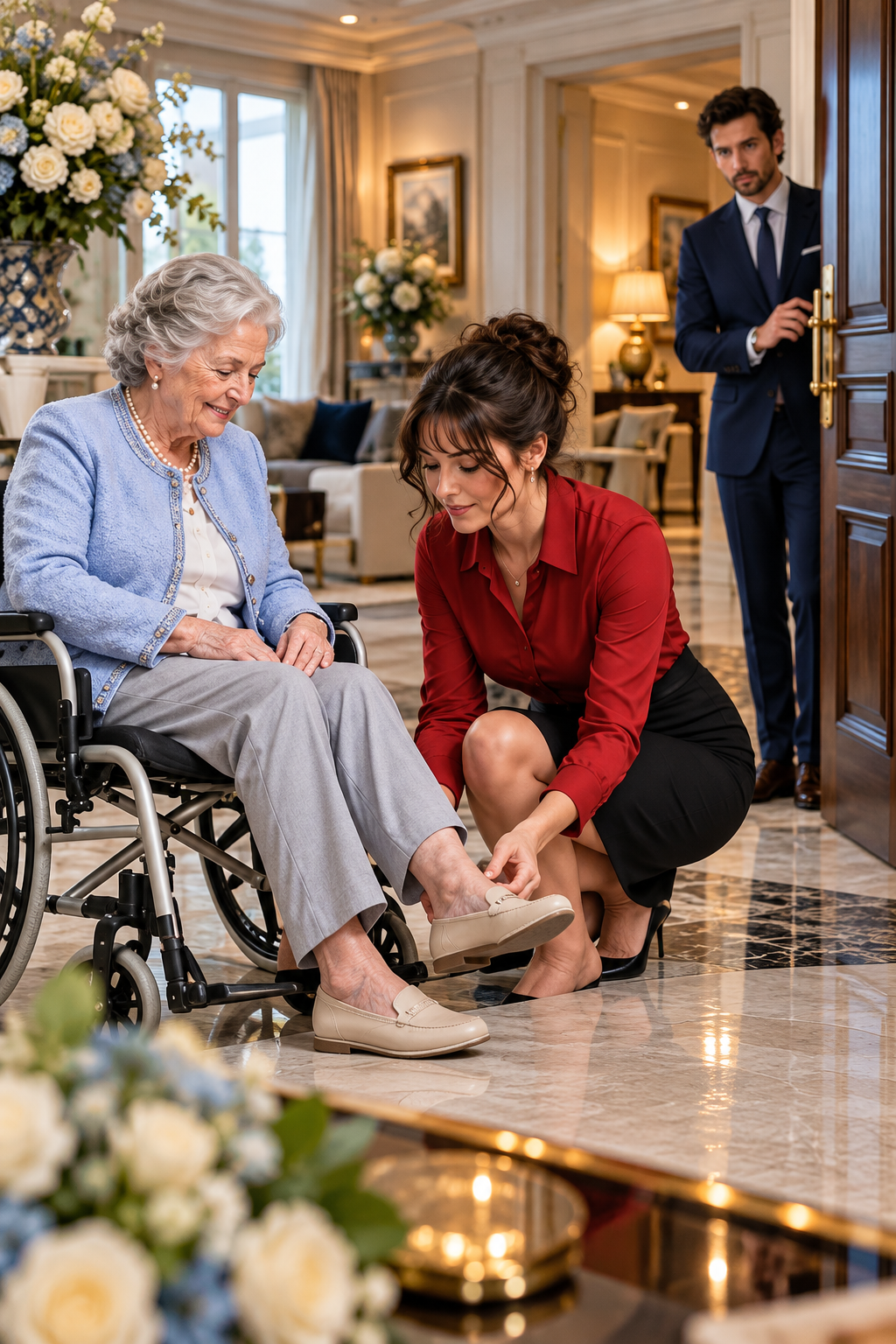
The moment the glass doors closed behind him, Beatrice tried to adjust the blanket. Her hands were too weak to pull it over one shoulder. Margot approached and asked permission before helping. She found a paper bag beside the wheelchair containing medication, then noticed the water bottle was empty. Without making a fuss, she brought a fresh glass, checked the nurse’s medication schedule, and set a comfortable chair beside the window.
Beatrice studied the young woman with tired curiosity. “You work for my son?” she asked. Margot said she did and told her she had arranged a quieter room. Beatrice thanked her, then apologized for causing trouble on such a busy morning. Margot answered that she was not causing trouble. She was having a difficult day. The older woman’s eyes filled, but she looked away before the tears could fall. Margot stayed nearby without filling the silence with advice.
Part 3: A medical emergency exposes the loneliness money could not solve
The board meeting grew tense as the acquisition proposal came under review. The target company had valuable medical patents, but its financial records contained unexplained liabilities. Everett’s chief financial officer urged him to approve the transaction before a competitor made a competing offer. Several directors warned that delaying could cost the company millions. Everett listened, asked for clarification, and kept his face composed. Yet through the glass wall, his attention kept drifting toward the sitting room.
He could see Margot seated beside Beatrice. She was not checking email or watching the clock. She adjusted the blanket when the room grew cool and offered water when Beatrice’s hands began to shake. When the older woman became anxious, Margot placed one hand over hers. Everett watched the simple gesture and felt shame rise before he could stop it. He had paid for professional care for years, but he had not sat beside his mother long enough to notice when she was frightened.
Then Beatrice began coughing and struggled to breathe. Margot called the medical team stationed on another floor and stayed calm while she knelt beside the wheelchair. Everett pushed open the boardroom doors so quickly that several executives turned in surprise. He hurried to his mother, both hands gripping the chair. The medical team arrived moments later and stabilized her. The crisis passed, but the fear remained in the room like smoke.
Everett stood beside the wheelchair, unable to make himself move. He had negotiated contracts worth billions without blinking, yet now he did not know what to say. Margot stepped back, assuming her part was finished. Beatrice reached out and took her hand. It was a small gesture, but Everett saw how tightly his mother held on. She had spent the morning surrounded by doctors concerned for her health, employees concerned about the meeting, and a son who loved her but had forgotten how to show it.
The physician explained that Beatrice’s condition was serious but manageable with rest, regular treatment, and emotional support. She would need follow-up tests, but the immediate episode had passed. Everett sat beside her, and for once there was no board meeting waiting behind a closed door. His phone buzzed repeatedly with questions about the acquisition, but he turned it off. Beatrice watched him do it and squeezed his hand. She had never wanted an empire, she said. She had wanted time with her son.
Part 4: A homemade lunch reveals the secretary’s grief and kindness clearly
A few hours later, Margot entered the sitting room carrying a simple container of food. She explained that she had noticed Beatrice had barely eaten and remembered from the nurse’s notes that certain foods were easier for her to tolerate. Everett stared at the container as if it were an object he had never seen before. He had access to private chefs and the city’s finest restaurants, yet Margot had brought something homemade because she thought his mother might feel better with a familiar meal. Beatrice smiled when she recognized the smell.
Everett asked Margot why she had gone so far beyond her job. She hesitated before answering. When she was twenty-one, her grandmother had spent the final months of her life in a care facility. Margot had been working two jobs and attending college, and she often could not afford the transportation to visit as often as she wanted. Her grandmother died believing Margot had been too busy to care. Margot knew that was not true, but the regret had stayed with her.
She had promised herself that when she saw an older person who needed kindness, she would not assume someone else would help. She had not intended to make a point or impress Everett. She had simply seen Beatrice alone, cold, and frightened. Everett listened in silence. For the first time, he saw Margot as more than the person who organized his calendar. She was a woman carrying a private grief he had never bothered to ask about.
Beatrice ate a few bites, then asked Margot about her grandmother. Margot told her about a woman who kept handwritten recipes in a drawer and insisted every visitor leave with leftovers. Beatrice shared a memory of baking bread with Everett when he was a boy. He had been impatient to shape the dough, she said, and had made loaves that looked like rocks. Everett laughed despite himself. He had not heard his mother tell that story in years.
That afternoon, he canceled the remaining meetings and accompanied Beatrice to her medical appointment. He held her bag and listened while the doctor explained the treatment plan. He asked questions without checking his phone. On the drive home, Beatrice rested her head against the seat and told him she was glad he had come. Everett realized that her gratitude made him feel worse, not better. She had been asking for so little, and he had treated even that as an inconvenience.
Part 5: Everett faces his past when his mother shares old memories
Everett began changing his schedule, though the changes were small at first. He blocked time for Beatrice’s appointments, ate lunch with her twice a week, and stopped sending every meal through a private chef. He asked her about the years after his father died. Beatrice remembered the small apartment where they had lived, the bakery that sold warm bread every Sunday, and the park where Everett used to race pigeons. He remembered the debts, but not the way she had made ordinary days feel safe.
Beatrice told him that after his father died, she had been afraid every night. She did not know whether the company would survive or whether she could keep Everett in school. She kept working because he needed to believe someone had a plan. She had sold her wedding ring to cover an overdue bill and later told him she had misplaced it. Everett remembered the day she stopped wearing it, but he had never asked why. Hearing the truth made him understand how much of his childhood she had carried alone.
The acquisition remained unresolved. The target company’s liabilities were real, and the board still wanted a decision. Everett returned to the office the following week and reviewed the records himself. He rejected the original deal structure, then negotiated a smaller purchase that protected the company from the hidden debts. His finance team had warned him that waiting would weaken their position. Instead, the additional review saved Callahan Meridian from taking on a costly obligation. Everett realized that slowing down did not always mean losing.
He thanked Margot for covering his schedule during the crisis. She said she had done what any competent assistant would do. Everett told her he knew she had done more than that, but did not try to turn gratitude into a promotion or a gift. He asked whether she had any ideas for helping employees manage family emergencies. Margot suggested listening sessions with staff before drafting a policy. People often knew where the process failed, she said, but rarely had a safe way to explain it.
Everett asked her to organize the sessions. Margot created small groups across departments and promised employees their comments would be summarized without names. She heard from workers who had missed medical appointments because they could not afford unpaid leave, parents who had no backup childcare, and caregivers who hid emergencies until their work suffered. Their problems were not solved by inspirational speeches. They needed flexibility, paid leave, and a way to ask for help before a crisis became a resignation.
Part 6: A boardroom acquisition forces compassion into company policy at last
Margot brought the findings to Everett and the executive team. Several directors called the proposals expensive and warned that generous leave could slow operations. Everett asked how much the company had spent replacing employees who left after family emergencies. The finance team had not calculated it. He asked them to do so. The number was larger than anyone expected, especially after recruiting, training, and lost productivity were included. The conversation shifted from whether support was sentimental to whether the company could afford to keep ignoring the problem.
Everett proposed flexible family-care leave, a confidential resource line, and a small emergency fund for employees facing medical or caregiving crises. The plan also allowed managers to approve temporary schedule changes without escalating every case through human resources. He insisted that the policy be reviewed after six months and adjusted based on employee feedback. Some executives worried staff would misuse the flexibility. Everett asked whether they believed employees were more trustworthy when they were rested and supported. The room had no easy answer.
The first board vote was close. Everett had enough support to pass the initial policy, but only after agreeing to publish quarterly results. Margot helped design the reporting process, ensuring it tracked outcomes without exposing private employee details. The emergency fund helped a warehouse manager whose child needed surgery and a receptionist who was caring for her father after a stroke. Neither employee had to resign or hide what was happening. Their departments covered the work while they handled their families.
The changes affected Everett personally, too. He began leaving the office at a reasonable hour on days Beatrice had treatment. He stopped asking his assistant to rearrange her own life around every last-minute meeting. When a board member scheduled a late dinner on the evening of his mother’s birthday, Everett declined. The board member looked surprised. Everett simply said he had plans with his mother. He did not explain that those plans were only cake and a quiet dinner at home.
Margot’s role grew as the company’s new policies took shape. She was skilled at anticipating problems, but she also knew how to ask employees what they needed before proposing a solution. Everett promoted her to Director of Executive Operations after reviewing her work with human resources and the board. He made clear that her advancement came from her abilities, not from the kindness she had shown his mother. Margot accepted the role after negotiating her own boundaries and support for the workload. She would not become the company’s emergency caretaker for every executive.
Part 7: Margot earns leadership by solving problems no title recognized before
The promotion changed Margot’s title, but it did not change the way she treated people. She still learned the names of the cleaning staff, receptionists, drivers, and maintenance workers. She asked them which systems wasted their time and which small changes would make their work safer. One facilities employee explained that a supply closet on the executive floor was difficult to access during evening shifts. Margot arranged a redesign and added a simple request system. The change cost little and saved employees hours.
Everett began asking Margot’s perspective before making decisions that affected staff. He did not always agree with her recommendations, and she did not always agree with his. Their conversations grew more honest because she no longer had to guess whether disagreement would damage her position. When she thought a proposal might hurt employees, she explained why. Everett learned to ask follow-up questions instead of treating criticism as resistance. The company’s executive floor grew less quiet, though the work remained demanding.
Beatrice’s health stabilized gradually. There were still difficult days, additional tests, and moments when she felt too tired to leave her room. Everett learned the difference between being present and trying to control every outcome. Sometimes he sat with her without talking. Sometimes he brought the wrong tea or asked a question she had already answered. She corrected him without ceremony, and he learned to laugh at his mistakes. Their relationship began to feel less like an appointment schedule and more like a family again.
One afternoon, Beatrice asked Margot to join them for lunch at the house. Margot tried to refuse, saying it might be inappropriate to spend time with the CEO’s family outside work. Beatrice told her she was inviting the woman who had helped her feel safe on the worst morning of the year. Everett left the decision to Margot. She eventually accepted, but brought a dish she had made herself and insisted everyone try it. Beatrice praised the recipe, and Everett asked for seconds.
Over lunch, Beatrice spoke about the years she had raised Everett alone. She did not hide how hard those years had been, but she also shared the funny parts: the broken kitchen sink, the school science project that caught fire, the Sunday mornings when Everett tried to bargain his way out of chores. He listened, surprised by how many memories he had forgotten. Margot watched mother and son find their way back to each other through stories. She understood then that care was often made of these ordinary moments, repeated until people trusted them.
Part 8: Mother and son rebuild their relationship through ordinary shared time
A year after the day Everett brought his mother to the office, he took her outside to the company garden. Beatrice sat beneath a tree while sunlight moved through the leaves. Everett parked his phone in his pocket and did not check it once. They talked about the old apartment, her first job, and the years she had spent keeping the company alive. He asked what she wanted to do now, beyond appointments and rest. She said she wanted to visit the bakery where they used to buy warm bread.
They made the trip the following Sunday. The bakery had changed owners, but the sign was still the same, and the smell of fresh bread filled the small shop. Beatrice bought two loaves and insisted Everett carry them. On the drive home, she told him that she had never wanted him to spend his life repaying her sacrifices. She wanted him to build a life of his own and remember that the people around him were part of it. Everett promised to keep trying.
Callahan Meridian’s new family-care policies had become part of the company’s culture. Managers received training on how to respond when employees faced emergencies. The emergency fund was replenished each year, and employees could request confidential support without explaining their private lives to a room of executives. Some directors still questioned the expense, but the results showed lower turnover and stronger morale. Everett no longer described the program as charity. It was a way to recognize that employees were people before they were job titles.
Margot continued to lead the program while building her own career. She completed an executive management certificate she had postponed for years and mentored two assistants who wanted to move into operations. She never presented herself as a perfect example of balance. There were weeks when work overwhelmed her, and she learned to ask for help before resentment took over. Her grandmother’s memory remained painful, but Margot began volunteering at a care center on weekends. She visited residents who rarely had family nearby and brought books they could share.
Everett and Margot developed a genuine friendship based on mutual respect. He learned more about the life behind her professionalism, including the grandmother she missed and the education she had once interrupted. Margot learned that the distant CEO was not incapable of affection; he had become afraid that caring meant failing to protect someone from every hardship. Neither of them tried to fix the other. They simply learned to speak honestly, and that honesty changed how they worked together.
Part 9: An entire company learns to notice people before they break
Years later, Everett still remembered the morning the executive floor fell silent. He remembered Beatrice’s pale face beneath the wool blanket, the acquisition proposal waiting behind the glass doors, and Margot kneeling beside his mother without asking whether it was part of her job. The image returned whenever he was tempted to treat time as something he could postpone. He had built a company the world could see, but one quiet act had helped him rebuild a relationship he had neglected. He learned that a person could be surrounded by comfort and still feel terribly alone.
Beatrice’s illness did not disappear, and no policy or family visit could promise a perfect recovery. Her condition had manageable periods and difficult ones, and Everett remained beside her through both. He accompanied her to appointments, listened when she was tired, and stopped pretending every problem could be solved with a check. The doctors and nurses continued to provide the care she needed. Everett’s presence did not replace their expertise; it gave his mother the companionship she had been missing.
Margot remained with Callahan Meridian, eventually becoming Chief Operating Officer. She earned the role through years of careful work, sound judgment, and the trust she had built across departments. She never let the company turn her kindness into an expectation that she would carry everyone else’s burdens. The family-care program had trained more people to respond, so it no longer depended on one person noticing every crisis. Margot kept the original emergency fund records in a secure archive, not as a trophy, but as a reminder of what the company had learned.
At a gathering for employees and their families, Beatrice asked Margot to sit beside her. She looked healthier than she had on that frightening morning, though silver strands framed her face and her hands still trembled occasionally. Everett watched his mother smile at the woman who had changed their lives by doing something small. He thought about the world he had tried to control and the people he had nearly failed to see. Then he put his phone away and listened as Beatrice told another story about his childhood.
The greatest fortune Everett had ever possessed was not hidden inside a bank account. It had been sitting beside him all along, waiting for him to stop working long enough to notice. Margot had not saved his mother with a miracle; she had helped her feel less alone until the medical team could care for her. Beatrice had not asked her son to abandon his company; she had asked him to remember that love required presence. And Everett, who had once believed every problem could be managed from a boardroom, finally understood that the most valuable thing a person can give is often their time, attention, and willingness to stay.
✓ Lynn R. Adams
Part 2: Margot notices the fear Everett has spent years concealing quietly When the elevator doors opened, the executive floor went silent. Everett pushed Beatrice’s wheelchair himself, one hand grip…