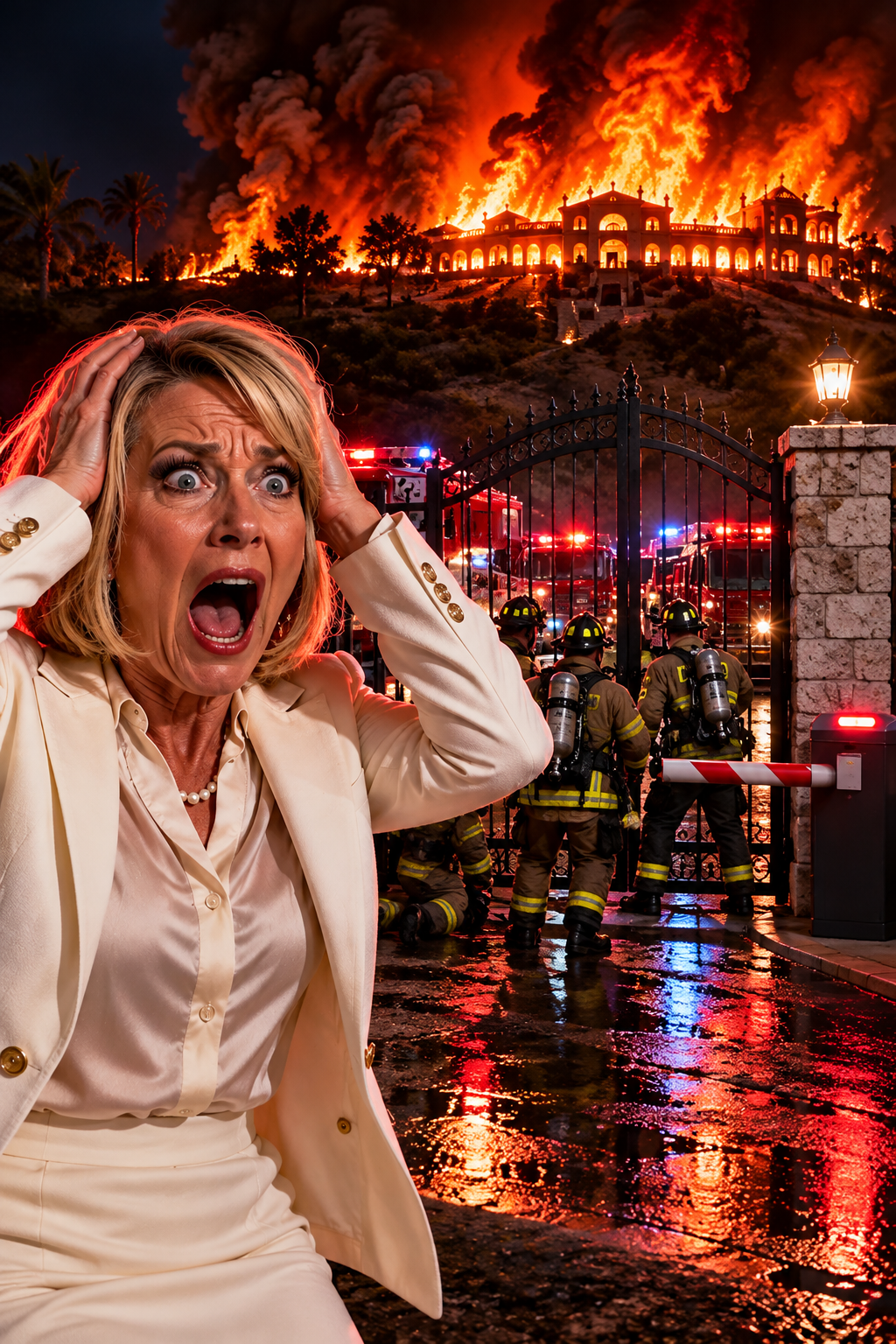
Eleven fire trucks sat helpless behind a locked steel gate while an eight-million-dollar
Part 2: My private emergency road became her personal toll collection empire.
I first met Colette Farnsworth at a county wildfire-preparedness meeting, where she arrived carrying an expensive leather notebook and behaved as though the fire department existed to provide recommendations she could accept or ignore. Captain Lockwood was discussing evacuation corridors when he mentioned the emergency access road crossing my ranch, explaining that its wide turning radius and reinforced culverts allowed heavy fire engines to reach Cedar Summit from the valley. Colette interrupted him and complained that an unmanaged dirt road near a luxury subdivision undermined the neighborhood’s security image. I explained that emergency access was not a decorative feature and that a beautiful gate meant nothing if a tanker truck could not pass through it. She smiled with the icy politeness of someone who had already decided my opinion did not matter.
Within two weeks, survey stakes appeared on both sides of my road, marked with signs announcing a proposed Cedar Summit security checkpoint. I contacted the association immediately because the marked area lay entirely within my property, and I had never granted permission for construction. Instead of calling me back, Colette sent a letter declaring that regular emergency use had transformed the route into a shared transportation corridor requiring HOA oversight. She demanded control of the eastern entrance, mandatory vehicle registration, and maintenance fees for people crossing the road. My attorney, Ruth Ellington, examined the recorded agreements and confirmed that the association possessed no ownership interest authorizing those demands.
Ruth sent a formal notice instructing Cedar Summit to stop construction and warning that any interference with emergency access could create serious legal exposure. Captain Lockwood separately notified the board that the proposed barrier threatened compliance with applicable fire-access requirements. Colette responded by calling an emergency meeting and telling homeowners that the road allowed unregistered vehicles to enter the area without adequate supervision. She described imaginary burglars, unidentified contractors, and security threats that had never appeared in eighteen years of operation. By the end of the meeting, residents had approved an expensive checkpoint budget because Colette convinced them their safety depended on shutting an entrance that had been designed to save them.
A contractor named Travis Garrison received the job of installing two reinforced steel gates, a guard station, electronic locks, cameras, and retractable roadway barriers. The association security manager, Dwayne Calder, was ordered to collect fees based on vehicle type, beginning with twenty-five dollars for ordinary service access and rising substantially for heavy commercial equipment. Colette described the arrangement as a responsible maintenance program, although she had never paid for the road’s upkeep and lacked permission to occupy the land. When I arrived during construction, Travis admitted he had been told the property belonged to the association. I placed my survey documents beside his construction plans and watched his expression change as he realized his client had given him a dangerously incomplete account.
Colette appeared before Travis could explain further, stepping from a white luxury SUV with two security employees following behind her. She told me I was interfering with an approved community improvement and suggested my objections were motivated by resentment toward wealthy homeowners. I replied that the residents’ finances were irrelevant to the question of who owned the road and whether firefighters could pass safely. Then I asked Travis what would happen if an electrical failure disabled the access system during an emergency. He explained that the design included an automatic override, but he looked uncomfortable when Colette interrupted and insisted the details had already been reviewed.
Three days later, I found the finished checkpoint blocking the road, with Dwayne standing inside the guard cabin beneath a sign displaying the new toll schedule. When I asked him to open the gate so I could cross my own property, he pointed to the twenty-five-dollar fee and told me association rules applied to everyone. I reminded him that the checkpoint stood on land described in my recorded deed, but he repeated that his job was enforcing policy rather than discussing ownership. He warned me that attempting to force the gate could trigger security devices and lead to a police report. I photographed the sign, recorded the time, and called Ruth before leaving.
The legal fight began that afternoon, but the most disturbing part was how quickly an unauthorized checkpoint became normal to people who passed it every day. Delivery drivers paid because arguing took longer, contractors added fees to invoices, and residents praised the extra security without understanding the obstacle it created. A forestry crew reported being delayed during a routine inspection, while another emergency vehicle waited several minutes because the license-recognition equipment failed. I submitted those incidents to Ruth and Captain Lockwood, believing enough documented problems would convince the association to reopen the road. Instead, Colette began describing me publicly as a troublemaker determined to undermine Cedar Summit’s progress.
Part 3: Repeated fire safety warnings could not penetrate her obsession.
By the following spring, Captain Lockwood had personally witnessed the checkpoint delaying a fire engine during an access inspection. The camera could not recognize the emergency vehicle’s license plate because dust had accumulated across its lens, forcing Dwayne to request an override code from someone inside the clubhouse. The response took several minutes, an unacceptable delay on a road created specifically to shorten emergency travel time. Abram documented the incident and instructed the association to keep the barrier open until an independent access mechanism could be verified. Colette complied briefly, then ordered the gate secured again after the inspection ended.
Travis later returned to modify the gate, and I discovered that the work involved replacing part of the mechanical access system with a more heavily reinforced electronic locking enclosure. I confronted him at the job site and asked why anyone would make an already troublesome emergency barrier harder to open manually. He admitted that the original design provided better access during power failures, but Colette had insisted unauthorized vehicles might exploit a mechanical release. I asked whether he had documented his professional concerns, and he said he had sent several emails recommending additional safeguards. I told him those messages might someday be more important than he realized.
Around that time, Miriam Rockwell, Cedar Summit’s accountant, began questioning how the checkpoint had been funded. The association had drawn heavily from reserves intended for emergency preparedness, despite receiving repeated warnings that the project itself created emergency-access problems. Miriam raised concerns with Brett Winslow, the board’s finance officer, including the possibility that insurers would scrutinize known safety deficiencies after a major loss. Brett forwarded her concerns to Colette, who replied that a gate could not be blamed for a fire simply because someone disliked its location. Miriam saved the exchange, unsettled by the casual way Colette dismissed the implications.
I continued maintaining the unobstructed sections of the road because I refused to allow the dispute to make surrounding land less safe. Every few weeks, I drove the route checking drainage, removing fallen branches, and documenting the deteriorating access conditions around the checkpoint. I also installed cameras on my side of the property to record vehicle delays and any changes made to the structure. Colette responded by issuing an HOA fine accusing me of unauthorized surveillance, despite the fact that my ranch was not part of Cedar Summit and the cameras observed my own property. Ruth advised me to ignore the unsupported invoice but preserve it with the growing collection of correspondence.
Summer arrived early, bringing relentless heat and weeks without meaningful rain. The hillsides turned brittle, with dry pine needles collecting beneath trees and grasses breaking underfoot. I watched weather forecasts closely because the terrain around Cedar Summit created wind channels capable of carrying flames rapidly uphill. The clubhouse was particularly exposed, sitting near the crest of Ridge View Hill with dense vegetation below and several luxury homes beyond the landscaped grounds. I worried that one ignition at the wrong time could overwhelm the development’s limited defensive space before crews reached the scene.
Captain Lockwood shared those concerns and circulated updated fire restrictions to communities across the district. He reminded property managers to maintain defensible space, inspect suppression equipment, and avoid activities that could produce sparks during periods of severe fire danger. Cedar Summit had scheduled a lavish anniversary celebration at the clubhouse, and Colette refused to cancel despite the warnings. The event promised outdoor lighting, elaborate decorations, catered food, amplified music, and enough wealthy guests to fill the association’s promotional materials for years. Colette apparently considered the celebration essential to proving that her leadership had transformed Cedar Summit into the county’s most prestigious address.
An event contractor later expressed concern about a generator located behind a decorative wall near the outdoor stage. The equipment showed signs of a fuel-system problem, and the electrical setup also required additional inspection before heavy lighting loads were connected. Rather than delay preparations, Colette pressed the contractors to keep working and insisted any remaining issues could be handled discreetly. Travis separately warned that the clubhouse and checkpoint shared electrical infrastructure, creating the possibility that a major outage could disable the gate. He recommended configuring the barrier to release during power loss, but Colette rejected that proposal because she feared unauthorized entry.
A week before the celebration, I sent Colette one final letter accompanied by wildfire-risk maps, the emergency-access agreement, photographs of the gate, and summaries of previous delays. I explained that an electronically locked barrier dependent on the same infrastructure as the threatened community created a foreseeable hazard. Ruth delivered the notice formally, and Abram sent his own reminder demanding reliable emergency passage. Colette did not answer either of us directly, although a staff member later said she had described my letter as another attempt to frighten homeowners. I filed the correspondence away, hoping the summer would pass without forcing us to discover how wrong she was.
Part 4: The clubhouse celebration ignited a catastrophe nobody could control.
On the evening of Cedar Summit’s anniversary celebration, the wind shifted southwest and began sweeping hot, dry air through the mountain ravines. I noticed the change while repairing a pump near my ranch reservoir, and the way the treetops moved made me uneasy before sunset. From the valley, I could see the clubhouse illuminated by hundreds of decorative lights, its outdoor stage glowing against the darkening hillside. Music drifted faintly across the distance, interrupted occasionally by cheers from guests who had gathered to celebrate Colette’s achievements. I finished my work, checked the emergency radio, and walked outside once more to study the ridge.
Inside the clubhouse, guests admired elaborate floral arrangements, expensive food, and a projected presentation celebrating ten years of development. Colette moved between donors and residents, accepting compliments while describing the community as a model of private security and sophisticated planning. Staff members were busy serving drinks, managing lighting equipment, and moving supplies between the kitchen and outdoor stage. Behind a decorative partition, electrical equipment and the backup generator operated under conditions that investigators would later examine in painful detail. At approximately , someone near the stage noticed the smell of heated plastic.
The first visible flame appeared near the concealed equipment and spread into surrounding decorative materials. A server reached for a fire extinguisher, but the nearest unit had not been properly maintained, delaying the initial response while staff searched for another. Before they could control the ignition, fire reached combustible fabric and traveled toward the wooden roof overhang. Guests began moving away, some assuming the sudden commotion involved a minor technical problem rather than an emergency. Then smoke thickened across the patio, and frightened voices rose above the music.
A guest called emergency services as employees attempted to evacuate the building. The alarm sounded, but electrical failures disrupted parts of the facility, and the emergency water system did not operate as intended. Flames climbed toward the clubhouse roof while wind pushed burning material into surrounding landscaping. At the same time, the electrical system serving the checkpoint failed, triggering the locking arrangement Colette had specifically insisted on maintaining. Down the mountain, two steel gates secured themselves across the emergency road.
Captain Lockwood received the structure-fire dispatch and immediately requested a major response because the location and weather created serious potential for wildland spread. Eleven emergency vehicles joined the response, including engines, water tankers, rescue units, and command equipment. The crews approached my road expecting the short route they had used for years, and Abram could already see the glow above Ridge View Hill. Under ordinary conditions, the convoy would have reached Cedar Summit in less than ten minutes. Instead, the lead engine stopped abruptly in front of the darkened checkpoint.
The security cabin was empty because Dwayne had left his post to attend part of the celebration. The electronic control panel showed no power, and the usual override procedure could not activate the lock. Firefighters attempted to reach the emergency release but discovered that recent modifications had made the locking assembly difficult to access. The reinforced gate structure and nearby concrete barriers complicated the use of rescue equipment, preventing trucks from simply driving around the obstruction. As each emergency vehicle stopped behind the first, the entire road became a line of flashing lights pointed toward a fire they could not reach.
Abram radioed dispatch and requested immediate assistance in opening the route. He attempted to contact Colette, who was already outside the burning clubhouse demanding to know why firefighters had not arrived. When he explained that her checkpoint was locked without power, she insisted he use the emergency code that had been distributed months earlier. Abram told her the electronic system could not accept a code because the power was gone. She then asked Travis to operate the remote system, only to discover that its controls were connected to the same compromised electrical infrastructure.
I heard the sirens, checked my cameras, and immediately understood what had happened. The images showed fire engines trapped along the road while smoke and flames rose behind the ridge. I contacted Abram, drove down with my property maps, and offered the emergency crews access to an old northern service trail that smaller vehicles might be able to navigate. I also began arranging for heavy recovery equipment to help remove the obstruction under firefighter direction. As I reached the gate, I could see men and women trained to fight disasters standing helpless before a structure that existed only because one person considered unrestricted access unacceptable.
Part 5: Twenty-seven stolen minutes turned a fire into total destruction.
The first thing Abram told me when I arrived was that the crews had already lost far too much time. Firefighters were working to open the barrier while commanders evaluated alternatives, but the road’s geometry prevented the larger vehicles from turning around safely. I showed Abram the northern service route, explaining that it would not accommodate the ladder truck or loaded tankers but might allow smaller rescue equipment to approach from another direction. He immediately sent a team to assess it while the remaining crews continued working at the main checkpoint. Above us, flames spread along the clubhouse roof and glowing embers began moving toward nearby trees.
I considered using my tractor to pull the gate apart, but the reinforced posts and buried foundations created hazards that could injure firefighters if the structure failed unpredictably. Instead, I asked a recovery operator to bring suitable equipment while the incident commander directed the safest approach. The firefighters weakened part of the obstruction with specialized tools, and the recovery crew helped remove enough material to create a passage. The guard cabin and concrete barriers still narrowed the opening, requiring additional work before the larger vehicles could proceed. The entire operation consumed precious minutes while the fire above us continued growing.
At last, the first engine crossed the checkpoint after a delay of more than twenty-seven minutes. I watched it accelerate uphill and felt a sickening mixture of relief and dread because I knew how much damage could occur during that period under severe wildfire conditions. Abram later told investigators that the crews had not been delayed by travel distance, traffic, or poor dispatch procedures. They had been stopped by a privately installed obstruction that officials had repeatedly warned should not exist in that configuration. The distinction would become central to everything that followed.
When firefighters reached the clubhouse, much of the main structure was already fully involved. Crews divided their efforts between protecting nearby houses, securing hazardous equipment, and preventing flames from advancing into the forest. The clubhouse itself was no longer realistically salvageable, so commanders concentrated on limiting the disaster’s spread. Burning debris had reached surrounding vegetation, and several parked vehicles were damaged as the heat intensified. A propane installation near the building created additional danger that forced crews to adjust their positions.
I joined the wildland suppression effort under the direction of the incident commander, using equipment from my ranch to support containment work along an exposed section of the forest edge. Years of wildfire experience helped me recognize how the wind might carry embers into the ravines, but I remained painfully aware that the firefighters were the ones responsible for directing the response. Crews worked through the night, protecting homes and cutting off advancing flames wherever terrain allowed. Residents gathered at evacuation points, watching the ridge glow orange as the clubhouse collapsed into smoke and twisted structural steel. Colette stood among them, unable to conceal her shock as the symbol of her presidency disappeared.
Before dawn, the main fire was contained after destroying the clubhouse and damaging additional structures, vehicles, and surrounding forest. Several people required treatment for smoke exposure, but the evacuation prevented the catastrophe from becoming far worse. Initial damage estimates reached into the millions, and the full cost remained uncertain while crews continued monitoring hot spots. I returned to the checkpoint as the sun rose and found emergency workers examining the mangled gate that had delayed them. The steel looked almost ordinary in daylight, making its consequences feel even more disturbing.
Colette arrived shortly afterward and demanded an explanation for the delayed response. She accused the fire department of failing to follow proper procedures and suggested that my objections to the checkpoint might somehow have contributed to the failure. Abram calmly explained that his crews had used the authorized route, attempted the designated access procedures, and encountered a barrier that could not be opened through its promised emergency system. I told Colette that my cameras had recorded the gate, the arriving vehicles, and the entire effort to create access. Her face changed when she realized the chronology could not be rewritten by a newsletter or public speech.
She accused me of secretly interfering with the electronics, although I had been working at my ranch when the fire began. I reminded her that the checkpoint was powered through Cedar Summit’s own infrastructure and that Travis had repeatedly warned about the consequences of electrical failure. Colette claimed she had never been told the gate might remain locked, but Abram said his office possessed written records of the warnings. Several residents standing nearby began asking questions about why the association had ignored those notices. For the first time since I had met her, Colette appeared genuinely afraid of what ordinary people might discover.
Part 6: Hidden emails proved the disaster had been predicted and ignored.
Within days, investigators from fire-safety authorities, insurers, and other agencies began reconstructing the events surrounding the clubhouse fire. They examined the electrical equipment, generator installation, suppression system, checkpoint controls, maintenance records, and communications between the association and its contractors. The initial inquiry focused on the origin of the fire and the factors that allowed it to spread, while a separate review considered whether the checkpoint had obstructed emergency response. I provided camera footage, road maintenance records, property documents, and the correspondence Ruth had preserved throughout the dispute. None of those materials required speculation because they recorded events, dates, and warnings that had already occurred.
Miriam Rockwell contacted investigators after Colette pressured the board to describe the checkpoint as a temporary security measure. Miriam had retained copies of financial records and emails because previous disputes convinced her that important discussions were sometimes omitted from official minutes. Those records showed that association funds designated for fire preparedness had been used to finance the gate despite objections about its legality and safety. They also documented the additional expense of reinforcing the lock after Captain Lockwood raised concerns about emergency access. Investigators found that Colette had been personally involved in approving decisions that increased the difficulty of opening the barrier during an outage.
One message from Travis warned that a power failure could leave the gate secured unless independent emergency release provisions were maintained. Another message from Brett Winslow warned that an insurer might question coverage if a known checkpoint hazard interfered with firefighting. Miriam had also preserved Colette’s response rejecting a design that would automatically release the barrier when electrical power failed. Colette argued that an unlocked entrance could allow unauthorized vehicles to pass without paying or registering. Read together, the messages showed an extraordinary willingness to prioritize control over the consequences repeatedly identified by professionals.
Dwayne also cooperated after investigators questioned him about the checkpoint’s normal operating procedures. He admitted that he had proposed storing an emergency mechanical key in an approved access box but had been instructed to rely on the electronic system. He explained that the guard cabin ordinarily handled vehicle registration and payment collection, although staffing was inconsistent during major community events. On the night of the fire, he had left the station because he expected the automated gate to function without assistance. His admission did not absolve him, but it revealed how fragile the association’s supposed emergency safeguards had become.
The fire investigation identified several serious failures involving electrical equipment, combustible decorations, inadequate maintenance, and ineffective suppression systems. Investigators found no evidence supporting Colette’s suggestion that I had sabotaged the clubhouse or interfered with the gate controls. Instead, the loss of power and the checkpoint’s programmed behavior provided a straightforward explanation for why the gates remained closed. Dispatch records and emergency-vehicle footage allowed investigators to compare the time of the call with the vehicles’ arrival and the eventual reopening of the road. The resulting timeline showed that the delay occurred at the checkpoint rather than along the route from the station.
The insurer requested records demonstrating that known deficiencies had been corrected before the anniversary celebration. Colette’s board struggled to produce satisfactory documentation, and questions arose about whether safety concerns had been accurately disclosed. The company reserved its position on substantial portions of the claim while the investigations continued. Cedar Summit residents learned they might face extraordinary assessments to cover uninsured losses, damaged facilities, and litigation expenses. The neighborhood that once praised Colette for increasing property values began asking why its emergency reserves had financed a gate that prevented firefighters from entering.
Colette responded by hiring new attorneys and a crisis communications firm to portray herself as a victim of unusual circumstances. Her public statements suggested that no one could reasonably have predicted a fire, an electrical failure, and a locked gate occurring simultaneously. Ruth answered with the written warnings that had described precisely that scenario, including Travis’s recommendations and Abram’s inspection reports. Reporters obtained public records showing that my earlier objections to Cedar Summit development had concerned emergency access and wildfire protection rather than hostility toward wealthy homeowners. Colette’s attempt to turn the story into a personal feud lost credibility as the evidence accumulated.
Ruth then filed a civil action addressing the unauthorized checkpoint, interference with my property rights, damage to the access road, and losses associated with the resulting fire. I told her I did not want to profit from anyone’s suffering, but I also refused to absorb restoration costs caused by a structure I had repeatedly opposed. She explained that lawful compensation was not revenge and that accountability often required financial consequences substantial enough to reflect the harm. The court began reviewing the property records and emergency-access agreements while investigators continued examining the broader disaster. Colette was about to learn that the rules governing ownership and safety did not become optional because she disliked their conclusions.
Part 7: The courtroom revealed how twenty-five dollars destroyed her reputation.
The first major property hearing centered on a question so simple that Colette’s attorneys struggled to make it complicated. Judge Caroline Alder asked what legal interest Cedar Summit possessed in the land beneath the checkpoint. Ruth presented the recorded deed, the original emergency-access agreement, the surveys, and correspondence documenting my repeated objections to construction. The association argued that its responsibility for neighborhood security justified managing traffic near its boundaries. The judge asked again whether it actually owned the ground occupied by the gate, and the answer was no.
The court determined that Cedar Summit had no right to maintain the checkpoint on my private property and ordered the obstruction removed under an enforceable timetable. The association was also required to address damage caused during construction, subject to the applicable findings and further proceedings. Contractors discovered that parts of the foundation had damaged drainage infrastructure, creating erosion beneath a section of the roadway. Engineers recommended substantial repairs before another severe storm could undermine the route. What Colette had presented as a modest security improvement had become a costly infrastructure problem requiring immediate attention.
The broader civil case brought together evidence from fire investigators, emergency responders, contractors, accountants, and residents. Captain Lockwood testified about the earlier inspection in which his engine had been delayed at the checkpoint, describing the official warning he issued afterward. Travis explained the differences between the original design and the revisions approved by Colette, including the choice to retain a locking configuration during power loss. Miriam described financial concerns and read from emails documenting the board’s knowledge of potential insurance and safety consequences. Dwayne acknowledged that he lacked a reliable independent means of opening the gate when the electrical system failed.
Ruth introduced synchronized footage from emergency vehicles and my property cameras, allowing the court to see how the fire response unfolded. The footage showed the first vehicles arriving, the attempts to activate the disabled system, the work required to remove the barrier, and the time lost while flames spread uphill. No dramatic speech was necessary because the timestamps established the delay with painful clarity. One young firefighter described watching the glow intensify while waiting behind the gate and wondering whether people were still trapped above them. I saw several residents lower their eyes as he spoke.
Colette’s defense argued that the fire originated inside the clubhouse and that the checkpoint had not caused the initial ignition. That distinction was correct, but Ruth explained that the case also concerned the consequences of obstructed emergency access, along with separate allegations involving unsafe decisions and misrepresented conditions. Expert witnesses discussed how response delays can affect containment opportunities, while acknowledging that actual fire growth depends on many interacting conditions. The evidence did not require claiming that every dollar of damage resulted from a single gate. It required showing what warnings had been received, which decisions followed, and what consequences could reasonably be attributed to those decisions.
The civil proceedings resulted in substantial liability findings and a multimillion-dollar judgment concerning property damage, restoration expenses, and other established losses. Colette and the association faced consequences far beyond the cost of removing the checkpoint, while separate insurance disputes complicated Cedar Summit’s ability to rebuild. Prosecutors also pursued allegations involving false safety documentation and misuse of association funds, with those matters proceeding independently from the civil judgment. Colette ultimately lost her presidency as residents replaced the board leadership and demanded a comprehensive financial review. Her authority, once supported by polished presentations and strict neighborhood rules, collapsed beneath records she had assumed nobody would examine.
When Colette passed me outside the courthouse, she stopped and accused me of destroying Cedar Summit. I looked at her for a long moment, remembering how confidently she had dismissed the fire captain, the contractor, and everyone else who questioned her plans. I told her I had spent eighteen years maintaining a road so emergency crews could reach her community quickly. She had chosen to block that road, charge people to cross it, and ignore the warnings about what might happen when electricity failed. Then I walked away because there was nothing more she could say that would change those facts.
Part 8: I rebuilt the fire road and watched it save lives again.
Six months after the fire, Cedar Summit’s new board approached me with a proposal to permanently protect the emergency access corridor. They wanted a written agreement involving the county, the fire department, and my ranch, preserving my ownership while clearly defining maintenance responsibilities and prohibiting unauthorized obstructions. I agreed because my goal had never been to punish residents for living on the mountain or to make their neighborhood dependent on my goodwill. I wanted the road to function as it had been designed to function, without tolls, security theatrics, or delays created by competing administrative interests. The new agreement established shared oversight procedures and required professional review before any future changes affecting emergency passage.
We removed the remaining checkpoint foundations, repaired damaged drainage systems, reinforced vulnerable sections of the road, and improved the turning area for heavy apparatus. The location once occupied by the guard cabin became a properly designed water-access point for emergency operations. Cedar Summit’s replacement board funded vegetation management near the former clubhouse and abandoned plans to rebuild the same vulnerable structure on the exposed ridge. Instead, the hilltop was incorporated into a wider defensible space intended to reduce wildfire exposure for nearby homes. The decision disappointed some residents who missed the old clubhouse, but most understood why repeating the same risks would have been irresponsible.
I used a portion of the civil recovery to improve road maintenance equipment and support additional firefighting resources. My ranch reservoir was fitted with equipment that could provide water under approved emergency arrangements, and a small observation station was established near an accessible ridge. Captain Lockwood helped coordinate training exercises so crews could become familiar with the revised route before the next severe fire season. We also improved signs at the entrance, making the road’s emergency purpose clear without turning it into another monument to neighborhood politics. The most important change was simple: no gate stood between the valley and Cedar Summit.
Colette’s legal problems continued after she left the association, ultimately resulting in penalties and restrictions that ended her involvement in residential leadership. Travis cooperated with investigators and faced professional consequences for failing to resolve serious ownership and safety questions before completing the installation. Dwayne left private security work and eventually approached me to apologize for demanding payment when I tried to cross my own property. I told him I accepted the apology but hoped he understood that following instructions did not eliminate responsibility when those instructions created obvious danger. He nodded, and we parted without another argument.
Miriam became an important figure in Cedar Summit’s financial recovery, helping the new board establish transparent accounting and stronger controls over major expenditures. Brett supported independent audits and procedures requiring documented approval before reserves could be redirected toward new construction. Residents who once treated HOA meetings as social rituals began examining budgets, contracts, and safety reports with the seriousness those documents deserved. Some homeowners apologized to me directly, admitting they had believed Colette’s claims because challenging her was uncomfortable. I told them the most useful apology was refusing to surrender their judgment to the next confident person who wanted unlimited authority.
The following summer brought another brutal stretch of dry weather, and every afternoon I watched the forecasts with the same vigilance I had learned during my years in wildfire prevention. Cedar Summit conducted evacuation drills, cleared hazardous vegetation, and allowed firefighters to inspect access points without political arguments. The road remained open through heat waves, thunderstorms, and occasional power failures, its usefulness no longer dependent on a security guard remembering a code. I began spending more evenings near the reservoir, enjoying the quiet but never forgetting how quickly conditions could change. There were still scars where the checkpoint had stood, although grass was slowly returning to the disturbed ground.
Nearly one year after the clubhouse fire, lightning struck a section of woodland along Cedar Summit’s western boundary shortly before midnight. I heard the dispatch over my radio and drove toward the road, remembering the terrible sight of eleven emergency vehicles trapped behind steel. This time, the engines passed through without stopping, their headlights sweeping across the open corridor as crews climbed toward the smoke. Captain Lockwood reached the ignition area quickly enough to deploy resources before the fire could spread beyond manageable limits. By dawn, the flames were contained and no homes had been lost.
I stood beside the roadway watching the emergency vehicles return through the valley. Eleven engines passed, one after another, and I counted them without meaning to because the number carried a memory I would never lose. Abram stopped his command vehicle beside me and said the road had finally done exactly what it was supposed to do. I looked toward the place where Colette’s steel gate once stood, now nothing more than an open stretch of ground and a sign reading, “FIRE ACCESS — NEVER BLOCK.” Then I told him the road had always known its purpose; people had finally stopped interfering with it.
A few weeks later, I attended a public Cedar Summit meeting at the invitation of the new board. Residents asked practical questions about firebreaks, vegetation management, evacuation planning, and why certain mountain roads needed wider curves than ordinary neighborhood streets. I explained what experience had taught me: safety was rarely glamorous, often expensive, and sometimes inconvenient, but its value became unmistakable when conditions turned against you. I never mentioned Colette by name because the lessons no longer depended on her personality. What mattered was recognizing that anyone with authority had a responsibility to understand the consequences of using it.
That evening, I drove back to my ranch beneath a red mountain sunset and stopped near the entrance to the emergency road. I remembered the first time Colette demanded control of it, the twenty-five-dollar toll sign, the warning letters she ignored, and the long line of firefighters waiting helplessly while her clubhouse burned. Then I remembered the open road during the lightning fire, the engines passing without hesitation, and the knowledge that someone else’s family had been spared a terrifying evacuation. For years, Colette believed the ability to close a gate proved she was powerful, but she never understood that genuine leadership meant knowing when the gate needed to remain open. The mountain had taught all of us a costly lesson, and I intended to honor it for the rest of my life: no amount of money, status, or authority should ever stand between people in danger and those trying to save them.
✓ Lynn R. Adams
Part 2: My private emergency road became her personal toll collection empire. I first met Colette Farnsworth at a county wildfire-preparedness meeting, where she arrived carrying an expensive leather…