D-THE RIVER REMEMBERS EVERY BROKEN VOW: THE LAST SECRET OF THE BLUE MAGNOLIA
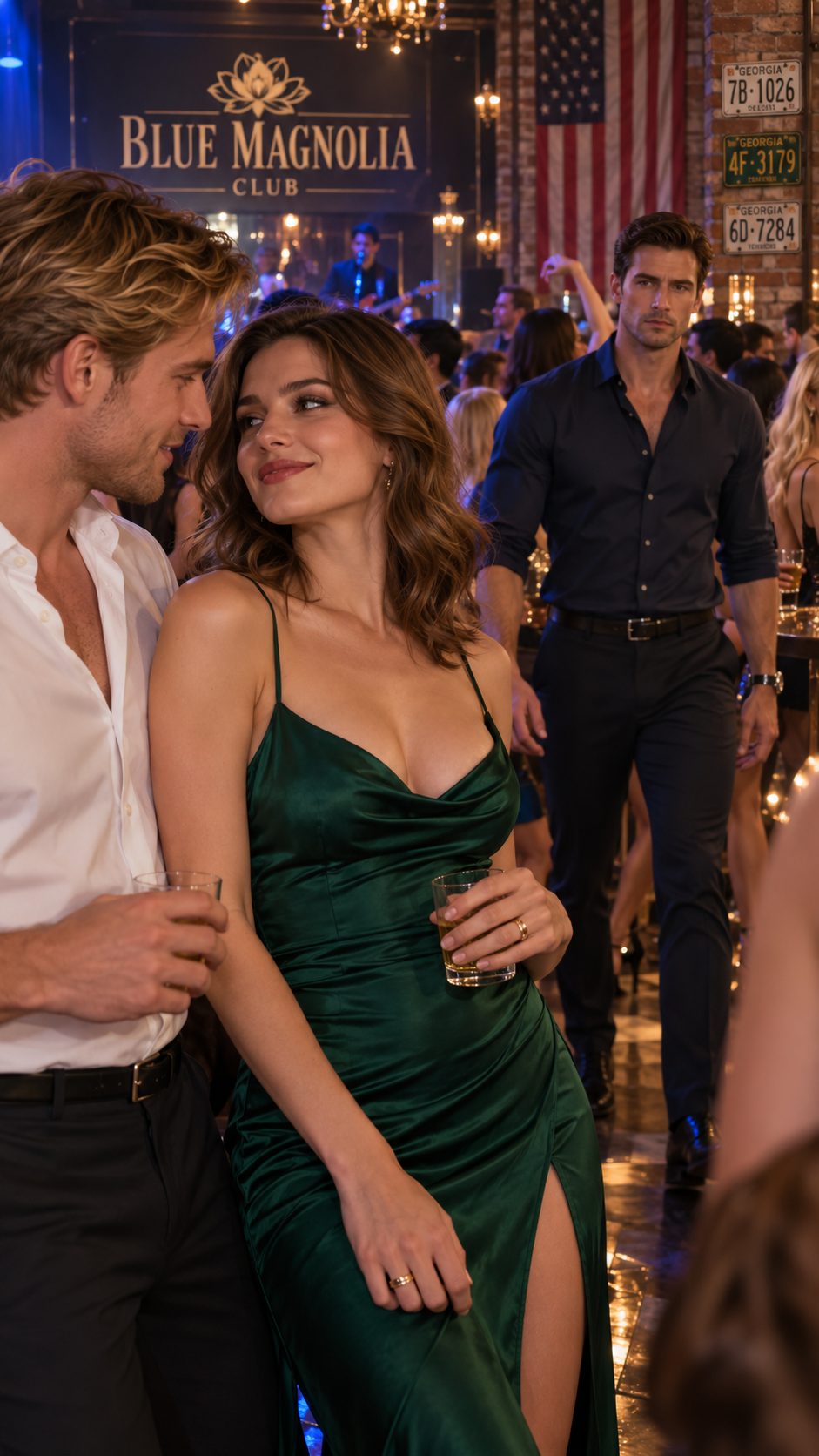
Some promises die in silence.
Others awaken something that should have remained buried beneath the water.
**CHAPTER 1: THE NIGHT MY HUSBAND WALKED AWAY**
The last time I saw my husband smile at me, I was standing in another man’s arms.
Three hours later, the Savannah River whispered my name in a voice that belonged to someone who had been dead for forty years.
And by sunrise, the city had begun forgetting that my husband had ever existed.
But everything started with a wedding ring.
It was Friday night at the Blue Magnolia Club on River Street, and Savannah was drowning beneath another humid Southern evening.
Neon lights shimmered against old brick walls, tourists crowded the bar, and music vibrated through the wooden floorboards.
My husband, Evan Calloway, stood beside me looking like a man who desperately wanted to be somewhere else.
“One drink, Mara,” he said gently.
“Then we can go to the diner.”
I rolled my eyes.
“You make thirty sound like retirement.”
He smiled faintly.
“I worked ten hours today.”
“And I spent ten hours waiting for you to come home.”
His smile disappeared.
I should have heard the loneliness beneath my own accusation.
Instead, I reached for my drink.
Evan worked at a shipping office near Garden City, handling manifests, cargo schedules, and invoices that seemed to follow him home.
He was dependable, patient, and almost painfully considerate.
Unfortunately, I had begun confusing those qualities with boredom.
Our marriage hadn’t exploded.
It had slowly faded into grocery lists, quiet dinners, and conversations about tomorrow’s weather.
Then Kellen Reed walked into the club.
He was Evan’s old college friend, the sort of handsome, effortlessly charming man who could turn an ordinary conversation into something dangerous.
“Well, look at Savannah’s happiest married couple!”
He embraced Evan before turning toward me.
His gaze dropped to my wedding ring.
“Still wearing that thing like it’s your favorite accessory?”
Evan didn’t.
Kellen rested his hand on my shoulder.
My husband noticed but said nothing.
That silence irritated me more than any jealous accusation could have.
When the DJ changed songs, Kellen offered his hand.
“Come on, Mara.
One dance won’t make national news.”
I glanced at Evan.
“Are you going to stop me?”
He looked genuinely confused.
“Why would I?”
“Maybe because I’m your wife?”
His expression softened.
“That’s exactly why I trust you.”
I hated how calmly he said it.
So I took Kellen’s hand.
The dance floor swallowed us in flashing lights and laughter.
Kellen spun me once before drawing me closer.
He knew it.
And I made sure Evan could see.
When my husband finally stood, satisfaction rushed through me.
There it is, I thought.
Finally, he’s going to fight for me.
Evan approached without anger.
His eyes moved from my face to the gold band on my finger.
“If you want to act single,” he said quietly, “take off your wedding ring first.”
The surrounding dancers fell silent.
“Why, Evan?
Are you really that insecure?”
Someone nearby snickered.
Kellen’s smile tightened.
Evan looked at me for a long moment.
Then he nodded once.
No argument.
Not even an accusation.
He turned and walked toward the exit.
I watched him leave, convinced he would return after cooling down.
I didn’t follow.
That was my first mistake.
My second was remaining beside Kellen when the clock above the bar stopped at exactly 11:47.
The music continued.
The dancers moved.
But every reflection in the mirrors behind the liquor bottles became perfectly still.
In one reflection, Evan stood beside me.
He wasn’t smiling.
His clothes were soaked.
Water streamed from his sleeves onto the floor.
I spun around.
Nobody stood there.
Kellen touched my arm.
I jerked away.
“Did you see that?”
“See what?”
“The mirror.”
He followed my gaze.
For one instant, something like recognition crossed his face.
Then he laughed.
“You’ve had too much excitement tonight.”
The clock began ticking again.
Across the room, an elderly woman in a charcoal-gray dress stood beneath the American flag.
She was staring directly at me.
Her pale hair hung in a neat braid, and a blue magnolia flower rested against her collar.
She lifted one finger to her lips.
Then every light above the bar flickered.
When they steadied, she was gone.
I left Kellen without explaining.
Outside, River Street glistened beneath the streetlights.
The Savannah River moved black and silent beyond the railing.
I called Evan.
Straight to voicemail.
I texted him.
No response.
Then I noticed something floating beside the dock.
A small wooden box.
It moved against the current, approaching the steps as though something beneath the water were pushing it toward me.
Inside was an old photograph.
Evan stood on a wooden pier beside an elderly woman.
He looked exactly as he had tonight.
But the photograph was dated October 17, 1968.
The woman beside him wore a charcoal-gray dress.
A blue magnolia flower rested against her collar.
My hands began shaking.
“That isn’t possible.”
Behind me, a voice answered.
“Very little about this river is possible.”
The elderly woman stood at the bottom of the steps.
Up close, her skin looked almost translucent.
Water dripped from the hem of her dress, although the pavement beneath her remained dry.
“Who are you?”
She studied my wedding ring.
“Someone who made the same mistake you did.”
“I don’t understand.”
“No,” she whispered.
I backed away.
“Where is my husband?”
The woman’s expression changed.
For the first time, she looked afraid.
“Your husband has been keeping something beneath this city asleep.”
She looked toward the river.
“And tonight, when he walked away from you, something heard the sound of a promise breaking.”
A bell rang beneath the water.
Not from a church.
Not from any boat.
From somewhere deep below the riverbed.
The woman’s figure began dissolving into silver mist.
“Find the names,” she whispered.
“What names?”
“Before the seventh tide.”
Then she vanished.
I stumbled backward, clutching the photograph.
My phone vibrated.
A message from Evan.
Only six words.
“Whatever happens, do not follow me.”
Then another message appeared.
This one came from his number, but the words weren’t his.
“HE HAS ALREADY GIVEN US HIS NAME.”
I looked toward the black water.
And from beneath the surface, my husband called for help.
**CHAPTER 2: THE HOUSE THAT BEGAN TO FORGET**
I ran toward the river before remembering Evan’s warning.
His voice came again, faint and distorted, as though he were speaking through several feet of water.
I leaned over the railing.
The surface reflected the streetlights.
Nothing moved beneath it.
Then a pale hand appeared against the underside of the water.
Not rising through it.
Pressed against it from below, as though the river were a sheet of glass.
I screamed.
The hand disappeared.
A passing couple turned toward me.
“Ma’am, are you okay?”
I pointed toward the water.
“There’s someone down there!”
The man looked over the railing.
He saw nothing.
By the time the police arrived, I was shaking so badly that I could barely explain what had happened.
They searched the dock.
They searched the water.
They found nobody.
At two in the morning, an officer drove me home.
Evan’s truck was parked in our driveway.
Relief nearly brought me to my knees.
I ran inside.
His shoes were beside the door.
His coffee mug stood in the kitchen sink.
His favorite blue sweater lay folded across the couch.
Everything was where it belonged.
Except him.
I found an envelope on the dining table.
My name was written across it in his familiar handwriting.
Inside was a single sheet of paper.
“Mara, if you’re reading this, I wasn’t able to explain before the river came for me.”
I stopped breathing.
“I wanted to tell you everything, but I was afraid you would look at me differently.”
The next sentence had been crossed out so violently that the pen tore through the page.
Below it, he had written:
“Go to the old city archives and ask for Eleanor Shaw.
Tell her the bell has started ringing again.”
At the bottom was one final line.
“I’m sorry I made you feel alone while trying to protect you.”
I sank onto the floor.
For the first time that night, I cried.
Not because Evan had embarrassed me.
Not because he had walked away.
Because I suddenly understood how much sadness he had been carrying without telling me.
At sunrise, I called his office.
“Garden City Shipping, this is Patricia.”
“Patricia, it’s Mara Calloway.
Has Evan come in?”
“I’m sorry, who?”
“My husband.
Evan Calloway.”
“I don’t believe anyone by that name works here.”
I stared at the wall.
“He’s worked there for eight years.”
“I’m looking at the employee directory, ma’am.”
“Ask his supervisor.”
Another pause.
Calloway isn’t listed.”
Then I noticed our wedding photograph.
It hung above the fireplace in a silver frame.
Yesterday, Evan had been standing beside me, his hand resting gently against my waist.
Now I stood alone.
My white dress filled the center of the photograph.
Beside me was an empty patch of garden.
I pulled the frame from the wall.
The image shifted while I watched.
For one second, Evan returned.
He was looking down at me with the smile I remembered from our wedding day.
Then his face blurred.
And vanished again.
I fled the house.
The Savannah City Archives occupied an old stone building beneath enormous live oaks.
Inside, the air smelled of dust, old paper, and polished wood.
An elderly woman sat behind the front desk.
She wore silver spectacles and a dark-green cardigan.
“Can I help you?”
“I’m looking for Eleanor Shaw.”
She removed her glasses.
“Who sent you?”
“My husband.”
“His name?”
“Evan Calloway.”
The woman’s face drained of color.
She rose slowly.
“Come with me.”
She led me through a locked door into a basement lined with cabinets.
At the far end stood a brass-bound book beneath glass.
Its cover was stained with dark, branching marks resembling water damage.
Eleanor unlocked the case.
“What happened last night?”
I told her everything.
Evan’s warning.
The woman by the river.
The photograph.
The messages.
Eleanor listened without interruption.
When I finished, she closed her eyes.
“Then we have less time than I hoped.”
“For what?”
She opened the book.
The pages were filled with names written in different inks.
Some were more than a century old.
Others appeared disturbingly recent.
Near the final page, I found Evan’s name.
EVAN CALLOWAY.
The letters were fading.
“What’s happening to him?”
Eleanor touched the page.
“Your husband is the last living Keeper of the Undertide.”
I stared at her.
“That doesn’t mean anything.”
“It means he has spent years standing between Savannah and something that lives beneath the river.”
“Something?”
“Not a creature, exactly.”
She looked toward the ceiling, where the sound of distant traffic drifted through the stone.
“A memory that learned how to hunger.”
I shook my head.
“You’re telling me my husband is disappearing because of a ghost story?”
“Ghost stories are often what remain after people stop telling the truth.”
She turned to an older page.
Forty names had been written inside a rectangular border.
Thirty-nine were crossed through.
The final name was missing.
“Many years ago, forty people vanished during a disaster on the river,” she said.
“The city buried the truth, and the Undertide began collecting what had been denied.”
“Collecting what?”
I looked toward Evan’s fading signature.
“Can we get him back?”
“Possibly.”
“We must recover the names that were stolen from the dead and speak them where the first bell was drowned.”
I gripped the edge of the desk.
“And if we don’t?”
Eleanor’s voice became very quiet.
“At the seventh tide, your husband will cease to exist in the memory of the living.”
I swallowed.
“And Evan?”
“He will become part of the river.”
A scraping noise came from inside the glass cabinet.
The ledger’s pages turned without anyone touching them.
A fresh line appeared beneath Evan’s name.
MARA CALLOWAY.
Then, letter by letter, my own name began turning black.
**CHAPTER 3: FORTY NAMES BENEATH THE WATER**
Eleanor slammed the ledger shut.
The scraping stopped.
For several seconds, neither of us spoke.
Then I grabbed her arm.
“Why is my name in that book?”
“Because you have heard the Undertide.”
“Then take it out!”
“I cannot.”
“You don’t understand.
I saw my husband disappear from a photograph this morning!”
“I understand more than you think.”
She reached beneath her cardigan and withdrew a small silver locket.
Inside was a faded picture of a young man.
“My brother, Thomas, was taken thirty-two years ago.”
“What happened to him?”
“He heard the river calling someone who had already died.”
She closed the locket.
“He answered.”
Something cold moved down my spine.
Eleanor returned the ledger to its cabinet and led me toward a table covered in old maps.
One depicted Savannah’s waterfront as it had existed in 1912.
Beneath River Street, a series of narrow stone tunnels connected forgotten storage vaults to the harbor.
At their center stood a small chapel.
“The Bell Chapel,” Eleanor said.
“Why would anyone build a chapel underground?”
“It wasn’t underground when they built it.”
She pointed to an old shoreline marked in blue ink.
“The city expanded over it.
Buildings rose.
Roads changed.
Eventually, the chapel became part of the foundations beneath the waterfront.”
“What happened there?”
Eleanor unfolded a newspaper.
The headline read:
FORTY DOCKWORKERS MISSING AFTER MIDNIGHT COLLAPSE.
The article blamed unstable foundations and a sudden rise in river water.
“No bodies were recovered,” I read.
“That’s what the city told everyone.”
She placed another document beside it.
An unsigned testimony.
The workers had been ordered into the lower warehouse to salvage valuable cargo despite warnings about structural damage.
When the retaining wall failed, supervisors locked the upper access doors to prevent the flood from spreading into neighboring businesses.
Forty people were trapped.
“Someone locked them in?”
Eleanor nodded.
“Company officials denied the order, and the city accepted their account.”
“Who owned the warehouse?”
She hesitated.
“The Vale family.”
I knew the name.
Vale Maritime had financed half the luxury waterfront developments in Savannah.
Its current chairwoman, Lydia Vale, appeared constantly in local newspapers.
“What does this have to do with Evan?”
“The Calloways kept the original records.
Evan’s great-grandmother was a clerk at the docks.
She tried to expose what happened.”
“She discovered that the river was already repeating the names of the dead.”
Eleanor spread the map beneath the light.
“The Undertide forms wherever grief is denied long enough to become something else.
It cannot speak for itself, so it borrows the voices of those who were forgotten.”
I remembered the woman’s wet dress.
The ringing bell.
My husband’s voice beneath the water.
“The Keepers kept the boundary closed,” Eleanor continued.
“But each generation paid with pieces of its own memory.”
“Why didn’t Evan tell me?”
“Because he hoped the old debt would never come due.”
I looked away.
All those evenings when he seemed distracted.
All those nights when I mistook exhaustion for indifference.
I had wanted him to show more emotion without ever asking what he was frightened of.
Eleanor touched my shoulder.
“That doesn’t excuse keeping you in the dark.”
I looked at her.
“He should have trusted you with the truth.”
Her honesty made me cry harder than sympathy would have.
We spent the afternoon examining shipping manifests and damaged photographs.
The original list of workers had been divided among several locations before the archives were sealed.
Eleanor had recovered twenty-three names over the years.
Seventeen remained lost.
Without all forty, she believed the river could not release its claim.
As evening approached, we found a handwritten note inside a ledger from 1989.
“The current Keeper knows the location of the second register.”
Beneath it was a sketch of an iron pedestrian bridge near the old warehouses.
I recognized the place.
Evan sometimes went there alone after work.
He always said he needed fresh air.
Eleanor followed my gaze.
“Don’t go without me.”
But I was already reaching for my keys.
The bridge stood above a narrow inlet where the river pushed between abandoned loading platforms.
At dusk, the water reflected the sky like tarnished silver.
Evan stood at the far end.
For one heartbeat, I couldn’t move.
He looked thinner than he had the night before.
His dark hair was damp.
His navy shirt clung to his shoulders.
The relief in his eyes was immediate.
Then fear replaced it.
“Mara, you shouldn’t be here.”
I hurried toward him.
“Your photographs are changing.
Your office doesn’t remember you.
What is happening?”
He looked away.
“I tried to keep you out of this.”
“By lying to me?”
“By protecting you.”
“Those aren’t the same thing.”
His expression tightened.
We stood several feet apart.
I wanted to touch him.
I wanted him to reach for me.
Neither of us moved.
“I’m sorry about the club,” I whispered.
He closed his eyes.
“Please, Evan.”
“Mara, I heard every word you said.”
I flinched.
He continued quietly.
“I watched you hurt me because you wanted proof that I could still be hurt.”
Tears blurred my vision.
“You’re right.”
That seemed to surprise him.
“I don’t have an excuse,” I said.
“I was cruel.”
The river moved beneath us.
For a moment, Evan’s expression softened.
Then a bell sounded in the distance.
His face changed.
“Go back to Eleanor.”
“Not without you.”
He stepped toward me.
“You cannot fix what happened between us by throwing yourself into something you don’t understand.”
“Then why are you here?”
“Because whatever happens to our marriage, you don’t deserve to disappear.”
He stared at me.
Slowly, he reached into his pocket.
He removed a folded piece of paper and placed it on the bridge railing.
“The second register is hidden in the old customs house.”
Before I could take it, the water beneath us turned white.
Dozens of pale faces appeared below the surface.
A woman’s voice rose from the river.
“Thirty-nine remembered.”
Another voice answered.
“One still hidden.”
Evan seized my wrist.
“Don’t look down.”
But I already had.
Among the faces beneath the water was the elderly woman from the nightclub.
Her eyes opened.
And she whispered a name.
“Kellen Reed.”
**CHAPTER 4: THE MAN WHO KNEW TOO MUCH**
Kellen answered my call on the first ring.
His voice sounded almost relieved.
“We need to talk,” I said.
“About Evan?”
“About what you knew before Friday night.”
Then he asked, “Where are you?”
“Tell me the truth.”
Another pause.
“Meet me at the Blue Magnolia tomorrow afternoon.”
“You come to the archives, Kellen.
And if you’re lying to me, don’t bother coming at all.”
He arrived just before noon.
The club’s effortless charmer looked nothing like the man who had danced with me two nights earlier.
His blond hair was uncombed.
Dark circles shadowed his eyes.
Eleanor stood beside the table while I placed the old photograph and a copy of the dockworker records in front of him.
Kellen stared at the woman’s face.
“You saw her.”
It wasn’t a question.
“Who is she?”
He swallowed.
“Cora Bell.”
“How do you know her?”
“My sister saw her too.”
Eleanor’s expression hardened.
“Kellen, what have you done?”
He sat down heavily.
“My sister Alice disappeared when she was sixteen.”
I remembered Alice Reed.
She had been funny, stubborn, and endlessly curious.
Twelve years ago, her disappearance had devastated Kellen’s family.
The police believed she had fallen into the river.
Her body was never recovered.
“She started hearing the bell,” Kellen said.
“At first, she thought someone was playing a trick.
Then she began seeing people nobody else could see.”
“Why didn’t you tell anyone?”
He looked toward Eleanor.
“Nobody believed us until it was too late.”
Eleanor’s silence told me she remembered.
Kellen rubbed his face.
“Two months ago, Lydia Vale contacted me.
She said Alice wasn’t dead.”
My stomach tightened.
“What did Lydia want?”
“She said Evan was keeping the river closed.”
I stared at him.
“If the boundary weakened, Alice could return.”
The pieces began fitting together.
His sudden appearance at the club.
His comments about my ring.
The way he had deliberately moved closer while Evan watched.
“You weren’t flirting with me because you wanted me.”
Kellen lowered his eyes.
“You were trying to make Evan leave.”
He said nothing.
I felt sick.
“You used me.”
I stepped backward.
“And you knew what might happen to him?”
“Not everything.”
“But enough.”
His silence was an answer.
I wanted to slap him.
Instead, I forced myself to remain still.
“You gave me an opportunity to hurt my husband,” I said.
“But I’m the one who chose to do it.”
Kellen looked up.
“I never meant for you to get caught in this.”
“You don’t get to make that sound like kindness.”
Eleanor placed a hand on the table.
“Where is Lydia keeping the third register?”
Kellen hesitated.
“At the old Tidehouse.”
The name meant nothing to me.
Eleanor went pale.
“The customs station?”
“Lydia bought it last year.
She’s restoring the foundations.”
“For what purpose?”
Kellen looked at me.
“She says there’s a door beneath it.”
A cold sensation moved through the room.
Eleanor opened a drawer and withdrew an iron key.
It was dark with age and shaped like a narrow bell.
“The Tidehouse was built over one of the original channels leading to the chapel.”
I looked at Kellen.
“Take us there.”
He shook his head.
“Lydia has people watching it.”
“Then we’ll go at night.”
“You’re not listening.
She knows your name now.”
“So does the river.”
For the first time, he looked genuinely frightened.
That afternoon, Kellen took us to Lydia Vale’s waterfront headquarters.
He insisted that speaking to her might reveal something useful.
Lydia received us in an office overlooking the Savannah River.
She was a poised woman in her early fifties, dressed in an ivory suit that looked expensive enough to purchase my car.
“Mara Calloway,” she said pleasantly.
“I’ve been expecting you.”
My hands turned cold.
“Where’s my husband?”
She indicated a chair.
“Your husband has inherited a very unfortunate obligation.”
“Stop talking around the question.”
Lydia smiled.
“Evan has spent years resisting something inevitable.
The river needs a Keeper, and his family has served that purpose for generations.”
“Then release him.”
I stared at her.
She leaned forward.
“But I need the old registers destroyed.”
Eleanor stiffened.
“Those are the only surviving records of the people your family abandoned.”
Lydia’s expression sharpened.
“History is full of unfortunate accidents.”
“Forty people were locked inside a warehouse,” I said.
“That was more than a century ago.”
“And they’re still waiting for someone to acknowledge them.”
For the first time, Lydia stopped smiling.
“Careful, Mrs.
Sentiment can become expensive.”
I looked at the river through the enormous windows.
“And what happens if I refuse?”
“Your husband will be gone by the seventh tide.”
I turned toward the door.
Her voice followed me.
“Ask Evan what he surrendered three years ago.”
Lydia spoke more softly.
“Ask him why you cannot remember the night he first heard the bell.”
I looked back.
She was smiling again.
“You see, Mara, your husband has already made a bargain with the river.”
“And the price,” she whispered, “was something he took from you.”
**CHAPTER 5: THE ROOM BETWEEN TWO TIDES**
I confronted Evan beneath the old pedestrian bridge.
He was waiting beside the railing when I arrived, as though he had known I would come.
“Did you make a bargain with the river?”
He closed his eyes.
“Who told you that?”
“Lydia Vale.”
His expression darkened.
“Stay away from her.”
“Answer me.”
He looked down at the water.
The word felt like a door slamming.
“What did you give it?”
“A memory.”
He didn’t answer.
I stepped closer.
For a moment, the world seemed to tilt.
Three years ago, I had been hospitalized after a car accident near the waterfront.
The doctors said I had suffered a concussion and lost several hours of memory.
Evan had stayed beside my bed for two days.
He barely slept.
I remembered waking to find him holding my hand.
But nothing before that.
“What really happened?”
He gripped the railing.
“You heard the bell while we were walking along River Street.”
“You saw someone standing on the water.”
“You followed her toward the dock.
I tried to stop you, but you stepped through something I couldn’t see.”
My mouth went dry.
“Through what?”
“A doorway beneath the surface.”
He spoke as though each word hurt.
“When I reached you, you couldn’t remember your own name.”
A distant boat horn sounded across the harbor.
“I begged the Undertide to let you go,” he continued.
“It offered me a choice.”
“What choice?”
“Your memory of the crossing, or your life.”
I pressed a hand over my mouth.
“I chose your memory,” he said.
“Why didn’t you tell me afterward?”
“Because the bargain forbade me from explaining what you had seen.”
“All these years?”
“I tried to tell you other things.
About the bell.
My family.”
His eyes filled with exhaustion.
“Every time I got close, I lost another memory of us.”
I remembered him forgetting our first vacation.
Forgetting the name of the restaurant where he’d proposed.
I had thought he was becoming indifferent.
He had been trying not to lose the last pieces of our life together.
Tears burned my eyes.
“Evan, you should have told me what you could.”
“We were supposed to face things together.”
Neither of us spoke for a long moment.
Then he looked at my wedding ring.
“Please don’t think what happened Friday was entirely your fault.”
I shook my head.
“You don’t have to protect me from the truth about my own behavior.”
His expression softened.
“Neither do you have to forgive everything I hid.”
That was the first completely honest conversation we’d had in years.
And somehow, it hurt more than any argument.
At sunset, Eleanor called.
She had found a way into the Tidehouse.
Kellen met us beside a rusting gate near the eastern waterfront.
The building stood on wooden pilings above a narrow channel.
Its windows were boarded.
Salt stained the walls.
A painted sign above the entrance had nearly disappeared.
Kellen unlocked the door using Eleanor’s iron key.
Inside, old shipping desks stood beneath sheets of dust.
A narrow staircase descended toward the river.
“Why did Lydia buy this place?”
I whispered.
“Because her family sealed the original evidence beneath it,” Eleanor answered.
We descended.
The lower room should have been underwater.
Instead, the river pressed against invisible walls surrounding a dry stone chamber.
Fish moved past us at eye level.
Moonlight filtered through the black water.
“This isn’t possible.”
Evan touched the wall.
“The boundary is weak.”
At the chamber’s center stood a wooden desk.
On it rested a ledger, a brass lantern, and a blue magnolia brooch.
Eleanor opened the ledger.
“Seventeen names.”
She looked almost afraid to breathe.
“These are the missing workers.”
Kellen stood near the doorway, watching the water.
“Take it quickly.”
I reached for the brooch.
The moment my fingers touched it, the room vanished.
I stood inside a crowded warehouse.
Rain hammered the roof.
Workers shouted as water poured through the lower doors.
A young woman struggled with an iron lock.
“Open it!” someone screamed.
She turned toward me.
Her face was pale with terror.
I recognized her.
But now she was young.
She held a ring of keys and was desperately trying to open the warehouse doors.
A man in an expensive coat seized her arm.
“Leave them!”
“There are people inside!”
“The cargo matters more!”
She pushed him away.
Then the wall collapsed.
Water rushed toward me.
I screamed.
Suddenly Evan’s arms were around me.
We were back in the stone chamber.
The brooch lay on the desk.
“What did you see?” he demanded.
“Cora tried to save them.”
Eleanor looked stunned.
“She wasn’t one of the workers.”
I grabbed the ledger.
“She was trying to open the doors.”
A low grinding sound came from beneath us.
The water beyond the invisible wall darkened.
Dozens of faces appeared.
Then a woman’s voice whispered:
“Thirty-nine remembered.”
Eleanor counted the recovered names again.
Her fingers stopped at the final page.
“There are only thirty-nine.”
My heart began pounding.
“But the records say forty.”
The brass lantern lit itself.
Letters appeared across the wall in dripping silver.
THE FORTIETH NAME WAS NEVER A VICTIM.
Evan turned white.
He stared at the words.
Then whispered:
“The fortieth name belongs to the person who ordered the doors locked.”
**CHAPTER 6: THE NAME NO ONE DARED WRITE**
We escaped the Tidehouse just before the walls of water collapsed inward.
The building shook beneath us.
Kellen slammed the outer door as a wave struck the pilings.
For several minutes, we stood in the rain without speaking.
Then Eleanor opened the recovered ledger beneath the shelter of an abandoned warehouse.
“Thirty-nine workers,” she said.
“And one man responsible,” I answered.
Evan stared toward the dark river.
“The original Keeper believed the truth could not be restored without naming both the dead and the person who condemned them.”
Kellen looked troubled.
“Why would the river care about the guilty man?”
“Because the dead were blamed for their own deaths,” Eleanor replied.
She turned to a page filled with water stains.
“The city called them careless.
Their families were denied compensation.
Their names were removed from company records.”
I remembered the young Cora struggling with the lock.
“The man in the coat…”
Eleanor looked at me.
“Did you see his face?”
“Not clearly.”
“What about his voice?”
I closed my eyes.
The memory returned in fragments.
The shouting.
The frantic rattle of keys.
And the man speaking with cold impatience.
“The cargo matters more.”
Something about those words bothered me.
I had heard them before.
Not from a person.
From a recording.
Three months earlier, Lydia Vale had appeared in a documentary about Savannah’s maritime history.
She had described her great-grandfather as a visionary businessman.
The documentary included a restored audio cylinder from an old company address.
In it, a man had declared:
“Commerce must survive, whatever sacrifice the river demands.”
I opened my eyes.
“Gideon Vale.”
Eleanor nodded slowly.
“Lydia’s great-grandfather.”
Kellen swore under his breath.
Evan took the ledger from Eleanor.
“The records don’t name him because his family paid to remove every trace of the order.”
“Then we name him ourselves,” I said.
Eleanor shook her head.
“It isn’t enough to accuse him.
The Undertide remembers truth, not suspicion.”
“So we need proof.”
Kellen looked toward the waterfront.
“I know where she keeps it.”
We turned toward him.
“Lydia has a private archive inside her family’s old house on East Gaston Street.”
“How would you know that?”
He hesitated.
“Because she showed me Alice’s belongings there.”
My anger toward him had not disappeared.
But there was something terrible about the way he said his sister’s name.
He had spent twelve years believing she was alive somewhere.
Perhaps he had never allowed himself to mourn.
We drove through rain-soaked streets beneath enormous live oaks.
Lydia’s house stood behind an iron gate.
Its white columns gleamed beneath the storm.
Kellen knew the side entrance.
Inside, the rooms smelled of expensive polish and old roses.
He led us to a locked study.
Evan forced the door open with a heavy brass fireplace tool.
I expected alarms.
Instead, I heard a familiar voice.
“You’re late.”
Lydia stood beside the fireplace.
In her hand was a leather-bound journal.
“I wondered which of you would finally work out the truth.”
Kellen stepped forward.
“Where’s Alice?”
Lydia gave him a pitying look.
“Your sister belongs to the river now.”
His face collapsed.
“You said she could come back.”
“I said the boundary could be opened.”
“You lied.”
“I allowed you to believe what you needed.”
Kellen moved toward her.
Evan stepped between them.
Lydia turned toward me.
“You should understand something, Mara.
The original disaster built this family’s fortune, but the river’s anger has endangered Savannah for generations.”
“Then tell the truth.”
“And destroy everything my family created?”
“Forty people died.”
“Forty people died more than a century ago.”
She raised the journal.
“And thousands live here now.”
I looked at Evan.
He had gone strangely still.
His hand was fading at the edges.
I reached for him.
My fingers passed through his sleeve.
He looked down.
For the first time, I saw fear break through his composure.
Lydia noticed.
“The seventh tide is approaching.”
She opened the journal.
“His family kept the Undertide sleeping by surrendering memories.
Now it wants a name permanently.”
“Mine,” Evan said.
Lydia smiled.
Kellen’s hands curled into fists.
“You planned this.”
“I planned to save the city.”
“By sacrificing Evan?”
“His family understood the responsibility when they accepted it.”
I stepped toward her.
“No one has the right to make that decision for him.”
Lydia’s expression hardened.
“You still believe this is about your marriage.”
“It isn’t.”
My voice shook.
“It’s about people being erased so someone else can avoid responsibility.”
For a moment, nobody moved.
Then Kellen reached toward the journal.
Lydia pulled it away.
A gust of icy wind swept through the room.
Every mirror darkened.
Water began seeping between the floorboards.
From somewhere beneath the house came the sound of the bell.
Lydia backed toward the fireplace.
The journal opened in her hands.
A page tore itself free and floated into the air.
I caught it.
Across the top was an order dated October 17, 1912.
WAREHOUSE SEVEN — EMERGENCY CONTAINMENT.
At the bottom was a signature.
Beneath it, in faded ink, stood the words:
“Secure the upper doors before releasing the cargo.”
I looked up.
“We have proof.”
The river answered before anyone could speak.
Every window in the study filled with black water.
And from inside the glass, Alice Reed pressed her pale hands against the surface.
**CHAPTER 7: THE BELL WITHOUT A TONGUE**
Kellen dropped to his knees.
The girl beyond the window looked sixteen.
Exactly as she had in the photograph he still carried inside his wallet.
Her dark hair floated around her face.
Her eyes were open.
But she wasn’t looking at Kellen.
She was looking at Lydia.
The glass began to crack.
Evan seized my hand.
“We have to go.”
Kellen struggled to stand.
“I can’t leave her.”
“Alice isn’t trapped behind that glass,” Eleanor said.
She spoke with painful gentleness.
“That is the Undertide showing you what you have refused to release.”
Kellen shook his head.
The girl pressed one hand against the glass.
Her lips moved.
This time, we all heard her.
“Remember me.”
The windows shattered inward.
Water rushed across the floor.
We fled the house carrying the ledger, Gideon Vale’s order, and the recovered names.
Behind us, Lydia screamed for someone to save the journal.
Nobody turned back.
By midnight, storm warnings had emptied much of River Street.
The Savannah River rose against the seawall, carrying branches, debris, and strange pale lights beneath its surface.
Eleanor led us toward the Blue Magnolia.
The club was closed.
Its windows were dark.
But behind the bar, beneath the old brick wall, she uncovered a narrow iron hatch.
“The original chapel,” she said.
Kellen helped raise it.
Stone steps descended into darkness.
Evan stood beside me.
His outline had become frighteningly faint.
Through his shoulder, I could see the wall behind him.
I reached for his hand.
This time, my fingers met his.
“Mara,” he whispered.
I looked up.
“If this doesn’t work, don’t let what happened between us become the only thing you remember.”
My throat tightened.
“Don’t talk like that.”
He swallowed.
“I loved the quiet life we had.
Even when it wasn’t enough for you, it was everything I knew how to give.”
Tears filled my eyes.
“I didn’t know how to ask for what I needed without making you feel like you had failed.”
“You didn’t fail by wanting more.”
“I failed by turning it into a test.”
He brushed one trembling finger against my cheek.
“We both stopped telling each other the truth.”
I leaned toward him.
For one brief moment, our foreheads touched.
Then the bell sounded beneath us.
Eleanor called from the staircase.
“It’s starting.”
We descended.
The chapel stood inside a cavern of ancient stone.
Black water surrounded a circular platform.
Above it hung an enormous bronze bell.
Its surface was covered in names.
But inside, where the clapper should have been, there was only darkness.
“The bell was silenced when the first Keeper hid the testimony,” Eleanor explained.
“How do we ring it?”
She looked toward Evan.
“A Keeper can give his name to become its voice.”
I turned sharply.
Evan didn’t look surprised.
He had known.
All along, he had known.
“I can hold the boundary,” he said.
“You’ll disappear.”
“Then we’re finding another way.”
Eleanor opened the ledger.
“The names must be spoken before witnesses, with the truth of their deaths acknowledged.”
Kellen stepped forward.
“I’m a witness.”
“So am I,” Eleanor said.
I looked toward the staircase.
The sound of approaching footsteps echoed above us.
Lydia appeared at the entrance, soaked from the storm.
She held a lantern and looked as though she had aged ten years.
“You can’t do this.”
I faced her.
“Your family buried the truth.”
“Because admitting it would have destroyed the city!”
“The city survived because people kept lying!”
The water began rising around the platform.
A hundred pale faces appeared beneath the surface.
I opened the ledger.
My voice trembled as I read the first name.
“Samuel Harlan.”
The water stirred.
“Margaret Bell.”
A pale face looked upward.
“Joseph Mercer.”
One by one, I spoke the names.
Eleanor repeated them.
Kellen followed.
Their voices joined mine until the chapel seemed filled with more people than the four of us could possibly account for.
At the thirty-ninth name, the bell began to tremble.
I unfolded Gideon Vale’s order.
“The warehouse doors were locked under the authority of Gideon A.
Vale,” I said.
“The workers were not careless.
They were abandoned.”
Lydia covered her mouth.
Water surged over the platform.
The final name appeared across the bell.
I spoke it aloud.
The bronze bell shuddered.
But it did not ring.
Evan stepped forward.
“The truth needs a living witness willing to take responsibility for carrying it.”
Eleanor looked horrified.
“It will take your name.”
Evan nodded.
I caught his wrist.
“No more people disappearing to protect everyone else’s silence.”
I removed my wedding ring.
The little gold band gleamed beneath the lantern.
For years, I had worn it without understanding that love was something I needed to practice, not merely possess.
I placed it against the bronze bell.
“My name is Mara Calloway,” I said.
“I saw what silence did to someone I loved.”
The water became perfectly still.
“I will remember these people.
I will tell their story.
I will not let their names disappear again.”
The bell began to glow.
Evan reached for me.
“Mara, stop!”
But the ring had already fused to the bronze.
A deep voice rose from the water.
ONE LIVING NAME MUST BE GIVEN.
Evan stepped forward.
I moved before him.
“Then take mine.”
The bell swung.
And everything turned white.
**CHAPTER 8: THE PROMISE WE CHOSE TO KEEP**
I expected darkness.
Instead, I found myself standing in a field of water beneath a sky full of unfamiliar stars.
The river stretched in every direction.
Yet I could walk across its surface.
Far away, forty lanterns floated in a circle.
Inside each flame was a face.
People wearing the work clothes of another century.
Cora Bell stood among them.
She was no longer the frightened young woman from the warehouse.
Her expression was peaceful.
“Why am I here?”
She approached slowly.
“Because you offered your name.”
“Did the river take it?”
I looked around.
“Where is Evan?”
My heart tightened.
“Please don’t let him disappear.”
Cora studied me.
The question stunned me.
“Because I love him.”
“Is that why you followed him?”
“At first, perhaps.”
I thought of the thirty-nine names.
Of Eleanor’s brother.
Of generations of people whose grief had been dismissed because the truth was inconvenient.
“Because nobody deserves to be erased.”
Cora smiled faintly.
“Then you have understood what the first Keepers forgot.”
She raised her hand.
The water beneath us became transparent.
Far below, I saw Savannah.
People stood along River Street watching strange lights rise from the river.
Some held phones.
Others clutched their families.
The bell’s sound traveled through the city like thunder.
“The Undertide was never meant to feed on promises,” Cora said.
“It was created from remembrance.”
“Then why did it take people?”
“Because those who knew the truth refused to carry it.
The burden fell upon the few who were willing to listen.”
I looked toward the lanterns.
“What happens now?”
“You have named the dead and acknowledged the wrong done to them.”
“Is that enough?”
“It will be, if the living continue what you began.”
The lanterns drifted toward me.
Each passed close enough for me to see a face clearly.
A young father.
An elderly woman.
A boy who couldn’t have been older than seventeen.
Forty lives.
Forty stories that deserved more than a forgotten newspaper headline.
One lantern remained behind.
Inside it stood Alice Reed.
She looked toward me.
“Tell Kellen I wasn’t waiting to come home.”
My eyes filled.
“What were you waiting for?”
“For him to remember me without destroying himself.”
Her lantern glowed brighter.
Then the sky opened.
I fell through the light.
When I woke, I was lying on the chapel floor.
Eleanor knelt beside me.
Kellen stood near the water, crying silently.
The bronze bell hung motionless above us.
My wedding ring was gone.
But every name engraved across its surface gleamed like polished gold.
Nobody answered.
My breath caught.
I struggled to stand.
Then someone spoke from behind me.
“I’m here.”
Evan stood at the edge of the platform.
His face was pale.
His clothes were soaked.
But he was solid.
I crossed the distance between us.
He caught me before I could fall.
For several seconds, I simply held him.
I could feel his heartbeat.
His breathing.
The warmth of his hands against my back.
“I thought I’d lost you,” I whispered.
He held me tighter.
“So did I.”
Above us, the bell rang once more.
Not with warning.
With release.
The water withdrew from the chapel.
The pale faces disappeared.
And somewhere outside, the Savannah River began flowing peacefully toward the sea.
By morning, the city remembered Evan again.
His name returned to company records.
Our wedding photographs showed him beside me.
His coworkers called to ask where he’d been.
Nobody could explain the missing hours.
But everyone remembered the strange bell heard across the waterfront during the storm.
Within days, the recovered warehouse records became public.
Gideon Vale’s signed order forced an investigation into the century-old disaster and the company’s later concealment of evidence.
Lydia resigned from Vale Maritime.
The old Tidehouse was placed under historical protection.
Plans began for a memorial honoring the forty people whose deaths had been hidden.
Kellen attended every planning meeting.
He never asked me to forgive him.
And I never pretended his actions had been harmless.
But one afternoon, he showed me an old photograph of Alice smiling beside the river.
“I finally dreamed about her,” he said quietly.
“Was she all right?”
“For the first time, she wasn’t calling for help.”
He looked toward the water.
“She was saying goodbye.”
I squeezed his shoulder.
Nothing more needed to be said.
Evan and I didn’t magically return to the marriage we’d had before.
Some things were too damaged for that.
Sometimes we argued.
Sometimes we sat across from each other in complete silence because neither of us knew how to explain what we were feeling.
But the silence was different now.
It wasn’t a punishment.
It wasn’t avoidance.
It was room to think.
Evan told me about the fear he’d carried for years.
I told him how invisible I’d sometimes felt.
We learned that love could be both genuine and imperfect.
And that staying together meant nothing if we stopped choosing each other honestly.
Three months after the storm, we met for dinner at our favorite late-night diner.
Evan arrived in a navy shirt.
I wore a simple black dress.
Neither of us wore a wedding ring.
Over coffee, he looked at me.
“Do you think we can really start again?”
I considered the question.
“I don’t think we can start again as the people we were.”
He looked down.
Then I reached across the table.
“But I’d like to find out who we can become.”
He took my hand.
His familiar warmth nearly brought me to tears.
After dinner, we walked along River Street.
The Blue Magnolia had reopened.
Music spilled through its doors.
A small crowd gathered beneath its renovated sign.
Evan stopped.
“Do you want to go inside?”
I studied his face.
“Are you sure?”
“One dance.”
I laughed softly.
“Only one?”
“Let’s not get ambitious.”
Inside, the club looked almost unchanged.
The old flag still hung above the bar.
The Georgia license plates remained on the brick wall.
But beside the entrance, a small bronze plaque listed forty names.
No one had tried to hide them this time.
Evan held out his hand.
I looked at it.
Then I placed mine in his.
We moved slowly to the music.
There was no jealousy.
No audience to impress.
No desperate need to prove that either of us mattered.
He rested his hand gently against my waist.
I looked into his eyes.
“Can I ask you something?”
“Anything.”
“Do you think the river still remembers us?”
He glanced toward the windows.
Beyond them, the Savannah River shimmered beneath the moonlight.
“Probably.”
“Does that frighten you?”
He considered it.
“Not anymore.”
I leaned closer.
“Because I think it finally knows the difference between a promise someone makes out of fear and one they make freely.”
My throat tightened.
“Then I want to make you a promise.”
He brushed a strand of hair away from my cheek.
“Make it a small one.”
I smiled through sudden tears.
“Tomorrow, I’ll tell you the truth, even when it’s difficult.”
His expression softened.
“And tomorrow, I’ll listen, even when I’m afraid of what you’ll say.”
For a moment, neither of us spoke.
Then Evan kissed my forehead.
Outside, the river continued its endless journey toward the ocean.
Somewhere beneath its surface, the old bell remained silent.
And I understood something I had been too foolish to recognize before.
Love wasn’t proven by how desperately someone chased you when you walked away.
It was proven by the courage to remain honest when staying became difficult.
That night, my husband didn’t promise me forever.
He promised me tomorrow.
And for the first time in years, tomorrow felt like enough.
✓ Lynn R. Adams
Some promises die in silence. Others awaken something that should have remained buried beneath the water. **CHAPTER 1: THE NIGHT MY HUSBAND WALKED AWAY** The last time I saw my husband smile at me,…