D-The Night My Wife Took Off Her Wedding Ring Was the Beginning of the End We Had Both Refused to See
*One joke at a summer party exposed what eight years of silence had been hiding.*
**CHAPTER 1:THE WEIGHT IS GONE**
My wife slipped off her wedding ring in front of everyone, held it up like a trophy, and laughed, “The weight is gone.”
The crowd burst out laughing.
Kevin laughed louder than anyone.
And while my wife smiled at him as if our eight-year marriage were nothing but a joke, I stood ten feet away and said absolutely nothing.
It happened during a summer evening in Raleigh, North Carolina, at an outdoor office party near Five Points.
String lights hung between oak trees, small American flags filled mason jars on the buffet tables, and barbecue smoke drifted across the lawn beneath a white party tent.
Everything looked warm, relaxed, and harmless.
Nothing about that night was harmless to me.
My wife, Marissa, had spent nearly two hours getting ready before we left.
She changed dresses twice, checked her hair in every mirror she passed, then held up a pair of gold earrings.
“Do these make me look too settled?” she asked.
I looked at her.
She smiled at the mirror.
“You know what I mean.”
“No,” I said quietly, “I don’t think I do.”
She laughed like I was being difficult.
“You take everything so seriously.”
That word stayed with me.
As though our marriage was something that had happened to her instead of something we had built together.
We had been married eight years, and everyone who knew us thought they understood exactly who we were.
I was the quiet husband.
The dependable one.
The man who carried coolers, fixed broken porch lights, remembered birthdays, and never caused a scene.
Marissa used to tell people that was what she loved most about me.
Lately, she had started using my silence like permission.
The moment we arrived at Dana’s house, she practically disappeared from my side.
She moved between groups with a drink in her hand, laughing too loudly, touching people’s arms while she talked, and letting certain men stand closer than necessary.
One man more than the others.
Kevin Mercer.
Her coworker from the sales division.
Six months earlier, she had called him “annoying but harmless.”
Then one night, he became “actually pretty sharp.”
Later, he was “going through a hard time.”
Eventually, she stopped mentioning him altogether.
That was the part that bothered me most.
I stood near the drink table and watched Kevin lean toward her.
He whispered something into her ear.
Marissa threw her head back laughing and placed her hand against his chest.
Kevin grinned.
“You think I’m wrong?” he asked.
“You’re terrible,” she said.
“But I’m right.”
Marissa smiled.
“I didn’t say that.”
People around them noticed.
Then they looked away.
A few minutes later, someone in the group joked about how heavy marriage could feel after enough years.
I never even saw who said it.
I only saw Marissa raise her left hand.
Her diamond caught the glow from the string lights.
For half a second, I thought she might defend us.
Instead, she twisted the ring from her finger.
Kevin watched closely.
Marissa held the ring between two fingers.
Then she smiled.
“The weight is gone.”
Everyone laughed.
Some of them probably laughed because everyone else did.
Some looked uncomfortable the second the words registered.
Kevin did not.
He laughed loudly.
“Freedom looks good on you,” he said.
Marissa turned toward him with a smile that made my stomach tighten.
“Careful, Kevin.”
“You’ll give me ideas.”
More laughter.
I stared at her.
She finally noticed me.
Our eyes met across the lawn.
I waited for her expression to change.
I waited for embarrassment.
For regret.
For her to put the ring back on and say, “Relax, I’m kidding.”
Instead, she slipped it into her clutch.
Then she turned back to Kevin.
I didn’t confront her.
I didn’t shout.
I didn’t give her the angry-husband scene she could later use to make herself the victim.
I finished my sweet tea, placed the plastic cup on the table, and left without saying goodbye.
That night, I went home alone.
For the first time in eight years, I didn’t leave the porch light on.
Marissa arrived after one in the morning.
I heard her key turn in the lock from the bedroom.
She walked in carrying her heels, and for several seconds she stood in the doorway watching me.
“You seriously left me there?”
I kept my eyes on the book in my hands.
“You had company.”
Her face hardened.
“Oh, come on.”
I looked up.
“You took off your wedding ring and told a crowd that losing it felt like losing weight.”
“It was a joke.”
“Then why are you acting like this?”
That question told me more than the joke had.
She wasn’t sorry.
She was annoyed that I had reacted.
“You embarrassed me,” she said.
I almost laughed.
“I embarrassed you?”
“You vanished without telling me.”
“Would you have noticed if Dana hadn’t asked where I went?”
Her mouth opened.
Then closed.
That silence was answer enough.
She put her heels down.
“Kevin is a coworker.”
“I didn’t ask.”
“You’re obviously thinking something.”
“I’m thinking you knew exactly what you were doing.”
She folded her arms.
“You always do this.”
“Get quiet and punish me.”
I stared at her.
“I’m not punishing you, Marissa.”
“Then what is this?”
I closed the book.
“This is me finally listening when you show me how you feel about our marriage.”
For the first time that night, she looked unsettled.
But it lasted only a second.
She turned away.
“You’re being dramatic.”
Then she went into the bathroom and shut the door.
I stayed awake long after she fell asleep.
Beside me, her left hand rested above the blanket.
The wedding ring was back on her finger.
Two inches of space separated her hand from mine.
It felt like miles.
And somewhere between two and three in the morning, I understood something that frightened me more than anger ever could.
I no longer wanted to argue her into respecting me.
I wanted to know the truth.
**CHAPTER 2:THE SILENCE BETWEEN US**
The morning after the party, Marissa behaved as though nothing had happened.
She made coffee.
She scrolled through her phone.
She complained that Dana had bought cheap wine.
At one point, she even kissed my cheek while passing behind my chair.
The gesture was so ordinary that it felt rehearsed.
I watched her move around the kitchen and wondered how two people could live in the same house while experiencing completely different realities.
“Are you still mad?” she asked eventually.
“I’m not mad.”
She looked up from her phone.
“That’s worse.”
“Because when you’re mad, at least you talk.”
I took a sip of coffee.
“What would you like me to say?”
“That you know I was joking.”
“I know you said it as a joke.”
She smiled with relief.
“That’s different from saying I thought it was funny.”
The relief disappeared.
Marissa put her phone down.
“Kevin jokes with everyone.”
“This isn’t about Kevin.”
“It clearly is.”
I met her eyes.
“It’s about you.”
She leaned back.
“I’m not doing this before work.”
“Neither am I.”
The strange thing about a marriage beginning to crack is that life does not stop to honor the occasion.
Trash still has to be taken out.
Bills still arrive.
Grass still grows.
People still ask whether you want to meet for dinner on Friday.
For the next several days, Marissa and I lived almost normally.
She sent me grocery lists.
I changed the air filter.
We discussed whether the upstairs bathroom faucet needed replacing.
But somewhere beneath every conversation was the party.
The missing ring.
Kevin’s laugh.
The look on her face when he said freedom looked good on her.
I began noticing things I had trained myself not to notice before.
She kept her phone face down.
She took it into the bathroom.
She smiled at messages and then became expressionless when I entered the room.
She started saying she had to stay late at work, though her office had spent the last two years bragging about flexible schedules.
None of those things proved anything.
That mattered to me.
Suspicion was not truth.
I refused to destroy eight years of marriage based only on fear.
Three days after the party, Dana texted me.
I had known her casually for years.
She was friendly with Marissa, though they were never especially close.
Her message contained only six words.
I’m sorry about Saturday night.
I stared at the screen.
Then typed back.
You don’t have to apologize.
The three dots appeared.
Disappeared.
Appeared again.
Finally, another message arrived.
I should have stopped it sooner.
My stomach tightened.
Stopped what?
There was no answer for almost ten minutes.
Then Dana called.
I stepped outside my office before answering.
Her voice sounded uncomfortable.
“I don’t want to be in the middle of your marriage.”
“Then don’t be.”
“That’s not what I mean.”
I leaned against the brick wall.
“What do you mean?”
Dana exhaled.
“Marissa and Kevin have been getting too close for a while.”
“How close?”
“I don’t know.”
Her voice lowered.
“But people at work notice things.”
“What things?”
“Drinks after meetings.”
Another pause.
“Kevin showing up in places where he had no reason to be.”
The heat outside suddenly felt suffocating.
“Why are you telling me this?”
“Because Saturday made me feel sick.”
I closed my eyes.
“Did they leave together?”
Dana hesitated.
That hesitation hurt more than the answer.
“I saw Kevin near her car after you left.”
“Near her car?”
“They were talking.”
“That isn’t what I asked.”
“I didn’t watch them leave.”
She sounded ashamed.
“I’m sorry.”
“Don’t be.”
“I like Marissa.”
“But what she did to you in front of everyone wasn’t okay.”
I thanked her and hung up.
For the first time, I had something beyond jealousy.
But a pattern.
That evening, Marissa came home at seven fifteen.
“Traffic was awful,” she said.
She kissed my cheek.
I smelled a cologne that was not mine.
It could have come from a crowded elevator.
A hug from a coworker.
A restaurant booth.
There were a dozen innocent explanations.
I hated myself for cataloging them.
“You hungry?” she asked.
“Not really.”
“I’m ordering Thai.”
“Go ahead.”
She studied me.
“You’re still doing this?”
“Doing what?”
“This silent detective thing.”
The word detective made me look at her.
She saw the reaction.
Her face changed.
Only slightly.
But I caught it.
“What?” she asked.
“You’re being weird.”
She turned away quickly.
That night, while she showered, her phone buzzed on the nightstand.
I did not touch it.
I did not need to.
The screen lit up.
A notification preview appeared.
K: Tomorrow.
Same place?
Then the screen went dark.
My chest tightened.
Marissa came out of the bathroom wrapped in a towel.
She saw me looking toward the nightstand.
Her eyes moved immediately to the phone.
Then back to me.
For a moment, neither of us moved.
Then she picked up the phone.
She turned the screen toward herself.
Whatever she read made her face go blank.
Her answer came too quickly.
She watched me.
“You know Kelly.”
Another silence.
Marissa placed the phone in the drawer instead of back on the nightstand.
That was the moment I stopped wondering whether something was wrong.
I only wondered how wrong it was.
And how much of my marriage had already happened behind my back.
**CHAPTER 3:THE THINGS I DIDN’T WANT TO KNOW**
I did not confront Marissa about the message.
That decision surprised even me.
For years, I had believed honesty meant saying whatever you felt as soon as you felt it.
But honesty without facts could become noise.
And Marissa had become very good at turning noise into confusion.
The next morning, I called an attorney.
Not because I had decided to divorce her.
Because I wanted to understand what not to do.
Her name was Caroline Shaw.
A friend of mine had used her during a difficult separation two years earlier.
She listened while I explained the party, Dana’s call, and the message on Marissa’s phone.
When I finished, Caroline asked one question.
“Do you want to save the marriage?”
I stared through the window of her office at downtown Raleigh.
“I want to know whether there’s still a marriage to save.”
She nodded.
“Then don’t empty accounts, don’t threaten her, don’t record conversations illegally, and don’t do anything you’d be embarrassed to explain to a judge.”
“I’m not trying to punish her.”
“That’s good.”
She folded her hands.
“What are you trying to do?”
“I’m trying to stop feeling crazy.”
Her expression softened.
“That’s usually when people come see me.”
I left her office with no dramatic plan.
No revenge.
No secret strategy.
Only permission to trust my own discomfort.
Two days later, the joint credit-card statement updated.
One charge caught my attention.
The Oak & Laurel Hotel.
Eighty-seven dollars.
Marissa had told me she had been at a client dinner that night.
The hotel had a restaurant and bar.
Again, it proved nothing.
I stared at the charge until I hated myself.
Then I closed the laptop.
That evening, Marissa came home cheerful.
Too cheerful.
“I thought we could go to Charleston next month,” she said.
I looked up from the couch.
“Charleston?”
She laughed.
“Because married couples go places together?”
I said nothing.
Her smile faded.
“What now?”
“Stop saying nothing.”
She crossed the room.
“If you’re angry, be angry.”
“I’m not angry.”
“You keep saying that.”
“Because I’m not.”
“What are you, then?”
I looked at the woman I had married.
For a second, I saw the version of her from eight years earlier.
The woman who cried during our vows.
The woman who once drove twenty miles in a thunderstorm because I had forgotten my wallet at work.
The woman who slept on the floor beside me when I had food poisoning because she refused to leave me alone.
That woman had been real.
That was what made everything harder.
“I’m tired,” I said.
Marissa’s anger softened.
The question was so quiet that it almost sounded honest.
I could have lied.
Instead, I said, “Of not knowing which version of you I’m talking to.”
She went still.
Then her face hardened again.
“There it is.”
“The accusation.”
“I didn’t accuse you of anything.”
“You don’t have to.”
She turned away.
“You make everything feel like a trial.”
I almost told her about the hotel charge.
About the message.
About Dana.
But something inside me stopped.
If I showed her every card I held, she would explain each one separately.
Kelly sent the message.
The hotel restaurant hosted the client dinner.
Dana misunderstood.
Kevin was only a friend.
Every fact would be isolated until the pattern disappeared.
I needed the whole picture.
A week after the party, Dana called again.
This time she sounded nervous.
“I probably shouldn’t send you this.”
“Then don’t.”
“That’s the problem.”
“I found something.”
My throat tightened.
“From the party?”
She hesitated.
“From three weeks ago.”
A message arrived while we were still on the phone.
I opened it.
The photograph had been taken outside a downtown restaurant.
Marissa stood beside Kevin.
His hand was at the small of her back.
Her face was turned toward him.
They were not kissing.
But they were standing like two people who had forgotten everyone else existed.
“Who took this?”
“One of the marketing assistants.”
“She was taking pictures for the company event.”
“What event?”
Dana was silent.
I understood.
There had been no event Marissa mentioned to me.
“When was this?”
Dana told me the date.
I remembered that night.
Marissa had said she was helping her mother with something.
My hands went cold.
“Is that the only picture?”
My voice dropped.
“Send them.”
The second showed Marissa and Kevin leaving together.
The third showed Kevin touching her face.
The fourth showed them kissing beside a parking garage.
I stared at that image for a long time.
There was no ambiguity left.
No innocent explanation.
No version of events in which I was paranoid.
My wife was kissing another man.
The strange thing was that I did not feel rage.
Not immediately.
I felt relief.
A terrible, humiliating relief.
I had not imagined it.
I had not become suspicious because I was insecure.
I had been noticing the truth.
Dana spoke softly.
“I’m sorry.”
I swallowed.
“Does Marissa know you have these?”
“Does Kevin?”
“Keep it that way.”
“What are you going to do?”
I looked at the photographs on my screen.
“I don’t know.”
That was true.
That evening, Marissa texted me.
Late meeting.
Don’t wait for dinner.
I stared at the message.
Then I typed back.
Two minutes later, another message arrived from Dana.
Kevin left the office twenty minutes ago.
I placed my phone on the kitchen counter.
Outside, the porch light came on automatically as dusk settled over the neighborhood.
For eight years, that light had meant home.
That night, I walked outside and switched it off.
**CHAPTER 4:THE PHOTOGRAPHS ON THE TABLE**
For the next week, I said nothing.
That was the hardest part.
Not because I wanted to scream.
Because once you know someone is lying to you, ordinary conversations become surreal.
Marissa asked whether we needed milk.
I knew she had kissed Kevin beside a parking garage.
She reminded me to call the plumber.
I knew she had lied about being with her mother.
She sat beside me on the couch and complained about a television show.
I wondered whether she had texted Kevin from the same cushion.
My silence was no longer confusion.
It was preparation.
I met Caroline again.
This time I brought the photographs.
She studied them without expression.
“I’m assuming these were taken in public?”
“And sent to you voluntarily?”
She slid them back.
“Then decide what you want before you confront her.”
“I thought the confrontation would help me decide.”
Caroline shook her head.
“People confess only as much as they think you already know.”
The sentence stayed with me.
That night, I printed the photographs.
Not because I wanted drama.
Because I wanted something physical between us that she could not swipe away.
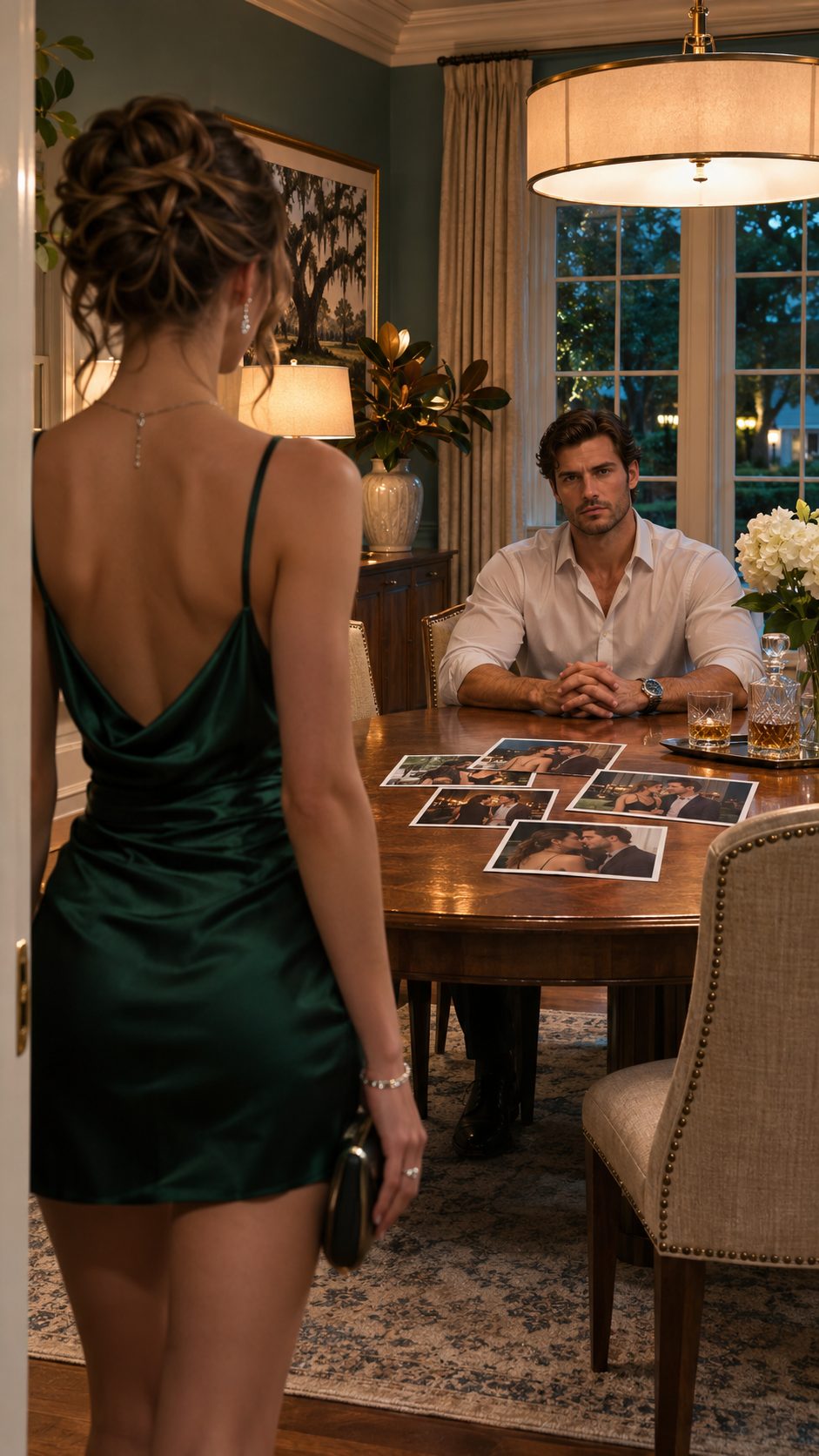
I laid them across the dining table.
Then I sat down.
Marissa came home at seven forty-three.
I heard her keys.
The door opened.
She called from the hallway.
I said nothing.
Her heels clicked toward the dining room.
Then stopped.
“What’s going on?”
I looked at her.
She still wore her wedding ring.
The irony almost made me smile.
Her gaze dropped to the table.
The smile slowly disappeared from her face.
Photographs of her.
Photographs of Kevin.
The restaurant.
The parking garage.
Her eyes snapped back to mine.
“Where did you get those?”
I pushed the photographs toward her.
Marissa went pale.
“Listen to me.”
I finally looked her directly in the eyes.
“Your little joke finally has consequences.”
She stared at me.
For several seconds, the only sound in the room was the hum of the air conditioner.
Then she whispered, “It’s not what you think.”
I almost laughed.
“Which photograph?”
“Which one isn’t what I think?”
She looked down.
“The one where his hand is on your back?”
Her jaw tightened.
“The one where he’s touching your face?”
“The one where you’re kissing him?”
“I said stop.”
I leaned back.
“You wanted me to talk.”
Her eyes filled.
“Now I’m talking.”
She pulled out a chair but did not sit.
“It happened once.”
I stared at her.
“That’s your opening statement?”
“I’m telling you the truth.”
I shook my head.
“You’re telling me the smallest truth you think the photographs force you to tell.”
Her face changed.
The tears stopped.
For one second, I saw calculation.
“How long have you been following me?”
“I haven’t.”
“Then who took these?”
“That matters to you?”
“Yes, it matters.”
“More than what’s in them?”
She turned away.
I understood Caroline’s warning.
Marissa was already searching for a different argument.
“Three months,” I said.
She looked back.
“That’s my guess.”
Her face answered before her mouth did.
I felt something inside me break cleanly.
“How long?”
She lowered her eyes.
“Not three months.”
“How long?”
“About ten weeks.”
I nodded slowly.
Seventy days.
Seventy mornings waking beside me.
Seventy nights deciding whether to lie.
“Was it physical?”
She closed her eyes.
The word landed quietly.
I had imagined that moment a hundred different ways.
In none of them did it feel so ordinary.
She looked sick.
“I’m not answering that.”
“Then I’ll assume everywhere.”
Her voice sharpened.
“It wasn’t like that.”
I looked at her.
“Then tell me what it was like.”
She finally sat.
Her hands shook.
“It started after the regional conference.”
“In Charlotte?”
She nodded.
“You told me you were exhausted and went straight to bed.”
I looked away.
For the first time, the room felt too small.
“Did you love him?”
Marissa hesitated.
That hurt more than if she had simply said yes.
“I don’t know.”
“You don’t know?”
“He made me feel…”
She stopped.
“Finish it.”
I laughed once.
There was no humor in it.
“Of course.”
“That isn’t fair.”
“I felt invisible here.”
I stared at her.
“You felt invisible?”
“You stood in front of fifty people and took off our wedding ring.”
“I was unhappy.”
“You could have told me.”
“All the time.”
“No, Marissa.”
My voice remained calm.
“You complained that I worked too much, that I was predictable, that we never traveled enough, that I didn’t surprise you.”
“Those are complaints.”
I leaned forward.
“They are not permission slips.”
She started crying again.
“I never meant for this to happen.”
“Affairs don’t happen like weather.”
She flinched.
“You made choices.”
I pointed toward the photographs.
“Because you didn’t look guilty at Dana’s party.”
She covered her face.
“I was drunk.”
“You knew I was watching.”
“You took off your ring.”
“You looked straight at me.”
Her shoulders began shaking.
That was the first honest thing she had said all night.
Marissa looked up.
“What are you doing?”
“I packed a bag this afternoon.”
Her face went blank.
“I’m staying with a friend for a few days.”
She stood immediately.
“No, don’t do that.”
“I need space.”
“We can talk.”
“We’ve been talking.”
She grabbed my wrist.
I looked down at her hand.
Her wedding ring pressed against my skin.
Marissa followed my eyes.
Slowly, she let go.
“I’m sorry,” she whispered.
I picked up my bag near the hallway.
Behind me, she said my name.
I stopped without turning.
“I do love you.”
I closed my eyes.
For eight years, those words had meant safety.
Now they sounded like a question.
I opened the front door.
Before stepping outside, I looked back once.
Marissa stood beside the dining table.
The photographs were scattered around her.
Her left hand covered her mouth.
And for the first time since I had known her, she looked like someone who finally understood that consequences were not the same thing as punishment.
They were simply what came next.
**CHAPTER 5:WHAT CAME NEXT**
I spent four nights in my friend Michael’s guest room.
He did not ask many questions.
That was why I chose him.
Some people respond to betrayal like sports commentators.
They want details.
Michael handed me a clean towel and said, “You can stay as long as you need.”
That was enough.
Marissa called eleven times the first night.
I answered the twelfth.
“Where are you?”
“Michael’s.”
“Come home.”
“I don’t want to.”
Then, “Are you leaving me?”
“I don’t know.”
Her breath shook.
“You said you needed space.”
“That sounds like leaving.”
“Maybe it is.”
She began crying.
I listened.
Part of me wanted to comfort her.
That frightened me.
Habit can survive almost anything.
Even betrayal.
“I ended it with Kevin,” she said.
I looked at the ceiling.
“After I found out.”
“That isn’t choosing me.”
“What does that mean?”
“It means you didn’t stop because you remembered you loved me.”
I swallowed.
“You stopped because you got caught.”
“That’s not fair.”
“You keep saying that.”
“I don’t know what you want from me.”
“The truth.”
“I told you.”
“You admitted what I could prove.”
Marissa went quiet.
“How many times?”
“How many times were you with him?”
She began crying harder.
I said nothing.
“Maybe five.”
I laughed bitterly.
“That changed quickly.”
“I’m trying to remember.”
My voice sharpened.
“You’re trying to calculate.”
She inhaled.
There it was.
The slow expansion of truth.
Like opening nested boxes.
“One in Charlotte?”
“Where else?”
“At the Oak & Laurel?”
That was confirmation.
“How did you know?”
“I saw the charge.”
“Oh my God.”
“Was that our money?”
“That’s what you care about?”
I closed my eyes.
“No, Marissa.”
I spoke quietly.
“That’s what I’m realizing.”
“You used our life to finance the life you were hiding from me.”
She did not answer.
The next day, she texted me a paragraph about therapy.
The day after that, she sent the name of a marriage counselor.
I agreed to one appointment.
Not because I had decided to stay.
Because I wanted to know whether there was anything left inside me besides shock.
The counselor’s office smelled like lavender.
Marissa sat on the opposite end of a gray couch.
For the first ten minutes, she cried.
Then she began talking.
She said she had felt restless.
She said our marriage had become routine.
She said Kevin made her feel desirable.
She said she had hated herself after the first time.
Then she had done it again.
The counselor looked at her.
“What stopped you from telling your husband?”
Marissa glanced at me.
“Fear of what?”
“Losing him.”
The counselor asked, “And what did continuing the affair risk?”
Marissa stared at the floor.
“Losing him.”
The counselor let the silence sit.
Something about that moment changed me.
Until then, part of me had imagined Marissa’s affair as evidence that Kevin offered something I lacked.
More excitement.
More charm.
More spontaneity.
But sitting there, listening to her explain the contradiction, I realized the affair was not a referendum on my worth.
It was a decision she had made to escape discomfort without accepting responsibility.
That did not make me feel better.
But it made me feel less small.
After the session, Marissa followed me to the parking lot.
“Can we get coffee?”
“I have to get back.”
She looked at me.
“Are you seeing someone?”
I stared at her.
The question was so absurd that I almost smiled.
“Then why won’t you come home?”
“Because your affair is not the only problem.”
Her face tightened.
“What else is there?”
“The party.”
She blinked.
“You still think that was separate.”
“I was joking.”
I stepped closer.
“That was the first honest thing you did.”
Her face drained.
“You took off your ring because, for a few seconds, you wanted everyone to know how you really saw our marriage.”
“That isn’t true.”
“Then why did Kevin understand the joke?”
She opened her mouth.
Nothing came out.
I walked to my car.
Behind me, she said, “I hate what I did.”
She looked smaller than I remembered.
“I believe you.”
Hope flickered across her face.
Then I finished.
“But I don’t know if hating it is the same as becoming someone who won’t do it again.”
Her hope disappeared.
That night, Caroline emailed me the first draft of a separation agreement.
I stared at the attachment for almost an hour before opening it.
The document was eighteen pages long.
Eight years reduced to sections.
The language was clean.
At the bottom of the final page was a blank line for my signature.
I placed the cursor there.
Then stopped.
For the first time since the photographs, I cried.
Not because I wanted Marissa back.
Because I finally understood that even the right decision could break your heart.
**CHAPTER 6:THE MAN BEHIND THE JOKE**
Kevin called me three days later.
I almost did not answer.
Then curiosity won.
“It’s Kevin.”
Another pause.
“I think we should talk.”
“I want to clear some things up.”
“There’s nothing to clear up.”
“Marissa told me you know.”
“That was generous of her.”
He exhaled.
“I didn’t call to fight.”
“I’m not proud of what happened.”
“Then we have something in common.”
He ignored that.
“She told me you two were basically done.”
There it was.
The oldest sentence in the world.
“She told you that?”
“What exactly did basically done look like?”
Kevin hesitated.
“She said you hadn’t been close in a long time.”
“We had dinner together four nights before Charlotte.”
“I’m telling you what she told me.”
“And I’m telling you that you wanted to believe it.”
His voice hardened.
“You don’t know me.”
I looked out Michael’s window.
“But I know you laughed when she took off her wedding ring.”
“That wasn’t my best moment.”
“I was drinking.”
“Interesting.”
“That both of you keep blaming alcohol for things you enjoyed doing sober.”
Kevin did not answer.
I almost hung up.
Then he said, “She told me she was going to leave you.”
That landed differently.
“After the conference.”
My grip tightened on the phone.
“She said that?”
“Did you believe her?”
“At first.”
“And later?”
He hesitated.
“She kept changing the timeline.”
Of course she had.
“How long were you willing to wait?”
“That’s not your business.”
I smiled without humor.
“You called me.”
“Look, I’m ending it.”
“It’s already ended.”
“She keeps contacting me.”
I went still.
Kevin seemed to realize he had said too much.
“I thought she told you.”
“Yesterday.”
My chest tightened.
Marissa had told me she ended things with him the night I confronted her.
“What did she say?”
“I’m not getting in the middle of this.”
“You’re standing in the middle of it.”
Then Kevin said, “She said she needed closure.”
I closed my eyes.
“Did you meet her?”
I could not tell whether I believed him.
“I told her not to contact me again.”
He laughed once.
“Because this stopped being exciting.”
The sentence disgusted me.
Not because it was cruel.
Because it was honest.
For Kevin, my marriage had been excitement.
For Marissa, he had been escape.
For me, the consequences were permanent.
“Don’t call me again,” I said.
I ended the call.
That evening, I met Marissa at the house.
She had asked me to collect more clothes while she was out.
Instead, she was sitting on the front steps when I arrived.
“I thought you were going to your mother’s.”
“I wanted to see you.”
I stayed near the driveway.
“Kevin called me.”
Her face changed.
“What did he say?”
“That you contacted him yesterday.”
Marissa stood.
“It wasn’t what it sounds like.”
“Do you hear yourself?”
“I needed to tell him it was over.”
“You told me you already did.”
“Then why do it again?”
“Because he kept texting me.”
“He says you contacted him.”
“He’s lying.”
There it was.
Another fork in the truth.
Another version.
I felt suddenly exhausted.
“Does it matter?”
She stared at me.
“Which one of you is lying now?”
Her expression broke.
“Of course it matters.”
I shook my head.
“It mattered when I still believed I could identify one lie and remove it like a splinter.”
I looked at the house behind her.
“Now I don’t trust the whole surface.”
She stepped toward me.
“I’ll give you my phone.”
“I don’t want your phone.”
“My passwords.”
“I don’t want your passwords.”
“You can track me.”
“I don’t want to track my wife.”
“Then tell me what to do.”
Her voice cracked.
“Tell me how to fix this.”
I looked at her for a long time.
“You keep asking me for instructions.”
“Because I’m trying.”
I shook my head.
“You’re trying to get back to normal.”
“Aren’t you?”
That surprised her.
“I don’t want normal back.”
“Because normal was where you learned you could lie to me.”
The words sat between us.
Marissa covered her mouth.
I continued.
“If there is any version of us after this, it cannot be the marriage we had.”
She nodded quickly.
“You say that because you think it means there’s still a chance.”
“Isn’t there?”
I wanted to say no.
I wanted a clean answer.
Instead, I told the truth.
“I don’t know.”
She began crying.
“I’ll do anything.”
I looked at her.
“Then start by doing one thing that has nothing to do with convincing me.”
“Figure out why you needed someone else to make you feel alive.”
She stared at me.
“Without blaming me.”
That was harder for her.
I could see it.
For years, unhappiness had always had an external address.
Maybe Kevin.
Now I was asking her to look inward.
I walked past her toward the front door.
Before I entered, Marissa said, “Do you still love me?”
That question had haunted me.
Her face crumpled with relief.
Then I said the part I had only recently understood.
“But love is no longer the question.”
**CHAPTER 7:THE COST OF STAYING**
For six weeks, Marissa and I lived separately.
She stayed in the house.
I rented a small furnished apartment near North Hills.
It had white walls, cheap artwork, and a balcony overlooking a parking lot.
I hated it the first night.
By the third week, I appreciated how quiet it was.
There were no hidden meanings in the kitchen.
No phones turned face down.
No questions about why someone was late.
For the first time in years, I began noticing how much emotional energy I had spent managing Marissa’s moods.
If she was bored, I planned something.
If she was unhappy, I tried harder.
If she felt unappreciated, I rearranged my schedule.
Somewhere along the way, love had become maintenance.
Marissa attended individual therapy.
We continued marriage counseling once a week.
The sessions changed.
At first, she focused on the affair.
Then the therapist began asking about what came before it.
Marissa talked about growing up in a house where her father left twice and returned twice.
She talked about her mother rewarding charm and ignoring conflict.
She talked about learning that attention meant safety.
None of it excused her choices.
But explanation was different from excuse.
That distinction mattered.
One Tuesday evening, she said something in counseling that finally sounded honest.
“I think I wanted both lives.”
I looked at her.
She continued.
“I wanted the husband who made me feel safe and the man who made me feel wanted.”
The counselor asked, “And what did that require?”
Marissa swallowed.
“For me to lie to both of them.”
That was the first moment I believed she was beginning to understand.
Not because she cried.
Because she stopped making herself the victim of her own decisions.
After the session, we walked to our cars together.
She looked at me.
“Would you ever come home?”
“I don’t know.”
“Do you think about it?”
Hope entered her eyes.
I hated that hope.
Not because I wanted to hurt her.
Because I still did not know what my answer meant.
“I also think about divorce,” I said.
She nodded.
For once, she did not argue.
That night, I sat on my apartment balcony with a cup of coffee and imagined both futures.
In one, we stayed married.
There would be therapy.
Transparency.
Years of rebuilding.
Every business trip would carry a shadow.
Every late meeting would ask a question.
Every unexpected notification might tighten my chest.
Could trust return?
But returning was not the same as becoming what it had been.
In the other future, we divorced.
I imagined selling the house.
Splitting furniture.
Explaining things to family.
Watching Marissa eventually build a life that no longer included me.
That future hurt differently.
Freedom and grief were not opposites.
They could occupy the same room.
A week later, Marissa asked me to meet her at the house.
When I arrived, she placed her wedding ring on the dining table.
The same table where I had placed the photographs.
I stared at it.
“What is this?”
“I think I’ve been wearing it for the wrong reason.”
I looked at her.
She continued.
“I kept it on because I was terrified that taking it off would mean you were gone.”
Her eyes filled.
“But I already took it off once for attention.”
She looked down at the ring.
“I don’t want to use it as a symbol when I haven’t earned what it represents.”
For several seconds, I said nothing.
Six weeks earlier, seeing her remove that ring had humiliated me.
Now, strangely, watching her place it down felt respectful.
“Keep it,” I said.
She looked up.
“I don’t want it.”
“It’s yours.”
I shook my head.
“It belonged to a promise we both understood differently.”
Her face tightened.
“Are you saying it’s over?”
I looked at the ring.
Then at her.
“I’m saying I don’t want to decide because I’m afraid to lose eight years.”
She nodded slowly.
“What do you want?”
The answer came more easily than I expected.
“I want peace.”
Her eyes closed.
I stepped closer.
“And I don’t know if I can have that with you anymore.”
She began crying silently.
I expected to feel guilty.
Instead, I felt calm.
That terrified me more.
Marissa wiped her face.
“Is there someone else?”
“Would it be easier if there were?”
She gave a broken laugh.
“I deserve that.”
I shook my head.
“This is what I mean.”
“You keep turning consequences into punishment.”
I pointed toward the ring.
“This isn’t about what you deserve.”
My voice softened.
“It’s about what I can live with.”
She looked at me for a long time.
Then she nodded.
No argument.
No defense.
No request for another chance.
That was the moment I knew she had changed.
It was also the moment I understood that her changing did not obligate me to stay.
Two days later, I called Caroline.
“I’m ready,” I said.
She knew what I meant.
**CHAPTER 8:THE LAST SIGNATURE**
The divorce took four months.
There were no dramatic courtroom battles.
No hidden accounts.
No revenge.
We sold the house.
Marissa kept her car.
I kept mine.
We divided savings.
She took the dining table.
I almost laughed when she asked.
“That table?”
She looked embarrassed.
She ran her hand over the wood.
“Because I think I need to remember what happened there.”
I understood.
The morning we signed the final papers, Raleigh was cold and gray.
Caroline’s office looked exactly as it had the first time I entered it.
Same window.
Same chairs.
Same quiet efficiency.
Marissa arrived wearing a navy coat.
No wedding ring.
We sat across from each other at a conference table.
Eight years of marriage ended through initials and signatures.
Caroline left us alone for a few minutes after everything was complete.
Marissa stared at the folder.
“So that’s it.”
She smiled sadly.
“You always were precise.”
“I’m trying not to be.”
We sat in silence.
Then she said, “I’m sorry.”
I looked at her.
She had apologized dozens of times.
But this one sounded different.
No expectation.
“I know,” I said.
“I used to hate when you said that.”
“Said what?”
She smiled faintly.
“It sounded like you were refusing to forgive me.”
“Maybe I was.”
I looked toward the window.
“Forgive you?”
She nodded.
I thought about the party.
The ring between her fingers.
Kevin laughing.
The photographs.
The hotel charge.
The months afterward.
Then I thought about the woman sitting across from me.
She looked older.
Not in years.
In awareness.
“Yes,” I said.
Her eyes filled.
“But that doesn’t mean I want the marriage back.”
This time, the words belonged to her.
We walked out of the building together.
At the sidewalk, she stopped.
“Can I ask you something?”
“If I hadn’t taken off the ring that night, do you think you would have found out?”
I considered it.
“Eventually.”
“What if you hadn’t?”
I looked at her.
“Then we might still be married.”
Her face changed.
“That’s worse.”
She stared down the street.
“I thought the party was the moment I destroyed everything.”
I put my hands in my coat pockets.
“It was the moment you stopped being able to hide what was already broken.”
She nodded.
A car passed.
The wind moved through the trees.
“Are you happy?” she asked.
“Not every day.”
She smiled.
“That sounds like you.”
“But I’m peaceful.”
Her smile faded into something softer.
“That’s good.”
“What about you?”
“I’m learning how to be alone.”
“That’s probably good too.”
She laughed quietly.
“Probably.”
We hugged once.
It was not romantic.
It was not a reconciliation.
It felt like saying goodbye to a house you once loved after all the furniture had been removed.
When we stepped apart, Marissa wiped her eyes.
“I hope someone makes you happy.”
I shook my head.
“I hope I do.”
She looked at me.
Then smiled.
She nodded.
“I hope that too.”
We walked in opposite directions.
Six months later, I moved into a smaller house on the north side of Raleigh.
Nothing impressive.
Two bedrooms.
A narrow backyard.
A porch just large enough for two chairs.
The first evening I stayed there, I carried a box into the living room and found an old photograph buried between books.
It was from our wedding.
Marissa was laughing.
I was looking at her.
For a moment, the grief returned so sharply that I had to sit down.
I did not tear up the photograph.
I did not throw it away.
I placed it inside the box.
That life had been real.
Its ending did not erase its beginning.
For a long time, I believed healing meant reaching the point where the past no longer hurt.
I was wrong.
Healing meant the past could hurt without controlling what I did next.
My life became quieter.
I started running again.
I cooked badly.
I learned to enjoy eating alone without turning on the television.
I traveled to Asheville with Michael and spent an entire weekend without checking whether anyone needed me.
Months passed.
One Saturday afternoon, I ran into Dana at a coffee shop.
She looked nervous.
“I always wondered whether you hated me for sending those pictures.”
“I almost didn’t.”
“Sometimes I wish I hadn’t.”
She looked surprised.
“You gave me information.”
I stirred my coffee.
“What I did with it was my choice.”
Dana smiled.
“You sound different.”
I thought about it.
“More honest.”
That evening, I returned home just after sunset.
The porch was dark.
For years, I had associated an unlit porch with the night my marriage began to end.
I stood there for a moment, keys in hand.
Then I reached for the switch.
Warm light spilled across the steps.
Not because I was waiting for anyone.
Not because someone might come home late.
Not because a husband was supposed to leave the light on for his wife.
I turned it on because it was my porch.
I sat outside with a glass of iced tea while the sky above Raleigh faded from orange to blue.
Somewhere down the street, someone laughed.
A dog barked.
A screen door closed.
Ordinary sounds.
Ordinary life.
And for the first time in a long time, ordinary did not feel like a burden.
It felt like freedom.
I thought about Marissa lifting her wedding ring beneath those string lights.
“The weight is gone.”
At the time, I had thought she was talking about me.
Months later, I finally understood.
The real weight had never been the ring.
It had been the lies.
The pretending.
The fear of losing something that had already stopped being what I believed it was.
I looked toward the warm porch light glowing beside me.
Then I smiled.
Not because I had won.
There had never been anything to win.
I smiled because I no longer needed someone else to lose for me to move forward.
And that was the consequence Marissa never expected.
Her joke had ended our marriage.
But the truth had given me my life back.
**THE END**
✓ Lynn R. Adams
*One joke at a summer party exposed what eight years of silence had been hiding.* **CHAPTER 1:THE WEIGHT IS GONE** My wife slipped off her wedding ring in front of everyone, held it up like a trophy…